
Oxford Audio Tour: Behind the Gown
Oxford's spires belong to the colleges. The streets between them belong to a different city — the boatmen who built college barges at Folly Bridge, the bleating-voiced sweetshop keeper Alice Liddell loved, the Town Hall librarians who issued tickets for seventy-six years, the medieval brewers and vintners killed in the bell-tower brawl of 1355, the 17th-century ostler whose house is now the Bear, the two prison guards who held Oliver Butler's arms in 1952, the brewer dynasty whose 132 tied pubs watered the town from 1743, the bargees who hauled hay and slate to Hythe Bridge for six centuries, the bicycle apprentice William Morris who bought and buried Oxford's coal wharf for the price of a Cotswold college, the Bocardo turnkeys of St Michael's North Gate, the David Johns and the Mitzi Fellers who supplied 350 Christ Church mouths a sitting, the marmalade widow Sarah Jane Cooper, Mrs Ducker who ran an Oxford shoemaker's for a fortnight after her husband died, and the same Morris who built his first car in a stable on Longwall. This is the town that fed, clothed, printed, shod, brewed and ferried the gown — and whose names rarely made it onto the plaques.
Tour preview
About this tour
- scheduleDuration 40–60 minsGo at your own pace
- straighten3.7 km walking routeFollow the guided path
- location_onLocationOxford, United Kingdom
- wifi_offWorks offlineDownload once, use anywhere
- all_inclusiveLifetime accessReplay anytime, forever
- location_onStarts at Salter's Steamers, Folly Bridge, Oxford
Stops on this tour
On your right, Oxford Town Hall is a broad pale-stone frontage with stepped gables, tall mullioned windows, and the city’s coat of arms set above the main entrance. This plot…Read moreShow less
Open dedicated page →On your right, Oxford Town Hall is a broad pale-stone frontage with stepped gables, tall mullioned windows, and the city’s coat of arms set above the main entrance.
This plot has held Oxford’s civic headquarters three times over, which is a very municipal way of saying the city kept rebuilding its own desk. First came the medieval guildhall in about twelve ninety-two. Then Isaac Ware designed an Italianate replacement in seventeen fifty-two, opened in seventeen fifty-three with a Venison Feast - because apparently civic administration went down better with deer. When costs ran over, the younger Thomas Rowney covered roughly one thousand pounds, something like two hundred thousand pounds in today’s money. Then, after that hall grew hopelessly cramped, Henry Hare gave Oxford the building in front of you, a swaggering Jacobethan design that the Prince of Wales opened on the twelfth of May, eighteen ninety-seven.
If you glance at the image on your screen, you can see Hare’s façade in full: busy, proud, and determined to look like a city taking itself seriously.
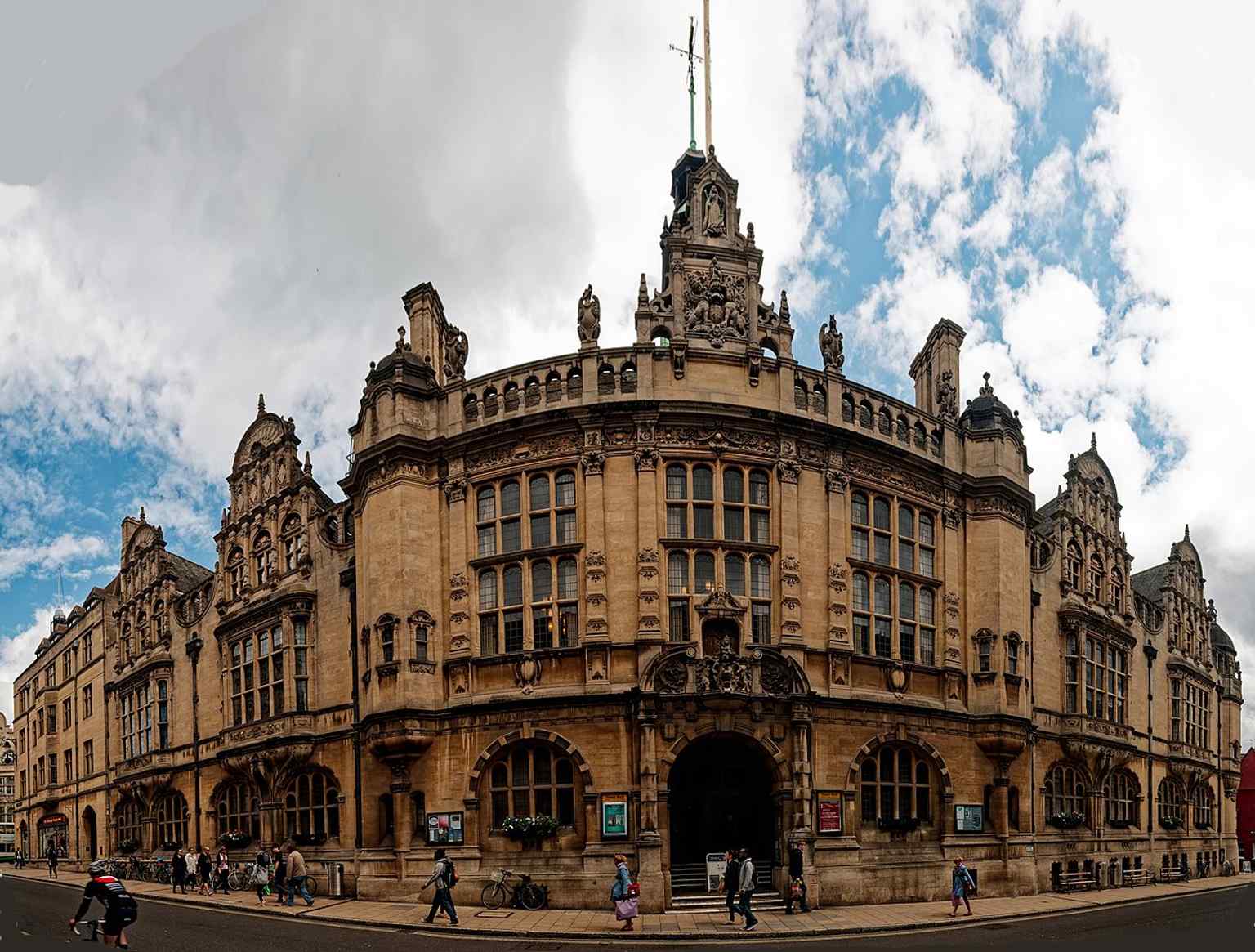
The present Oxford Town Hall on St Aldate’s, rebuilt by Henry Hare in 1897 on the same historic civic site.Photo: Txllxt TxllxT, Wikimedia Commons, CC BY-SA 4.0. Cropped & resized. What matters here, though, is not just the architecture. It is the workforce this place gathered under one roof. Hare packed in the council, public rooms, courts, library, and police. Down in the basement sat a working police station, and the design included a stairway leading straight from the cells up into the courtroom dock - that small enclosed space where defendants stood during trial. Efficient, certainly. Cheerful, less so. Under the great hall, police officers even had their own parade hall for drills and muster.
And in the south-west corner, something rather different: Oxford’s first central public library. The lending library opened in December of eighteen ninety-five, before the grand opening ceremony, and generations of readers used it until the library moved in nineteen seventy-three. Long before the Museum of Oxford took over those rooms, librarians here issued tickets, fetched volumes, answered questions, and quietly kept the city’s mind in working order.
If you look at the interior image, the main hall gives you the grand public face of the place. But grand rooms always rely on people whose names rarely make the stonework. Clerks kept minutes. Porters carried messages. Charwomen - women hired to scrub, clean, and keep order - tackled the unglamorous part. The university may have supplied the gowns and the reputation, but the host city paid an army of practical people to make daily life function.
That still shows in the ceremonial side of the building. On Sundays and holidays, councillors and freemen gathered here to accompany the mayor to the City Church. Mace-bearers carried the city’s ceremonial staff, sword-bearers carried the civic sword, and robe-keepers managed the layers of official finery without letting Oxford descend into comic opera. Those are the people I like to remember here: the mace-bearers and the librarians, the porters and cleaners, the invisible municipal staff who kept the ritual, and the paperwork, running.
From here, The Bear is about a two-minute walk away. If you plan to come back inside later, the Town Hall generally opens from nine to seven on weekdays, ten to five on Saturday, and closes on Sunday.
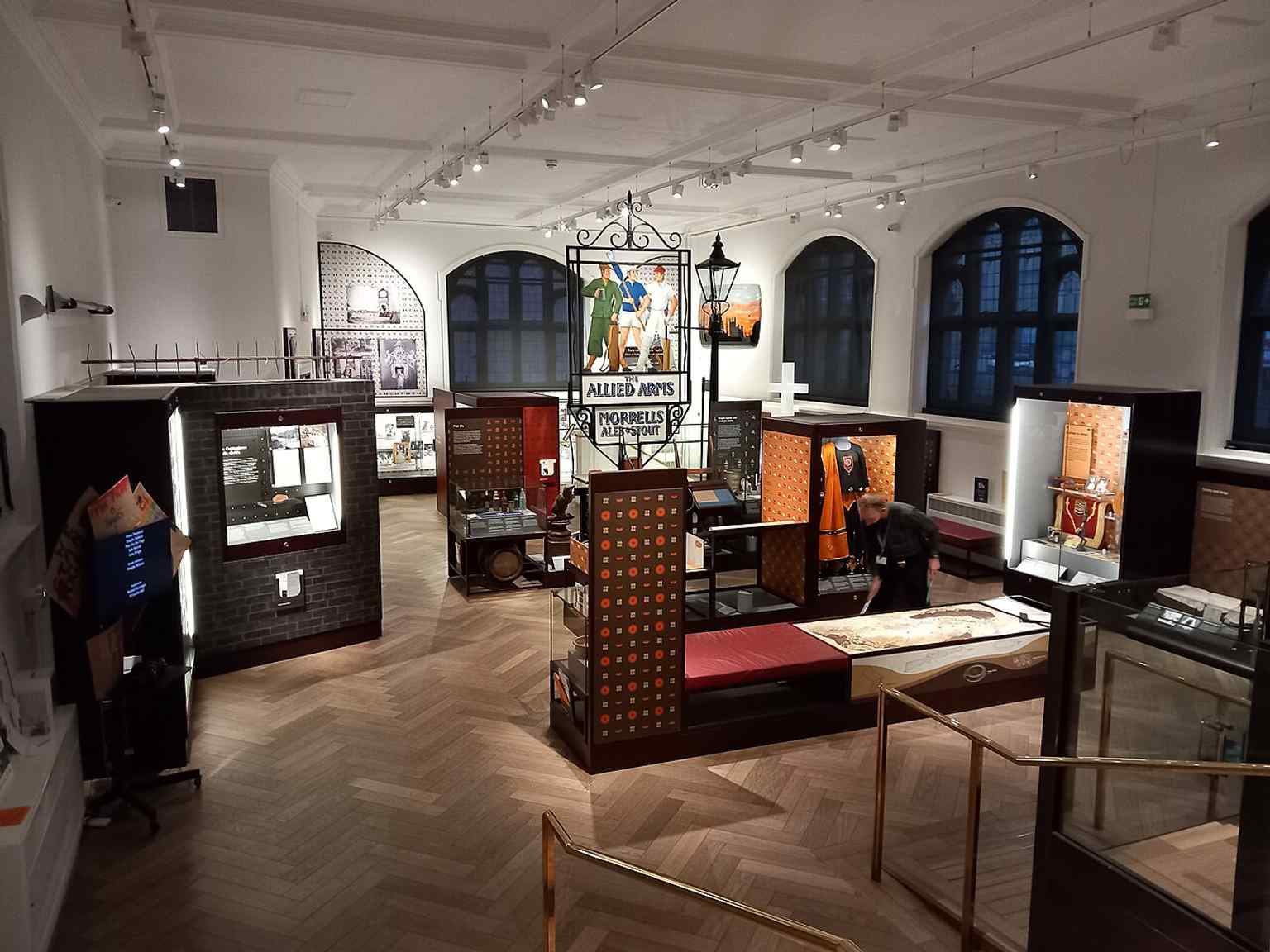
The Museum of Oxford’s main gallery, created within the Town Hall after the public library moved out in the 1970s.Photo: The History Wizard of Cambridge, Wikimedia Commons, CC0. Cropped & resized.
Show 12 more stopsShow fewer stopsexpand_moreexpand_less
This is a compact corner pub with pale stucco walls, a simple pitched roof, and a projecting hanging sign marking the old timber-framed building at Alfred Street and Blue Boar…Read moreShow less
Open dedicated page →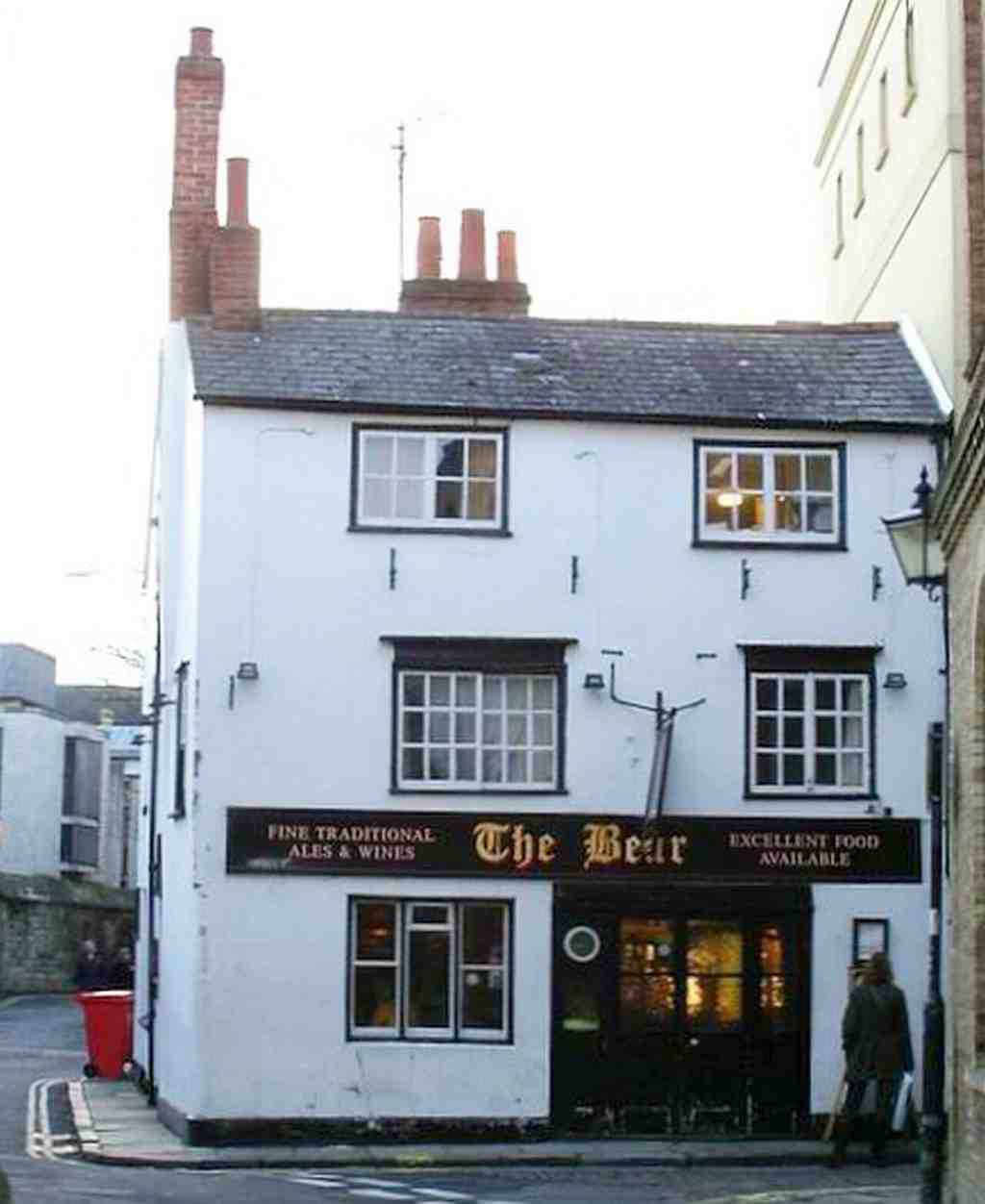
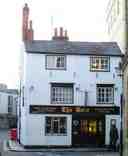
The Bear, OxfordPhoto: user:M stone, Wikimedia Commons, CC BY 3.0. Cropped & resized. This is a compact corner pub with pale stucco walls, a simple pitched roof, and a projecting hanging sign marking the old timber-framed building at Alfred Street and Blue Boar Street.
First, the honest bit: this is not the medieval Bear Inn. The original Bear stood on the High Street, and when that older inn was rebuilt as private housing in eighteen oh one, the name moved here... to a pub already trading as the Jolly Trooper since seventeen seventy-four. Oxford, like many old cities, is perfectly capable of giving a building a borrowed ancestry and then acting as if nothing odd happened.
What you’re looking at began life in the early seventeenth century as the home of the ostler for the coaching inn. An ostler was the man who met your horse at the gate, watered it, rubbed it down, and found it a stall for the night. Not glamorous, not famous, absolutely essential. If the inn ran smoothly, some tired traveler praised the landlord... while the ostler did the muddy work out back. That feels very Oxford, really: the polished front, and the labor that made it possible tucked just out of sight.
If you check the exterior photo in the app, you can see how modest the place still looks from the street. It was never the grand frontage on the High. It was the working end of the operation. And behind that stucco skin, the old timber frame still survives. You can’t see it from out here, but inside, some original timber framing remains visible near the top of the staircase. That hidden structure helped earn the building formal protection when it received Grade II listed status in January of nineteen fifty-four.
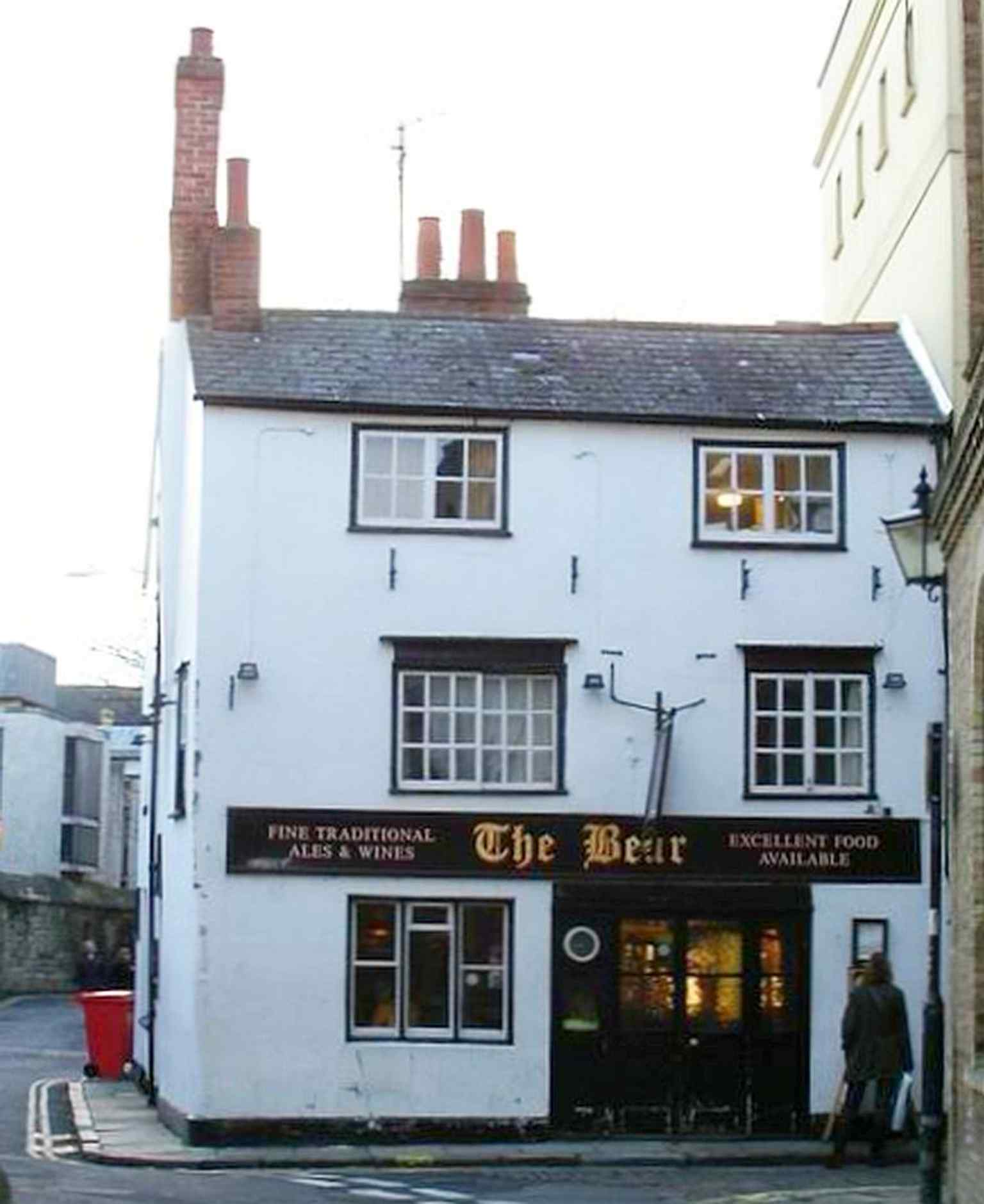
The Bear on Alfred Street, the 18th-century pub that inherited the older Bear Inn name in 1801.Photo: Original uploader was user:M stone at en.wikipedia, Wikimedia Commons, CC BY 3.0. Cropped & resized. There’s another layer to the ground under this pub. This corner stood on the site of Saint Edward’s churchyard, and evidence from the cellar has confirmed that rather directly. Human bones turned up there in recent years. So yes... even the basement has a longer memory than the sign outside.
But The Bear’s most famous story belongs to a named publican, Alan Course. In nineteen fifty-two, he started collecting the cut-off ends of club ties. The deal was wonderfully specific: surrender the end of your tie, and you got half a pint of beer in return. Over time, that became more than a gimmick. It became nightly work. Staff with scissors in apron pockets, a pencil for labeling, and one more snippet pinned up before the next round. Not one grand gesture, just repetition... shift after shift, year after year.
If you look at the interior image on your screen, you’ll see the result: thousands of tie ends crowding the walls and even the low ceiling. More than four thousand five hundred of them now, from schools, colleges, clubs, sports teams. Colin Dexter even used the collection in an Inspector Morse novel, where a tie becomes a clue. Naturally, in Oxford, even the pub decor can end up doing detective work.
So this corner tells a very working story: the ostler with the horses, the landlord with the scissors, the bar staff who kept the ritual alive across decades. Not the people who usually get statues.
When you’re ready, head on to eighty-four High Street, about a two-minute walk away. If you fancy returning later, The Bear opens from noon every day, closes between around ten-thirty and eleven, and prices are moderate.
On your left, look for a long pale-stone frontage with a row of tall arched openings and a plain roofline behind it: that repeated arcade is the Covered Market. Oxford built…Read moreShow less
Open dedicated page →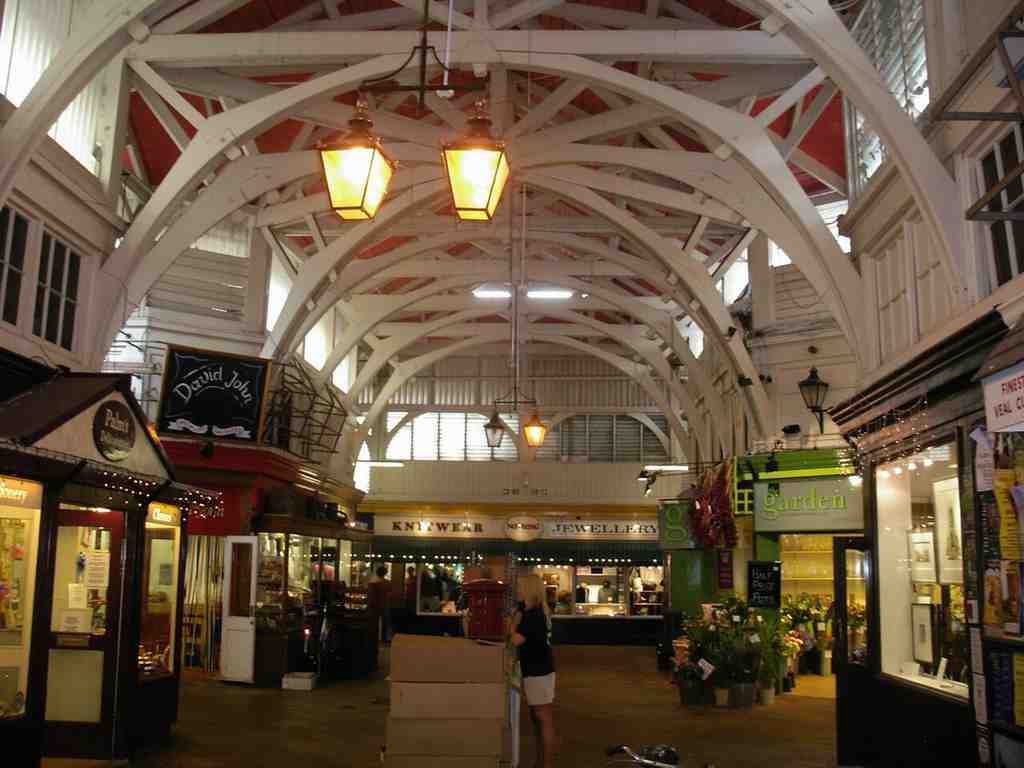
Covered Market, OxfordPhoto: User:M stone, Wikimedia Commons, CC BY-SA 3.0. Cropped & resized. On your left, look for a long pale-stone frontage with a row of tall arched openings and a plain roofline behind it: that repeated arcade is the Covered Market.
Oxford built this place to clear “untidy, messy and unsavoury” meat stalls off the High Street. In seventeen seventy-two, a new market committee - half town, half university, because Oxford likes shared control almost as much as it likes an argument - accepted an estimate of nine hundred and sixteen pounds and ten shillings for twenty butchers’ shops, roughly one hundred and fifty thousand pounds in today’s money. John Gwynn, the architect who also designed Magdalen Bridge, drew up the plans, including this High Street front with its four entrances, and the market officially opened on the first of November, seventeen seventy-four. After seventeen seventy-three, meat could be sold only inside the market.
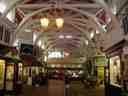
From that practical beginning grew one of Oxford’s great working interiors. If you glance at the image on your screen, you can see the covered arcade inside, where permanent stalls spread out from those first butcher shops into produce, dairy, fish, and much later bakeries and gift shops. The building was enlarged in the eighteen thirties and eighteen forties, then added to again in the late nineteenth century, and it now carries Grade II listed status, meaning it is legally protected for its historic character.
But the real story lives in the families. David John, often described as the market’s last butcher, got his first job at twelve in Aldens. By twenty he was working for Michael Feller here; by twenty-two, the two had bought a shop together. He said, “Christ Church was our main customer... When you’re supplying three hundred and fifty students, you’d got to know you have that amount of meat available and ready.” That is Oxford in one sentence: the town feeding the gown, one college sitting at a time. His own family carried a long chain of labor too - a Norwegian great-great-grandfather who docked in Cardiff, met a local girl, and stayed; a father on the footplates, shoveling coal for steam engines. David said a lifetime on cold flagstones had done for his knees.
The Fellers carried the other half of that trade. M Feller and Daughter butchered here from nineteen seventy-nine to twenty twenty-three, and when the shop closed, Mitzi Feller wrote, “After over forty years, Feller’s family-run business has come to a sad decision to close our shop.” If you want the older roots, look at the butcher’s counter in the app image and picture the generations behind it.
Then there is Catherine Brown, who opened her café here in nineteen twenty with the motto, “Plain food, well cooked and plenty of it,” and the even better line, “I have no customers, only friends.” That may be the market at its best: labor without fuss, women running businesses, and family names lasting longer than fashions. Today more than fifty independent traders work under this roof, and Bonner’s greengrocer has traded here continuously since nineteen fifty-two.
So hold those three final images for a moment... David John on aching knees, Mitzi Feller signing a closing letter, Catherine Brown insisting her customers were friends. When you’re ready, head on to Carfax Tower, about a two-minute walk away; and if you want to come back inside later, the market generally opens from eight to five-thirty Monday to Wednesday, until ten Thursday to Saturday, and from ten to five on Sunday.
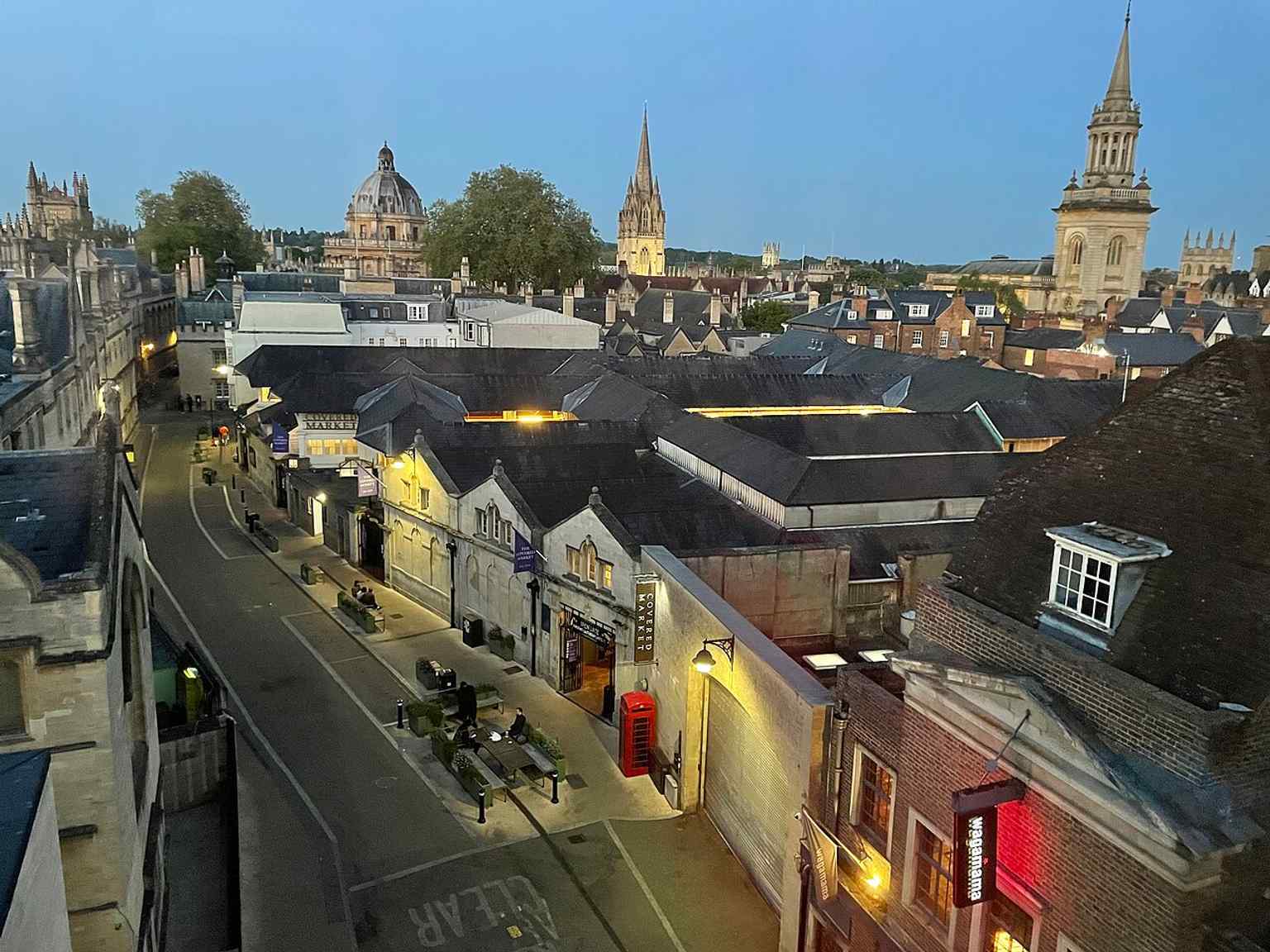
An elevated view along Market Street, one of the main approaches to the Covered Market, helping place the building in the city centre.Photo: Addedentry, Wikimedia Commons, CC0. Cropped & resized. 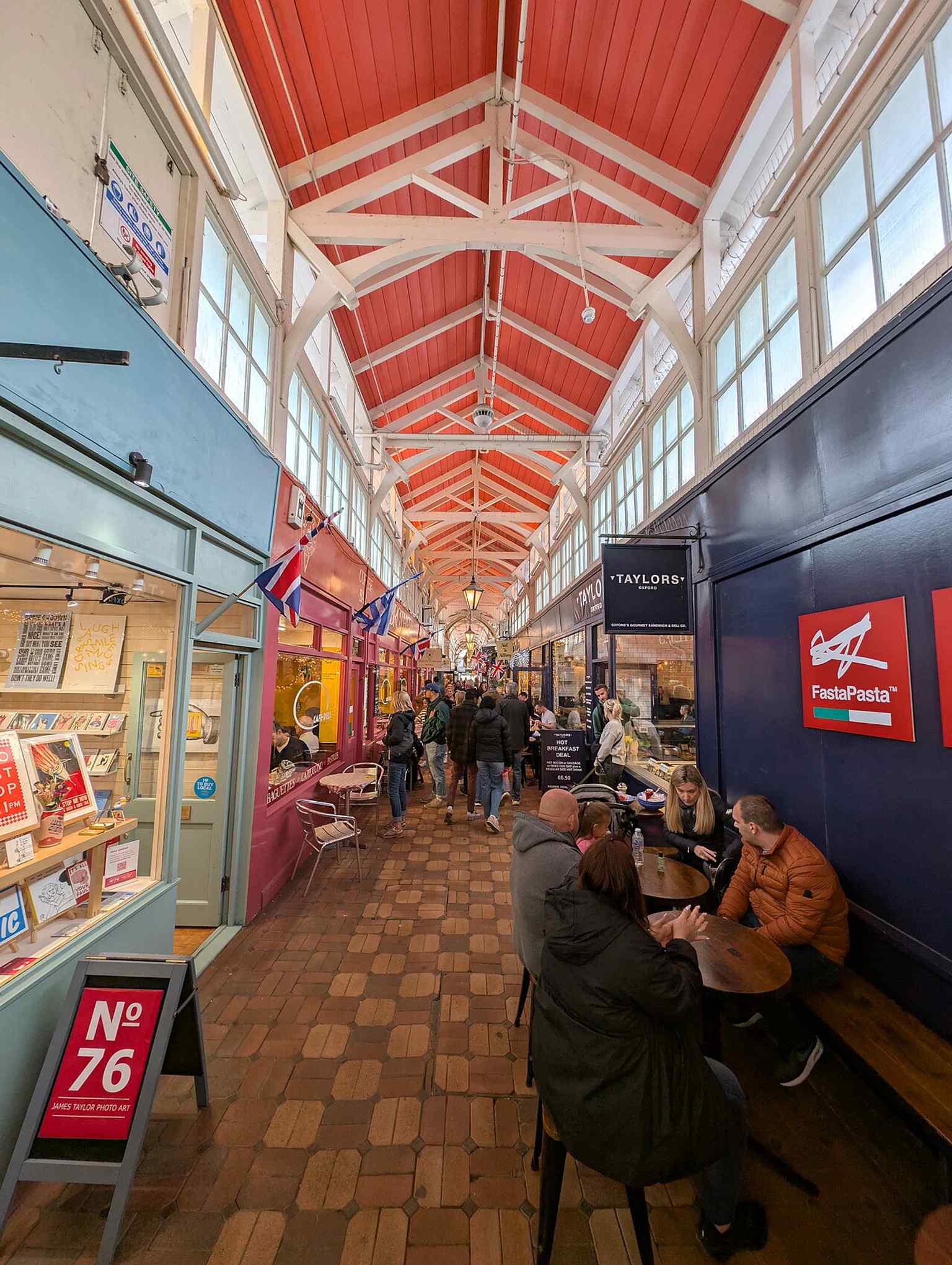
A clear modern exterior view of the Covered Market, showing the preserved building that has been in continuous use since 1774.Photo: Andy Li, Wikimedia Commons, CC0. Cropped & resized. 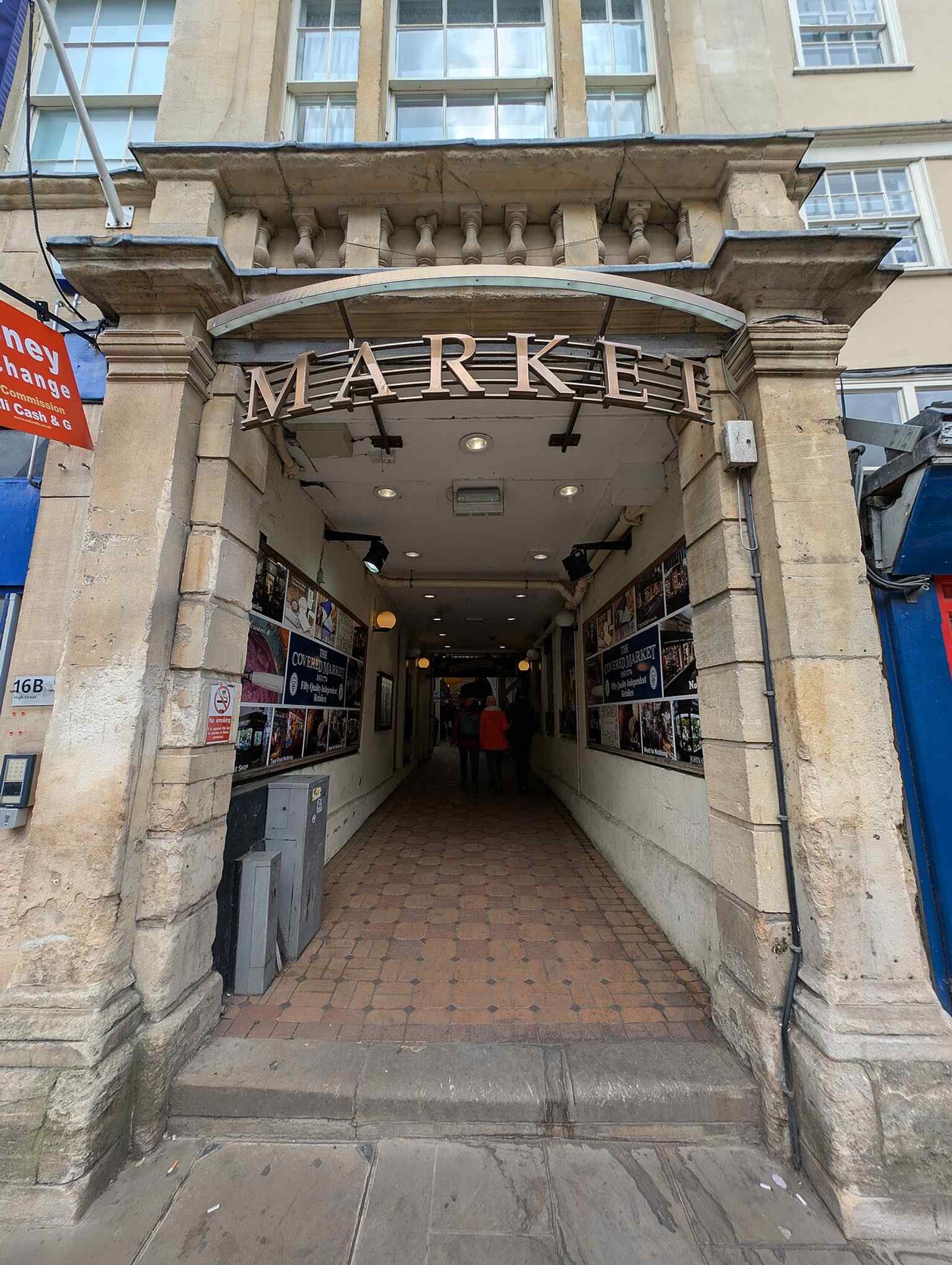
One of the entrances to the market, matching the building’s many access points from High Street, Market Street and Cornmarket.Photo: Andy Li, Wikimedia Commons, CC0. Cropped & resized. 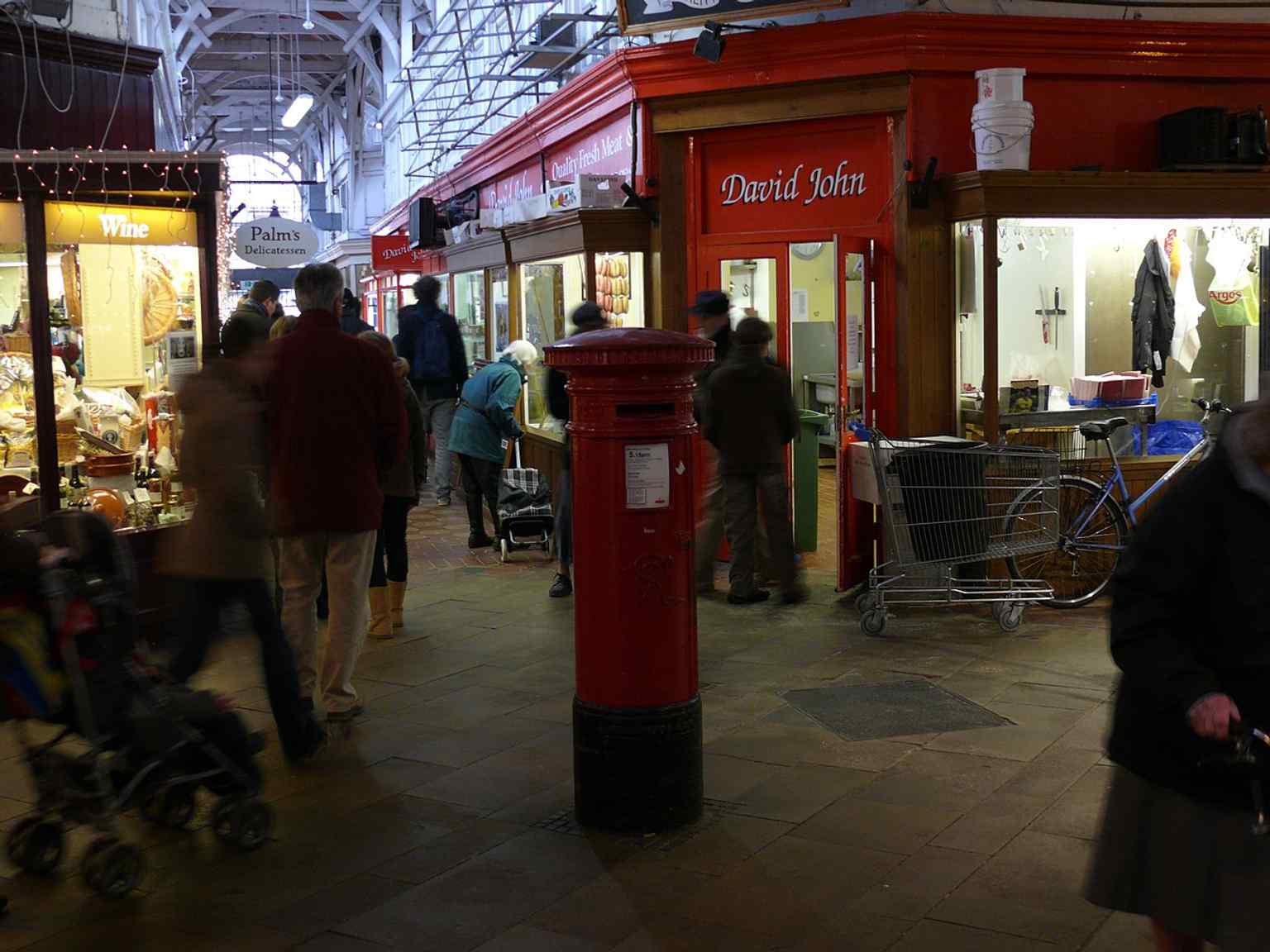
A record-style view of the listed building, underlining the market’s protected status as a Grade II listed historic site.Photo: Andrew Gray, Wikimedia Commons, CC BY-SA 3.0. Cropped & resized. 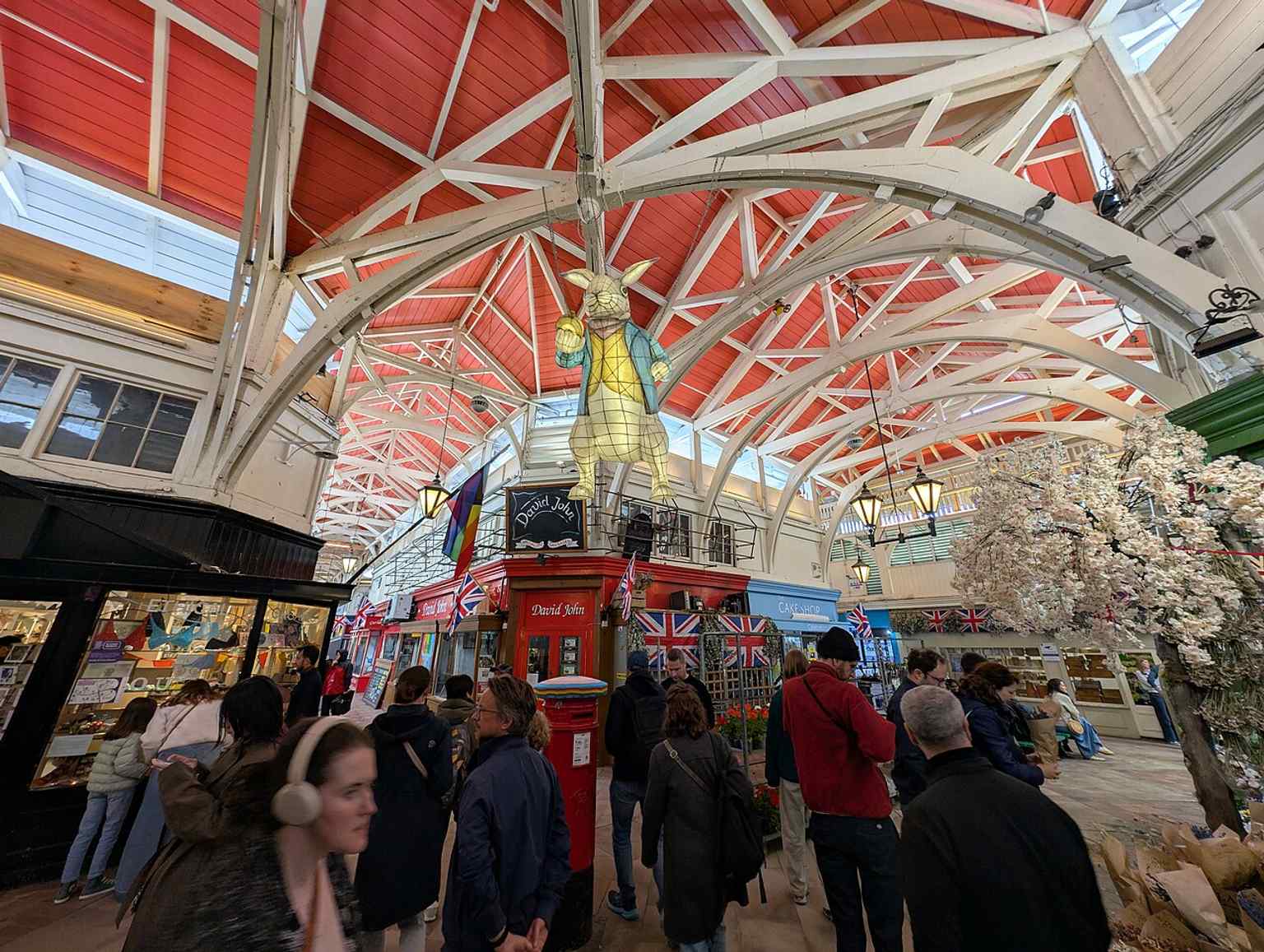
The White Rabbit lantern adds a playful Oxford touch inside the market, showing the character of today’s independent shops.Photo: Andy Li, Wikimedia Commons, CC0. Cropped & resized. On your right, pale Cotswold stone rises in steep gabled blocks, crowned by a tall square library tower. The final section of the Oxford Canal into central Oxford opened on the…Read moreShow less
Open dedicated page →On your right, pale Cotswold stone rises in steep gabled blocks, crowned by a tall square library tower. The final section of the Oxford Canal into central Oxford opened on the first of January, seventeen ninety, then ran under Worcester Street to a coal wharf beside New Road. For a century and a half, bargees and coal-heavers worked here while dons walked past. Then William Morris returned in another form: the Longwall bicycle apprentice, starting work at fifteen, later Baron Nuffield in nineteen thirty-four and Viscount in nineteen thirty-eight. In nineteen thirty-seven he bought this basin for one hundred and thirty-three thousand, three hundred and seventy-three pounds, filled it in by nineteen fifty-one, and built his college on part of the old wharf. On your screen, the tower marks the first new Oxford tower in two hundred years. Austen Harrison first drew it Mediterranean; Nuffield called that "un-English," so Harrison redrew it in Cotswold style and builders worked from nineteen forty-nine to nineteen sixty. An apprentice's success bought him a wharf, then buried it. Oxford Castle is two minutes away; the college usually opens weekdays and shuts on weekends.
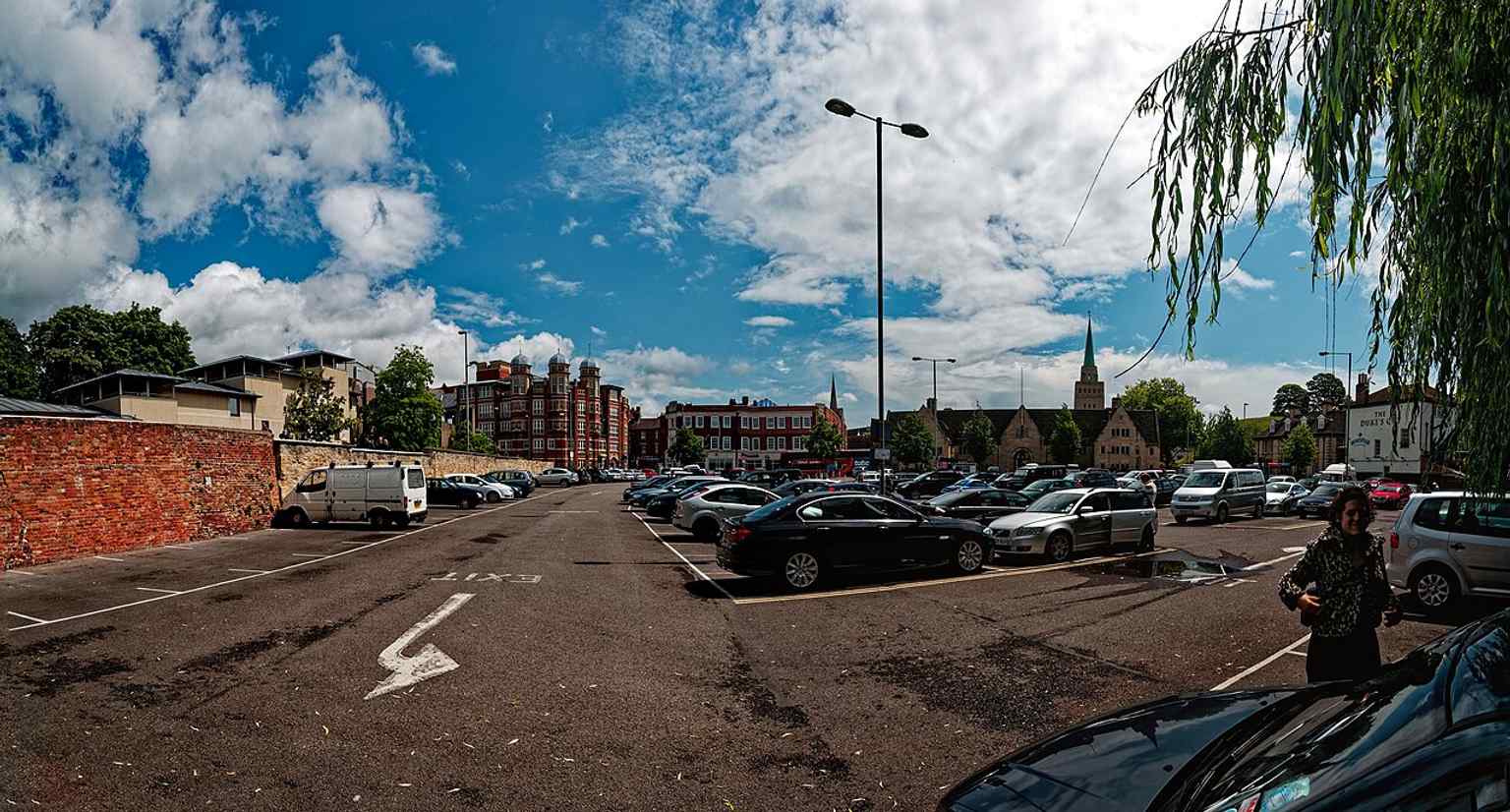
A close exterior view of the tower from Hythe Bridge Street, useful for showing the building’s mid-century form and height.Photo: Txllxt TxllxT, Wikimedia Commons, CC BY-SA 4.0. Cropped & resized. 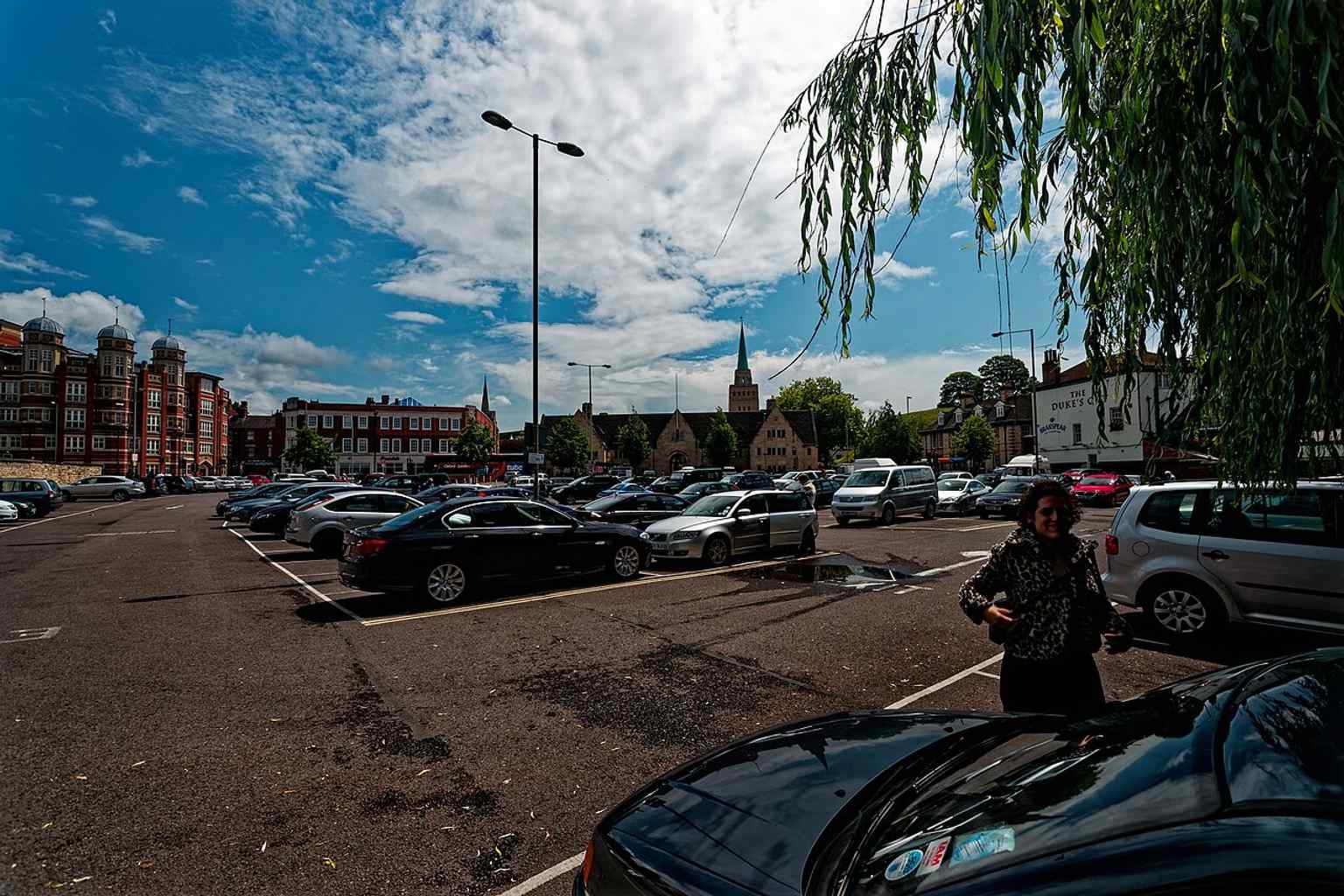
Another strong street-level view of the library tower, highlighting the college’s bold vertical presence beside the old canal route.Photo: Txllxt TxllxT, Wikimedia Commons, CC BY-SA 4.0. Cropped & resized. 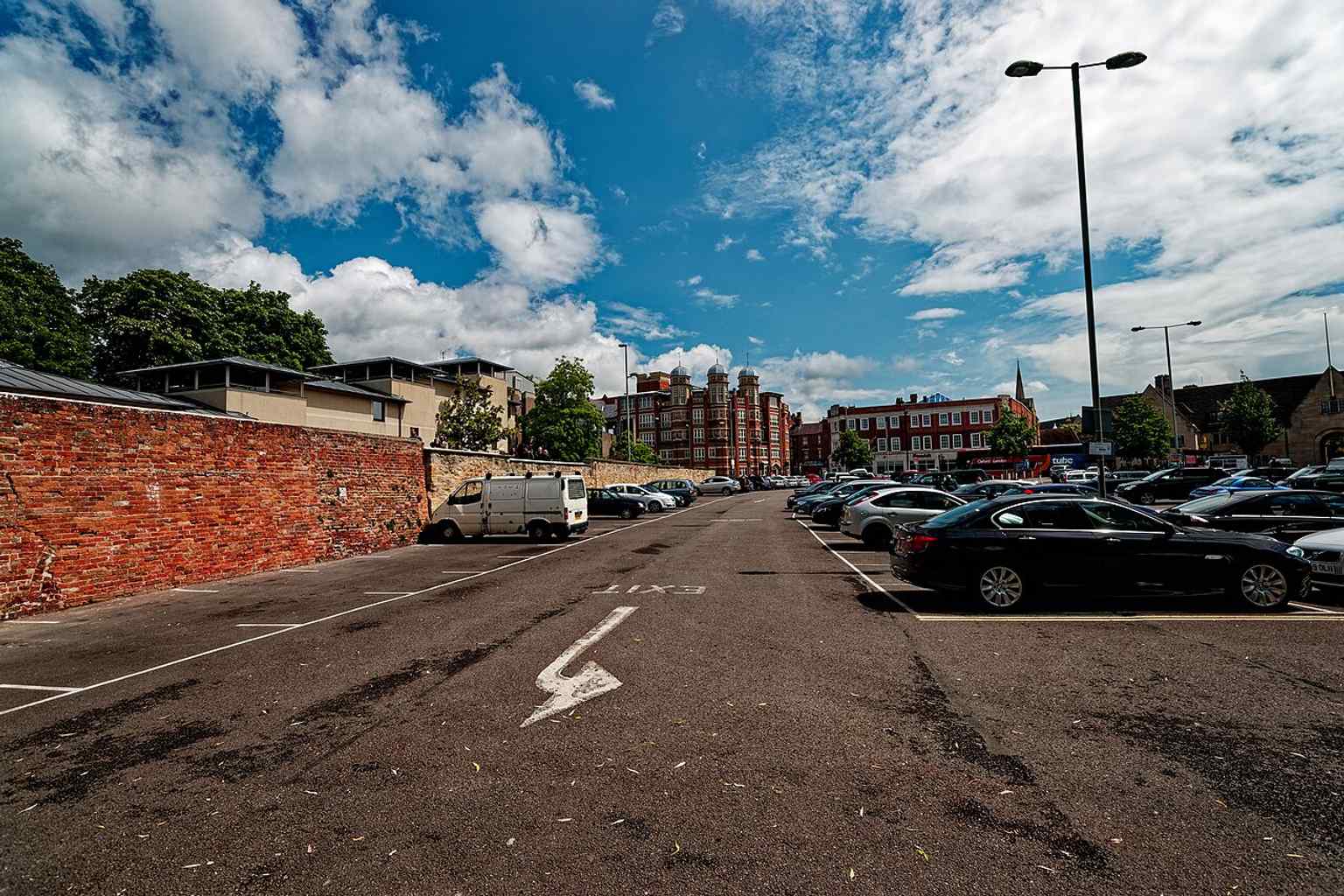
This wider view of the tower helps place Nuffield College in central Oxford, close to the historic route of the former canal terminus.Photo: Txllxt TxllxT, Wikimedia Commons, CC BY-SA 4.0. Cropped & resized. 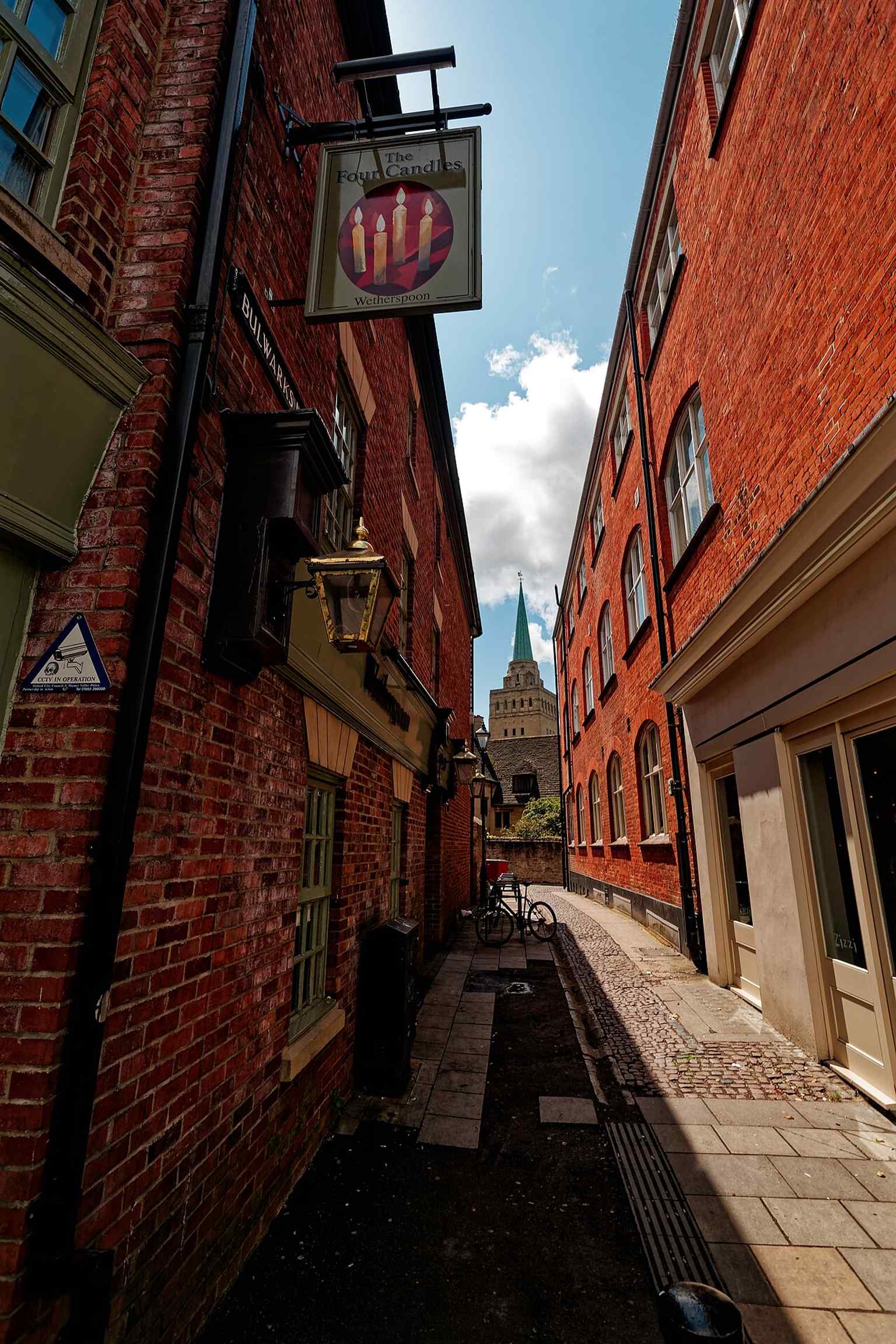
Looking south through Bulwarks Lane, this view links Nuffield College to Oxford’s west side and the rebuilt post-war streetscape.Photo: Txllxt TxllxT, Wikimedia Commons, CC BY-SA 4.0. Cropped & resized. On your left stands nearly a thousand years of Oxford learning how to lock people in. Robert D'Oyly the elder raised the Norman castle between ten seventy-one and ten…Read moreShow less
Open dedicated page →Look for a broad straight roadway edged by pale stone and brick civic buildings, with a rounded castle mound rising beside it and bits of battlement-like crenellation giving the whole stretch a faintly fortified look.
New Road sounds practical, almost boring... which is unfair, because the ground beside you is ridiculously old. Oxford Castle took shape here between ten seventy-one and ten seventy-three, when the Norman baron Robert D'Oyly the elder planted his fortress on the edge of the city. But the oldest standing fabric is older still: St George’s Tower, probably late Saxon, from around ten twenty, a watch tower guarding the west gate. If you want a quick visual, have a look at the mound on your screen in image five. That great earth hump is the surviving motte, the raised mound of a Norman castle. In eleven forty-two, during King Stephen’s siege, Empress Matilda escaped from here across the frozen Castle Mill Stream. English history does enjoy an implausible getaway.
New Road itself arrived much later, in seventeen sixty-nine to seventy, when builders drove a new turnpike through what remained of the castle’s outer ramparts and ditch. Christ Church chose to preserve the old mound as what it called a venerable monument of antiquity. Meaning: perhaps do not flatten the thousand-year-old hill.
After the Civil War, Oxford Castle served primarily as the local prison. In seventeen eighty-five, the Oxford County Justices bought it and brought in the London architect William Blackburn to rebuild punishment on a more systematic Georgian scale. In eighteen eighty-eight, national prison reforms renamed it H-M Prison Oxford. In a city famous for scholarly gowns, this was the county-justice machinery that kept order for the wider town... grim, practical, and very much not on the prospectus.
Until the mid-nineteenth century, executions here were public, ticketed spectacle. On the twenty-fourth of March, eighteen sixty-three, William Calcraft hanged Noah Austin on the gatehouse roof before nine to ten thousand spectators: Oxford’s last public hanging. Calcraft gets remembered. The bricklayers who dug out the gallows, and the people who cleaned up afterward, mostly do not.
Then, on the tenth of August, nineteen fifty-two, a short squat man stepped off the train from London at Oxford Railway Station. His name was Albert Pierrepoint, the executioner. Two days later he entered the condemned cell with the prison governor and the chaplain. The two guards who had remained with Oliver Butler all night held his arms while Pierrepoint strapped his wrists. Butler was twenty-three. Rose Meadows, whom he had killed, was twenty-one.
The prison closed in nineteen ninety-six. The former cell blocks reopened as the Malmaison hotel in two thousand and five, and the heritage site followed in two thousand and six. You can see that afterlife on your screen in image three. So as you leave, keep two people in mind: the unnamed guards who held Butler through the night, and the chambermaid on D-wing today. Same building, same truth... places like this run on hidden labor. When you’re ready, continue on to Oxford, about five minutes away.
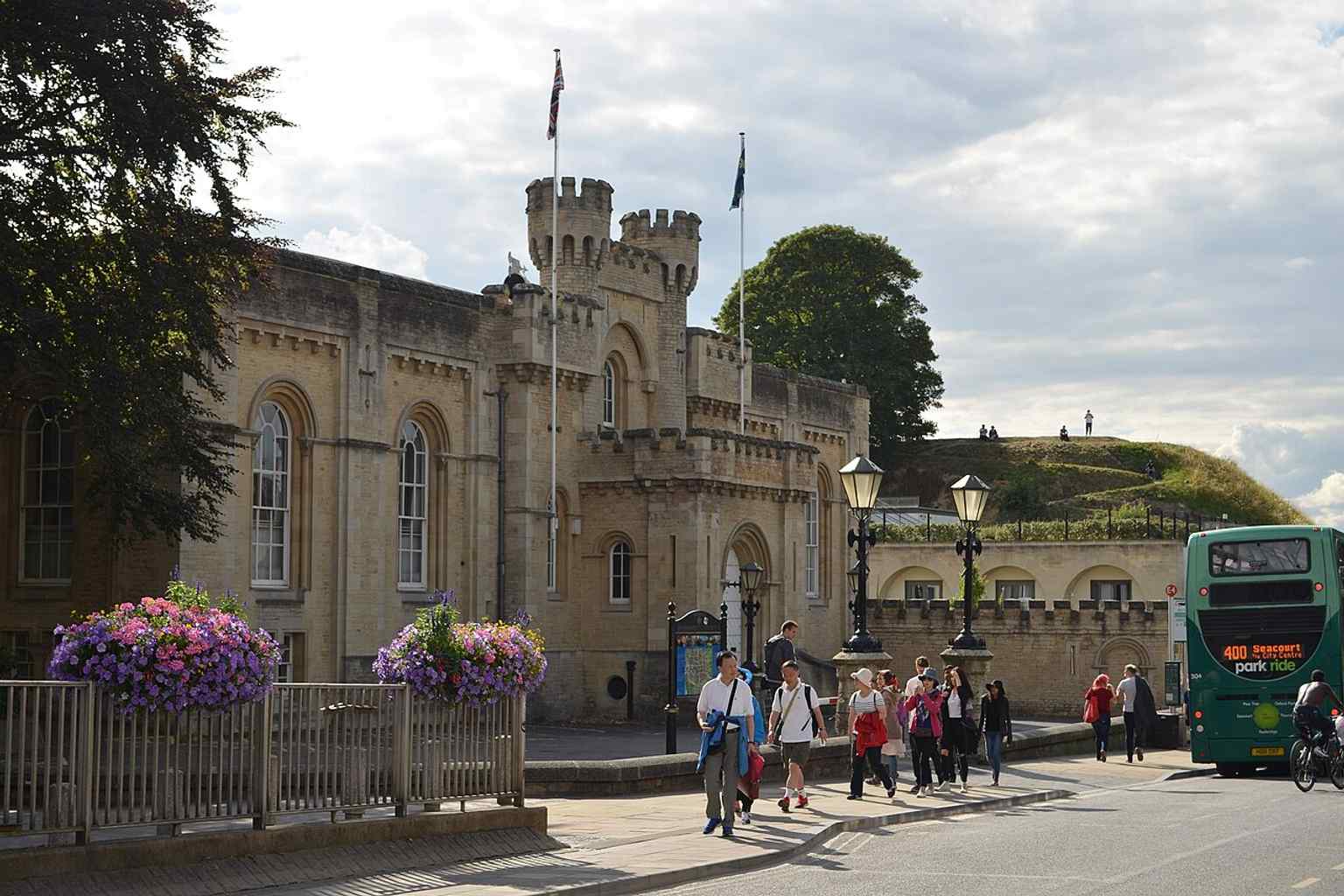
Oxford County Hall beside the castle mound on New Road — the 1840s building was designed to complement Oxford Castle with Norman-style crenellations.Photo: Cmglee, Wikimedia Commons, CC BY-SA 4.0. Cropped & resized. Hythe is a street name that tells you exactly what happened here. In Old English, hithe meant a wharf, a landing place. So Hythe Bridge was, quite plainly, the bridge by the…Read moreShow less
Open dedicated page →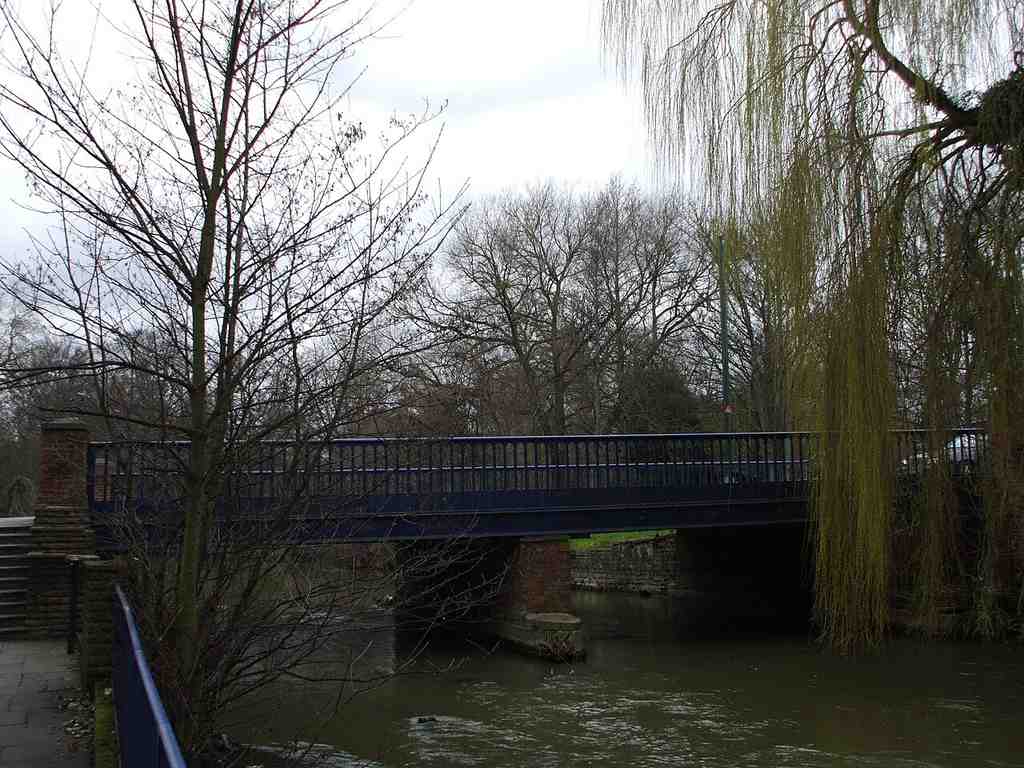
Hythe BridgePhoto: Omassey, Wikimedia Commons, Public domain. Cropped & resized. Look for the low, flat cast-iron bridge with straight beams crossing the narrow Castle Mill Stream, a plain Victorian span whose very lack of fuss is its signature.
Hythe sounds tidy enough, but it comes from the Old English word hithe, meaning a wharf or landing place. So this street is really named for its old job. People were unloading cargo here by at least twelve eighty-two, and Oseney Abbey put up the first known bridge between twelve hundred and twelve ten, probably in wood. In thirteen eighty-three, Oxford replaced it with a stone bridge of three round arches. The version in front of you arrived much later, in eighteen sixty-one, when the Oxford engineer John Galpin gave the crossing its current iron body.
And this was never some picturesque little footbridge. It was a working threshold. In the sixteenth century, the city’s wharf here handled hay, wood, stone, and slate. Freemen paid half a penny per load, others paid a penny - enough to make every crossing count. Even access had a price.
If you glance at your screen, the stream under the bridge gives you the setting the old boatmen knew best. They brought goods up from the upper Thames, but the trip could be miserable. Millers downstream controlled the weirs and the water. They charged heavy tolls, guarded their rights fiercely, and sometimes kept boats waiting for days before releasing enough water for passage. A flash-lock barge, by the way, was a river boat that depended on a rush of released water to get through.
So picture the bargee here: stuck at Iffley or Sandford for days, sleeping on deck, then finally reaching Hythe to unload hay at dawn. For six centuries, the stone in college walls, the slate on Merton roofs, and the hay for stable horses all crossed here on somebody’s back. Next, we’ll head toward Nuffield College, where the old canal basin once spread out beyond this bridge. And unlike the boatmen, you can cross here at any hour.
Look for the pale, rough Coral Rag stone tower, a plain rectangular Saxon shaft with small arched openings and an old clock face set into its upper stage. This is the sort of…Read moreShow less
Open dedicated page →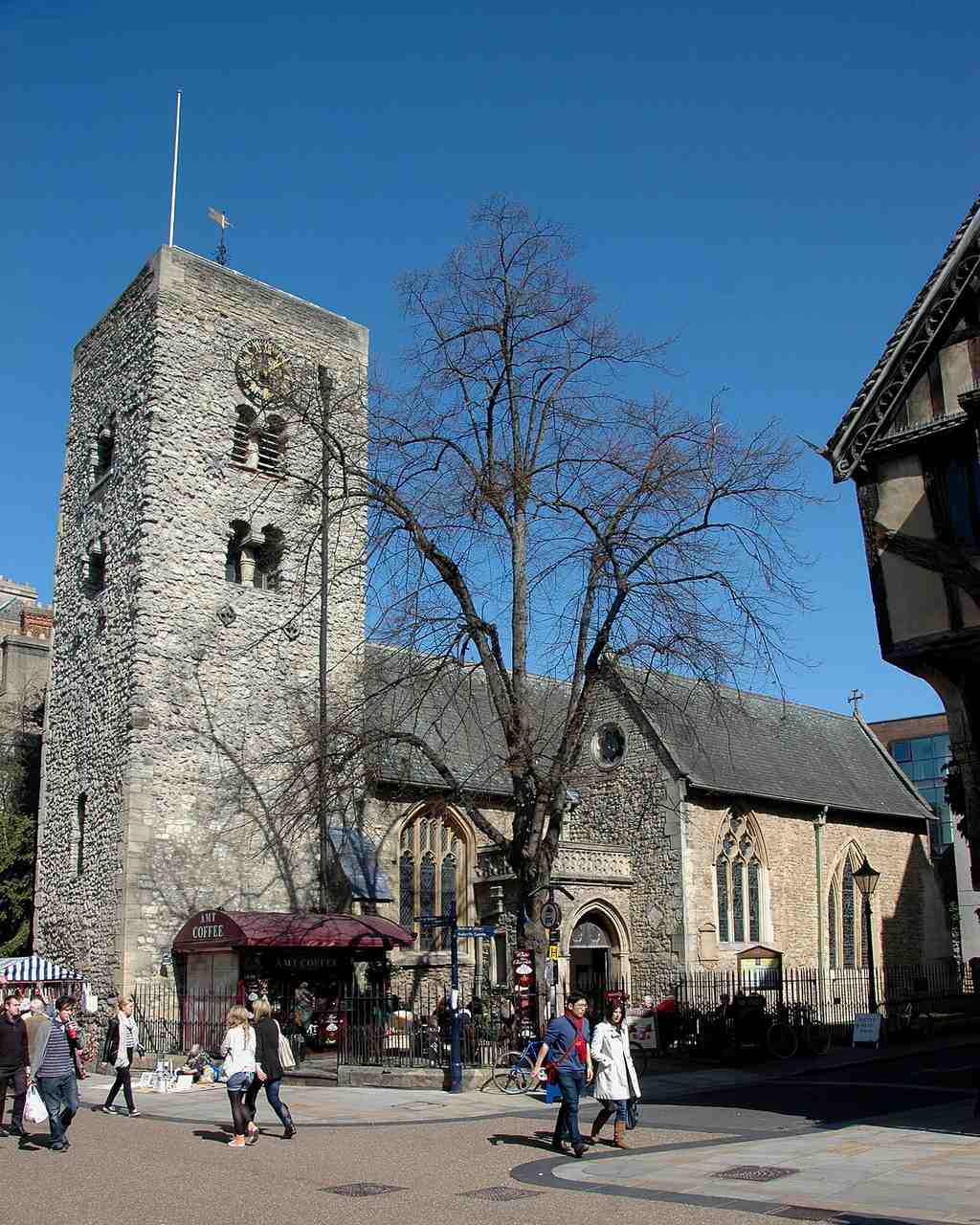
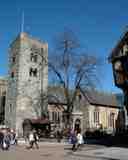
St Michael at the North GatePhoto: Motacilla, Wikimedia Commons, CC BY-SA 3.0. Cropped & resized. Look for the pale, rough Coral Rag stone tower, a plain rectangular Saxon shaft with small arched openings and an old clock face set into its upper stage.
This is the sort of building that makes younger Oxford landmarks seem... a bit needy. The church began around the years one thousand to ten fifty, and the tower from about ten forty still stands here in front of you. The parish makes the bold claim that this is the oldest extant building in Oxford, and honestly, it has a strong case. That tough local stone, Coral Rag, is not graceful stuff. It is hard, stubborn, and durable... which turns out to be a very good personality for surviving a thousand years.
Its name tells you exactly why it matters. St Michael at the North Gate stood on the site of Oxford’s north gate when the city still wrapped itself in defensive walls. So this was not only a church. It also worked as part of the gatehouse: watchmen above, toll-collectors below, and a bell-rope calling the city to closure at dusk. A church tower, a checkpoint, and a practical bit of civic machinery all at once. Oxford has always liked multitasking when rent was involved.
That working life grew darker with Bocardo Prison, which occupied rooms in the watchtower by the North Gate. In fifteen fifty-five, Bishops Latimer, Ridley, and Cranmer were imprisoned there before the burnings nearby on what is now Broad Street. Cranmer met his end in fifteen fifty-six. The prison connected directly to the church tower by a passage, which gives this peaceful frontage a rather grim second life in the imagination.
If you want a glimpse of that lost gateway world, have a look at the before-and-after image in the app; the church stays reassuringly steady while Cornmarket around it shifts into a cleaner modern streetscape.
The gate and prison did not survive. Parliament approved redevelopment in seventeen seventy, and workers demolished the old North Gate and Bocardo in seventeen seventy-one when Cornmarket needed widening. But one harsh little survivor remains: the cell door from the Bocardo room where Thomas Cranmer was held before his execution. If you glance at the image on your screen, you can see that preserved door now kept in the tower.
You can still climb the tower today: ninety-seven steps, past an original clockwork mechanism that a parish clock-winder once wound by hand every week. And that may be my favorite part of this place. Not only bishops and martyrs, but the gatekeeper, the turnkey, the bell-ringer, the sexton, the clock-winder... ordinary workers keeping the city running while the gowned university carried on above them.
When you are ready, head toward Blackwell Bookshop on Broad Street, about a four-minute walk from here. If you want to go inside first, the church usually opens from nine AM to six PM most days, with shorter hours on Saturday and different Sunday opening.
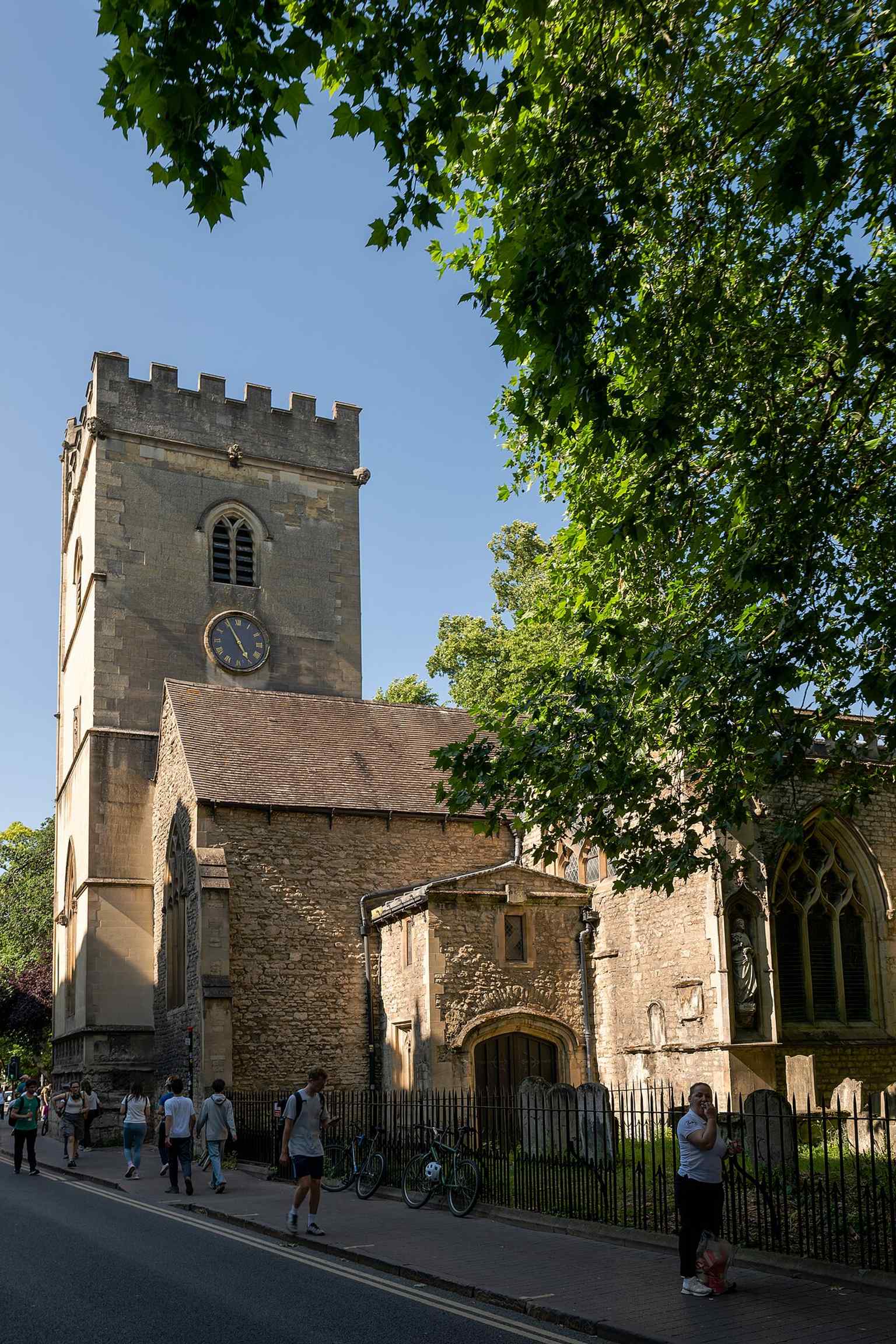
A full view of St Michael at the North Gate, the Saxon church tower said to date from around 1040 and Oxford’s oldest surviving building.Photo: Tilman2007, Wikimedia Commons, CC BY-SA 4.0. Cropped & resized. 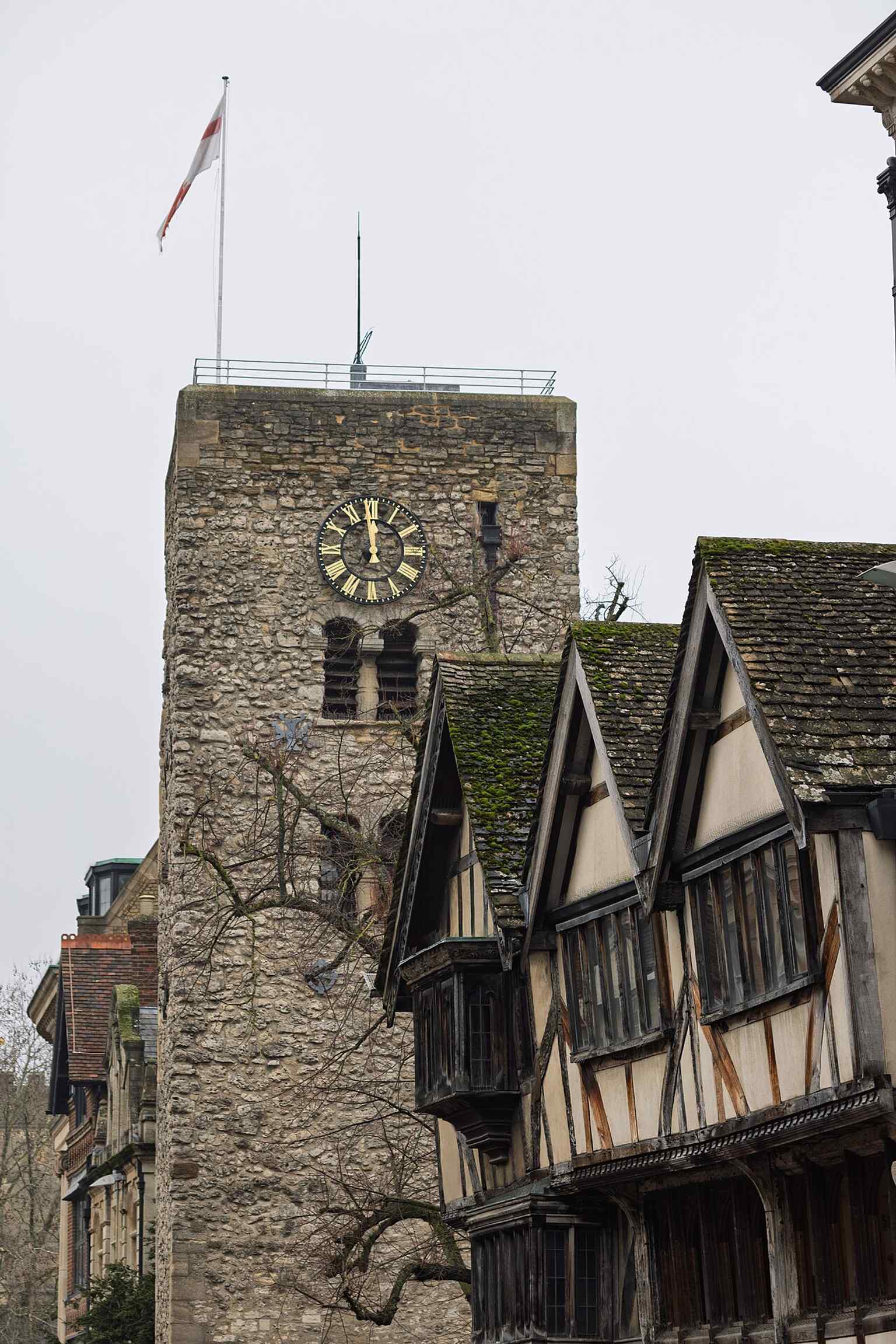
The church on busy Cornmarket Street, showing its position right by the historic North Gate site where Oxford’s city wall once stood.Photo: The wub, Wikimedia Commons, CC BY-SA 4.0. Cropped & resized. 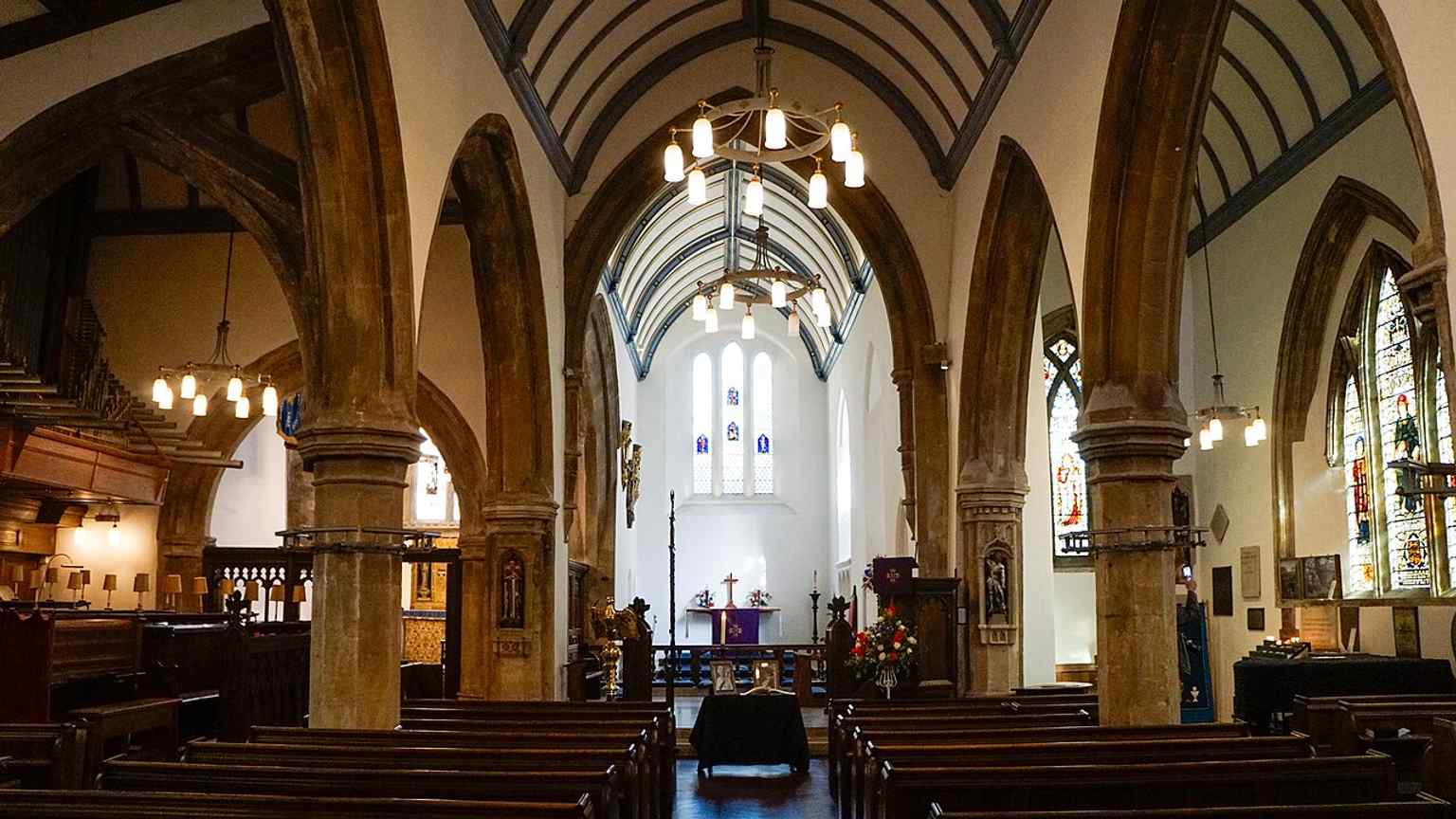
Inside the city church, where the tower displays historic objects linked to Oxford’s religious and civic history, including the Martyrs’ cell door.Photo: JFVoll, Wikimedia Commons, CC BY-SA 4.0. Cropped & resized. On New Year’s Day, eighteen seventy-nine, Benjamin Henry Blackwell opened this shop in a room just twelve feet square, stocked with seven hundred used books. Oxford does love a…Read moreShow less
Open dedicated page →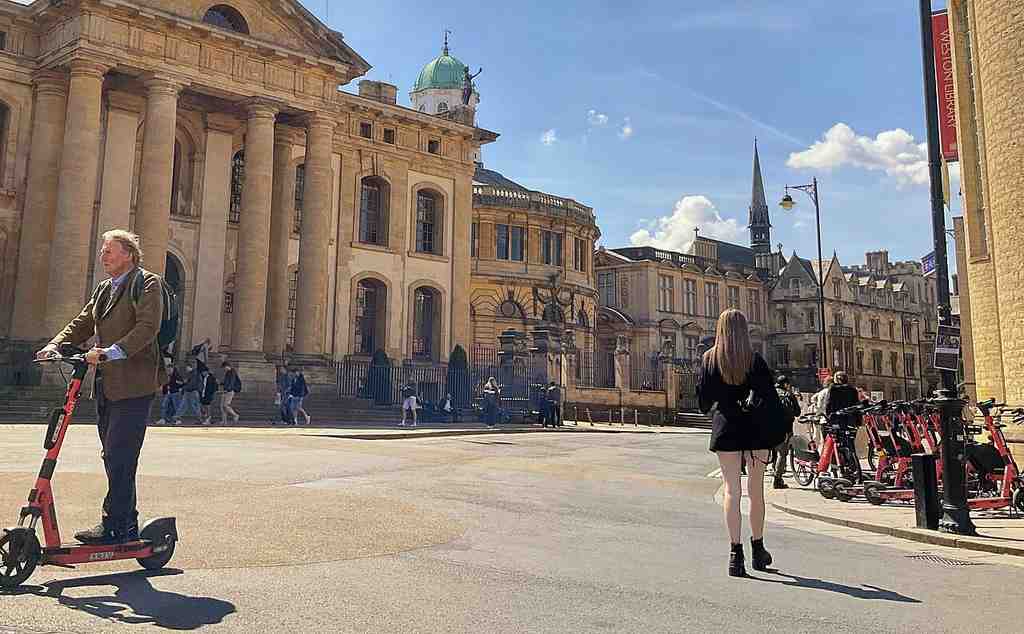
Broad Street, OxfordPhoto: Honcques Laus, Wikimedia Commons, CC0. Cropped & resized. Broad Street is easy to spot as an unusually wide paved avenue lined with long honey-colored stone fronts, with the rounded Sheldonian Theatre and the grand classical Clarendon Building marking its eastern end.
On New Year’s Day, eighteen seventy-nine, Benjamin Henry Blackwell opened a shop here with a room only twelve feet square and a stock of seven hundred used books. That is not the beginning of an empire... it is the beginning of a cupboard with ambitions.
B-H Blackwell knew the trade from the ground up. He was the son of Oxford’s first city librarian, but there was nothing especially cushy about his route in. He left school at thirteen and apprenticed himself to the Oxford bookseller Charles Richards for one shilling a week. Thirteen years old, a shilling a week, and straight into work among shelves, customers, and accounts. From that schoolboy start, he built the bookshop that became the best-known university bookseller in Britain.
Broad Street was the perfect stage for it. Long before the book trade took over, this broad strip began as the ditch outside Oxford’s city wall, then served as the horse market, which explains its old name, Horsemonger Street. Later, as the walls lost their military use, the ditch turned into plots for houses and shops. So this street kept reinventing itself: from defense line, to market, to the intellectual shopfront of Oxford. If you glance at your screen, the image shows how tightly the university presses in here, with major academic buildings crowding the east end.
And what buildings. Across Broad Street sit colleges like Balliol and Trinity. Nearby stand the Sheldonian, designed by Christopher Wren, and the Clarendon Building, where Oxford University Press once ran its printing. It is one of those Oxford places where town business and university grandeur stop pretending they are separate things.
Blackwell’s proved that neatly. B-H’s son, Basil Blackwell, known as “the Gaffer,” took over in nineteen twenty-four when his father died and ran the firm for decades. Under the family, the shop grew quite literally beneath the gown. In nineteen sixty-six, Blackwell’s opened the Norrington Room under the lawn of Trinity College next door: ten thousand square feet, three miles of shelving, and at one point a Guinness record for the world’s largest single room selling books. Only in Oxford does a bookshop quietly expand under a college lawn and call it perfectly normal.
The shop also linked writers, readers, and the street outside. In nineteen fifteen, Blackwell’s published J-R-R Tolkien’s first poem, Goblin Feet. Yes, that Tolkien - the same man whose Ducker rugby boots, bought for fourteen shillings and sixpence, survive in a Bodleian ledger not far from here. Customer, author, scholar, sportsman... Oxford does like its people thoroughly overqualified.
The Blackwell family kept the business for one hundred and forty-three years, across five generations, until the sale to Waterstones in February, twenty twenty-two. That is a remarkable run for any family business, let alone one that began with a boy who left school at thirteen and earned a shilling a week.
Keep that apprentice in mind. Oxford loves its grand facades, but some of its biggest stories begin with someone learning the job the hard way. We will hear that note again by our final stop. For now, continue to number six Turl Street, about a two-minute walk from here.
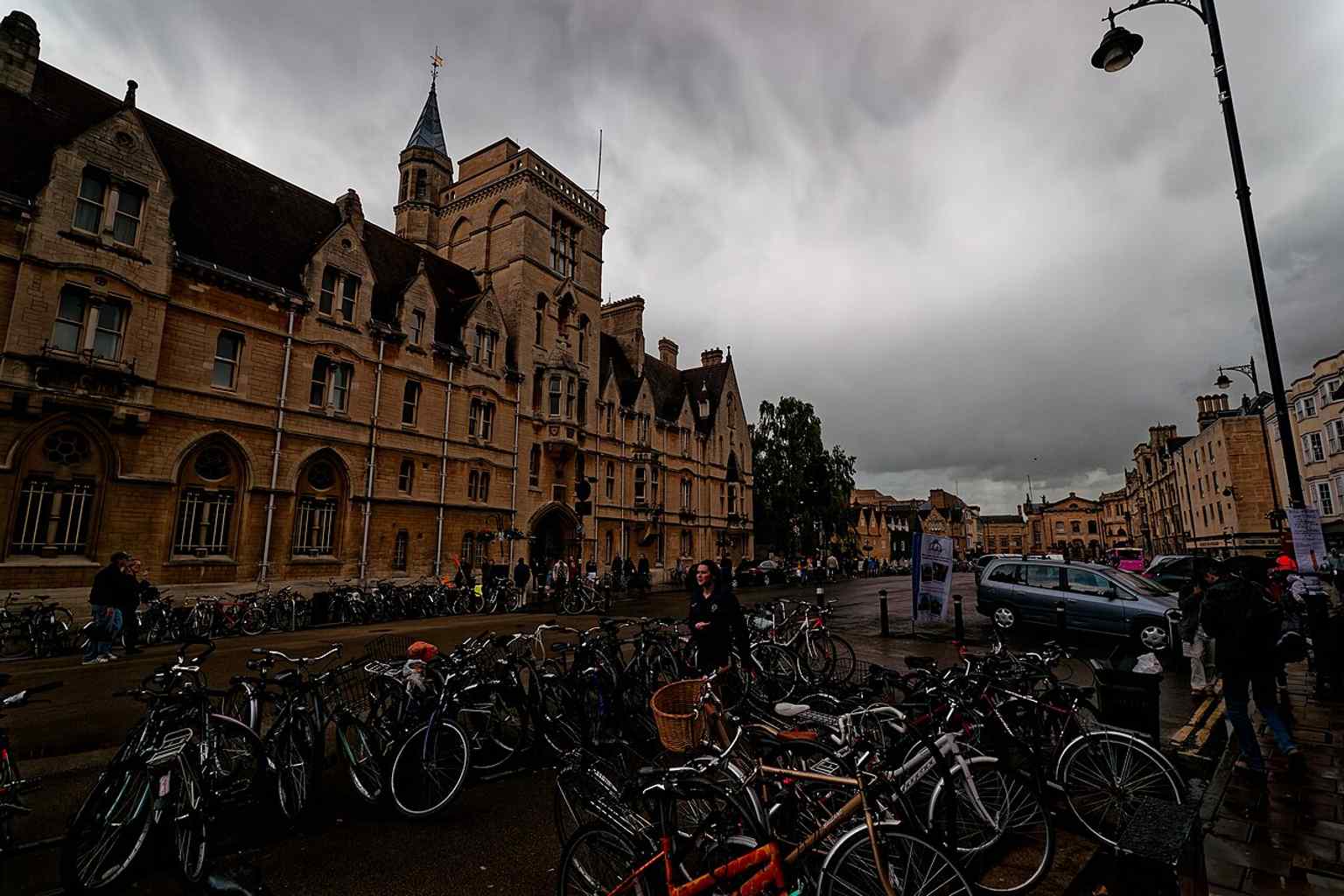
Balliol College fronts Broad Street here, one of the colleges that helped make this stretch the academic heart of Oxford.Photo: Txllxt TxllxT, Wikimedia Commons, CC BY-SA 4.0. Cropped & resized. 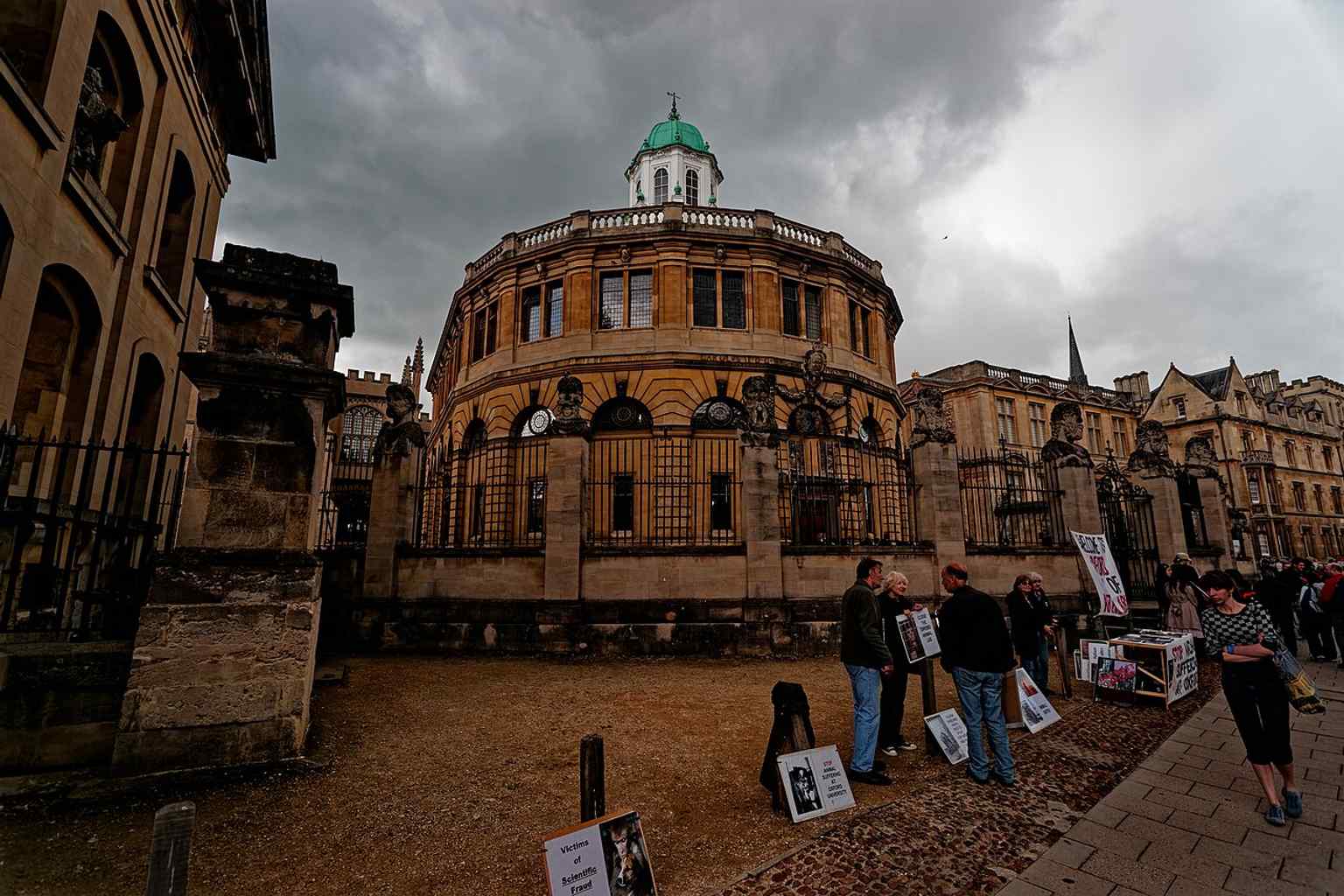
The Sheldonian Theatre, built by Christopher Wren, is one of Broad Street’s great architectural landmarks.Photo: Txllxt TxllxT, Wikimedia Commons, CC BY-SA 4.0. Cropped & resized. 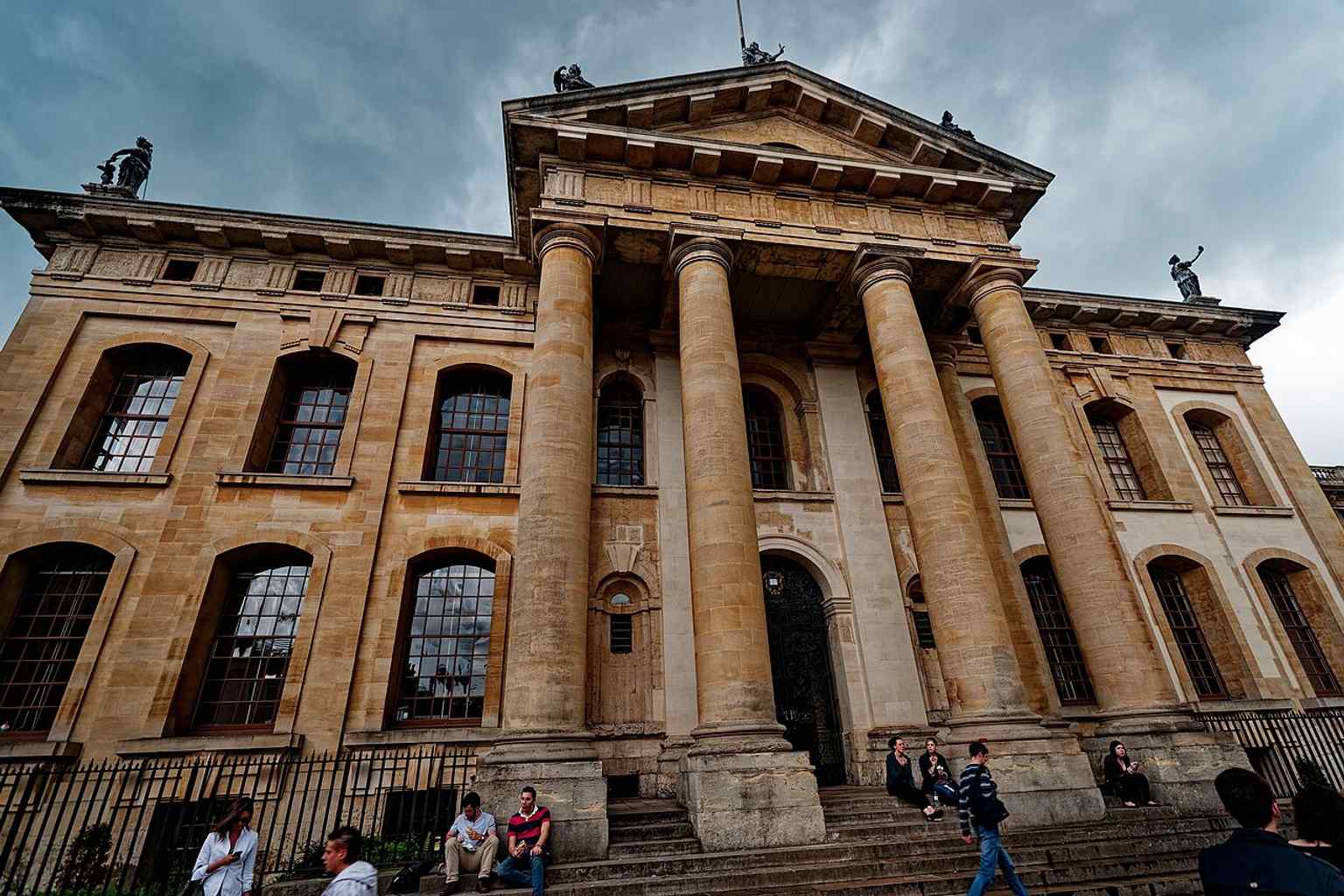
The Clarendon Building on Broad Street, built in the early 18th century for Oxford University Press.Photo: Txllxt TxllxT, Wikimedia Commons, CC BY-SA 4.0. Cropped & resized. 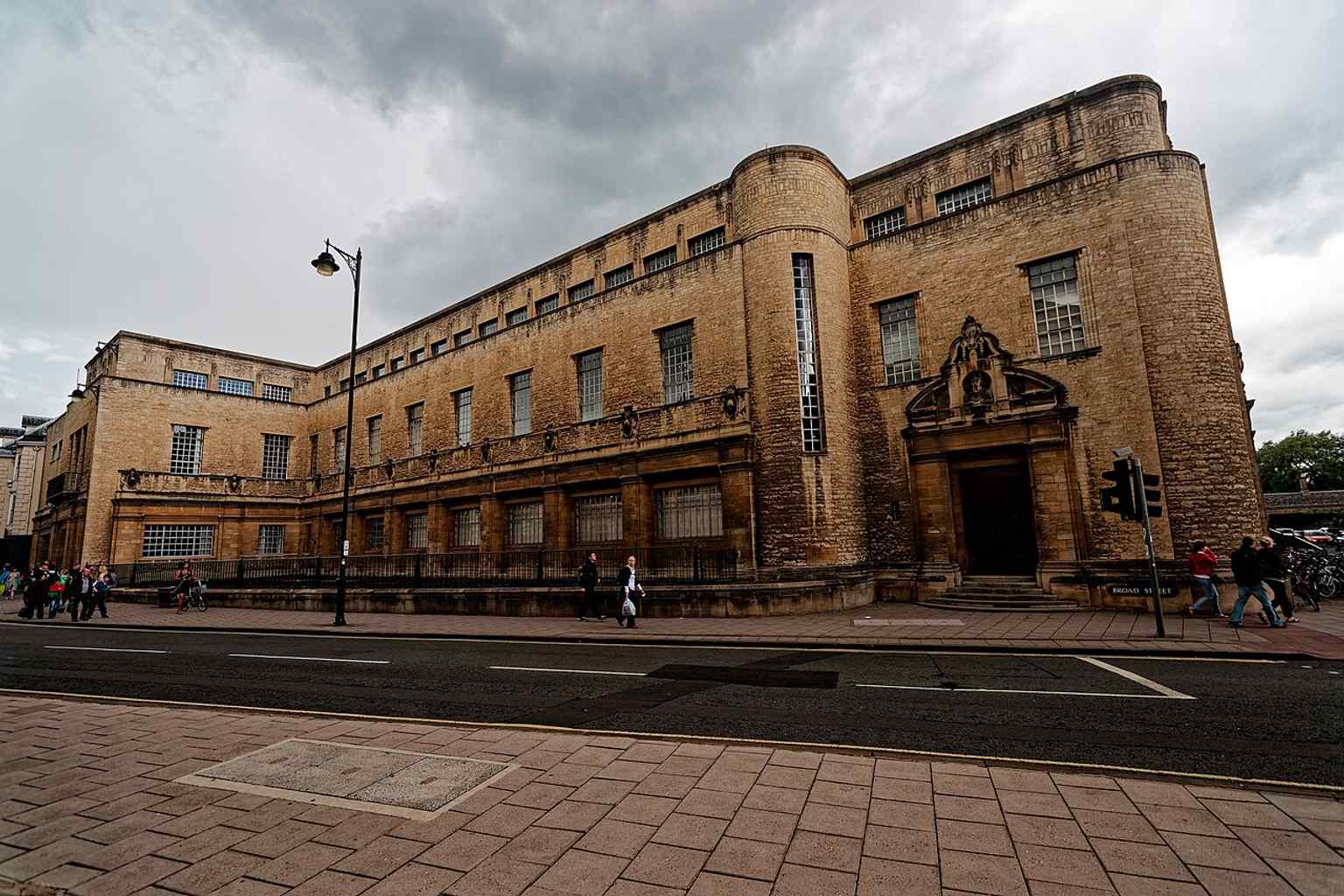
The former New Bodleian, now the Weston Library, marks the university-library side of Broad Street.Photo: Txllxt TxllxT, Wikimedia Commons, CC BY-SA 4.0. Cropped & resized.
Frequently asked questions
How do I start the tour?
After purchase, download the AudaTours app and enter your redemption code. The tour will be ready to start immediately - just tap play and follow the GPS-guided route.
Do I need internet during the tour?
No! Download the tour before you start and enjoy it fully offline. Only the chat feature requires internet. We recommend downloading on WiFi to save mobile data.
Is this a guided group tour?
No - this is a self-guided audio tour. You explore independently at your own pace, with audio narration playing through your phone. No tour guide, no group, no schedule.
How long does the tour take?
Most tours take 60–90 minutes to complete, but you control the pace entirely. Pause, skip stops, or take breaks whenever you want.
What if I can't finish the tour today?
No problem! Tours have lifetime access. Pause and resume whenever you like - tomorrow, next week, or next year. Your progress is saved.
What languages are available?
All tours are available in 50+ languages. Select your preferred language when redeeming your code. Note: language cannot be changed after tour generation.
Where do I access the tour after purchase?
Download the free AudaTours app from the App Store or Google Play. Enter your redemption code (sent via email) and the tour will appear in your library, ready to download and start.
If you don't enjoy the tour, we'll refund your purchase. Contact us at help@audatours.com
Checkout securely with 










.jpg)


%20-%20Oxford%2C%20UK.jpg)


%201711-15%20by%20Nicholas%20Hawksmoor.jpg)
