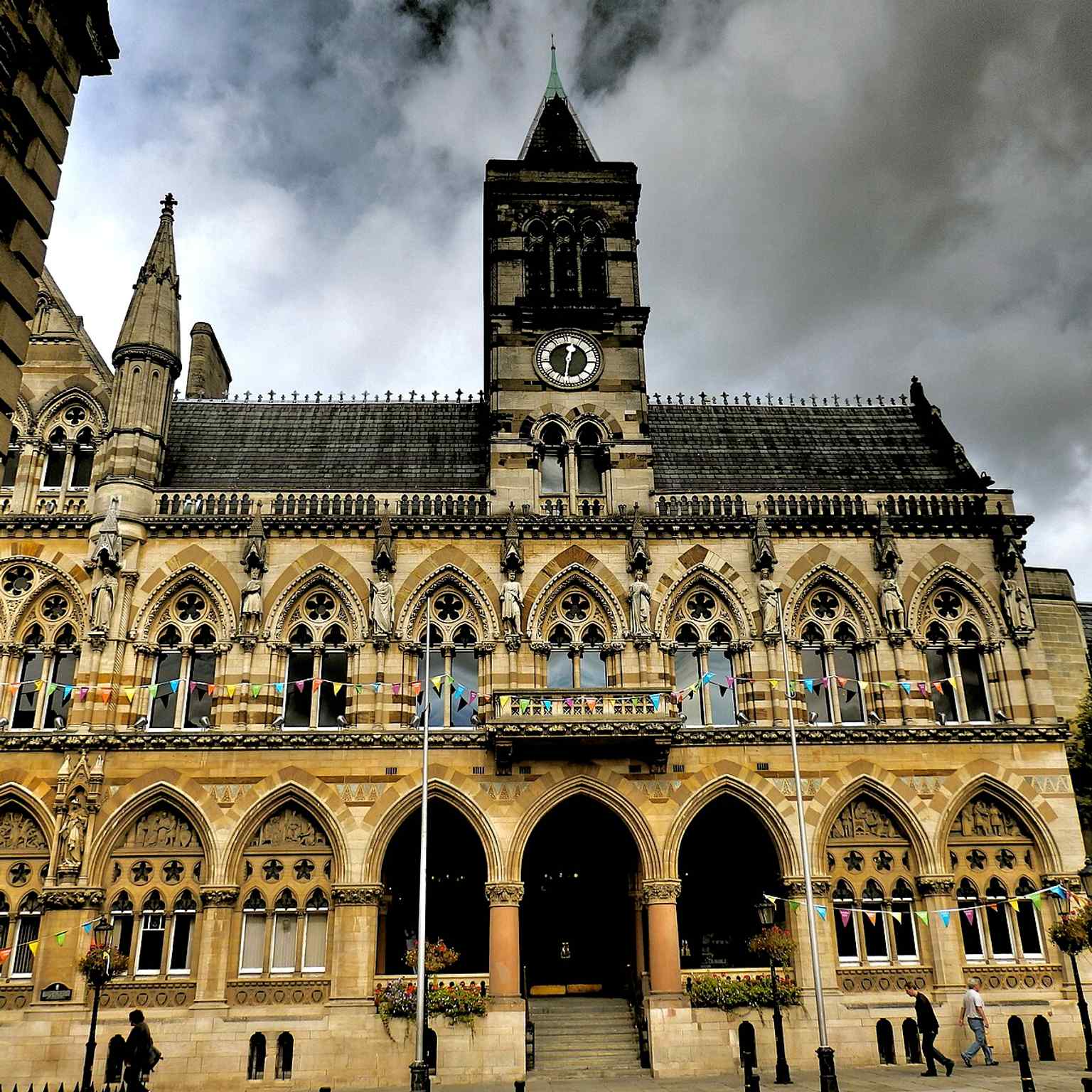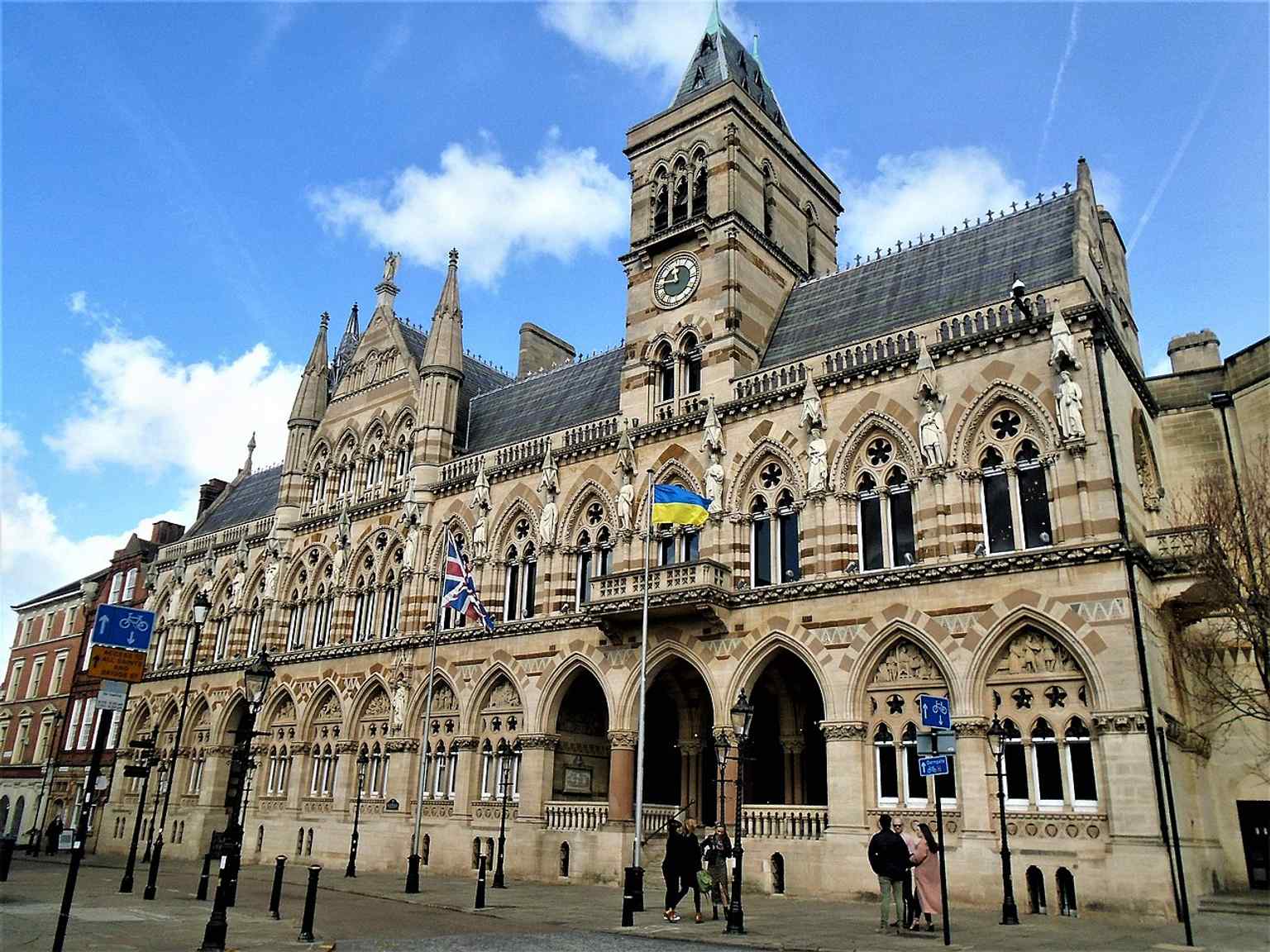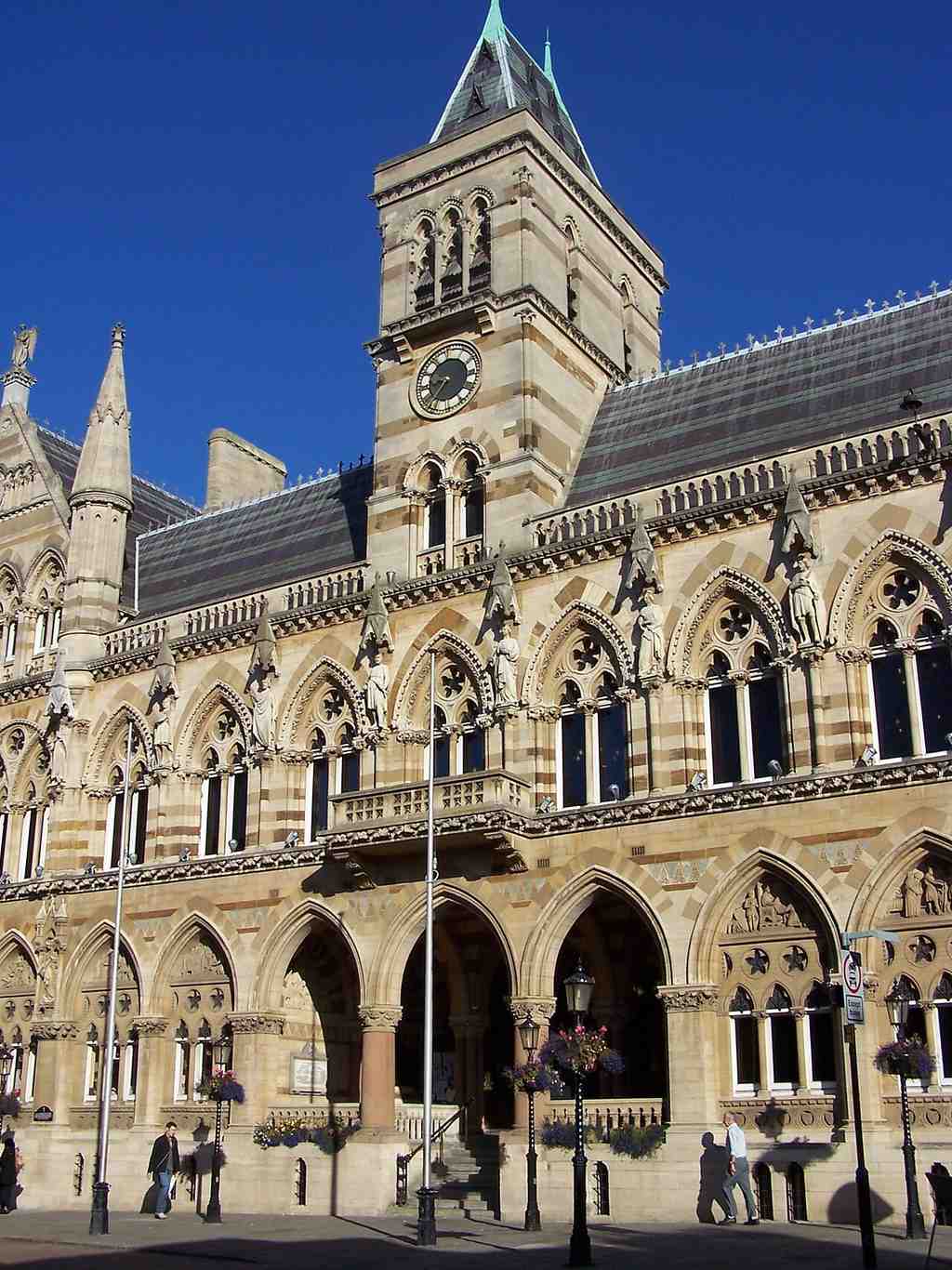
Look for the long pale-stone Gothic frontage with pointed arches, a steep clock tower, and a row of carved figures standing between the upper windows.
This is Northampton Guildhall... the town dressing itself for public business in full Victorian confidence. Edward William Godwin designed the original building in eighteen sixty-one, when he was only twenty-eight, and he beat more than fifty rival entries to get the job. Not bad for a man still young enough to be mistaken for the intern. He opened it in eighteen sixty-four, giving Northampton a civic headquarters in Gothic Revival style, meaning a deliberate revival of medieval forms: pointed arches, vertical lines, carved stone, and plenty of moral seriousness.
What you see stretching across the square today is even bigger than Godwin first planned. Between eighteen eighty-nine and eighteen ninety-two, Matthew Holding pushed the building westward, with A. W. Jeffrey shaping the interior, creating this long fourteen-bay front with arcading at ground level and a statue above each upper window. The facade turns local history into a stone cast list: monarchs, saints, benefactors, and scenes tied to Northampton’s legal and religious past. It is a town hall, yes, but also a public argument about who mattered here.
If you fancy it, have a look at the before-and-after image in the app; the restored frontage feels a bit sharper now, as though the stone has remembered its lines.
Inside, the council chamber did not belong only to merchants and grandees. In nineteen hundred and three, James Gribble took his seat there as a councillor for the Social Democratic Federation. Gribble had been a bootmaker since the age of twelve, and he was one of three Northampton shoeworkers elected to the council that year. That matters. In this town, people who stitched uppers and cut leather did not just vote on politics... they entered the room and made it.
Two years later, Gribble proved he was not there to admire the furniture. In May nineteen oh five, he led one hundred and fifteen striking boot operatives from Raunds on a four-day march to Westminster, protesting War Office piece-rates that had sunk to two shillings and sixpence or sevenpence a pair. From the Commons gallery, he broke protocol and shouted his demand at the Speaker. Subtle, he was not. But it worked: the pressure helped force an Arbitration Board, and the rate rose to two shillings and elevenpence a pair.
There’s a straight line from the literate cordwainers around Doddridge’s congregation to Gribble here: shoemakers in Northampton kept finding their way from the bench to the argument. This building held the magistrates above and authority all around, but working people kept walking in anyway.
Now turn your gaze toward Guildhall Road. The old County Gaol stands there, the prison built in eighteen forty-six; its east wing later became the museum, and the vaulted cells now hold the shoe collection. In the next stop, the people behind these facades reappear there in stubborn, human detail... and it’s only about a minute away.