Northampton Audio Tour: Clicking, Closing and the Sound of the Town
Northampton's boots once walked the world, and behind every pair was a parlour, a workshop, a factory floor and a family. This self-guided audio tour traces a working day through England's shoemaking capital, from the open Market Square where shoemakers organised against the new machines, to St Crispin's altar at All Saints, through the cordwainer-chapel where Northampton's shoemakers learned to organise, to the very block where the first 'monster warehouse' broke the parlour trade and triggered the strike of 1858, and finally to a Victorian prison whose vaults now hold one of the world's great shoe collections. You will hear what a clicker actually clicked, why the closing rooms were full of women on rented Singer machines, and how a 1936 super-cinema, a leather-works in Pont Street Dutch brick and a 1940 youth club for the no-collar kids of the Boroughs all share the same streets. Walk slowly. The buildings still hold their shape, and the shoes still hold their stitches.
Tour preview
About this tour
- scheduleDuration 40–60 minsGo at your own pace
- straighten4.6 km walking routeFollow the guided path
- location_onLocationNorthampton, United Kingdom
- wifi_offWorks offlineDownload once, use anywhere
- all_inclusiveLifetime accessReplay anytime, forever
- location_onStarts at Market Square
Stops on this tour
Ahead of you stretches a broad open rectangle of pale stone paving, edged by long brick and stucco frontages, with All Saints’ tower rising close by as the square’s old…Read moreShow less
Ahead of you stretches a broad open rectangle of pale stone paving, edged by long brick and stucco frontages, with All Saints’ tower rising close by as the square’s old landmark. This is one of the oldest open-air market spaces in England. Northampton got its first market charter in eleven eighty-nine, and in twelve thirty-five Henry the Third pushed trade out of All Saints’ churchyard and onto this open ground. Sensible enough. Churches tend to object when commerce starts elbowing liturgy out of the way. For the next seven centuries, this square became the town’s outdoor workplace, hiring hall, debating chamber and pressure valve. This is where we need to establish the basic cast of characters. Northampton’s defining trade was boot and shoe making. If England had one shoemaking town, this was it. Before the factories took over, much of the work happened through the outwork system: a master supplied leather in town, workers carried it home to parlours, kitchens and back-shed workshops, then brought back finished parts or full boots for piece-rate pay. And every pair depended on a four-step chain. The clicker cut the leather uppers on a knee-board using brass templates - that sharp contact gave the trade its famous click. The closer stitched those uppers together. The laster pulled the leather over a wooden foot-form called a last. The finisher trimmed, edged and polished the result. In Northampton, men usually clicked and lasted; women usually closed. By eighteen forty-one the census counted one thousand eight hundred and twenty-one shoemakers here. By eighteen seventy-one, about forty percent of Northampton’s men worked in the trade. One local writer said you knew you were within a mile of town by the noise of shoemakers’ lap-stones. Not church bells. Not traffic. Work. This square also taught shoemakers how public power worked. In seventeen sixty-eight, three earls fought the so-called Spendthrift Election here and burned through about one hundred and sixty thousand pounds - roughly twenty-five million pounds today - on bribes and entertainment. Democracy, in that version, came with drinks included. One earl had to sell Horton, another fled to Switzerland from his creditors. Then came fire. On the twentieth of September, sixteen seventy-five, flames starting in St Mary’s Street tore through about seven hundred of the town’s eight hundred and fifty buildings in six hours. The rebuilding act that followed forced new houses around the square to use brick or stone with slate roofs. That disaster is one reason the space feels broader and more orderly than many medieval market places. If you look toward the north side, the Welsh House is the stubborn survivor - stone-built, older than the fire, and strong enough to help townspeople escape through it while the rest of the center burned. And this place could still turn ugly when workers felt cheated. In October eighteen seventy-four, after the radical Charles Bradlaugh lost a by-election, supporters - many of them shoemakers - ripped up stones from this very square and smashed windows across town. The Mayor read the Riot Act, soldiers arrived, and despite the legend that always grows extra smoke and drama, no shots were fired. But the point stands: Northampton’s working people did not treat politics as a spectator sport. So hold this square in your mind as we walk: not as a tidy civic backdrop, but as the place where Northampton bought, sold, hired, shouted, voted, rioted and tried to stop the future arriving
Open dedicated page →On your right, look for the long cream-and-pale facade with curved horizontal lines, a central canopy, and the blue plaque by the main entrance. This opened on the second of May,…Read moreShow less
On your right, look for the long cream-and-pale facade with curved horizontal lines, a central canopy, and the blue plaque by the main entrance. This opened on the second of May, nineteen thirty-six, as the Savoy - a streamlined cinema built in under nine months for the A-B-C chain, designed by William Riddell Glen in the International Modern style. Nearly two thousand seats: six hundred and ninety-six in the circle, twelve hundred in the stalls, and an orchestra pit because it was meant to work as both cinema and theatre. In other words, Northampton didn’t build a picture house here. It built an event. By then, the boot and shoe town we met in Market Square had been through strike, mechanisation and factory discipline. Friday wages still landed in working hands, though, and many of those hands came here. Shoemakers, outworkers, shop assistants, apprentices - people who had spent the week in glue, leather dust, machine belts and piecework - came to Abington Square for glamour, song, film stars and a seat in the dark. A different soundtrack from the lap-stone, but still part of the same week. The building sits on the old site of Northampton Grammar School and later the Technical College, so one kind of instruction gave way to another. Latin verbs out, Fred Astaire in. The opening gala screened Broadway Melody of nineteen thirty-six, and the interior was dressed to impress, with decorative plasterwork and grilles by Clark and Fenn. There was even a Compton theatre organ here, opened by Wilfred Southworth and kept for twenty-four years before its chambers were turned into dressing rooms for touring acts with larger entourages and, one suspects, larger opinions. And then, of course, the Beatles. They played here twice in nineteen sixty-three. The first visit, on the twenty-seventh of March, caught them still climbing - supporting Tommy Roe and Chris Montez with a six-song set. By the sixth of November they came back as headliners, performing ten songs including All My Loving, She Loves You and Twist And Shout. The blue plaque marks both nights. One photograph taken that evening by Nicky Haslam became the first picture of the Beatles seen in America when U.S. Vogue published it that December. Northampton, very casually, helped export Beatlemania. This stage also hosted the Rolling Stones. P-J Proby caused a national flap after his trousers split here in nineteen sixty-five, which is either rock-and-roll scandal or very poor tailoring in the wrong town. Given where we are, I suspect the audience had notes. The Stones returned that same year with Satisfaction in the set and enough crowd pressure outside to need a heavy police presence. The Savoy became the A-B-C, then the Cannon, then lost the fight with the multiplex age and closed in nineteen ninety-five. It sat dark for five years, half ghost, half headache, before reopening in the early two thousands as a multi-purpose venue. Locals still mostly call it the Deco, because once Northampton gives a place a name, it tends to keep it. So this is not a break from the town’s working story. It’s what happened after the bench, after the whistle, after the week’s money hit a pocket. The soundtrack widened. Three streets on, the knife and machine take over again. Walk to Lower Mounts, gateway to the Boot and Shoe Quarter; it’s about seven minutes.
Open dedicated page →Ahead of you the street climbs through a corridor of brick civic buildings and older terraces, with the slope itself and the dense side streets marking the edge of Northampton’s…Read moreShow less
Ahead of you the street climbs through a corridor of brick civic buildings and older terraces, with the slope itself and the dense side streets marking the edge of Northampton’s old industrial quarter. This is the gateway to the Boot and Shoe Quarter, and it matters because Northampton still has an extraordinary amount of it left. Around these streets - Lower Mounts, the Racecourse edge, Abington Square, Billing Road - roughly seventy percent of the surviving boot and shoe industry buildings still stand. That density is why the council created the conservation area in twenty eleven. The hope, as planning officer Jenny Ballinger put it, was to do for Northampton what Birmingham did for its Jewellery Quarter: stop a working district from being quietly shaved away. Two centuries ago, the Mounts were fields. Then, between about eighteen forty and eighteen eighty, they filled up at speed with factories, leather works, terraces, chapels, clubs and pubs. Walk any side street nearby and the trade still reads clearly in the architecture. Three-storey workshop blocks sit hard against the pavement. Long top-floor windows flood daylight onto the rooms where the most light-hungry work happened - clicking and closing. Lower down came the heavier processes, where machinery and weight could sit safely on stronger floors. It’s a very practical kind of urban poetry. And this is the place to make one important correction to the neat factory story. Factories did not wipe out the old outwork system overnight. They lived side by side for decades. Even after the first major factory arrived, old residents still remembered houses in streets like Lower Harding, St Crispin and Compton where three or four people worked in one room, often in foul air, by tallow candle at night. Northampton held on to the parlour trade longer than almost any rival town. Modern industry arrived here, yes, but it had to squeeze in beside the old habits rather than bulldoze them at once. It also helps to understand what machine changed the balance. From the late eighteen fifties, Singer-style lockstitch sewing machines entered the trade. Because Singer rented machines, a closer could have one in a front room instead of only in a factory. That sounds almost democratic until you remember wages. The cutting had already been centralized in town; the stitched uppers now moved increasingly into women’s hands on machines, often for long piecework hours and roughly half the pay of men in the clicking room. Progress can be surprisingly selective in who it benefits. In November eighteen fifty-seven, local shoemakers proposed a strike against these closing machines. Their line was blunt: either the machines went, or the workers did. The Mutual Protection Society formally constituted itself in April eighteen fifty-eight and called the strike. Manufacturers answered by sending orders to Leicester. By mid-May, Northampton’s men had to concede. The machines stayed; Leicester grew stronger; and the quarter ahead of you filled with the buildings of a new industrial order. There are other layers here too. The old Borough Gaol once stood on this general civic site, Mounts Baths opened nearby in nineteen thirty-six like an Art Deco temple to public health, and the fire station was placed here because dense shoe factories had an awkward habit of burning. But for us, this slope is the hinge in the story: from market and parlour into factory town. Just ahead, one of the big names in Northampton boots makes that shift visible in brick. Walk to the G-T Hawkins Factory at Overstone Road and St Michael’s Road; it’s about five minutes.
Open dedicated page →
Show 9 more stopsShow fewer stopsexpand_moreexpand_less
- location_on4
The Hawkins Building
Buy tour to unlock all 16 tracksAhead of you stands a large red-brick factory block with polychrome brickwork, tall iron-window ranges, and a carved royal warrant set right on the corner. This is G-T Hawkins,…Read moreShow less
Ahead of you stands a large red-brick factory block with polychrome brickwork, tall iron-window ranges, and a carved royal warrant set right on the corner. This is G-T Hawkins, or rather the great shell of it - one of the largest factories in the Mounts, built in stages from the eighteen eighties onward and now turned into apartments after decades standing empty. Look for the scale of the thing: the long ranges, the muscular brick piers, the sense that a whole city block got recruited into making boots. That is not accidental. Hawkins grew by swallowing neighbours, including the older Hornby and West works next door, until the firm occupied the entire block. George Thomas Hawkins started building here around eighteen eighty-five or eighteen eighty-six. In that same period he began making riding boots for Queen Victoria and earned the royal warrant you can still see carved into the fabric of the building. From there the business moved hard into military supply: Boer War boots, First World War aviation boots, Second World War flying boots for Mosquito and Spitfire crews, and army boots again in the Falklands conflict of nineteen eighty-two. Northampton factories had a habit of turning local skill into imperial logistics. There’s a useful detail on the facade if you can spot it: a taking-in door, used to hoist hides and materials up into the building from carts below. And that gives us another missing link in the chain. Before the clicker ever laid brass patterns on leather, tanners cured the raw hide and curriers dressed and finished it for use. The currier is the quiet first link, easy to forget because no one writes songs about surface treatment. Nearby firms such as James Collier and Company at the Globe Leather Works handled that stage. Then the leather came here, into the four-step chain you already know. Inside a place like Hawkins, hierarchy was built into the floors. Clickers at the top, usually men and usually the best paid, decided how to cut around flaws in the hide. Closing rooms, full of women machine-stitching uppers, worked longer hours for less money. Lower down, lasting and finishing drove the leather toward a saleable boot. It was skilled work throughout, but not equally rewarded. Funny how industry can count every minute except the unfair ones. And Hawkins comes with a local misconception worth clearing up. People often say Hillary and Tenzing wore Hawkins boots on the nineteen fifty-three Everest summit push. They did not. S-A-T-R-A designed those final high-altitude boots, and Harry Bradley with Ron Skillman supervised just thirty-five hand-made pairs in Kettering. Hawkins later sold a commercial Everest boot and certainly benefited from the glow, which is good marketing if not quite the same as standing on top of the world. Still, the firm did make serious specialist footwear - including rope-soled boots for early tank crews, where metal hobnails could have sparked in fuel vapour. That sort of practical invention is very Northampton: not flashy, just life-saving. Hawkins closed in nineteen ninety-five. The smell of glue drifted down Overstone Road almost to the end. Then silence for nearly thirty years, until restoration turned the works into Hawkins Court in twenty twenty-four. A factory can lose its machines and keep its authority. This one still does. Next we’ll see a place where production never really stopped. Walk to Tricker’s Factory, fifty-six to sixty St Michael’s Road; it’s about three minutes.
Open dedicated page → - location_on5
Tricker's Factory Shop
Buy tour to unlock all 16 tracksOn your right, look for the long red-brick frontage with pale glazed brick across the lower face, tall regular windows, and the Royal Warrant plaque worked into the front. This…Read moreShow less
On your right, look for the long red-brick frontage with pale glazed brick across the lower face, tall regular windows, and the Royal Warrant plaque worked into the front. This is Tricker’s, founded in eighteen twenty-nine by Joseph Tricker and still trading - the oldest continuously operating shoemaker in England. The factory here opened in nineteen oh four, and the glazed-brick frontage you can see today comes from a nineteen thirty-seven rebuild. It is one of the clearest surviving links between Northampton’s old craft world and its modern premium shoe trade, because the work never really left. Around a hundred people still make shoes here. If Hawkins showed you the scale of industrial production, Tricker’s shows you the technical idea that let Northampton keep quality as the market changed: the Goodyear welt. This is the first time we need the term. In a Goodyear-welted shoe, the upper and insole are stitched to a strip of leather called the welt, and then the sole is stitched to that welt, rather than simply glued on. The result is strong, repairable, and capable of being resoled again and again. In other words, it’s expensive up front and stubbornly long-lived - rather like some Northampton opinions. Tricker’s own history is very specific here. Walter James Barltrop, Joseph Tricker’s son-in-law, went to New York around the turn of the twentieth century, bought the machine technology, and brought Goodyear welting into the factory. That moment matters. The parlour trade had already been weakened by the machine age, but this did not kill craft. It redirected it. Every pair still moved through the traditional sequence under one roof: cut, closed, lasted, stitched, finished. Same old chain, just under factory discipline and with better machinery. Look at the windows and the building’s height. Factories like this were designed around light. Top floors gave clickers the clearest view of the hide; lower levels carried the weight and vibration of making and finishing. Inside, Tricker’s staff still talk about the place as a living factory - whirring, hammering, laughing, stretching. One wonderfully Northampton detail: in the closing room they have used an industrial tea urn as a humidifier, boiling away to keep the leather pliable. In this town even the tea equipment ends up in production. There’s a cautionary note, though. Some sources claim Tricker’s made the Everest summit boots in nineteen fifty-three. That story gets repeated a lot, but the cleaner evidence points elsewhere, to S-A-T-R-A’s custom expedition work in Kettering. What Tricker’s indisputably did do was survive, adapt, and stay rooted here while almost everyone else either closed, merged or moved. It received a Royal Warrant in nineteen eighty-nine, renewed by King Charles the Third in twenty twenty-four. In twenty twenty-five the Barltrop family sold a controlling stake for the first time in nearly two centuries, though they remain involved. Even Northampton continuity, it seems, now travels with paperwork. And yes - if the place feels familiar, that’s because the factory served as a key location for Kinky Boots. Not fantasy, then. The real rooms were photogenic enough. From here we move to the other surviving giant of central Northampton shoemaking. Walk to Crockett and Jones at Perry Street and Magee Street; it’s about eight minutes.
Open dedicated page → - location_on6
Crockett & Jones
Buy tour to unlock all 16 tracksAhead of you rises a broad red-brick factory frontage with continuous bands of large-paned windows, a stone frieze reading Crockett and Jones, and a corner presence that fills the…Read moreShow less
Ahead of you rises a broad red-brick factory frontage with continuous bands of large-paned windows, a stone frieze reading Crockett and Jones, and a corner presence that fills the street. Crockett and Jones began in eighteen seventy-nine with two brothers-in-law, James Crockett and Charles Jones, each backed by an interest-free loan of one hundred pounds from the Sir Thomas White Trust. That trust dates all the way back to the sixteen hundreds in Northampton and further in idea to fifteen forty-two - a scheme to help young tradesmen of good character set themselves up. So this famous shoemaking firm started, quite literally, on a local leg-up. Not venture capital. More like civic faith with a repayment schedule. The company first worked in Exeter Road with about twenty employees, still using the hybrid system we’ve already met: leather cut centrally, then sent out to home workers, then returned for assembly. In eighteen ninety-one the firm moved here. What you see is a building layered over decades. Charles Dorman designed the earliest block in eighteen eighty-nine to eighteen ninety. Alexander Anderson added to it in eighteen ninety-six. Then Brown and Mayor produced the big nineteen ten extension, probably Northampton’s first steel-framed building, using vertical strips of glazing almost like north-light sheds turned upright to throw daylight deep onto the work floors. Finally F. H. Allen added the nineteen thirty-five Perry Street office block. This place was built to keep workers close. The company chose to expand on the same site rather than move away and lose its trained labour, because many employees lived only a few doors off in Perry Street and Turner Street. That local geography matters. A shoe factory is not just a building; it’s a daily orbit of homes, shops, pubs and bodies arriving on time. Nick Jones, a fifth-generation family member, has talked about standing on the balcony above the shoe room since childhood and not wanting this to go. You can hear both pride and mild alarm in that sentence. Fair enough. It has outlived most of its peers. Inside, around two hundred and fifty people still carry each pair through more than two hundred operations over roughly eight weeks, almost all in Goodyear welted construction. During the First World War this same site became a war machine, making over six hundred thousand pairs in a single year and more than one million over the course of the conflict. That wartime surge also came with private loss: Clifden Crockett, youngest son of founder James Crockett, died in action in nineteen sixteen at Pozières Ridge. Percy Jones returned and served the company for sixty-seven years. Northampton history is full of those pairings - mass production and one family’s grief sharing the same ledger page. In the late twentieth century Jonathan Jones helped save the firm by pushing toward export markets and higher-end shoes. That strategy held. The company won the Queen’s Award for Export Achievement in nineteen ninety and later a Royal Warrant in twenty seventeen. Today many people know Crockett and Jones through James Bond, with several models made here for Daniel Craig’s films. Secret agent footwear from Perry Street - proof that espionage, too, depends on decent welted soles. This is one of the last central factories where Northampton’s premium trade still feels ordinary and alive rather than embalmed. But the turning point that made all this possible came from one address we’ve been circling for a while. Walk to Campbell Square, Northampton; it’s about seven minutes.
Open dedicated page → - location_on7
Campbell Square
Buy tour to unlock all 16 tracksAhead of you, look for the plain multi-storey brick block at the corner with a hard industrial shape and little ornament, set into the square like a practical argument. This is…Read moreShow less
Ahead of you, look for the plain multi-storey brick block at the corner with a hard industrial shape and little ornament, set into the square like a practical argument. This is Campbell Square, and this building is the argument. In eighteen fifty-seven Isaac Campbell and Company put up what local memory called the monster warehouse - widely taken as Northampton’s first proper indoor boot and shoe factory. Not just a bigger workshop. A deliberate break with the old order, stocked with the new closing machines that threatened the parlour trade. The reaction was immediate. This was the building that helped trigger the anti-machinery strike we met back at Lower Mounts. The Mutual Protection Society warned that either the machines went, or the workers did. The workers lost. Manufacturers sent orders to Leicester, the strike cracked, and the factory model stayed put. Then the scale shot up. Four years later Turner Brothers took over, and by eighteen sixty-five they were producing one hundred thousand pairs a week here using steam power. That is the moment the old outwork town stopped merely fearing the future and found it standing in brick in front of it. Campbell Square is short on romance and long on consequences. Next stop: where Northampton spent the wages after the work was done. Walk to the Roadmender nightclub; it’s about eight minutes.
Open dedicated page → - location_on8
Roadmender (nightclub)
Buy tour to unlock all 16 tracksAhead of you is a sturdy brick venue with a simple hall-like frontage, broad entrance, and the Roadmender name set plainly on the building. The Roadmender began not as a rock…Read moreShow less
Open dedicated page →On your left, look for a sturdy brick building with a broad rectangular frontage and the Roadmender name set across the front.
For a place with so much noise in its history, the outside is almost suspiciously sensible. That is part of the charm. The Roadmender did not begin as a rock venue at all, and it was never some generic youth club with a ping-pong table and worthy intentions. It started life for Northampton’s “no-collar boys and girls” of the Boroughs - working-class young people, the ones who went straight into jobs rather than into office collars and polished careers. Its name came from Michael Fairless’s nineteen oh-two devotional book The Roadmender, which sounds pious enough, but here the idea became practical: give young people somewhere to belong.
By nineteen thirty-seven, the club had nearly four hundred members. That is not a minor local sideline; that is a small social force. The Duke of Gloucester served as national president of the wider Roadmender movement, while Earl Spencer presided over the Northampton branch. Between royal patronage at the top and hard local need on the ground, the town found the will to build this purpose-made home here in Lady’s Lane. Architect Dalgleish designed it, and the building opened in October nineteen forty, right on the edge of wartime. During the war, it even doubled as a Home Guard headquarters. Not bad for a place founded for kids sitting on orange wooden boxes because proper furniture was a luxury.
What matters is that the original mission never quite disappeared. In the nineteen eighties, Roadmender still ran community arts work - printing, textiles, music, theatre - especially for disadvantaged young people. But it also turned into something larger, louder, and much sweatier: Northamptonshire’s great music room. From the early nineteen eighties through the late nineteen nineties, this was the key touring stop between London and Birmingham. Radiohead played here. So did Metallica, Oasis, the Manic Street Preachers, Blur, Pulp, Travis. If you worked in shoes, engineering, rail, or on a factory floor, this was the place that took the week’s pressure and turned it into volume.
And sometimes into absurdity. My Bloody Valentine played here in nineteen eighty-eight with such overwhelming volume that Peter Kember of Spacemen Three later called it a “quantum shift” - meaning the band seemed to become something else entirely through sheer sound. That feels very Roadmender: part youth project, part civic hall, part glorious racket.
It has survived closures, debt, relaunches, and the sort of financial brinkmanship that would make a bank manager reach for a chair. Roger Daltrey and Jools Holland helped relaunch it in nineteen ninety-two. New owners rescued it again after two thousand and five. Since two thousand and nine, Dave Norris and Natalie Norris-Lee have steered it through modern crises, including pandemic closures, and kept it alive as central Northampton’s only major live venue. If you want a glimpse inside that continuing story, take a look at the image on your screen: the hall still doing exactly what it was meant to do, gathering people and letting the noise out.
When you’re ready, head on to Castle Hill United Reformed Church, about six minutes away, carrying with you the echo of the place where the shift ended.
- location_on9
Castle Hill URC
Buy tour to unlock all 16 tracksAhead of you stands a modest brick chapel with round-headed windows, a simple gabled front, and an old dissenting plainness that almost hides its importance. Castle Hill Chapel,…Read moreShow less
Ahead of you stands a modest brick chapel with round-headed windows, a simple gabled front, and an old dissenting plainness that almost hides its importance. Castle Hill Chapel, now United Reformed, dates from sixteen ninety-five and is one of the earliest surviving Nonconformist chapels in England. Philip Doddridge arrived here in seventeen twenty-nine and stayed until seventeen fifty-one. His congregation, by contemporary recollection, was composed mostly of humble shoemakers, many barely literate when they came. Doddridge taught them theology and reading together. That matters because literacy changes what a trade can become. A town of cordwainers who can read, argue, organize and write petitions does not stay quiet for long. The radical line we’ve already traced - the Mutual Protection Society, Bradlaugh’s support, James Gribble later on - grows from soil like this. And there is William Carey: journeyman shoemaker, later missionary scholar, baptized in the Nene near here in seventeen eighty-three. A man who started at the bench and ended up translating scripture into dozens of languages. Northampton did occasionally overachieve. This chapel planted ideas as surely as the factories made boots. Next we head to the parish church where the trade kept its rituals. All Saints’ Church is about four minutes away.
Open dedicated page →
10All Saints' Church, Northampton
Buy tour to unlock all 16 tracksAhead of you stands a honey-coloured church with a deep classical portico, broad stone steps, and a statue of Charles the Second in Roman dress above the entrance. This is All…Read moreShow less
Open dedicated page →
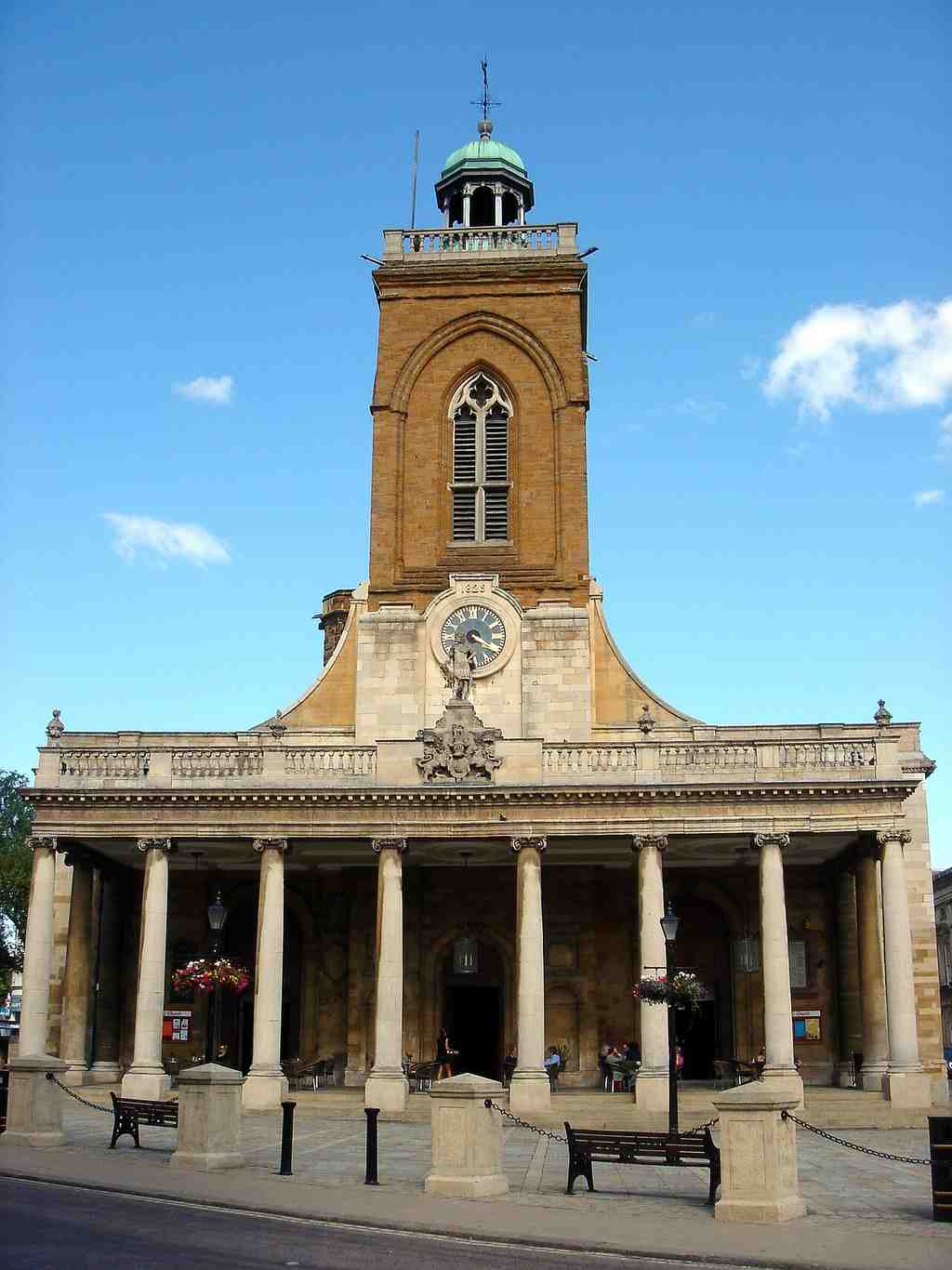
All Saints' Church, NorthamptonPhoto: Thorvaldsson, Wikimedia Commons, CC BY-SA 3.0. Cropped & resized. On your left, look for the pale stone church with a deep classical portico, a square tower rising behind it, and a statue of King Charles the Second in Roman dress standing above the front.
All Saints tells you something important about Northampton: here, the shoe trade did not just fill workshops and factories... it reached the altar. This church still holds a thanksgiving service every twenty-fifth of October for shoemakers, leatherworkers, and tanners, in honor of St Crispin and St Crispinian, patrons of shoemakers. Tradition remembers them as brothers associated with shoemaking, and as martyrs. Practical saints, you might say. Northampton liked that.
And this place needed saints with stamina. In September of sixteen seventy-five, the Great Fire tore through Northampton and destroyed about seven hundred of the town’s eight hundred and fifty buildings in roughly six hours. The old medieval church here, then called All Hallows, went down with the rest. Henry Bell of King’s Lynn took charge of the rebuilding and gave the town a church in the new London style, strongly echoing Sir Christopher Wren. So what you see is a piece of post-disaster confidence: orderly, classical, determined not to look beaten.
If you glance at the before-and-after image in the app, you can see how the grand west front holds its pose while the town around it keeps updating its wardrobe.
Now lift your eyes to that figure above the portico. That is Charles the Second, carved by the local sculptor John Hunt and dressed, with admirable royal modesty, as a Roman emperor. The statue commemorates a very real rescue package. The king gave Northampton a thousand tons of timber from royal forests and remitted seven years of chimney tax revenue to help the town rebuild. So this facade carries a thank-you note in stone... with a crown on top.
If you want a closer look at the royal thank-you, check the statue image on your screen.
But for working Northampton, the church mattered not only after catastrophe. It helped set the rhythm of ordinary life. St Crispin’s Day was the trade’s feast, a sanctioned burst of rest, worship, and merrymaking. And then there was Shoemaker’s Monday: the old custom, especially in the outwork system, where home-based or loosely supervised workers might lose Monday to drink, recovery, or general human weakness, then claw the hours back later in the week. Industrial discipline met craft independence... and craft independence often won.
So stand here for a second and think about that. When a town gives a trade its saints, its feast day, and even its own unofficial Monday, who is really keeping the calendar: the church, the employer, or the people with awls, waxed thread, and sore backs?
That is the feeling to carry onward from All Saints: not just religion, not just architecture, but ritual woven into labor... holiday, hangover, and holy day all sharing the same page. From here, continue toward Northampton Guildhall, about a two-minute walk away.
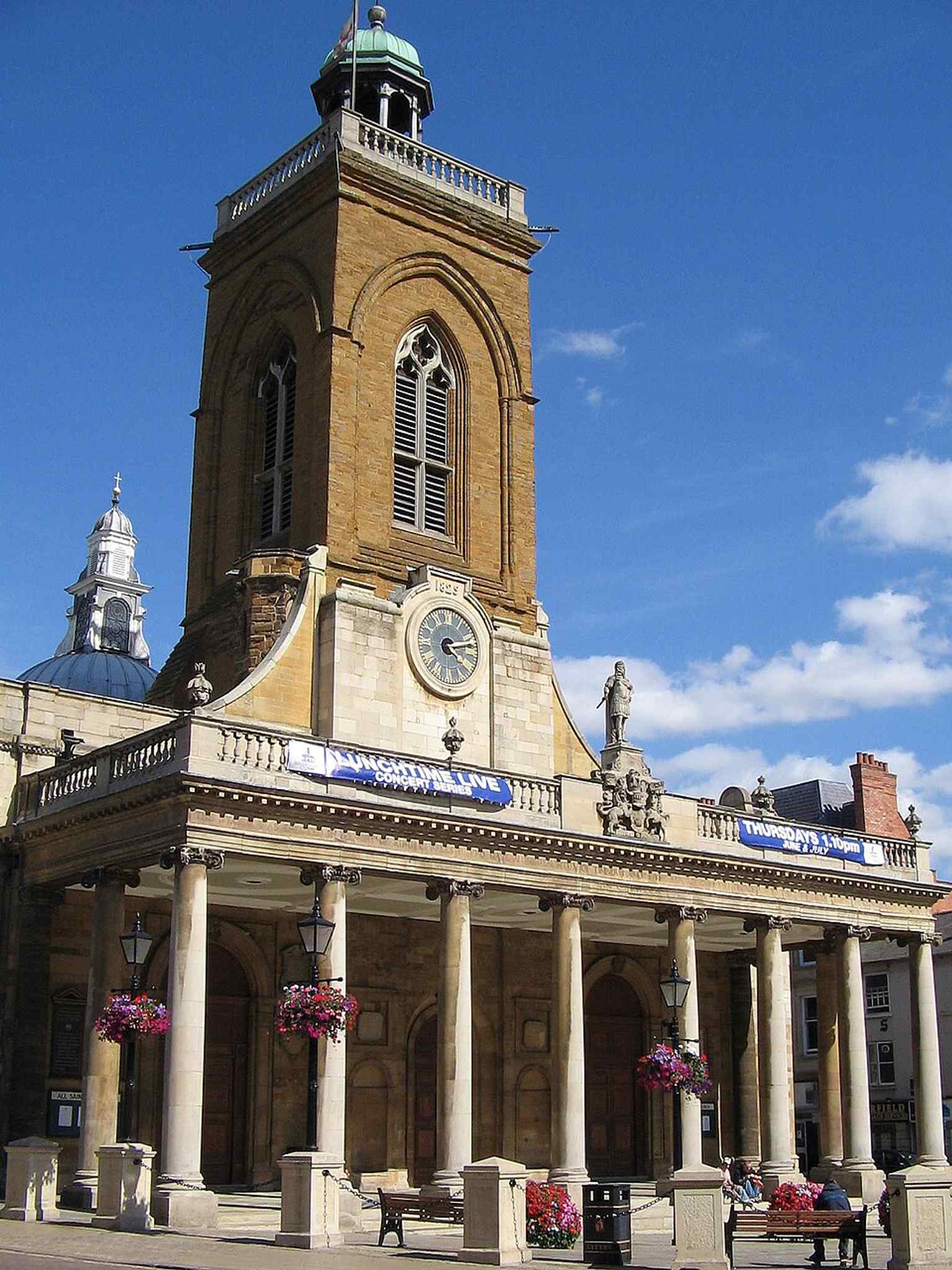
The west front of All Saints’ Church, where the 1701 portico was added in memory of Charles II’s help after the Great Fire.Photo: Original uploader was G-Man at en.wikipedia, Wikimedia Commons, Public domain. Cropped & resized.
11Northampton Guildhall
Buy tour to unlock all 16 tracksAhead of you rises a grand Gothic building of warm stone, all pointed arches and carved figures, with a long arcaded frontage stretching away to your side. Northampton Guildhall…Read moreShow less
Open dedicated page →
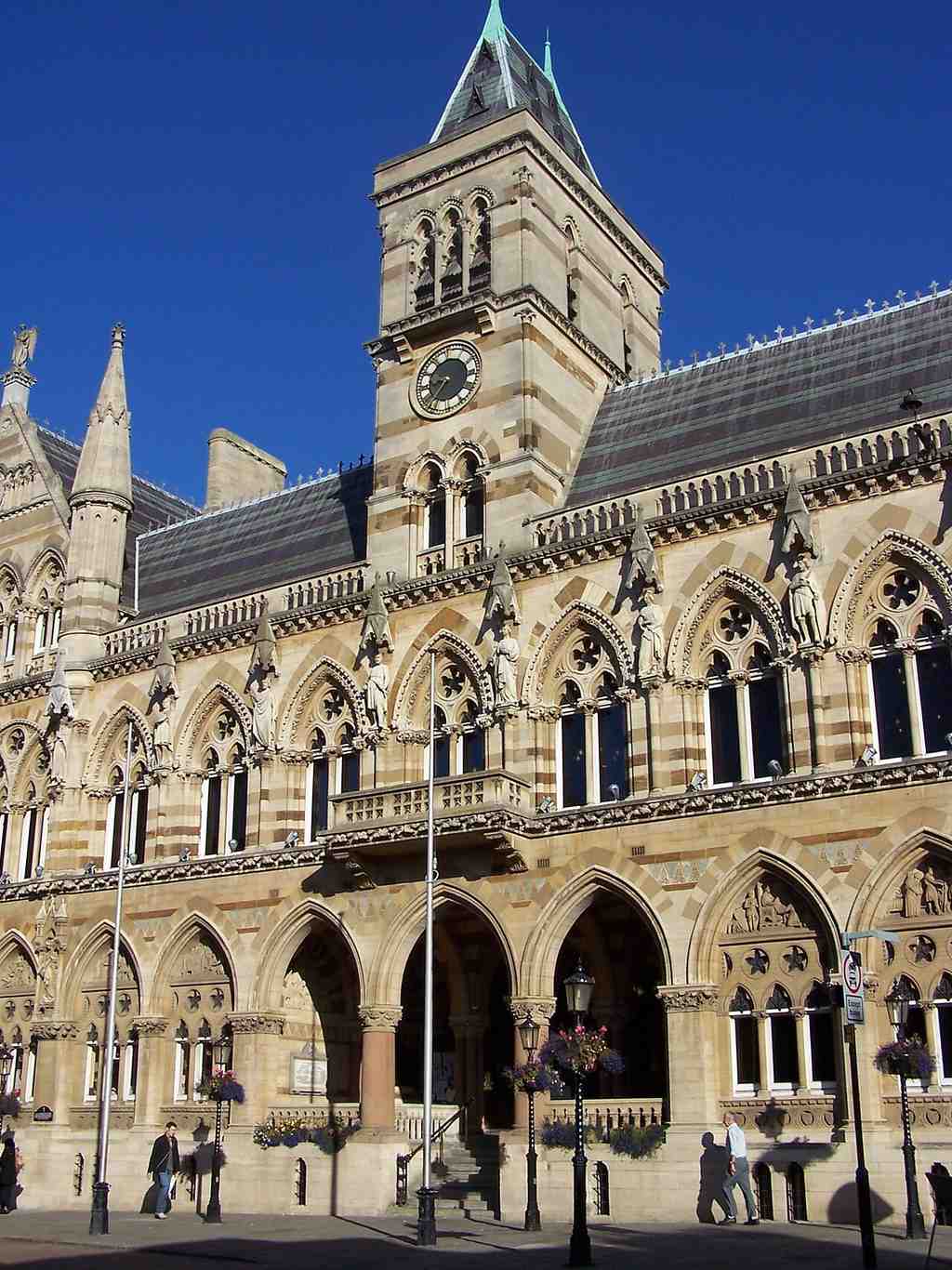
Northampton GuildhallPhoto: Chris Nyborg, Wikimedia Commons, CC BY-SA 3.0. Cropped & resized. Look for the long pale-stone Gothic frontage with pointed arches, a steep clock tower, and a row of carved figures standing between the upper windows.
This is Northampton Guildhall... the town dressing itself for public business in full Victorian confidence. Edward William Godwin designed the original building in eighteen sixty-one, when he was only twenty-eight, and he beat more than fifty rival entries to get the job. Not bad for a man still young enough to be mistaken for the intern. He opened it in eighteen sixty-four, giving Northampton a civic headquarters in Gothic Revival style, meaning a deliberate revival of medieval forms: pointed arches, vertical lines, carved stone, and plenty of moral seriousness.
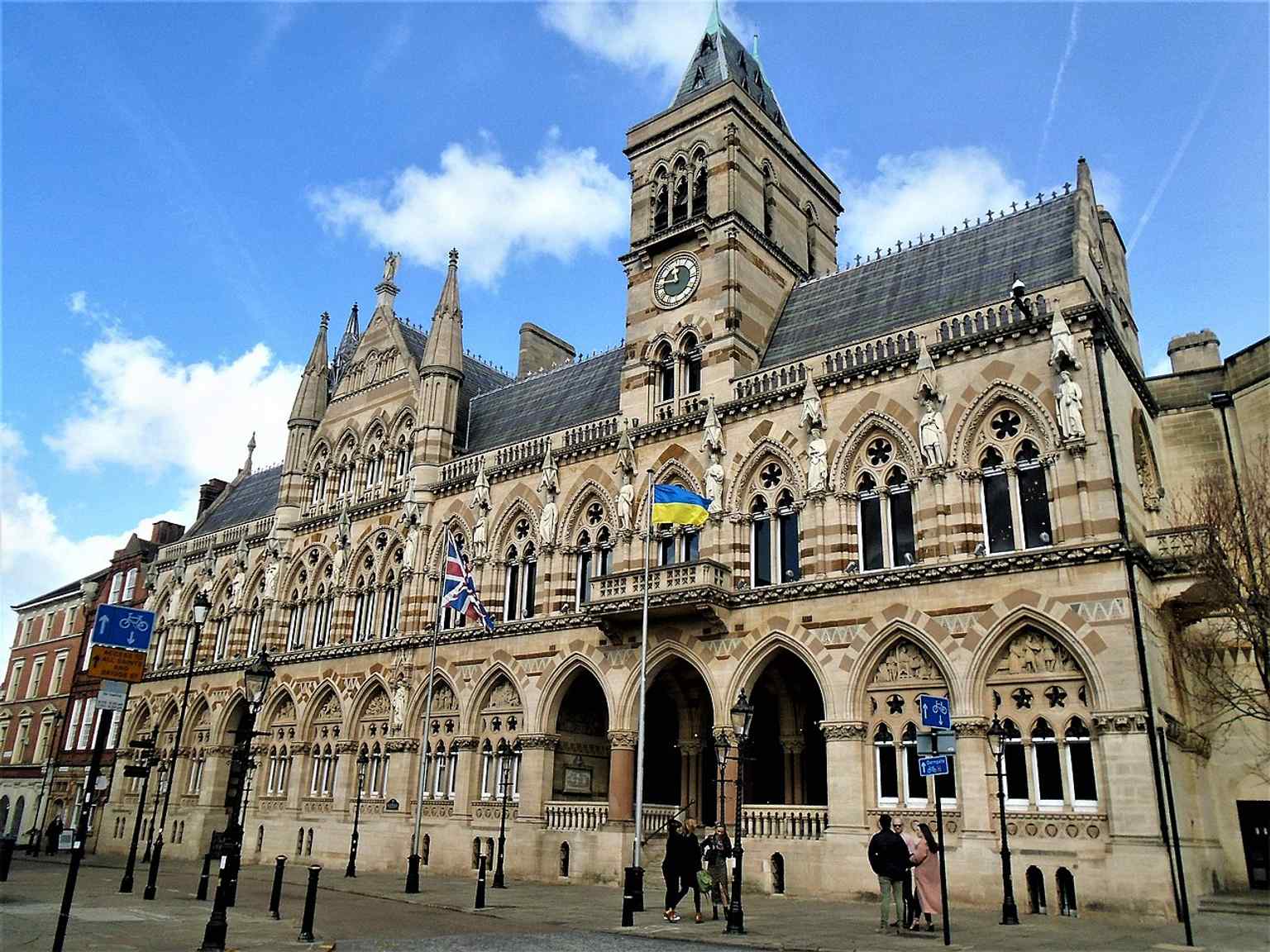
What you see stretching across the square today is even bigger than Godwin first planned. Between eighteen eighty-nine and eighteen ninety-two, Matthew Holding pushed the building westward, with A. W. Jeffrey shaping the interior, creating this long fourteen-bay front with arcading at ground level and a statue above each upper window. The facade turns local history into a stone cast list: monarchs, saints, benefactors, and scenes tied to Northampton’s legal and religious past. It is a town hall, yes, but also a public argument about who mattered here.
If you fancy it, have a look at the before-and-after image in the app; the restored frontage feels a bit sharper now, as though the stone has remembered its lines.
Inside, the council chamber did not belong only to merchants and grandees. In nineteen hundred and three, James Gribble took his seat there as a councillor for the Social Democratic Federation. Gribble had been a bootmaker since the age of twelve, and he was one of three Northampton shoeworkers elected to the council that year. That matters. In this town, people who stitched uppers and cut leather did not just vote on politics... they entered the room and made it.
Two years later, Gribble proved he was not there to admire the furniture. In May nineteen oh five, he led one hundred and fifteen striking boot operatives from Raunds on a four-day march to Westminster, protesting War Office piece-rates that had sunk to two shillings and sixpence or sevenpence a pair. From the Commons gallery, he broke protocol and shouted his demand at the Speaker. Subtle, he was not. But it worked: the pressure helped force an Arbitration Board, and the rate rose to two shillings and elevenpence a pair.
There’s a straight line from the literate cordwainers around Doddridge’s congregation to Gribble here: shoemakers in Northampton kept finding their way from the bench to the argument. This building held the magistrates above and authority all around, but working people kept walking in anyway.
Now turn your gaze toward Guildhall Road. The old County Gaol stands there, the prison built in eighteen forty-six; its east wing later became the museum, and the vaulted cells now hold the shoe collection. In the next stop, the people behind these facades reappear there in stubborn, human detail... and it’s only about a minute away.
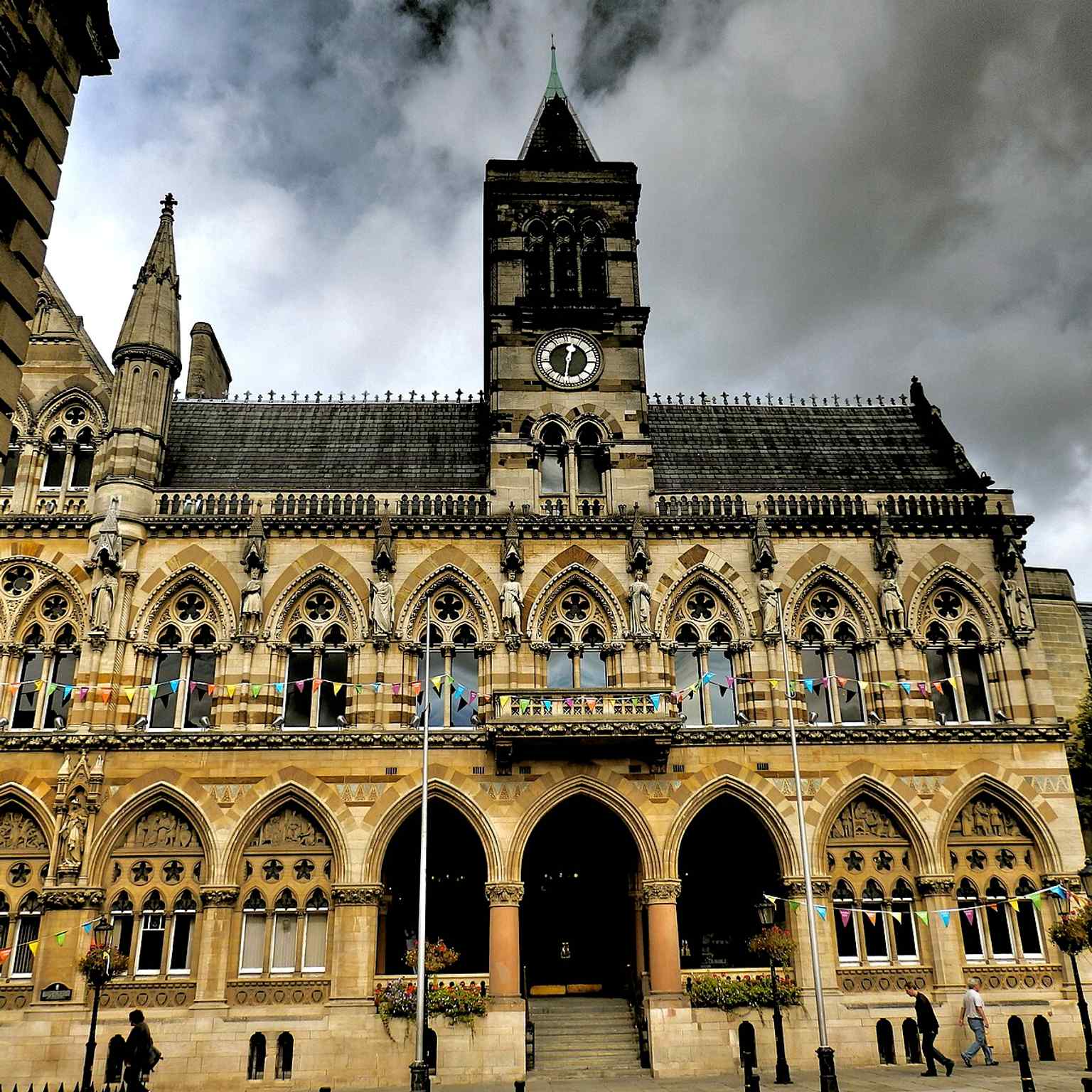
The grand Gothic front of Northampton Guildhall, with its clock tower and arcaded façade added in the 1890s.Photo: Mickyflick, Wikimedia Commons, CC BY-SA 3.0. Cropped & resized. 
The courtyard of the 1992 eastern extension, part of the modern expansion that now holds the bronze history-maker statues.Photo: Richard Kelly, Wikimedia Commons, CC BY-SA 4.0. Cropped & resized.
12Northampton Museum and Art Gallery
Buy tour to unlock all 16 tracksAhead of you is a layered building of old stone and brick joined to modern glass, with a tall glazed atrium linking the historic museum frontage to the former gaol ranges…Read moreShow less
Open dedicated page →
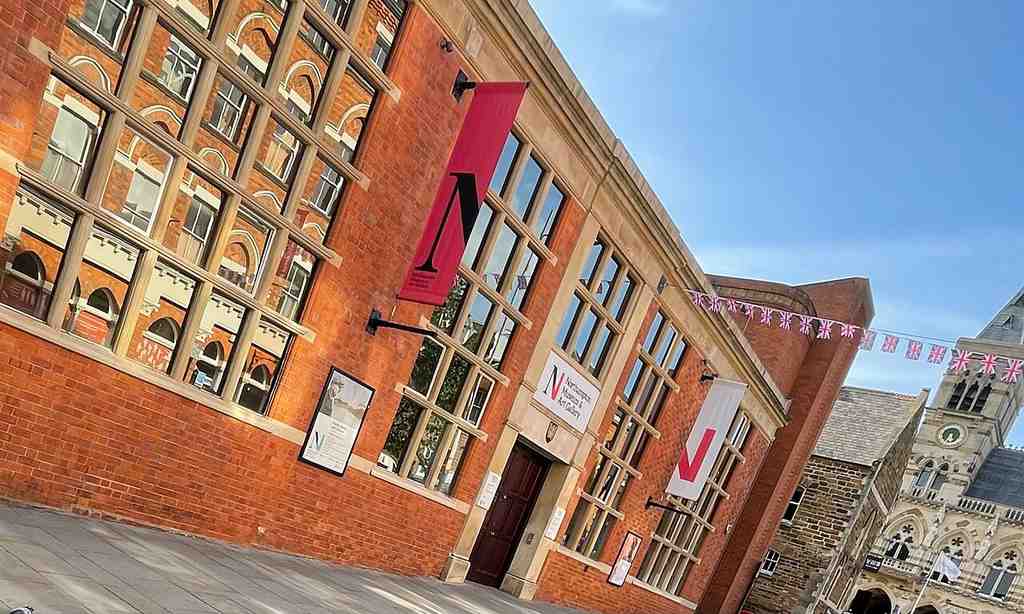
Northampton Museum and Art GalleryPhoto: StJaBe, Wikimedia Commons, CC BY-SA 4.0. Cropped & resized. On your right is a long red-brick and stone building with tall rectangular windows and, beside it, a modern glass-and-sandstone extension marked by a high glazed atrium.
This is Northampton Museum and Art Gallery, but the bones of it tell a sterner story. You’re standing at the old County Gaol on Guildhall Road. In seventeen ninety-one, reformer John Howard argued for a better kind of prison design, and by eighteen forty-six this east wing followed that thinking: a galleried jail, with single cells stacked over four floors for around one hundred and fifty inmates. The place once kept people in line... and now it keeps memory in order, which is a much better use of the space.
Most visitors never clock what happened after the prison closed. The east wing became a library, public reading room and museum, while the west wing turned into a Salvation Army barracks, with a mineral water factory down in the basement. Northampton, as ever, found a practical second life for everything.
The town founded its museum in eighteen sixty-five and moved it here in eighteen eighty-four. Not long after, local shoe manufacturer Moses Philip Manfield began donating footwear as a kind of technical library. That was in the eighteen seventies. The idea was simple and sharp: let local workers study the best shoemaking from around the world, and they’d improve their own craft. Very Northampton, really - culture, yes, but preferably with useful stitching.
If you glance at your screen, the newer work shows clearly there: the redevelopment added that glazed link and courtyard extension in glass and sandstone, more than doubling the public space when the museum reopened in twenty twenty-one. G-S-S Architecture of Kettering led the project, and the new Shoe Gallery now sits in the reclaimed vaulted cells below. Old confinement, new purpose.
That expansion cost six point seven million pounds, and the money came with a long shadow. In two thousand and fourteen, the council sold the ancient Egyptian statue of Sekhemka for fifteen point seven six million pounds. The sale caused public outrage, raised serious questions about whether the statue should ever have been treated as an asset, and cost the museum its Arts Council accreditation for years. The building you see now is part of the result: improved, bigger, and tied to an argument the town still hasn’t entirely finished having.
Inside, though, the collection earns its place. It holds more than fifteen thousand pairs of shoes, one of the largest collections in the world. If you look at the interior image, you can see how that story now unfolds in the new gallery space. And it is not only about famous footwear, though Queen Victoria’s wedding shoes, Elton John’s towering boots, and the red boots from Kinky Boots all make their entrance. The deeper story belongs to the people who worked. The anonymous outworkers sewing at home. The closing-room women stitching uppers. The four-step chain of clicker, closer, laster and finisher. The factory hands who made millions of military boots in Northamptonshire during the First World War. The makers from Raunds, from the great workshops, from the Goodyear-welted trade that gave this town its stride.
That is the quiet triumph here. In the old prison vaults, the last word no longer belongs to warders, magistrates, or donors. It belongs to the workers, and the cells below have turned from places of confinement into rooms of remembrance.
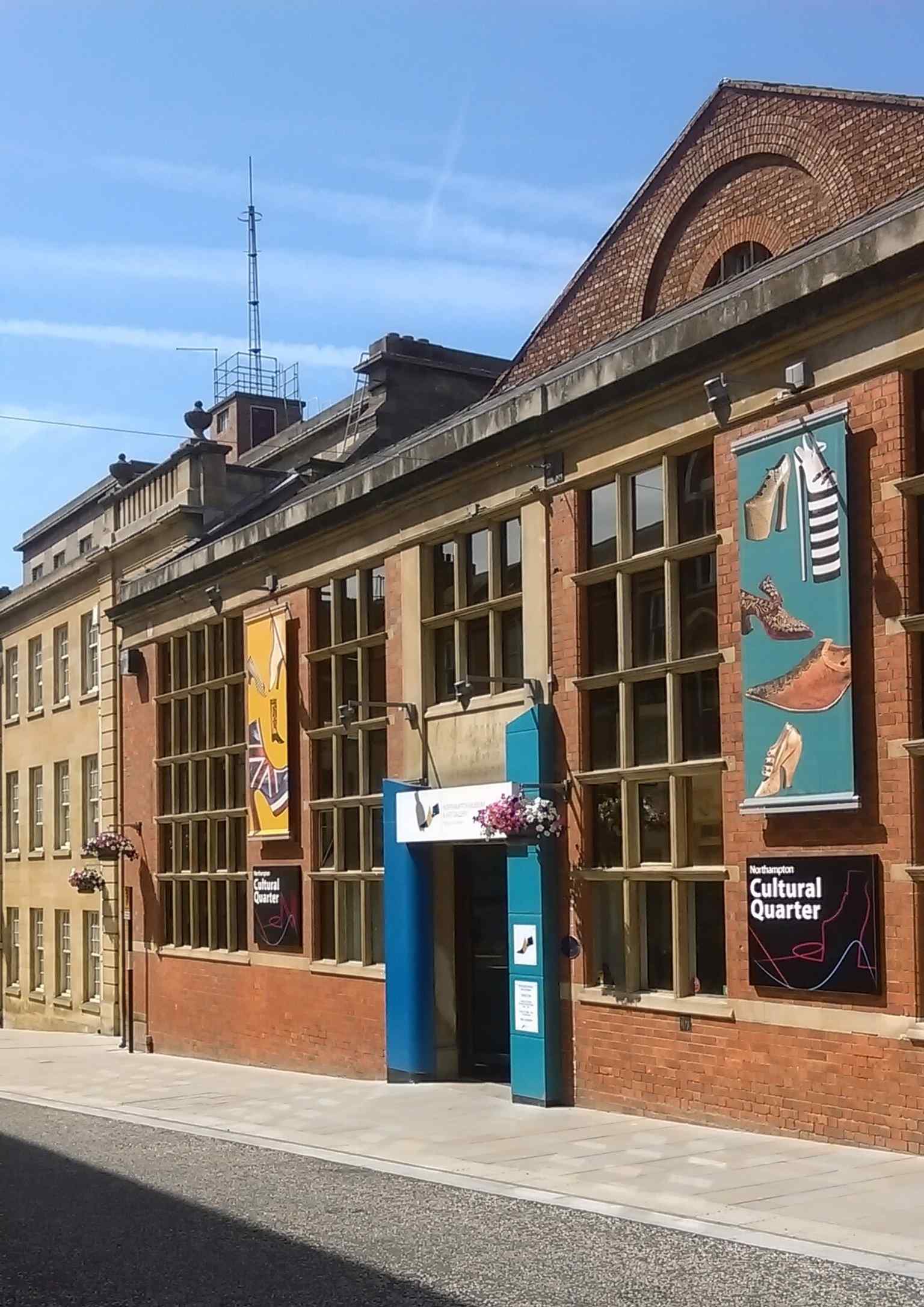
The museum’s main entrance on Guildhall Road, home to Northampton’s celebrated shoe collection since the 1884 move to the old county gaol site.Photo: StJaBe, Wikimedia Commons, CC BY-SA 4.0. Cropped & resized.
Frequently asked questions
How do I start the tour?
After purchase, download the AudaTours app and enter your redemption code. The tour will be ready to start immediately - just tap play and follow the GPS-guided route.
Do I need internet during the tour?
No! Download the tour before you start and enjoy it fully offline. Only the chat feature requires internet. We recommend downloading on WiFi to save mobile data.
Is this a guided group tour?
No - this is a self-guided audio tour. You explore independently at your own pace, with audio narration playing through your phone. No tour guide, no group, no schedule.
How long does the tour take?
Most tours take 60–90 minutes to complete, but you control the pace entirely. Pause, skip stops, or take breaks whenever you want.
What if I can't finish the tour today?
No problem! Tours have lifetime access. Pause and resume whenever you like - tomorrow, next week, or next year. Your progress is saved.
What languages are available?
All tours are available in 50+ languages. Select your preferred language when redeeming your code. Note: language cannot be changed after tour generation.
Where do I access the tour after purchase?
Download the free AudaTours app from the App Store or Google Play. Enter your redemption code (sent via email) and the tour will appear in your library, ready to download and start.
If you don't enjoy the tour, we'll refund your purchase. Contact us at help@audatours.com
Checkout securely with