
50+ languages

 Tbilisi · Georgia
 Tbilisi Audio Tours
Discover Tbilisi with self-guided audio walking tours
headphones
3 tours
pin_drop
20 landmarks
translate
Tbilisi tours
Pick a Tbilisi worth walking.
Self-guided audio tours written by people who actually live there.
3 tours
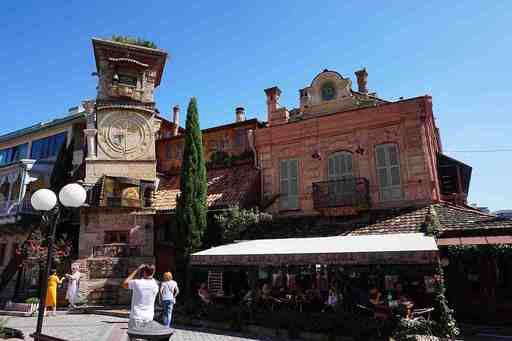
Tbilisi Highlights Audio Tour: Historic Heart and Architectural Wonders
Tbilisi is a city built on top of its own ghosts where ancient stone foundations hide whispers of forgotten revolutions. Beneath the surface of every cobblestone street lies a saga of political betrayal and architectural defiance waiting for you to unearth it. This self guided audio tour acts as your personal key to the capital. Unlock stories buried by time and visit the spots that ordinary tourists walk past without a second glance. Why did the city tremble when the Anchiskhati Basilica survived centuries of invasions? What dark secret remains hidden behind the tilting facade of the Rezo Gavriadze Theater? Can you identify which bullet holes in the walls of the Kashveti Church date back to a bloody midnight rebellion? Navigate the labyrinth of the old town as history breathes against your skin. Witness the collision of past violence and modern art. Transform your perspective on this resilient city forever. Open the map and start the walk.
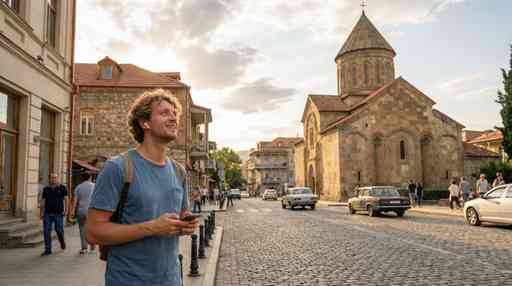
Tbilisi Audio Tour: Sacred Treasures and Legends of the Old Town
High above the tangled lanes and golden rivers of Tbilisi, legends linger behind every stone and whisper through every bell’s echo. Dive into a self-guided audio journey that peels back the centuries, revealing secrets and struggles most visitors never see. How did a fortress like Narikala withstand centuries of siege and disaster, yet crumble in a single tragic instant? What unsolved mysteries lie entombed beneath the Sioni Cathedral’s ancient stones? Why did a midnight battle over headstones erupt at the Norashen Church, splitting the city for days? Wind through royal scandals, hidden relics, forbidden prayers, and moments of revolt as you move from shadowy courtyards to panoramic ramparts. Each step draws you deeper into a city where history burns beneath your feet and every street corner could spark a new discovery. Begin exploring Tbilisi’s untold tales—if you’re ready to see what lies beyond the surface.

Tbilisi Audio Tour: A Journey Through History and Heritage
A marble lion guards the steps on Rustaveli Avenue, watching centuries of revolutions, royal scandals, and whispered secrets pass by. This self-guided audio tour unlocks Tbilisi’s living history—revealing the drama beneath every elegant arch and busy café. Find the stories locals know but visitors overlook as you trace cobblestone paths from the stately Supreme Court to the golden domes of Alexander Nevsky Cathedral and beyond. What sparked a courtroom scene so chaotic it changed the fate of a nation? Whose midnight bargain shaped Tiflis forever—yet barely left a trace? Why do old priests hush when certain names are spoken inside candlelit cathedrals? Cross battle-scarred plazas and silent gardens as shadow and sunlight chase each other over monuments to power and hope. See the Georgian capital shift in front of you with every step—a city alive with rebellion, redemption, and forgotten triumphs. Take your first stride—and let Tbilisi reveal what only the marble lion has ever truly seen.
Top landmarks
The Tbilisi everyone knows.
The landmarks in every guidebook — and the tours that tell you what guidebooks don't.
A few words on Tbilisi
Built where a king's falcon fell. Warmed by sulfur springs ever since.
Tbilisi was founded in 455 CE, according to Georgian legend, when King Vakhtang I hunted with a falcon that caught a pheasant which fell into a hot spring and cooked in the thermal water. The king built his capital where the water boiled from the earth, and the city's name reflects it still: tbili means warm in Georgian. The hot sulfur baths of the Abanotubani district, in the valley below the medieval Narikala Fortress on its volcanic ridge above the Kura River, are the oldest neighborhood in the city and still function as they have for 1,500 years, their distinctive domed bathhouses rising from lanes that narrow and wind in every direction.
The city's position at a Caucasian crossroads meant repeated conquest: Arab, Mongol, Ottoman, Persian, and Russian rulers all occupied Tbilisi over the centuries, and each left traces.
Old Town's narrow streets combine Persian-influenced wooden balconies overhanging the lanes with Russian neoclassical facades on Rustaveli Avenue and medieval churches that predate most of Western Europe's major cathedrals. The Anchiskhati Basilica, the oldest surviving church in the city, dates to the 6th century. The Peace Bridge, a glass and steel arc by Italian architect Michele de Lucchi opened in 2010, became a symbol of the city's deliberate reinvention after the Rose Revolution of 2003.
Tbilisi
Tbilisi FAQ
Before you walk.
Tbilisi has a metro with two lines that cover the main areas. The Old Town and Abanotubani are most easily reached on foot from the city center, with the cable car from Rike Park providing an alternative way up to Narikala Fortress. Bolt and Yandex Go are cheap and reliable ride-hailing options for longer distances. The city center is walkable but hilly.
Yes, Tbilisi is quite hilly. The Old Town and Abanotubani district involve steep streets and stairs, particularly around Narikala Fortress. Rustaveli Avenue and the city center below are flat. Wear shoes with grip, especially on the older cobblestone lanes in Old Town that can be slippery when wet. The cable car from Rike Park saves the steepest climb up to the fortress.
Tbilisi is notably safe and hospitable. Georgia consistently ranks as one of the safest countries in Eastern Europe and the Caucasus. Walking with headphones is not a concern. The only thing to be aware of is traffic: Tbilisi's driving culture is enthusiastic and pedestrian crossings are not always respected, so cross carefully.
Yes. The Abanotubani bathhouses are a defining Tbilisi experience. Private rooms at Orbeliani Baths or Gulo's Thermal Spa are available for around 15 to 20 euros for an hour. You can soak in sulfuric water that smells pungent but leaves your skin remarkably smooth. Book ahead for weekend visits. They open from early morning and can be incorporated into an afternoon tour without difficulty.
Every Tbilisi tour, in your language.
All 50+ languages, included with every booking.
🇬🇧 English🇫🇷 Français🇪🇸 Español🇩🇪 Deutsch🇮🇹 Italiano🇯🇵 日本語🇨🇳 中文🇰🇷 한국어+ 41 more
star AudaTours Unlimited
Visiting more than one city? Subscribe.
Unlock every Tbilisi tour — plus thousands more worldwide. Cancel any time.
$4.99/week · Cancel anytime

More in Georgia
Explore Georgia arrow_forwardOther cities to walk in Georgia.

Loved by travellersThousands of tours started.
Thousands of tours started.
Plenty of opinions.
4.8 across the App Store and Google Play. Here's a few we keep coming back to.
starstarstarstarstar
This tour was such a great way to see the city. The stories were interesting without feeling too scripted, and I loved being able to explore at my own pace.

Jess
Tbilisi Tourstarstarstarstarstar
This was a solid way to get to know Brighton without feeling like a tourist. The narration had depth and context, but didn't overdo it.

Christoph
Brighton Tourstarstarstarstarstar
Started this tour with a croissant in one hand and zero expectations. The app just vibes with you, no pressure, just you, your headphones, and some cool stories.

John
Marseille Tourdownload Get the app Pop your headphones in.


Pop your headphones in.
Step outside.
Free to download. Tours in every city. Start in 60 seconds — no account, no card.

headphones
~ 4 min until your first tour starts
public
1,000+ cities worldwide
all_inclusive
AudaTours
Unlimited
Every tour. Every city. One subscription.
3097 tours2273 cities138 countries50+ languages
$39 /year
all_inclusive Explore Unlimited