
50+ languages

 Berlin · Germany
 Berlin Audio Tours
Discover Berlin with self-guided audio walking tours
headphones
2 tours
pin_drop
20 landmarks
translate
Berlin tours
Pick a Berlin worth walking.
Self-guided audio tours written by people who actually live there.
2 tours
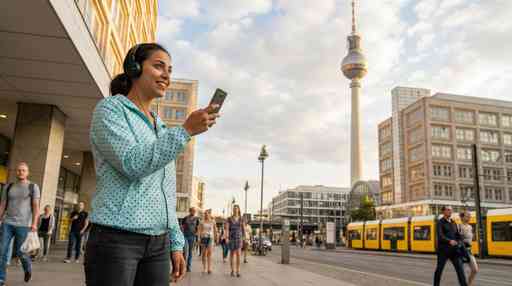
Berlin Audio Tour: Mitte Cultural Walk
In Berlin Mitte, a single square holds a screaming silence. At Bebelplatz, the ground remembers fire, words, and power. This self guided audio tour threads from the New Guard to St. Hedwig’s Cathedral and beyond, turning famous façades into living evidence. Walk at your own pace and catch the political battles, rebellions, scandals, mysteries, and forgotten moments most visitors never hear. What warning echoes through the New Guard when the city tips toward catastrophe. What secret grief is hidden beneath Bebelplatz long after the bonfires fade. Why does St. Hedwig’s Cathedral carry a strangely specific tale of doors, candles, and an unexpected visitor on a freezing night. Stride past stone and shadow, cross courtyards and checkpoints, and feel Berlin’s nerve under your feet. Each stop sharpens the city into drama, discovery, and unsettling beauty. Press play and follow the silence back to its source.
Berlin Audio Tour: Hidden Histories of Kreuzberg's Art & Resistance
A single brick in Berlin can hide a revolution or a secret handshake—the city’s streets shimmer with memories just below the surface. This self-guided audio tour invites you to peel back the layers, leading you through Kreuzberg’s vibrant pulse and into corners where the past still lingers. Why did the Martin-Gropius-Bau rise from postwar ashes to host world-changing art? What chilling powers were hatched behind the Schutzstaffel’s closed doors as dusk fell on prewar Berlin? Which underground tunnel whisked train travelers straight into the marble halls of Hotel Excelsior, right under everyone’s noses? Step boldly between bomb-scarred façades and vanished grandeur, tracing lines from jazz-soaked nights to silent ruins. Expect drama. Expect discoveries that stick in your mind like neon on wet cobblestones. Are you ready to wander deeper and see Berlin’s heart beat beneath your feet? The story begins now—listen for what history never said aloud.
Top landmarks
The Berlin everyone knows.
The landmarks in every guidebook — and the tours that tell you what guidebooks don't.
A few words on Berlin
Rebuilt from rubble, perpetually reinventing what comes next.
Berlin was divided for twenty-eight years by a wall, from 1961 to the night of November 9, 1989, when crowds gathered at the checkpoints and the guards stopped checking. The Brandenburg Gate, which had stood in the no-man's land between East and West, became the image of the reunification that followed. The Wall ran 155 kilometres through and around the city, and its ghost is still visible in the landscape: a double row of cobblestones embedded in streets marks where it stood, and the East Side Gallery, a 1.3-kilometre stretch of surviving Wall along the Spree in Friedrichshain, is the longest open-air gallery in the world.
David Bowie lived on Hauptstrasse in Schoneberg from 1976 to 1978 and made three albums in the city.
He said Berlin was the only place he could walk around without being recognised. The creative anonymity he found in the divided city, the cheap rents, the clubs in abandoned buildings, the sense that ordinary social rules did not fully apply, defined Berlin's cultural reputation for decades and echoed forward into the techno scene that emerged after reunification, the clubs like Tresor (opened 1991 in the old vault of a department store) and Berghain (which refuses to name itself on its facade) that made the city a global music destination.
Berlin
Berlin FAQ
Before you walk.
Berlin has an excellent U-Bahn (underground), S-Bahn (suburban rail), tram and bus network. A day ticket (Tageskarte) for the ABC zone covers all modes including the airport line. The Mitte neighbourhood, Museum Island, Prenzlauer Berg and Friedrichshain are all walkable or connected by frequent U-Bahn trains every few minutes.
Museum Island requires separate entry tickets for each museum or a combined day pass. Most Berlin state museums offer free entry on Thursday evenings from 6pm. The East Side Gallery is free and open at all times. The Holocaust Memorial is free to walk through, and the underground information centre beneath it has a modest entry charge.
Yes, and distances in central Berlin can be deceptive. The Brandenburg Gate to Museum Island is about a kilometre and a half. Checkpoint Charlie to Potsdamer Platz is a ten-minute walk. The city is very flat, which helps, but some areas like Prenzlauer Berg require the U-Bahn if you are combining them with Mitte in a single day.
Currywurst from a Imbiss stand (the one at Wittenberplatz has been trading since the 1950s) is the classic Berlin street food. Doner kebab, which evolved here as a fast food phenomenon in the Turkish diaspora communities from the 1970s, is excellent throughout the city. For sit-down food, the Prenzlauer Berg neighbourhood and Neukölln both have concentrated stretches of good restaurants.
Every Berlin tour, in your language.
All 50+ languages, included with every booking.
🇬🇧 English🇫🇷 Français🇪🇸 Español🇩🇪 Deutsch🇮🇹 Italiano🇯🇵 日本語🇨🇳 中文🇰🇷 한국어+ 41 more
star AudaTours Unlimited
Visiting more than one city? Subscribe.
Unlock every Berlin tour — plus thousands more worldwide. Cancel any time.
$4.99/week · Cancel anytime



Loved by travellersThousands of tours started.
Thousands of tours started.
Plenty of opinions.
4.8 across the App Store and Google Play. Here's a few we keep coming back to.
starstarstarstarstar
This tour was such a great way to see the city. The stories were interesting without feeling too scripted, and I loved being able to explore at my own pace.

Jess
Tbilisi Tourstarstarstarstarstar
This was a solid way to get to know Brighton without feeling like a tourist. The narration had depth and context, but didn't overdo it.

Christoph
Brighton Tourstarstarstarstarstar
Started this tour with a croissant in one hand and zero expectations. The app just vibes with you, no pressure, just you, your headphones, and some cool stories.

John
Marseille Tourdownload Get the app Pop your headphones in.


Pop your headphones in.
Step outside.
Free to download. Tours in every city. Start in 60 seconds — no account, no card.

headphones
~ 4 min until your first tour starts
public
1,000+ cities worldwide
all_inclusive
AudaTours
Unlimited
Every tour. Every city. One subscription.
3097 tours2273 cities138 countries50+ languages
$39 /year
all_inclusive Explore Unlimited