On your right stands a compact stone church with a square tower and, high on its oldest wall, a distinctive triple-arched window set like a frame within the masonry.
San Tirso can look modest at first glance... and that is the trick it plays. Most visitors read it as a small old church beside the cathedral. Locals know it began as something far more intimate and far more powerful: part of the palace world of Alfonso the Second, known as Alfonso the Chaste.
Alfonso the Second took the throne in the late eighth century and moved the political heart of his kingdom to Oviedo in seven ninety-one. He did not just rule from here; he reshaped the city on purpose, tying government, worship, and royal ceremony into one tight knot. He raised palaces, the early church of San Salvador, the Holy Chamber, defensive walls... and San Tirso, which served as an oratory, a private royal chapel, not simply a neighborhood parish. In plain English, this was once chapel access for the crown, not general admission.
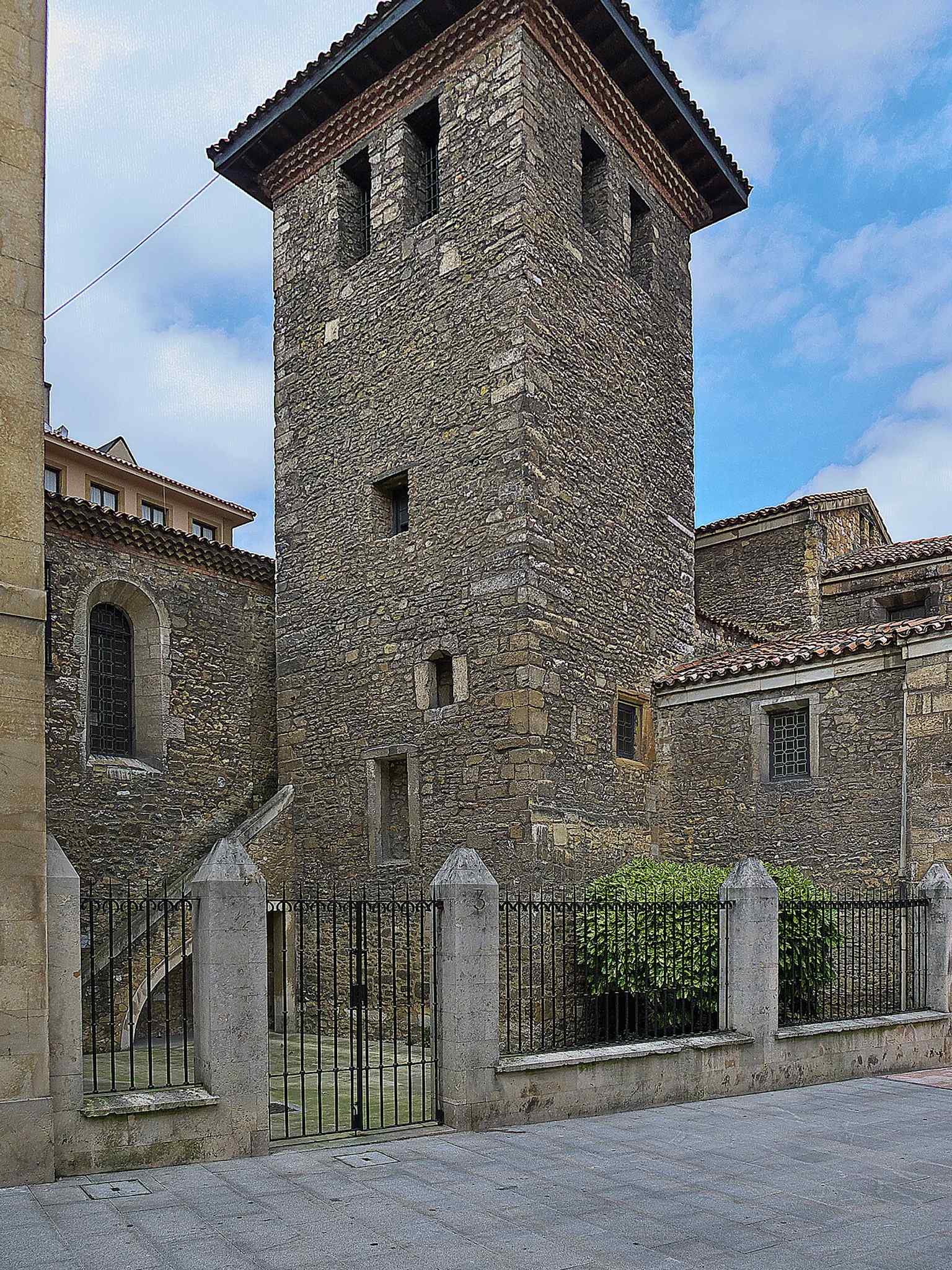
That royal beginning is easy to miss because so much vanished. Almost the whole first church disappeared under later rebuilding. What survives from Alfonso’s time is mainly the end wall of the original sanctuary, with its remarkable window: three rounded arches resting on marble columns, some of them reused from older Roman pieces, with carved capitals decorated with acanthus leaves. The upper frame around the window stands out boldly, almost like a picture border cut into stone. If you tap open the exterior photo in the app, the tower helps you place the church in that old royal compound.
And here comes the turn in the story. San Tirso is not a tidy relic preserved under glass. Fire tore through it in fifteen twenty-one and destroyed what remained of the old basilica. Builders rebuilt, then altered it again, first in Romanesque form in the twelfth century, then in later Gothic and Baroque phases. The twentieth century hit hard too: the Civil War left severe damage, and in the nineteen fifties Manzanares directed another partial reconstruction. So this church is not one clean medieval survivor. It is a survivor stitched together after repeated blows.
Even its details carry that stubbornness. The old masonry still shows small rough stone blocks with larger cut stone at the corners. Under the roofline, the projecting supports end in rounded forms locals compare to a pigeon’s breast, marked with neat stripes. Small things, maybe, but they are fingerprints from the first royal Oviedo.
Inside, the layers continue: an eighteenth-century main altarpiece by the Oviedo sculptor José Bernardo de la Meana, a much-loved image of San Tirso by Antonio Borja, and the tomb of Balesquita Giráldez, a local woman who left property to support a hospital for the poor. In two thousand and five, restorers even uncovered a painted Jerusalem hidden for centuries beneath later paint. This place keeps giving up its secrets one layer at a time.
Now turn your attention toward the cathedral. In about a one minute walk, Alfonso’s private chapel world opens outward into something much grander: San Salvador, the great sacred statement of his Oviedo.