
50+ languages

 Paramaribo · Suriname
 Paramaribo Audio Tours
Discover Paramaribo with self-guided audio walking tours
headphones
2 tours
pin_drop
20 landmarks
translate
Paramaribo tours
Pick a Paramaribo worth walking.
Self-guided audio tours written by people who actually live there.
2 tours

Paramaribo Highlights Audio Tour: Cultural and Colonial Treasures
Paramaribo hides a chaotic soul beneath its polished wooden facades and tropical heat. Here, colonial grandeur masks centuries of brutal uprisings and spiritual resilience that remain etched into the very soil of the city. Unlock these secrets with this self-guided audio tour. Navigate the historic streets at your own pace to uncover the hidden narratives that most travelers walk past without a second glance. Did a single synagogue hold the key to an entire community’s survival during a brutal regime? Why does the Independence Square pulse with the phantom echoes of long-forgotten political coups? Could a local street festival hold the ancient, hidden code to a rebellion buried for generations? Traverse the divide between past and present. Witness the city’s dramatic evolution through stories of scandal and strength. Transform a simple walk into an immersive exploration of Surinamese history. Start the journey now and see what lies beneath the surface.
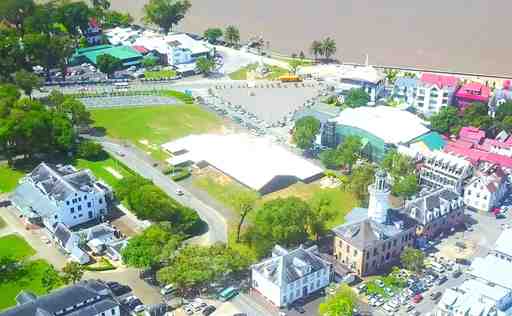
Paramaribo Audio Tour: Stories in Stone, Spirit, and Waterfront Wonders
Palm trees line the Suriname River as painted wooden buildings whisper stories older than the jungle itself. Hear the echo of secret deals and sudden uprisings along Paramaribo’s legendary Waterfront. This self-guided audio tour unlocks the city’s beating heart, taking you beyond the usual postcard views to hidden corners rich with long-lost scandals. Why did a midnight fire at the National Assembly send shockwaves through the city? What ghostly secret lingers behind the statues in Independence Square? And who vanished from a grand 18th-century townhouse without a trace, leaving only a cryptic diary behind? Feel the energy of revolution racing through cobbled lanes and leafy plazas. Stand where history cracked open and see Paramaribo shake off every mask. It is time to lift the curtain on Paramaribo. Press play and let the city’s true pulse pull you in.
Top landmarks
The Paramaribo everyone knows.
The landmarks in every guidebook — and the tours that tell you what guidebooks don't.
A few words on Paramaribo
Dutch colonial wood, tropical sun, four religions on one street.
Paramaribo is one of the most improbable cities in South America: a Dutch colonial capital built of tropical hardwood, where a Sephardic Jewish synagogue and a mosque stand side by side on Keizerstraat, where the Christian cathedral of Saint Peter and Paul is the largest wooden building in the Western Hemisphere, and where the national cuisine is a collision of West African, Javanese, Hindustani, Chinese, Dutch, and Creole traditions that makes arriving hungry an excellent policy. The city was founded as a Dutch trading post in 1613, survived English occupation, fires in 1821 and 1832 that destroyed much of the early settlement, and a Dutch return to sovereignty in 1667 as part of the Treaty of Breda that also handed New Amsterdam (New York) to the English.
The historic inner city, designated a UNESCO World Heritage Site in 2002, contains the most complete surviving collection of 17th and 18th-century Dutch colonial wooden architecture in the world.
The buildings on Waterkant Street along the Suriname River, once the trading houses and warehouses of the sugar economy built on enslaved African labor, now contain government offices, restaurants, and the Fort Zeelandia museum complex. The fort itself, originally English and renamed Dutch after 1667, overlooks the river and contains the history of the colonial period without euphemism, including the period under military dictatorship from 1980 to 1988.
Paramaribo
Paramaribo FAQ
Before you walk.
Johan Adolf Pengel International Airport is about 45 kilometers south of the city center, roughly 50-60 minutes by taxi on a good day. Direct flights connect Paramaribo to Amsterdam, Miami, and several Caribbean and South American cities. There is no rail connection. The historic inner city is compact enough to walk once you are there, but getting around the wider city requires taxis or minibus.
The historic center around Independence Square, Fort Zeelandia, Waterkant, and Keizerstraat is generally safe for tourists during the day. Normal precautions apply: don't display expensive equipment, don't walk alone in unfamiliar areas after dark, and be aware of your surroundings. Paramaribo is a working city rather than a tourist destination, which means fewer tourist-specific scams but also less tourist infrastructure.
Roti is the most beloved everyday food in Paramaribo: a soft flatbread wrapped around curried chicken, beef, or potato, brought by Hindustani workers in the colonial period and now a national institution. Pom, a baked dish of pomtajer root and chicken or salted fish, is the Creole-Dutch festive food. The central market area has Javanese, Chinese, and Hindustani street food stalls at low prices.
Strongly recommended. Mobile data in Paramaribo is available through local operators but can be inconsistent in older residential areas. Wi-Fi is available at hotels and some cafes in the tourist center. Download your tour content at your accommodation before heading into the historic streets, particularly in the areas away from the main Waterkant waterfront.
Every Paramaribo tour, in your language.
All 50+ languages, included with every booking.
🇬🇧 English🇫🇷 Français🇪🇸 Español🇩🇪 Deutsch🇮🇹 Italiano🇯🇵 日本語🇨🇳 中文🇰🇷 한국어+ 41 more
star AudaTours Unlimited
Visiting more than one city? Subscribe.
Unlock every Paramaribo tour — plus thousands more worldwide. Cancel any time.
$4.99/week · Cancel anytime

Loved by travellersThousands of tours started.
Thousands of tours started.
Plenty of opinions.
4.8 across the App Store and Google Play. Here's a few we keep coming back to.
starstarstarstarstar
This tour was such a great way to see the city. The stories were interesting without feeling too scripted, and I loved being able to explore at my own pace.

Jess
Tbilisi Tourstarstarstarstarstar
This was a solid way to get to know Brighton without feeling like a tourist. The narration had depth and context, but didn't overdo it.

Christoph
Brighton Tourstarstarstarstarstar
Started this tour with a croissant in one hand and zero expectations. The app just vibes with you, no pressure, just you, your headphones, and some cool stories.

John
Marseille Tourdownload Get the app Pop your headphones in.


Pop your headphones in.
Step outside.
Free to download. Tours in every city. Start in 60 seconds — no account, no card.

headphones
~ 4 min until your first tour starts
public
1,000+ cities worldwide
all_inclusive
AudaTours
Unlimited
Every tour. Every city. One subscription.
3097 tours2273 cities138 countries50+ languages
$39 /year
all_inclusive Explore Unlimited