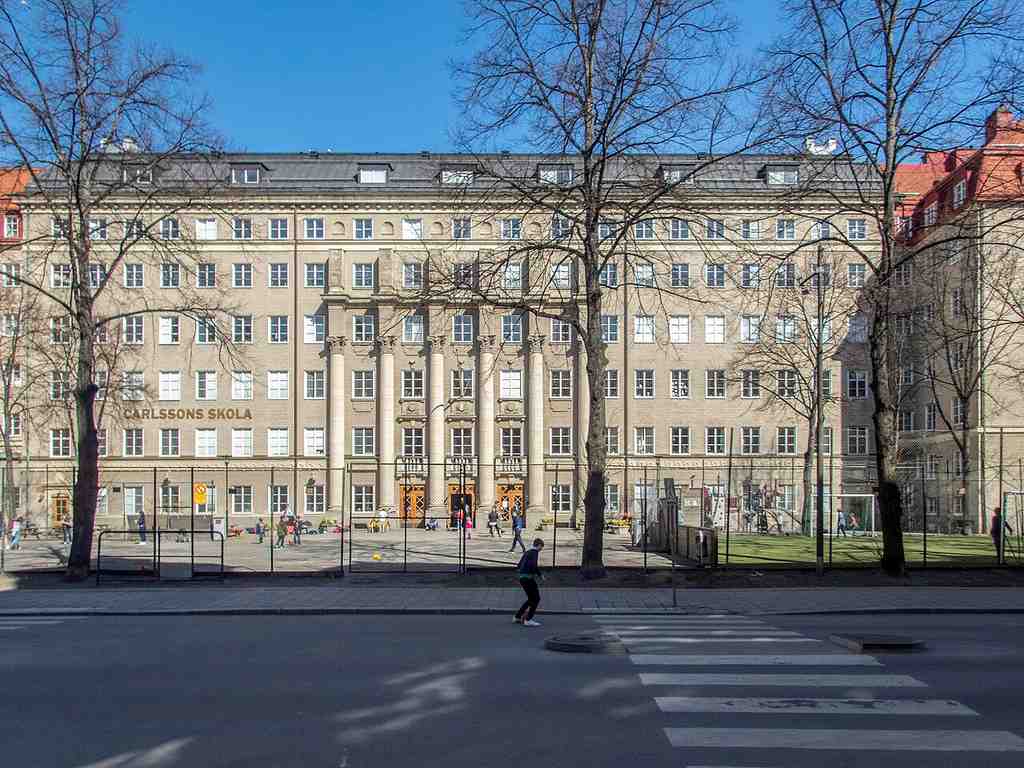
On your right is a long, pale stone school building with a formal classical front and six hefty columns topped by block-like stone crowns.
This is Ahlströmska skolan, and it started with one woman refusing to accept the limits set for her. In nineteen oh-two, Anna Ahlström, one of Sweden’s first academically educated women, opened a private school for girls. She had a doctorate, real intellectual fire, and the kind of determination that changes a city. But the system still blocked her. Authorities denied her a senior teaching post, and when she founded her own school, they would not let her use the title “rektor,” meaning head of school... even though that is exactly what she was in practice.
She began in her own apartment on Jungfrugatan with just fifteen pupils: fourteen girls and one boy in the preparatory classes. Then growth came fast. The school moved to Kommendörsgatan twenty-five, expanded into another apartment, and by nineteen oh-seven took over larger quarters at Kommendörsgatan twenty-nine. Anna Ahlström built what people called a “vertical” school, meaning students could stay here all the way from the earliest classes to studentexamen, the final exam that opened the door to university.
By nineteen twenty-two, the school had more than four hundred students. There were preparatory classes, an eight-year girls’ school, and a four-year gymnasium, or upper secondary program, where students could choose a Latin track focused on classical languages or a “real” track centered on science and modern subjects. That is such a powerful statement: serious academic training for girls, right here, at a time when society still tried to keep women in a smaller room.
And then came this building. The plot had a dramatic past: first a circus ground, then exhibition uses, and later Östermalmsteatern, which burned in nineteen thirteen. Anna Ahlström saw possibility in the ashes. She bought the site in nineteen nineteen. Architect Gustaf Petterson drew early plans, and Albin Stark finished the design that rose here and opened in nineteen twenty-six. Look at the scale of it... seven stories in the main building, wings with apartments, and that proud classical façade. Anna wanted a girls’ school that could stand shoulder to shoulder with Stockholm’s grand boys’ schools like Norra Latin and Östra Real.
She did not do it alone. Her closest partner was Ellen Terserus, a language teacher educated in Britain. People called them “Ahlan and Tersan.” They were colleagues, co-leaders, and life companions in what was known as a Boston marriage, a term for two women living together independently and sharing a life. They poured energy into the school’s spirit, handpicked highly trained teachers, and created an environment where girls met chemists, physicists, writers, and thinkers as role models. Even Ada Nilsson, the socially engaged doctor who fought for women’s rights, served as the school physician.
The story kept evolving. The school became coeducational, officially took the name Ahlströmska skolan in nineteen seventy, entered the municipal system in nineteen seventy-three, and closed in nineteen ninety-five. Today, Carlssons skola uses the building, while the Anna Ahlström and Ellen Terserus Foundation still supports women scholars... a beautiful afterlife for a school born from stubborn ambition.
If you want to go inside, the school is generally open weekdays from eight in the morning until four, with a shorter day on Friday ending at one in the afternoon.
This façade still feels like a declaration that education belongs to everyone.
When you’re ready, continue on to the next stop and let this story of courage travel with you.