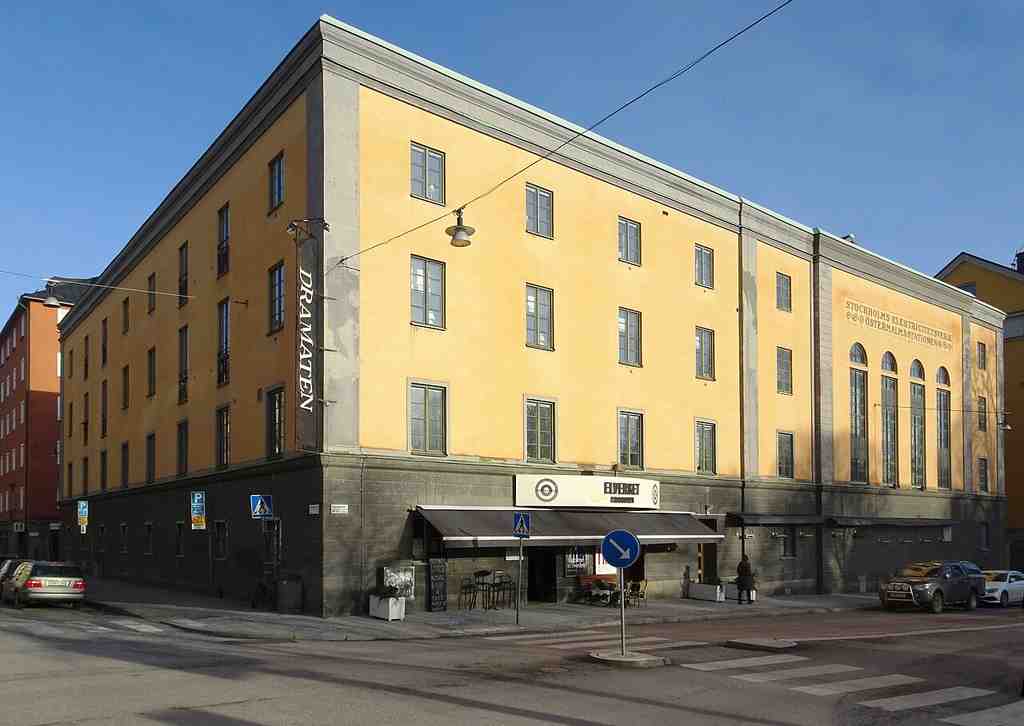
On your left, look for a large pale stucco block with smooth walls, four tall arched windows, and a raised roof lantern running along the top.
This place began as Östermalmsstationen, a transformer station - a building that converts electricity so a neighborhood can actually use it. After the First World War, Stockholm’s power appetite exploded, so the Värta power works pushed for new substations, and architect Gustaf de Frumerie gave this one real muscle between nineteen twenty-three and nineteen twenty-five. Kreuger and Toll built it for the city’s Gas and Electricity Works, and you can still feel that industrial confidence. Those high arched windows flooded the transformer hall with daylight, while the roof lantern - that raised strip along the roof - also pulled in air to cool the machines. Amazingly, this was the last Stockholm substation to give up direct current, in nineteen seventy-three.
Then came a gorgeous second act. Since nineteen ninety-seven, Dramaten has used it as Elverket, and since twenty twenty-one it has shared the stage with Dansens hus for experimental theater and modern dance.
A power station turned performance engine... that is Stockholm at its best. From power to performance, this building shows how Stockholm likes to reuse its bones.