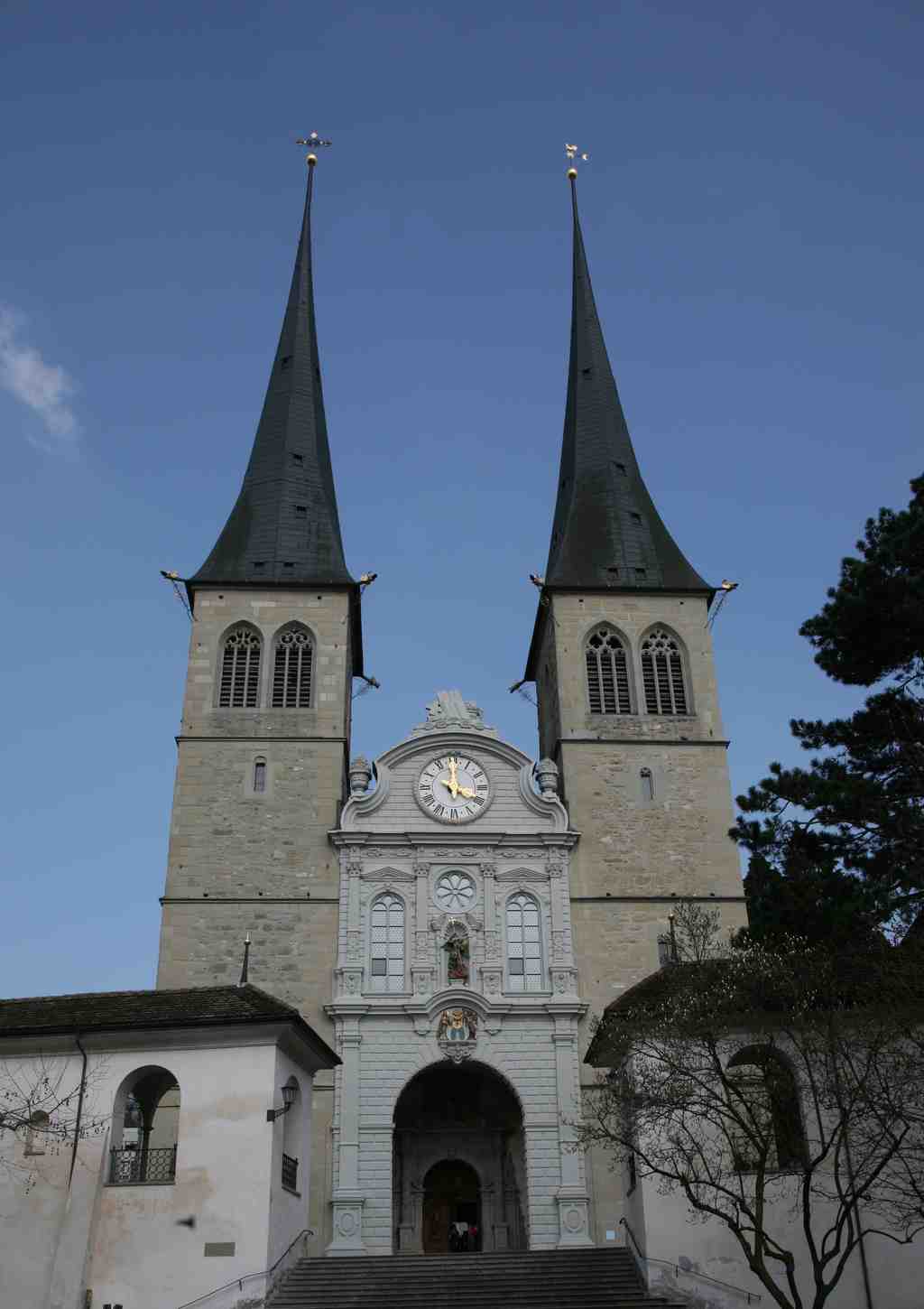
Standing at the foot of the steps, look up to spot St. Leodegar with its imposing twin towers shooting high into the sky, their steep dark roofs and ornate facade making it impossible to miss.
Ah, you’ve arrived at one of Lucerne’s proudest symbols-and trust me, those dramatic spires are no accident. Now, picture this: It’s the year 735, and a few noble folks from south Germany decide this very hilltop is just perfect for a tiny monastery. The place starts out as a humble spot dedicated to Saint Maurice, but a few generations later, King Pepin the Short-yes, Charlemagne’s dad-donates land and people for the monks, and thus Lucerne’s name first appears in the archives. Fast forward a bit, and after a few ups and downs (including the whole monastery vanishing for a while-imagine if your house did that), it rises again stronger, becomes part of the Benedictine order, and finally, Saint Leodegar is chosen as the star patron.
As you gaze at those towers-each 69 meters high-see the dragon-headed gargoyles peeking from the corners, and maybe even squint to spot a golden lily cross on the north tower and a rooster weathervane on the south. These towers survived a wild and fiery disaster: In 1633, on Easter Sunday, a clueless roofer is told to clear out the pesky jackdaws from the spires. Let’s just say, he took “cleaning” a bit too literally, and with a few shots, the dry, ancient wood goes up in flames. By morning, the entire church is a smoldering ruin-except, miraculously, for these very towers, a few treasures, and a sculpture of Mary.
But Lucerne’s spirit isn’t so easily doused! Straight away, the city vows to rebuild. They hire Jakob Kurrer, a Jesuit from Ingolstadt, and by 1639, an architectural marvel rises-a blend of Gothic (the tough old towers), Renaissance (look at that impressive central doorway), and Baroque (the flourishes atop). Above the main entrance, St. Leodegar stands with his trusty drill-he’s something of a mascot here, and next to him, St. Maurice with his flag. Enter through the great portal and you’d find soaring corridors, woodcarvings, and a gleaming black marble altar donated by a papal diplomat who wanted true Roman style even this far from Rome.
Now, for a peculiar quirk: This church owns one of Switzerland’s oldest and heaviest sets of bells, with some giants over five tons. On feast days, these legends come to life overhead. Can you feel it rumble in your bones?
And there’s more. Through centuries of history-whether under the Benedictines, Habsburgs, or even as a home base for the Pope’s ambassador during the Catholic Reformation-this spot has witnessed wild swings of fortune. Important families are buried all around, and rumor has it, the cemetery is like a VIP lounge for Lucerne’s history. The legendary Hoforgel organ, with pipes reaching nearly eleven meters and weighing as much as a small elephant, can whip up sounds from a whisper to a full thunderstorm. There’s even a “rain machine” inside the organ for the ultimate musical drama.
Don’t miss that tiny little door to the north-the secretive-looking one. Behind that, a treasure chamber hides some of the country’s most dazzling relics and nearly life-sized silver saints-art so rare that some pieces had to be smuggled out to save them from being melted for war repair money.
Year after year, the Hofkirche is the stage for processions where knights, altar boys (“Zwergli”), and even a saintly Santa parade solemnly (or sometimes joyfully) through Lucerne, rain or shine. All told, this church is where stories, music, fire, and faith have collided for over a thousand years. If those stone seats and bright stained glass could talk, they’d have more tales than a Swiss cheese has holes-although, lucky for you, I get to do the storytelling today.
Ready to ring in the next chapter? Let’s carry on!
Ready to delve deeper into the exterior of the court church, inside or the treasury and lucerne abbey treasure? Join me in the chat section for an enriching discussion.