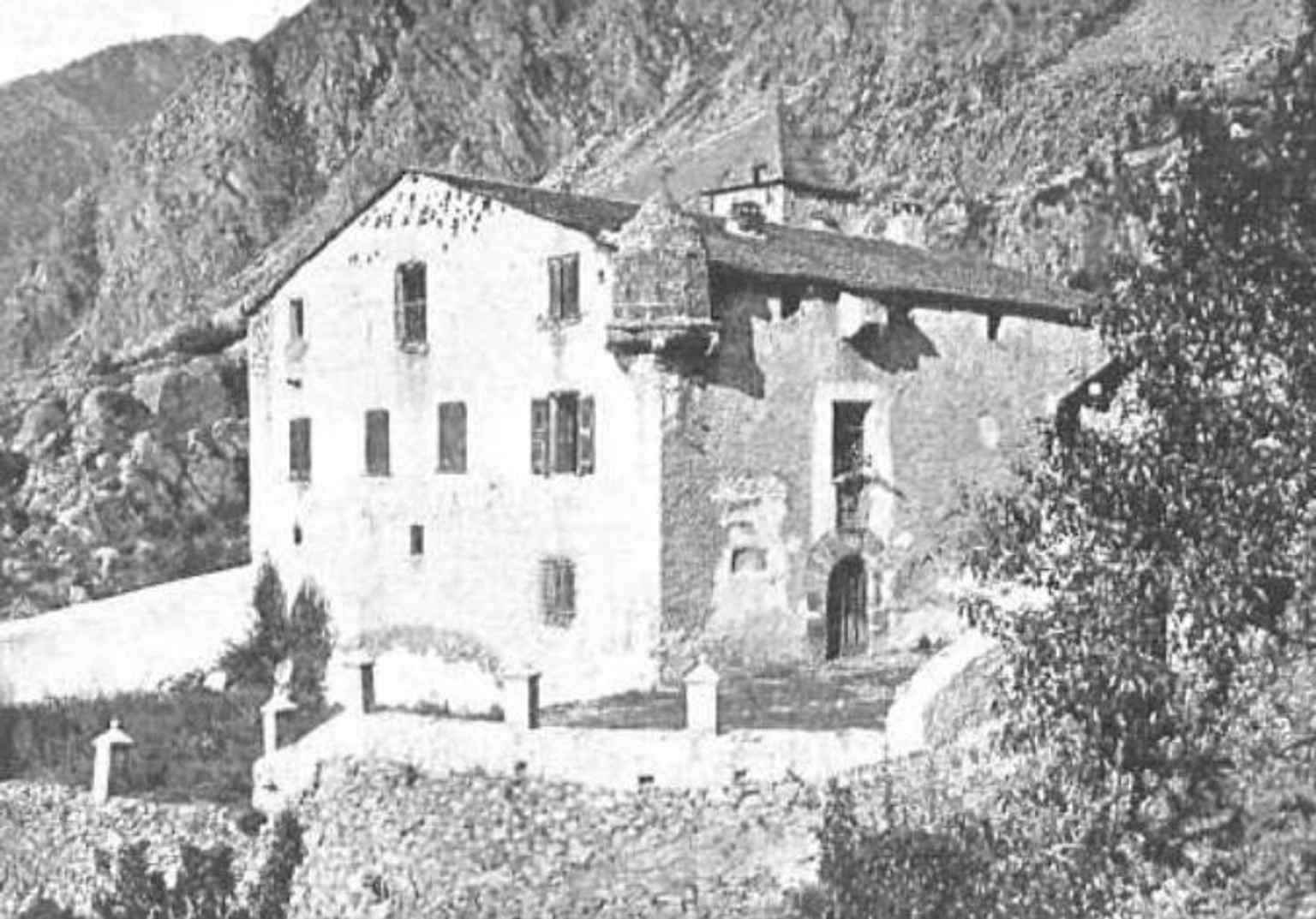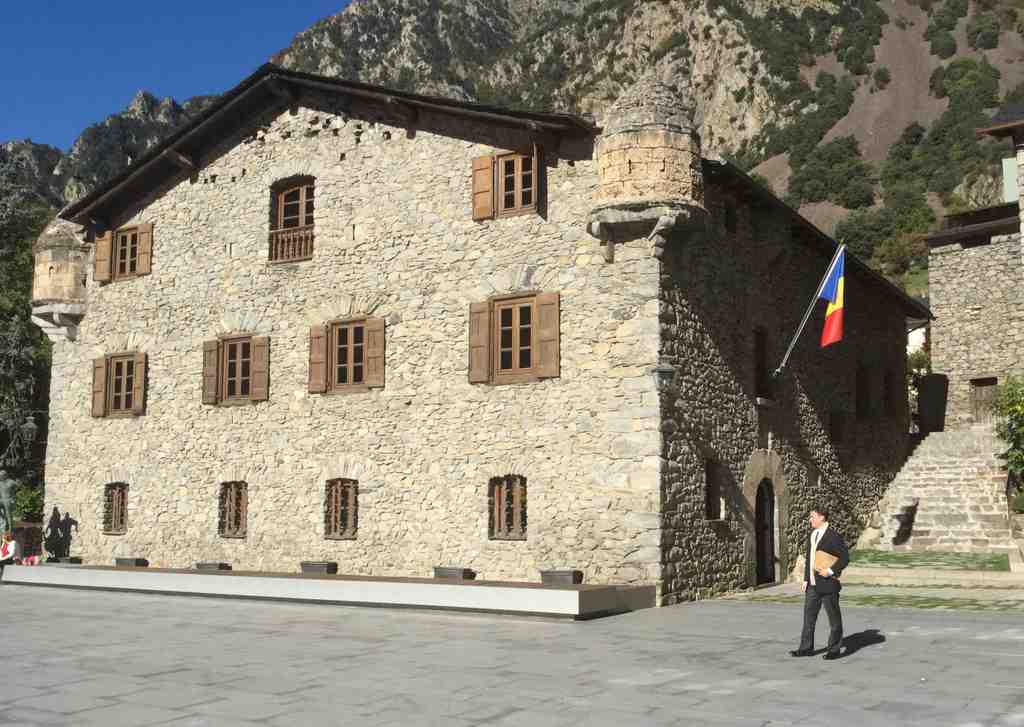
On your left, Casa de la Vall is a sturdy stone rectangle with a steep dark roof, a small corner turret shaped like a dovecote, and carved coats of arms set by the doorway.
For a country’s old parliament, it looks almost humble... and that is part of the charm. Before this house took on public life, Andorra’s governing body, the Consell de la Terra, had no fixed chamber at all. Meetings gathered in church porches, and when that failed, the heads of household met in cemeteries beside the churches. That is not a grand marble beginning. It is practical, local, and just a little astonishing.
Then Antoni Busquets enters the story. He was the vicar of Andorra la Vella, and in fifteen eighty he created this place as a family manor with a defensive tower. He even recorded it in his will of sixteen oh three. A clerical family house, solid and private, stood here waiting for a second life it could not have guessed.
That second life arrived when the General Council bought the house on the nineteenth of December, seventeen oh one, for one thousand six hundred and fifty lliures... a serious sum at the time. By seventeen oh two, the Busquets home had become the seat of the land’s government. Not bad for a family residence. One minute you are minding the household; the next, you are hosting the state.
Inside, each level picked up a job. The ground floor handled justice, with the courtroom set where stables once stood before restoration reshaped the space in the early nineteen sixties. Upstairs, the old family floor turned into the Council Chamber, a chapel dedicated to Saint Ermengol, and the famous closet of the seven keys, a cabinet for historic documents. Each parish held one key, so no single hand could open the archive alone. That little bit of locksmithing tells you plenty about Andorra’s political instincts.
Those documents included the Manual Digest and the Politar Andorrà, texts that helped define how this tiny country understood itself. For a brief spell in nineteen thirty, what became the National Library even moved in here, turning the old parliamentary house into a makeshift cultural storehouse too. Later, the top floor changed again: it held the Postal Museum until the early nineteen nineties, then made room for the three-party commission that drafted Andorra’s Constitution in nineteen ninety-three. If you want a quick time jump, check the before-and-after image in the app; the nineteen oh seven view makes this restored landmark’s many reinventions easier to spot.
And politics here was not neat and tidy. Winter sessions could drag on so long that councilors slept in the building and shared heavy meals under this roof. Parliament, court, hostel, archive... this house wore more hats than a mountain pack mule. If you look at the detail image on your screen, you can see the old arms by the doorway, where the Busquets family and Andorra quite literally meet on the same stone threshold.
Even after the new parliament opened next door in twenty eleven, this house kept its ceremonial role. So let me leave you with this: if your parliament began in porches and graveyards before settling into a former home, does that make power seem fragile... or wonderfully close to ordinary life?
And notice one more thing before we move on: here, government and worship stood almost side by side, which sets us up nicely for Església de Sant Esteve, about a four-minute walk away. If you plan to return, Casa de la Vall usually opens from ten to two and again from three to six, with shorter hours on Sunday.