
50+ languages

 Bremen · Germany
 Bremen Audio Tours
Discover Bremen with self-guided audio walking tours
headphones
2 tours
pin_drop
20 landmarks
translate
Bremen tours
Pick a Bremen worth walking.
Self-guided audio tours written by people who actually live there.
2 tours

Bremen Highlights Audio Tour: Historic Landmarks and Riverside Beauty
Bremen is not just a city of fairy tales. Beneath its cobblestones lie centuries of merchant greed, bloody political rebellions, and artistic obsession. Unlock these secrets with this self-guided audio tour. Wander beyond the standard guidebook path to uncover scandals and forgotten moments that shaped this Hanseatic powerhouse. Why did a local tycoon turn his home into a temple for gold and dark history? What haunting secret forced a painter to hide her most private works from the public eye? Can you find the exact spot where a lonely windmill once served as the final witness to a public execution? Trace the pulse of the city through shadow and stone. Feel the weight of history as you navigate from the quiet halls of the Paula Modersohn-Becker Museum to the imposing Herdentor Wallmill. Put on your headphones. The city is ready to confess.
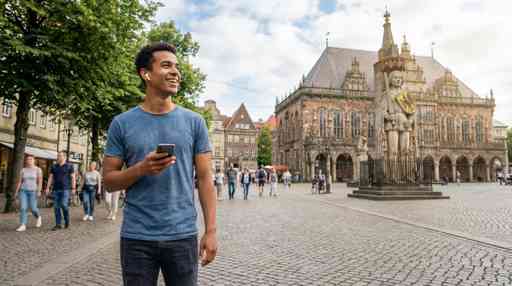
Bremen Audio Tour: Merchants, Markets & Medieval Echoes
Bremen hides more secrets behind glass, brick, and steel than most travelers ever imagine. Beneath the city’s energetic surface pulse are whispers of vanished fortunes, scandalous ambition, and moments that nearly changed history forever. This self-guided audio tour invites you to wander from Melchers’ globe-spanning business empire to the fabled crossroads of Am Brill and into the shadows of Greensill Bank’s shocking collapse. Along the way, uncover stories even locals overlook. Who sabotaged Bremen’s most influential financiers in a single dizzying week? What haunted legend lingers beneath the cobbles at Am Brill, waiting for dusk to return? Why did a small company’s decision in far-off Hawaii alter Bremen’s fate for decades? Step through centuries of political intrigue, daring escapes, city-wide transformations, and unquiet ghosts—feel each stride opening new chapters under your feet. Ready to see Bremen through the eyes of its boldest risk-takers and hidden conspirators? The secrets start now.
Top landmarks
The Bremen everyone knows.
The landmarks in every guidebook — and the tours that tell you what guidebooks don't.
A few words on Bremen
A Hanseatic republic that never stopped being proud of it
Bremen has been governing itself since 1358, when it joined the Hanseatic League and began acquiring the stubbornly independent civic identity it has never relinquished. The city-state of Bremen, which also encompasses the port of Bremerhaven 60 kilometers to the north, is the smallest German state and one of only three that are city-states. The Marktplatz at the center of the old town is one of the great medieval squares of northern Europe: Roland's Column, erected in 1404 as a symbol of civic freedom, stands 10 meters tall before the Gothic Town Hall, and both were awarded UNESCO World Heritage status in 2004 as outstanding examples of the assertion of civic rights against feudal authority.
The Bottcherstrasse, a narrow alley off the Marktplatz, was entirely reconstructed between 1922 and 1931 by Ludwig Roselius, a Bremen coffee merchant who invented decaffeinated coffee and made a considerable fortune selling it under the Kaffee HAG brand.
He hired expressionist artists to create a street of red brick buildings that functions as an outdoor gallery of early 20th-century German art. The Schnoorviertel, a short walk from the Marktplatz, is a surviving medieval quarter of fishermen's cottages now housing cafes, galleries, and craft shops. The Brothers Grimm collected the story of the Town Musicians of Bremen, a donkey, dog, cat, and rooster who journeyed here for a better life, and their bronze statue on Obernstrasse outside the Town Hall has had its donkey's nose polished bright from decades of tourists rubbing it for luck.
Bremen
Bremen FAQ
Before you walk.
The Bottcherstrasse is a 100-meter alley transformed between 1922 and 1931 into a showcase of expressionist architecture by coffee magnate Ludwig Roselius. The red brick facades, sculptures, and towers are deliberately fantastical. The Paula Modersohn-Becker Museum at number 6, dedicated to the pioneering German expressionist painter who worked nearby in the artists' colony at Worpswede, is the cultural highlight of the street.
The Schnoorviertel is Bremen's surviving medieval quarter, a neighborhood of narrow lanes and small cottages dating from the 15th and 16th centuries that was originally home to fishermen and rope-makers. Today it houses cafes, restaurants, galleries, and small shops. It is the most atmospheric walking neighborhood in the city and easily reached on foot from the Marktplatz.
The bronze donkey, dog, cat, and rooster statue, created by sculptor Gerhard Marcks in 1953, stands on Obernstrasse on the west side of the Town Hall. The donkey's nose has been polished smooth by generations of tourists who rub it for luck. The story, collected by the Brothers Grimm, ends with the animals never actually reaching Bremen, which locals find appropriately ironic.
Labskaus, a sailor's hash of salt beef, beet, and herring with a fried egg on top, is the traditional Bremen dish and an acquired taste that locals are proud of. The fish market along the Schlachte embankment has fresh North Sea fish. Bremen also has a strong coffee culture, partly owing to Kaffee HAG being invented here, and there are excellent independent roasters in the Viertel quarter.
Every Bremen tour, in your language.
All 50+ languages, included with every booking.
🇬🇧 English🇫🇷 Français🇪🇸 Español🇩🇪 Deutsch🇮🇹 Italiano🇯🇵 日本語🇨🇳 中文🇰🇷 한국어+ 41 more
star AudaTours Unlimited
Visiting more than one city? Subscribe.
Unlock every Bremen tour — plus thousands more worldwide. Cancel any time.
$4.99/week · Cancel anytime


Loved by travellersThousands of tours started.
Thousands of tours started.
Plenty of opinions.
4.8 across the App Store and Google Play. Here's a few we keep coming back to.
starstarstarstarstar
This tour was such a great way to see the city. The stories were interesting without feeling too scripted, and I loved being able to explore at my own pace.

Jess
Tbilisi Tourstarstarstarstarstar
This was a solid way to get to know Brighton without feeling like a tourist. The narration had depth and context, but didn't overdo it.

Christoph
Brighton Tourstarstarstarstarstar
Started this tour with a croissant in one hand and zero expectations. The app just vibes with you, no pressure, just you, your headphones, and some cool stories.

John
Marseille Tourdownload Get the app Pop your headphones in.


Pop your headphones in.
Step outside.
Free to download. Tours in every city. Start in 60 seconds — no account, no card.

headphones
~ 4 min until your first tour starts
public
1,000+ cities worldwide
all_inclusive
AudaTours
Unlimited
Every tour. Every city. One subscription.
3097 tours2273 cities138 countries50+ languages
$39 /year
all_inclusive Explore Unlimited