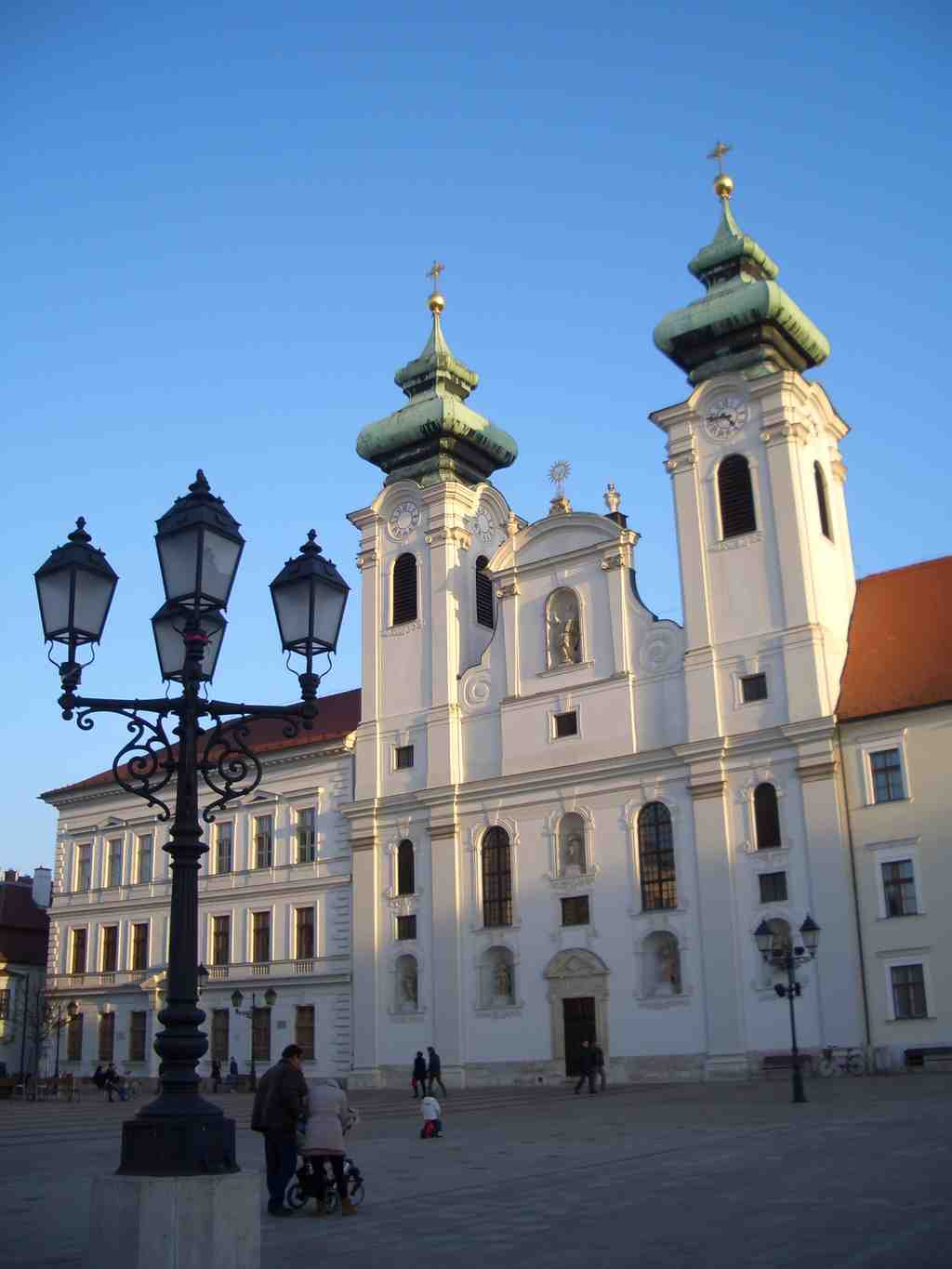
Look for the pale stone facade with two square towers, a high arched doorway, and dark onion-shaped domes rising above the roofline.
This church does not play modestly. It faces the square like a set piece, and that is fitting, because baroque architecture aimed for drama: movement, grandeur, and the feeling that faith should reach you through the eyes before it ever reaches the sermon. Locals sometimes point out something most visitors miss: this is not simply a beautiful church in Győr. It is considered the earliest baroque-style church built in present-day Hungary, which gives this facade a place in the national story, not just the local one.
The Jesuits started that story. In the sixteen twenties, Bishop Miklós Dallos gave them this plot, and Archbishop György Szelepcsényi pushed the project forward. Between sixteen thirty-four and sixteen forty-one, the Jesuits followed plans by Baccio del Bianco and raised a church that helped define the rebuilt city after the Ottoman wars. They taught, studied, supported science, and staged school dramas too, so even here, education and spectacle walked hand in hand.
Then came a sharp institutional turn. In seventeen seventy-three, Maria Theresa enforced the papal suppression of the Jesuits. Empires did love reorganizing other people’s lives. But here the story did not break. The Benedictines stepped in, took over the church, school, and monastery, and carried on the same educational and spiritual mission. It feels less like replacement than a careful passing of custody.
You can still read some of that continuity on the front. Above the entrance, a stone-framed date marks the church’s consecration in sixteen forty-one. Statues stand in the facade niches like actors paused between entrances. The twin towers, finished by the sixteen fifties, gave the whole composition a formal balance that still commands the square.
Inside, the design becomes even more deliberate. The main hall opens directly to side chapels, instead of connecting chapel to chapel, so the space feels unusually unified, almost theatrical in the best baroque sense. In the seventeen forties, Bishop Ádám Acsády donated a new high altar of red limestone, and Paul Troger painted the great altar image of Saint Ignatius in glory. Troger also slipped his own face into the sanctuary ceiling, painting himself as Saint Luke. Painters, like playwrights, do enjoy a cameo.
This place kept company with real people, not just saints. Tradition says Lajos Batthyány and Ányos Jedlik both wore down these pews, along with generations of students from the Benedictine school beside it. That matters. A building survives in stone, but a community survives in repeated acts: teaching, worship, music, memory. Even the restoration respected that long thread, and the renewed main hall earned major international conservation praise in two thousand seven.
Now let your attention drift from this disciplined facade to the square in front of it. The church offers order, but the open space ahead has seen markets, ceremony, and some far less serene public business. We’ll step into Széchenyi Square next, about a minute away. If you want to return later, the church is generally open every day from eight in the morning until seven in the evening.