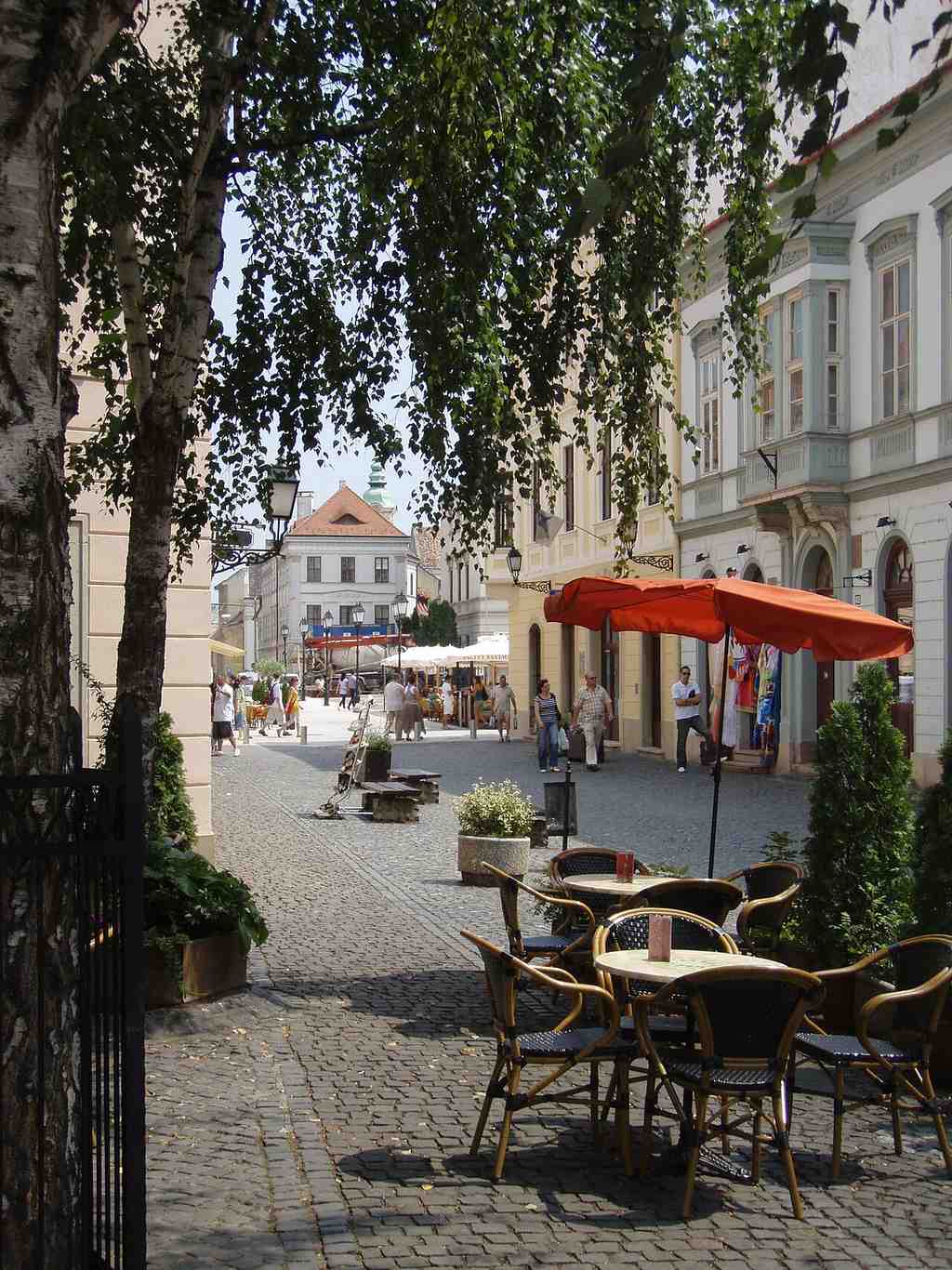
Look for a narrow stone-paved street lined with tall plastered houses, marked by projecting corner balconies and backed along its northern side by the old fortress wall of Káptalandomb.
Király Street does not try very hard to impress you... which is exactly why it works. This is one of the most intimate stretches of old Győr, linking Vienna Gate Square to the northwest corner of Széchenyi Square, and every single house along it carries monument protection. In other words, even the quiet façades here have legal proof that they matter.
The street begins near Vienna Gate Square between two houses with corner balconies, and that little flourish tells you something important. This lane may be narrow, but it has stage instincts. Győr seems constitutionally unable to keep its history off display.
One of the loveliest examples is the Probst House at number three. It grew from two sixteenth-century houses and took on its present shape in the early eighteenth century. Its east-facing front is slim and topped by a curved gable, while the upper part along Király Street pushes outward on stone supports, as if the house wanted a slightly better view of passing gossip. Right beside it opens one of the step-passages climbing toward Káptalandomb.
If you can spot that narrow side passage, let your eyes follow its tight walls toward the steps... It is a very small gap in the street, yet it holds a whole biography. In that almost Italian-feeling little alley, Blaha Lujza spent part of her childhood. Long before she became one of Hungary’s most beloved actresses, a future star began in a tucked-away corner like this. For a city with a national theatre, that feels fitting.
A few doors along, number four carries one of the best names in town: the Napoleon House. This restrained late baroque palace came together from several older buildings and took its present form in the seventeen seventies. Local tradition insists Napoleon slept here after the Battle of Győr, and in this case tradition appears to be right: he spent the night here on the thirty-first of August, eighteen oh nine. Conqueror of Europe by day, overnight guest on Király Street by night. These days the house hosts art exhibitions, so even its celebrity story kept evolving.
Király Street likes that sort of double life. Number five served in the eighteenth century as the lodging house of the Pauline monks from Pápa, then turned into the Arany Bárány Hotel in the nineteenth. Through its vaulted entrance lies a courtyard edged by the former fortress wall. Number eight adds another literary trace: Gárdonyi Géza lived there from eighteen eighty-three to eighteen eighty-eight. And number twelve hides a small surprise behind an eclectic nineteenth-century face: a late Renaissance courtyard with arcades resting on Tuscan columns.
That is the trick of this street. Thresholds, passages, stairways, inner courts... everyday addresses, and then suddenly a famous guest, a future actress, a writer, a monastery connection, a hidden wall.
When you are ready, continue toward the northern opening. In about three minutes, this close-grained lane gives way to one of Győr’s grander urban scenes at Vienna Gate Square.