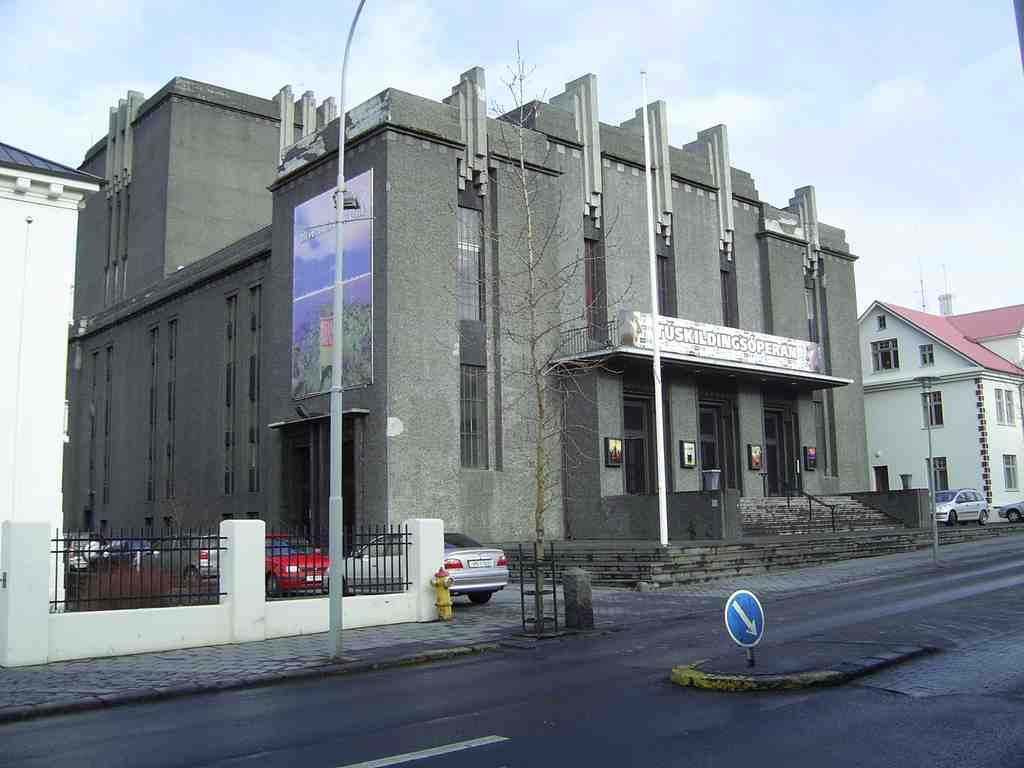
On your right, look for a pale stone theater with a broad, blocky facade, rough basalt-like surfaces, and a tall central tower rising above the entrance.
This is the National Theatre of Iceland, and like a lot of good Icelandic stories, it took grit, stubbornness, and a little theatrical drama before anyone ever stepped onstage. The dream started way back in eighteen seventy-three, when the writer Indriði Einarsson sent a telegram proposing a national theater. He kept pushing for it for decades, and by nineteen oh five he laid out the idea publicly in print. That is patience on a heroic scale... the kind that deserves its own curtain call.
The building you see came from architect Guðjón Samúelsson, the same man who designed Hallgrímskirkja. Here, though, he aimed for something different. He looked to Iceland’s basalt cliffs, those natural rock columns, and imagined an elf rock opening into a hidden world. That is why the exterior feels heavy, rugged, and a little mysterious, as if the stone might part and let a saga walk out.
Funding the place became its own national argument. In nineteen twenty-two, Jónas Jónsson from Hrifla backed an unusual solution: an entertainment tax. The law passed a year later, and the basic idea was delightfully cheeky. Cinema tickets and dance halls, what some sniffed at as “lower culture,” would help pay for “higher culture” here at the theater. You can imagine how movie owners felt about that.
Workers laid the foundation in nineteen twenty-nine, and the outer walls rose over the next two years. Then the money stopped in nineteen thirty-two, and construction stalled. In nineteen forty-one, before the unfinished building could become a theater, British forces took it over and used it as a military storehouse. Not costumes and painted scenery... ammunition and explosives. That made plenty of Reykjavík residents nervous, because one bad blast could have devastated the city center. After the British left, Icelandic ministries even used parts of the building for document storage. The place spent years serving paper and gunpowder before it ever served art.
At last, after cleanup, repairs, and a final push, the theater officially opened on the twentieth of April, nineteen fifty. Indriði Einarsson had died in nineteen thirty-nine, so he never saw the completed dream, but the opening performance honored him with his own play, Nýársnóttin. And then came one of those bittersweet turns history likes to slip in: Guðjón Samúelsson died just five days after the opening. He lived long enough to see the doors open... and only just.
Inside, the main stage still uses a revolving platform from that era. Its iron frame came from the old Ölfusá bridge after the bridge collapsed in nineteen forty-four. Reykjavíkers like to joke that the actors here still perform on an old bridge. Fair enough. In Iceland, even the scenery gets a second life.
And because no great theater should be entirely sensible, staff still tell ghost stories. One tale says a British soldier lingers in the catwalks above the main stage, where technicians handle the lights. Others speak of a resident spirit named Jón, who enjoys meddling with lights and hiding things. A theater without a ghost is just office space with better acoustics.
So this building stands as a national stage, an elf rock, a war storehouse, and a very Icelandic triumph of persistence. When you’re ready, continue on toward the Ministry of Finance.