
50+ languages

 Kolkata · India
 Kolkata Audio Tours
Discover Kolkata with self-guided audio walking tours
headphones
1 tours
pin_drop
20 landmarks
translate
Kolkata tours
Pick a Kolkata worth walking.
Self-guided audio tours written by people who actually live there.
1 tours
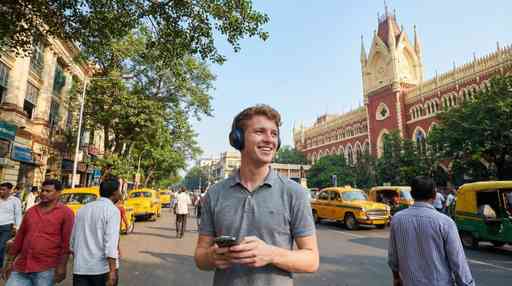
Top landmarks
The Kolkata everyone knows.
The landmarks in every guidebook — and the tours that tell you what guidebooks don't.
A few words on Kolkata
India's intellectual capital, still arguing about it.
Kolkata has always been a city with opinions. It served as capital of British India until 1911, produced Nobel laureate Rabindranath Tagore, and became the city where the independence movement crystallized into political force. When the British moved the capital to Delhi, Kolkata did not stop mattering; it simply argued more eloquently. The tradition of street-corner debate, of coffee house intellectual culture, of theater, poetry, and political outrage never left. The Indian Coffee House on College Street, open since 1942, still serves the same strong coffee to students and writers who treat the place like a seminar room.
The Howrah Bridge, a cantilever span completed in 1943 that carries an estimated 100,000 vehicles and countless pedestrians every day, is possibly the best single image of Kolkata's intensity.
The Victoria Memorial -- enormous in white Makrana marble, finished in 1921 -- sits in its southern gardens as if the British Empire never quite accepted it was over. Kalighat temple is among the holiest Shakti shrines in India, and Durga Puja turns the city every October into something that must be witnessed rather than described: temporary outdoor shrines of staggering elaboration fill every neighborhood for five consecutive nights. The street food alone -- kati rolls from Nizam's, phuchka from corner vendors, jhalmuri mixed to order -- is a serious civic institution.
Kolkata
Kolkata FAQ
Before you walk.
Kolkata has India's only functioning tram network, which runs through the central city and is worth riding for the experience alone. The metro covers north-south routes efficiently. Yellow Ambassador taxis are a Kolkata institution, and auto-rickshaws navigate the lanes that larger vehicles cannot. Ride-share apps also operate throughout the city.
The historic areas -- Dalhousie Square (now BBD Bagh), the North Kolkata lanes around Sovabazar, and the South Kolkata neighborhoods around Kalighat -- are all rewarding on foot. Footpaths can be uneven and busy, so sturdy, comfortable shoes are essential. The city is flat, which helps. Start early to avoid the midday heat in warmer months.
Kati rolls (flatbread wrapped around egg and meat from a tawa) were invented at Nizam's restaurant on New Market Street in the 1930s and are still best there. Mishti doi (sweetened curd) and rosogolla (sponge sweet in syrup) are the Bengali desserts worth tracking down. Fish -- particularly hilsa in mustard sauce -- is central to the Bengali kitchen.
Kolkata rewards slower exploration rather than rushing between sites. North Kolkata (the old mansion district, Kumartuli where clay idols are made) and South Kolkata (Kalighat, Victoria Memorial, the Maidan) have distinct characters and could reasonably fill a full day each. The colonial center around Dalhousie Square fits well into a half-day walk.
Every Kolkata tour, in your language.
All 50+ languages, included with every booking.
🇬🇧 English🇫🇷 Français🇪🇸 Español🇩🇪 Deutsch🇮🇹 Italiano🇯🇵 日本語🇨🇳 中文🇰🇷 한국어+ 41 more
star AudaTours Unlimited
Visiting more than one city? Subscribe.
Unlock every Kolkata tour — plus thousands more worldwide. Cancel any time.
$4.99/week · Cancel anytime


Loved by travellersThousands of tours started.
Thousands of tours started.
Plenty of opinions.
4.8 across the App Store and Google Play. Here's a few we keep coming back to.
starstarstarstarstar
This tour was such a great way to see the city. The stories were interesting without feeling too scripted, and I loved being able to explore at my own pace.

Jess
Tbilisi Tourstarstarstarstarstar
This was a solid way to get to know Brighton without feeling like a tourist. The narration had depth and context, but didn't overdo it.

Christoph
Brighton Tourstarstarstarstarstar
Started this tour with a croissant in one hand and zero expectations. The app just vibes with you, no pressure, just you, your headphones, and some cool stories.

John
Marseille Tourdownload Get the app Pop your headphones in.


Pop your headphones in.
Step outside.
Free to download. Tours in every city. Start in 60 seconds — no account, no card.

headphones
~ 4 min until your first tour starts
public
1,000+ cities worldwide
all_inclusive
AudaTours
Unlimited
Every tour. Every city. One subscription.
3097 tours2273 cities138 countries50+ languages
$39 /year
all_inclusive Explore Unlimited