
Basel Highlights Audio Tour: Historical Heritage
Red sandstone glows against the Rhine while shadows of medieval conspiracies linger in the narrow alleys of Basel. Beneath the serene facade of this Swiss hub lies a volatile history of political bloodbaths and eccentric power struggles. Experience this immersive self guided audio tour to uncover the narratives buried beneath the city streets. Gain exclusive access to hidden corners and forgotten anecdotes that escape the average traveler. Which hidden chamber inside the Basel Cathedral once whispered secrets of a doomed rebellion? Why does the Museum of Cultures hold artifacts that triggered a citywide scandal? Can you pinpoint the exact stone where a traitor met his sudden fate under the moonlight? Traverse the shifting landscape of time as you wander from ancient relics to revolutionary landmarks. Reframe your perspective through the lens of drama and clandestine discovery. Unveil the restless spirit of Basel and claim your journey now.
Tour preview
About this tour
- scheduleDuration 100–120 minsGo at your own pace
- straighten4.0 km walking routeFollow the guided path
- location_onLocationBasel, Switzerland
- wifi_offWorks offlineDownload once, use anywhere
- all_inclusiveLifetime accessReplay anytime, forever
- location_onStarts at Carnival Fountain
Stops on this tour
lock_open 3 free previews · 12 unlock with purchase
Look for a broad, shallow basin lined in dark material, filled with black iron machine-figures on thin legs, including one odd theatrical head that seems to peer across the water.…Read moreShow less
Open dedicated page →Look for a broad, shallow basin lined in dark material, filled with black iron machine-figures on thin legs, including one odd theatrical head that seems to peer across the water.
Welcome to Basel... and instead of a solemn old statue, you get a gang of mechanical mischief-makers. That is very Basel. This fountain opened in nineteen seventy-seven, and it gives away one of the city’s favorite tricks early: when something disappears here, it often comes back wearing a new costume. Demolition debris, stage machinery, carnival wit... somehow Basel turns leftovers into landmarks.
Jean Tinguely understood that better than most. He was born in Fribourg in nineteen twenty-five, but he grew up here in Basel, started a decorator’s apprenticeship at the Globus department store in nineteen forty-one, and promptly got fired for ignoring the house rules. A promising start for a man who became the city’s great playful troublemaker. He loved Basel’s Fasnacht, the local carnival, and this fountain feels like his permanent parade.
Take a moment and watch the separate figures move... which one looks most like it still expects applause?
Most visitors see whimsy. Locals see witnesses. Several of these ten sculptures came from movable parts of the old city theatre’s stage equipment, and they stand exactly where that theatre once stood. So these are not just decorations spraying water through the air with small electric motors. They are bits of backstage memory, still performing.
If you want a closer guide to the cast, glance at the image on your screen. One figure, dr Theaterkopf, “the theatre head,” borrows its shape from the roofline of the demolished theatre itself. Tinguely even set this delicate fountain here as a needling reply to the heavier new theatre building nearby. That’s the joke with a sharp edge: art dancing where a building vanished.
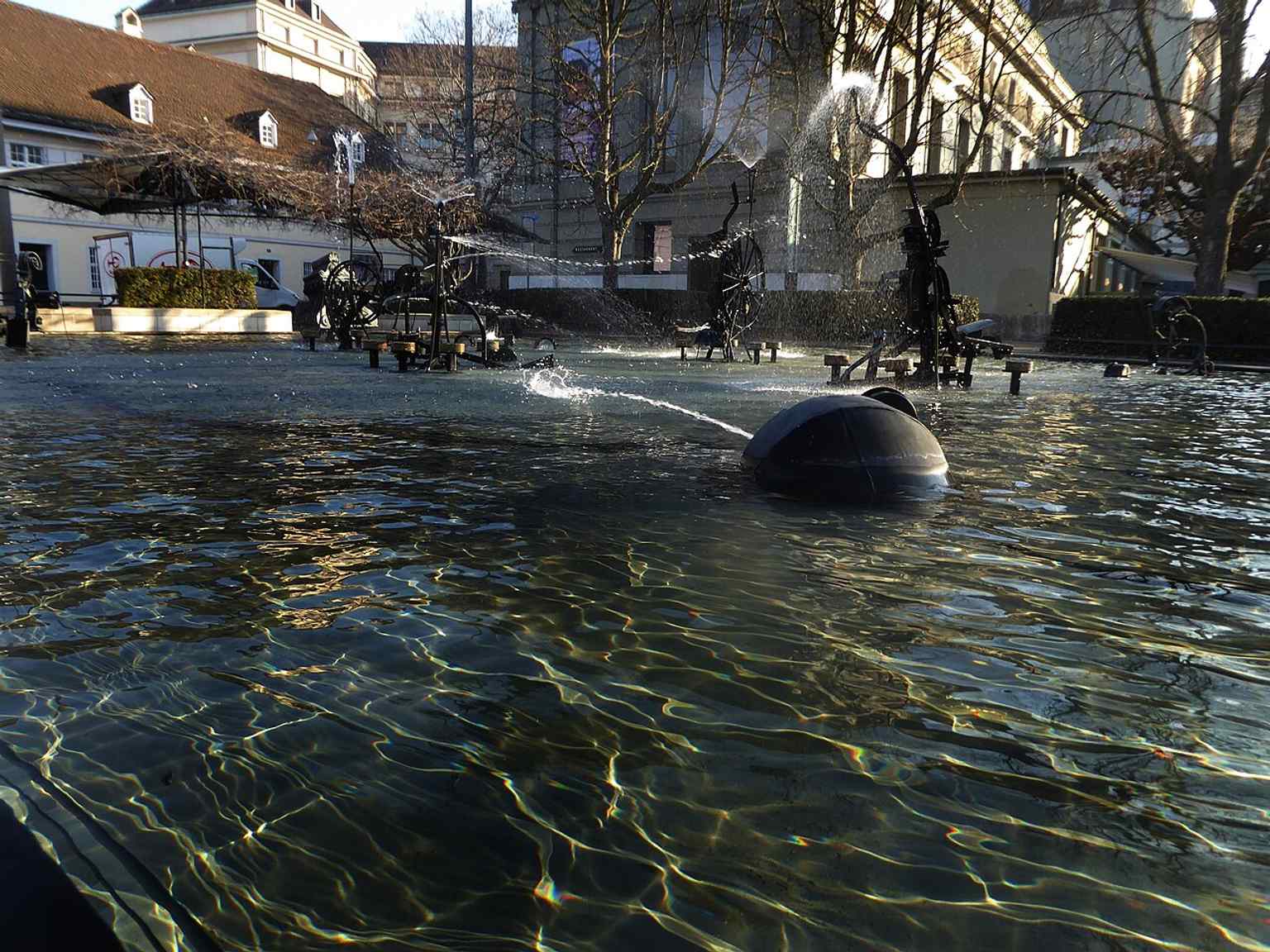
One of a set of contemporary views that identifies the ten named figures, including the "Theaterkopf" inspired by the old theatre’s roofline.Photo: EinDao, Wikimedia Commons, CC BY-SA 4.0. Cropped & resized. The basin is only about nineteen centimeters deep, and the fountain runs all year, day and night, so Basel protects it even through freezing spells. In a minute, we’ll head to the Basel Historical Museum... and keep an eye out for what is missing, because in this city, absence leaves footprints.
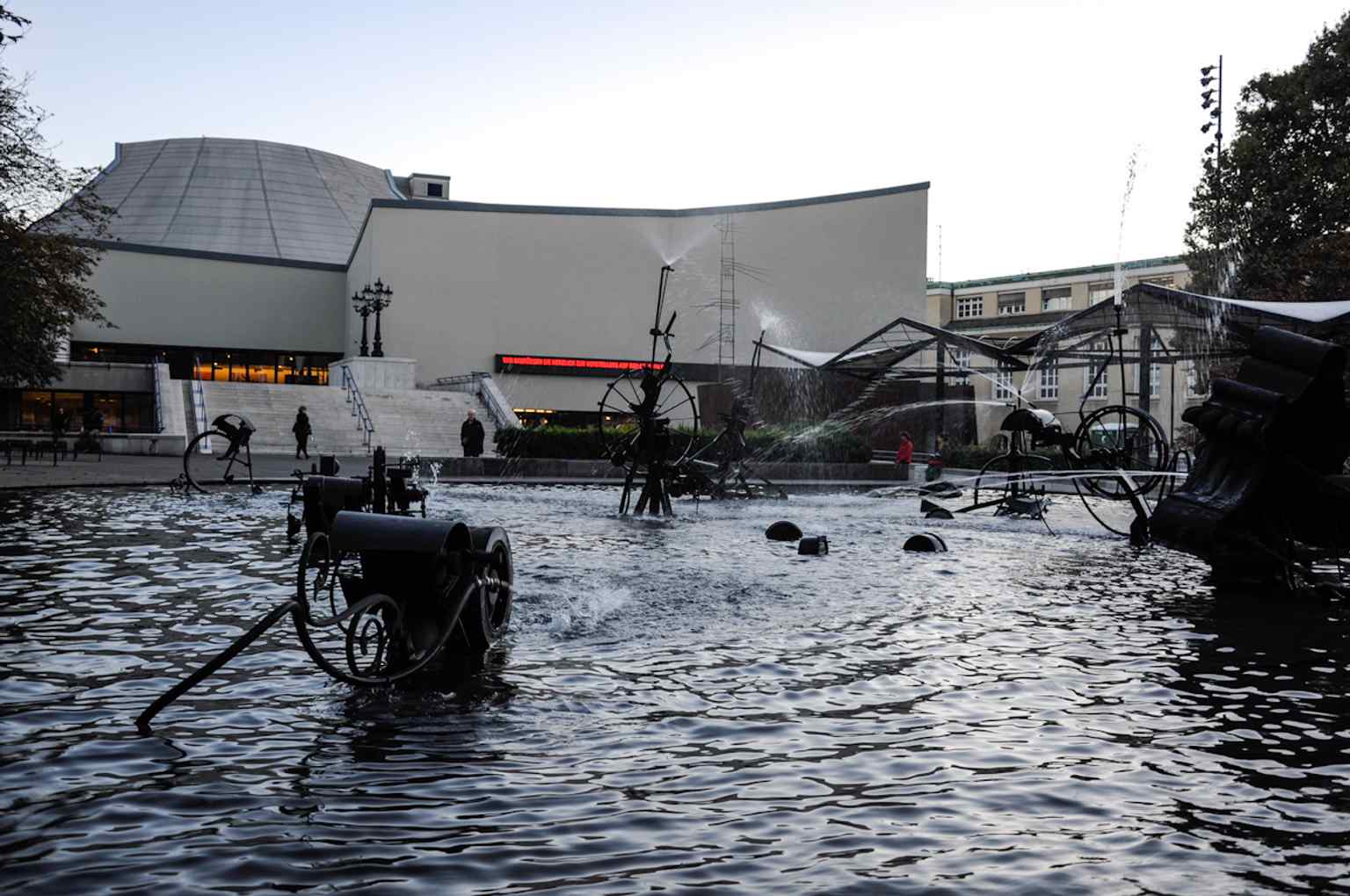
The fountain in front of Basel’s Stadttheater, matching Tinguely’s deliberate protest against the theatre’s heavy new building.Photo: Tobias Hoderlein, Wikimedia Commons, CC BY-SA 3.0. Cropped & resized. 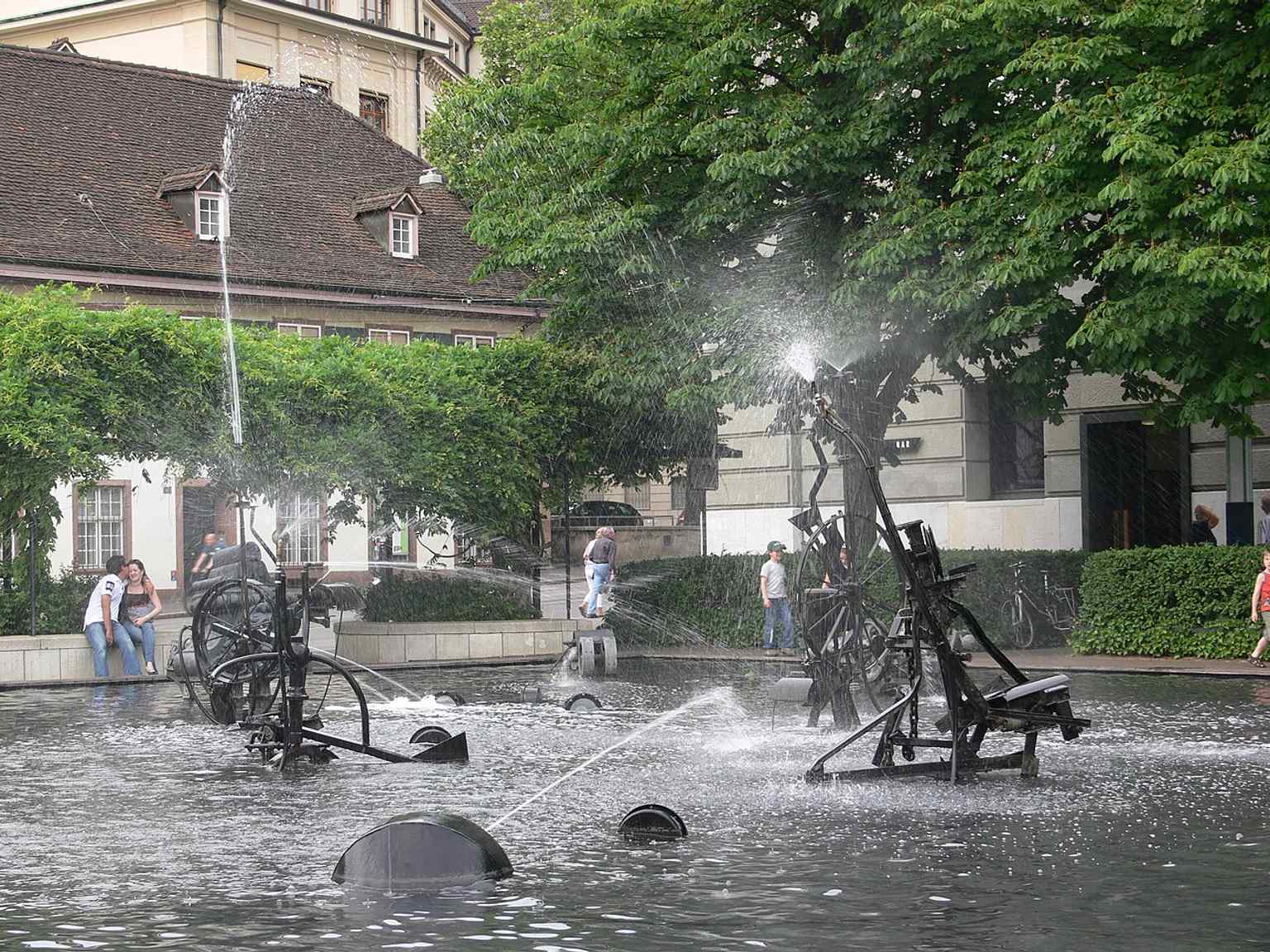
A wider daytime view of the Carnival Fountain in its setting on Theaterplatz, where the old theatre once stood.Photo: Photo: Andreas Praefcke, Wikimedia Commons, CC BY 3.0. Cropped & resized. 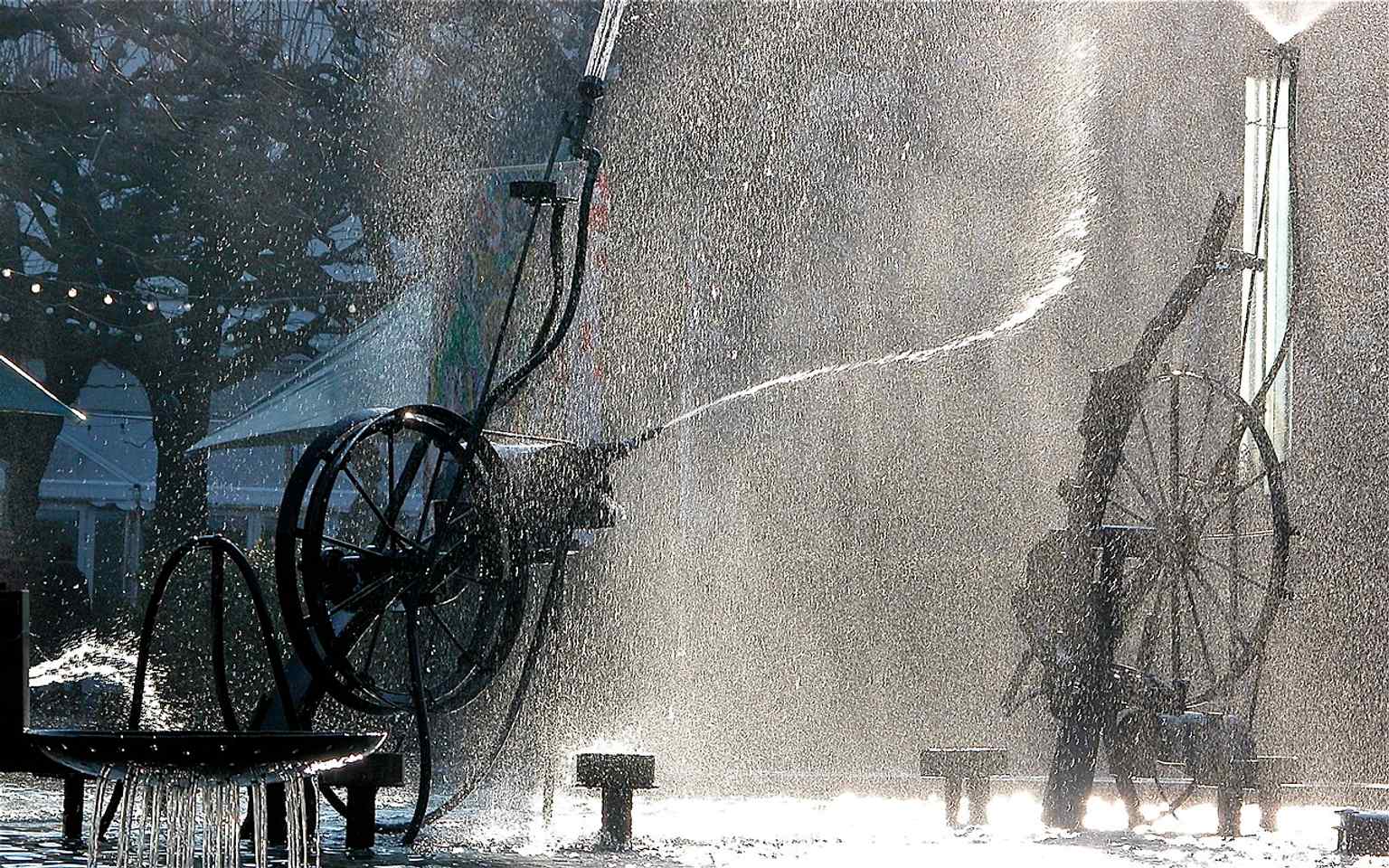
A clear overview of the full Brunnen ensemble, showing the ten machine sculptures inside the shallow basin.Photo: Kurt Riedberger, Wikimedia Commons, CC BY-SA 3.0. Cropped & resized. 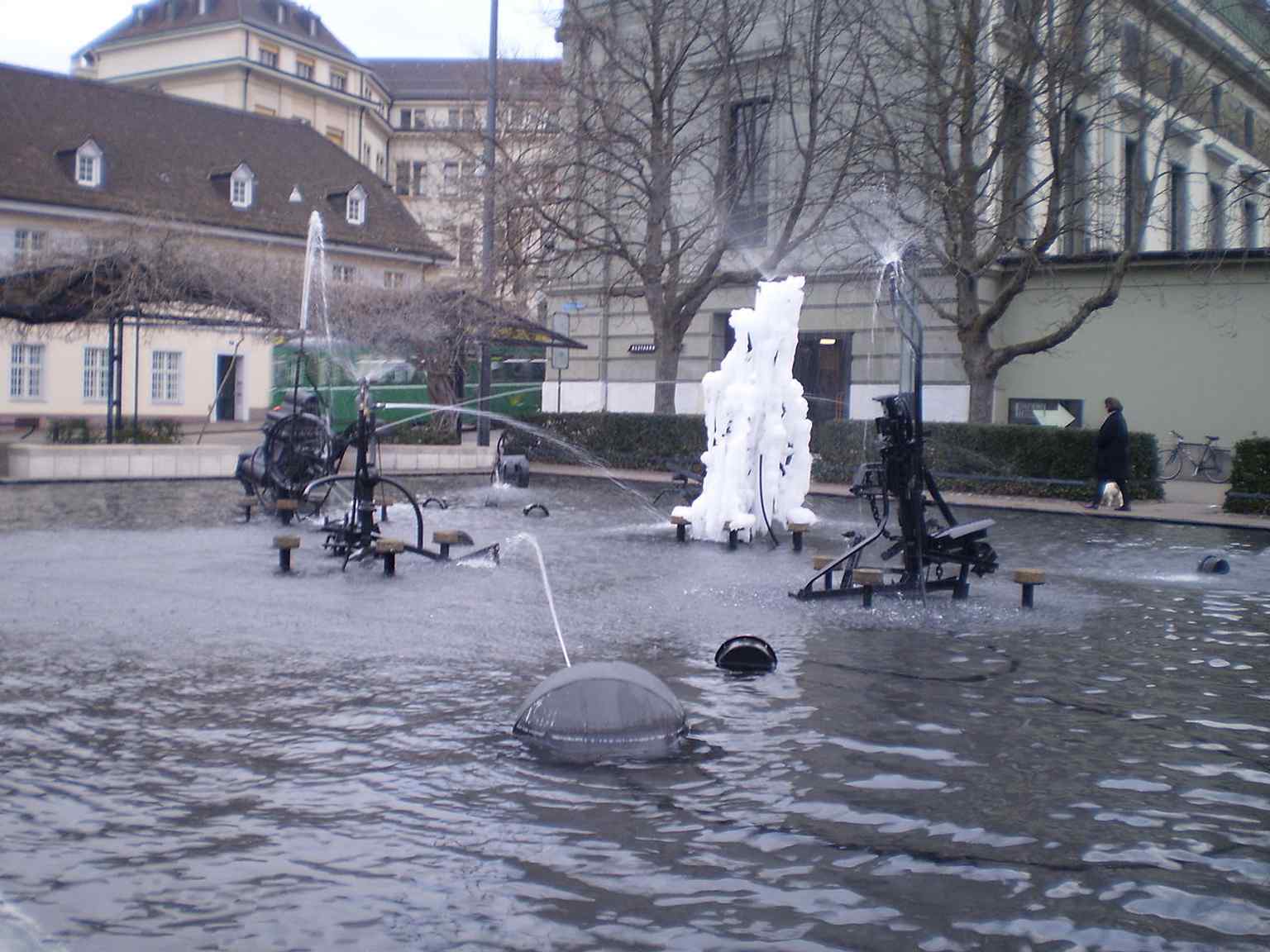
A winter scene of the fountain frozen over — a reminder that the water stays in the basin all year and must be protected from frost.Photo: דוד שי, Wikimedia Commons, CC BY-SA 3.0. Cropped & resized. 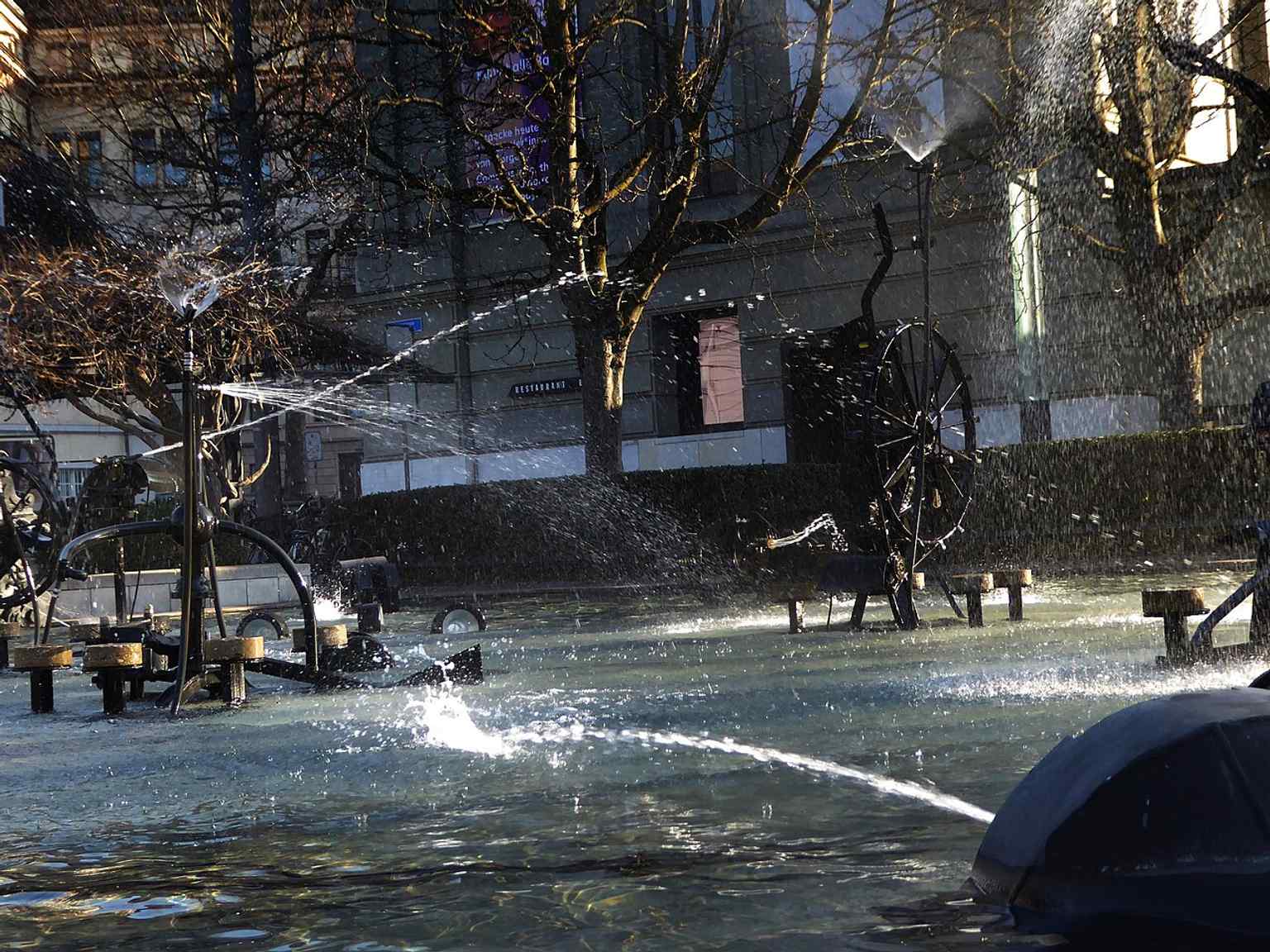
A companion close view of Tinguely’s machine sculpture group, evoking the Fasnacht spirit that became permanent in the cityscape.Photo: EinDao, Wikimedia Commons, CC BY-SA 4.0. Cropped & resized. 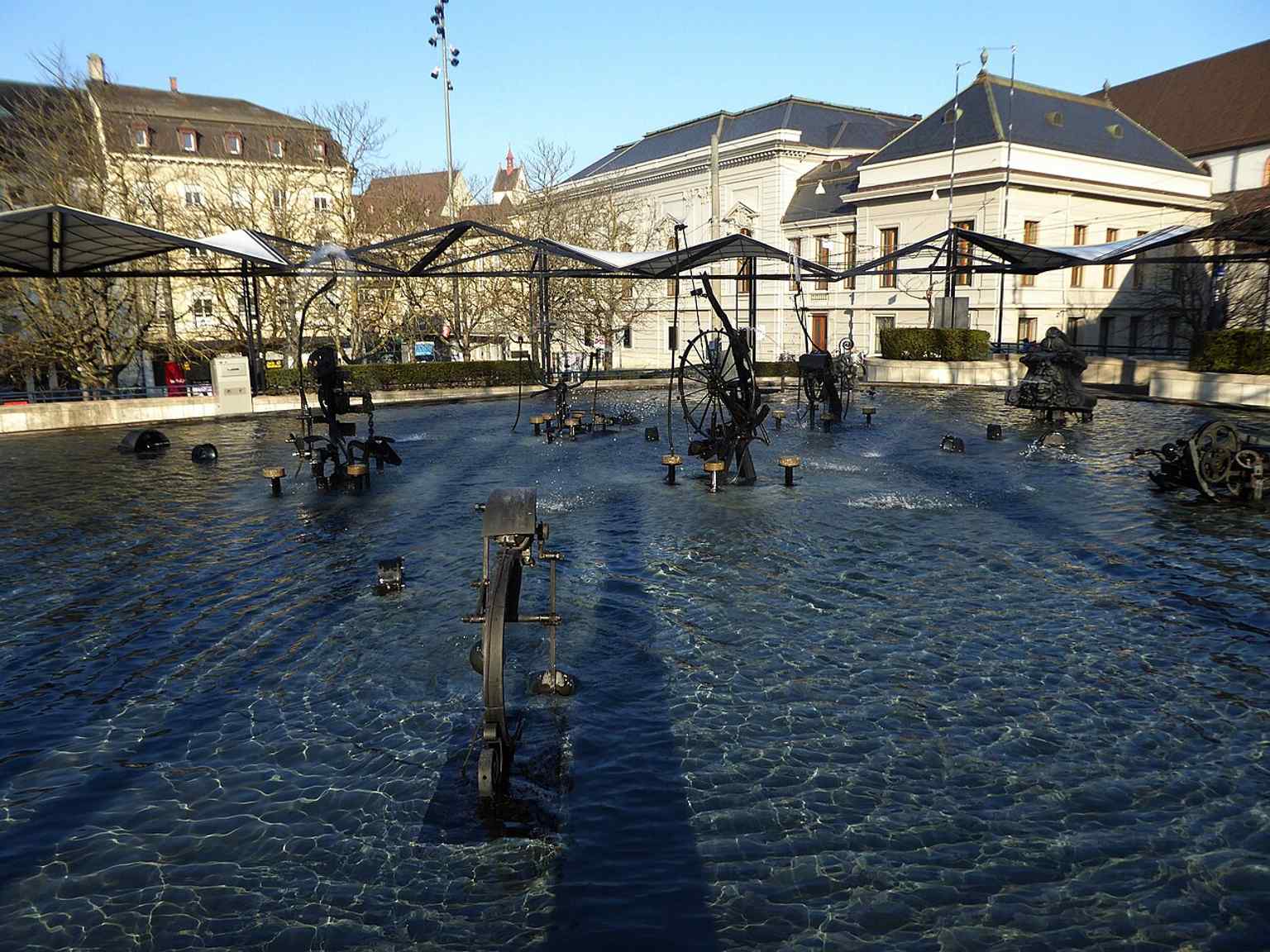
A close artistic view of the Brunnen’s sculptural language, linking theatre, parody and Basel carnival.Photo: EinDao, Wikimedia Commons, CC BY-SA 4.0. Cropped & resized. 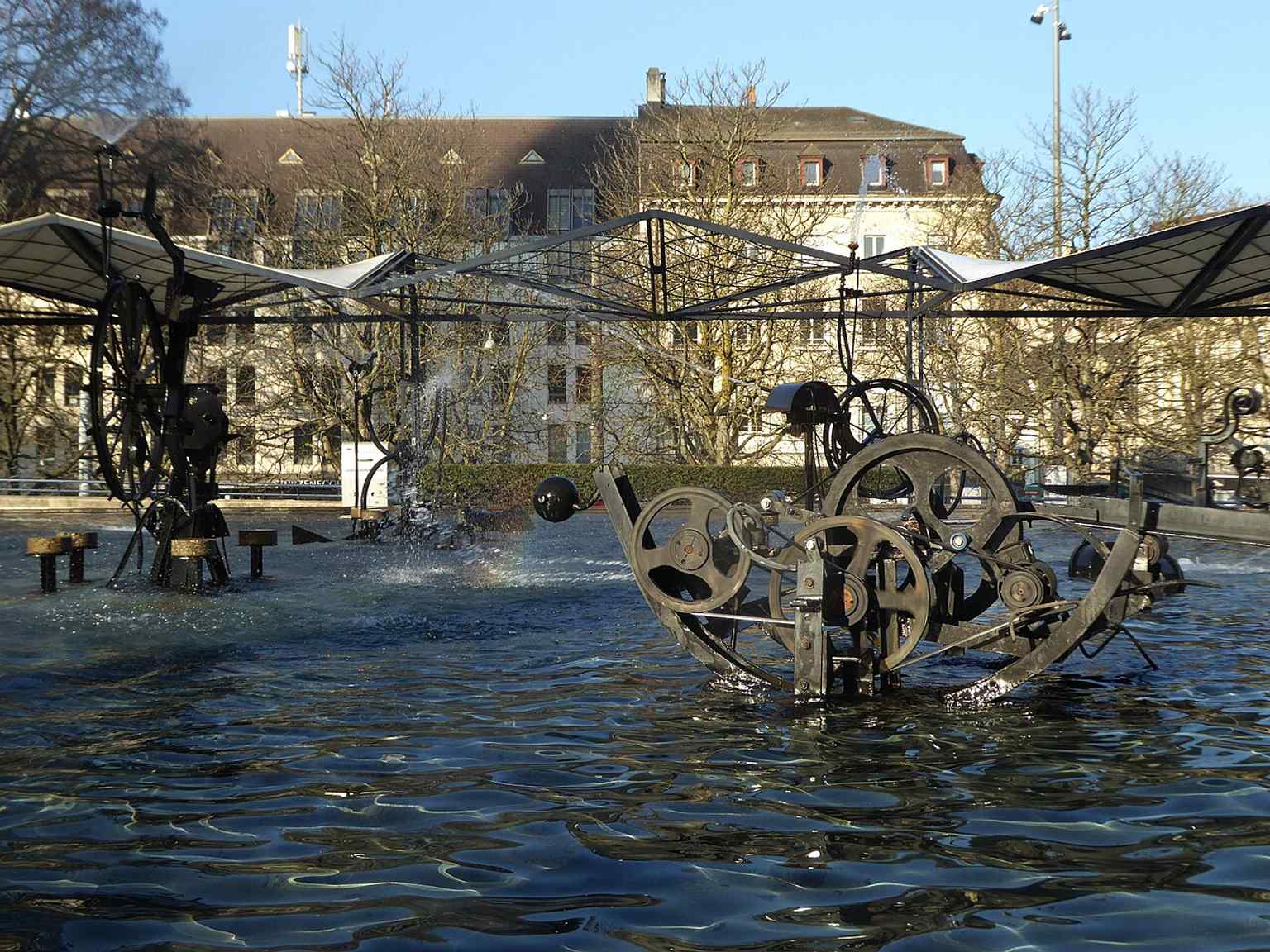
This image helps show the fountain as a lively mechanical tableau rather than a conventional monument.Photo: EinDao, Wikimedia Commons, CC BY-SA 4.0. Cropped & resized. 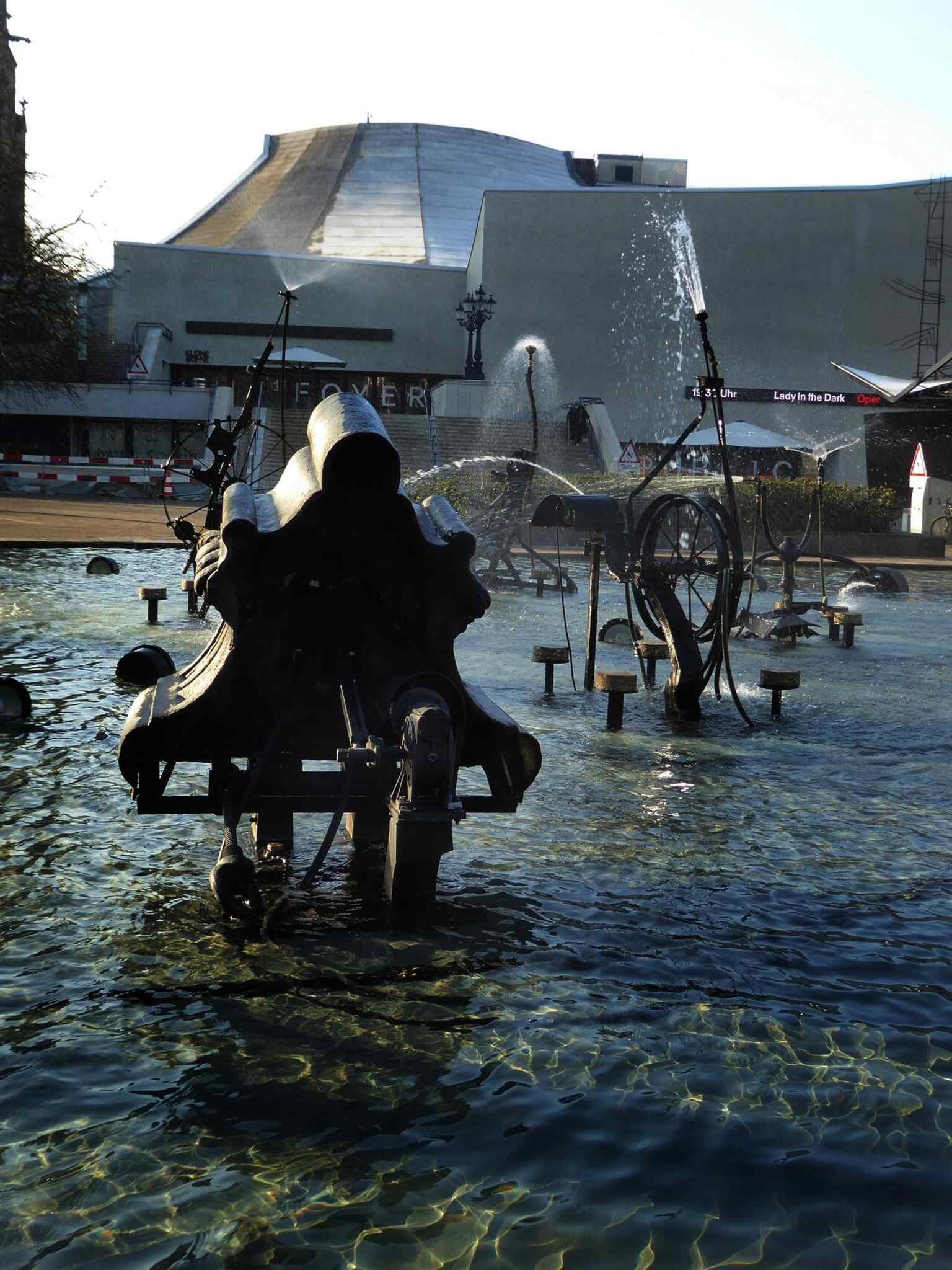
A strong detail from the 2023 series, ideal for explaining that the fountain’s figures carry distinct names and personalities.Photo: EinDao, Wikimedia Commons, CC BY-SA 4.0. Cropped & resized. 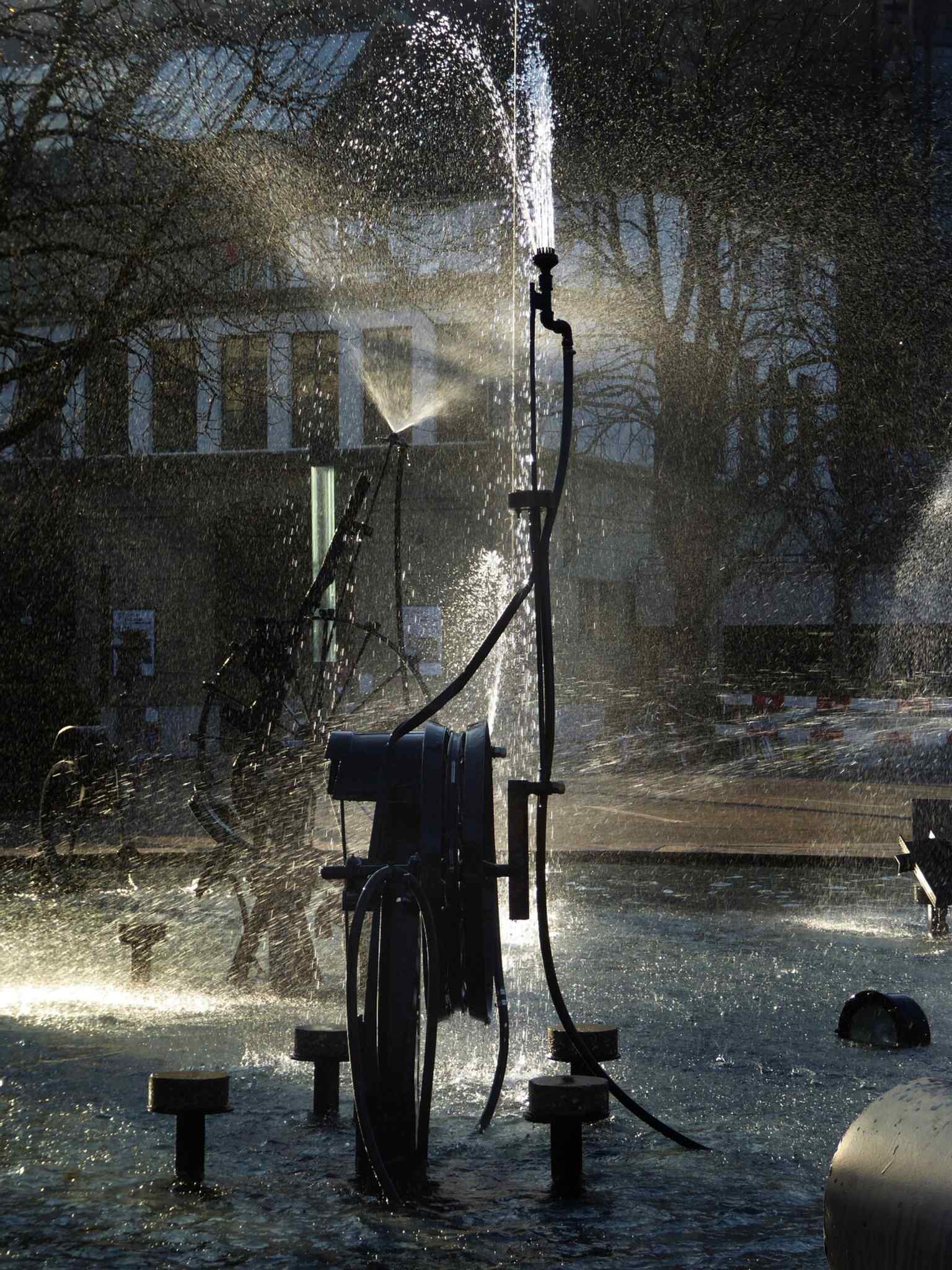
A clear artwork-style view of the fountain’s playful machinery, echoing Tinguely’s long connection to Basel Fasnacht.Photo: EinDao, Wikimedia Commons, CC BY-SA 4.0. Cropped & resized. 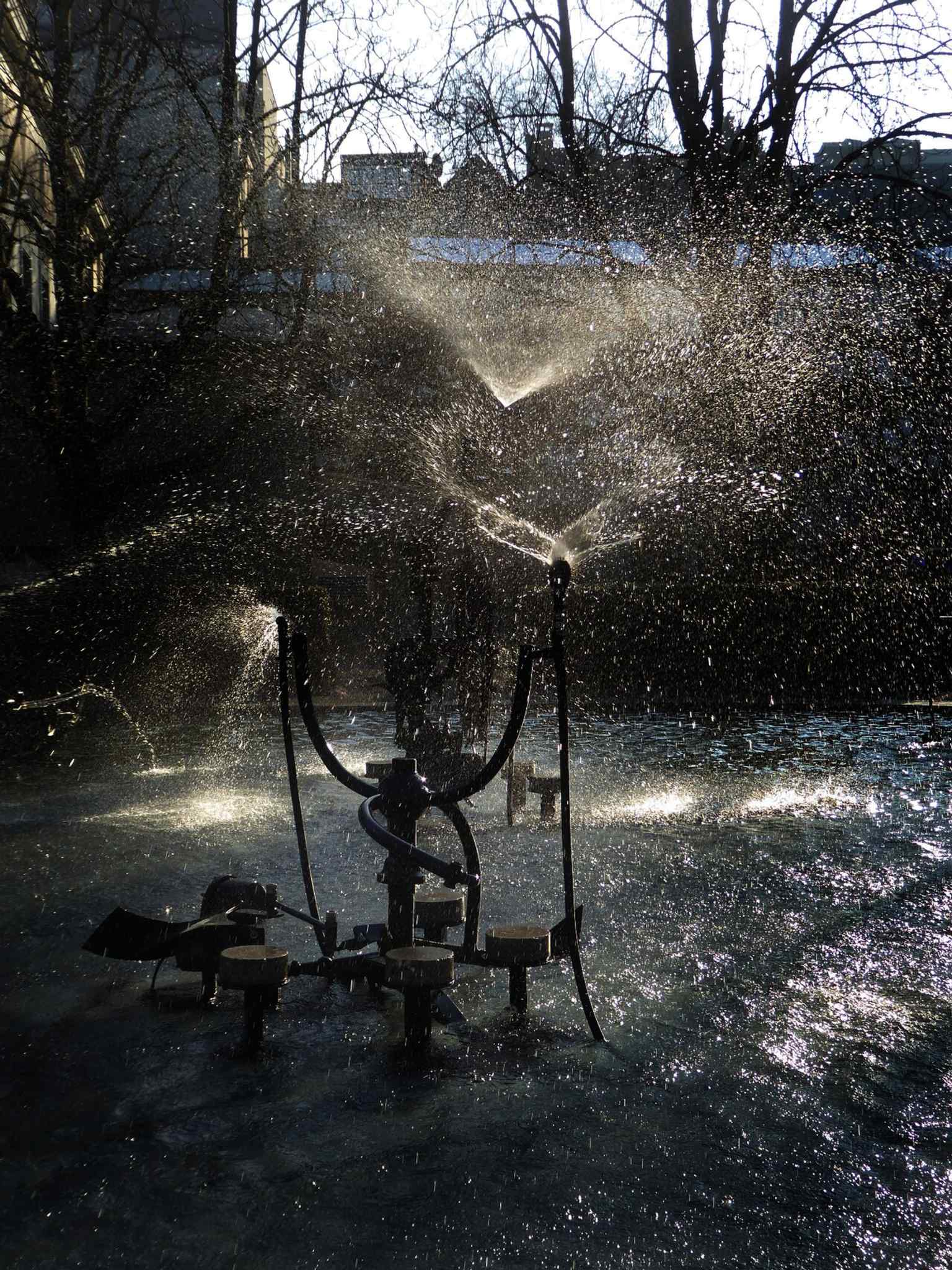
Another close composition from the sculpture series, showing the fountain as a permanent, urban continuation of carnival performance.Photo: EinDao, Wikimedia Commons, CC BY-SA 4.0. Cropped & resized. On your right, look for the pale sandstone church with its steep roof, tall pointed Gothic windows, and the narrow tower that marks the old Barfüsserkirche. This is the main…Read moreShow less
Open dedicated page →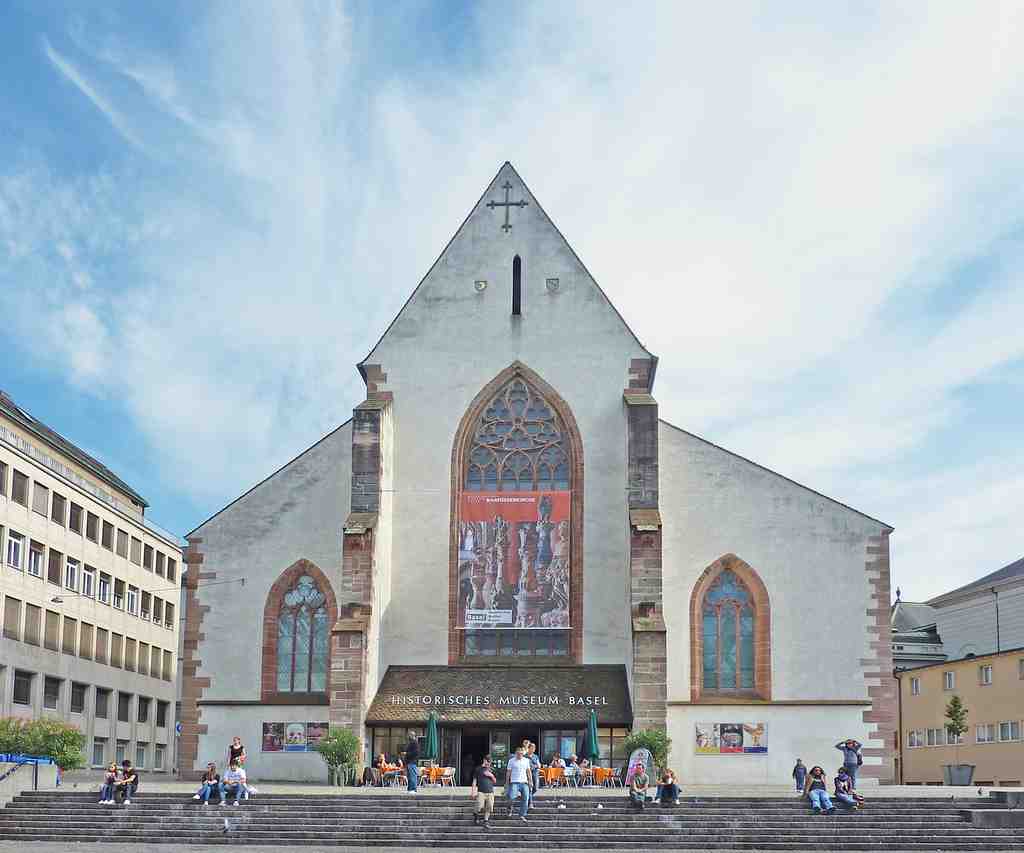
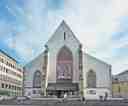
Basel Historical MuseumPhoto: James Steakley, Wikimedia Commons, CC BY-SA 3.0. Cropped & resized. On your right, look for the pale sandstone church with its steep roof, tall pointed Gothic windows, and the narrow tower that marks the old Barfüsserkirche.
This is the main home of the Basel Historical Museum, and it makes Basel’s character plain as day without ever saying a word: the city often saves a place by giving it a new job. The fountain behind us already hinted at that, because Basel does not let vanished things disappear without a second life. Basel dislikes clean erasures; when something ends, the city tends to fold it into the next chapter.
This church began in the thirteenth century as a Franciscan church. “Barfüsser” means “barefoot,” a nod to the friars’ simple life. After the Reformation in fifteen twenty-nine, the city took the complex over. Worship continued here until seventeen ninety-four, but the building then drifted through a string of practical lives: hospital, school, warehouse... and, in the version locals never forget, a salt store from seventeen ninety-nine to eighteen fifteen. Salt is wonderful on dinner and murder on old stone. By nineteen sixty-four, the damage had become serious enough to threaten the structure itself.
So the museum you see here is not just a collection of old things. It is also a rescue mission that succeeded. Between eighteen ninety and eighteen ninety-four, Basel renovated the former church to house a new Historical Museum. That opening crowned decades of civic effort: the Medieval Collection started in eighteen fifty-six, an association formed in eighteen seventy-two to support it, and in eighteen ninety-two the Medieval Collection, the Antiquarian Collection, and the Basel Armoury merged under one name.
But the roots go deeper still, into Basel humanism. In the sixteenth century, the Amerbach family, especially Basilius and Bonifacius Amerbach, built a Wunderkammer, a “cabinet of curiosities” filled with art, books, and remarkable objects. They belonged to Basel’s humanist circle, Renaissance scholars who believed careful study of language, history, and art could improve public life. When the city bought their holdings in sixteen sixty-one, including Erasmus of Rotterdam’s estate and works by Hans Holbein, and opened them to the public in sixteen seventy-one, Basel created one of the earliest civic public collections in the German-speaking world.
If you look at the image on your screen, you can see an early interior view of the nave, the long central hall of the church, after it became museum space. That huge hall now holds the Upper Rhine’s broad sweep of cultural history: cathedral treasure, tapestries from Basel and Strasbourg, fragments of Basel’s Dance of Death, coins, glass painting, altars, and the plain everyday objects that tell you how people actually lived.
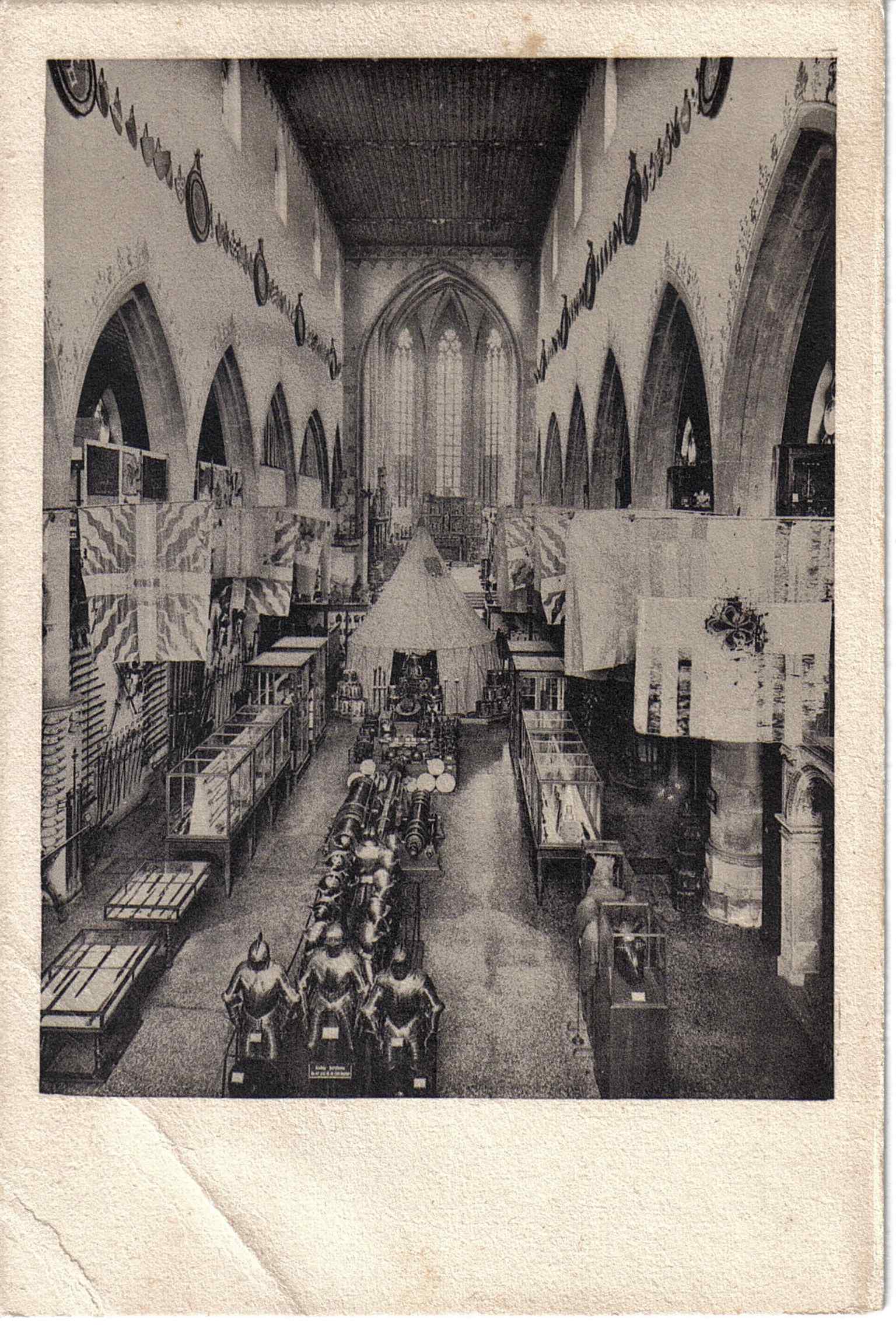
An early view inside the former Barfüsser church, showing the museum space before later renovations and expansions.Photo: Lichtdruck Frobenius A.G., Basel, Wikimedia Commons, CC BY-SA 4.0. Cropped & resized. During the major renovation from nineteen seventy-five to nineteen eighty-one, workers found a brick grave chamber in front of the choir, the area near the altar. Inside lay Anna Catharina Bischoff, mummified and astonishingly preserved. Later research identified her, adding one more thread to Basel’s buried stories. Basel can be wonderfully serious, then suddenly hand you a detail like that with a straight face.
Another image in the app shows one of the museum’s glittering reliquaries, containers for saints’ relics, a reminder that craft here was never merely decorative; it carried belief, status, and memory all at once. That confidence in preserving, reframing, and showing off old things will appear again very soon, especially at the art institutions nearby. Kunsthalle Basel is about a one-minute walk from here. If you want to visit later, this museum is closed on Monday and otherwise open from ten to five.
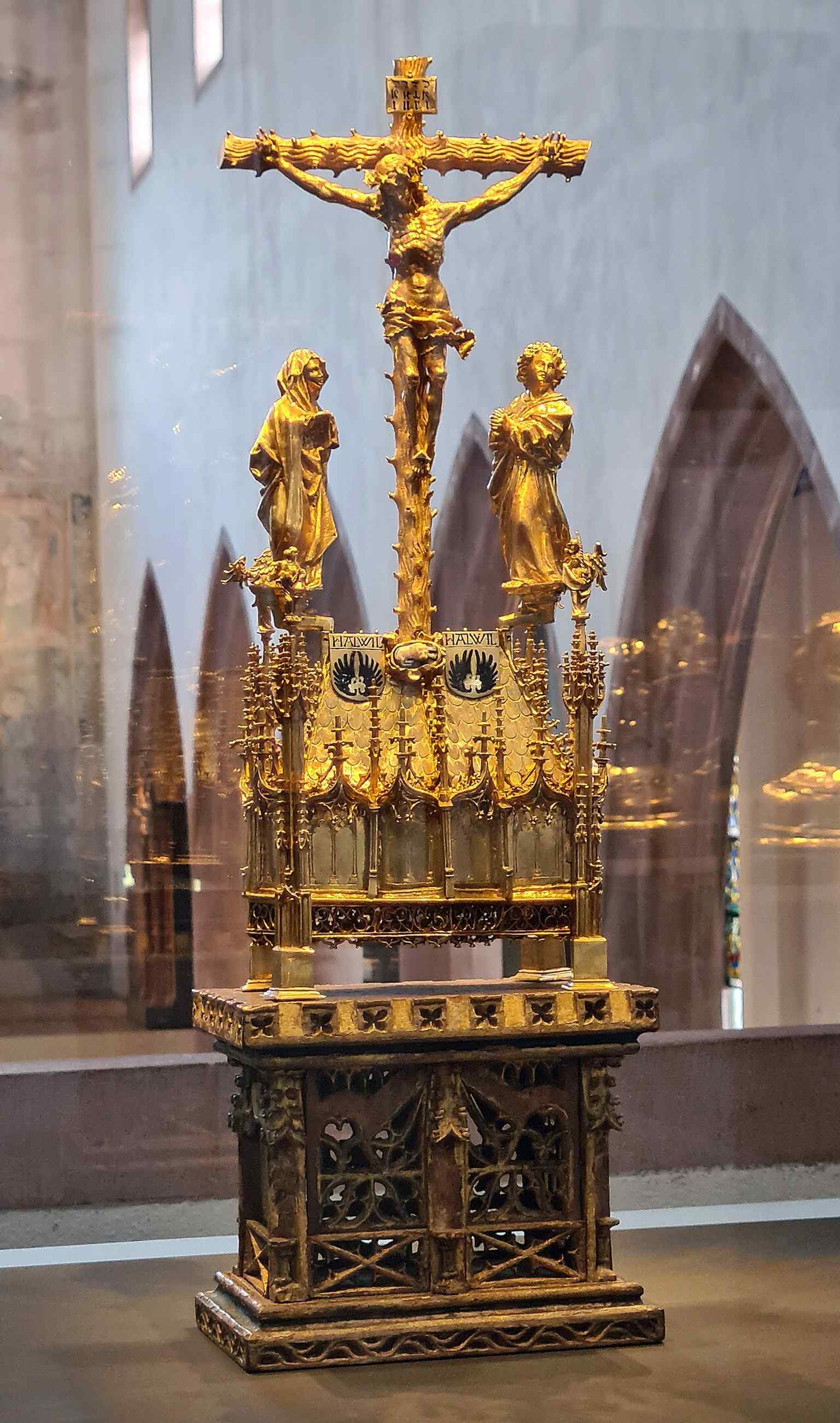
A glittering medieval reliquary from the collection, reflecting the museum’s strength in Upper Rhine church treasury and devotional art.Photo: Ji-Elle, Wikimedia Commons, CC BY-SA 4.0. Cropped & resized. 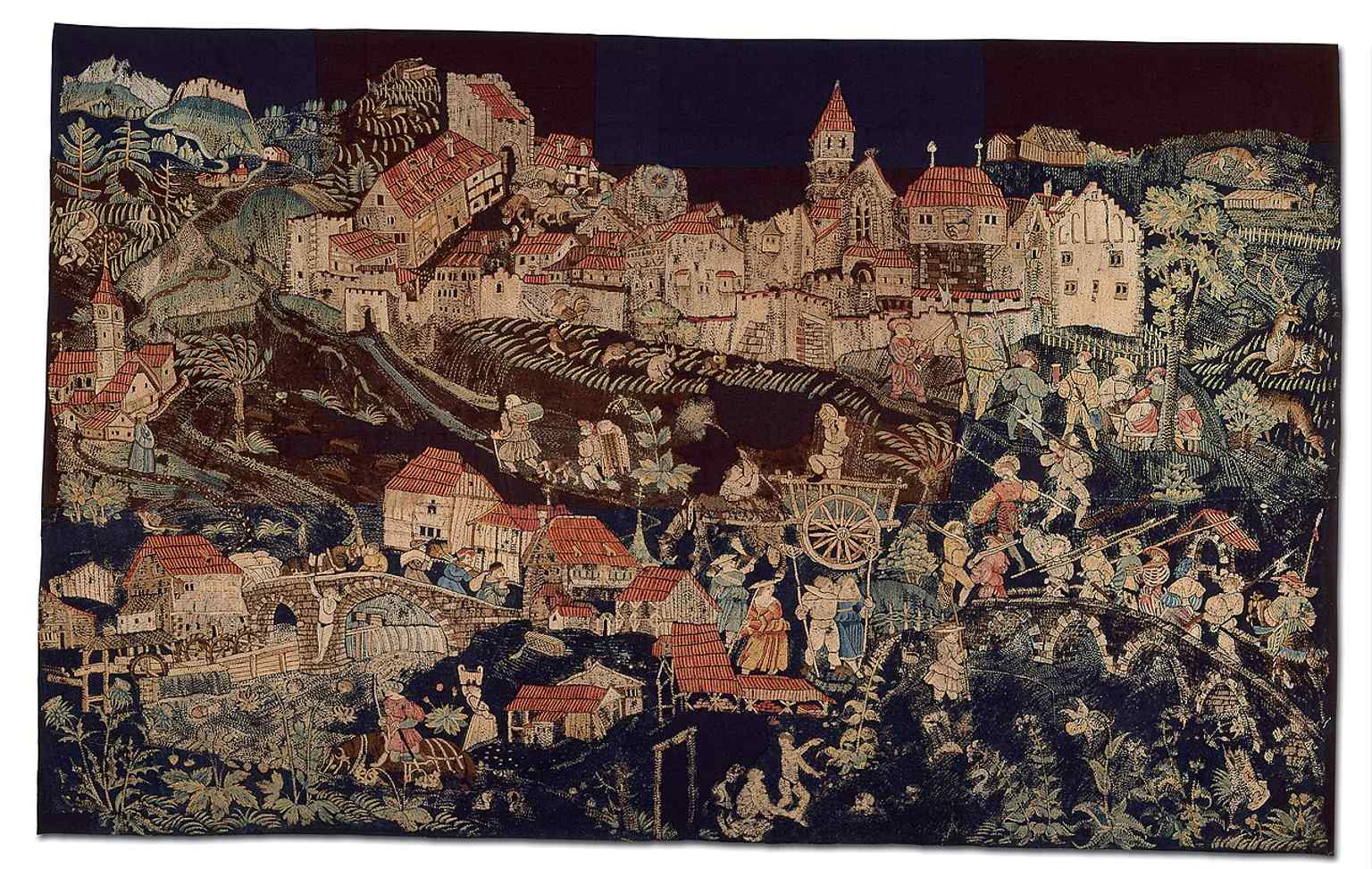
A large embroidered tapestry from the museum’s textile holdings, echoing its rich collection of late medieval and Renaissance crafts.Photo: Historisches Museum Basel, Peter Portner, Wikimedia Commons, CC BY-SA 4.0. Cropped & resized. 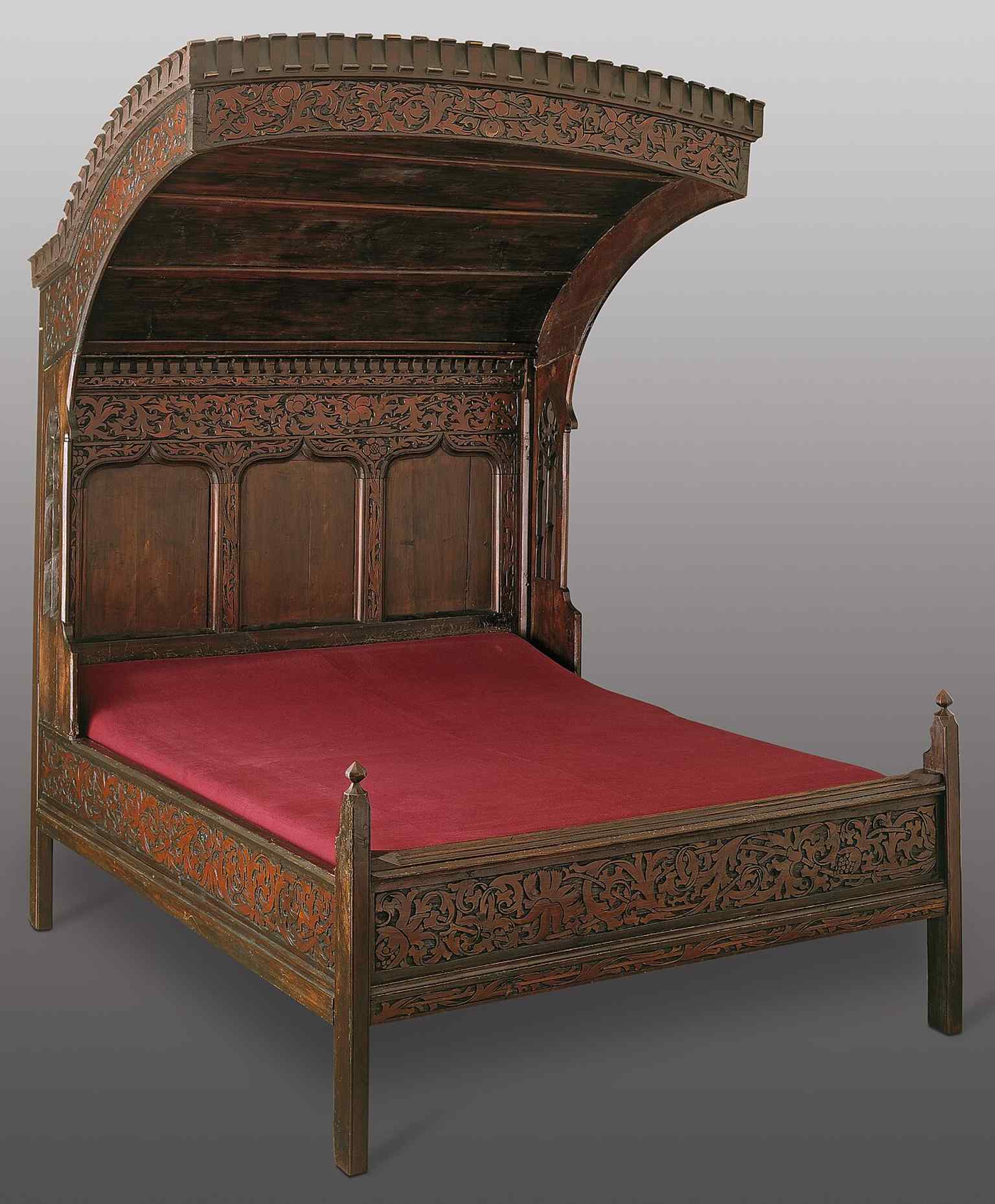
A medieval carved bed from a former monastery interior, matching the museum’s focus on everyday life and historic furnishings.Photo: Unknown authorUnknown author, Wikimedia Commons, CC BY-SA 4.0. Cropped & resized. 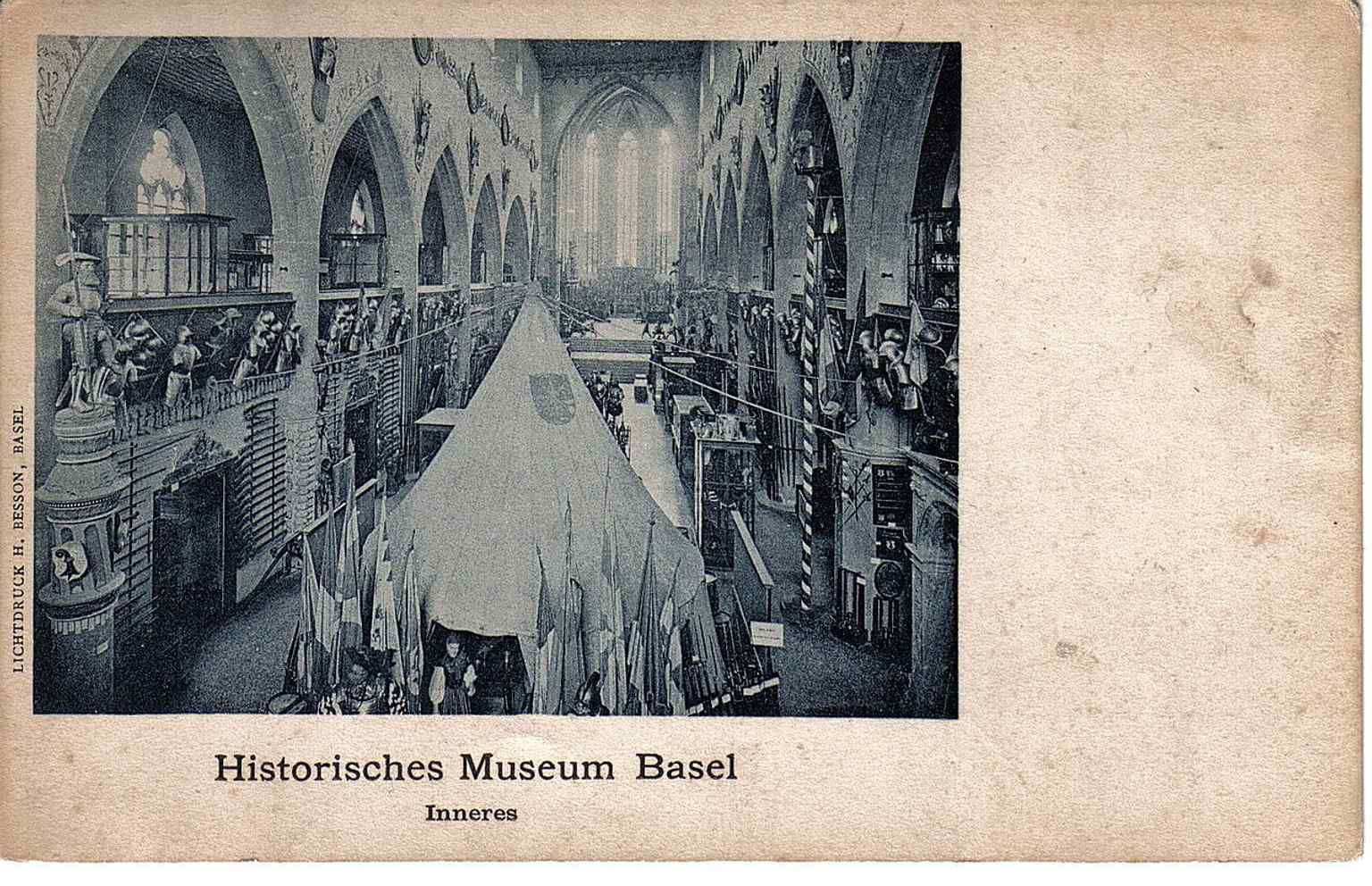
Inside the Barfüsserkirche museum hall, where Basel’s historical collections were brought together under one roof.Photo: Lichtdruck H. Besson, Basel, Wikimedia Commons, CC BY-SA 4.0. Cropped & resized. On your right, Kunsthalle Basel is a pale stone neoclassical building with a crisp symmetrical front, tall rectangular windows, and a temple-like entrance capped by a triangular…Read moreShow less
Open dedicated page →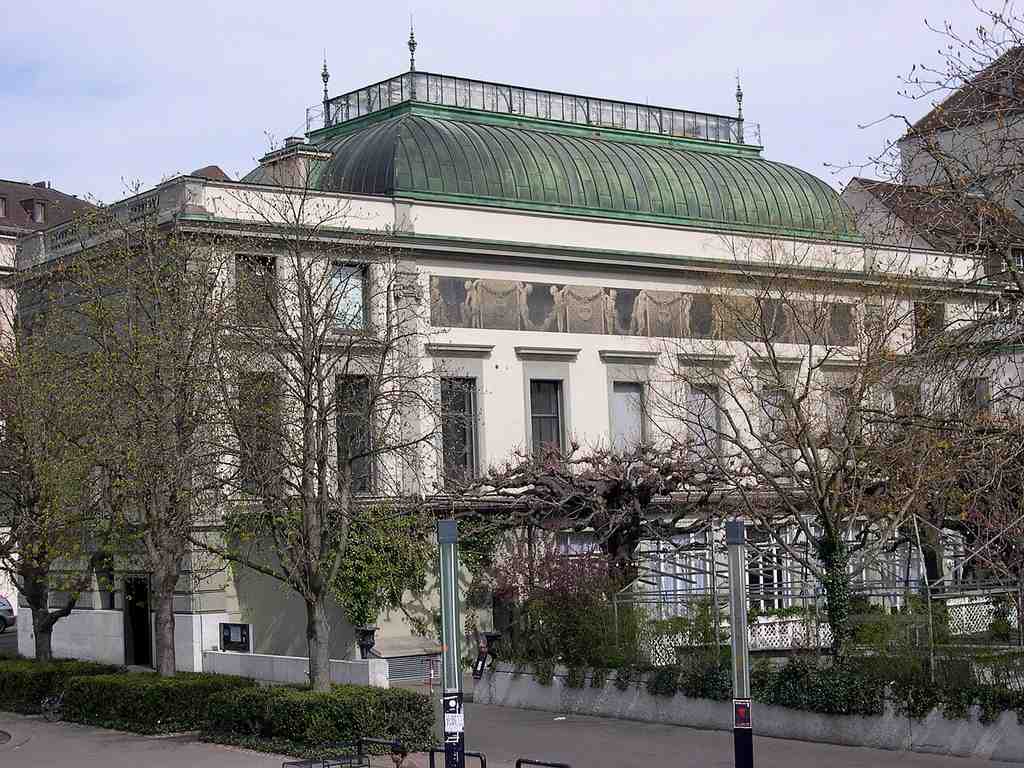
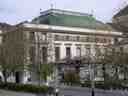
Kunsthalle BaselPhoto: Basmus, Wikimedia Commons, CC BY-SA 3.0. Cropped & resized. On your right, Kunsthalle Basel is a pale stone neoclassical building with a crisp symmetrical front, tall rectangular windows, and a temple-like entrance capped by a triangular pediment.
If Tinguely’s splashy mischief has already given you a hint, here is the larger truth: Basel’s avant-garde art tradition did not pop up yesterday. This city has spent a very long time making room for art that pokes, experiments, argues, and occasionally grins at you sideways.
Kunsthalle Basel opened in eighteen seventy-two, making it the oldest kunsthalle in Switzerland. A kunsthalle is not a museum with a fixed collection at its core; it is, first and foremost, a place for changing exhibitions. That difference matters. Museums protect treasures. A kunsthalle takes risks in public. Basel decided it wanted both.
And here is a very Basel detail... the money that helped raise this building came from the earnings of two Rhine ferry services. Not a duke, not a royal court, but boat crossings helped finance a home for new art. The architect Johann Jakob Stehlin-Burckhardt gave it this formal, confident shell, while the president of the Basler Kunstverein, Johann Jakob Im Hof, put the mission plainly at the opening: create a place for visual art, stir interest in it across the city, and keep artists and art lovers in lively company.
That spirit still fits the address. You are standing in one of Basel’s cultural crossroads: the theater sits beside it, the Stadtcasino concert hall faces it, and this whole stretch feels a bit like a civic stage set. If you glance at the image on your screen, you can see how firmly the building holds its place in that ensemble.
Most visitors read the façade as dignified and a little strict. Locals like to remember the impish note tucked into its early story: in eighteen seventy-one, Arnold Böcklin designed grimacing figures for the garden façade. That means this polished art house carried a mischievous little snarl almost from birth. Very Basel, really... respectable coat, unruly imagination underneath.
Inside these walls, the city repeatedly tested its nerve. In nineteen forty-nine, an Impressionist exhibition brought Claude Monet’s Water Lilies outside France for the first time ever. Then, in nineteen fifty-eight, Kunsthalle Basel became the first place in Europe, and the first museum space outside the United States, to show “The New American Painting,” including artists such as Mark Rothko and Jackson Pollock, in collaboration with New York’s Museum of Modern Art. That was not safe programming. That was Basel putting its chips on the future.
The building itself kept changing too. It gained additions by the nineteen twenties, sheltered the city’s displaced public art collection before the Kunstmuseum opened, and even rented space to government offices in leaner years. Later renovations, especially in nineteen sixty-nine and again in two thousand and four, updated the house while trying to keep its old dignity intact. The Swiss Architecture Museum moved in then as well, a neat reminder that in Basel, even the container becomes part of the conversation. The clear front view in the app helps show that balance between grandeur and usefulness.
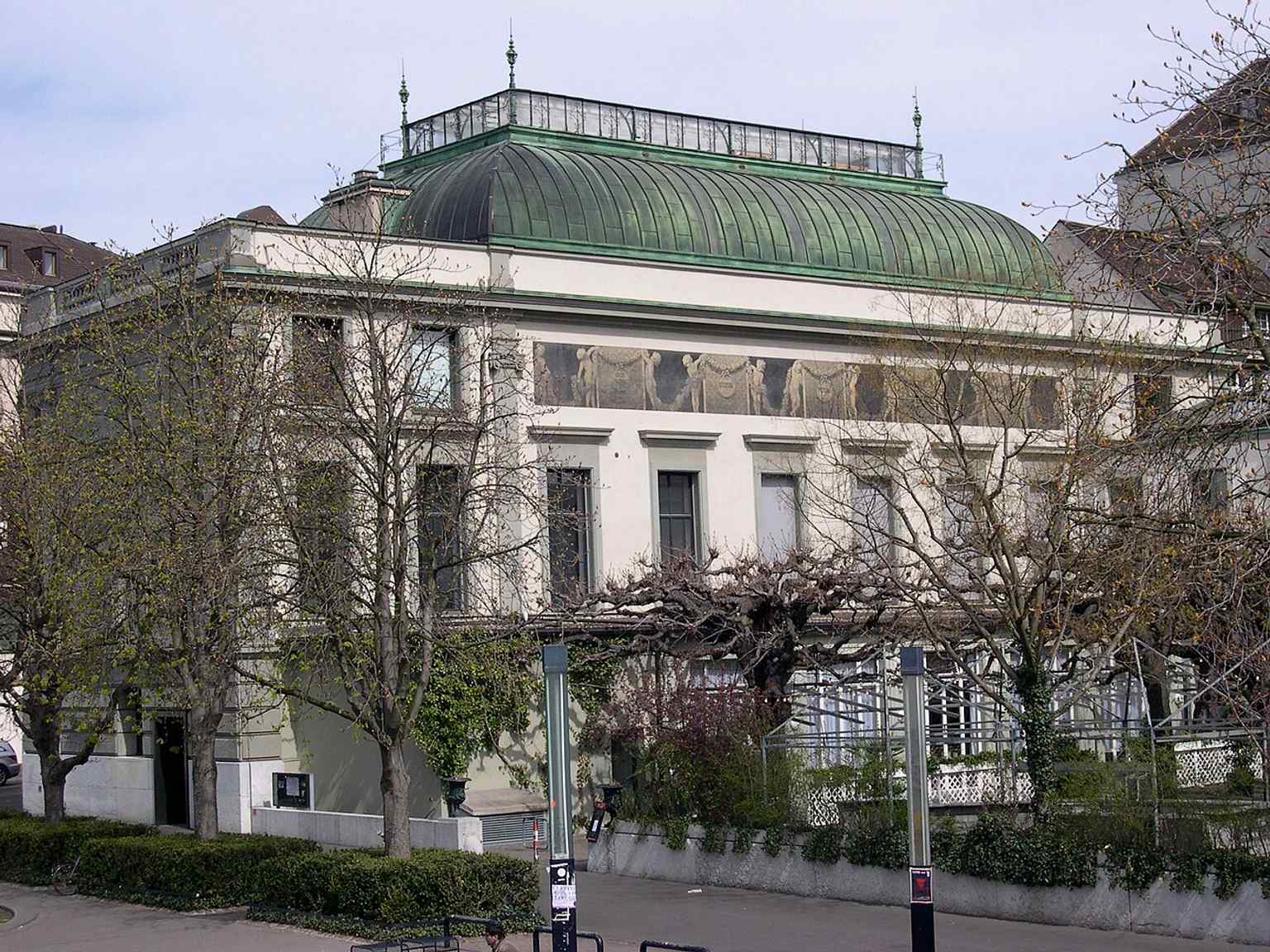
A clear front view of Kunsthalle Basel, the oldest kunsthalle in Switzerland, showing the neoclassical building that opened in 1872.Photo: Basmus, Wikimedia Commons, CC BY-SA 3.0. Cropped & resized. And the story is not frozen. Researchers revisiting a nineteen thirty-six Cézanne exhibition uncovered letters that turned one watercolor into a modern provenance debate about possible Nazi-era loss. So this place does more than hang art; it keeps reopening questions.
That matters for where we’re headed next, because Basel’s collections rarely sit still for long. In about two minutes, we’ll walk to the Museum of Antiquities and Ludwig Collection, where very old objects will ask some very current questions. If you plan to return, Kunsthalle Basel is closed on Monday and usually opens from four in the afternoon until ten at night the rest of the week.
Show 12 more stopsShow fewer stopsexpand_moreexpand_less
Look for the pale stone façade with its straight neoclassical lines, tall rectangular windows, and a dignified entrance set into a calm, orderly frontage. This museum tells a…Read moreShow less
Open dedicated page →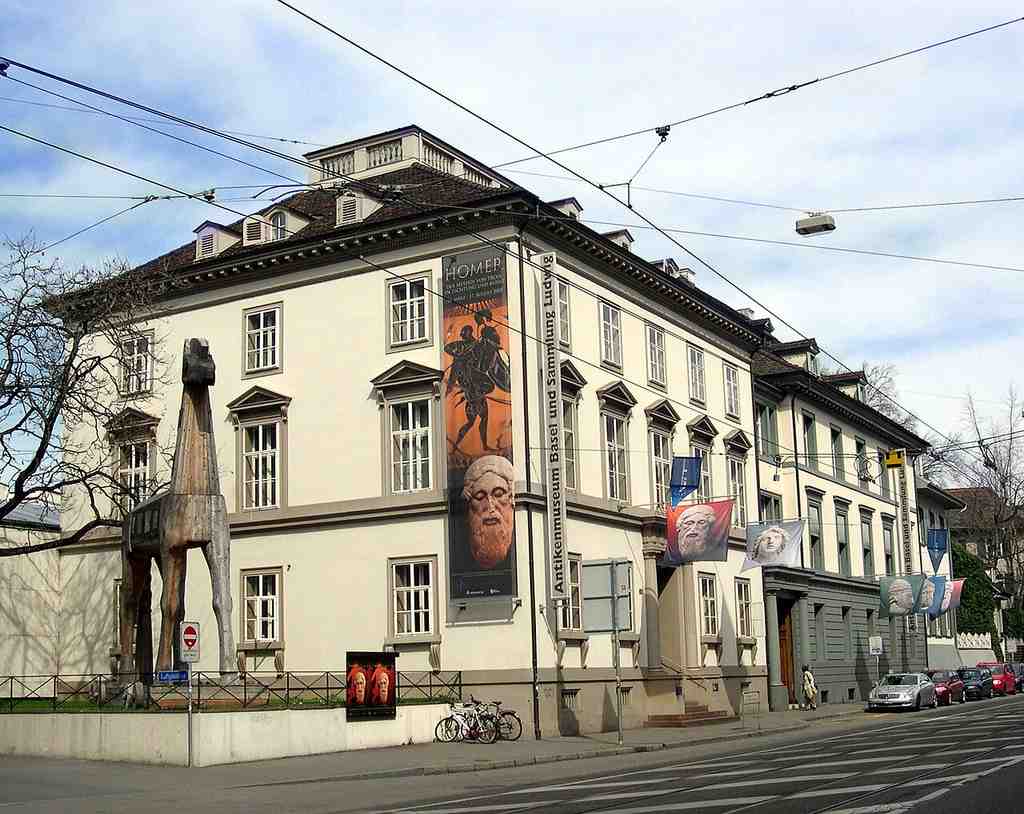
Basel Museum of Antiquities and Ludwig CollectionPhoto: Basmus, Wikimedia Commons, CC BY-SA 3.0. Cropped & resized. Look for the pale stone façade with its straight neoclassical lines, tall rectangular windows, and a dignified entrance set into a calm, orderly frontage.
This museum tells a very Basel story. Some of the city’s quietest builders never laid a single brick. Collector couples and donor couples kept handing over private passions, and little by little those passions became public memory.
At first, Basel owned ancient objects almost by accident. When the city bought the Amerbach cabinet in sixteen sixty-one and created its public collection, a few antiquities came along for the ride. But for a long time they sat neglected, while plaster casts of famous ancient sculptures stole the limelight. Those casts moved into the Augustinergasse museum, then into their own display at the Kunsthalle in eighteen eighty-seven. The original ancient pieces got split up in eighteen ninety-four between the Historical Museum and the Art Museum, and by nineteen twenty-seven even the sculpture room had closed. In other words... the ancients were here, but mostly waiting in the wings.
The real turning point came in nineteen sixty-one, when Basel gathered those scattered objects into a dedicated antiquities museum. About three quarters of what visitors saw came from private collections. Then, in nineteen sixty-six, the museum opened here in a neoclassical house designed by Melchior Berri in the eighteen twenties, paired with a modern hall lit from above. If you peek at the app, you can see how those interior galleries still use careful lighting and thematic rooms to make ancient life feel close, not dusty.
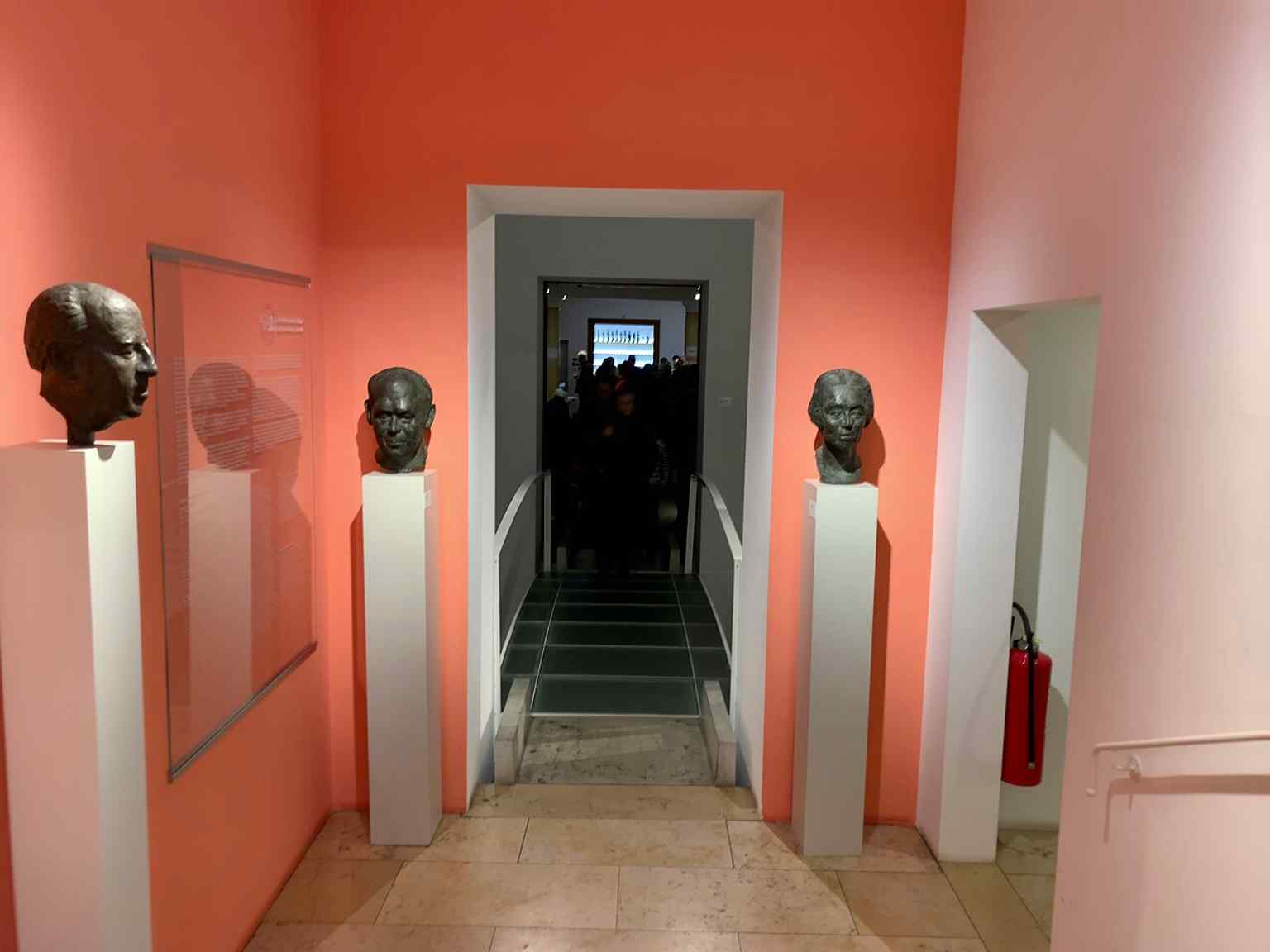
A dedicated exhibition hall at the Basel Museum of Antiquities and Ludwig Collection, showing how the museum uses special displays to interpret ancient life beyond just isolated objects.Photo: Ank Kumar, Wikimedia Commons, CC BY-SA 4.0. Cropped & resized. One couple gave this place its emotional core. Rudolf Emil Gsell-Busse, a lawyer who later ran Roche, and his wife Margarethe loved Greek art with real devotion. Their collection came here in stages, first as a long-term loan in the nineteen sixties, then again in the nineteen eighties. After they died, their daughter Daniela Schlettwein-Gsell and then their granddaughter Eleonore Pierrette Schlettwein chose to turn that family treasure into a permanent gift. That is the move Basel makes again and again: private desire, public trust.
Another donor couple changed the building itself. In nineteen eighty-one, Peter and Irene Ludwig from Aachen donated a major collection of antiquities. The museum had to expand into the neighboring Berri building at St. Alban-Graben seven, and it reopened in nineteen eighty-six with its fuller name: the Museum of Antiquities and Ludwig Collection.
Inside, this is still the only museum in Switzerland devoted entirely to the ancient Mediterranean world: Egypt, Greece, Etruria, Rome, the Near East, and Cyprus, spanning from the fourth millennium before Christ into late antiquity. Sculpture and ceramics lead the conversation, with strong holdings in Greek vases, bronzes, terracottas, and gold jewelry. A later Egyptian department opened beneath the courtyard in two thousand and one, and the department for the Orient, Cyprus, and archaic Greece followed in two thousand and two, shaped again by collectors such as Peter and Elisabeth Suter-Dürsteler, and Hans and Trudy Bosshard-Wirz.
There is even a local legend in plaster. The museum’s sculpture hall, once a university teaching collection, now holds more than twenty-two hundred casts, including an almost complete Parthenon sculptural ensemble. Its star reconstruction is Achilles and Penthesilea, pieced together in Basel by director Ernst Berger and sculptor Willi Walter from fragmentary Roman copies of a lost Greek original. Not bad for a city that knows how to make absence work overtime. You can get a feel for that curatorial style in another gallery view on your screen.
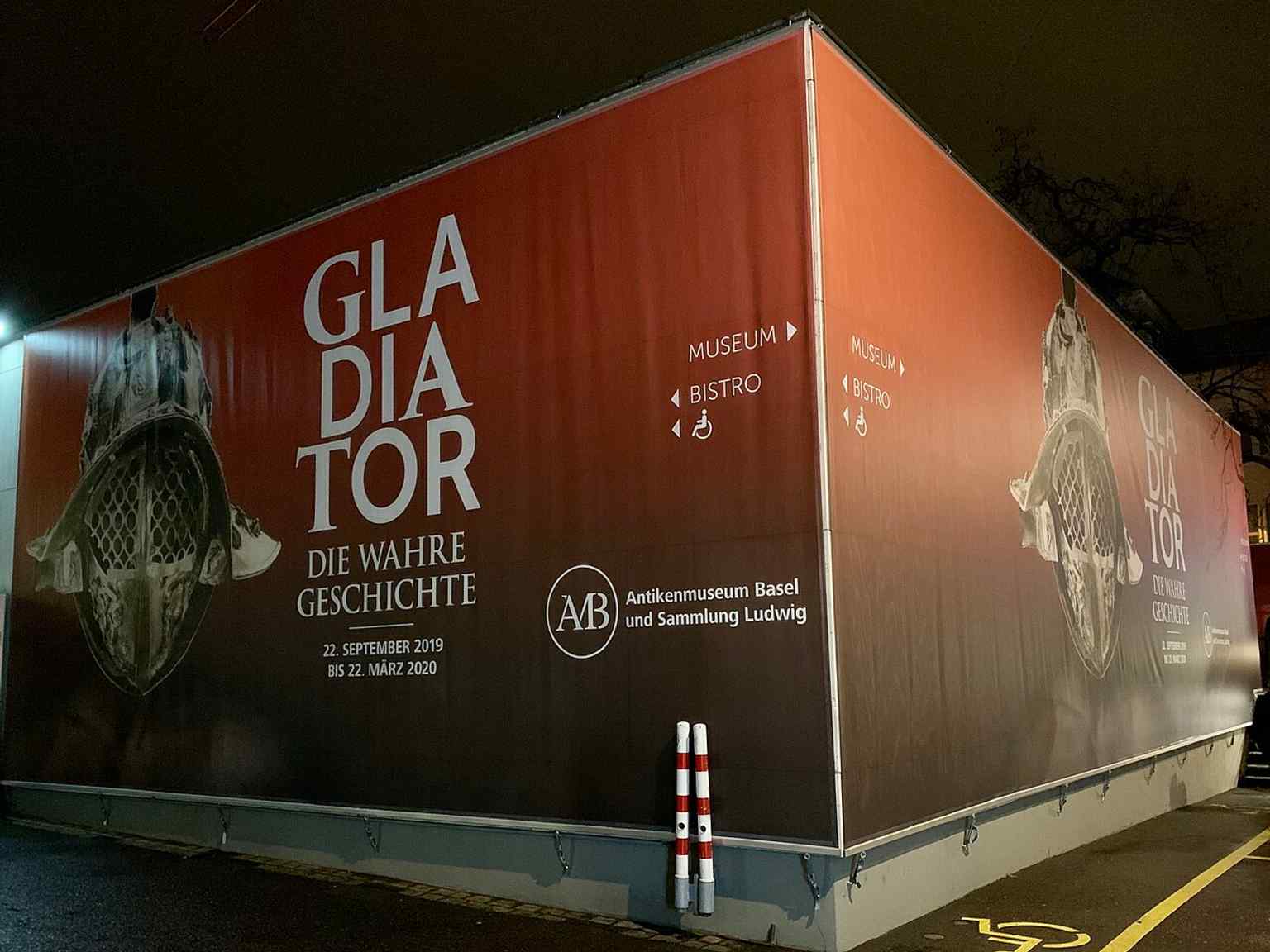
A gallery view inside the museum, reflecting the institution’s role as Switzerland’s only museum dedicated exclusively to the ancient Mediterranean world.Photo: Ank Kumar, Wikimedia Commons, CC BY-SA 4.0. Cropped & resized. And one more thing matters here: these objects are not just beautiful; they are witnesses. Since twenty twenty-three, the museum has carried out systematic research into where the objects came from, tracing whether any pieces connect to Nazi looting, colonial extraction, or illicit excavation. By March twenty twenty-six, researchers had identified six objects with clear signs of problematic acquisition.
In a moment, we leave imported marble, clay, and bronze for local fiber, water, and craft... because Basel did not only collect knowledge, it learned to manufacture it. The Basel Paper Mill is about an eleven-minute walk from here.
If you want to come back inside, the museum is closed on Monday, usually opens at eleven from Tuesday to Friday, stays open late on Thursday and Friday, and opens at ten on Saturday and Sunday.
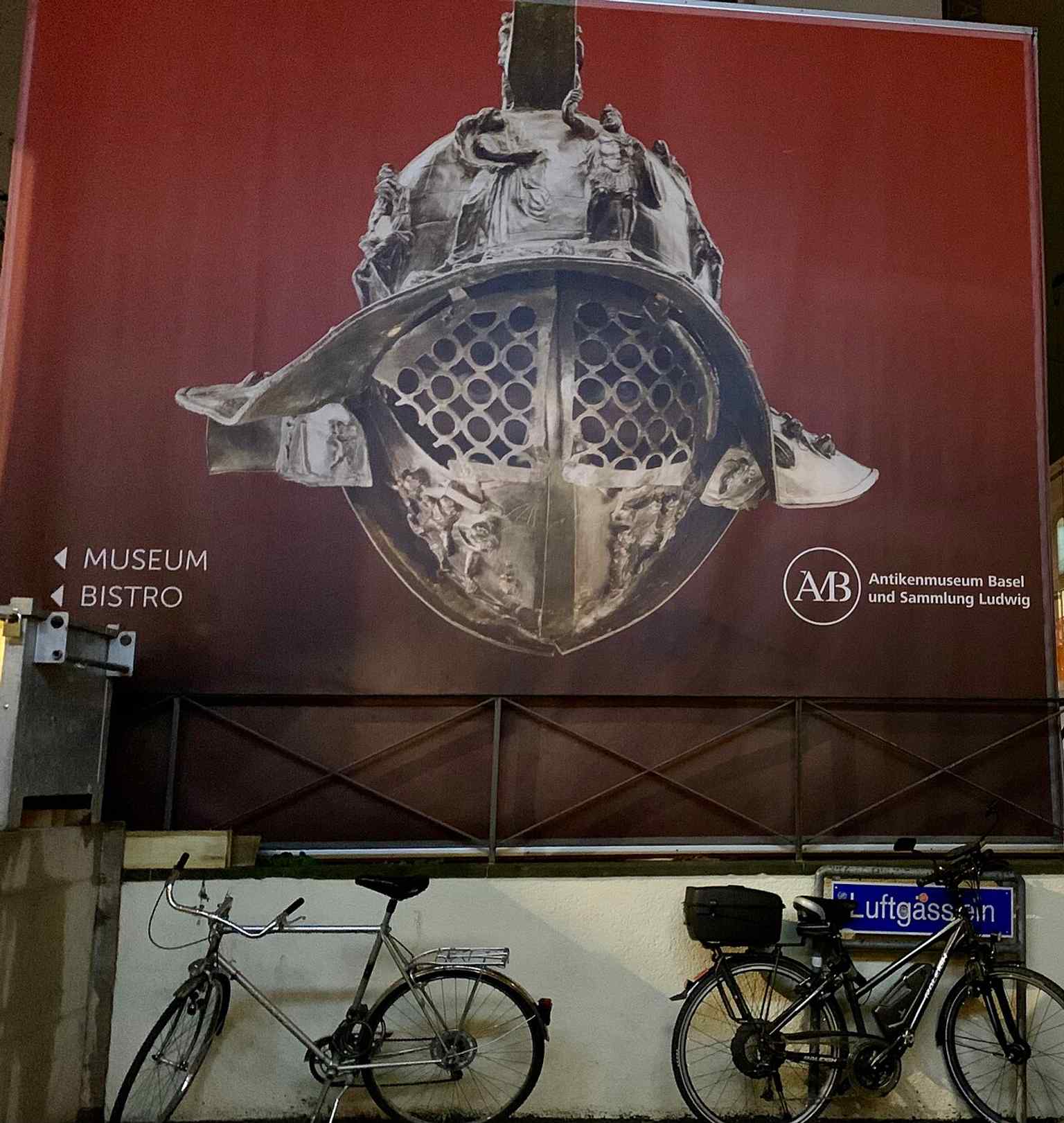
An exhibition interior from the Antikenmuseum Basel — a good example of the museum’s focus on ancient culture through curated thematic rooms.Photo: Ank Kumar, Wikimedia Commons, CC BY-SA 4.0. Cropped & resized. 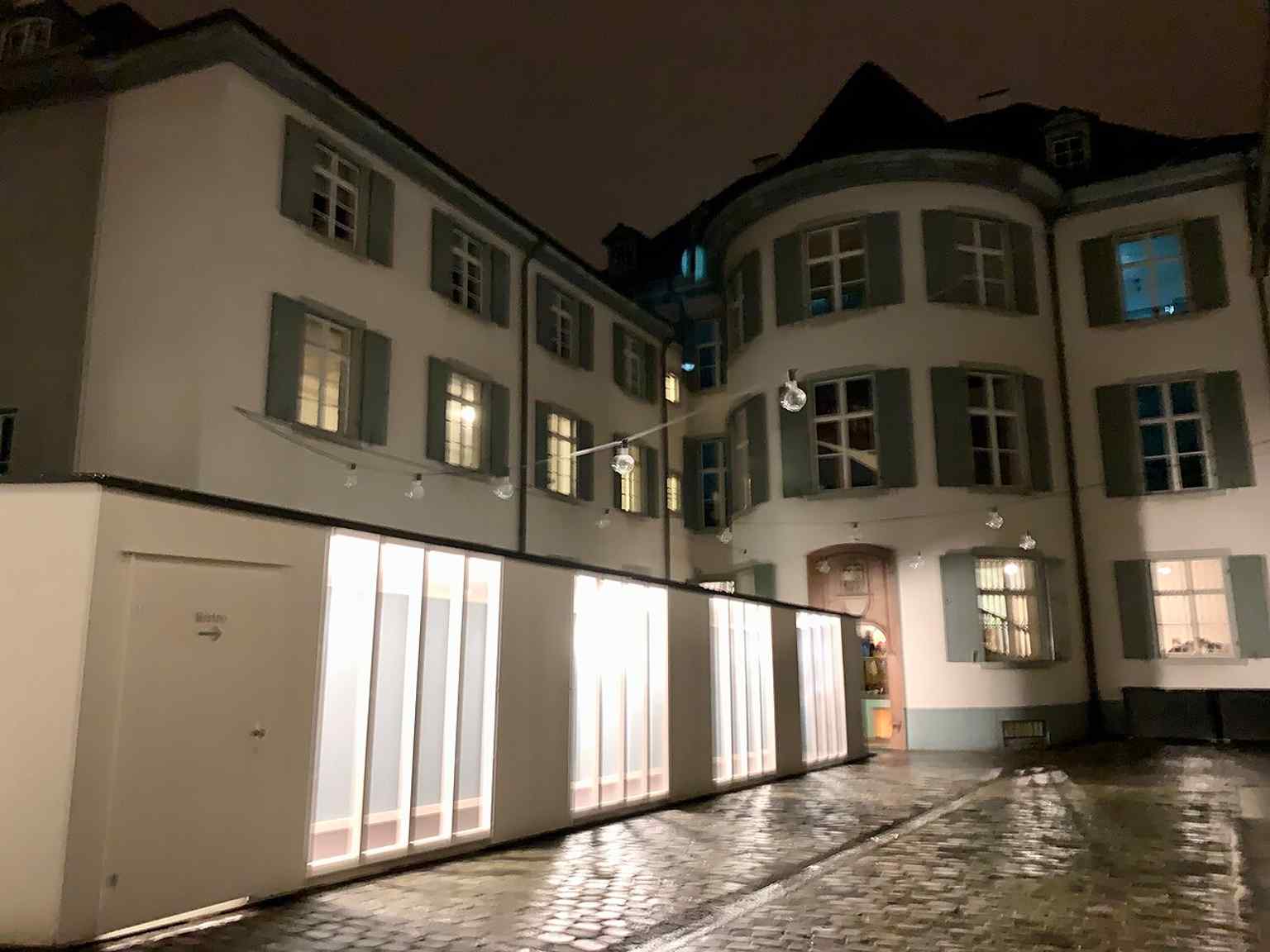
A final exhibition-room view from the Basel Museum of Antiquities and Ludwig Collection, showing the kind of contemporary installations used to tell ancient stories.Photo: Ank Kumar, Wikimedia Commons, CC BY-SA 4.0. Cropped & resized. On your right, look for a pale stone-and-plaster mill with a steep tiled roof and a broad wooden waterwheel set beside the canal. This is the Basel Paper Mill, and it tells a…Read moreShow less
Open dedicated page →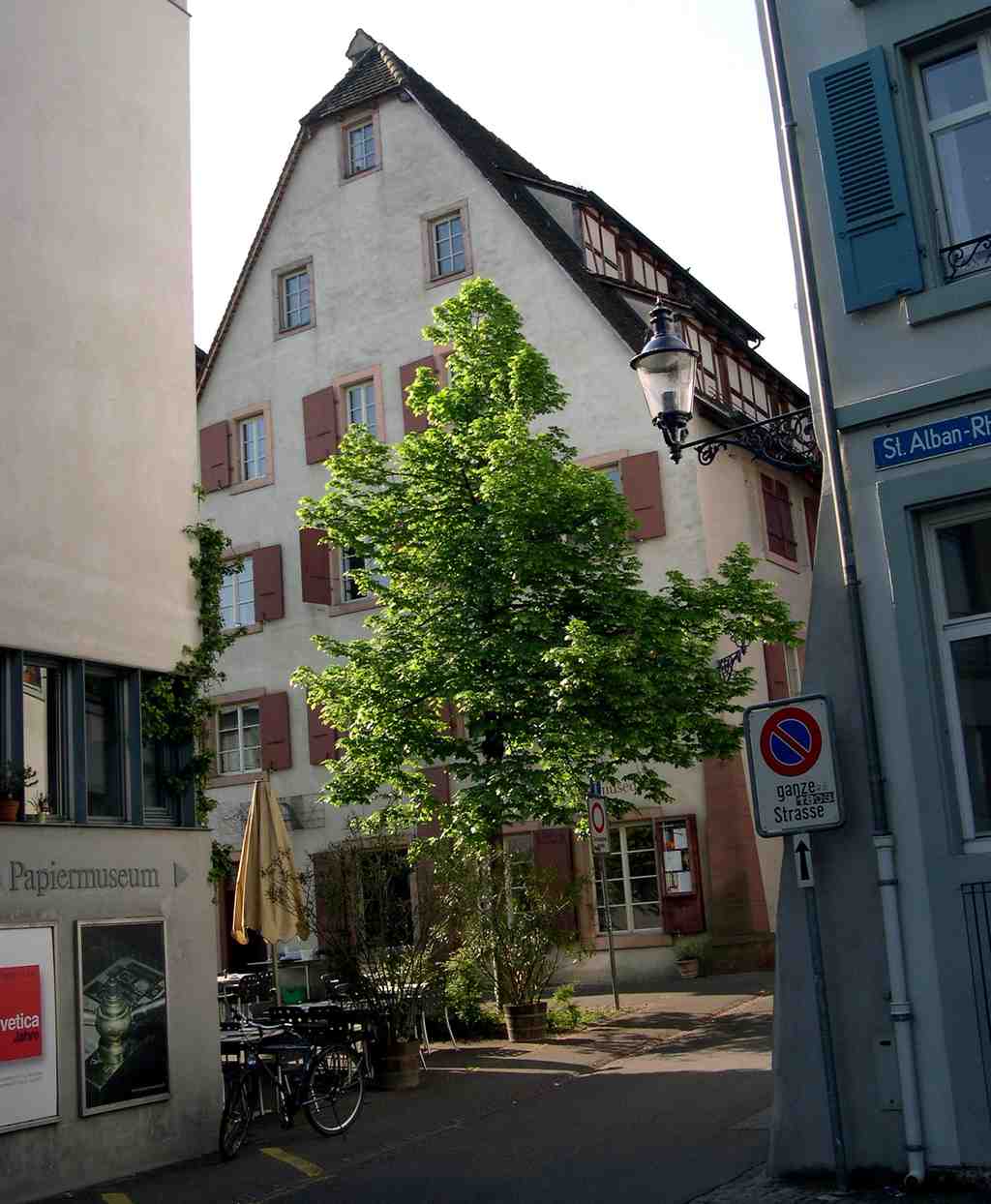
Basel Paper MillPhoto: Basmus, Wikimedia Commons, CC BY-SA 3.0. Cropped & resized. On your right, look for a pale stone-and-plaster mill with a steep tiled roof and a broad wooden waterwheel set beside the canal.
This is the Basel Paper Mill, and it tells a wonderfully practical truth: before a city can become famous for ideas, it needs paper. Paper, writing, and printing formed the working floorboards under Basel’s scholarship, religion, trade, and reform. Before a sermon could spread, before a scholar could argue, before a law could stick, somebody had to make the sheet, mix the ink, set the type, and bind the book. Big thoughts, humble fibers.
This building began life as a corn mill owned by Klingental Abbey until fourteen twenty-eight. Then, in fourteen fifty-three, Anton Gallizian converted it into a paper mill here on the St. Alban pond, a commercial canal that had already powered work in this part of Basel since the thirteenth century. Gallizian’s family worked the trade until fifteen twenty-one, when political change pushed them out, and the Thüring family expanded the mill after that. In seventeen seventy-eight, bookseller and publisher Johann Christoph Imhof-Burckhardt bought the place, and ten years later he replaced part of it with a two-story structure. So even the building itself kept changing jobs... mill, factory, warehouse, museum. Basel has a habit of hanging on by changing shape.
If you glance at the image in the app, you can see that careful restoration: not a stage set, but a working memory in timber, masonry, and water power.
The human thread I’d keep in your pocket here belongs to Walter F. Tschudin. He was a chemist at Sandoz from nineteen thirty-seven to nineteen sixty-three, and somewhere along the way he fell hard for the history of papermaking. In nineteen fifty-eight he published a major study of Basel’s mills, their owners, their watermarks, and even the marks used on bundles of paper. He also collected tools, machines, and documents piece by piece, long before this museum had a home. In a sense, this museum started as a collector’s rescue mission in exile, with its early paper history collection stored over on Augustinergasse.
What you see now opened here on the nineteenth of September, nineteen eighty, after the Christoph Merian Foundation restored the old mill. Later renovations in twenty ten and twenty eleven expanded and reorganized the museum, and today the Gallizian Mill holds workshops, while the neighboring buildings add a café, shop, and more working spaces. One highlight is a Fourdrinier machine from nineteen sixty-four - that’s an industrial paper machine that makes a continuous ribbon of paper instead of one sheet at a time.
And the old mechanics still matter. In twenty twenty-two, the mill renovated its waterwheel with a new oak transmission beam measuring four point three metres. They needed oak about three hundred years old to take the strain, and finding it proved tricky because the reconstruction of Notre-Dame in Paris had already tightened the market for ancient timber. Even conservation has supply-chain drama.
So the vats, presses, beams, and wheel here are not just equipment. They are survivors of labor. They remember the anonymous hands that made Basel legible.
As you leave, here’s the question to carry forward: when a city is praised for its writers, printers, scholars, and reformers, who deserves more of the credit - the famous names, or the workers who made thought printable in the first place?
Up ahead, the story shifts from craft to stone: head on to St. Alban Gate, about five minutes away, where survival meant walls, defense, and rebuilding after disaster. If you want to come back inside, the museum is closed on Mondays and otherwise opens from late morning, with a shorter afternoon opening on Saturdays.
On your right stands a pale stone gate tower with a tall pointed arch, a flat pyramid roof, and small clock faces set high in the walls. This is St. Alban Gate, one of only…Read moreShow less
Open dedicated page →On your right stands a pale stone gate tower with a tall pointed arch, a flat pyramid roof, and small clock faces set high in the walls.
This is St. Alban Gate, one of only three surviving city gates in Basel, and it tells a sturdy little truth about the city: survival here usually comes with dents, arguments, and a bit of practical tinkering. The gate first shows up in records around twelve thirty. At that point, it may not even have worked as a proper gate yet. It seems to have started as a freestanding tower, set slightly behind the line of the wall, and only later did builders tie it into the city defenses with side structures. Basel did not always build in one grand plan. Sometimes it improvised... and then called that tradition.
Then came the Basel earthquake of thirteen fifty-six, the great rupture that damaged Basel on a citywide scale. This tower was partly destroyed too, and from thirteen sixty-two onward people rebuilt it. By thirteen seventy-four it appears again in a watch order, not as a gate, but as a tower that nearby residents had to guard.
That defensive role hardened in fourteen seventy-three, when Basel expected trouble during the Burgundian Wars. Builders added a forework, meaning an extra fortified barrier in front of the main tower, plus a drawbridge across the ditch. If you glance at the image on your screen looking through the passage, you can see the point of it: this arch squeezed movement into a narrow, controllable throat.
Now for the local politics... because this place has plenty. In eighteen sixty-four, contractor Hollinger tore down the outer earthwork and used the rubble to fill the moat. A few years later, Amadeus Merian and the Basel Art Society fought to restore the gate gracefully, but the city chose a remake instead. Ground levels were lowered so the tower looked taller, a fussy high roof went on top, huge clock dials appeared, and a neo-Gothic police post got attached to the north side. One opponent even joked that if Basel insisted on keeping the old thing, they should decorate it with the carnival figure known as the Lällenkönig, so schoolboys would still have something to gawk at. Nothing says refined urban planning like designing for heckling.
If you pull up the old photograph, you can catch that nineteenth-century version after the military edges had softened into a promenade. Then, in nineteen seventy-five, Basel corrected course again. With support from the Christoph Merian Foundation, the federal government, and public fundraising that brought in over three hundred thousand francs, roughly around a million today, the city restored the flatter roof and brought back key defensive details.
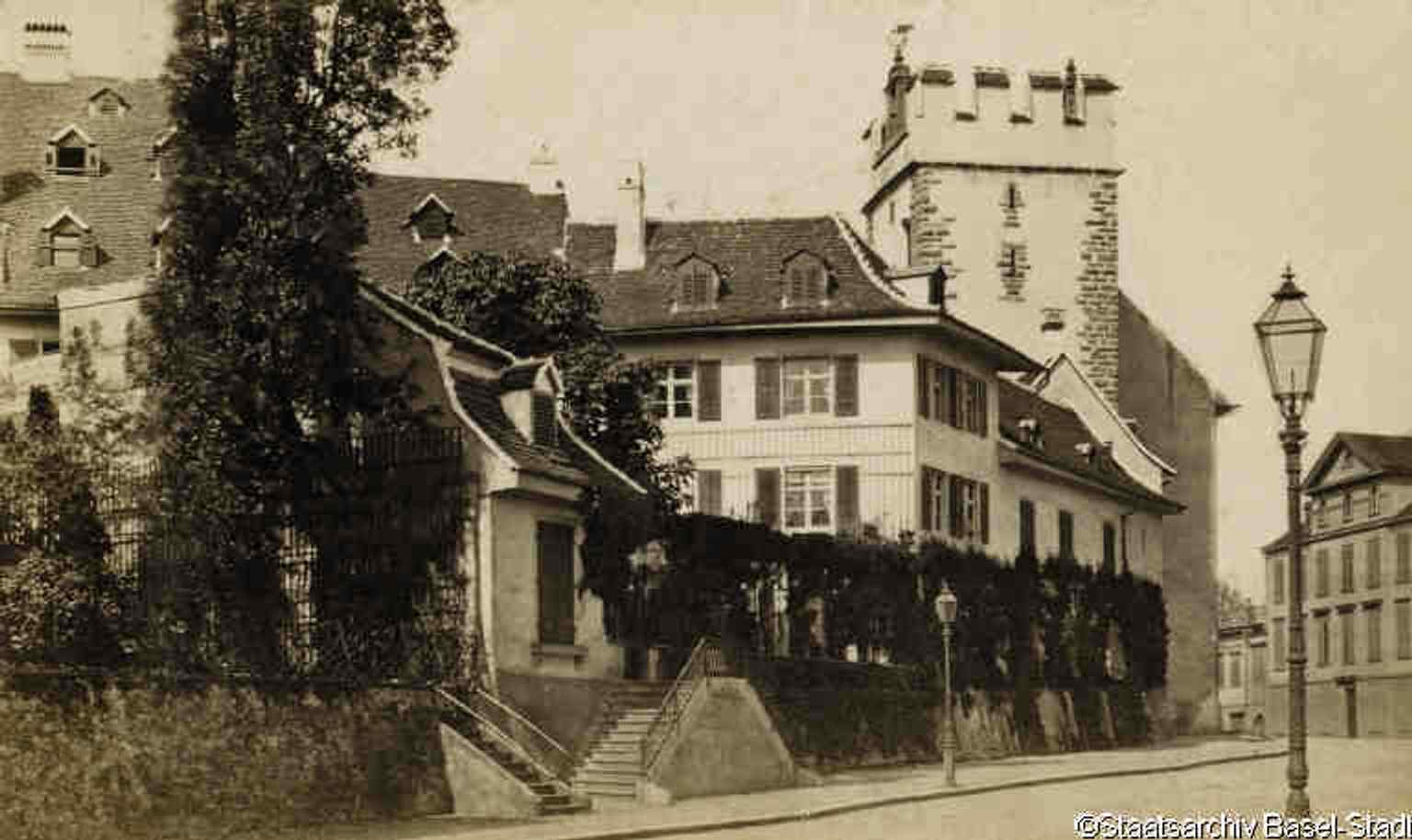
A rare 1878 historic view of St. Alban Gate, useful for showing how the gate looked in the 19th century after the area was reshaped into a promenade.Photo: Unknown, Wikimedia Commons, Public domain. Cropped & resized. So this gate no longer guards Basel from armies. Instead, it marks the threshold to the city’s oldest historical ground uphill. From here, head on toward Münsterplatz, about fourteen minutes away, where power stops looking military and starts looking sacred.
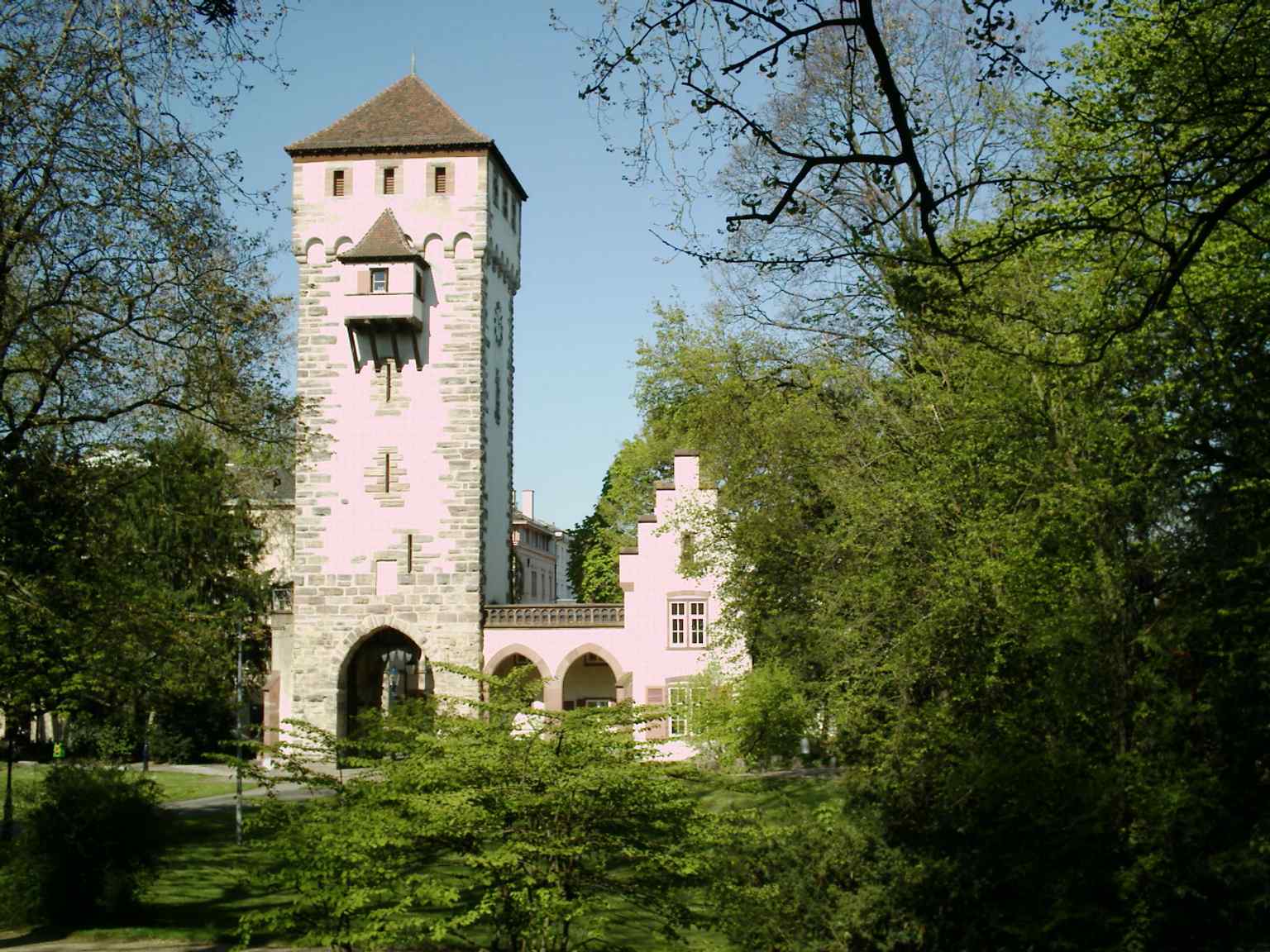
Front view of St. Alban Gate, the surviving medieval city gate that marks the entrance to Basel’s St. Alban district.Photo: Unknown, Wikimedia Commons, CC BY-SA 3.0. Cropped & resized. 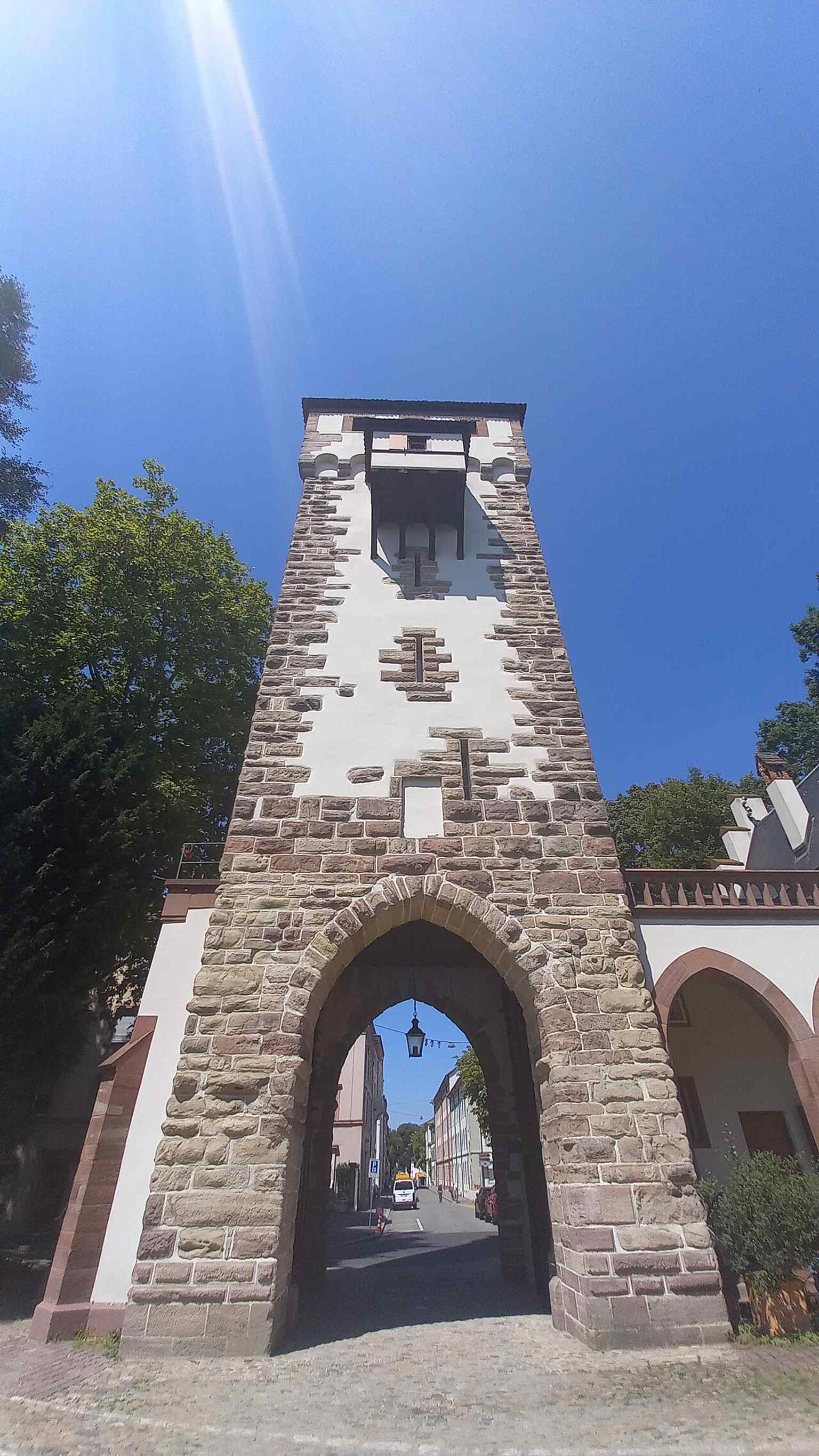
The gate in 2022, with the surrounding parkland that replaced the old defensive works and turned the site into a public green space.Photo: PersianDutchNetwork, Wikimedia Commons, CC BY-SA 4.0. Cropped & resized. 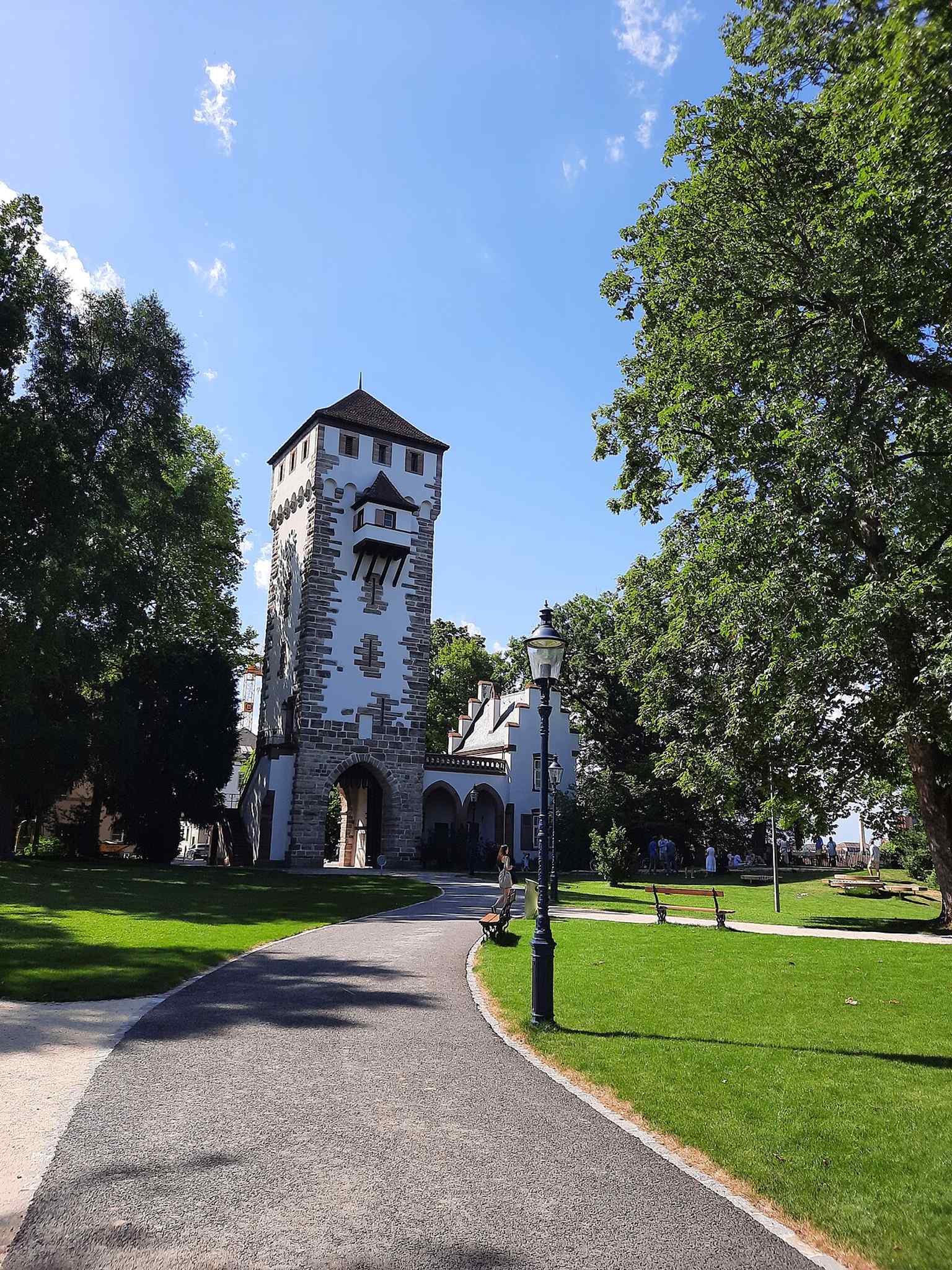
St. Alban Gate with the park in front, illustrating how the former fortifications now sit within a landscaped urban recreation area.Photo: Jnmths, Wikimedia Commons, CC BY-SA 4.0. Cropped & resized. Look for a wide, stone-paved square of split Rhine cobbles, edged by stately old houses, with the red sandstone mass of Basel Minster holding the whole space in place. This is…Read moreShow less
Open dedicated page →Look for a wide, stone-paved square of split Rhine cobbles, edged by stately old houses, with the red sandstone mass of Basel Minster holding the whole space in place.
This is Münsterplatz, one of Basel’s oldest squares... and one of its best stage sets. Not stage set in the fake Hollywood sense... more like a place where the same ground kept accepting new scenes for more than two thousand years.
This hill is the Münsterhügel, the layered core of Basel. Long before the cathedral, people settled this rise above the Rhine because it gave them a strong position and a long view. In the first century before Christ, the Raurici lived here in a fortified settlement, so ancient life and medieval life sit here almost like stacked pages in the same book.
The square you see took shape much later, in steps: first with the building of the Minster in the Middle Ages, then with Baroque changes, and again in the early nineteenth century. Even the paving under your feet carries that long memory. These are Rhine stones, split and set with the broken face upward, and the core of this surface goes back to the late fourteenth and early fifteenth centuries. When the Council of Basel met here in the early fifteenth century, people already crossed this same patchwork of stone.
If you glance at the app, the older view shows how stubbornly this place has kept its role, even as the city changed around it.
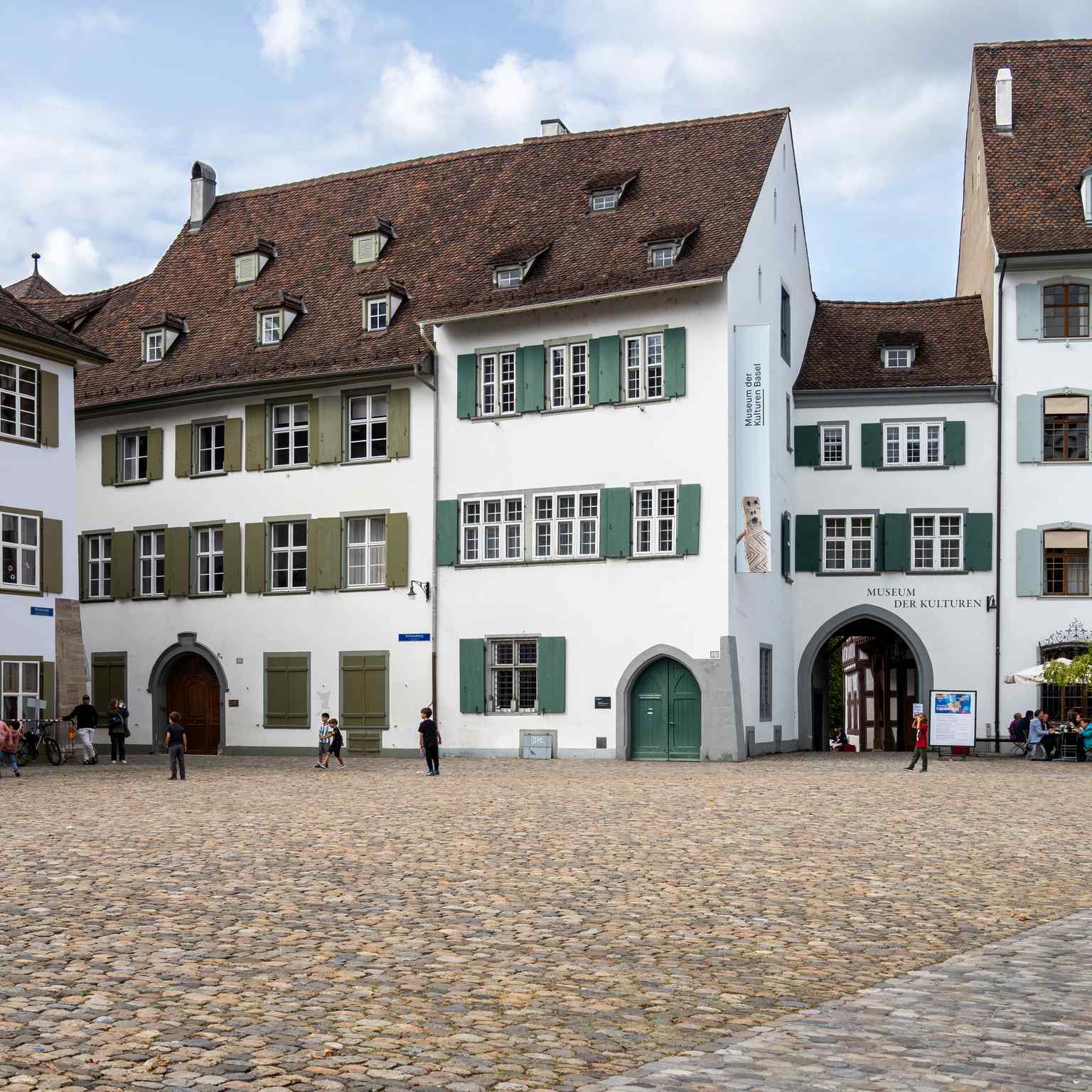
An 18th-century view of Basel’s cathedral square, showing the Münsterplatz before modern changes and highlighting its long role as the setting for the city’s cathedral and public life.Photo: Emanuel Büchel (Künstler), Wikimedia Commons, Public domain. Cropped & resized. Now take a slow look around the edges of the square... Notice how the open space meets those tightly packed historic houses. It feels ceremonial, yes, but also lived-in, like a grand room that never forgot it had neighbors.
Those houses mattered. Across the square stood the Haus zur Mücke, and in fourteen forty, during the Council of Basel, it became the scene of a European power struggle. Pope Martin the Fifth had called the council to reform the church, but reform and politics are old traveling companions. Under Cardinal Ludwig of Arles, the conclave in that house chose Amadeus of Savoy as Felix the Fifth, an antipope, meaning a rival claimant to the papacy. For his public crowning on this square, workers had to force open sealed doors with axes, and witnesses said the electors came out pale and exhausted. So yes... this peaceful square has seen men argue about the fate of Christendom within a few steps of where schoolchildren later walked home.
And the square kept changing jobs. In seventeen ninety-eight, Basel citizens and French revolutionaries held a fraternization ceremony here around a liberty tree. In eighteen seventy-one, the city laid asphalt across the space because horse-drawn traffic clattered so loudly it disturbed lessons in the nearby school. Then, after years of parking and buses, Basel restored the square between two thousand six and two thousand thirteen, bringing back a unified stone surface while making it easier to walk. Old fabric, new use... Basel’s favorite trick.
One more witness hides in plain sight: somewhere in the paving of the larger square, a cast-iron plate marks a Roman well once about twenty meters deep. The well is filled in now, but its marker quietly says, “I was here first.”
If you want one more visual anchor, the app’s southeast view makes the square’s breadth and its ring of old houses especially clear.
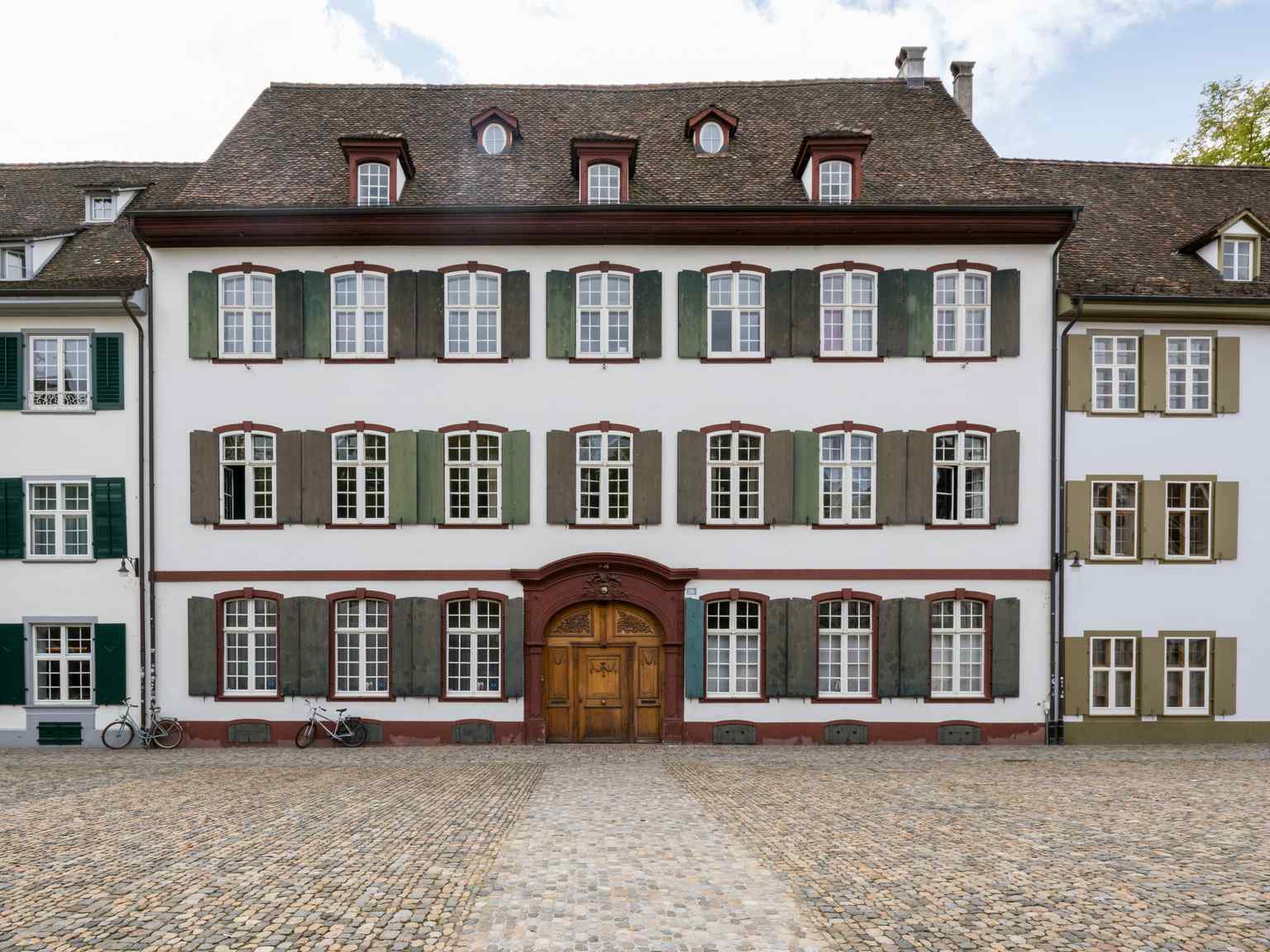
A southeast view of Münsterplatz, useful for showing the broad paved square framed by the old houses that line Basel’s cathedral hill.Photo: JoachimKohler-HB, Wikimedia Commons, CC BY-SA 4.0. Cropped & resized. Now let your eyes rise from the square to the Minster itself. We’ve been standing in the city’s outer chamber; next, we step toward its heart.
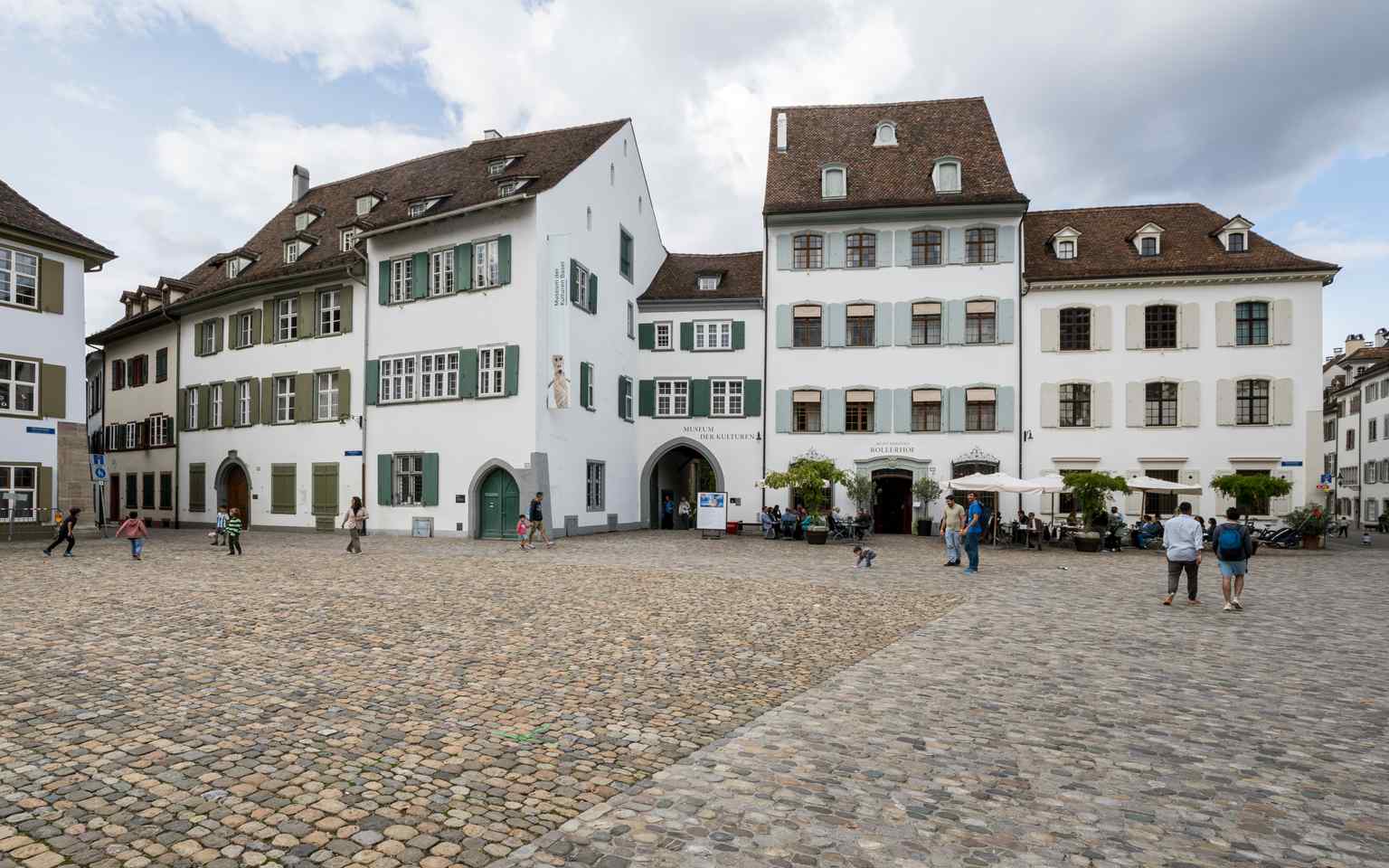
The northwest side of Münsterplatz with the Museum der Kulturen, one of the landmark buildings surrounding the square’s historic medieval setting.Photo: JoachimKohler-HB, Wikimedia Commons, CC BY-SA 4.0. Cropped & resized. 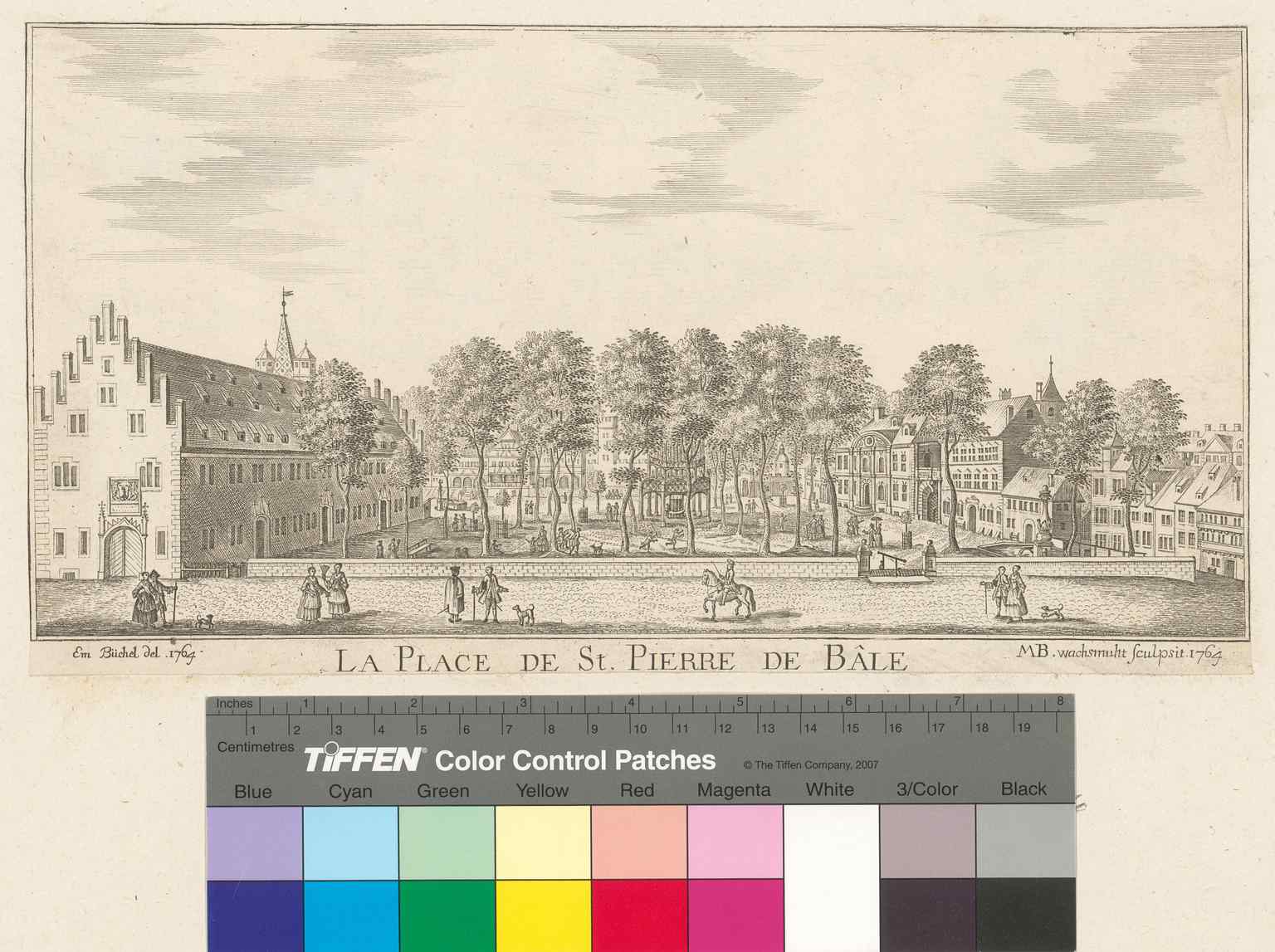
Münsterplatz 17, part of the row of old civic houses that give the square its preserved historic character.Photo: JoachimKohler-HB, Wikimedia Commons, CC BY-SA 4.0. Cropped & resized. Look for the red sandstone church with steep patterned roofs, two slender pointed towers, and dense carved stonework climbing the facade. At first glance, Basel Minster seems…Read moreShow less
Open dedicated page →Look for the red sandstone church with steep patterned roofs, two slender pointed towers, and dense carved stonework climbing the facade.
At first glance, Basel Minster seems immovable... the kind of building that has always known exactly where it stands. But this hill has changed costumes for more than two thousand years. Before the church, people fortified this ridge in late Celtic times. Later, the Romans planted a stronghold here. Then, in the early Middle Ages, Bishop Haito raised an earlier church, and after that Emperor Henry the Second helped launch the great cathedral begun in the year ten nineteen. What you see now took shape in waves, from Romanesque solidity to Gothic height, all the way to the year fifteen hundred.
That is the surprise of this place: it looks permanent, but it is really a masterclass in repair, revision, and second chances.
From where you are standing, the tower details tell that story nicely. The Minster’s two west towers did not rise together like twins in matching suits. Builders finished them at different times, so each has its own character. The south tower, the Martinsturm, reached completion in the year fifteen hundred under Hans von Nussdorf. He even left his name on the tower below the spire... a medieval version of signing your workbench. If you glance at the app image of the Martinsturm clock and sundial, you’ll catch one charming Basel quirk: the sundial still shows the city’s old local time.
Then came the earthquake of thirteen fifty-six.
It shattered all the towers, wrecked vaults, and damaged the crypts below. Master builder Johann Parler led the rebuilding, and by thirteen sixty-three the high altar stood ready again. So the church you’re facing is not just old; it is old and reassembled, like a family story patched together after a fire.
The deepest upheaval, though, came from people rather than stone. In fifteen twenty-nine, Basel’s Reformation, shaped locally by Johannes Oekolampad and energized by the wider ideas of Huldrych Zwingli, changed what sacred space meant in this city. Worship shifted away from richly adorned images toward preaching and scripture. On the ninth of February that year, armed townsmen forced their way into the Minster and smashed crosses, saints, and altar images. Permanence met argument... and argument won.
One witness makes that turn unforgettable. Erasmus of Rotterdam, the great humanist scholar, described the iconoclasm in a shocked letter. Yet after he died in fifteen thirty-six, this now Reformed church still gave him an honored burial place. That tells you something important about Basel: even when it overturns an old order, it rarely throws away every layer.
If you tap the before-and-after image, you can watch the Minster keep command of the skyline while the riverfront around it changes nearly everything else.
And not all of Basel’s important collections stayed inside church walls; many later faced outward toward the wider world. We’ll pick up that thread at the Museum of Cultures, about a two-minute walk from here. If you plan to go inside later, the Minster generally opens from ten to five, with shorter hours on Saturday and a later start on Sunday.
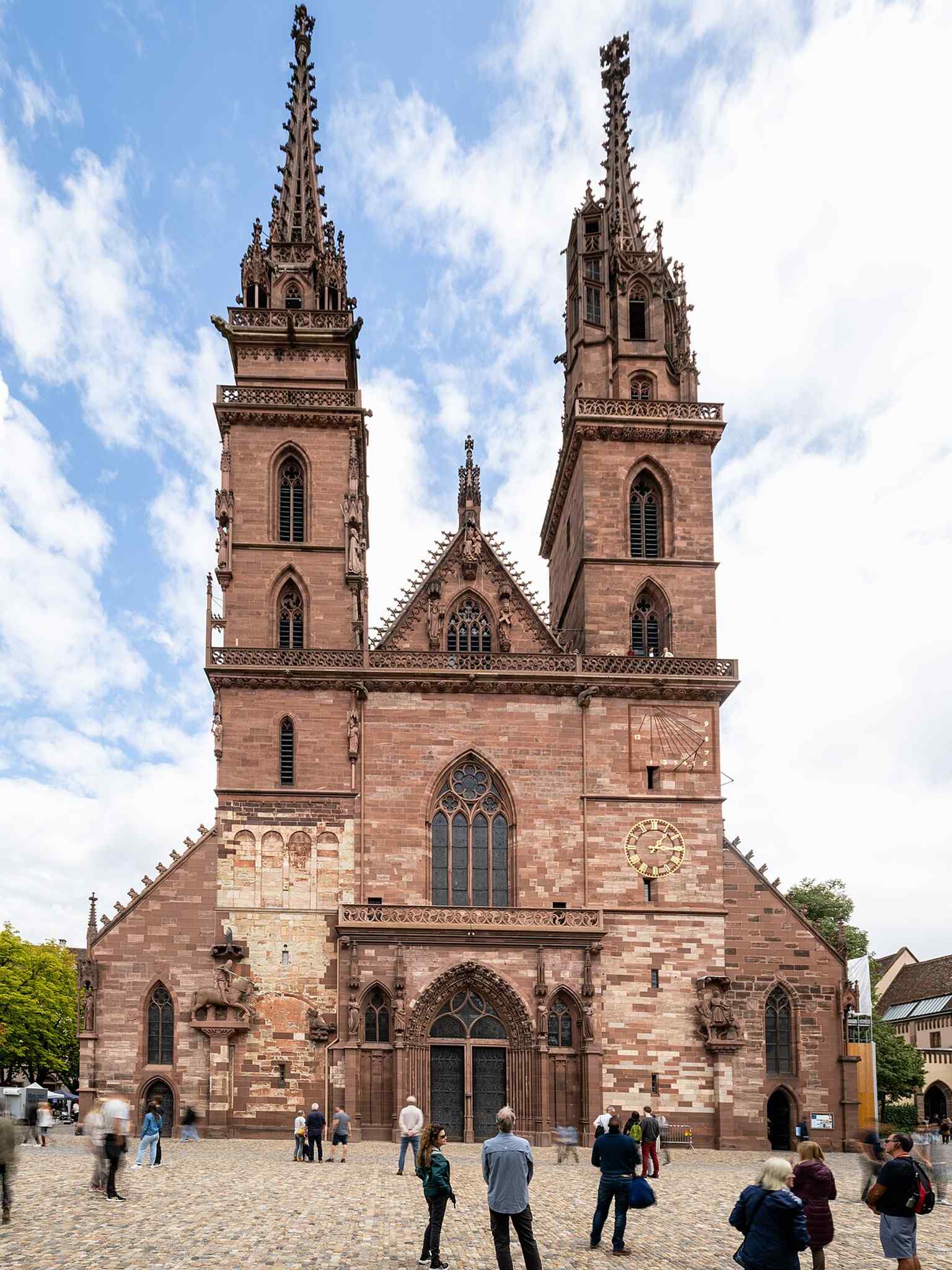
A sharp modern view of the west facade, where the two towers rose again after the 1356 earthquake and later Gothic rebuilding.Photo: JoachimKohler-HB, Wikimedia Commons, CC BY-SA 4.0. Cropped & resized. 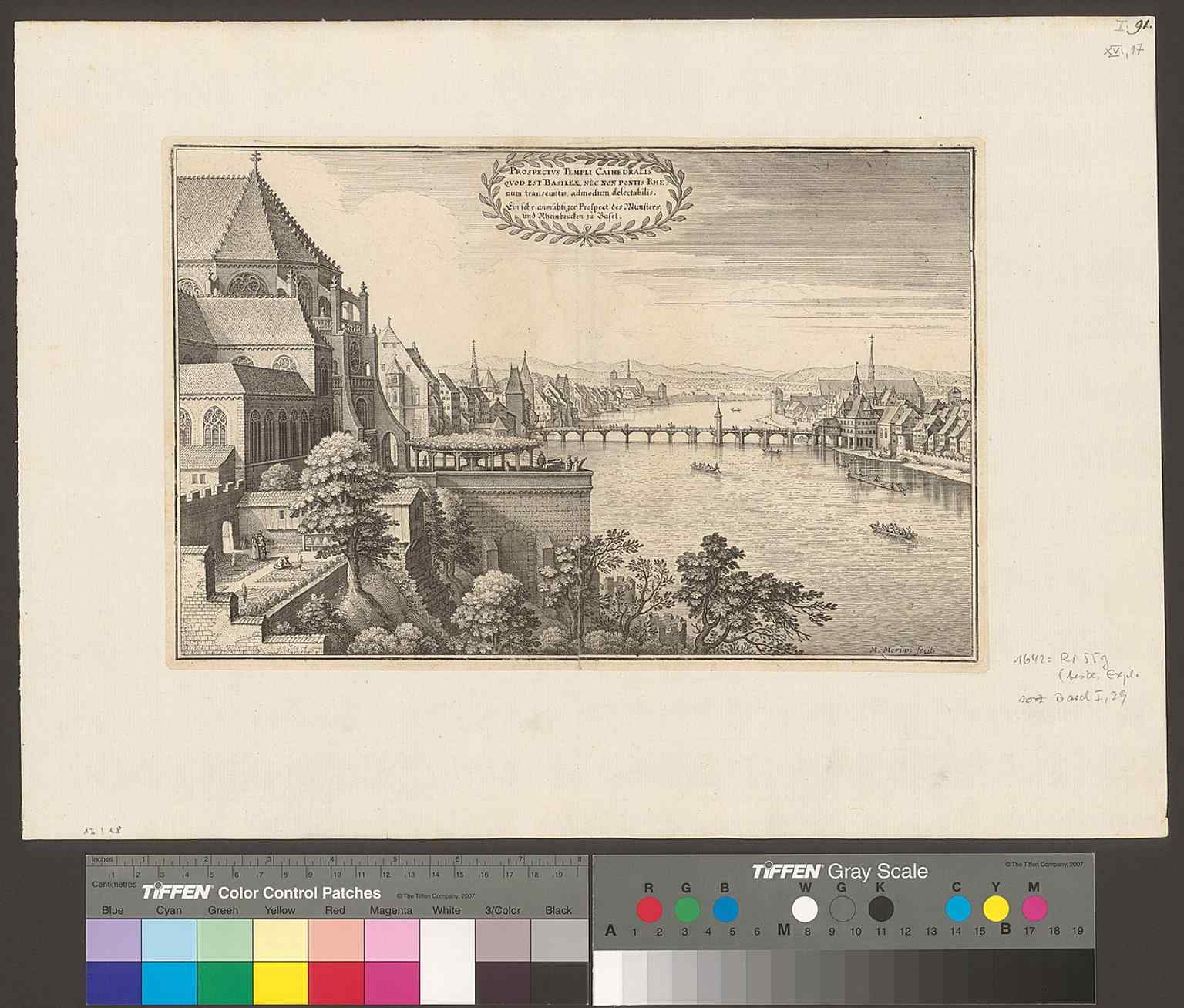
A 1642 southern prospect showing the Minster, the Pfalz terrace, and the old Rhine bridge — a rare early city view from the riverside.Photo: Anonym/e Künstler/in, Wikimedia Commons, Public domain. Cropped & resized. 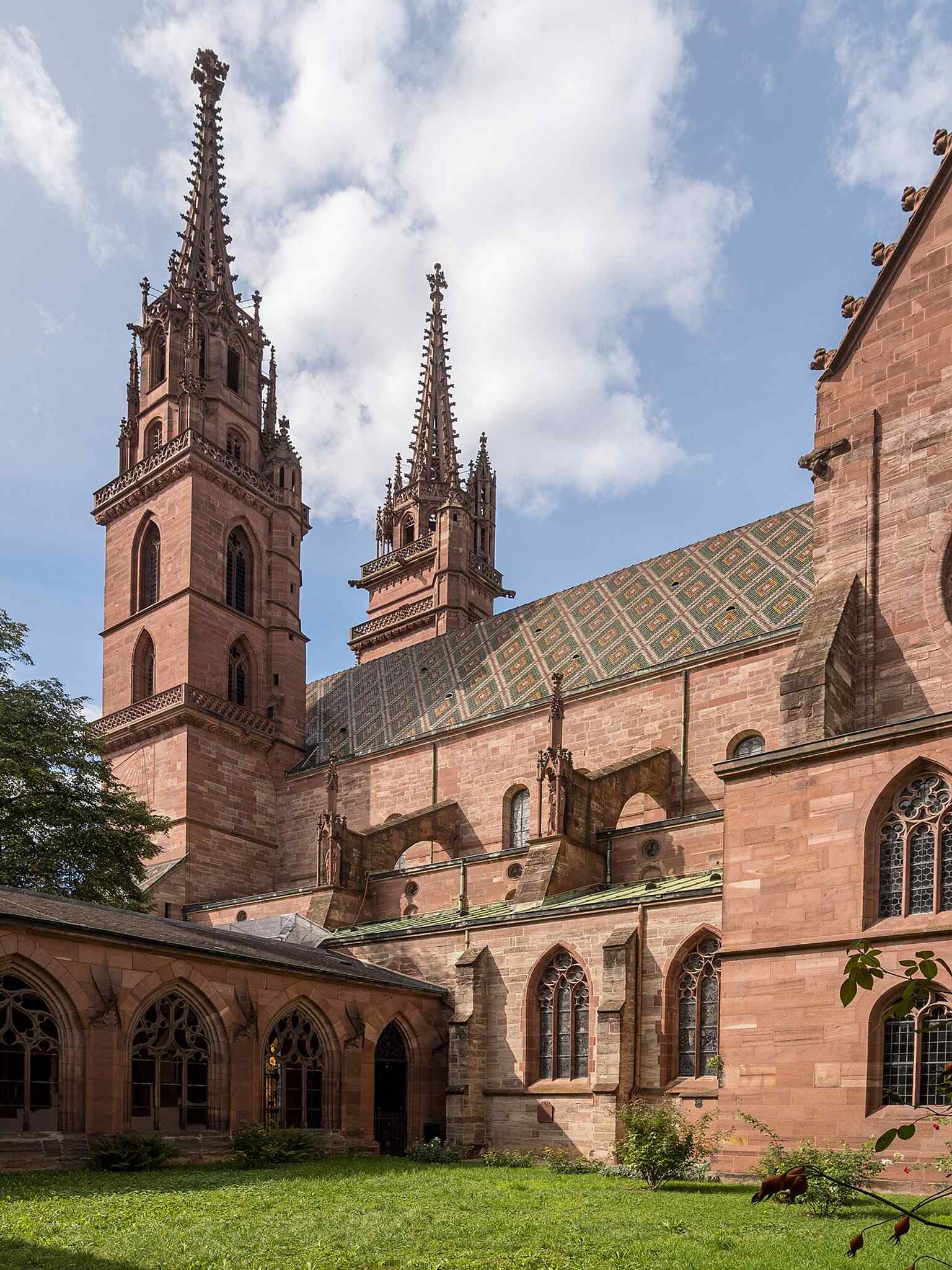
The cloister side looking toward the towers, showing how the Minster’s massing dominates the surrounding monastery buildings.Photo: JoachimKohler-HB, Wikimedia Commons, CC BY-SA 4.0. Cropped & resized. 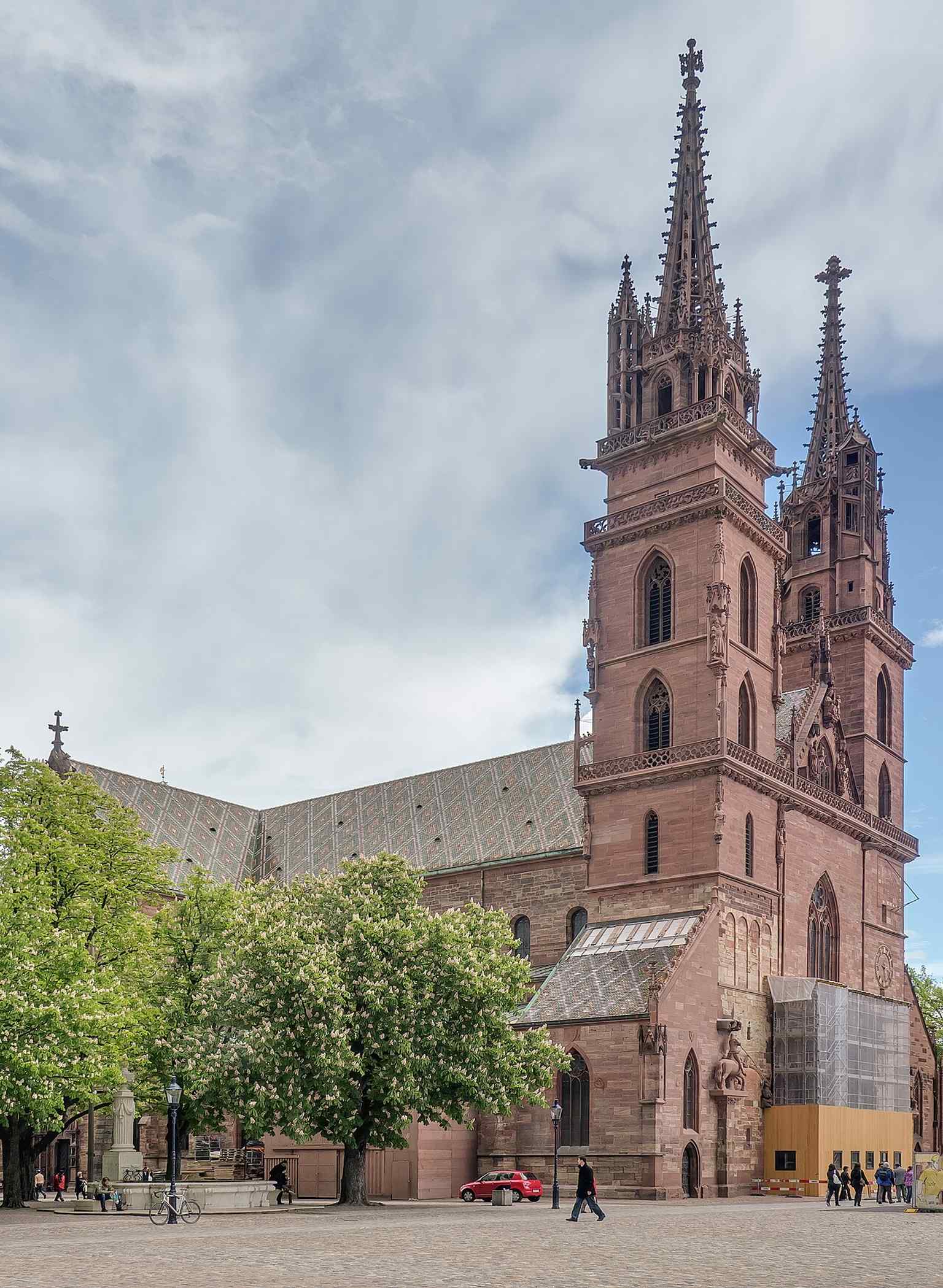
A full exterior view of Basel Minster, useful for showing the building’s overall Romanesque-Gothic character and twin-tower silhouette.Photo: Ermell, Wikimedia Commons, CC BY-SA 4.0. Cropped & resized. 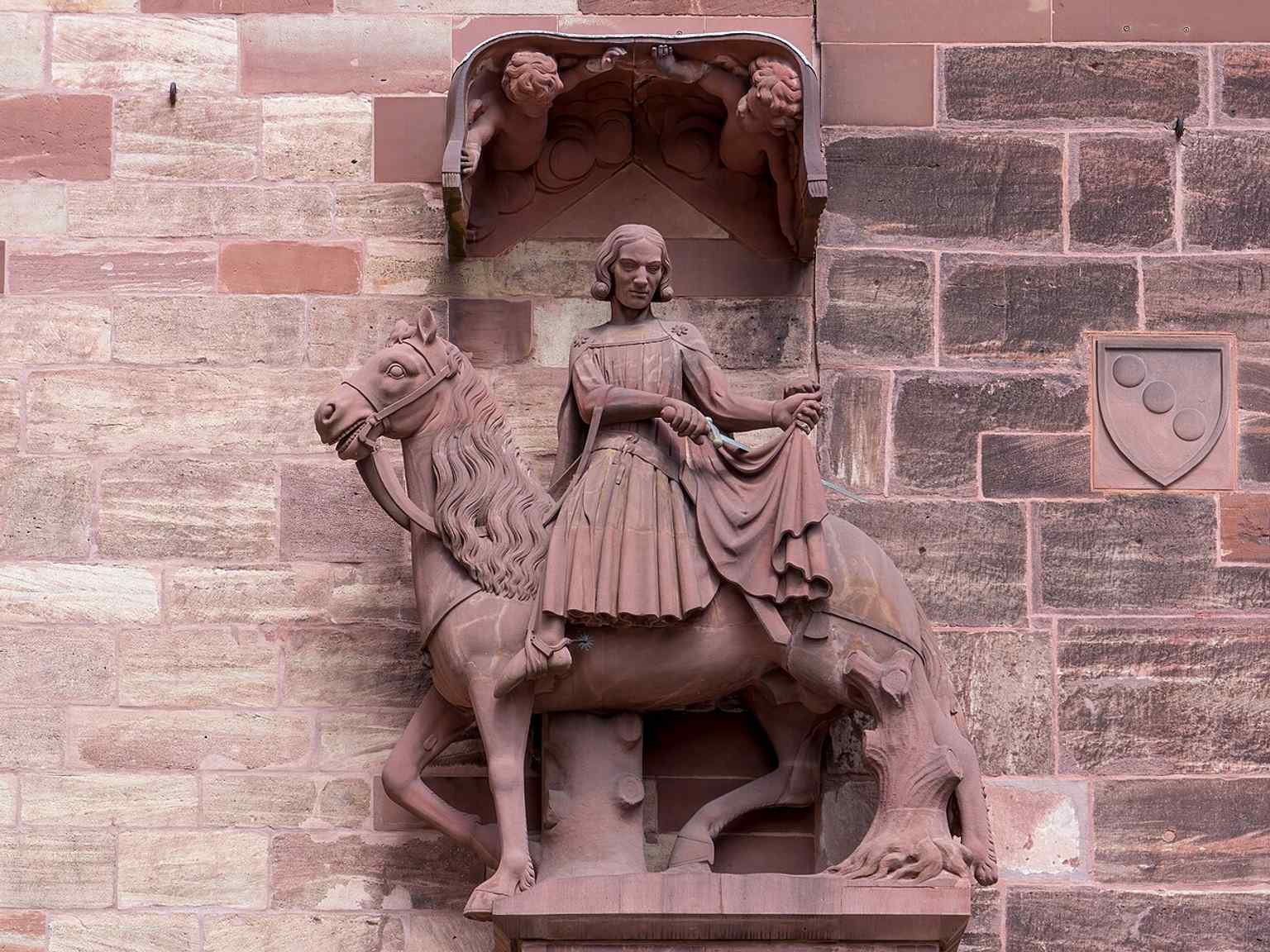
Saint Martin on the facade — one of the two tower saints named in the source, guarding the southern tower.Photo: Ermell, Wikimedia Commons, CC BY-SA 4.0. Cropped & resized. 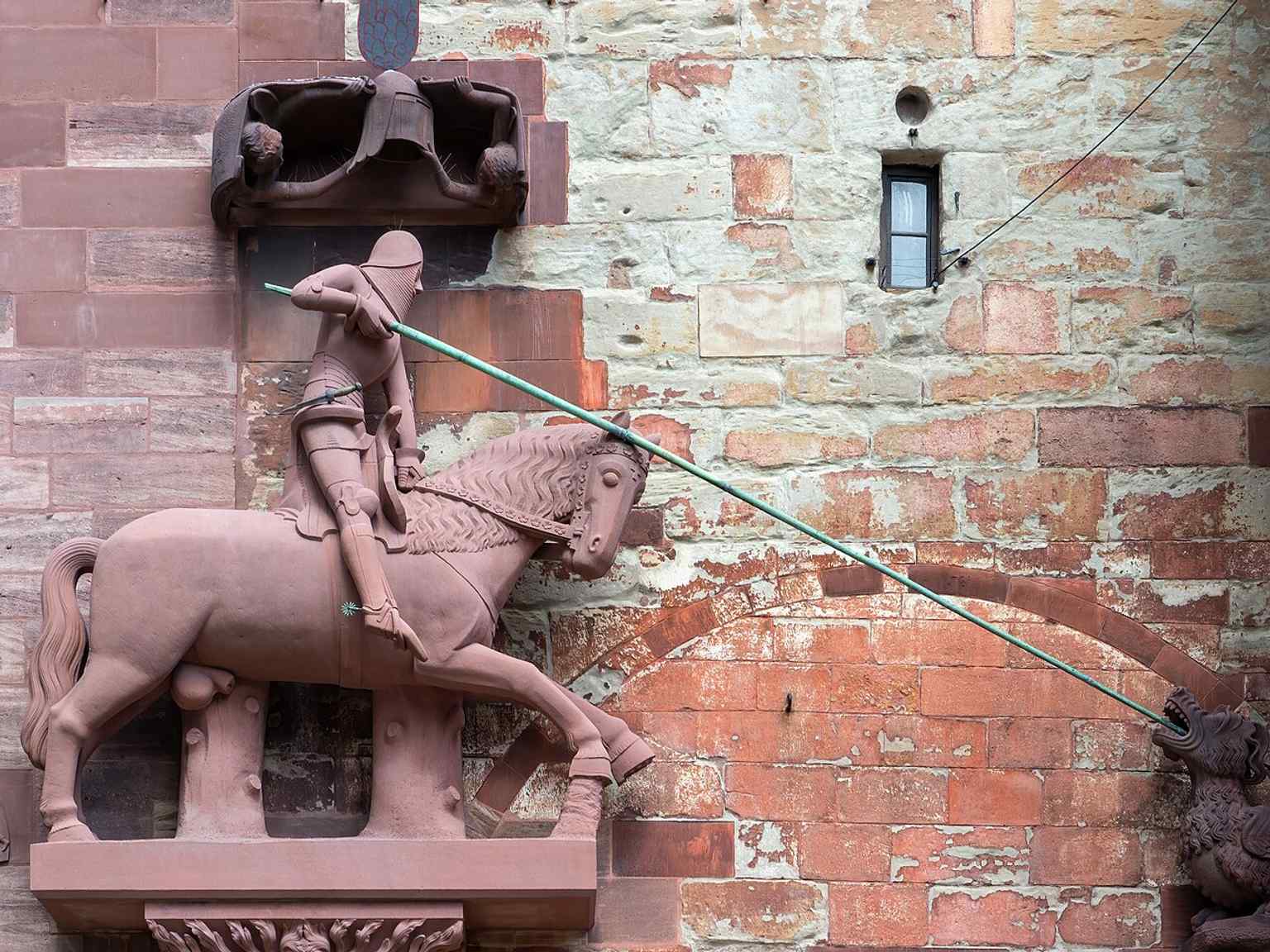
Saint George on the facade — the northern tower saint, whose slaying of the dragon is carved in monumental scale.Photo: Ermell, Wikimedia Commons, CC BY-SA 4.0. Cropped & resized. 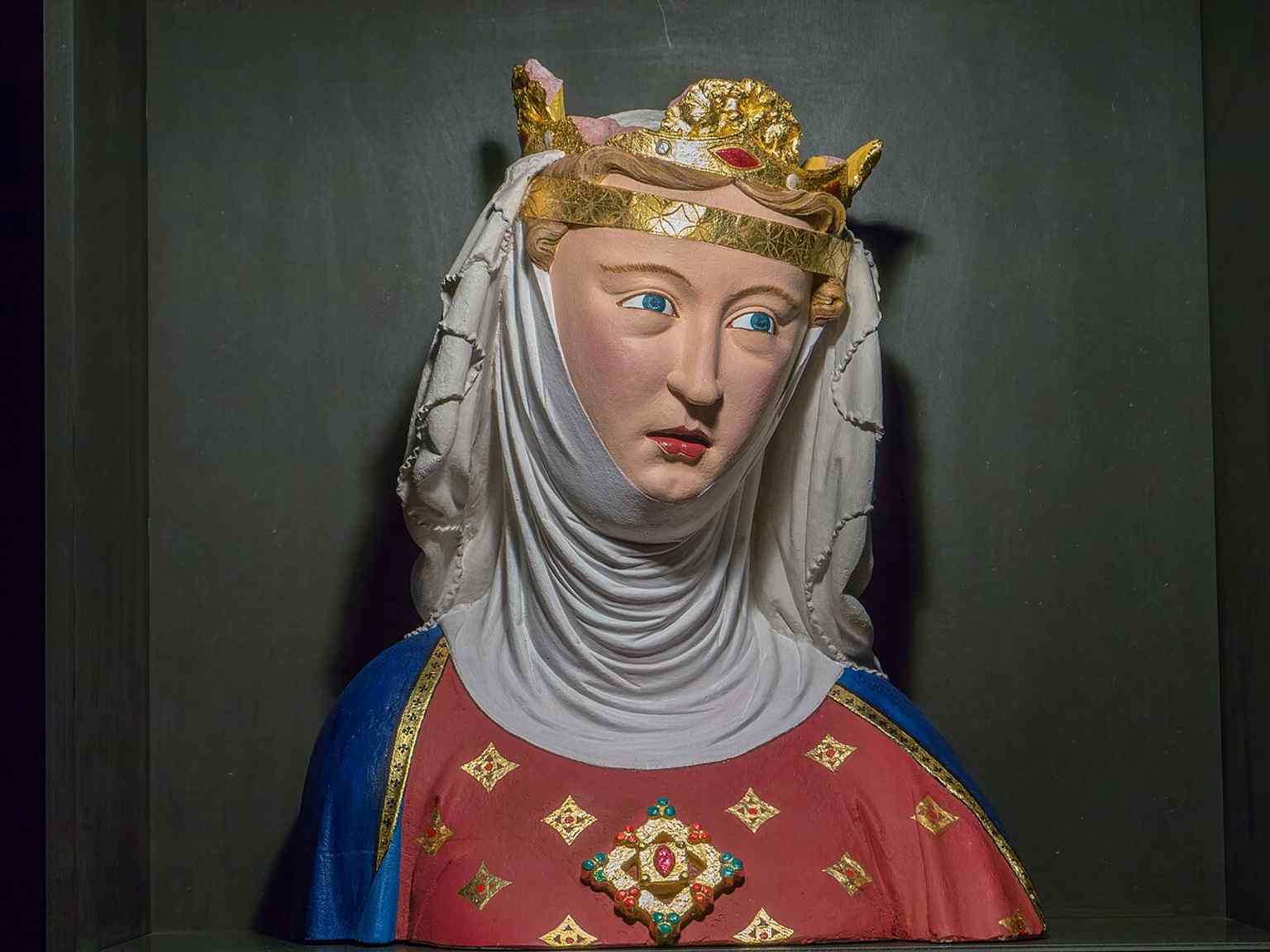
A replica bust of Saint Kunigunde, recalling the imperial founders Heinrich II and Kunigunde commemorated beside the main portal.Photo: Ermell, Wikimedia Commons, CC BY-SA 4.0. Cropped & resized. 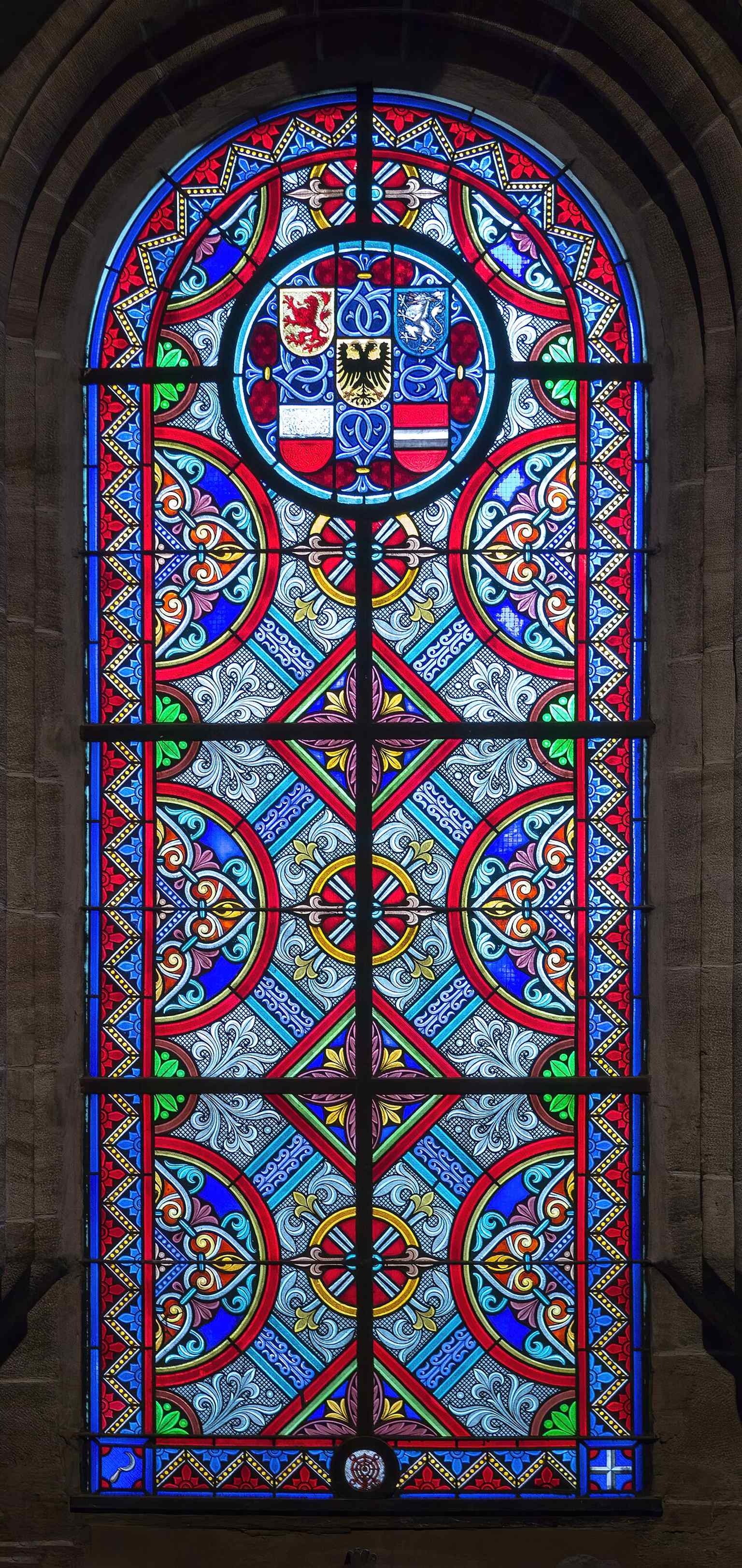
One of the Minster’s stained-glass windows, reflecting the later 19th-century glazing that fills much of the interior light today.Photo: Ermell, Wikimedia Commons, CC BY-SA 4.0. Cropped & resized. 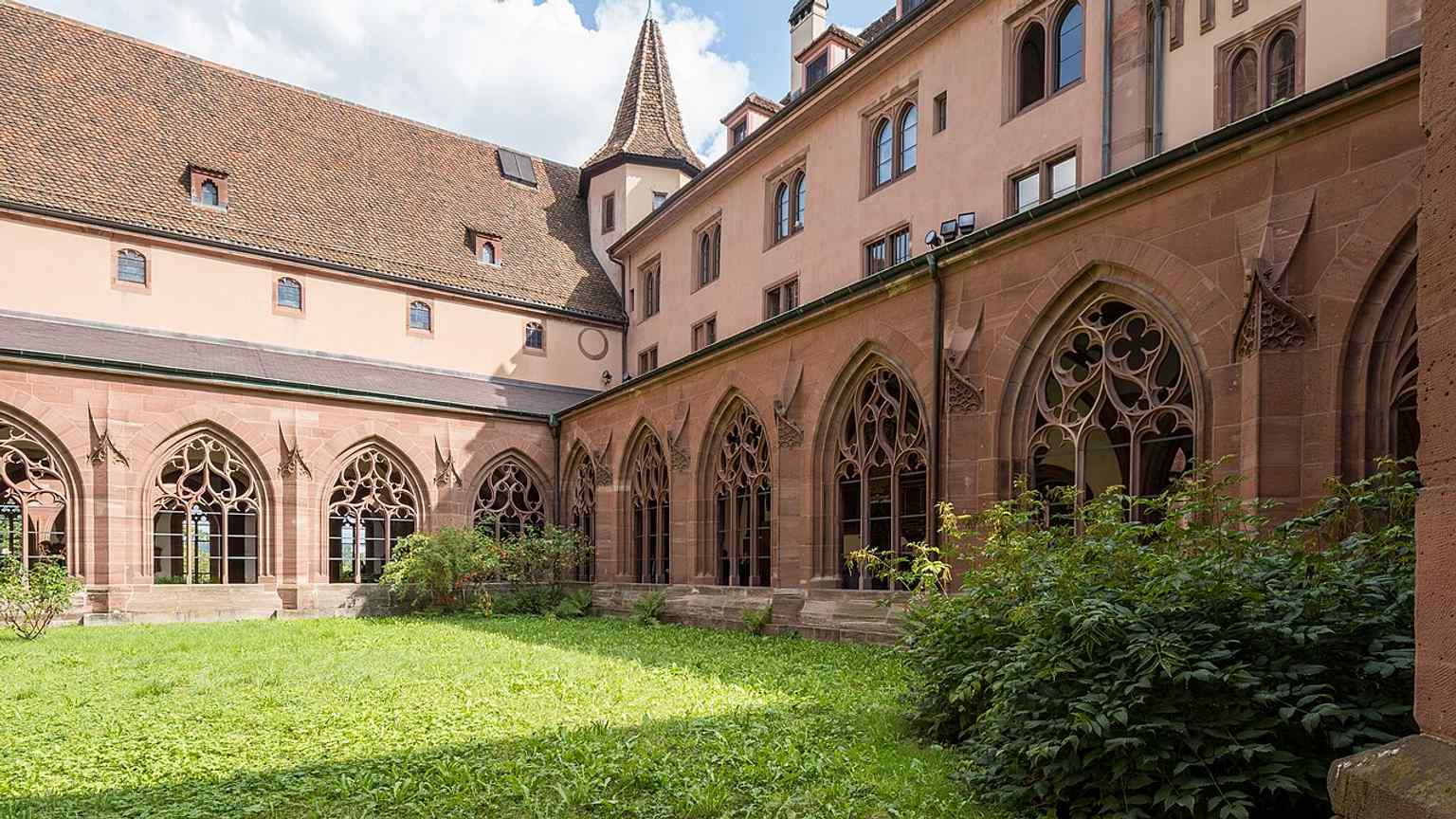
The large cloister with its elegant late-Gothic tracery — among the finest cloisters in Switzerland.Photo: JoachimKohler-HB, Wikimedia Commons, CC BY-SA 4.0. Cropped & resized. 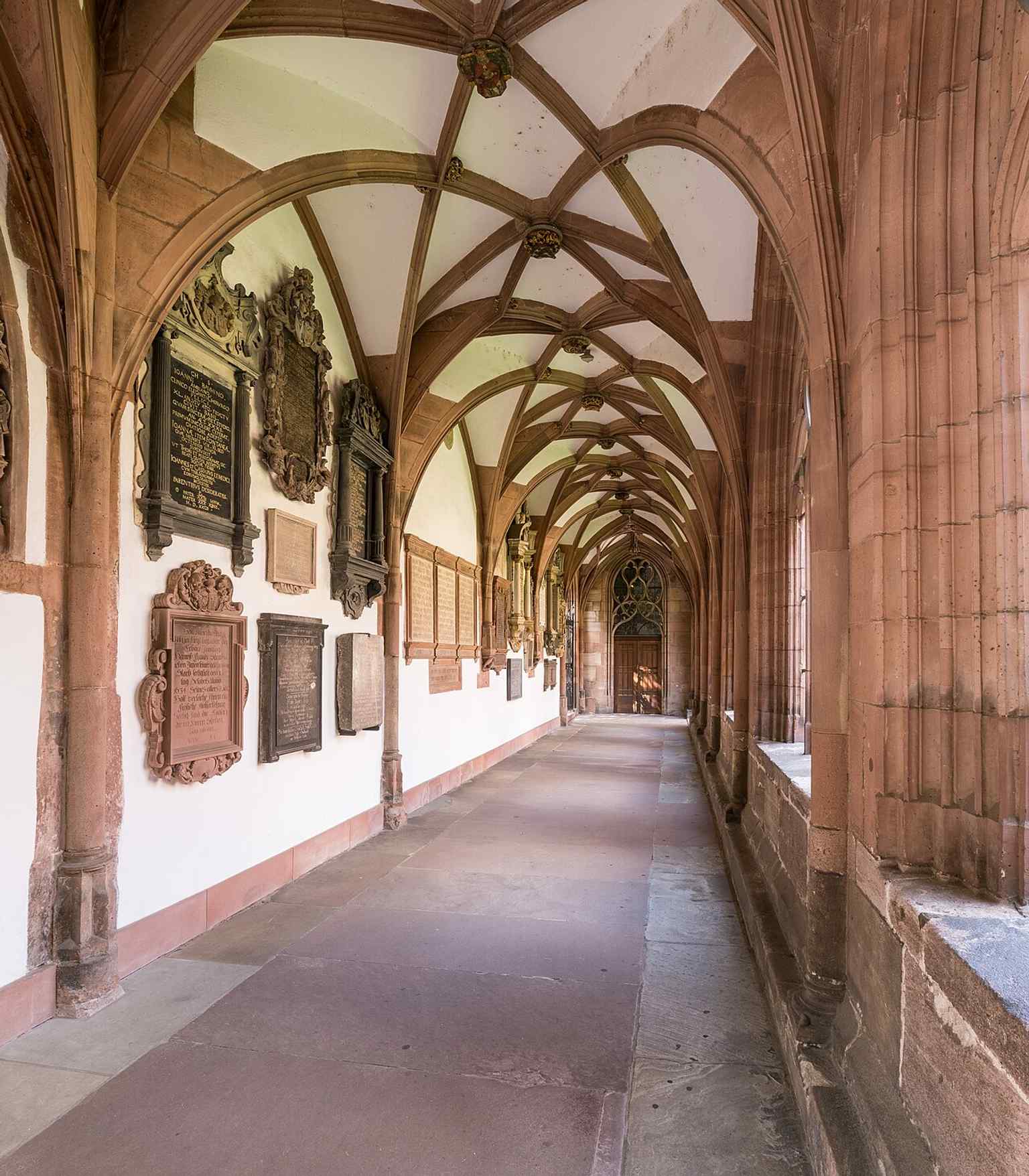
Another view inside the great cloister, where tomb slabs and memorials line the walls around the medieval monastery walk.Photo: JoachimKohler-HB, Wikimedia Commons, CC BY-SA 4.0. Cropped & resized. On your left, look for a pale stone building with a steep folded roof clad in dark green glazed tiles, its broad rectangular facade tucked behind the square and marked by that…Read moreShow less
Open dedicated page →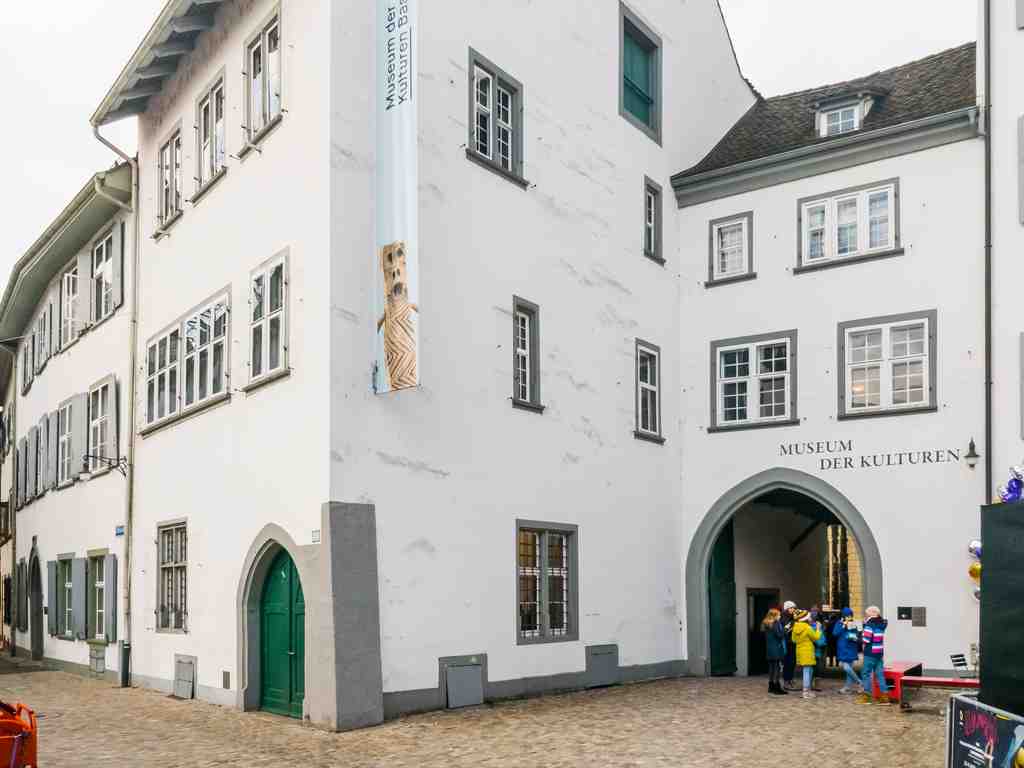
Museum of Cultures BaselPhoto: Raimond Spekking, Wikimedia Commons, CC BY-SA 4.0. Cropped & resized. On your left, look for a pale stone building with a steep folded roof clad in dark green glazed tiles, its broad rectangular facade tucked behind the square and marked by that striking overhanging roofline.
This place tells a Basel story that suddenly opens onto the whole world. From the outside, it still belongs to the old hill of the Minster... but inside, the city has been gathering objects, images, and questions from far beyond Switzerland for well over a century. That world-facing curiosity gave Basel extraordinary knowledge, and, truth be told, it also shows how cities collect influence by collecting things.
The museum stands on the site of an Augustinian monastery. In eighteen forty-nine, architect Melchior Berri replaced the monastic complex with a grand public museum, a kind of all-purpose civic treasure house inspired by Berlin’s Bauakademie. So right here, one kind of authority gave way to another: prayer to study, cloister to collection. Basel has a habit of changing the use of a place without fully erasing its older ghost.
If you glance up, you can catch the newest layer. Herzog and de Meuron rebuilt and expanded the museum between two thousand eight and two thousand eleven, giving it that folded roof of black-green hexagonal ceramic tiles. The shape nods to the nearby Minster roof, like the old church and the museum quietly borrowing each other’s clothes. If you want a clearer look, peek at the image on your screen
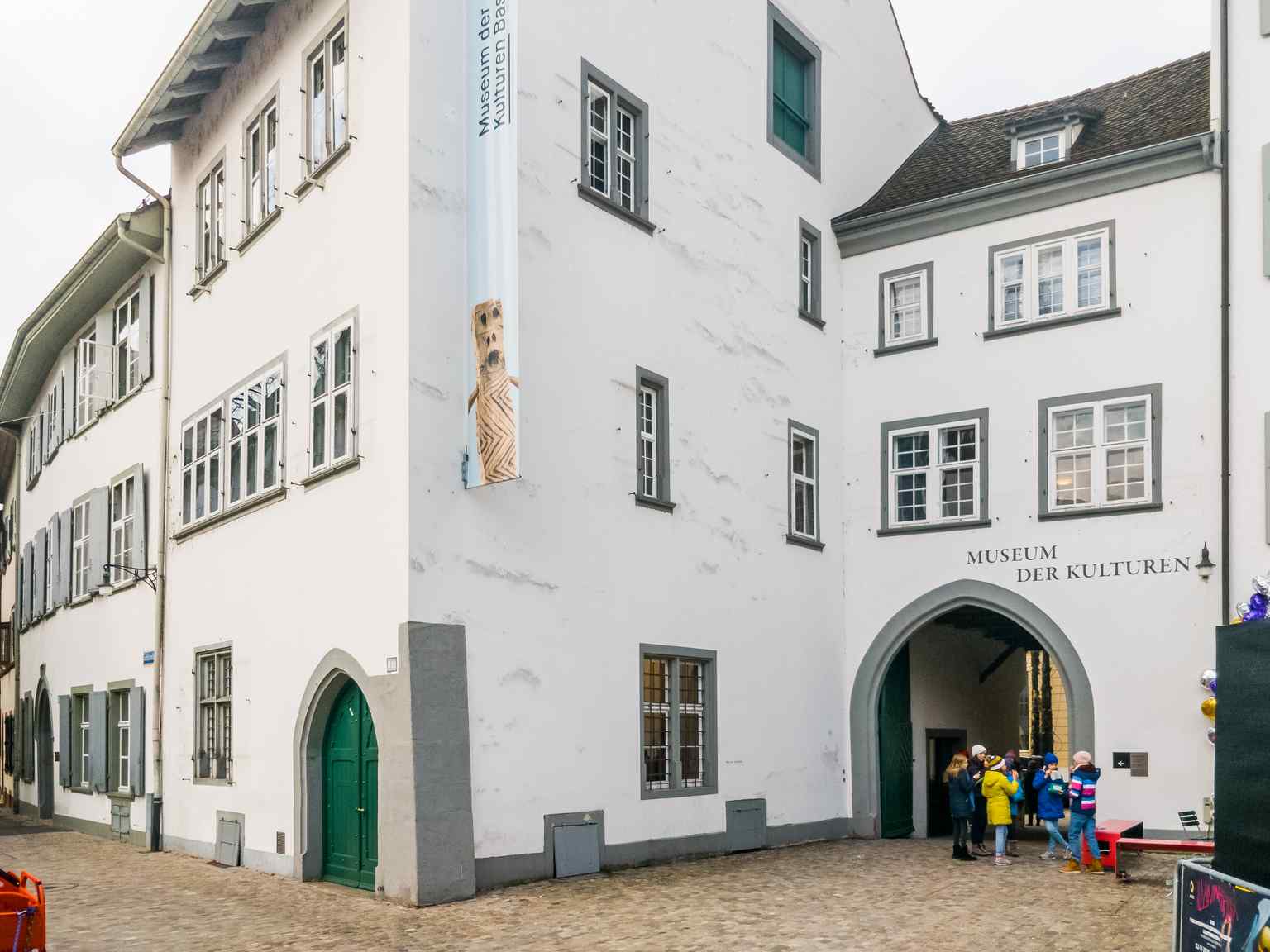
The Museum of Cultures Basel at Münsterplatz, now entered through the 1915 extension after the 2011 renovation by Herzog & de Meuron.Photo: Raimond Spekking, Wikimedia Commons, CC BY-SA 4.0. Cropped & resized. Now here’s the part most visitors miss. One of the museum’s foundational treasures came from a Basel entrepreneur named Lukas Vischer. He spent nine years in Mexico and, between eighteen twenty-eight and eighteen thirty-seven, assembled a remarkable collection of ancient Mexican sculpture and ceramics. In other words, Basel’s early global reach did not begin with some abstract institution. It began with one traveler, his eye, his money, and the power to bring a distant world home in crates. That is both impressive and a little unsettling... which is exactly why this museum matters now.
At first, wealthy Basel citizens brought objects back from their travels. Later, trained ethnologists - scholars who study how people live and make meaning - took over. Names like Fritz and Paul Sarasin, Felix Speiser, Alfred Bühler, and Paul Wirz expanded the collection through research journeys in Sri Lanka, Vanuatu, Indonesia, East Timor, and Cameroon. Today the holdings reach more than three hundred twenty thousand objects, plus around fifty thousand historical photographs. That scale is world-class. It also raises a fair question: under what conditions did all of this arrive here?
The museum no longer dodges that question. Its focus shifted from displaying “other cultures” to creating dialogue with them. Provenance research - tracing where objects came from, how they moved, and whether coercion played a role - now sits at the center of the work. In recent years, the museum joined research on objects from Benin City linked to the British punitive expedition of eighteen ninety-seven, and in twenty twenty-four it returned forty-seven objects to Veddah cultural centers in Dambana, Sri Lanka. Even Bruno Manser’s diaries entered the collection, bringing in a different Basel connection: not collecting from afar, but activism tied to rainforest people and questions of responsibility.
So this building widens the map, then asks who drew it.
Keep that question with you as we head to St. Martin’s Church, about a five-minute walk from here, where Basel’s local faith and reform story comes back into view. And if you plan to go inside later, the museum is open Tuesday through Sunday, from ten in the morning to five in the afternoon.
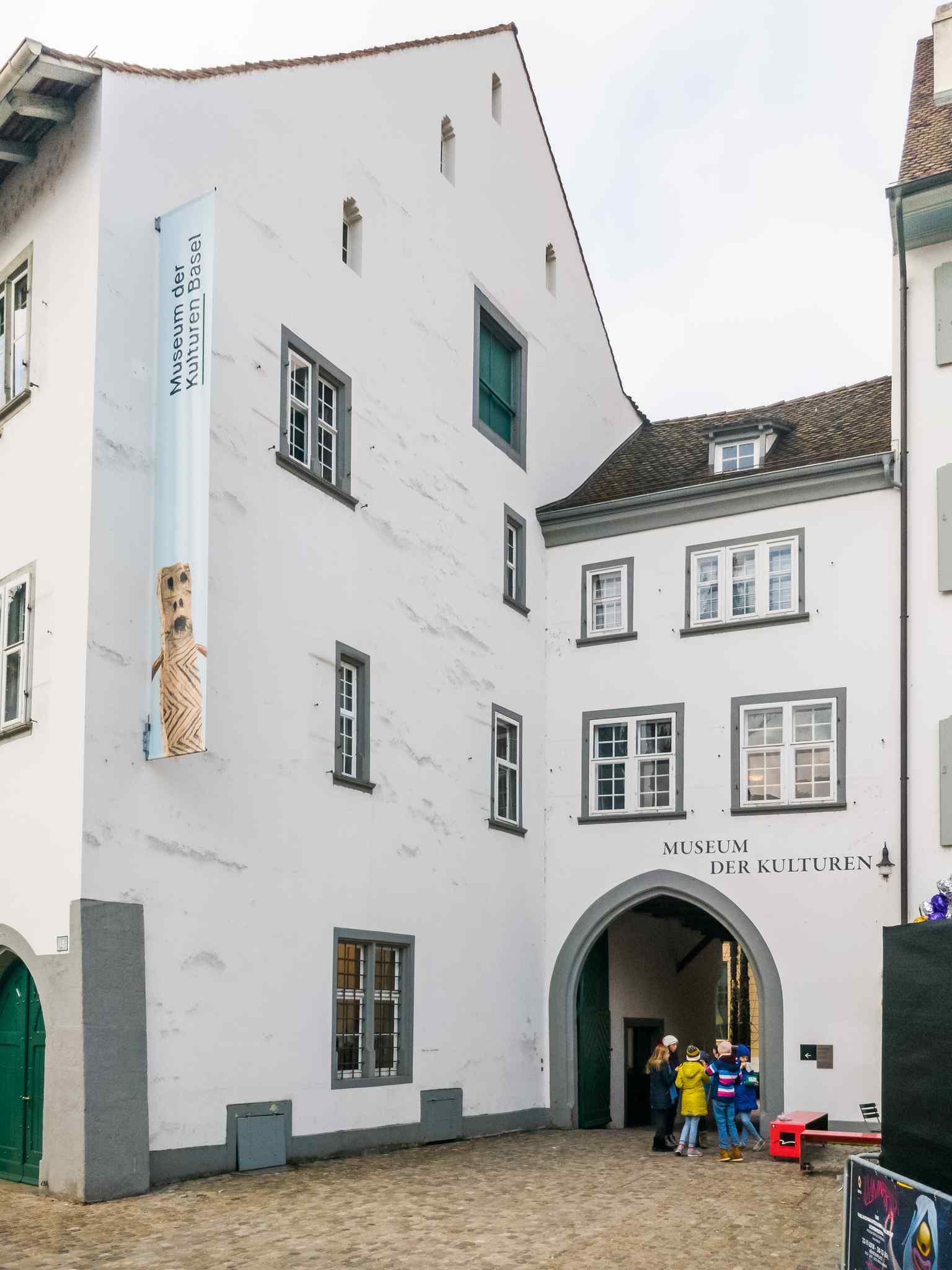
A clear view of the museum’s Münsterplatz facade, home to a collection that grew from Basel’s early ethnographic holdings into an institution of world renown.Photo: Raimond Spekking, Wikimedia Commons, CC BY-SA 4.0. Cropped & resized. On your right, spot the pale stone church with its tall square tower, steep rooflines, and angular choir projecting from the hill above the river. St. Martin’s is easy to…Read moreShow less
Open dedicated page →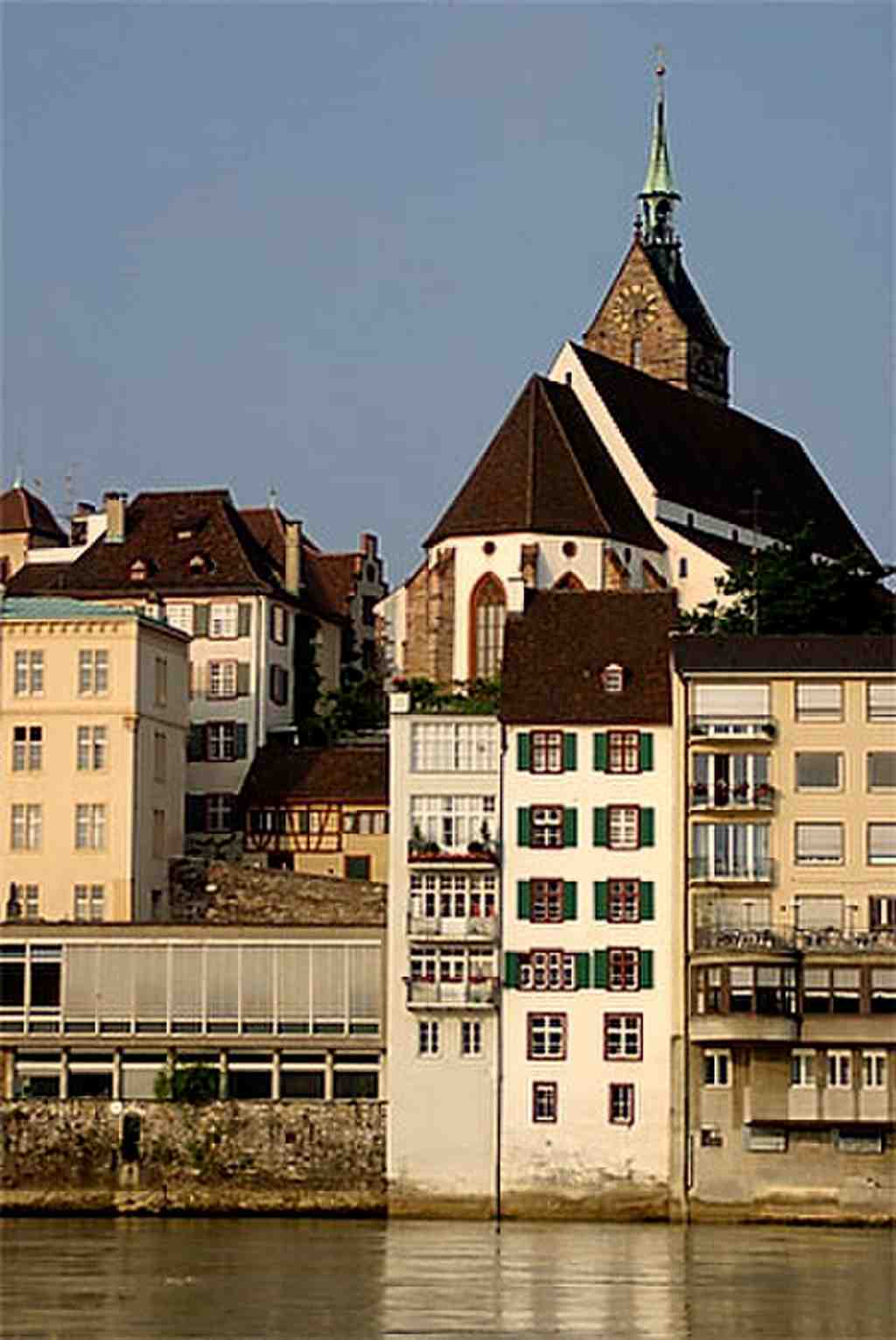
St. Martin's Church (Basel)Photo: Roland Zumbühl, Wikimedia Commons, CC BY-SA 3.0. Cropped & resized. On your right, spot the pale stone church with its tall square tower, steep rooflines, and angular choir projecting from the hill above the river.
St. Martin’s is easy to mistake for just another old church in Basel... but this place changes the whole story. It is likely the city’s oldest parish church, first mentioned in the early twelve hundreds, yet the ground it claims is far older. Long before Christian Basel, people fortified this spur of the Münster hill in the Bronze Age with a ditch about ten meters wide. So this church did not begin on empty land; it inherited a place people had already decided mattered.
If you glance at your screen, you can see how it rises over Grossbasel like a lookout post. That feels right, because St. Martin’s has served faith, warning, and power all at once. Around fourteen hundred, its fire bell called out the city’s bucket brigades when flames broke loose. Practical religion, Basel style.
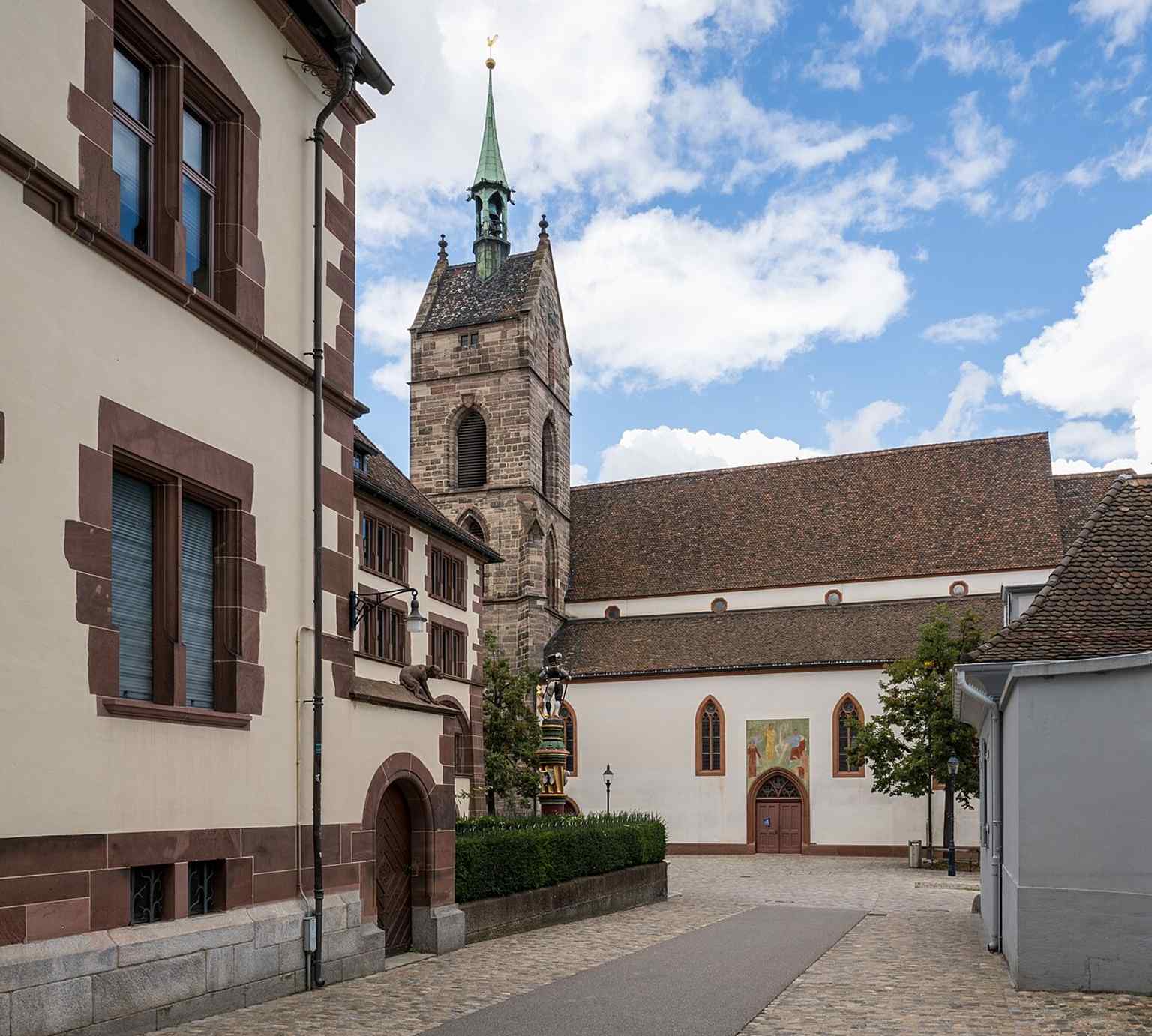
The Martinskirche rising above Basel’s old town, beside the State Archives — a landmark that overlooks Grossbasel from the Münster hill.Photo: JoachimKohler-HB, Wikimedia Commons, CC BY-SA 4.0. Cropped & resized. The human turning point here is Johannes Oekolampad. In fifteen twenty-nine, he preached here for the first time in the new Reformed style, and in German, not Latin. That choice brought doctrine down from the scholar’s desk to ordinary ears. But reform did not arrive as a tidy plan. Zealots stormed in without Oekolampad’s approval and threw out the church’s images. So even here, conviction came with a messier edge than the heroic version likes to admit.
Then the building changed again. In eighteen fifty-one, Basel turned part of the interior into a concert setting, replacing the old screen that separated clergy from congregation with tiered seating for singers. A church that once staged theological combat learned a second career as a music venue.
And one more life lingers nearby: Wibrandis Rosenblatt later lived at the parsonage here, surviving Oekolampad and then marrying other leading reformers, as if the upheaval of an age kept passing through one household.
How differently does a city sound when its biggest revolutions arrive through sermons, arguments, and bells instead of armies? Hold that thought as you head to City Hall, about three minutes from here, where belief soon turns into government.
On your left, Basel’s City Hall is a deep red façade with pointed arches and a tall tower, marked by a balcony figure in an ostrich-feather hat. This is where Basel put power on…Read moreShow less
Open dedicated page →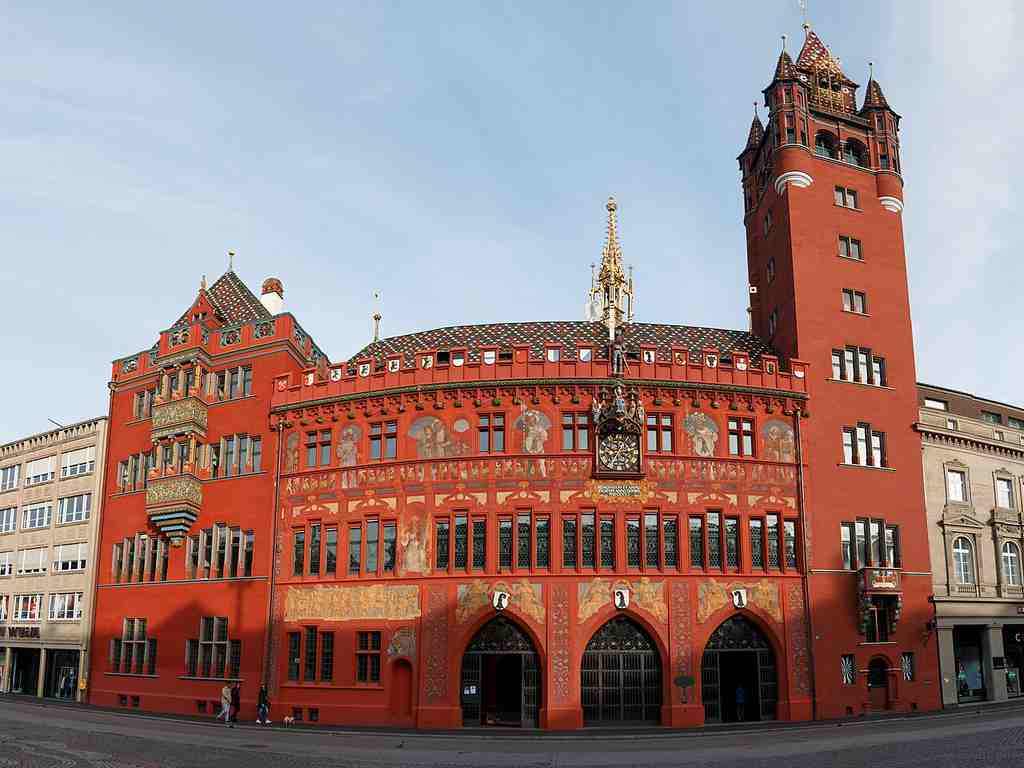
City Hall (Basel)Photo: Michał Rawlik, Wikimedia Commons, CC BY-SA 4.0. Cropped & resized. On your left, Basel’s City Hall is a deep red façade with pointed arches and a tall tower, marked by a balcony figure in an ostrich-feather hat.
This is where Basel put power on stage. Trade happened in the square, justice sat under these arches, and politics learned to dress for the occasion. The building began as the Richthaus, the city court, and when Basel’s center shifted from the old Fischmarkt to this market square, the court moved here too by the mid-fourteenth century.
Then came the city’s big promotion. After Basel joined the Swiss Confederation in fifteen oh one, the Great Council ordered a grander Rathaus in fifteen oh three and basically said, spare no expense. A very public way to say, “We’ve arrived.”
Look closely at the entrance arcade, that row of arches. A bronze plaque there remembers the floods of fifteen twenty-nine and fifteen thirty. Most visitors blame the Rhine, but the real trouble came when the Birsig backed up against a high Rhine and sent water through the city center. That little plaque is one of Basel’s best witnesses.
Hans Holbein the Younger gives this place a face. Basel made him a citizen in fifteen twenty, then hired him in fifteen twenty-one to paint the Great Council chamber. If you check the image on your screen, you can see the chamber that replaced the one with his murals; later rebuilding erased the originals, but fragments and copied designs still echo on the façade. Around sixteen oh eight, Hans Bock painted biblical warnings inside, reminding councillors that power should answer to judgment.
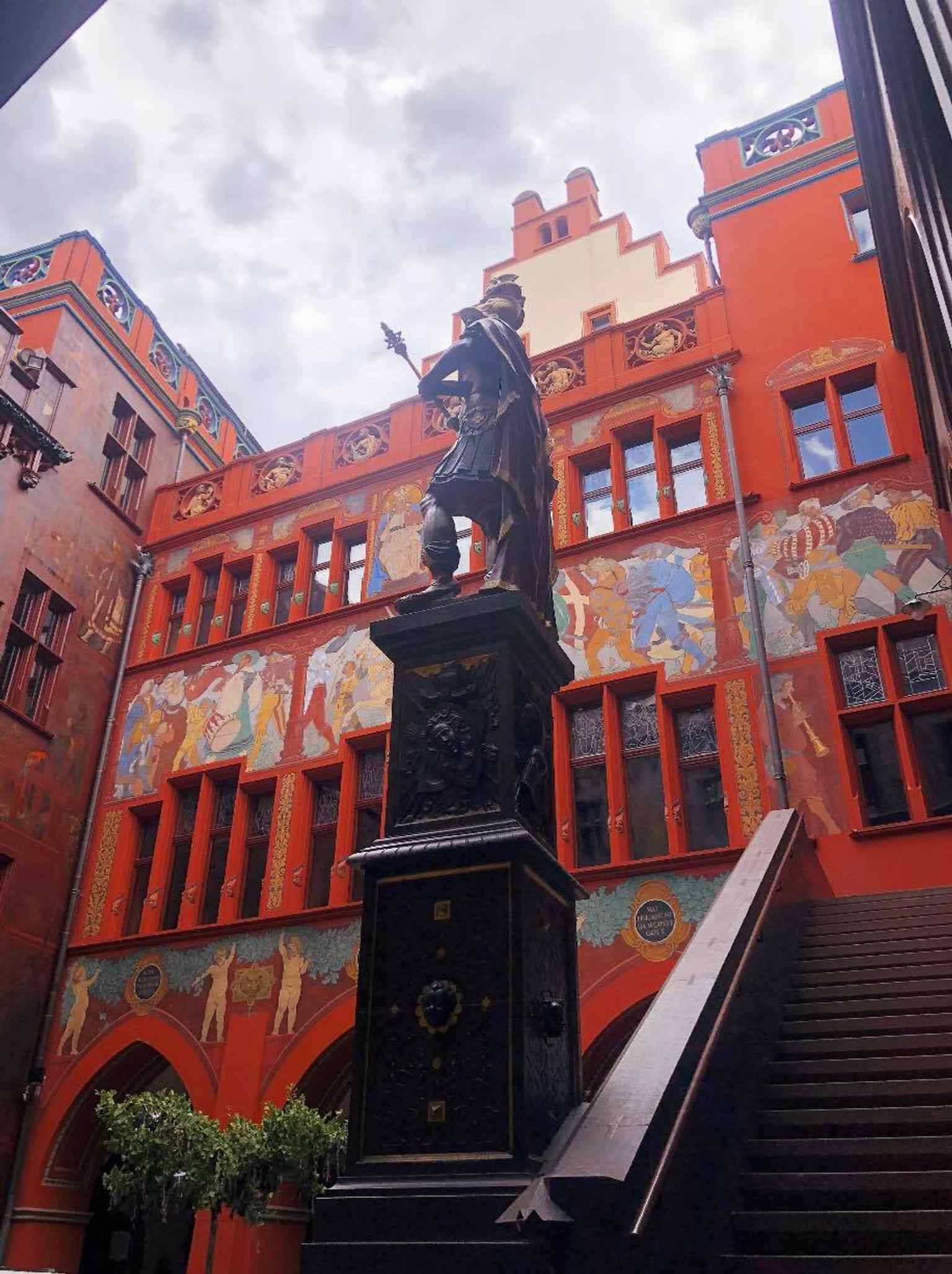
Inside the Great Council Chamber, the room that once carried Hans Holbein the Younger’s frescoes before they were lost and later known through fragments and copies.Photo: OrestaLova, Wikimedia Commons, CC0. Cropped & resized. Now step outward into Market Square, where the audience for all this civic theater was never very far away. If you want to return later, City Hall is generally open on weekdays and closed on weekends.
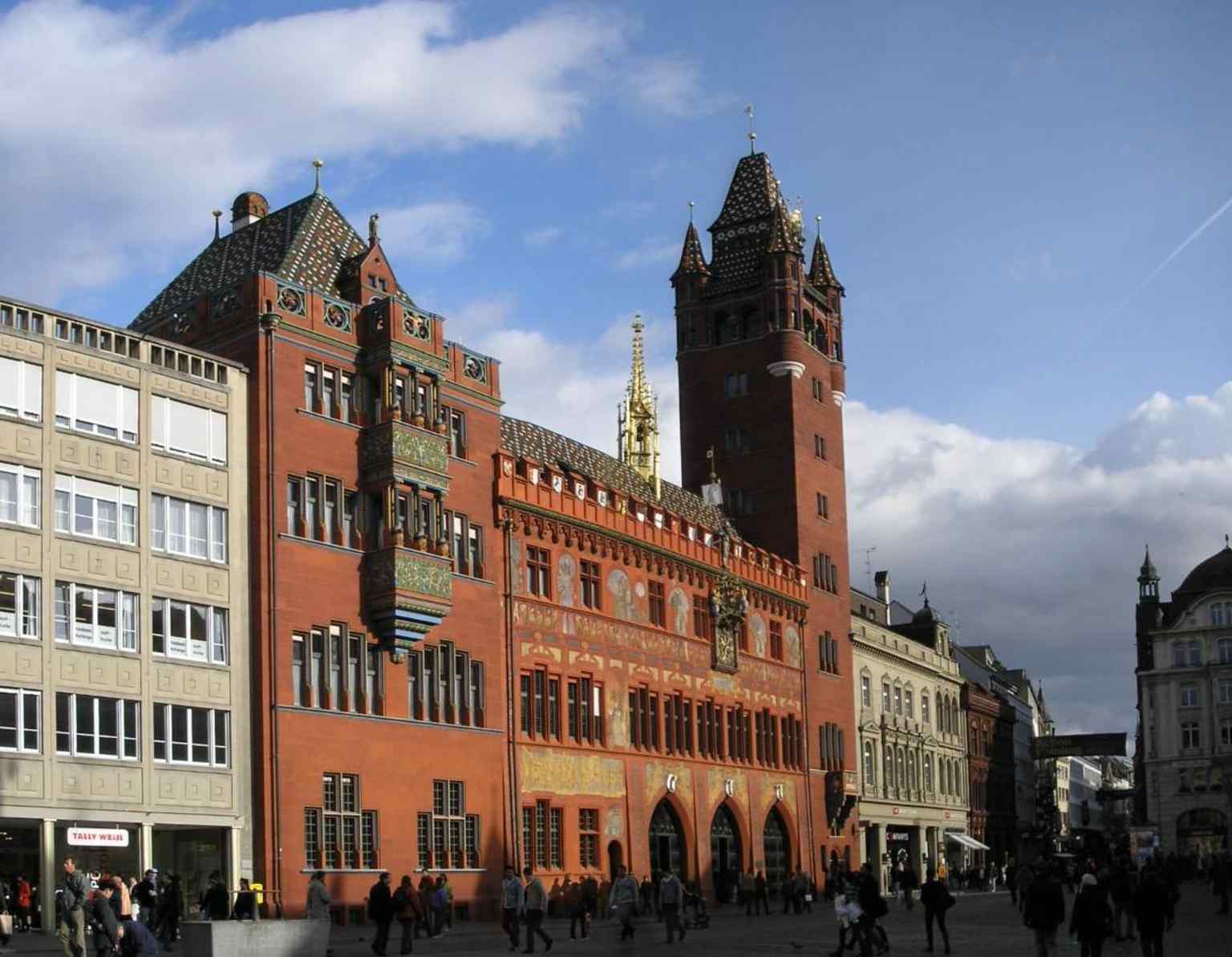
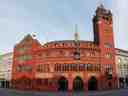
A classic view of Basel City Hall’s red façade and tower, the rebuilt landmark that became a political statement after Basel joined the Confederation in 1501.Photo: Gryffindor, Wikimedia Commons, Public domain. Cropped & resized. 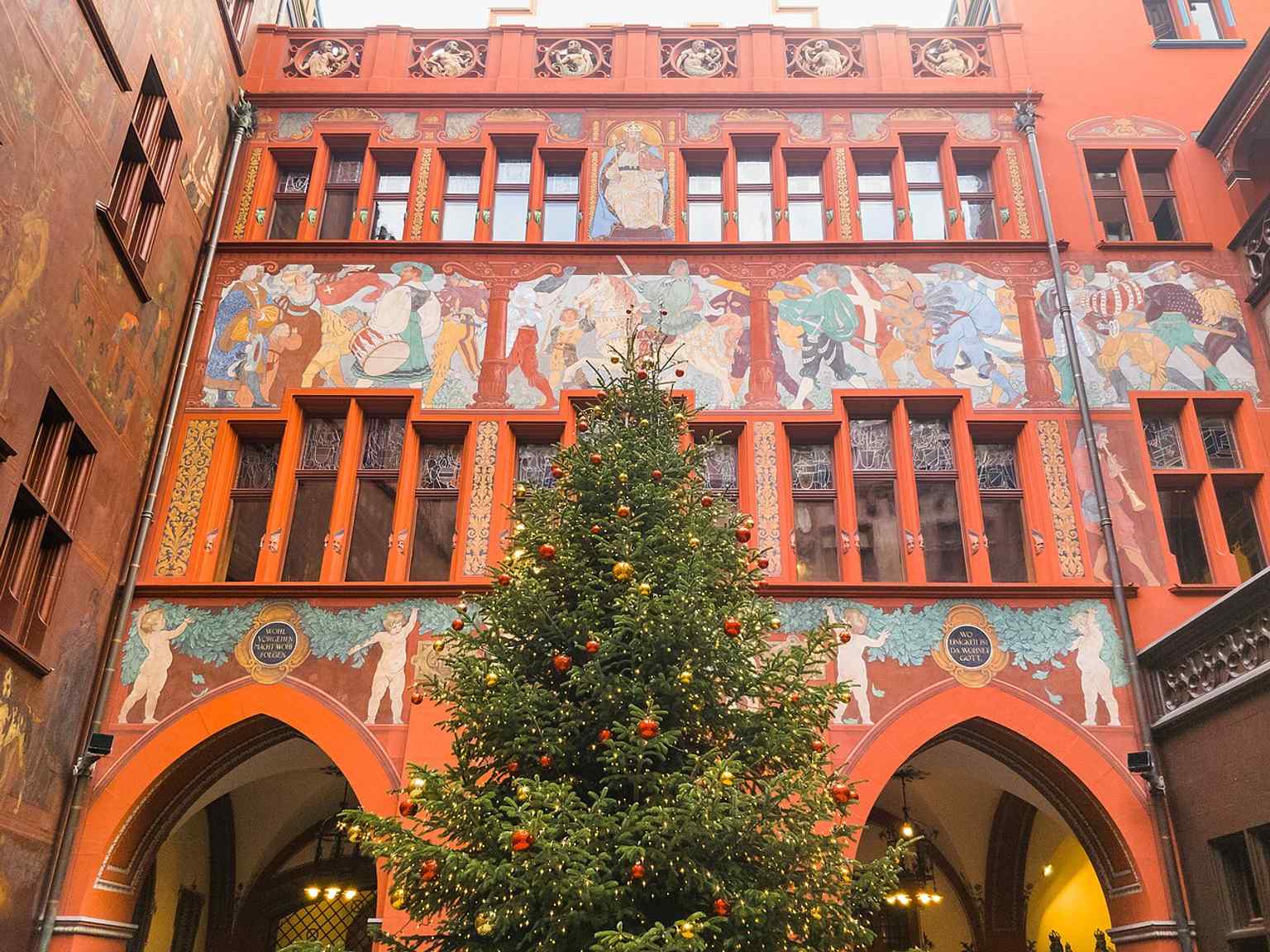
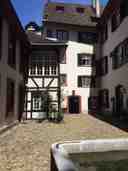
The courtyard atrium shows the living heart of the Rathaus, where government still meets inside a building shaped by centuries of change and restoration.Photo: Raimond Spekking, Wikimedia Commons, CC BY-SA 4.0. Cropped & resized. 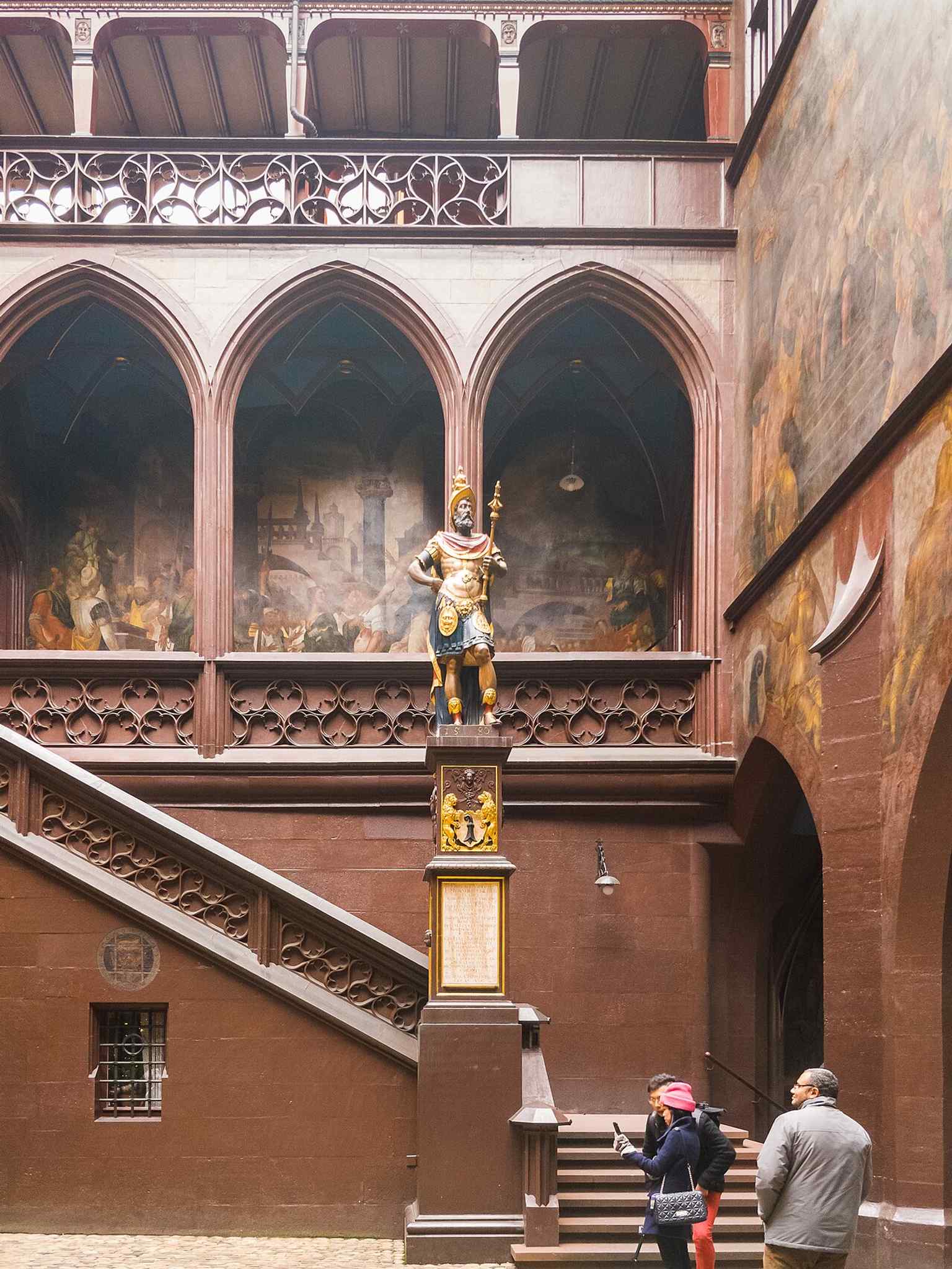
Another view of the atrium with the statue, highlighting the Rathaus as an active workplace rather than just a historic monument.Photo: Raimond Spekking, Wikimedia Commons, CC BY-SA 4.0. Cropped & resized. 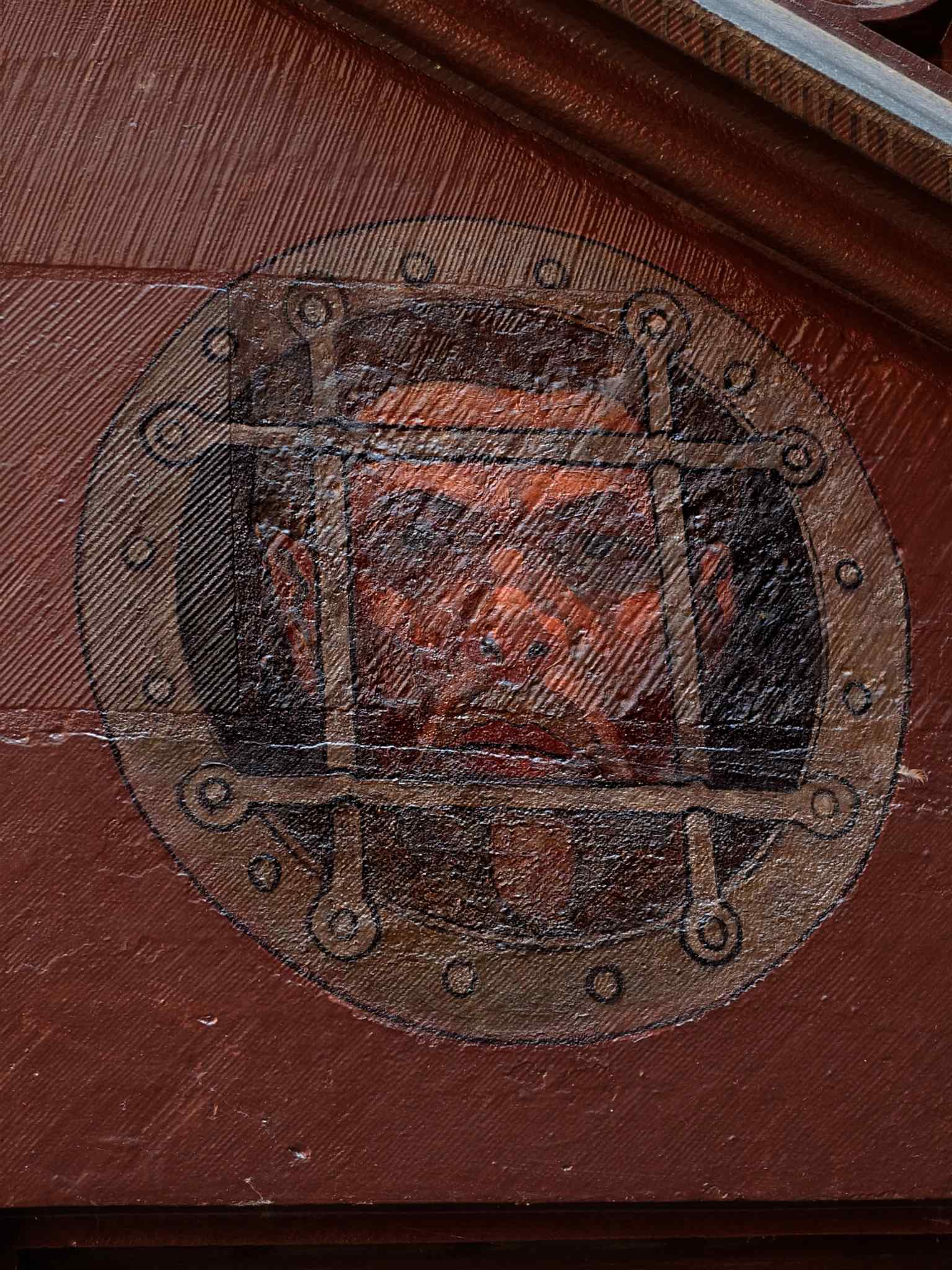
A façade detail by Burkhard Mangold and Otto Plattner, part of the decorative rebuilding that followed the destruction of the old council chamber around 1900.Photo: EinDao, Wikimedia Commons, CC BY-SA 3.0. Cropped & resized. 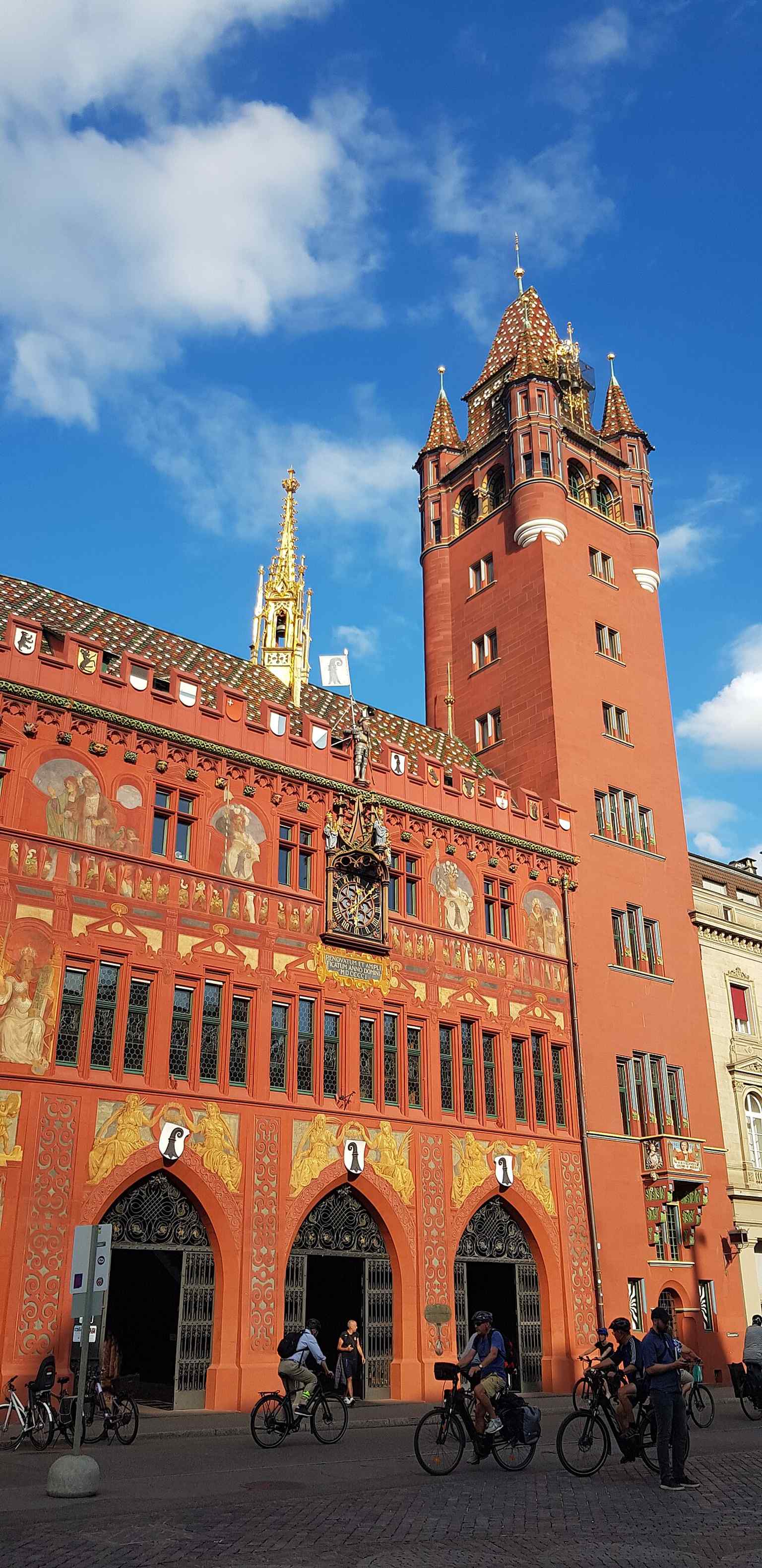
Another clean exterior angle of the Rathaus, useful for showing how the historic council house dominates the Marktplatz today.Photo: Armineaghayan, Wikimedia Commons, CC BY-SA 4.0. Cropped & resized. 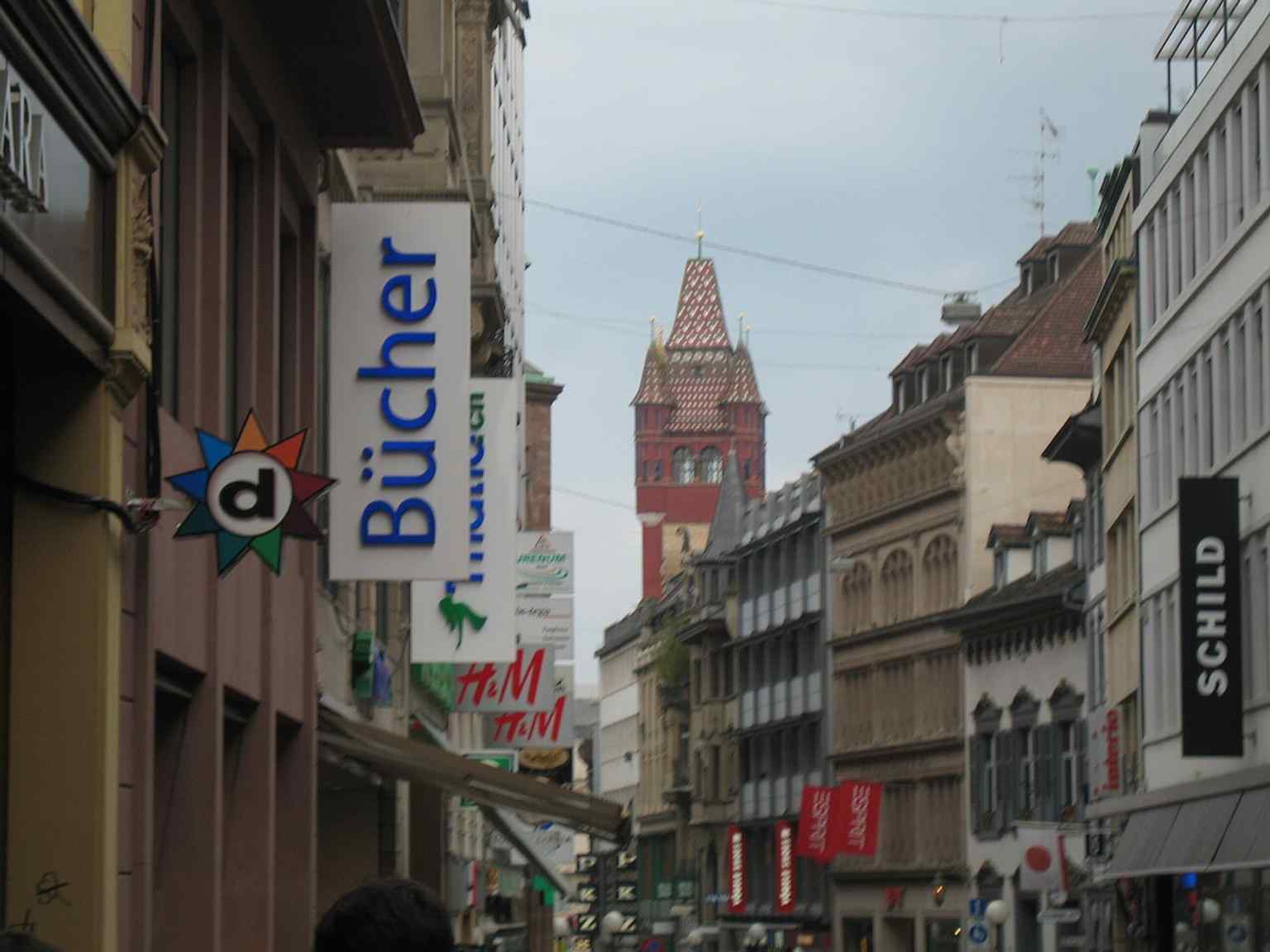
An older photograph of Basel’s Rathaus before recent restorations, useful for showing the building’s continuing public life across the 20th century.Photo: Syced, Wikimedia Commons, CC0. Cropped & resized. 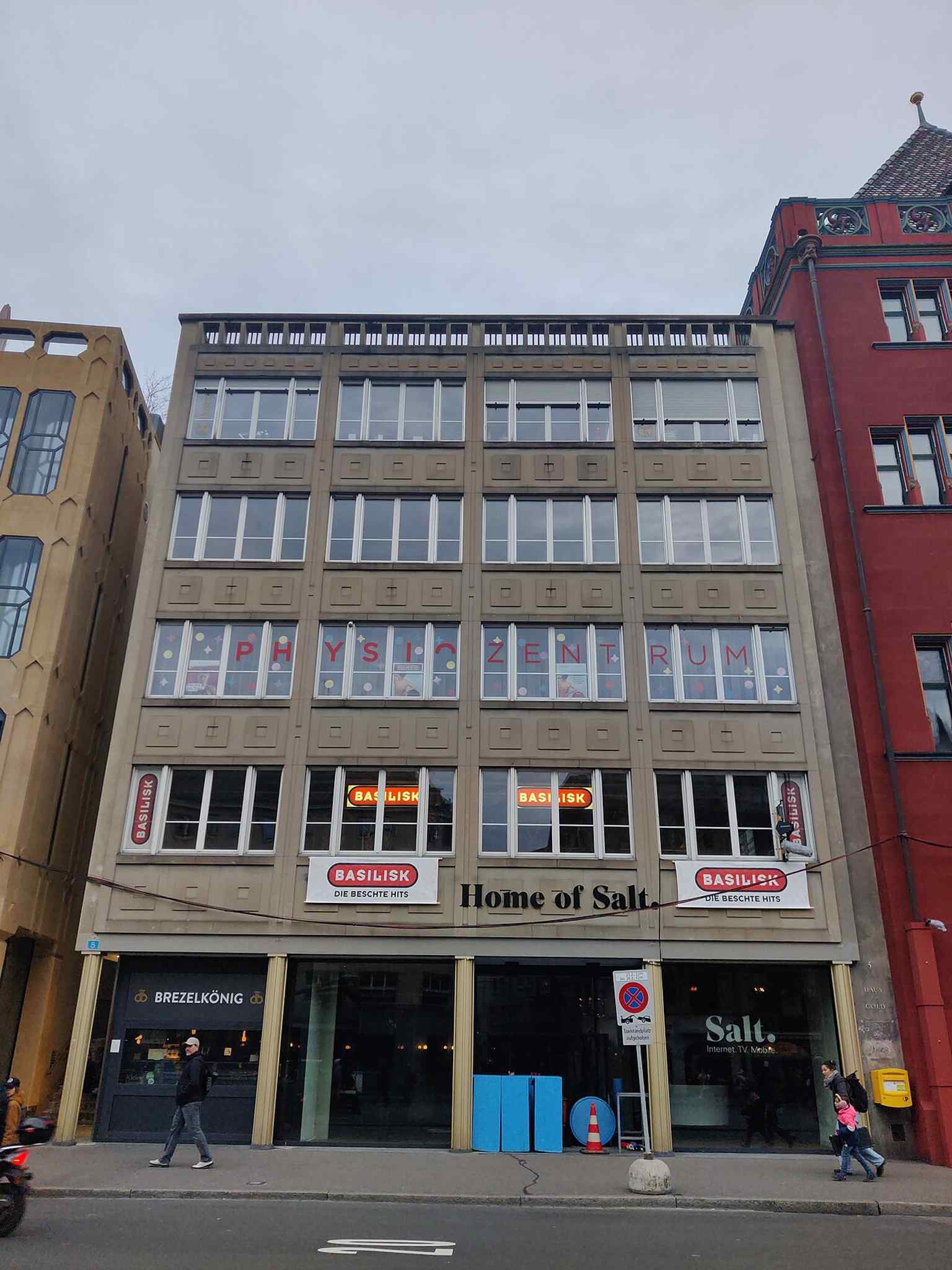
The neighboring Marktplatz building beside the Rathaus helps place the city hall in its urban setting at the heart of Basel’s civic square.Photo: Zwantzig, Wikimedia Commons, CC BY-SA 4.0. Cropped & resized. On your right, Market Square opens as a long stone-paved rectangle, its broad surface patterned with rosette paving and tightly framed by old town façades. This is Basel’s…Read moreShow less
Open dedicated page →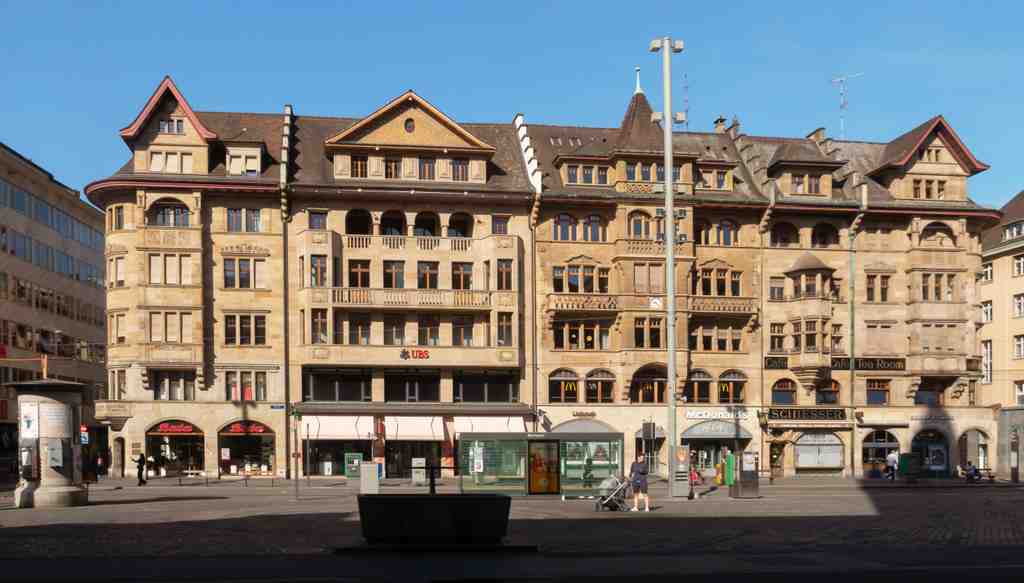
Market Square (Basel)Photo: Michielverbeek, Wikimedia Commons, CC BY-SA 4.0. Cropped & resized. On your right, Market Square opens as a long stone-paved rectangle, its broad surface patterned with rosette paving and tightly framed by old town façades.
This is Basel’s working heart... not a ceremonial stage that happened to attract people, but a place shaped by people who needed the city to function. Under your feet lies reclaimed ground. In the late twelfth century, this area at the lower end of Freie Strasse was partly marshy land on both sides of the Birsig stream. Basel filled it, dried it, and turned it into the Kornmarkt, the grain market. The first written trace comes in eleven ninety-three, in the name of a man called Chunradus de Chornmergit. That little scrap of Latin tells you something useful: once a place earns a name, it has started doing real work.
A stream used to cut across this square. In twelve thirty, builders put up a new stone bridge here on what records called the forum frumenti, the grain market. Later, after a fire in thirteen seventy-seven, the city likely enlarged the space and eventually vaulted the stream over, tucking the water out of sight so the market could breathe. Basel has a habit of doing that: not erasing the old layer, just teaching it to carry a new one.
Look around at the lanes feeding in. Eisengasse, Marktgasse, Martinsgässlein, Freie Strasse, Gerbergasse... they all pour into this space like spokes into a hub. Goods came from the Rhine valley, the Birs valley, the Jura passes, and the roads toward Alsace. If Münsterplatz carried older prestige uphill, this square handled the heavy lifting downhill.
And it kept changing when the city changed. In the eighteen eighties, Basel tore down the block along the lower side. Then came the very Swiss part: a public vote decided not to rebuild on that land, but to fold it into the square. So the old near-square doubled in size and stretched into the long rectangle you see now. In eighteen ninety-one they leveled it, raising the west side; in eighteen ninety-five electric trams began crossing; by nineteen oh three the open space had its paving, including those decorative rosettes that still survive. If you want a quick picture of how this place works today, have a glance at your screen. The tram stop image catches the square doing what it does best: moving people efficiently without losing its old bones.
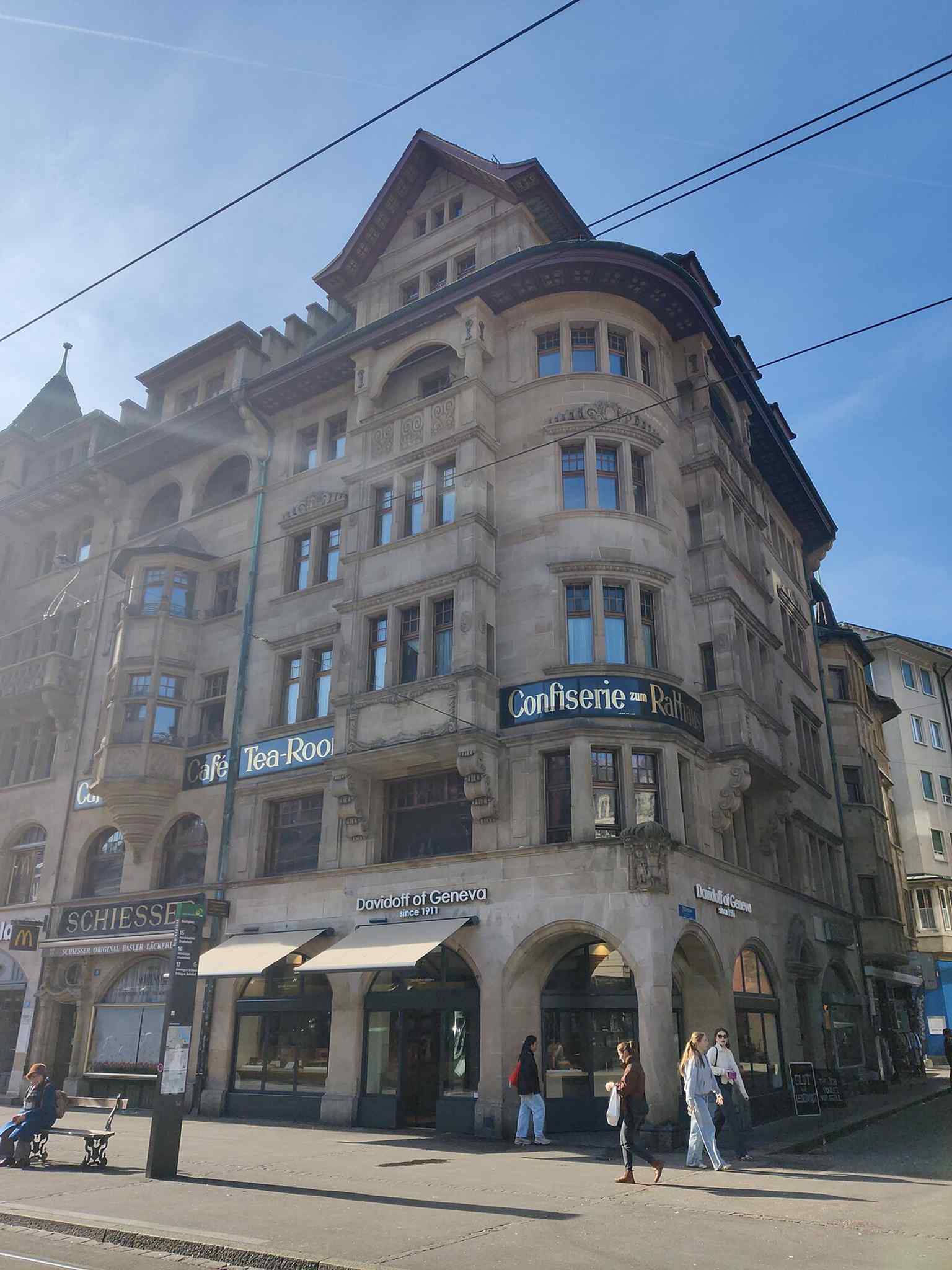
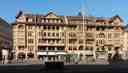
Marktplatz 19 and 21 with the tram stop capture the square as Basel’s main transit hub, crossed by seven tram lines.Photo: Zwantzig, Wikimedia Commons, CC BY-SA 4.0. Cropped & resized. This square also turned public power into public theater. In fifteen oh one, citizens gathered here while Basel’s pact with the Swiss Confederation was read aloud and sworn before armed townsmen. In danger, men assembled here and drew weapons from the Rathaus. Justice happened here too, sometimes grimly, with the pillory and public executions right in view of the crowd.
Then came Paracelsus. In fifteen twenty-seven, Basel’s city physician and lecturer reportedly staged a book burning here, tossing the authority of Galen and Avicenna into the fire to declare that medicine should trust observation over inherited doctrine. In other words, he picked the busiest square in town and said, very publicly, “I’ve got notes.”
If you peek at the app again, the view toward Martinsgässlein shows how the square opens straight into the city’s older routes and institutions. That is the point of Marktplatz: trade, government, argument, and daily life all sharing one stone floor.
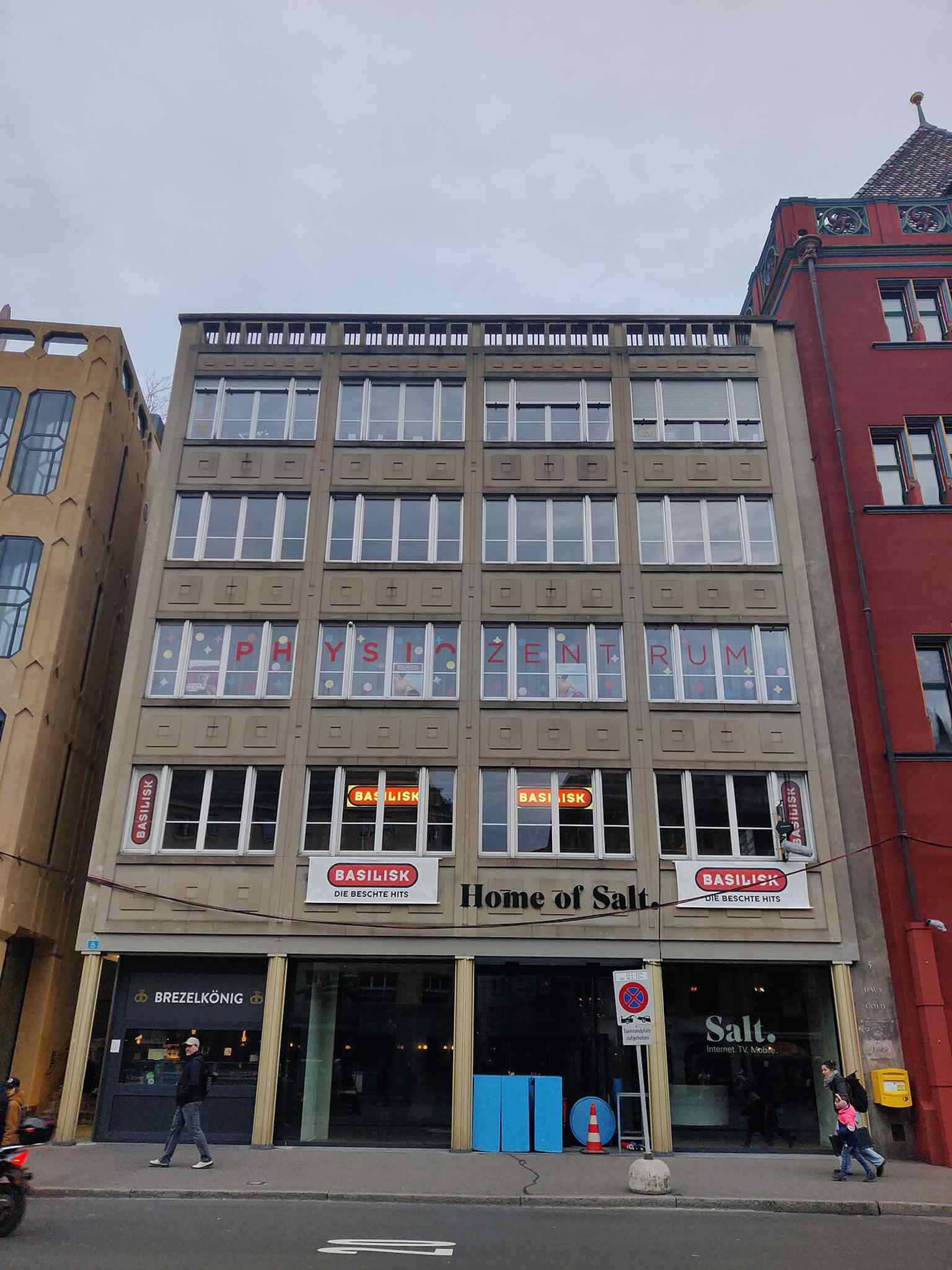
Marktplatz 5 next to the Rathaus and Martinsgässlein highlights how the square opens toward the old city routes and the town hall.Photo: Zwantzig, Wikimedia Commons, CC BY-SA 4.0. Cropped & resized. Now let your eyes follow the lanes toward the books, jars, and learned remedies waiting ahead. The Pharmacy Museum is about a two-minute walk away. And if you ever want the square at its most practical, the daily market usually runs Monday through Thursday from eight to two, Friday and Saturday until five, and rests on Sunday.
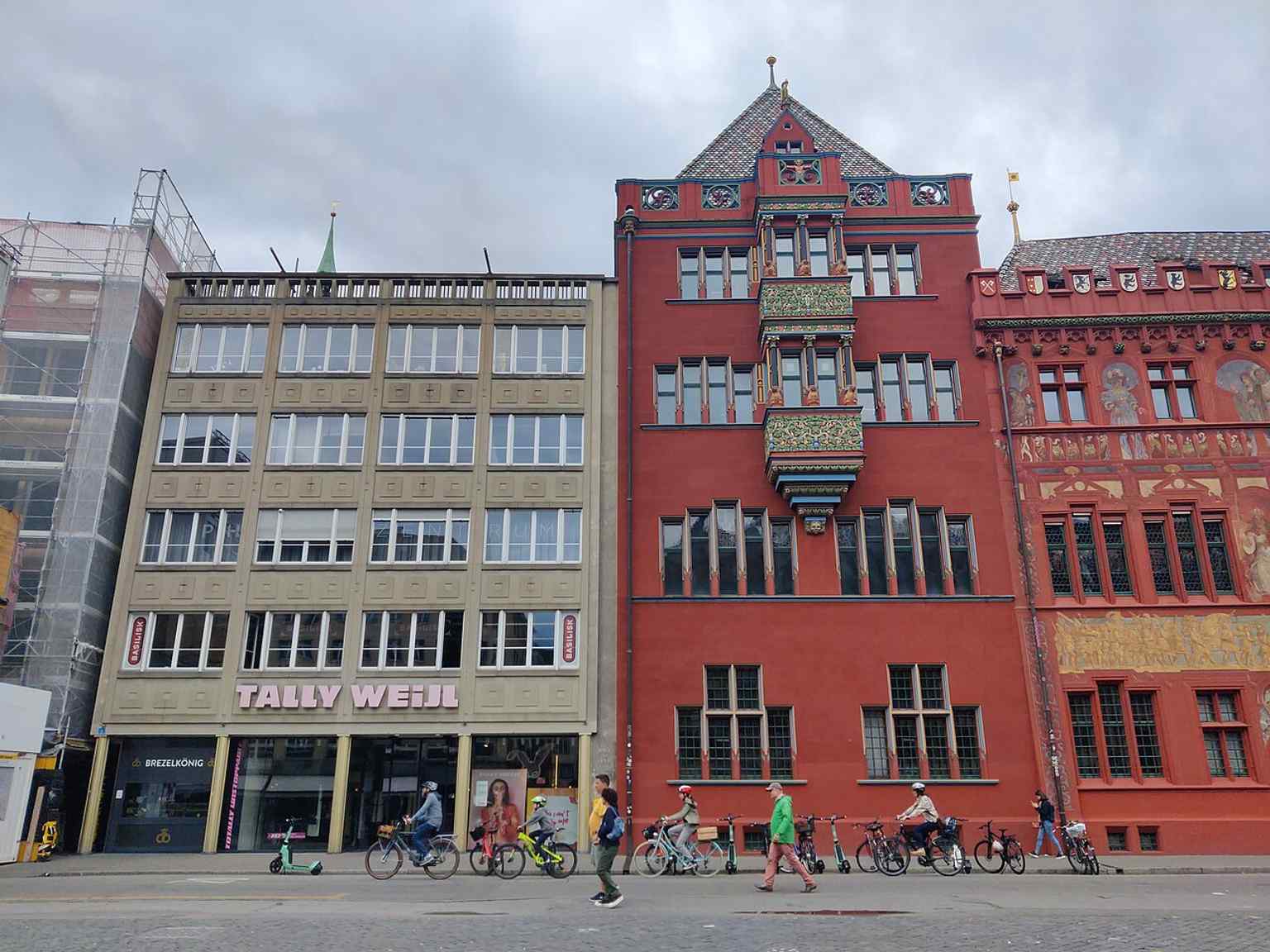
The House zum Gold beside Basel Town Hall shows the Marktplatz’s east side, where the historic civic centre meets the square.Photo: Zwantzig, Wikimedia Commons, CC BY-SA 4.0. Cropped & resized. 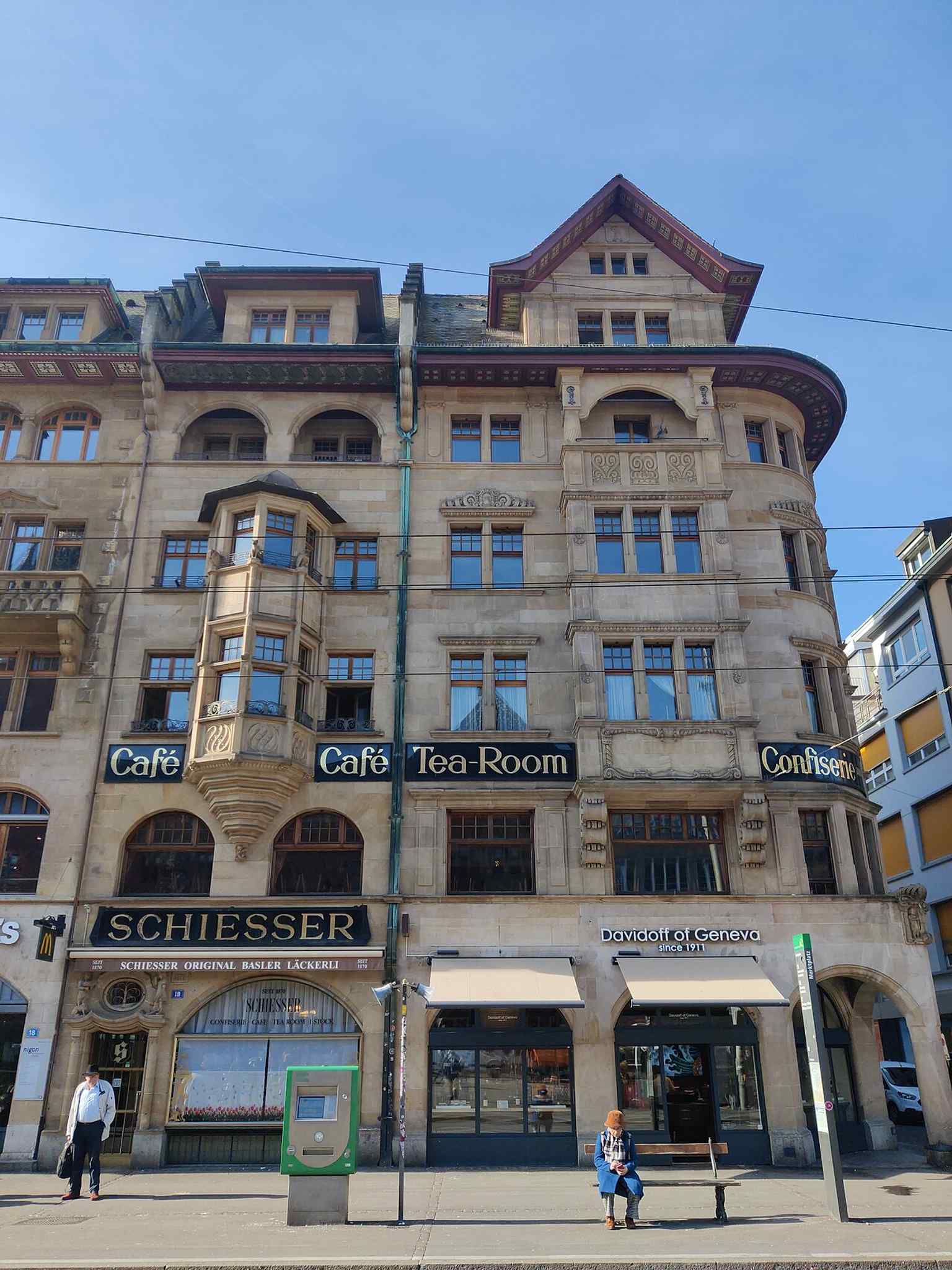
A street-level view of the Marktplatz by the Sattelgasse, useful for showing the square’s busy edges and daily market setting.Photo: Zwantzig, Wikimedia Commons, CC BY-SA 4.0. Cropped & resized. On your left is a modest plastered town house with a stone-framed doorway, tidy rectangular windows, and a deep entrance passage cut into the old facade. From out here, the…Read moreShow less
Open dedicated page →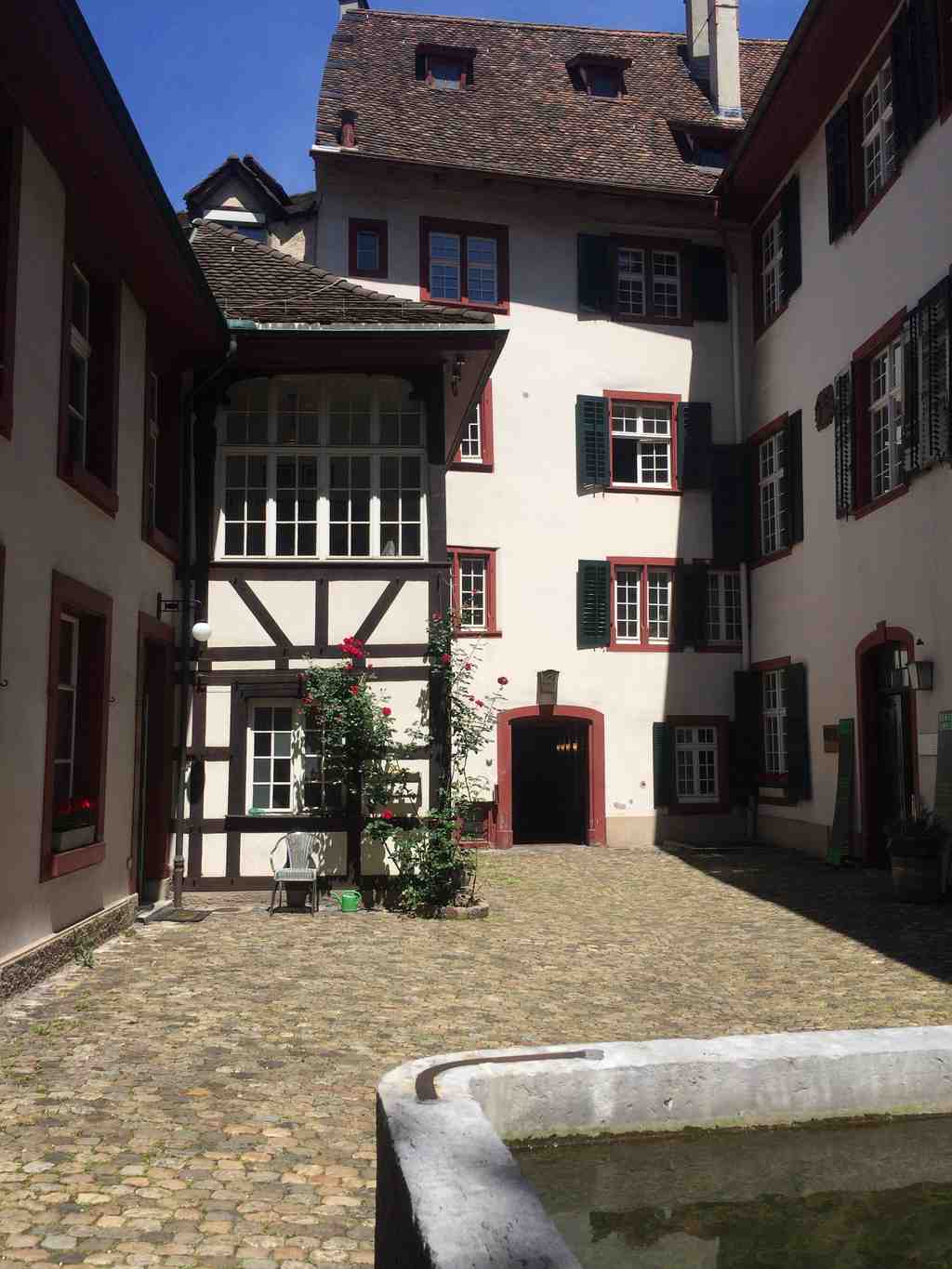
Pharmacy Museum of the University of BaselPhoto: Paunima, Wikimedia Commons, CC BY-SA 4.0. Cropped & resized. On your left is a modest plastered town house with a stone-framed doorway, tidy rectangular windows, and a deep entrance passage cut into the old facade.
From out here, the Pharmacy Museum does not brag... and that suits Basel just fine. This house, called Zum Vorderen Sessel, is one of those places where whole centuries got stacked on top of each other without much fuss.
It first turns up in the record in thirteen sixteen as a bathhouse called Unter Krämern. Then the address changed careers again and again. In fourteen eighty, the printer Johannes Amerbach lived here. In fifteen oh seven, Johannes Froben bought the house, and now the story really starts to hum.
Here is the detail locals love: in fifteen thirteen, Froben received a manuscript by Erasmus that had been intended for Paris. Froben printed it so beautifully that Erasmus did not just send thanks from afar... he came here himself. He later lived and worked in this house from fifteen fourteen to fifteen sixteen as Froben’s guest. Their friendship mattered. Froben went on to publish one hundred forty-eight works by Erasmus, and together they helped turn Basel printing toward humanist scholarship, meaning a new kind of learning built on ancient languages, close reading, and sharp debate rather than just repeating old authorities.
And it was not only Erasmus. Johannes Oekolampad worked here as a corrector, basically the scholar who checked a text line by line before printing, and during the work on the Greek-Latin New Testament he even lived in this house. That edition became the first printed Greek New Testament, and its text helped shape later Bible work across Europe. So yes... in this one address, ink, friendship, argument, and European religion all crowded the same rooms. Not bad for a house on a side lane.
Other names passed through too: Reuchlin, Beatus Rhenanus, Sebastian Münster, Sebastian Brant. Hans Holbein the Younger and his brother Ambrosius worked with the printing world here, along with the engraver Urs Graf. Then medicine stepped in. In the fifteen twenties, Paracelsus, the fiery physician and alchemist, treated Froben’s leg ailment, became city physician, and lectured for practical, patient-centered medicine. He pushed against doctors who trusted books more than bodies, and Basel heard the argument loud and clear.
If you glance at your screen, the room in image three still feels like the kind of teaching cabinet this place became in the twentieth century: shelves of remedies and old drugs arranged for study, not decoration. In nineteen seventeen, Karl Heinrich Zörnig moved Basel’s Pharmaceutical Institute here with only ten students, and he taught pharmacy hands-on. Then, in nineteen twenty-four, Josef Anton Häfliger donated his collection of apothecary jars, obsolete medicines, prescriptions, books, woodcarvings, and paintings. That gift became the museum, and since nineteen twenty-five the house has kept it in that original “scientific cabinet” spirit.
Inside are glazed ceramic pharmacy vessels, full historic pharmacy interiors, an alchemical laboratory from the sixteenth and seventeenth centuries, a pharmaceutical lab from around eighteen hundred, and the old Barfüsser-Apotheke fittings now reused as the shop. Take a look at image six and you’ll see that counter-and-cabinet world still standing, like the apothecary never quite left.
That is Basel’s little magic trick: a bathhouse becomes a printer’s house, a school, an institute, a museum... and each life leaves something behind. Next we’ll head to St. Peter’s Church, where learned networks give way to parish routine, burial ground, and the city’s reform-era reshaping. If you plan to come back inside, the museum is open Tuesday through Sunday from ten to five.
On your right, St. Peter’s Church appears as a pale stone church with a long, sturdy hall, a steep roofline, and a tall tower beside the choir capped with a small roof turret.…Read moreShow less
Open dedicated page →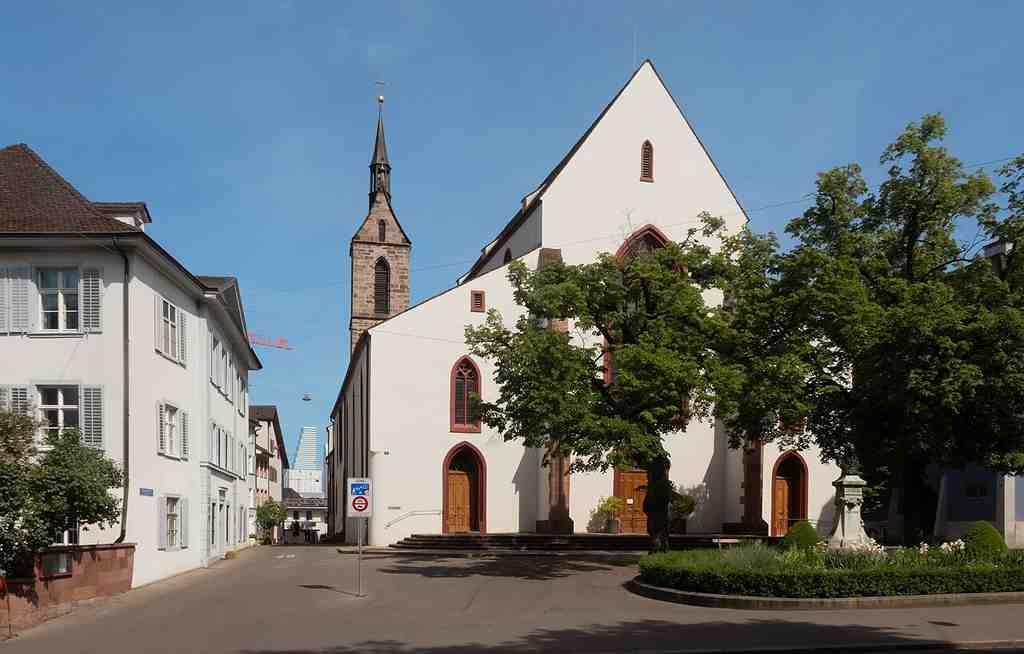
St. Peter's Church (Basel)Photo: Michielverbeek, Wikimedia Commons, CC BY-SA 4.0. Cropped & resized. On your right, St. Peter’s Church appears as a pale stone church with a long, sturdy hall, a steep roofline, and a tall tower beside the choir capped with a small roof turret.
St. Peter’s feels less like a single chapter than a whole stack of them. This hilltop church began, most likely, in the ninth century, and it may have started as a burial church. Even the nearby lane name, Totengässlein, keeps that memory alive. So before this was a place for sermons and parish life, it was already a place where Basel brought its dead, said farewells, and tried to place grief in order. That is a very old human habit... and this church has held it for a very long time.
The building standing here now carries scars and repairs. In thirteen fifty-six, Basel’s great earthquake damaged it badly, and the church had to rise again. The long main hall was finished before thirteen eighty-eight, and the choir, the more sacred eastern end where the altar stands, took on its later form after that rebuilding. The tower went up from about twelve seventy onward, then gained its little roof turret in fifteen oh one and fifteen oh two. Piece by piece, century by century... Basel kept mending what mattered.
What I like about St. Peter’s is how quietly it shows change without pretending nothing changed. This church did not flip from Catholic to Protestant in a blink. In fact, it resisted the Reformation for quite a while. Only in fifteen twenty-nine did the city council appoint Paul Phrygio, a humanist scholar, as Basel’s first evangelical preacher here. So this was not only a change in worship. It was a shift in who held authority, who spoke, and who shaped public life. Same church, new voice.
And still, older layers stayed put. The church chapter survived in an unexpected form because its sixteen clerical posts gradually turned into professorships at Basel’s university, founded in fourteen sixty. That is such a Basel move, if you ask me: turn church offices into university jobs and keep going. The chapter lasted all the way to eighteen thirteen.
Inside, the story keeps folding back on itself. After the Reformation, many wall paintings were covered in whitewash. Then, in nineteen twenty-seven, Rudolf Riggenbach uncovered medieval paintings again in the Eberler Chapel. That chapel had once served as a heating room, which is about as unromantic as it sounds, until restoration in nineteen thirty-nine and nineteen forty gave it back some dignity. A man named Mathis Eberler had commissioned that chapel’s decoration around fourteen seventy-five as a personal memorial space, so even its rediscovery became part of its meaning.
If you look at the image in your app, you’ll see the bronze bust of Johann Peter Hebel, baptized here in seventeen sixty and remembered outside the church centuries later. One more life added to the ledger.
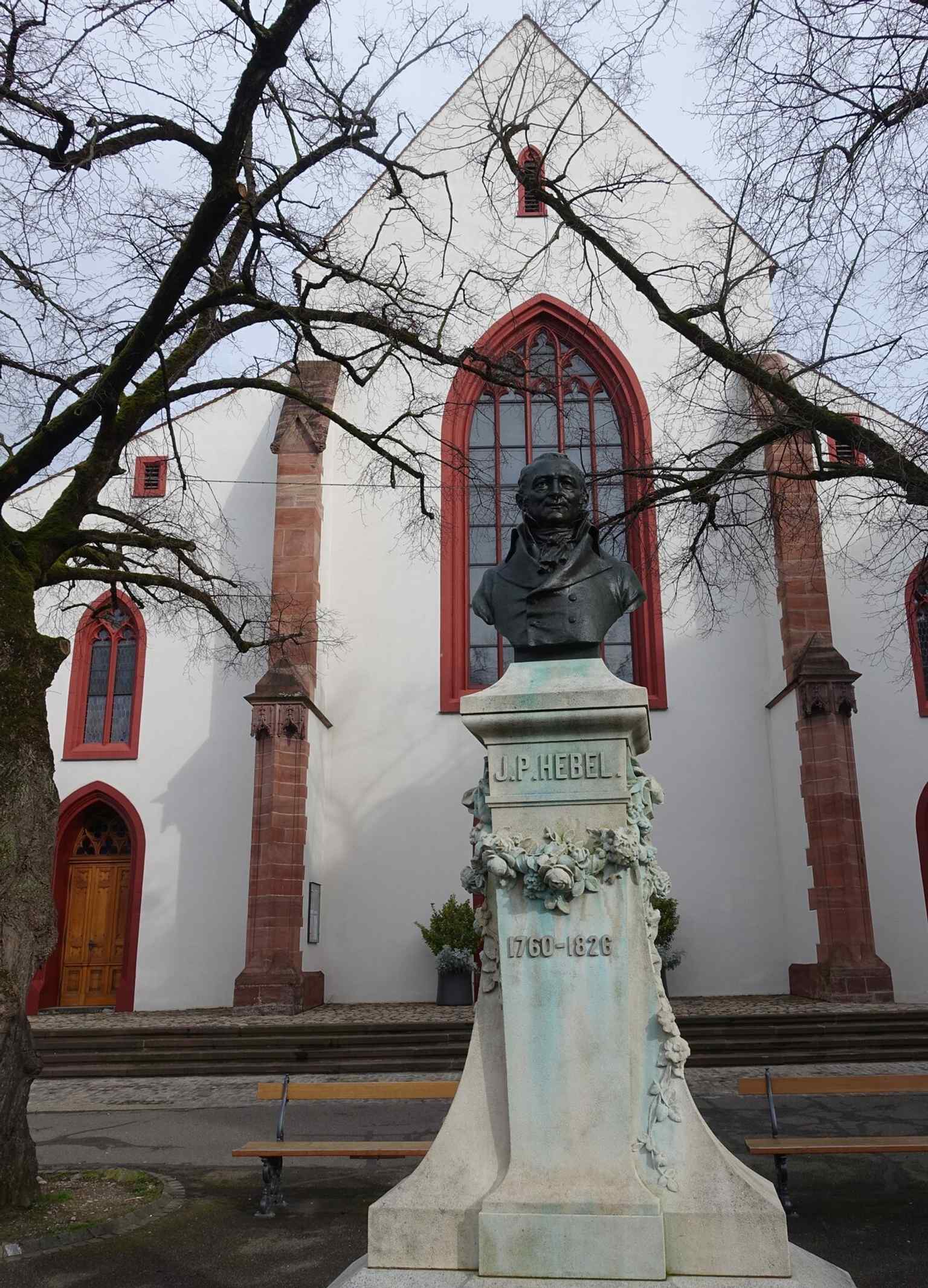
The bronze bust of Johann Peter Hebel outside St. Peter’s Church, commemorating the poet who was baptized here in 1760.Photo: EinDao, Wikimedia Commons, CC BY-SA 3.0. Cropped & resized. Even the outer wall remembers scholars: the Bernoulli family, giants of Basel mathematics, have epitaphs here. A burial church, a parish church, a scholarly church, a Reformed church... St. Peter’s never stayed exactly the same, but it never stopped being useful to the city’s memory.
From here, we’ll head toward the Middle Bridge, about five minutes away, where all these separate threads finally meet the river.
Ahead of you is a broad gray granite bridge with low stone arches and, on its middle pier, a small chapel-like structure called the Käppelijoch that makes it easy to recognize.…Read moreShow less
Open dedicated page →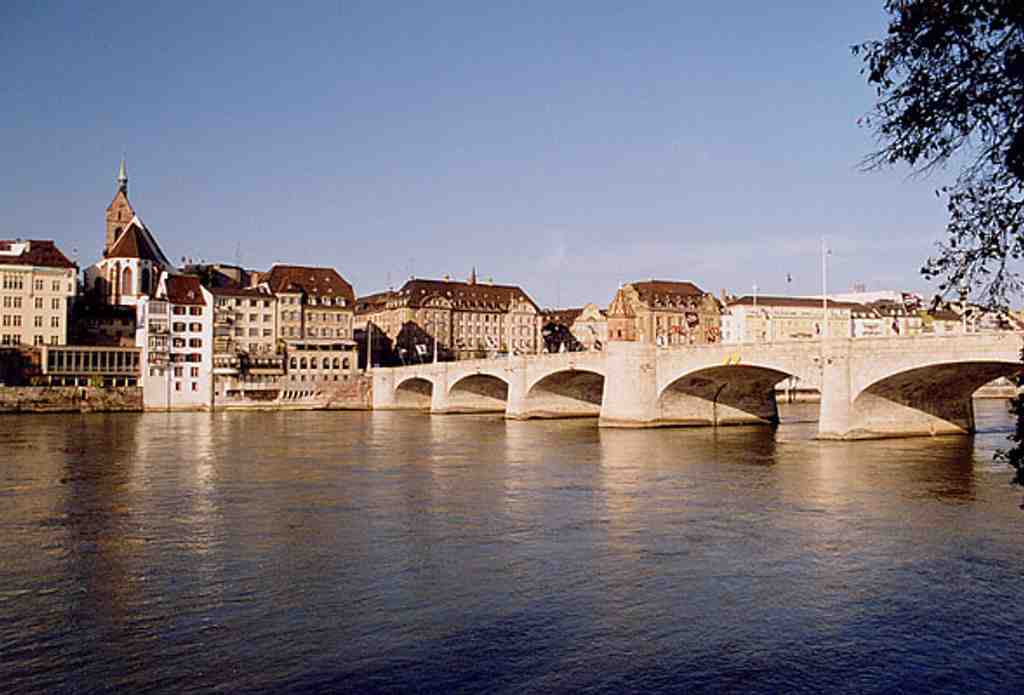
Middle BridgePhoto: Rynacher, Wikimedia Commons, CC BY-SA 3.0. Cropped & resized. Ahead of you is a broad gray granite bridge with low stone arches and, on its middle pier, a small chapel-like structure called the Käppelijoch that makes it easy to recognize.
This is the Mittlere Brücke, the Middle Bridge in everyday speech, and it is the oldest Rhine crossing in Basel. For a very long stretch of the city’s life, this was not just a bridge. It was the bridge. Until the Wettstein Bridge opened in eighteen seventy-nine, Basel had only this one permanent way across the river. If you wanted to trade, collect tolls, move troops, visit family, or simply get to the other bank without getting wet in a very dramatic fashion... this was your line.
The driving force behind the first bridge was Heinrich von Thun, Basel’s prince-bishop in the early thirteenth century. He did not back this project out of pure kindness to tired travelers. Heinrich saw that a fixed crossing could strengthen his authority, pull traffic and goods through Basel, and tighten the city’s grip on the river. By around twelve twenty-five, documents already mention toll exemptions for monasteries that helped pay for it. In plain English: the bridge came with receipts.
If you glance at the image on your screen, you can see how old and strategic that first crossing was in the city’s memory. At the time, Basel’s bridge was among the lowest fixed bridges on the Rhine. That gave the city real leverage. A toll here was never just a fee; it was a hand on the steering wheel of commerce.
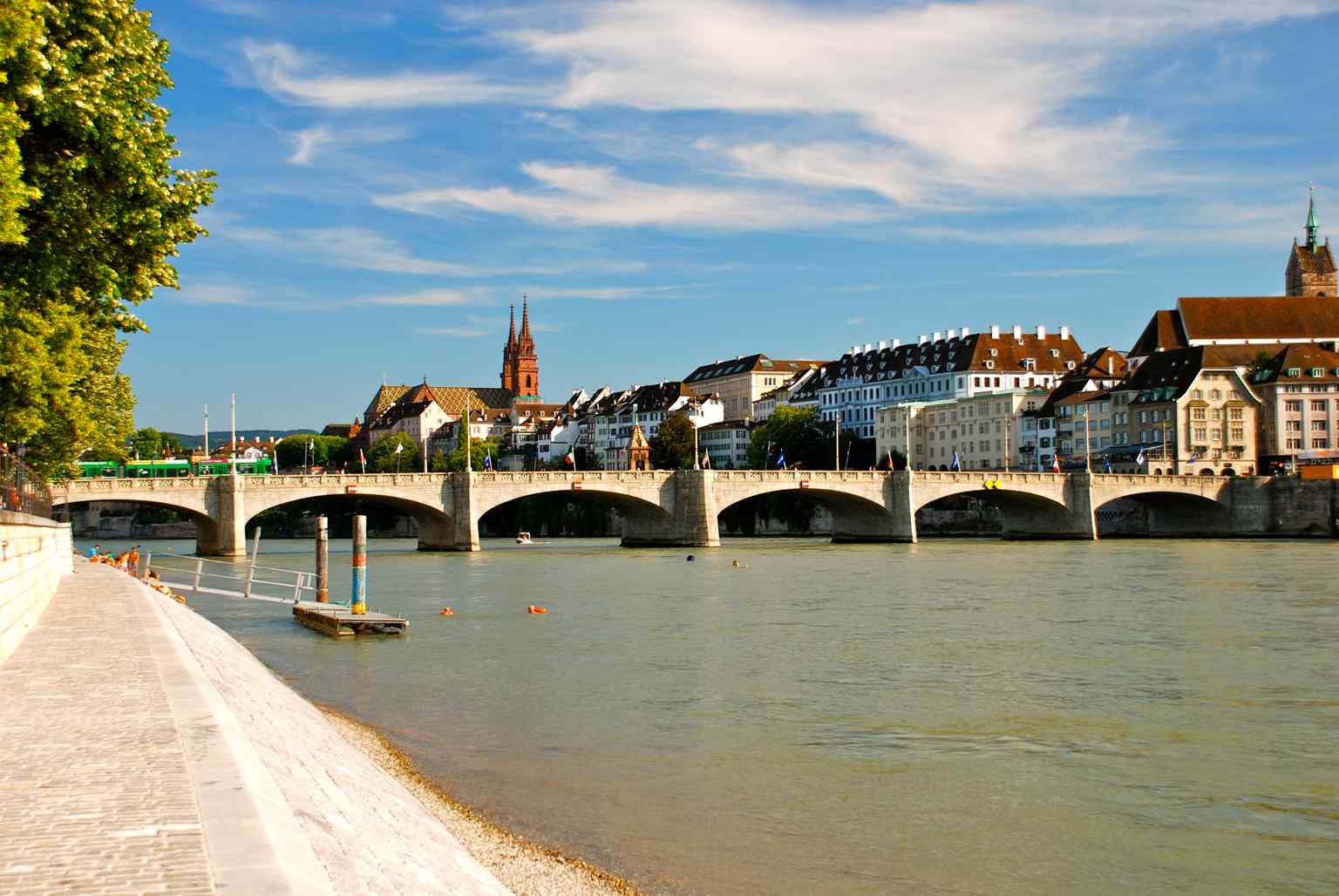
A view of Basel’s oldest Rhine crossing, built under Bishop Heinrich von Thun in the 13th century and long the city’s only bridge over the river.Photo: Lucazzitto, Wikimedia Commons, CC BY-SA 3.0. Cropped & resized. The first bridge mixed five stone piers on the Kleinbasel side with oak pile supports on the Grossbasel side, because the river ran too deep and too hard for thirteenth-century builders to do more. It had no railing, and its planks lay loose so ice would not jam the structure and defenders could disable part of it in war. Practical, a little grim, and very Basel.
The river, of course, kept reminding people who was boss. A flood in twelve seventy-five reportedly collapsed the bridge and killed about a hundred citizens. In fourteen twenty-four, high water tore away three wooden supports; after a hasty repair, fifteen people fell into the Rhine. So this place carries memory as much as masonry.
That little structure in the middle, the Käppelijoch, began as a chapel after the union of Grossbasel and Kleinbasel in thirteen ninety-two. It also served as extra weight on a vulnerable pier. Later, it became the site of executions by drowning. And yet even there, the story bends: nuns from the Klingental convent sometimes pulled condemned women from the river alive, to the fury of the authorities. If you want one image for Basel, that might do it: power lays down a rule, and human beings quietly complicate it.
The bridge you see now dates from nineteen oh-three to nineteen oh-five. Engineers replaced the old structure with this all-stone bridge of Gotthard granite, seven openings wide, because the medieval foundations could no longer cope with the faster river. Basel could have chosen a modern iron truss, but it chose stone arches instead, to keep the old city’s silhouette intact. That is Basel in a nutshell: update the machinery, keep the face.
Take a moment and look along the arches and the curve of the Rhine. You can almost feel why one dependable crossing here could shape markets, government, punishment, expansion, and belonging all at once. This city keeps moving forward the way this bridge does: by spanning the gap, not erasing it.
And fittingly, this final stop is open all day and all night.
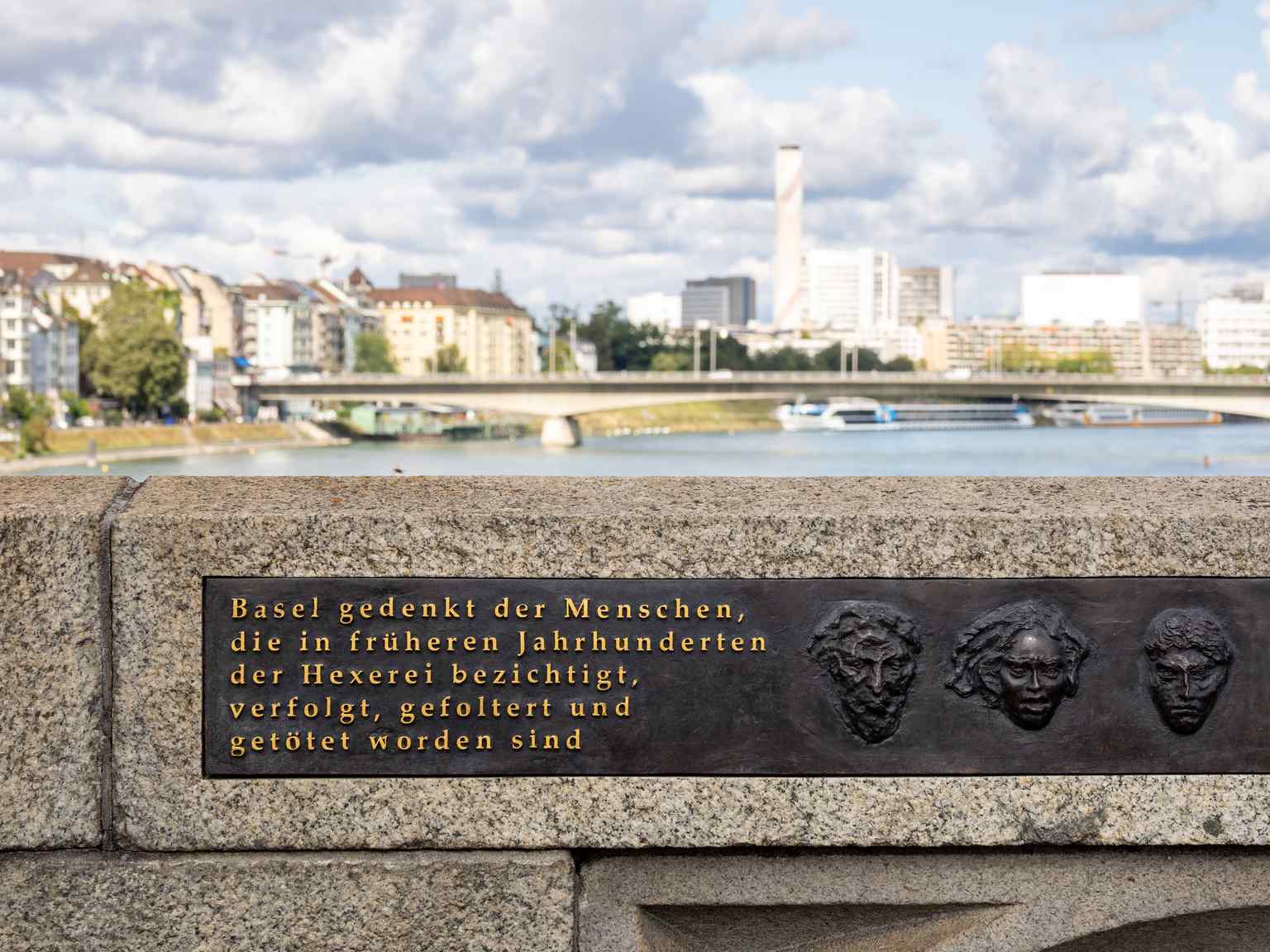
The Middle Bridge with the Käppelijoch area visible — the spot that became both a chapel site and, later, a notorious place of execution.Photo: W. Bulach, Wikimedia Commons, CC BY-SA 4.0. Cropped & resized. 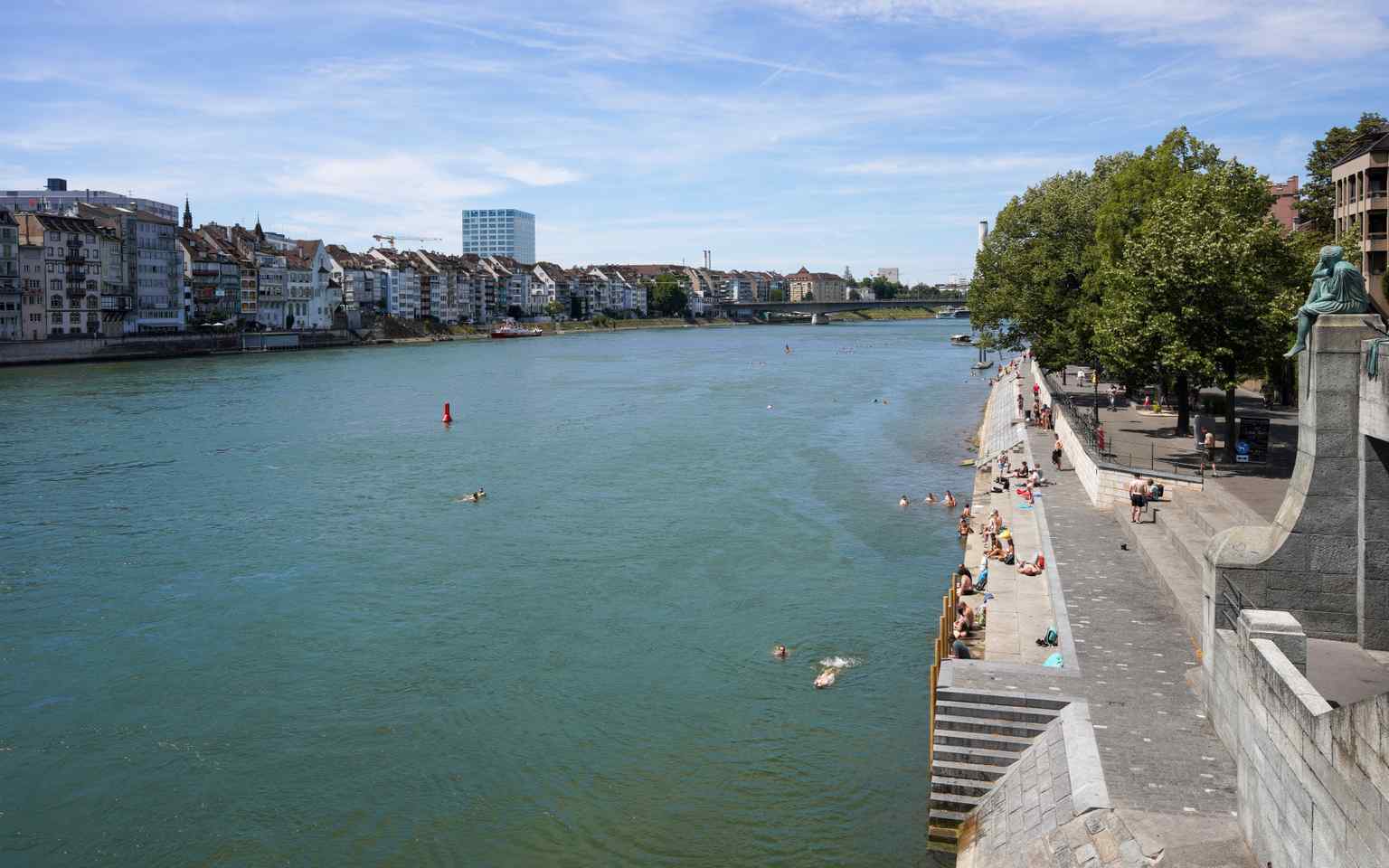
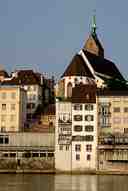
The riverside setting linked to Bettina Eichin’s 'Helvetia auf der Reise,' a sculpture that looks out over the Rhine from the bridge area.Photo: WikiEuropian, Wikimedia Commons, CC BY-SA 4.0. Cropped & resized. 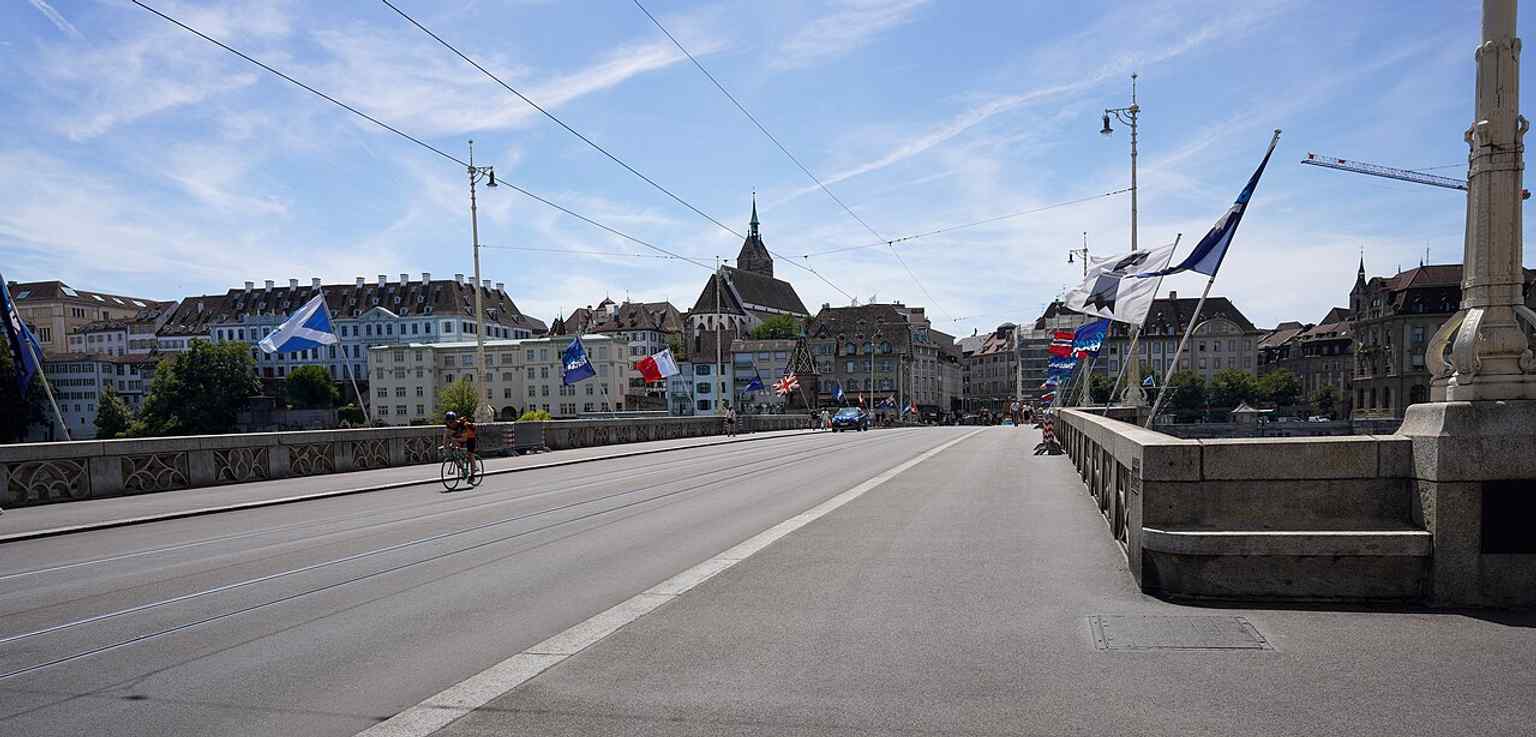
A broad exterior view of the Mittlere Brücke, showing the present-day bridge that now spans the Rhine with seven openings.Photo: WikiEuropian, Wikimedia Commons, CC BY-SA 4.0. Cropped & resized.
Frequently asked questions
How do I start the tour?
After purchase, download the AudaTours app and enter your redemption code. The tour will be ready to start immediately - just tap play and follow the GPS-guided route.
Do I need internet during the tour?
No! Download the tour before you start and enjoy it fully offline. Only the chat feature requires internet. We recommend downloading on WiFi to save mobile data.
Is this a guided group tour?
No - this is a self-guided audio tour. You explore independently at your own pace, with audio narration playing through your phone. No tour guide, no group, no schedule.
How long does the tour take?
Most tours take 60–90 minutes to complete, but you control the pace entirely. Pause, skip stops, or take breaks whenever you want.
What if I can't finish the tour today?
No problem! Tours have lifetime access. Pause and resume whenever you like - tomorrow, next week, or next year. Your progress is saved.
What languages are available?
All tours are available in 50+ languages. Select your preferred language when redeeming your code. Note: language cannot be changed after tour generation.
Where do I access the tour after purchase?
Download the free AudaTours app from the App Store or Google Play. Enter your redemption code (sent via email) and the tour will appear in your library, ready to download and start.
If you don't enjoy the tour, we'll refund your purchase. Contact us at help@audatours.com
Checkout securely with 










%20Fasnachts-Brunnen%2C%20Tinguely-Brunne%2C%20Basel%2000.jpg)


%20Fasnachts-Brunnen%2C%20Tinguely-Brunne%2C%20Basel%2001.jpg)
%20Fasnachts-Brunnen%2C%20Tinguely-Brunne%2C%20Basel%2004.jpg)
%20Fasnachts-Brunnen%2C%20Tinguely-Brunne%2C%20Basel%2007.jpg)
%20Fasnachts-Brunnen%2C%20Tinguely-Brunne%2C%20Basel%2011.jpg)
%20Fasnachts-Brunnen%2C%20Tinguely-Brunne%2C%20Basel%2014.jpg)
%20Fasnachts-Brunnen%2C%20Tinguely-Brunne%2C%20Basel%2016.jpg)


%2002.jpg)
%2006.jpg)
%2004.jpg)
%2010.jpg)


.jpg)
.jpg)
.jpg)
.jpg)

.jpg)


.jpg)
.jpg)


-3.jpg)

.jpg)


%20Basler%20Rathaus.jpg)
.jpg)


.jpg)


