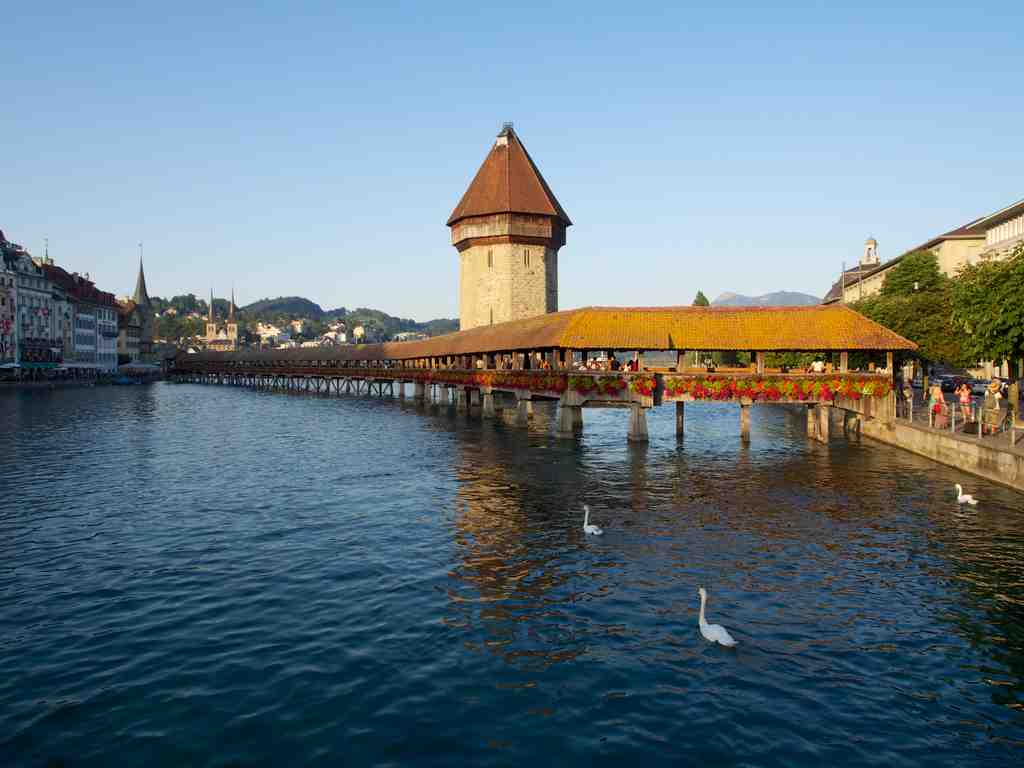
Look to the river in front of you and you’ll spot the Chapel Bridge - a long, covered wooden walkway crossing the water, easily recognized by its steeply sloped roof, a colorful row of flowers, and the tall, octagonal Water Tower rising dramatically from the middle of the bridge.
Welcome to Lucerne’s Chapel Bridge, or as the locals call it, Kapellbrücke - a place so full of stories, if its wooden planks could talk, I’m sure they’d never stop! Imagine yourself in medieval times. The year is 1365, the city is busy building new defenses, and suddenly, right across the Reuss River, they decide to construct not just a beautiful bridge, but a mighty strong one. This isn’t any ordinary wooden bridge. It’s covered, it’s fortress-like, and it was built to connect the two sides of Lucerne - the Old Town and the New - and to keep out any cheeky invaders. If you listen closely, you might almost hear the river lapping against those ancient posts.
Back then, Lucerne had walls, gates, and towers everywhere, but the river was still a weak spot in its armor. So, not only did they build the bridge, they put up a palisade in the water to stop enemy ships. They even raised the side of the bridge facing the lake to give archers a little surprise advantage - now that’s what I call thinking ahead!
Right at the heart of the bridge stands the Water Tower, older than the bridge itself. This odd, octagonal structure has lived many lives: it’s been a watchtower, a prison, a torture chamber, a treasury, and even now, holds a souvenir shop and the meeting room of a local artillery club. Just don’t ask if they’ve kept the dungeon as a feature, or you might get more chills than you bargained for.
Let’s jump to the 15th century, when the Chapel Bridge transforms from a fortress to a kind of medieval social media hotspot. They installed benches, and suddenly everyone wanted to linger here, gossip about the latest news, or just get the city’s best river views. The bridge also got dressed up with a grand series of triangular paintings in the gables above your head. These pictures, painted by Hans Heinrich Wägmann and his sons, tell dramatic tales from Lucerne’s and Switzerland’s history - think knights, saints, epic battles, and a giant called the “Giant of Reiden”! Talk about an action-packed timeline - Netflix, eat your heart out.
But the bridge’s career wasn’t always smooth sailing. In the 1800s, parts were torn down to make way for urban projects; the bridge was shortened, bent, and even separated from the buildings it used to protect. There was talk of tearing it down altogether, but after loud protests from locals and tourists alike (just imagine the Swiss shaking their fists - politely, of course), the city decided to keep the bridge. Sometimes history is saved by the power of nostalgia - or perhaps a good postcard industry.
Then, in 1993, disaster struck. On a peaceful night, a fire broke out, likely from a single careless cigarette. Flames tore through the wooden bridge in minutes, destroying much of its structure and burning seventy-eight of the precious paintings. The loss was heartbreaking. The city’s heart ached, but like any legend worth telling, the story didn’t end there! Within months, the bridge rose from the ashes. Volunteers, craftspeople, and artists poured in, and by the next year, the Chapel Bridge reopened, strong as ever, with thirty restored pictures and paintings moved in from other places to fill its middle section. If you look closely where the original meets the reconstructed, you might see some charred remnants - little scars that remind us this bridge is tough as well as beautiful.
The paintings themselves are a masterpiece of Renaissance group work. Each city council member of Lucerne got to sponsor a painting (with their own coat of arms, naturally - can’t pass up PR like that), with verses and legends teaching lessons of faith, good citizenship, and the proud stories of Swiss soldiers, saints, and heroes. And just because the Swiss love their festivals, during Carnival, local groups hang new paintings right over these masterpieces for the season, giving the bridge a fresh new look every year. It’s a historical fashion show and a living gallery rolled into one.
So as you stand by the river, listen for the tales carried on the breeze, and feel free to linger for a while, just as people have done here for centuries. And whatever you do, don’t light a cigarette near the wood - unless you want to see some very concerned Swiss appear faster than you can say “Kapellbrücke”!