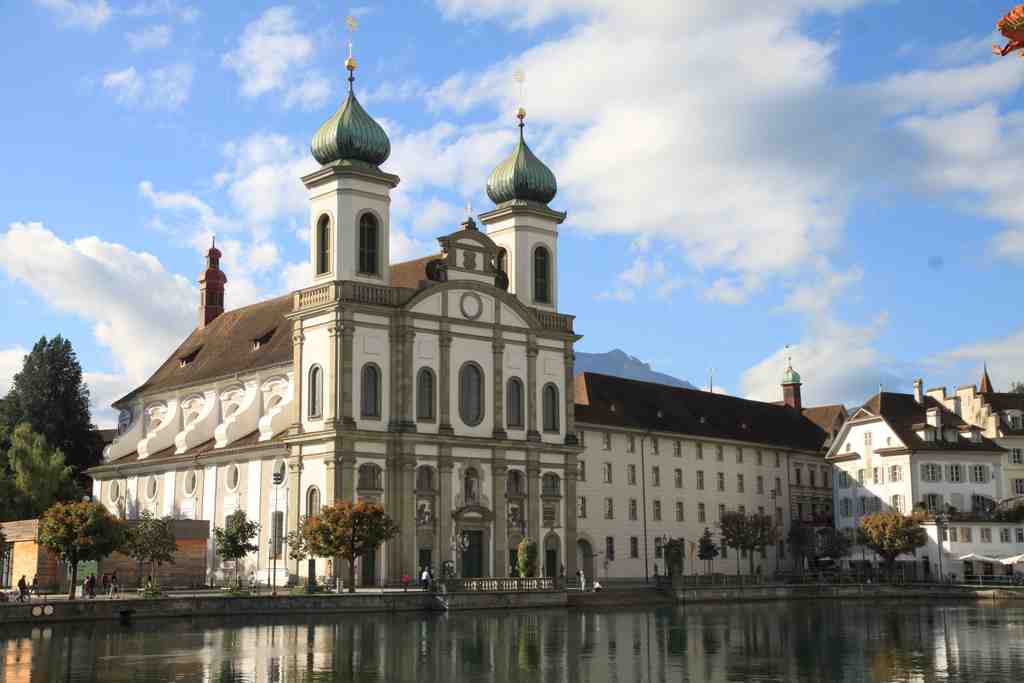
To spot the Jesuit Church, just look riverside for a grand, creamy white building with twin green onion-shaped domes - it stands out proudly right by the water with its decorative baroque facade.
Now, as you stand before the shimmering waters of the Reuss and gaze up at these twin towers topped with their quirky green onion domes, let’s step back in time together. Imagine it’s the mid-1600s: Lucerne’s Old Town bustles nearby, while here, skilled builders and pious Jesuits put the finishing touches on Switzerland’s very first grand Baroque church. But don’t let that beautiful calm fool you - in those days, religious and political tides were as choppy as the river after a thunderstorm.
A grand plan was hatched: to build not just any church, but one dedicated to Francis Xavier, the famous Jesuit missionary - talk about a man of adventure! If you peek at the facade, you’ll count five divisions and two impressive stories, lined with elegant pilasters and crowned with gables and a vibrant golden cross that glints in the sunlight. The look is meant to dazzle, and honestly, if you think it’s impressive now, you should’ve seen the jaw-drops back in 1677 when the church first opened its doors.
Inside, you’d find more than just quiet prayers and candlelight. There’s the lingering sweet smell of incense and, flashing before your eyes, a painter named Domenico Torriani from Mendrisio busily working on the main altar painting, while the Torricelli brothers create sweeping murals depicting heroic travels and even the odd elephant pulling a heavenly chariot (really, how often do you get to see an elephant in a Lucerne church?). These wild animals weren’t just for show; they symbolized the far-off places Francis Xavier brought his message-from India to Japan and back again.
Of course, no grand church would be complete without a little competitive spirit. The Jesuits commissioned designs rumored to be from architectural powerhouses like Michael Beer or Michael Thumb. Still, Father Heinrich Mayer, a Jesuit himself, drew the actual plans for the chapel’s stunning stucco decorations. He set the trend for a whole style of Swiss and South German church-building. By the way, if you stroll in, try imagining the splendor Mayer envisioned while wrestling with the tricky Swiss weather and the endless debate over pillars - everyone’s a critic, even in the 17th century!
The magic didn’t stop there. The structure took shape with careful layers: the lower story with its arched doors welcomes both humble townsfolk and mighty dignitaries, while above, the windows flood the church with a golden, ethereal light. Take a glance at the towers, too - those iconic domes were a 19th-century update by designer Heinrich Viktor von Segesser, turning the church’s silhouette into Lucerne’s ultimate skyline calling card.
Inside, the high altar, created by Christoph Bruck, is a masterpiece of layers - topped with the divine rays of glory and a golden eye representing God. But look closer: among the saints, clouds, and a host of angels, Francis Xavier himself kneels beneath the gaze of Mary and child, stars twinkling in her crown, his hand on a flaming heart. There’s even a fresco showing Xavier cruising through history in a chariot pulled by an unlikely crew: an elephant, a dromedary, a horse, and a cheetah! Those animals were chosen for where the saint’s legendary adventures took him, showing that here, faith had no borders.
As for music - after all, what’s a church without a little organ thunder? The current organ, built in 1982 but still echoing with pipes from 1897, can make the very stones vibrate and your heart skip a beat, especially on a Sunday morning.
But don’t let all this devotion fool you - the Jesuit Church has a sense of humor, too. It played a cameo role in the satirical Swiss film “Beresina,” where - spoiler alert - a Russian call girl is crowned Empress of Switzerland! If you hear a little extra laughter echoing through the halls, now you know why.
So whether you’re drawn here by awe, curiosity, or just to rest your feet along the river, the Jesuit Church stands as Lucerne’s palace of light, history, and unending stories - and now, you’re part of its tapestry, too.
Fascinated by the architecture, equipment or the organ? Let's chat about it