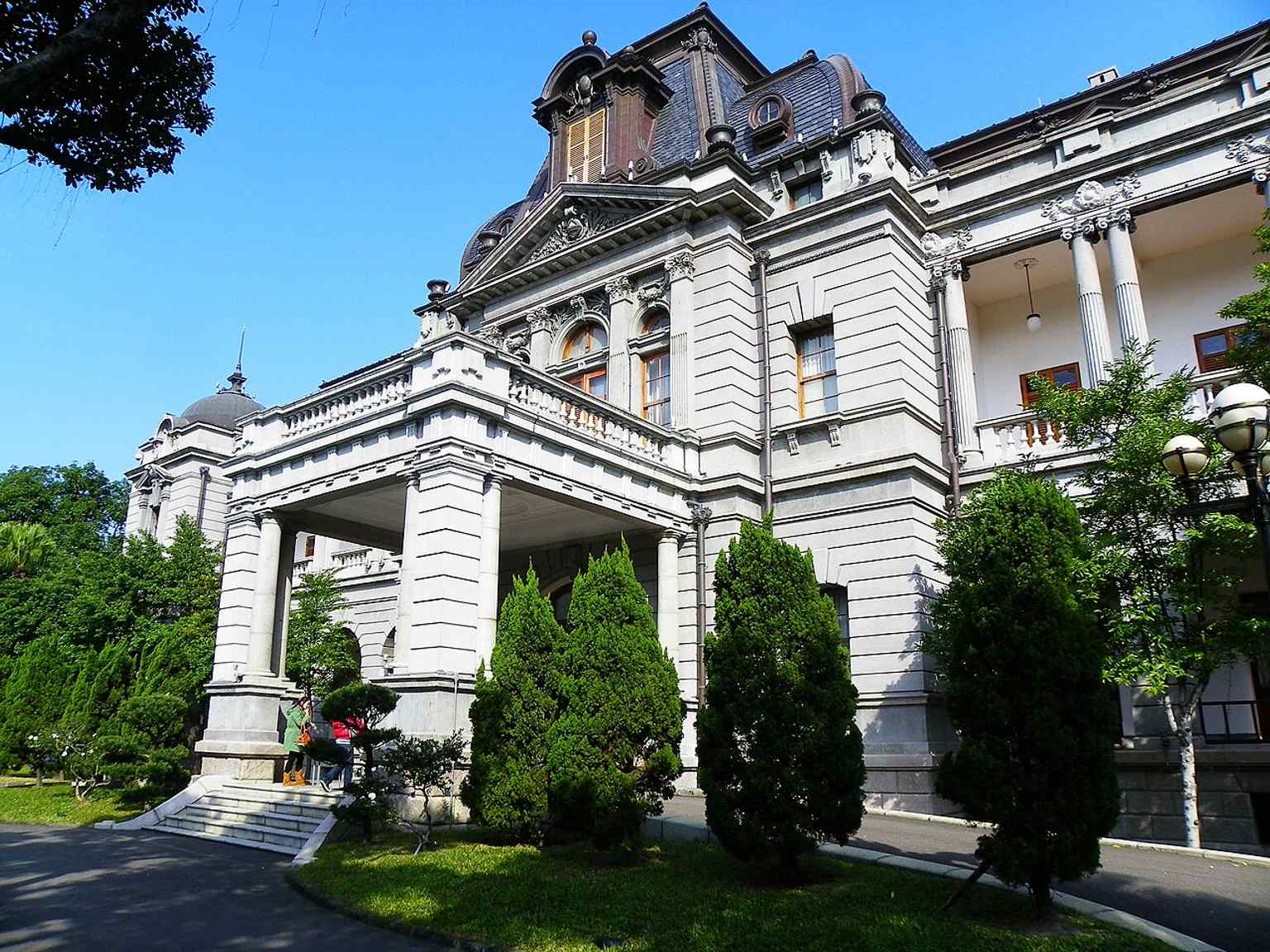
On your right, look for the pale stone-and-brick mansion with its dark curved mansard roof, broad arched windows, and the grand columned entrance porch that announces itself like a carriage still expects to roll up.
This is Taipei Guest House, the former Governor-General’s residence, and it served as the intimate counterpart to official administrative power. If the Presidential Office projected command, this place handled the softer business of rule: residence, ceremony, hospitality, and the careful art of making power look gracious.
And yes... this is the real Ketagalan Boulevard Number One. A lot of people casually pin that address on the Presidential Office, but locals who care about these things will tell you the honor belongs here.
The story starts after Japan took Taipei in eighteen ninety-five. Governors first bounced through a series of temporary residences, but the fourth Governor-General, Kodama Gentaro, wanted something far more deliberate. He ordered a proper mansion in eighteen ninety-nine, and he wanted it grand enough to display authority without needing to shout. Architects Fukuda Togo and Nomura Ichiro finished it in nineteen oh-one as a Renaissance-style residence: a brick-and-stone structure, two stories high, with parquet wood floors, imported British tiles, a Western-style front garden, and, behind it, Taiwan’s first Japanese strolling garden.
Then even that proved not quite grand enough. By nineteen eleven, the house felt too small, and the old timber roof had been chewed up by termites... nature, apparently, was unimpressed by empire. Architect Moriyama Matsunosuke led a major rebuild, completed in nineteen thirteen. He turned the place into a more theatrical Neo-Baroque mansion, borrowing the look of a French court palace from the Second Empire period. Think paired Roman columns, steel roof framing, imported fireplaces, crystal chandeliers, plush carpets, silk curtains, and layers of decorative plaster. It stopped being simply a home and became a machine for receiving important people.
If you glance at the before-and-after image in the app, you can see how that Meiji-era residence became the formal ceremonial forecourt in front of you now.
One of its most telling moments came in nineteen twenty-three, when Crown Prince Hirohito, the future Showa Emperor, visited Taiwan. This house staged banquets and performances for local elites, turning hospitality into politics. Upstairs, there was even a single Japanese tatami room set inside an otherwise European world of display, a small reminder that identity here was curated as carefully as the guest list.
After nineteen forty-five, the building slid almost seamlessly into a new state. First it served briefly as the residence of the Taiwan Provincial Government chairman. In nineteen fifty, authorities renamed it Taipei Guest House. In nineteen fifty-two, Foreign Minister Ye Gongchao signed the Treaty of Taipei here with Japan’s representative, Retsu Kawada. Later, the Ministry of Foreign Affairs took it over for state banquets and foreign guests. If you want a peek inside that role, have a look at the formal dining setup in the app.
Long neglect nearly undid the place, but a major restoration from two thousand and two to two thousand and six brought it back. Now it still hosts diplomacy, receptions, and national ceremonies. So this elegant mansion teaches a useful lesson: private comfort and public welcome can serve power every bit as effectively as offices and courtrooms.
In about three minutes, we’ll head to Two Two Eight Peace Memorial Park, where the city’s carefully managed public face gives way to a far more painful memory.