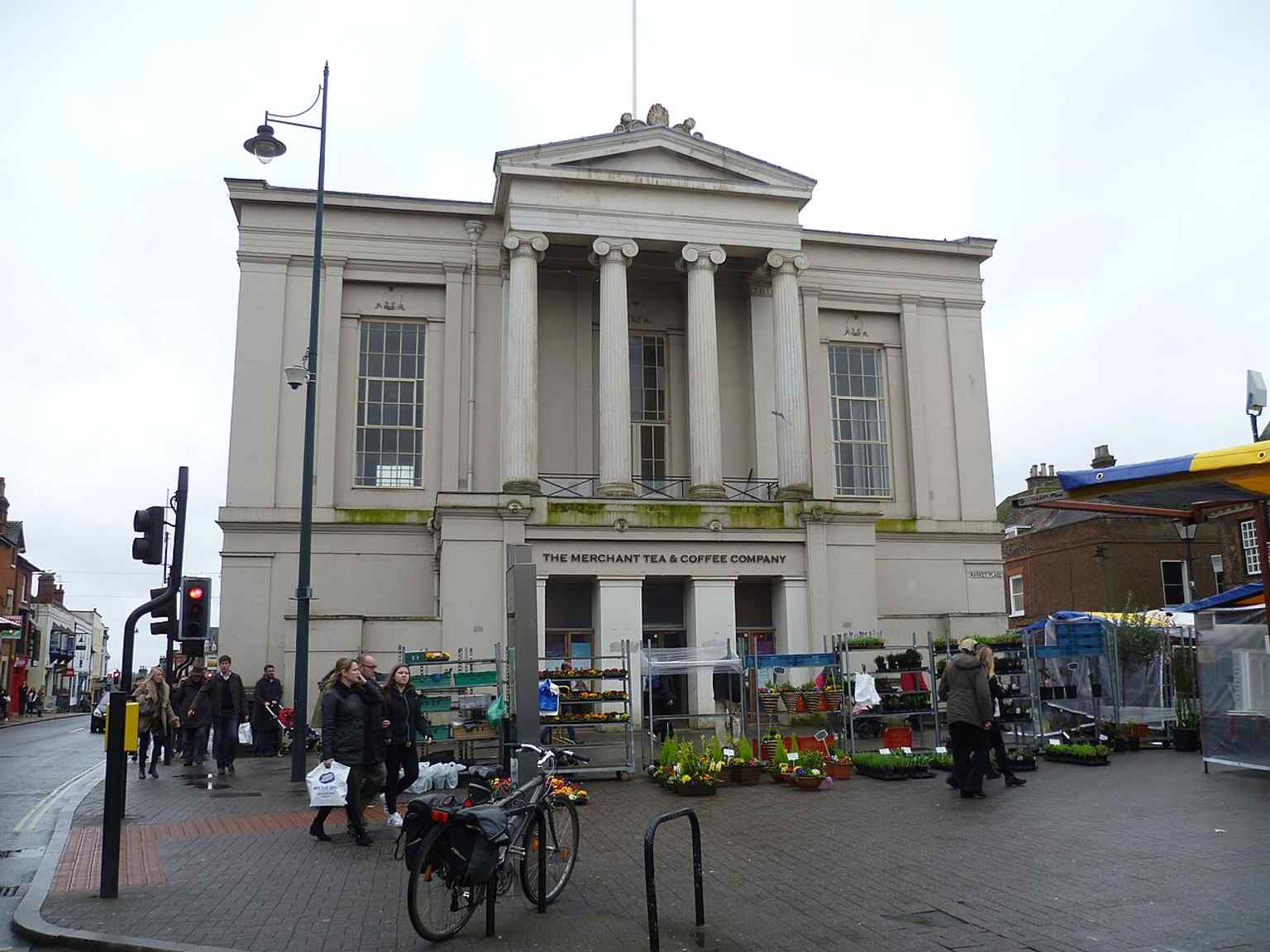
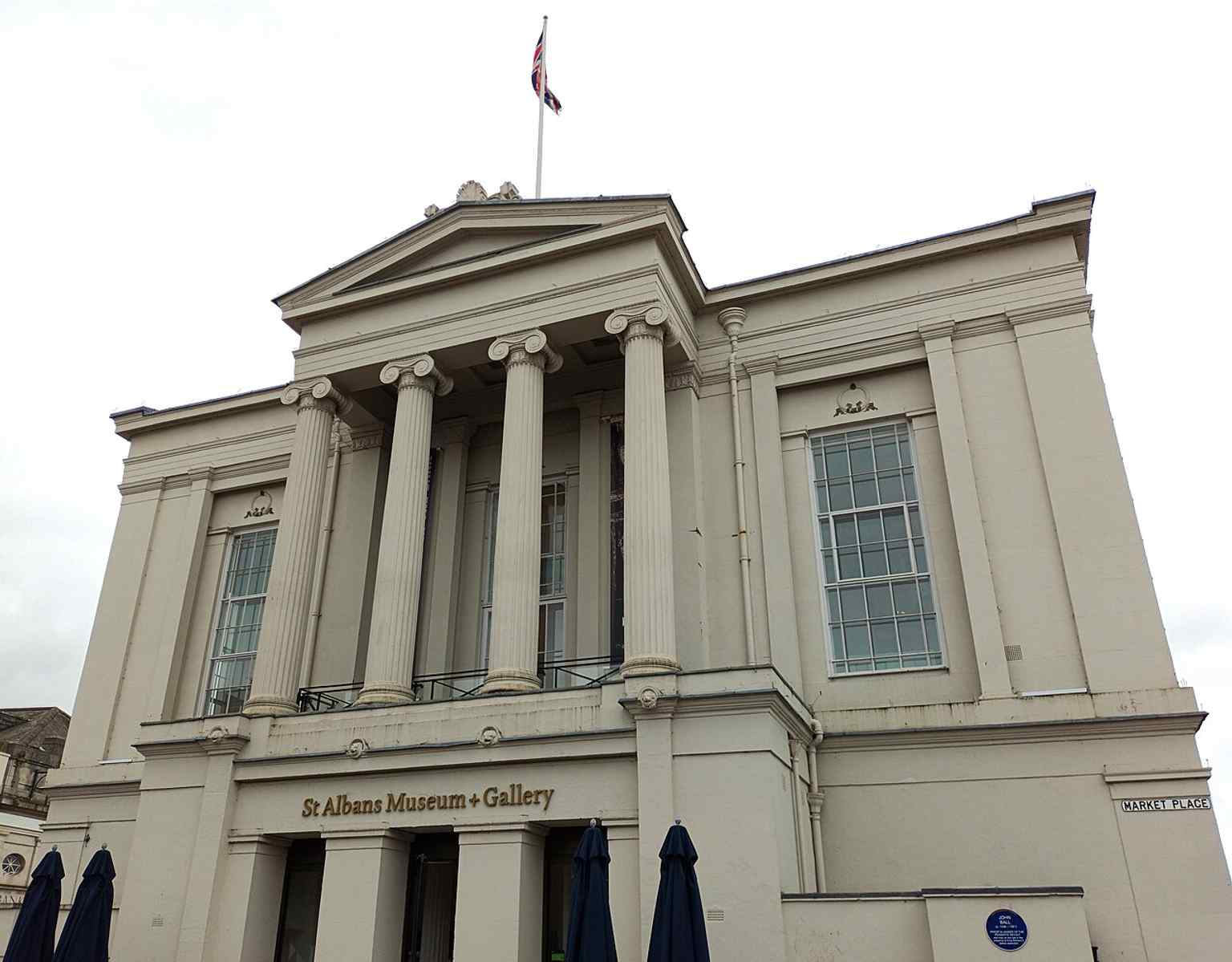
On your right, look for the pale stone frontage with its crisp three-part symmetry, a porch of four Ionic columns, and a triangular pediment set high above the centre.
From where you stand, St Albans Town Hall has the poise of a building that expects to be obeyed. It opened in eighteen twenty-six, when the town decided its old Moot Hall in the Market Place had become too shabby and too awkward to rescue. The architect, George Smith, a local man from Aldenham who trained in London before returning home, argued firmly against rebuilding on the old site. He reckoned repairs alone would cost five hundred to six hundred pounds, around fifty to sixty thousand pounds today, and a full rebuild about four thousand pounds, roughly four hundred thousand now. Worse, he thought the old position was poor for security. His report helped settle a lively civic quarrel, and St Peter’s Street won.
Smith gave the town a neoclassical design, which means it borrows the calm order of ancient Greek and Roman architecture. You can read that in the strict symmetry, the four-column portico, and the Ionic capitals, those neat curled tops on the columns. Historians later called Smith meticulous and dependable, and many consider this one of his finest surviving works.
Yet the building’s life was never only dignified. Almost at once, it opened its doors to anti-slavery lectures, so reform entered here alongside law and government. Then, in eighteen thirty-one, the town hall turned grand host for the first county ball. The Morning Post admired the occasion, noting the patronage of the Earl of Verulam and Lord Grimston, dancing that began at eleven, Weippert’s band, and a supper judged first-rate. Justice downstairs, elegance upstairs: that contrast suits this place rather well.
And then came scandal. In eighteen fifty-one, the Bribery Commission sat here to investigate Jacob Bell’s election campaign. The findings were astonishing. Bell’s side had spent about two thousand five hundred pounds, something like a quarter of a million pounds today, and voters were commonly paid five pounds each, around five hundred pounds in modern terms. Out of only four hundred and eighty-three eligible voters in a town of about seven thousand people, the commissioners found that three hundred and eight had taken money. The result was brutal: St Albans lost its parliamentary representation for a time. If you glance at the courtroom image on your screen, you can see the octagonal room, eight-sided, wood-panelled, and intimate enough to make every accusation land with force. This was also a working courthouse in the old sense, with quarter sessions, local criminal courts that met four times a year, and even cells below for prisoners awaiting trial. Civic ceremony and detention sat almost on top of each other here. Later, the council reshaped parts of the building again, including turning the Grand Jury room into a council chamber in eighteen ninety-nine, before civic government moved elsewhere in the twentieth century and the courts finally left for Bricket Road in nineteen ninety-two.
Its newest reinvention is the gentlest of all. After a major conversion by John McAslan and Partners, costing seven point seven five million pounds, the building reopened in twenty eighteen as the St Albans Museum and Gallery. If you fancy it, have a look at the before-and-after image in the app; it shows beautifully how a courthouse learned to present itself as a museum. If you want to go inside, the museum is open every day from ten in the morning until four in the afternoon.
For all its classical calm, this building has held reform, vanity, punishment and public pride in one remarkably composed shell.
When you are ready, continue on toward the market, where the town’s civic story turns back into trade.