
On your left, look for the broad paved sweep of Market Place and Saint Peter’s Street: a long, gently rising strip of open roadway whose widened shape still marks the market’s ancient ground.
This is not simply where a market happens. This is the market: England’s oldest street market, and the oldest in the country still trading on its original site. After Canterbury’s market closed in twenty twenty-two, only York outranked Saint Albans by age, and in twenty twenty-four this one claimed a fresh title of its own, Best Large Outdoor Market from the National Association of British Market Authorities.
Its story begins with Wulsin, the sixth abbot of Saint Albans. He founded the market to bring money into the abbey and, just as importantly, to pull a new town into being beside the Waxhouse Gate. So commerce and urban planning began here together. By at least the late twelve hundreds, the trading days had settled into Wednesday and Saturday, the same rhythm the market still keeps.
Medieval markets liked order, even when people did not. Traders clustered by goods: meat in the Fleshambles, fish in the Fish Shambles, wheat in Wheat Cheping, leather in Leather Shambles, wool in its own section. “Shambles” simply meant rows or benches for selling. Kings protected the abbey’s rights here too. Henry the Second confirmed control of the town and market, and Richard the First did the same.
Yet this place never dealt only in buying and selling. It dealt in rules. The abbot’s court sat nearby, and the market even had a court of piepowders, a fast court for disputes among travelling traders; the name comes from “dusty feet”. Justice could be swift, and public. In fifteen forty-one, a man named Raynold Carte stood in the pillory here from an hour before the market opened until an hour after it closed. The square was a stage for shame as much as trade. Astonishingly, punishments lingered on so long that in eighteen twelve the last pillory use in Hertfordshire took place on a market day in Saint Albans.
If you glance at your screen, the old photograph in image one shows how naturally the market stretches along the street, as though the town grew around it because, in truth, it did. That feeling lasted well into later centuries. Women and girls once sold straw plait by the yard beside the Clock Tower, feeding a local hat-making trade. In the year from June eighteen oh eight, local tollgates counted more than forty-five thousand carts and carriages and about two hundred and sixty thousand animals heading for market. By eighteen ninety-three, one newspaper still described the place with oil lamps blazing and vendors crying out so fiercely that the scene felt more medieval than Victorian.
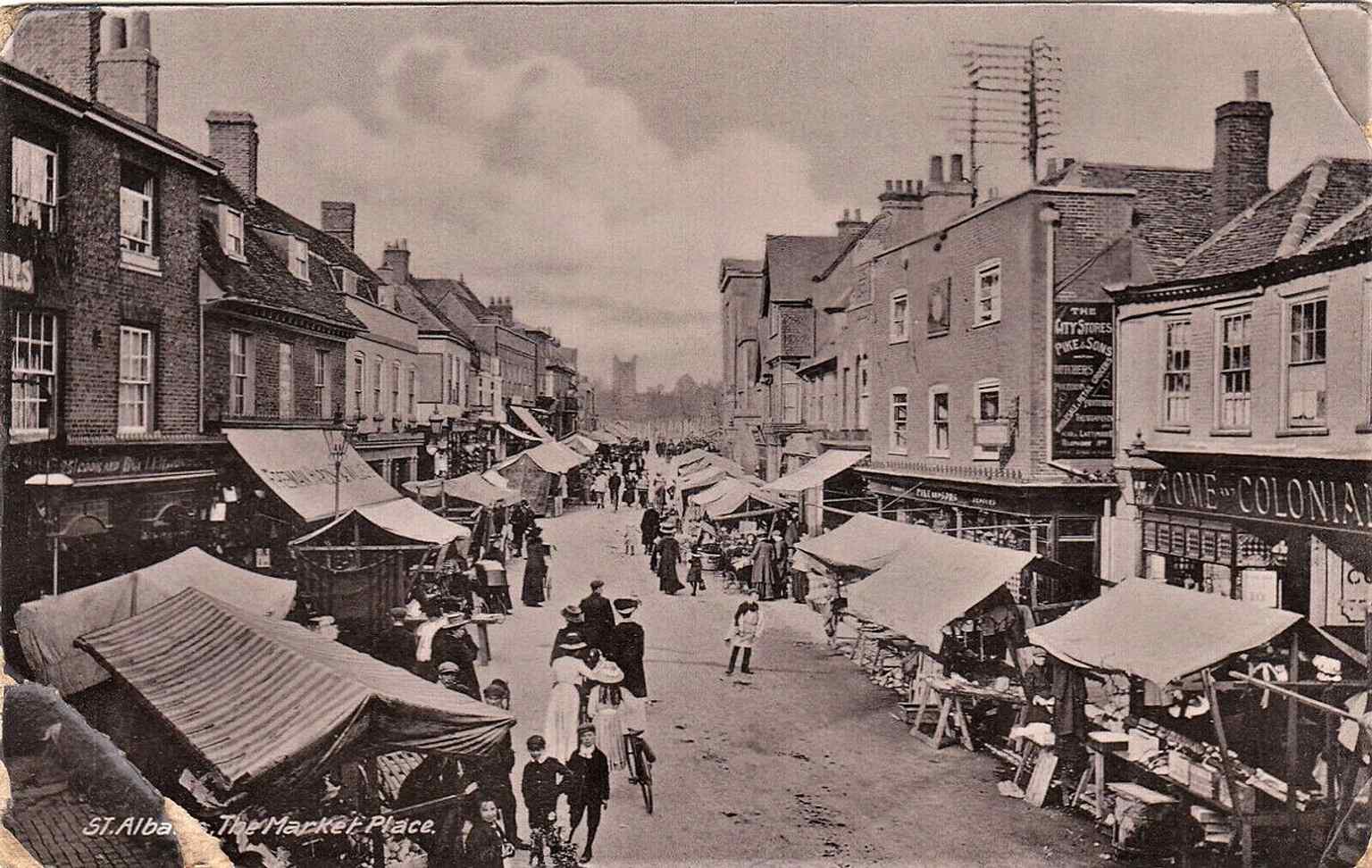
Even politics claimed a pitch here. In nineteen eleven, women’s suffrage campaigners chalked meeting notices onto the pavement and sold copies of The Vote on market day. Then came the long modern shifts: cattle moved away in nineteen twenty-six, the live-animal trade finally ended in nineteen seventy-six, and the pandemic closure in twenty twenty forced the market to reinvent itself yet again. It recovered, modernised its layout, and returned with surprising strength.
The charter market still trades here on Wednesdays and Saturdays, from nine o’clock until half past four.
For all its changes, this long street remains Saint Albans speaking in its own plain, persuasive voice.
When you are ready, continue on to The Cock.





.jpg)