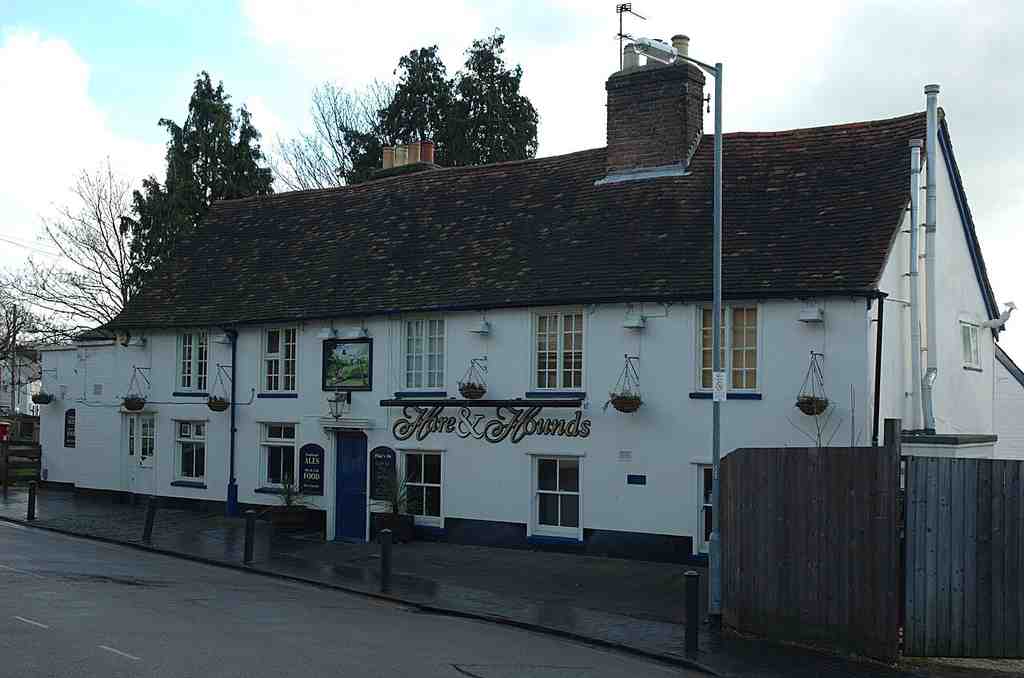
On your right, look for a low, plaster-faced timber-framed pub with a long, slightly uneven front and a stout central brick chimney rising above the roof.
The Hare and Hounds likes to keep a little of its age concealed. Historic England protects it as a Grade Two listed building, meaning the law recognises it as specially important, and the basic listing calls it seventeenth century or earlier. Yet later archaeology whispered something even older through the structure itself. Surveyors found a queen-strut roof frame - a pair of upright braces holding the roof up - typical of the seventeenth to early eighteenth century, and they linked that great central chimney to the earliest core of the house.
After that, the building kept growing as St Albans changed around it. Two bays went on to the east in the late eighteenth or early nineteenth century, a south extension arrived in the late nineteenth, and another single-storey addition followed between nineteen twenty-four and nineteen thirty-seven. The app view lets you trace those layers in the stretched shape of the place.
Its story as a pub carries a small argument. One source places it on maps by sixteen fifty; archaeology can only prove it by seventeen twenty-one. Either way, by the early eighteenth century this was already an old, altered house. More than that, it stood apart on the edge of Sopwell Lane, marking the entrance to St Albans for coach travellers, so it welcomed strangers before it embraced locals.
A six-figure revival in twenty twenty-three restored it as a much-missed community hub, even as repair work in twenty twenty-four reminded everyone that old timber needs constant care. If you feel like coming back later, it keeps generous daily opening hours and the prices are moderate.
The Hare and Hounds still feels like a threshold between arrival and belonging.
From here, carry on to The Old Kings Arms.