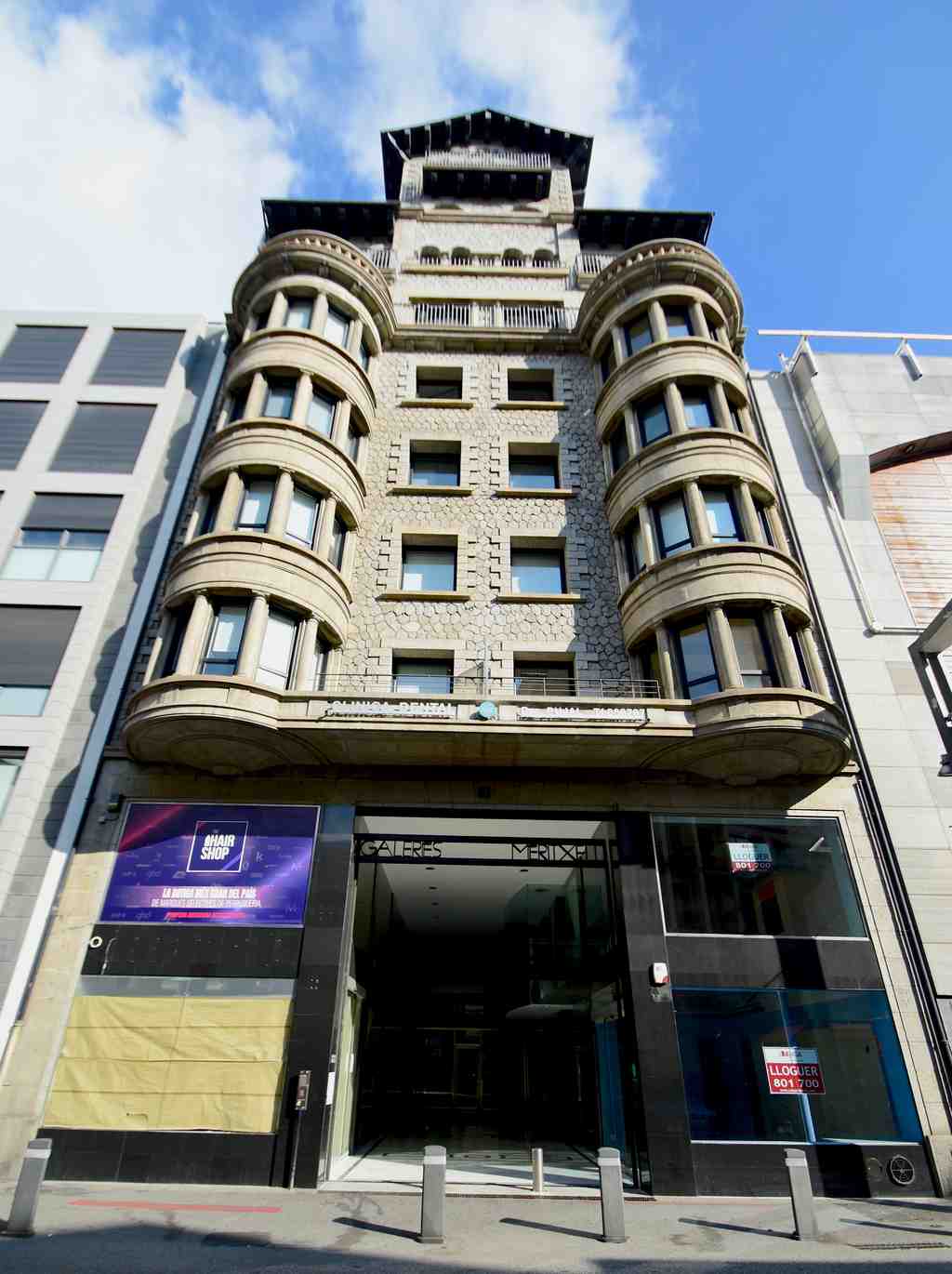
On your left, Casa Felipó is a tall granite-faced block with a narrow vertical profile, stacked balconies, and a sharp corner façade that gives it a distinctly urban swagger.
Businessman Josep Mariné Mèlich asked Barcelona architect Agustí Borrell Sensat to design this place in nineteen forty-eight, and together they gave Andorra la Vella something unusually modern for its day: height, a cosmopolitan look, and even an elevator... which, around here then, was a bit of a show-off move. If you glance at the image in the app, you can see how self-possessed the façade still feels. Today, Andorra protects it as part of the country’s cultural heritage.
But Casa Felipó kept a louder secret. By nineteen fifty, the telegraph service and Sud Radio studios were already inside, turning this address into a compact communications center. Then Radio de les Valls moved in during nineteen sixty-two, after its earlier life as Andor-Radio, and by nineteen sixty-four the Pic Blanc transmitter helped send voices from here far beyond this avenue.
Now lift your eyes toward the upper floors and imagine not quiet rooms, but studios, cables, and on the seventh floor, thousands of records. When Sud Radio closed in nineteen eighty-one, workers packed those discs into boxes and never unpacked them... a whole music library left sleeping overhead.
The sharpest turn came on New Year’s night, from nineteen ninety into nineteen ninety-one. Manel Sansa launched Ràdio Nacional d’Andorra from these old studios and later said the team found the place stripped of equipment, so they had to improvise, reconnect, and rebuild almost everything. For a while, Ràdio Valira squeezed in too. That’s Meritxell for you: polished frontage, busy shops, and behind the granite, a city learning to broadcast itself. We’ll catch the next chapter at Hotel Bellavista.