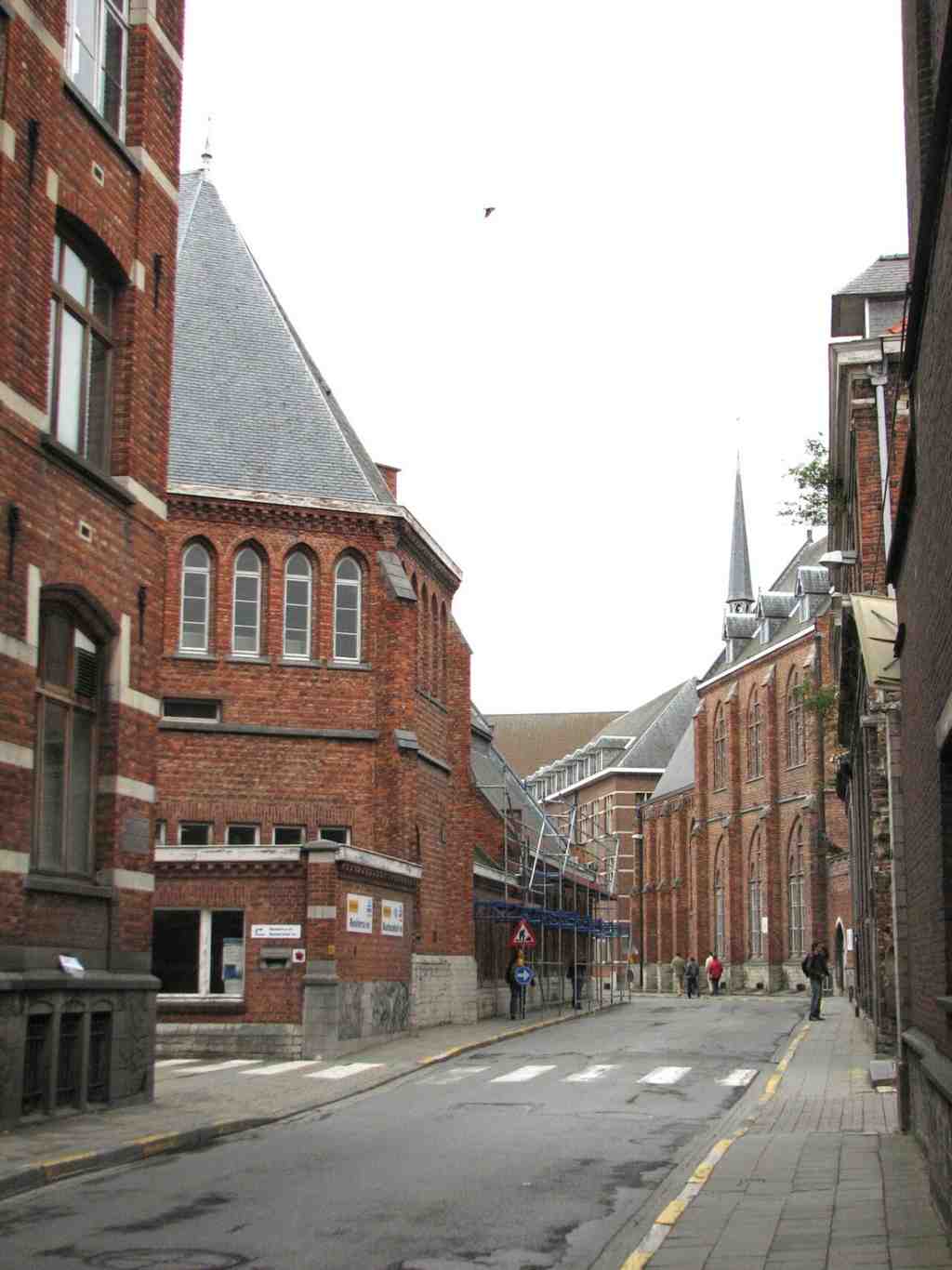
Look for a long run of brick and stone façades with narrow vertical windows, and near the Kapucijnenvoer end, a pale classical gateway carrying the words Hortus Botanicus.
Minderbroedersstraat is not the sort of place that struts. It works for a living. Since the middle of the twelfth century, this street has linked Leuven’s center to its outer neighborhoods, crossing two branches of the Dijle and carrying people, goods, prayers, patients, students, and ideas in a steady stream.
At first, the land around it stayed open and green. Then the city filled in. In twelve thirty-one, the Franciscans - the “Minderbroeders,” or Friars Minor - settled here and gave the street its name. After them came more religious houses: a Capuchin convent in the sixteenth century, then Ursulines and a town refuge for Park Abbey in the seventeenth. A refuge, in this case, means a safe city residence for an abbey based outside town. By the end of the eighteenth century, many of those large monastic buildings had come down... but the habit of learning, care, and enclosure never really left the street.
One medieval thread still tugs at the present. At the eastern stretch, the Justus Lipsius Tower survives as part of an old water gate - a river gate that controlled passage on the Dijle. It carries the name of Justus Lipsius, the great humanist scholar who died in sixteen oh six. He was buried in the Friars Minor church at the corner with Waaistraat, until that church disappeared in eighteen oh three. Leuven has a way of moving buildings around while keeping names and memories on duty.
Then the university began stretching its limbs. From the early eighteenth century, and especially in the nineteenth, it found this street ideal: close to the center, with room to grow. If the Cloth Hall showed you one grand university takeover, this street shows the next step - not one borrowed shell, but a whole corridor gradually claimed by colleges, institutes, and residences. St. Peter’s College, medical buildings, the former agricultural institute, even the old anatomical theater at the Kapucijnenvoer corner: knowledge here did not sit politely in one room. It expanded block by block.
And then came Pieter De Somer. In nineteen fifty-four, he launched the Rega Institute here after earlier work on penicillin during the Second World War. No marble drama, no heroic cape... just labs, discipline, and research that mattered. In the nineteen fifties, the institute helped drive Belgium’s mass vaccination against polio. That means this street did not only teach people; it helped protect them.
The layers keep coming. The Boerenbond, the powerful farmers’ organization, rooted itself here on former friars’ land; later, part of that complex became student housing named for Monseigneur Karel Cruysberghs, a university vice rector who also helped steady the Boerenbond’s finances. MATRIX, a center for new music, later found room here too, building files on composers like Boulez, Stockhausen, John Cage, and Karel Goeyvaerts. So yes... one street managed to hold monks, medics, farmers, and avant-garde composers without blowing a gasket.
And at the end of it all stands a clue to the next chapter: the monumental gate from seventeen seventy-one, the last remnant of Leuven’s first botanical garden. In a few minutes, we’ll head toward the living collection beyond it, where science leaves the lecture bench and starts growing leaves.