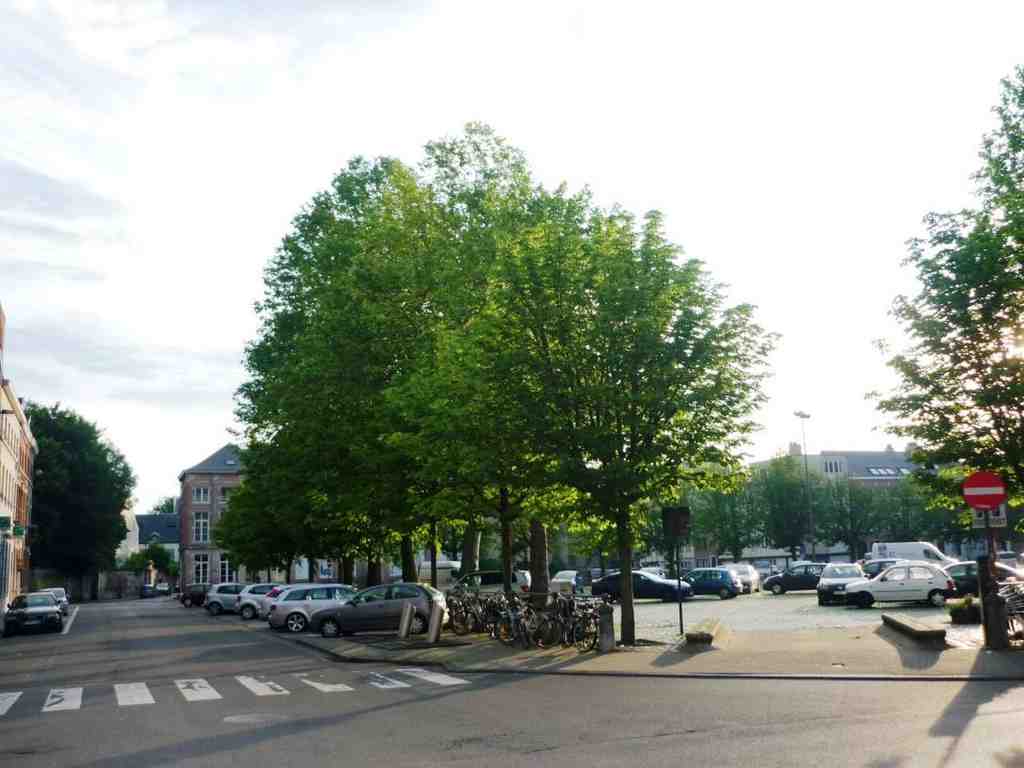
Look for the broad paved square framed by low blue-stone posts and black iron rails, an open rectangle whose old enclosure still marks it clearly from the streets around it.
Sint-Jacobsplein is a fine place to end, because Leuven is not only towers, libraries, and carved stone... it is also a working patch of ground that keeps changing jobs without losing its name. Before this became a square, people called it the Biest, a word tied to reeds, because this area sat near the Dijle and the Voer and stayed wet and rough around the edges.
For centuries, water ruled the map here. A ditch once cut across the Biest and carried water from the Doelage, a pond near the rectory, toward the Voer. Another ran beside what is now Biezenstraat, crossed by the Ezelsbrug, the Donkey Bridge. Not a grand title, but cities are practical creatures. In seventeen seventy-four, Leuven gave permission to fill the ditch and replace it with sewers, then leveled the scrubby ground.
One man nudged this area in a different direction much earlier: Duke Philip the Good. He moved a religious chapter from Incourt here in the late Middle Ages and gave it Saint James Church, so this neighborhood gained a religious role before the square itself took shape. Then, between eighteen twenty-four and eighteen twenty-seven, the city laid out the present square. It first stood among chestnut trees behind a wooden fence. The blue-stone posts and cast-iron rails in front of you came in eighteen forty-two.
Trade followed. A cattle and horse market was planned in seventeen ninety-three, finally carried out in eighteen twenty-four, and since nineteen twenty-seven Leuven Kermis has brought back that old habit each year with livestock and horse judging. Under this ordinary surface, archaeologists in twenty nineteen and twenty twenty-two even found medieval postholes, ditches, and a grave pit with two burials.
And after Saint James Church closed in nineteen sixty-three for structural danger, the neighborhood waited nearly sixty years for its return. On the twenty-fifth of July, twenty twenty-four, pilgrims used it again.
That feels right. In Leuven, knowledge does not live only in famous buildings. It survives in squares like this, where water, worship, trade, and neighbors keep teaching the city how to gather.