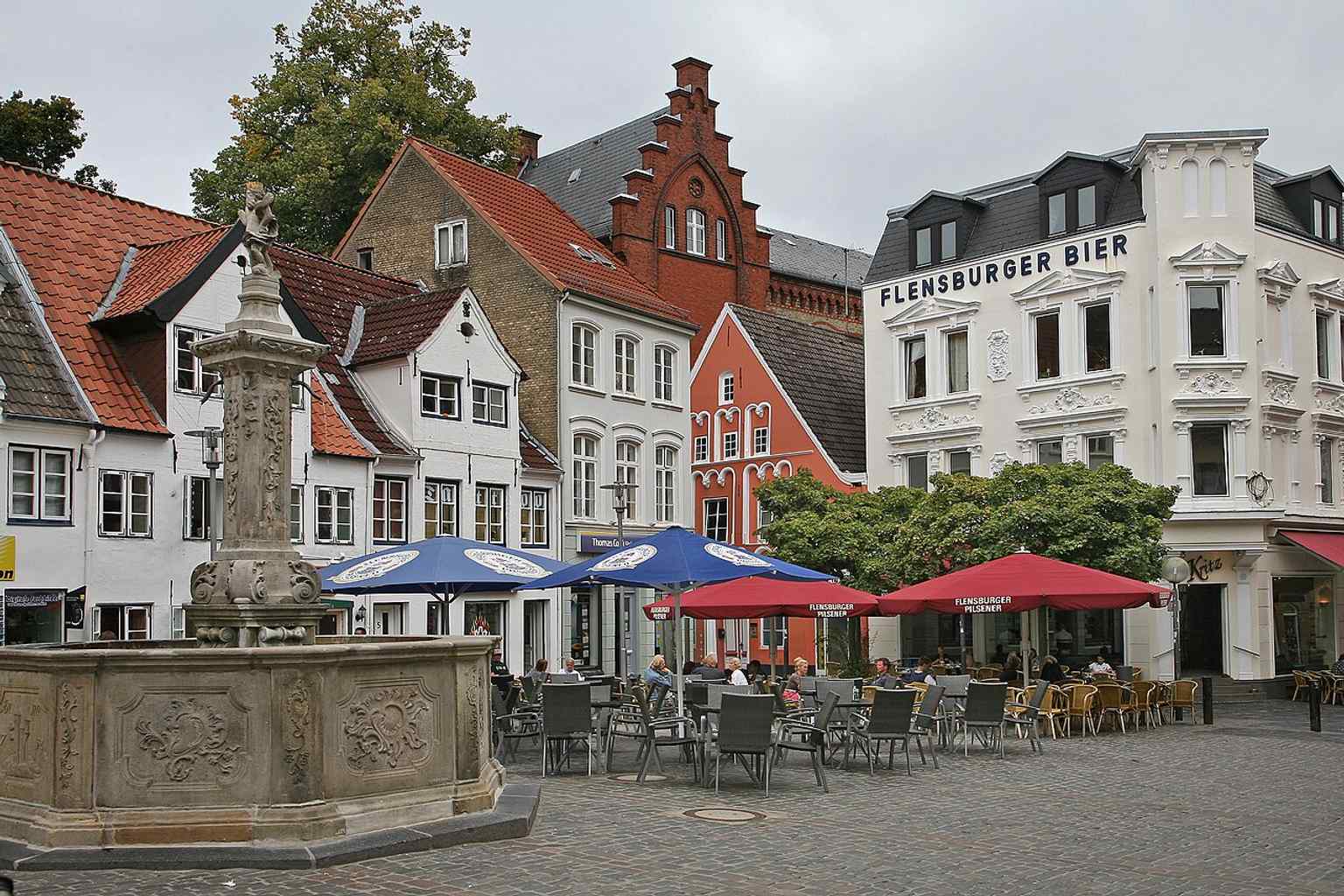
Look for a broad stone-paved square framed by tall gabled brick-and-plaster houses, with the pale stone Neptun Fountain planted right at its center.
Nordermarkt is the older, more theatrical sibling of Flensburg’s market squares. Südermarkt grew into the city’s bigger engine of trade; here, trade learned table manners. This square dealt in goods, yes, but also in hospitality, gossip, punishment, culture, and the public performance of status.
When the parish of St. Mary took shape around eleven seventy, this market formed beside it and likely became the oldest in town. That pairing mattered. In medieval Flensburg, church and market grew up together like two halves of the same handshake: one shaped belief, the other daily exchange. From here, people moved uphill to the church, downhill toward the harbor at the old Schiffbrücke, and across town through a whole network of markets. Every route carried buyers, believers, and people with opinions to spare.
This square even had a built-in piece of stagecraft. In fifteen ninety-five, the city put up the Schrangen, an arcade with arches leading toward St. Mary’s. On its south side hung a chain used as a pillory, a public punishment post. So a person might come here for provisions and leave with a sharp lesson in civic discipline. Old towns did love an audience.
That taste for public display softened over time into something more social. By the eighteen forties, Rasch’s Hotel on this square had become more than an inn. Actor and innkeeper Friedrich Hohl moved his establishment here in eighteen forty-five and turned it into part guesthouse, part cultural stage. Then he clashed politically with the Schleswig court society, lost his license, and left town. Still, he helped define the place: Nordermarkt could host conversation, performance, and reputation all at once.
Rasch’s then turned into a proper celebrity address. Hans Christian Andersen stayed here several times. Theodor Fontane spent a night here in eighteen sixty-four on his way through Denmark and Schleswig-Holstein, though he grumbled about a bad room... some customs in hotel reviewing are immortal. That same year, King Christian the Ninth of Denmark stopped here for lunch before heading toward Düppel. Merchants, writers, actors, and kings all crossed the same stones.
If you glance at your screen, you can see the square’s great showpiece: Neptune, carved in seventeen fifty-eight by L. Meymann in lively rococo style, full of flourish and movement. Since the nineteen eighties, graduates from the Danish Duborg-Skolen have marched here shouting, “Vi er studenter” - “We are students” - and celebrated with a Neptune baptism in the fountain or at the harbor. That ritual says a lot about Flensburg: even a fountain can become a stage for language, identity, and belonging. And in a very local twist, Neptune’s trident gets stolen so often that restorers now use a resin copy designed to snap before the statue’s arm does.
But Nordermarkt keeps a darker memory too. Local tradition ties this place to Mette Osthave, a servant girl condemned after a case influenced by Mayor Peter Pomerering. Legend says she protested her innocence here before her execution, and the stake used on the square kept growing back from the ground. The legend grew, but the case itself was real. On the north side, Café Mette preserves her memory, and a copy of the sentence is said to hang by the entrance.
Even in nineteen forty-five, after the war, new authorities used this square as a public noticeboard. British and American military orders were posted here for everyone to read, while the last Reich government still lingered in Mürwik.
Now let your eyes rise from the square’s social theater to the church tower above it. In about one minute, we’ll head to St. Mary’s, the spiritual anchor of this northern quarter.