
Flensburg Highlights Audio Tour: Hanseatic Heritage and Maritime Charms
Beneath the surface of Flensburg lies a city forged in fire, rebellion, and shifting borders. While others see simple cobblestone streets, you will uncover the volatile history buried deep within Jürgensby and beyond. This self-guided audio tour acts as your personal key to the city. Bypass the typical tourist trail to unearth the scandals and forgotten moments that shaped this northern gateway. Why does the Idstedt Lion stand as a silent witness to a battlefield tragedy? What dark secrets hide behind the ornate spires of St. Nicholas Church? And why did a single political decree turn local neighbors into lifelong enemies? Traverse the heights of Museumsberg and let the echoes of past conflicts pull you through the winding alleys. You will transform from a casual observer into a seeker of truth, tracing the dramatic pulse of a city defined by its resilience. Unlock the hidden history of Flensburg now.
Tour preview
About this tour
- scheduleDuration 80–100 minsGo at your own pace
- straighten3.3 km walking routeFollow the guided path
- location_on
- wifi_offWorks offlineDownload once, use anywhere
- all_inclusiveLifetime accessReplay anytime, forever
- location_onStarts at St. Nicholas Church (Flensburg)
Stops on this tour
lock_open 3 free previews · 9 unlock with purchase
Look for the long red-brick church with broad pointed Gothic windows and a tall square tower that lifts into a narrow neo-Gothic spire. For a first stop, this one sets the whole…Read moreShow less
Open dedicated page →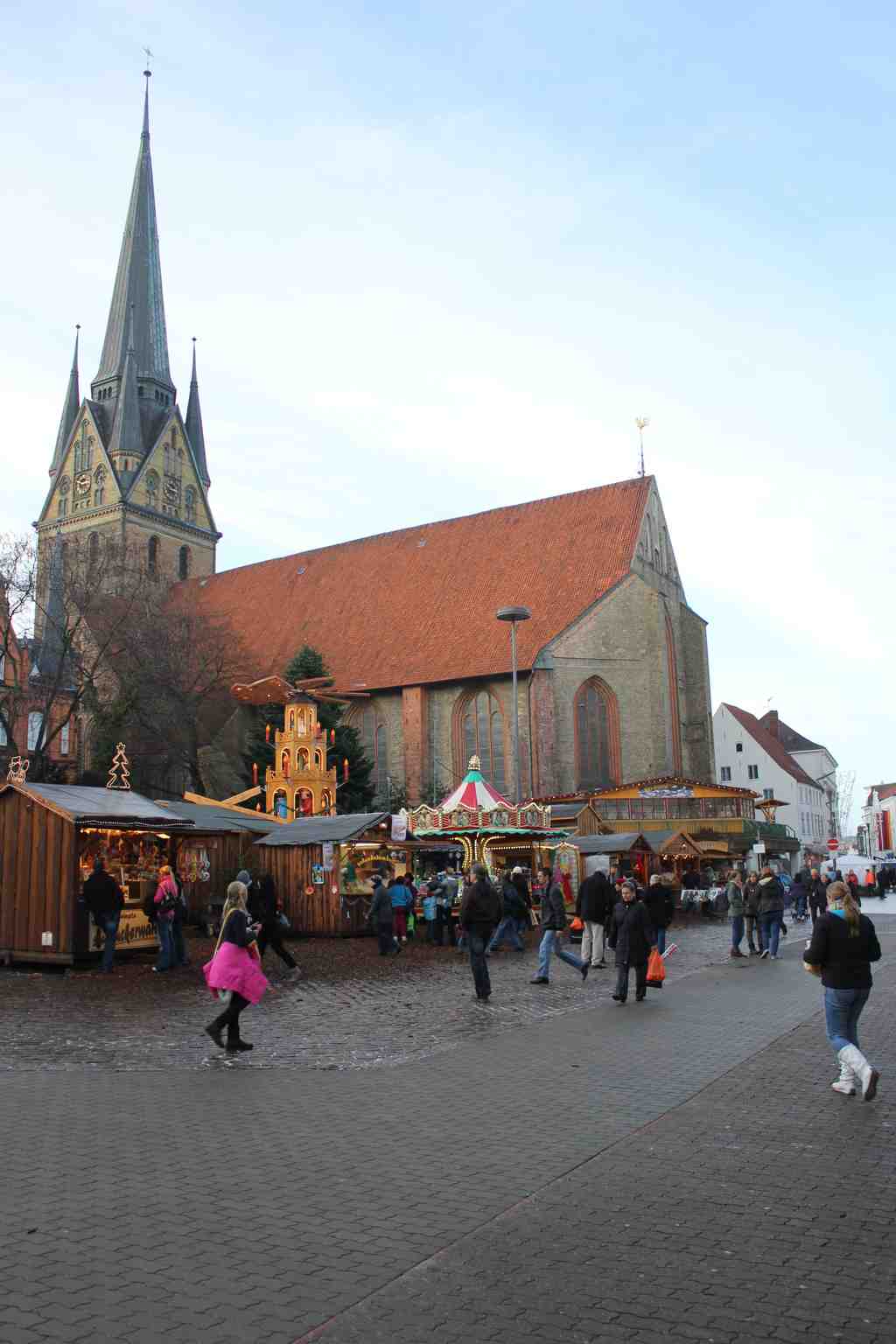
St. Nicholas Church (Flensburg)Photo: Sönke Rahn, Wikimedia Commons, CC BY-SA 3.0. Cropped & resized. Look for the long red-brick church with broad pointed Gothic windows and a tall square tower that lifts into a narrow neo-Gothic spire.
For a first stop, this one sets the whole machine in motion. Locals used to say the bells of Saint Nikolai did not only call worshippers... they also called “mayor and council.” That tells you a lot about Flensburg. This was never just a place to pray. It stood beside the Südermarkt as part church, part landmark, part public signal tower for a town learning how to organize itself.
Flensburg has long carried a real borderland identity. You can hear it even in the church’s names: Saint Nikolai in German, Nikolaikirken in Danish. In a city shaped by trade, shifting rulers, and close ties across the Danish-German frontier, buildings like this one often served more than one story at once. They belonged to faith, yes, but also to language, law, education, and civic life.
The church you see did not begin in the late fourteen hundreds. Builders started this Gothic hall church around thirteen ninety and kept extending it eastward through the fifteenth century. Builders started this Gothic hall church around thirteen ninety and kept extending it eastward through the fifteenth century. What rises above you now is one of the city’s clearest statements in brick: long, confident, and planted right in the urban grain. The tower reaches about ninety meters, the highest in Flensburg. After lightning destroyed the old Gothic tip in eighteen seventy-eight, the city gave it the neo-Gothic spire you see now. Flensburg, like a good sailor, repairs fast and carries on.
And this spot mattered because of where it stands. The church-market axis is almost impossible to miss here: one step away, people bought fish, cloth, grain, and gossip; here, they listened for judgment, mercy, and news. In a medieval town, those worlds were neighbors, not strangers.
In December of fifteen twenty-six, Saint Nikolai heard the first evangelical sermon in Flensburg. That made this church an early launch point for the Reformation here, when religion stopped being only inherited custom and became an argument with consequences. A sermon in this building could change how people prayed, learned, married, governed, and buried their dead. That is a lot of weight for a few spoken words.
Now take a moment and look at how tightly the church presses against the surrounding streets and buildings. Does it feel tucked into the city... or more like the point from which the city spread outward? If you check the picture in the app, you can see the Organistenhaus snug against the church wall and just how little breathing room old Flensburg gave even its grandest buildings.
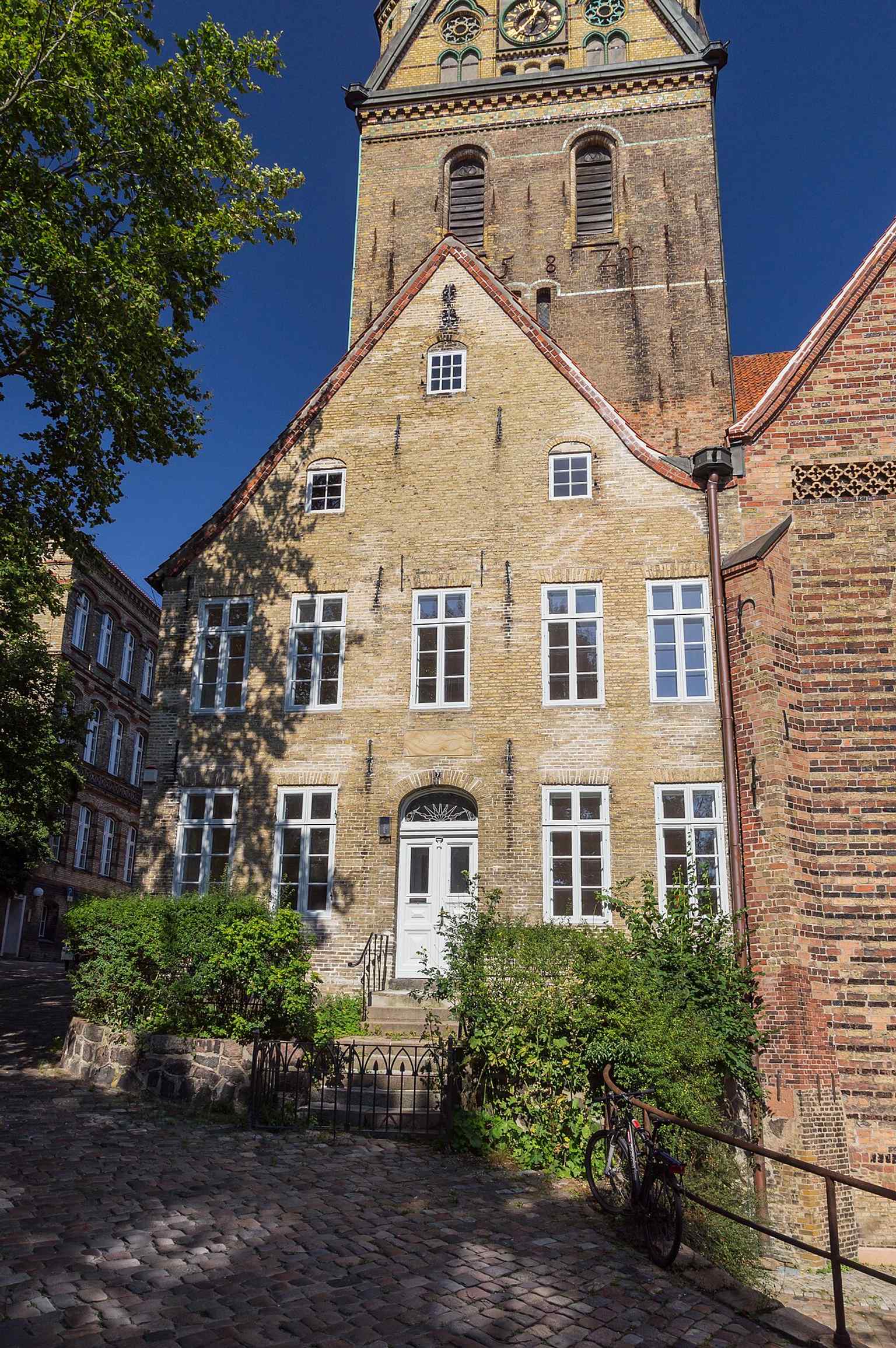
The Organistenhaus beside St. Nicholas Church — the tower rises just behind it, showing how tightly the church was woven into Flensburg’s old-town buildings.Photo: N. Simonsen, Wikimedia Commons, CC BY-SA 3.0. Cropped & resized. One local detail most visitors miss lives not in the tower but in memory. In fifteen eighty, Pastor Sebastian Schröder founded a church library here. A few years later, books that donor Lütke Namens had intended for the Latin school ended up moved here against his own testamentary wishes. So even in a place meant to preserve knowledge, memory could slip, get reassigned, and change hands. That, too, is part of city life.
If you look at the app once more, the interior organ image hints at another layer inside: a remarkable double organ, rebuilt in recent decades so the church can speak in both baroque and symphonic voices. Very Flensburg, really... more than one tradition under a single roof.
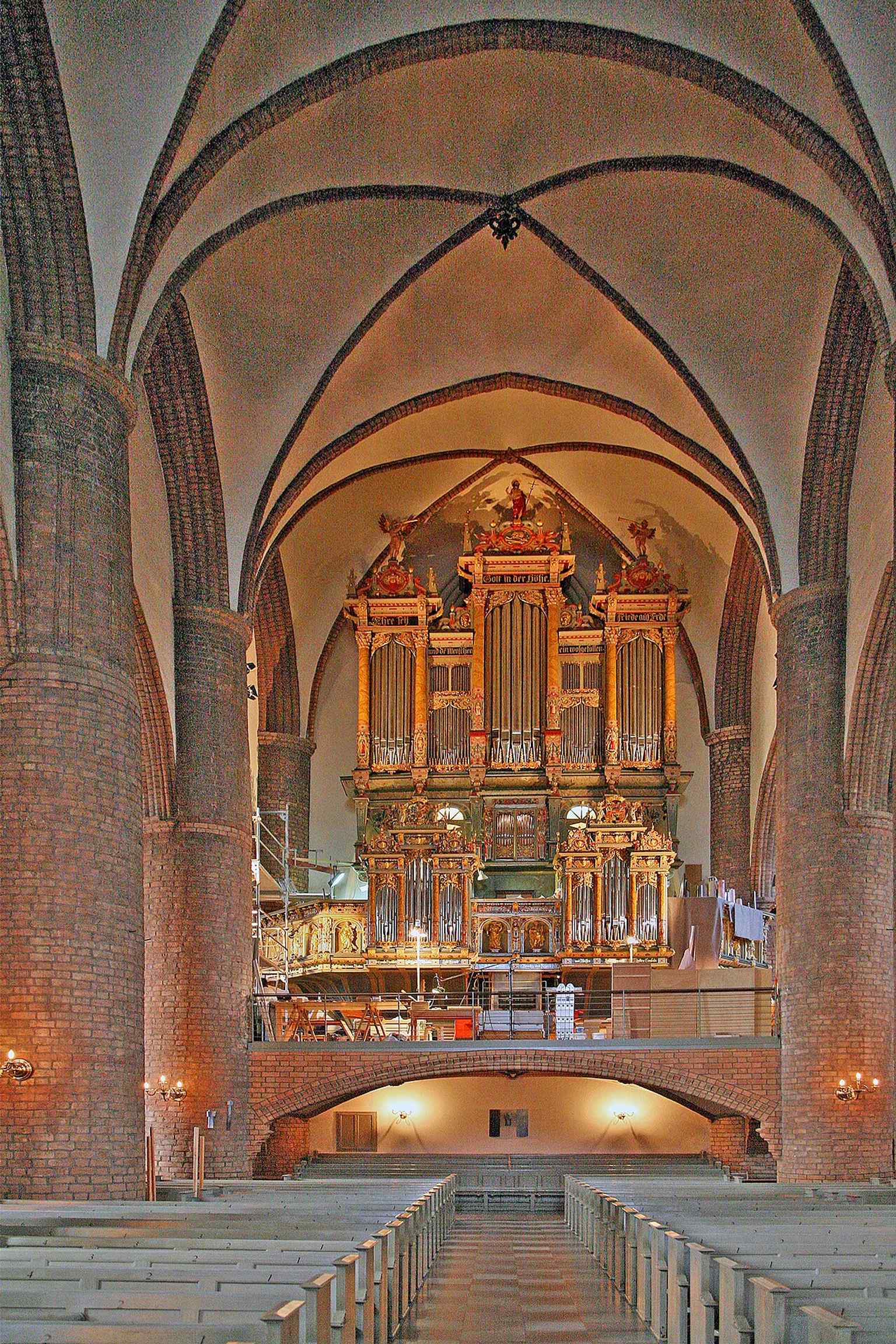
The church organ inside St. Nicholas Church, whose rebuilt double-organ system became a unique blend of historic Schnitger sound and modern symphonic design.Photo: W. Bulach, Wikimedia Commons, CC BY-SA 4.0. Cropped & resized. From these doors, ideas flowed out with the shoppers, magistrates, teachers, and sailors. Belief was one force entering the city here, but never the only one. When you’re ready, head to Red Street, about a four minute walk from here. If you want to step inside later, the church is generally open daily from nine in the morning to six in the evening.
Look for a narrow lane of brick and plaster facades with tall gables and deep courtyard openings, its straight, funnel-like shape pulling your eye between old shopfronts and…Read moreShow less
Open dedicated page →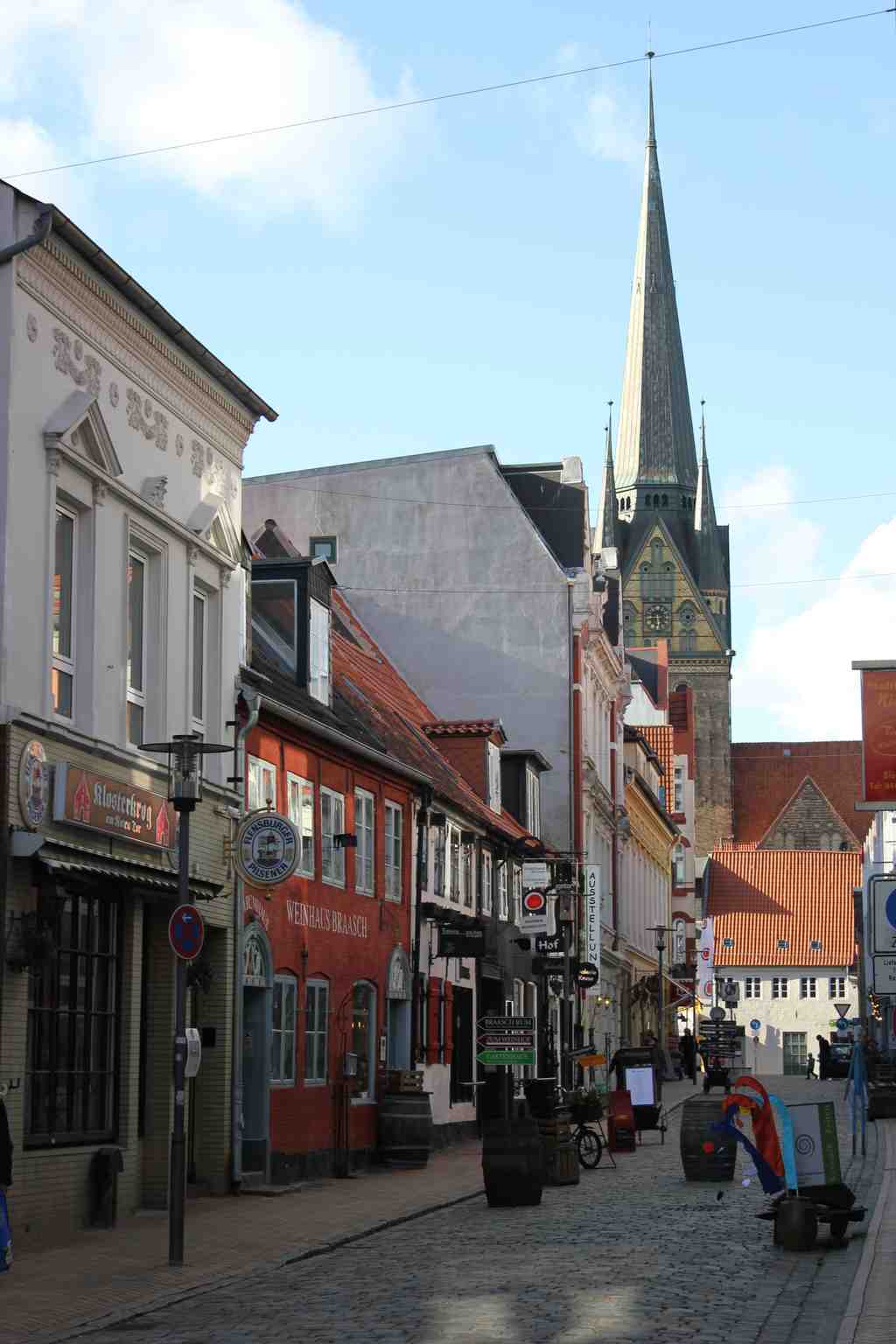
Red Street (Flensburg)Photo: Sönke Rahn, Wikimedia Commons, CC BY-SA 3.0. Cropped & resized. Look for a narrow lane of brick and plaster facades with tall gables and deep courtyard openings, its straight, funnel-like shape pulling your eye between old shopfronts and passageways.
Rote Straße is one of those places that explains a city in plain language. This was Flensburg’s southern funnel, the road that gathered people, carts, animals, and goods and squeezed them toward the town’s market core. And that makes it a threshold. A threshold is more than a doorway; it is the line where a place decides who may enter, what they bring, and on what terms.
The name does not come from red paint, by the way. It reaches back to the Rude, a wooded area farther south, and for centuries this was the main road leading in from that direction. Everything rolling up this street fed toward the market-and-church center you met at Saint Nikolai. Faith at the center, trade on the approach... that is Flensburg in a nutshell.
Now picture the lost Rote Tor, the Red Gate, standing here at the narrowest point until eighteen seventy-two. The road pinches tight. A guard stops a wagon, checks the driver, asks what is under the canvas, and decides whether the traveler belongs inside. Merchants and respectable townsfolk pass more easily; vagabonds and people with no recognized place in society do not. Local residents used the same gate in a more practical way, driving animals out to the meadows beyond the walls. Today, only a small piece of masonry and a plaque remember that choke point, but once this was city control made visible.
This street worked hard. On the west side stood inn after inn. On the east side, the parish poorhouse served Saint Nikolai’s community, and from the sixteenth century the city’s Latin school stood here too, where boys learned the scholarly language of church and administration. So on one street you had lodging, charity, education, and inspection... not neat categories, but all jostling shoulder to shoulder.
The real local clue hides in the courtyards. If you check the image in your app, you can see how the street keeps opening inward behind the facades. Those yards were not decorative. The Rote Hof, for example, worked as an Ausspannhof, which means a coaching-yard where people unhitched horses, unloaded goods, stored them in big lofts, and looked after travelers before sending them on again. Pretty? Sure. Practical? Absolutely.
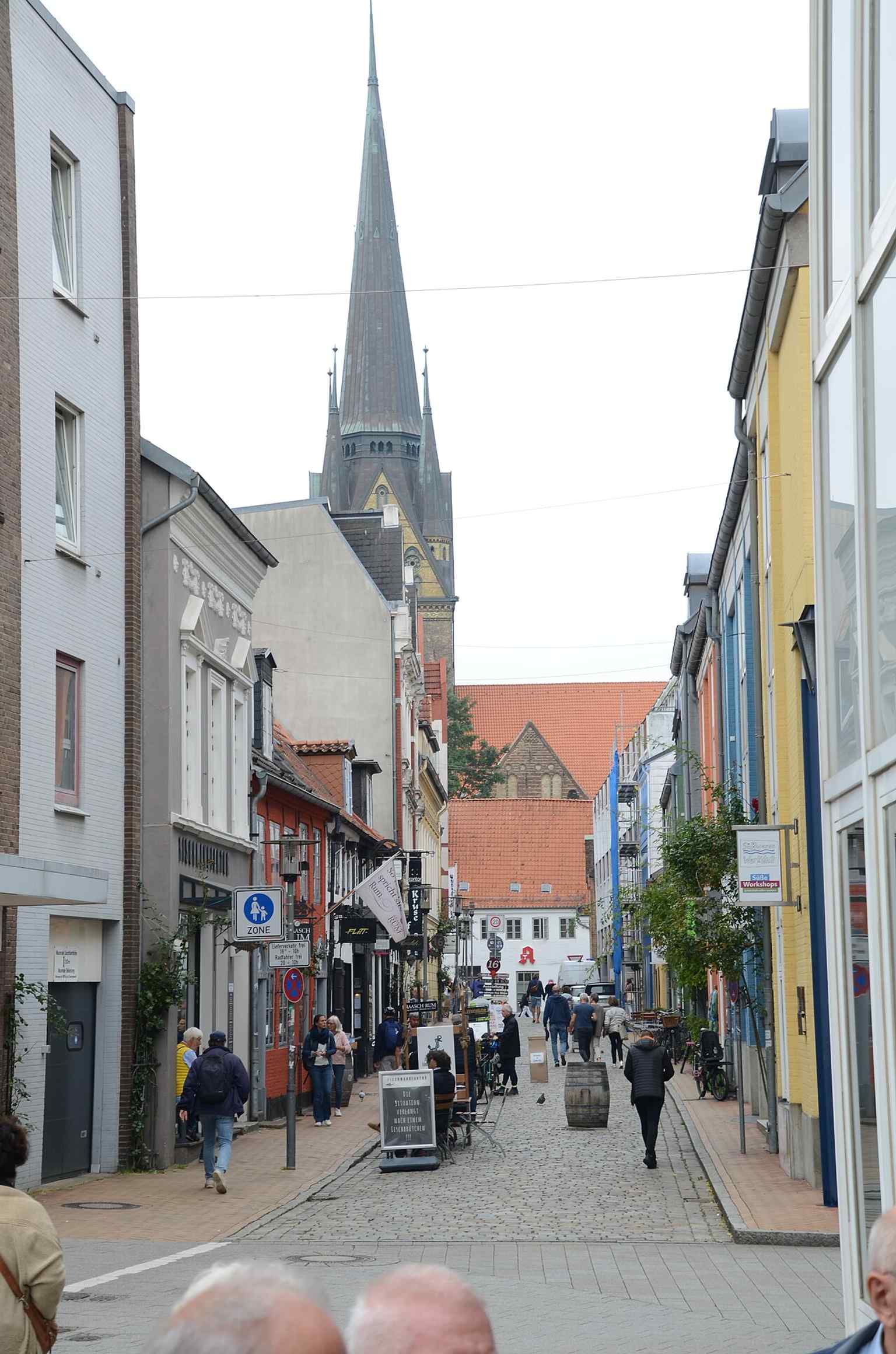
A present-day view of Red Street in Flensburg, the historic southbound route that still links the old town’s market squares and now serves as a lively pedestrian street.Photo: Hjart, Wikimedia Commons, CC BY-SA 4.0. Cropped & resized. One person who helps bring this street down to earth is Lorenz Goldt. In eighteen ninety-eight, he put up a large warehouse here for his grain business, ran Goldt’s inn in the front building, and then, in nineteen oh-five, opened an Opel contract workshop on the same property. Grain, guest beds, and early motorcars all in one yard... that tells you how fast old trade routes learned new tricks.
The street nearly lost much of its character in the twentieth century. Through traffic shifted away in the nineteen twenties, later demolitions and a parking structure cut into the old fabric, and owners had to band together in the nineteen sixties to pay for paving and street lighting themselves. Folks here did not wait politely for rescue; they rolled up their sleeves.
Now the courtyards live again with small shops, galleries, and restaurants, but the bones of the old logistics system are still right in front of you. When you are ready, follow this current of arrivals a couple of minutes onward to Südermarkt, where all this managed motion opens into a public square. If you want to browse first, most businesses here keep hours around ten to six-thirty on weekdays, close earlier on Saturday, and many are shut on Sunday.
On your right, look for the broad rectangular market square, its open stone paving framed by old gabled facades and marked by the raised platform tucked below Saint Nikolai’s…Read moreShow less
Open dedicated page →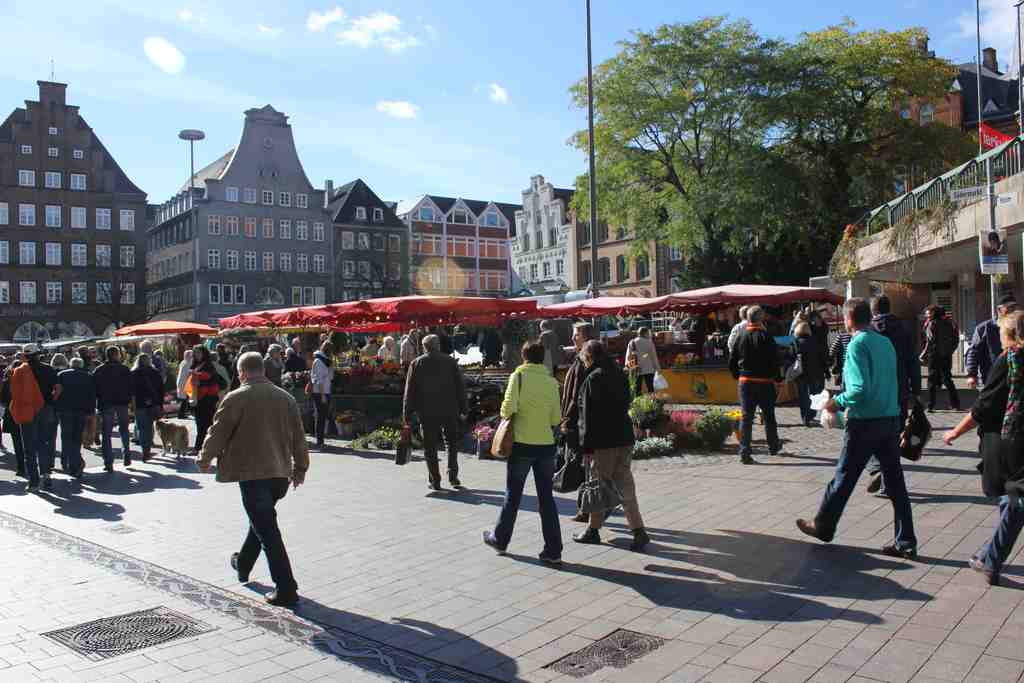
SüdermarktPhoto: Sönke Rahn, Wikimedia Commons, CC BY-SA 3.0. Cropped & resized. On your right, look for the broad rectangular market square, its open stone paving framed by old gabled facades and marked by the raised platform tucked below Saint Nikolai’s choir.
This is Südermarkt, one of Flensburg’s two main market squares, and for centuries it has handled the city’s most practical business... buying, selling, posting orders, making announcements, and starting over when trouble swept through. That last part matters here. Flensburg has a habit of rebuilding after rupture, not by erasing the damage, but by getting on with the work. This square learned that lesson early, and it never really forgot it.
Around the year twelve hundred, when the parish of Saint Nikolai took shape here by the fjord, this market likely formed beside it. That pairing tells you a lot about the city. Worship and trade did not live in separate worlds. The church stood over daily exchange like a stone witness, while a long-distance road linking Friesland and Angeln ran right past this spot. Along the south side, Angelburger Straße led east and Friesische Straße led west, so this was not just a neighborhood square. It sat in the path of movement, money, and news.
Then came the fire. On the third of May, fourteen eighty-five, flames destroyed the southern part of Flensburg, and Südermarkt took the hit with it. Yet that same year, people rebuilt the square and expanded Saint Nikolai. If your shop, your horse, your household, and your future all depended on this place, you did not go looking for a safer map... you picked up a hammer.
Some of that stubbornness still shows. After the fire, more old fabric survived here than you might expect. The step-gabled houses at numbers eleven and twelve are holdovers from those earlier, simpler fronts. And around fourteen ninety, builders raised what is now the Nikolai-Apotheke, the oldest secular building in Flensburg. Inside its old chimney room, fragments of late Gothic painting survived, including a crescent-moon Madonna and a cross. Even the practical places kept traces of devotion. Here, the practical and the sacred sat side by side.
Südermarkt also belonged to a larger market network. Oxen changed hands at the Ochsenmarkt out by the Exe, while horses were traded here. Different goods, different space, same city logic. Even punishment had an address here: until the eighteenth century, a copper Kaakmann, a bailiff figure, stood on the square as a warning that public order mattered as much as public trade. We will meet that survivor again later at Museumsberg.
In the early seventeenth century, a square fountain with four drain pipes stood here. Then, in nineteen oh three, sculptor Helmuth Schievelkamp gave the market a far more muscular centerpiece: the Bismarck Fountain, also called the Germania Fountain. It planted imperial swagger right in the middle of everyday commerce. Public monuments, like politics, do not always age gracefully. The fountain disappeared in nineteen thirty-seven, and in the nineteen fifties its remains found a second life in Carlisle Park as part of a fountain garden.
Power kept using this square. After British forces occupied Flensburg at the end of the Second World War, British and American military authorities posted new laws here and at Nordermarkt from May thirteenth, nineteen forty-five, even while the last Reich government still sat out in Mürwik. Later, politicians from Willy Brandt to Angela Merkel came here because anyone who wants Flensburg’s attention still comes to the market. So did handball champions in two thousand fourteen.
And here is the question I’d leave you with... if one fire could wipe out your livelihood in a day, would you rebuild in the same spot, under the same church, on the same square? The people of Flensburg did, again and again, and that choice helped make the city what it is. Südermarkt is the practical pulse; up ahead, Nordermarkt will show us the other face of civic life, about a twelve-minute walk from here. If you want the regular weekly market here, it usually sets up on Wednesdays and Saturdays from seven in the morning until two in the afternoon.
Show 9 more stopsShow fewer stopsexpand_moreexpand_less
Look for a broad stone-paved square framed by tall gabled brick-and-plaster houses, with the pale stone Neptun Fountain planted right at its center. Nordermarkt is the older,…Read moreShow less
Open dedicated page →Look for a broad stone-paved square framed by tall gabled brick-and-plaster houses, with the pale stone Neptun Fountain planted right at its center.
Nordermarkt is the older, more theatrical sibling of Flensburg’s market squares. Südermarkt grew into the city’s bigger engine of trade; here, trade learned table manners. This square dealt in goods, yes, but also in hospitality, gossip, punishment, culture, and the public performance of status.
When the parish of St. Mary took shape around eleven seventy, this market formed beside it and likely became the oldest in town. That pairing mattered. In medieval Flensburg, church and market grew up together like two halves of the same handshake: one shaped belief, the other daily exchange. From here, people moved uphill to the church, downhill toward the harbor at the old Schiffbrücke, and across town through a whole network of markets. Every route carried buyers, believers, and people with opinions to spare.
This square even had a built-in piece of stagecraft. In fifteen ninety-five, the city put up the Schrangen, an arcade with arches leading toward St. Mary’s. On its south side hung a chain used as a pillory, a public punishment post. So a person might come here for provisions and leave with a sharp lesson in civic discipline. Old towns did love an audience.
That taste for public display softened over time into something more social. By the eighteen forties, Rasch’s Hotel on this square had become more than an inn. Actor and innkeeper Friedrich Hohl moved his establishment here in eighteen forty-five and turned it into part guesthouse, part cultural stage. Then he clashed politically with the Schleswig court society, lost his license, and left town. Still, he helped define the place: Nordermarkt could host conversation, performance, and reputation all at once.
Rasch’s then turned into a proper celebrity address. Hans Christian Andersen stayed here several times. Theodor Fontane spent a night here in eighteen sixty-four on his way through Denmark and Schleswig-Holstein, though he grumbled about a bad room... some customs in hotel reviewing are immortal. That same year, King Christian the Ninth of Denmark stopped here for lunch before heading toward Düppel. Merchants, writers, actors, and kings all crossed the same stones.
If you glance at your screen, you can see the square’s great showpiece: Neptune, carved in seventeen fifty-eight by L. Meymann in lively rococo style, full of flourish and movement. Since the nineteen eighties, graduates from the Danish Duborg-Skolen have marched here shouting, “Vi er studenter” - “We are students” - and celebrated with a Neptune baptism in the fountain or at the harbor. That ritual says a lot about Flensburg: even a fountain can become a stage for language, identity, and belonging. And in a very local twist, Neptune’s trident gets stolen so often that restorers now use a resin copy designed to snap before the statue’s arm does.
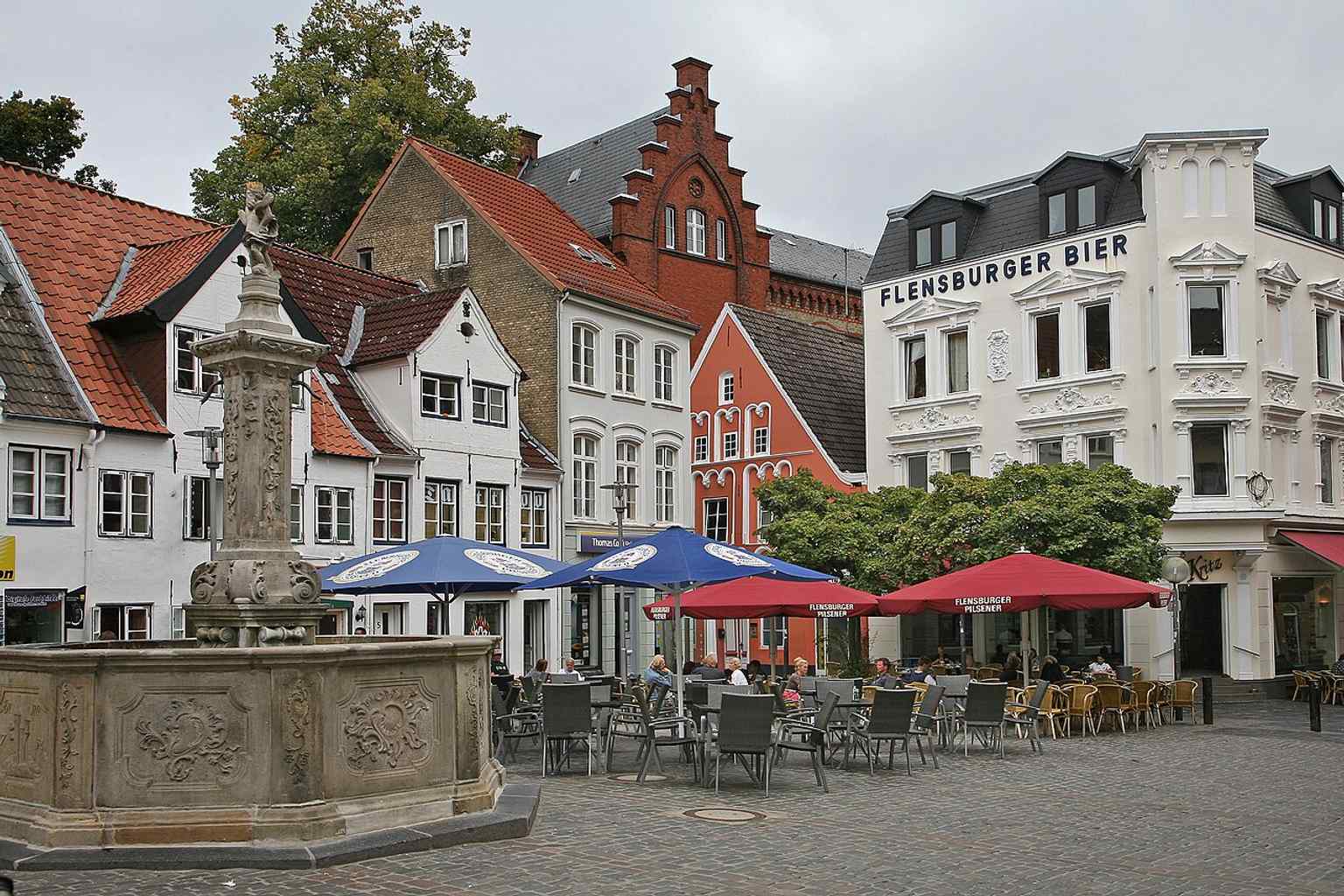
The Neptun Fountain on Flensburg’s Nordermarkt, the baroque centerpiece that today defines the square and became famous for the Duborg-Skolen “Neptune baptism” ritual.Photo: W. Bulach, Wikimedia Commons, CC BY-SA 4.0. Cropped & resized. But Nordermarkt keeps a darker memory too. Local tradition ties this place to Mette Osthave, a servant girl condemned after a case influenced by Mayor Peter Pomerering. Legend says she protested her innocence here before her execution, and the stake used on the square kept growing back from the ground. The legend grew, but the case itself was real. On the north side, Café Mette preserves her memory, and a copy of the sentence is said to hang by the entrance.
Even in nineteen forty-five, after the war, new authorities used this square as a public noticeboard. British and American military orders were posted here for everyone to read, while the last Reich government still lingered in Mürwik.
Now let your eyes rise from the square’s social theater to the church tower above it. In about one minute, we’ll head to St. Mary’s, the spiritual anchor of this northern quarter.
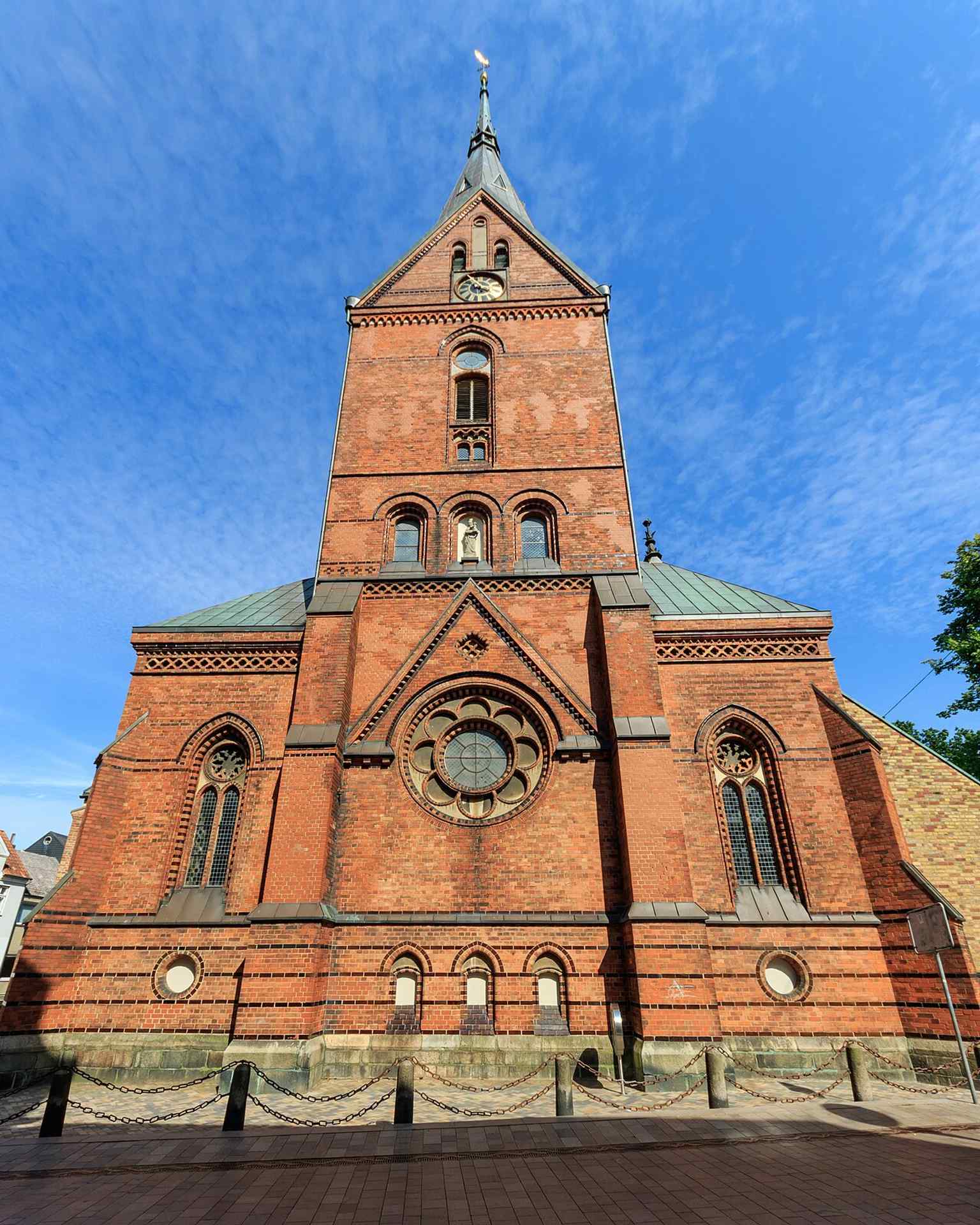
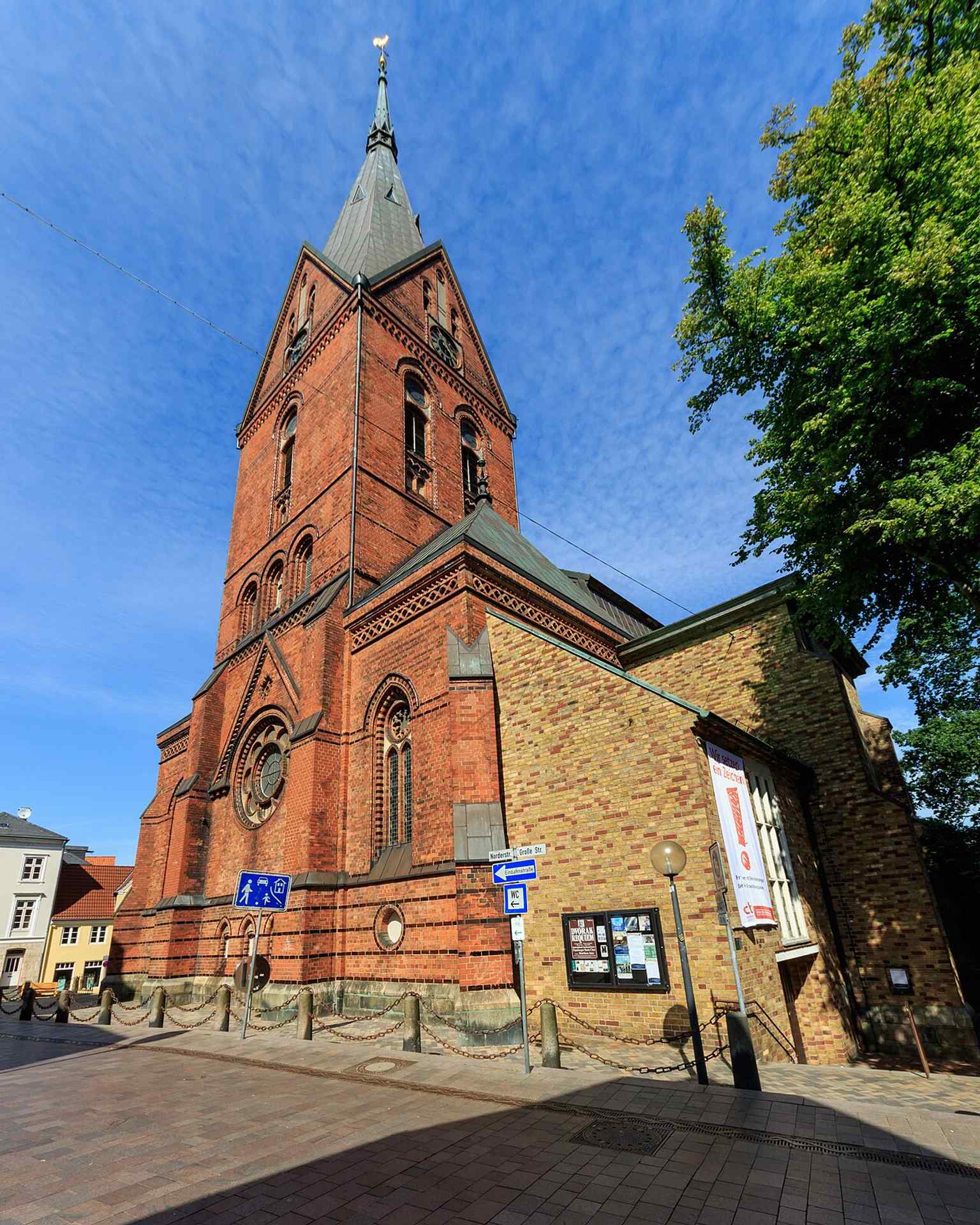
On your left stands a broad red-brick Gothic church with a steep roof and a tall, needle-pointed tower rising from its western end. St. Mary’s looks calm enough now... but this…Read moreShow less
Open dedicated page →
St. Mary's Church (Flensburg)Photo: A.Savin, Wikimedia Commons, CC BY-SA 3.0. Cropped & resized. On your left stands a broad red-brick Gothic church with a steep roof and a tall, needle-pointed tower rising from its western end.
St. Mary’s looks calm enough now... but this site entered Flensburg’s story through violence as much as prayer. Before this church, a Romanesque stone church stood here under Danish rule, probably begun in the late twelfth century under King Waldemar the First, though some place it a little later under King Knut the Sixth. Then, in the year twelve forty-eight, a dynastic war tore through Schleswig. King Erik the Fourth fought Duke Abel, his own brother, for control of the duchy, and the earlier church fell in that struggle. So this ground is not just holy ground. It is contested ground.
The church you see rose from that wreckage. Flensburg’s citizens started again in brick, building a Gothic hall church, meaning a wide church where the central space and side aisles stand nearly equal in height. Most visitors assume a place this old must begin with a grand founding legend. Instead, the first solid documentary trace is wonderfully bureaucratic: an indulgence letter from Bishop Tycho of Aarhus, dated the second of May, twelve eighty-four, now kept in the city archive. That little scrap of church paperwork tells us the townspeople had already begun rebuilding. It is a small clue, but around here small clues do heavy lifting.
And notice the geography of power wrapped into that one document. Aarhus is in Denmark. The earlier kings were Danish. Schleswig was disputed. Flensburg sat right in the middle, where allegiance, language, trade, and worship rarely stayed in neat little boxes. This church is one of the clearest reminders that the town’s spiritual life always answered to forces larger than a parish map.
What looks settled from out here is really a stack of revisions. A baroque tower crowned the church in the early seventeen hundreds; later builders replaced it, in the late nineteenth century, with the sharper neo-Gothic spire you see now. Churches age the way port cities do: by adding layers rather than asking permission.
Inside, wealthy merchant families turned devotion into display. Mayor Dietrich Nacke made a fortune from Flensburg’s sea trade and then poured part of it back into this church. In fifteen ninety-eight, he funded the huge high altar, one of the great late Renaissance works in Schleswig-Holstein, and he and his wife Catharina were buried before it. That tells you plenty about the city: money from ships, honor in church, memory fixed in wood and stone.
If you check the image on your screen, look at the Madonna standing in the tower opening, balanced on a crescent moon. Heinrich Ringerink carved her in fifteen eighty-nine. The same master later shaped much of the church’s splendor inside.
A close view of the Mondsichelmadonna, one of the church’s notable Renaissance artworks by Heinrich Ringerink, placed in the western tower window opening.Photo: A.Savin, Wikimedia Commons, CC BY-SA 3.0. Cropped & resized. One more scar before we move on: the church survived wartime air raids, but in June nineteen forty-five a munitions explosion at Kielseng in the harbor shattered windows here. Even from a distance, the harbor could still strike this hill.
Now let your thoughts drift downhill toward the waterfront, where merchants, privilege, and shipping rules ran the town’s daily business. Company Gater, about a one-minute walk from here, picks up that story at street level.
The Gothic brick church from the outside — St. Mary’s is one of Flensburg’s main churches and dates back to the medieval rebuilding after the earlier Romanesque church was destroyed.Photo: A.Savin, Wikimedia Commons, CC BY-SA 3.0. Cropped & resized. In front of you stands a solid red-brick gatehouse with a tall gabled façade, a broad central arch, and carved coats of arms set high above the opening. This is the…Read moreShow less
Open dedicated page →In front of you stands a solid red-brick gatehouse with a tall gabled façade, a broad central arch, and carved coats of arms set high above the opening.
This is the Kompagnietor, and despite the name, it was never just a gate. In sixteen oh two, the master builder Dirick Lindingk gave Flensburg something much more serious: a harbor control point, meeting house, weigh station, customs post, and fee office all folded into one stout building. Think of it as the port’s front desk... if the front desk also collected money, checked cargo, and told you when to behave.
Flensburg’s shippers were not loose bands of sailors chasing the next tide. They formed a maritime guild culture, the Schiffergelag, a seafaring fellowship with real status in town. They helped shape harbor life, backed major building projects, and spoke as an organized force alongside merchants and councilmen. When this new structure rose, the city, the merchants’ company, and the shippers all helped carry the cost. That tells you who held weight here.
Look at the structure as more than an archway. Picture clerks weighing goods, officials collecting harbor dues, and shipmasters gathering upstairs to settle matters before anyone unloaded a barrel.
Most visitors miss the number that tells the whole story: roughly eighty-four thousand one hundred bricks went into this building. Nobody spends that much masonry on decoration alone. Even though it looked like a gate, it was not a military fortification, yet the town still locked it at night... order mattered here, on water just as much as on land, much like the old southern gate did for traffic by road.
If you glance at the image on your screen, the façade details show that sturdy harbor presence beautifully. And on the front, look for the high-water marks. They record storm surges from sixteen ninety-four, eighteen thirty-five, and eighteen seventy-two, when the water reached about three point two seven meters above mean level.
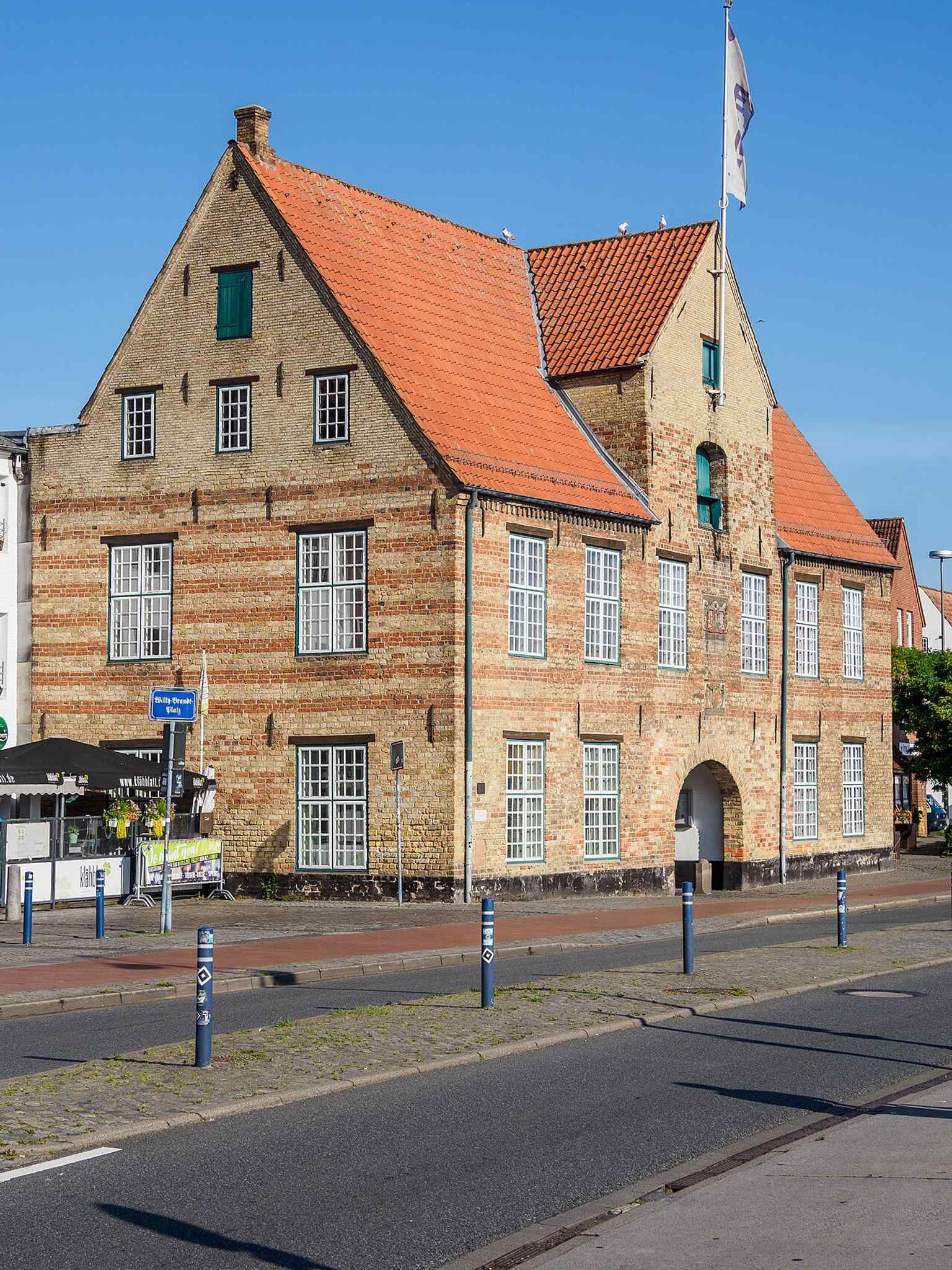
A closer view of Kompagnietor’s façade, useful for seeing the historic harbor building’s preserved brickwork and landmark presence on Flensburg’s waterfront.Photo: JoachimKohler-HB, Wikimedia Commons, CC BY-SA 4.0. Cropped & resized. Later, this old harbor workhorse housed the Sea Court, and today it serves the European Centre for Minority Issues, a fitting next chapter in a border city used to rules, identities, and negotiation. Up ahead, the Maritime Museum will show you the ships and sailors behind all this regulation... about a five-minute walk from here.
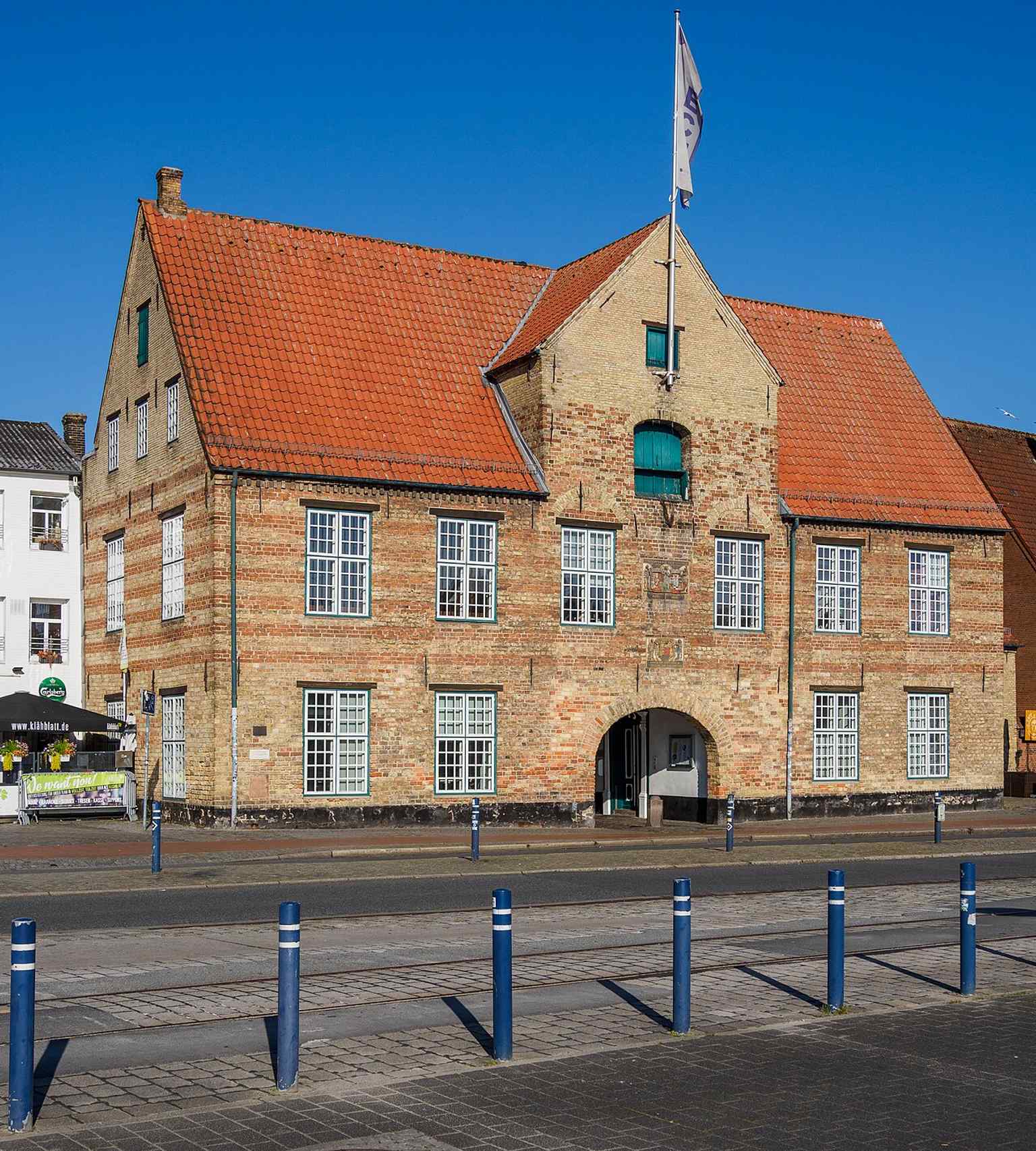
Front view of Kompagnietor on Schiffbrücke 12 — the 17th-century harbor gate that later housed the Seegericht and now the ECMI.Photo: JoachimKohler-HB, Wikimedia Commons, CC BY-SA 4.0. Cropped & resized. 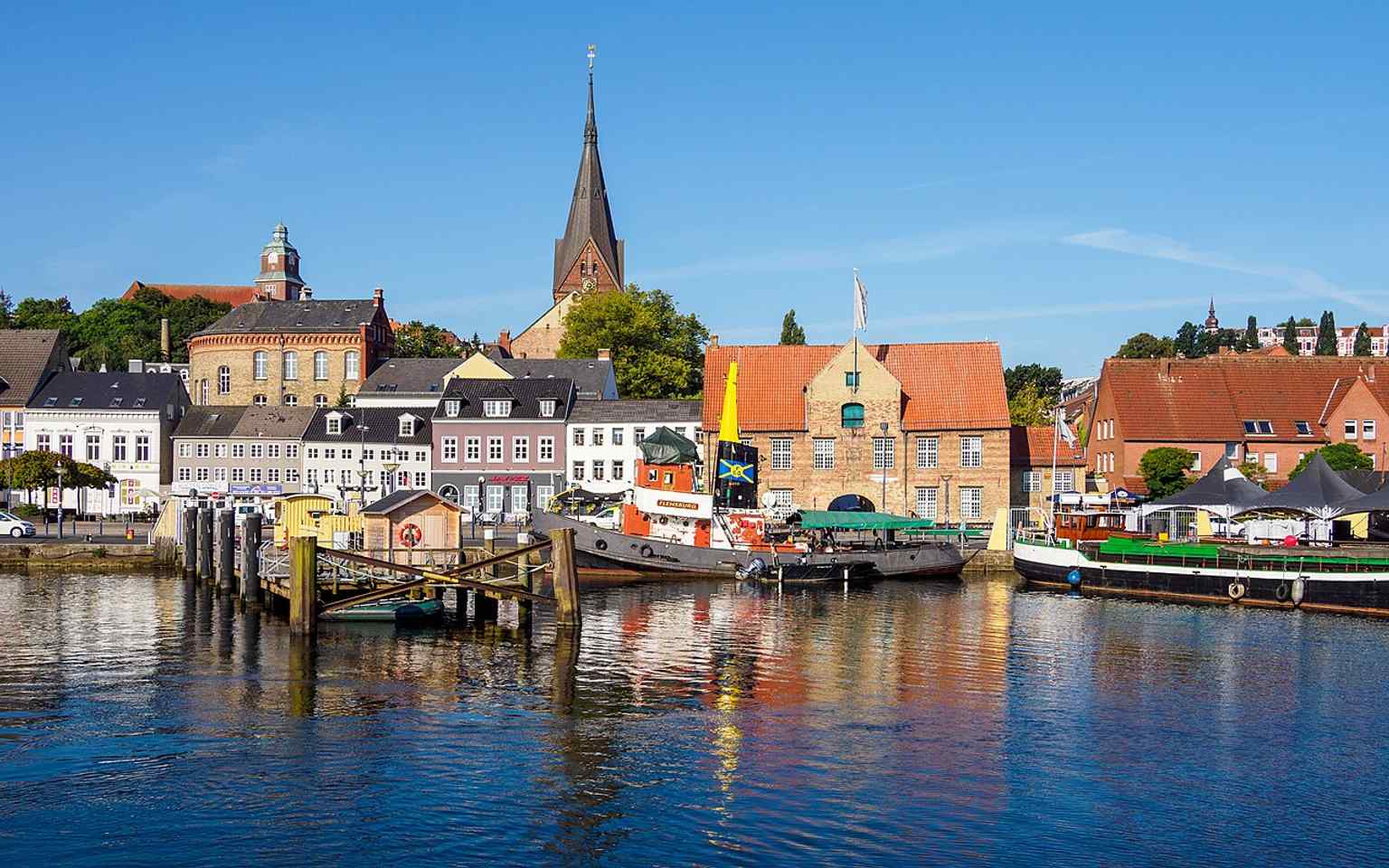
Kompagnietor rising behind Schiffbrücke, showing how the old harbor gate sits right in the port scene described in the tour text.Photo: JoachimKohler-HB, Wikimedia Commons, CC BY-SA 4.0. Cropped & resized. 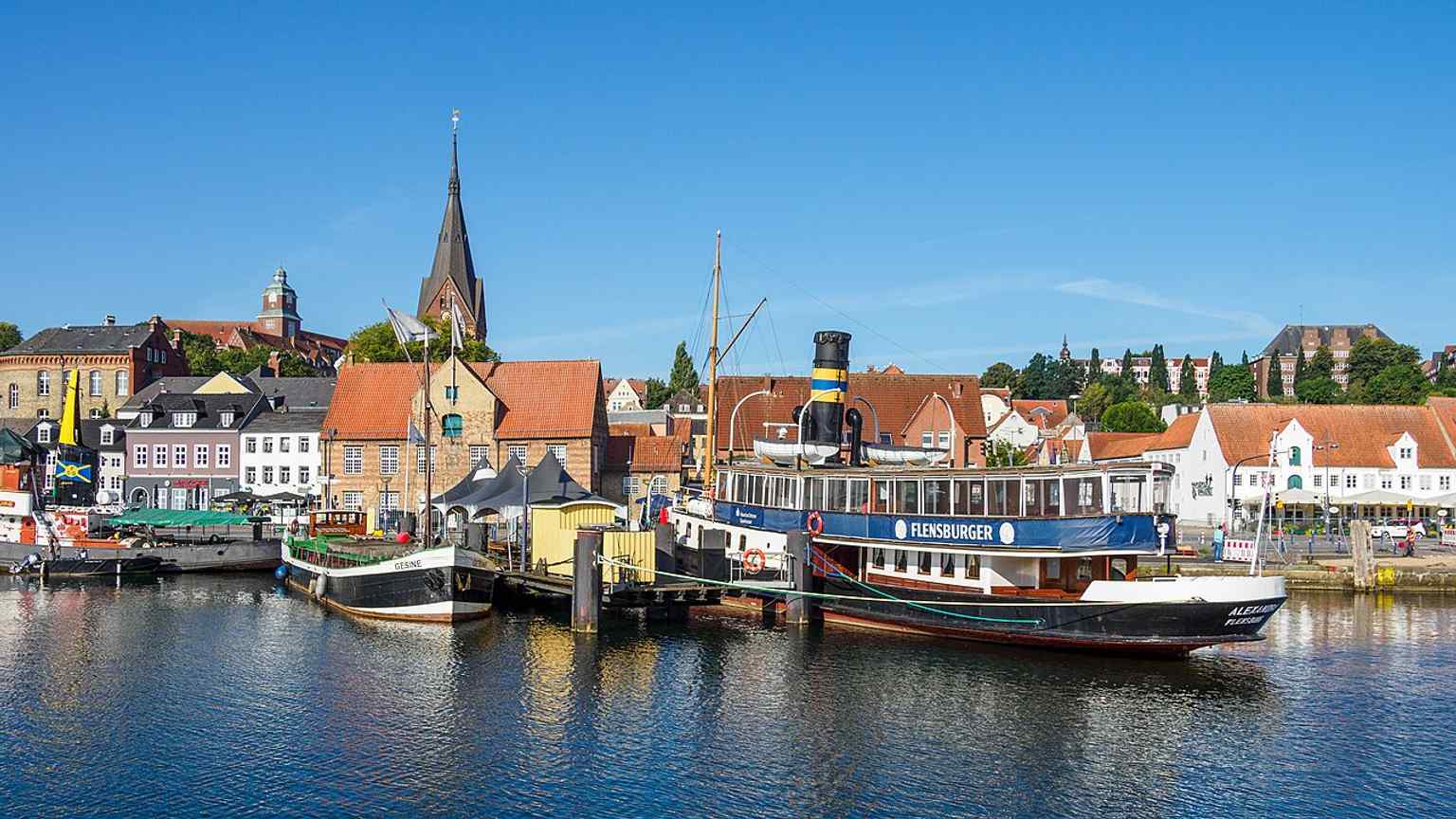
The harbor frontage with Kompagnietor in the background — a good context shot for the building’s setting at Flensburg’s ship bridge.Photo: JoachimKohler-HB, Wikimedia Commons, CC BY-SA 4.0. Cropped & resized. On your left stands a long red-brick warehouse with a broad gabled roof and a central arched passage cut through its middle. If you want a clear example of citizen-led…Read moreShow less
Open dedicated page →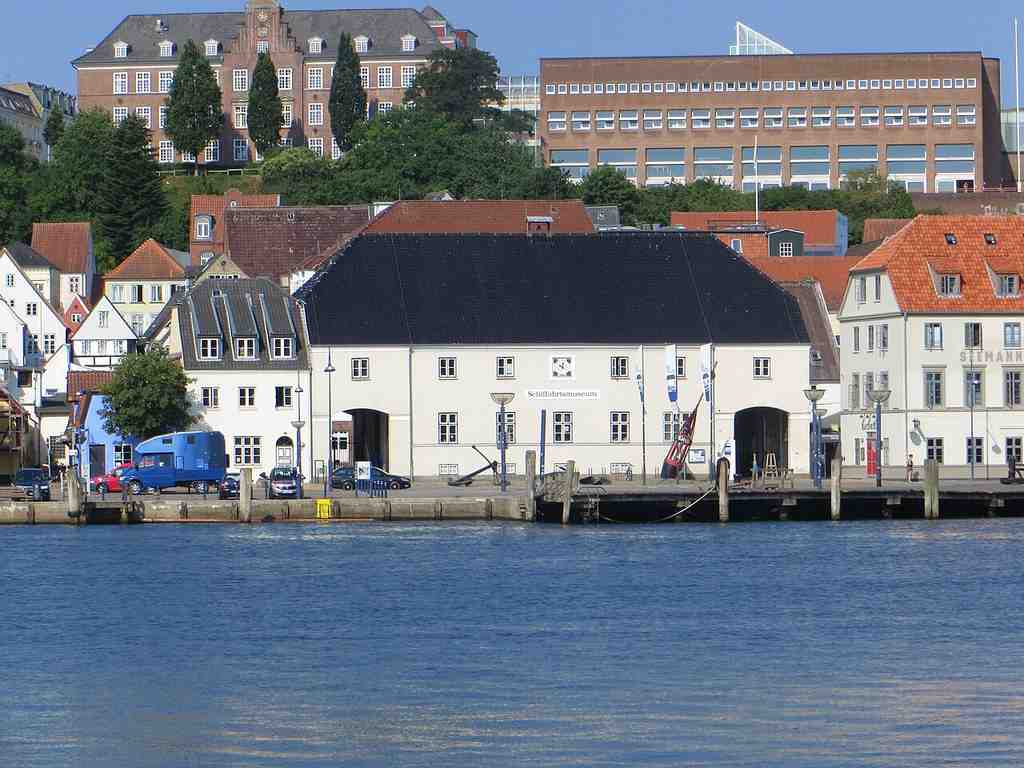
Flensburg Maritime MuseumPhoto: Marseille77, Wikimedia Commons, CC BY-SA 4.0. Cropped & resized. On your left stands a long red-brick warehouse with a broad gabled roof and a central arched passage cut through its middle.
If you want a clear example of citizen-led preservation, you’re looking at it. Maritime history did not simply drift into a museum like a bottle washing ashore... people in Flensburg argued over it, raised money for it, restored it, and decided what stories this harbor should keep.
This building began life in eighteen forty-two and eighteen forty-three, when the royal Danish building inspector Meyer designed it as a customs warehouse, a place where imported goods sat under seal until merchants paid the tax. Until nineteen seventy-two, Flensburg merchants stored goods here, and rum ranked among the big ones. That alone tells you plenty about this town: church towers on one side, trade ledgers on the other, and a harbor tying both together.
But turning it into a museum took a fight. In nineteen seventy-nine, the state of Schleswig-Holstein handed the old warehouse to the city. Even then, nothing was settled. A public meeting did not give a clear yes. Museum director Doctor Rudolf Zöllner still thought the city might simply enlarge its older museum instead. Then local supporters stepped in. They urged the city to accept the gift and remake this harbor warehouse as a home for Flensburg’s seafaring past. City president Ingrid Groß did not blink at the bill: about two point three million Deutsche Marks. That is what you call civic courage with a calculator in hand.
And then came Doctor Jutta Glüsing, the art historian who got the official task of creating the museum. She did not just arrange old objects in glass cases. She helped build the whole memory machine. Supporters sold hundreds of symbolic ship shares to fund a model ship, and collection tins appeared in banks, pharmacies, offices, and shops. From nineteen eighty to nineteen eighty-three, workers restored the listed building, added accessibility, and opened the museum in nineteen eighty-four as part of Flensburg’s seven hundredth anniversary. By the next year, it had already welcomed its fiftieth-thousand visitor.
Inside, the old world of Flensburg’s shippers survives in layers: ship portraits, models, nautical instruments, a city model showing the boom years around sixteen hundred, and the “treasure of the Schiffergelag,” the old shippers’ guild collection linked to medieval harbor management. There is even a two-cylinder ship steam engine from around eighteen seventy. Beneath one of the storage floors, cast-iron columns still hold the building up; Georg Dittmann’s first Flensburg iron foundry made them in eighteen forty-two. Solid stuff... history with muscles.
But here comes the turn. This museum no longer tells a cozy harbor tale and leaves it there. Its rum exhibits and later exhibitions, especially “Rum, Sweat and Tears,” confronted the darker side of Flensburg’s wealth: West Indies trade in sugar, rum, coffee, and dyewoods depended on enslavement, human trafficking, and brutal plantation labor in the Caribbean. So this place preserves pride, yes... but it also preserves accountability.
In a moment, head on toward Oluf-Samson Gang, where harbor life leaves the official record and slips into a narrower, more intimate lane, where reputation and survival rubbed shoulders. If you want to come back inside later, the museum is open Tuesday through Sunday from ten to five, and closed on Mondays.
Look for a narrow lane of small plastered houses with pitched roofs, squeezed between taller buildings and marked by the Oluf-Samson-Gang street sign. This little passage has a…Read moreShow less
Open dedicated page →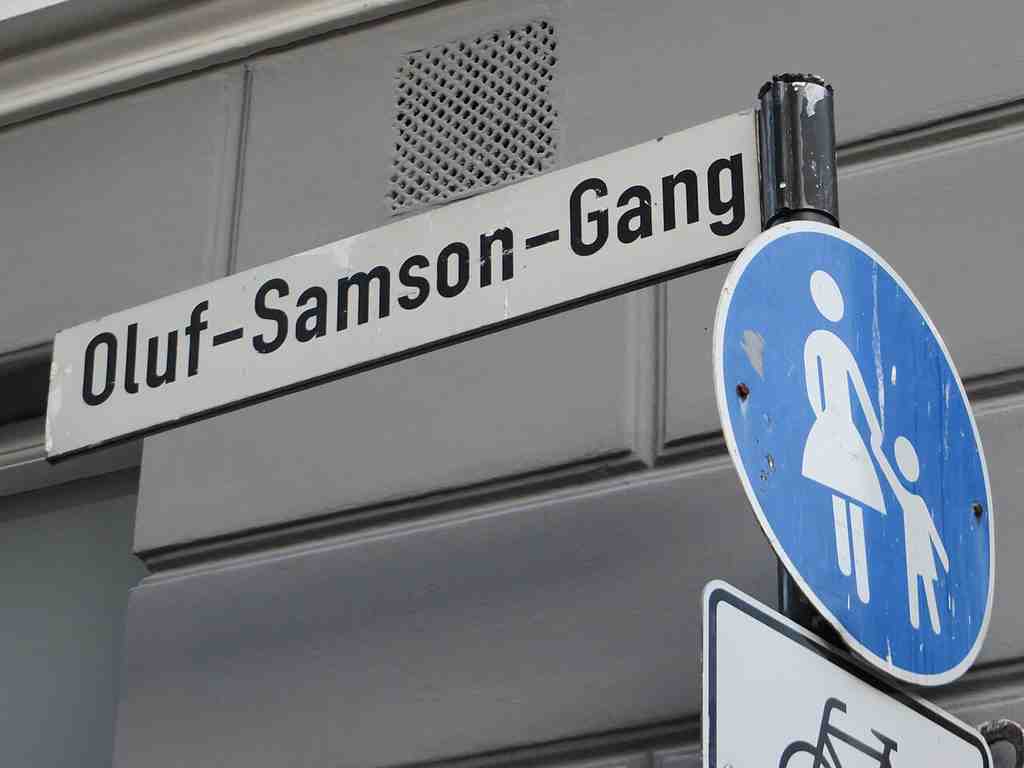
Oluf-Samson GangPhoto: Soenke Rahn, Wikimedia Commons, CC BY-SA 4.0. Cropped & resized. Look for a narrow lane of small plastered houses with pitched roofs, squeezed between taller buildings and marked by the Oluf-Samson-Gang street sign.
This little passage has a double life. On one hand, it served as a practical cut-through from Norderstraße down to the harbor. On the other, it carried a reputation that spread far beyond Flensburg... as the city’s “sin mile.” That contrast is the whole point of this place: intimate, useful, and never quite innocent.
The name takes us to a real man. In fifteen eighty-two, merchant and shipowner Oluf Samson swore his citizen’s oath in Flensburg. His name did not come from the Bible’s Samson, but from the island of Samsø in the Kattegat. Oluf married the daughter of an administrative official from nearby Duburg, gained property, and between two plots he controlled, a small passage ran toward the harbor. Records mention it by fifteen ninety-three. Oluf then put up several tiny rental houses here for poorer residents.
Here is the detail locals treasure and most visitors miss: this may have been the first street in Flensburg named after one of its own citizens. For Oluf, that was a small badge of honor... and then life turned on him. After the economic crisis that spread from about sixteen ten, he had to sell more and more of what he owned. By sixteen seventeen, he kept only two houses on Norderstraße. He died poor a year or a few years later, and none of his seven children appear later as property owners in the city. So this pretty lane carries a private rise and fall right in its name.
What you see now mostly comes from the eighteenth century. War had shattered much of the earlier lane during the Thirty Years’ War, and Flensburg recovered only later, when builders filled the lane again with the small plastered half-timbered houses you see now. These were not grand merchant homes. They belonged to working people: sailors, craftsmen, laborers.
Then came the chapter that changed the street’s image. After the First World War, the new border in nineteen twenty, and the crash after nineteen twenty-nine, poverty deepened in the harbor quarter. Cheap rents turned Oluf-Samson-Gang into an almost continuous row of brothels. By the boom decades after the Second World War, up to seventy women worked here. That gave the lane its notorious fame, somewhere between Hamburg’s Saint Pauli and Copenhagen’s Istedgade.
But the place never fit neatly into one label. Witnesses remembered women sitting at their windows knitting and crocheting. Barber Harald Meyer said they came around the corner to have their hair done and enjoyed his Low German jokes. In a town this size, scandal still had to book a haircut.
There is one more layer. This northern old town had many Danish-minded residents, and before the Schleswig vote in nineteen twenty, photographs show house after house here flying the Dannebrog, the Danish flag. So this lane did not only separate respectability from vice. It also sat on a line where identity itself stayed unsettled.
Today, the houses look lovingly restored, but this place makes sense only if you hold both truths at once: postcard beauty and hard bargains. When you’re ready, head up toward Norderstraße, about a two-minute walk from here, where these intimate side passages open back into one of Flensburg’s bigger urban corridors.
Look for a long stone-paved street framed by modest two-story brick-and-plaster houses, with narrow gables and simple shopfronts stretching in a straight run through the old town.…Read moreShow less
Open dedicated page →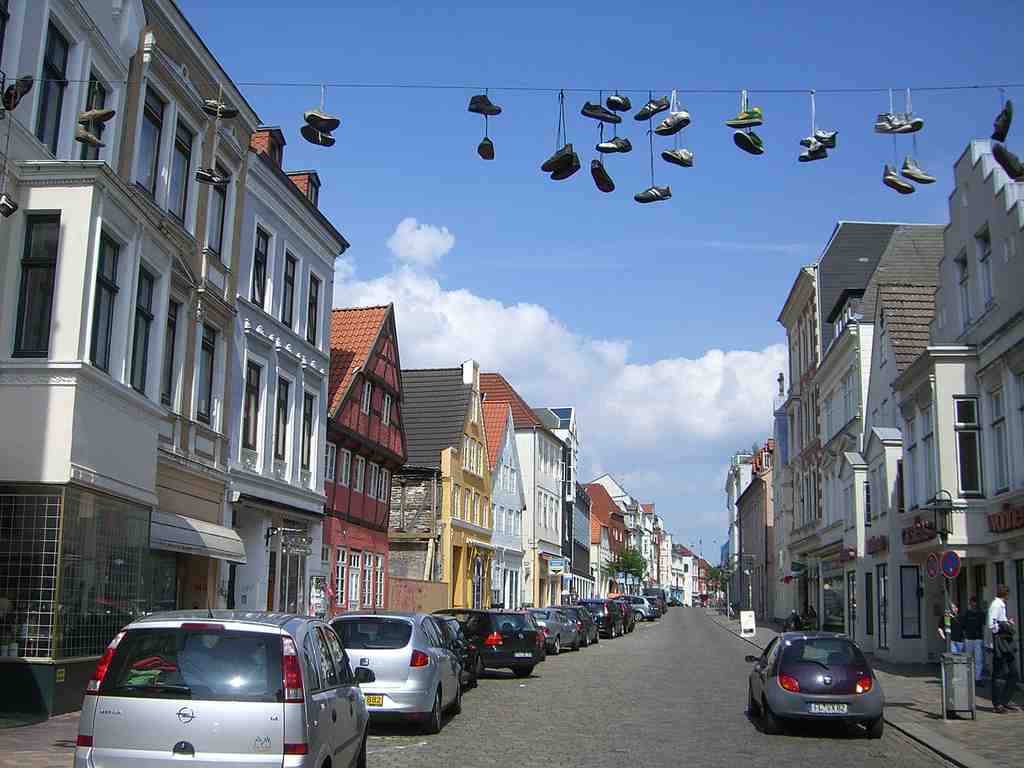
NorderstraßePhoto: Jens Junge, Wikimedia Commons, CC BY-SA 4.0. Cropped & resized. Look for a long stone-paved street framed by modest two-story brick-and-plaster houses, with narrow gables and simple shopfronts stretching in a straight run through the old town.
Norderstraße is Flensburg with its coat off. It is less polished than the grander shopping streets to the south, and that is exactly the point. This is the city’s long northern spine, about seven hundred meters from the edge of Nordermarkt up toward Nordertor, with side lanes slipping toward the harbor and stairs climbing uphill. Trade, gossip, errands, arguments, languages... they all passed through here.
Long before this became Norderstraße, this area belonged to a medieval settlement called Ramsharde, outside the old town walls, the settlement under the castle. Later, around fifteen ninety-five, the city pushed the northern gate farther out, and the street stretched with it. Even the name changed slowly. For centuries it formed part of the old Herrschaftsstraße, the ruler’s road. Only in the nineteenth century did people begin separating it into Holm, Große Straße, and Norderstraße, and the house numbering in eighteen eighty-one made the name official.
You can see that layered growth in the buildings. They do not march in neat formation. Many are low, simple gable houses or eave houses, meaning some show their pointed end to the street while others show their long roofline. Later buildings from the late nineteenth and early twentieth centuries added a more urban face. So the whole street feels mixed, practical, and lived-in... more work shirt than parade uniform.
That mix carries into daily life. Along this one street you find institutions of the Danish minority, including the Danish Central Library for South Schleswig, Flensborghus, and the House of Minorities. You also find international food, artist studios, bookshops, workshops, a Buddhist center, and a mosque. Flensburg has been telling you all tour long that identity here is rarely just one thing. Norderstraße says it in shop signs, meeting places, and lunch menus.
One of the street’s great local characters was Peter, known as Pit Liebmann. He rolled into Flensburg in nineteen seventy-two with a tattoo trailer and later turned numbers one hundred seven through one hundred nine into Villa Bunterhund, his wonderfully eccentric “Ministry for Finicky Affairs.” That is a title only a man with style and nerve would choose. Over his lifetime, Pit tattooed more than seventy thousand people. On this street, even self-invention got an address.
But Norderstraße also keeps harder memory in plain view. At number one hundred four, a memorial plaque recalls the Weiß family and the Flensburg Sinti who lived here until demolition in nineteen thirty-five. Authorities forced them first into a camp near Valentinerallee and later deported them through Hamburg to labor and extermination camps in Poland. This street does not let the city forget who belonged here, and who was torn away.
Then there is the playful side. Since two thousand and five, hanging shoes on wires, a bit of subcultural street art known as shoefiti, has helped turn Norderstraße into an unofficial landmark. Some travel writing has even singled it out as one of the city’s strangest streets. Fair enough. Flensburg has always had a taste for the respectable and the slightly unruly sharing the same block.
Take a slow look along the streetline now. The buildings are less uniform, less grand. Does that make the street feel ordinary... or does it make it feel more honest?
In a moment, we’ll head toward the Church of the Holy Spirit, where this city’s story narrows from street life to care, language, and memory held in an institution. It’s about a seven-minute walk from here.
In front of you stands a pair of red-brick museum buildings with steep gables, pale stone trim, and the ornate Dutch-Renaissance front of the Heinrich-Sauermann-Haus. This is…Read moreShow less
Open dedicated page →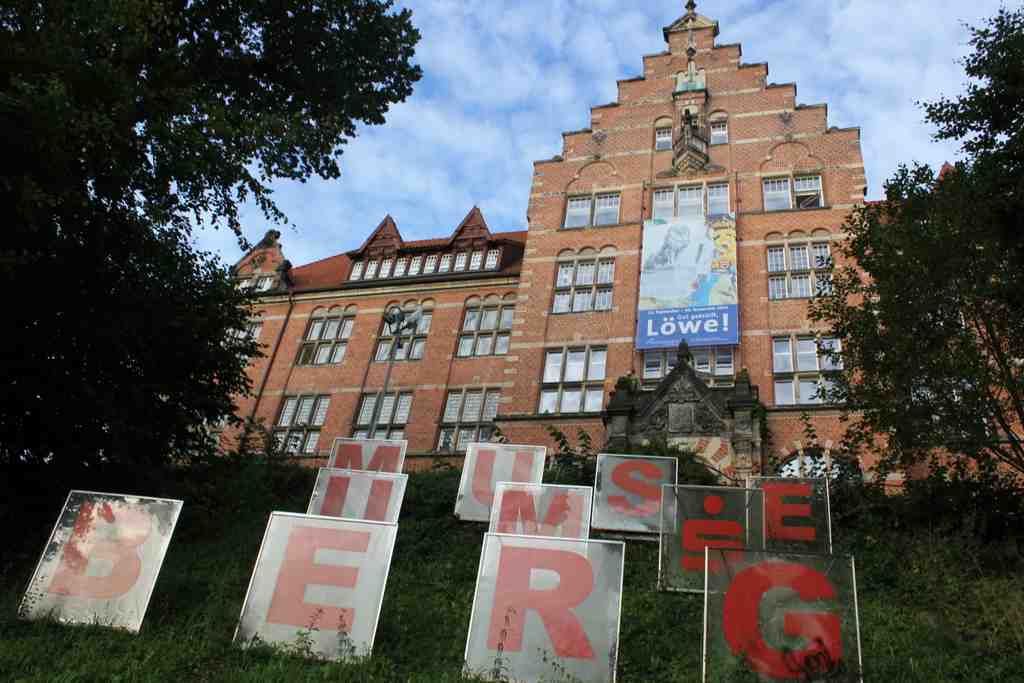
Museumsberg FlensburgPhoto: Soenke Rahn, Wikimedia Commons, CC BY-SA 3.0. Cropped & resized. In front of you stands a pair of red-brick museum buildings with steep gables, pale stone trim, and the ornate Dutch-Renaissance front of the Heinrich-Sauermann-Haus.
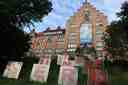
This is Museumsberg, one of the largest museums in Schleswig-Holstein, and it sits here like Flensburg's memory made solid. More than three thousand square meters of galleries spread across two houses on this rise above the theater, beside the old cemetery and parkland. If you check the picture on your screen, you can see how the twin buildings hold that hill together, almost like two bookends for the city's story.
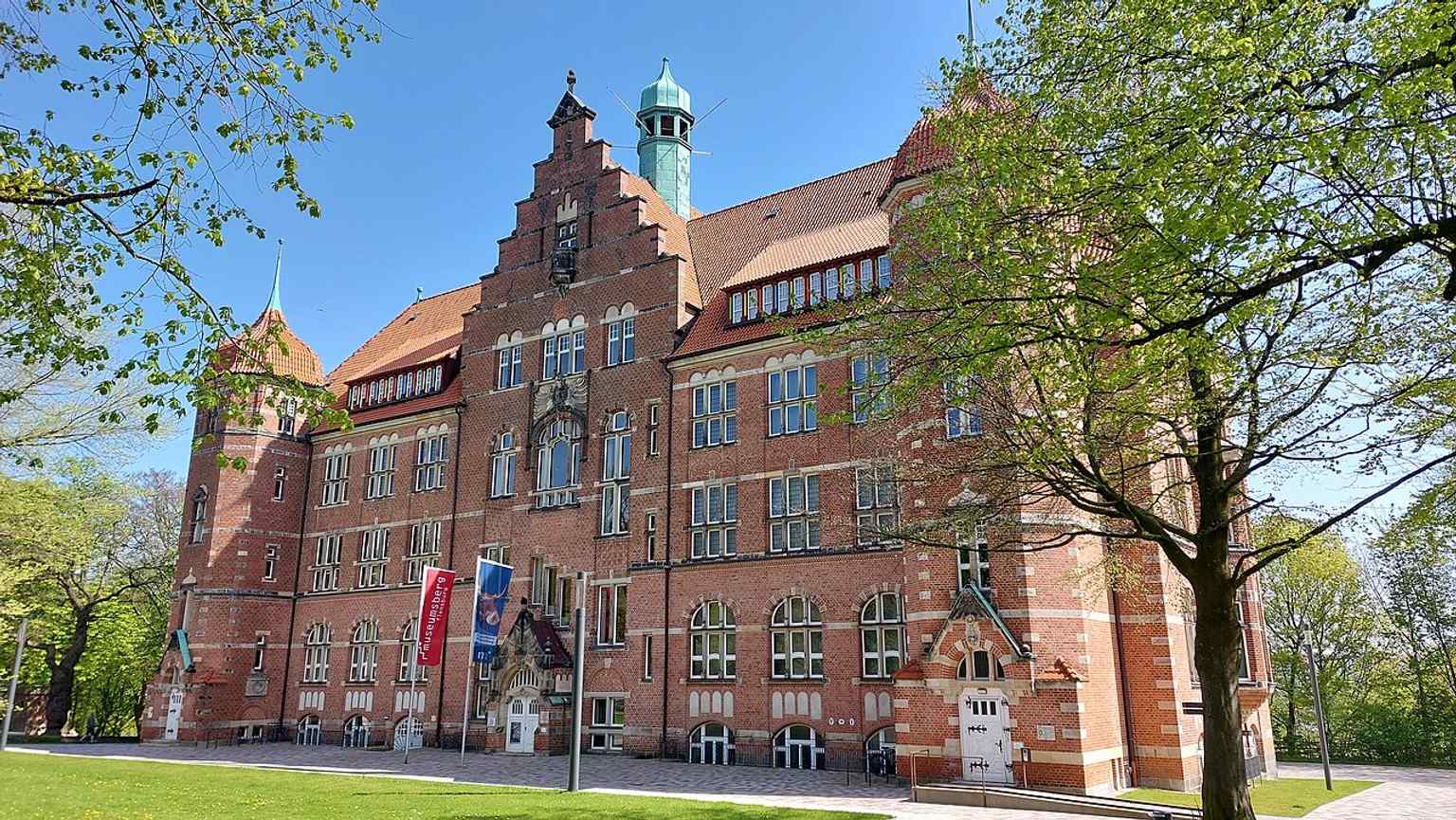
The Museumsberg’s twin museum buildings sit on the hill above the city, combining the old Heinrich-Sauermann-Haus with the newer Hans-Christiansen-Haus.Photo: 5R-MFT, Wikimedia Commons, CC BY-SA 4.0. Cropped & resized. The man to remember here is Heinrich Sauermann. He was not a grand aristocrat with a gallery habit. He was a furniture maker and woodcarver, a craftsman with sharp eyes and, apparently, no interest in owning just one chair when nine hundred historic ones might do. In eighteen seventy-six, he sold his private collection of old furniture to the city. That sale gave Flensburg the seed of this museum.
And Sauermann had a practical reason. He wanted apprentices to learn from the real thing. Old cupboards, carved panels, room interiors... these were teaching tools, not dead trophies. Collection and classroom worked side by side here, which made the museum unusually modern for its time, an early example of preserving objects while using them to train new makers. In a city shaped by trade, ships, churches, and shifting loyalties, that mattered. Flensburg was deciding what was worth keeping and what kind of place it meant to be.
The older building, opened in nineteen oh three, still wears its Dutch Renaissance style proudly. Later, the former school next door, built in the eighteen nineties in a restrained neo-Gothic style, became the Hans-Christiansen-Haus. Since nineteen ninety-seven, it has given the painting collection room to breathe.
Inside, the museum stretches from the thirteenth century to contemporary art. Sauermann's furniture remains one of the most important collections of its kind in Germany. There are rebuilt farmhouse rooms from the seventeenth and eighteenth centuries, a Marian altar from fifteen seventeen, the high-Gothic Viöl Madonna, and paintings by artists such as Louis Gurlitt, Carl Ludwig Jessen, Käte Lassen, Emil Nolde, and Erich Heckel. Nolde studied in Sauermann's school, then later failed to get the director's job here. History has a sense of humor sometimes.
But this place does not pretend memory is neat. After the border plebiscite of nineteen twenty, the museum briefly had to call itself a borderland museum, and Sauermann himself remained a Danish citizen. Then, in nineteen thirty-seven, the Nazi campaign against so-called degenerate art struck here directly. Officials seized twenty-seven works by Nolde and a sculpture by Ernst Barlach. Later, director Fritz Fuglsang guided the museum through those years, brought much of the collection back after the war, and gave it an order that still shapes the house. More recently, the museum examined its own record by researching where certain artworks came from and how they were acquired. That kind of honesty is a form of care too.
If you glance at the other image, the old cemetery beside the museum helps explain the setting. This whole hill is a place where Flensburg keeps company with its own past.
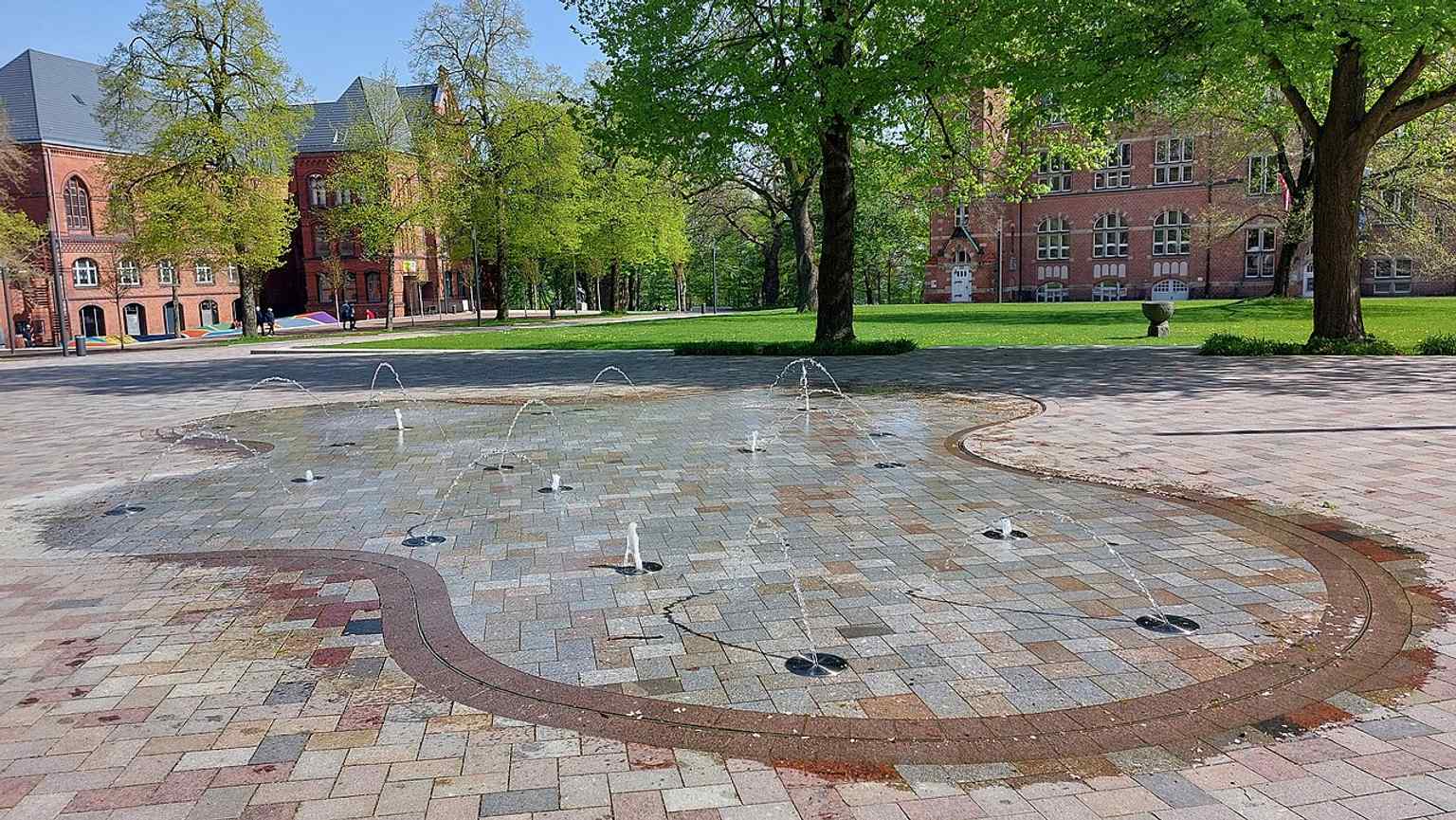
A view of the Alter Friedhof beside the Museumsberg area, part of the historic park-and-cemetery landscape that frames the museum complex.Photo: 5R-MFT, Wikimedia Commons, CC BY-SA 4.0. Cropped & resized. A museum gathers memory indoors. At the next stop, you will meet the same question out in the open: one lion, one border, and a great deal of feeling. If you want to come back inside, Museumsberg opens Tuesday through Sunday from ten to five and closes on Mondays.
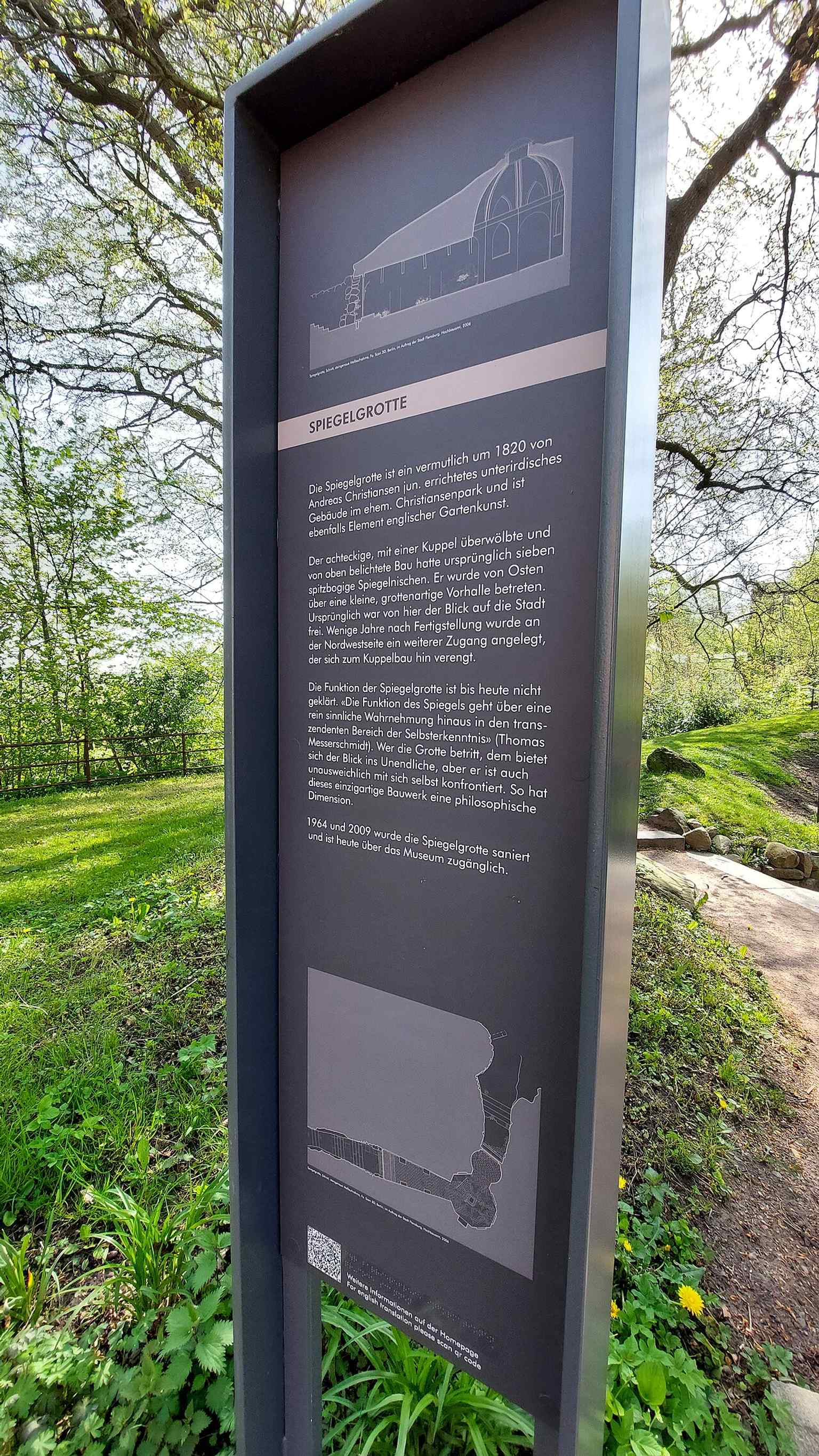
The Spiegelgrotte in the Christiansenpark, a rare relic of the historic landscape garden linked to the museum grounds.Photo: 5R-MFT, Wikimedia Commons, CC BY-SA 4.0. Cropped & resized. On your left stands a dark bronze lion with its head lifted high on a pale stone pedestal, marked by a plaque on the front. For a monument that never takes a single step, this…Read moreShow less
Open dedicated page →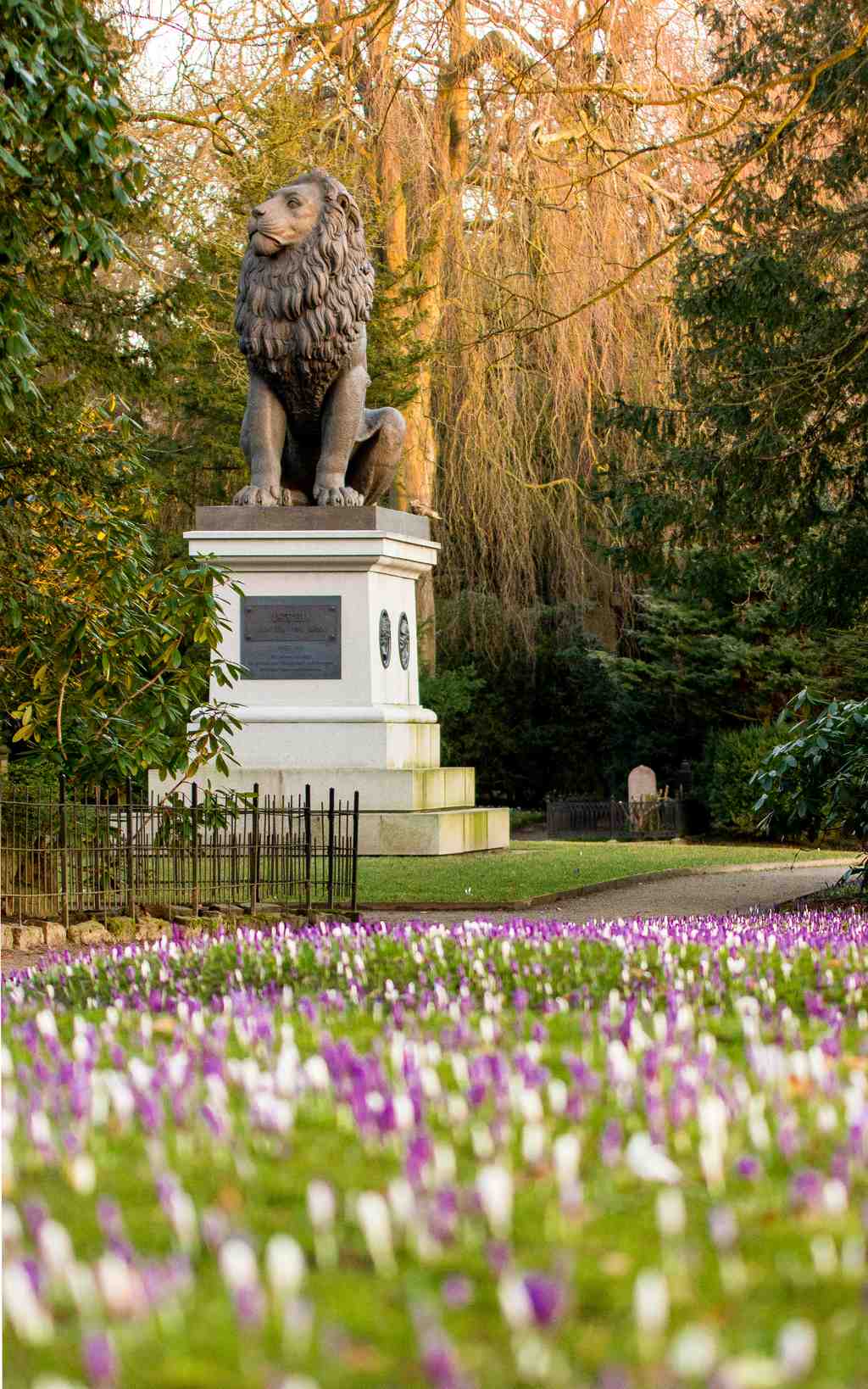
Idstedt LionPhoto: Ichwarsnur, Wikimedia Commons, CC BY-SA 4.0. Cropped & resized. On your left stands a dark bronze lion with its head lifted high on a pale stone pedestal, marked by a plaque on the front.
For a monument that never takes a single step, this lion has had quite a travel schedule. The Idstedt Lion began here as a victory monument. In eighteen sixty-two, the Danish sculptor Herman Wilhelm Bissen placed it on the Old Cemetery to honor Denmark’s victory at the Battle of Idstedt on the twenty-fifth of July, eighteen fifty, during the Schleswig-Holstein uprising.
Bissen did not dash this off from imagination. He went to Paris and studied a living lion in the Jardin des Plantes, the city’s great zoological garden, because he wanted the muscles, stance, and proud lifted head to feel convincing. What you see here is not just symbolism; it is careful anatomy serving politics.
And politics, my friend, is the whole point.
The lion stood more than seven meters high with its stone base, facing south, with the Danish flag once flying before it. But the ground beneath it carried a wound. To give the monument firm footing, workers destroyed about two hundred German coffins and graves. No Danish dead lay here. So for many German-minded Flensburgers, this was not remembrance. It felt like triumph planted on top of loss.
That anger turned physical in eighteen sixty-four, during the next war between Denmark and the German powers. Townspeople tried to pull the monument down and broke off its tail. After Prussia took control, Otto von Bismarck ordered the damaged lion removed. In eighteen sixty-seven it went to Berlin, where officials treated it as a trophy. Later it stood at the Zeughaus, then at the Prussian cadet academy.
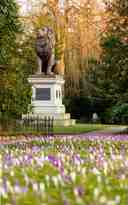
If you glance at the image in your app, you can see the lion’s clean silhouette and steady upward gaze. That calm pose is almost funny when you know the life it has had: Flensburg, Berlin, Copenhagen, then Flensburg again.
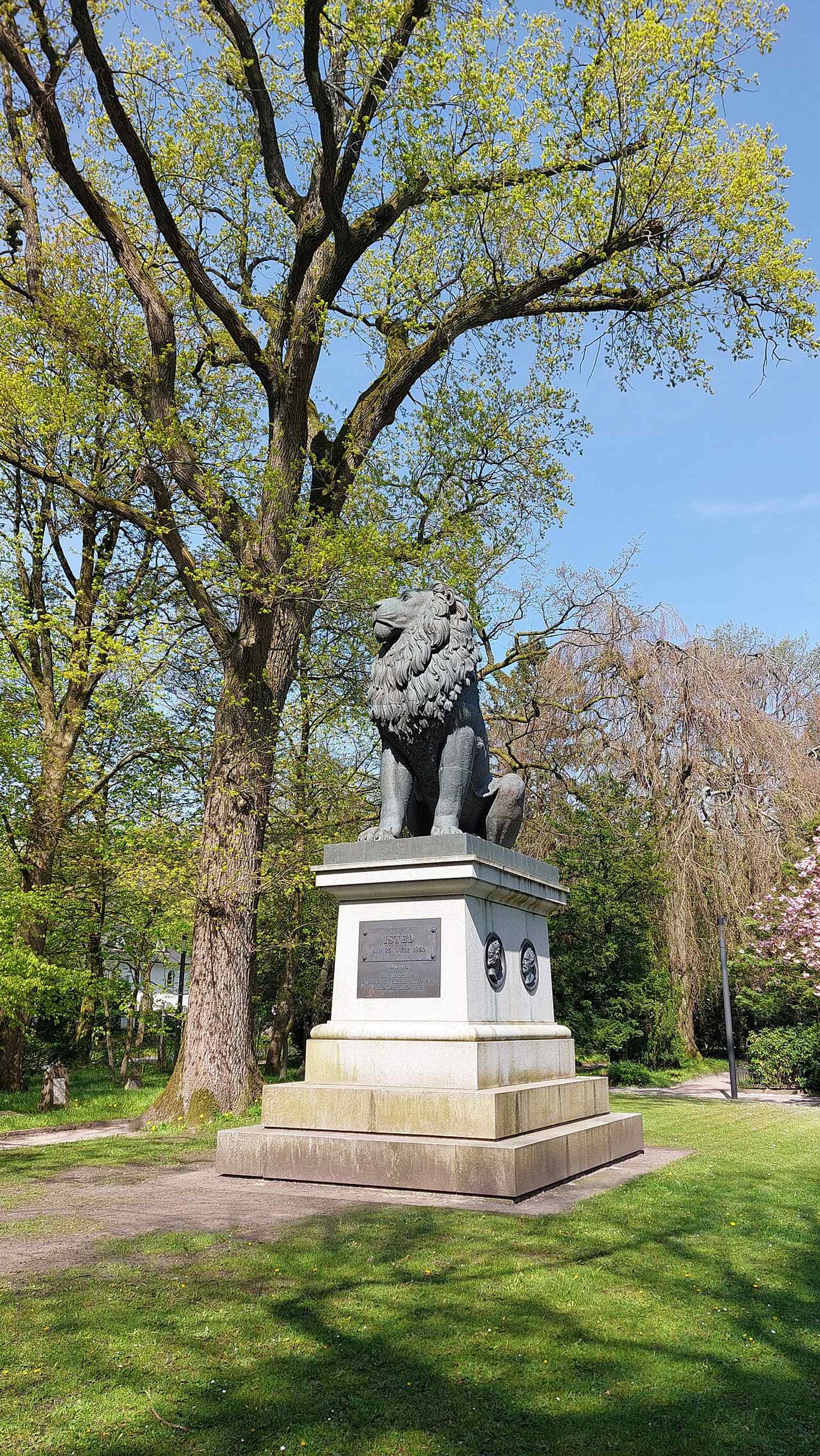
The Idstedt Lion at Flensburg’s Old Cemetery, where the monument returned in 2011 as a symbol of friendship and trust between Danes and Germans.Photo: 5R-MFT, Wikimedia Commons, CC BY-SA 4.0. Cropped & resized. The move to Copenhagen came after the Second World War. A journalist named Henrik V. Ringsted pressed the case with the U-S occupation authorities in Berlin, and even Dwight D. Eisenhower enters the story. In nineteen forty-five, Denmark received the lion, and King Christian the Tenth said he hoped it might one day return here, if Flensburg wanted it.
That “if” mattered. For decades, people argued. Was this a war trophy, a grave marker, a nationalist statement, a lesson, an insult, a chance for reconciliation? In two thousand eleven, after long debate and a major shift in Danish-German relations, the lion returned to this original site. Prince Joachim of Denmark unveiled the new plaque. It says the monument was re-erected as a sign of friendship and trust between Danes and Germans.
But monuments do not become innocent just because we wish them to. This one still carries all its former meanings, like old luggage with fresh tags. That is why it belongs here. Flensburg has always asked hard questions about faith, language, trade, and allegiance. In the churches, the markets, the harbor lanes, and the museum hill, you’ve seen a city sorting out who speaks for it. Here, at the end, a bronze lion answers with a proud silence: no single nation, memory, or century gets the last word.
Practical note: this site is generally accessible all day from Tuesday through Sunday, while Monday is listed as closed.
Frequently asked questions
How do I start the tour?
After purchase, download the AudaTours app and enter your redemption code. The tour will be ready to start immediately - just tap play and follow the GPS-guided route.
Do I need internet during the tour?
No! Download the tour before you start and enjoy it fully offline. Only the chat feature requires internet. We recommend downloading on WiFi to save mobile data.
Is this a guided group tour?
No - this is a self-guided audio tour. You explore independently at your own pace, with audio narration playing through your phone. No tour guide, no group, no schedule.
How long does the tour take?
Most tours take 60–90 minutes to complete, but you control the pace entirely. Pause, skip stops, or take breaks whenever you want.
What if I can't finish the tour today?
No problem! Tours have lifetime access. Pause and resume whenever you like - tomorrow, next week, or next year. Your progress is saved.
What languages are available?
All tours are available in 50+ languages. Select your preferred language when redeeming your code. Note: language cannot be changed after tour generation.
Where do I access the tour after purchase?
Download the free AudaTours app from the App Store or Google Play. Enter your redemption code (sent via email) and the tour will appear in your library, ready to download and start.
If you don't enjoy the tour, we'll refund your purchase. Contact us at help@audatours.com
Checkout securely with 











%20-%20Orgel.jpg)


.jpg)
.jpg)
.jpg)


