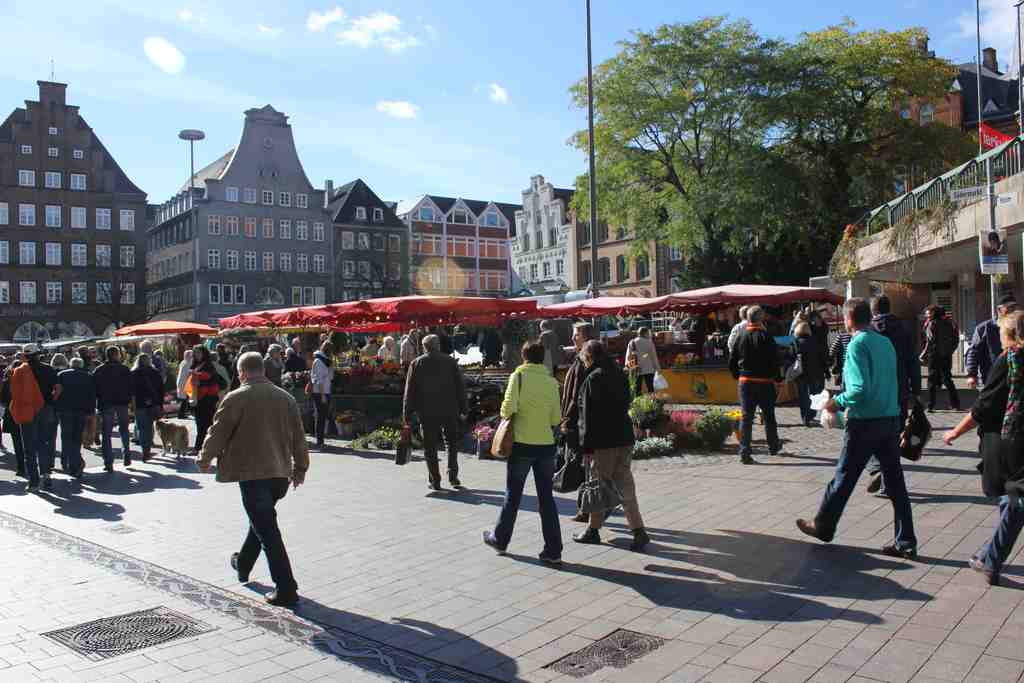
On your right, look for the broad rectangular market square, its open stone paving framed by old gabled facades and marked by the raised platform tucked below Saint Nikolai’s choir.
This is Südermarkt, one of Flensburg’s two main market squares, and for centuries it has handled the city’s most practical business... buying, selling, posting orders, making announcements, and starting over when trouble swept through. That last part matters here. Flensburg has a habit of rebuilding after rupture, not by erasing the damage, but by getting on with the work. This square learned that lesson early, and it never really forgot it.
Around the year twelve hundred, when the parish of Saint Nikolai took shape here by the fjord, this market likely formed beside it. That pairing tells you a lot about the city. Worship and trade did not live in separate worlds. The church stood over daily exchange like a stone witness, while a long-distance road linking Friesland and Angeln ran right past this spot. Along the south side, Angelburger Straße led east and Friesische Straße led west, so this was not just a neighborhood square. It sat in the path of movement, money, and news.
Then came the fire. On the third of May, fourteen eighty-five, flames destroyed the southern part of Flensburg, and Südermarkt took the hit with it. Yet that same year, people rebuilt the square and expanded Saint Nikolai. If your shop, your horse, your household, and your future all depended on this place, you did not go looking for a safer map... you picked up a hammer.
Some of that stubbornness still shows. After the fire, more old fabric survived here than you might expect. The step-gabled houses at numbers eleven and twelve are holdovers from those earlier, simpler fronts. And around fourteen ninety, builders raised what is now the Nikolai-Apotheke, the oldest secular building in Flensburg. Inside its old chimney room, fragments of late Gothic painting survived, including a crescent-moon Madonna and a cross. Even the practical places kept traces of devotion. Here, the practical and the sacred sat side by side.
Südermarkt also belonged to a larger market network. Oxen changed hands at the Ochsenmarkt out by the Exe, while horses were traded here. Different goods, different space, same city logic. Even punishment had an address here: until the eighteenth century, a copper Kaakmann, a bailiff figure, stood on the square as a warning that public order mattered as much as public trade. We will meet that survivor again later at Museumsberg.
In the early seventeenth century, a square fountain with four drain pipes stood here. Then, in nineteen oh three, sculptor Helmuth Schievelkamp gave the market a far more muscular centerpiece: the Bismarck Fountain, also called the Germania Fountain. It planted imperial swagger right in the middle of everyday commerce. Public monuments, like politics, do not always age gracefully. The fountain disappeared in nineteen thirty-seven, and in the nineteen fifties its remains found a second life in Carlisle Park as part of a fountain garden.
Power kept using this square. After British forces occupied Flensburg at the end of the Second World War, British and American military authorities posted new laws here and at Nordermarkt from May thirteenth, nineteen forty-five, even while the last Reich government still sat out in Mürwik. Later, politicians from Willy Brandt to Angela Merkel came here because anyone who wants Flensburg’s attention still comes to the market. So did handball champions in two thousand fourteen.
And here is the question I’d leave you with... if one fire could wipe out your livelihood in a day, would you rebuild in the same spot, under the same church, on the same square? The people of Flensburg did, again and again, and that choice helped make the city what it is. Südermarkt is the practical pulse; up ahead, Nordermarkt will show us the other face of civic life, about a twelve-minute walk from here. If you want the regular weekly market here, it usually sets up on Wednesdays and Saturdays from seven in the morning until two in the afternoon.