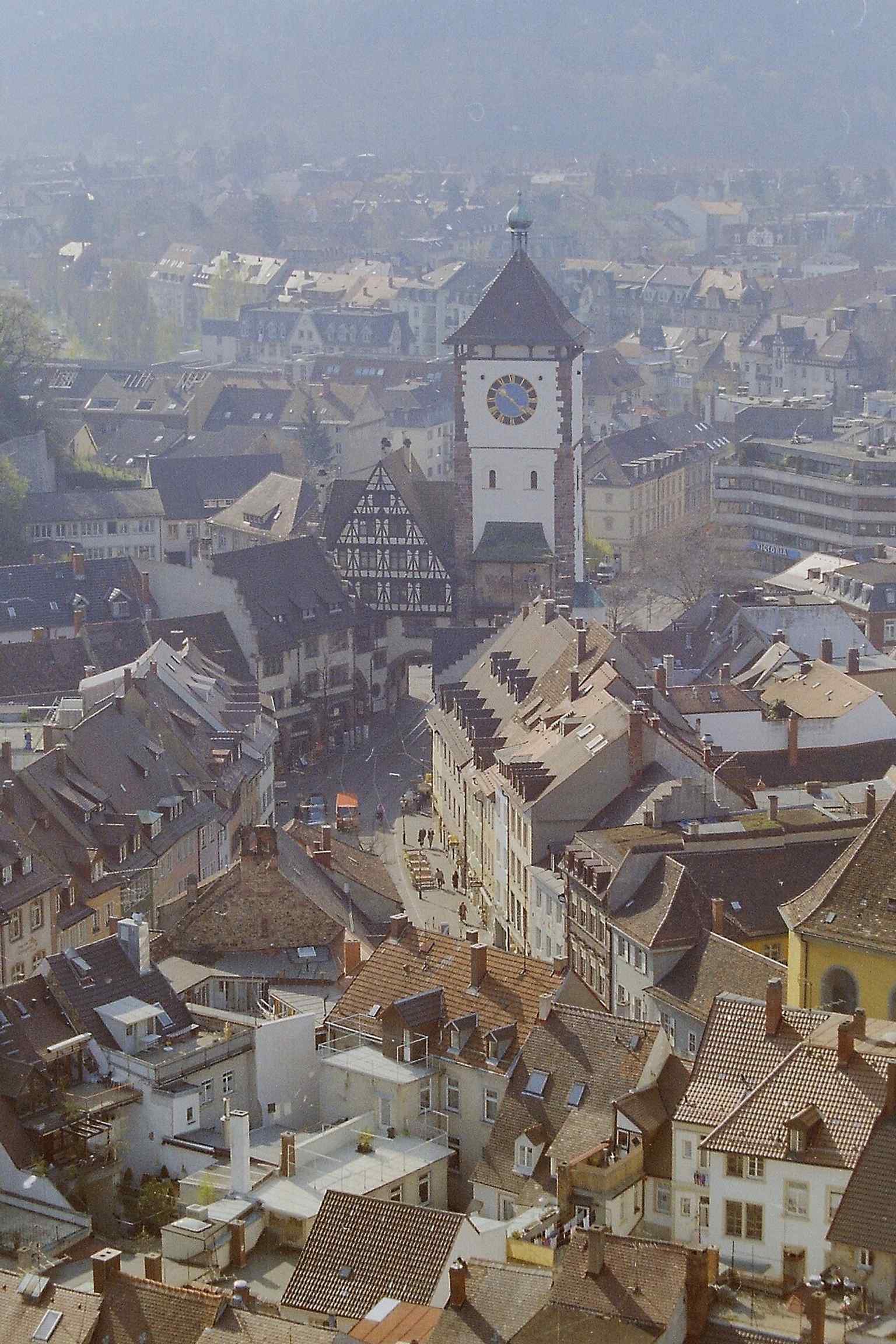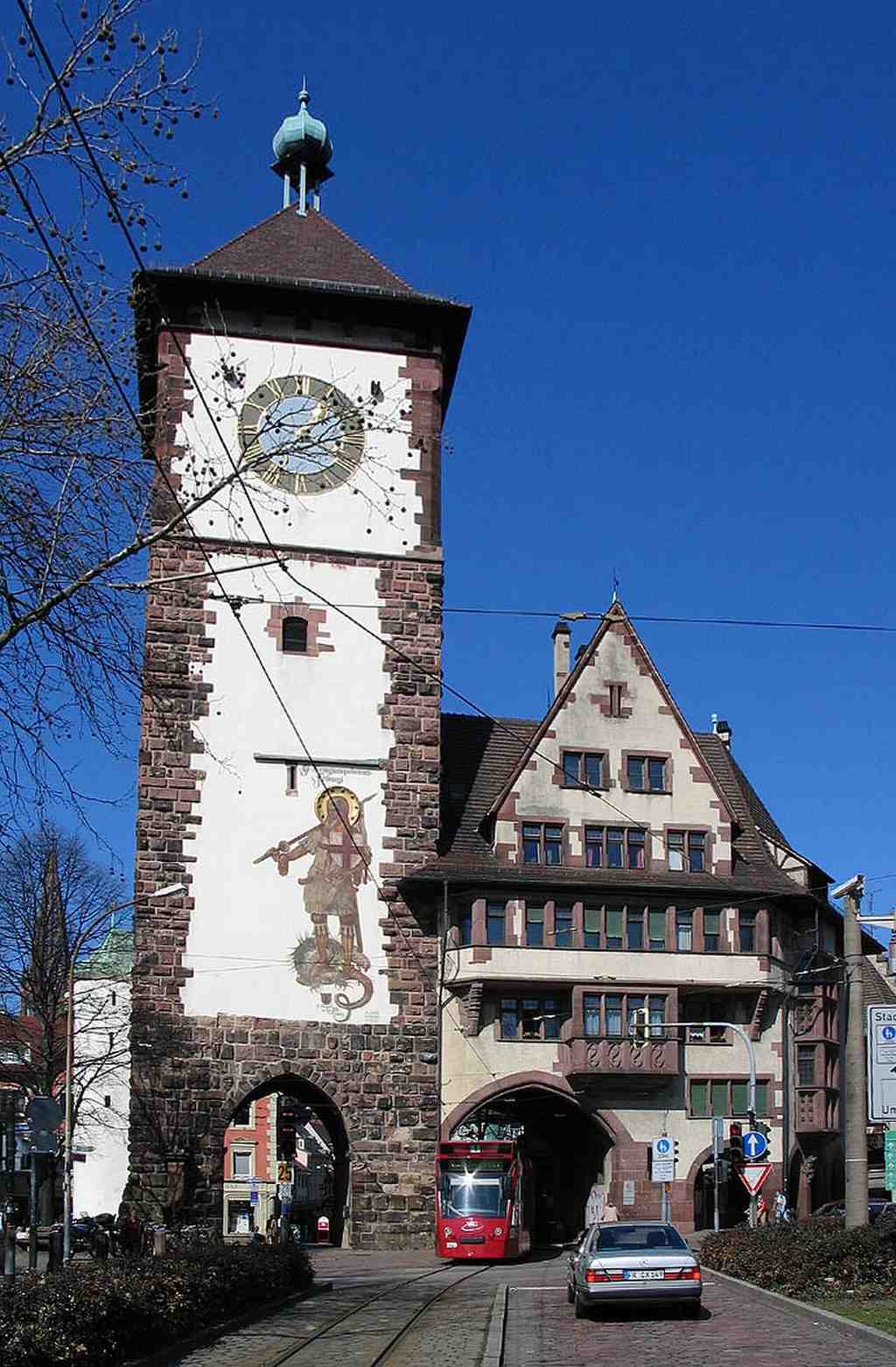
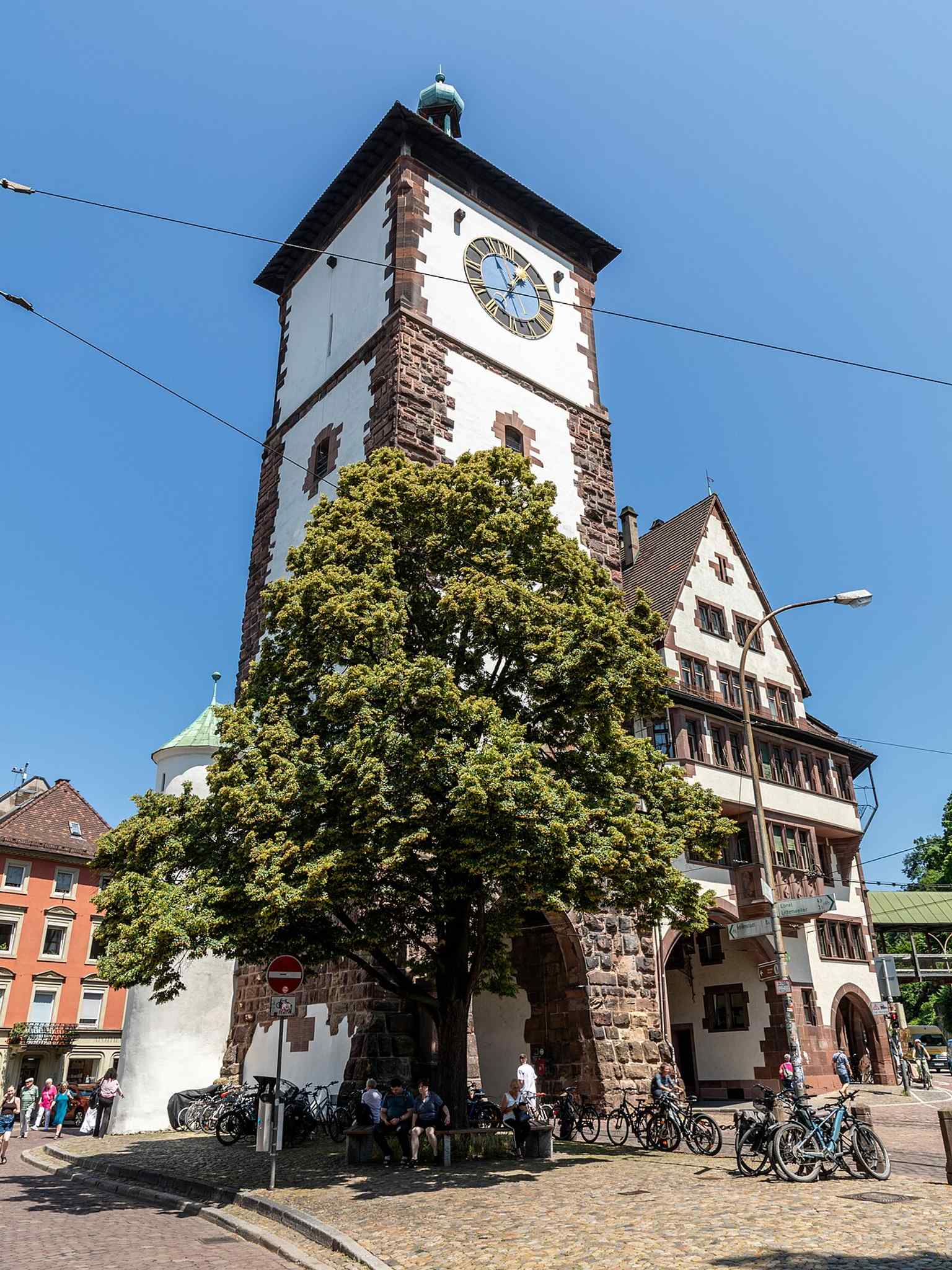
Look for the square red sandstone gate tower with its pointed arch and the small bell turret topped by an onion-shaped cap.
This is the Schwabentor, the younger of Freiburg’s two surviving medieval gates, rising here since about twelve fifty. At first it worked like a proper defensive machine: thick masonry below, a narrow passage through the wall, and in front of it a fenced killing zone between barriers... medieval urban planning, never accused of being subtle.
If you glance at the stonework in the app, you can see the mix of heavy rusticated blocks below and rougher masonry above. That patchwork tells the truth about this gate better than any slogan. Freiburg kept changing it. In fifteen forty-seven builders finally closed the city side with a stone wall. In fifteen seventy-two they added the little stair turret. What looks ancient and fixed is really a long argument in stone.
And then there’s the story Freiburg loves to tell. On the inner side, a merchant with a wagon appears in a painted scene. In the nineteenth century people attached a legend to him: a Swabian arrived with two barrels of money, hoping to buy Freiburg. Everyone laughed at the absurd idea... then laughed harder when the barrels turned out to hold sand and pebbles because his wife had secretly switched the money before he left. Marriage, as a check on reckless investment.
Most visitors assume that painting is a medieval survivor. It isn’t, not cleanly. Artists kept repainting and repairing it for centuries, including Simon Göser, Dominik Weber, Ernst Fey, and Wilhelm Hanemann. So even the “old” image is a layered reconstruction, a memory touched up again and again.
This gate also holds a sharper memory. On the twenty-fourth of April, eighteen forty-eight, Baden revolutionaries fought grand-ducal government troops here in the last clash at the gate. The liberal hopes we’ve felt elsewhere in Freiburg stopped being speeches and ideals for one brutal moment; they became barricades, gunfire, and bodies in the street. If the Victory Monument turned conflict into heroic certainty, this place remembers something rawer: citizens facing their own state.
Later, many wanted the gate demolished for traffic. Mayor Otto Winterer pushed back and saved it. That decision mattered, because by the time engineers stripped the plaster in twenty twelve, they found serious cracks from earlier alterations, and foundations that stood partly on medieval fill instead of firm ground. So the gate survived not by remaining untouched, but because people kept deciding it was worth rescuing.
Look up through the arch, then up the slope beyond. Do city gates feel more like protection... or control... once you know revolt gathered here? Hold that thought as you head toward the vanished stronghold above us, Freiburg Castle, about a thirteen-minute walk from here.
And for practical purposes: the exterior of the Schwabentor is accessible at any hour.