
Freiburg Highlights Audio Tour: Medieval Charm and Intellectual Heritage
Beneath Freiburg’s charming cobblestones lie centuries of rebellion, scandalous secrets, and ghosts of political upheaval that the typical tourist postcard dares not whisper. Unlock these hidden layers with this self-guided audio tour. Wander beyond the familiar sights and uncover the gritty, forgotten narratives trapped within the city’s walls, from the majestic Freiburg Theatre to the imposing House of the Whale. Which blood-soaked uprising was silenced by the shadow of the Victory Monument? What dark, supernatural curse was said to be etched into the stone of the House of the Whale? Why did a prominent local figure choose to hide a fortune in plain sight during a time of absolute chaos? Traverse the shifting landscape of history where every corner pulses with drama. This journey transforms a casual walk into an immersive descent into intrigue. Ready to confront the shadows? Start the tour now.
Tour preview
About this tour
- scheduleDuration 120–140 minsGo at your own pace
- straighten4.9 km walking routeFollow the guided path
- location_onLocationFreiburg im Breisgau, Germany
- wifi_offWorks offlineDownload once, use anywhere
- all_inclusiveLifetime accessReplay anytime, forever
- location_onStarts at Wiwilí Bridge
Stops on this tour
lock_open 3 free previews · 12 unlock with purchase
Ahead of you is a blue-painted steel bridge, stretched in a series of arched segments over the railway lines, with sturdy latticework sides that give it its unmistakable outline.…Read moreShow less
Open dedicated page →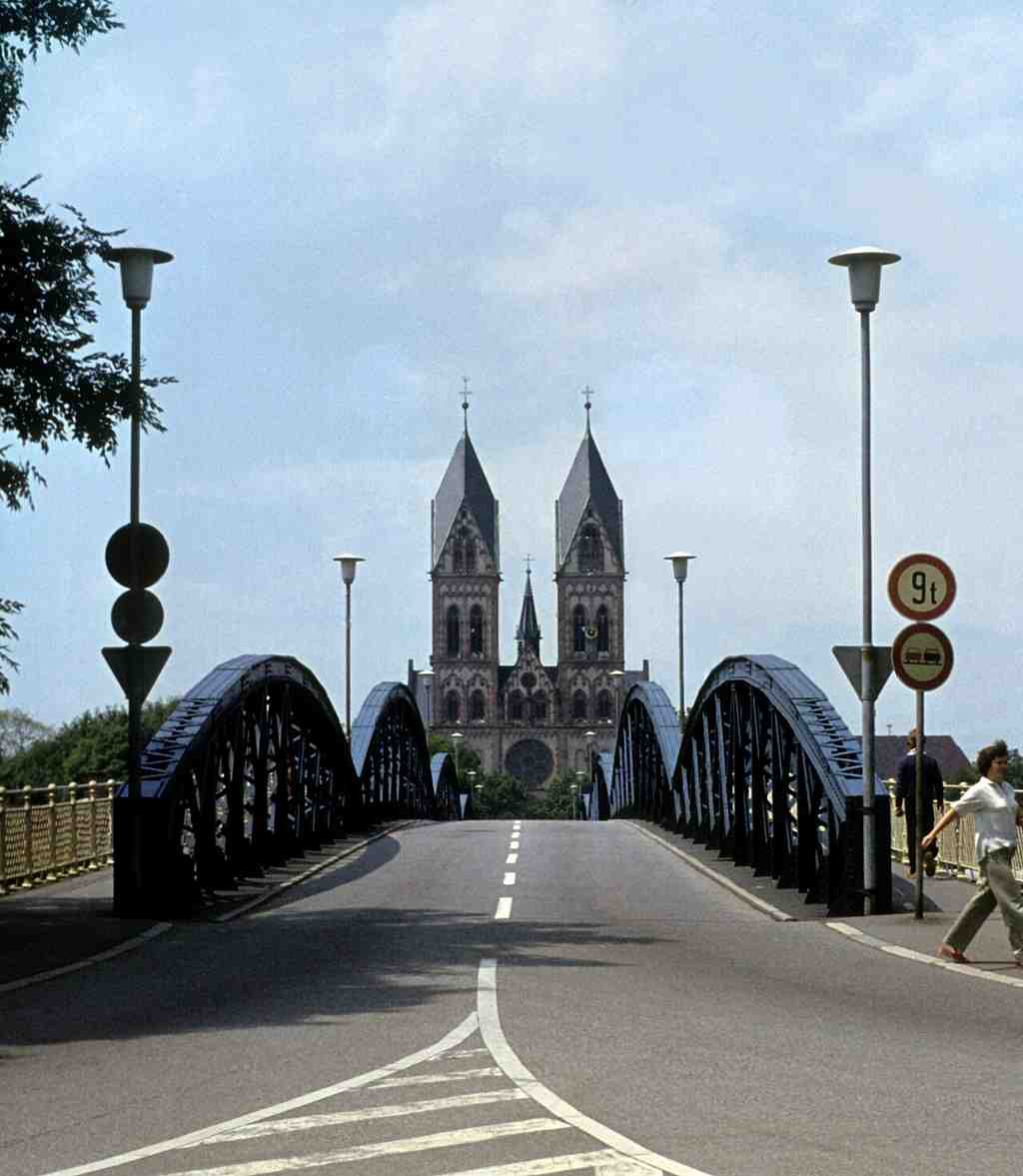
Wiwilí BridgePhoto: Peter Kappus, Wikimedia Commons, CC BY-SA 3.0. Cropped & resized. Ahead of you is a blue-painted steel bridge, stretched in a series of arched segments over the railway lines, with sturdy latticework sides that give it its unmistakable outline.
Welcome to Freiburg... and to a place that tells you, right away, what kind of city this is. In Freiburg, a bridge does more than move people from one side to the other. It can carry memory as seriously as it carries bicycles. This crossing began as hard-working railway infrastructure, and over time it took on the weight of grief, solidarity, and public conscience. Not bad for an overpass.
The Wiwilí Bridge links the Stühlinger district with the old town, crossing the tracks of Freiburg’s main station. The Grand Ducal Baden State Railway commissioned it in the years eighteen eighty-five and eighteen eighty-six to replace a level crossing that had become too dangerous and too small for a growing city. Architect Max Meckel drew the plans, and the ironworks in Kaiserslautern built the steel structure. At its opening, officials called it the Kaiser Wilhelm Bridge. Locals, with admirable efficiency, ignored that and simply called it the Stühlinger Bridge.
Its five spans are all different lengths because they had to hop over a messy spread of tracks and access roads. The ironwork alone cost one hundred fifty-one thousand four hundred twelve gold marks, roughly around a million euros in today’s value, and the full project came to about four hundred twenty-eight thousand gold marks, several million in modern terms. Cities have always spent good money solving practical headaches.
Now look along the axis of the bridge for a second... notice how this crossing lines up so deliberately with Herz-Jesu-Kirche. Most people pass through without realizing that Meckel designed both the church and the bridge. He treated them as a single urban composition, which is a wonderfully ambitious thing to do with a church at one end and railway steel at the other.
The name Wiwilí came much later, in two thousand and three, and that is where this bridge widens beyond Freiburg. It honors Wiwilí in Nicaragua, where two Freiburgers were killed during humanitarian work. Doctor Albrecht “Tonio” Pflaum went there as a physician and development worker; in nineteen eighty-three, Contra fighters - armed anti-government forces in Nicaragua’s conflict - murdered him along with thirteen Nicaraguans. Berndt Koberstein returned to Wiwilí in nineteen eighty-four to help build a drinking water system. In nineteen eighty-six, the Contras killed him too, almost at the same spot. Out of that loss, people in Freiburg formed a friendship circle, then a city partnership. By two thousand fifteen, Wiwilí had become an official partner city.
That’s why this bridge matters. It is infrastructure, yes... but it is also a memorial. On the bridge you’ll find plaques for Pflaum and Koberstein, and another remembrance nearby: a bronze coat marked with a Jewish star, recalling the deportation of about three hundred fifty Freiburg Jews to Gurs on the twenty-second of October, nineteen forty. The loading point lay close to here. So this crossing holds more than traffic history; it holds the city’s decisions about what must not be forgotten.
Since nineteen ninety-six, cars have been banned here, and the bridge belongs mainly to cyclists and pedestrians - up to ten thousand cyclists a day. Freiburg, as you’ll notice, rarely wastes a useful structure when it can give it a second life and a sharper meaning.
From here, we head toward Colombischlössle, about a ten-minute walk away, where that habit of reshaping the city continues in a very different register. And yes, this bridge is open all day, every day.
On your left, look for a pale stone villa with steep gables, pointed windows, and a small turret that makes it feel like a private castle. That little performance is entirely…Read moreShow less
Open dedicated page →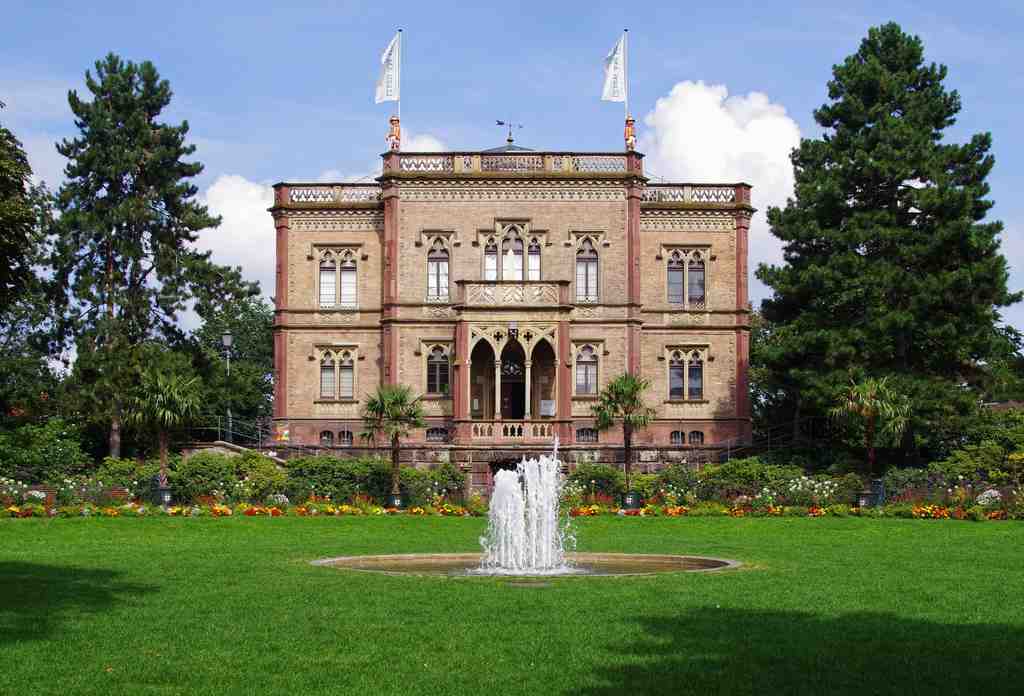
ColombischlösslePhoto: joergens.mi, Wikimedia Commons, CC BY-SA 3.0. Cropped & resized. On your left, look for a pale stone villa with steep gables, pointed windows, and a small turret that makes it feel like a private castle.
That little performance is entirely intentional. Most visitors admire the villa and miss the trick under their feet: Colombischlössle stands on the buried Bastion Saint Louis, an old fortification that workers filled in with roughly fifteen meters of earth before anyone planted a garden here. So beneath this polished residence lies an entire defensive work... Freiburg, never one to waste a good foundation.
This city has a habit of laying new identities over older ones without quite erasing them. A military bastion becomes a garden. A garden becomes an aristocratic home. That home turns into a museum, government offices, and courtrooms. You start to see the pattern: Freiburg keeps rewriting itself in plain sight.
Countess Maria Antonieta Gertrudis de Colombi y de Bode ordered this villa between eighteen fifty-nine and eighteen sixty-one as her widow’s residence. She hired the Freiburg architect Georg Jakob Schneider, who chose the Tudor Gothic style, a revival of late medieval English design. In the nineteenth century, architects called that habit historicism, which simply means using older styles on purpose to give a new building the authority of age. If you glance at the image on your screen, you can see how carefully Schneider staged the steep rooflines and noble profile.
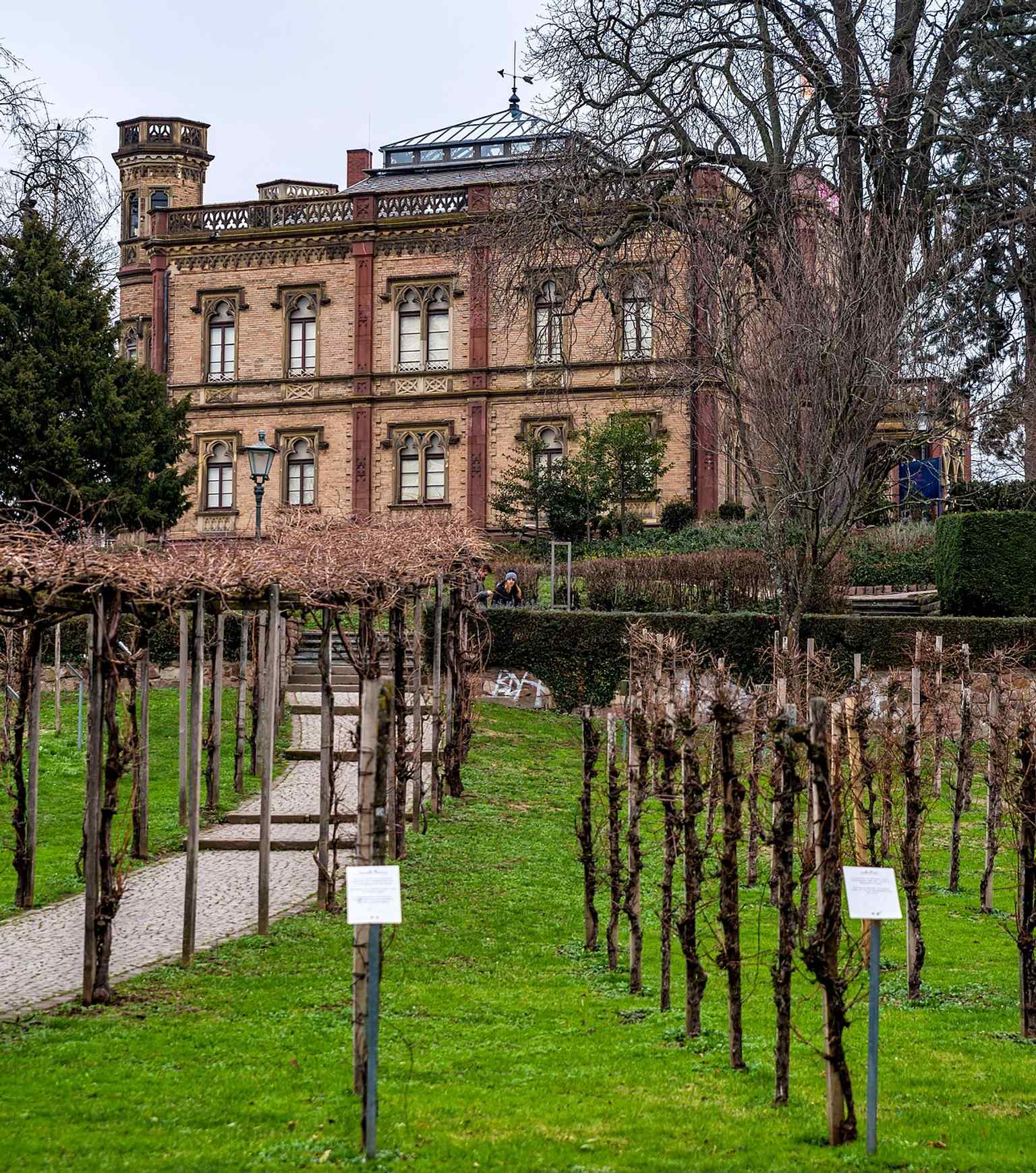
Front view of Colombischlössle, the historic Gothic Revival villa that now houses Freiburg’s Archaeological Museum.Photo: Joergens.mi, Wikimedia Commons, CC BY-SA 3.0. Cropped & resized. The bill came to about three hundred thousand goldmarks, roughly the equivalent of several million euros today, and that set local gossip humming nicely. Later newspaper stories said Freiburg speculated wildly about the Colombi family fortune, which gave the house an early aura of myth. Every city likes a rich family it can discuss at a safe distance.
Inside, the countess left plenty of evidence of her means: a grand stair hall, original inlaid parquet floors - wood fitted together in decorative patterns - and a bright glass dome overhead. The interior photo in the app gives you a glimpse of that polished world.
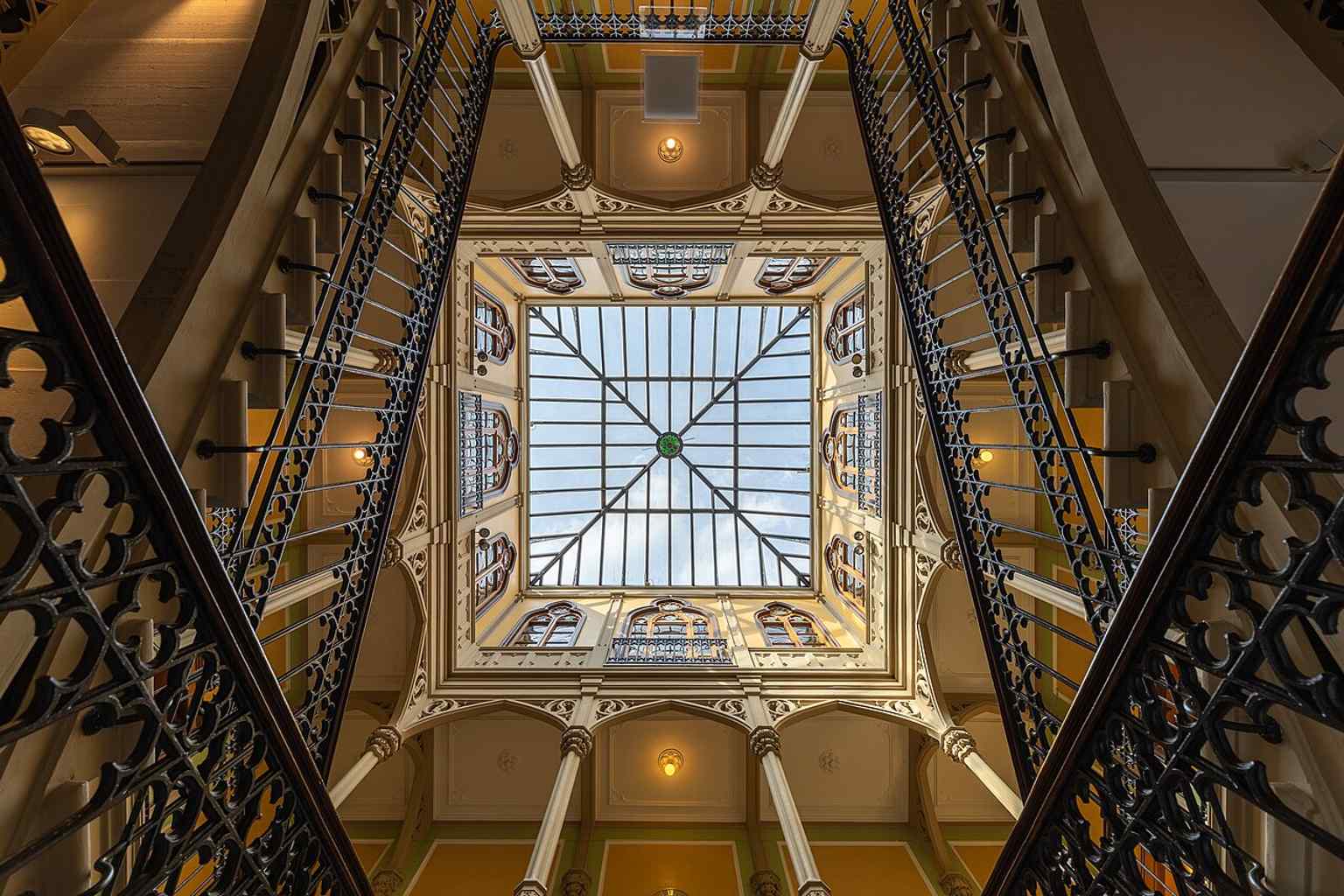
The stairwell and skylight inside Colombischlössle, highlighting the grand interior features that reflected the builder’s wealth.Photo: Martin Kraft, Wikimedia Commons, CC BY-SA 4.0. Cropped & resized. After the family, the story kept changing. Factory owner Johann Georg Thoma bought the estate, sold off part of the land for development, and gave Freiburg Colombistraße and Rosastraße, named for his wife Rosa. Then the city bought the villa in eighteen ninety-nine. It served as the municipal art museum from nineteen oh-nine to nineteen twenty-three, then as an administrative building, then from nineteen forty-seven to nineteen fifty-two as the state chancellery of Baden under Leo Wohleb. For a house built as a widow’s retreat, it developed a surprisingly public career.
One person worth remembering here is Georg Kraft, the scholar who helped Freiburg’s prehistoric collection stand on its own as a museum. He died in the bombing of nineteen forty-four, and after the war the collection drifted through provisional quarters for years. Only in nineteen seventy-eight did the city council decide to bring it back here, and in nineteen eighty-three the archaeological museum reopened in this villa.
Even the park around it joins the act: laid out in the style of an English landscape garden with exotic trees and a large fountain, it turned a former edge of defense into a place for strolling and looking. That is very Freiburg.
Reinvention here is not hidden in back streets; it sits right out in the open, wearing a turret as if it had always belonged. When you’re ready, head on to Freiburg Theatre, about seven minutes away. If you want to return later, the museum is closed on Mondays and otherwise usually opens from ten to five, with a later closing at seven on Wednesdays.
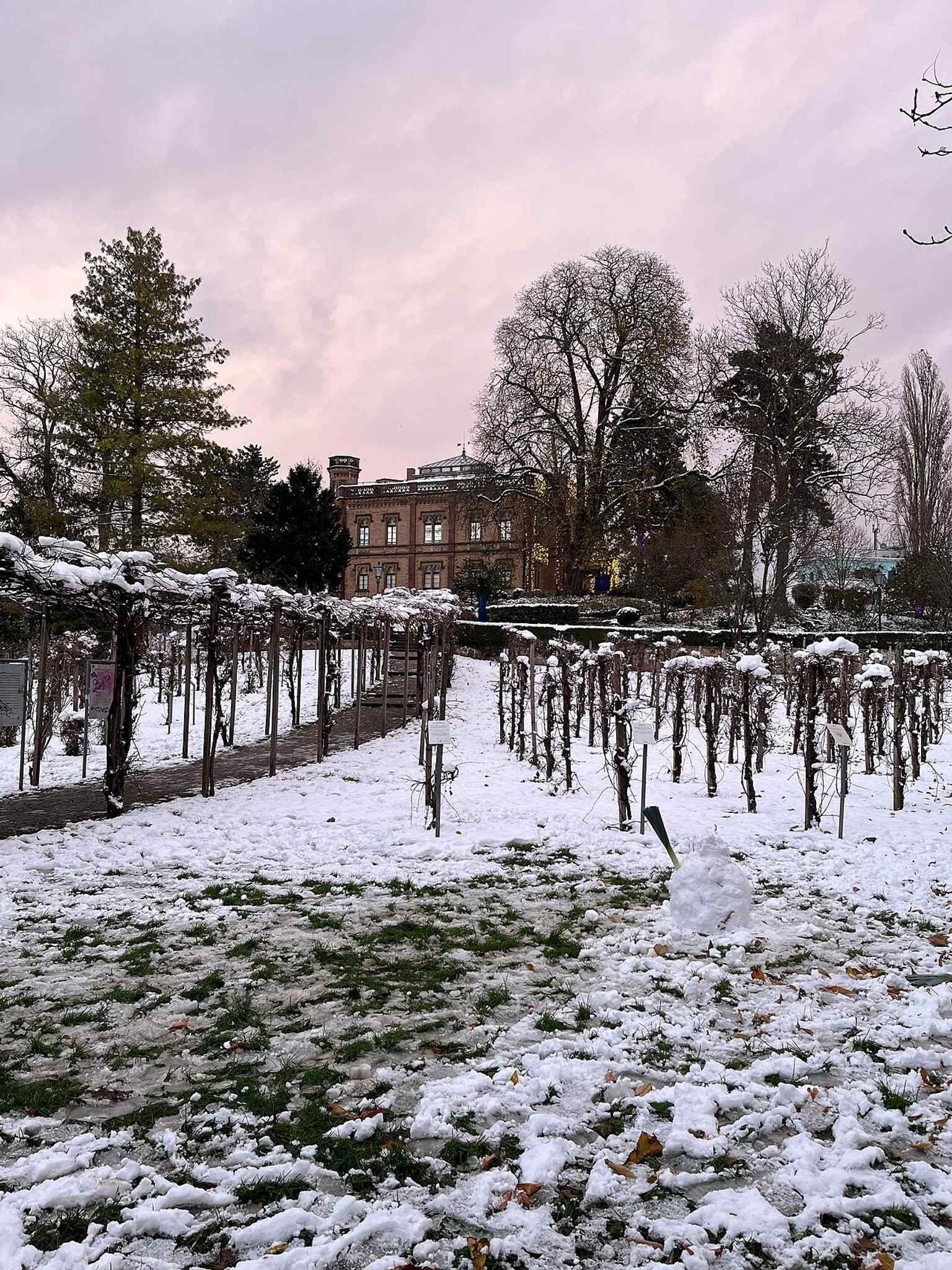
A recent exterior view of Colombischlössle in Freiburg, showing the villa as it stands today beside the park.Photo: Holder, Wikimedia Commons, CC BY-SA 4.0. Cropped & resized. Look for the broad pale stone facade with its curved central entrance block, tall vertical window bands, and the bold Theater Freiburg lettering above the doors. A theater is…Read moreShow less
Open dedicated page →Look for the broad pale stone facade with its curved central entrance block, tall vertical window bands, and the bold Theater Freiburg lettering above the doors.
A theater is the obvious home of performance... but a city performs too. Squares, facades, and entrances tell people who belongs, who holds power, and what kind of place this wants to be. Freiburg has been practicing that civic art for centuries, and this building became one of its clearest stages.
Professional theater here began because royalty needed entertainment. In May of seventeen seventy, Marie Antoinette passed through on her bridal journey, and the regional estates hired the Korn company to perform for the occasion. Those early shows took place in the Jesuit Gymnasium, then officials allowed more performances in the Kornhaus on Münsterplatz. By the seventeen nineties, Freiburg audiences were hearing Mozart here in town: The Abduction from the Seraglio in seventeen ninety-three, then The Magic Flute a year later. Not bad for a city still figuring out where to put its actors.
When the old spaces started feeling too cramped and outdated, Freiburg did something it would do more than once: it rewrote the setting. In eighteen twenty-three, architect Christoph Arnold converted the empty Augustinian church into a theater. Then in eighteen sixty-six, the city took the house over itself and opened its first municipal season with Lessing's Emilia Galotti. That matters, because once the city owns the stage, performance becomes a civic business, not just passing amusement.
The building in front of you arrived in the early twentieth century, when Mayor Otto Winterer and city architect Rudolf Thoma pushed for a proper modern theater on the former Dauphin bastion, part of Vauban's old fortifications. Berlin architect Heinrich Seeling designed it in a neo-Baroque style, and the theater opened in nineteen ten with Schiller's Wallenstein's Camp and part of Wagner's Meistersinger. If you tap the before-and-after image, you can see how this new playhouse once stood in a very different urban scene.
Then history, being history, barged in. The theater took a hit in the First World War, and bombing in November nineteen forty-four damaged it heavily. One of the most human chapters belongs to Mayor Wolfgang Hoffmann. He did not just argue for rebuilding; he sat at the piano and played fundraising concerts himself, bringing in one hundred and twenty thousand Deutsche Marks, roughly a few hundred thousand euros in today's buying power. Civic leadership, Freiburg style: part mayor, part concert artist, part emergency fundraiser.
When the house reopened in nineteen forty-nine, the city got practical. The lower levels housed the Kamera and Kurbel cinemas to help pay for reconstruction. High culture and commercial tickets under one roof... not glamorous, but very sensible. Later the building kept changing again: more stages moved in, and today it holds the Großes Haus, the Kleines Haus, and the Weltraum, along with concerts, readings, and youth work. Under Barbara Mundel, the theater pushed outward into city life and asked, "What kind of future do we want to live in?" In twenty ten, a sign above the entrance even flashed between "Heart" and "Art"... subtle it was not, but the point landed.
From here, we leave the place where Freiburg acts out its arguments and head toward the place where it stores them: the University Library, about a four-minute walk away. If you plan to come back, the theater is generally open Monday through Friday from ten to six, Saturday until one, and closed on Sunday.
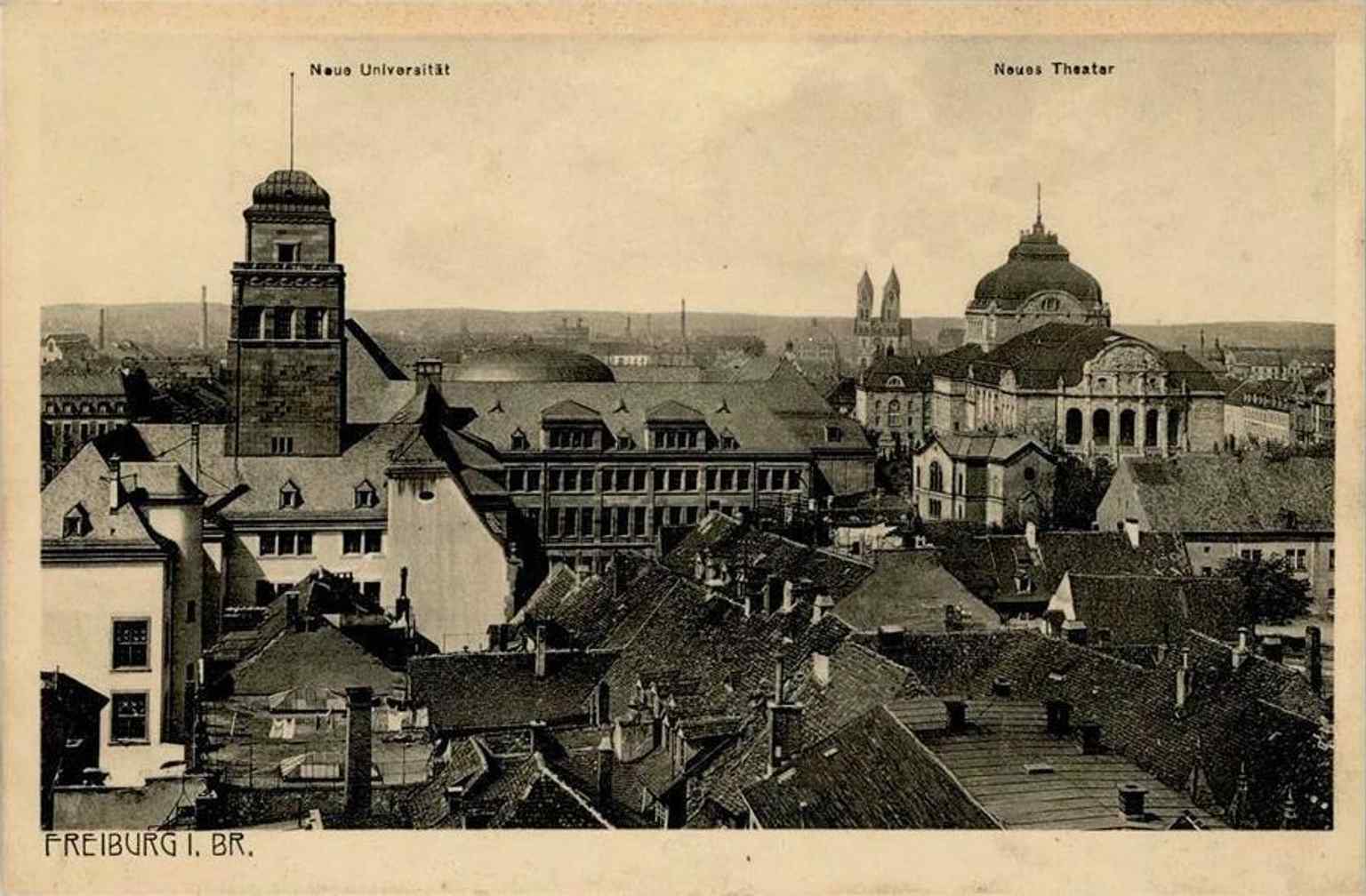
A 1912 postcard showing the new theatre beside the synagogue and university — a rare view of Freiburg’s cultural center just after the theatre’s 1910 opening.Photo: Unknown authorUnknown author, Wikimedia Commons, Public domain. Cropped & resized. 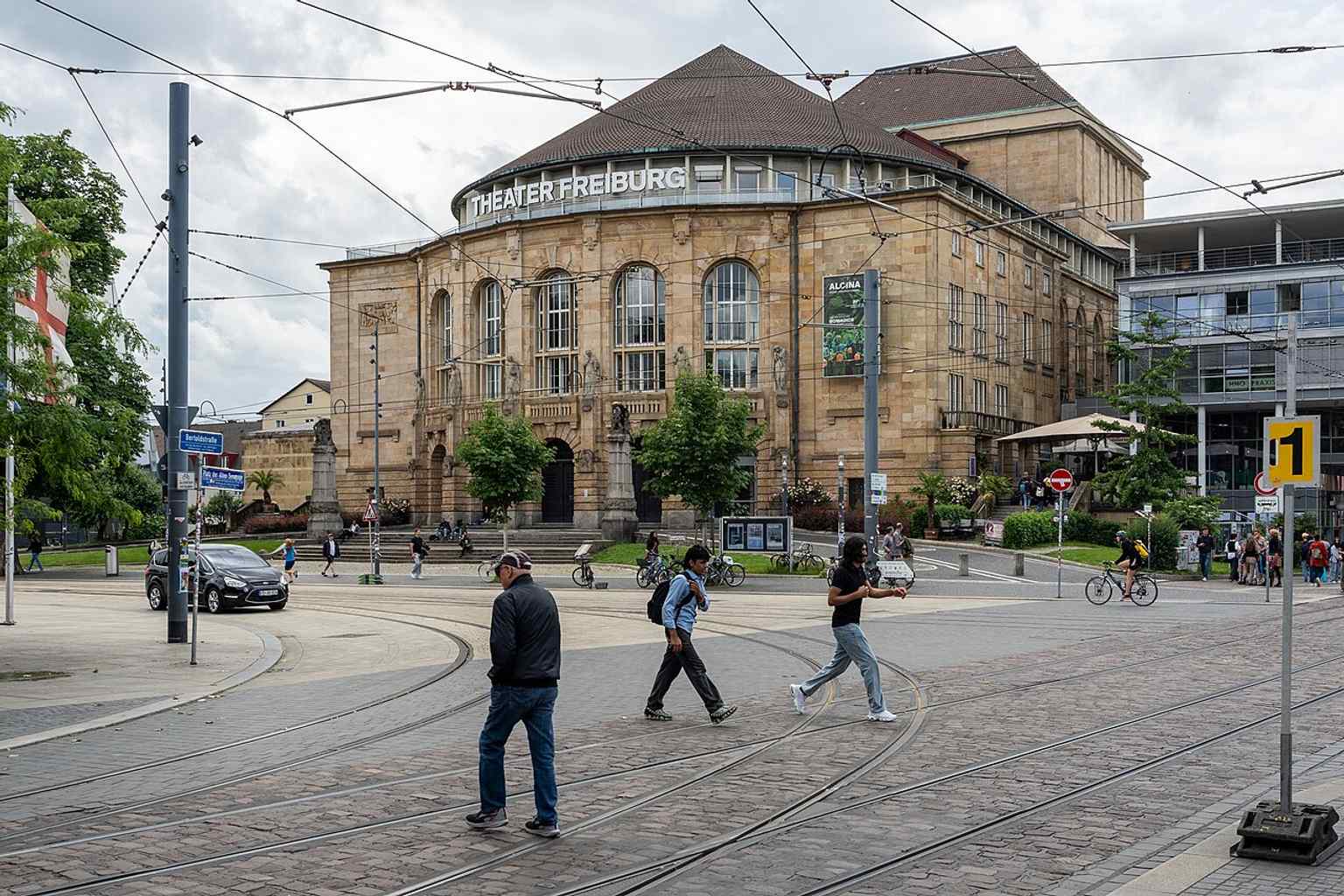
The modern front of Theater Freiburg, matching the building’s main entrance on Bertoldstraße and the redesigned façade seen today.Photo: JoachimKohler-HB, Wikimedia Commons, CC BY-SA 4.0. Cropped & resized. 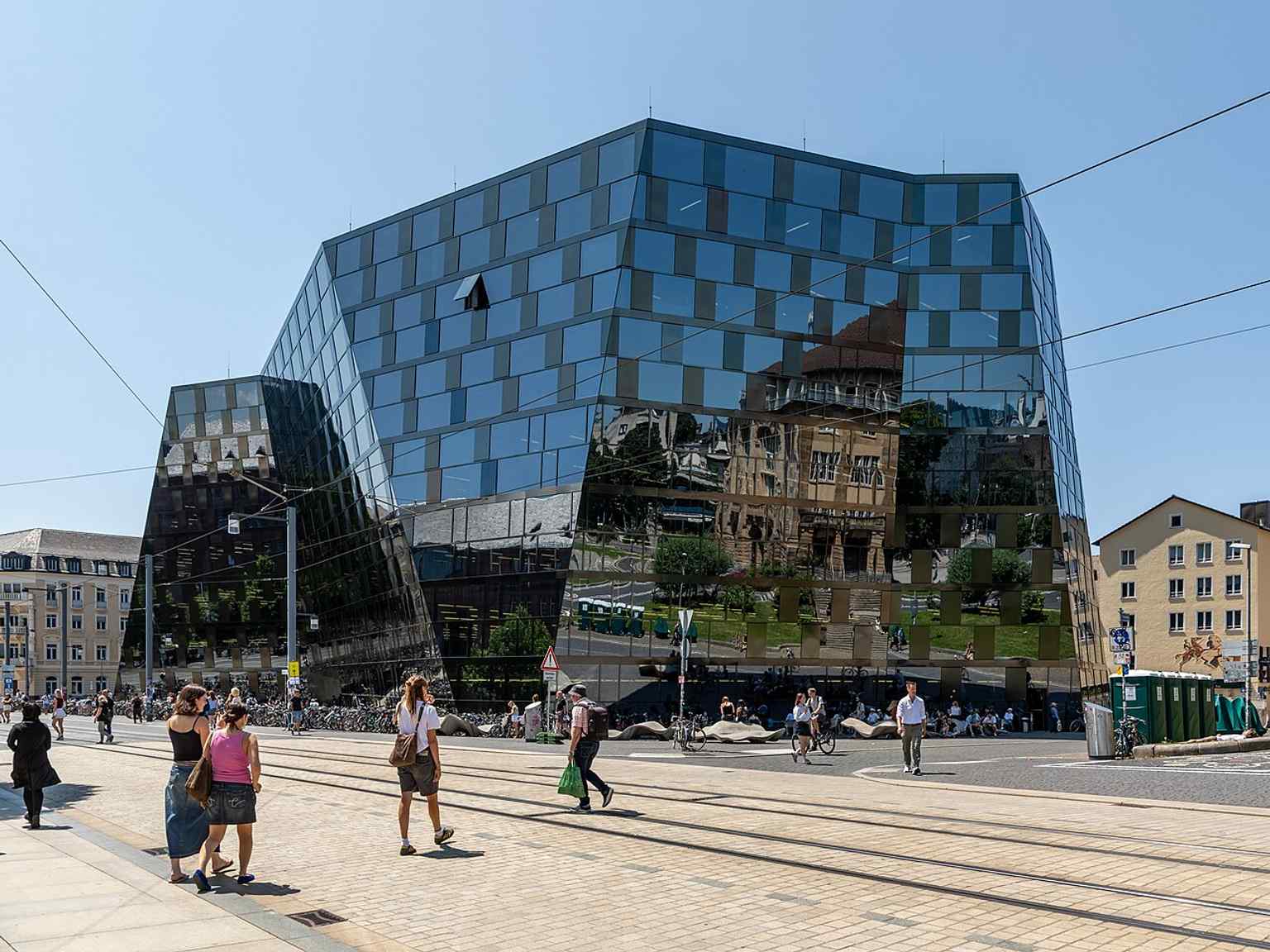
The theatre’s glassy neighbor on the square, showing how the area around Theater Freiburg has been transformed in the city center.Photo: Dietmar Rabich, Wikimedia Commons, CC BY-SA 4.0. Cropped & resized. 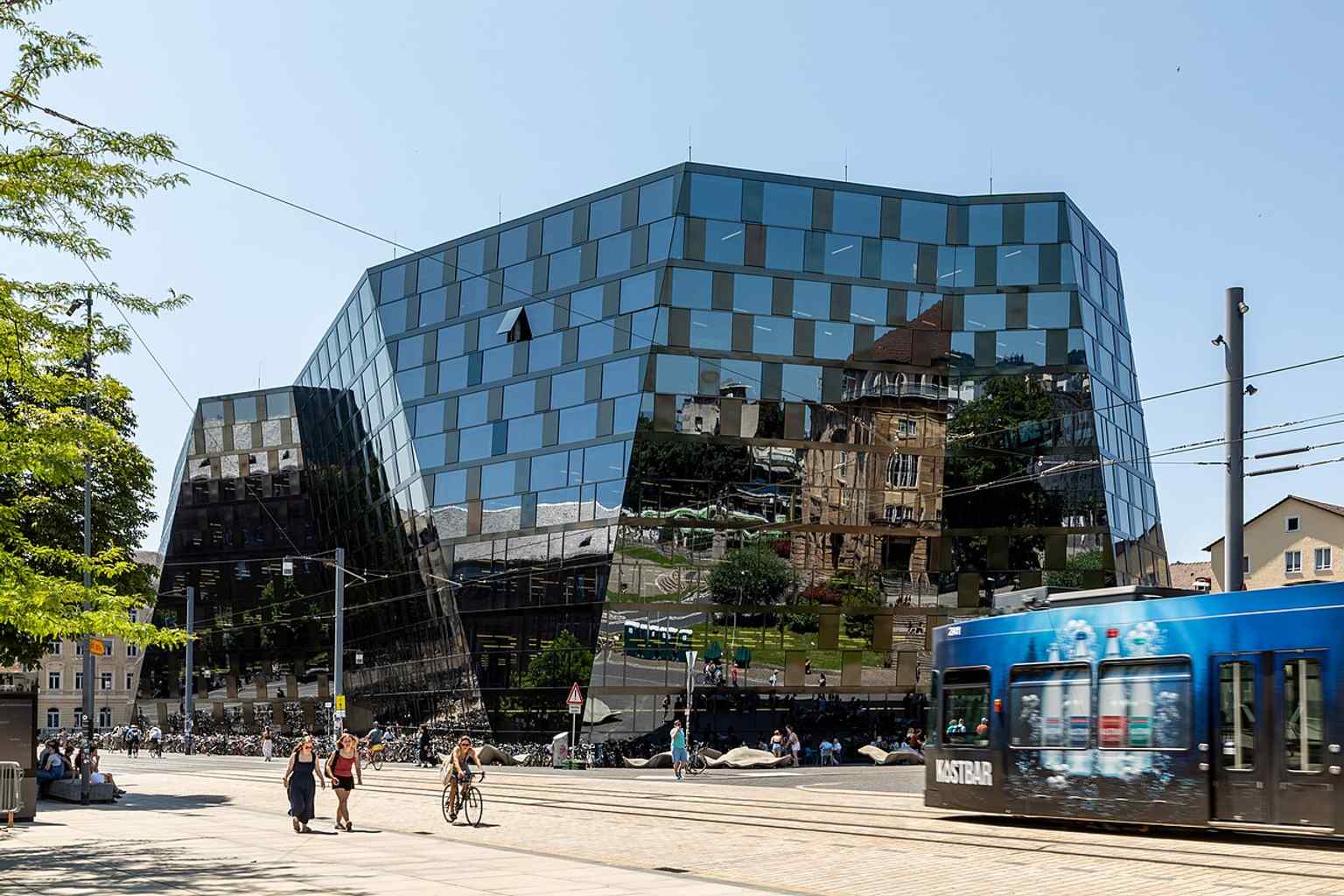
A street-level view with a tram at the theatre stop, reflecting how all Freiburg tram lines serve the stop 'Am Stadttheater'.Photo: Dietmar Rabich, Wikimedia Commons, CC BY-SA 4.0. Cropped & resized.
Show 12 more stopsShow fewer stopsexpand_moreexpand_less
On your right is a dark glass-and-chrome wedge, its sloping sides and mirrorlike skin turning the library into a sharp, reflective block in the street. This building looks…Read moreShow less
Open dedicated page →On your right is a dark glass-and-chrome wedge, its sloping sides and mirrorlike skin turning the library into a sharp, reflective block in the street.
This building looks almost futuristic, but the learning inside it is old enough to have wrinkles. Freiburg’s university dates to fourteen fifty-seven, and records mention its libraries by fourteen seventy; by fifteen oh five, senate notes already used the name bibliotheca universitatis, the university library. So what you’re seeing is not the birth of knowledge here... just its latest outfit.
For centuries, the books kept moving. First they lived in the New Town Hall with the young university. Later they moved into a former Jesuit building, where a baroque library hall stretched about thirty-five meters long, with wall-high shelves and a gallery running around the room. In nineteen oh three, architect Carl Schäfer gave the library a new neo-Gothic home on Rempartstraße. Then came a nineteen seventy-eight replacement that worked brilliantly inside, though outsiders sometimes mistook it for a parking garage.
Now take a second and study the facade. Notice how it reflects older buildings around it. Freiburg has a habit of layering one age over another, and this library makes that habit visible.
The current building came out of a two thousand six competition won by the Basel architect Heinrich Degelo. It opened in two thousand fifteen, nearly two years late, with dark matte chrome steel, triple glazing, and a big promise: modern study space, lower energy use, and room for serious academic life. Under director Antje Kellersohn, the library kept serving readers even during the rebuild, splitting itself between temporary quarters while the underground stacks still held millions of books. Institutional memory, in Freiburg, is stubborn in the best way.
And the scale is not small. This is the biggest library in southern Baden, one of the four largest in Baden-Württemberg, and it serves not only the university but the wider public as well. In two thousand twenty-four alone, it recorded more than four hundred seventy-three thousand loans and more than three million visits. That is less a quiet book shrine than a small republic of concentration.
If you want a wider view, check the image in the app and see how firmly the library plants itself in the city around it. It is also full of older treasures: manuscripts, early printed books, papyri, and founding documents from the university’s earliest days, now digitized so medieval paperwork can enjoy a second career online.
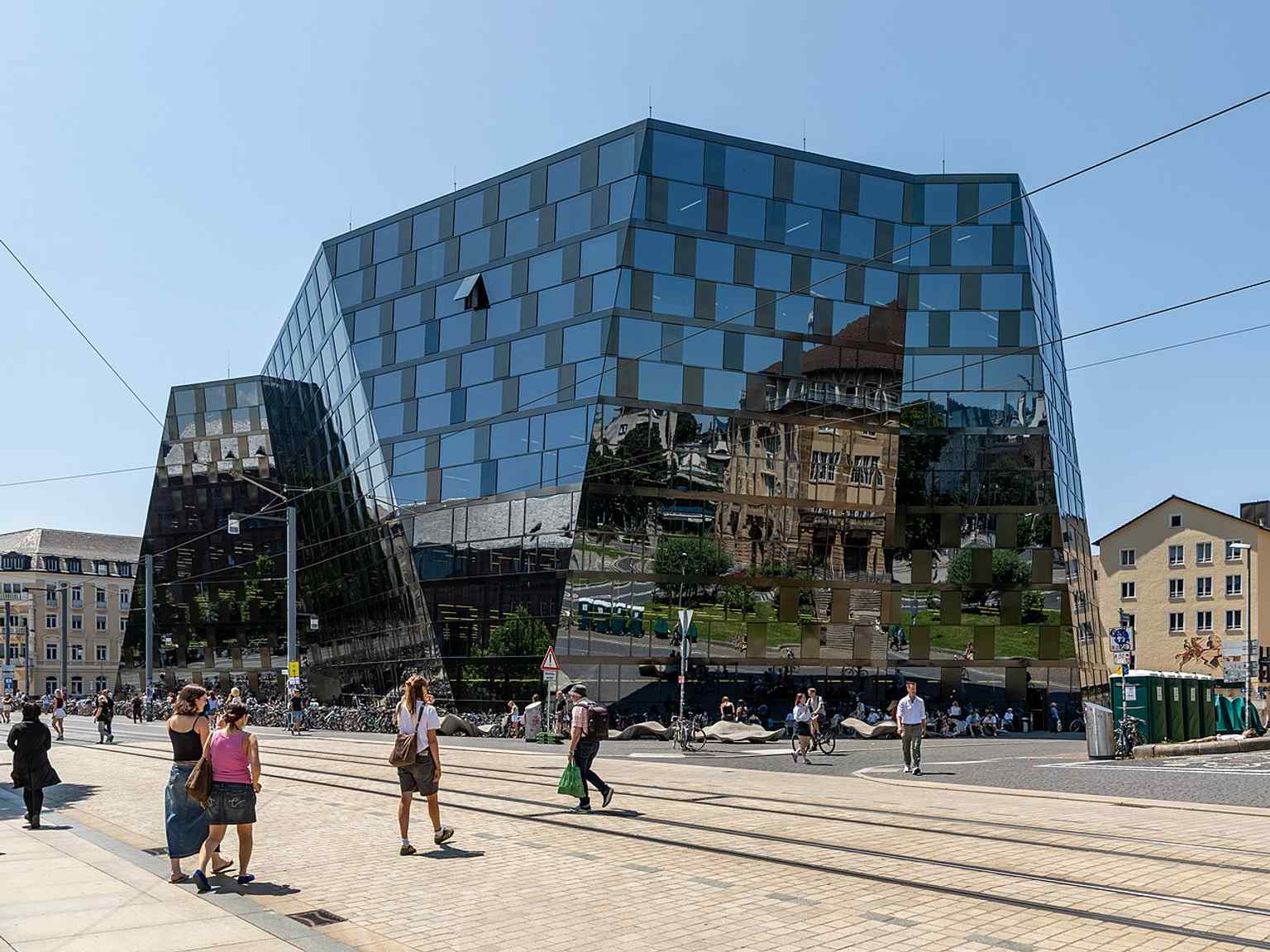
The library beside the Stadttheater area — a useful city-context shot that places the UB in central Freiburg.Photo: Dietmar Rabich, Wikimedia Commons, CC BY-SA 4.0. Cropped & resized. Next, we step from the keeper of memory to the institution that kept creating it: the University of Freiburg, about a one-minute walk away. And if you’re thinking of coming back, the library keeps generous hours, open daily from seven in the morning until midnight.
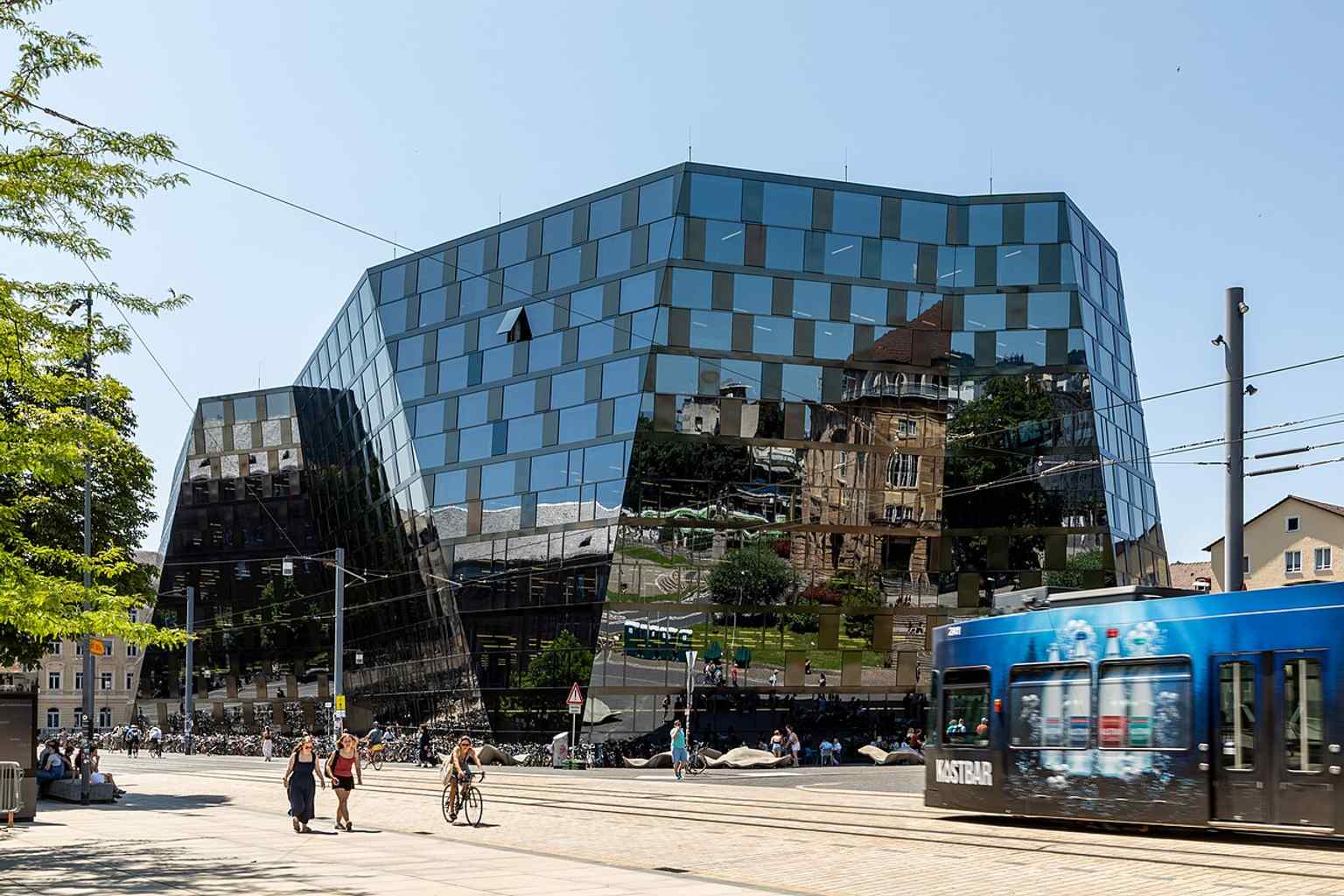
A street-level view with a tram nearby, showing how the university library is embedded in Freiburg’s transport network.Photo: Dietmar Rabich, Wikimedia Commons, CC BY-SA 4.0. Cropped & resized. Look for the pale stone university building with its broad rectangular facade, tall arched windows, and carved figures flanking the entrance. This is the University of Freiburg,…Read moreShow less
Open dedicated page →
University of FreiburgPhoto: Unbekannt bzw. Albert-Ludwigs-Universität Freiburg, Wikimedia Commons, Public domain. Cropped & resized. Look for the pale stone university building with its broad rectangular facade, tall arched windows, and carved figures flanking the entrance.
This is the University of Freiburg, founded in fourteen fifty-seven by Archduke Albert the Sixth of Austria. That makes it one of Germany’s oldest universities, but age is not really the point here. The point is momentum. This place kept pulling ideas, ambition, and argument into the middle of town for more than five centuries.
If you want the spirit of Humanist Freiburg in one place, start here. Scholars, reformers, and difficult minds kept gathering in this city, debating law, faith, philosophy, and public life... then sending those arguments far beyond Freiburg.
In the beginning, the university had four faculties: theology, philosophy, medicine, and law. Soon humanists like Johann Reuchlin and Jakob Wimpfeling arrived, and the jurist Ulrich Zasius helped turn Freiburg into a center for humanist law, meaning law studied through classical texts and critical reading, not just inherited habit. A nice reminder that even medieval institutions occasionally updated their software.
One of the most memorable battles here came in nineteen hundred. Johanna Kappes wanted to study medicine. The university rejected her. So she appealed directly to the Baden ministry, with help from Adelheid Steinmann and the university vice-president Gustav Steinmann. The ministry approved regular admission for women. Two weeks later, the university tried to take that right back, arguing that some lectures should not happen before mixed audiences. Academic resistance to change can be impressively creative. The attempt failed, and Kappes went on to study here, helping make Freiburg one of the first German universities to admit women.
This campus also produced brilliance with rough edges. Edmund Husserl taught here, and Martin Heidegger followed him. If you glance at your screen, you can put a face to Husserl’s formidable reputation. But the story darkens in nineteen thirty-three, when Heidegger became rector and tried to align the university with National Socialism. Jewish faculty were forced out, and Freiburg’s professors mostly stayed quiet, except for a small resistance group around Walter Eucken and Gerhard Ritter.
Then came the bombing raid of the twenty-seventh of November, nineteen forty-four. Around eighty percent of university buildings were destroyed, and many of the dead belonged to the university community. Students later helped rebuild it, physically and morally.
And that rebuilding never really stopped. If you want a quick visual of how sharply this campus keeps reinventing itself, just look at the mix of older and newer buildings around you.
Today the university stretches across eleven faculties, links itself to twenty-two Nobel laureates, and still shapes the city well beyond its lecture halls. In Freiburg, ideas do not stay indoors for long. They spill into squares, protests, memorials, and monuments... and our next stop, Bertoldsbrunnen, proves that nicely.
Look for a pale stone pedestal rising from a shallow basin, topped by a lean bronze rider whose whole silhouette narrows like a pointed Gothic arch. This is Bertoldsbrunnen, but…Read moreShow less
Open dedicated page →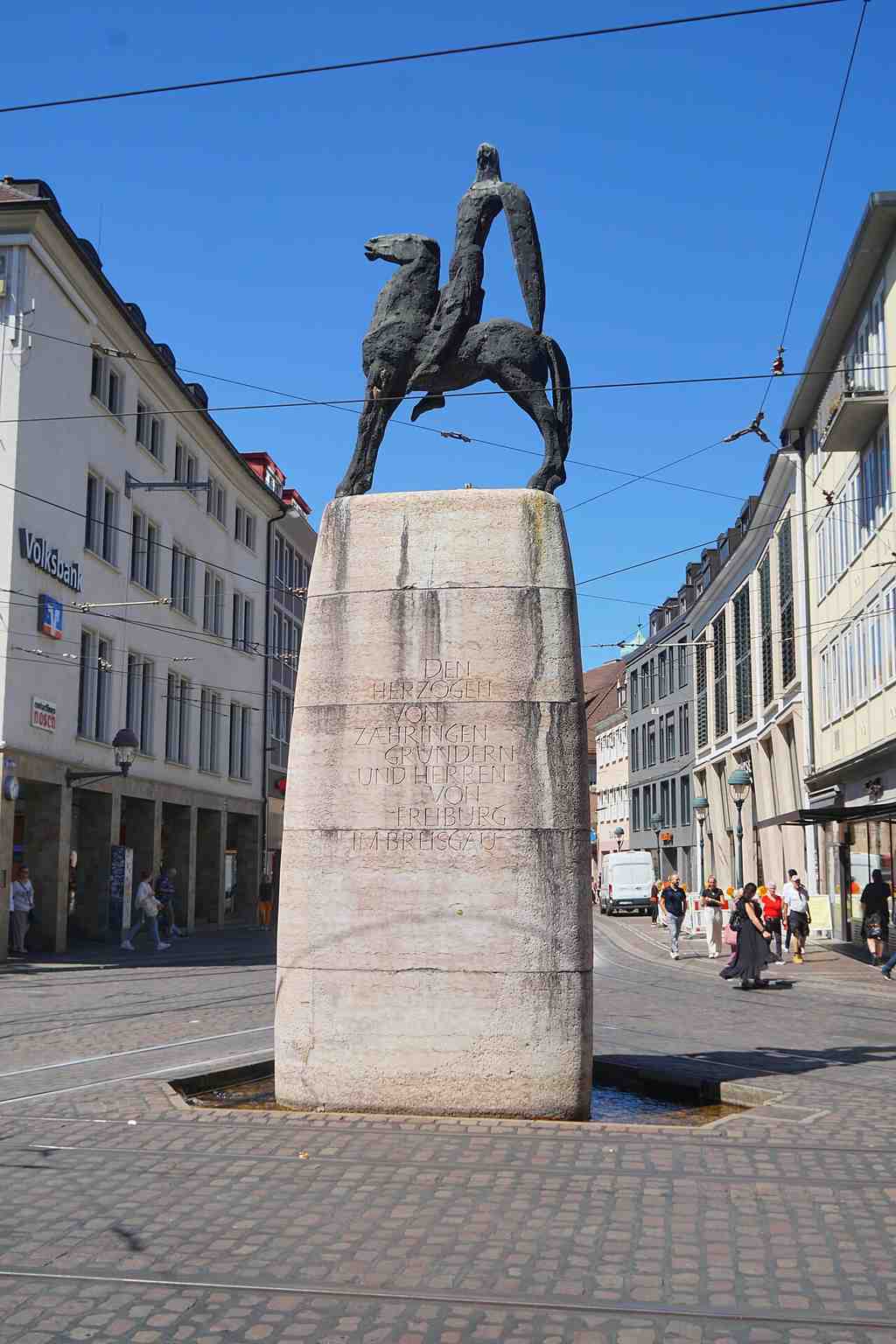
BertoldsbrunnenPhoto: Giftzwerg 88, Wikimedia Commons, CC BY-SA 3.0. Cropped & resized. Look for a pale stone pedestal rising from a shallow basin, topped by a lean bronze rider whose whole silhouette narrows like a pointed Gothic arch.
This is Bertoldsbrunnen, but don’t let the modest fountain fool you. This is political symbolism in stone. Right here at Freiburg’s busiest crossroads, the city planted a message in plain sight about who ruled it, who founded it, and who people were now expected to salute.
Until eighteen oh six, a different fountain stood here: the Fischbrunnen. Then the Napoleonic upheavals shuffled borders, Freiburg left its long Habsburg orbit, and the city needed a new public script. So officials moved the old fish fountain north to make room for a new monument in eighteen oh seven, honoring the oath Freiburgers had sworn to Karl Friedrich of Baden. Most tourists miss the sharp little point there: even moving the old fountain was part of the statement. Urban planning, Freiburg style... not just traffic management, but political choreography.
The first Bertoldsbrunnen praised more than one figure. It nodded to Karl Friedrich, but also to Berthold the Third of Zähringen, Freiburg’s founder, to Konrad the First, linked to the Minster, and to Albert of Austria, founder of the university. At a crossroads like this, that mattered. A monument tucked in a courtyard whispers. One placed where everyone passes, shops, argues, and catches a tram makes its case out loud.
Ferdinand Weiß, a city councilman, drafted the plan, and Baden’s chief architect Friedrich Weinbrenner reworked it. Sculptor Franz Anton Xaver Hauser gave the original fountain an armored Berthold with shield and spear, facing east toward the Zähringer ancestral castle. Even the direction had meaning. Nothing neutral about that.
Then came the air raid of the twenty-seventh of November, nineteen forty-four, and the monument vanished in the destruction. A sculptor named Hugo Knittel offered to recreate the old figure for free, using prewar photographs by Annemarie Brenzinger. But Joseph Schlippe, the man steering postwar rebuilding, said no. He wanted something “timeless,” not a copy. So in nineteen sixty-five, Nikolaus Röslmeir’s new version appeared: more abstract, with a bronze rider and a Gothic-arch outline that quietly nods toward the Minster you’ll see later. Many locals hated it at first. Grief has strong opinions.
If you want to see how much this crossroads changed, check the before-and-after image in the app.
Since nineteen seventy-nine, the fountain has stood in the middle of the junction, set into a low basin fed by Dreisam water, like Freiburg’s little Bächle channels. Four of the city’s five tram lines stop here, and locals simply call the place “Berti.” That may be the best proof that a monument can become part memorial, part meeting point, part public stage.
So here’s the question to carry with you: when a monument sits in the middle of daily life, can it ever be just decoration... or does each generation turn it into a new argument?
We’ll head next to the Victory Monument, about five minutes away, where the argument gets larger and a lot more martial. And yes, Berti is here all day, every day.
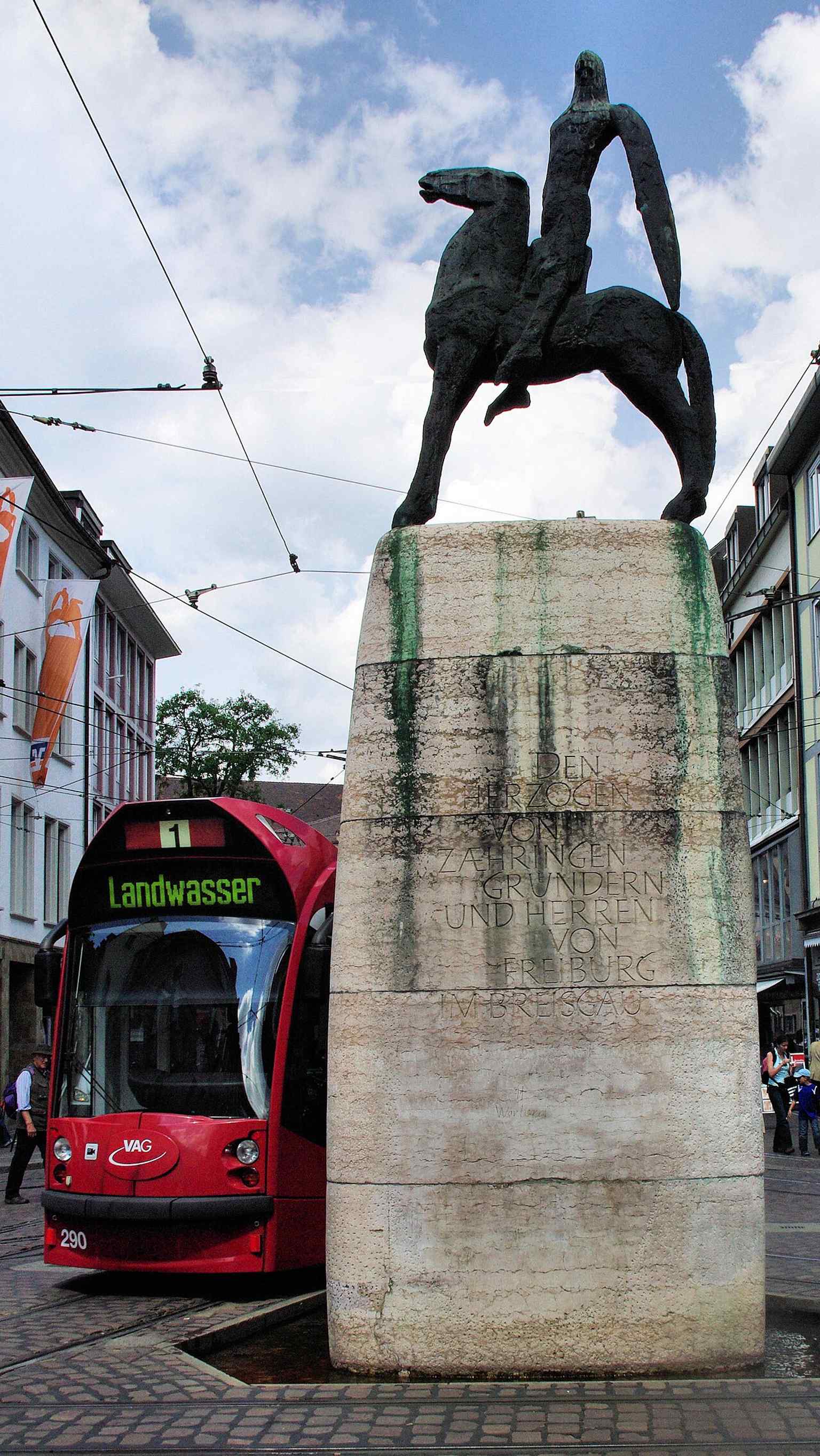
A close view of the fountain fed by the city’s famous Bächle, a detail that ties the monument to Freiburg’s water system.Photo: user:Joergens.mi, Wikimedia Commons, CC BY-SA 3.0. Cropped & resized. 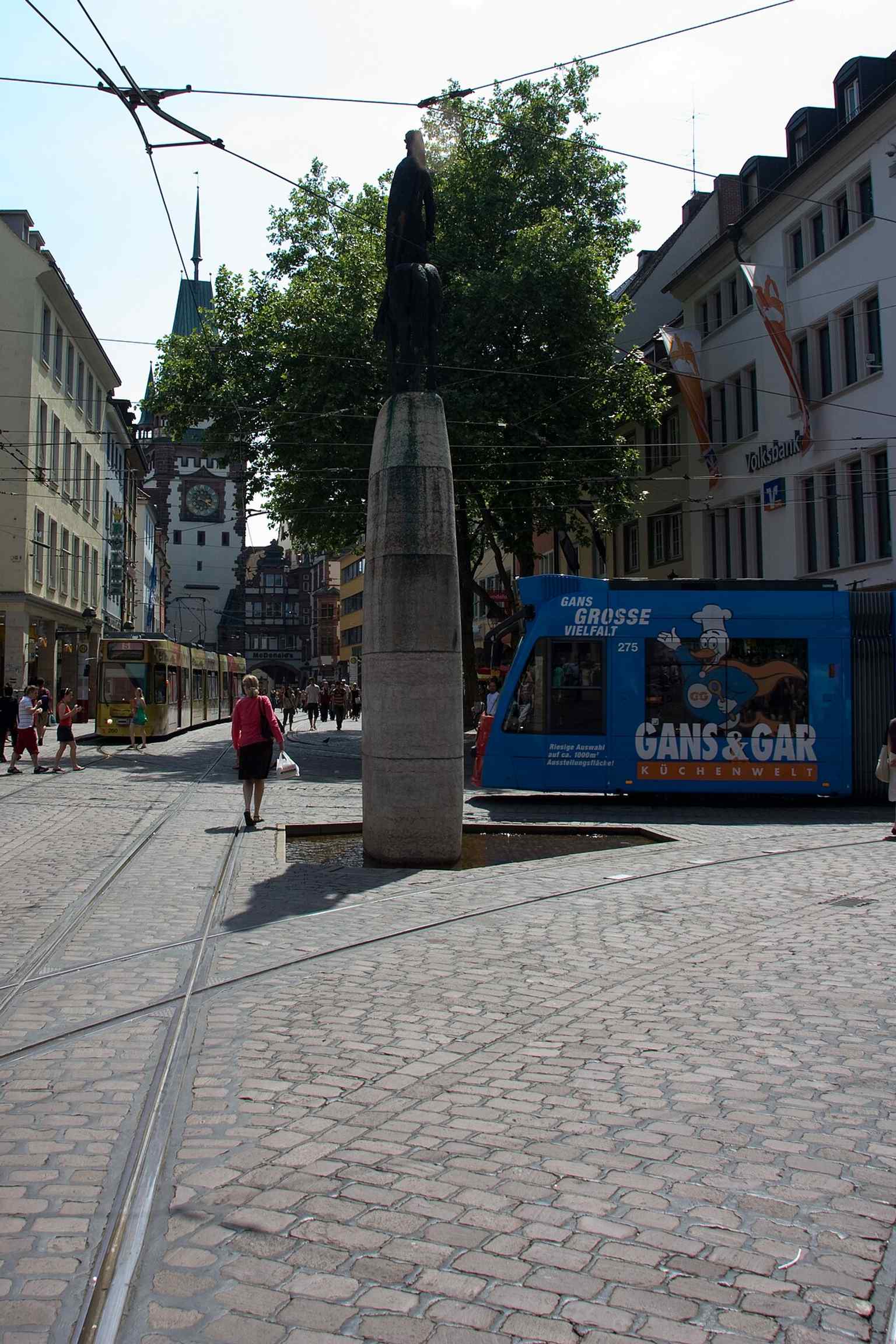
Trams passing the Bertoldsbrunnen — four of Freiburg’s five tram lines stop here, making it a true transport hub.Photo: Poudou99, Wikimedia Commons, CC BY 3.0. Cropped & resized. 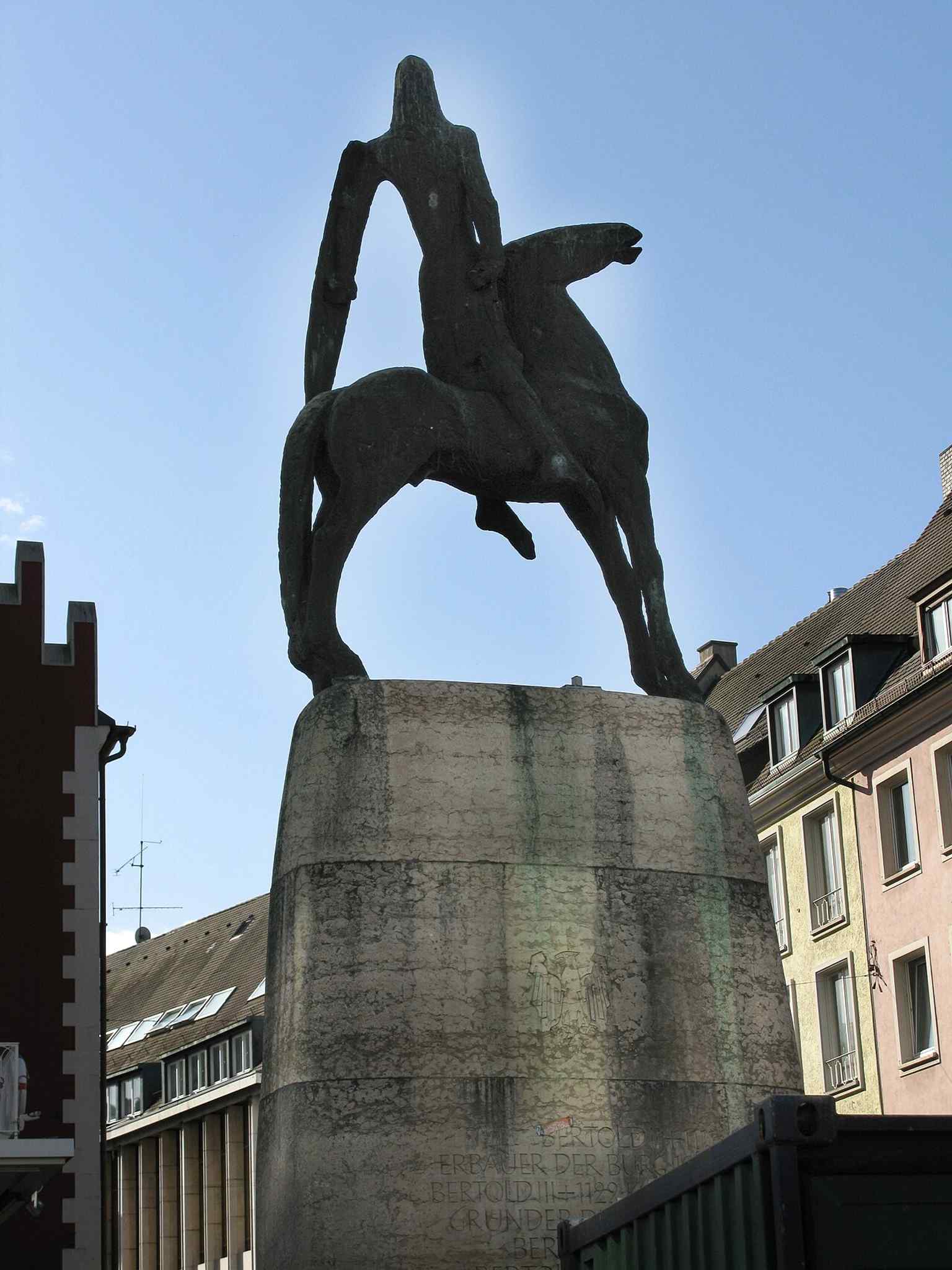
The monument during the 2014 works, when the overhead wires were removed and the plaza was temporarily cleared for construction.Photo: Andreas Schwarzkopf, Wikimedia Commons, CC BY-SA 3.0. Cropped & resized. 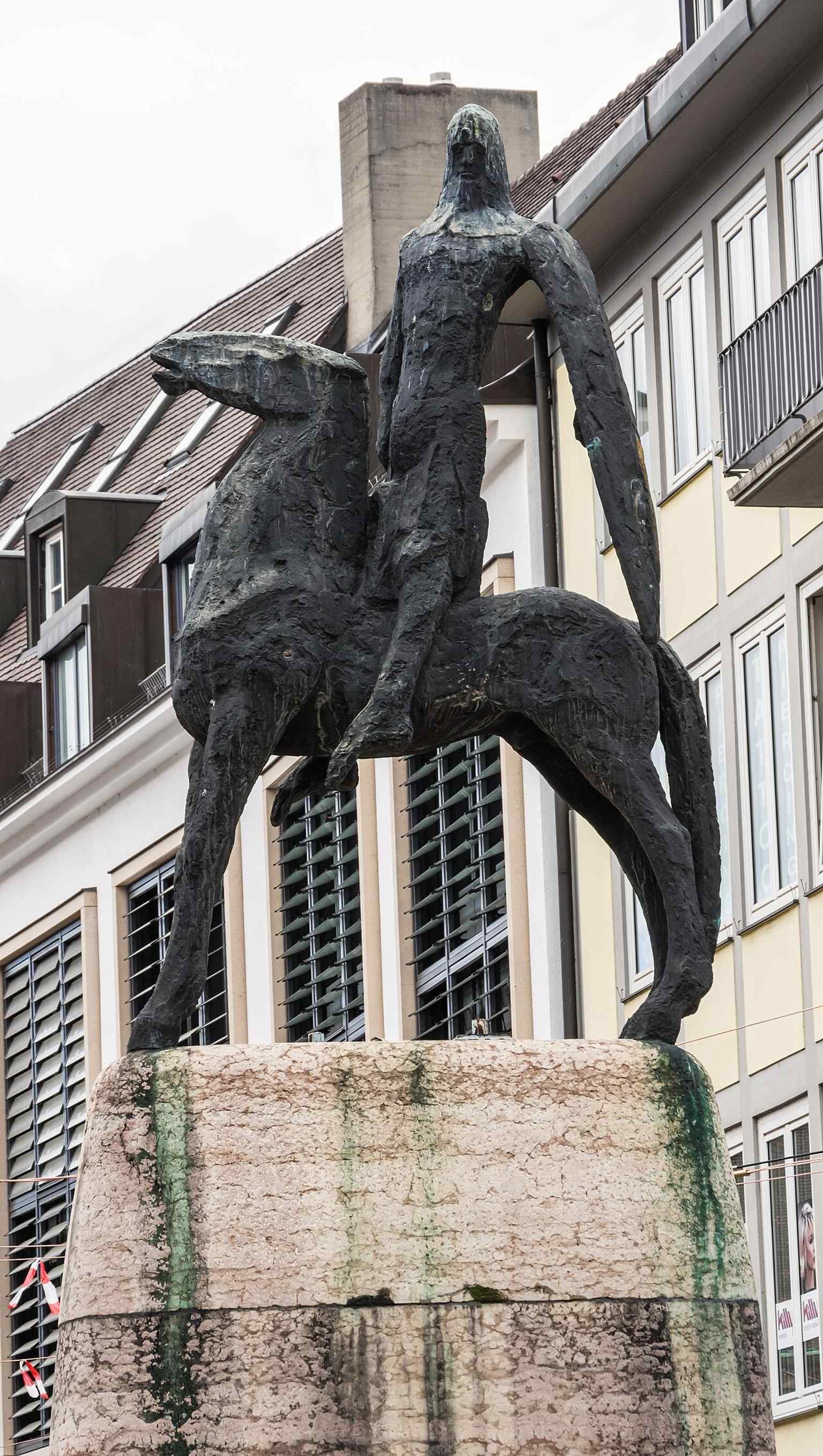
The bronze rider in a wire-free view, showing the abstract postwar figure that replaced the destroyed prewar statue.Photo: joergens.mi, Wikimedia Commons, CC BY-SA 3.0. Cropped & resized. 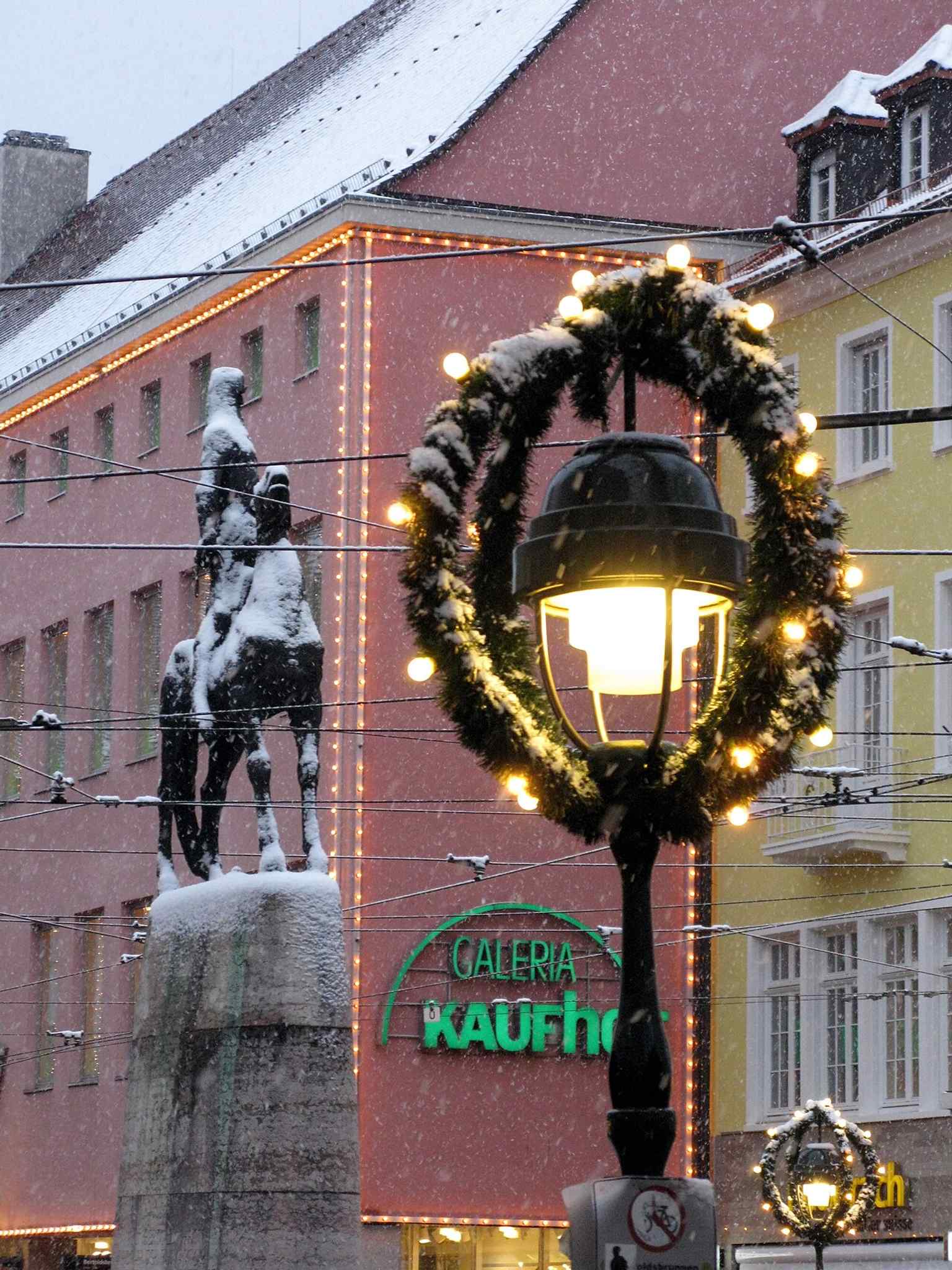
Bertoldsbrunnen in winter lights and snow, a popular city-center landmark that also becomes part of Freiburg’s seasonal decorations.Photo: Andreas Schwarzkopf, Wikimedia Commons, CC BY-SA 3.0. Cropped & resized. 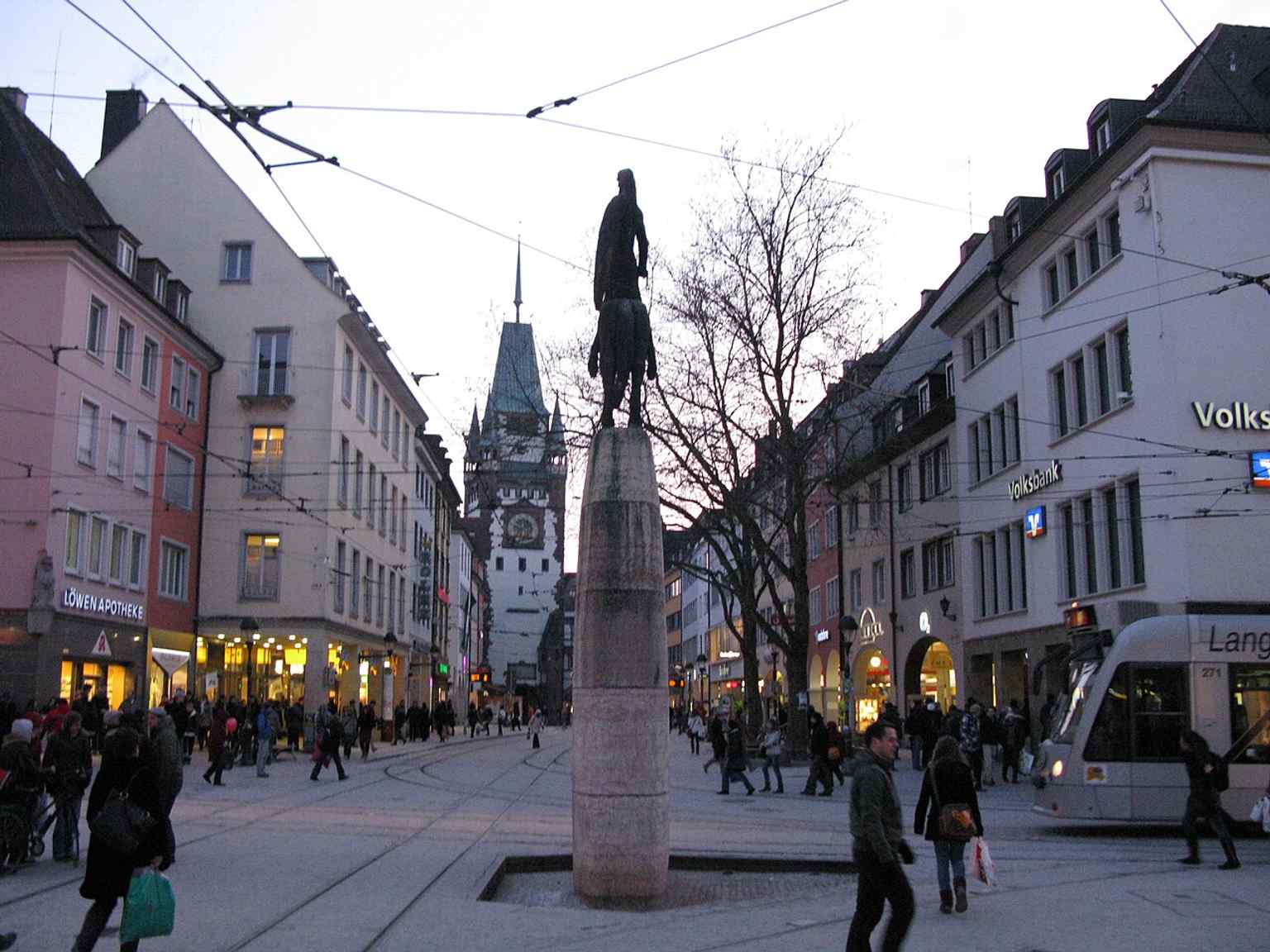
The fountain on Kaiser-Joseph-Straße with Martinstor in the background, placing Bertoldsbrunnen within Freiburg’s historic core.Photo: Andreas Schwarzkopf, Wikimedia Commons, CC BY-SA 3.0. Cropped & resized. 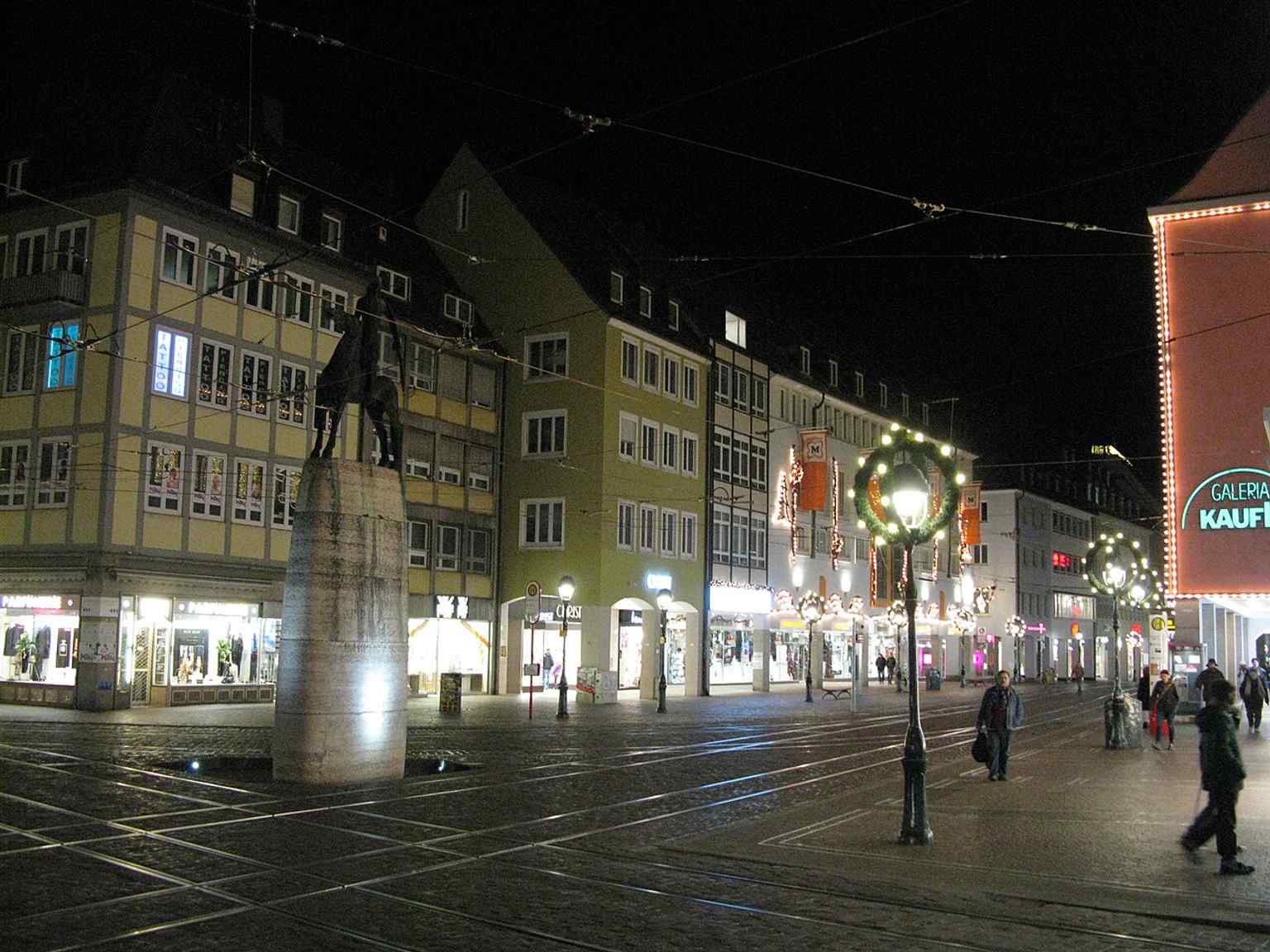
Christmas lights and the Bertoldsbrunnen on Freiburg’s main shopping street, emphasizing its role as a central meeting point.Photo: Andreas Schwarzkopf, Wikimedia Commons, CC BY-SA 3.0. Cropped & resized. 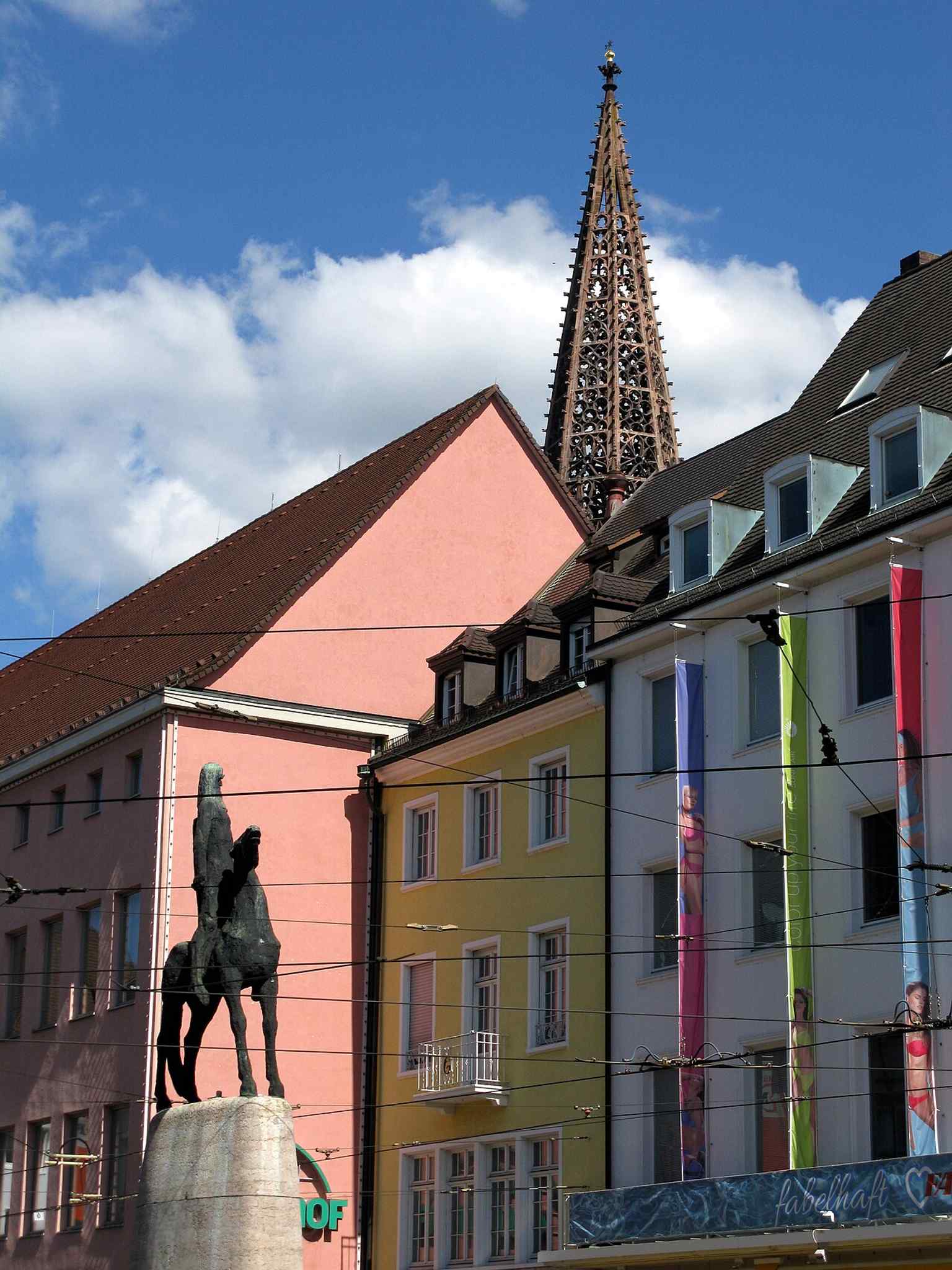
The fountain with Freiburg Minster in the background, linking the modern monument to the city’s medieval heritage.Photo: Andreas Schwarzkopf, Wikimedia Commons, CC BY-SA 4.0. Cropped & resized. 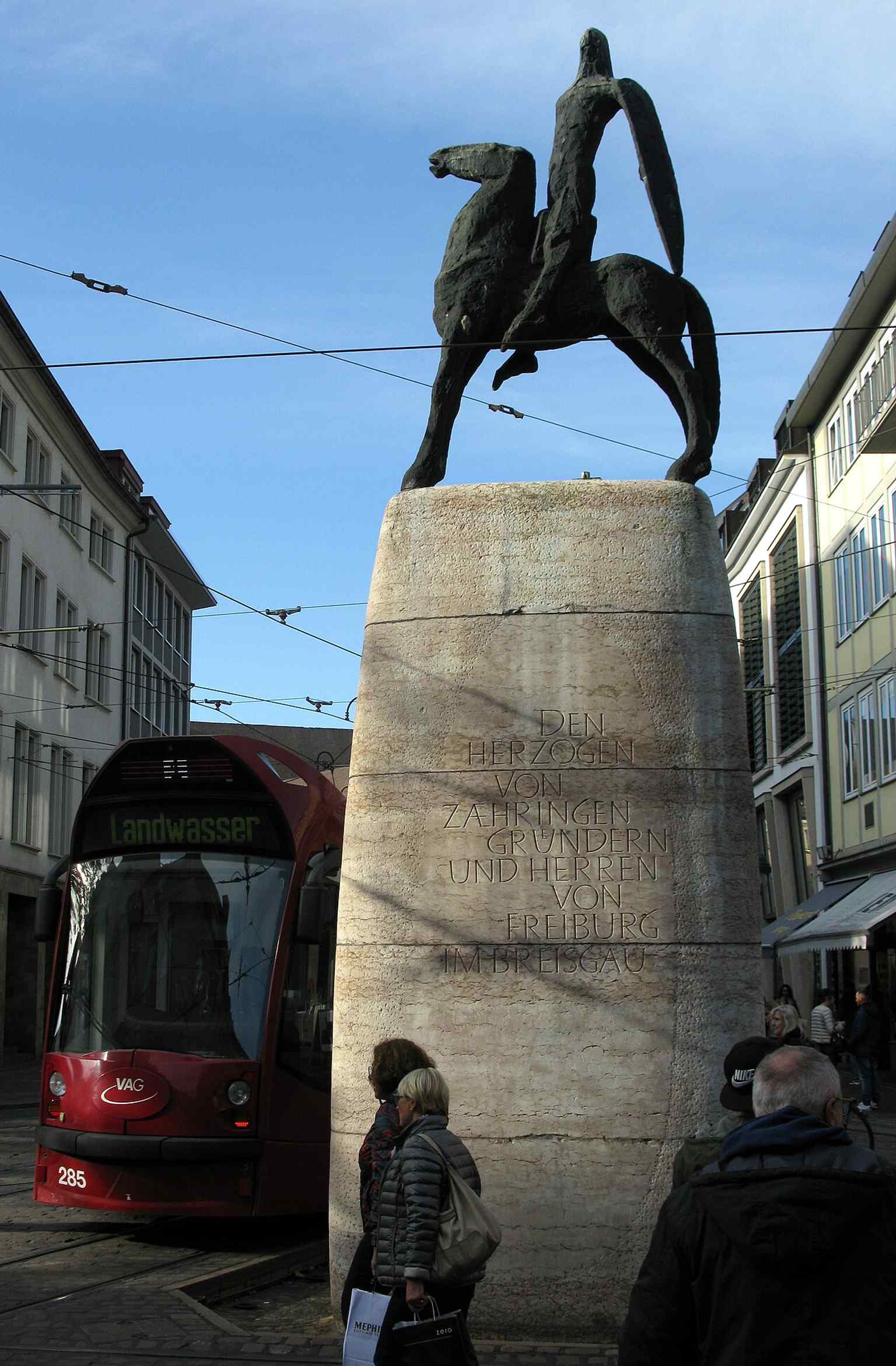
A clear street-level view of the modern Bertoldsbrunnen, showing how the monument stands at the heart of pedestrian traffic.Photo: Andreas Schwarzkopf, Wikimedia Commons, CC BY-SA 4.0. Cropped & resized. 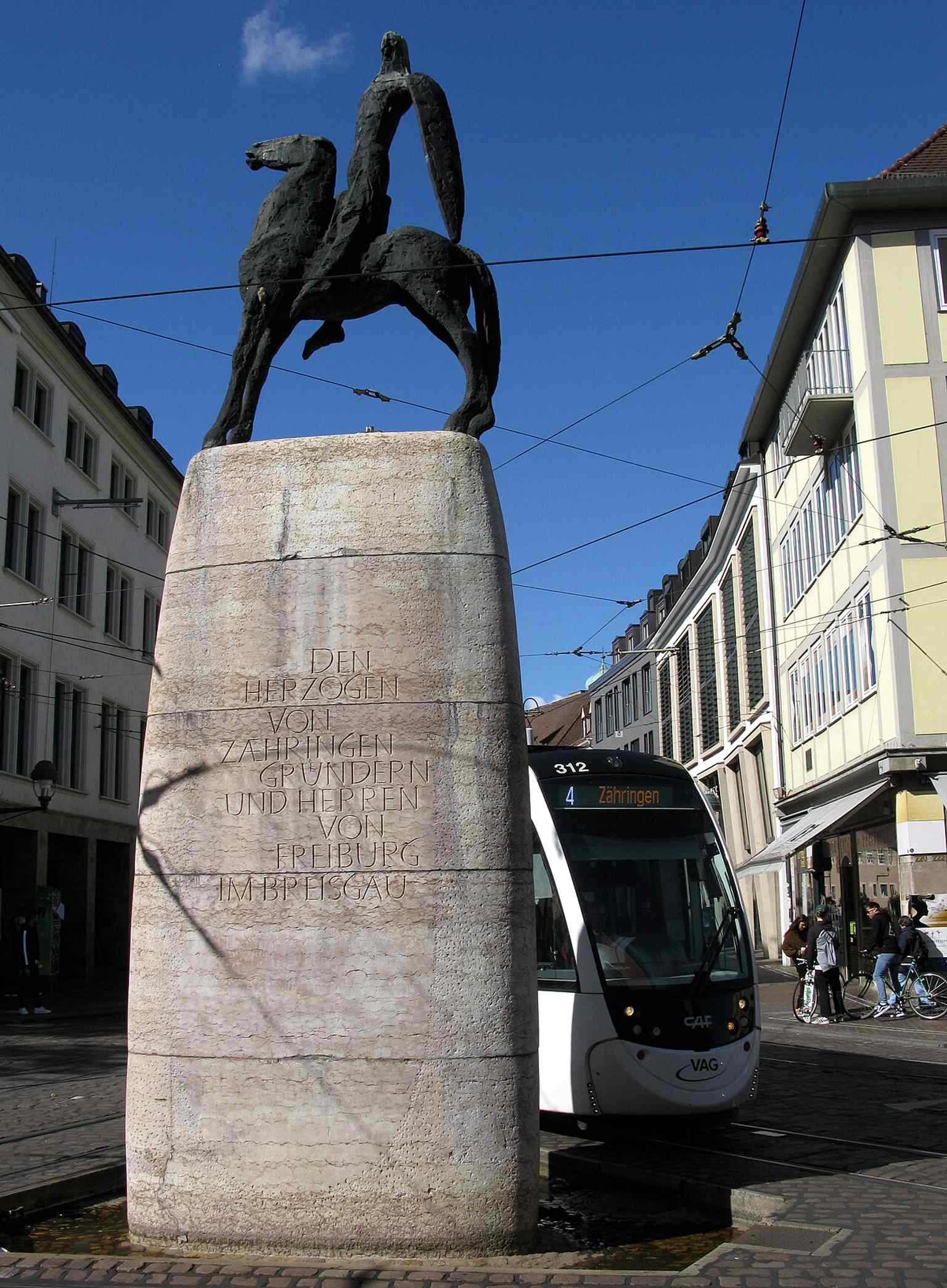
A tram gliding past the Bertoldsbrunnen, a good illustration of the square’s constant mix of public transport and city life.Photo: Andreas Schwarzkopf, Wikimedia Commons, CC BY-SA 4.0. Cropped & resized. On your left rises a dark granite monument with rounded corner plinths, topped by a bronze Victory goddess standing on a half-globe and lifting a laurel wreath. This is…Read moreShow less
Open dedicated page →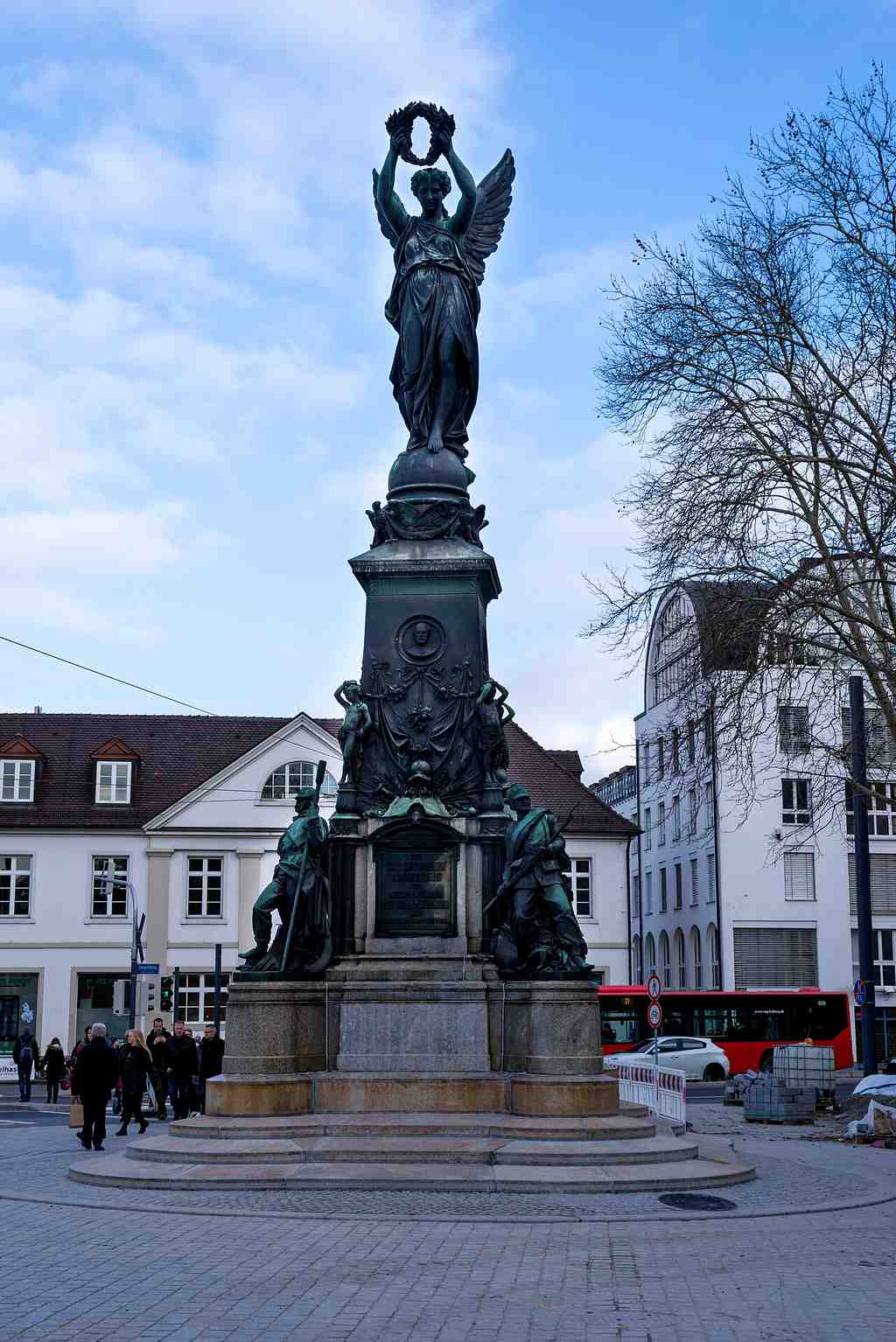
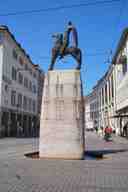
Victory Monument (Freiburg im Breisgau)Photo: joergens.mi, Wikimedia Commons, CC BY-SA 3.0. Cropped & resized. On your left rises a dark granite monument with rounded corner plinths, topped by a bronze Victory goddess standing on a half-globe and lifting a laurel wreath.
This is Freiburg’s Siegesdenkmal, the Victory Monument... and it shows how public memory rarely sits still, even when the bronze does. It began as a celebration of war, then became an argument about war, and now stands in a square with a newer, more careful voice around it.
The monument honors the fourteenth German Army Corps, made up largely of soldiers from Baden, under General August von Werder in the Franco-Prussian War of eighteen seventy-one. A wave of victory fever swept through the region, and donors from Lörrach to Karlsruhe paid for this monument to stand here in the middle of Baden. The sculptor Karl Friedrich Moest won a national design competition, judged by some very serious artistic heavyweights, including Gottfried Semper. Moest gave Freiburg not just a goddess on top, but four soldiers below: three still fighting, and one artilleryman collapsing in death. That last figure keeps the triumph from becoming too neat. Bronze has a way of bragging... but it also remembers the bill.
If you glance at the image in the app, you can see the monument after its recent return near its original setting. It first went up in eighteen seventy-six, with Kaiser Wilhelm the First, Otto von Bismarck, and General von Werder all present for the unveiling. The whole project cost eighty-five thousand marks, roughly the value of several hundred thousand euros today, and some of the bronze came from captured cannon barrels. Victories, apparently, like recycling.
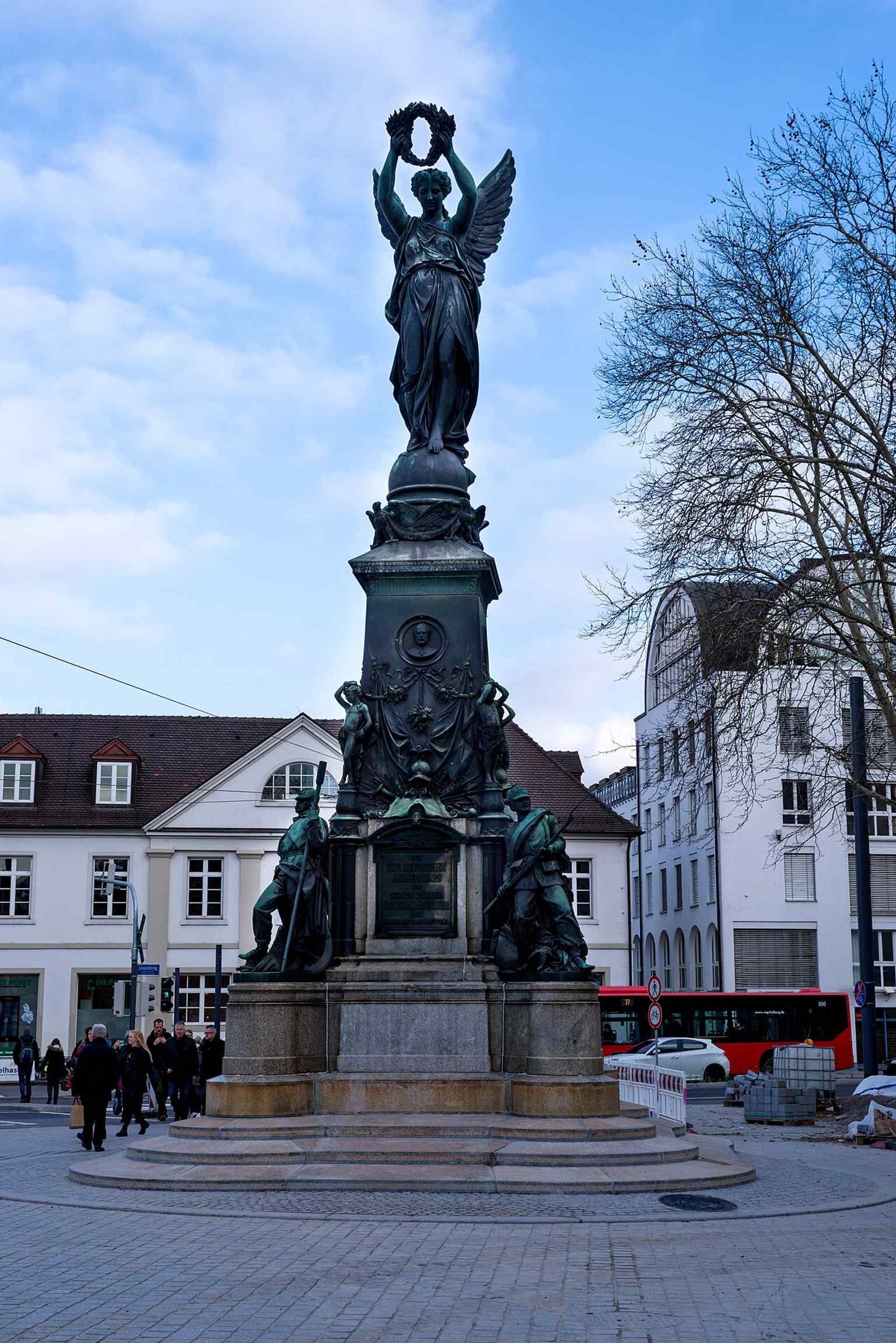
The restored Victory Monument at Europaplatz in Freiburg, shown after its 2017 return near the old Karlskaserne site.Photo: joergens.mi, Wikimedia Commons, CC BY-SA 3.0. Cropped & resized. Here’s the part most visitors miss: official place names around this square kept changing. Wilhelmplatz, Kaiser-Wilhelm-Platz, then eventually Europaplatz. But locals mostly ignored the paperwork and just kept calling the place Siegesdenkmal. Public memory quietly overruled the city register.
The monument also survived the twentieth century by argument as much as by stone. In nineteen forty, the Nazi Gauleiter, the regional party leader, Robert Wagner, pushed to have it melted down as a birthday gift for Hitler. City figures including Franz Kerber resisted, and the monument stayed. Then in the bombing of November nineteenth forty-four, the nearby Karlskaserne was destroyed, while the monument remained standing, almost indecently intact. In nineteen sixty-two, traffic engineers shoved it about one hundred meters west because it was in the way. Then, during the rebuilding of the tram line, the city moved it back in twenty seventeen, nearly to where it had begun.
So this monument keeps changing without changing: same Victoria, same granite, new surroundings, new explanations, and more skeptical eyes. At Bertoldsbrunnen, civic symbolism felt confident; here it puts on a uniform.
Next, the story narrows from armies to one remarkable house and one famous scholar in exile: the House of the Whale is about a three-minute walk away.
And, in practical terms, this stop is always accessible, day and night.
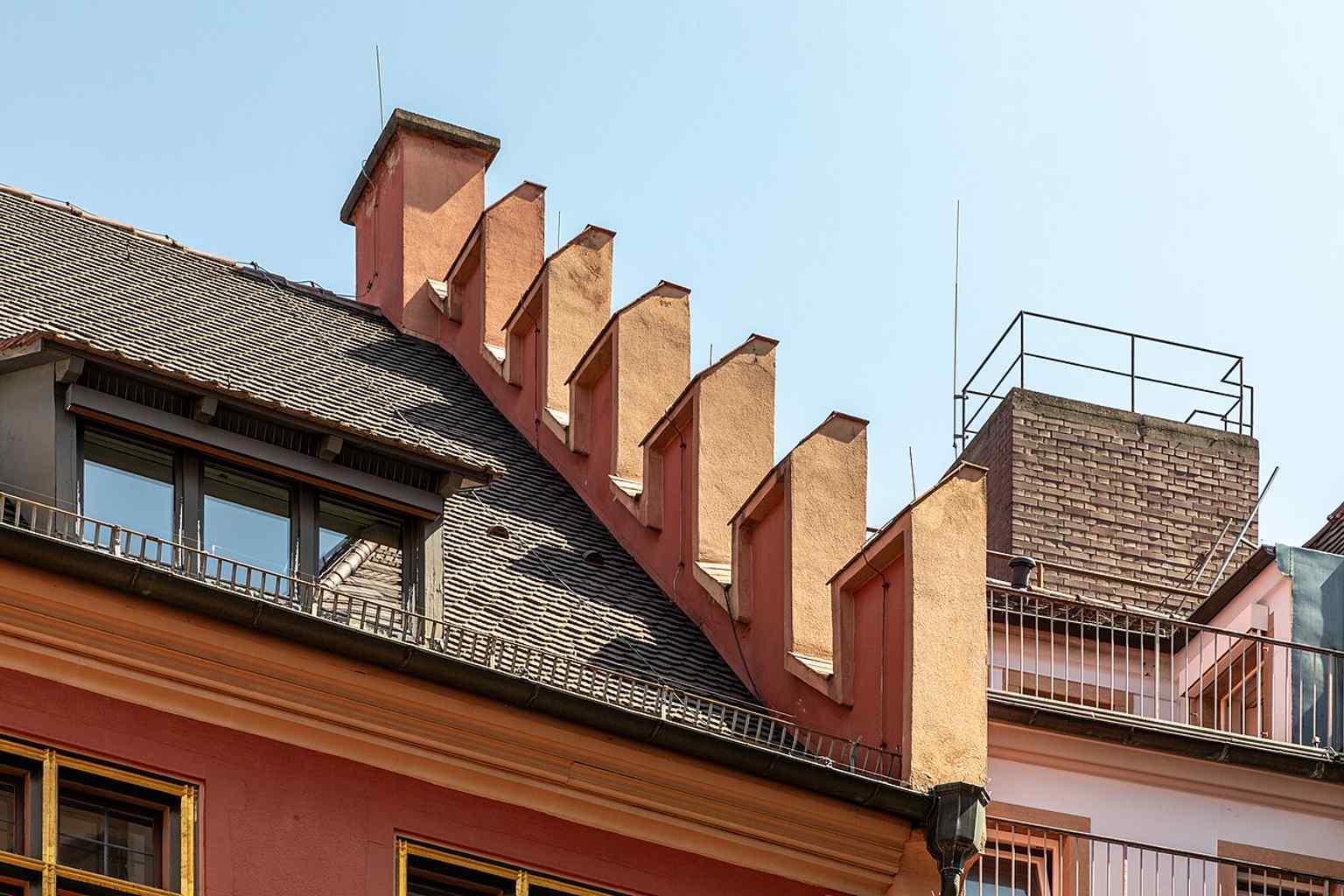
Look for the deep red facade, the steep stepped gable, and the stone memorial plaque set into the wall of this late Gothic house. This is the Haus zum Walfisch, the House of the…Read moreShow less
Open dedicated page →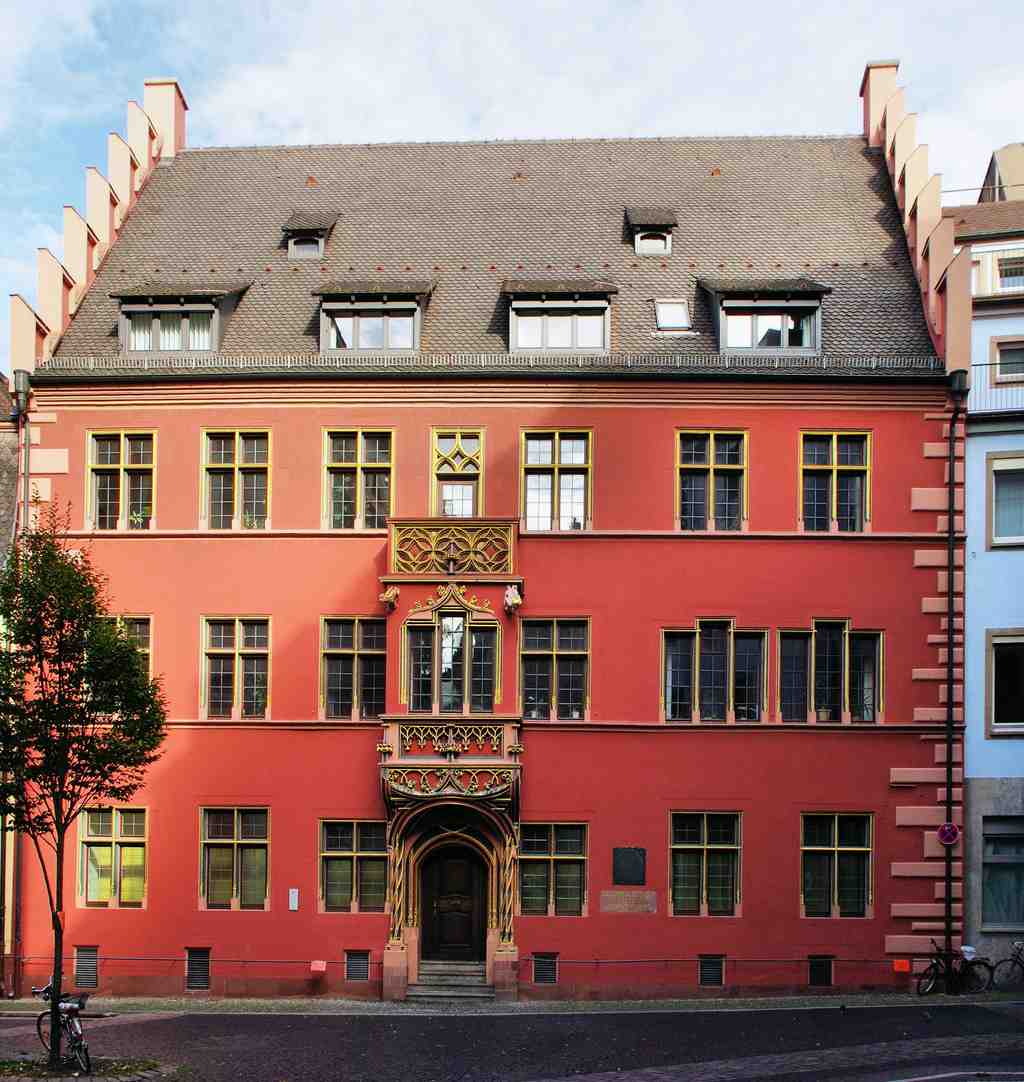
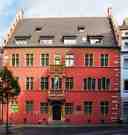
House of the WhalePhoto: Joergens.mi, Wikimedia Commons, CC BY-SA 3.0. Cropped & resized. Look for the deep red facade, the steep stepped gable, and the stone memorial plaque set into the wall of this late Gothic house.
This is the Haus zum Walfisch, the House of the Whale... one of Freiburg’s grandest town houses, though its story is less about grandeur than about who needed shelter, who paid for it, and who held the key.
Jakob Villinger, treasurer to Emperor Maximilian the First, started gathering property here in the early fifteen hundreds, buying up neighboring houses and folding older walls into a new residence. By fifteen seventeen, this “important building,” as the city called it, was ready to occupy. The name House of the Whale appears later, from fifteen sixty-five onward, and one local historian suspects a nod to Jonah and the whale. Freiburg does enjoy a name with a little drama.
But the person most people remember here is Erasmus of Rotterdam. He arrived in Freiburg after fleeing Basel, already one of Europe’s most influential humanists - a scholar of language, faith, and education, and the sort of man cities liked to claim as proof they mattered. Freiburg took him in through a mix of civic favor and high-level recommendation from Ferdinand, the future emperor.
Now here’s the detail locals relish: Erasmus did not stay in the house exactly as you see it. He stayed in the earlier Villinger house on this site, an older layer hidden inside this famous address. So the plaque tells the truth... just not the whole truth. If you check the plaque on your screen, you’ll see the public memory of that stay fixed in stone.
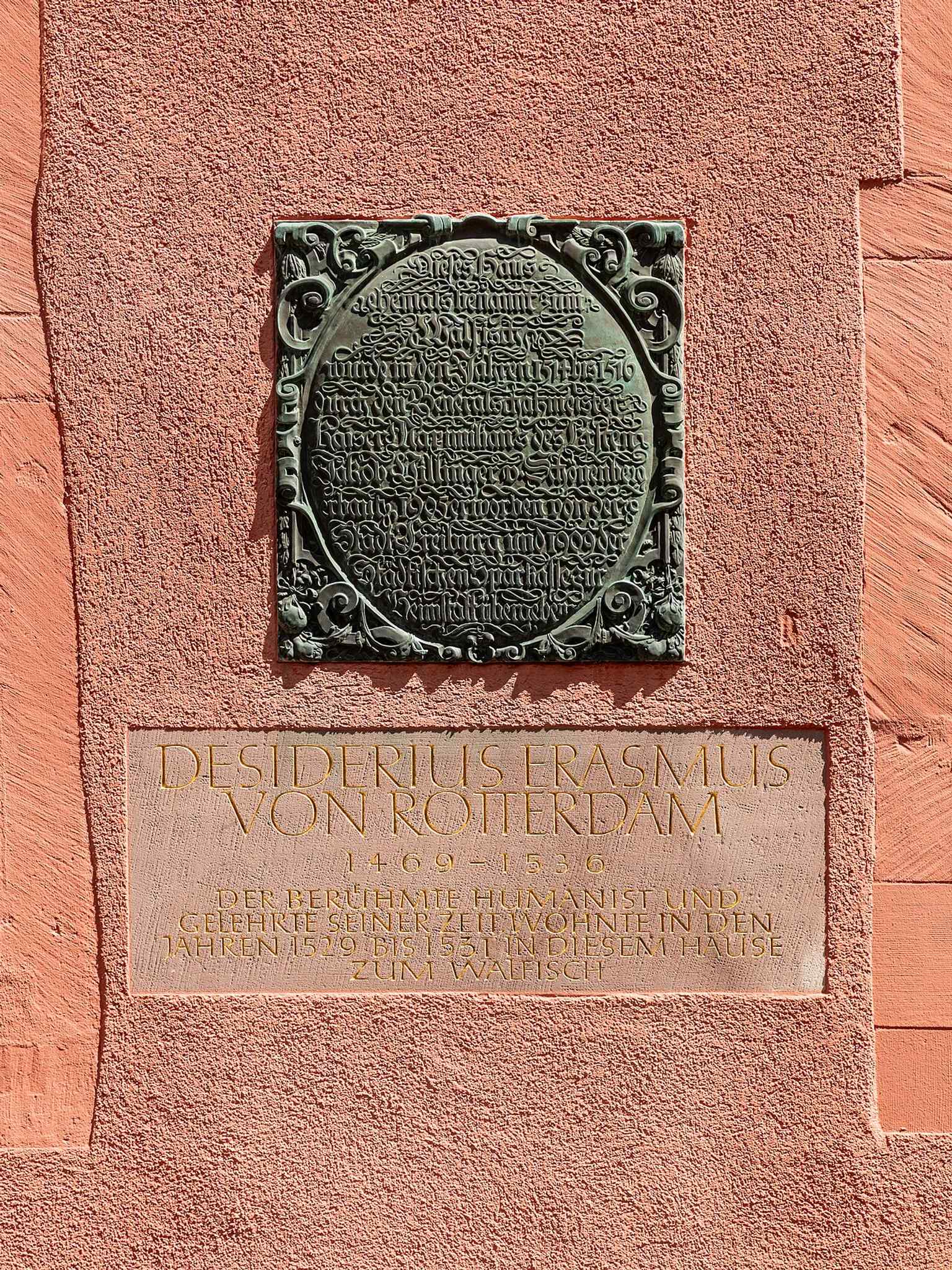
The Erasmus of Rotterdam memorial plaque, recalling his stay here in 1529–1531 when the house was still unfinished.Photo: Dietmar Rabich, Wikimedia Commons, CC BY-SA 4.0. Cropped & resized. And the stay itself was awkward. Erasmus thought the city had lodged him freely out of respect. Meanwhile, other humanists lived here too, including Otmar Nachtgall and Augustin Marius. Nachtgall even controlled the ground floor because he had the key. Then the city began rent negotiations, the owner’s widow wanted clarity, and Erasmus insisted he would only sign if he could have the whole house, not just the upper floor. In other words, one of Europe’s great minds got caught in a very ordinary housing dispute. Humanism, yes... but also landlords.
That is what makes this place so good. The history of ideas here does not float above daily life. It sits inside inheritance quarrels, property sales, patronage, exile, and borrowed rooms. Later, even Emperor Ferdinand the First stayed here, with a covered passage built from the upper floor to Saint Martin’s church. Much later, the city bought the house to preserve it, a bank adapted it, the bombing of nineteen forty-four destroyed the historic interiors, and the facade survived - which explains why the exterior still looks so self-assured. A closer look at the windows on your screen shows some of those preserved details.
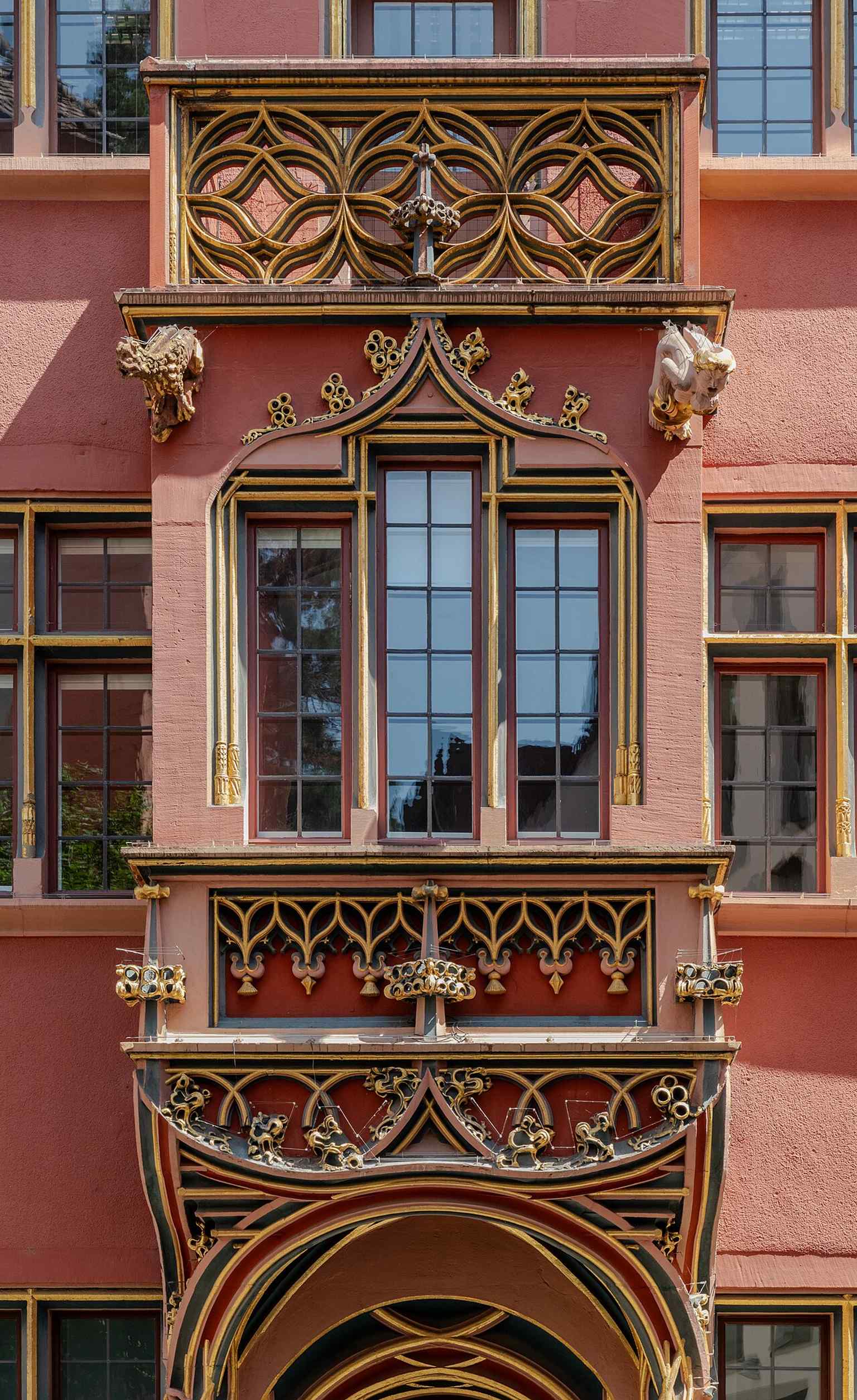
A close look at one of the house’s historic windows, showing the preserved facade details that survived the 1944 fire.Photo: Dietmar Rabich, Wikimedia Commons, CC BY-SA 4.0. Cropped & resized. From one scholar’s temporary refuge, we now head toward Freiburg’s older heart of power and devotion: the Minster, about two minutes away. And like much of Freiburg, this facade is yours to visit from the street at any hour.
The red-gabled front of the House of the Whale on Franziskanerstraße — the landmark’s most recognizable late-Gothic facade in Freiburg’s old town.Photo: Dietmar Rabich, Wikimedia Commons, CC BY-SA 4.0. Cropped & resized. 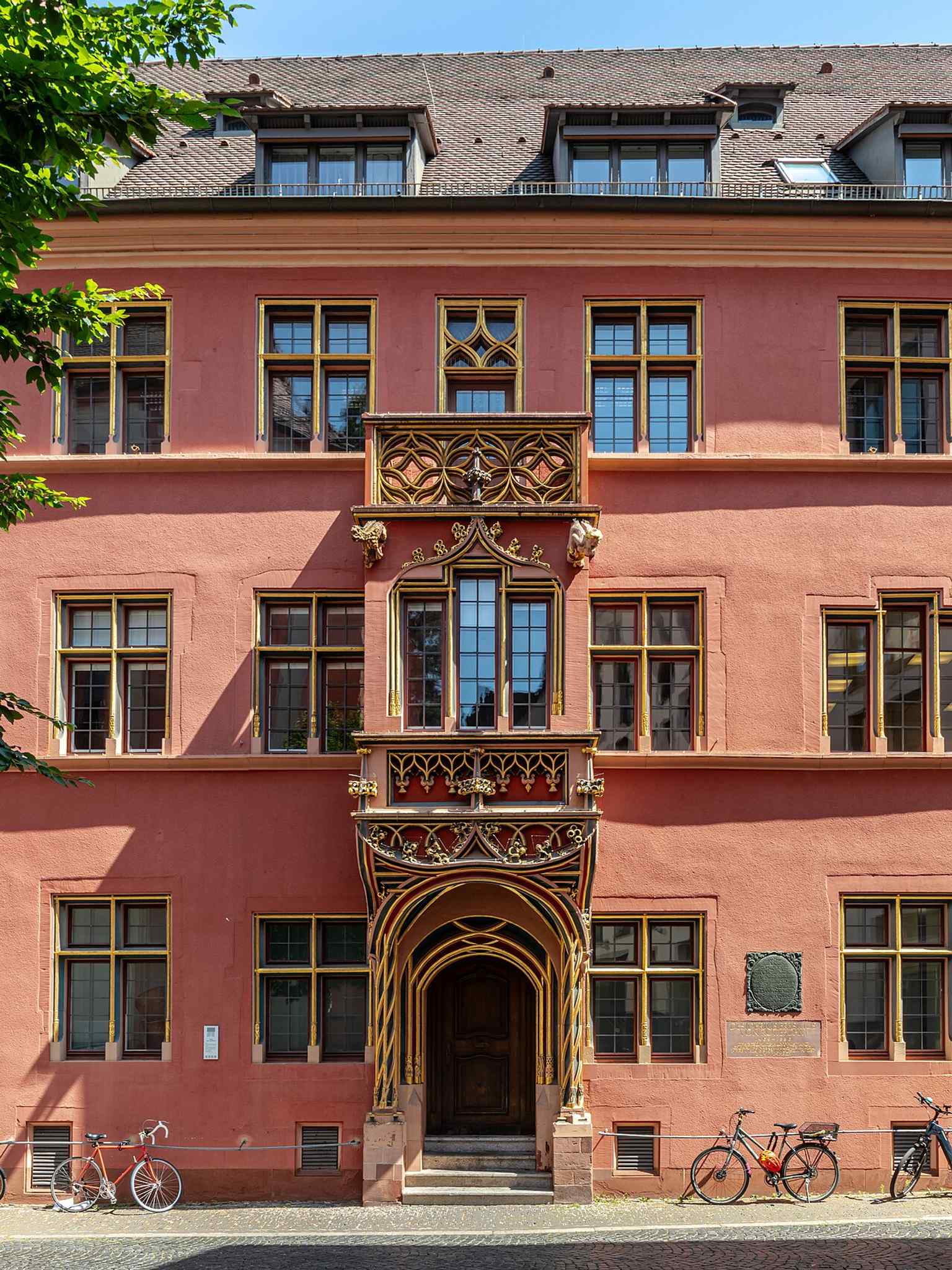
The entrance to the House of the Whale, where the building’s story ties together its Renaissance origins and later bank conversion.Photo: Dietmar Rabich, Wikimedia Commons, CC BY-SA 4.0. Cropped & resized. On your left rises a red sandstone church with a broad Gothic body and a lace-like west tower that climbs from a square base into a filigreed open spire. This is Freiburg…Read moreShow less
Open dedicated page →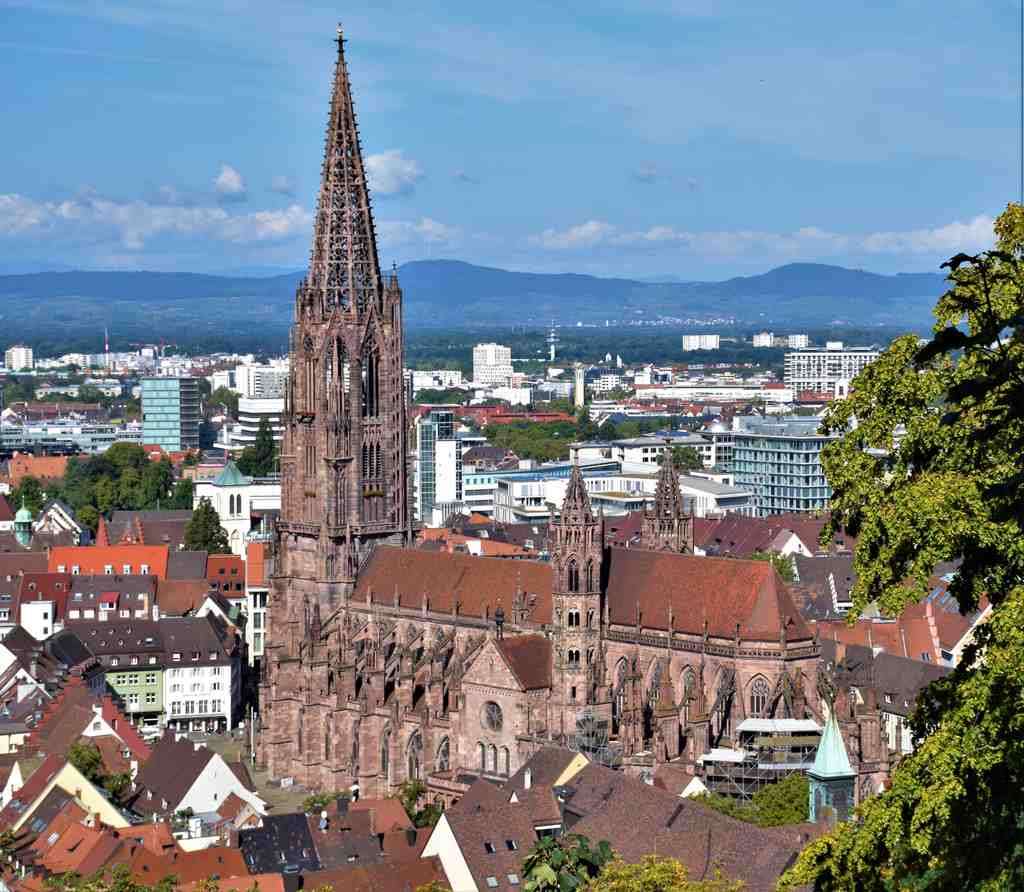
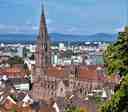
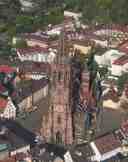
Freiburg MinsterPhoto: C. M., Wikimedia Commons, CC BY-SA 4.0. Cropped & resized. On your left rises a red sandstone church with a broad Gothic body and a lace-like west tower that climbs from a square base into a filigreed open spire.
This is Freiburg Minster, the church of Our Lady... and really, it is the city in stone. Builders worked on it from about twelve hundred to fifteen thirteen, starting in the heavy late Romanesque style and then switching, midstream, into Gothic. You can still read that change in the building itself: older, sturdier parts survive in the transept and the little side towers, while the main body and that famous tower reach upward with much more daring.
To understand why it exists at all, you have to meet the Zähringers. They were the ducal family who founded Freiburg and shaped its early identity, not just as a settlement but as a planned urban power. Berthold the Fifth of Zähringen wanted more than a parish church here; he wanted a dynastic statement and a worthy burial place in the city his family had helped define. So this Minster began as an act of faith, yes... but also of prestige, memory, and political self-advertisement. Medieval rulers were not exactly shy.
Now for the twist. This great church did not begin as property of the church. When the counts who inherited responsibility ran short of money in the thirteenth century, Freiburg’s citizens stepped in, funded the work, and created the Münsterfabrik, a legal building fund responsible for construction and repair. That arrangement still matters. The Minster is sacred space, but its survival has always depended on civic stubbornness, skilled labor, and a very long attention span.
Take a moment and look up at the tower. Notice how it shifts from a solid square base to a twelve-sided gallery, then to an octagon, and finally to that open stone spire, almost like lace carved out of rock. No wonder the art historian Jacob Burckhardt said in eighteen sixty-nine that Freiburg’s would remain “the most beautiful tower on earth.” At one hundred sixteen meters, completed around thirteen thirty, it became one of Europe’s great Gothic statements, and one of the earliest Gothic tracery spires - tracery meaning that delicate stone webwork - of its era.
If you feel like it, open the before-and-after image in the app; the eighteen ninety-two view catches one Hahnenturm under scaffold, a quiet reminder that this place has spent more than a century being lovingly fussed over.
That care mattered terribly in November nineteen forty-four. Bombs wrecked the surrounding old town, but the Minster largely endured. Its roof took damage, yet the medieval stained-glass windows survived because people had removed them in time. If you glance at the Martyrs’ Window on your screen, you can see how medieval glass still lives here, later joined by restorations from Fritz Geiges, whose work sparked arguments that restorers still grumble about.
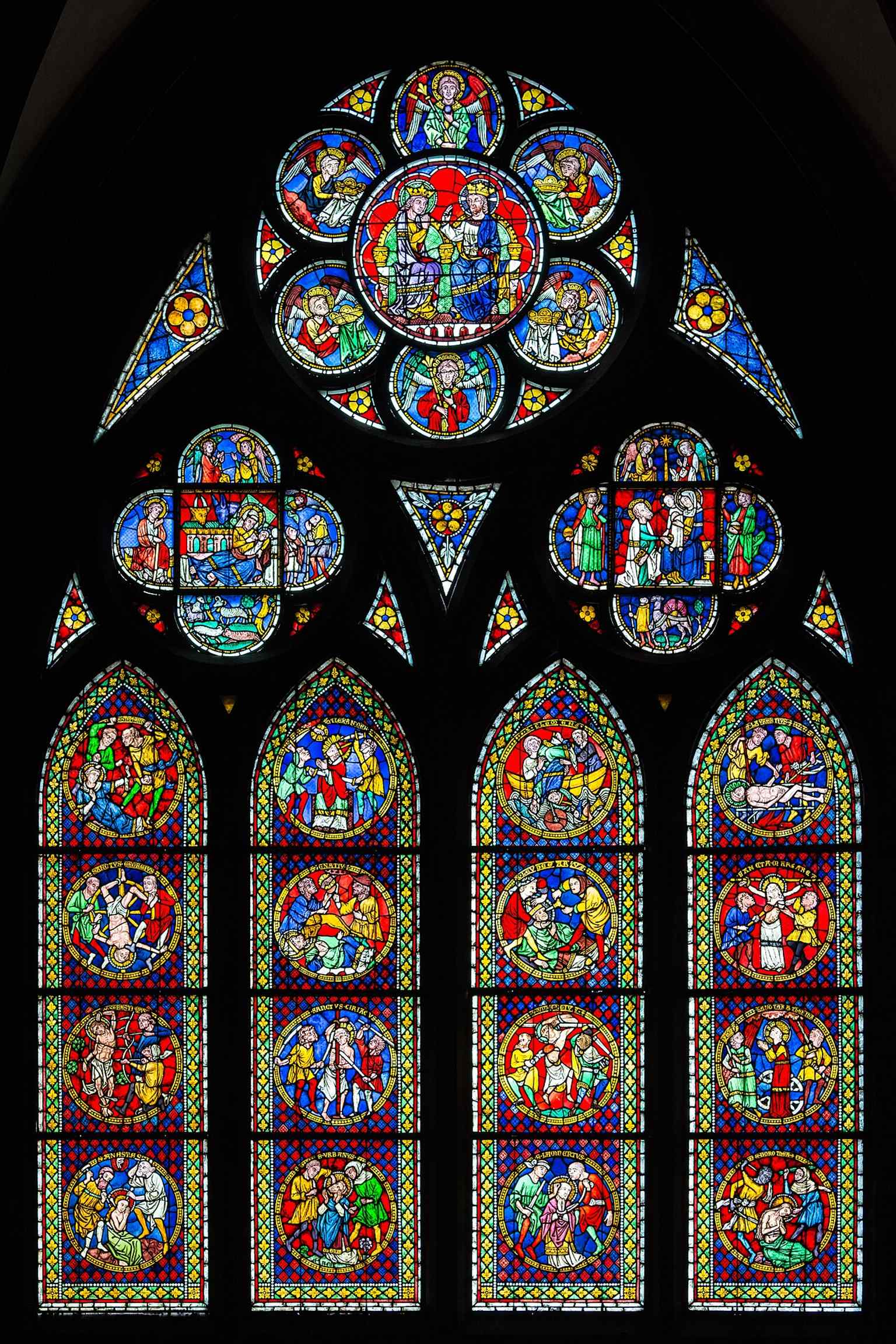
The Martyrs’ Window in the nave, with medieval glass later complemented by Fritz Geiges in the early 20th century.Photo: Uoaei1, Wikimedia Commons, CC BY-SA 4.0. Cropped & resized. Officially, this became a cathedral in eighteen twenty-seven, when Freiburg gained its archbishop. But everyone still calls it the Minster, which feels right. Grand title, local habit... very Freiburg.
And now, after all that ambition and endurance, look down from the tower to the life gathered at its feet. The next story is not inside the church at all, but in the square that keeps it company: Münsterplatz.
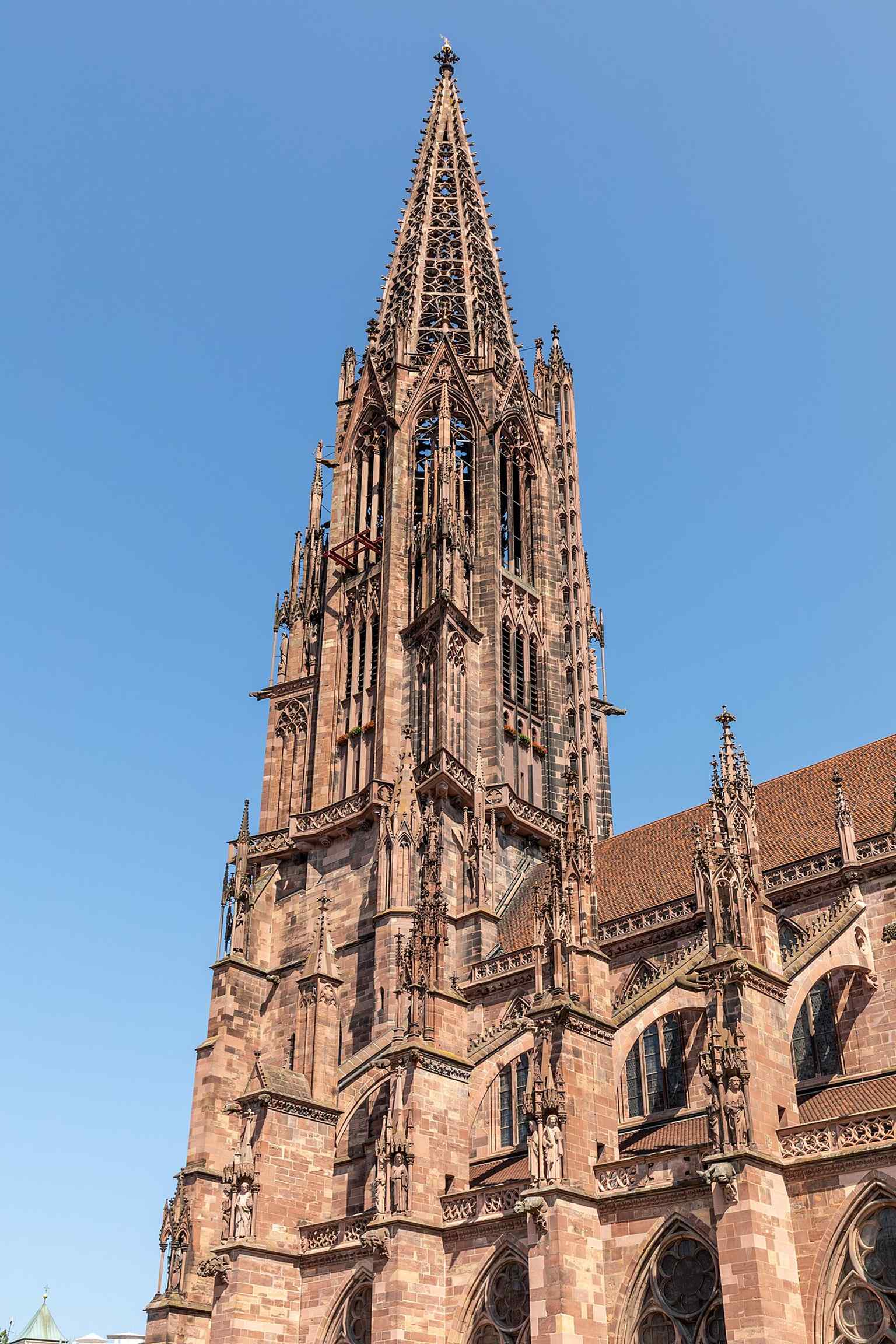
The soaring west tower, the Minster’s most famous feature and one of the great Gothic towers of Europe.Photo: Dietmar Rabich, Wikimedia Commons, CC BY-SA 4.0. Cropped & resized. 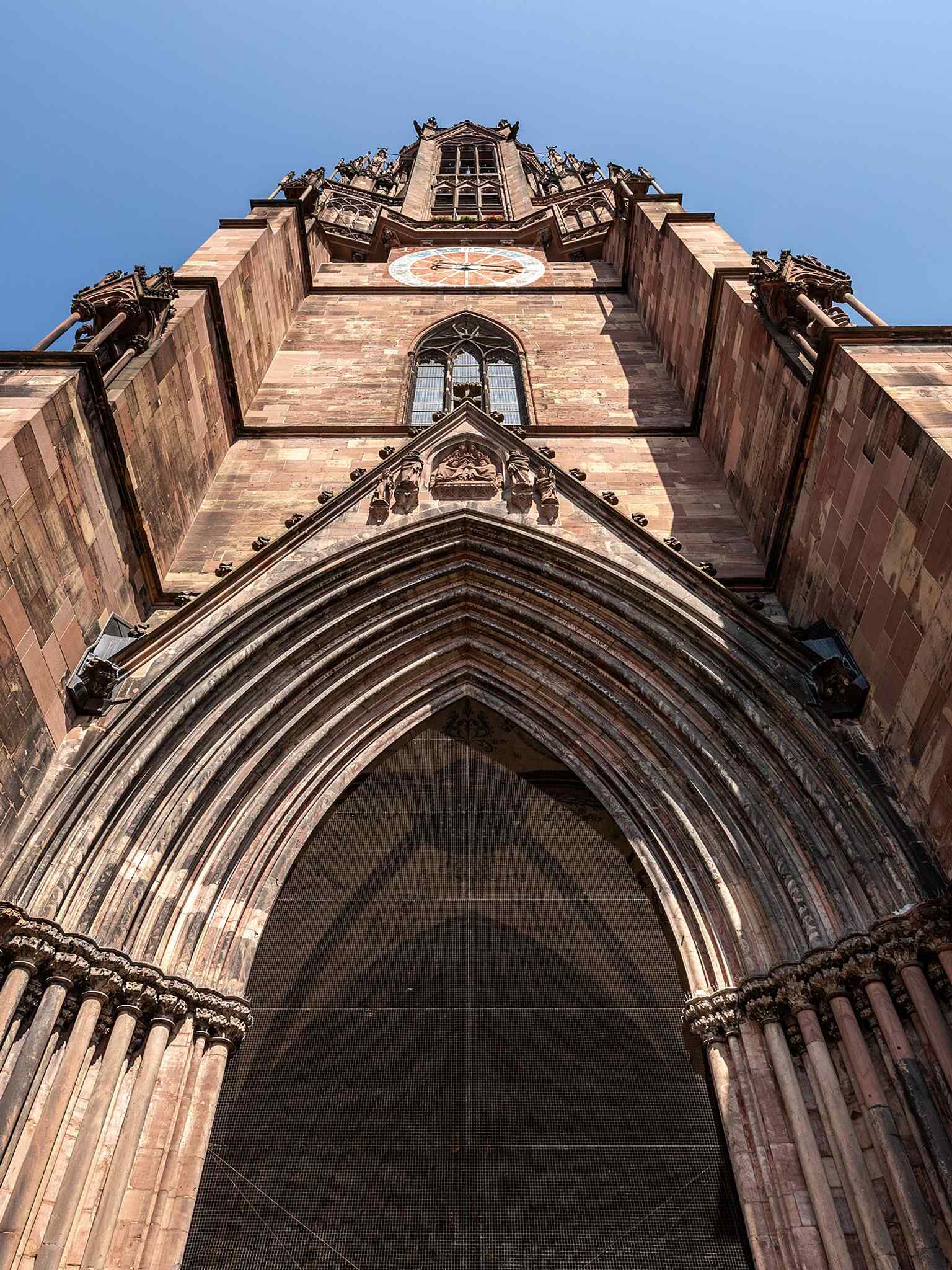
The tower and main portal together, showing the dramatic verticality that made Freiburg famous.Photo: Dietmar Rabich, Wikimedia Commons, CC BY-SA 4.0. Cropped & resized. 
Votive candles inside the Minster, giving a sense of the living church beyond its famous architecture.Photo: Dietmar Rabich, Wikimedia Commons, CC BY-SA 4.0. Cropped & resized. 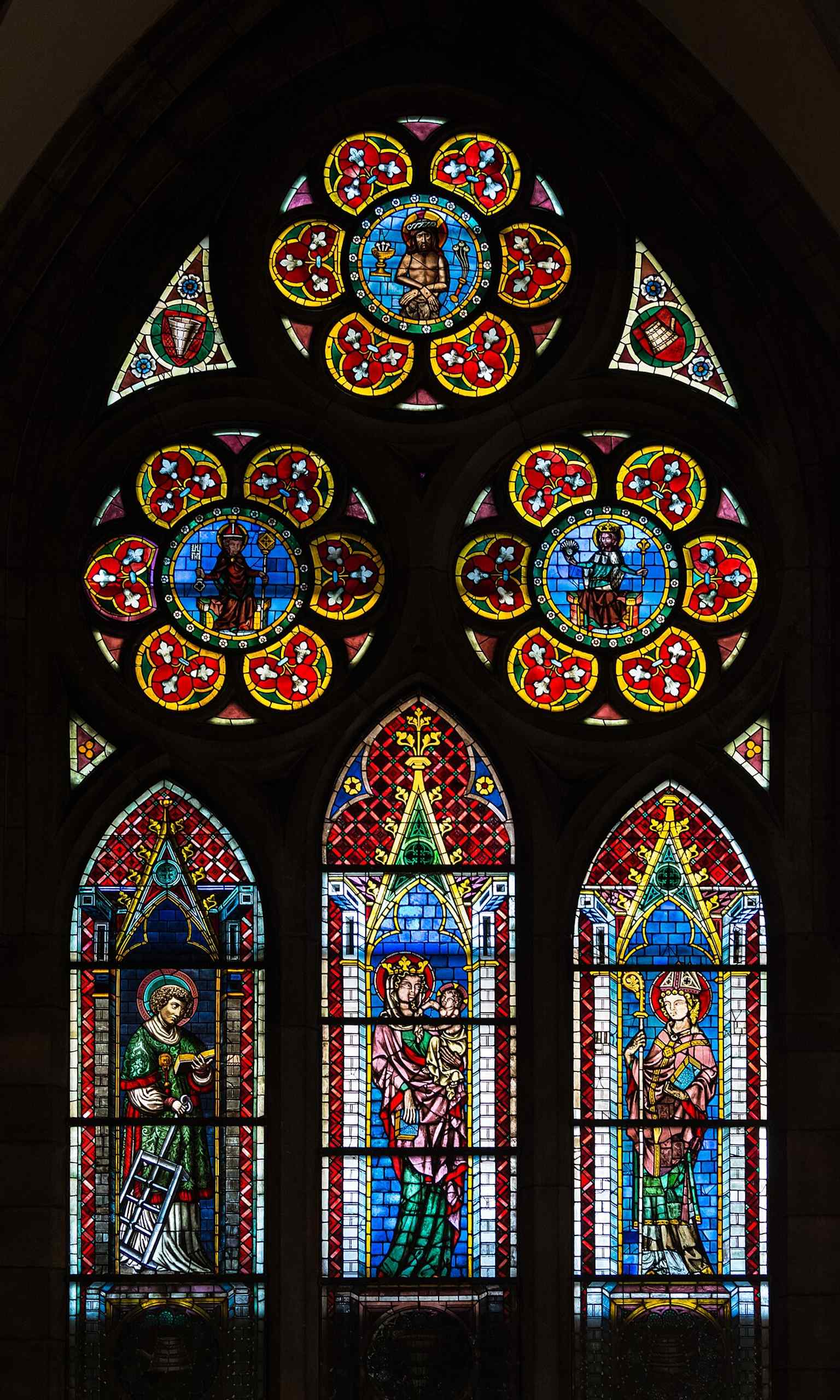
The Coopers’ Window, one of the remarkable stained-glass cycles preserved in the Minster’s aisles.Photo: Uoaei1, Wikimedia Commons, CC BY-SA 4.0. Cropped & resized. 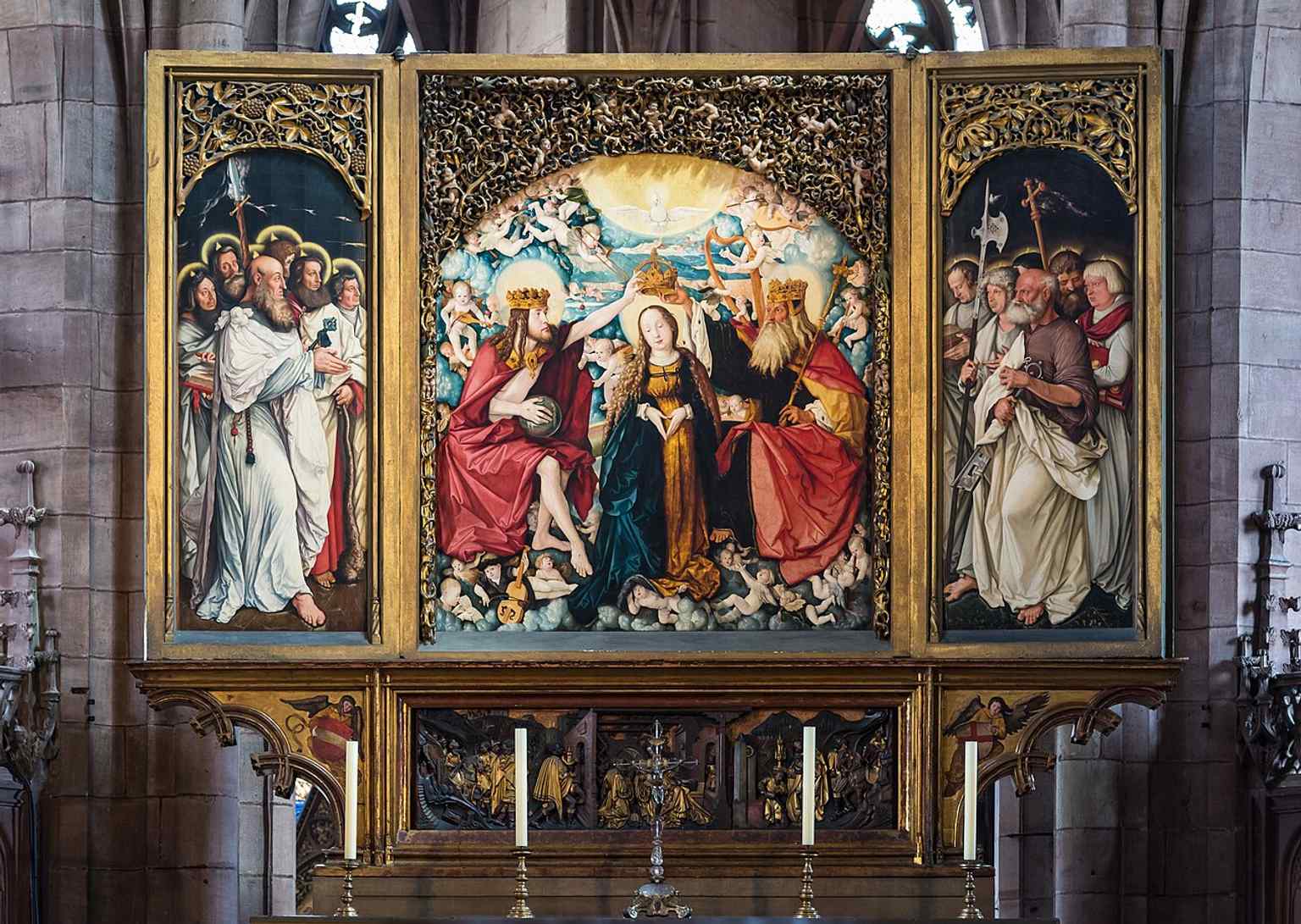
The high altar, a focal point of the interior and part of the Minster’s rich liturgical setting.Photo: Uoaei1, Wikimedia Commons, CC BY-SA 4.0. Cropped & resized. 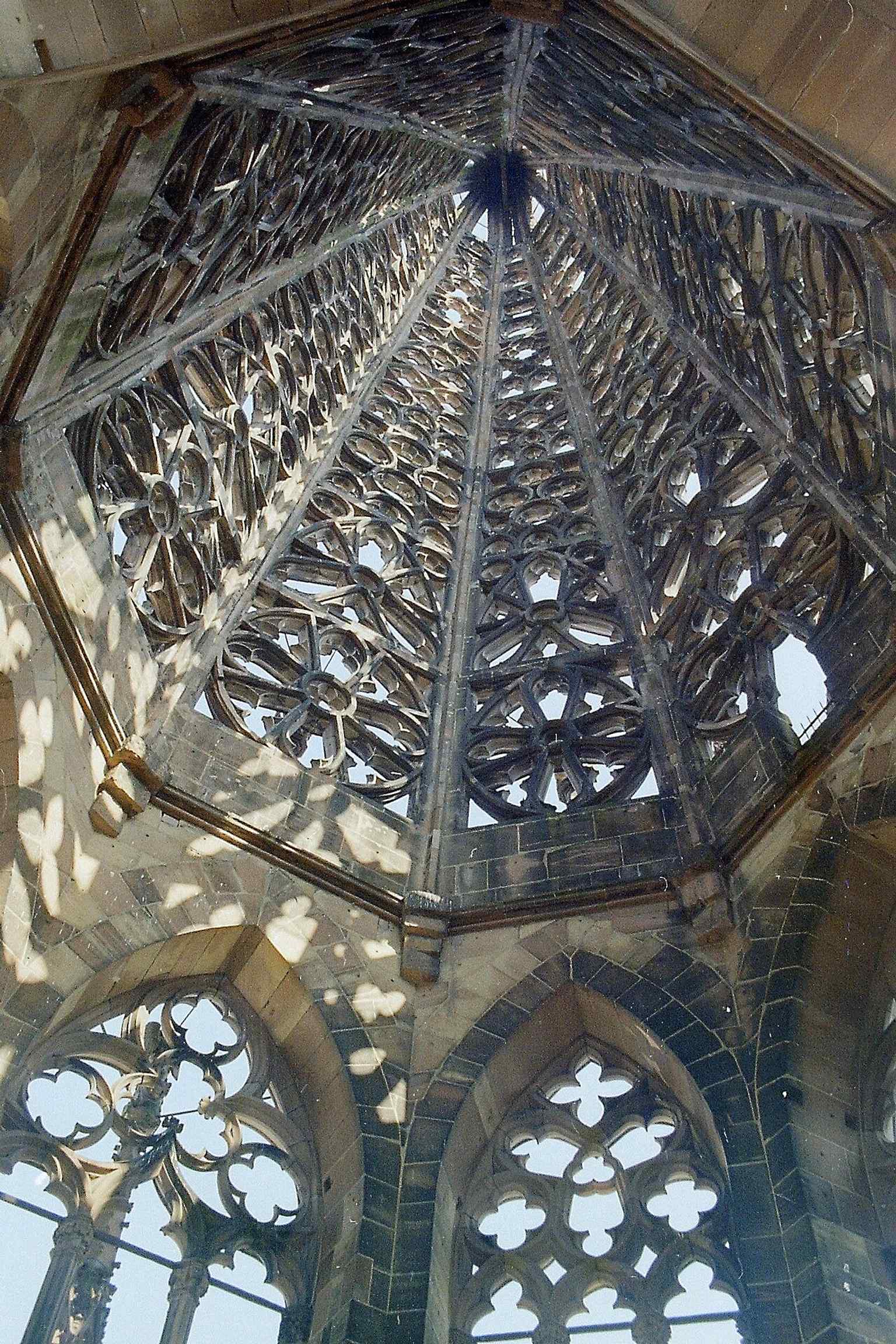
Inside the tower’s octagonal chamber, where the slender Gothic tower transitions into its openwork spire.Photo: Matthias Nonnenmacher, Wikimedia Commons, CC BY-SA 4.0. Cropped & resized. 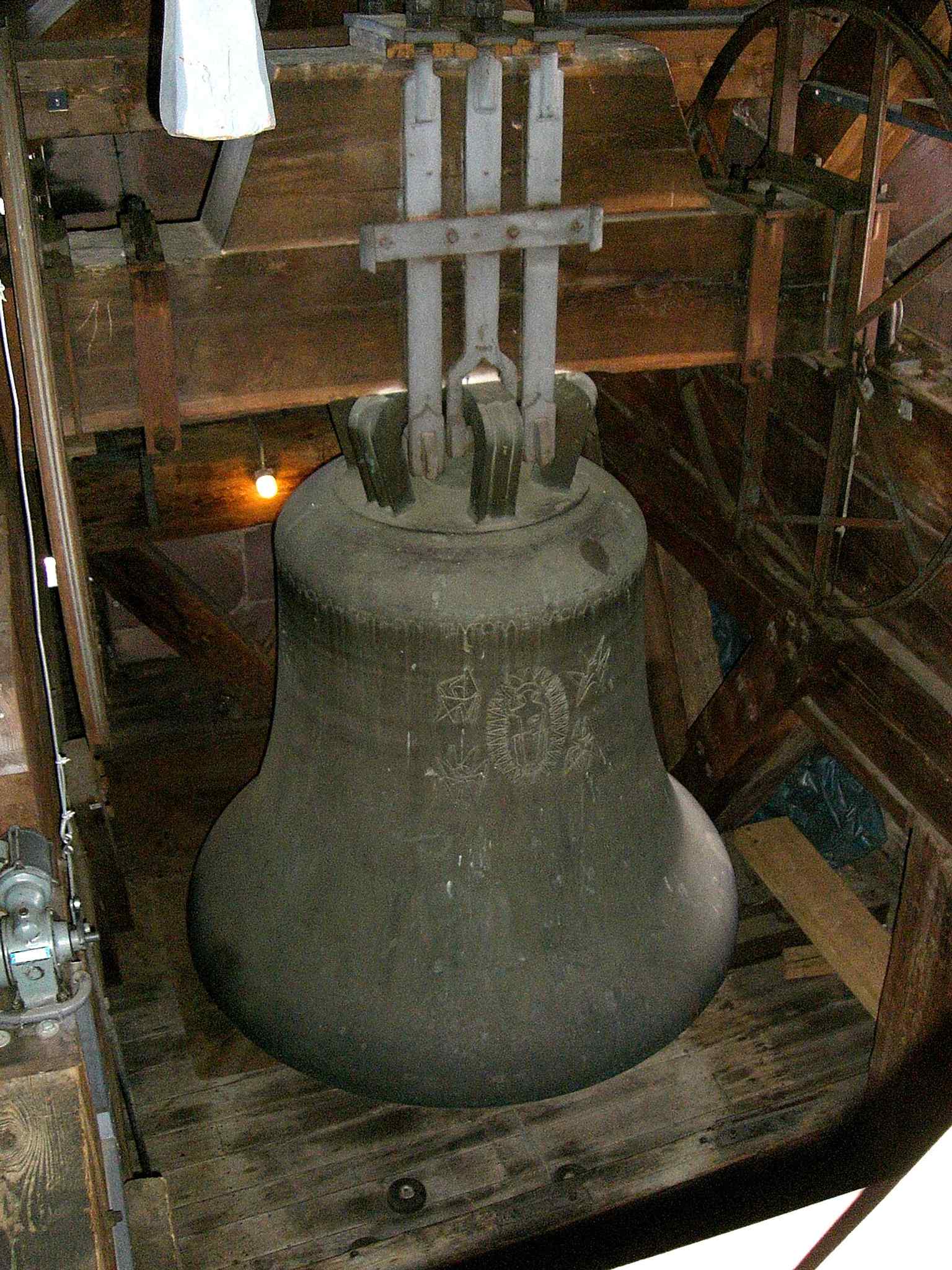
The Christ bell in the tower — a reminder that the Minster’s bells remain part of its daily life.Photo: Dr. med. Mabuse, Wikimedia Commons, CC BY 3.0. Cropped & resized. 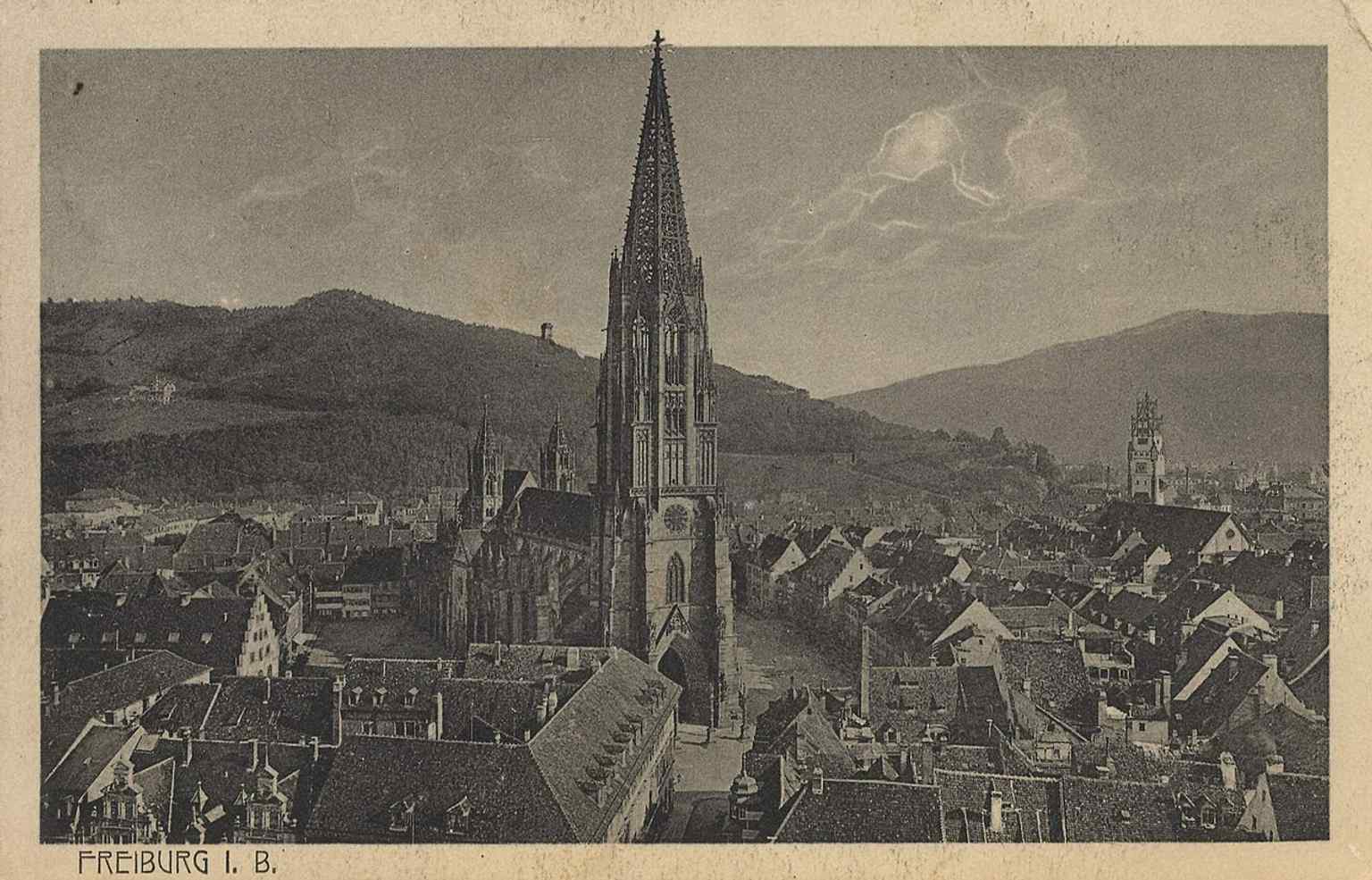
An early 20th-century city view with the Minster dominating Freiburg’s skyline above the old town.Photo: Gebrüder Metz, Wikimedia Commons, Public domain. Cropped & resized. 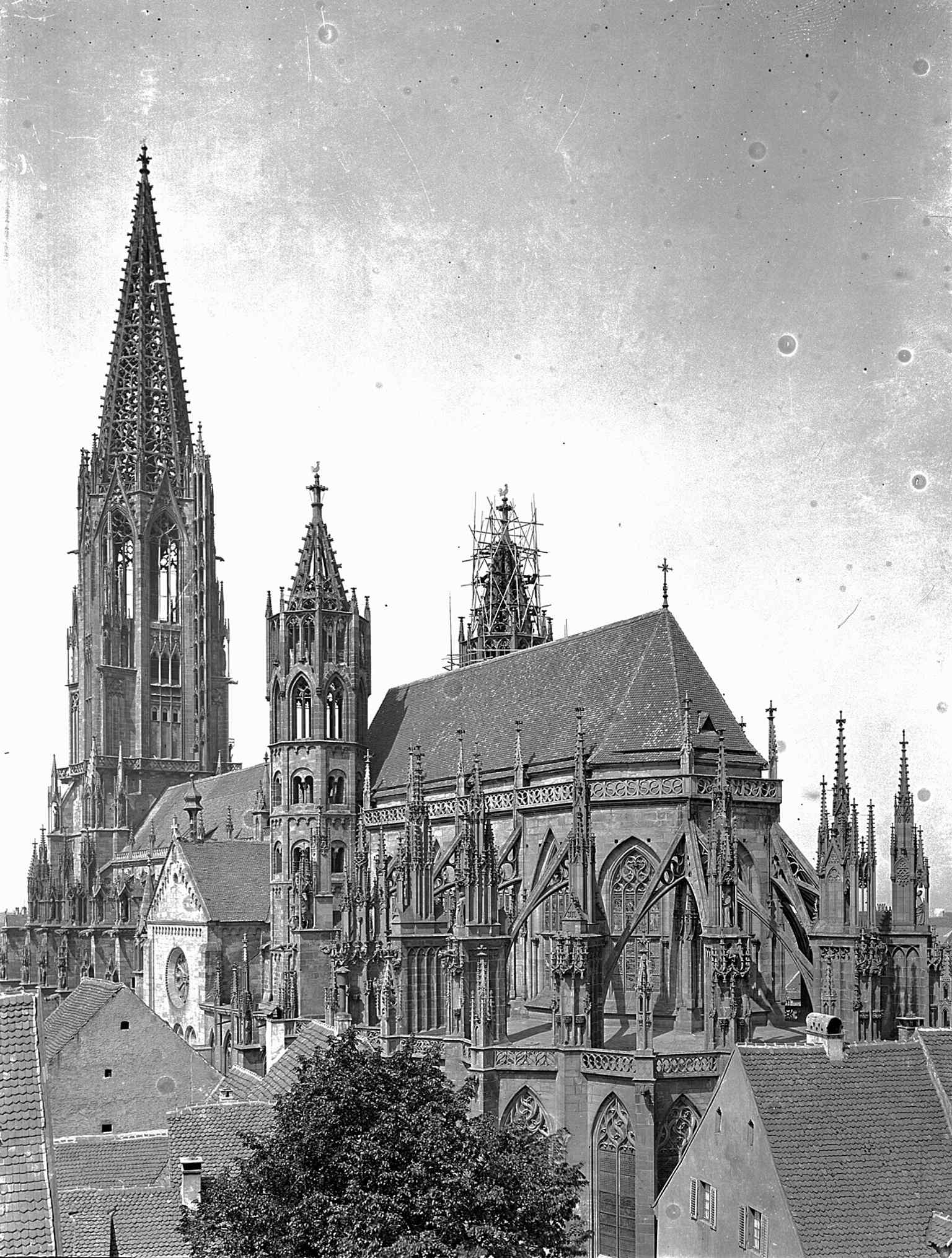
A 1892 view from southeast, documenting the Minster before modern restoration campaigns.Photo: Carl Günther, Wikimedia Commons, Public domain. Cropped & resized. On your left, Münsterplatz opens as a broad cobbled apron around the red sandstone Minster, edged by narrow Bächle water channels and marked in the paving by the footprint of a…Read moreShow less
Open dedicated page →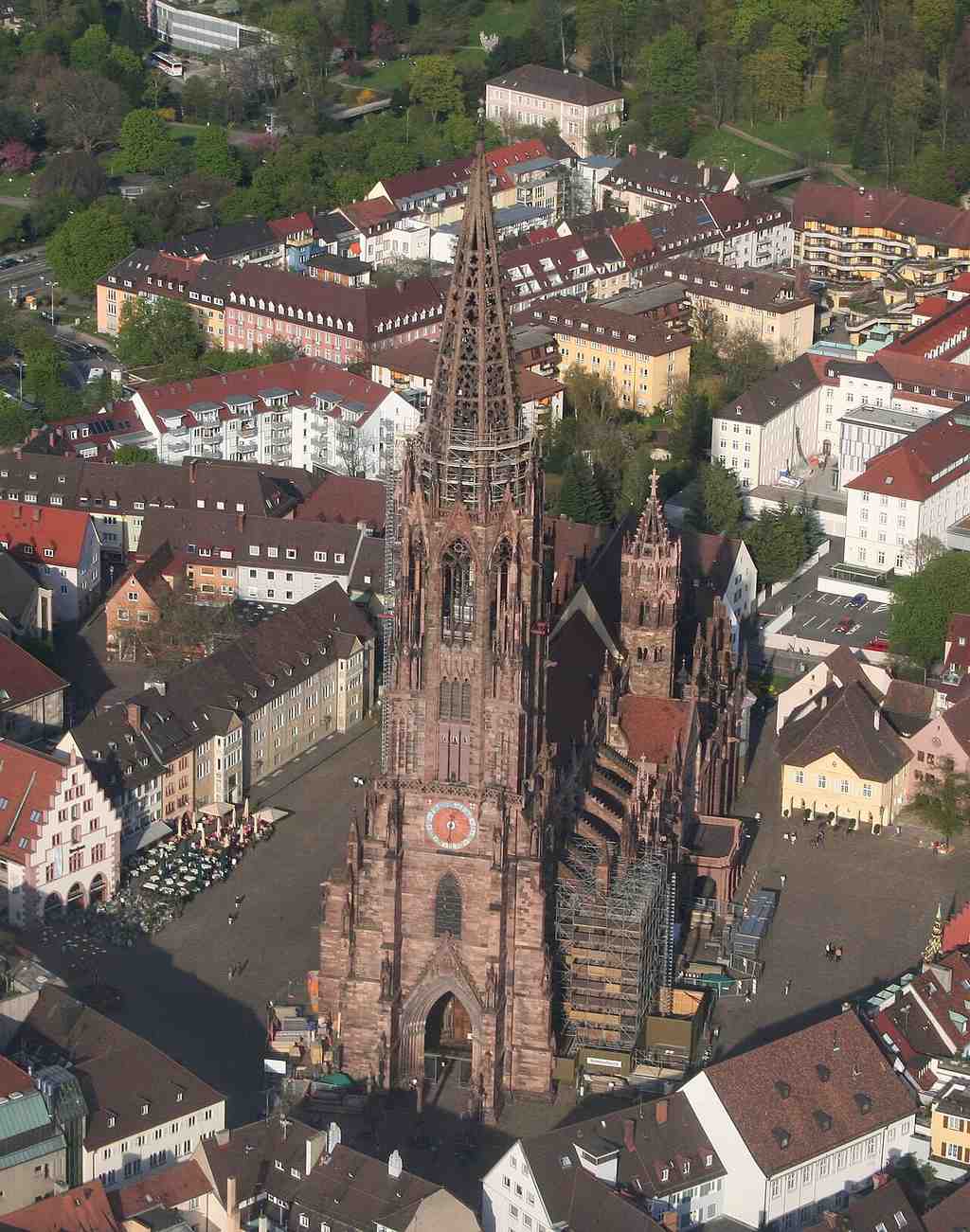
Münsterplatz (Freiburg im Breisgau)Photo: Oberth, Wikimedia Commons, CC BY-SA 3.0. Cropped & resized. On your left, Münsterplatz opens as a broad cobbled apron around the red sandstone Minster, edged by narrow Bächle water channels and marked in the paving by the footprint of a vanished chapel.
This square is Freiburg’s living room... the place where sacred stone and daily bargaining learned to share the same address. It is the city’s largest square, but it never feels like a pompous parade ground. It feels social, practical, a little theatrical, and very Freiburg.
That practicality has old bones. In the Middle Ages, this area around the Minster was not simply a plaza at all. It was a churchyard, and on the north side, a cemetery for the city, enclosed by a wall about one and a half meters high. The little St. Andreas chapel, with an ossuary below it - an ossuary is a chapel for storing bones after burial space ran out - stood here too. When you spot that outline traced in the paving, you are looking at absence made visible... which is a very Freiburg trick.
The market itself did not always belong here. It first gathered on the old main street, the Große Gass, now Kaiser-Joseph-Straße. Then Emperor Maximilian the First ordered burials moved away in fifteen fourteen for hygiene reasons. Later, Vauban’s fortifications disrupted the replacement cemetery, soldiers of the French garrison ended up buried back here, and only after that whole tangle finally settled did the market truly take over the square. So yes... even a charming market square can have a rather complicated afterlife.
Look around the edges and you get Freiburg in miniature. On the south side stand the Haus zum Ritter, the Historical Department Store, the Wentzingerhaus, and the Alte Wache. On the north side sit the Kornhaus and the Fischbrunnen, the Fish Fountain. That fountain is a copy, placed here in nineteen seventy, of the city’s oldest and grandest market fountain from fourteen eighty-three. Fish were once sold around it, and its stacked figures turn a practical water source into a public sermon in stone.
And then there is the Georgsbrunnen nearby, with Saint George as a gilded knight. Here’s the twist: what looks ancient is, in part, a twentieth-century act of memory. In nineteen thirty-five, Carl Anton Meckel rebuilt the old Saint George fountain from surviving fragments in the Augustinian Museum and an eighteen twenty-six lithograph. He switched the soft sandstone for tougher shell limestone and even slipped his own stonecutter’s mark into the work. Medieval authenticity, with a modern signature tucked into the fine print.
If you want, take a quick look at the before-and-after image; the nineteen forty-five view makes the square’s survival and rebuilding hit a little harder. On the twenty-seventh of November, nineteen forty-four, bombing destroyed almost all the buildings around this square. The southeast side - including the Historical Department Store, Wentzingerhaus, and Alte Wache - survived comparatively well, and that changed what Freiburg could remember directly and what it had to rebuild from fragments.
If you glance at your screen, the Fish Fountain photo shows that mix of market business and civic symbolism beautifully.
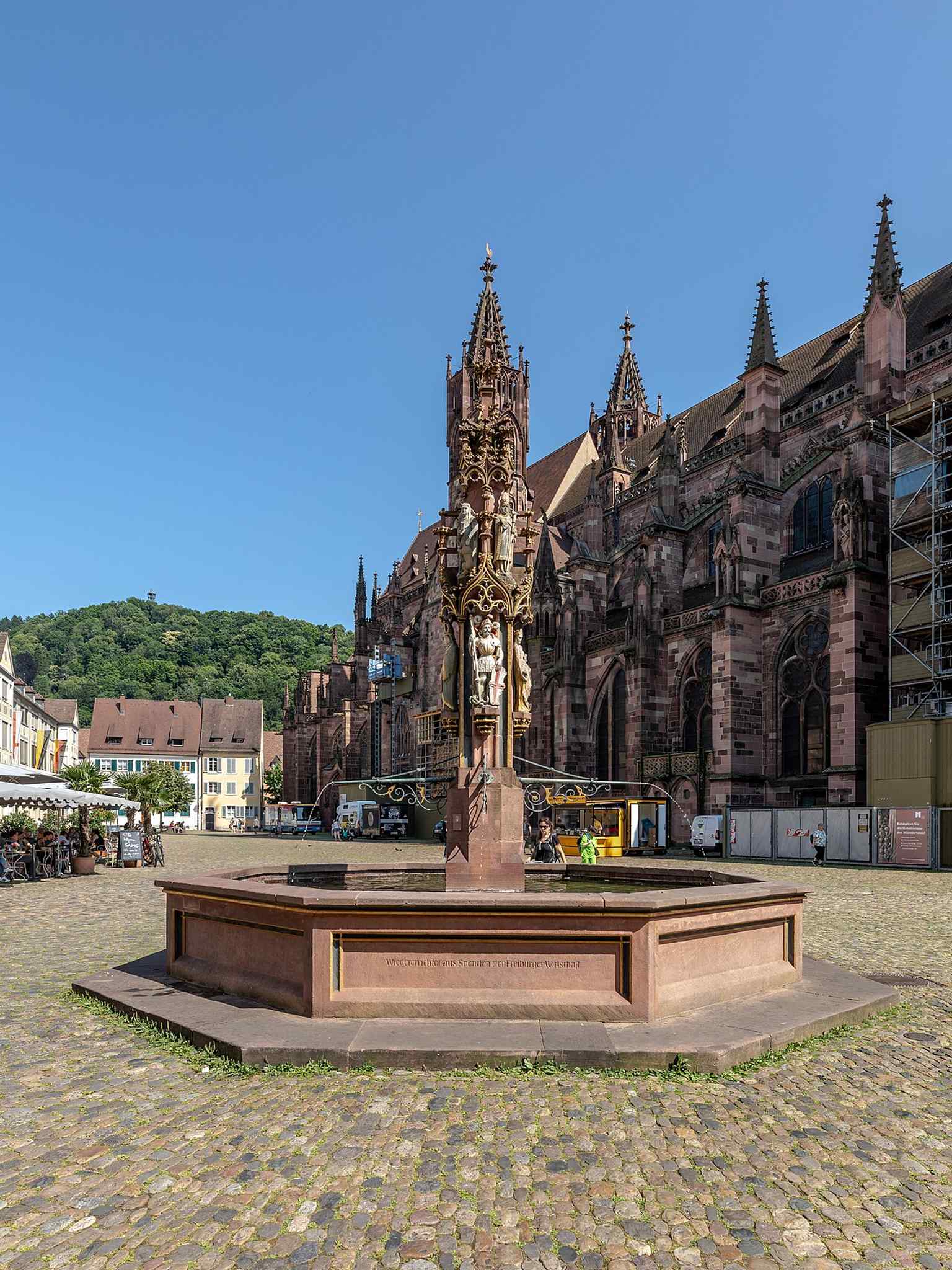
A close view of the Fischbrunnen, the reconstructed market fountain that once served as a center for fish sales on the Münsterplatz.Photo: Dietmar Rabich, Wikimedia Commons, CC BY-SA 4.0. Cropped & resized. Now let your eyes settle on the richly decorated red facade on the south side. That building is our next stop.
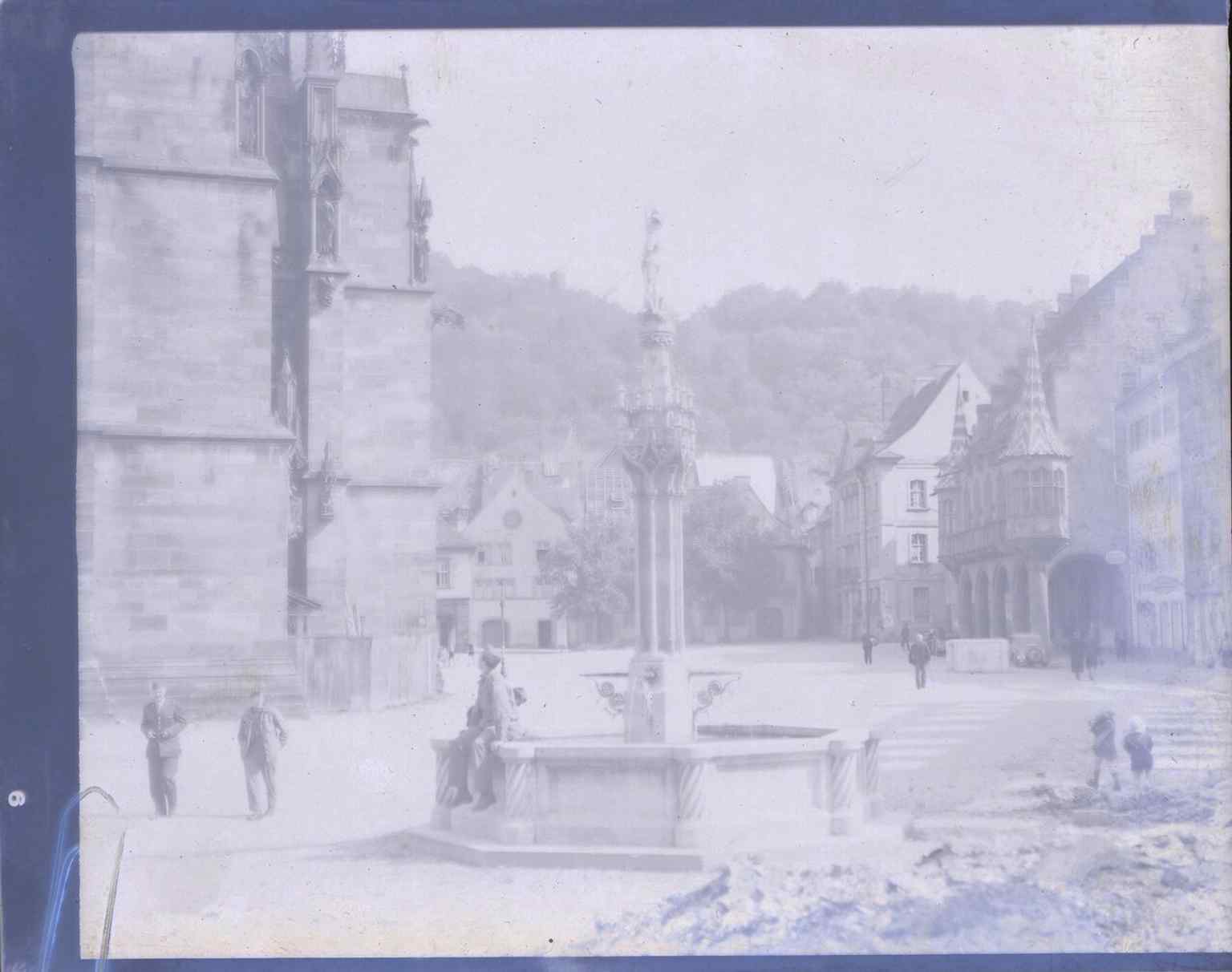
A rare wartime view of Münsterplatz in 1945, with the cathedral and the Historic Merchant’s Hall visible on a square that had just lost much of its surrounding buildings.Photo: AIP Emilio Segrè Visual Archives, Gift of Michaele Thurgood Haynes and Terry Thurgood, Wikimedia Commons, CC0. Cropped & resized. 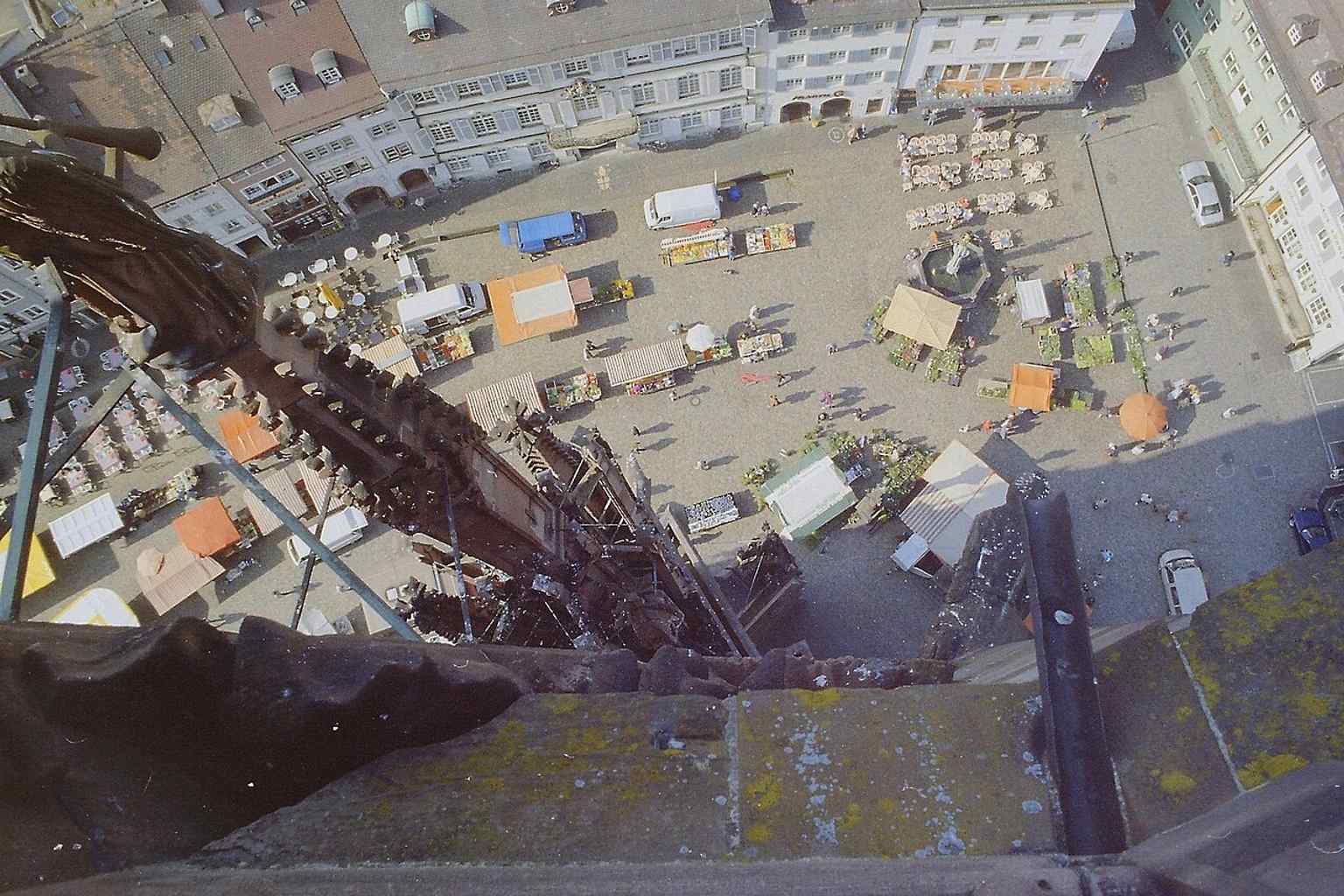
The Münstermarkt in front of Freiburg Minster, showing the square’s daily market life that makes Münsterplatz one of the city’s busiest public spaces.Photo: Karlunun, Wikimedia Commons, CC BY-SA 4.0. Cropped & resized. 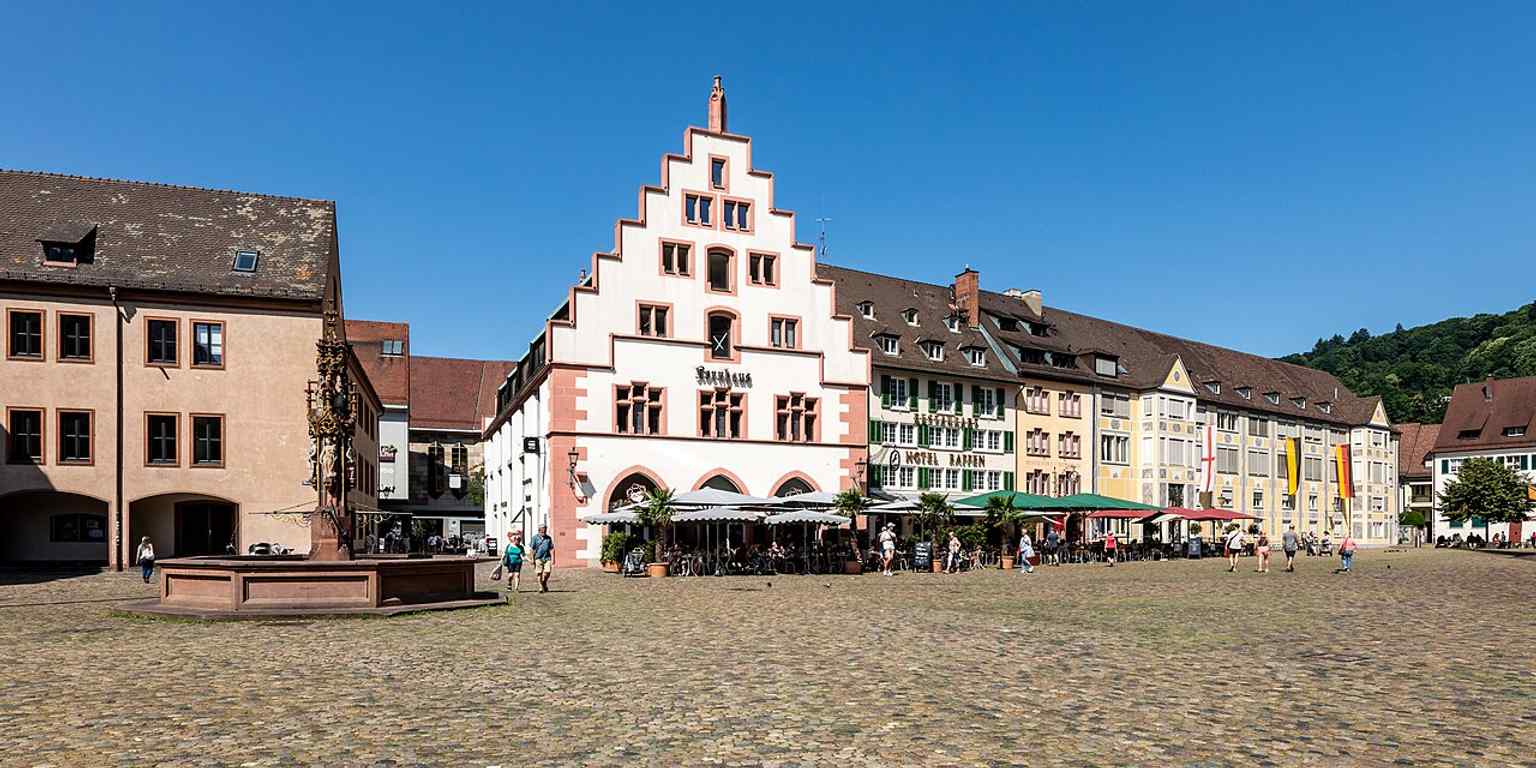
Münsterplatz with the Fischbrunnen and the Kornhaus on the north side, matching the square’s historic market edge and its famous fountain ensemble.Photo: Dietmar Rabich, Wikimedia Commons, CC BY-SA 4.0. Cropped & resized. On your left, the Historical Department Store is the long deep-red building with open stone arcades at ground level, steep stepped gables, and two tiled corner bays marked with…Read moreShow less
Open dedicated page →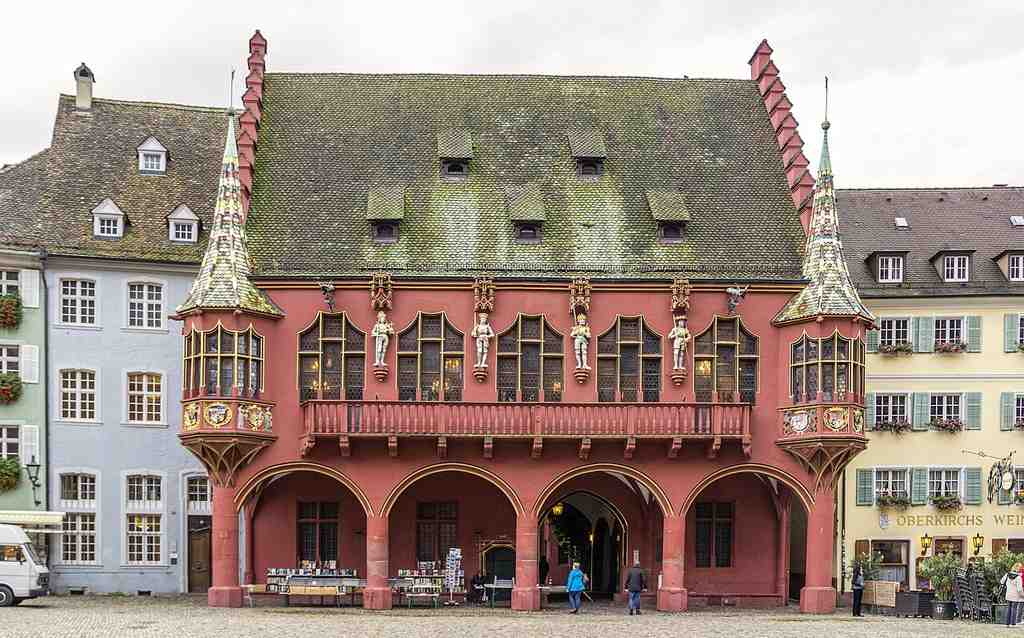
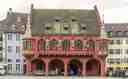
Historical Department Store (Freiburg im Breisgau)Photo: user:joergens.mi, Wikimedia Commons, CC BY-SA 3.0. Cropped & resized. On your left, the Historical Department Store is the long deep-red building with open stone arcades at ground level, steep stepped gables, and two tiled corner bays marked with coats of arms.
This is where trade, tolls, and display came together... where Freiburg counted goods, collected money, and then wrapped the whole business in a very handsome costume. Bureaucracy, apparently, did not want to look boring.
The city’s first municipal warehouse stood nearby on Schusterstraße in the fourteenth century, first recorded in the year thirteen seventy-eight. Officials used it to handle goods coming through town and to process customs dues. Then, from around fifteen twenty to fifteen thirty-two, Freiburg pushed that practical machine outward into the square and built this “new” Kaufhaus facing the Minster. That move matters. Münsterplatz did not run on charm alone. Its market life depended on places like this one to weigh, store, regulate, and profit from the traffic of produce, cloth, wine, salt, and whatever else rolled in.
If you glance at the image on your screen, you can see how the upper part of the building still gives the game away: those stepped gables and roof levels were working storage floors, ventilated for the goods kept above the market action below. Along the west side, openings and projecting beams once helped load the storerooms. Down here, the arcaded ground floor announced the building’s job with admirable honesty: this was commerce under civic supervision.
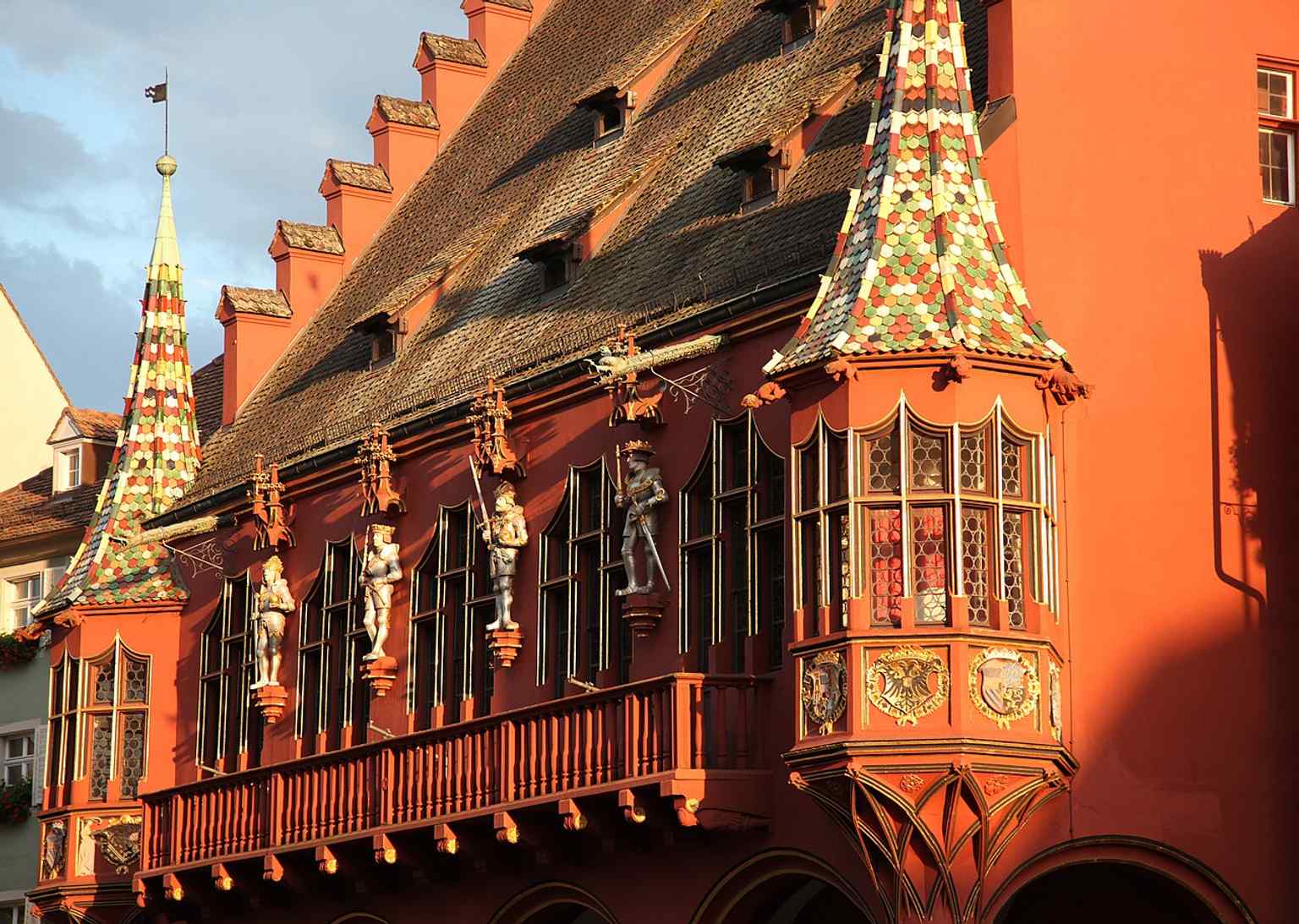
The roofline and treppengables of the 1532 building, showing the upper storeys that once served as storage space.Photo: Marc-Lautenbacher, Wikimedia Commons, CC BY-SA 4.0. Cropped & resized. And yet Freiburg did not stop at usefulness. It staged authority. The sculptor Hans Sixt of Staufen carved the Habsburg rulers on the façade between about fifteen thirty and fifteen thirty-one: Maximilian the First, Philip the Fair, Charles the Fifth, and Ferdinand the First. Their statues stand above the square like a dynastic endorsement stamped onto a customs office. If you pull up the detail image, that corner bay is crowded with heraldry, including the imperial eagle and the Habsburg lands. In other words, buying and selling here unfolded beneath a very deliberate reminder of who claimed power.
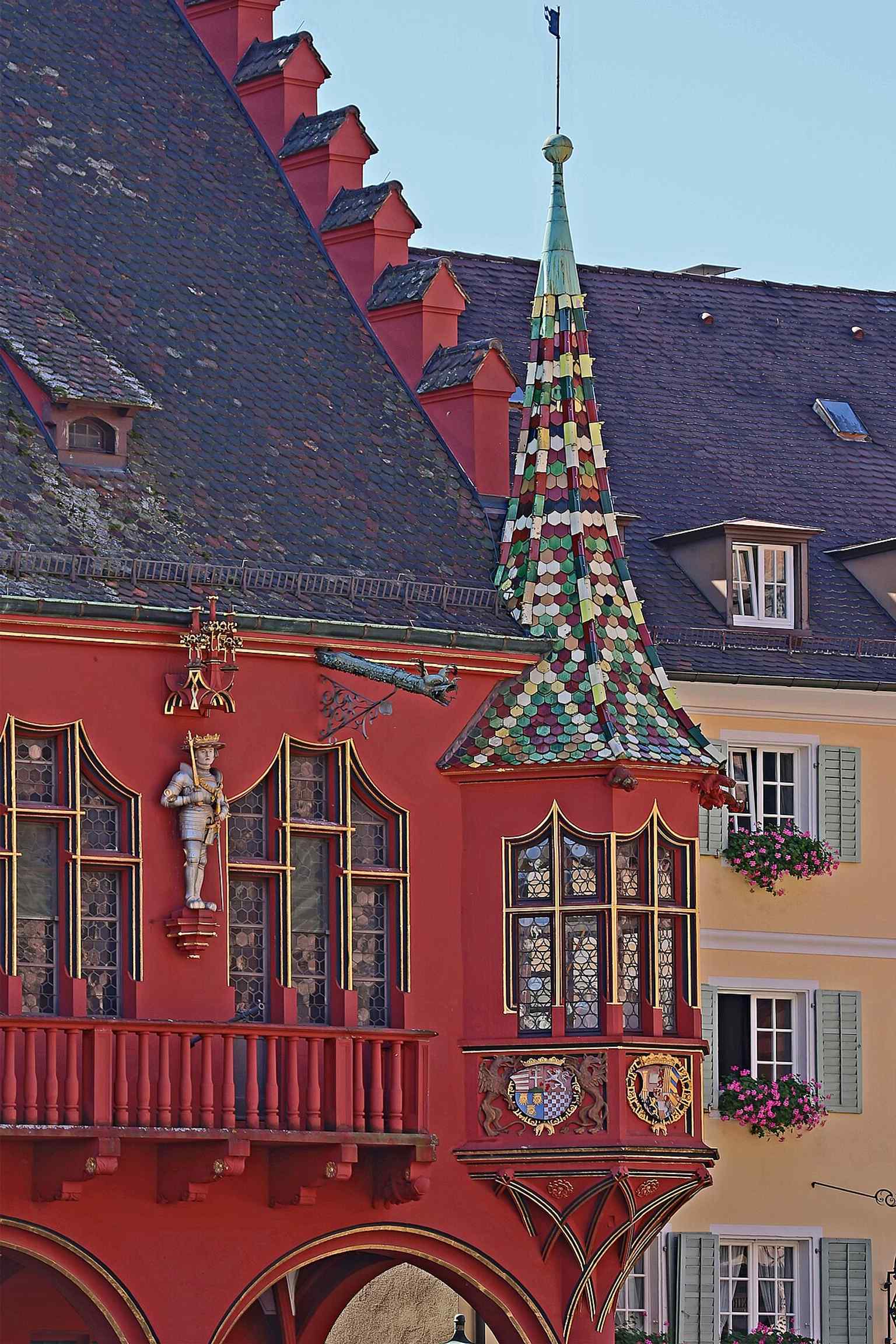
One of the ornate corner oriels, a signature feature of the façade decorated with Habsburg symbolism.Photo: W. Bulach, Wikimedia Commons, CC BY-SA 4.0. Cropped & resized. Inside, things became even more theatrical. The whole upper floor formed a great hall opening toward the market through late Gothic windows. But here is the detail locals like to point out: the famous Kaisersaal, the “Emperor’s Hall,” does not owe its name to those sixteenth-century Habsburg figures. It got that name in eighteen seventy-six, when Freiburg hosted a banquet here for Kaiser Wilhelm the First during the celebrations for the Victory Monument. So the room that looks ancient and imperial earned its title from a comparatively late piece of civic stagecraft. Neat trick.
The building kept changing roles without losing its sense of ceremony. Simon Göser repainted the façade in eighteen fourteen. A heavy nineteenth-century makeover came and went. Then city architect Karl Gruber restored the older look in the nineteen twenties and added the Blue Salon for municipal meetings. After the Second World War, the same complex even served as the parliament building of Baden. So this was never just a pretty shell. It was a working engine that repeatedly learned new lines.
From civic wealth and public display, we head next to a former monastery where sacred architecture found another life as a museum... the Augustinian Museum is about a two-minute walk from here.
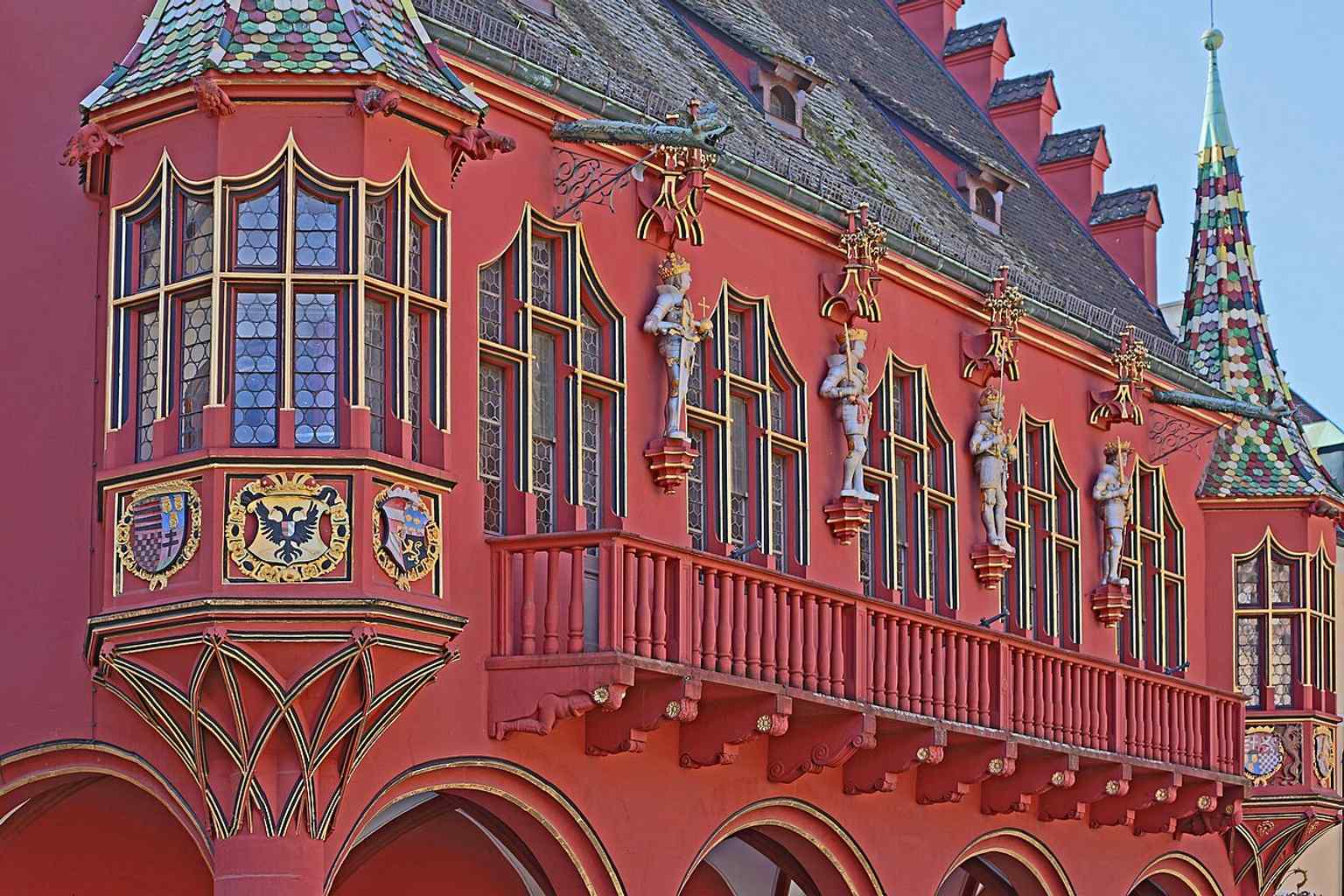
A full view of the Historic Department Store’s red Münsterplatz façade, the landmark’s most famous side facing Freiburg Minster.Photo: W. Bulach, Wikimedia Commons, CC BY-SA 4.0. Cropped & resized. On your right, look for the long red-stone former church with a steep tiled roof, tall pointed Gothic windows, and a crisp modern entrance set into the old west façade. This is…Read moreShow less
Open dedicated page →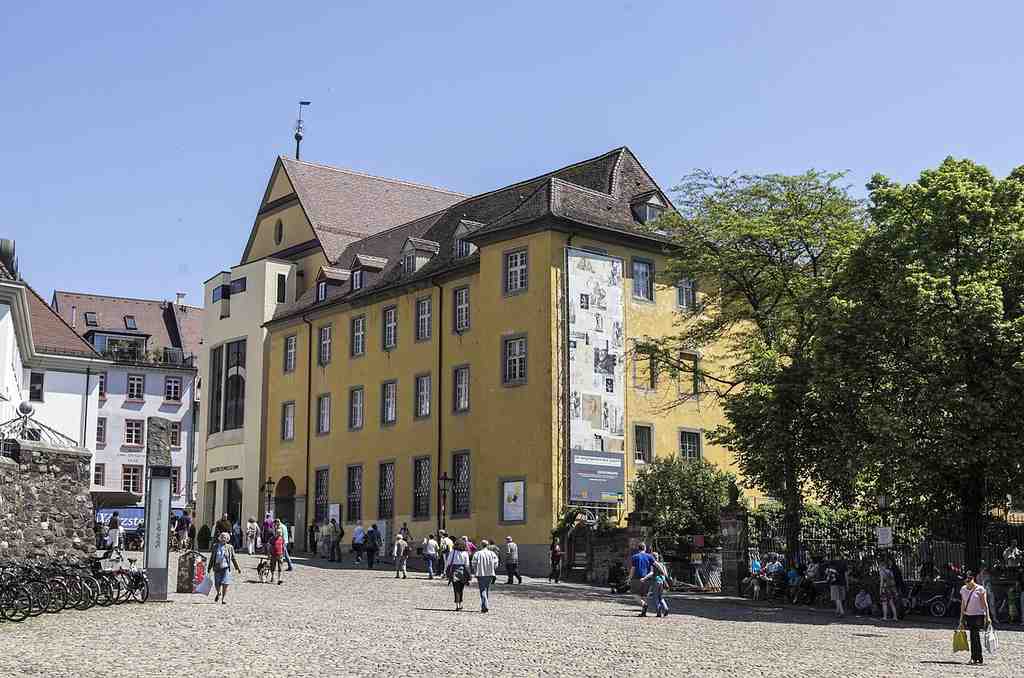
Augustinian MuseumPhoto: user:joergens.mi, Wikimedia Commons, CC BY-SA 3.0. Cropped & resized. On your right, look for the long red-stone former church with a steep tiled roof, tall pointed Gothic windows, and a crisp modern entrance set into the old west façade.
This is the Augustinian Museum, and it may be Freiburg’s neatest lesson in how a city keeps its soul without keeping everything unchanged. It began as an Augustinian monastery. In Freiburg, sacred buildings often survive by accepting new civic jobs... and this one has had several.
Augustinian hermits settled here inside the city walls in the year twelve seventy-eight. Much of the structure still comes from the fourteenth century, and the roof timbers over the choir rank among the oldest in Freiburg, second only to the Minster. Then came secularization, when church property passed into civic hands. The city turned the church hall into a theater, and other rooms served as barracks and classrooms. Practical, slightly irreverent, very Freiburg.
By the early twentieth century, Mayor Otto Winterer wanted one central home for the city’s collections, which had been wandering from place to place since eighteen sixty-four. Architect Rudolf Schmid first planned a much harsher remake, but the First World War stopped work in nineteen fifteen. That pause mattered. When city building director Karl Gruber took over in nineteen nineteen, he chose restraint instead of swagger. He preserved the historic fabric and restored the old sequence of cloister spaces, even though money was tight and some work had to be done with what Germans politely call “poor materials”... which usually means, “we did our best with almost nothing.”
That decision shaped everything you see here now. This museum is not old stone pretending nothing happened. It is old stone carrying a lot of happened things.
Inside, the former church became a sculpture hall for the original stone prophets from Freiburg Minster. There are medieval panels, stained glass, Baroque altars, and a splendid organ front brought from Gengenbach. The museum also holds the collections of the Archdiocese’s diocesan museum, treasures from the Minster, and since twenty twenty-six, Freiburg’s city history in the west wing. If the Historical Department Store nearby turned trade into spectacle, this place turned devotion into memory.
Not every rewrite here was graceful. In nineteen thirty-seven, the Nazis seized a large part of the museum’s modern art as “degenerate.” Most of those works were later destroyed. So this building preserves absence as well as presence.
Then came the long modern rescue. Starting in two thousand and six, Freiburg rebuilt the museum in three phases: the church reopened in two thousand and ten, the House of the Graphic Collection followed in two thousand and sixteen with climate-controlled rooms for seventy thousand works on paper, and the final convent section reopened in twenty twenty-six after years of delays, wood-decaying fungus, and costs rising to about eighty-three million euros. Conservator Kai Miethe, who worked on it for decades, described the effort as a kind of shared life task. That feels right. Places like this do not survive on sentiment alone; they survive because people keep choosing the hard version of care.
From here, head on toward Schwabentor. At that gate, Freiburg starts showing its walls again... and with them, the city’s myths and revolts.
If you want to come back inside later, the museum is closed on Monday, open Tuesday through Sunday from ten to five, and on Friday it stays open until seven.
Look for the square red sandstone gate tower with its pointed arch and the small bell turret topped by an onion-shaped cap. This is the Schwabentor, the younger of Freiburg’s…Read moreShow less
Open dedicated page →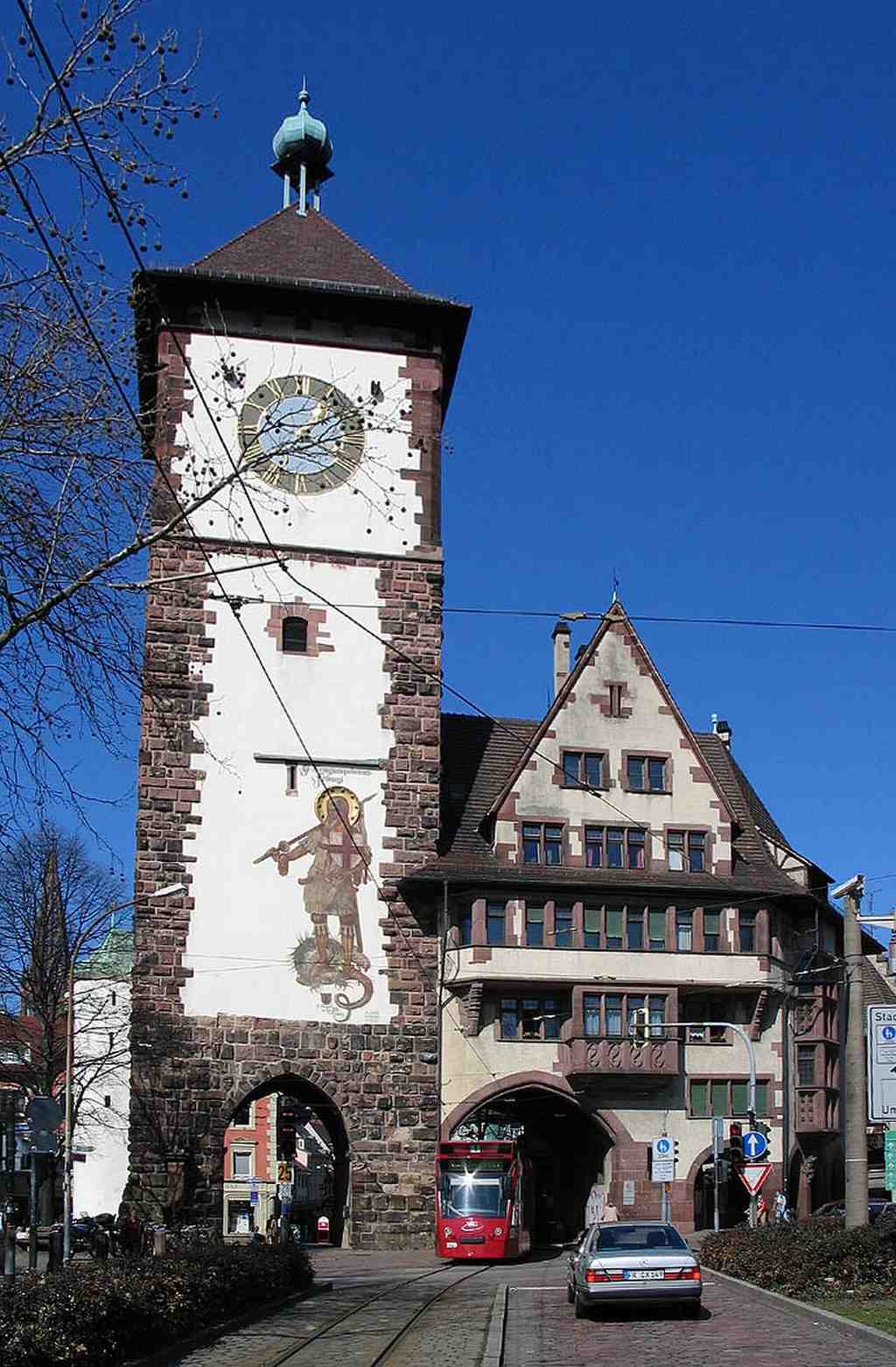
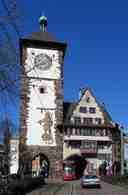
Schwabentor (Freiburg im Breisgau)Photo: Wikimedia Commons contributor, Wikimedia Commons, CC BY-SA 3.0. Cropped & resized. Look for the square red sandstone gate tower with its pointed arch and the small bell turret topped by an onion-shaped cap.
This is the Schwabentor, the younger of Freiburg’s two surviving medieval gates, rising here since about twelve fifty. At first it worked like a proper defensive machine: thick masonry below, a narrow passage through the wall, and in front of it a fenced killing zone between barriers... medieval urban planning, never accused of being subtle.
If you glance at the stonework in the app, you can see the mix of heavy rusticated blocks below and rougher masonry above. That patchwork tells the truth about this gate better than any slogan. Freiburg kept changing it. In fifteen forty-seven builders finally closed the city side with a stone wall. In fifteen seventy-two they added the little stair turret. What looks ancient and fixed is really a long argument in stone.
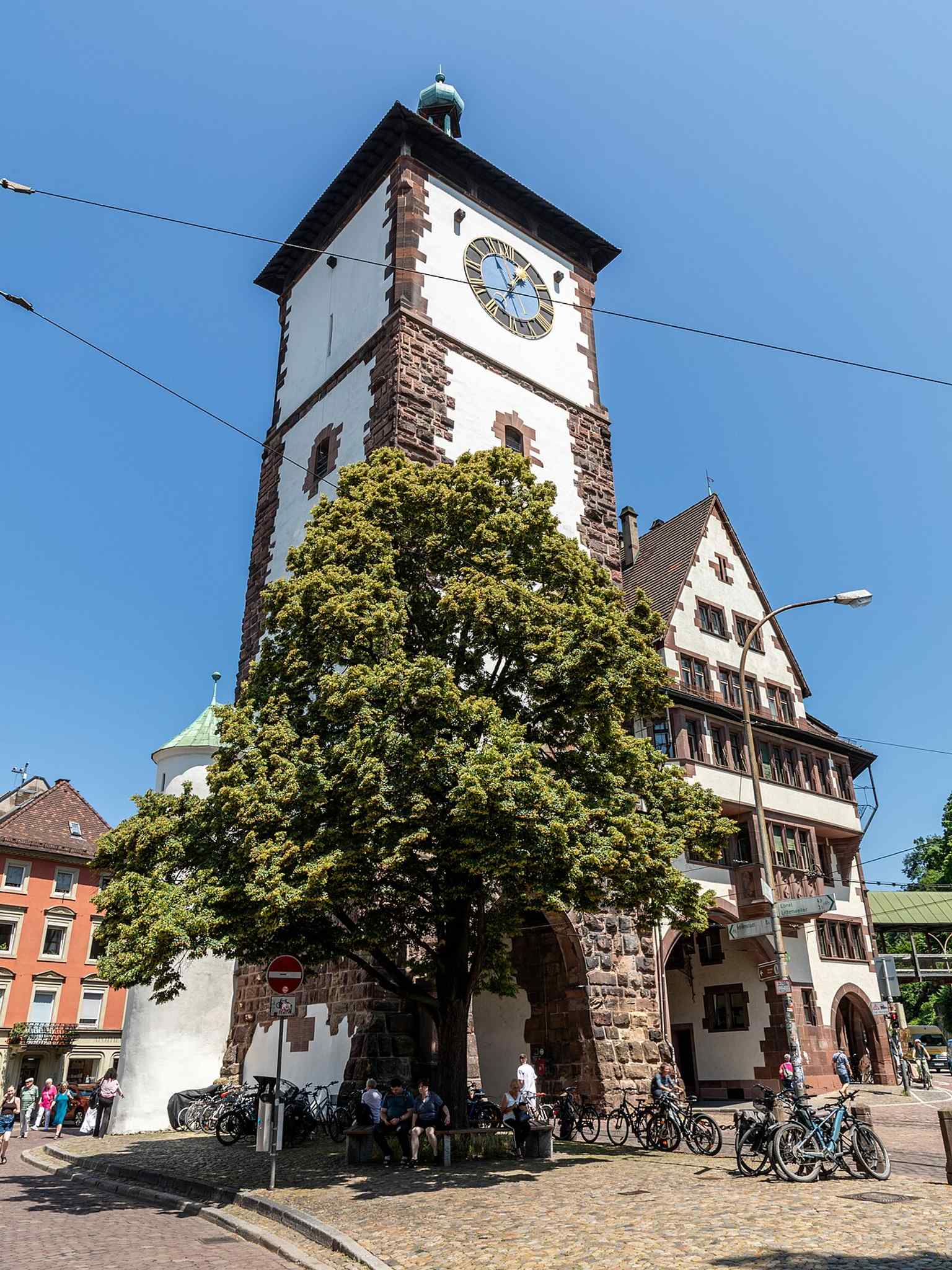
A close exterior detail of the Schwabentor façade — ideal for showing the building’s restored medieval stonework and the later decorative additions.Photo: Dietmar Rabich, Wikimedia Commons, CC BY-SA 4.0. Cropped & resized. And then there’s the story Freiburg loves to tell. On the inner side, a merchant with a wagon appears in a painted scene. In the nineteenth century people attached a legend to him: a Swabian arrived with two barrels of money, hoping to buy Freiburg. Everyone laughed at the absurd idea... then laughed harder when the barrels turned out to hold sand and pebbles because his wife had secretly switched the money before he left. Marriage, as a check on reckless investment.
Most visitors assume that painting is a medieval survivor. It isn’t, not cleanly. Artists kept repainting and repairing it for centuries, including Simon Göser, Dominik Weber, Ernst Fey, and Wilhelm Hanemann. So even the “old” image is a layered reconstruction, a memory touched up again and again.
This gate also holds a sharper memory. On the twenty-fourth of April, eighteen forty-eight, Baden revolutionaries fought grand-ducal government troops here in the last clash at the gate. The liberal hopes we’ve felt elsewhere in Freiburg stopped being speeches and ideals for one brutal moment; they became barricades, gunfire, and bodies in the street. If the Victory Monument turned conflict into heroic certainty, this place remembers something rawer: citizens facing their own state.
Later, many wanted the gate demolished for traffic. Mayor Otto Winterer pushed back and saved it. That decision mattered, because by the time engineers stripped the plaster in twenty twelve, they found serious cracks from earlier alterations, and foundations that stood partly on medieval fill instead of firm ground. So the gate survived not by remaining untouched, but because people kept deciding it was worth rescuing.
Look up through the arch, then up the slope beyond. Do city gates feel more like protection... or control... once you know revolt gathered here? Hold that thought as you head toward the vanished stronghold above us, Freiburg Castle, about a thirteen-minute walk from here.
And for practical purposes: the exterior of the Schwabentor is accessible at any hour.
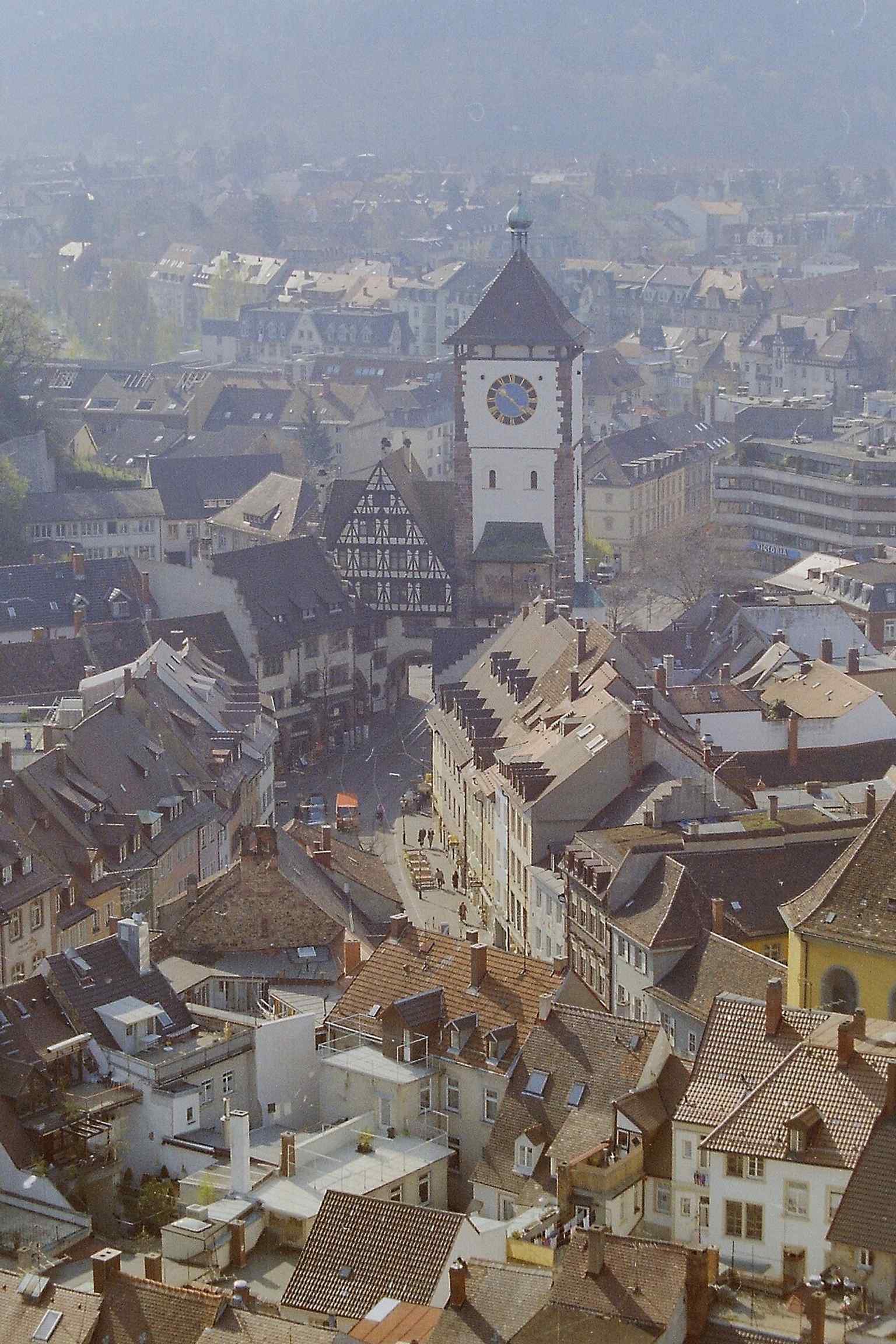
A high viewpoint from the cathedral tower toward the Schwabentor and old town — a great way to place the gate in Freiburg’s medieval cityscape.Photo: Matthias Nonnenmacher, Wikimedia Commons, CC BY-SA 4.0. Cropped & resized. Look for the broad grassy mound and the cut defensive ditch on the Schlossberg, a rounded earthwork of packed soil and stone with Ludwigshöhe marking the lost center of Freiburg’s…Read moreShow less
Open dedicated page →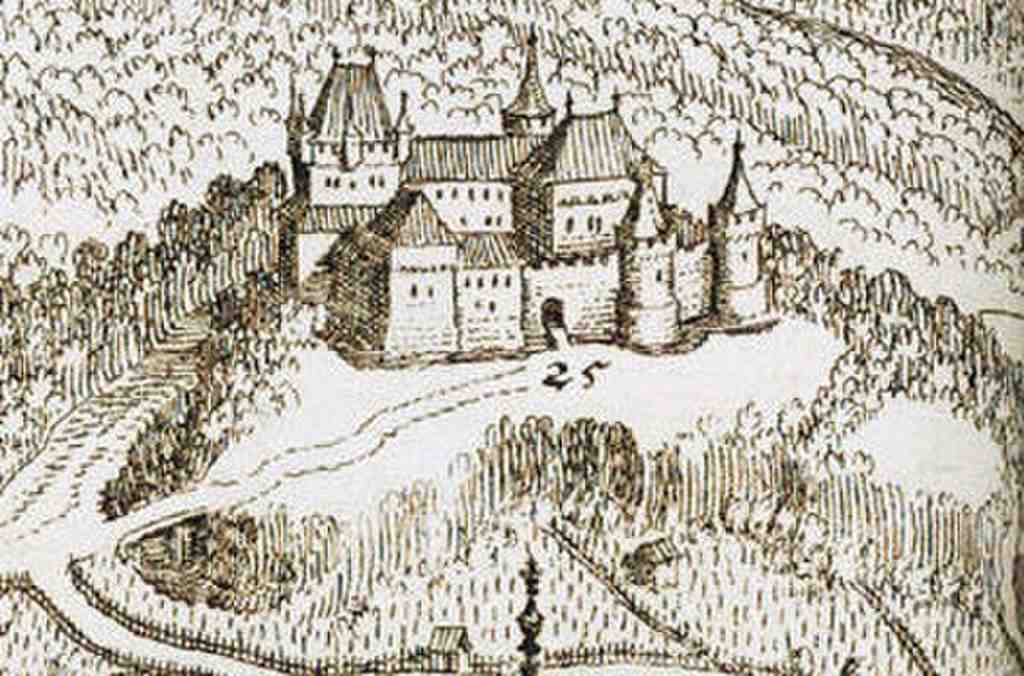
Freiburg CastlePhoto: Martin Zeiller, Wikimedia Commons, Public domain. Cropped & resized. Look for the broad grassy mound and the cut defensive ditch on the Schlossberg, a rounded earthwork of packed soil and stone with Ludwigshöhe marking the lost center of Freiburg’s vanished castle.
What you’re facing is mostly absence... and that is the point. Freiburg Castle has almost disappeared above ground, yet this missing place explains why the city began here at all. Long before medieval rulers arrived, people had already noticed the hill’s value. In eighteen nineteen, workers found Roman stone mosaics beneath Ludwigshöhe, hinting that a Roman villa or strongpoint once stood here too. Even without walls, the hill keeps confessing.
This is the Zähringer foundation in its uphill form. In ten ninety-one, Duke Berthold the Second of Zähringen ordered the Castrum de Friburch on this slope, while his servants and craftsmen lived below, where the old city later spread out. Then in eleven twenty, his son Konrad granted the settlement market rights, with imperial approval, and the place below the castle stopped being a camp of helpers and became a real town. So Freiburg did not simply grow around a church or a square... it grew under a watchful stronghold.
A poet, Hartmann von Aue, later praised the castle. A monk gave it something even better: a story. In eleven forty-six, a tradition later linked Bernard of Clairvaux to a blind boy healed here at Freiburg Castle. Whether you take that as miracle, memory, or medieval public relations, it fixed this hill in local imagination.
The city’s bond with its rulers soon turned sour. After the Zähringers died out, the Counts of Freiburg moved in, and the citizens got tired of paying for the privilege. In twelve ninety-nine they attacked the castle with catapults. In thirteen sixty-six, when Count Egino the Third tried to force his way into the city by night, the citizens answered with cannon and wrecked what people had called the most beautiful castle in the German lands. Cities do hold a grudge.
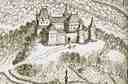
Then came one rewrite after another. In thirteen sixty-eight, Freiburg bought freedom from the counts for fifteen thousand silver marks, roughly several million euros in metal value today, and placed itself under Habsburg protection. Later emperors repaired, rebuilt, and fortified the hill because whoever held this height controlled the road into the Black Forest and the Dreisam valley. In sixteen sixty-eight, Leopold the First added a new fortress here. Then Louis the Fourteenth sent Vauban, his star military engineer, to modernize the whole hill into a French fortress ring. If you check the old view on your screen, you can see how the castle once sat over Freiburg like a thumb on the map.
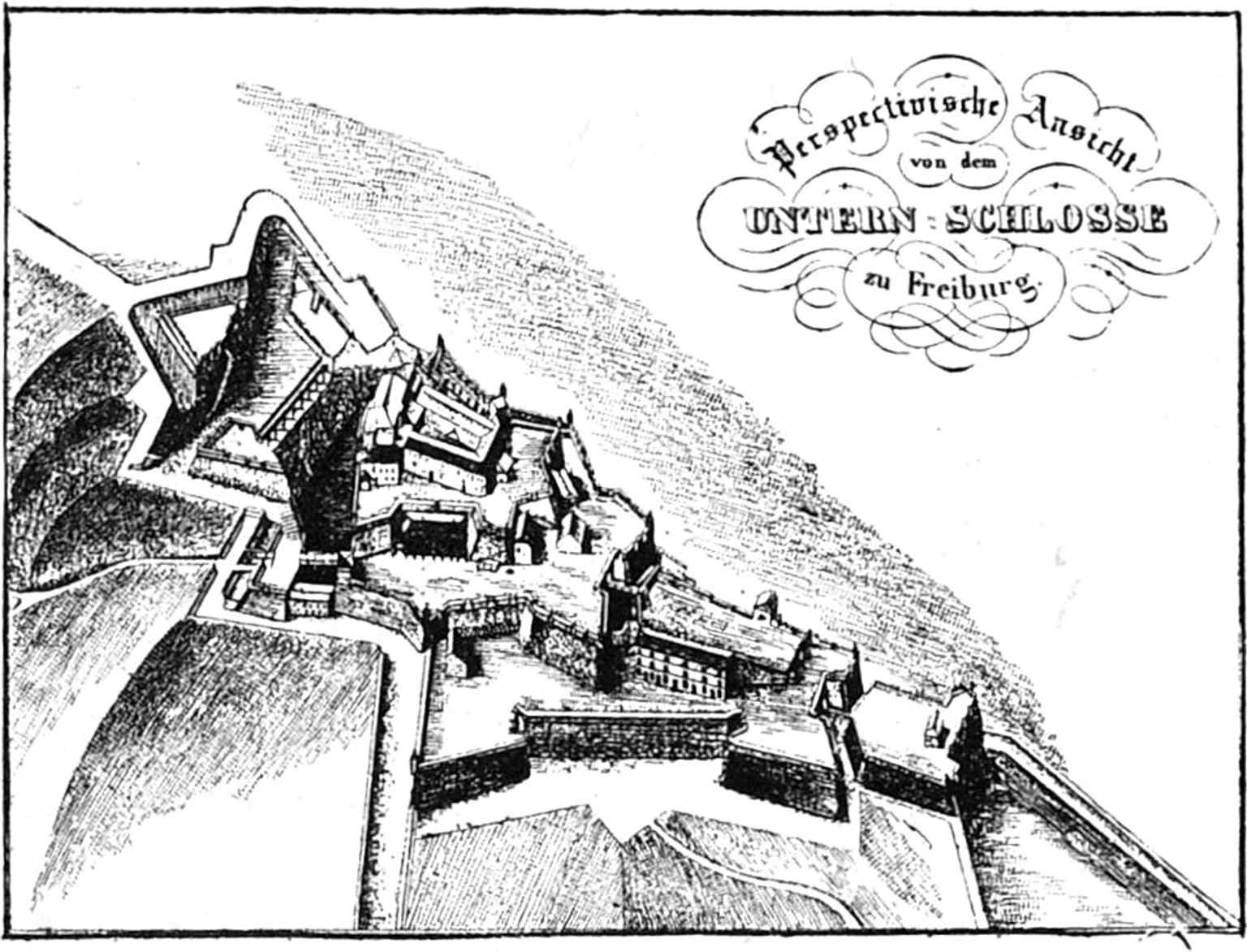
An older Freiburg view tied to the vanished Schlossberg castle, useful for showing the hill’s former strategic position above the city.Photo: Various authors, Wikimedia Commons, Public domain. Cropped & resized. And then... the French erased much of it before leaving in seventeen forty-five. They blasted the works so thoroughly that little remained beyond a debris cone and the neck ditch, a trench cut across the hill to make attack harder. The plan in the app shows that vanished geometry with almost chilly clarity.
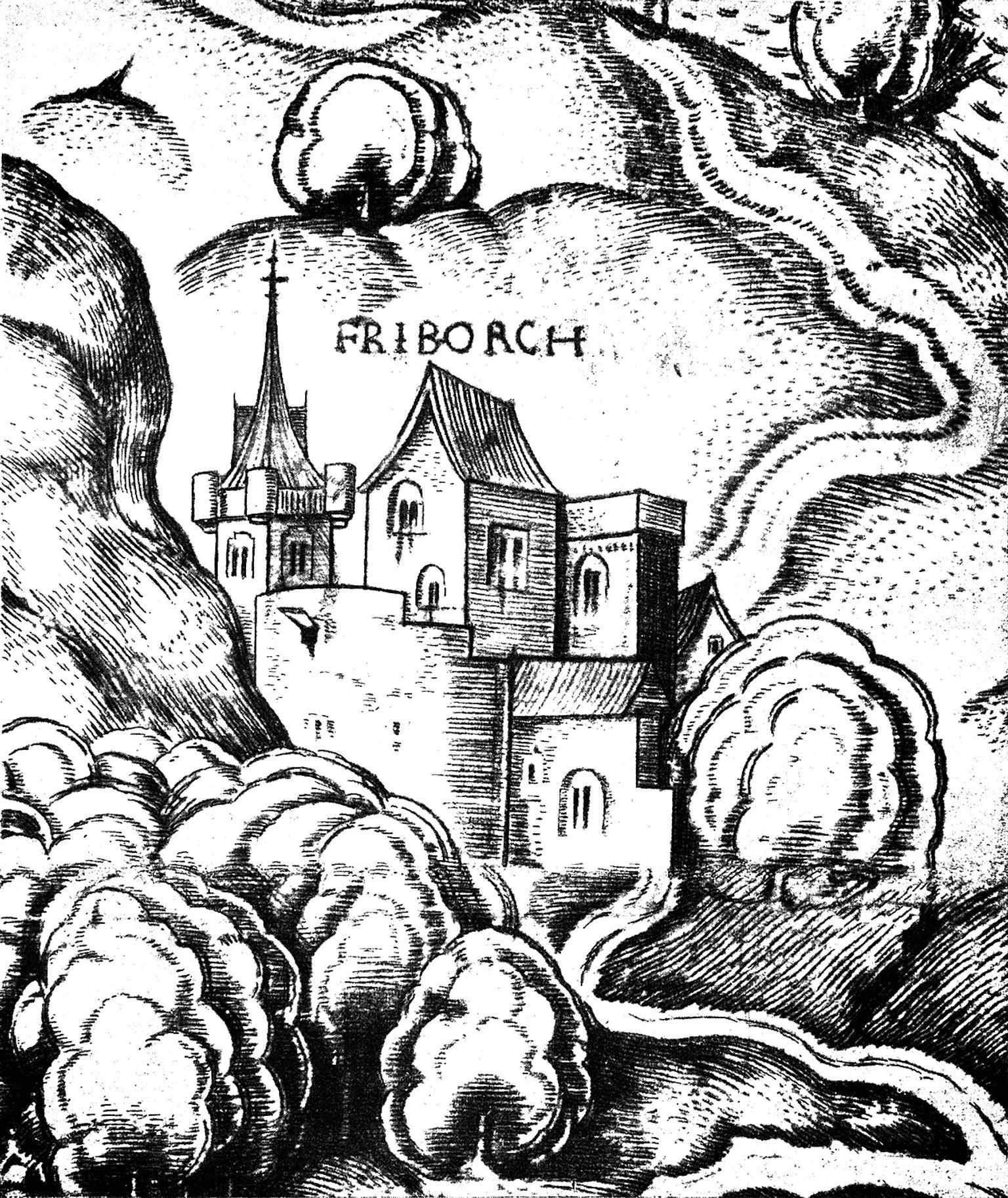
A historic plan from Freiburg’s old city views, showing how the castle hill once overlooked the town before the fortress was dismantled.Photo: Various authors, Wikimedia Commons, Public domain. Cropped & resized. What lasted was not the masonry, but the logic of the place. In the nineteenth century, Freiburg turned this former battle hill into a promenade. Johann Georg Dattler, the first innkeeper at the Adlerschloß up here, welcomed guests where soldiers once waited for orders. That may be the most Freiburg ending possible.
From here, the story softens into parkland. When you’re ready, head down toward the City Garden, about fifteen minutes away; and fittingly, this hill is open at all hours.
You’re looking for a broad green park with curving paths, a band of mature trees, and the slanted line of the Schlossbergbahn rising up the Schlossberg. This is a fine place to…Read moreShow less
Open dedicated page →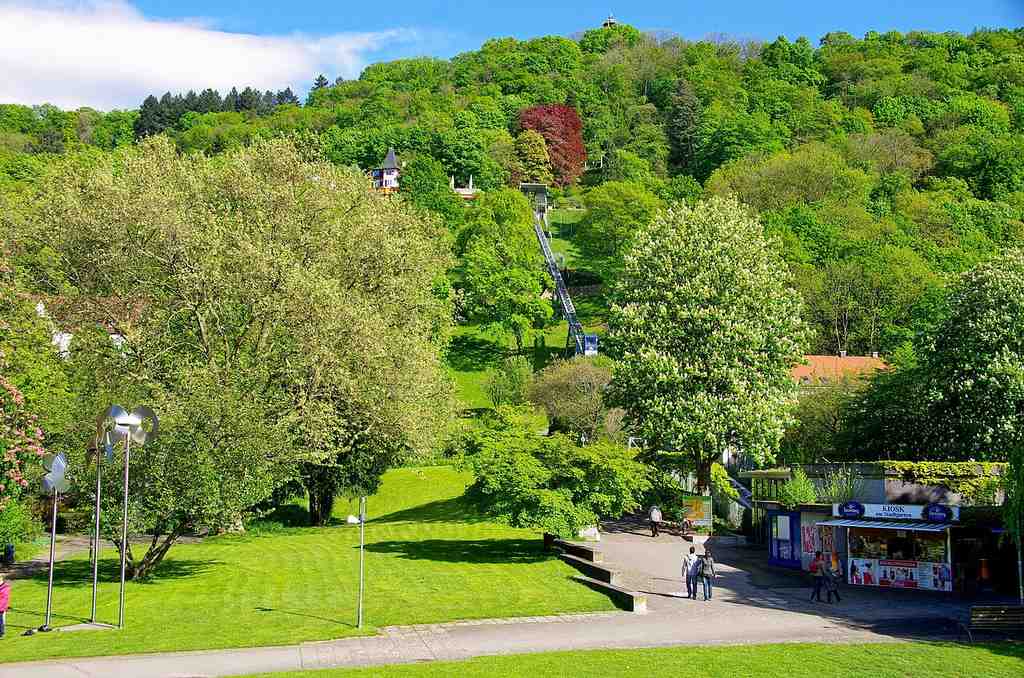
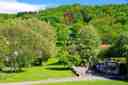
City Garden (Freiburg im Breisgau)Photo: user:joergens.mi, Wikimedia Commons, CC BY-SA 3.0. Cropped & resized. You’re looking for a broad green park with curving paths, a band of mature trees, and the slanted line of the Schlossbergbahn rising up the Schlossberg.
This is a fine place to end, because the Stadtgarten makes Freiburg’s habits plain. The city keeps taking ground that once served power, defense, trade, or display... and teaching it gentler work.
The park began after the Upper Rhine Trade Exhibition of eighteen eighty-seven, which took place nearby on Karlsplatz. That same year, the city hired its gardener, Schmöger, to plan and build this place, and by eighteen eighty-eight it had opened. For a while, right up to nineteen eleven, people even paid admission to come in. Public greenery, apparently, was too refined to be entirely free. Back then the park offered an aquarium, fountains, a music pavilion, a playground, and, in one of history’s stranger side notes, an enclosure for a rhesus monkey named Änne. She later ended up in the Museum of Nature and Humankind, which is not the retirement plan most of us imagine.
The garden grew in eighteen eighty-nine up the western slope of the Schlossberg as a woodland park. Then history did what history does. After the First World War, care slipped and the grounds had to be redesigned between nineteen twenty and nineteen twenty-four. In the air raid of nineteen forty-four, the park and its concert hall were devastated. Workers started restoring it in nineteen forty-eight by filling bomb craters and clearing paths. By nineteen fifty-two the recovery was complete, and in nineteen fifty-three the garden expanded again onto the site of the old Festhalle, a grand hall that never returned after the bombing. If you glance at the image on your screen, you can see that earlier version of the place, when the hall still stood here like a confident piece of civic furniture.
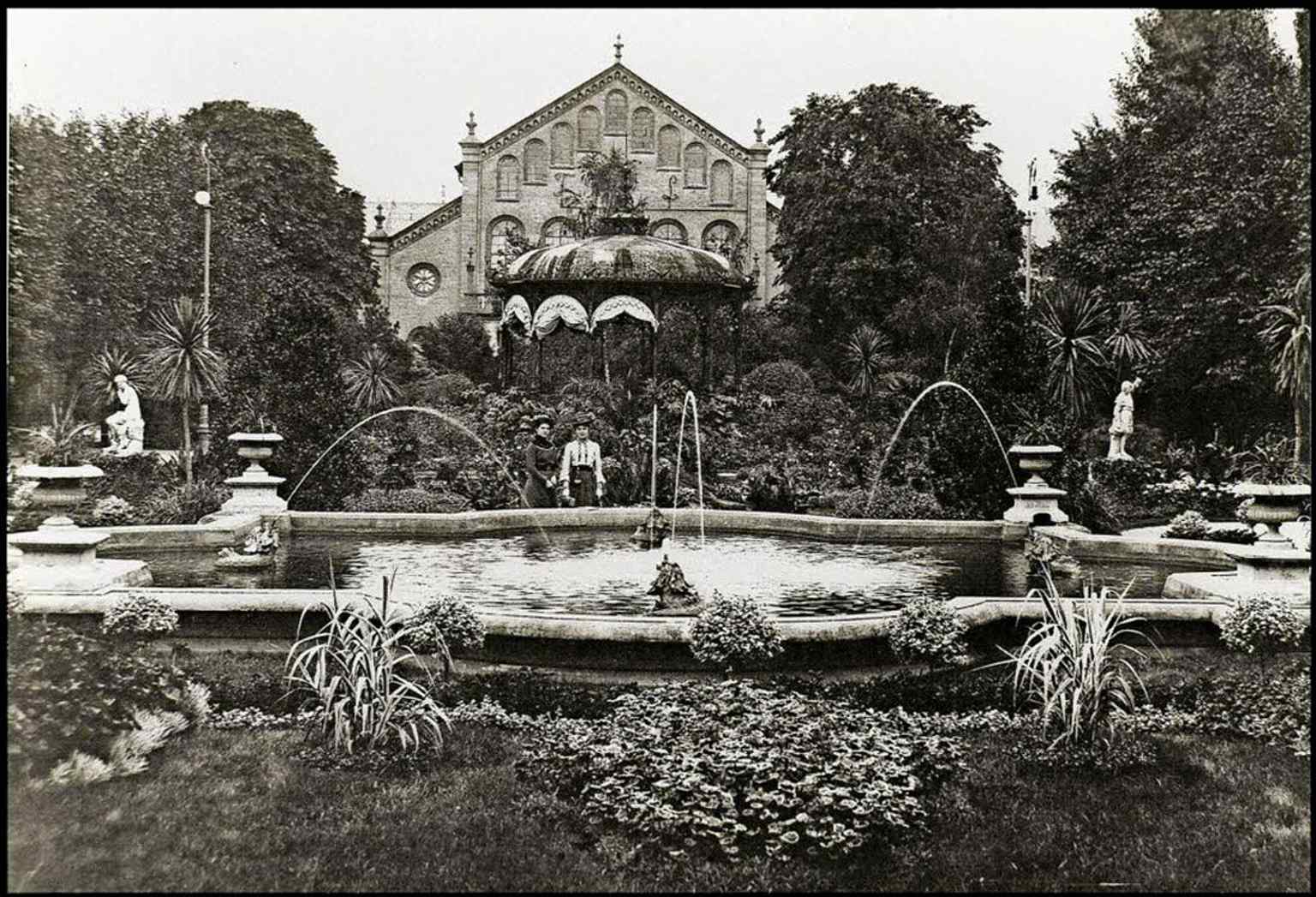
The Stadtgarten around 1900, when the old Kunst- und Festhalle still stood here before it was destroyed in 1944.Photo: Georg Röbcke, Wikimedia Commons, Public domain. Cropped & resized. One of the park’s best statements is the Musikpavillon. In nineteen sixty-nine, Max Scherberger designed its roof as a hyperbolic paraboloid, which is a gloriously technical way of saying a saddle-shaped surface, curving in opposite directions. He assembled that elegant form from straight wooden elements, while Immo Kirsch designed the concrete supports. It was the first roof shell of its kind in the Federal Republic of Germany. Neat trick. In twenty fifteen, inspectors found water inside the roof and declared the structure unsafe, so the stage closed and even the Theatersport festival had to cancel in twenty sixteen when repairs dragged on. Then came a proper comeback in twenty twenty-two, when open-air performances filled the park again. Freiburg, in other words, does not enjoy staying broken.
Even memory here gets revised. A duck monument in one of the ponds honors the tale that a duck’s quacking warned people before the bombing; later, the writer Andreas Venzke argued that story had been deliberately shaped to present Freiburg as an innocent victim. So this park does not just preserve memory... it asks you to examine it.
Before you end the tour, pause and notice how the paths, trees, and the climb toward the Schlossberg soften what was once a charged edge of the city.
That may be Freiburg’s quiet genius: not erasing damage, but turning old pressure points into places where ordinary life can gather, rest, argue, play music, and begin again.
If you’re planning to linger at the garden venue here, it generally keeps moderate prices and operates daily from eleven thirty in the morning until ten at night.
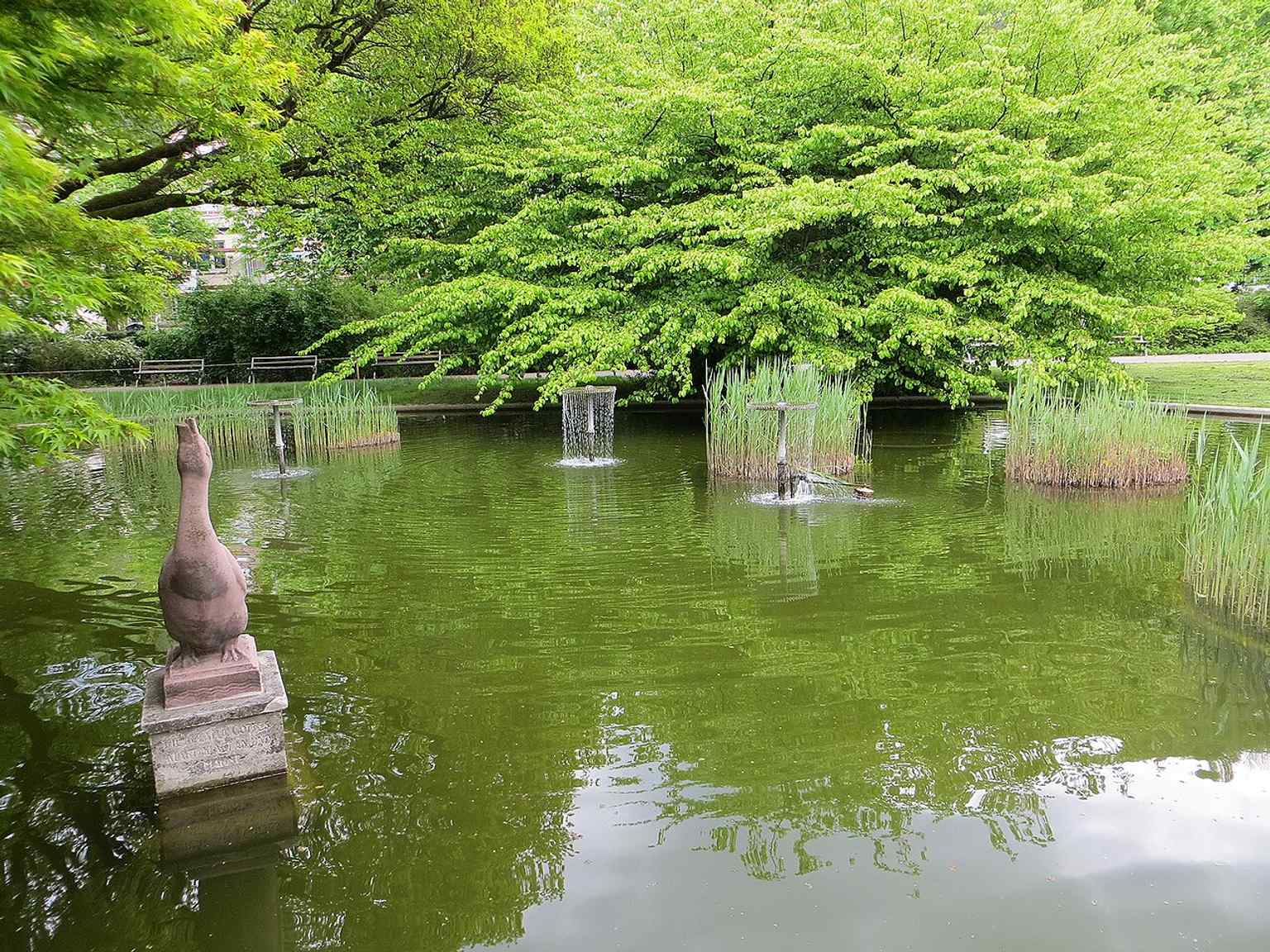
A modern view of Freiburg’s Stadtgarten, the park created after the 1887 exhibition and still used today for concerts and open-air events.Photo: Mister No, Wikimedia Commons, CC BY 3.0. Cropped & resized. 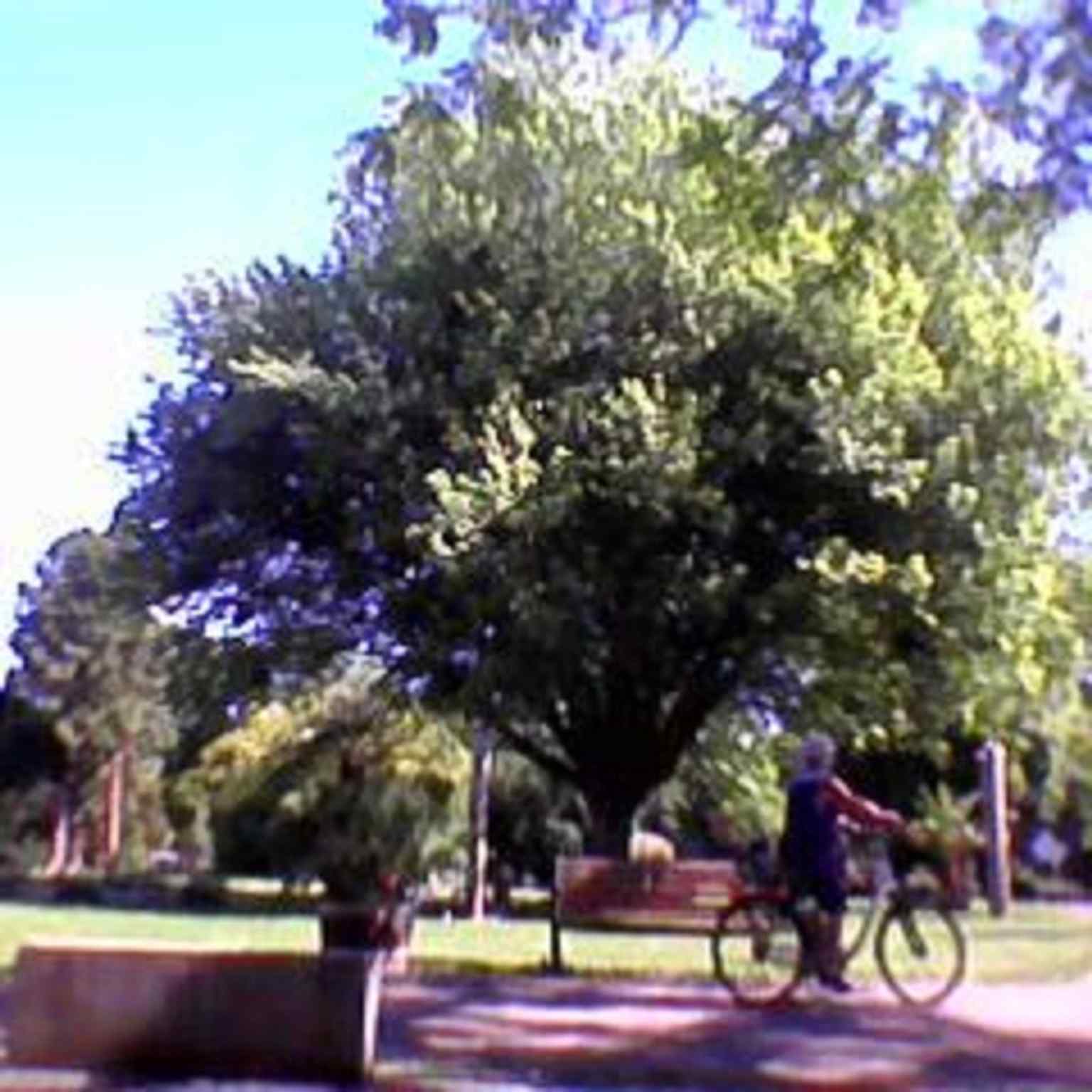
A cyclist in the Stadtgarten near the posted rules — the park is part of Freiburg’s pedestrian and leisure landscape, with cycling restricted on the paths.Photo: GFHund, Wikimedia Commons, CC BY-SA 4.0. Cropped & resized.

Frequently asked questions
How do I start the tour?
After purchase, download the AudaTours app and enter your redemption code. The tour will be ready to start immediately - just tap play and follow the GPS-guided route.
Do I need internet during the tour?
No! Download the tour before you start and enjoy it fully offline. Only the chat feature requires internet. We recommend downloading on WiFi to save mobile data.
Is this a guided group tour?
No - this is a self-guided audio tour. You explore independently at your own pace, with audio narration playing through your phone. No tour guide, no group, no schedule.
How long does the tour take?
Most tours take 60–90 minutes to complete, but you control the pace entirely. Pause, skip stops, or take breaks whenever you want.
What if I can't finish the tour today?
No problem! Tours have lifetime access. Pause and resume whenever you like - tomorrow, next week, or next year. Your progress is saved.
What languages are available?
All tours are available in 50+ languages. Select your preferred language when redeeming your code. Note: language cannot be changed after tour generation.
Where do I access the tour after purchase?
Download the free AudaTours app from the App Store or Google Play. Enter your redemption code (sent via email) and the tour will appear in your library, ready to download and start.
If you don't enjoy the tour, we'll refund your purchase. Contact us at help@audatours.com
Checkout securely with 











.jpg)


.jpg)


%20jm26650.jpg)


%20ger%C3%BCstfrei%20ist.jpg)


%20jm59159.jpg)


.jpg)


%20um%201900.jpg)
.jpg)
