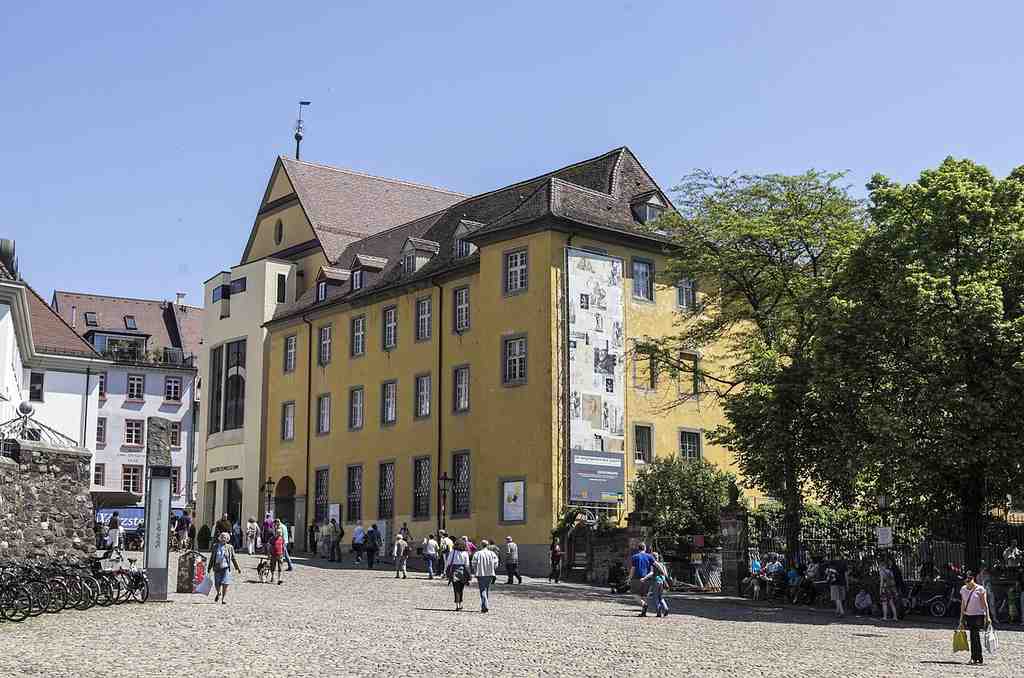
On your right, look for the long red-stone former church with a steep tiled roof, tall pointed Gothic windows, and a crisp modern entrance set into the old west façade.
This is the Augustinian Museum, and it may be Freiburg’s neatest lesson in how a city keeps its soul without keeping everything unchanged. It began as an Augustinian monastery. In Freiburg, sacred buildings often survive by accepting new civic jobs... and this one has had several.
Augustinian hermits settled here inside the city walls in the year twelve seventy-eight. Much of the structure still comes from the fourteenth century, and the roof timbers over the choir rank among the oldest in Freiburg, second only to the Minster. Then came secularization, when church property passed into civic hands. The city turned the church hall into a theater, and other rooms served as barracks and classrooms. Practical, slightly irreverent, very Freiburg.
By the early twentieth century, Mayor Otto Winterer wanted one central home for the city’s collections, which had been wandering from place to place since eighteen sixty-four. Architect Rudolf Schmid first planned a much harsher remake, but the First World War stopped work in nineteen fifteen. That pause mattered. When city building director Karl Gruber took over in nineteen nineteen, he chose restraint instead of swagger. He preserved the historic fabric and restored the old sequence of cloister spaces, even though money was tight and some work had to be done with what Germans politely call “poor materials”... which usually means, “we did our best with almost nothing.”
That decision shaped everything you see here now. This museum is not old stone pretending nothing happened. It is old stone carrying a lot of happened things.
Inside, the former church became a sculpture hall for the original stone prophets from Freiburg Minster. There are medieval panels, stained glass, Baroque altars, and a splendid organ front brought from Gengenbach. The museum also holds the collections of the Archdiocese’s diocesan museum, treasures from the Minster, and since twenty twenty-six, Freiburg’s city history in the west wing. If the Historical Department Store nearby turned trade into spectacle, this place turned devotion into memory.
Not every rewrite here was graceful. In nineteen thirty-seven, the Nazis seized a large part of the museum’s modern art as “degenerate.” Most of those works were later destroyed. So this building preserves absence as well as presence.
Then came the long modern rescue. Starting in two thousand and six, Freiburg rebuilt the museum in three phases: the church reopened in two thousand and ten, the House of the Graphic Collection followed in two thousand and sixteen with climate-controlled rooms for seventy thousand works on paper, and the final convent section reopened in twenty twenty-six after years of delays, wood-decaying fungus, and costs rising to about eighty-three million euros. Conservator Kai Miethe, who worked on it for decades, described the effort as a kind of shared life task. That feels right. Places like this do not survive on sentiment alone; they survive because people keep choosing the hard version of care.
From here, head on toward Schwabentor. At that gate, Freiburg starts showing its walls again... and with them, the city’s myths and revolts.
If you want to come back inside later, the museum is closed on Monday, open Tuesday through Sunday from ten to five, and on Friday it stays open until seven.