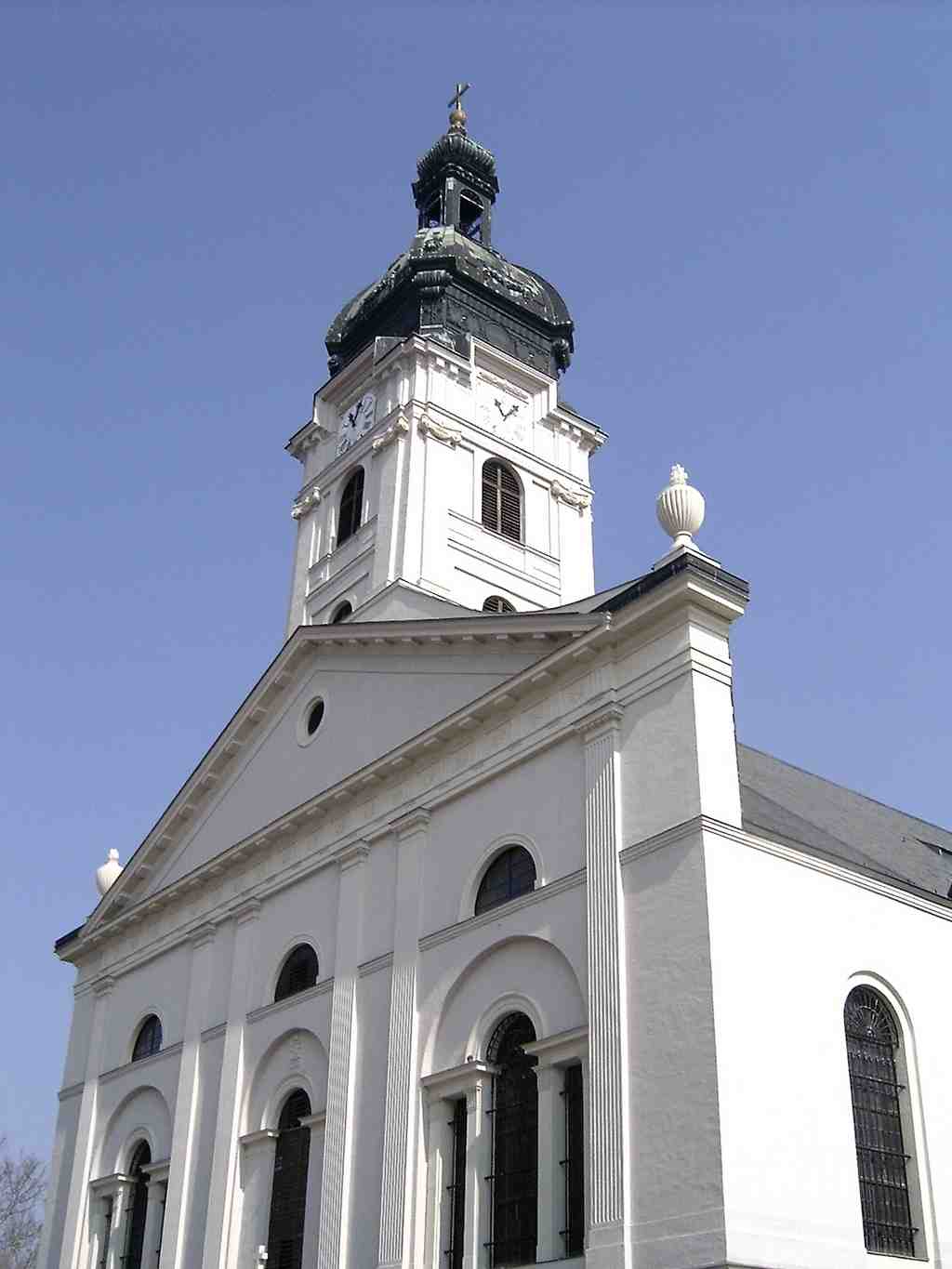
On your left, look for the pale stone front with its large half-round windows, a triangular pediment lined with vases, and the Gothic side chapel tucked against the basilica’s flank.
This is Győr Basilica, dedicated to the Assumption of the Virgin Mary, and it stands on Káptalandomb, the oldest sacred core of the city. If Győr has a memory center, this hill is it: church, bishop, relics, power, grief, and survival all packed into one tight precinct.
King Stephen founded the bishopric here in the eleventh century, and the first cathedral rose in Romanesque form. Only its apse - the rounded end of the earliest church - survived the centuries. After the Mongol invasion, builders raised it again in Gothic style, then János Héderváry added that chapel you can see from here in the early fifteenth century. Inside it rests one of Hungary’s great national relics: the Saint Ladislaus herma, a reliquary bust, meaning a sculpted shrine that holds sacred remains.
The strange thing about old holy places is how unholy their hardest years can get.
After the Ottomans threatened Győr in the sixteenth century, the cathedral suffered badly. One tower collapsed. Lightning destroyed the other. Soldiers turned part of the church into storage, then into a fortress. They filled the north aisle with earth up to the windows for cannon positions, used the sacristy and Héderváry Chapel as powder magazines, and kept horses in the rest. Even cathedrals, it seems, sometimes get assigned deeply unsuitable second jobs.
Then came the bells. In fifteen thirty-one, Captain Pál Bakics ordered them smashed so founders in Pozsony could cast cannon from the metal. Imagine that reversal: bells meant to call people to prayer reborn as weapons.
Bishop György Draskovich refused to let the place end there. He hired the Italian architect Giovanni Battista Rava, who reshaped the ruined cathedral in early baroque style between the late sixteen thirties and mid-sixteen forties. Later, György Széchényi gave it the present tower, and in the seventeen seventies and eighties Menyhért Hefele and Franz Anton Maulbertsch finished the grand interior with altars and sweeping frescoes.
This basilica also gathers more recent memory. Pope John Paul the Second prayed here in nineteen ninety-six, and in nineteen ninety-seven the church was raised to the rank of minor basilica. In the Héderváry Chapel, the city honors Bishop Vilmos Apor, whose story we touched at the castle: martyrdom met memorial here, though the planned nineteen forty-eight cathedral ceremony for him did not unfold as intended. His presence binds conscience to stone.
And still the building keeps renewing itself. In twenty twenty-two, new bells finally replaced those lost to war and requisition. One of them, the Holy Trinity bell, sounded for the first time under a bishop’s hammer. Not a bad ending for a long argument between faith and force.
Next, we leave this deep sacred archive for Jedlik Ányos Street, where memory turns from bishops and relics toward ideas in everyday motion. If you want to step inside later, the basilica is generally open mornings and again in the afternoon, with Sunday opening later in the day.