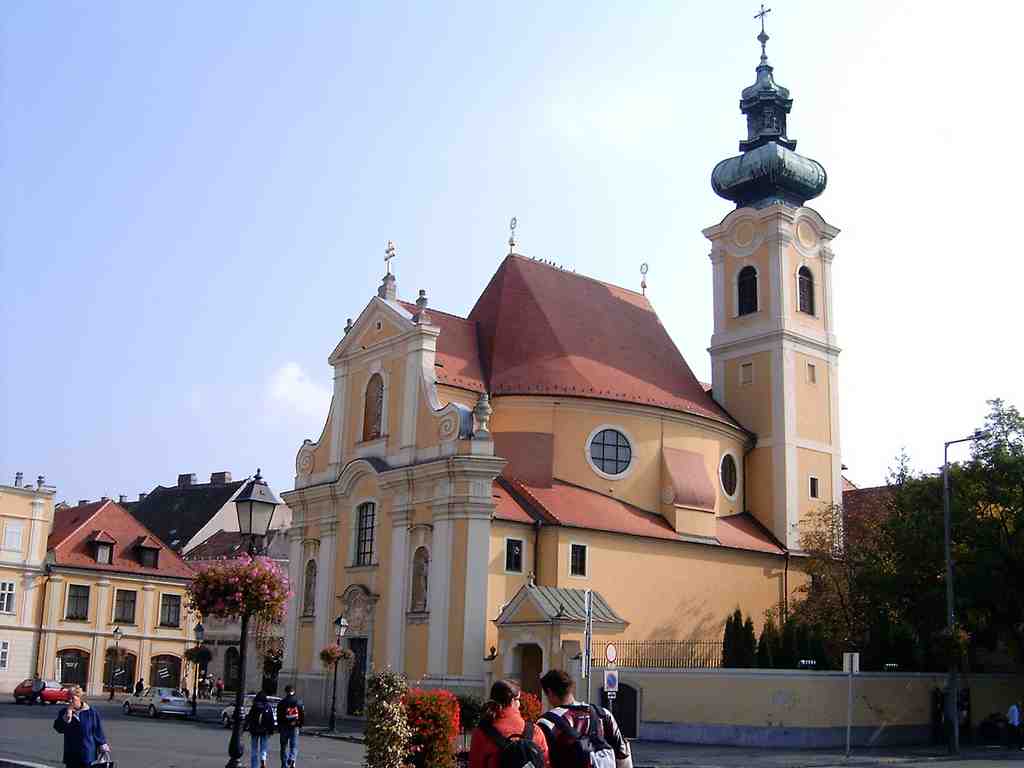
On your left, the Carmelite Church rises in pale plaster and stone like a Baroque stage set, with a broad triangular gable, a tall onion-domed tower, and a Madonna standing in the facade niche.
This church does an awful lot with one facade. It greets Vienna Gate Square like a carefully arranged performance, which is fitting in Győr, where public space so often feels like a set built for faith, memory, and a little civic self-respect.
The Carmelites came here because Archbishop György Szelepcsényi left them fifty thousand forints in his will - a substantial sum - on one condition: they had to found a monastery somewhere in Hungary. Bishop Lipót Kolonich offered a few possible cities. The friars chose Győr, arrived in sixteen ninety-seven, and settled beside the old western gate near the Rába. They owned no estates, so donations kept the whole venture alive. That is why the church took its time, rising between seventeen sixteen and seventeen twenty-five instead of appearing in one grand burst of confidence.
The person to remember here is Martin Athanáz Wittwer, a Carmelite friar who also happened to be an architect. Handy fellow. He designed something unusual for Hungary: not the long, processional church plan favored by the Jesuits, but an oval central space - an elliptical church under a low dome and steep roof. He even placed the tower outside the main body of the church so the building could connect more neatly to the monastery. Beauty and logistics, working together for once.
Now, let your eyes drift from the front to the church body behind it... and see if you can catch the local joke. Győr residents like to read an owl’s face into the architecture: two round openings as eyes, the little central projection as a beak. The Karmelite “owl face” is one of those affectionate urban habits that tells you a monument has been fully adopted. Once locals start finding animal faces in your masonry, you belong to them.
Back on the facade, the details reward a longer look. Four Doric pilasters - flat classical columns attached to the wall - divide it into three parts. Scroll-like volutes climb upward toward the pediment, the triangular crown at the top. In the niches stand Saint Teresa of Ávila and Saint John of the Cross, and above them the Madonna by the Italian sculptor Diego Carlone. That statue even had a prior life elsewhere in Győr before settling here, which feels appropriate. Buildings in this city rarely keep their stories politely separated.
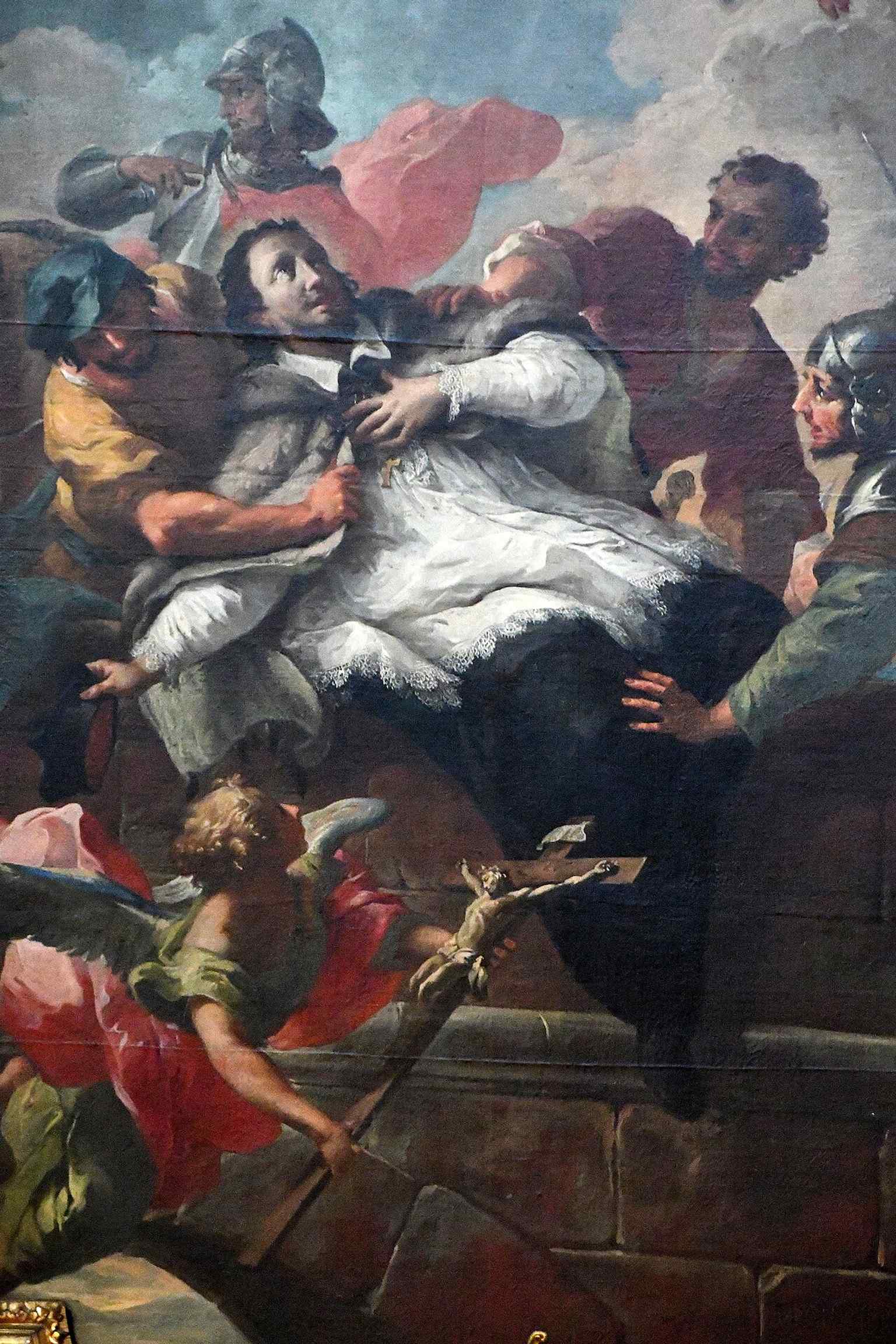
If you glance at the image in the app, you can peek inside at one of the side altars. Martino Altomonte painted Saint John of Nepomuk at the moment of martyrdom, flung into the river by soldiers in dark red while the saint stands out in white and black. Inside, Francis Richter, a Carmelite brother, shaped the altars, pulpit, benches, and gilded sculpture so the whole interior works like a single Baroque drama.
And then, quietly, the tone changes. Beneath the church lies a crypt that sits lower than the Rába’s usual water level yet somehow stays dry - a neat little river-city mystery. For decades, Blessed Vilmos Apor’s body rested there, giving this place a deeper charge than ornament alone can carry. In a moment, at Bishop’s Castle, we meet the harder part of that story.
If you want to come back inside later, the church generally opens on Tuesday and Wednesday mornings and late afternoons, Saturday morning and late afternoon, and Sunday around midmorning and late afternoon.