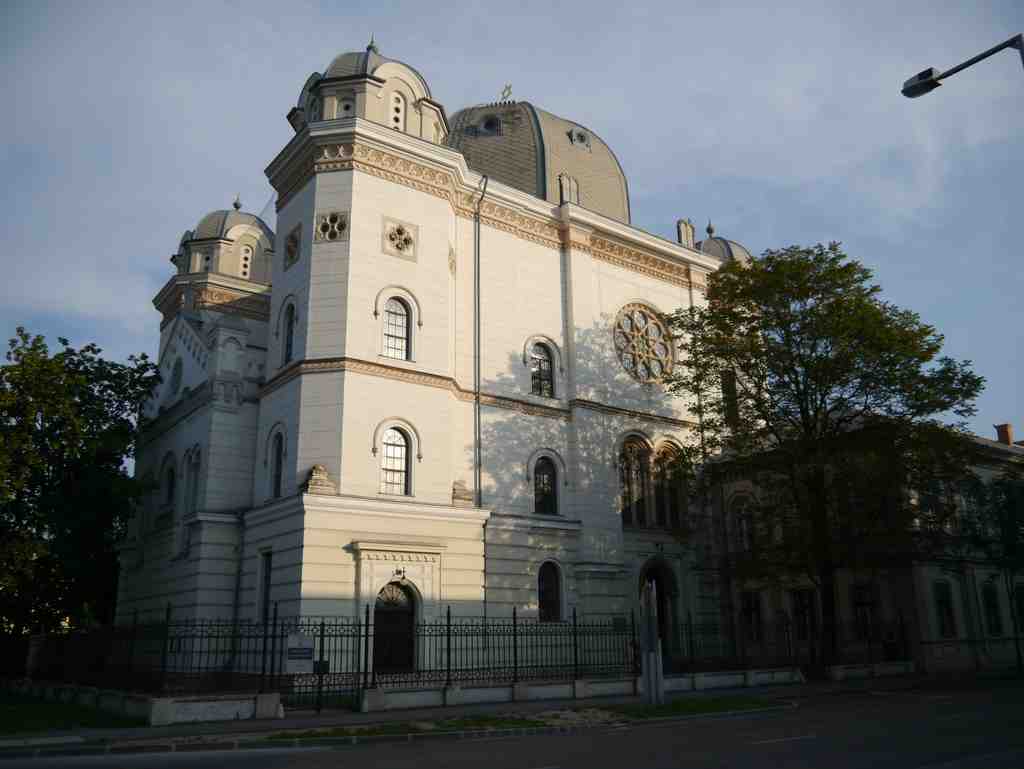
On your left, look for the pale masonry synagogue with its large central dome, tall round-arched windows, and compact corner towers framing the front.
This building has presence... the kind that does not need to shout. A Pest architect, Károly Benkó, drew the winning design after officials, including the county engineer József Kliegl, argued over the plans. The synagogue opened on the fifteenth of September, eighteen seventy, together with a two-story school beside it. In style, it mixes historicism, meaning it borrows older architectural forms, with touches of Art Nouveau, the more flowing late nineteenth-century taste. Győr quickly treated it as one of the city’s showpieces, and other towns looked to it as a model for a large urban synagogue.
Even then, people found things to worry about. Contemporary critics said major holy days might pack it too tightly, and the three spiral stair towers could make a fire evacuation dangerously slow. Human beings, bless us, can admire a building and argue with it in the same breath.
But the real break came later. In nineteen forty-four, ghettoization and deportation severed this synagogue from the community that built it, filled it, and gave it meaning. Jews from Győr and the surrounding area were forced into the ghetto linked to this very place, then deported. One of the most painful stories is that of Chief Rabbi Dr. Emil Róth, whom men beat inside the ghetto before they deported him.
Once you know that, the dome looks different.
After the war, survivors tried to rebuild Jewish communal life here, but loss and emigration hollowed it out. By nineteen fifty-six, the Orthodox community had disappeared, and the Neolog community kept shrinking. The sacred hall later sat unused, and in the nineteen eighties officials turned it into a furniture warehouse... which is about as bleak a second act as a sanctuary can get.
And yet the building stayed. That matters. Records, testimony, old photographs, and walls like these become witnesses to what was lost when a community has been violently scattered. Since two thousand and three, restorers have given the interior back its original octagonal central space, reconstructed the dome painting from old images, and rebuilt wall patterns with stencils. Today the synagogue serves as a museum and cultural venue, run by Széchenyi István University and the City Art Museum, with concerts, exhibitions, and a permanent exhibition on Jewish life and achievement.
So here is the hard question to carry with you: what does it mean when a holy building survives, but the people who gave it prayer, argument, music, and daily life are largely gone?
Hold that thought as you continue to the Carmelite Church, about an eight-minute walk away. If you want to return inside, it generally opens Monday, Tuesday, Thursday, and Friday from noon to four.