50+ languages

 Groningen · Netherlands
 Groningen Audio Tours
Discover Groningen with self-guided audio walking tours
headphones
1 tours
pin_drop
20 landmarks
translate
Groningen tours
Pick a Groningen worth walking.
Self-guided audio tours written by people who actually live there.
1 tours
Top landmarks
The Groningen everyone knows.
The landmarks in every guidebook — and the tours that tell you what guidebooks don't.
A few words on Groningen
The Netherlands' liveliest student city, built around a medieval market
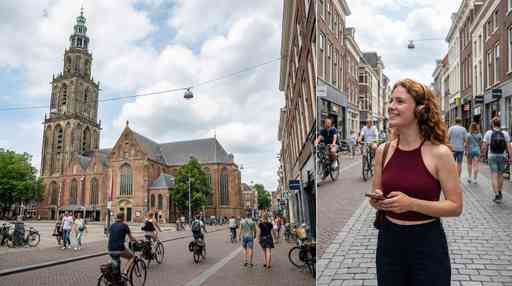
Groningen is the capital of its own province and the largest city in the northern Netherlands, which means it has the confident, slightly independent character of a regional center that has never had to defer to Amsterdam. The University of Groningen, founded in 1614 -- the same year Harvard was founded in Massachusetts -- gives the city its underlying energy: roughly a quarter of the population is students at any given time, and the effect on the restaurant, bar, and cultural scene is substantial. The Martinikerk, the towering Gothic church at the Grote Markt, has been the visual anchor of the city since the 14th century, and the adjacent Martinitoren can be climbed for views over the flat province and, on clear days, across to the Wadden Sea islands.
The Forum Groningen, opened in 2019, is a remarkable building on the Nieuwe Markt: a wave-shaped structure designed by NL Architects with a public roof terrace and a mix of cinema, library, and museum spaces that has become the city's most popular gathering point.
The Groninger Museum across the canal from the central station, designed by Alessandro Mendini with contributions from Coop Himmelblau and Philippe Starck, is one of the most architecturally audacious museum buildings in the Netherlands, its primary-color sections jutting over the water in a way that still divides opinion 30 years after it opened.
Groningen
Groningen FAQ
Before you walk.
The Forum on Nieuwe Markt is a multipurpose cultural building opened in 2019, designed to be a city living room. Inside you will find the Groningen public library, cinema screens, the local history museum of Groningen, a food court, and various event spaces. The rooftop terrace is free to access and gives excellent city views. It is open daily and is the most visited building in the city.
Groningen is consistently ranked among the top cycling cities in the world and has a higher percentage of daily bicycle journeys than almost any other Dutch city. The compact center is almost entirely navigable by bike, the network of dedicated cycle paths is extensive, and bike rental shops are plentiful near the station. Many visitors find the cycling culture is part of what makes the city enjoyable.
Intercity trains from Amsterdam Centraal to Groningen run regularly and take about 2 hours. From Amsterdam Schiphol Airport the journey is about 2 hours 15 minutes. Groningen is also connected by train to Leeuwarden, Assen, and Zwolle for exploring the northern Netherlands.
The Groningen gas field, discovered in 1959, is one of the largest natural gas fields in the world. Decades of extraction have induced significant earthquakes in the region, causing structural damage to thousands of buildings and leading to the displacement of many residents. Gas production has been wound down toward zero by 2025. The earthquakes remain a major local political issue and have shaped attitudes toward the energy industry across the northern Netherlands.
Every Groningen tour, in your language.
All 50+ languages, included with every booking.
🇬🇧 English🇫🇷 Français🇪🇸 Español🇩🇪 Deutsch🇮🇹 Italiano🇯🇵 日本語🇨🇳 中文🇰🇷 한국어+ 41 more
star AudaTours Unlimited
Visiting more than one city? Subscribe.
Unlock every Groningen tour — plus thousands more worldwide. Cancel any time.
$4.99/week · Cancel anytime


Loved by travellersThousands of tours started.
Thousands of tours started.
Plenty of opinions.
4.8 across the App Store and Google Play. Here's a few we keep coming back to.
starstarstarstarstar
This tour was such a great way to see the city. The stories were interesting without feeling too scripted, and I loved being able to explore at my own pace.

Jess
Tbilisi Tourstarstarstarstarstar
This was a solid way to get to know Brighton without feeling like a tourist. The narration had depth and context, but didn't overdo it.

Christoph
Brighton Tourstarstarstarstarstar
Started this tour with a croissant in one hand and zero expectations. The app just vibes with you, no pressure, just you, your headphones, and some cool stories.

John
Marseille Tourdownload Get the app Pop your headphones in.


Pop your headphones in.
Step outside.
Free to download. Tours in every city. Start in 60 seconds — no account, no card.
headphones
~ 4 min until your first tour starts
public
1,000+ cities worldwide
all_inclusive
AudaTours
Unlimited
Every tour. Every city. One subscription.
3097 tours2273 cities138 countries50+ languages
$39 /year
all_inclusive Explore Unlimited