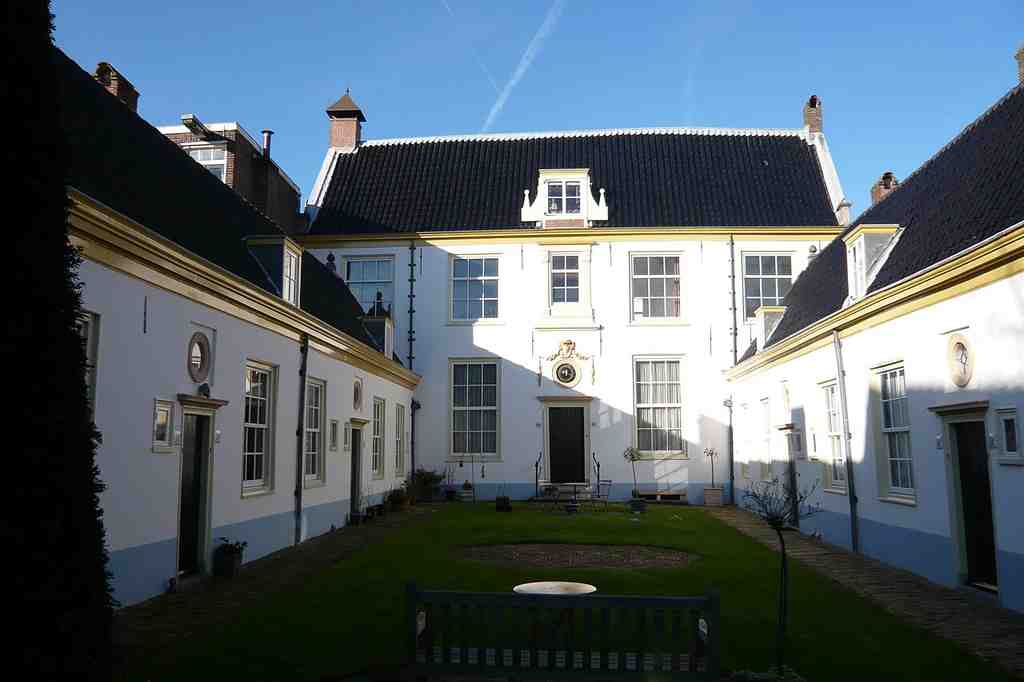
On your left is a sober brick hofje with a taller central house, two balanced side wings, and a gate that folds the whole place into a private little court.
This is the Vrouwe- en Antonie Gasthuys, a hofje... a charitable courtyard of small homes. It looks calm now, but its history runs on family money, social standing, and some very practical real-estate thinking. In sixteen fifty-five, the wealthy Haarlem merchant Joseph Coymans and his wife, Dorothea Berck, bought the foundation, and for a while people even called it the Coymans Hofje. If you glance at your screen, you can meet Dorothea in Frans Hals’s portrait. She brought more than generosity here; she brought a famous family name.
In seventeen eighty-seven, the foundation left Hagestraat and settled here on Klein Heiligland. The old reason for staying put had faded: pilgrims were no longer coming in large numbers, while travelers now preferred the trekschuit, a canal passenger boat. So care moved where the city’s traffic had moved.
And here’s the quiet local twist: this property may have come to the Gasthuys through an exchange with the Teyler Foundation. So even this peaceful court may owe something to Pieter Teyler’s wider network of charity, not just scholarship and museums. Before that, this ground held the Kolderhofje, a Mennonite - a plain-living Protestant - courtyard founded in seventeen twenty-nine.
The building in front of you keeps those layers visible: the main block dates to sixteen forty-eight, and the flanking wings came in seventeen thirty; the app image shows the whole composition clearly. Now protected at Klein Heiligland sixty-four, it reminds us that behind every serene hofje sits a negotiation over money, land, status, and who gets to belong. When you’re ready, Proveniershof is about a four-minute walk from here.