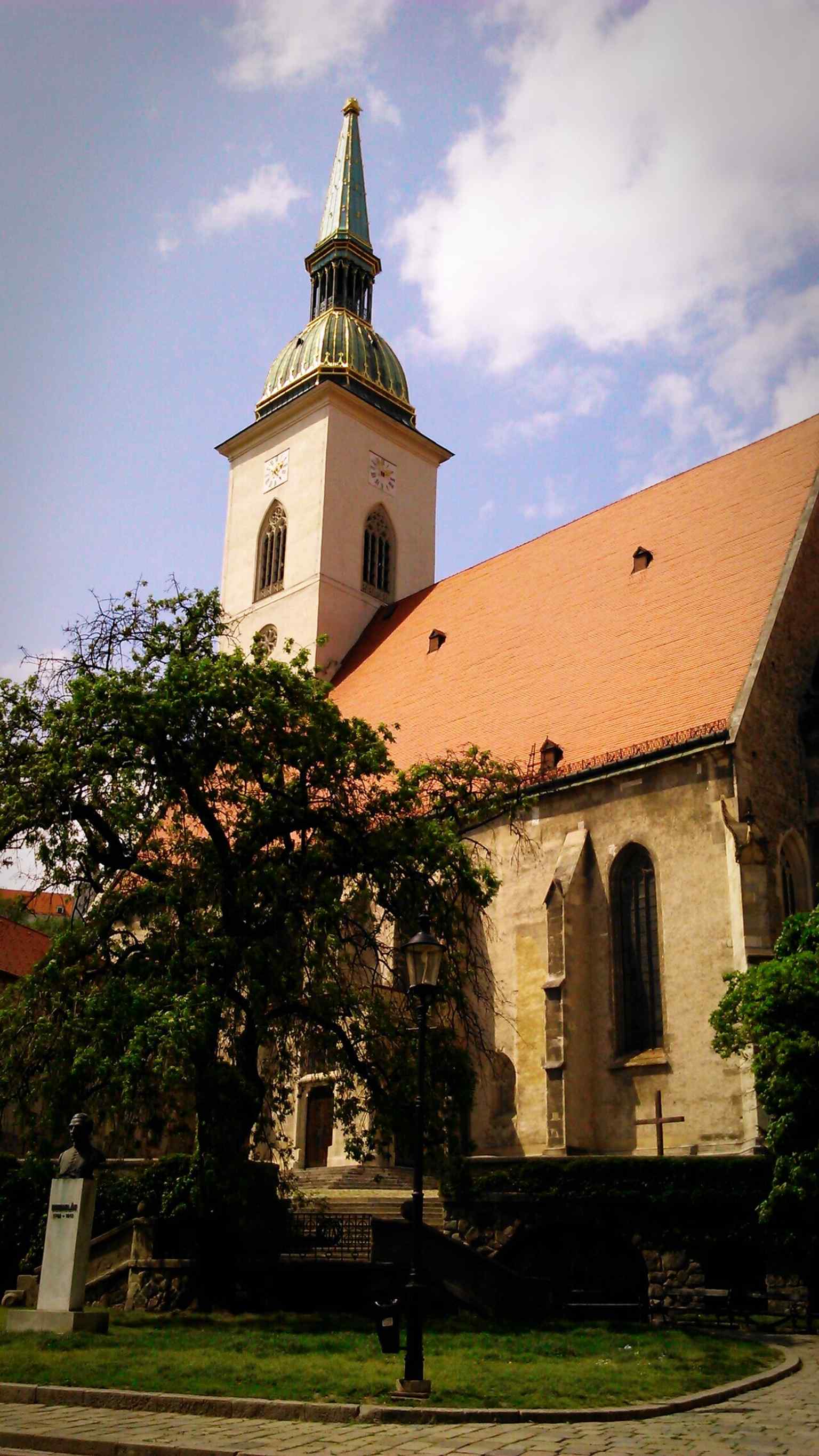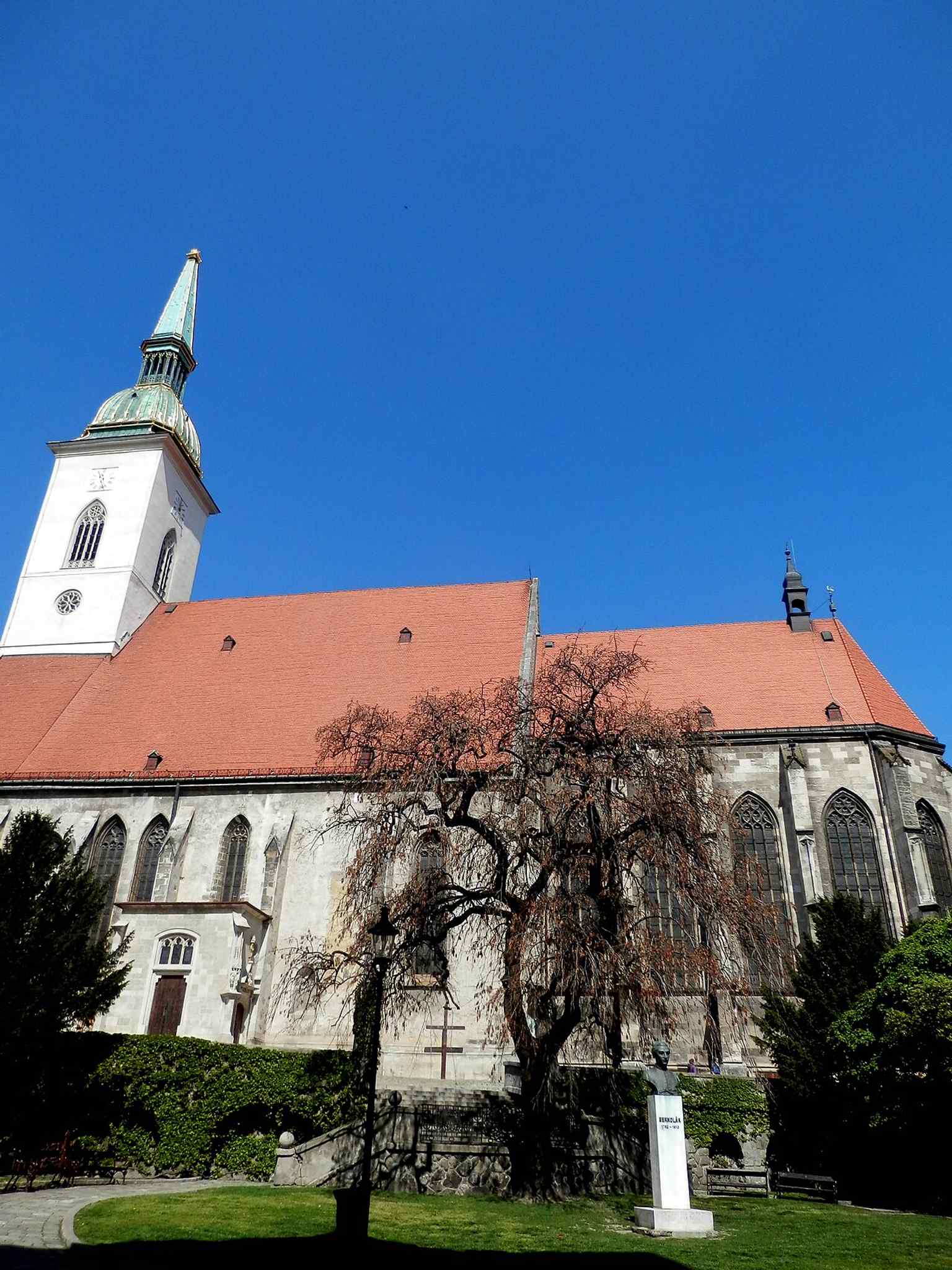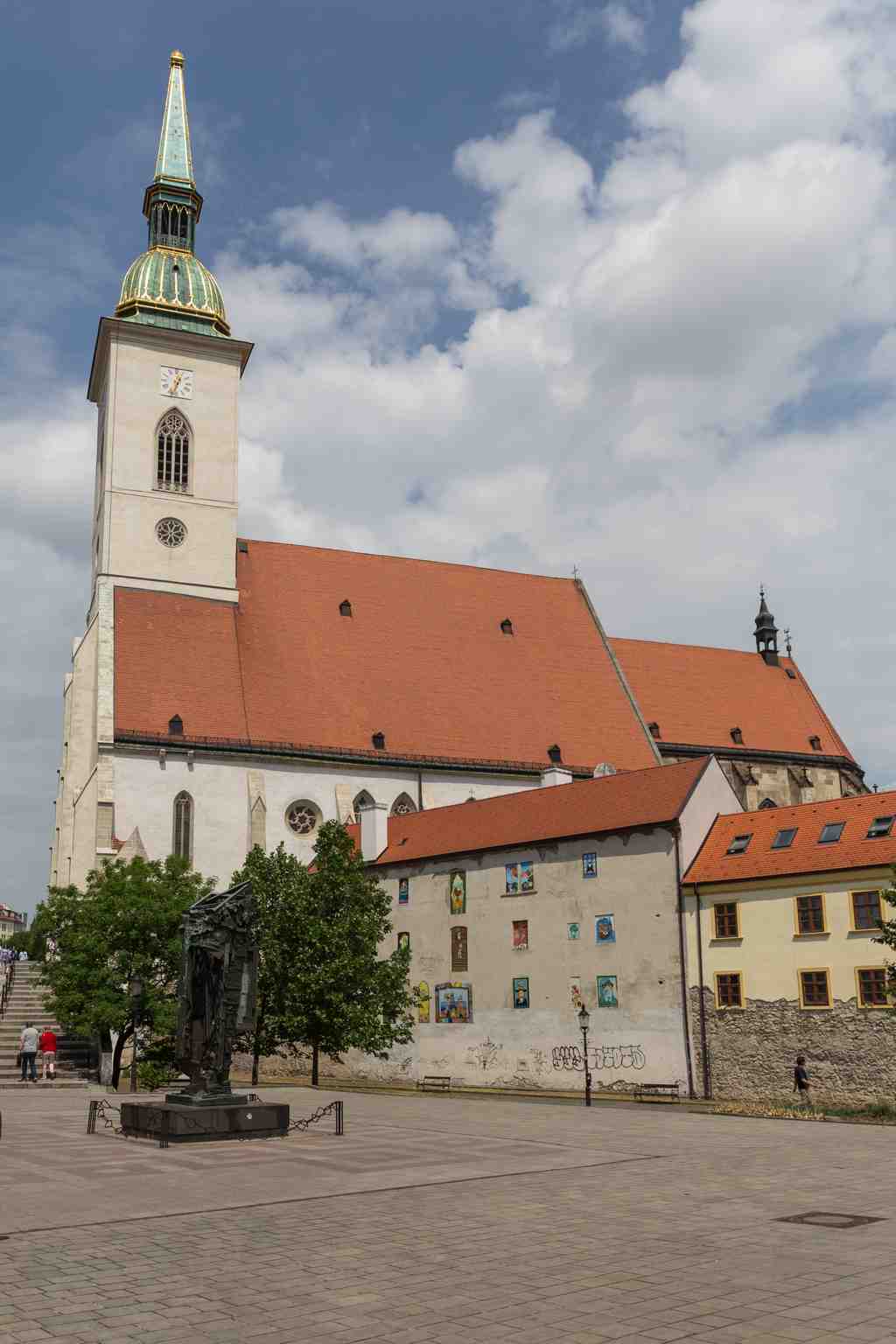
On your left, St. Martin’s Cathedral is a long pale-stone Gothic church with a steep roof and a tall square tower topped by a curved copper cap and a gleaming golden crown.
Here it is... the ceremonial heart of old Pressburg, today’s Bratislava. If the castle held power, this church gave that power its public blessing. Kings did not just rule from papers and armies; here, in front of clergy, nobles, and the city itself, they received a crown and became something larger than a person.
This ground had a long memory even before the cathedral rose. People lived here as far back as prehistoric times. Later came a small round church, then a Romanesque stone church, and from the early fourteen hundreds a much bigger Gothic rebuild. The builders pulled off a neat medieval trick: they raised the new church around the old one so worship could continue while construction went on. No wasted Sundays.
The city changed, and the church changed with it. As Bratislava expanded eastward, this church found itself at the edge of town, folded right into the defensive walls. Its western end joined the city ramparts, and the tower served as a bastion, a defensive strongpoint. So even the house of prayer had to keep one eye on the gate.
Its greatest role began in fifteen sixty-three. That is when the coronation age opened here, in the reign of Maximilian the Second, the same ruler you met back at Maximilian’s Fountain. From fifteen sixty-three to eighteen thirty, this cathedral hosted nineteen coronations: eleven rulers and eight royal consorts. Maria Theresa took the Hungarian crown here too, and with every ceremony Bratislava’s standing rose. The city was no longer just a border town with good walls. It became the stage where a kingdom announced itself.
Look up at that tower. The golden crown at the top is not a cute ornament. In seventeen sixty-five, builders placed a gilded model of the Hungarian royal crown there as a permanent reminder of this church’s coronation role. Think of it as the city’s own exclamation point in metal. If you glance at the image on your screen, you can see how that tower still commands the old town skyline.
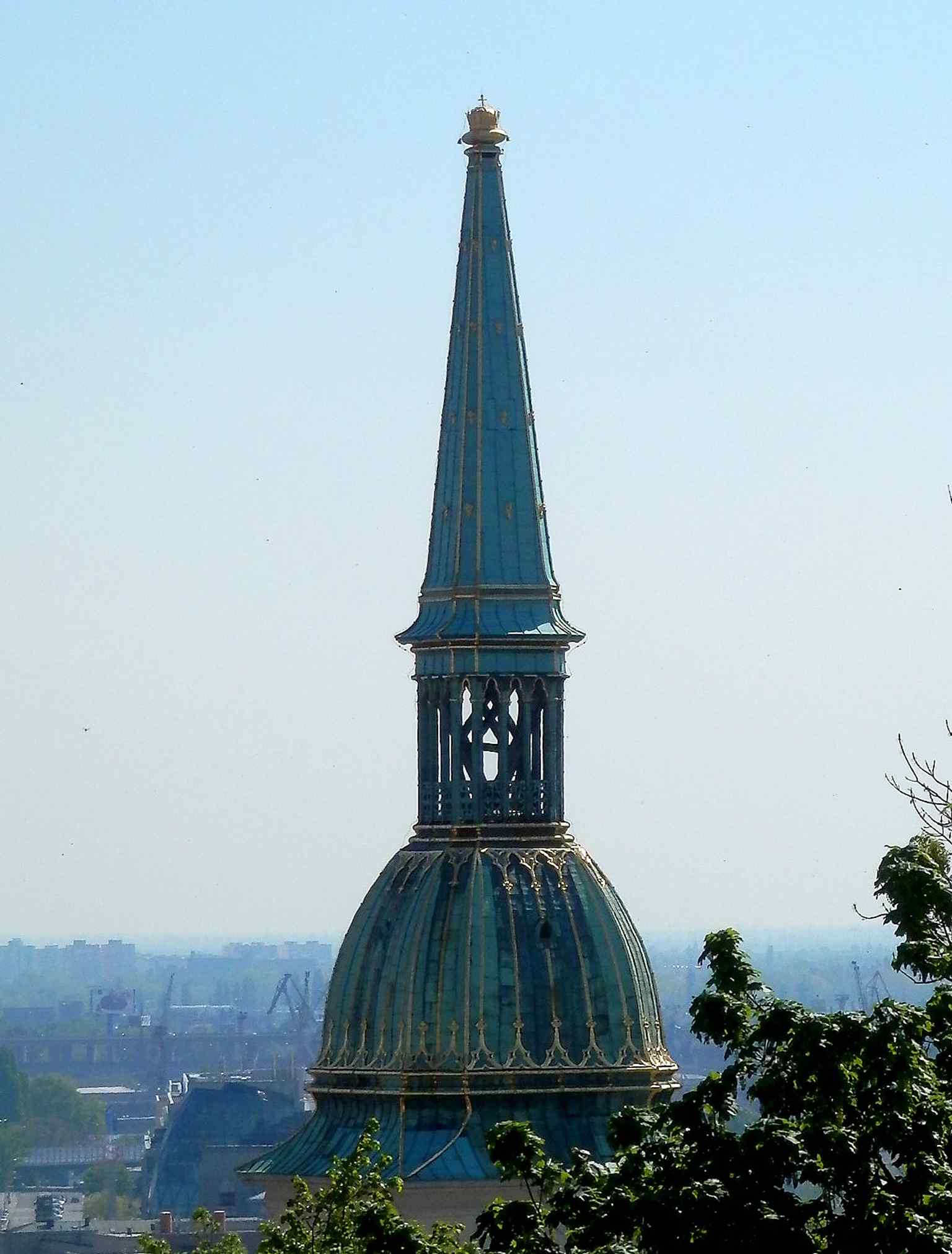
One person who stays with me here is Ferdinand the Fifth, the last monarch crowned in this cathedral, in eighteen thirty. Just a few years later, lightning struck the tower and fire damaged it. Ferdinand then sent copper for the new roof. That tells you something: even after the ceremony ended, this place still tugged at the people who had stood at its center.
And yet, for all this grandeur, the cathedral could not hold the city still. In the nineteenth century, restorers stripped away much of its Baroque interior to recover a more Gothic look. One age crowned kings here; another edited the scenery. That old argument between memory and reinvention is not over yet... and at the S-N-P Bridge, eight minutes from here, you’ll see it in a very different key.