
Bratislava Audio Tour: Historic Heart
Velvet curtains and cold stone meet on Bratislava streets where empires argued and secrets slipped between palace doors. This self guided audio tour leads through the Old Town from the Historical building of the Slovak National Theatre to Primate's Palace and Mirbach Palace, with stories that surface the political battles, rebellions, scandals, mysteries, and forgotten moments most visitors never hear. What decision inside Primate's Palace nearly tipped a city into panic at the worst possible hour? Which Mirbach Palace detail hides a quiet clue to a vanished patron and a scandal nobody confessed? Why does the theatre facade seem to point to one oddly specific spot where a protest once turned abruptly silent? Follow footsteps across squares and side streets as scenes change like acts in a drama. Expect sharp turns, sudden revelations, and a new way to read every arch and window. Press play and let Bratislava pull the curtain back.
Tour preview
About this tour
- scheduleDuration 110–130 minsGo at your own pace
- straighten4.6 km walking routeFollow the guided path
- location_onLocationBratislava, Slovakia
- wifi_offWorks offlineDownload once, use anywhere
- all_inclusiveLifetime accessReplay anytime, forever
- location_onStarts at The historic building of the Slovak National Theatre
Stops on this tour
lock_open 3 free previews · 12 unlock with purchase
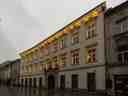
In front of you stands a pale stone neo-Renaissance theater with a rounded central dome, tall arched windows, and a sculpted figure group perched above the main entrance. Welcome…Read moreShow less
Open dedicated page →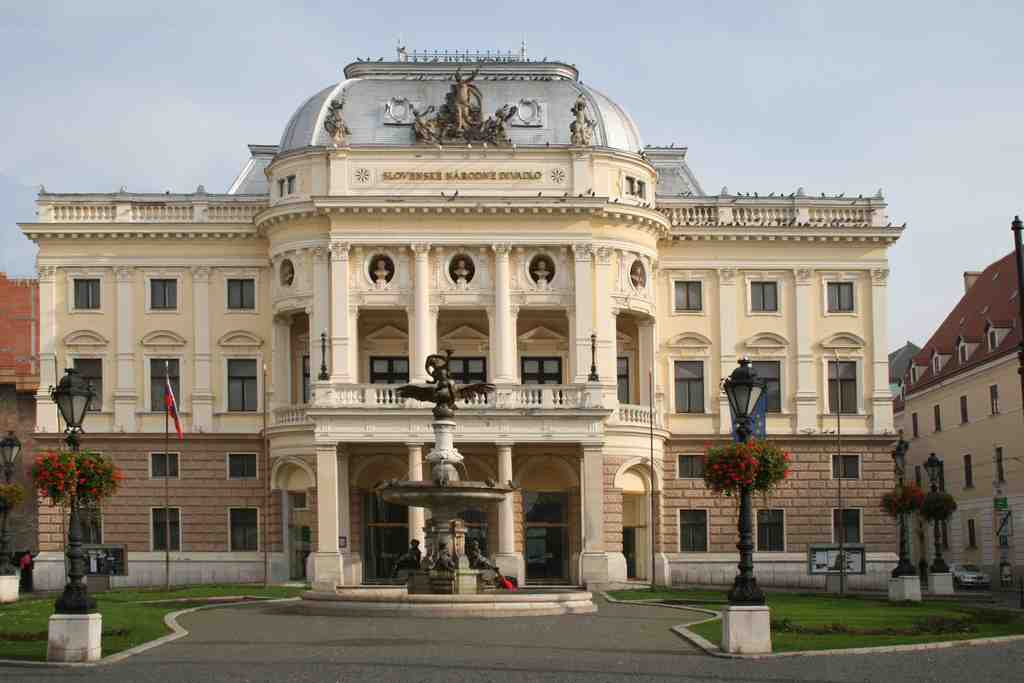
The historic building of the Slovak National TheatrePhoto: Peter Zelizňák, Wikimedia Commons, Public domain. Cropped & resized. In front of you stands a pale stone neo-Renaissance theater with a rounded central dome, tall arched windows, and a sculpted figure group perched above the main entrance.
Welcome to Bratislava... and to a building that tells you, right away, how this city likes to work. It rarely throws the old script away. It keeps the stage, changes the cast, and gives the lines a new voice.
This theater stands on a site where a city playhouse had already been performing since seventeen seventy-six, when Count Juraj Csáky commissioned one from the designs of Matej Walch. The building you see now arrived later, opening on the twenty-second of September, eighteen eighty-six. Two Viennese architects, Ferdinand Fellner and Hermann Helmer, designed it as one of their many grand theaters across Europe, and the local builder Ignác Feigler Junior pushed the work through at remarkable speed, from August of eighteen eighty-four to September of eighteen eighty-six. That is brisk, even by contractor bragging standards.
Look at the façade and you can read its inheritance: imperial taste, formal symmetry, a little flourish, a little authority. Early on, the house welcomed German and Hungarian companies. Then, after the birth of Czechoslovakia, the same walls took on a new job. From nineteen twenty, this became the home of the Slovak National Theatre, one of the key places where Slovak professional culture learned to stand on its own feet.
That change did not happen with trumpets and instant perfection. It began modestly, almost tenderly. After the premiere of Mariša on the second of March, nineteen twenty, the first Slovak productions followed within months, including Hriech and V službe. In nineteen twenty-one, the first Slovak actors joined the ensemble, among them Andrej Bagar and Ján Borodáč. And here is the detail locals love to point out: when ballet chief Václav Kalina staged Delibes’s Coppélia in May of nineteen twenty, the ballet troupe was so small that the production had to borrow amateurs and members of the opera chorus just to fill the stage. A national institution, yes... but one still stitching its costume in the wings.
That is why this place matters. It was never only a pretty shell. Under this dome, Bratislava practiced becoming something new without pretending it had come from nowhere. Opera conductor Oskar Nedbal helped train the company in serious musical theater, and in nineteen twenty-six the house presented Kováč Wieland by Ján Levoslav Bella, the first Slovak opera to claim the stage here as its own.
If you glance at your screen, the photo helps the upper façade read a little more clearly. Above the loggia, those busts carry a quiet argument about identity. The originals came down in nineteen thirty-six, with plans to replace them with Slovak and Czech figures. The replacements never arrived, the busts sat in the basement for decades, and copies returned only in two thousand and three, with the missing one replaced by Mozart. That, in one small stone episode, is Bratislava all over: symbols revised, restored, and renegotiated.
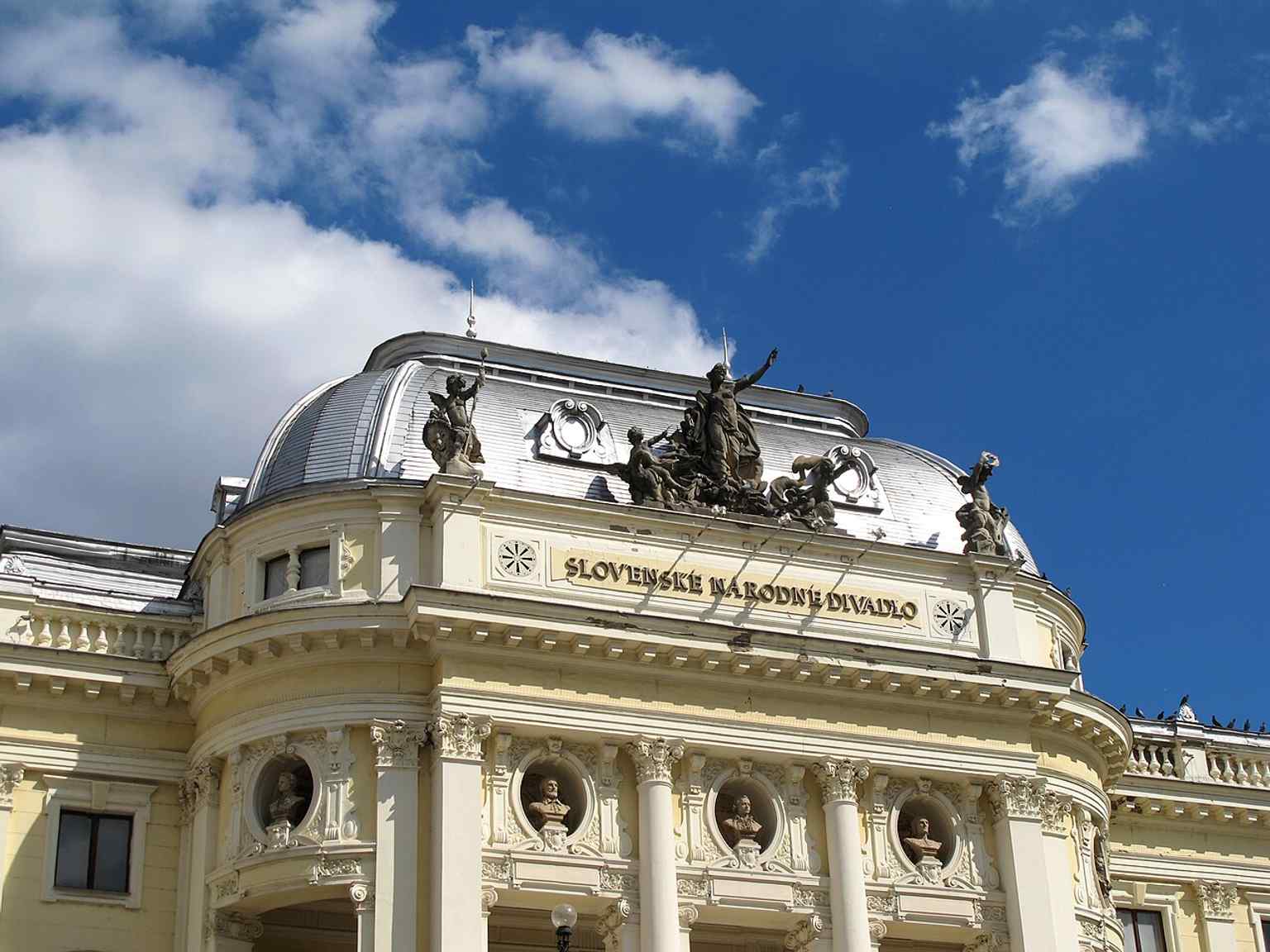
A clear view of the neo-Renaissance theatre façade in Bratislava, linking the building’s elegant exterior to its long role as the original seat of Slovak National Theatre.Photo: Acediscovery, Wikimedia Commons, CC BY 4.0. Cropped & resized. The building itself kept needing rescue too. Bomb damage in the nineteen forties cracked foundations under the auditorium, later renovations modernized the stage and backstage, and because the historic parts are protected, the façade, foyer, and auditorium had to keep their old character even as the working guts changed behind them. Today the story is still unfinished; the historic building closed for performances in May of two thousand twenty-one because of its technical condition, while the national company performs in the newer riverside building.
So as we begin, keep this image in mind: a theater with borrowed forms, local ambitions, and a city learning to perform itself in public. Step away from the curtain now and toward the next hall where Bratislava showed off its civic elegance-the Reduta is about a one-minute walk from here.
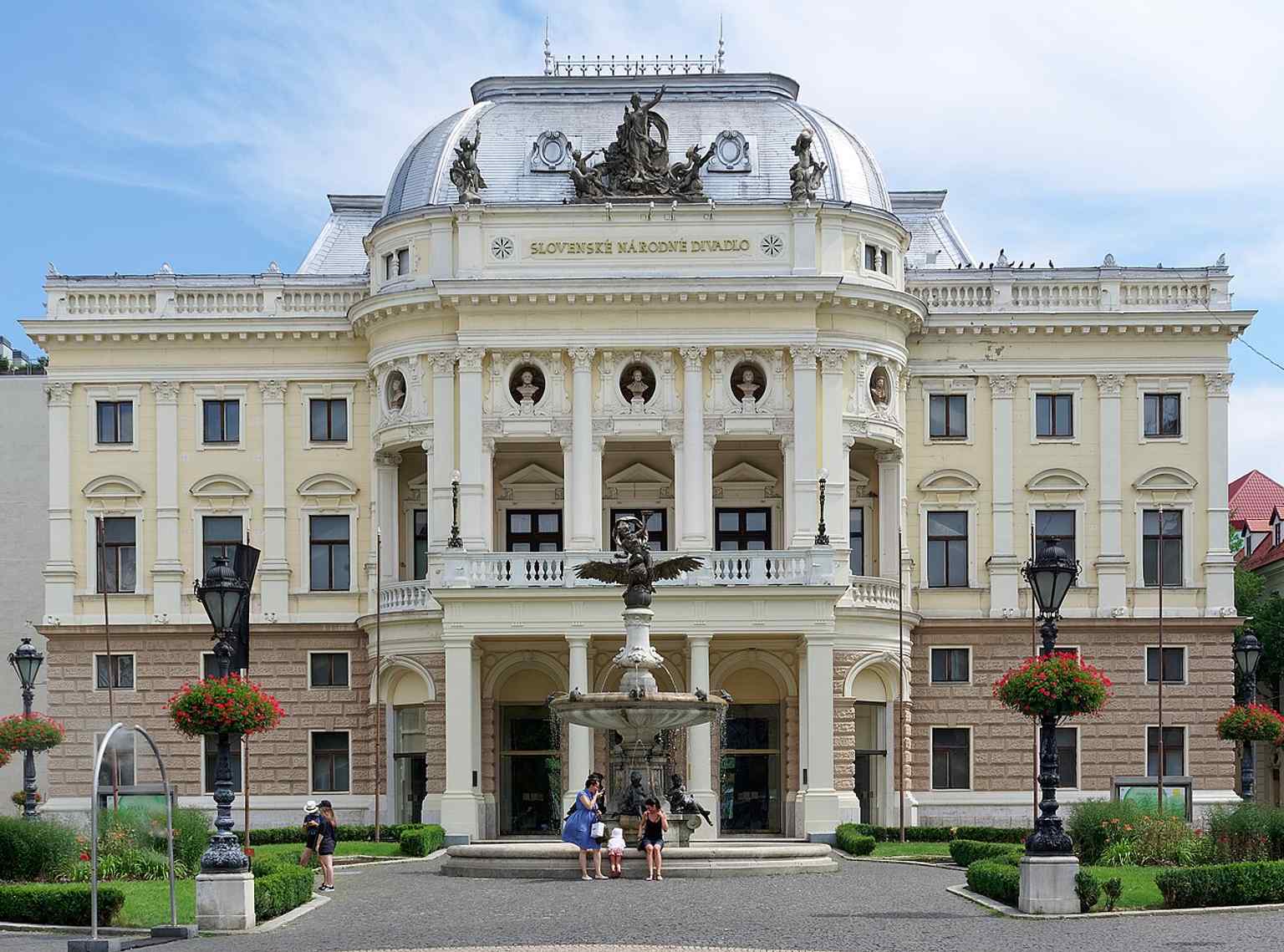
The historic Slovak National Theatre building on Hviezdoslav Square, still standing as Bratislava’s former home of the national stage and a protected cultural monument.Photo: Jakub Hałun, Wikimedia Commons, CC BY-SA 4.0. Cropped & resized. On your right, look for a pale stone corner building with a tall mansard roof, curved window lines, and a façade crowded with columns, pilasters, and little roof turrets. This is…Read moreShow less
Open dedicated page →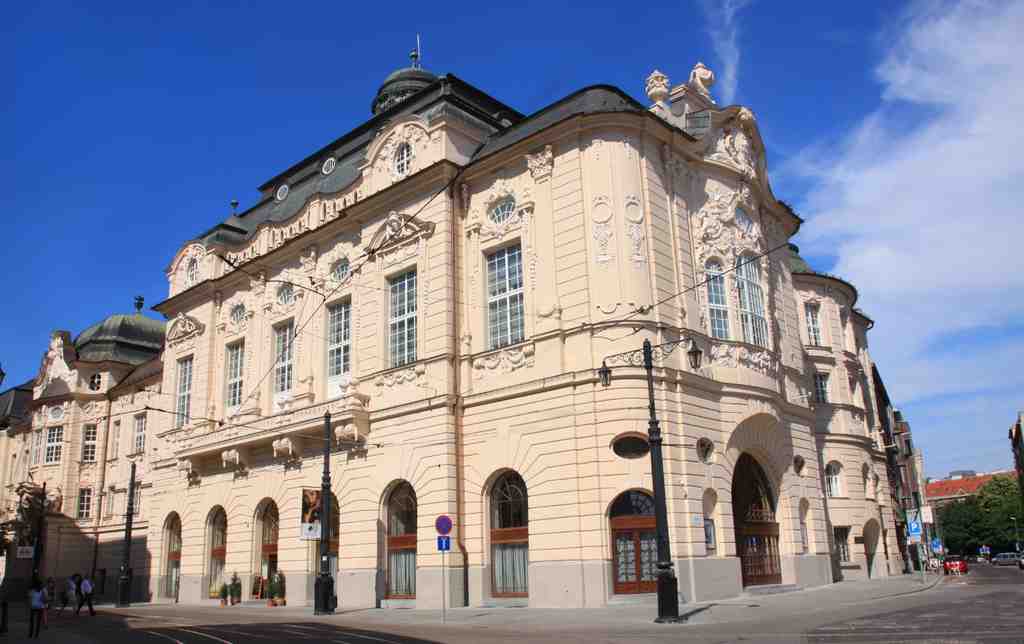
Redoubt (Bratislava)Photo: Dukeofelliun, Wikimedia Commons, CC BY-SA 4.0. Cropped & resized. On your right, look for a pale stone corner building with a tall mansard roof, curved window lines, and a façade crowded with columns, pilasters, and little roof turrets.
This is the Reduta, and it tells you a lot about Bratislava very quickly: this city liked culture, but it also liked showing up for culture in good shoes. The name comes from the French word redoute, meaning a ballroom or dance hall. Before this building stood here, the city had a Theresa-era granary on the site. In nineteen oh-one, city leaders bought that old storage building, cleared the way, and slowly turned a place for grain into a place for glamour.
Budapest architects Dezider Jakab and Marcell Komor won the design competition in nineteen oh-six, and construction ran from nineteen thirteen to nineteen nineteen, slowed by the First World War. For all its lace-like decoration, the building was technically modern for Bratislava: one of the city’s early reinforced-concrete structures. So under the fancy clothes, this place had very new bones.
And Reduta never lived just one life. It was a hybrid cultural machine from the start: ballroom, concert hall, meeting place, and one of Bratislava’s earliest cinemas, opened here in nineteen sixteen. During carnival season, masked balls and society parties pulled in the city’s elite. At the same time, film screenings and concerts shared the building. In other words, Bratislava entertained itself here while teaching itself how to be modern. Not a bad multitasker.
Take a moment and study the building’s bulk and decoration. Does it feel like a palace, a concert hall, or a very dressed-up civic clubhouse? That uncertainty is the point. A pilaster, by the way, is a flat decorative column attached to a wall, and a mansard roof is that steep, layered roof shape that squeezes in extra upper rooms. If you want a clearer view of the façade’s full theatrical spread, glance at your screen now.
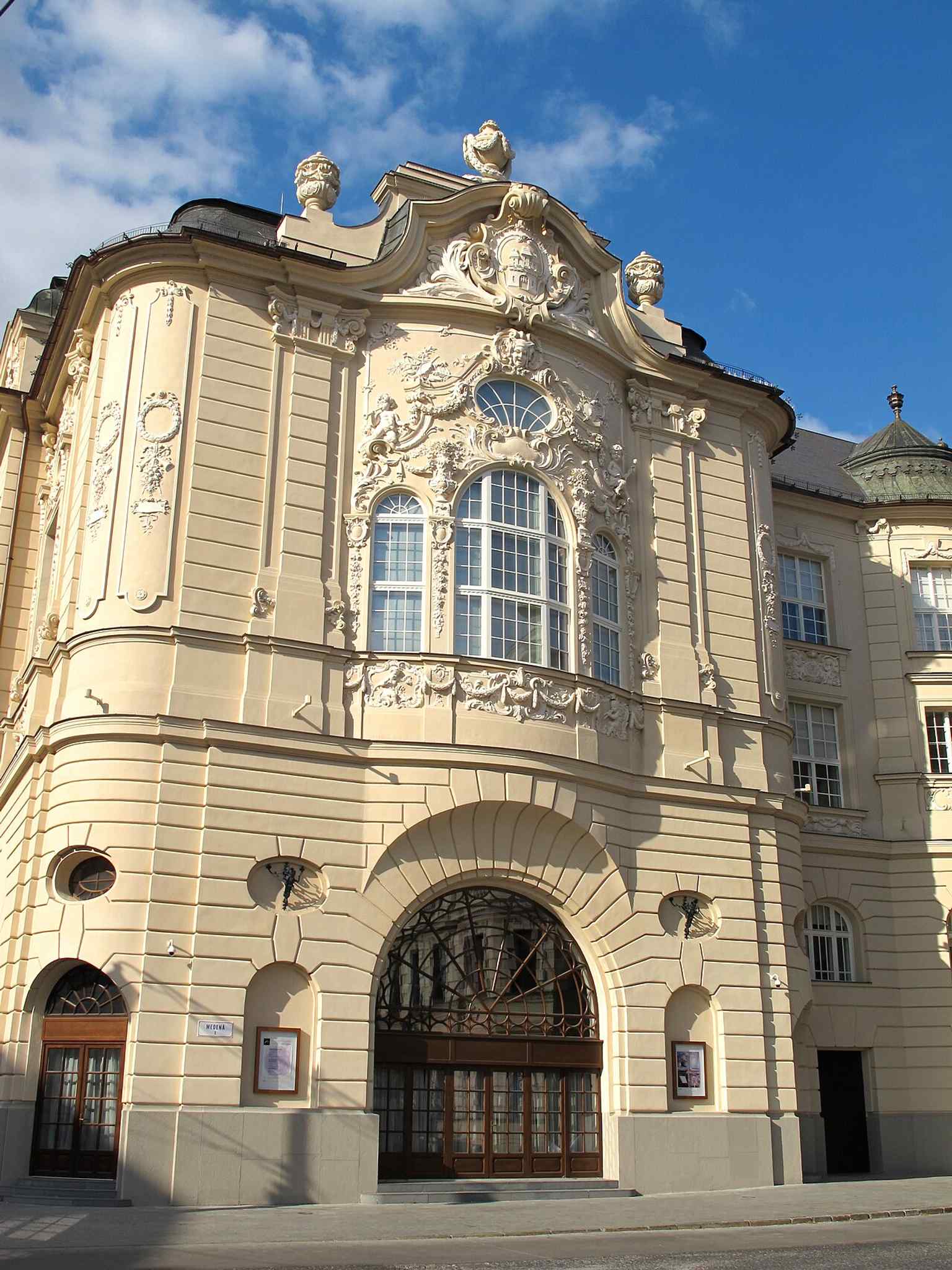
The Reduta’s ornate street-facing façade in Bratislava, home of the Slovak Philharmonic since the postwar years.Photo: Acediscovery, Wikimedia Commons, CC BY 4.0. Cropped & resized. By the interwar years, major names turned Reduta into a serious musical address. Erich Wolfgang Korngold performed here repeatedly, and so did the Vienna Philharmonic, Richard Strauss, and Béla Bartók. After the Second World War, the state nationalized the building and gave it to the Slovak Philharmonic, which still calls it home. A huge restoration, backed by nearly thirty-seven point eight four million euros, revived thousands of square meters of stucco inside and out; later, in twenty sixteen, Reduta even hosted important meetings during Slovakia’s presidency of the Council of the European Union.
So this building kept changing costumes without leaving the stage. Now the performance spills outdoors. Head on toward Hviezdoslavovo námestie, about a three-minute walk, where city life trades chandeliers for open sky.
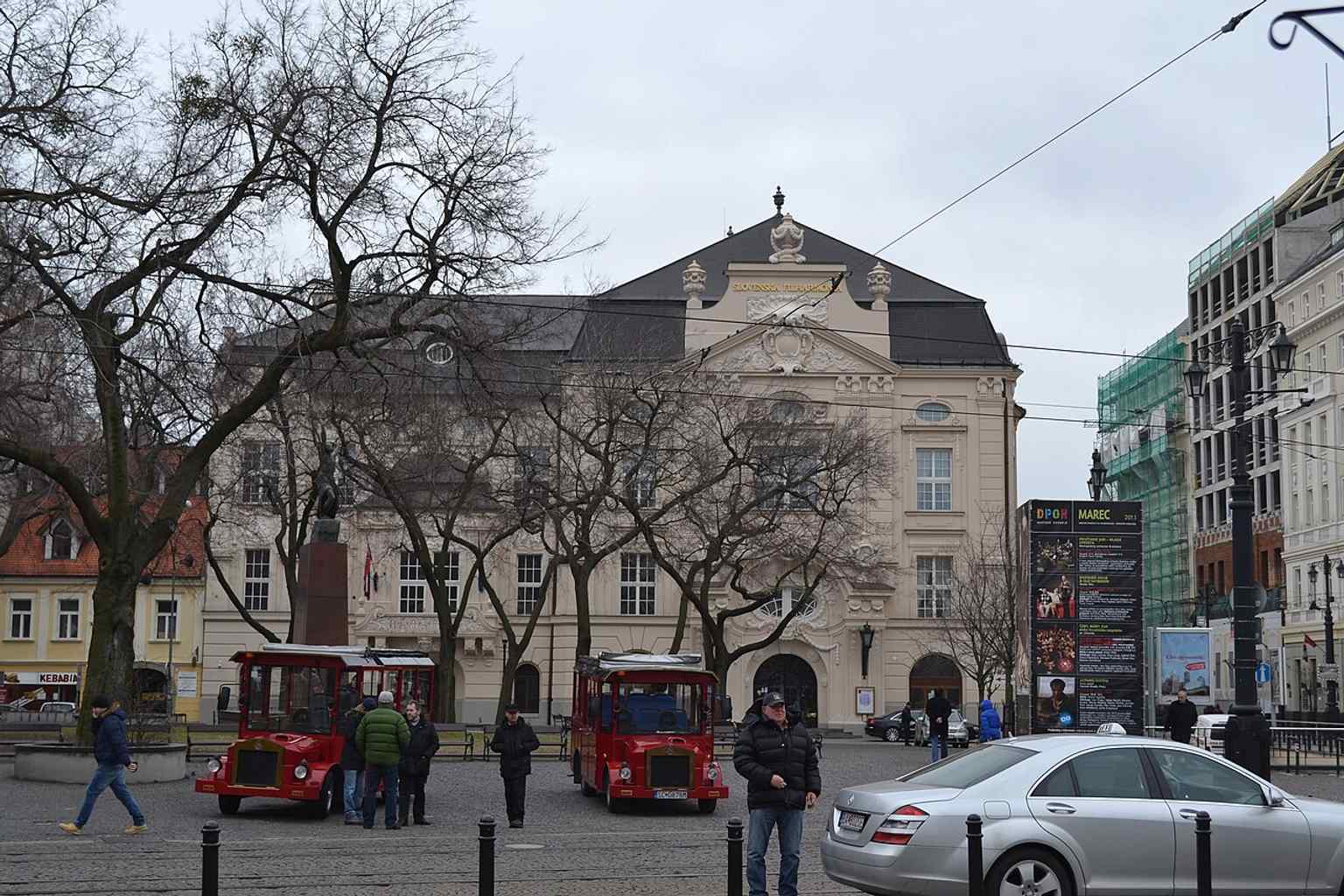
A clear view of the landmark’s monumental exterior, whose lavish historicist decoration made it one of Bratislava’s most representative concert buildings.Photo: Slyronit, Wikimedia Commons, CC BY-SA 4.0. Cropped & resized.
Show 12 more stopsShow fewer stopsexpand_moreexpand_less
A bronze man in a worker’s cap leans out of a round manhole at street level, elbows on the rim, with a little road-warning sign marking his corner. Meet Čumil, Bratislava’s most…Read moreShow less
Open dedicated page →A bronze man in a worker’s cap leans out of a round manhole at street level, elbows on the rim, with a little road-warning sign marking his corner.
Meet Čumil, Bratislava’s most famous fellow with no interest in standing up. His name gets translated a few ways, from “Man at Work” to “the sewage worker,” and that tells you something important about this city. Alongside theaters, palaces, and all the grand public faces, Bratislava also treasures jokes, habits, and ordinary street memory. Sometimes the local soul shows up not on a pedestal, but peeking out of a drain.
Sculptor Viktor Hulík created him in bronze and unveiled him here on the twenty-sixth of July, nineteen ninety-seven, during the Korzo party that celebrated the renewed pedestrian zone. About thirty thousand people came, including Slovak president Michal Kováč. Hulík said he invented Čumil as an anonymous figure carrying the easygoing spirit of the old korzo, the city’s promenade where people wandered, chatted, and quietly watched one another. Later, Hulík shrugged and called it more of a playful joke than some grand masterpiece. Well... the joke certainly landed.
Pause a moment and study his face and posture. Is he resting, working, flirting with the street, or giving the crowd a sideways little audit?
Most visitors miss this part: foreign media often call him a soldier. Hulík insisted he was not that at all, but a nameless street character, really a memory of Bratislava’s social mood made solid in bronze. If you check the close-up in the app, you can see the cap people rub for luck. That small superstition helped turn him into one of the city’s most photographed figures.
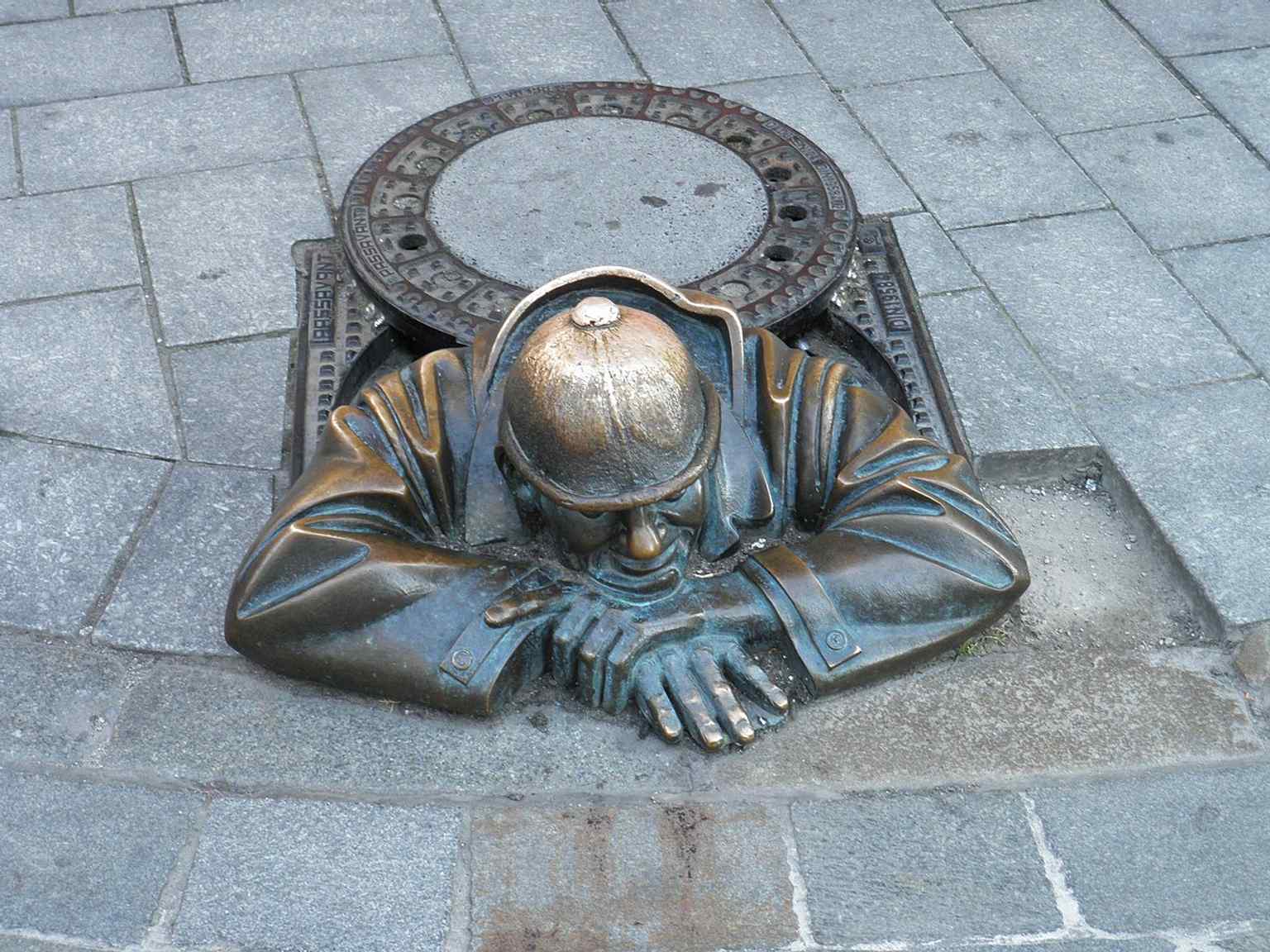
A closer look at Čumil’s head and cap, the part tourists often touch for good luck.Photo: Mister No, Wikimedia Commons, CC BY 3.0. Cropped & resized. His exposed spot brought trouble too. An inattentive Italian driver hit him in nineteen ninety-nine, which is why that warning sign appeared, and in twenty eighteen vandals tampered with him so badly the city removed him, checked his anchoring, and returned him safely.
So here’s Bratislava in miniature: official history towers above you, but its truest wink may happen down at street height. In about one minute, we’ll head to Maximilian’s Fountain. And Čumil, fittingly, keeps open hours all day, every day.
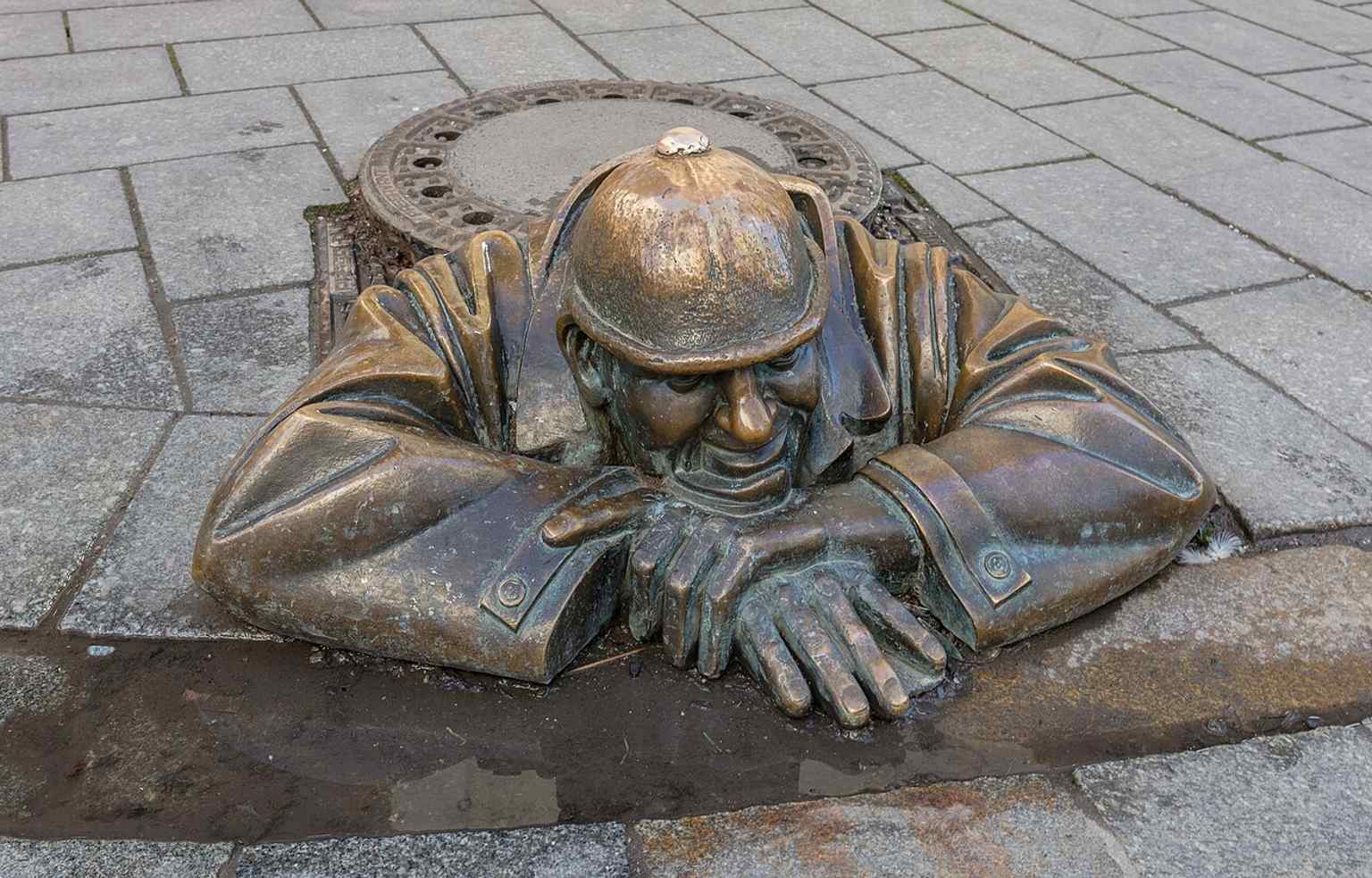
A clear modern view of Čumil, the bronze figure installed in 1997 as part of Bratislava’s renewed pedestrian zone.Photo: Diego Delso, Wikimedia Commons, CC BY-SA 4.0. Cropped & resized. 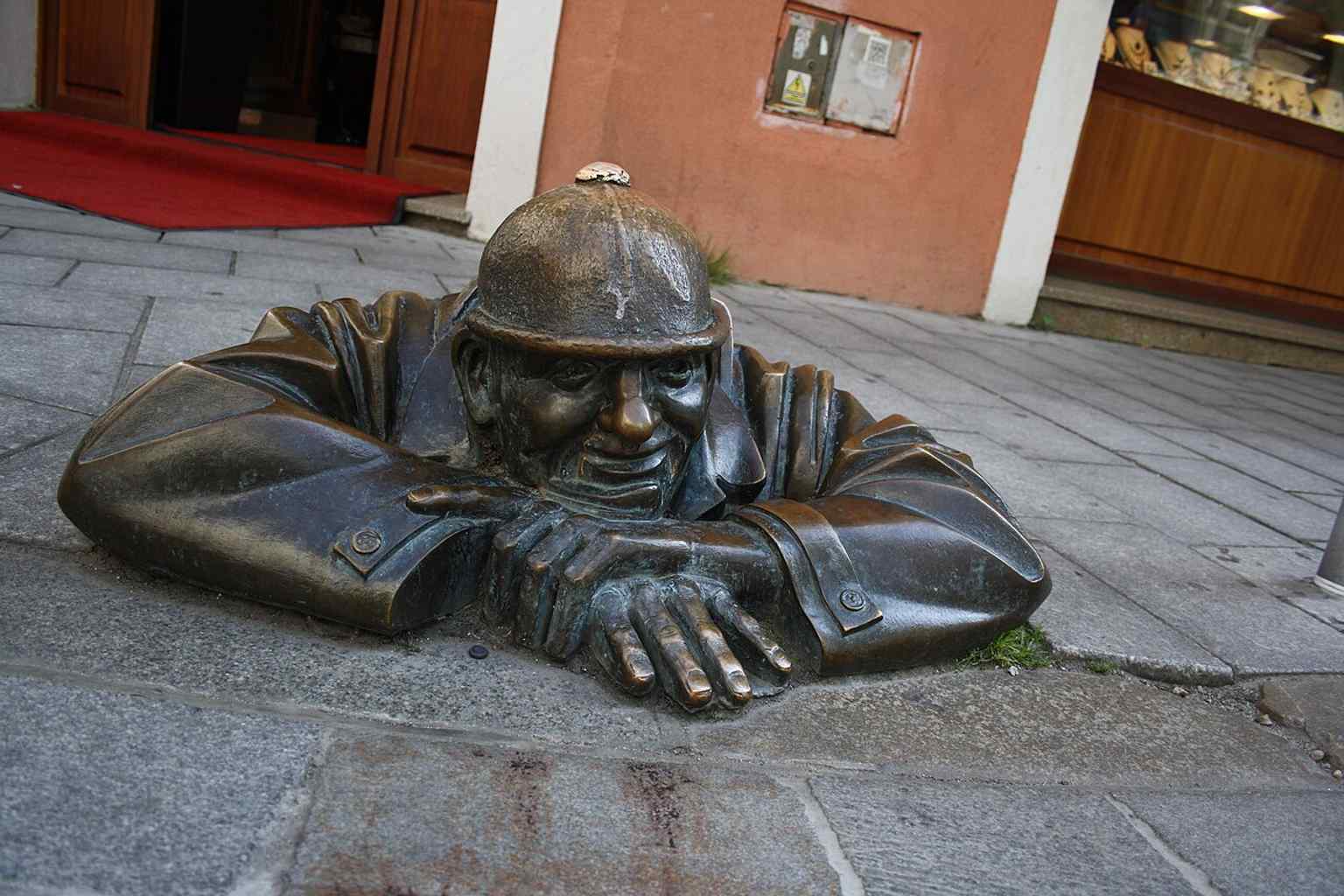
Čumil peeking from the pavement in the Old Town — one of Bratislava’s most photographed street sculptures.Photo: Frettie, Wikimedia Commons, CC BY 3.0. Cropped & resized. 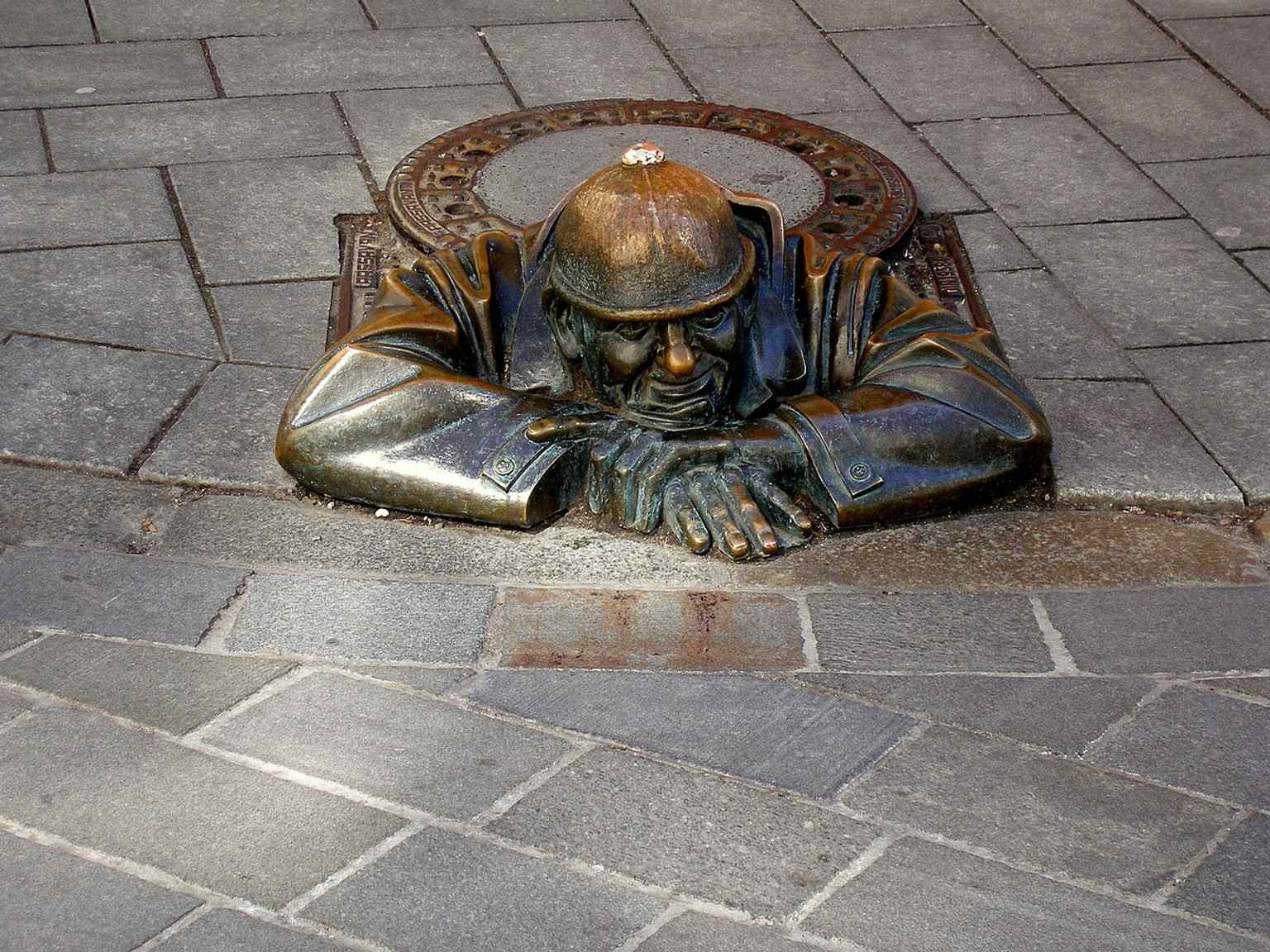
The statue at the corner of Laurinská, Panská and Rybárska brána, where visitors stop to see the famous bronze worker.Photo: sculpture Viktor Hulík/ Doko Ing. Mgr. Jozef Kotulič (photo), Wikimedia Commons, CC BY-SA 3.0. Cropped & resized. 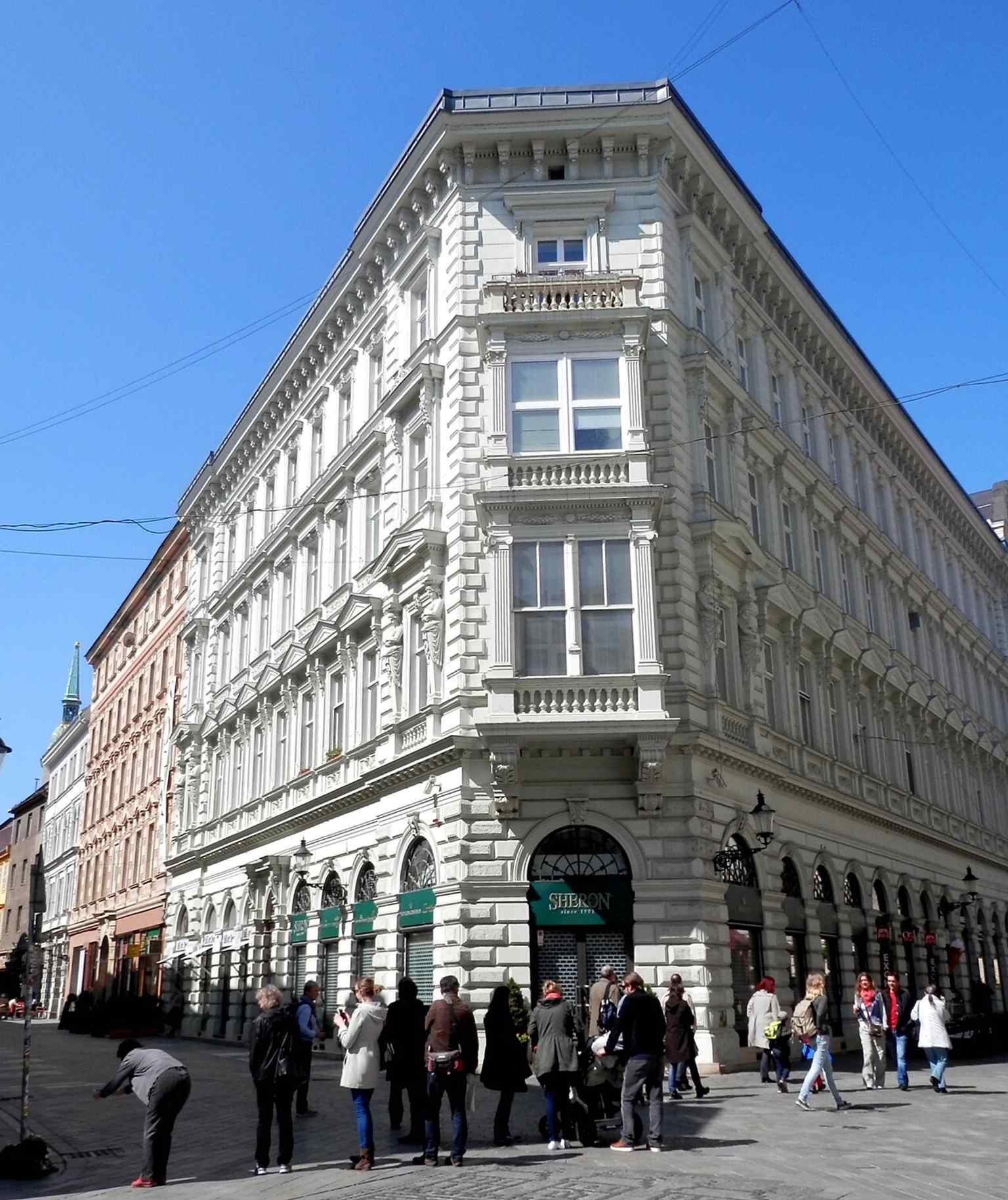
Čumil on Panská Street, showing the playful “man at work” pose that made it a city landmark.Photo: Jozef Kotulič, Wikimedia Commons, CC BY-SA 3.0. Cropped & resized. 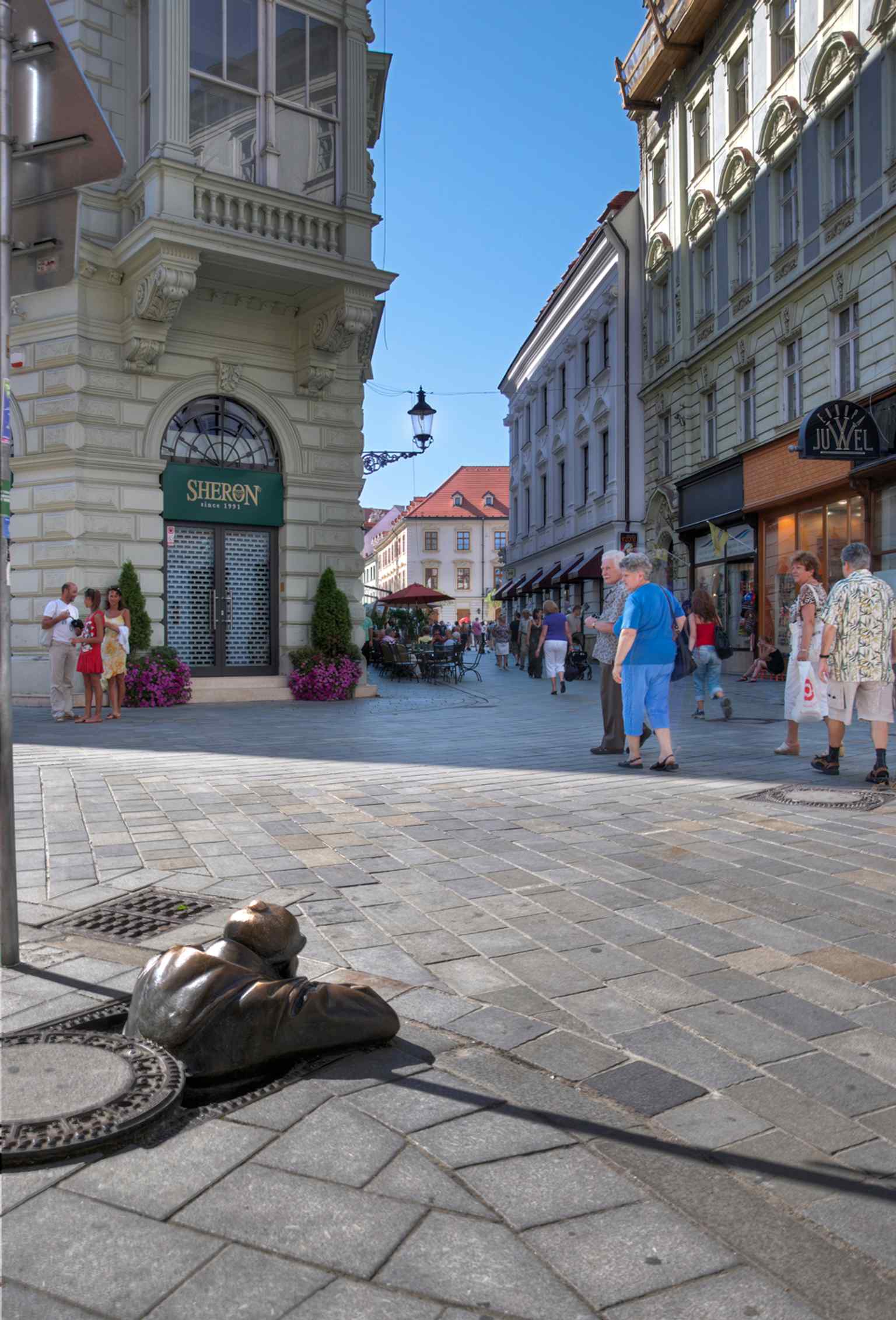
Tourists gathering around Čumil, reflecting the ritual of crowding in for photos at Bratislava’s best-known statue.Photo: Neil Aitkenhead, Wikimedia Commons, CC BY-SA 3.0. Cropped & resized. 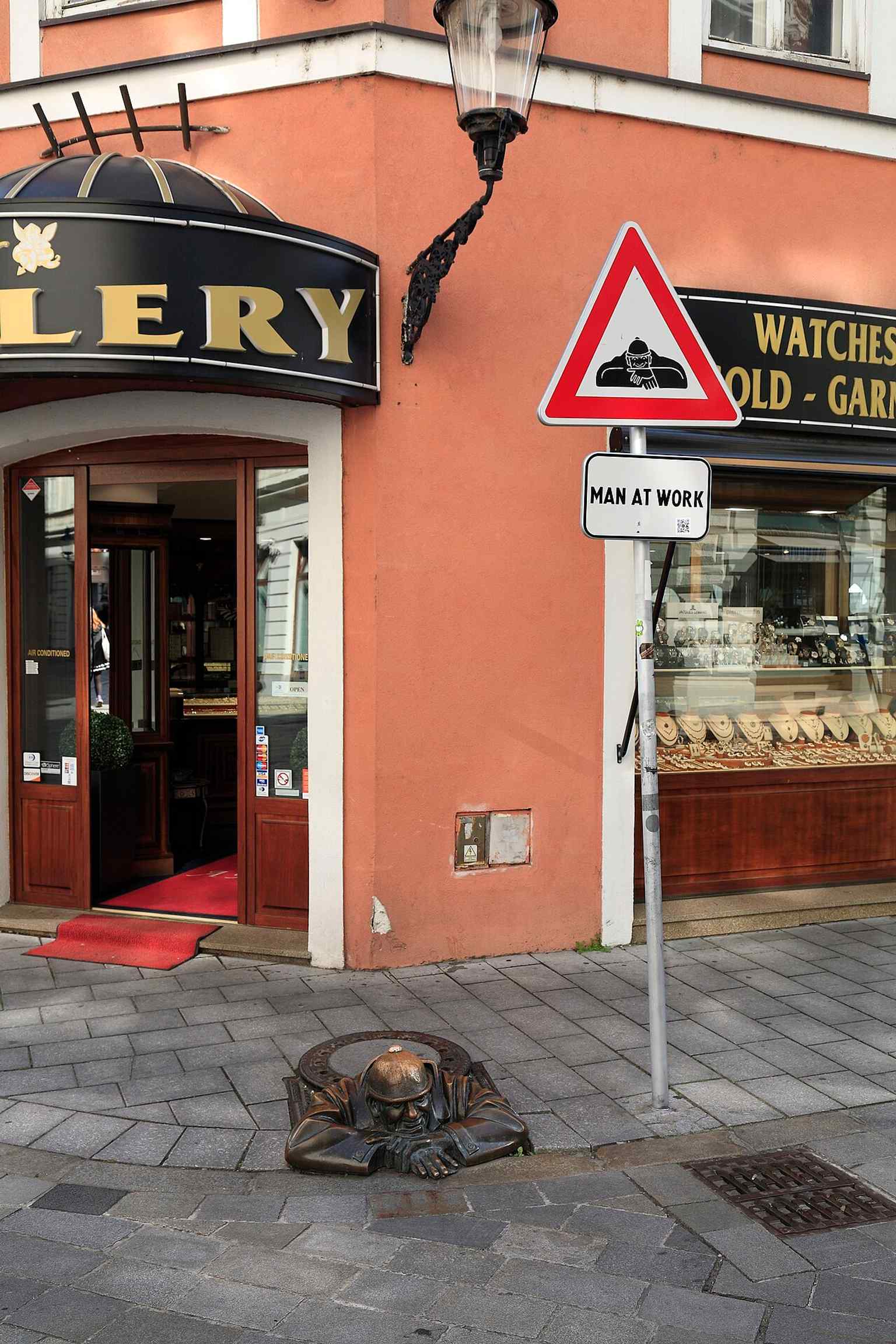
An angled view of the figure peering from the pavement, matching the nickname ‘the voyeur’ or ‘man at work.’Photo: Falk2, Wikimedia Commons, CC BY-SA 4.0. Cropped & resized. 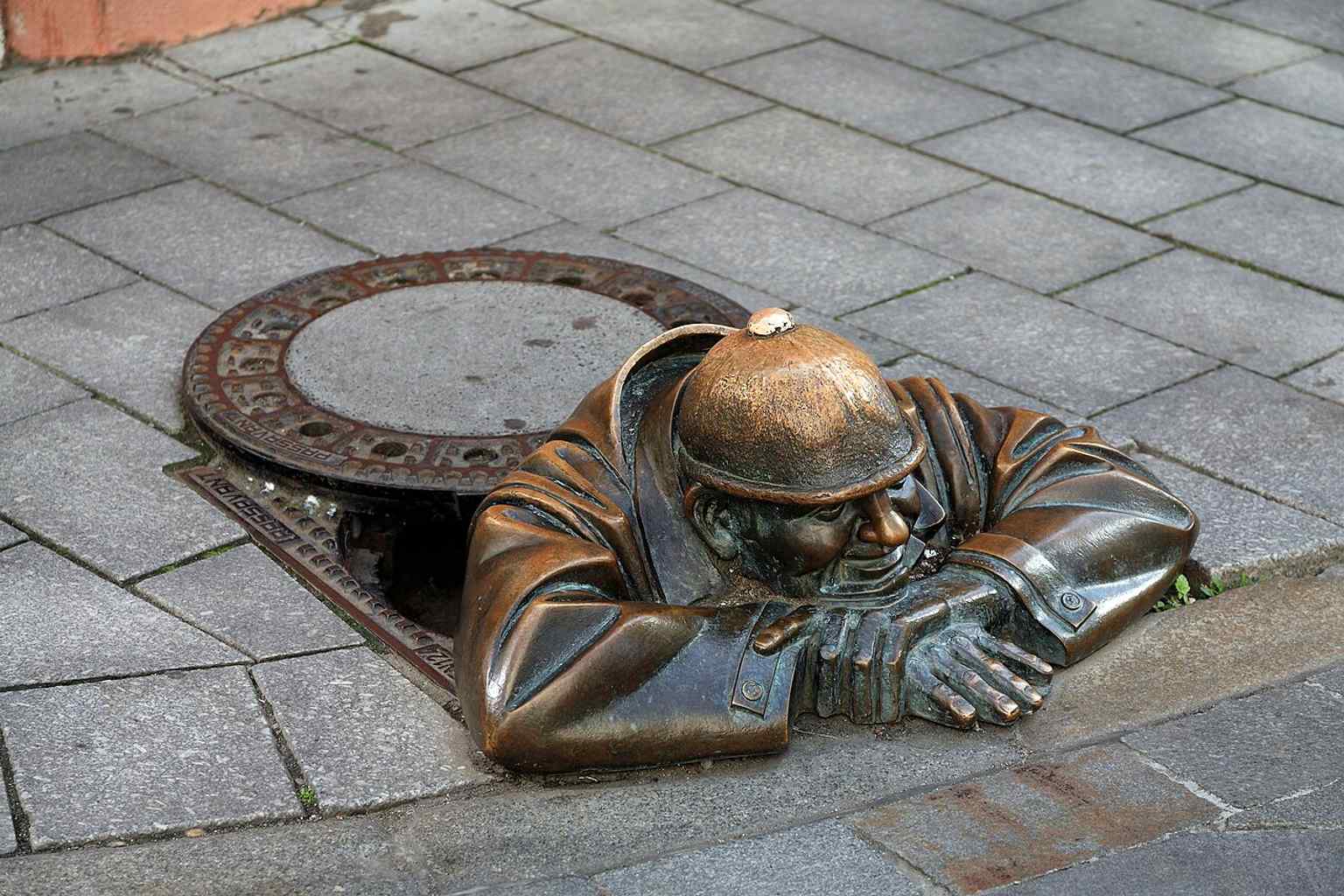
Another strong close-up of Čumil from the corner of Panská and Rybárska brána, emphasizing the statue’s hidden, joking character.Photo: Falk2, Wikimedia Commons, CC BY-SA 4.0. Cropped & resized. On your right, look for a broad round stone basin topped by a tall central column and a helmeted knight, with carved faces around the rim where water once poured. This is…Read moreShow less
Open dedicated page →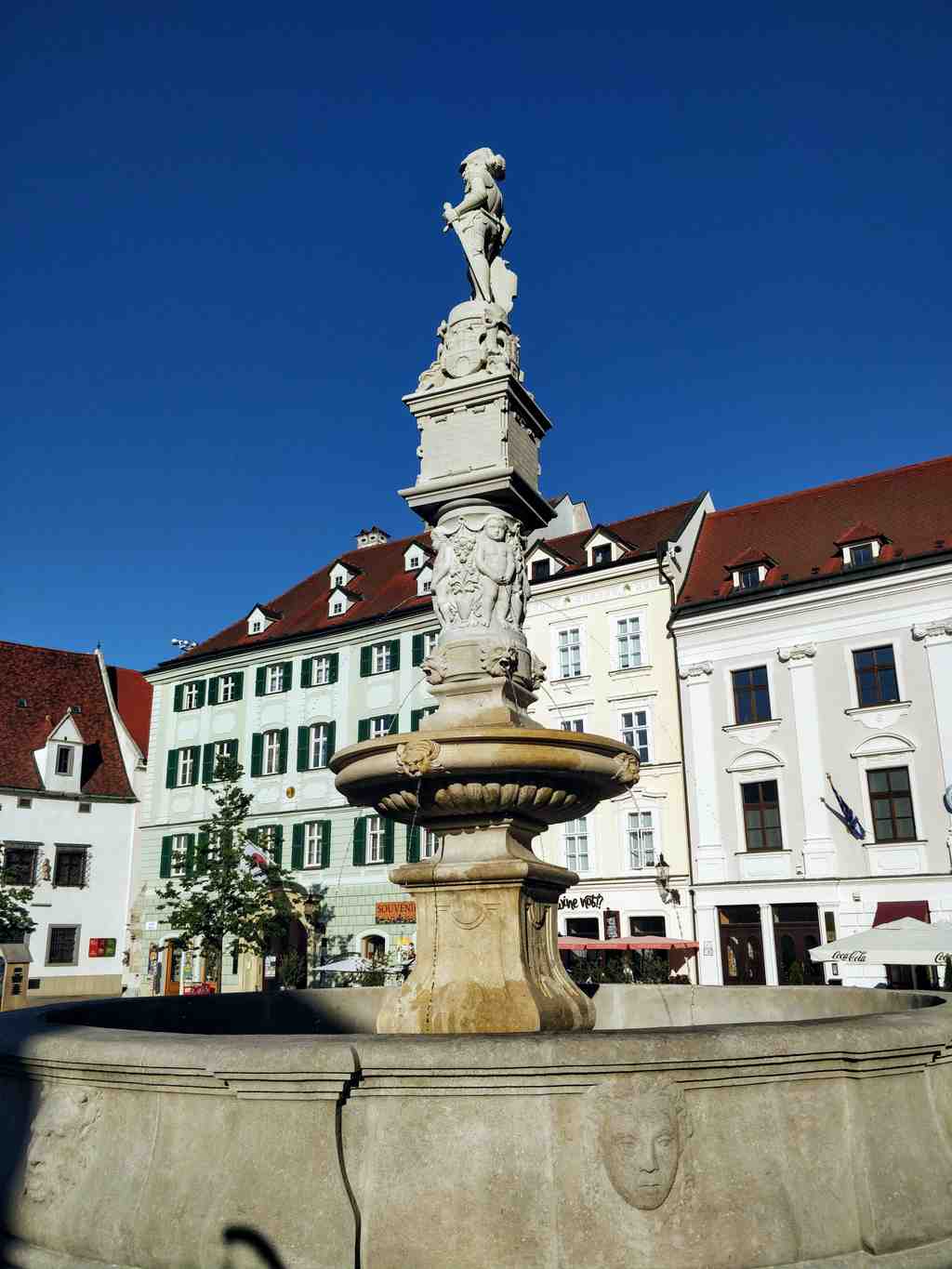
Maximilian's FountainPhoto: Wizzard, Wikimedia Commons, CC BY-SA 4.0. Cropped & resized. On your right, look for a broad round stone basin topped by a tall central column and a helmeted knight, with carved faces around the rim where water once poured.
This is Maximilian’s Fountain, raised in fifteen seventy-two, and it is the oldest fountain in Bratislava. At first glance it looks ceremonial... a proud Renaissance monument in the middle of the main square. And it is that. But it also began as something far more practical: a city’s answer to fire.
Maximilian the Second entered Bratislava history as the first Hungarian king crowned here, on the eighth of September, fifteen sixty-three. Just four days later, during festive games held for the coronation, a fire broke out in the Hungarian camp and spread into the city. Royal pageantry had barely ended before the hard lesson arrived: celebration is lovely, but water saves lives. So Maximilian ordered water reservoirs across the city, with running water feeding them year-round. This fountain became the finest of them, set here in the main square where markets, town business, and daily survival all met.
That mix of usefulness and image is the real story here. The fountain gave people water, but it also advertised power. Up on top, the armored figure holds a sword and leans on a shield with the Hungarian coat of arms, facing the town hall. For generations, locals called this the Roland Fountain, linking it to Roland, the legendary knight who symbolized city rights and protection. But many scholars now argue the figure is actually Maximilian himself, dressed as a Christian knight. Same armor, very different message. If you glance at the image on your screen, the figure’s stance makes that debate easier to see.
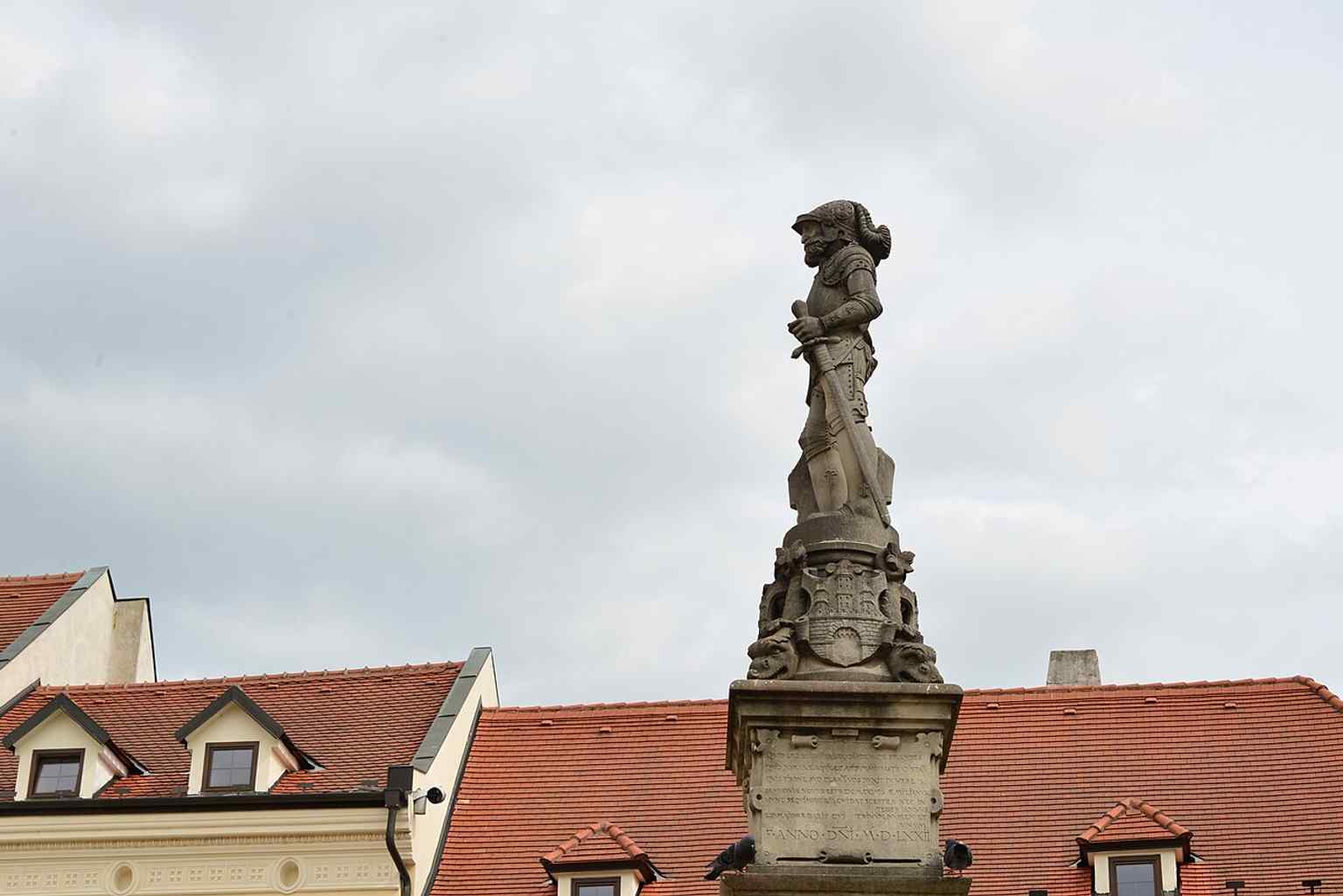
A detail shot of the fountain, ideal for the debate over whether the figure is Roland or Emperor Maximilian II.Photo: Андрей Бобровский, Wikimedia Commons, CC BY 3.0. Cropped & resized. The human hand behind the stone belonged to Andreas Luttringer, a master stonemason from Deutsch Altenburg in Austria, who completed the work in fifteen seventy-two. And there may have been another ambitious hand at work too: newer research suggests a nobleman, Tibor Bocskai, may have pushed the project forward as a private initiative, using the dedication to shine a little brighter at the imperial court. Even fountains, it turns out, can campaign for attention.
Look around the basin and you’ll notice carved masks, called mascarons, stone faces used as decorative water spouts. The basin is about nine meters across. The fountain changed over the centuries: in the eighteenth century, restorers swapped out some original figures; in two thousand and five, the city added a marble ring that many experts disliked because it dulled the fountain’s historic character. Then, in two thousand and nineteen, restorers from the atelier of sculptor Vladimír Višváder removed those modern additions, brought back the steps, repaired the water system, and restored the Renaissance look. If you want a closer sense of that cleanup, check the restored detail image in the app.
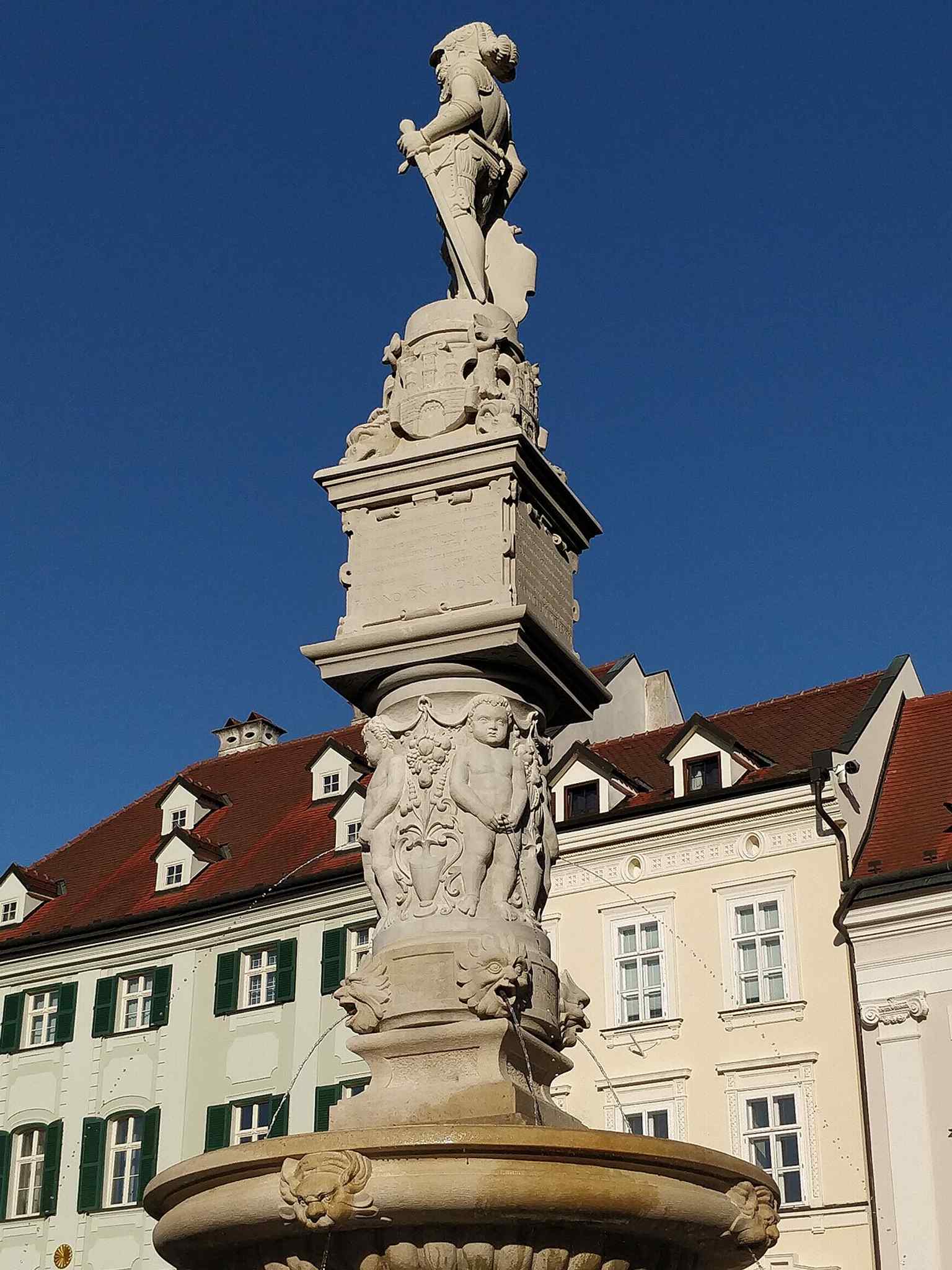
Close framing of the restored fountain after the 2019 work, when modern additions were removed and the Renaissance look was brought back.Photo: Wizzard, Wikimedia Commons, CC BY-SA 4.0. Cropped & resized. One inscription here once addressed the traveler directly: refresh yourself at this fountain, then remember the king and wish prosperity for Hungary before you go. Not subtle. But honest.
And here’s the question this fountain leaves hanging in the square: if you were a ruler cheered with tournaments and ceremony, what would matter more after the applause... a monument to your glory, or safer daily life for the people living around it?
From this basin in the market square, we’re heading next toward rooms where power moved indoors and became more formal: Primate’s Palace is about a two-minute walk away. And like any good city landmark, this fountain is here around the clock.
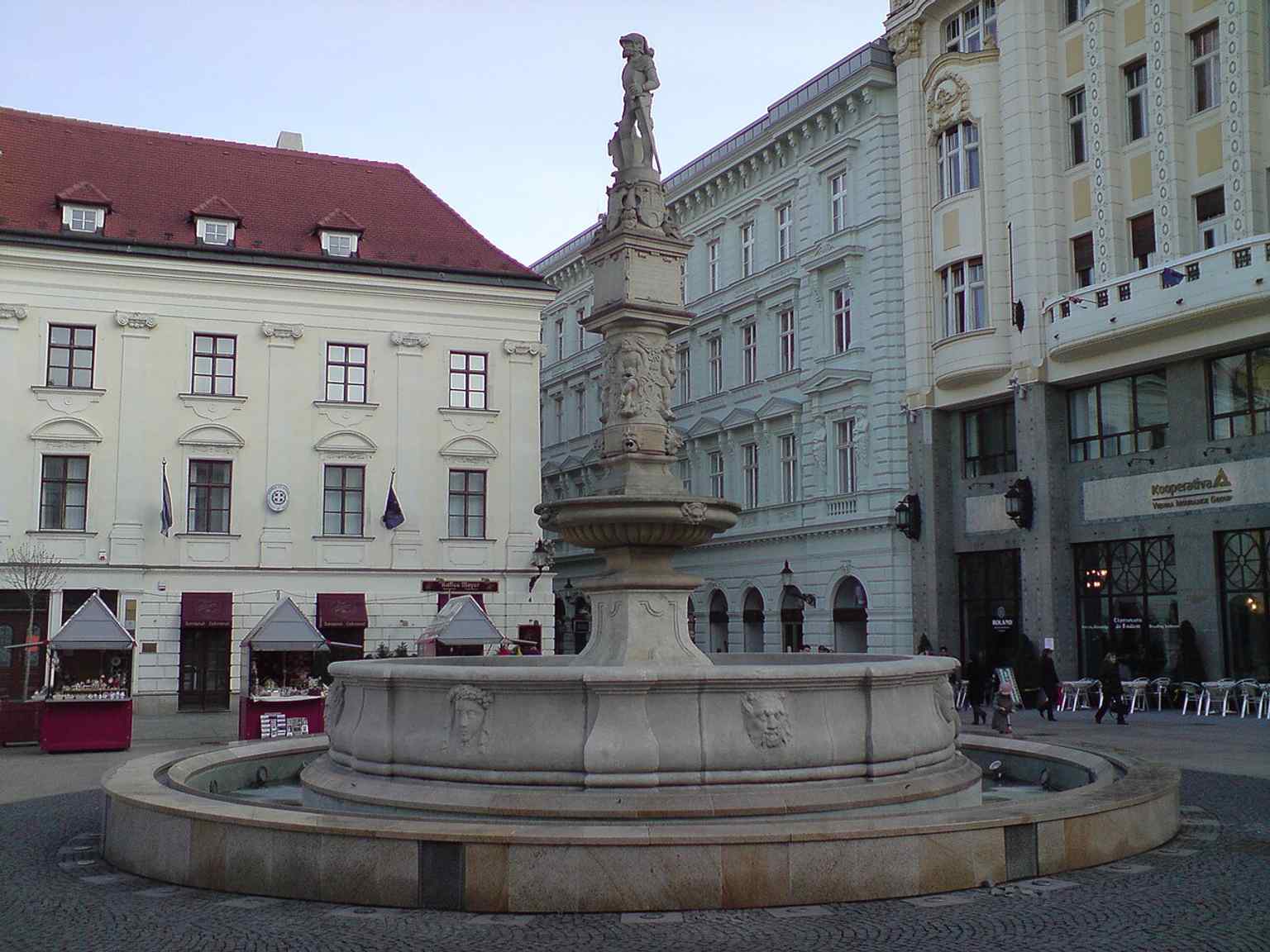
A clear daytime view of Maximilian’s Fountain on Bratislava’s Main Square, where the city’s oldest fountain has stood since 1572.Photo: Wizzard, Wikimedia Commons, Public domain. Cropped & resized. 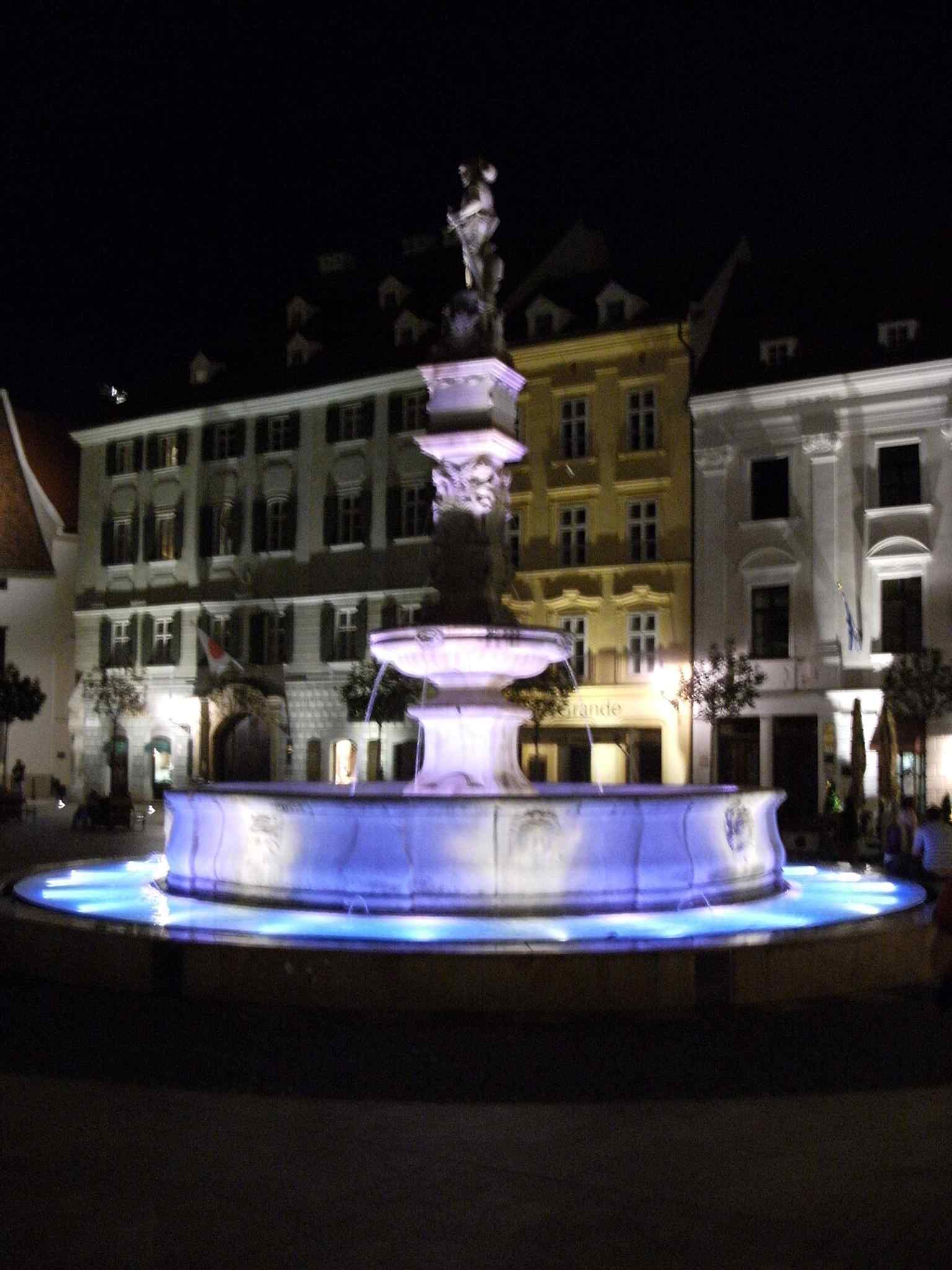
A strong full view of the Renaissance fountain, useful for showing its round basin and central knight figure in one frame.Photo: Mark Ahsmann, Wikimedia Commons, CC BY-SA 3.0. Cropped & resized. 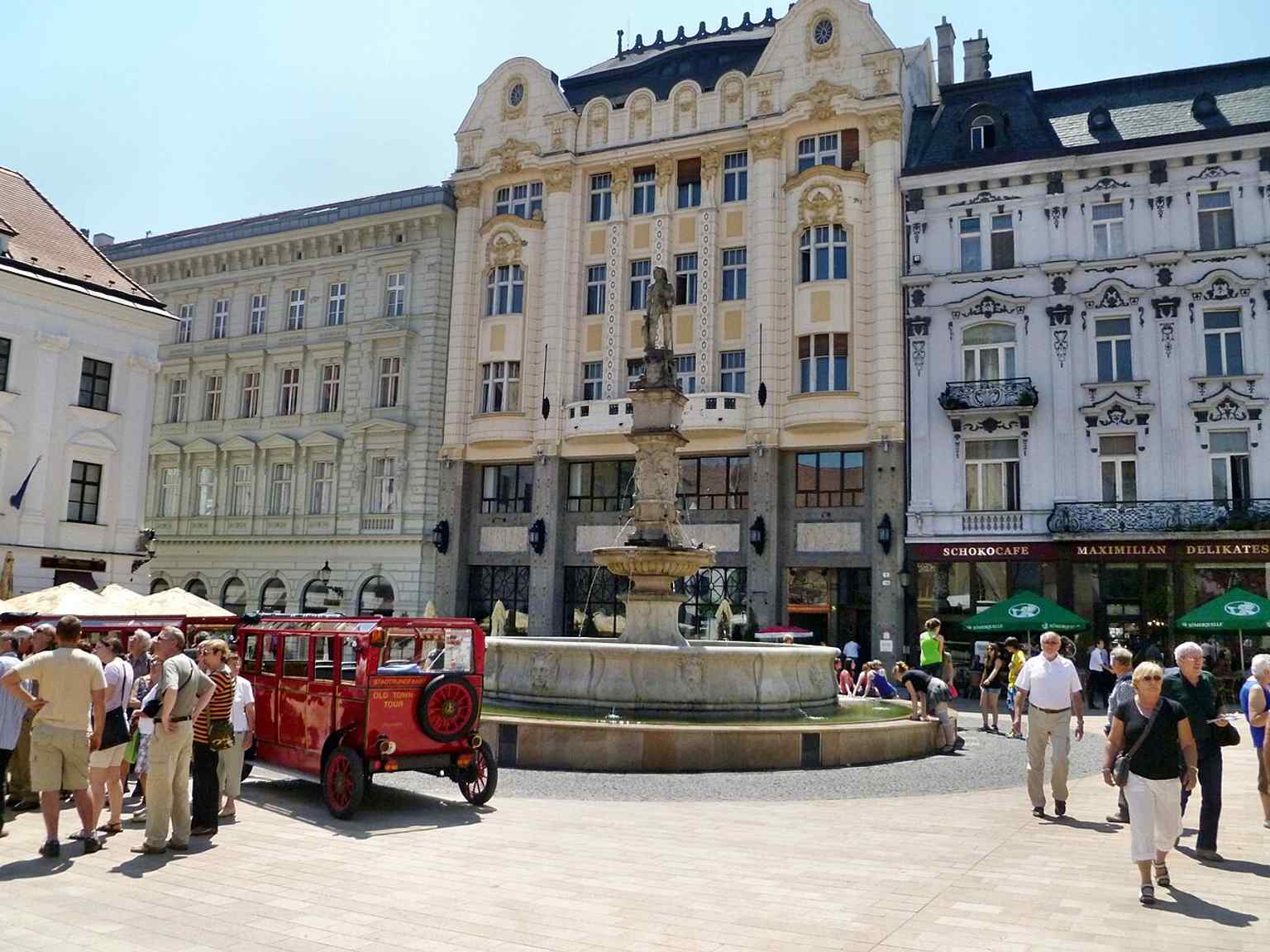
The fountain set against the square’s historic buildings, echoing its original role as a landmark at the heart of public life.Photo: JoJan, Wikimedia Commons, CC BY 3.0. Cropped & resized. 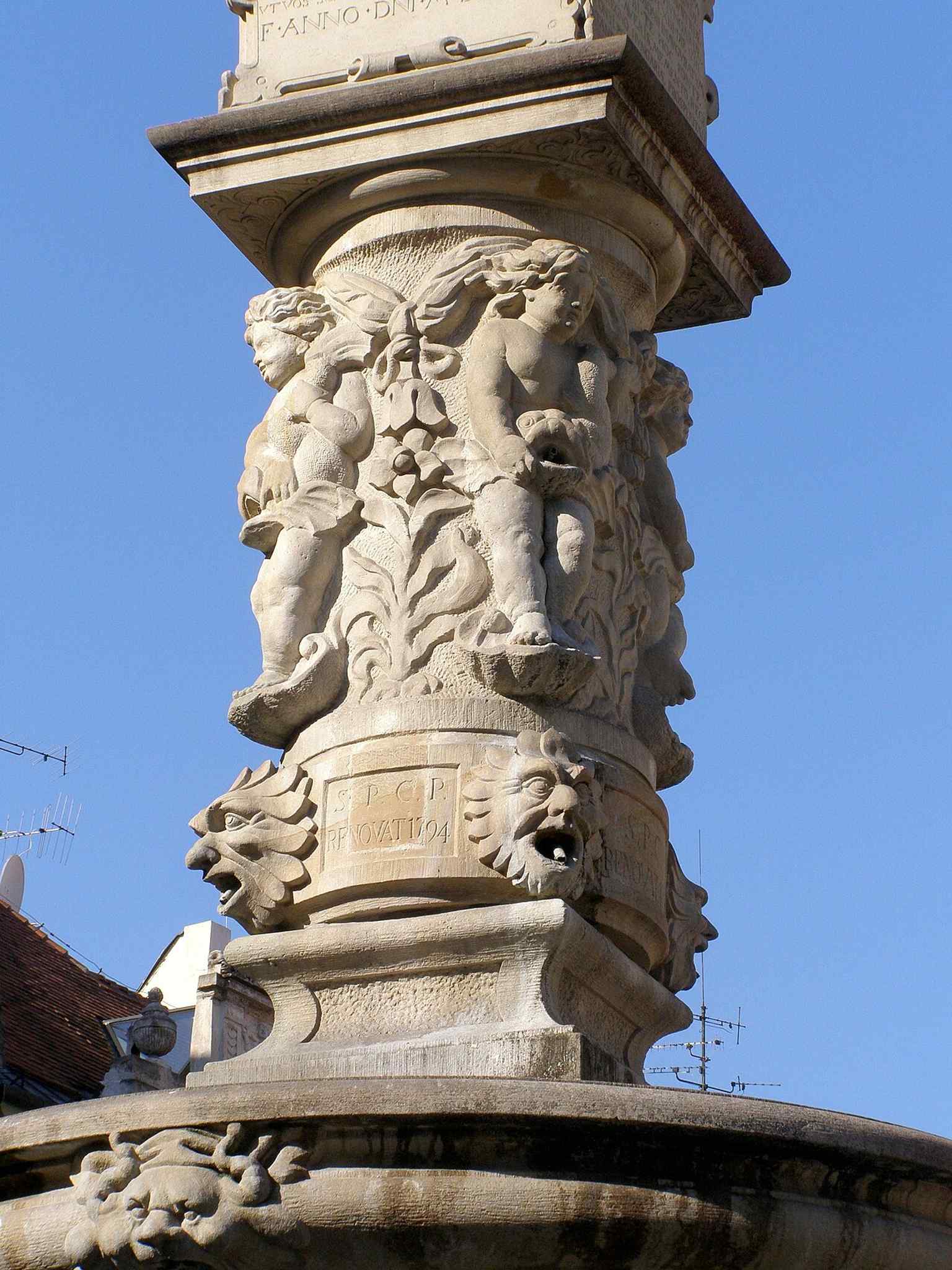
A close look at the fountain’s sculptural form and basin, helping illustrate the 16th-century craftsmanship behind the monument.Photo: Lure, Wikimedia Commons, CC BY-SA 3.0. Cropped & resized. 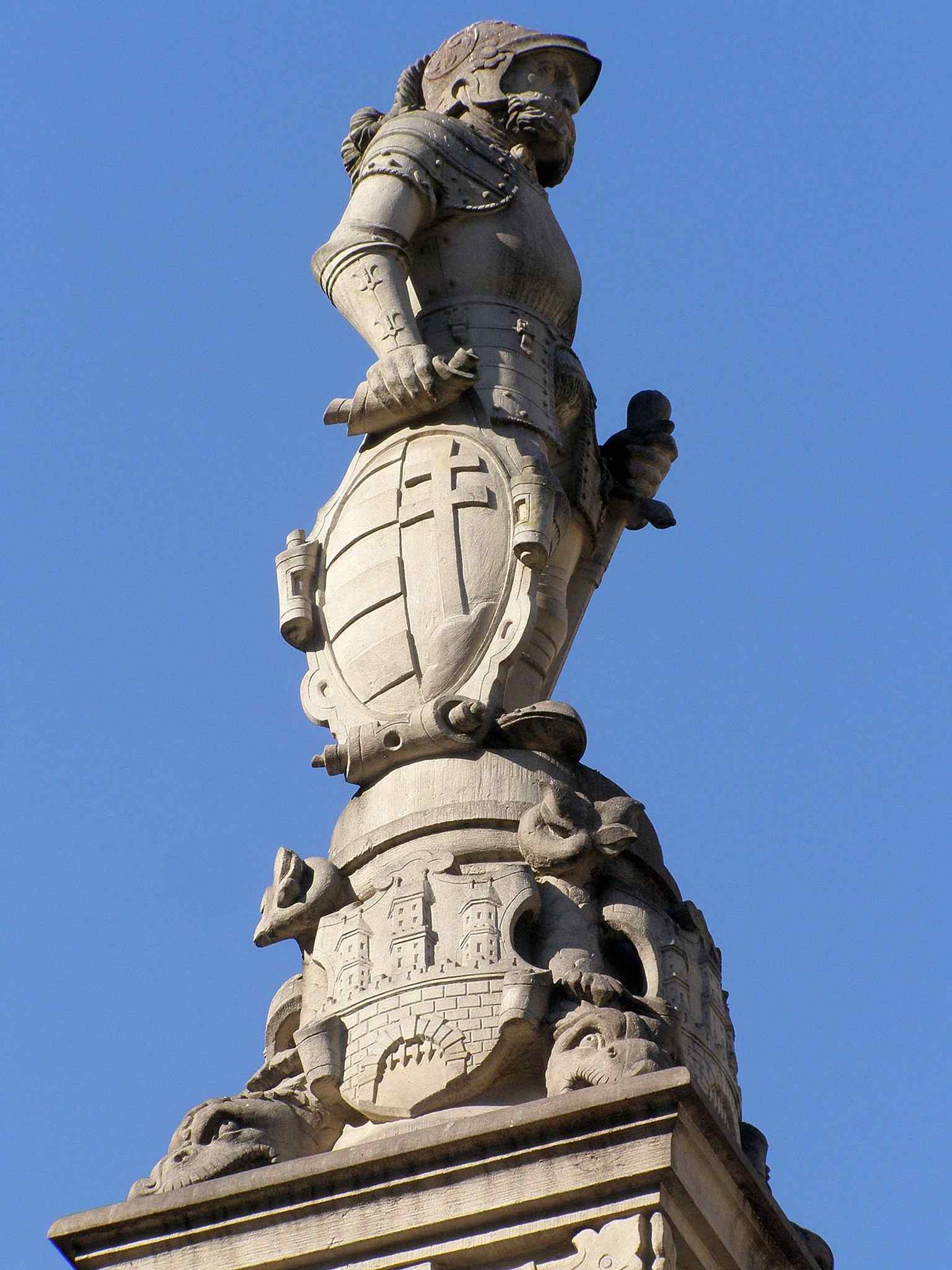
Detail view that likely captures the heraldic side of the fountain—fitting for the inscriptions and royal symbolism described in the source.Photo: Lure, Wikimedia Commons, CC BY-SA 3.0. Cropped & resized. 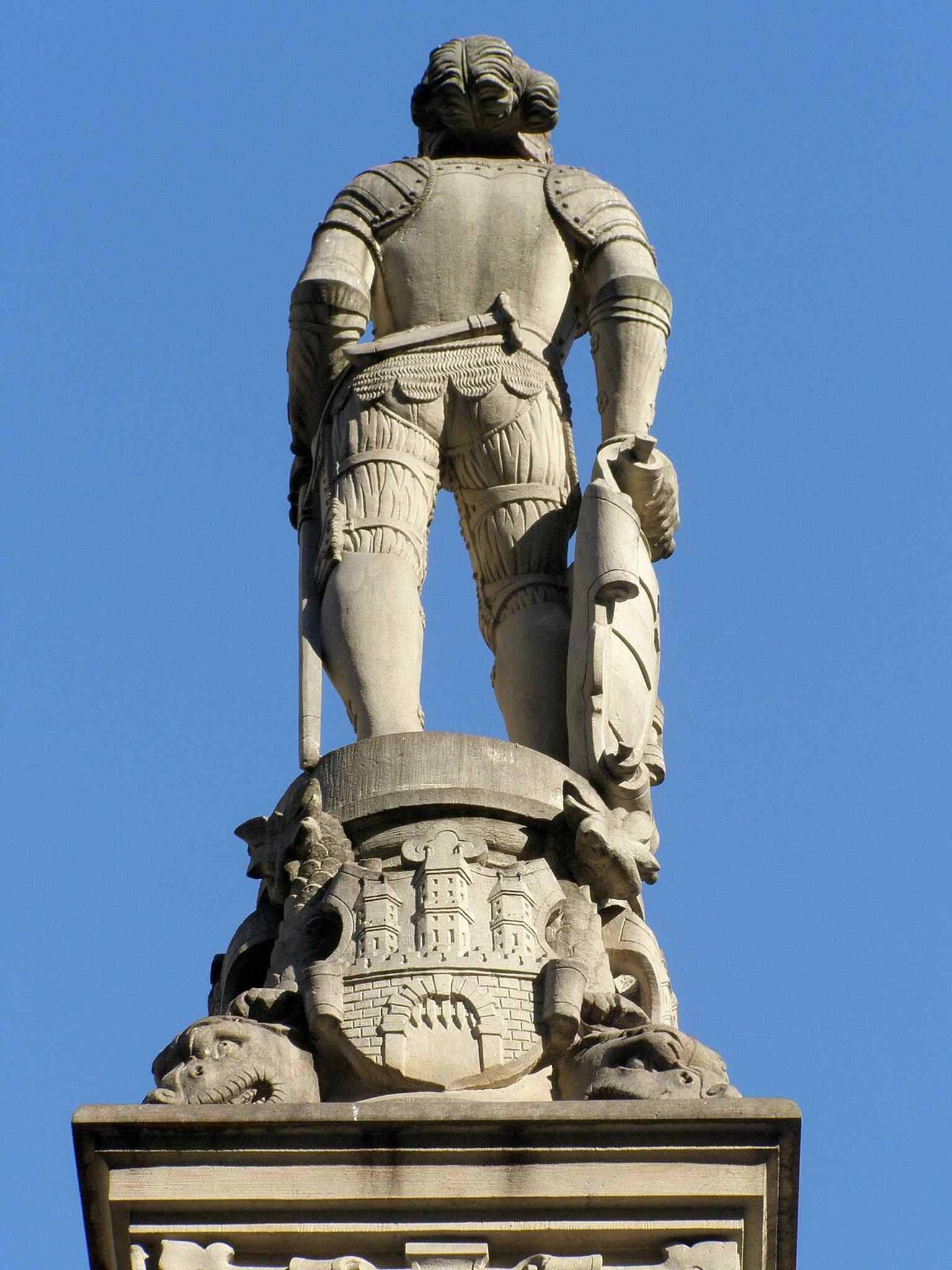
A close image of the fountain’s decorative stonework, where the carved coat of arms reinforces the monument’s royal dedication.Photo: Lure, Wikimedia Commons, CC BY-SA 3.0. Cropped & resized. 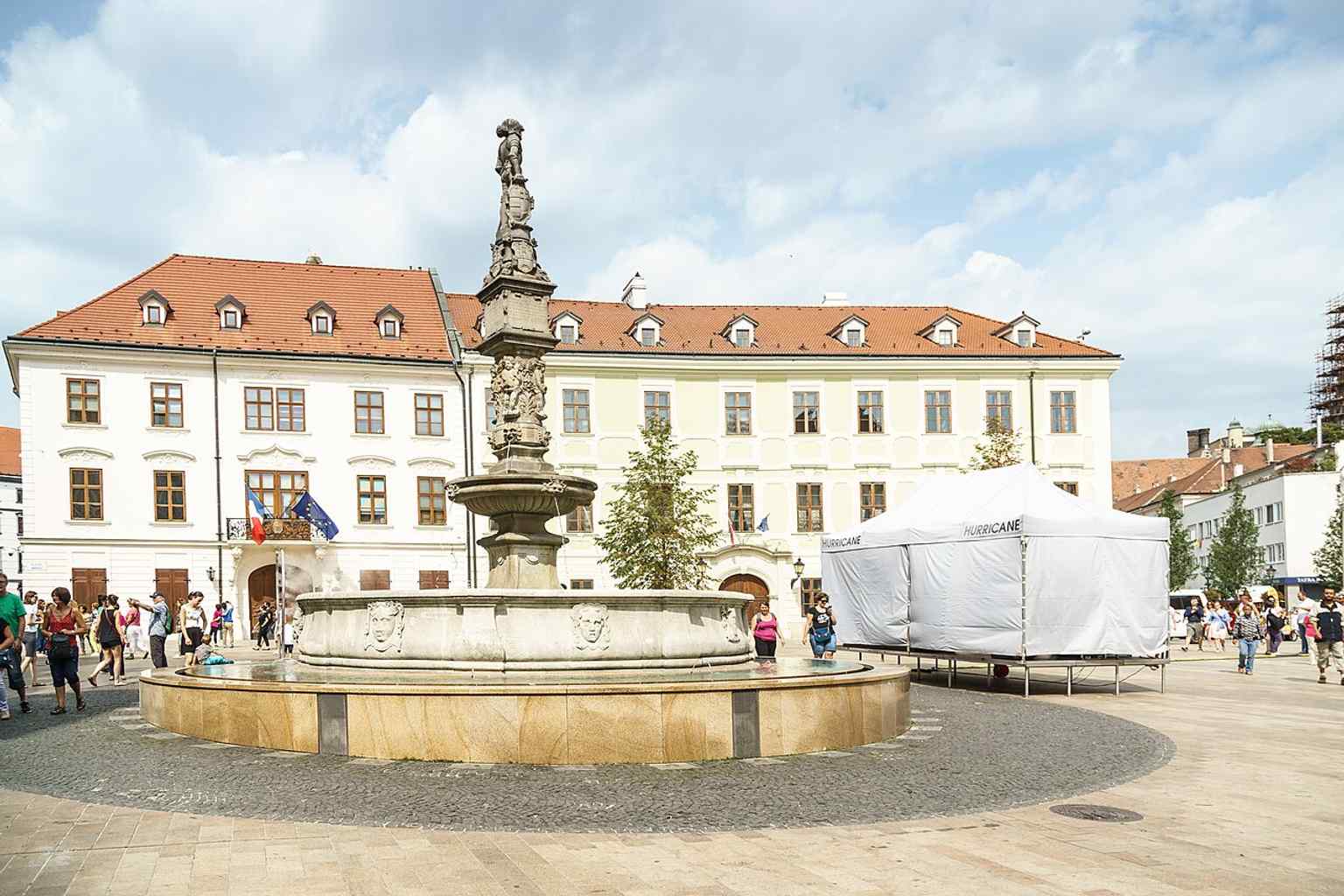
A high-resolution view of the fountain in its urban setting near Kutscherfeld Palace, showing how it anchors the square.Photo: Radler59 (talk), Wikimedia Commons, CC BY-SA 4.0. Cropped & resized. 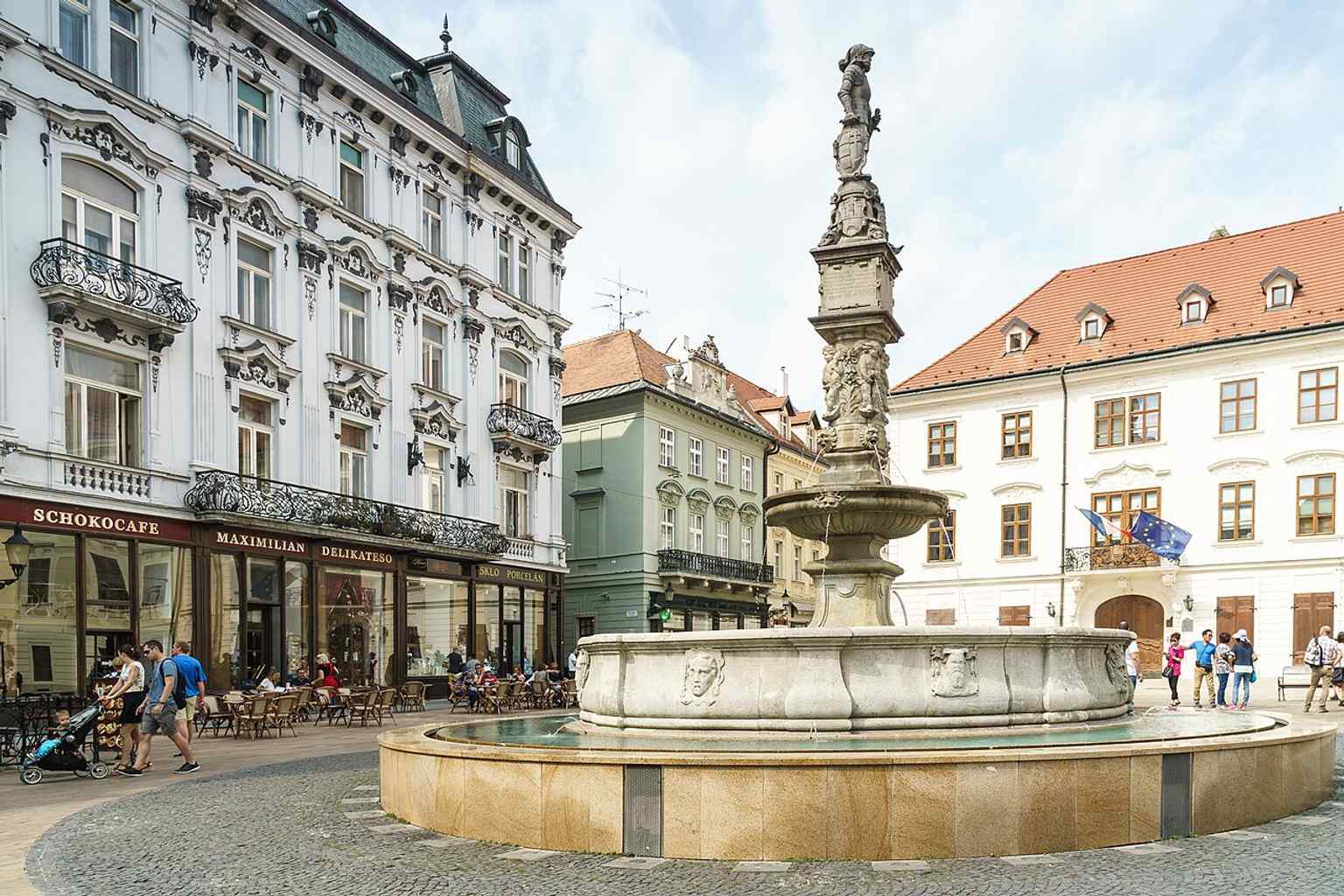
Another sharp city-view of the fountain, useful for presenting the monument within Bratislava’s historic Main Square ensemble.Photo: Radler59 (talk), Wikimedia Commons, CC BY-SA 4.0. Cropped & resized. 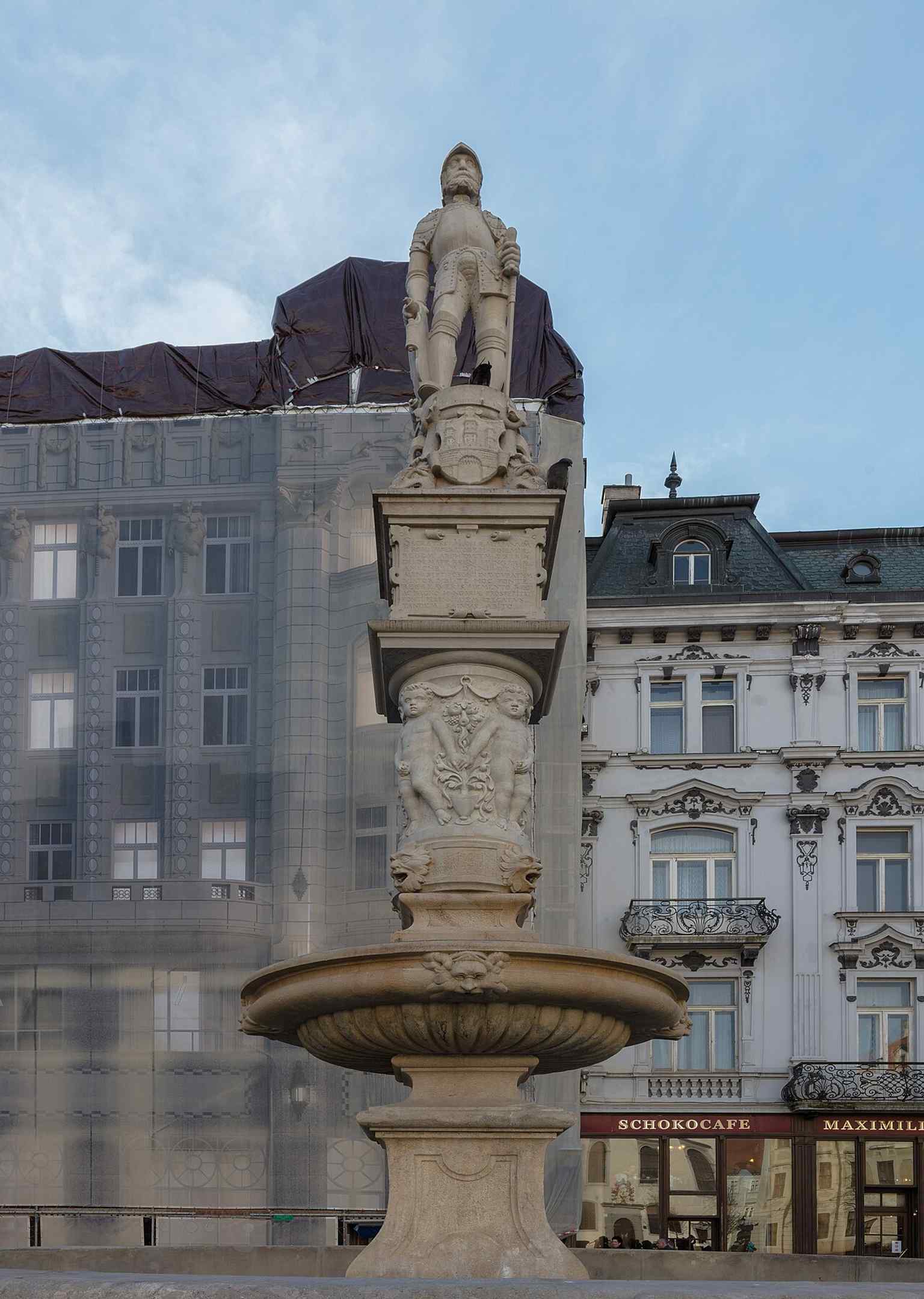
A crisp modern close-up of the fountain, well suited to the story of restoration and the return of its historic appearance.Photo: Diego Delso, Wikimedia Commons, CC BY-SA 4.0. Cropped & resized. On your right, look for the wide pale pink stucco façade, the central balcony carried by four stone columns, and the huge coat of arms set high along the roofline. This is…Read moreShow less
Open dedicated page →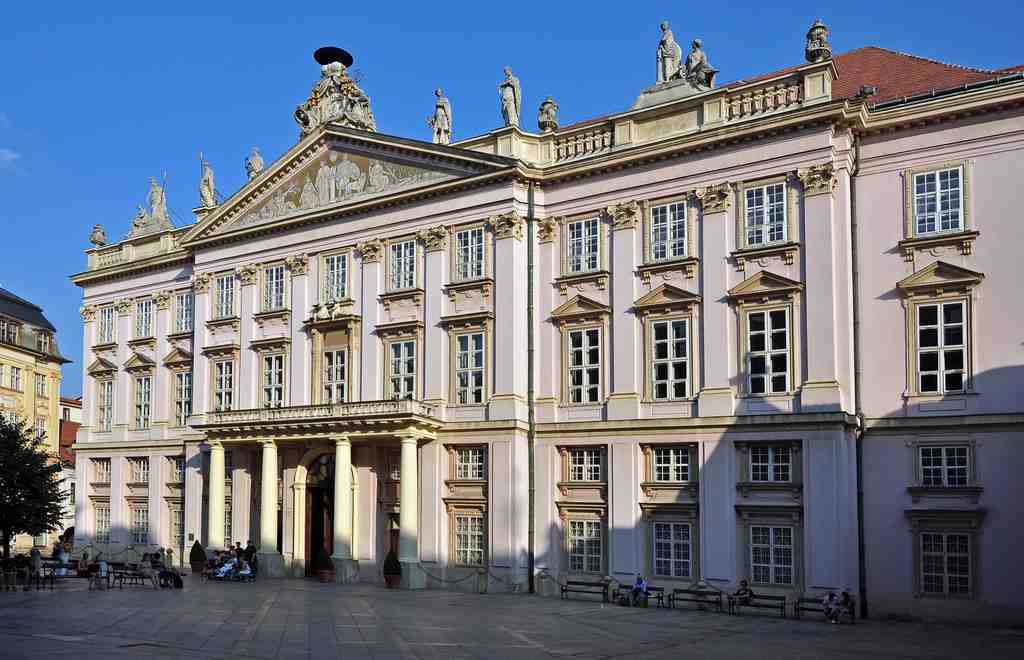
Primate's PalacePhoto: LMih, Wikimedia Commons, CC BY-SA 3.0. Cropped & resized. On your right, look for the wide pale pink stucco façade, the central balcony carried by four stone columns, and the huge coat of arms set high along the roofline.
This is Primate’s Palace, and it wears power very neatly. Not loud power... the organized kind. The kind that signs treaties, hosts dignitaries, and decides how a capital should present itself to the world.
Before this elegant front rose here in the late eighteenth century, this spot already mattered for centuries. Most visitors admire the polish and keep walking, but beneath it lies one of the old city’s deepest roots: a central medieval zone where the archbishop kept a working residence, where a chapel of Saint Ladislaus stood by the fifteenth century, and where archaeology pushes human presence back to Roman times. Bratislava has a habit of laying a fresh tablecloth over an ancient table.
When the Hungarian army was defeated at Mohács in fifteen twenty-six, the kingdom’s center of gravity shifted north. Pressburg, today’s Bratislava, grew into a coronation city, and once kings were crowned here, the supporting machinery of rank and rule clustered close by. Crowns touched heads in Saint Martin’s Cathedral, but the hosting, lobbying, filing, bargaining, and ceremonial planning needed headquarters like this one.
That helps explain the title here. The primate was not just a senior churchman, but the leading archbishop of the kingdom, with land, money, influence, and a direct hand in shaping the city. In a place like Bratislava, religious authority and political authority often shared the same front door.
The man who gave the palace its present form was Archbishop József Batthyány. In the seventeen seventies, he decided Bratislava needed a residence worthy of his office and convenient for his family ties, nearby estates, and the imperial court in Vienna. He hired his Viennese architect, Melchior Hefele, approved the final plan in seventeen seventy-eight, and within just a few years this broad, symmetrical palace stood here with its inner courtyard, grand façade, and roofline statues. If you glance at your screen, image three isolates Batthyány’s coat of arms above you. Those two little figures above the balcony hold the letters C and I, for his motto: clemency and justice. A pretty tidy job description, if you ask me.
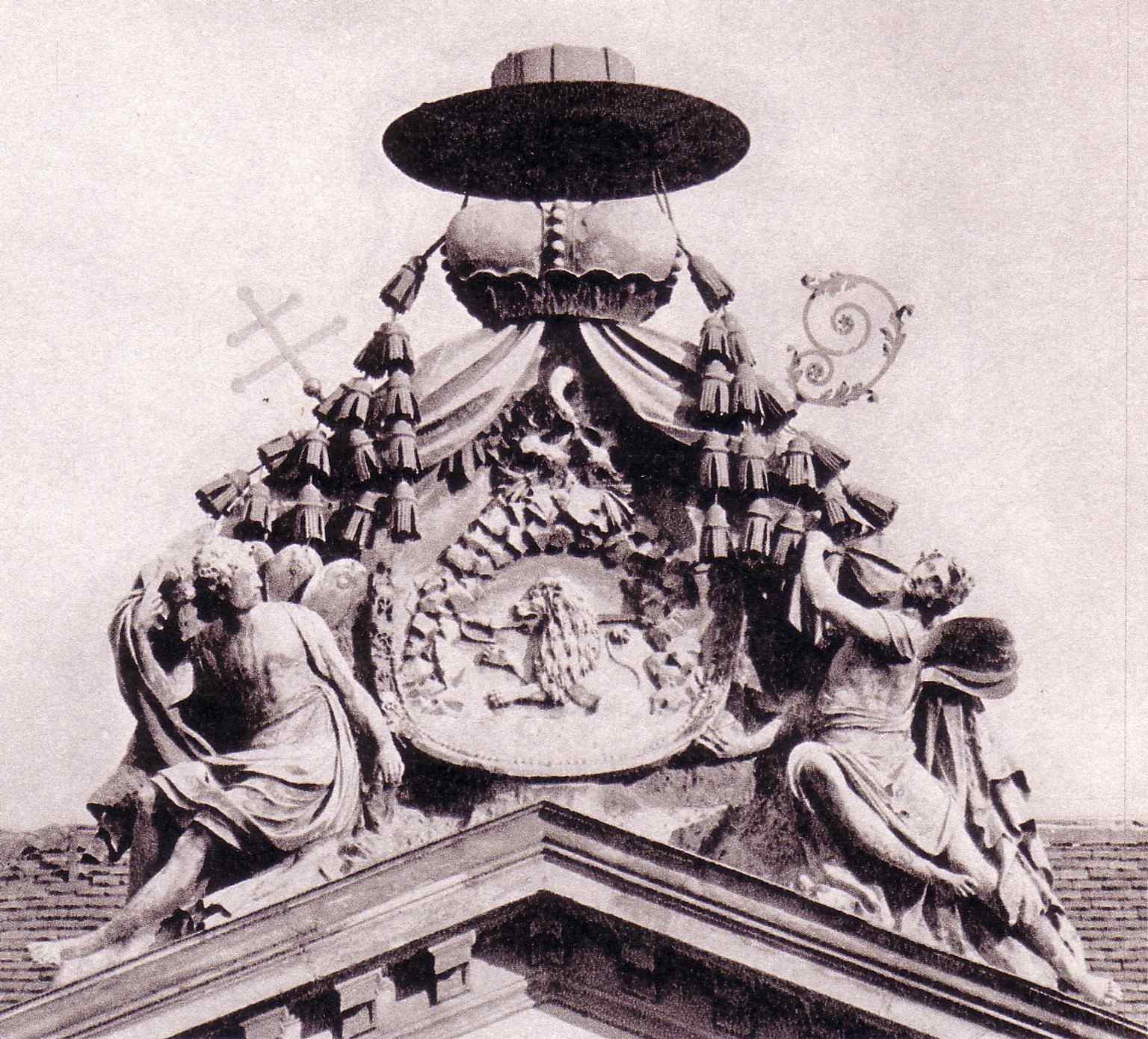
The Batthyány coat of arms on the roofline links the building to Archbishop József Batthyány, who commissioned the palace’s late-18th-century reconstruction.Photo: Carol23 de, Wikimedia Commons, CC BY-SA 4.0. Cropped & resized. Inside, the grand reception room is the Mirror Hall, and that room has seen Europe reshuffled. On the twenty-sixth of December, eighteen oh five, after Napoleon’s victory at Austerlitz, Prince Johann-Joseph von Liechtenstein signed the Peace of Pressburg here for Austria, and Charles-Maurice de Talleyrand signed for France. Later, Ferdinand the Fifth signed the March Laws here in eighteen forty-eight. Even in nineteen sixty-eight, communist leaders used this palace for the Bratislava Declaration. Same walls... different empires, different paperwork.
And then the city added one more layer. After the archbishops moved back to Esztergom, the palace declined, until Bratislava bought it in nineteen oh three and turned it into city property. During that restoration, workers found six lost tapestries hidden behind coverings near the Mirror Hall, like history slipping a note out from inside the wall. Some parts now serve the city mayor, some hold gallery spaces, and the building still hosts public life rather than merely posing for it.
Carry that thought with you to Mirbach Palace: in Bratislava, the loveliest façades often stand on much older claims.
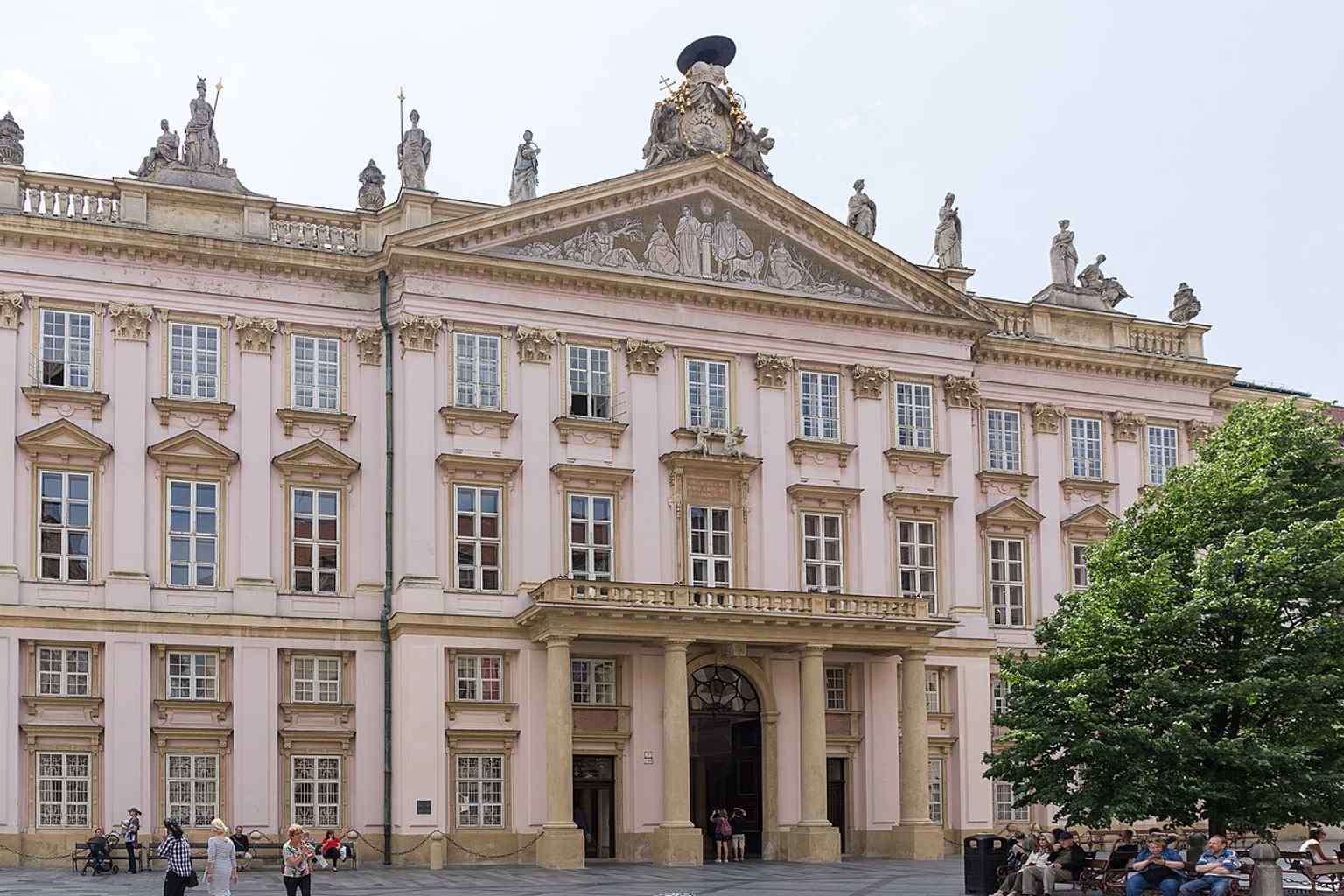
A crisp modern view of the palace’s main façade on Primatial Square, showing the grand classical front that fills nearly the whole south side of the square.Photo: Pymouss, Wikimedia Commons, CC BY-SA 4.0. Cropped & resized. 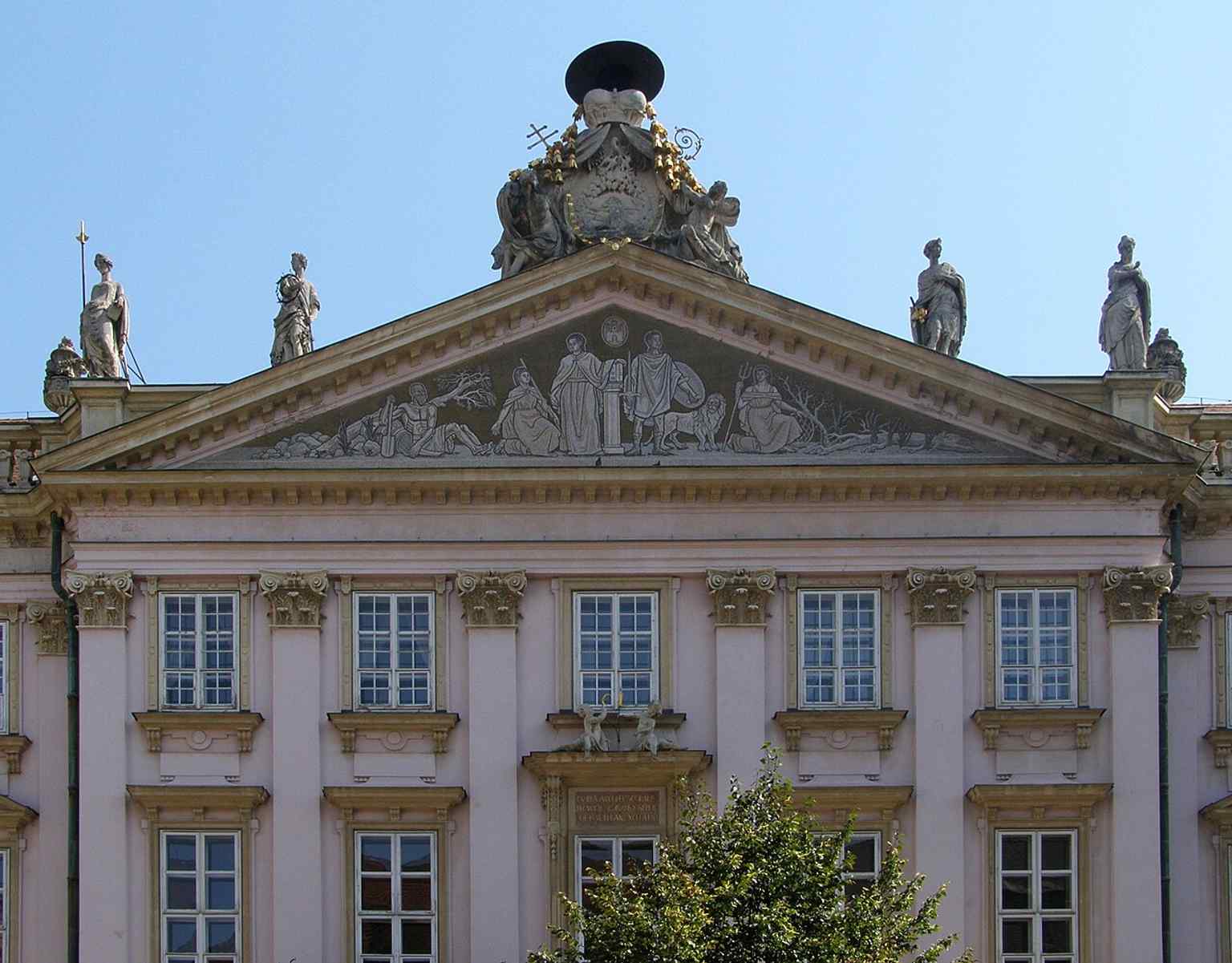
The pediment close-up highlights the palace’s classical fronton, where the original Maulbertsch fresco once crowned the façade before being replaced by a later mosaic.Photo: Albertus teolog, Wikimedia Commons, CC BY-SA 4.0. Cropped & resized. 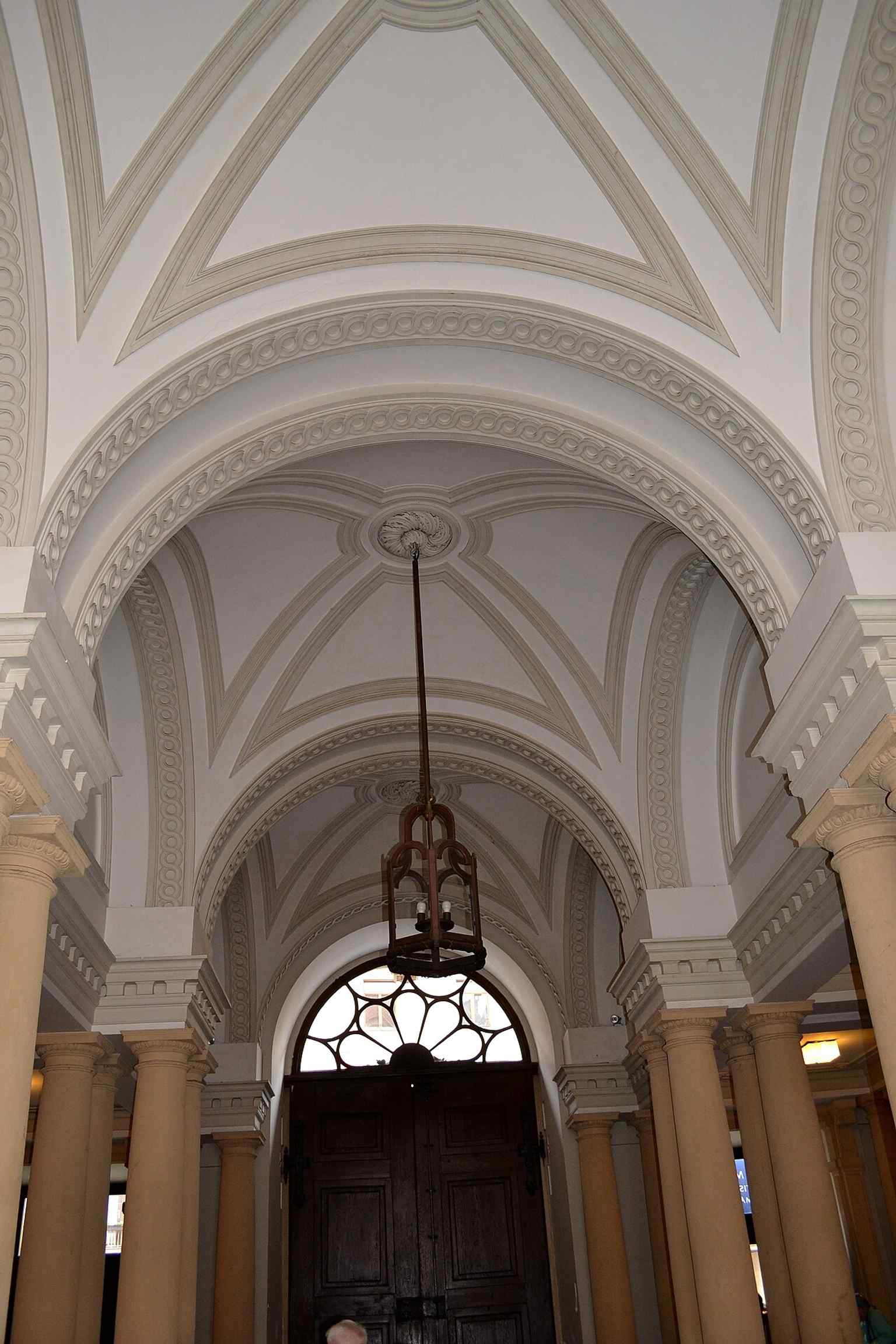
Looking up into the passageway, this image captures the interior entrance space that leads into the palace’s ceremonial courtyards.Photo: Lure, Wikimedia Commons, CC BY-SA 3.0. Cropped & resized. 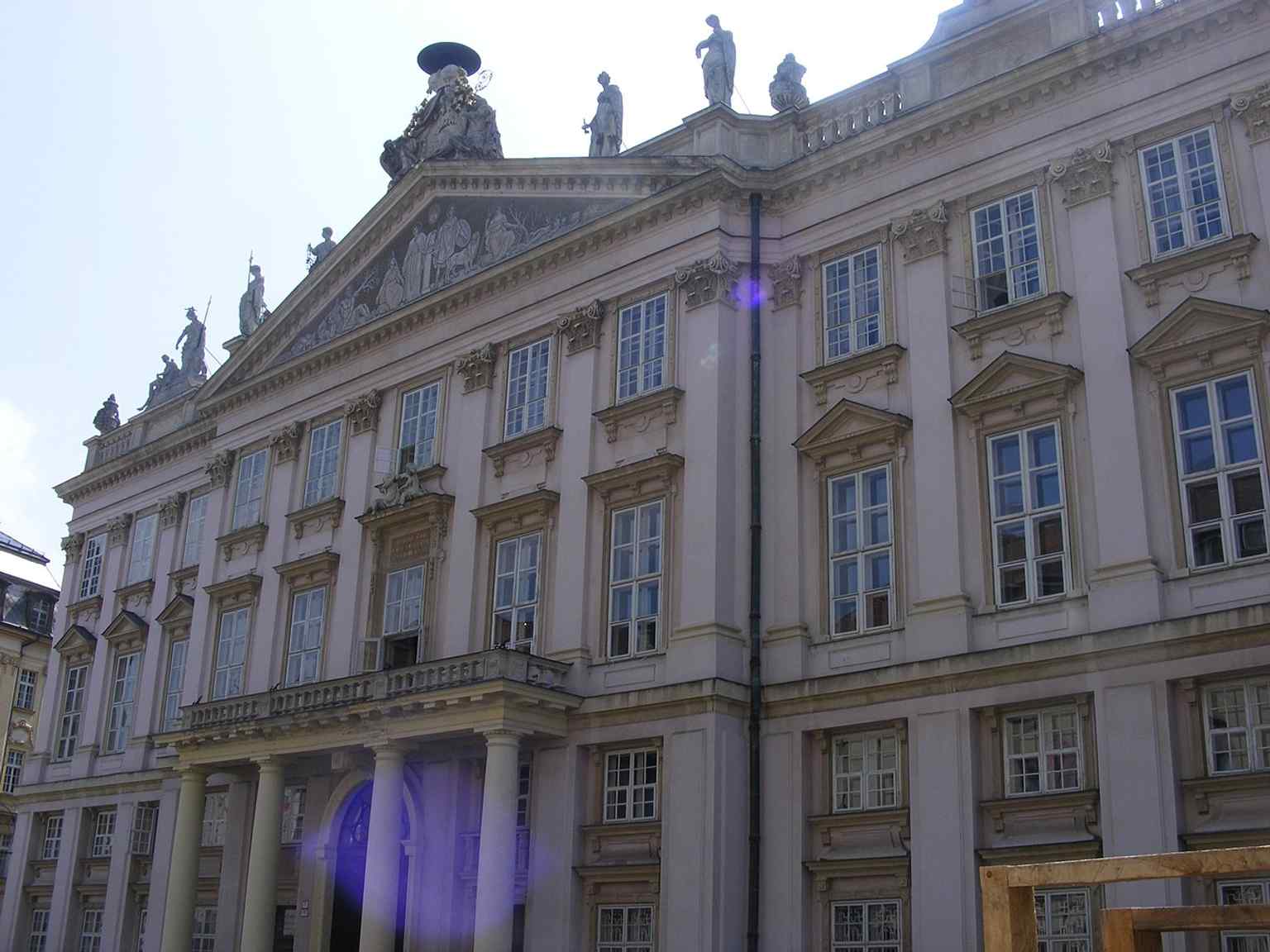
This plaque commemorates the Peace of Pressburg of 1805, signed in the palace’s Mirror Hall after the Battle of Austerlitz.Photo: Szabi237, Wikimedia Commons, CC BY 3.0. Cropped & resized. 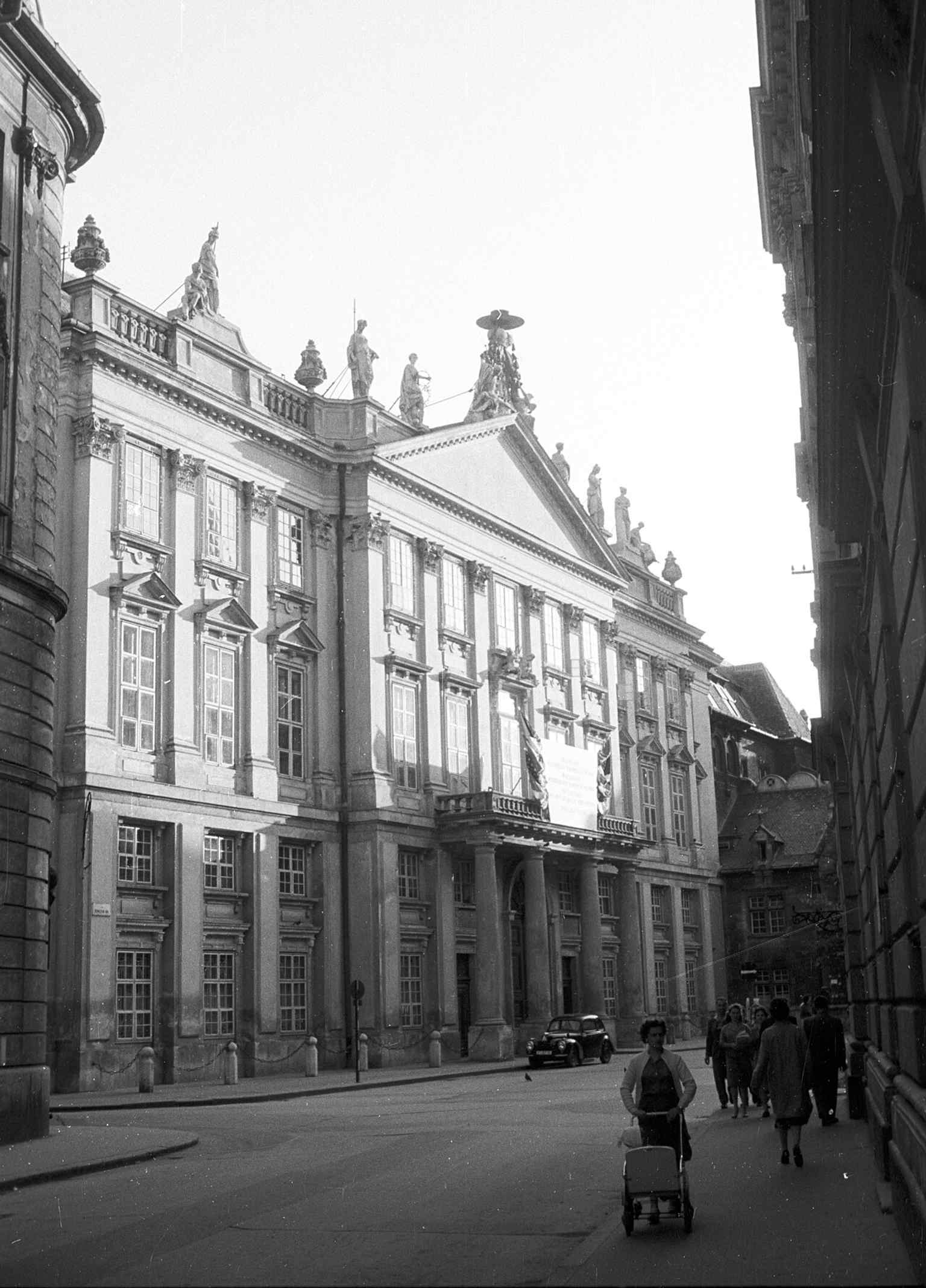
A vintage street-level view shows the palace in an earlier urban setting, useful for telling the story of how it survived and changed through the 20th century.Photo: FOTO:Fortepan — ID 51370: Adományozó/Donor: Nagy Gyula. archive copy at the Wayback Machine, Wikimedia Commons, CC BY-SA 3.0. Cropped & resized. 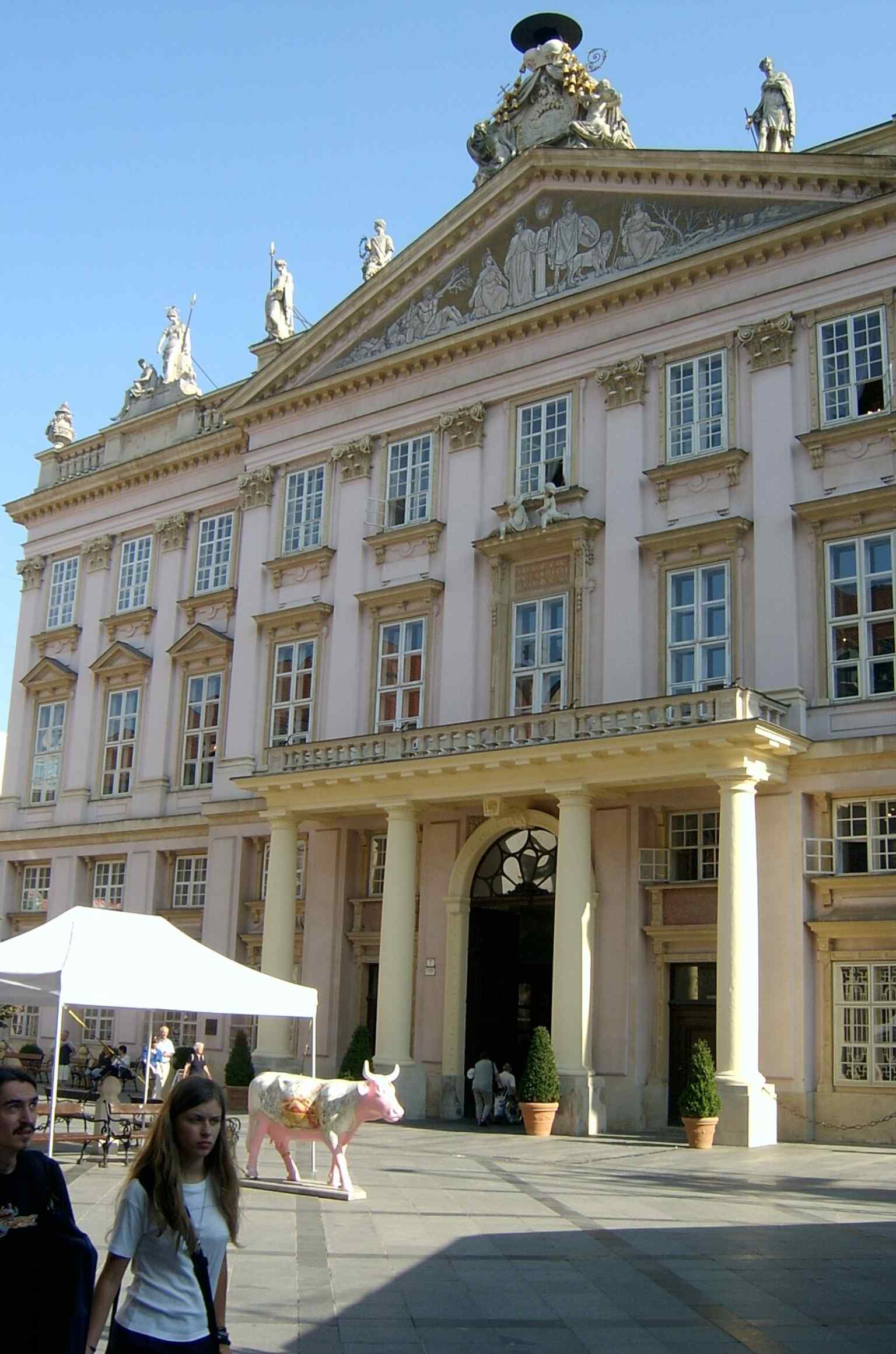
An older heritage-record image of the monument, ideal as a documentary view of the palace as a protected cultural landmark.Photo: This photograph was taken by K@rl . It's released under the license(s) stated below. You are free to use it for any purpose as long as you credit me as the author and follow the terms of the license., Wikimedia Commons, CC BY-SA 3.0. Cropped & resized. 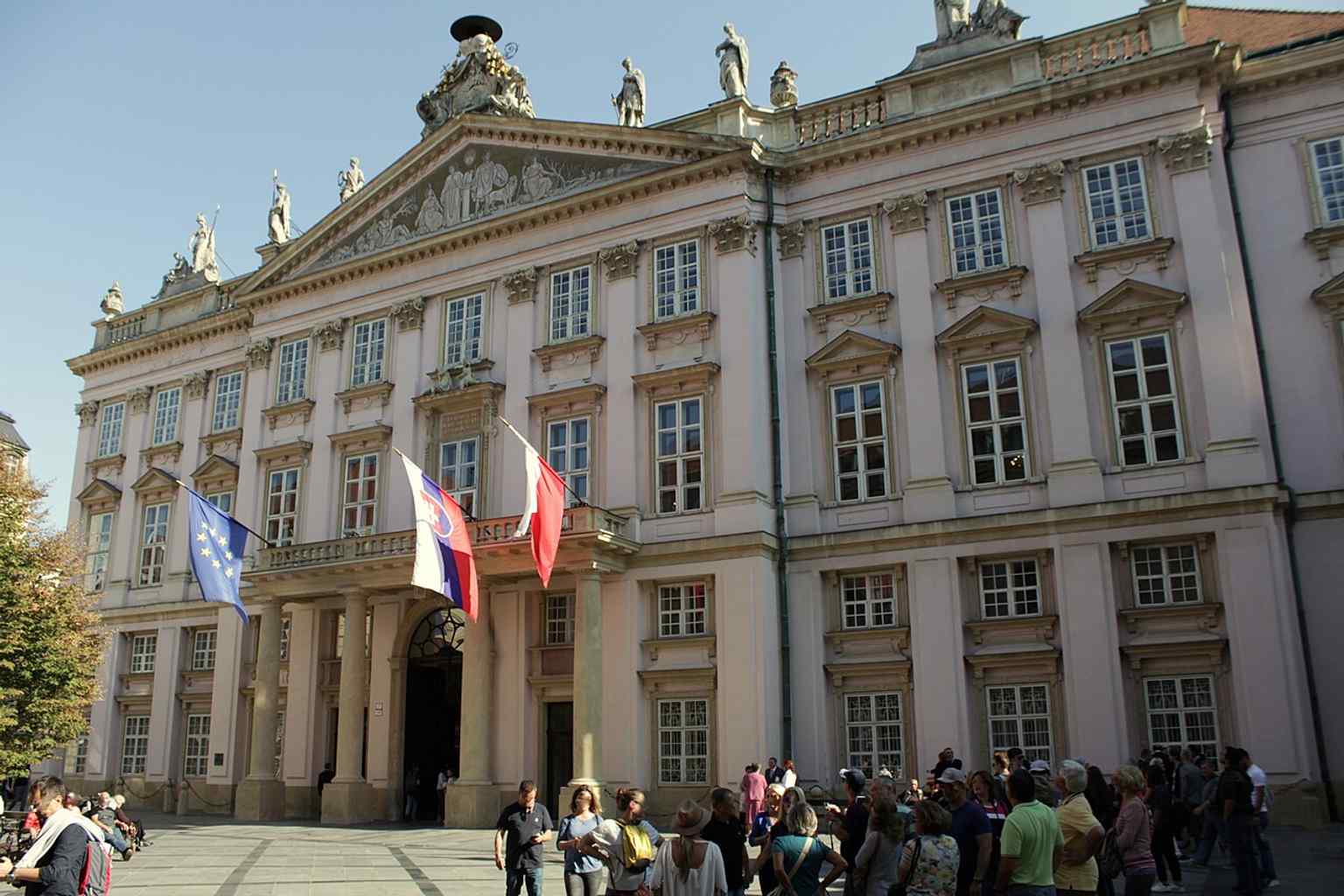
Another strong full-building view, useful for showing the palace’s symmetrical classicist massing and its place in the historic center.Photo: Valerio2468, Wikimedia Commons, CC BY-SA 4.0. Cropped & resized. 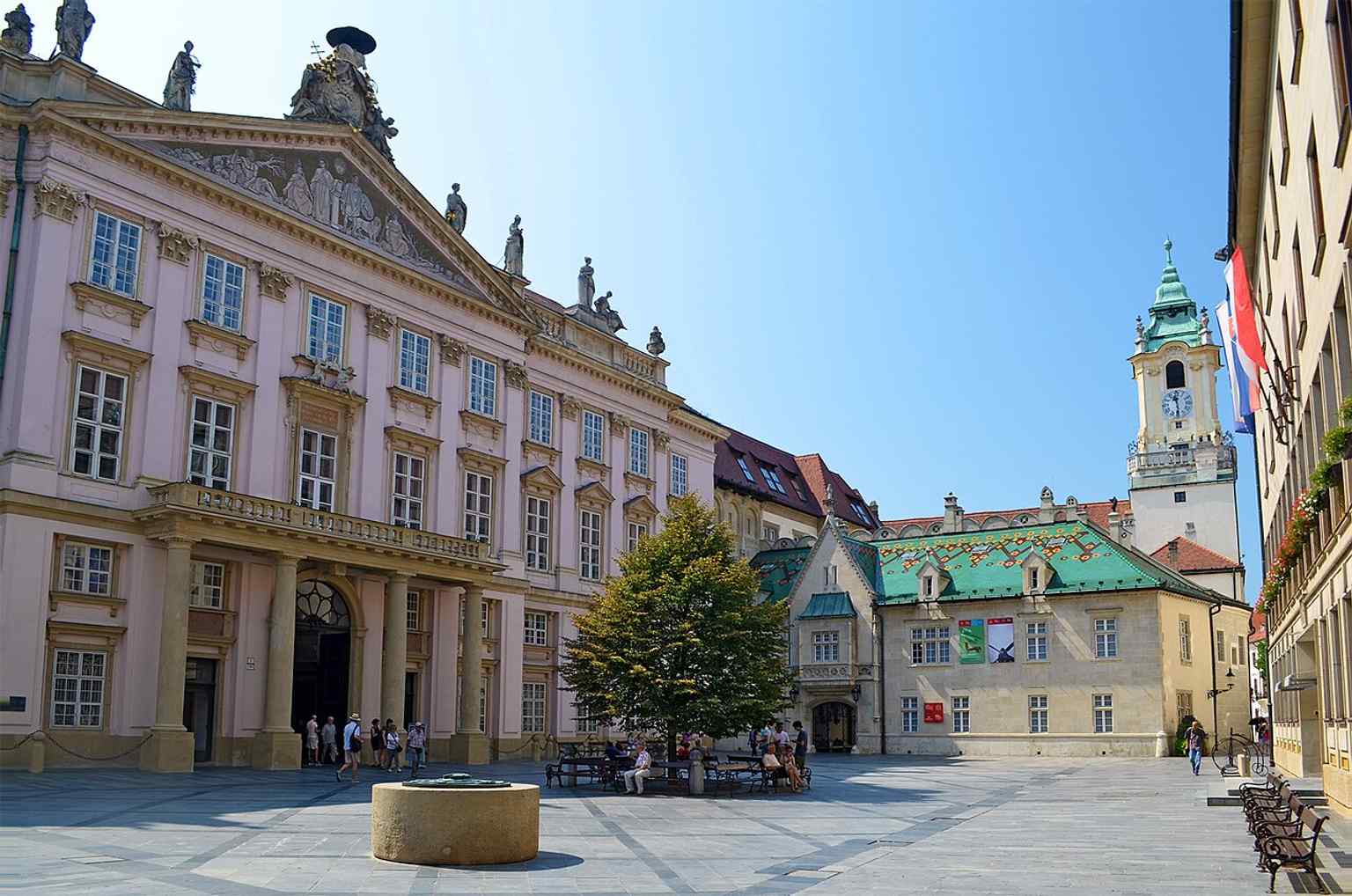
This street-level perspective shows the palace embedded in the old town fabric, echoing the text’s note about its sensitive integration into the historic core.Photo: Рустам Абдрахимов, Wikimedia Commons, CC BY 3.0. Cropped & resized. 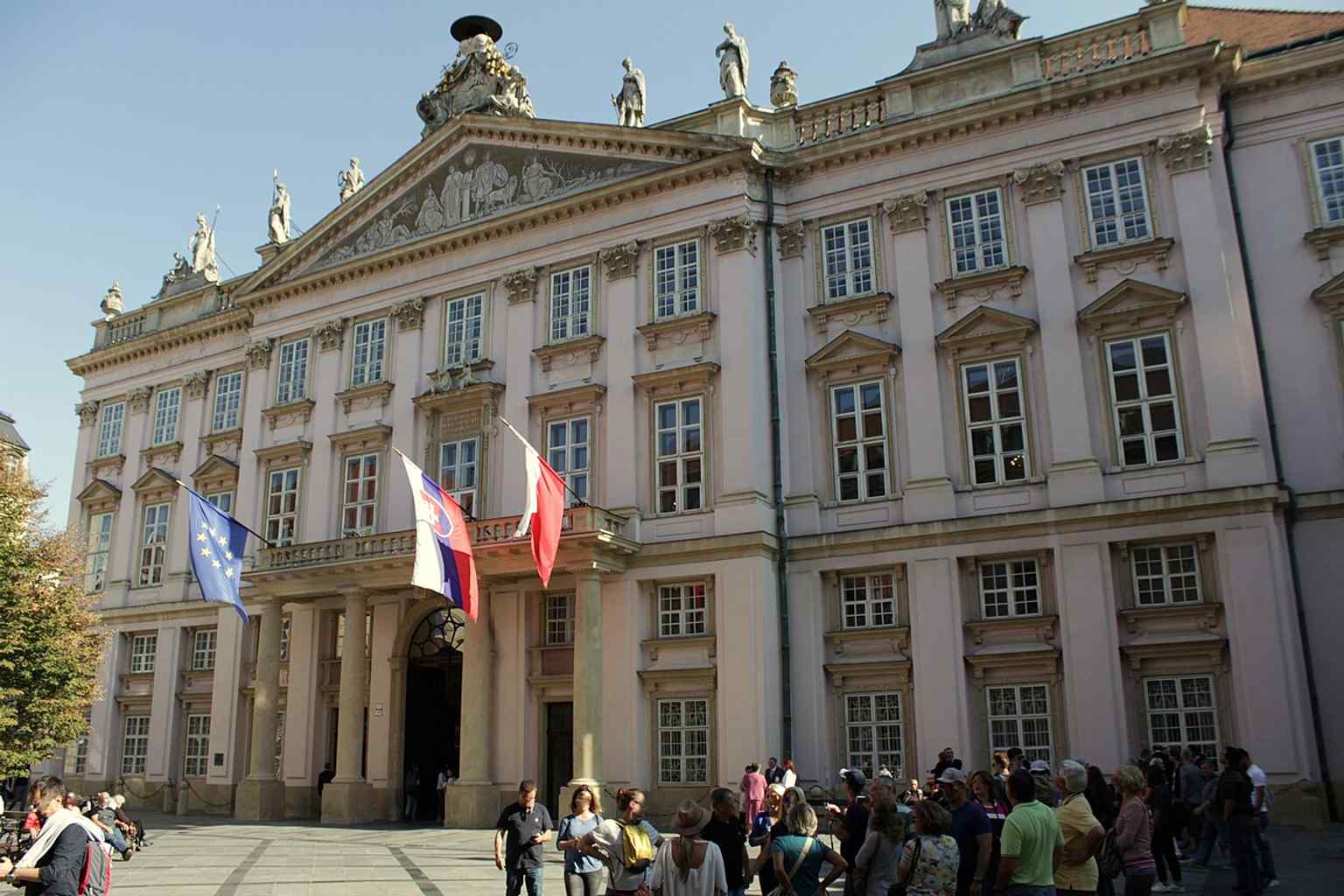
A likely interior-focused catalogue image that can support the story of the palace as an active civic and ceremonial venue, not just a monument.Photo: Valerio2468, Wikimedia Commons, CC BY-SA 4.0. Cropped & resized. On your left is a pale stone palace with a broad, symmetrical two-story facade, a central triangular pediment, and delicate Rococo stucco curling around the windows like icing…Read moreShow less
Open dedicated page →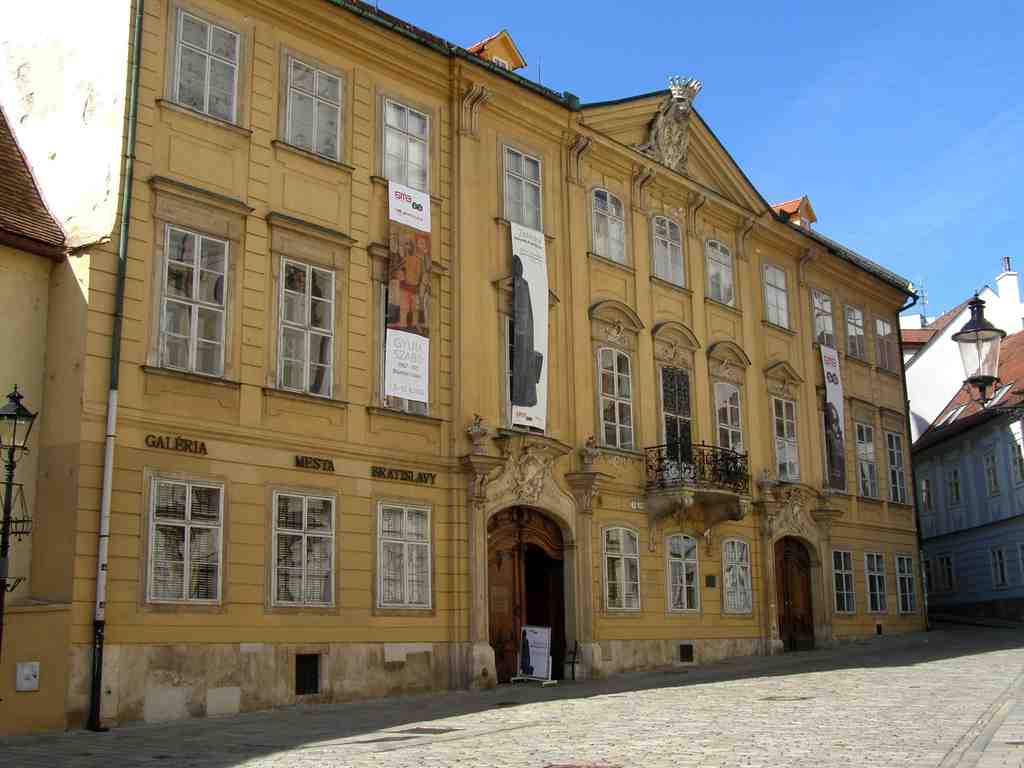
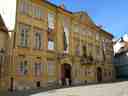
Mirbach PalacePhoto: Lure, Wikimedia Commons, CC BY-SA 3.0. Cropped & resized. On your left is a pale stone palace with a broad, symmetrical two-story facade, a central triangular pediment, and delicate Rococo stucco curling around the windows like icing that hired an architect.
Mirbach Palace is one of the best places in Bratislava to understand how a city stacks itself in layers. What looks polished and settled from the outside often sits on older ground stories... not erased, just covered, reused, and argued with. This palace is the tidy top sheet; underneath it lie a wooden house, a city property, a worship space, a burned ruin, and then this graceful Baroque-Rococo showpiece.
The paper trail starts in thirteen seventy-nine, with a plot owned by Mikuláš Damankusch. By fourteen forty-three, records call the house here Weittenhof, meaning “wide yard.” Later writers say the old building carried the city coat of arms and relied heavily on wood. In the sixteenth and seventeenth centuries, this address still lived an earlier life: people even held Protestant services here in sixteen sixty-six. So before it became elegant, this corner had already served the city in very practical, communal ways.
Then comes one of those very human turns history loves. The scholar Matej Bel wrote in seventeen thirty-five that the house stood prominently at the mouth of Zámočnícka Street, with decent living rooms, side wings, cellar storage for wine, and occasional lodging for military officers. He also recorded what happened on the twenty-third of October, seventeen thirty-three: the place burned. The fire may have started because a theater company renting rooms here was careless. A dramatic ending... in the least useful sense.
The man who truly changed the site was Johann Michael Spech, a Bratislava brewer from a family tied to former mayors in Podhradie. In seventeen sixty-two he bought the fire-damaged remains, and on the fourth of March, seventeen sixty-eight, he got permission to raise something entirely new. Master mason Matej Höllrigl led the construction, and within two years, from the spring of seventeen sixty-eight to the spring of seventeen seventy, Spech had turned wreckage into a refined urban palace. If you glance at the image in your app, you can pick out that careful symmetry and the airy stucco decoration more easily than from street level.
And then, true to form for this city, the story kept shifting owners. Count Imrich Csáky held it by the early nineteenth century. Adam Jurenák, a city councillor, owned it later. The Nyáry family arrived in the early twentieth century, and the pair of oval shields under the count’s crown in the pediment still belong to them. After that came Baron Doctor Emil Mirbach, the man whose name stayed. He understood exactly what he had: not just a fancy address, but a rare survival. In his will, he left the palace to the city and asked that it become a public fine arts museum. That is a pretty fine last act.
The city took over in nineteen forty-nine, opened its first exhibitions the next year, and after a major restoration reopened the palace in nineteen seventy-five as part of the Bratislava City Gallery. Inside, two first-floor rooms still preserve wooden paneling and a remarkable set of eighteenth-century prints built right into the walls like art and architecture shaking hands.
In a moment, we’ll step straight into the Church of the Annunciation, where the next layer of this old city gathers around belief as carefully as this palace gathers around memory.
On your left, look for a pale stone-and-plaster façade arranged in two strict tiers, crowned by a rounded gable, with a statue of the Virgin above the main portal. This is the…Read moreShow less
Open dedicated page →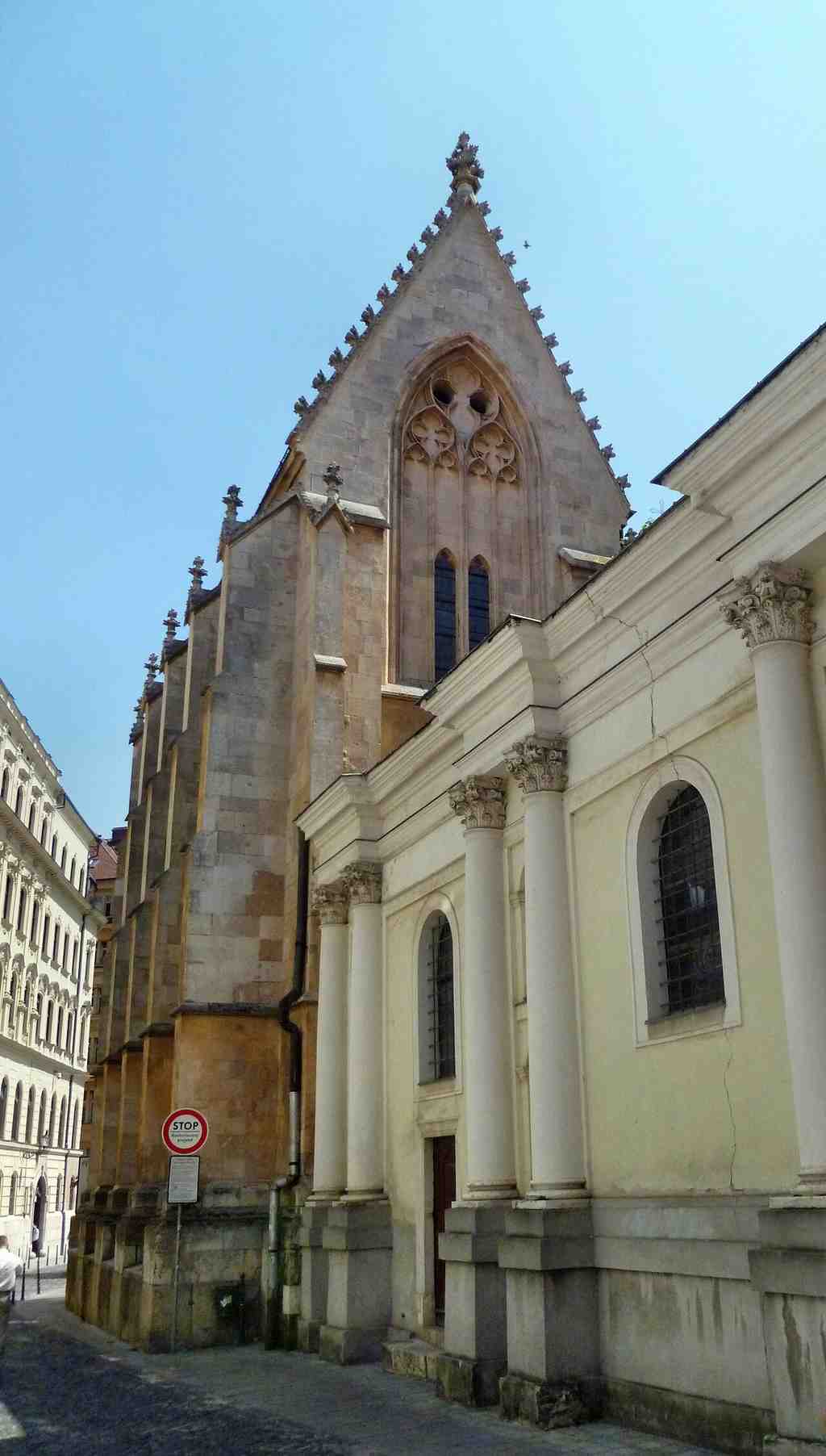
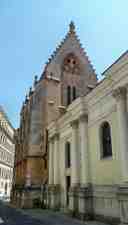
Church of the Annunciation (Bratislava)Photo: JoJan, Wikimedia Commons, CC BY 3.0. Cropped & resized. On your left, look for a pale stone-and-plaster façade arranged in two strict tiers, crowned by a rounded gable, with a statue of the Virgin above the main portal.
This is the Church of the Annunciation, better known here as the Franciscan Church, and it is the oldest preserved sacred building in Slovakia’s capital. That sounds noble, and it is... but the deeper story is not just prayer surviving the centuries. It is power, carefully dressed in prayer.
The Franciscans arrived fast after Pope Innocent the Third approved their order in the year twelve oh nine. Around twelve twenty, they began the monastery here, then at the northern edge of the medieval town. The church followed later in the thirteenth century. King Ladislaus the Fourth ordered it as a memorial to victory after the battle of Marchfeld in twelve seventy-eight, when his side defeated the Bohemian king Ottokar the Second.
So yes, devotion mattered. But this church also spoke the language of politics. When King Andrew the Third came here for the consecration on the twenty-fourth of March, twelve ninety-seven, joined by Archbishop Lodomer, bishops, nobles, and townspeople, the ceremony did more than bless a building. It staged legitimacy in public. If you want the local reading of this place, don’t just see a church... see a medieval press conference in stone. Most visitors never notice that the consecration itself acted as a major political demonstration, gathering the kingdom’s top churchmen and power brokers to make victory, dynasty, and divine favor look inseparable.
And the city kept using this sacred ground for worldly business. In the monastery here, the Hungarian estates elected Ferdinand the First in fifteen twenty-six. Citizens later chose the town judge and council here, and even a Hungarian diet, a national assembly, met in the complex. After coronations at Saint Martin’s Cathedral, new kings came here to knight selected nobles as Knights of the Golden Spur. That is a pretty good sign this was no quiet corner chapel.
What you see outside also carries the marks of a city rewritten. Of the original Gothic church, only the presbytery, the altar end, and parts of the main walls still survive. Earthquakes in fifteen eighty and fifteen eighty-six damaged the church so badly that the vault over the nave, the main central hall, collapsed. The friars spent more than thirty years recovering. Later centuries added Renaissance repairs, then Baroque splendor.
That Baroque front in front of you came in the years seventeen forty-five and seventeen forty-six, when Lucca de Schramm reshaped the façade into this stern symmetry. Above the portal, the sculptor Jozef Sartory placed the Virgin with two angels, as if heaven itself had learned a little stagecraft. If you check the image on your screen, you can see how the later façade wraps itself around a much older core.
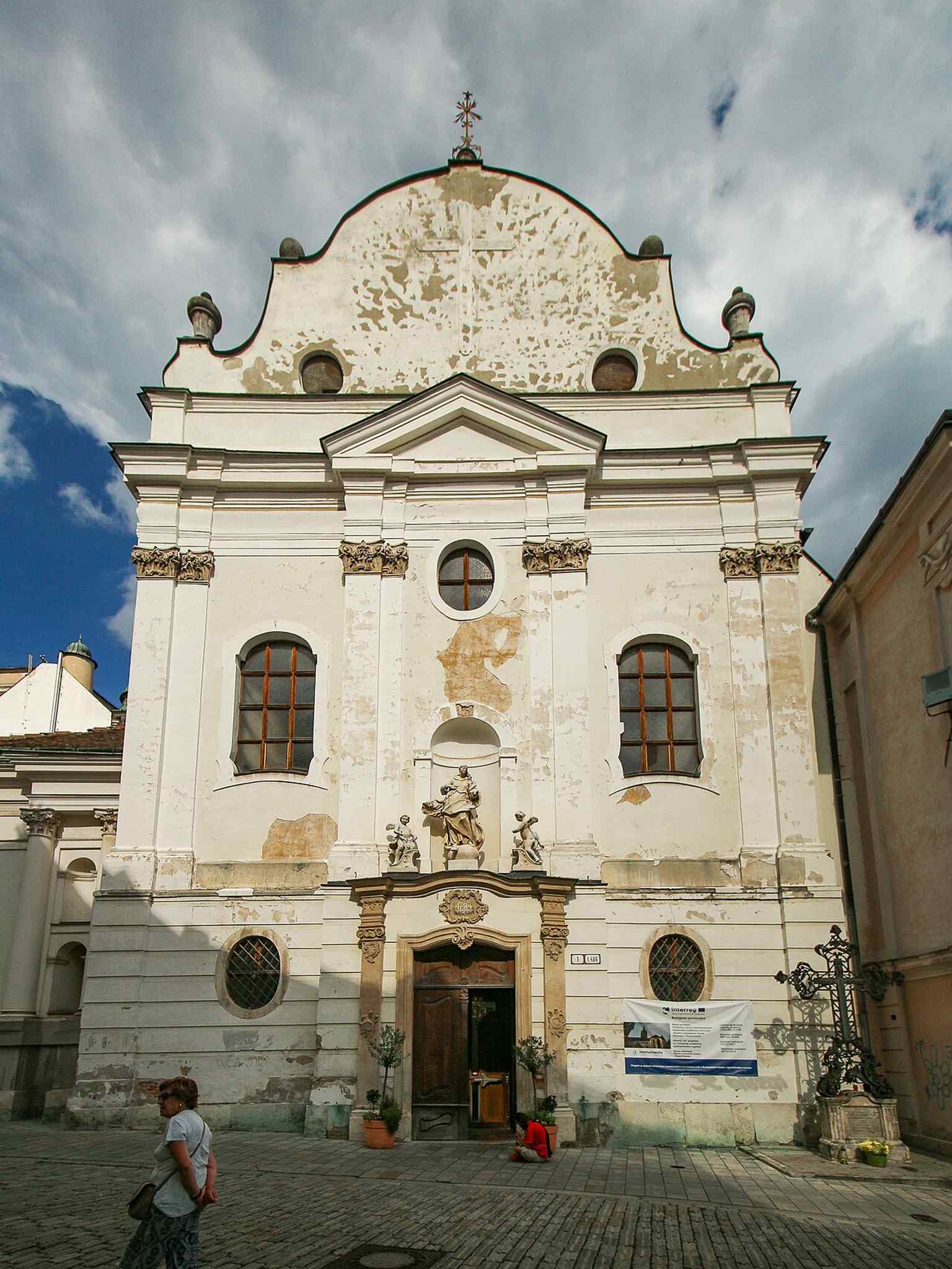
The Franciscan Church façade in Bratislava, with the Baroque front that frames the church’s long history from medieval foundation to later rebuilds.Photo: VitVit, Wikimedia Commons, CC BY-SA 4.0. Cropped & resized. Inside, the layering continues. A glance at your app shows the rich Baroque interior that replaced earlier furnishings after the earthquake damage. Yet this is not a frozen museum piece. The Franciscans still use it for worship, baptisms, weddings, and community life.
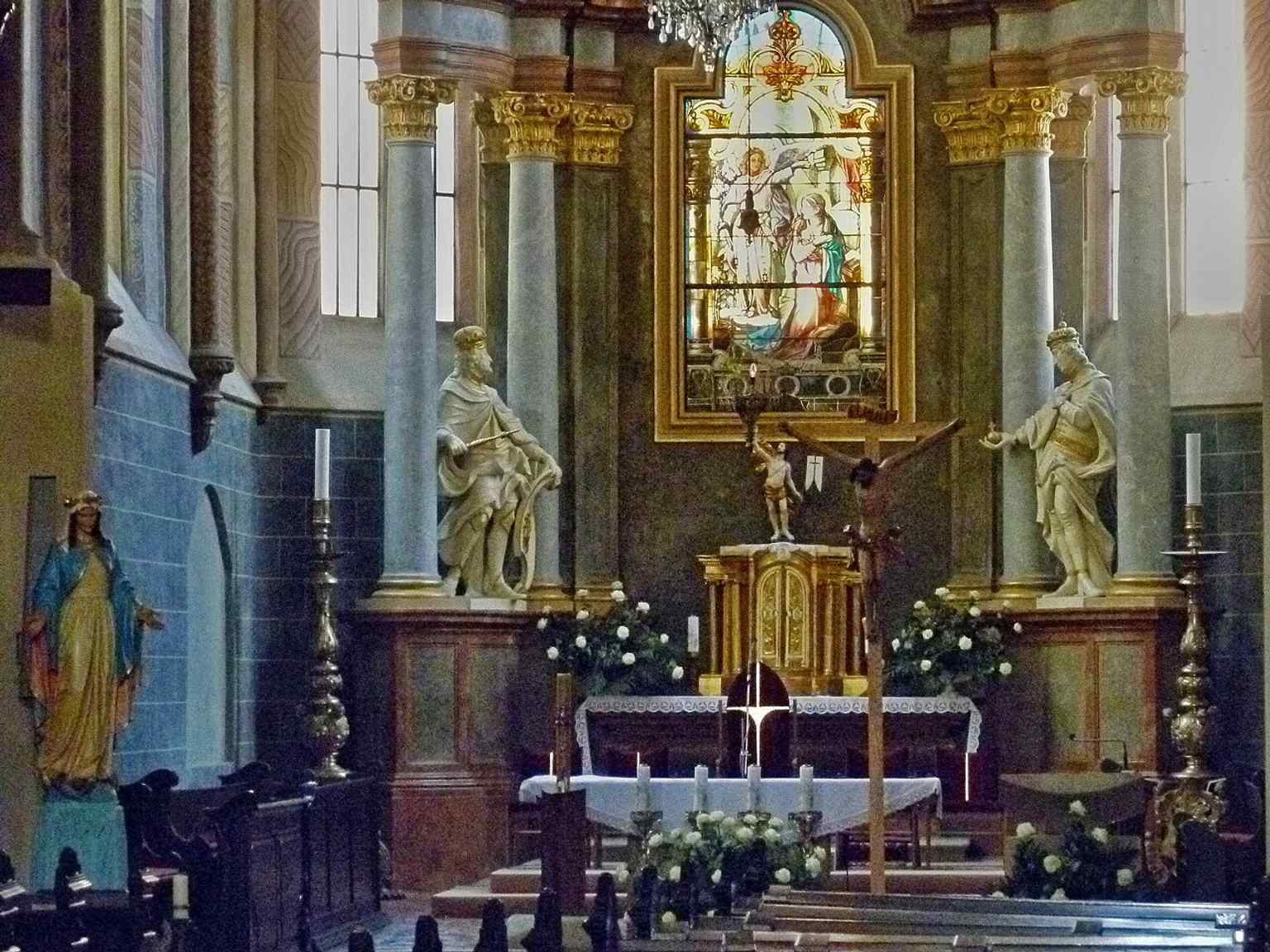
Inside the Franciscan Church: a richly decorated nave where the Baroque interior replaced earlier furnishings after the 16th-century earthquake damage.Photo: JoJan, Wikimedia Commons, CC BY 3.0. Cropped & resized. From here, faith in Bratislava steps into even more confident Baroque costume. In about five minutes, the Church of Saint John of Matha will show you that next act.
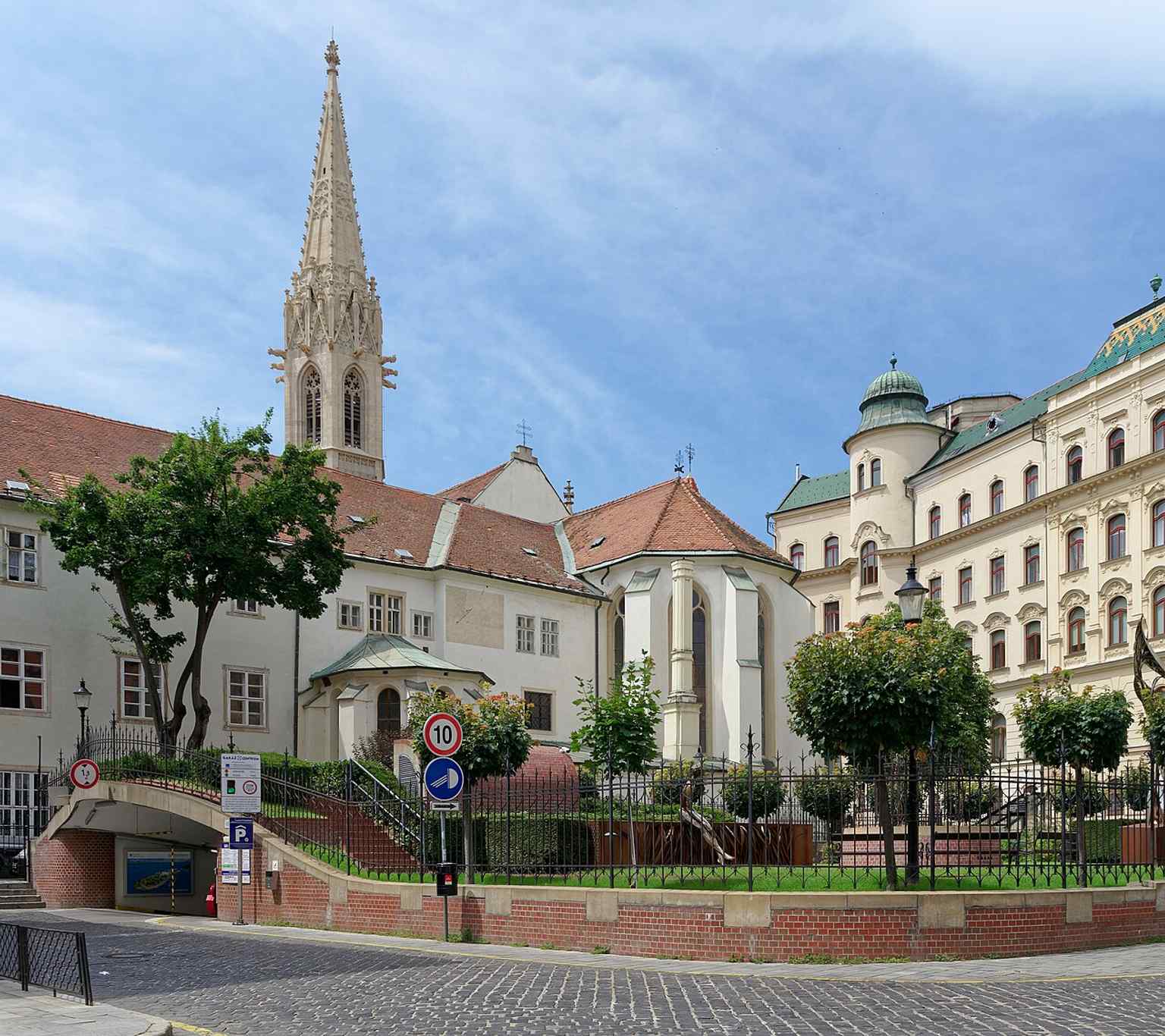
A wider view of the Franciscan Church exterior, showing the main façade and the attached monastery complex in the Old Town.Photo: Jakub Hałun, Wikimedia Commons, CC BY-SA 4.0. Cropped & resized. 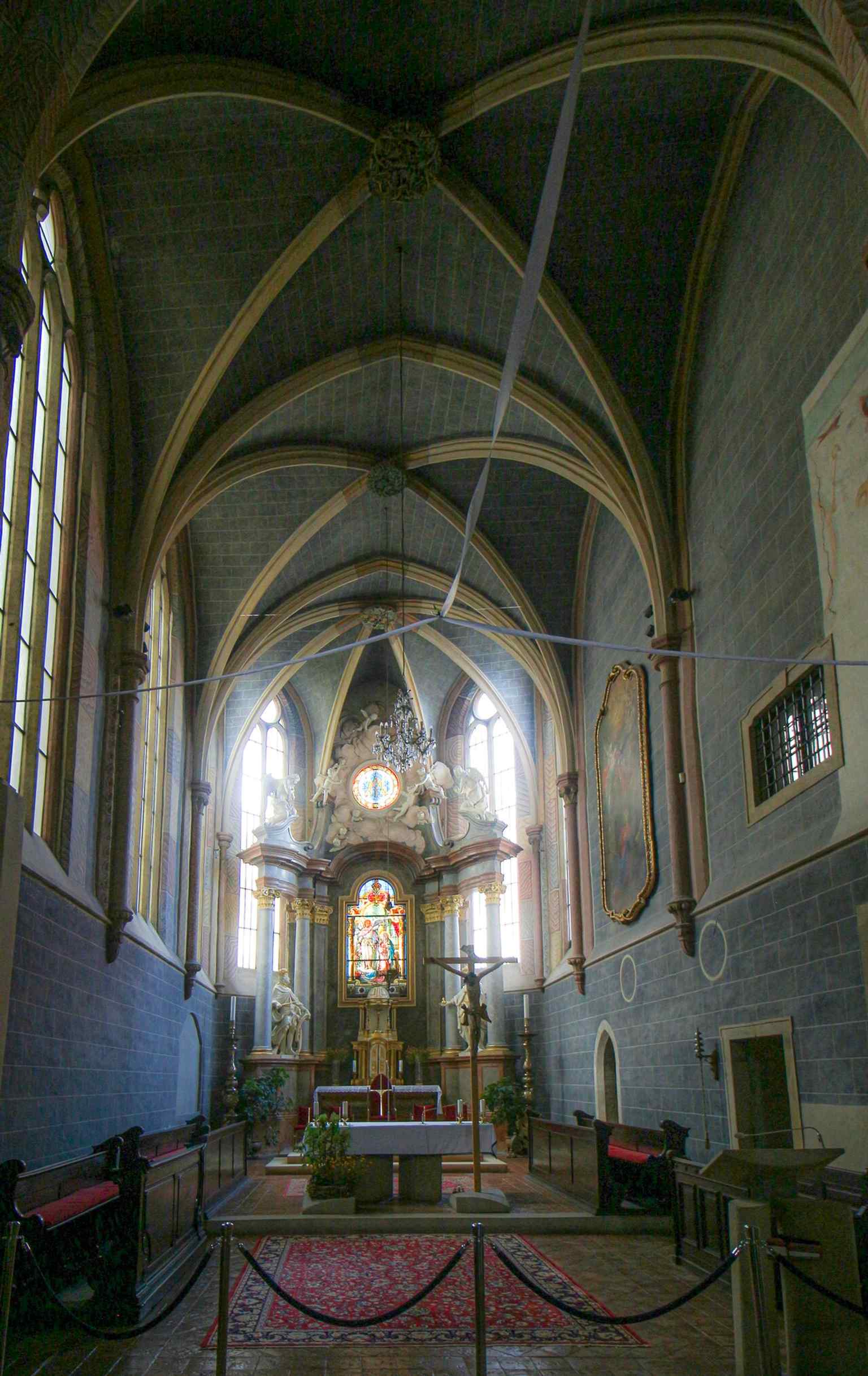
An interior view of the church’s ornate Baroque space, reflecting the layered history of the oldest preserved sacred building in Bratislava.Photo: VitVit, Wikimedia Commons, CC BY-SA 4.0. Cropped & resized. 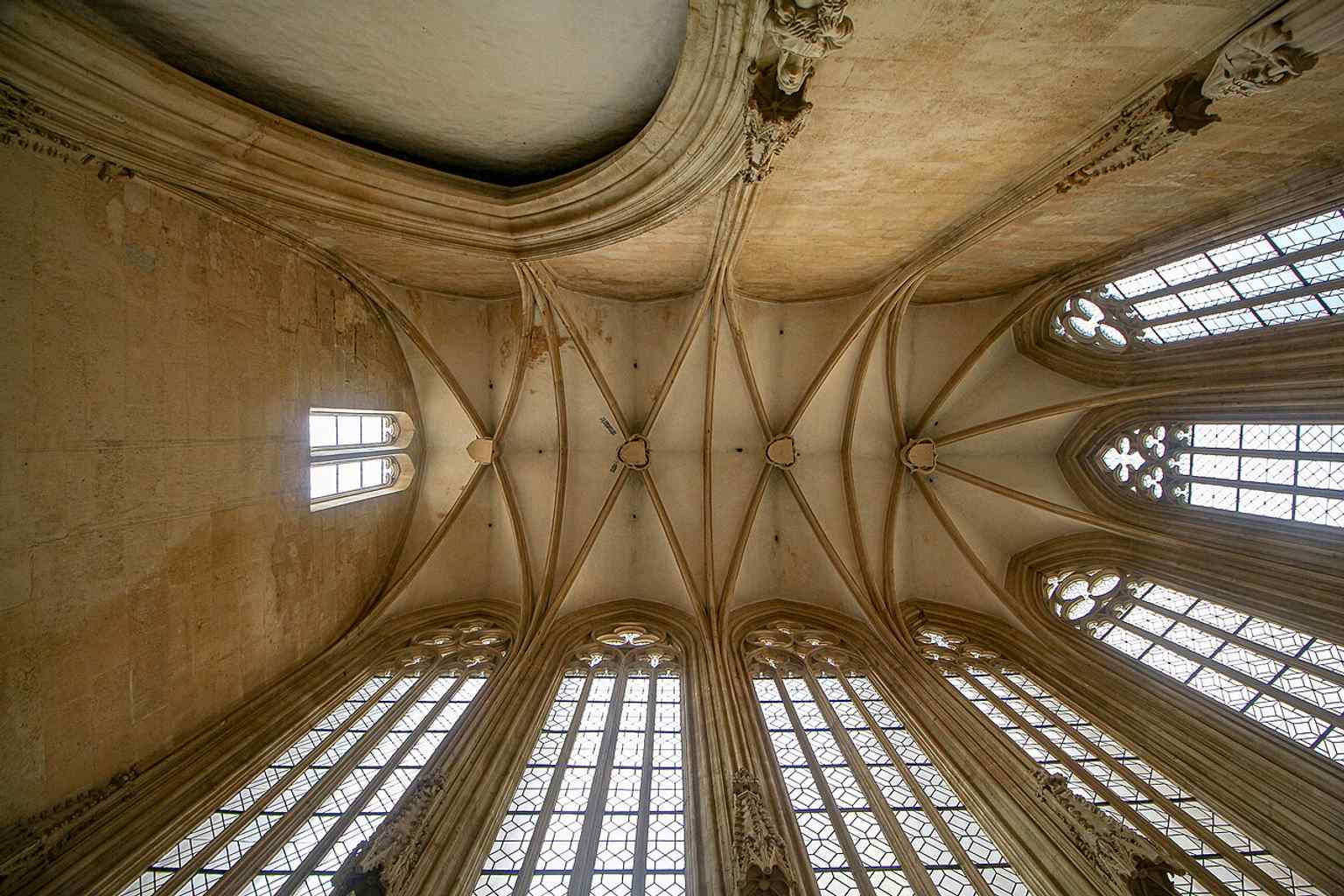
The ribbed vault of the Chapel of Saint John the Evangelist, one of the church’s most important Gothic chapels and a rare survivor from the 14th century.Photo: VitVit, Wikimedia Commons, CC BY-SA 4.0. Cropped & resized. 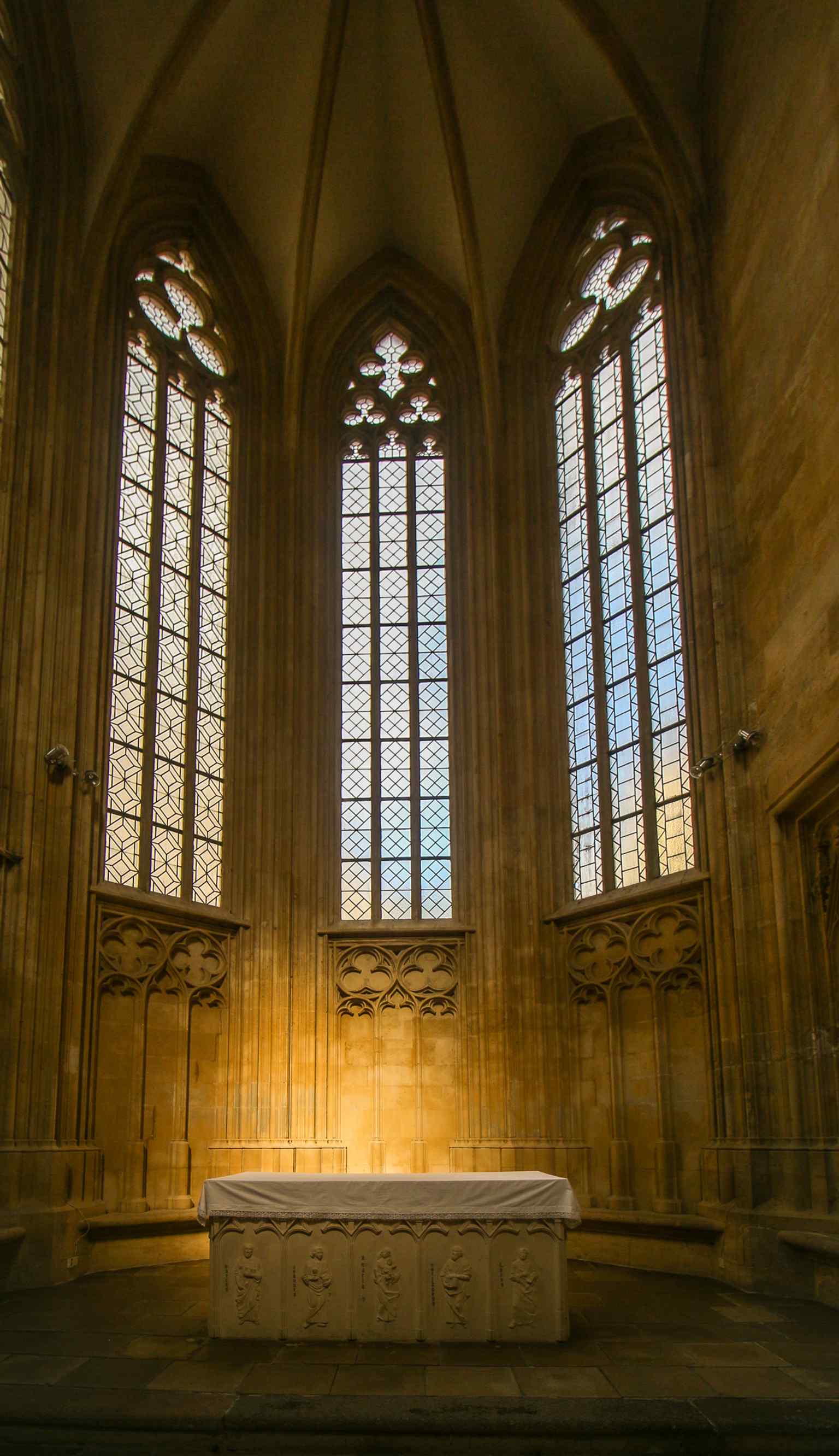
The altar in the Chapel of Saint John the Evangelist, a key Gothic side chapel later restored and fitted with a new altar table and saintly figures.Photo: VitVit, Wikimedia Commons, CC BY-SA 4.0. Cropped & resized. 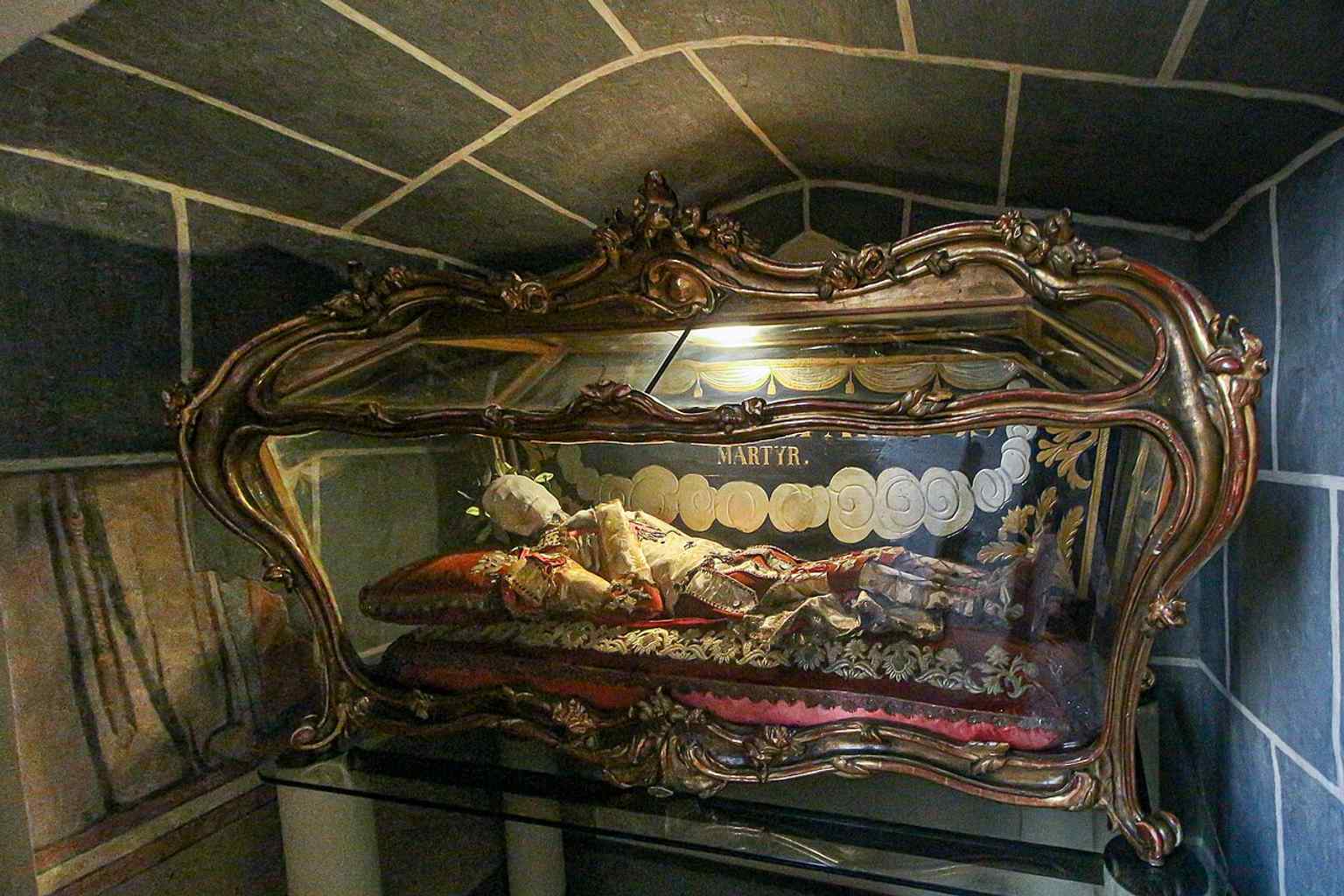
The relic of Saint Reparatus, once kept in the main altar and still highlighting the church’s role as a place of devotion and relic veneration.Photo: VitVit, Wikimedia Commons, CC BY-SA 4.0. Cropped & resized. On your right, look for the pale stone Baroque façade with its gentle inward curve, twin square towers, and a richly carved portal topped with the symbol of the Holy…Read moreShow less
Open dedicated page →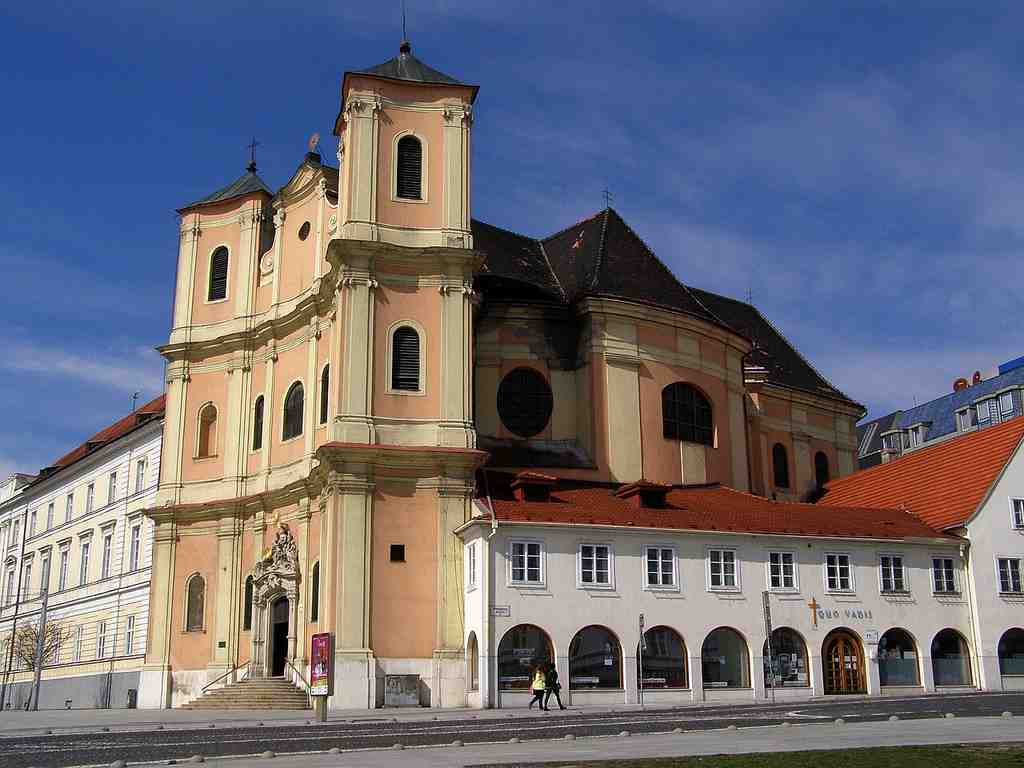
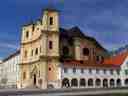
Church of St. John of Matha (Bratislava)Photo: Lure, Wikimedia Commons, CC BY-SA 4.0. Cropped & resized. On your right, look for the pale stone Baroque façade with its gentle inward curve, twin square towers, and a richly carved portal topped with the symbol of the Holy Trinity.
This church tells a very Bratislava story: a vision brought from elsewhere, paid for by powerful patrons, then absorbed so thoroughly that it now feels native to the street. It belonged to the Trinitarians, one of Europe’s oldest religious orders, founded by Saint John of Matha, and their mission was unusually direct and dramatic: they raised money to ransom captives and enslaved people back to freedom.
That helps explain the church’s design. Baroque architecture liked to persuade through space, light, and surprise... and this building does that with a little flourish. From out here, the front wall bends inward, almost like a stage curtain being drawn back. If you glance at the image in your app, you can see that rare concave façade clearly. It was the first church front of its kind in this region. And behind it sits something rarer still in Slovakia: an oval church plan, with the main worship space shaped like an ellipse rather than the usual long rectangle. In plain English, it wraps the congregation around the action.
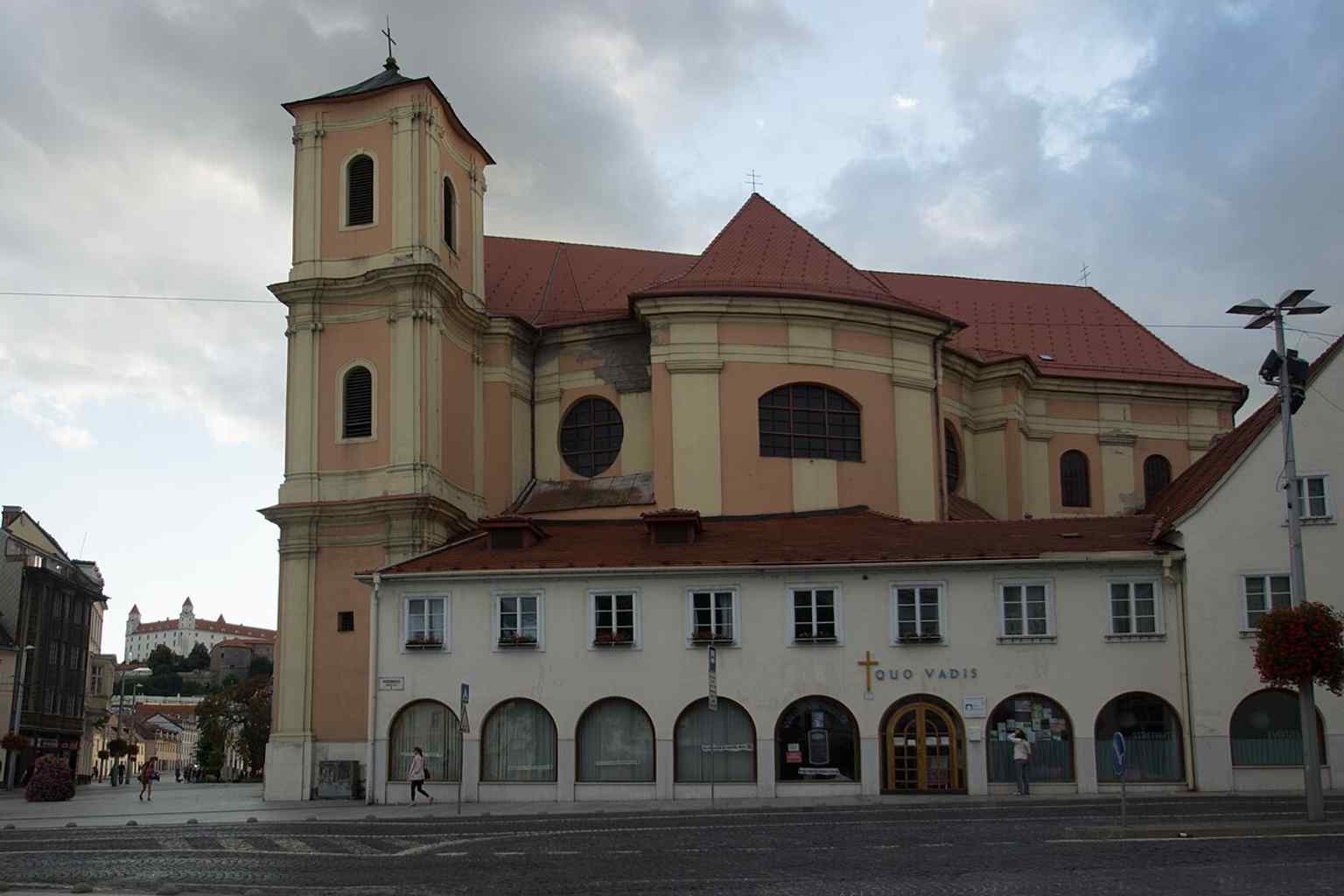
A clear full-front view of the Baroque church on Župné námestie, showing its rare concave façade and twin towers.Photo: Pedro J Pacheco, Wikimedia Commons, CC BY-SA 3.0. Cropped & resized. Now here comes the twist. This splendid church did not rise from an empty patch of ground. The Trinitarians arrived in Pressburg, old Bratislava, in sixteen ninety-seven from Ilava, and their first superior was Father Michael, a monk from Corella in Navarre, in Spain. They lodged in an inn, bought a house, then gradually gathered land with help from noble families and Archbishop Imrich Esterházi. But some of that land came from the old Saint Michael cemetery and the vanished Protestant cemetery nearby, and the foundation stone went down in seventeen seventeen on the site of an even older parish church of Saint Michael, demolished long before, in fifteen twenty-six. So this elegant Baroque statement stands on ground already crowded with memory. That is the city’s trick, and sometimes its ache: one era does not politely wait for the next.
The design likely came from Johann Lucas von Hildebrandt, the great Austrian architect of Italian background, though some historians argue for Franz Jänggl, a Vienna-based builder who also owned a house here in Bratislava and probably supervised the work. Either way, the message is clear: Rome inspires, Vienna translates, Bratislava adopts. You could call it the Habsburg version of international shipping.
Look closely at those towers. They seem a little blunt on top because they lost their original high Baroque roofs and onion domes. After eighteen oh five, the copper from similar towers reportedly got stripped for cannon casting. Even church towers, it turns out, could get drafted into empire.
And if you step inside later, the real magic happens overhead. The painter Antonio Galli da Bibbiena created an illusion of a soaring dome on a nearly flat vault, a grand piece of visual persuasion worthy of a theater set. Sacred devotion here worked hand in hand with patronage, money, and spectacle.
Next, we follow that same patronage from altar to aristocratic residence, where status found another language in ceremony and music at Grassalkovich Palace.
If you want to come back for the interior, the church generally opens daily from around seven until about five thirty, with longer hours on Sunday.
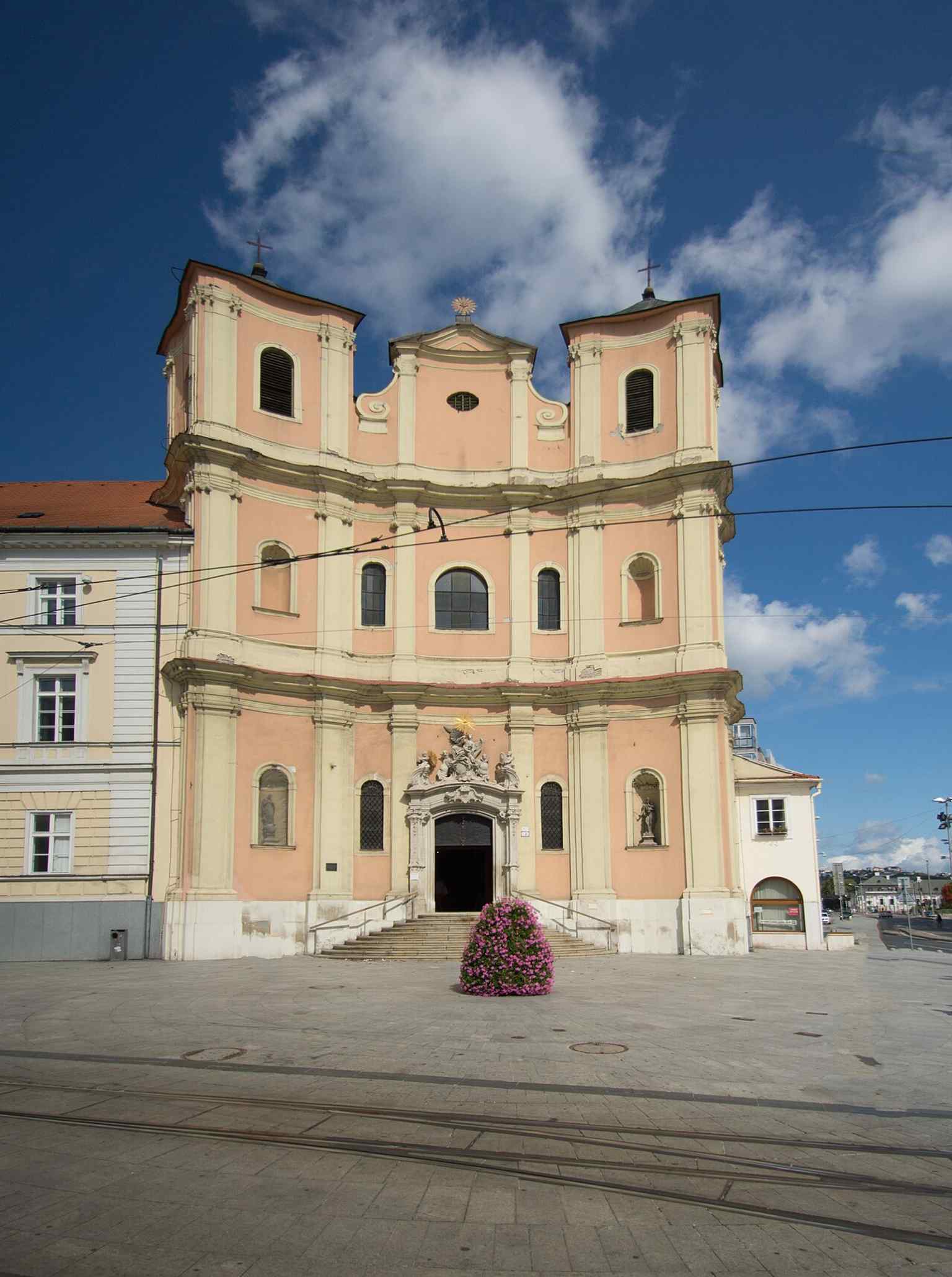
Another strong exterior angle that helps show how the church fits tightly into the old-town streetscape.Photo: Pedro J Pacheco, Wikimedia Commons, CC BY-SA 3.0. Cropped & resized. 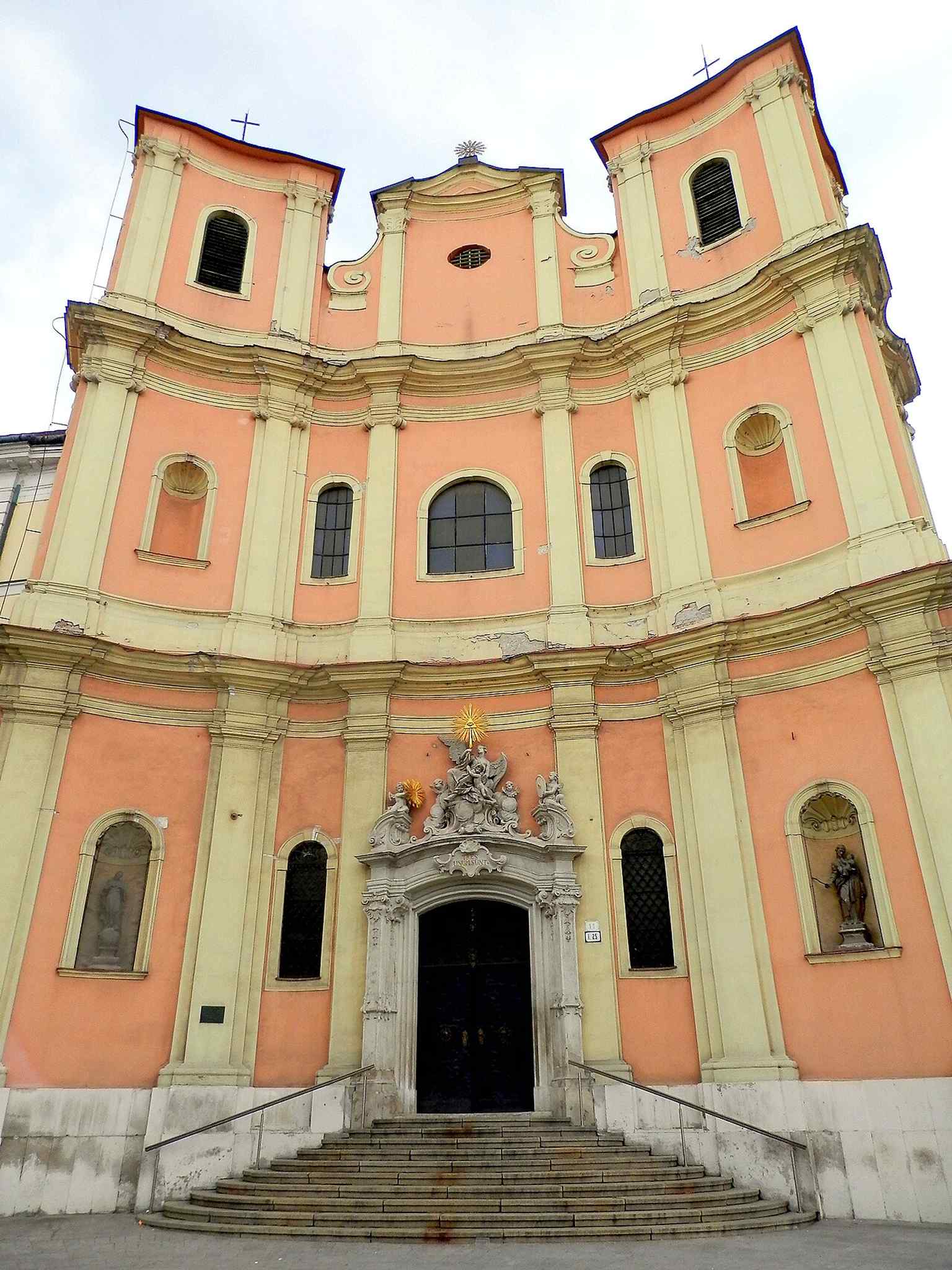
A broader view of the church façade, useful for appreciating its symmetrical front and restrained Baroque decoration.Photo: Ing.Mgr.Jozef Kotulič, Wikimedia Commons, CC BY-SA 4.0. Cropped & resized. 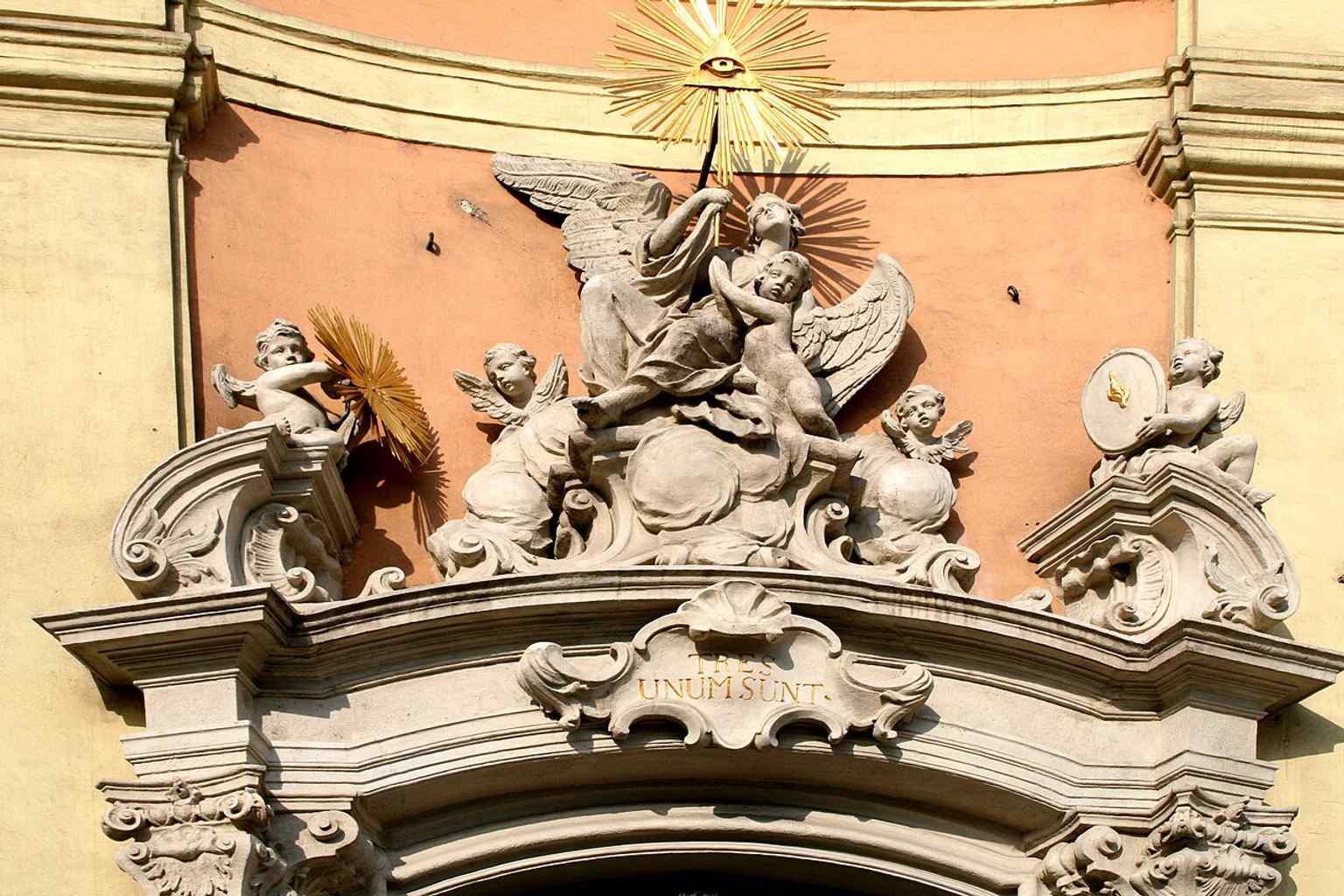
A close look at the sculpted portal relief, echoing the richly carved entrance described in the church history.Photo: ??? (sculptor) - cc-by-3.0 Peter Zelizňák (photo), Wikimedia Commons, Public domain. Cropped & resized. 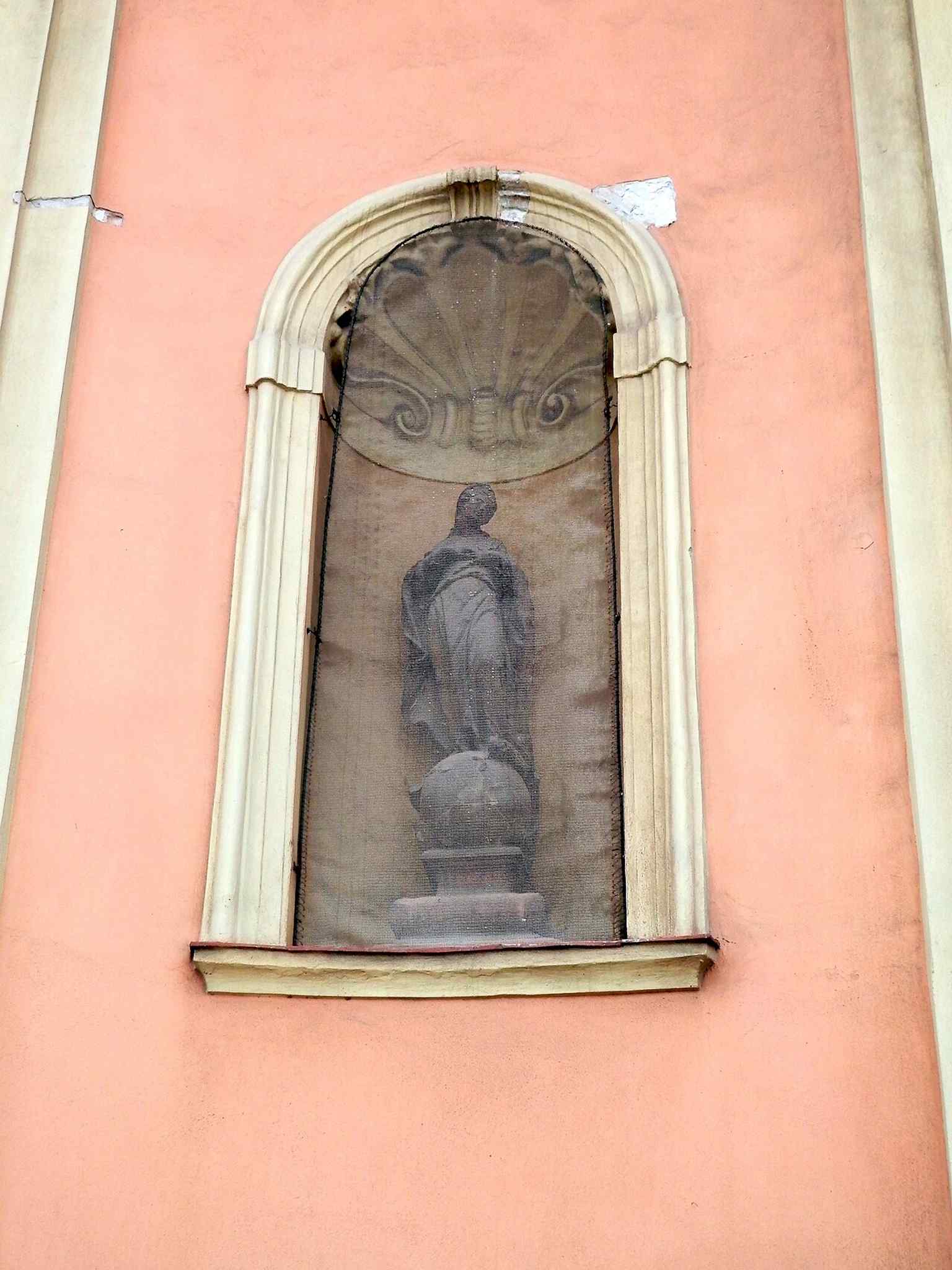
A second façade statue detail, adding variety to the story of the church’s decorative exterior.Photo: Ing.Mgr.Jozef Kotulič, Wikimedia Commons, CC BY-SA 4.0. Cropped & resized. 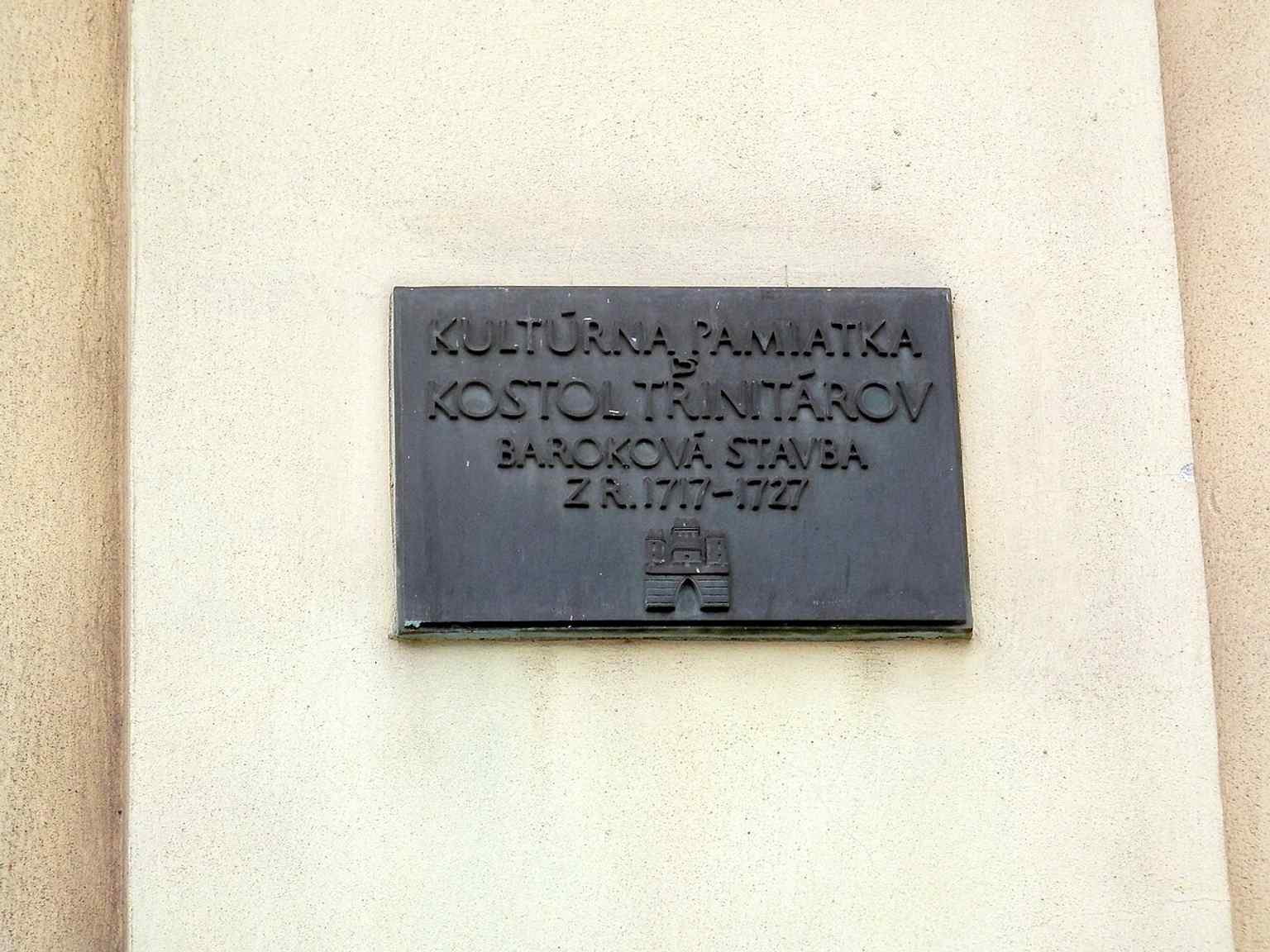
The information board adds context about the monument’s identity and preserves the church’s layered history.Photo: Ing.Mgr.Jozef Kotulič, Wikimedia Commons, CC BY-SA 4.0. Cropped & resized. On your right, look for the pale cream Rococo palace with a rounded central block, two sweeping side wings, and an ornate wrought-iron gate marking the presidential…Read moreShow less
Open dedicated page →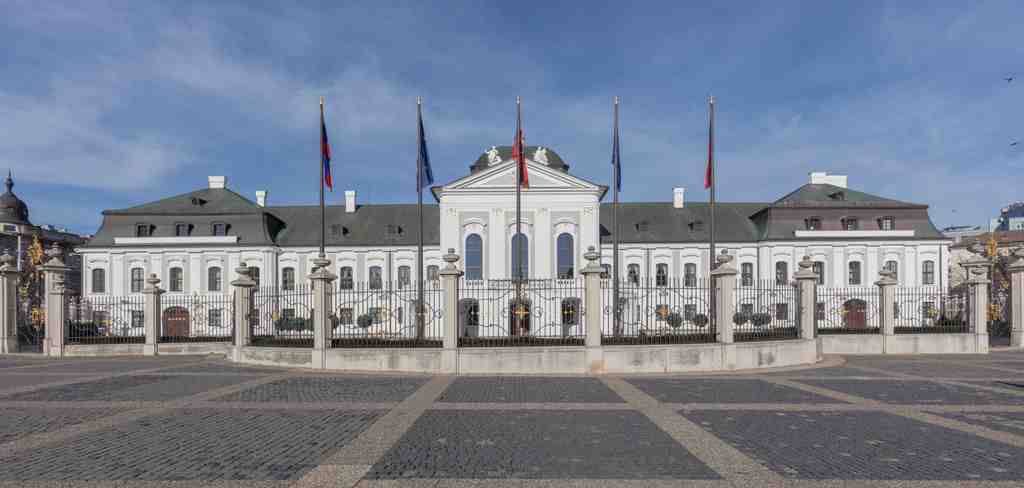
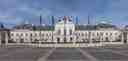
Grassalkovich PalacePhoto: Diego Delso, Wikimedia Commons, CC BY-SA 4.0. Cropped & resized. On your right, look for the pale cream Rococo palace with a rounded central block, two sweeping side wings, and an ornate wrought-iron gate marking the presidential entrance.
Take in that façade for a moment... it behaves like a court host. The center bows forward, the wings stretch outward, and the whole composition says, very politely, “important people this way.” Antal Grassalkovich wanted exactly that effect when he hired architect Andreas Mayerhoffer to finish this summer palace in seventeen sixty. Grassalkovich was no minor noble with expensive hobbies. He served as president of the Royal Hungarian Chamber, something close to a finance minister, and because Pressburg, today’s Bratislava, stood as the capital of the Kingdom of Hungary, he needed a residence that could perform rank as clearly as any title.
This is Rococo, a lighter, more playful late Baroque style, and it worked like elegant stage design. Here, politics dressed itself in stucco, symmetry, and ceremony. Courtly music and Enlightenment prestige met under this roof too: the palace became one of Pressburg’s great musical addresses, where art and power boosted each other like old friends with excellent tailoring. Joseph Haydn conducted here, and tradition ties him to a concert in the room now used for receptions. Grassalkovich kept his own orchestra, and Prince Esterházy even “loaned” Haydn across aristocratic lines. Not a bad borrowed employee.
Maria Theresa herself stayed here in seventeen seventy-five, and that matters because this was not just a rich man’s house. It was part salon, part political theater, part royal extension. Balls unfolded here, marriages were celebrated here, and the Great Hall still preserves so much of its eighteenth-century look that the room is presented as something the empress would recognize. If you glance at the image of the Green Salon on your screen, you’ll get a feel for how these interiors still turn conversation into ceremony.
Now here’s the sharper edge of the story. If you heard a brand-new Haydn piece in a room like this, would it feel like culture shared... or like a velvet rope set to music?
Because this palace did not glide untouched from powdered wigs to modern diplomacy. After the old empire faded, the building stood empty, then served the military. During the nineteen thirty-nine to nineteen forty-five period, architect Emil Belluš adapted it for Jozef Tiso, the president of the First Slovak Republic. Later the Communist state repurposed it again, and in nineteen fifty it became the Klement Gottwald House of Pioneers and Youth, nicknamed “Pinkáč.” Children came here for drama, ballet, ballroom dance, music, modeling, folk groups... and in the process they caused heavy damage to the palace. That’s the twist, isn’t it? A house built for elite display became a children’s activity center, then nearly a ruin through overuse rather than neglect.
You can check the before-and-after image in the app to see how that aristocratic residence turned into the guarded forecourt of a modern presidency.
After the Velvet Revolution, restoration finally began in earnest, overseen by Slovakia’s first First Lady, Emília Kováčová. On the thirtieth of September, nineteen ninety-six, President Michal Kováč received the keys here, and the palace began its latest act. Inside, even the small rituals matter: an antique Vienna clock from around seventeen eighty still gets wound by hand each day. Power likes its symbols... and this city rarely throws old ones away when it can teach them a new script.
Behind the palace, the former gardens now serve the public again as a park, another reminder that spaces of privilege in Bratislava keep slipping, slowly, into civic life. And if Reduta brought music into a more public hall, this palace reminds you where some of that cultural prestige first learned to wear formal clothes.
From here, we leave the polished salon and head back toward the city’s old skin. In about seven minutes, Michael’s Gate will show us how entry, status, and ceremony once narrowed into a single controlled passage.
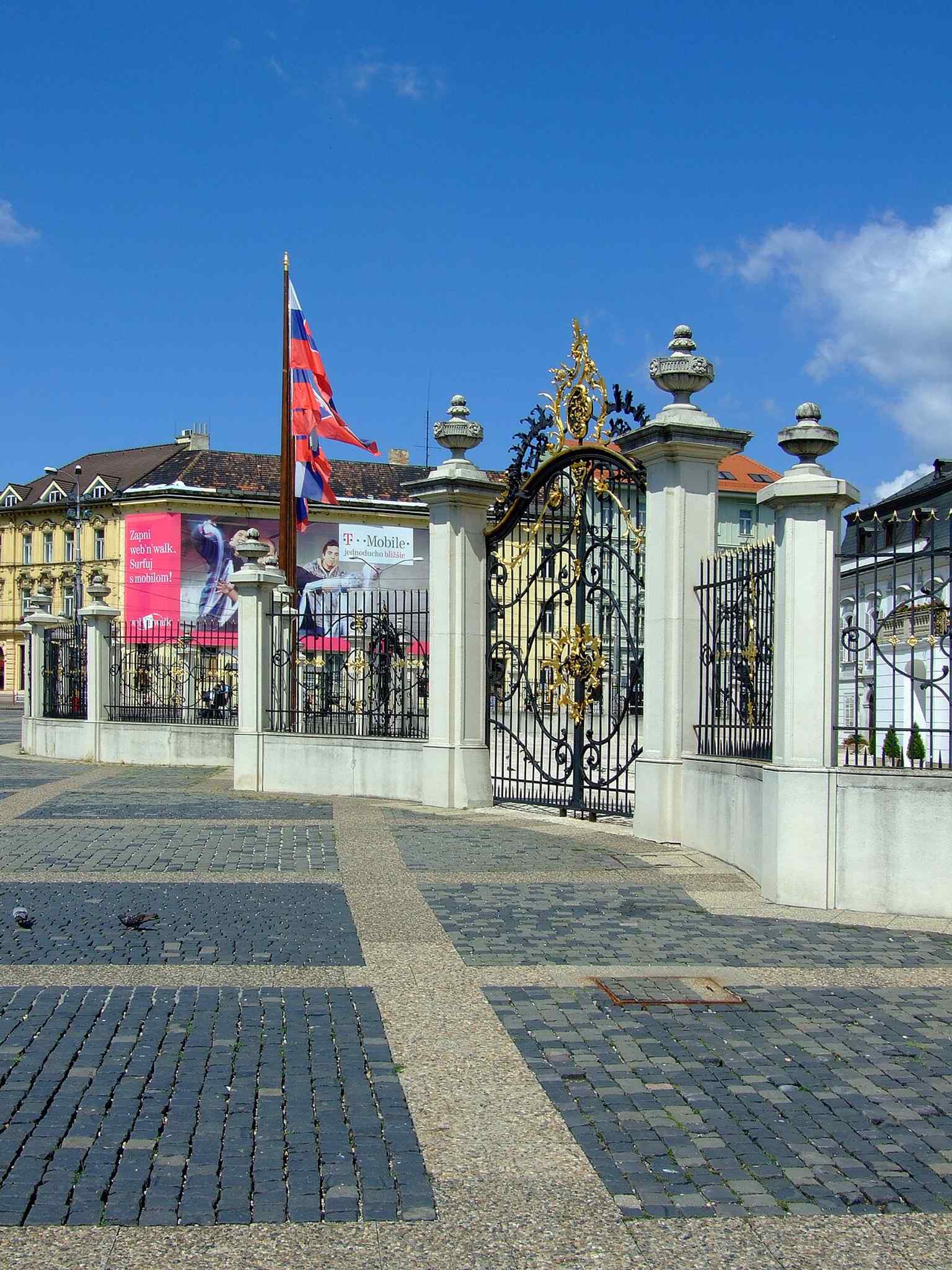
One of the main palace gates — a fitting detail for the residence that once hosted Habsburg court balls and now welcomes state visitors.Photo: I would appreciate being notified if you use my work outside Wikimedia. More of my work can be found in my personal gallery., Wikimedia Commons, CC BY-SA 3.0. Cropped & resized. Ahead of you rises a pale stone tower with a tall arched passage, a rounded green copper roof, and the figure of Saint Michael standing on top with his dragon. Michael's Gate is…Read moreShow less
Open dedicated page →Ahead of you rises a pale stone tower with a tall arched passage, a rounded green copper roof, and the figure of Saint Michael standing on top with his dragon.
Michael's Gate is the last witness of Bratislava's walled city. Nearly everything that once worked with it - the rings of walls, the moat, the defensive outworks - has disappeared, so this one survivor carries the memory of a whole lost system on its shoulders.
The first gate here dates to the late thirteenth century, and a written record mentions it in fourteen eleven. Back then, entering town was no casual stroll. Travelers approached the north side of the city, crossed a drawbridge over a moat, passed a barbican - that is, an outer defensive gatehouse - and then faced a portcullis, the heavy iron grille that could drop straight down, plus a stout wooden door for good measure. Medieval Bratislava believed in clear boundaries. Very clear.
If you check the image in the app, you can see how this gate once belonged to a much larger defensive puzzle, not a lonely monument standing by itself.
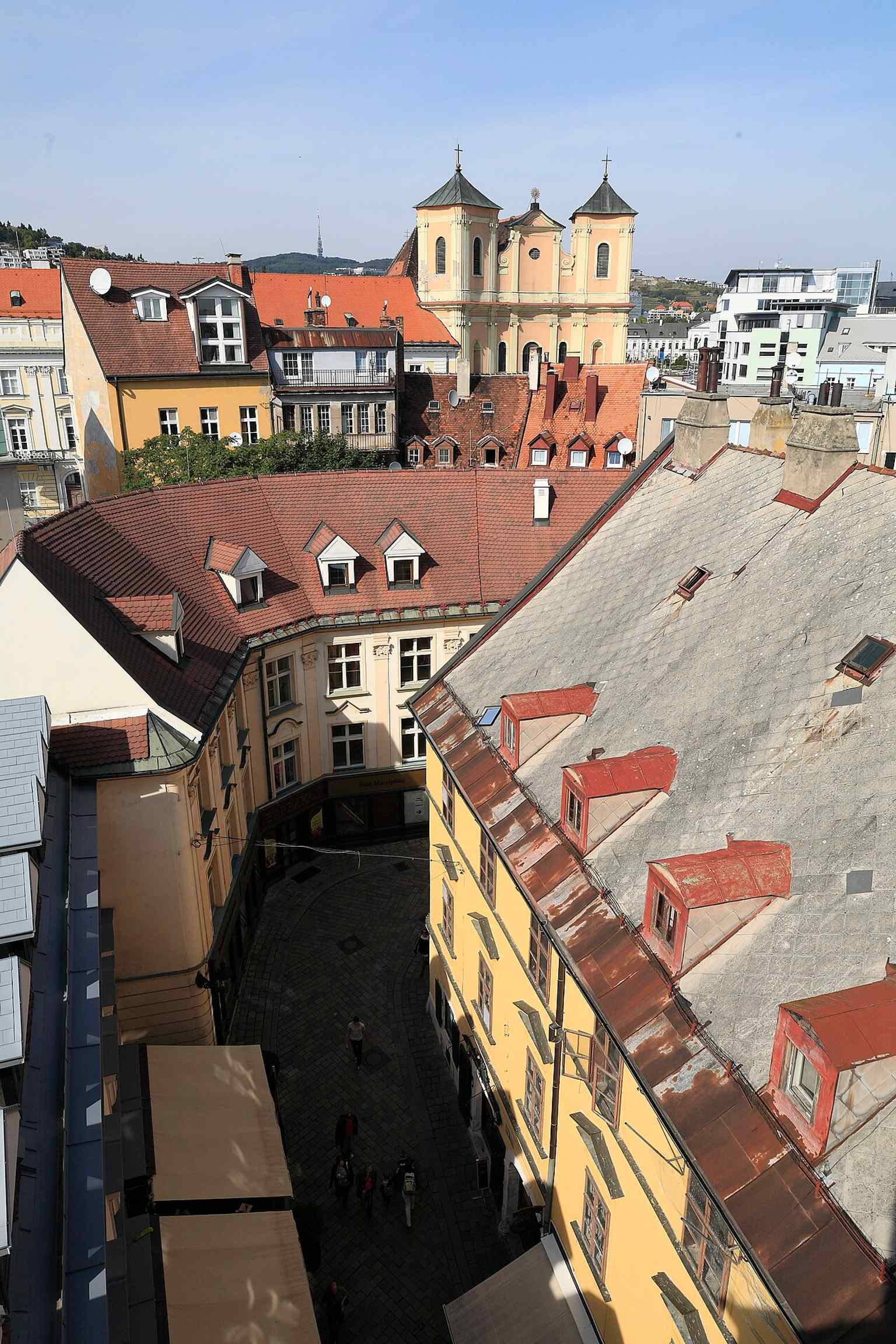
View toward the barbican and gate area, linking Michael’s Gate to the larger defensive complex that once protected the old town.Photo: Falk2, Wikimedia Commons, CC BY-SA 4.0. Cropped & resized. What you see now mostly comes from change, not purity. Builders first raised the gate around the year thirteen hundred, but they kept reworking it. The tower suffered major damage in the sixteenth century, and between seventeen fifty-three and seventeen fifty-eight city leaders rebuilt it into the Baroque form you see now. That was when they placed Saint Michael on top, turning a fortress into something a little more theatrical, a little more civic. Bratislava does that well: it keeps the bones and changes the outfit.
And this gate mattered in ceremony, not just security. During the coronations of nineteen Hungarian kings, from fifteen sixty-three to eighteen thirty, the new ruler processed through the city after the crowning at Saint Martin's Cathedral. Here at Michael's Gate, the ritual sharpened. The procession moved out through the gate, crossed the stone bridge over the moat, and stopped outside the walls, where the king swore his oath into the archbishop's hands. So this arch was not just an entrance. It was a threshold between power claimed inside the city and power promised in public.
Look up to the statue. Its recent restoration tells another fine Bratislava story. Architectural historian Patrik Baxa examined Saint Michael and found traces of gold, which suggested the sculpture had originally gleamed all over. During the restoration from two thousand twenty-one to two thousand twenty-three, conservators followed his clue and regilded the figure with twenty-eight grams of twenty-three point five carat gold. They also repaired the whole tower, reversed some nineteen-fifties efforts to make it look more severely medieval, and even recast one bell that World War Two gunfire had damaged. Old gates, like old cities, are never just one age.
If you open the app image of the museum interior, you'll see that the tower now tells its own story layer by layer, rather than simply showing off weapons.
Before you head on, lift your eyes to the archangel, then to the dark opening below, and picture this as a checkpoint instead of a postcard... who got welcomed through, and who heard the gate shut behind them?
When you're ready, continue into the streets beyond toward Pálffy Palace, where noble houses take over from city walls.
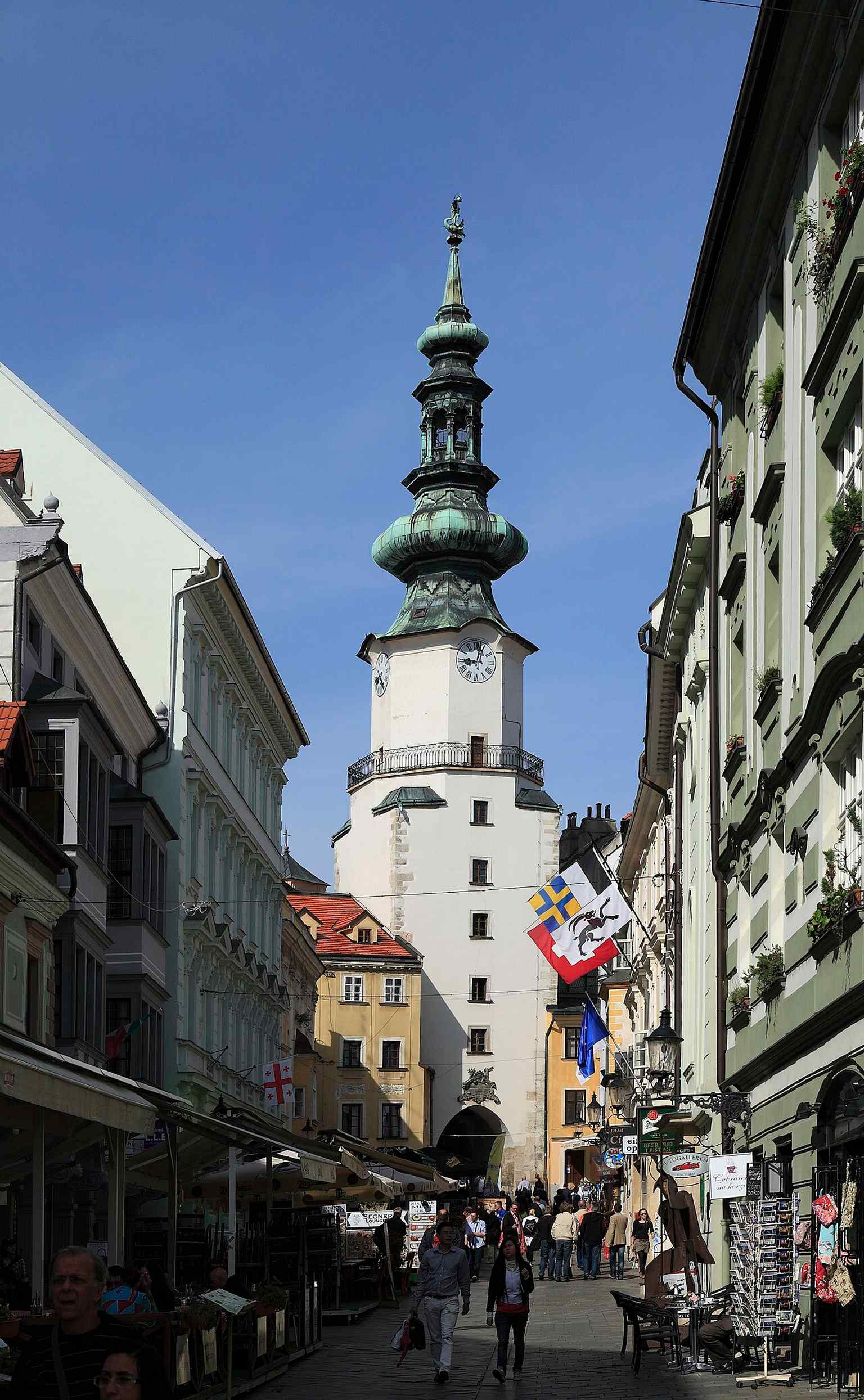
The Michael’s Gate tower rises above Michalská Street, showing the only surviving city gate from Bratislava’s medieval fortifications.Photo: Falk2, Wikimedia Commons, CC BY-SA 4.0. Cropped & resized. 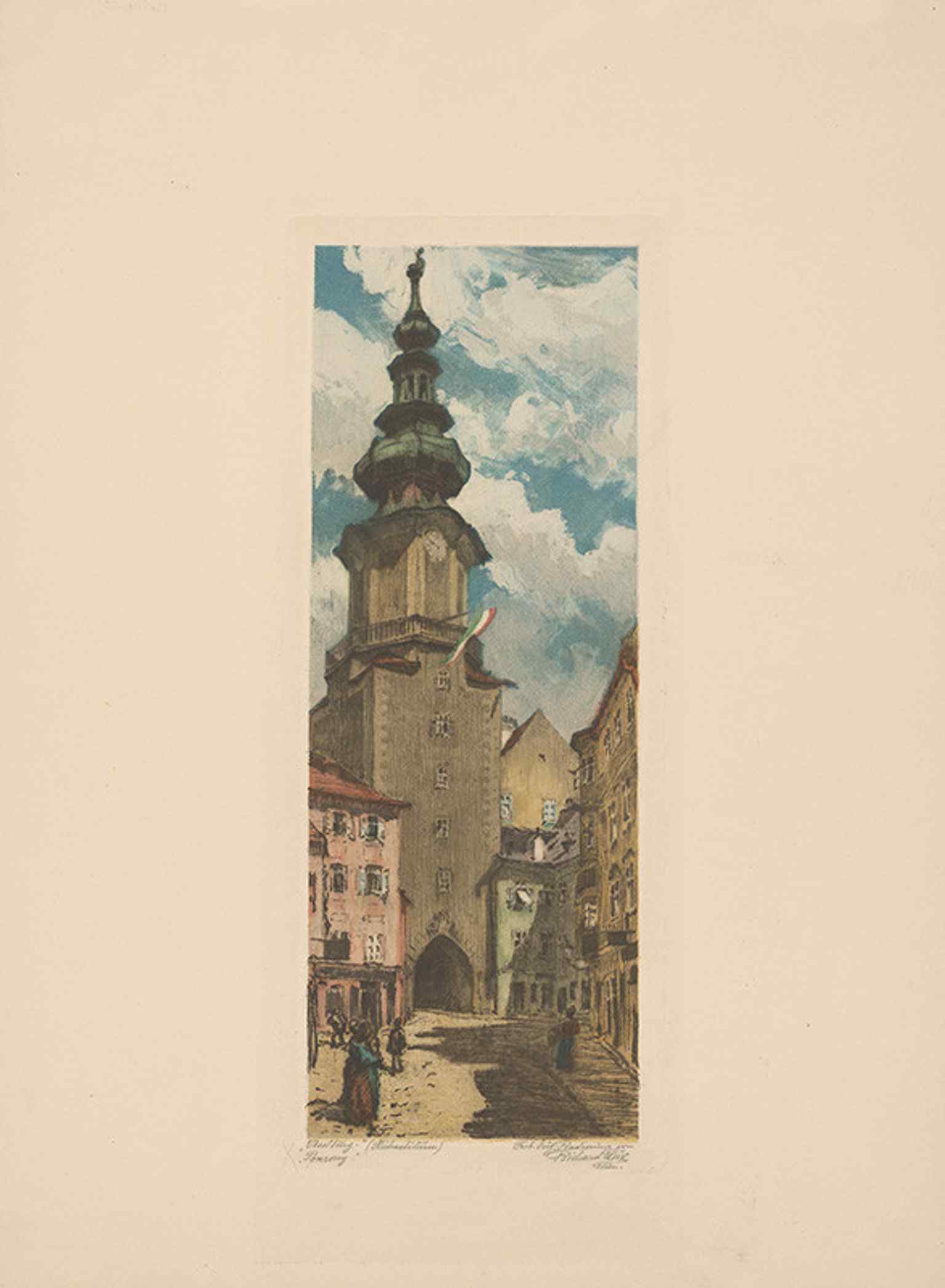
A historical view of Michalská Tower, capturing how Michael’s Gate has long been a recognizable symbol of Bratislava.Photo: Richard Lux, Wikimedia Commons, CC BY 4.0. Cropped & resized. On your right, look for a pale stone Baroque façade with tall rectangular windows and an ornate portal carved with military reliefs. Count Leopold Pálffy commissioned this palace…Read moreShow less
Open dedicated page →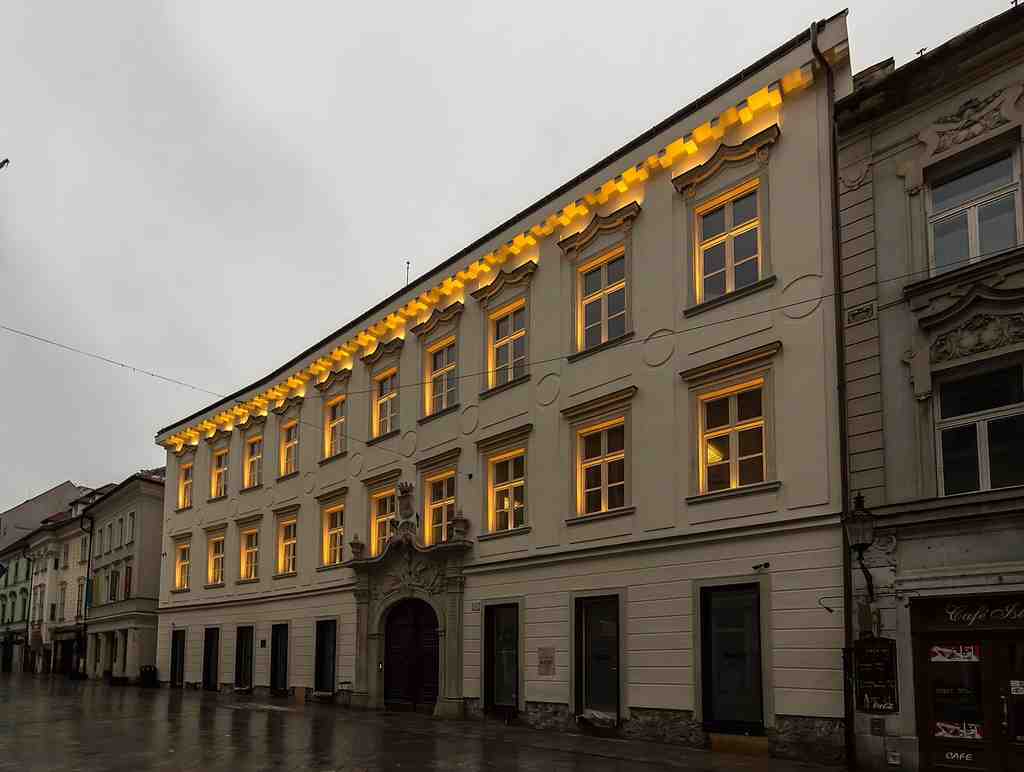
Pálffy Palace (Ventúrska Street)Photo: Matti Blume, Wikimedia Commons, CC BY-SA 4.0. Cropped & resized. On your right, look for a pale stone Baroque façade with tall rectangular windows and an ornate portal carved with military reliefs.
Count Leopold Pálffy commissioned this palace in seventeen forty-seven, and he made sure the doorway advertised exactly who he was: a general serving Empress Maria Theresa. But here is the local secret... this noble house is really several older cities wearing one elegant coat.
During restoration, researchers found Gothic walls tucked inside the later palace, and in the basement they uncovered Roman and Celtic remains. They also found hard proof that this site once held a mint: dozens of melting pots and silver-dosing plates, the working tools of coin production in the old oppidum, a fortified Celtic town. So yes, underneath the aristocratic polish, this address once rang with industry.
In the nineteenth century, Ján Pálffy Senior turned the place into a grand display case for himself, filling it with historical furniture, silver, and paintings by Italian and Dutch masters. Some locals still like to claim that six-year-old Mozart played here in seventeen sixty-two. Historians are not fully sold, but Bratislava does enjoy a good guest list.
Then came the rough years. In eighteen seventy, the city paid one hundred and fifty thousand guldens, roughly a large sum by modern standards, and turned it into artillery barracks. After that came warehouse use, an orphanage, a student dormitory, and even storage for road grit. If you check the image in the app, you can enjoy the happy ending written on the façade itself.
Now lift your eyes toward the hill... the castle is next, about a sixteen-minute walk away.
On your left rises a white rectangular palace of stone and plaster, framed by four corner towers and marked by the taller Crown Tower that gives the whole hill its unmistakable…Read moreShow less
Open dedicated page →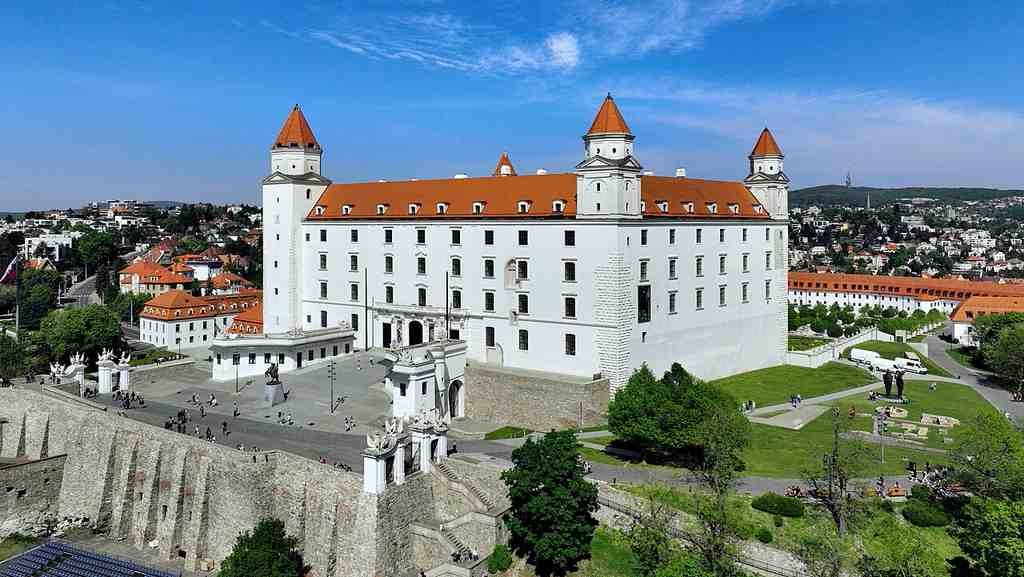
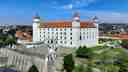
Bratislava CastlePhoto: C.Stadler/Bwag, Wikimedia Commons, CC BY-SA 4.0. Cropped & resized. On your left rises a white rectangular palace of stone and plaster, framed by four corner towers and marked by the taller Crown Tower that gives the whole hill its unmistakable profile.
From this courtyard, facing the main facade, you’re looking at the grand scrapbook of Bratislava... only this scrapbook happens to sit on a strategic hill above the Danube. A place like this never stays unemployed for long. People have fought over it, renamed it, rebuilt it, burned it, and then, like stubborn locals everywhere, rebuilt it again.
Even the city’s identity gathers here. In the early records, this hill appears as Brezalauspurch in the year nine hundred seven. Later came forms like Bresburg, then Pressburg in German, Pozsony in Hungarian, and only in the nineteenth century did the name Bratislava take hold, thanks to the Slovak national revival. Same hill, same commanding perch... different powers trying on different names.
And beneath this elegant shell are older lives stacked like hidden floors. Archaeologists found traces of settlement from roughly four thousand five hundred years ago, then a Celtic stronghold with Biatec coins, then Roman material reused in later walls, including bricks stamped by the Fourteenth Legion. By the ninth century, this was a Great Moravian fortified center with a palace and a three-aisled basilica - that means a church with a tall central hall and two side aisles. So yes, when Bratislava says it has layers, it is not kidding around.
If you glance at the image on your screen, you’ll see one of the castle’s earliest dramatic memories: the siege of ten fifty-two. Emperor Henry the Third tried for two months to force the place, and later illustrations show defenders striking at his ships on the Danube. Whether drawn with a little artistic swagger or not, the message is clear: this hill was hard to crack.
Then came kings with bigger plans. Sigismund of Luxembourg pushed a major rebuilding after fourteen twenty-three, shaping the castle into a regular four-sided residence-fortress. After the disaster of Mohács in fifteen twenty-six, power shifted here in earnest. Bratislava became the main and coronation city of the Kingdom of Hungary for nearly three centuries, and this castle became the chief royal castle. Crown jewels rested in the Crown Tower from the early seventeenth century. Maria Theresa later softened the fortress into a baroque residence fit for ceremony, gardens, and court life - the formal polish to match the political muscle.
But glory can be a fair-weather friend. Joseph the Second moved institutions away. The palace became a seminary, then barracks. Napoleon’s wars damaged it, and in eighteen eleven careless soldiers started a fire that gutted the complex. Take a look at the ruined shell in the old photograph on your phone. For generations, that wreck still defined the skyline.
One man I always remember here is Alfréd Piffl, the architect and researcher who, in the nineteen fifties, proved these walls could be saved. He helped rescue the castle from becoming just a romantic ruin. The cruel twist: the communist regime later imprisoned him. So even the modern restoration carries its own scar.
That’s why this place matters so much. It is not one castle from one age. It is a pileup of names, loyalties, crowns, arguments, and second chances.
And in about ten minutes, St. Martin’s Cathedral will bring the final piece into focus. Up here, rulers stored the crown and staged power. Down there, at the cathedral, ritual turned that power into something official.
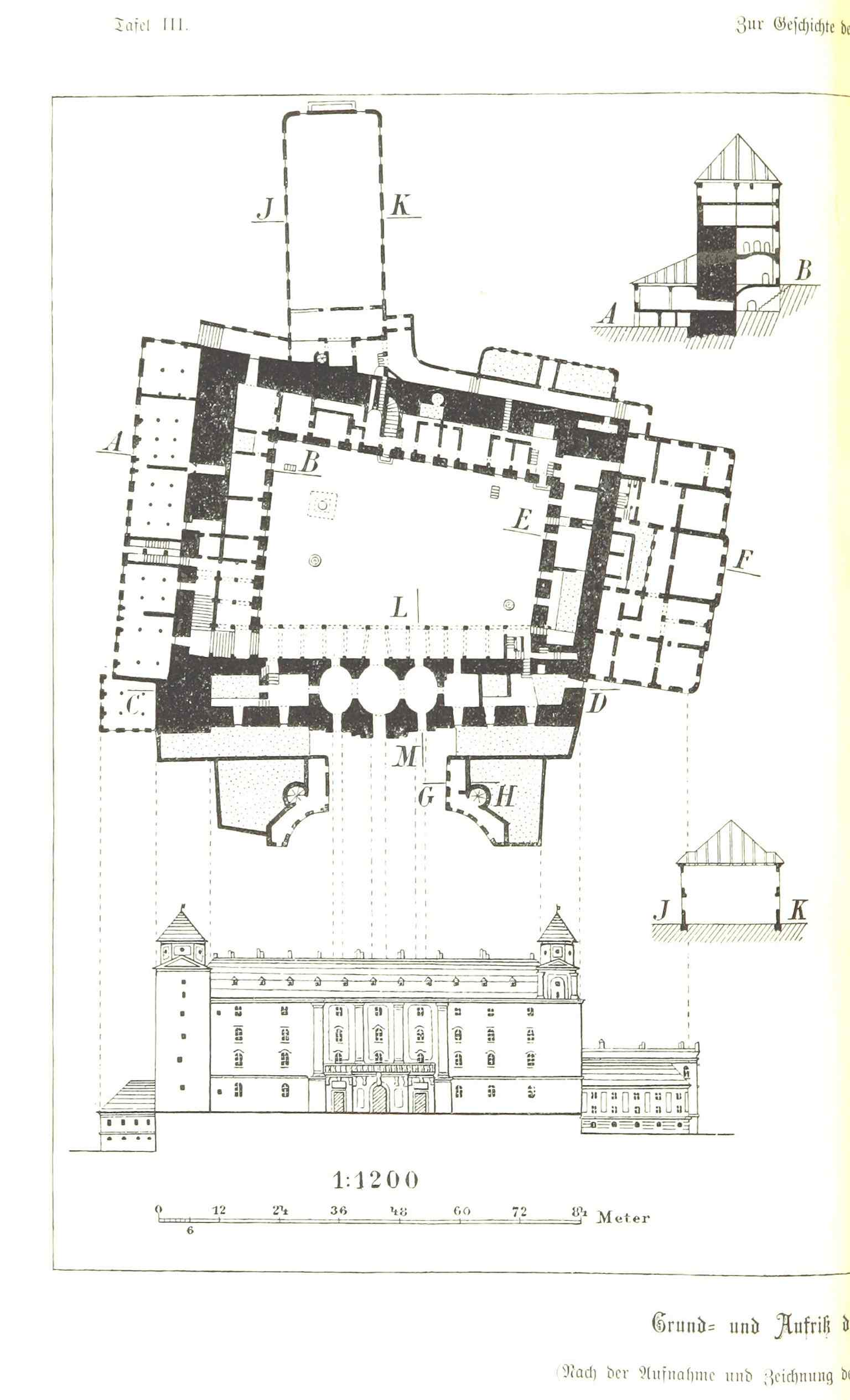
A 19th-century map of Pressburg that places the castle in its city context, showing how the fortress dominated the old town above the Danube.Photo: The British Library, Wikimedia Commons, No restrictions. Cropped & resized. 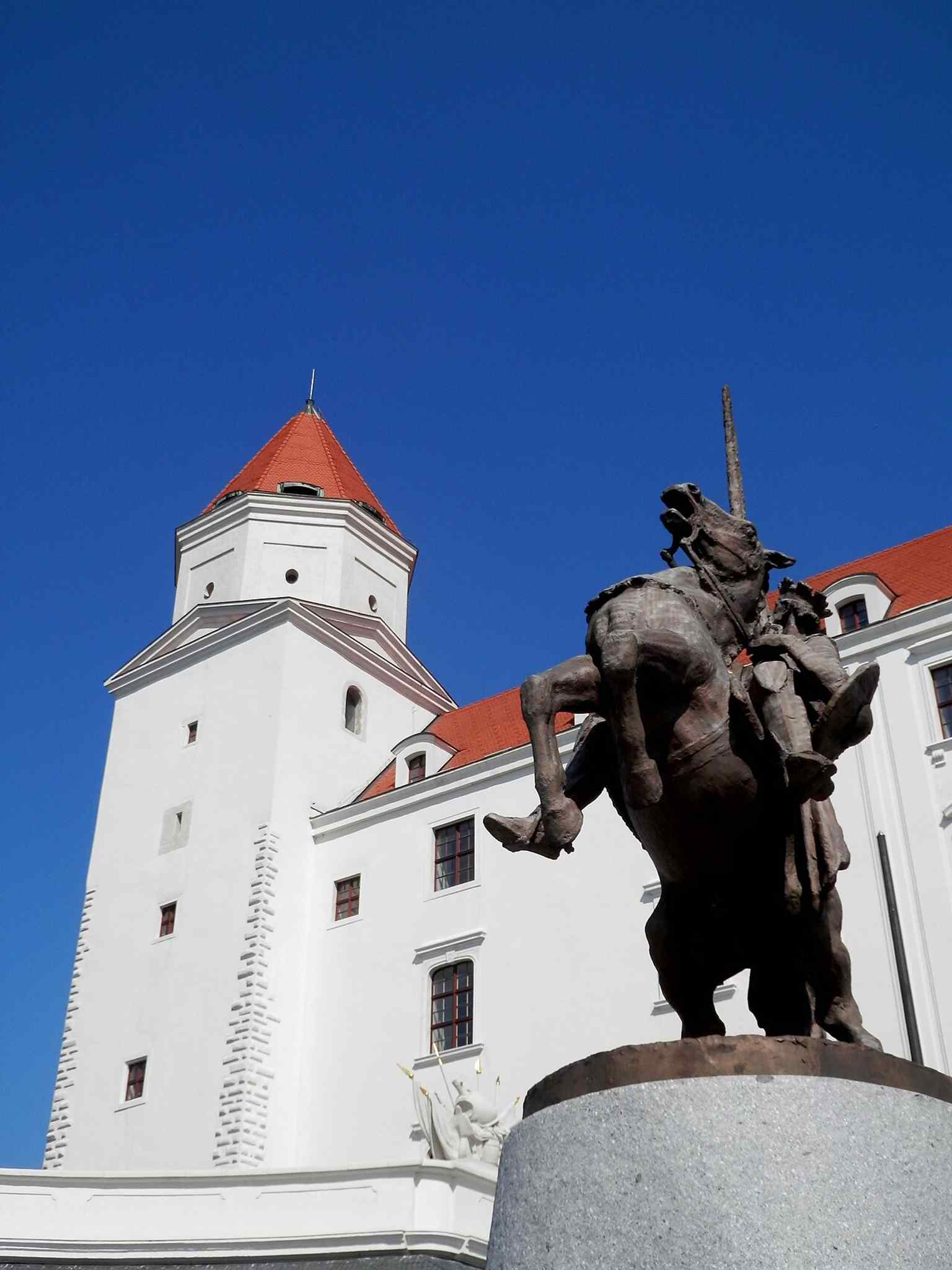
The statue of Svatopluk I on the castle grounds, linking the hilltop site to the Great Moravian roots of Bratislava Castle.Photo: Jozef Kotulič, Wikimedia Commons, CC BY-SA 3.0. Cropped & resized. 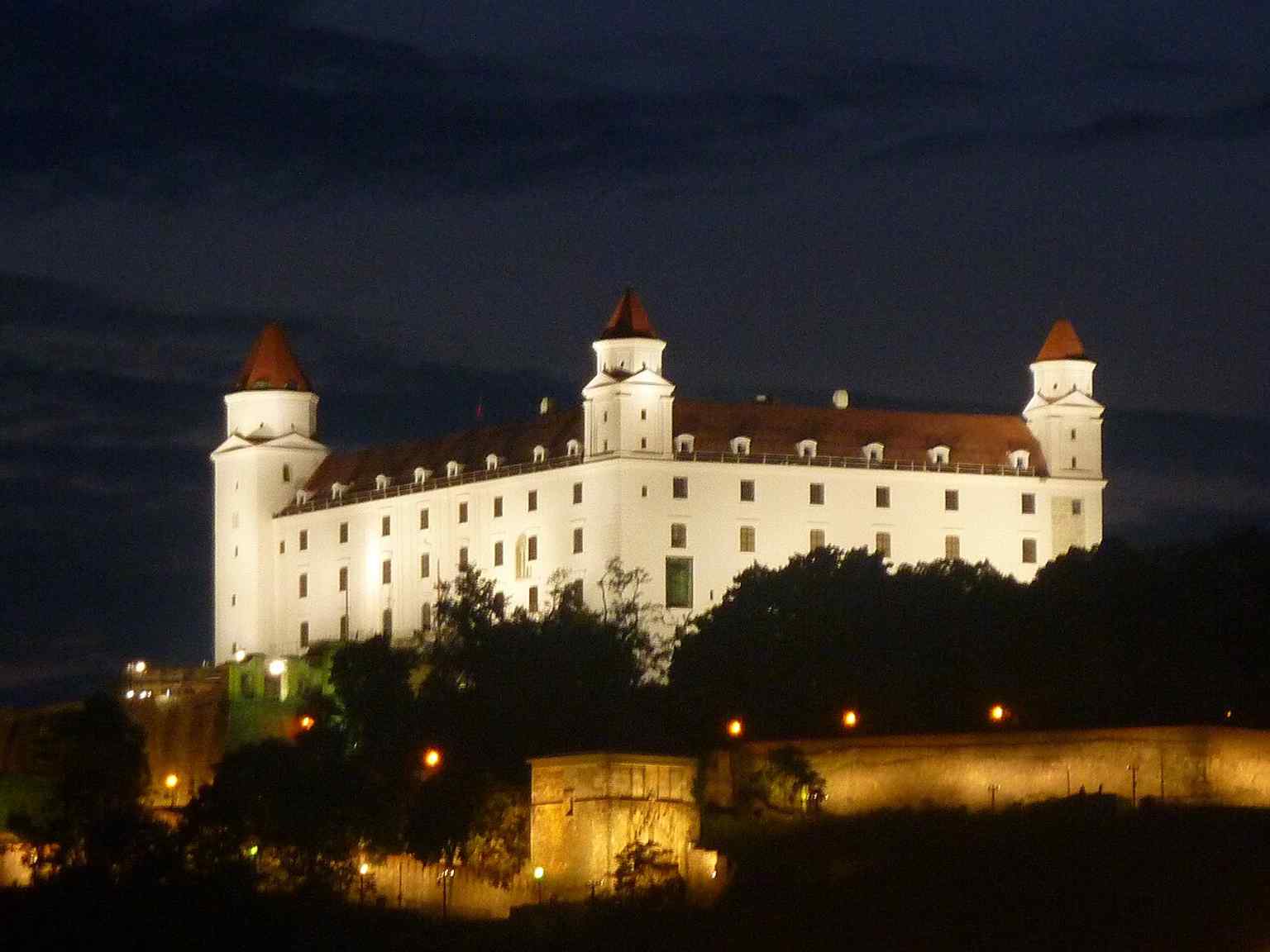
Bratislava Castle by night, a striking panorama of the landmark that still defines the skyline above the Danube.Photo: Digital nick, Wikimedia Commons, Public domain. Cropped & resized. 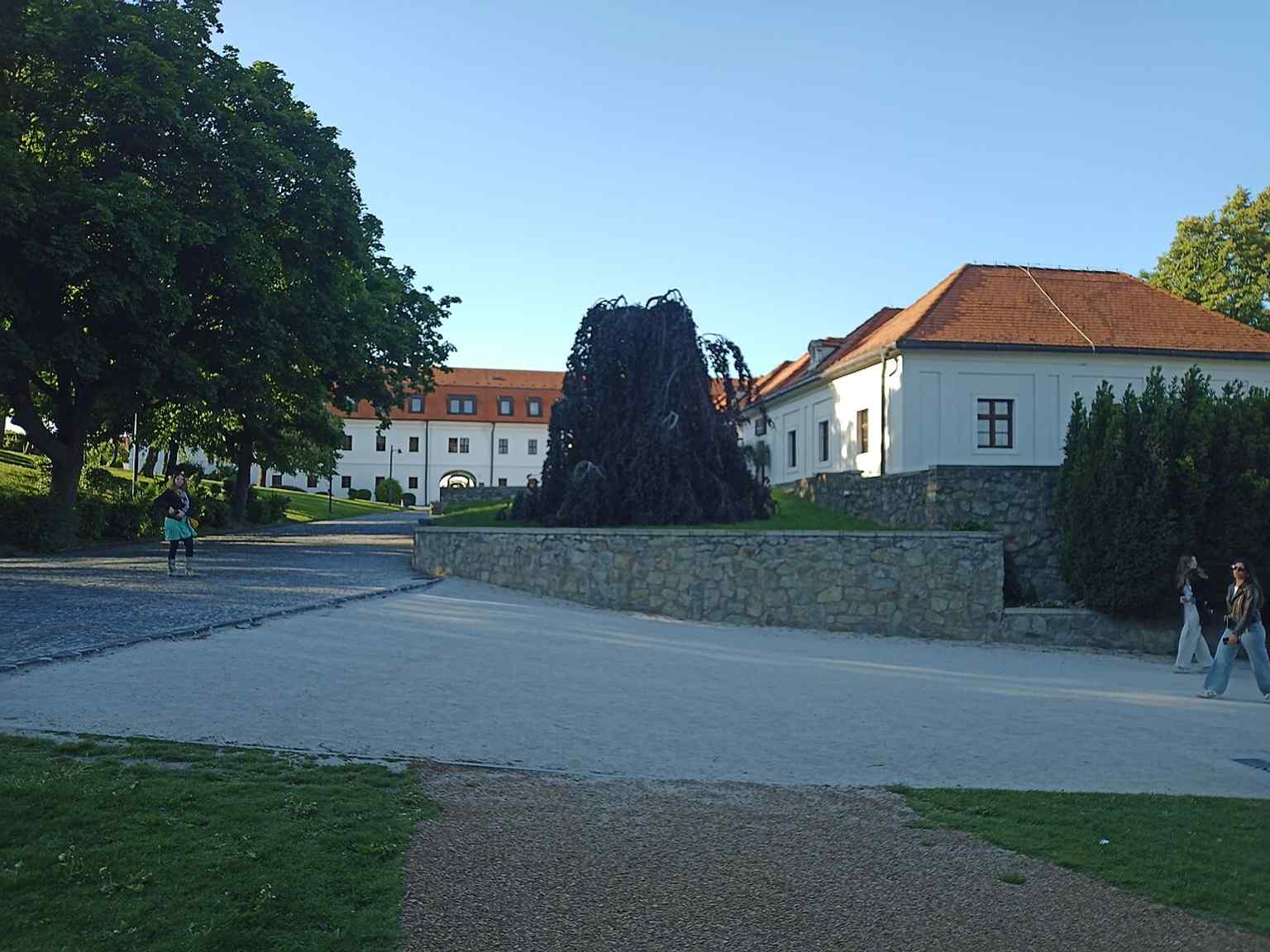
The castle park and grounds in a recent view, highlighting how the historic site is now also a public viewpoint and promenade.Photo: Aktron, Wikimedia Commons, CC BY-SA 4.0. Cropped & resized. On your left, St. Martin’s Cathedral is a long pale-stone Gothic church with a steep roof and a tall square tower topped by a curved copper cap and a gleaming golden crown. Here…Read moreShow less
Open dedicated page →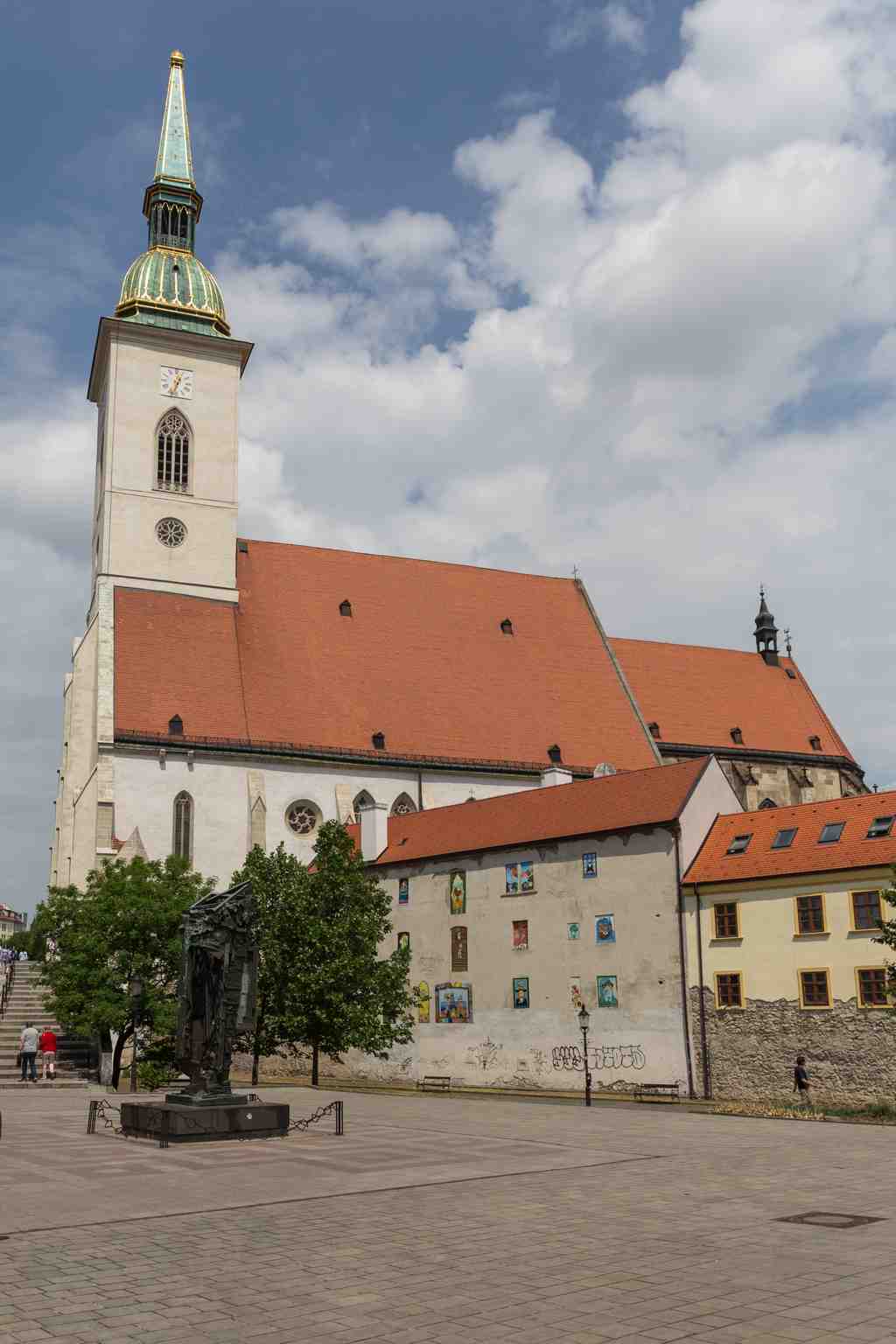
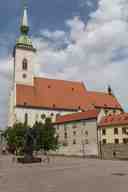
St. Martin's Cathedral (Bratislava)Photo: Pymouss, Wikimedia Commons, CC BY-SA 4.0. Cropped & resized. On your left, St. Martin’s Cathedral is a long pale-stone Gothic church with a steep roof and a tall square tower topped by a curved copper cap and a gleaming golden crown.
Here it is... the ceremonial heart of old Pressburg, today’s Bratislava. If the castle held power, this church gave that power its public blessing. Kings did not just rule from papers and armies; here, in front of clergy, nobles, and the city itself, they received a crown and became something larger than a person.
This ground had a long memory even before the cathedral rose. People lived here as far back as prehistoric times. Later came a small round church, then a Romanesque stone church, and from the early fourteen hundreds a much bigger Gothic rebuild. The builders pulled off a neat medieval trick: they raised the new church around the old one so worship could continue while construction went on. No wasted Sundays.
The city changed, and the church changed with it. As Bratislava expanded eastward, this church found itself at the edge of town, folded right into the defensive walls. Its western end joined the city ramparts, and the tower served as a bastion, a defensive strongpoint. So even the house of prayer had to keep one eye on the gate.
Its greatest role began in fifteen sixty-three. That is when the coronation age opened here, in the reign of Maximilian the Second, the same ruler you met back at Maximilian’s Fountain. From fifteen sixty-three to eighteen thirty, this cathedral hosted nineteen coronations: eleven rulers and eight royal consorts. Maria Theresa took the Hungarian crown here too, and with every ceremony Bratislava’s standing rose. The city was no longer just a border town with good walls. It became the stage where a kingdom announced itself.
Look up at that tower. The golden crown at the top is not a cute ornament. In seventeen sixty-five, builders placed a gilded model of the Hungarian royal crown there as a permanent reminder of this church’s coronation role. Think of it as the city’s own exclamation point in metal. If you glance at the image on your screen, you can see how that tower still commands the old town skyline.
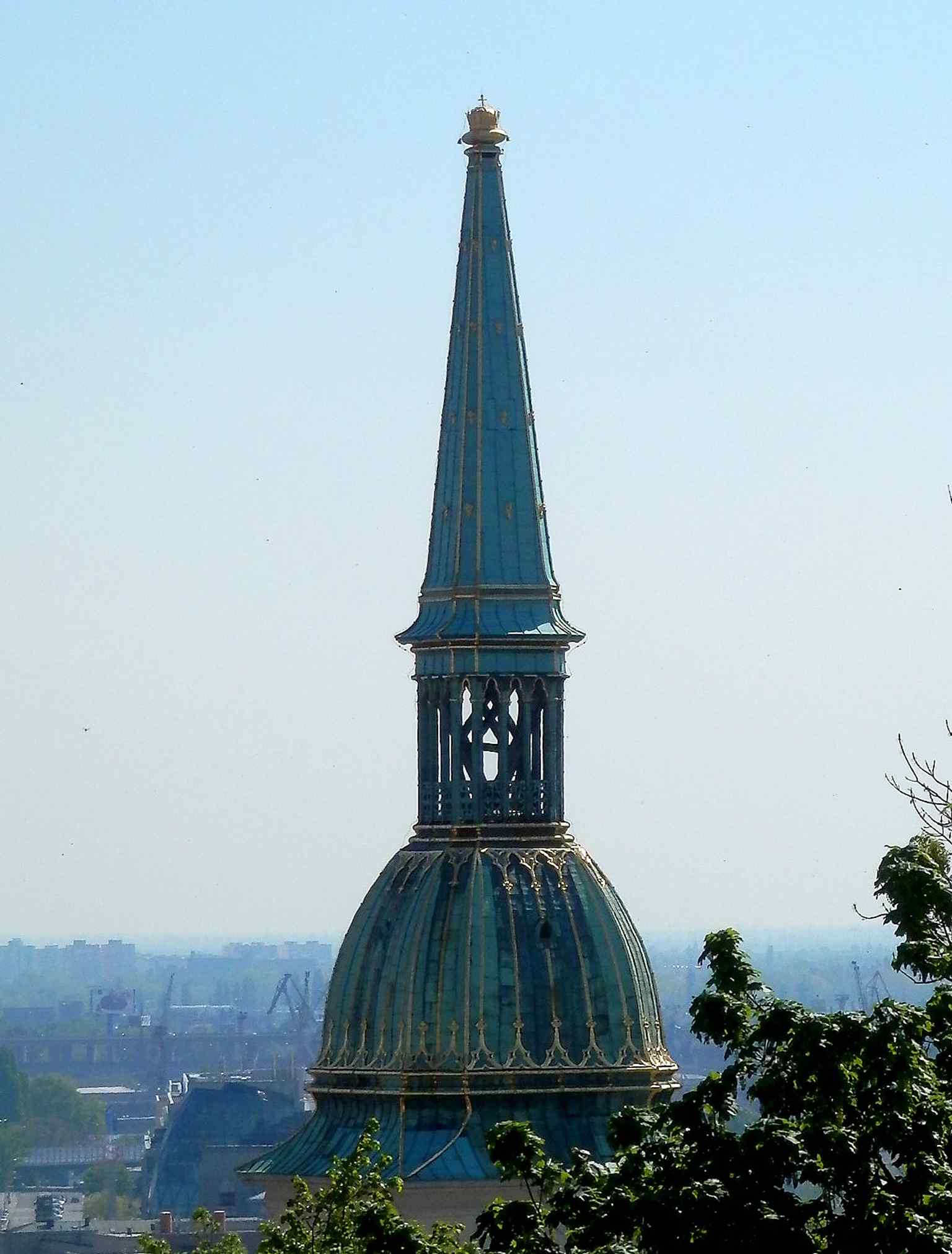
Seen from the castle side, the tower rises above the old town just as it has for centuries over Bratislava’s historic core.Photo: Jozef Kotulič, Wikimedia Commons, CC BY-SA 3.0. Cropped & resized. One person who stays with me here is Ferdinand the Fifth, the last monarch crowned in this cathedral, in eighteen thirty. Just a few years later, lightning struck the tower and fire damaged it. Ferdinand then sent copper for the new roof. That tells you something: even after the ceremony ended, this place still tugged at the people who had stood at its center.
And yet, for all this grandeur, the cathedral could not hold the city still. In the nineteenth century, restorers stripped away much of its Baroque interior to recover a more Gothic look. One age crowned kings here; another edited the scenery. That old argument between memory and reinvention is not over yet... and at the S-N-P Bridge, eight minutes from here, you’ll see it in a very different key.
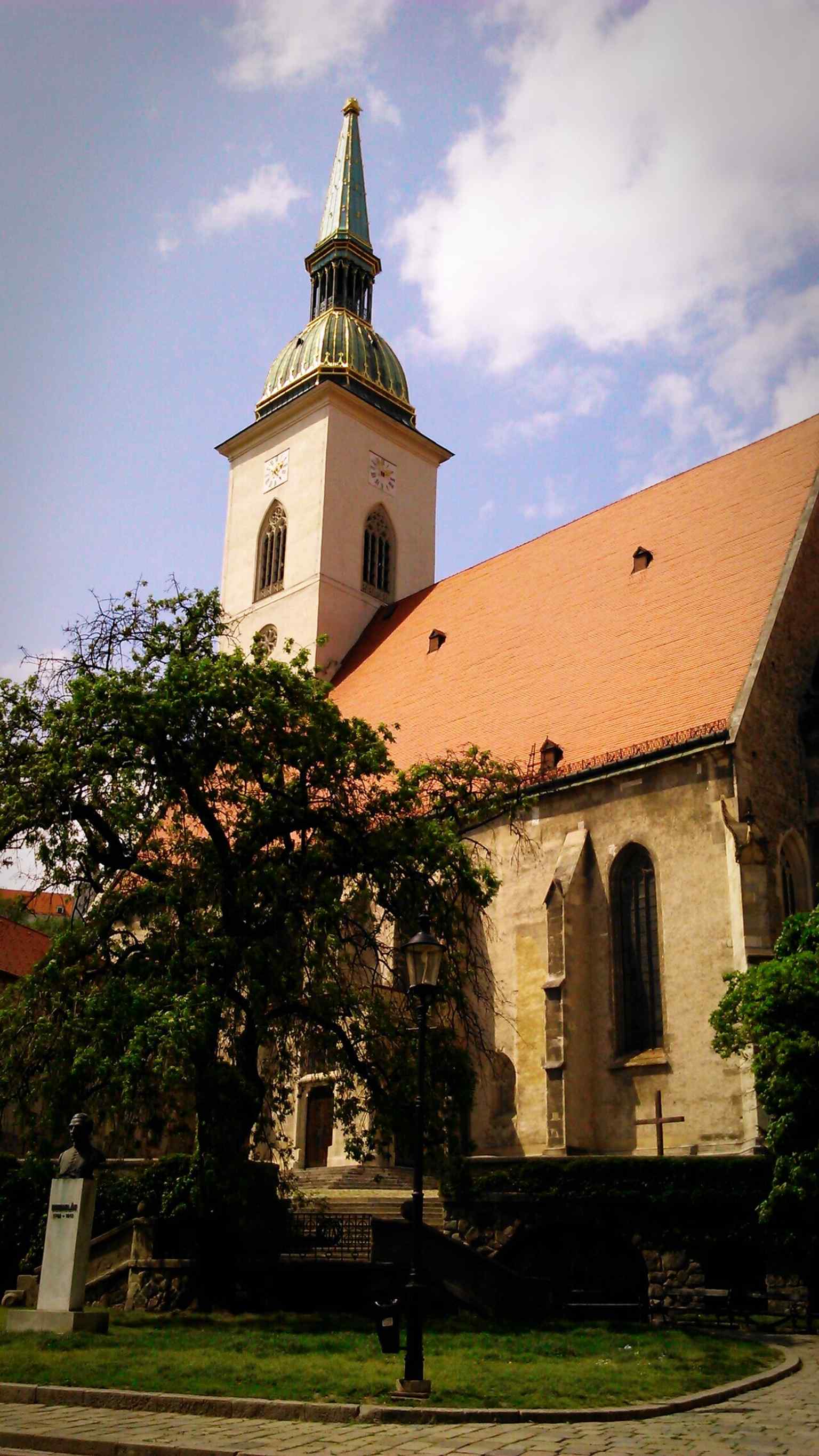
A straightforward façade view of the monument, good for introducing the cathedral as Bratislava’s most important church.Photo: Marek06 (talk), Wikimedia Commons, CC BY-SA 4.0. Cropped & resized. 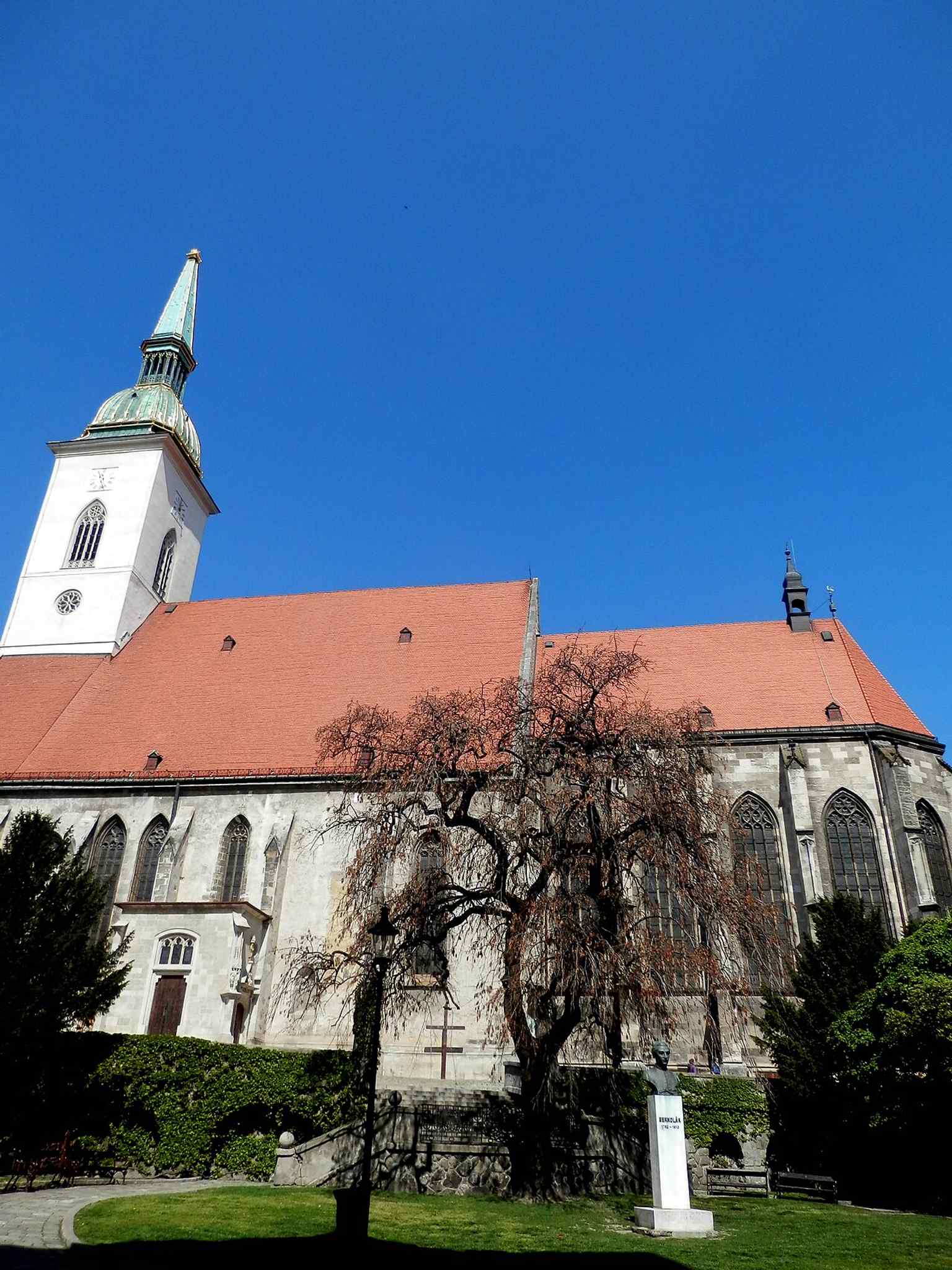
The cathedral from Rudnayovo námestie, linking the church to the square that once served as the former cemetery area.Photo: Jozef Kotulič, Wikimedia Commons, CC BY-SA 3.0. Cropped & resized. Ahead of you is a steel bridge with a long, flat deck, one leaning pylon, and a round saucer-like top that gives Bratislava its unmistakable U-F-O silhouette. Take it in for a…Read moreShow less
Open dedicated page →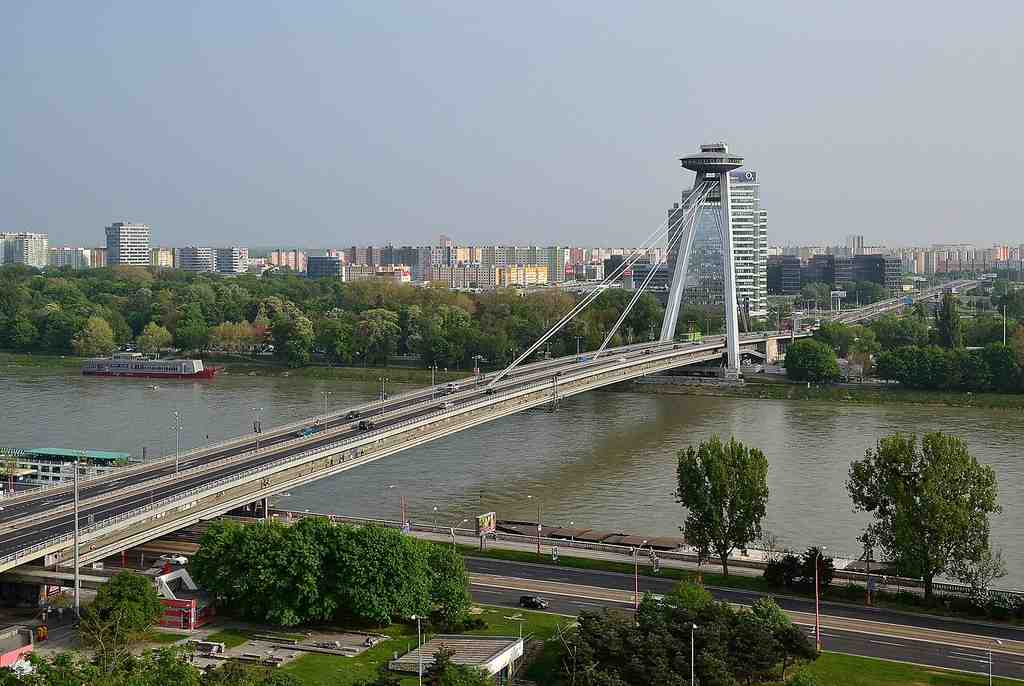
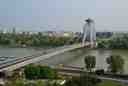
SNP BridgePhoto: Pudelek, Wikimedia Commons, CC BY-SA 3.0. Cropped & resized. Ahead of you is a steel bridge with a long, flat deck, one leaning pylon, and a round saucer-like top that gives Bratislava its unmistakable U-F-O silhouette.
Take it in for a second... this is Most S-N-P, the Slovak National Uprising Bridge, one of the city’s proudest pieces of engineering and one of its deepest arguments. It opened on the twenty-sixth of August, nineteen seventy-two, after five years of construction, and even now it looks like it arrived from a future somebody sketched on a napkin.
Structurally, it is a single-pylon cable-stayed bridge. In plain English, that means one main tower holds the roadway with a fan of steel cables, like taut strings pulling up a giant instrument. That design gave Bratislava something rare: this is the only bridge here with no pillar standing in the current of the Danube. So the river runs clean beneath it, and the main span stretches farther than any other bridge in the city. When it opened, it ranked fourth in the world among cable-stayed bridges, and in the narrower category of bridges with one pylon and one plane of cables, it still holds a world first. Not bad for a town crossing with a flying saucer on top.
If you glance at the image on your screen, you can really see that asymmetrical balance, almost daring gravity to try something clever.
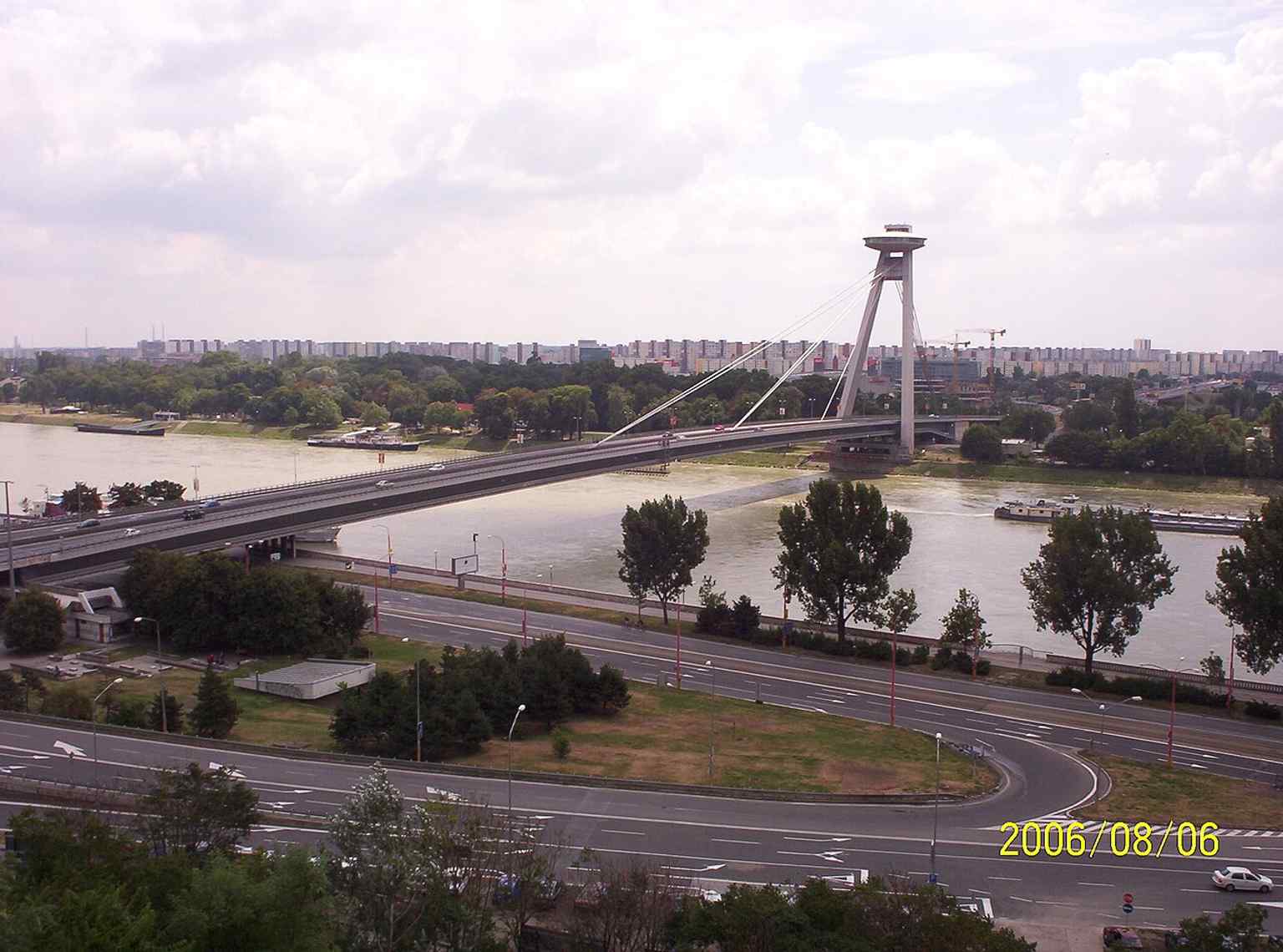
A clear daylight view of the bridge in 2006, useful for showing the striking asymmetrical silhouette that defines Bratislava’s skyline.Photo: Rákász Mihály (Rakaszmisi at Hungarian Wikipedia), Wikimedia Commons, Public domain. Cropped & resized. Most visitors never hear the little local twist behind that famous outline: the design that won the international competition did not get built. The bridge you’re looking at came from a proposal that placed only fourth in the competition, but the city chose it for economic reasons. So even this bold symbol of vision also carries compromise baked right into its bones.
Engineers Arpád Tesár and Jozef Zvara, with architects Jozef Lacko, Ladislav Kušnír, and Ivan Slameň, gave the city this striking form. Urbanist Emanuel Hruška looked at the same plan and worried. He argued against routing the bridge out at Rybné Square because he feared a heavy international traffic corridor would cut through the historic center. He was not just being fussy. He understood that roads do not simply pass through a city; they rewrite it.
And that is the hard part standing here. To build this bridge, Bratislava erased much of Podhradie below the castle, including historic parts of Vydrica and a Moorish-style synagogue. Whole streets vanished. The bridge sped up traffic, helped connect the fast-growing Petržalka housing district, and pushed the modern city forward. But it did so by clearing away a piece of the old one so thoroughly that planners later spoke of needing to “heal the wound.”
Look at the wider city view on your phone and notice how the bridge slices across the riverfront. It does not hide what it changed.
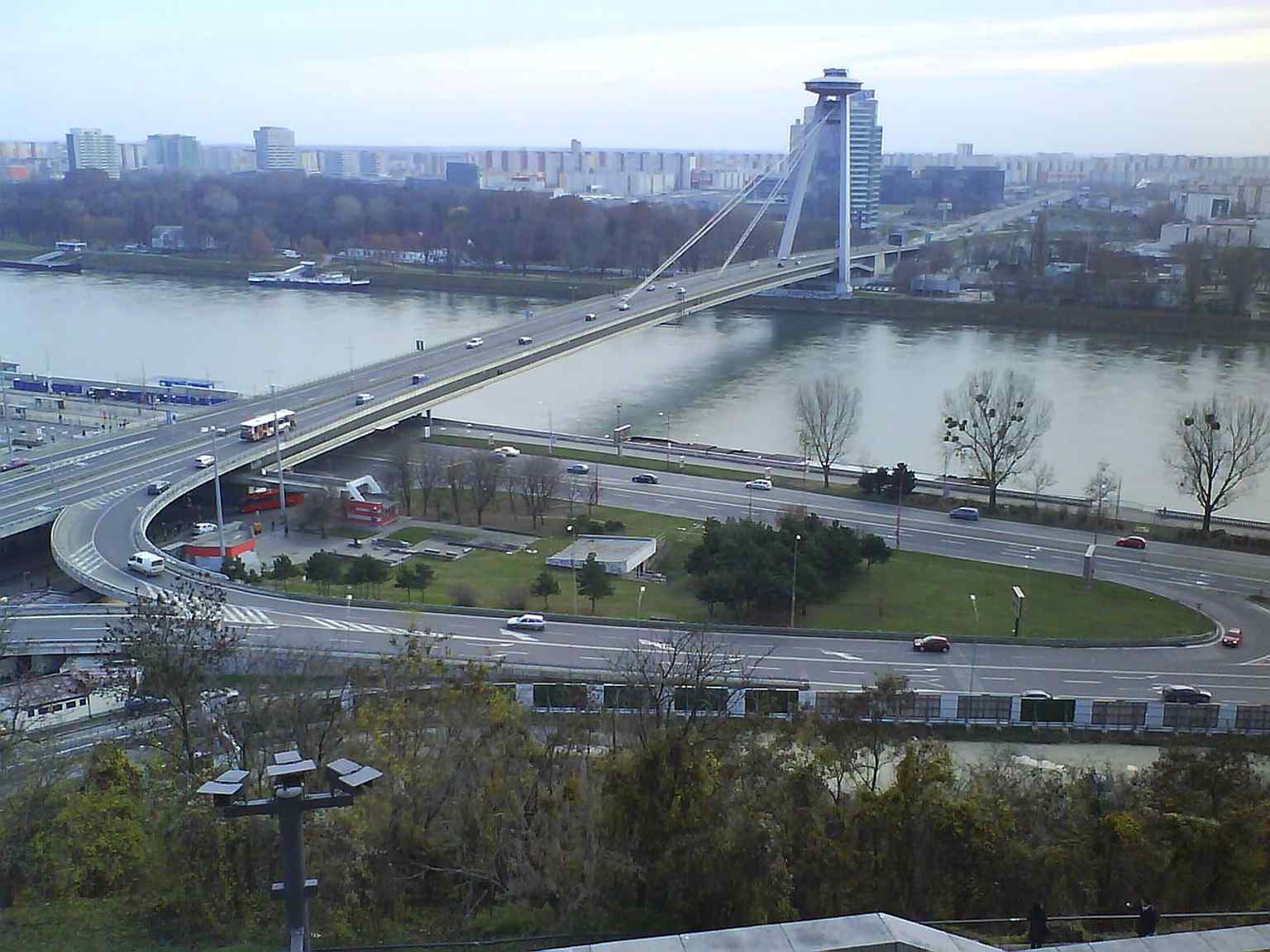
SNP Bridge seen from Bratislava Castle in 2009, showing how the landmark cuts across the Danube and reshaped the city’s historic riverfront.Photo: Zsombi1397 at Hungarian Wikipedia, Wikimedia Commons, CC BY-SA 3.0. Cropped & resized. Up there, about eighty-five meters above the river, the U-F-O holds a restaurant and observation deck. An elevator rises through the eastern pylon, while the western one hides an emergency stair with four hundred thirty steps. Inside the bridge, quietly doing ordinary work, runs a water pipe feeding the Old Town from Petržalka. That feels right somehow. Even icons have chores.
In two thousand and one, Slovakia named it the construction of the century in its bridge category. In two thousand eighteen, the state protected it as a national cultural monument. So here at the end, Bratislava leaves you with no neat answer. This bridge is brilliant. This bridge is costly. The city asks you to hold both truths at once... and maybe that is the most honest view of it, and of everything you’ve seen.
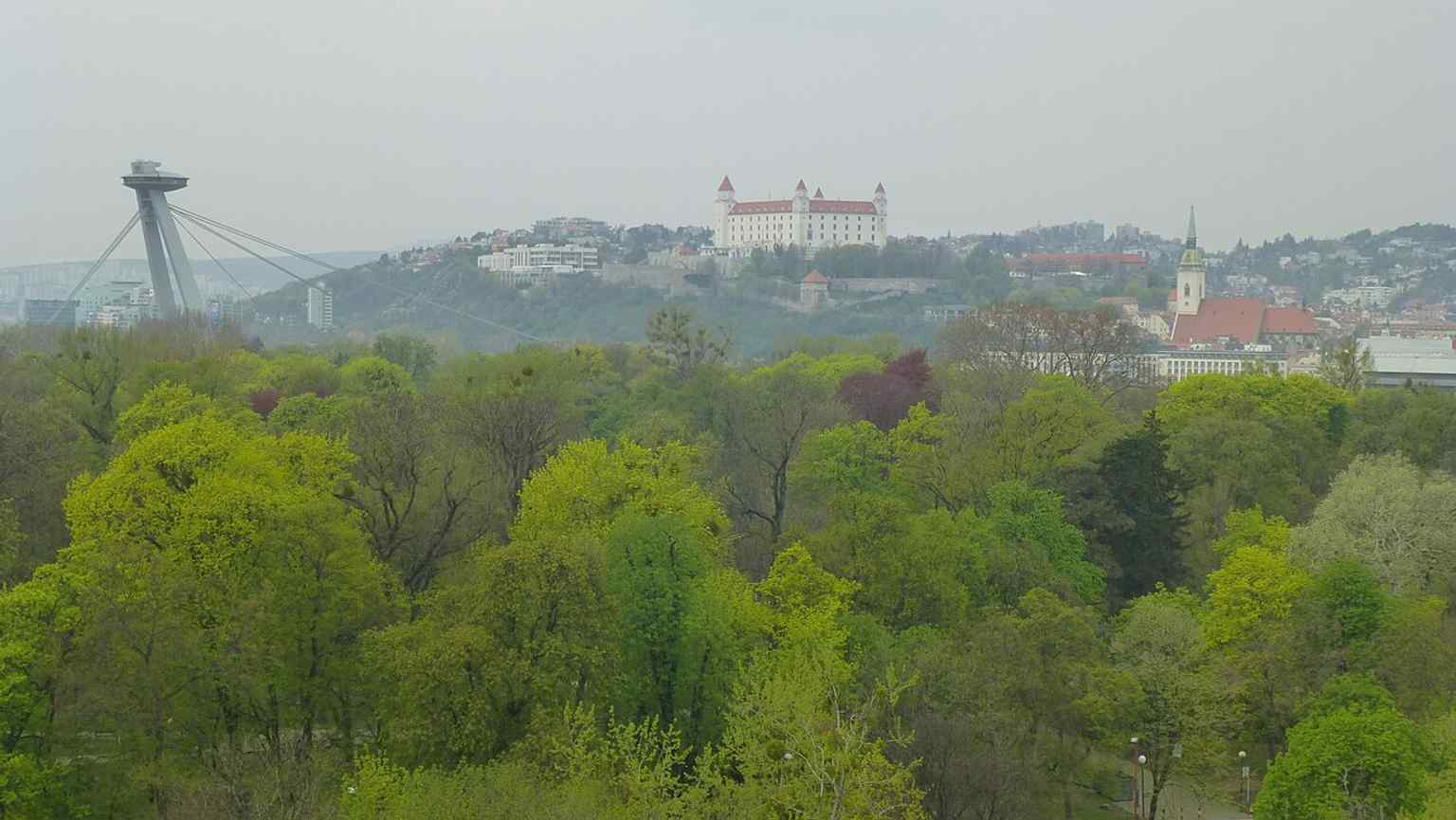
The bridge and the Danube from the park side — a strong cityscape that highlights SNP Bridge as one of Bratislava’s main visual landmarks.Photo: ANDREJ NEUHERZ, Wikimedia Commons, CC BY-SA 3.0. Cropped & resized. 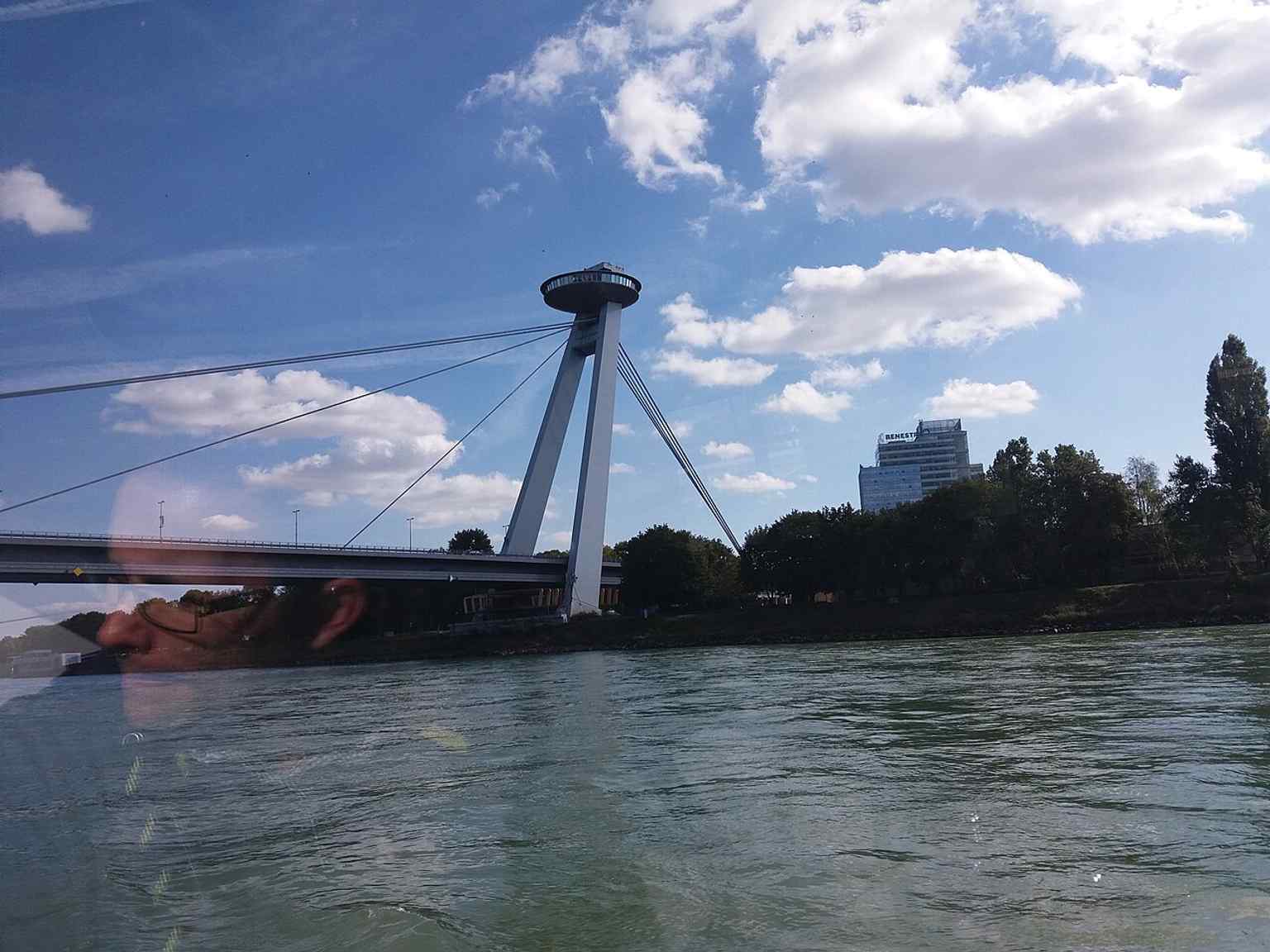
Seen from a boat on the Danube, this angle emphasizes the bridge’s long span and the lack of any river pillar beneath it.Photo: Jan_Polák, Wikimedia Commons, CC BY 4.0. Cropped & resized. 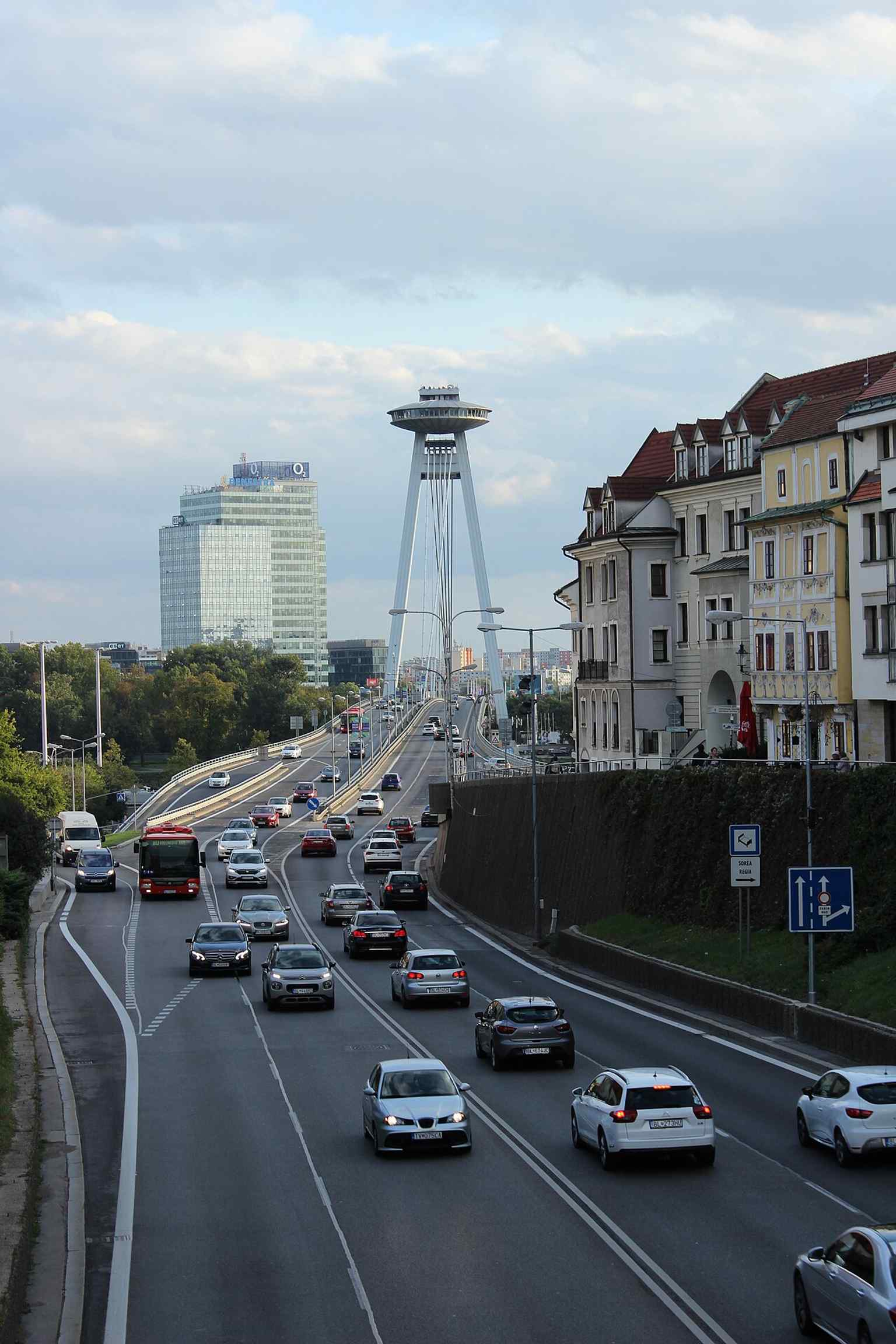
SNP Bridge rising behind Staromestská Street, a good urban context shot that shows how the bridge ties the city center to the river crossing.Photo: Jan Polák, Wikimedia Commons, CC BY-SA 3.0. Cropped & resized. 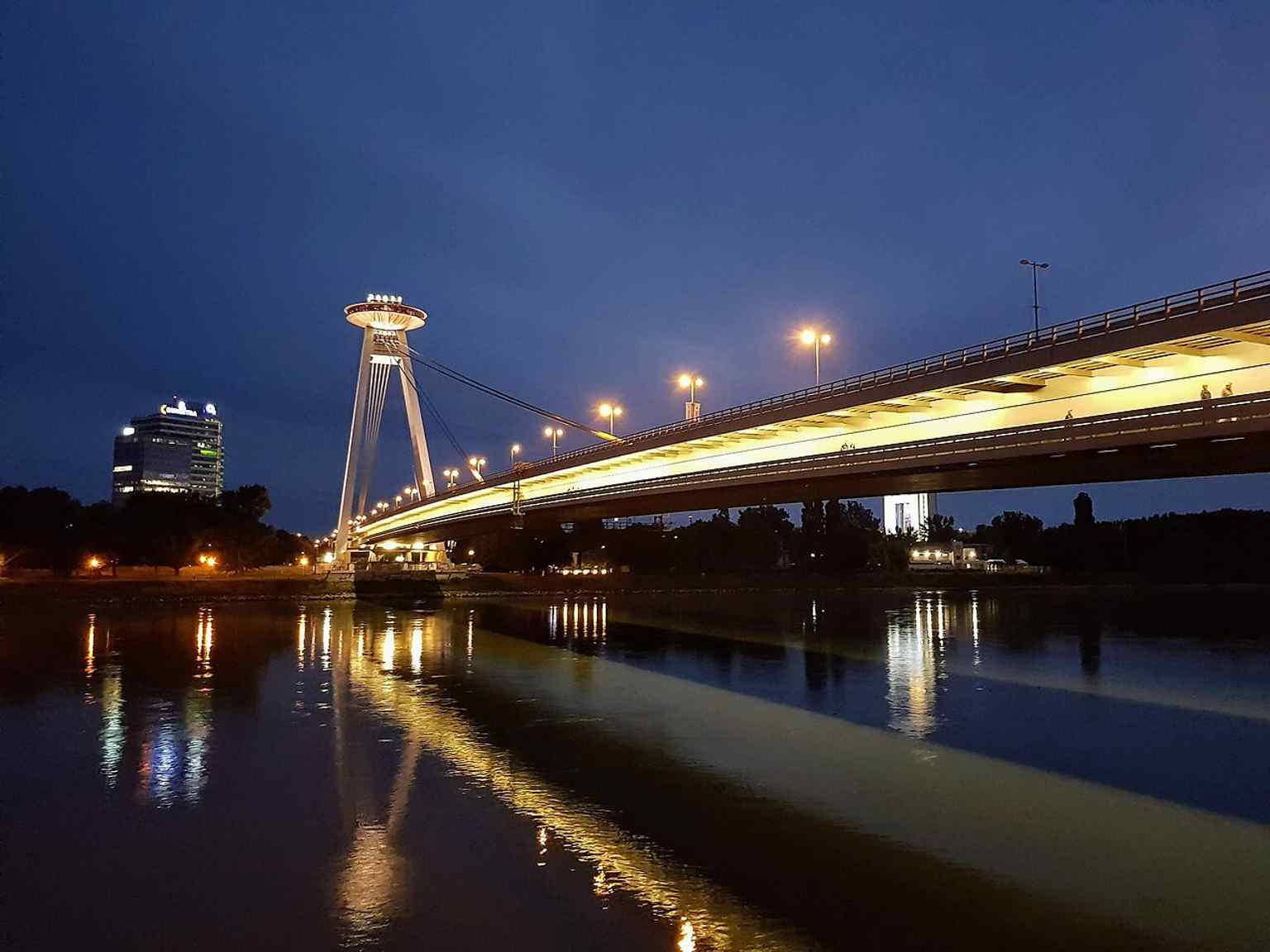
Night view with blue-hour reflections — a dramatic look at the illuminated bridge and its UFO-topped pylon.Photo: Maksym Kozlenko, Wikimedia Commons, CC BY-SA 4.0. Cropped & resized. 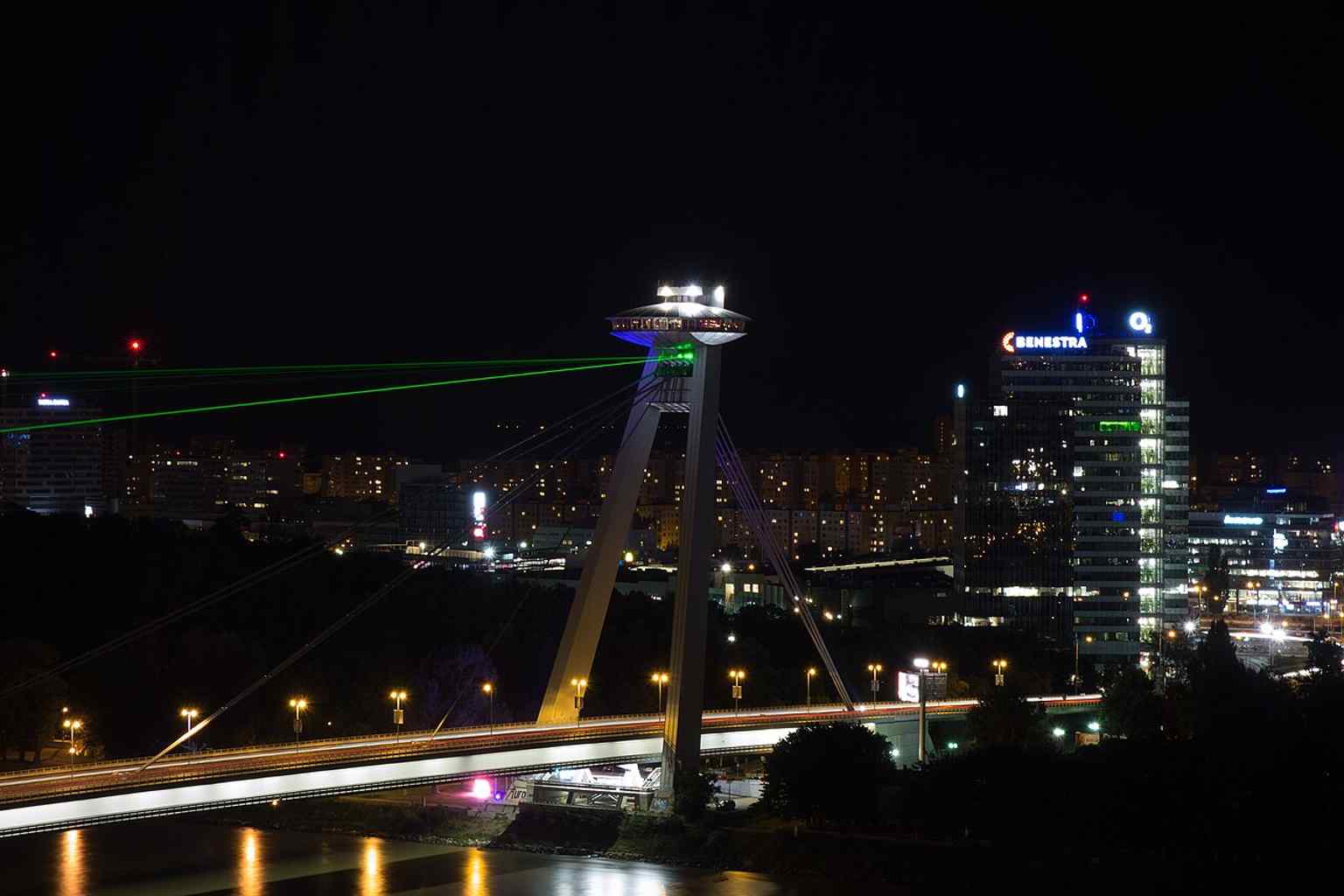
A zoomed night city view featuring the UFO tower, highlighting the restaurant and observation deck perched 85 meters above the Danube.Photo: Aleksey Potapov, Wikimedia Commons, CC BY 3.0. Cropped & resized.
Frequently asked questions
How do I start the tour?
After purchase, download the AudaTours app and enter your redemption code. The tour will be ready to start immediately - just tap play and follow the GPS-guided route.
Do I need internet during the tour?
No! Download the tour before you start and enjoy it fully offline. Only the chat feature requires internet. We recommend downloading on WiFi to save mobile data.
Is this a guided group tour?
No - this is a self-guided audio tour. You explore independently at your own pace, with audio narration playing through your phone. No tour guide, no group, no schedule.
How long does the tour take?
Most tours take 60–90 minutes to complete, but you control the pace entirely. Pause, skip stops, or take breaks whenever you want.
What if I can't finish the tour today?
No problem! Tours have lifetime access. Pause and resume whenever you like - tomorrow, next week, or next year. Your progress is saved.
What languages are available?
All tours are available in 50+ languages. Select your preferred language when redeeming your code. Note: language cannot be changed after tour generation.
Where do I access the tour after purchase?
Download the free AudaTours app from the App Store or Google Play. Enter your redemption code (sent via email) and the tour will appear in your library, ready to download and start.
If you don't enjoy the tour, we'll refund your purchase. Contact us at help@audatours.com
Checkout securely with 












%20statue%20in%20Bratislava%2C%20Bratislava%20I%20District.jpg)


.jpg)


.JPG)


.jpg)
.jpg)


.jpg)


%20at%20night.jpg)
.jpeg)