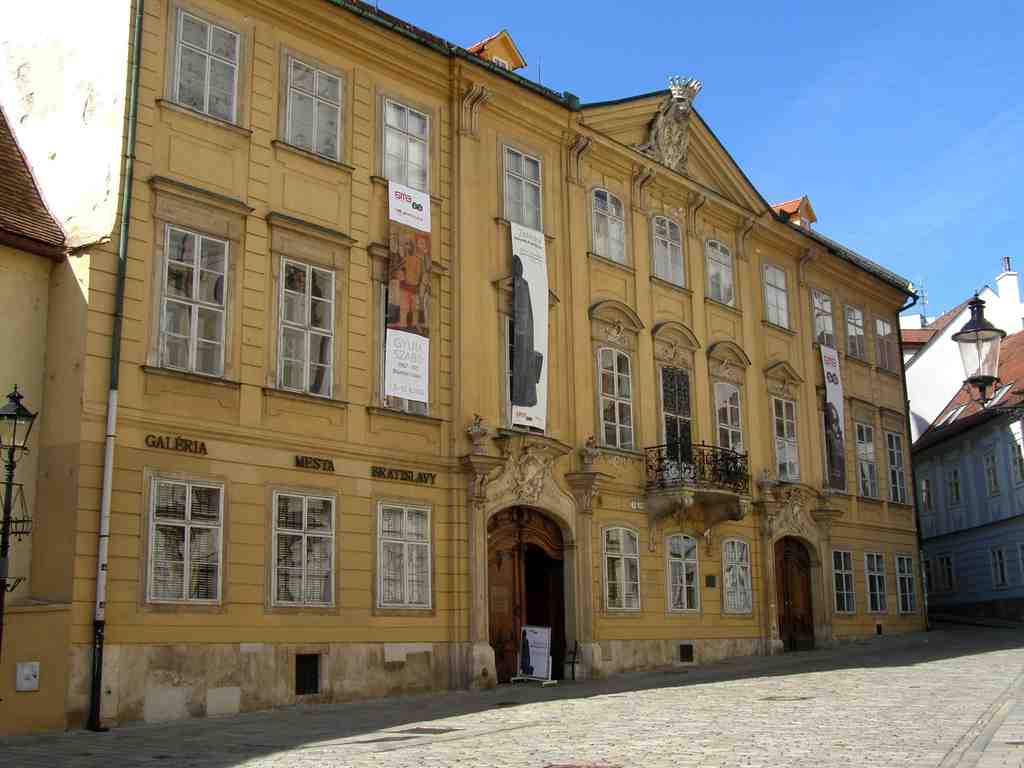
On your left is a pale stone palace with a broad, symmetrical two-story facade, a central triangular pediment, and delicate Rococo stucco curling around the windows like icing that hired an architect.
Mirbach Palace is one of the best places in Bratislava to understand how a city stacks itself in layers. What looks polished and settled from the outside often sits on older ground stories... not erased, just covered, reused, and argued with. This palace is the tidy top sheet; underneath it lie a wooden house, a city property, a worship space, a burned ruin, and then this graceful Baroque-Rococo showpiece.
The paper trail starts in thirteen seventy-nine, with a plot owned by Mikuláš Damankusch. By fourteen forty-three, records call the house here Weittenhof, meaning “wide yard.” Later writers say the old building carried the city coat of arms and relied heavily on wood. In the sixteenth and seventeenth centuries, this address still lived an earlier life: people even held Protestant services here in sixteen sixty-six. So before it became elegant, this corner had already served the city in very practical, communal ways.
Then comes one of those very human turns history loves. The scholar Matej Bel wrote in seventeen thirty-five that the house stood prominently at the mouth of Zámočnícka Street, with decent living rooms, side wings, cellar storage for wine, and occasional lodging for military officers. He also recorded what happened on the twenty-third of October, seventeen thirty-three: the place burned. The fire may have started because a theater company renting rooms here was careless. A dramatic ending... in the least useful sense.
The man who truly changed the site was Johann Michael Spech, a Bratislava brewer from a family tied to former mayors in Podhradie. In seventeen sixty-two he bought the fire-damaged remains, and on the fourth of March, seventeen sixty-eight, he got permission to raise something entirely new. Master mason Matej Höllrigl led the construction, and within two years, from the spring of seventeen sixty-eight to the spring of seventeen seventy, Spech had turned wreckage into a refined urban palace. If you glance at the image in your app, you can pick out that careful symmetry and the airy stucco decoration more easily than from street level.
And then, true to form for this city, the story kept shifting owners. Count Imrich Csáky held it by the early nineteenth century. Adam Jurenák, a city councillor, owned it later. The Nyáry family arrived in the early twentieth century, and the pair of oval shields under the count’s crown in the pediment still belong to them. After that came Baron Doctor Emil Mirbach, the man whose name stayed. He understood exactly what he had: not just a fancy address, but a rare survival. In his will, he left the palace to the city and asked that it become a public fine arts museum. That is a pretty fine last act.
The city took over in nineteen forty-nine, opened its first exhibitions the next year, and after a major restoration reopened the palace in nineteen seventy-five as part of the Bratislava City Gallery. Inside, two first-floor rooms still preserve wooden paneling and a remarkable set of eighteenth-century prints built right into the walls like art and architecture shaking hands.
In a moment, we’ll step straight into the Church of the Annunciation, where the next layer of this old city gathers around belief as carefully as this palace gathers around memory.