
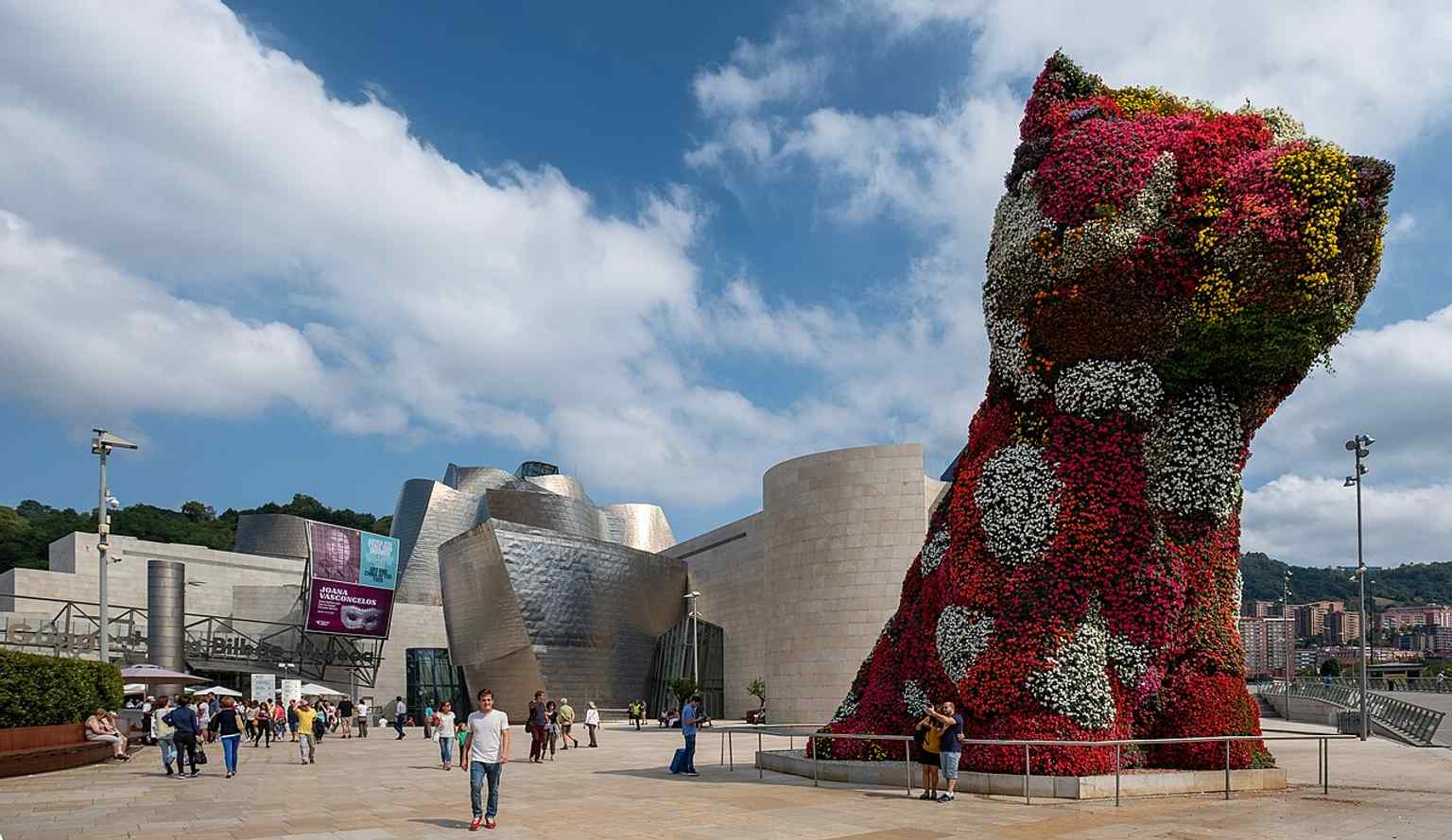
On your left, the Guggenheim is a swirl of silver titanium panels and pale limestone blocks wrapped around a tall glass atrium, the central hall, that Frank Gehry nicknamed “the Flower.”
This is the moment Bilbao announced itself to the world in a language everyone could read... not smokestacks, not shipbuilding, but spectacle. In the early nineteen nineties, the Basque Government looked at this worn-out port district and made a calculated gamble: spend about one hundred million dollars on a museum here, add fifty million for art, pay the Guggenheim Foundation to run it, and trust culture to do what industry no longer could. That wager became the Guggenheim turning point. After it opened in October of nineteen ninety-seven, nearly four million visitors came in the first three years, generating around five hundred million euros for the local economy.
And the building itself? Well, it does not exactly tiptoe. Gehry designed the exterior curves to feel almost random, so they catch light differently from every angle. More than thirty-three thousand thin titanium plates, arranged like scales, sit over steel; from some views the whole thing feels like a fish, from others a ship, from others a controlled explosion that somehow landed gracefully. If you check the river view in the app, you’ll see how the museum really opens itself toward the water, where the old industrial edge becomes sculpture.
Most people admire the skin and never realize the miracle was also technical. Gehry’s team used CATIA, software first developed for aerospace design, to calculate every curve, beam, and panel point by point. That may sound dry, but in plain English it meant this wild-looking thing could actually get built on time and on budget... a minor miracle in architecture, like finding a parking spot exactly where you need it.
Now for the part locals don’t forget. Just before the opening, E-T-A militants hid four anti-tank grenades in a planter outside, planning to trigger them on inauguration day. A Basque police officer, José María Aguirre Larraona, confronted them, and they shot him; he later died of his wounds. Bomb-sniffing dogs had been checking the museum every hour, which tells you how close that attack came. So this shimmering landmark entered the world not only as a civic celebration, but as a security emergency.
That double edge has never fully gone away. Critics praised the “Bilbao effect” and others called it gentrification with a fancy façade. Even the workers behind the scenes had to push back: in twenty twenty-one and twenty twenty-two, the museum’s cleaners, mostly women, struck for two hundred and eighty-five days before winning better pay and full-time contracts. And when leaders later proposed expanding into the Urdaibai estuary, a protected wetland, environmental groups and locals fought the plan until it was abandoned; the image in the app shows the landscape at the heart of that argument.
So yes, this place is dazzling. But it is also a reminder that reinvention always sends somebody the bill. Up next, about a three-minute walk away, we meet the museum’s softest-looking ambassador, Puppy... and even that friendly face has a carefully managed story. If you want to go inside later, the museum is generally open Tuesday through Sunday from ten to seven, and closed on Monday.





%20julesvernex2.jpg)