
Bilbao Audio Tour: Casco Viejo Treasures
Seven streets. A river that once carried iron and secrets. In Bilbao’s Casco Viejo, every stone looks calm until the past starts talking. This self guided audio tour leads from Ribera Market to the Cathedral of Santiago and the Arriaga Theatre, pulling hidden stories out of doorways, arches, and plazas most visitors hurry past. Which political battle nearly turned these lanes into a trap with no escape. What rebellion left a quiet mark near the cathedral that locals still glance at and never explain. And why did a scandal in the shadows of Arriaga begin with a missing glove and a very specific seat number. Follow the sound through crowded stalls and sudden silence. Turn corners into forgotten moments, mysteries, and close calls. Feel Bilbao shift from postcard to pulse. Press play and let the river’s secrets find you.
Tour preview
About this tour
- scheduleDuration 140–160 minsGo at your own pace
- straighten6.6 km walking routeFollow the guided path
- location_on
- wifi_offWorks offlineDownload once, use anywhere
- all_inclusiveLifetime accessReplay anytime, forever
- location_onStarts at Arriaga Theatre
Stops on this tour
lock_open 3 free previews · 12 unlock with purchase
Ahead of you stands a pale stone theater with a curved central façade, mansard roofs and small domed corner towers, all crowned by a lyre beneath a clock. Think of that lyre as…Read moreShow less
Open dedicated page →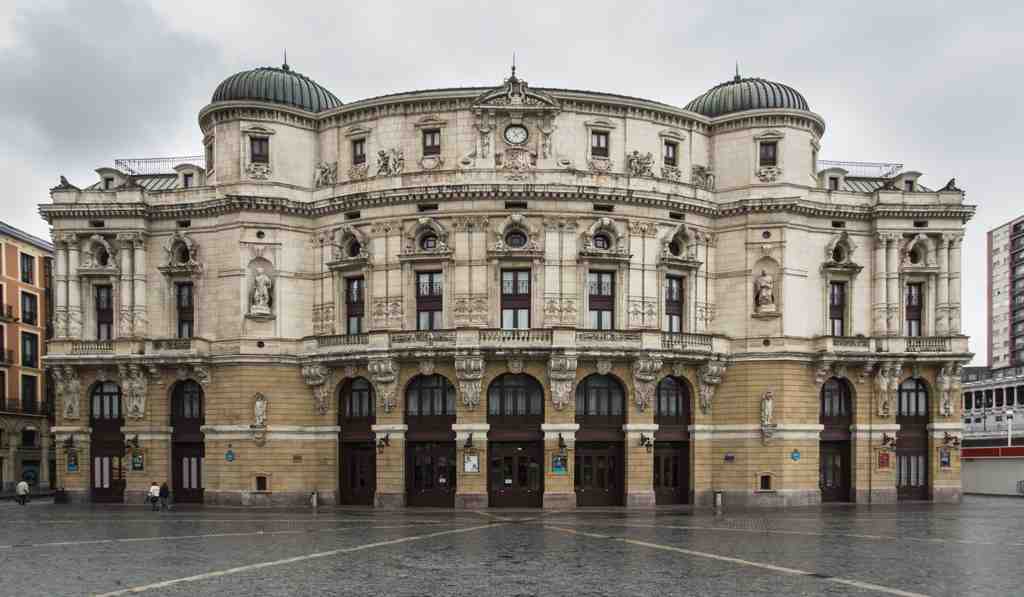
Arriaga TheatrePhoto: Pedro J Pacheco, Wikimedia Commons, CC BY-SA 3.0 ES. Cropped & resized. Ahead of you stands a pale stone theater with a curved central façade, mansard roofs and small domed corner towers, all crowned by a lyre beneath a clock.
Think of that lyre as Bilbao introducing itself on purpose. When the architect Joaquín de Rucoba opened this theater on the thirty-first of May, eighteen ninety, he gave the city a grand public face: neo-baroque, meaning it borrowed the swagger and ornament of older European opera houses to say, very politely and very clearly, “we belong on the big stage too.”
And the name belongs to someone who never got a long second act. Juan Crisóstomo de Arriaga was born in Bilbao in eighteen oh six, on the same day Mozart would have turned fifty. He died at just nineteen. That is why people called him the Spanish Mozart, and why this building always carries a small note of heartbreak under all its finery.
Bilbao has a habit you’ll notice all through this walk: it presents itself in public. Not just with speeches, but with stone, façades, bridges, parks, and grand rooms. This theater is the perfect opening curtain, because it tells you the city wants to be seen, judged, admired... and remembered.
Take a good look at that central curve, the balcony, and the heavy decoration. From where you’re standing, ask yourself what matters most here: beauty, prestige, or stubborn survival. Truth is, Bilbao chose all three.
Most visitors think the story starts in eighteen ninety. Locals know the stage was older than this costume. There was already a Teatro de la Villa on this ground in eighteen thirty-four, and Bilbao’s official theater memory reaches back to a dedicated performance venue in seventeen seventy-nine, before fire erased it. This city did not invent itself once. It kept rebuilding the set and carrying on.
Even this version paid a price to rise. In eighteen eighty-seven, part of the construction collapsed, killing two workers and injuring four. The finished theater cost one million pesetas, a fortune at the time, and it arrived with the latest marvels: electric lighting, plus an early telephone system that let people follow performances from a distance. Opera by landline... not bad for the nineteenth century.
If you glance at the image on your screen, you can spot the caryatids, sculpted women used like columns, whose generous proportions made locals nickname the place “the maternity house.” Bilbao has always mixed elegance with a little elbow-in-the-ribs humor.
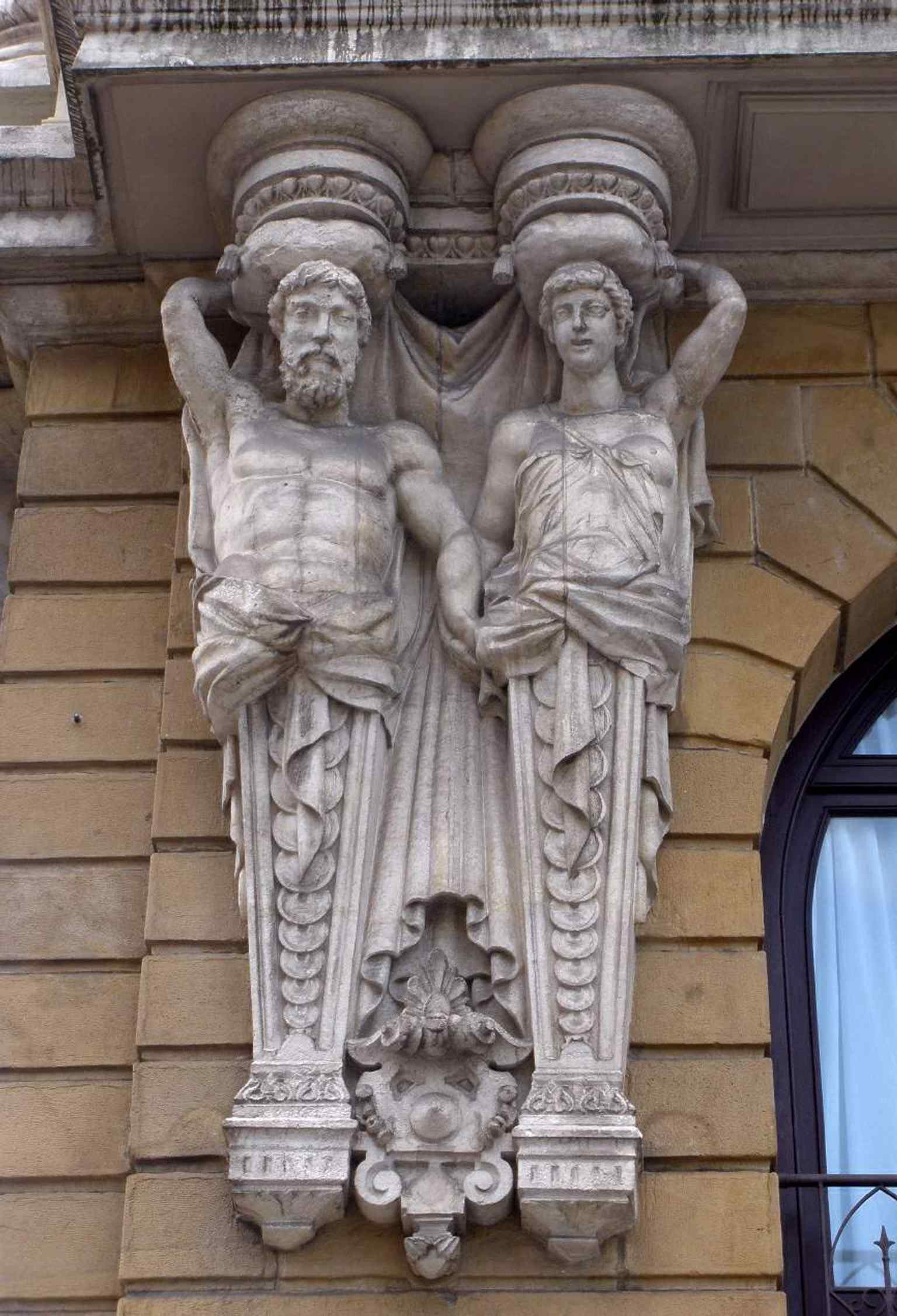
A close look at the caryatids on the façade — the sculpted figures that gave the theatre its playful nickname, “the maternity house.”Photo: Zarateman, Wikimedia Commons, CC0. Cropped & resized. The Arriaga did more than stage plays. In eighteen ninety-one, the lower floor hosted the first sessions of the Bilbao Stock Exchange. In nineteen oh one, Miguel de Unamuno took part here in literary festivities. Money downstairs, ideas upstairs, music in the middle... that’s a whole city in one building.
And then came the blows. A fire destroyed the theater in nineteen fourteen while the zarzuela company of Salvador Videgain García was performing. Federico de Ugalde rebuilt it. Decades later, the flood of nineteen eighty-three sent water up to the second floor during another restoration, forcing Bilbao to rethink the rescue yet again. If you look at the interior image in the app, that grand imperial staircase belongs to the later recovery, when Francisco Hurtado de Saracho reshaped the entrance and vestibule instead of merely patching the wounds.
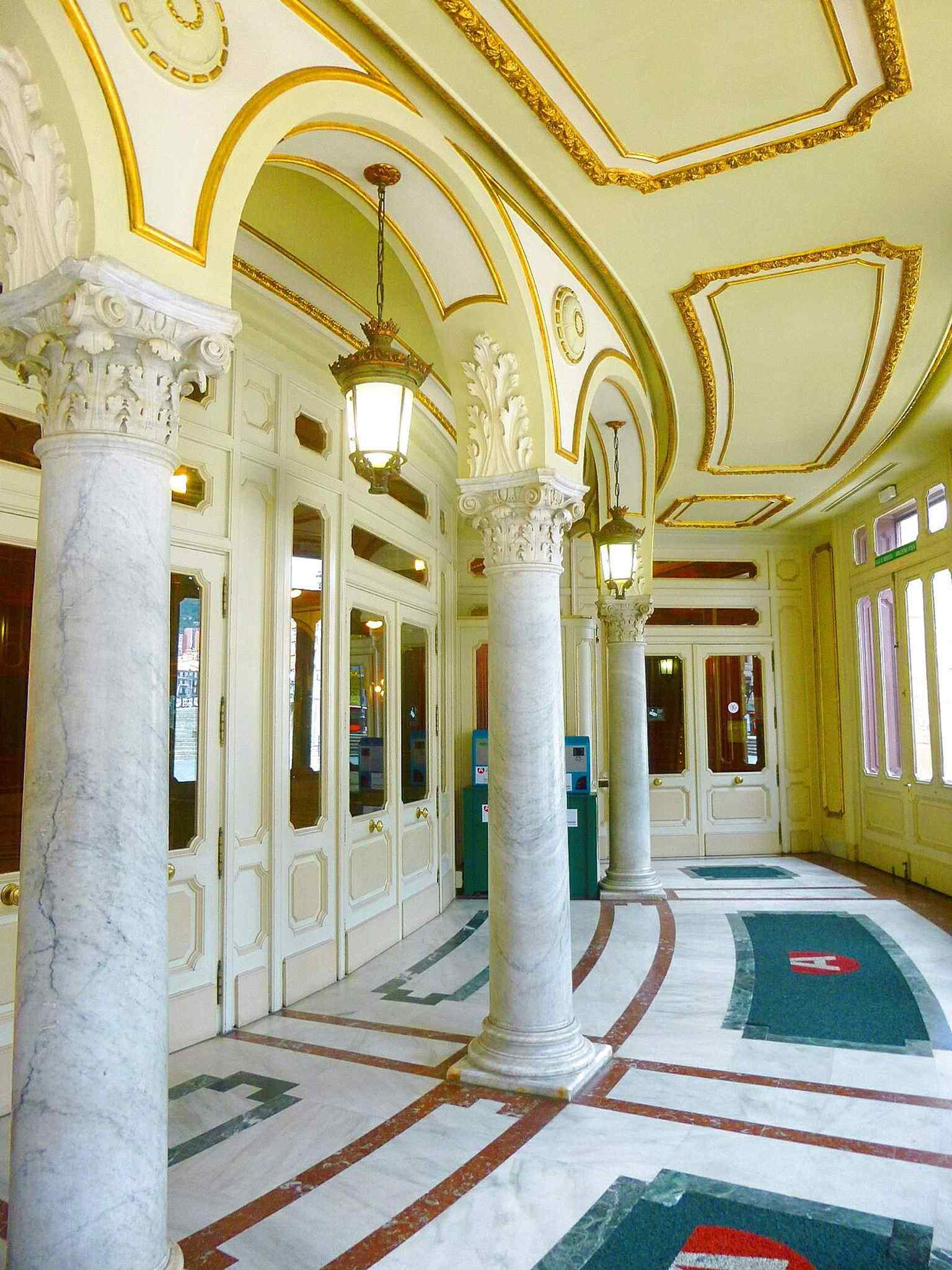
An interior view of the Arriaga, useful for the story of its restoration and for showing the elegant public spaces inside the theatre.Photo: Zarateman, Wikimedia Commons, CC0. Cropped & resized. So this is our first clue to Bilbao: a city that keeps its memories, but refuses to leave them in ruins. From here, the story moves from the public stage to private power. In about sixteen minutes, at Chavarri Palace, we’ll meet the social ambition that dressed itself just as carefully as this theater does.
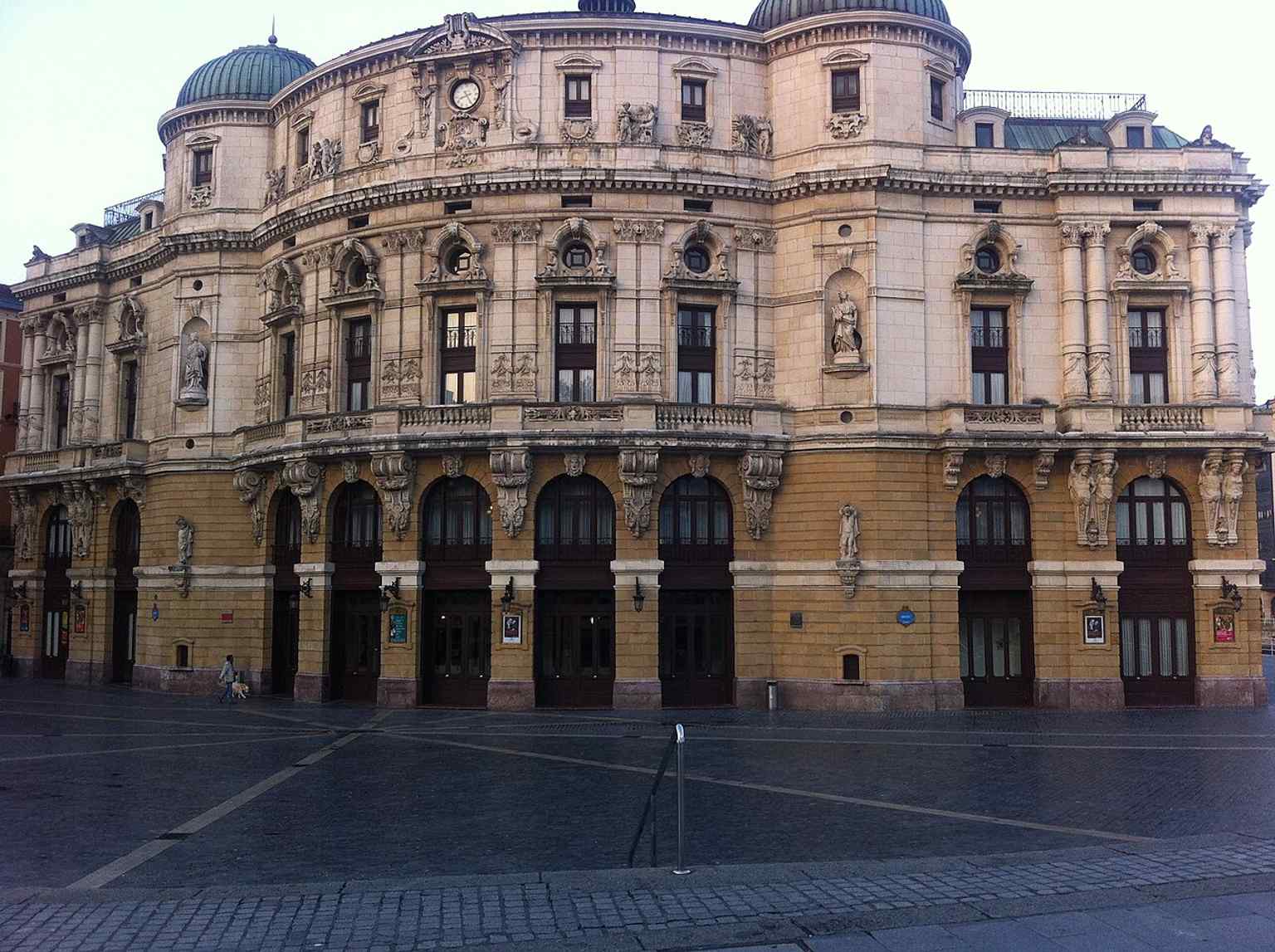
A classic full view of the Arriaga Theatre’s ornate neo-baroque façade, the Bilbao landmark designed by Joaquín de Rucoba and opened in 1890.Photo: Jesus Angel Salazar Orozco, Wikimedia Commons, CC BY-SA 3.0 es. Cropped & resized. 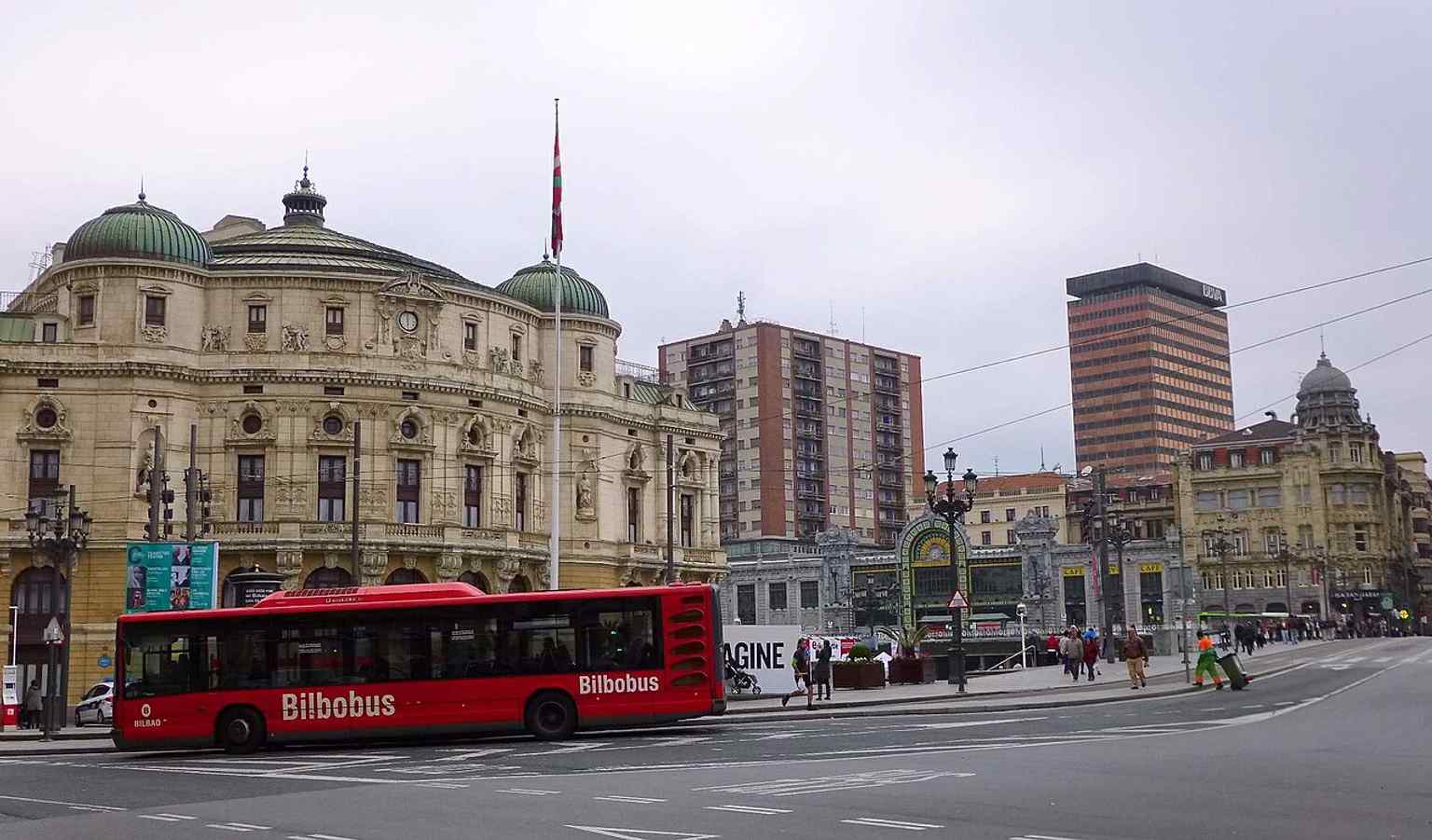
The Arriaga on the Arenal edge of Bilbao, showing how the theatre anchors the city’s riverfront and old town streetscape.Photo: Zarateman, Wikimedia Commons, CC0. Cropped & resized. 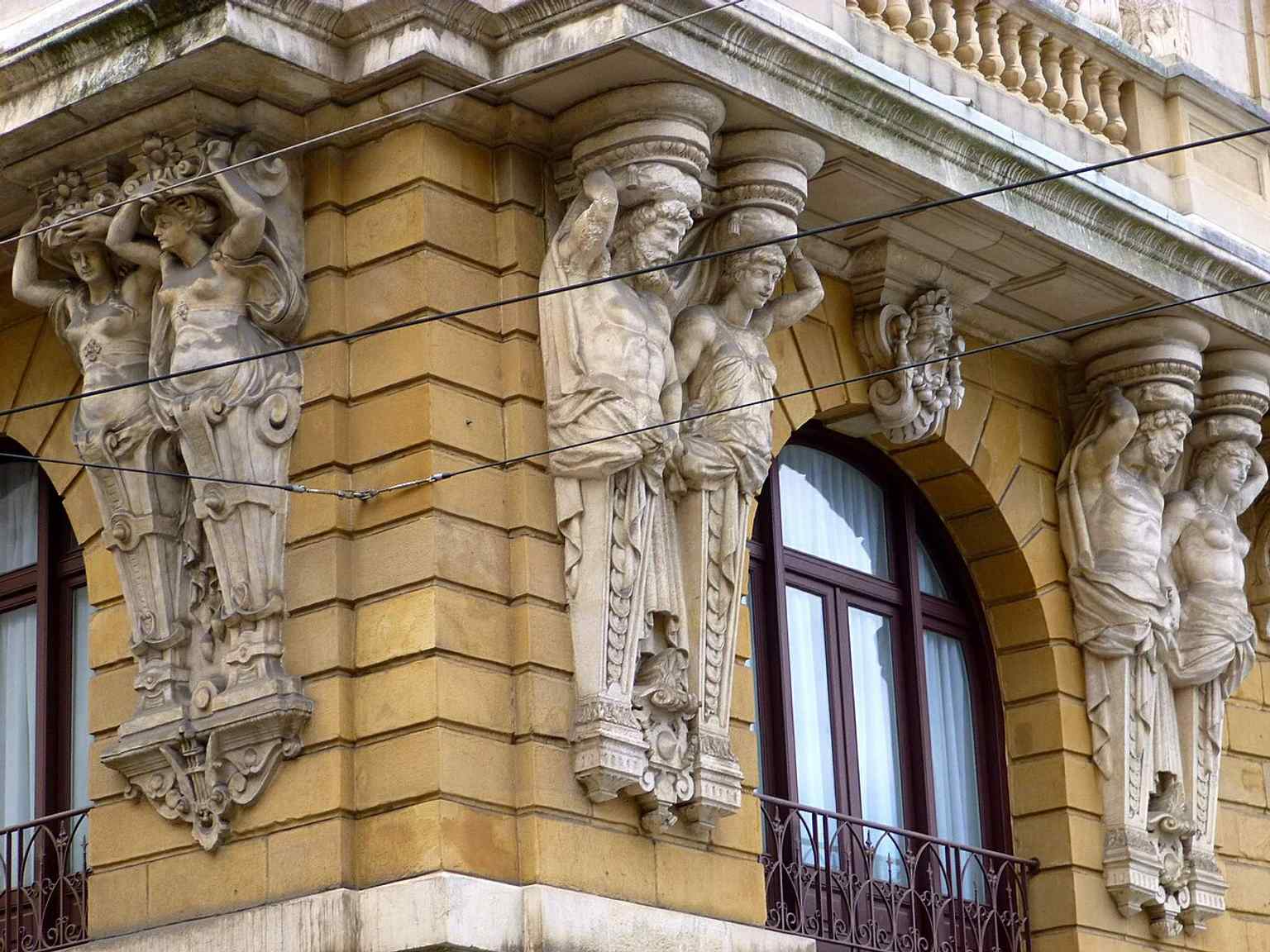
One of the façade’s atlantes, reflecting the richly decorated lower and middle sections described in the building’s architecture.Photo: Zarateman, Wikimedia Commons, CC BY-SA 4.0. Cropped & resized. 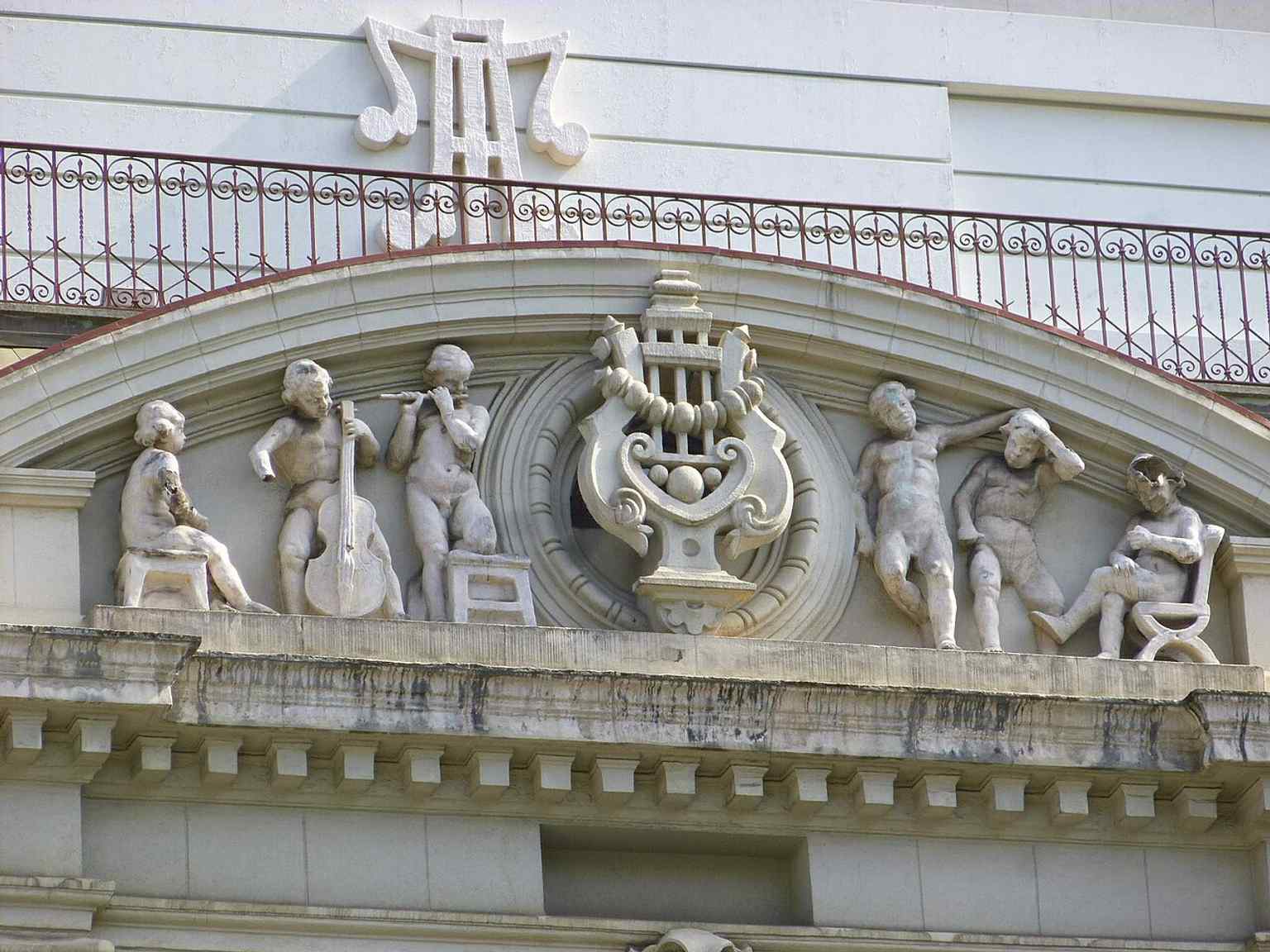
A decorative tympanum detail from the exterior, highlighting the theatre’s elaborate neobaroque ornament and sculptural finish.Photo: Zarateman, Wikimedia Commons, CC0. Cropped & resized. 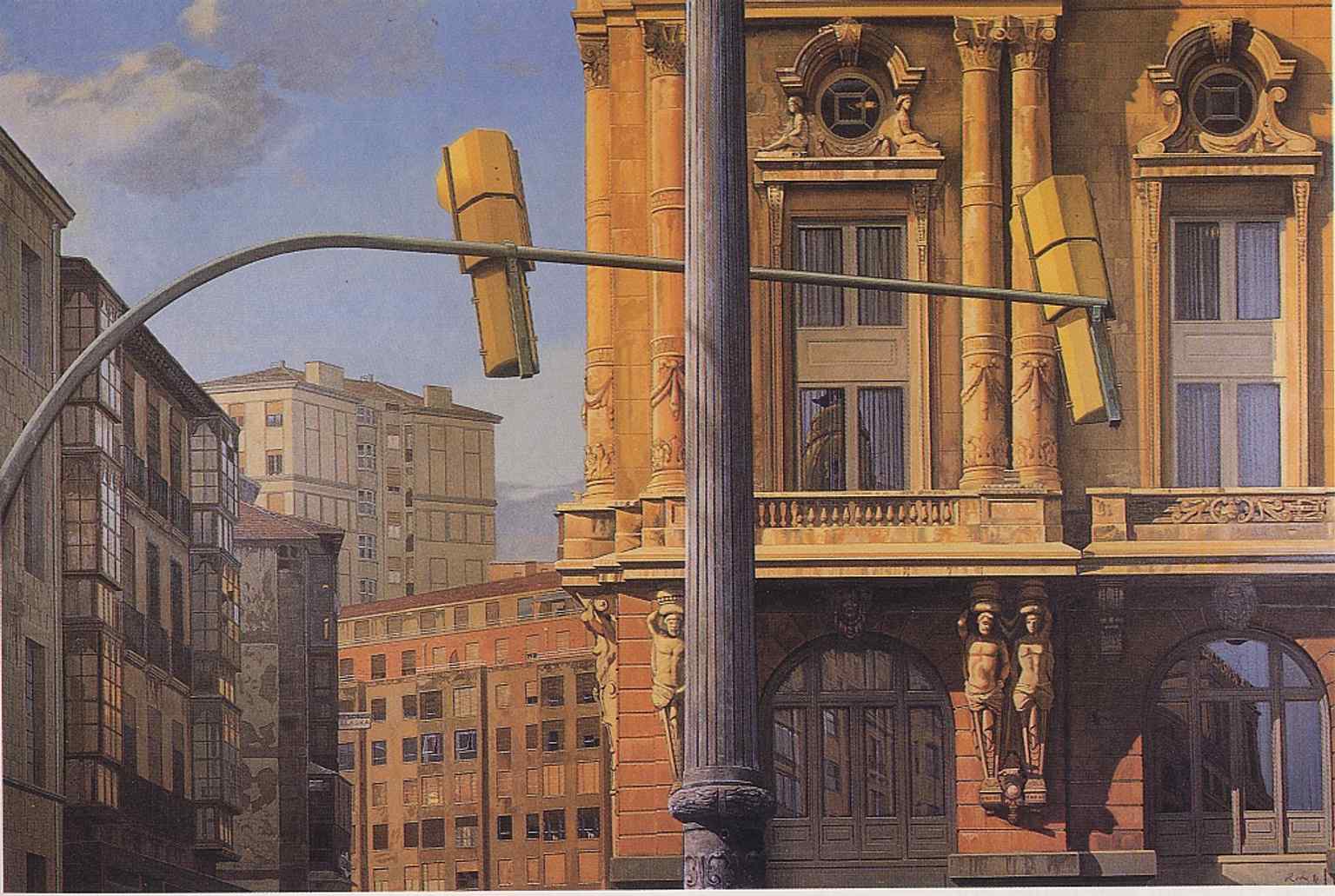
A painted view of the Arriaga and the Ribera, showing how deeply the theatre has entered Bilbao’s visual memory and urban identity.Photo: Agustín Reche Mora, Wikimedia Commons, CC0. Cropped & resized. 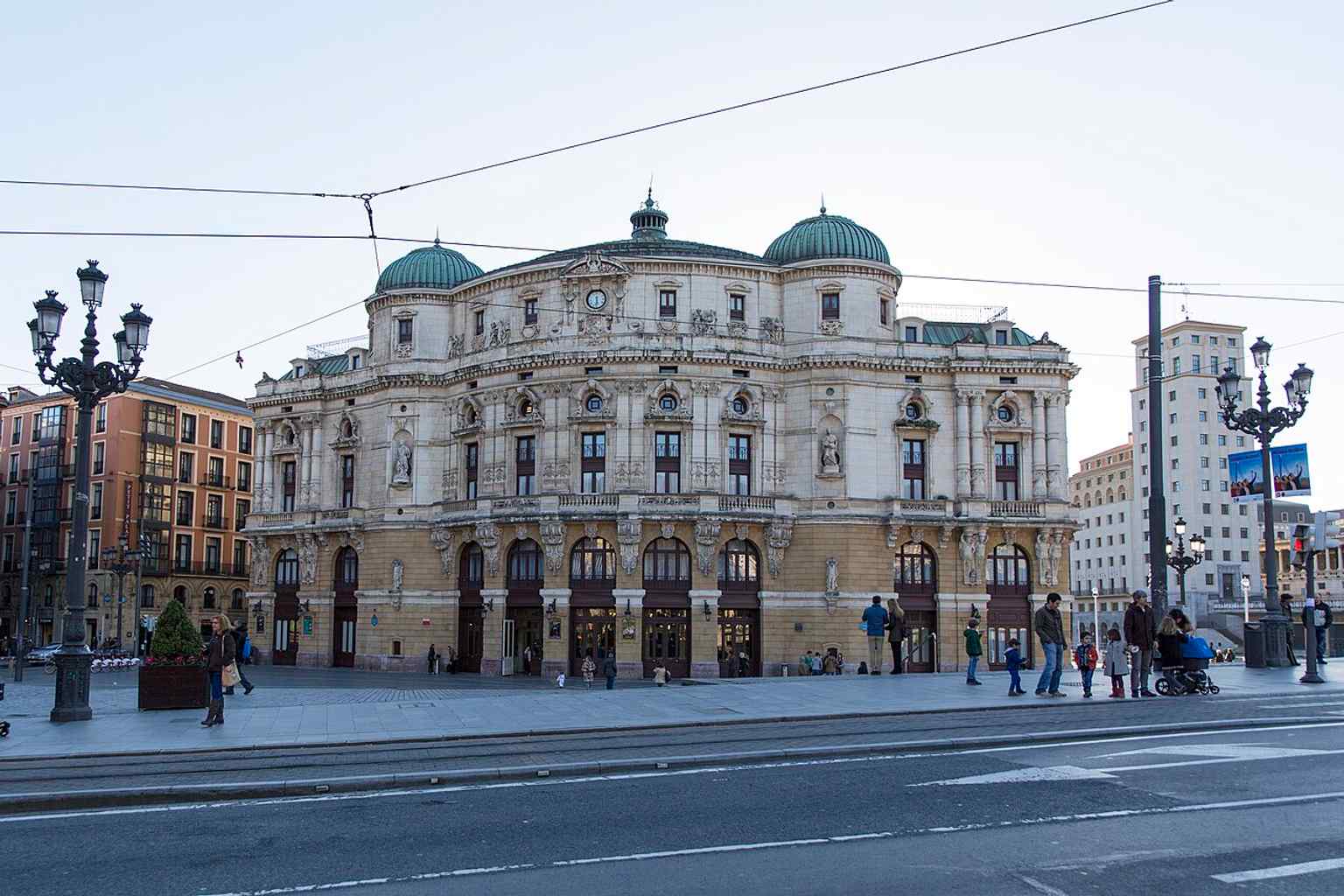
A wide elevated view of Arriaga Square and the surrounding streets, placing the theatre in the heart of Bilbao’s historic center.Photo: PA, Wikimedia Commons, CC BY-SA 4.0. Cropped & resized. On your right stands a pale stone palace with steep slate roofs, stepped gables, and a façade of tall windows that never quite repeat the same pattern. This is the Chávarri…Read moreShow less
Open dedicated page →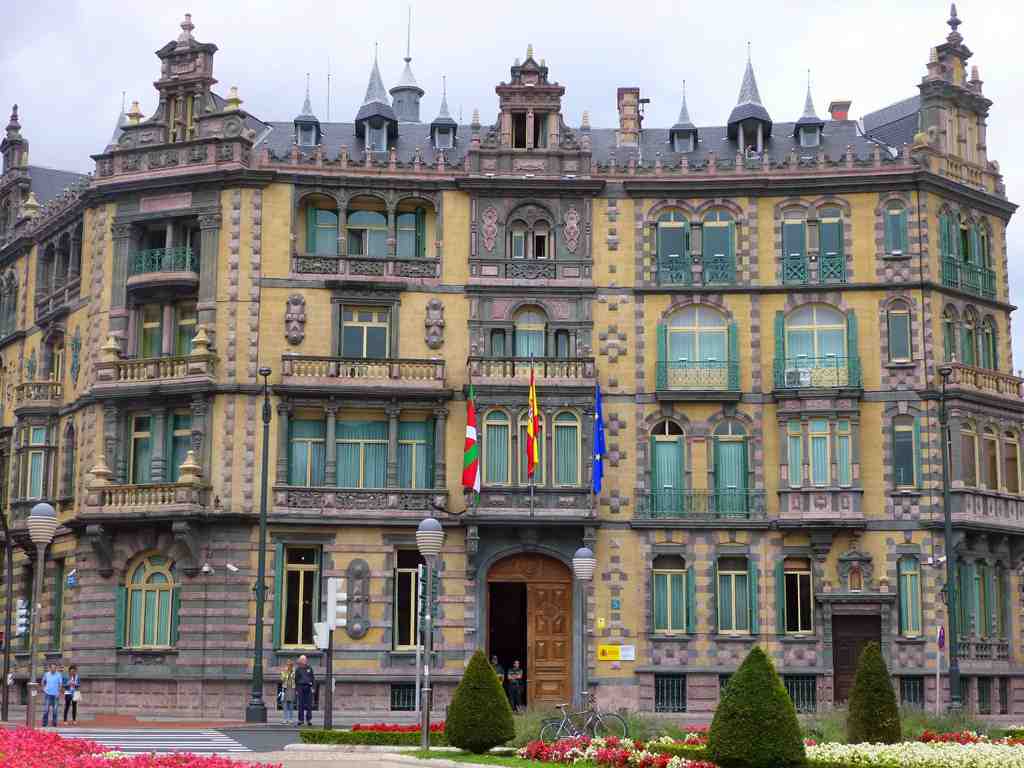
Chavarri PalacePhoto: Zarateman, Wikimedia Commons, CC BY-SA 4.0. Cropped & resized. On your right stands a pale stone palace with steep slate roofs, stepped gables, and a façade of tall windows that never quite repeat the same pattern.
This is the Chávarri Palace, the showpiece of Plaza Moyúa and one of Bilbao’s boldest declarations of arrival. In the early twentieth century, Víctor and Benigno Chávarri y Salazar commissioned it as their family residence. They chose Paul Hankar, a Belgian architect, and the Bilbao architect Atanasio de Anduiza carried the project into the street you see now. Hankar borrowed ideas from his own work in Brussels, which is why this place feels a little like Antwerp or Bruges took a train south and settled in Biscay.
Here’s a useful term for the tour: the industrial bourgeoisie. That means the urban business-owning class enriched by industry rather than old inherited titles. In Bilbao, families like the Chávarris made fortunes from the industrial boom and wanted architecture to say so... clearly, elegantly, and without much modesty.
Take a moment and scan the windows. Locals love this detail: no set is exactly the same as another. That is not accident. It turns the whole façade into a polished performance of uniqueness, wealth, and cultivated taste.
And notice where it stands. This district was part of the Ensanche expansion, meaning the planned enlargement of the city beyond the old town, with new streets and grand plots laid out in Abando. If you glance at the wider view on your screen, you can see how the palace claimed its place in that new urban canvas.
There’s a human sting here too. Víctor Chávarri fell gravely ill and died in nineteen hundred, before he could truly enjoy the house he ordered. Later, in nineteen forty-three, the family sold it to the Spanish state, and Eugenio María de Aguinaga reshaped it for government use. Franco even stayed here during his long Bilbao visit in nineteen fifty, turning private ambition into official theater.
So this palace tells you something important about modern Bilbao: planners drew the map, yes... but people with money made sure their power stood where everyone could see it. When you’re ready, Doña Casilda Iturrizar Park is about an eight-minute walk from here.
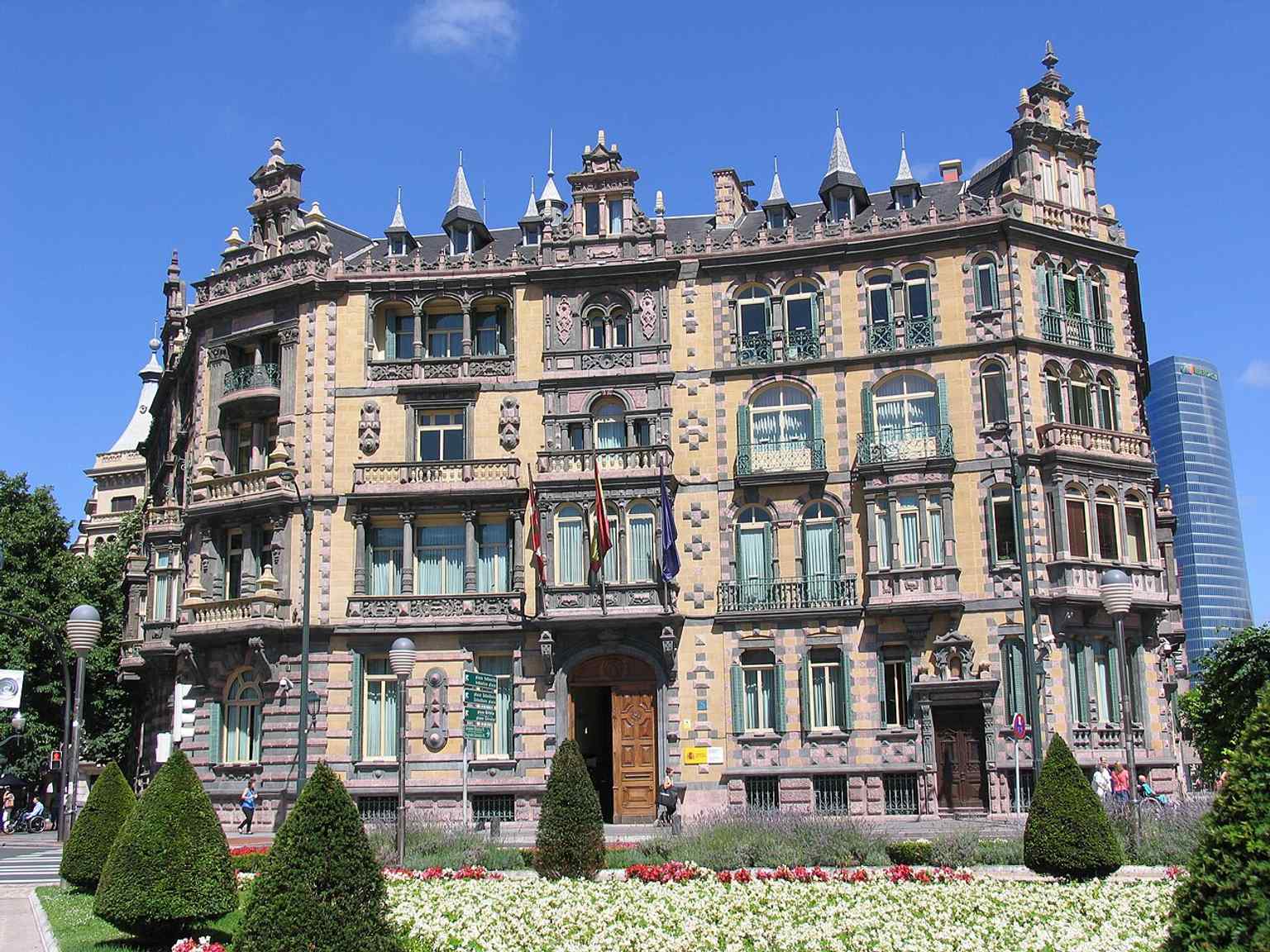
The Chavarri Palace’s ornate Flemish-style façade in Bilbao, designed by Paul Hankar and Atanasio de Anduiza, showing the public face of the house that became Spain’s government headquarters in Biscay.Photo: Alex Urcaregui, Wikimedia Commons, CC BY-SA 4.0. Cropped & resized. Ahead of you is a broad English-style park shaped by curving gravel paths, a long shaded pergola, and a pond that gives the whole place its unmistakable center. This is Doña…Read moreShow less
Open dedicated page →
Doña Casilda Iturrizar ParkPhoto: Zarateman, Wikimedia Commons, CC BY-SA 4.0. Cropped & resized. Ahead of you is a broad English-style park shaped by curving gravel paths, a long shaded pergola, and a pond that gives the whole place its unmistakable center.
This is Doña Casilda Iturrizar Park, and it carries the name of a woman Bilbao never quite forgot. Doña Casilda Iturrizar became a powerful widow after her husband, Tomás de Epalza, died in eighteen seventy-three. She inherited a huge fortune and, instead of vanishing behind private doors, she gave generously to the city... helping Basurto Hospital, La Misericordia, and even the effort to fund a university here. For a nineteenth-century benefactor, that kind of public memory is rare. In Bilbao, her name still sticks to the map.
What feels restful now came from careful planning, not accident. Bilbao’s eighteen seventy-six expansion plan reserved this land for public breathing room, and then architect Ricardo Bastida and agronomist Juan de Eguiraun turned the idea into a real park between nineteen twelve and nineteen twenty. If you glance at your screen, the wide view shows that old ambition clearly: a formal city park, but softened by trees and open space.
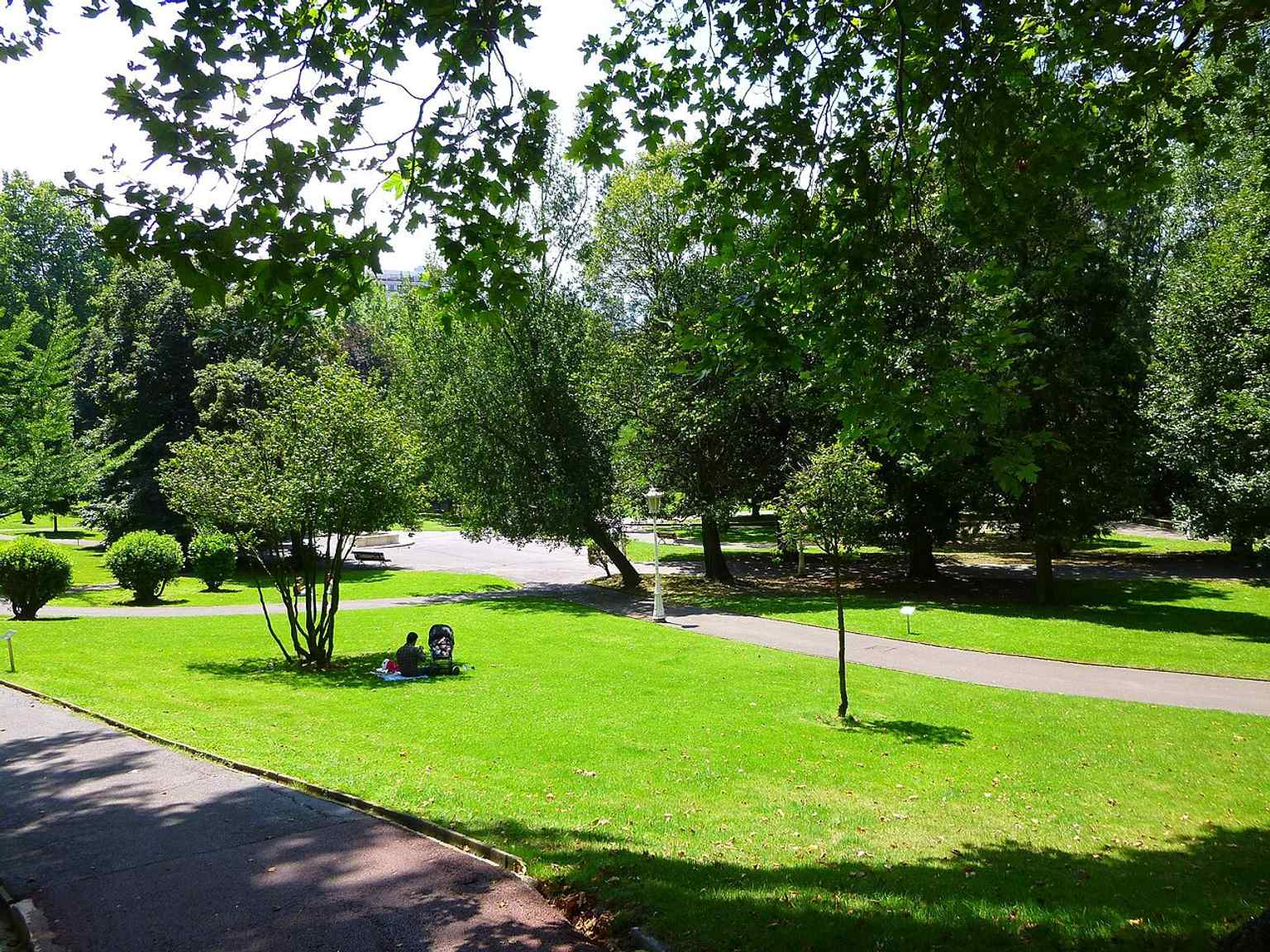
A broad view of Doña Casilda Iturrizar Park, Bilbao’s historic green heart and long-time public garden in the Indautxu district.Photo: Zarateman, Wikimedia Commons, CC BY-SA 4.0. Cropped & resized. Locals affectionately call it Parque de los Patos... Duck Park... because of the pond and its waterfowl. But it is also a quiet outdoor memory book. There’s Casilda’s effigy here, a sculpture by Eduardo Chillida, a tribute to the clown Tonetti, and Aureliano Valle’s monumental fountain. Take a look at the fountain image in the app and you can see how the park doubles as a memorial without ever feeling stiff.
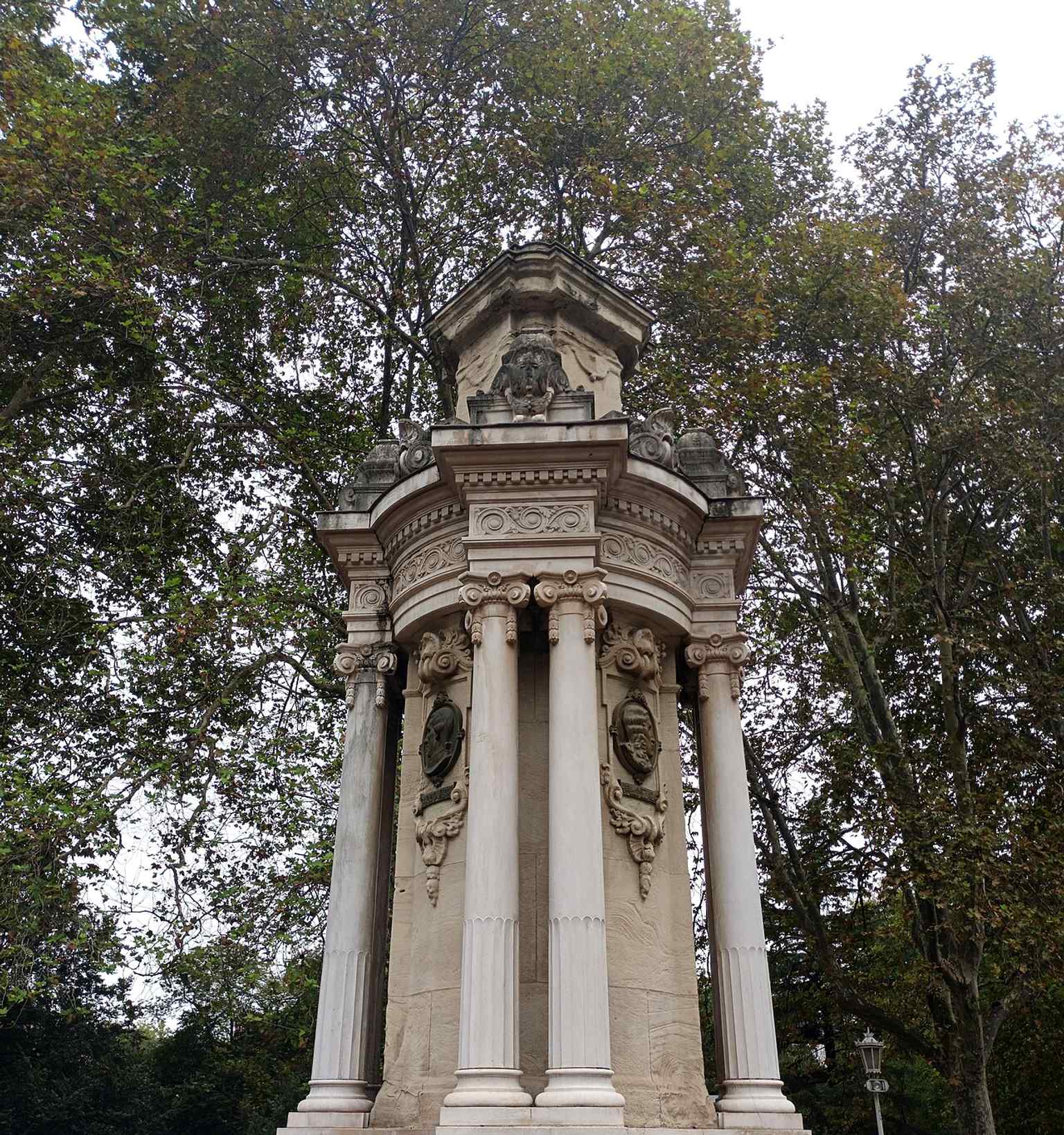
The park’s fountain, one of the memorial features that help turn Doña Casilda park into an open-air tribute to Bilbao’s history.Photo: Acediscovery, Wikimedia Commons, CC BY 4.0. Cropped & resized. Its identity even shifted with politics. During the Spanish Civil War, people called it Parque de las Tres Naciones. In nineteen forty-five, the city restored Casilda’s name. Later, roads and the Fine Arts Museum cut into the park, and then the Abandoibarra redevelopment gave some of that ground back, stretching green space over former shipyard land.
So here’s the question to carry with you: does a city reveal itself more by the fortunes it creates, or by what those fortunes return to everyone else? Up ahead, that question follows us to the old industrial river edge at Euskalduna. And one practical note: this park is open all day, every day.
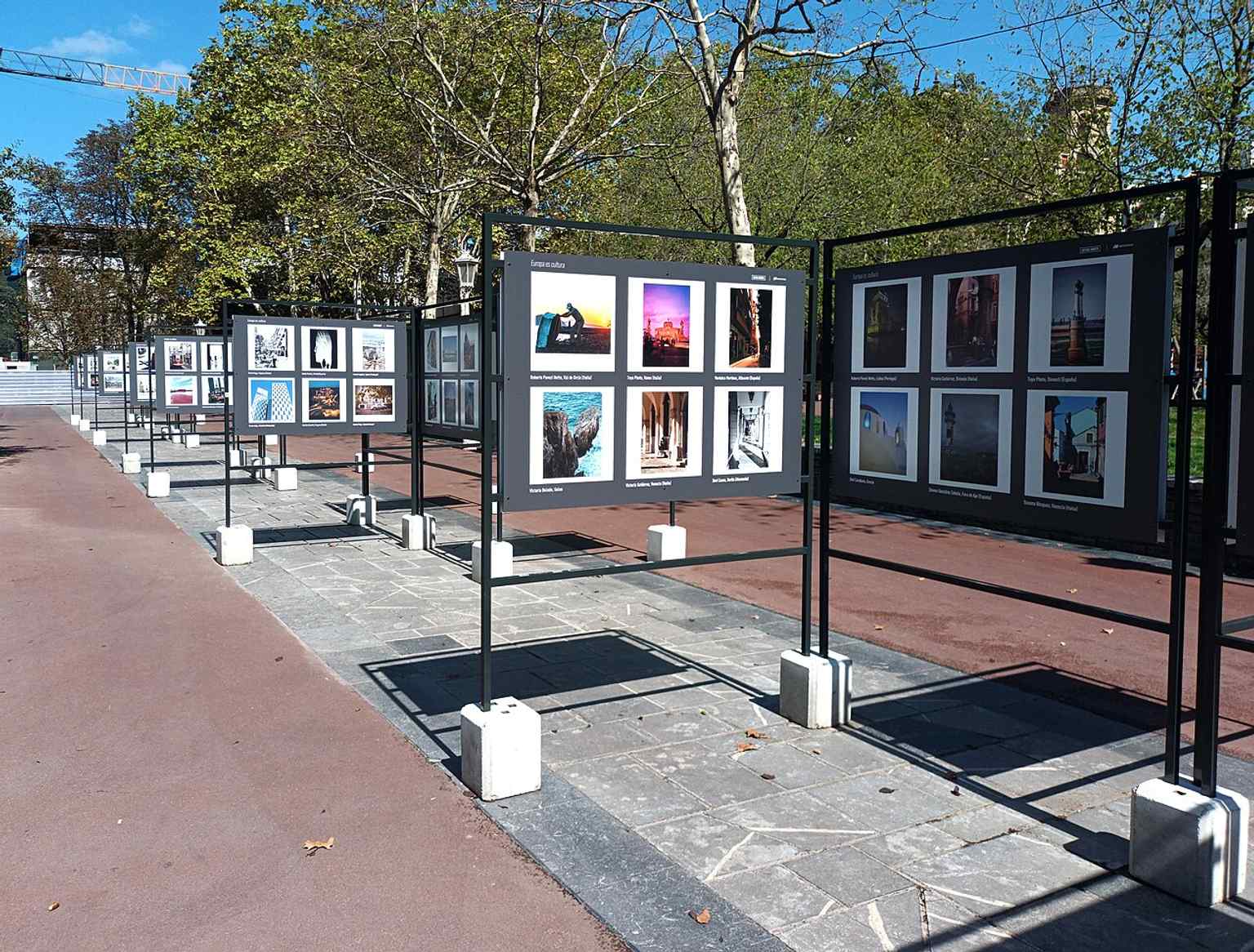
An outdoor exhibition staged in the park, showing how Doña Casilda Iturrizar Park still serves as a public cultural venue.Photo: Acediscovery, Wikimedia Commons, CC BY 4.0. Cropped & resized.

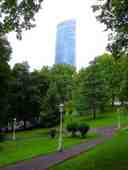
Show 12 more stopsShow fewer stopsexpand_moreexpand_less
On your left, the Euskalduna looks like a giant rust-red ship run aground: broad corten-steel walls, sharp hull-like angles, and a long sloping edge that feels almost like a…Read moreShow less
Open dedicated page →On your left, the Euskalduna looks like a giant rust-red ship run aground: broad corten-steel walls, sharp hull-like angles, and a long sloping edge that feels almost like a prow.
This is one of Bilbao’s boldest acts of translation. Before this hall stood here, this ground belonged to the former Euskalduna shipyard. In nineteen ninety-three, crews cleared away the last remains of those yards, and the city made a choice: not to hide the industrial past under a pretty blanket, but to recast it in steel, scale, and swagger.
Architects Federico Soriano and Dolores Palacios led that move. They designed this place beside the estuary as a kind of memory machine, and the corten steel was no accident. That weathered metal deliberately echoes the last vessel launched from the old yards. If you glance at the image on your screen, the ship idea becomes even clearer from a wider angle.
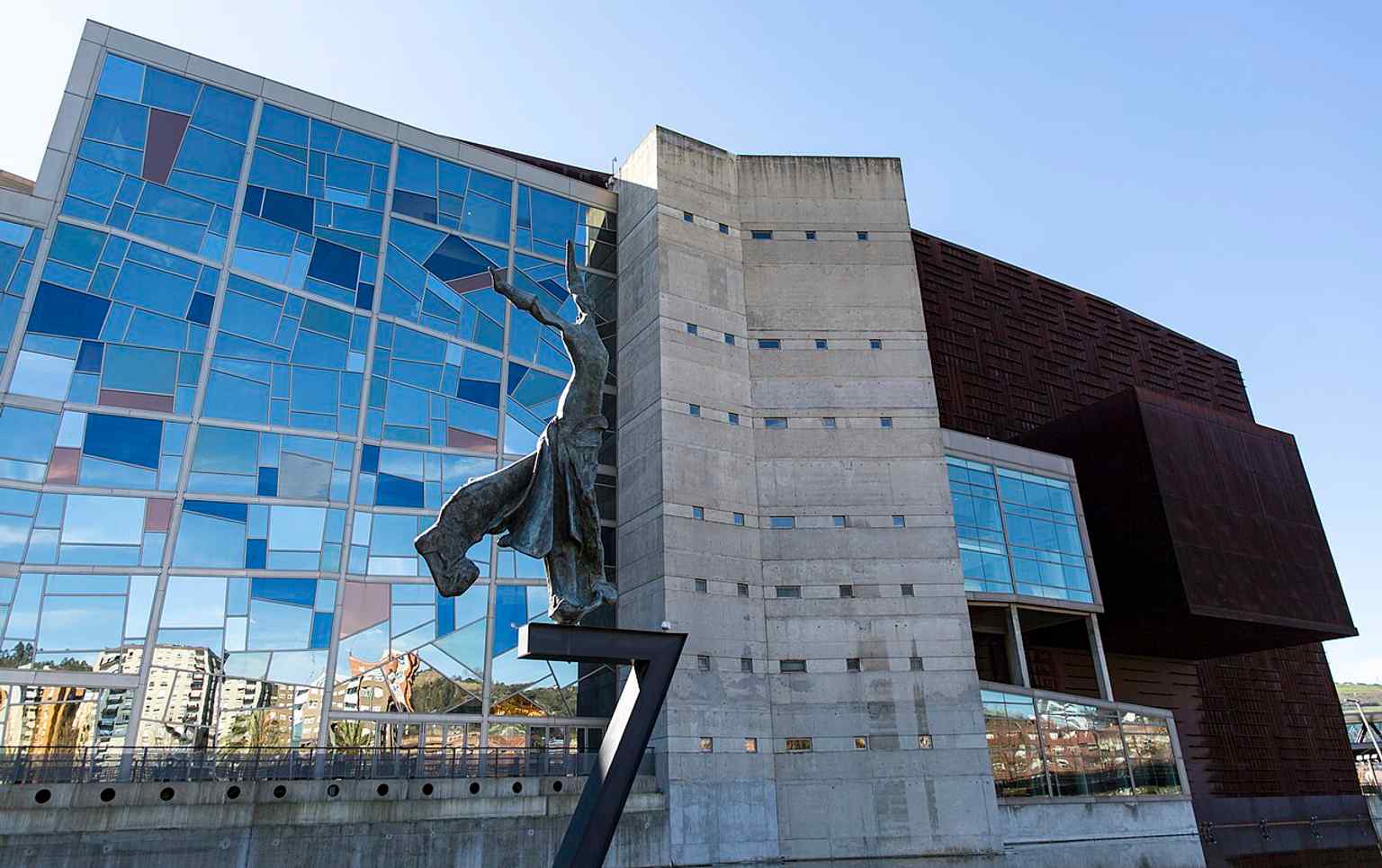
A high-resolution exterior of Euskalduna Palace, the corten-steel landmark built on the former Euskalduna shipyard site to echo a ship from Bilbao’s industrial past.Photo: PA, Wikimedia Commons, CC BY-SA 4.0. Cropped & resized. Now here is the part most people miss. Inside, the building works like two interwoven systems. The architects created separate vestibules - entrance halls, basically - so opera audiences and conference delegates can move through the complex without tangling into one giant coat-check traffic jam, while still sharing the same vast interior voids and circulation spaces. It is half theatre, half congress engine, and all of it runs with a certain industrial logic. Very Bilbao.
The place opened in February of nineteen ninety-nine, and it did not open timidly. The first major opera night brought the Mariinski Theatre from Saint Petersburg, with Valery Gergiev conducting a demanding Musorgsky work. That choice mattered. The organizers could have gone for an easy crowd-pleaser, but instead they chose discovery over nostalgia. That tells you a lot about the city standing here and saying, more or less, we remember what we were, but we are not going backward.
Inside are a concert hall, an opera house, conference facilities, exhibition space, rehearsal rooms, dressing rooms, even restaurants. The main auditorium seats two thousand one hundred sixty-four people, and its stage is unusually large, stretching across one thousand seven hundred seventy square meters. In two thousand three, the complex earned major recognition as a leading congress centre, and it also took the Enric Miralles award. Not bad for ground that once rang with instead of applause.
If you check the other exterior image, you can see how massive and layered the whole complex is, more like urban infrastructure than a single hall. That matters, because this is the hinge in Bilbao’s story: shipbuilding gave way not to amnesia, but to culture, business, and public performance on the very same soil.
Ahead, the University of Deusto and the Guggenheim will offer two different answers to the same question: when an industrial city remakes itself, what comes next? We’ll head to the university next, about a fourteen-minute walk from here. If you want to plan an interior visit later, public opening hours are generally Tuesday through Friday from five to eight in the evening, with Monday and the weekend closed.
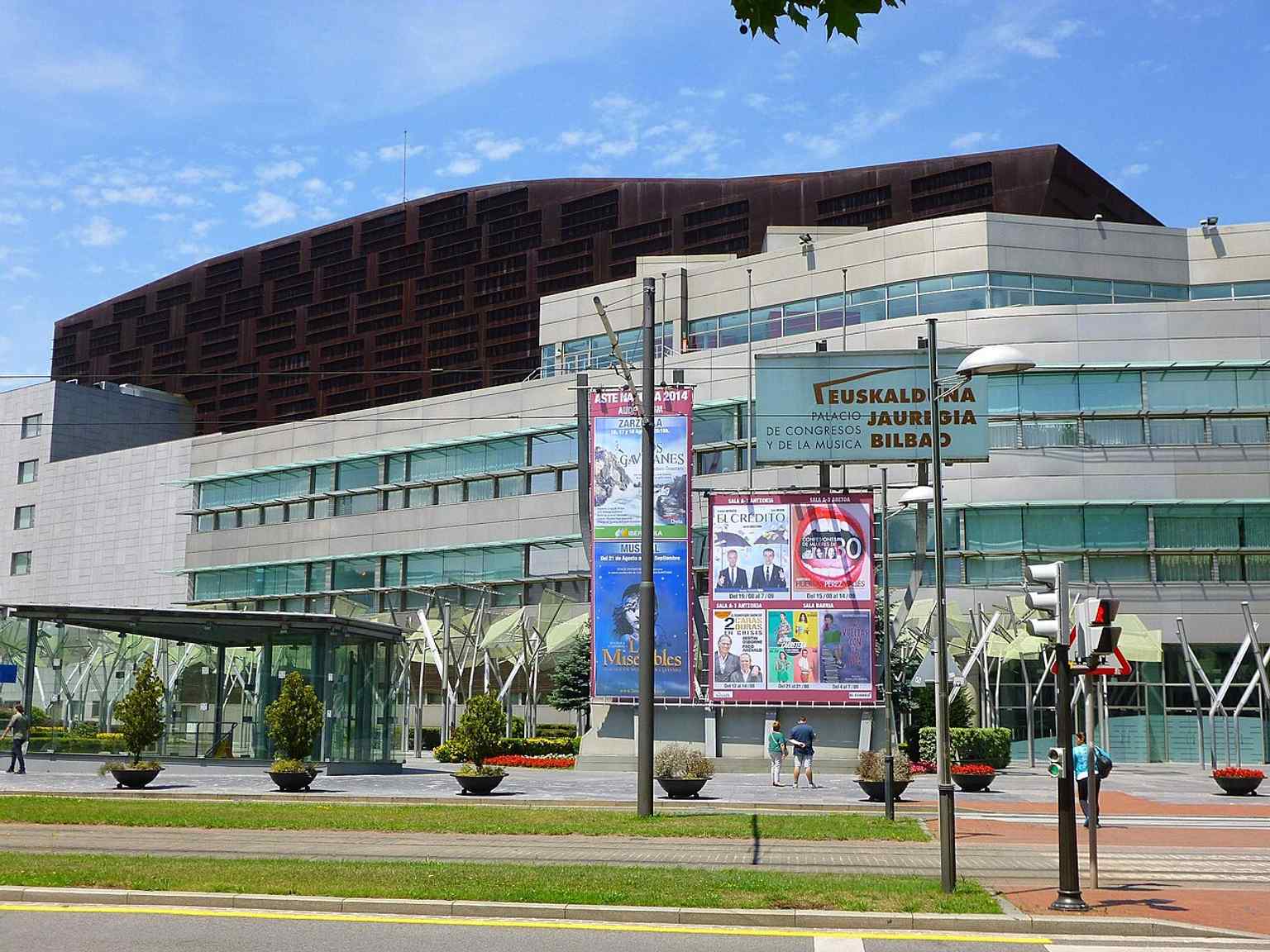
The conference and concert complex from another angle, matching the building’s role as a major opera, concert, and congress venue in Abandoibarra.Photo: Zarateman, Wikimedia Commons, CC BY-SA 4.0. Cropped & resized. On your right, the University of Deusto shows itself as a long pale-stone facade with orderly rows of arched windows and a central pediment that gives the whole building the calm…Read moreShow less
Open dedicated page →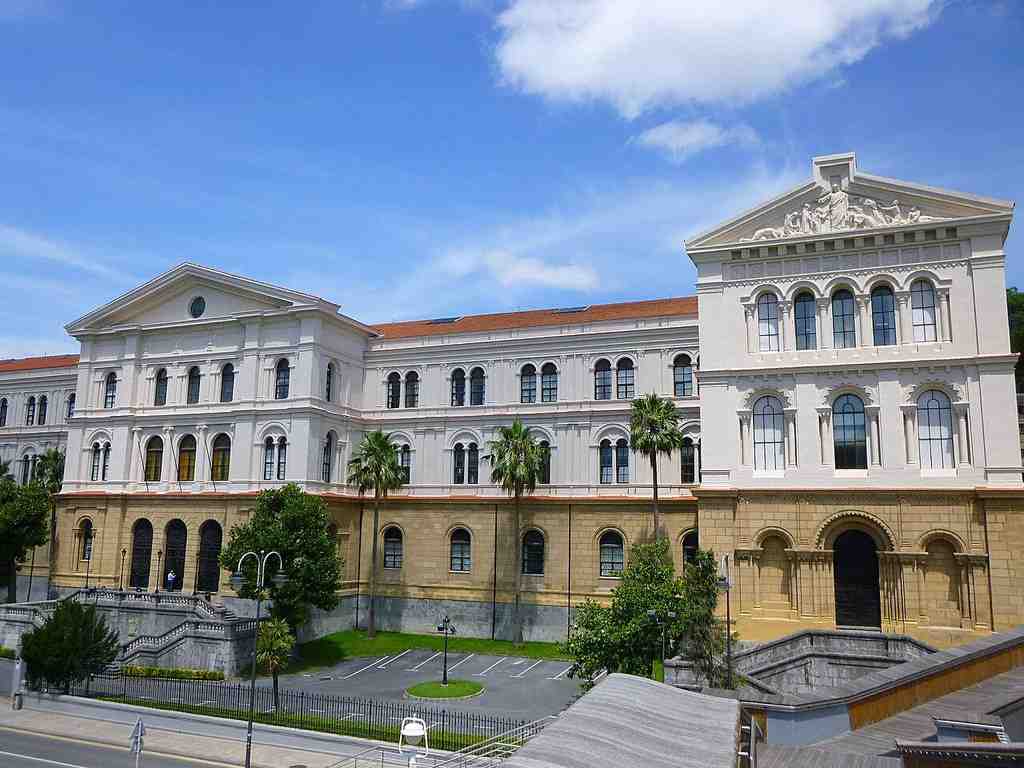
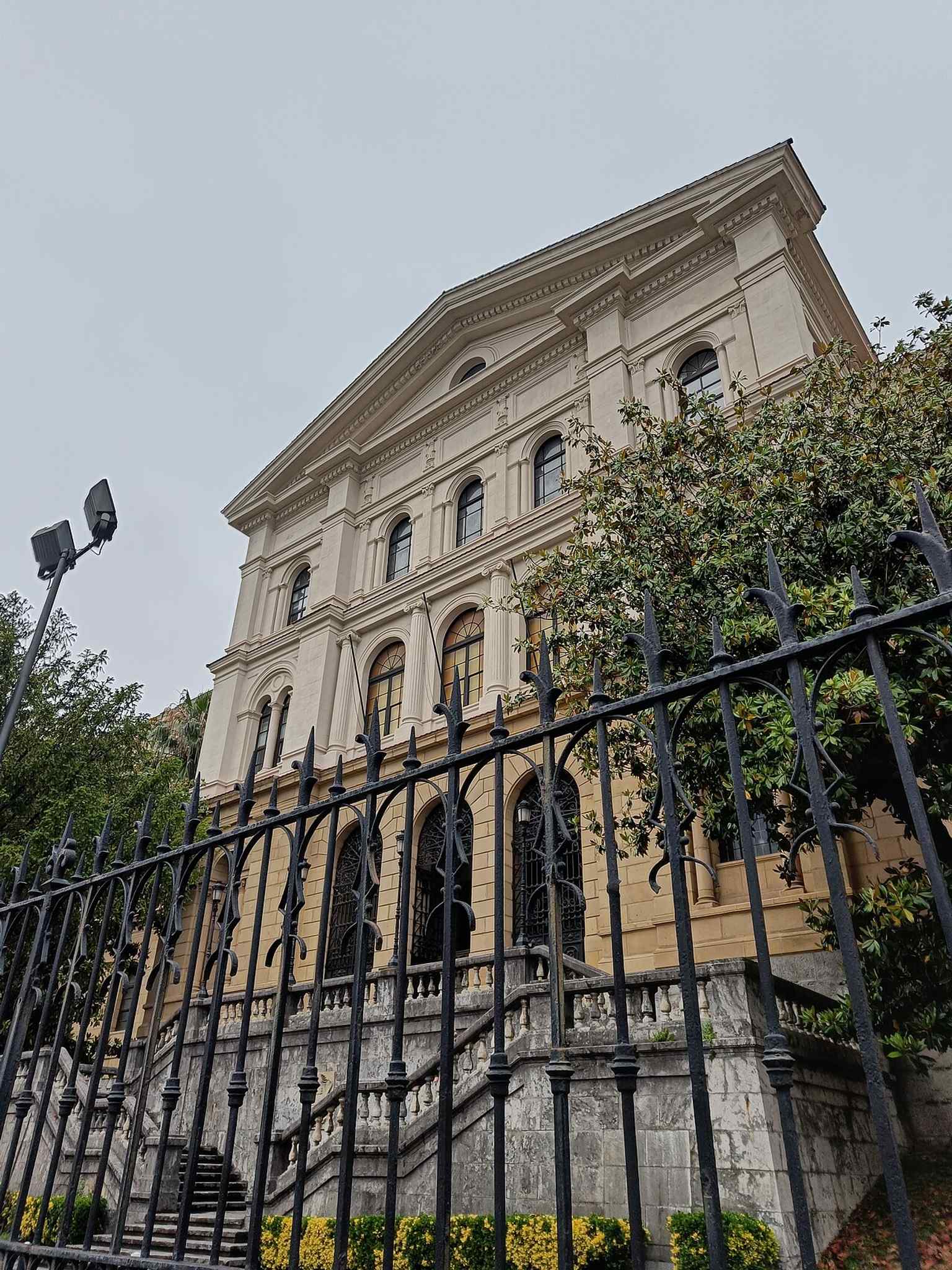
University of DeustoPhoto: Zarateman, Wikimedia Commons, CC BY-SA 4.0. Cropped & resized. On your right, the University of Deusto shows itself as a long pale-stone facade with orderly rows of arched windows and a central pediment that gives the whole building the calm authority of a scholarly palace.
From where you stand across the street, you are looking at the historic heart of Deusto, often called La Literaria. If you glance at your screen, the image helps pick out that formal, balanced front more clearly. It is handsome, yes, but its real importance is less about style than about intention. Bilbao did not reinvent itself with docks, banks, and grand avenues alone. It also needed trained minds... lawyers, teachers, business leaders, engineers, people who could turn industrial muscle into a durable society.
The main façade of Deusto’s La Literaria building, the historic heart of the university founded by the Jesuits in 1886.Photo: Miren Pascual, Wikimedia Commons, CC BY-SA 4.0. Cropped & resized. The Jesuits, the Catholic order that runs this university, are specialists in organized learning. They build systems that outlast political swings: classrooms, libraries, habits of study, a kind of intellectual scaffolding for a city.
They founded Deusto in eighteen eighty-six, when Bilbao and its port were growing fast and the Basque Country wanted a university of its own. That choice mattered. The Ensanche was pushing the city outward, and here, across the river, education was expanding its reach in parallel. One side laid out streets; the other trained the people who would fill the offices on them.
Deusto became Spain’s oldest private university, and one of its most respected. One of its boldest moves came in nineteen sixteen, when the university launched what became the Commercial University of Deusto. Its first students graduated with Deusto’s own business qualification a full twenty-five years before Spain officially recognized degrees in economics. That is a pretty good example of Bilbao behavior: if the rulebook is late, start working anyway.
But this facade has seen far more than lectures. In nineteen thirty-two, during the Second Republic, the government dissolved the Jesuit order in Spain and confiscated its property, so the university closed. Then, after Bilbao fell in June of nineteen thirty-seven, this main building became the central and permanent core of a Francoist concentration camp. It also served as a prison, a hospital, and a base for organizing prisoner battalions until December of nineteen thirty-nine. That is a hard layer of memory to carry beneath such a composed exterior.
One person tied to this place stands out: Jesús María Leizaola. Later rector José María Guibert said Leizaola had the vision and the determination to save these buildings during the occupation. Without that intervention, this campus might not have survived at all. So when you look at the stone and symmetry, you are also looking at something rescued.
Deusto kept adapting. It opened in San Sebastián in nineteen fifty-six. In nineteen sixty-seven, its theology faculty arrived from Oña, and the Vatican authorized it to admit all kinds of students, not only future clergy. Much later, architect Rafael Moneo designed the university’s new library, opened in two thousand and nine with ten floors, five of them underground, and a translucent glass skin carefully designed not to compete with the Guggenheim nearby. You can see the broader campus shape on your phone here.
That is the thread to keep in mind as we head on: before Bilbao unveiled its global icon, it spent generations building quieter engines like this one. The next stop is the city’s most famous leap onto the world stage.
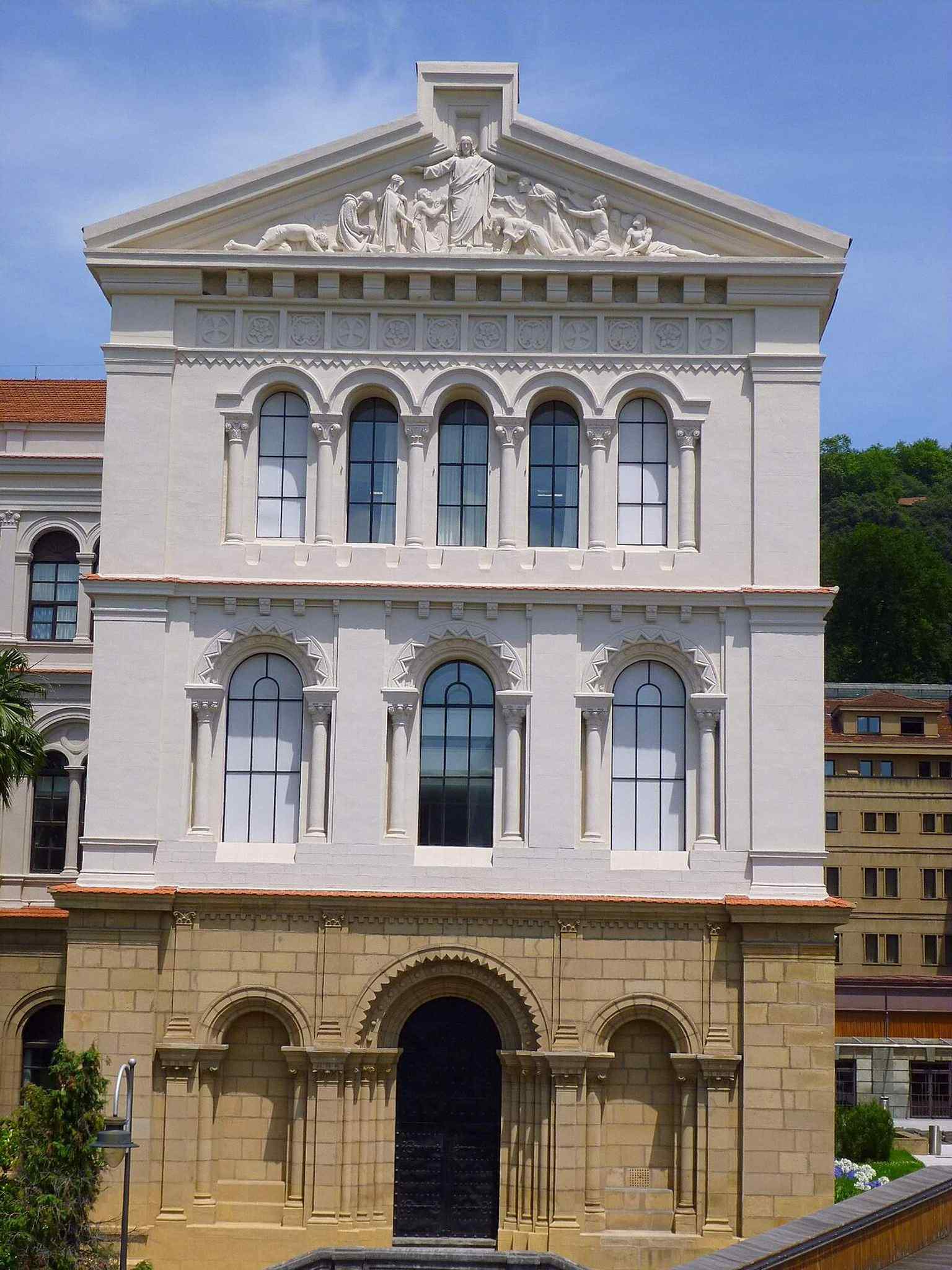
The University of Deusto’s central building in Bilbao, an emblematic Jesuit campus tied to the city’s academic and industrial growth.Photo: Zarateman, Wikimedia Commons, CC BY-SA 4.0. Cropped & resized. On your left, the Guggenheim is a swirl of silver titanium panels and pale limestone blocks wrapped around a tall glass atrium, the central hall, that Frank Gehry nicknamed “the…Read moreShow less
Open dedicated page →On your left, the Guggenheim is a swirl of silver titanium panels and pale limestone blocks wrapped around a tall glass atrium, the central hall, that Frank Gehry nicknamed “the Flower.”
This is the moment Bilbao announced itself to the world in a language everyone could read... not smokestacks, not shipbuilding, but spectacle. In the early nineteen nineties, the Basque Government looked at this worn-out port district and made a calculated gamble: spend about one hundred million dollars on a museum here, add fifty million for art, pay the Guggenheim Foundation to run it, and trust culture to do what industry no longer could. That wager became the Guggenheim turning point. After it opened in October of nineteen ninety-seven, nearly four million visitors came in the first three years, generating around five hundred million euros for the local economy.
And the building itself? Well, it does not exactly tiptoe. Gehry designed the exterior curves to feel almost random, so they catch light differently from every angle. More than thirty-three thousand thin titanium plates, arranged like scales, sit over steel; from some views the whole thing feels like a fish, from others a ship, from others a controlled explosion that somehow landed gracefully. If you check the river view in the app, you’ll see how the museum really opens itself toward the water, where the old industrial edge becomes sculpture.
Most people admire the skin and never realize the miracle was also technical. Gehry’s team used CATIA, software first developed for aerospace design, to calculate every curve, beam, and panel point by point. That may sound dry, but in plain English it meant this wild-looking thing could actually get built on time and on budget... a minor miracle in architecture, like finding a parking spot exactly where you need it.
Now for the part locals don’t forget. Just before the opening, E-T-A militants hid four anti-tank grenades in a planter outside, planning to trigger them on inauguration day. A Basque police officer, José María Aguirre Larraona, confronted them, and they shot him; he later died of his wounds. Bomb-sniffing dogs had been checking the museum every hour, which tells you how close that attack came. So this shimmering landmark entered the world not only as a civic celebration, but as a security emergency.
That double edge has never fully gone away. Critics praised the “Bilbao effect” and others called it gentrification with a fancy façade. Even the workers behind the scenes had to push back: in twenty twenty-one and twenty twenty-two, the museum’s cleaners, mostly women, struck for two hundred and eighty-five days before winning better pay and full-time contracts. And when leaders later proposed expanding into the Urdaibai estuary, a protected wetland, environmental groups and locals fought the plan until it was abandoned; the image in the app shows the landscape at the heart of that argument.
So yes, this place is dazzling. But it is also a reminder that reinvention always sends somebody the bill. Up next, about a three-minute walk away, we meet the museum’s softest-looking ambassador, Puppy... and even that friendly face has a carefully managed story. If you want to go inside later, the museum is generally open Tuesday through Sunday from ten to seven, and closed on Monday.
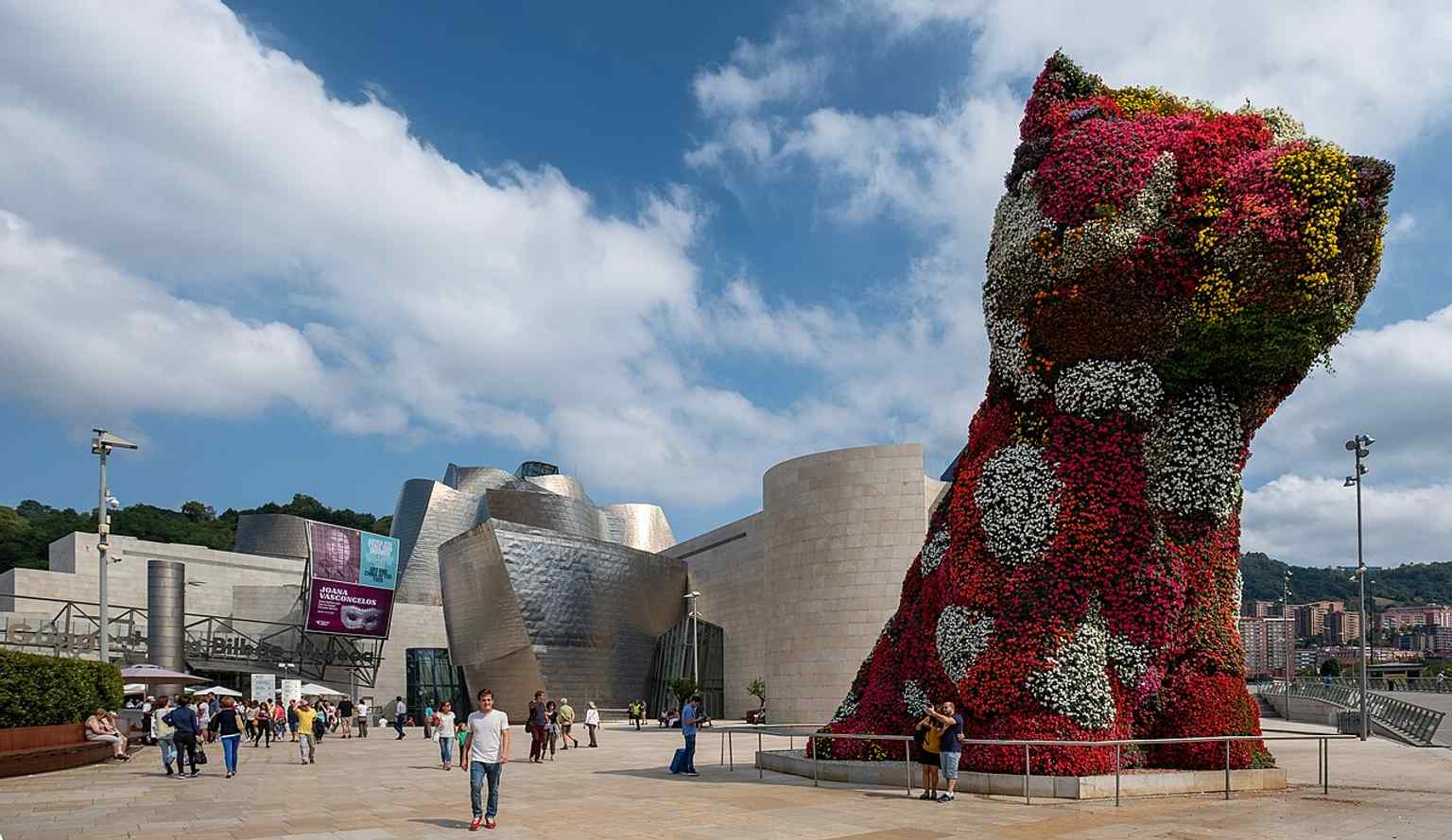
Jeff Koons’s Puppy, the flower-covered terrier that has become one of Bilbao’s most beloved museum icons.Photo: Jules Verne Times Two, Wikimedia Commons, CC BY-SA 4.0. Cropped & resized. On your left stands a giant terrier shaped from a steel frame and wrapped in a thick skin of living flowers, its rounded muzzle and upright ears giving it the unmistakable look of…Read moreShow less
Open dedicated page →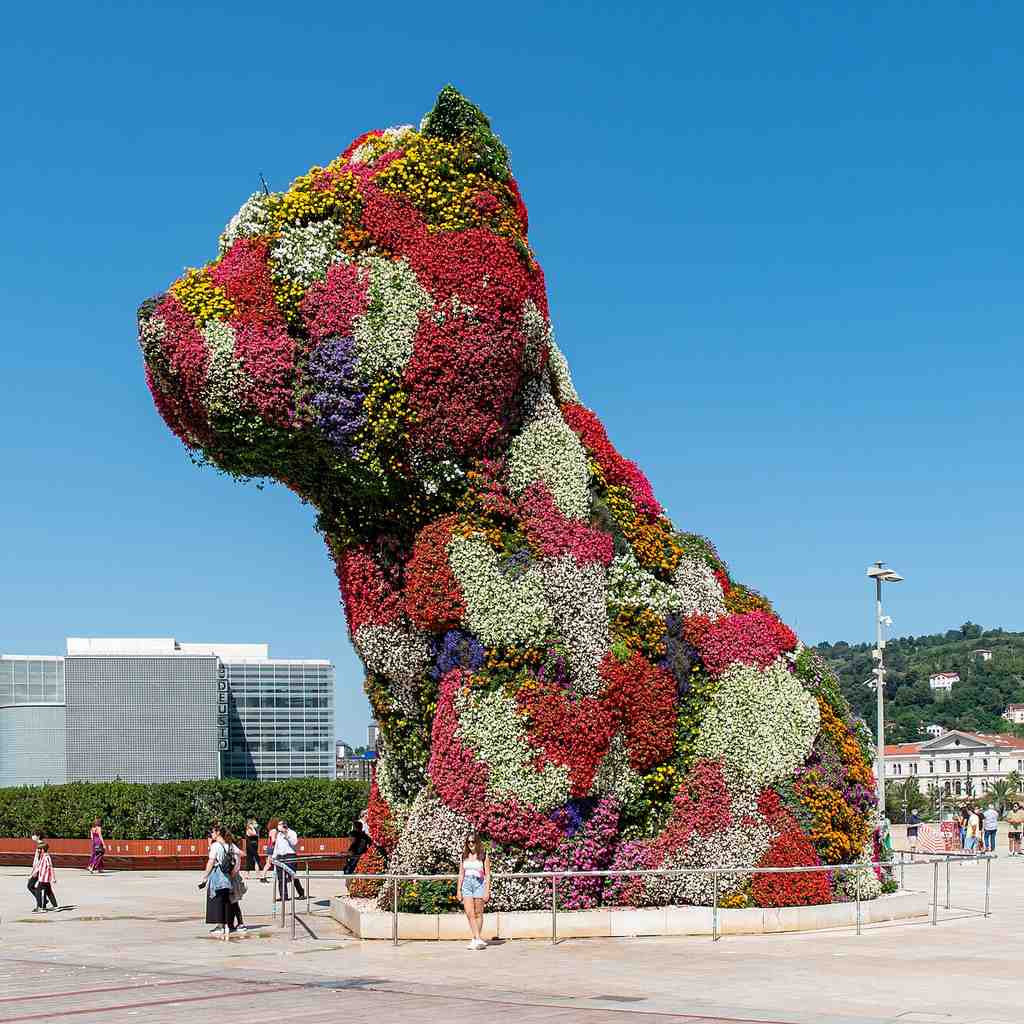
Puppy (sculpture)Photo: José Ligero Loarte, Wikimedia Commons, CC BY-SA 4.0. Cropped & resized. On your left stands a giant terrier shaped from a steel frame and wrapped in a thick skin of living flowers, its rounded muzzle and upright ears giving it the unmistakable look of an oversized West Highland White Terrier.
Puppy is one of Bilbao’s most cheerful ambassadors... and also one of its best little lessons in how this city remakes itself. Jeff Koons created it in nineteen ninety-two, and he gave the world a pop-art charmer that behaves more like a garden than a statue. From a distance, it looks simple enough: a big friendly dog. Up close, it turns into a negotiation between planning and wildness. Koons himself boiled it down to “control and disorder.” First you engineer every inch of it with precision; then you hand part of the result over to roots, water, bloom cycles, and plain old plant stubbornness.
That idea fits Bilbao pretty well, if you ask me. The city has spent this whole walk showing us that careful ambition can still produce messy, living results.
Before Bilbao claimed Puppy as its own in October of nineteen ninety-seven, the sculpture had a short first life in Germany as a temporary installation for Documenta Nine. That early version stood about eleven meters tall, used wood, and disappeared when the exhibition ended. So even this icon began as something temporary, a visitor testing how art could change a place.
Now have a good look at the surface... not the outline, the coat. Notice how it never reads like paint. It’s textured, uneven, alive. If you check the image on your screen, you can see that floral skin in close detail. This one sculpture carries around thirty-eight thousand plants, all rooted into layers held by an internal steel structure. They replace the planting twice a year, and the job usually takes about nine days with a team of twenty gardeners. Behind that grin is a serious machine: one hundred and fourteen irrigation outlets feed water and plant treatments through the body.
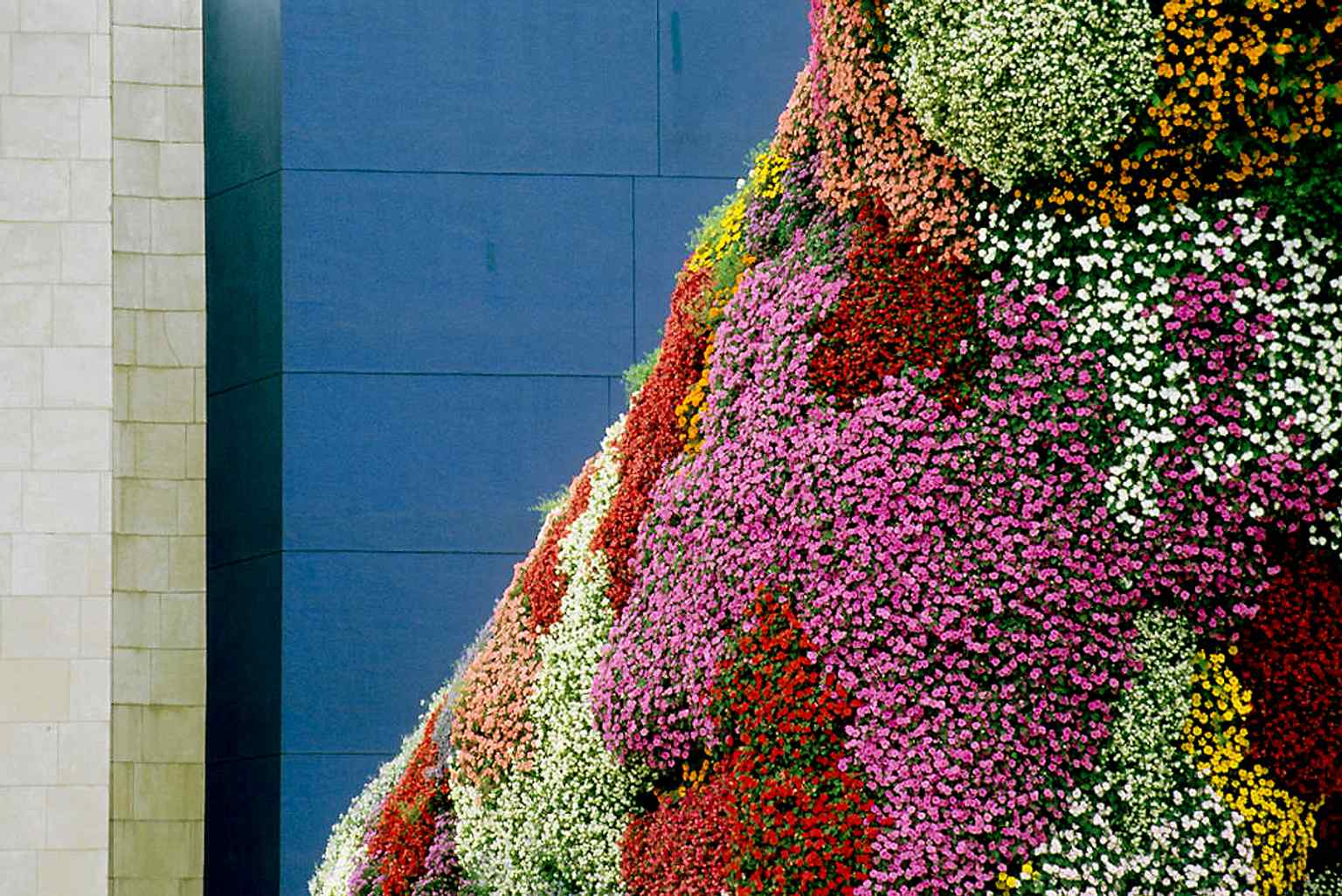
A closer look at Puppy’s floral surface, where thousands of plants form the terrier’s coat and are renewed twice a year.Photo: LBM1948, Wikimedia Commons, CC BY-SA 4.0. Cropped & resized. Koons used sophisticated computer models to shape Puppy so it could wink at the formal European gardens of the eighteenth century, those aristocratic landscapes where nature got dressed up and taught manners. But he also wanted optimism, confidence, and security. In plain English: a monumental flower dog that makes people smile before they start asking bigger questions.
And there are bigger questions. In two thousand twenty-one, the museum launched a crowdfunding campaign, Da Vida a Puppy, to help renew the sculpture’s irrigation and support systems. The community pitched in, and the work kept this local mascot viable for the long haul.
If you want a nice backstage reminder, the app’s image five shows Puppy under scaffolding during maintenance. That’s the secret here: Bilbao’s friendliest face depends on labor, money, horticulture, and patience.
Even its image can evolve. In two thousand twenty, Puppy wore a floral face mask after a Bilbao resident wrote to Koons with the idea during the pandemic. The plants took weeks to bloom, so the gesture appeared gradually, as if the sculpture itself were thinking it over.
So here we have a living artwork in a city that keeps revising itself: polished on the postcard, complicated in the plumbing. Our next stop, Zubizuri, is another modern symbol with elegant lines and a few practical headaches of its own, about a twelve-minute walk away. And unlike the museum behind it, Puppy keeps watch here twenty-four hours a day.
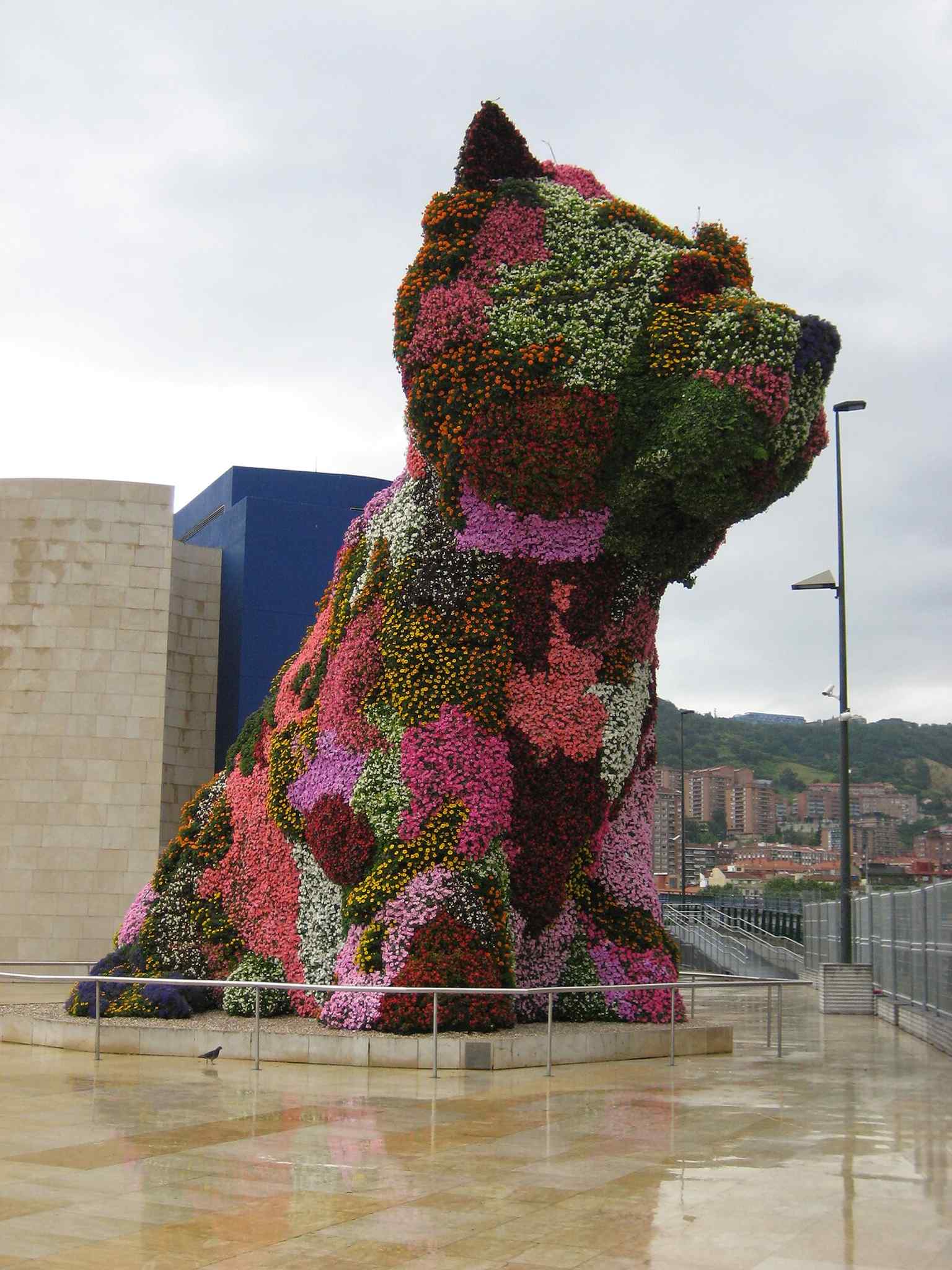
A tall, close outdoor view that emphasizes Puppy’s massive scale and the living carpet of plants that changes through the seasons.Photo: Ernmuhl at lb.wikipedia, Wikimedia Commons, CC BY-SA 3.0. Cropped & resized. 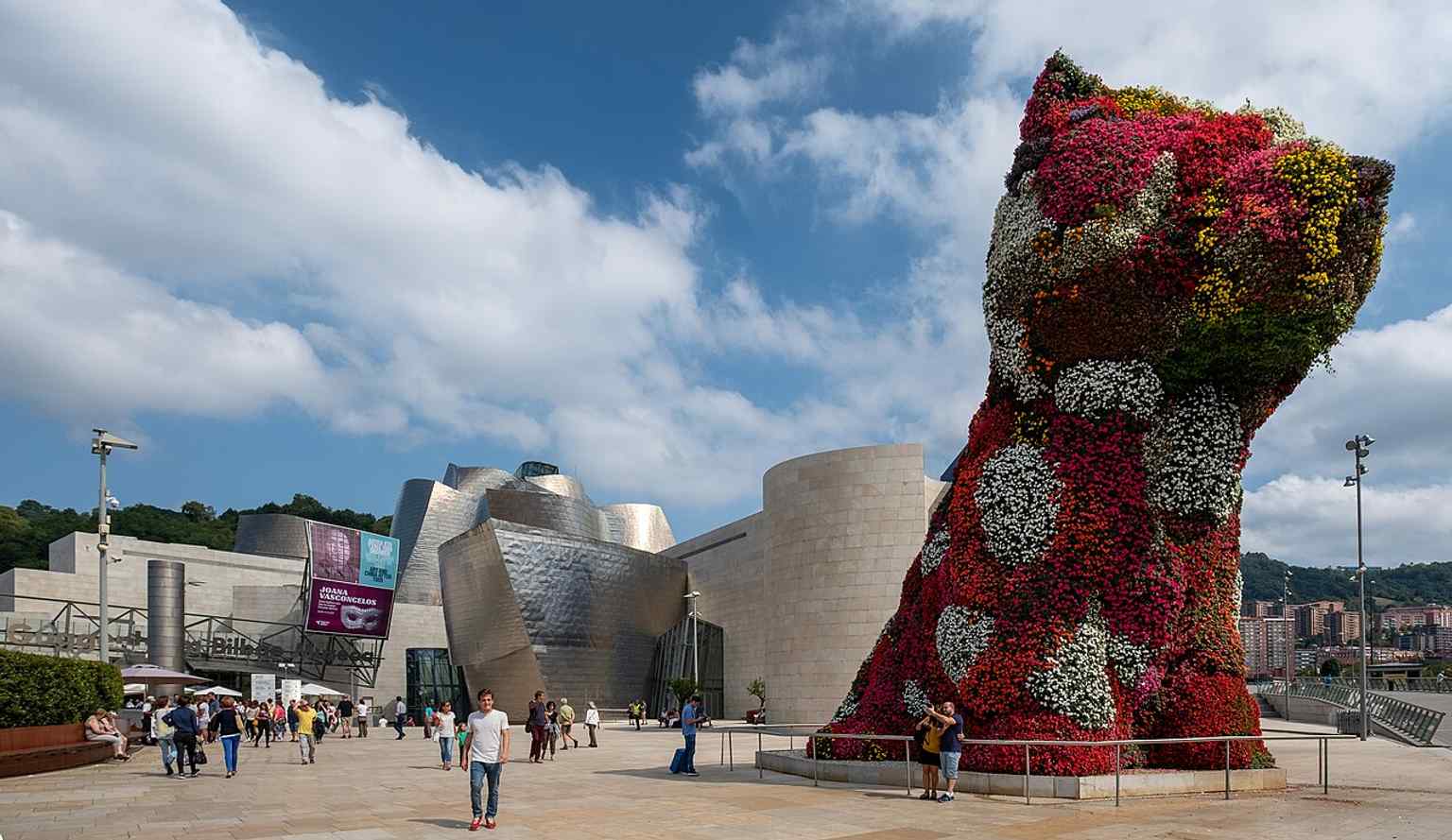
A strong architectural context shot: Puppy in front of the Guggenheim, linking Koons’s bright sculpture with Bilbao’s museum icon.Photo: Jules Verne Times Two, Wikimedia Commons, CC BY-SA 4.0. Cropped & resized. 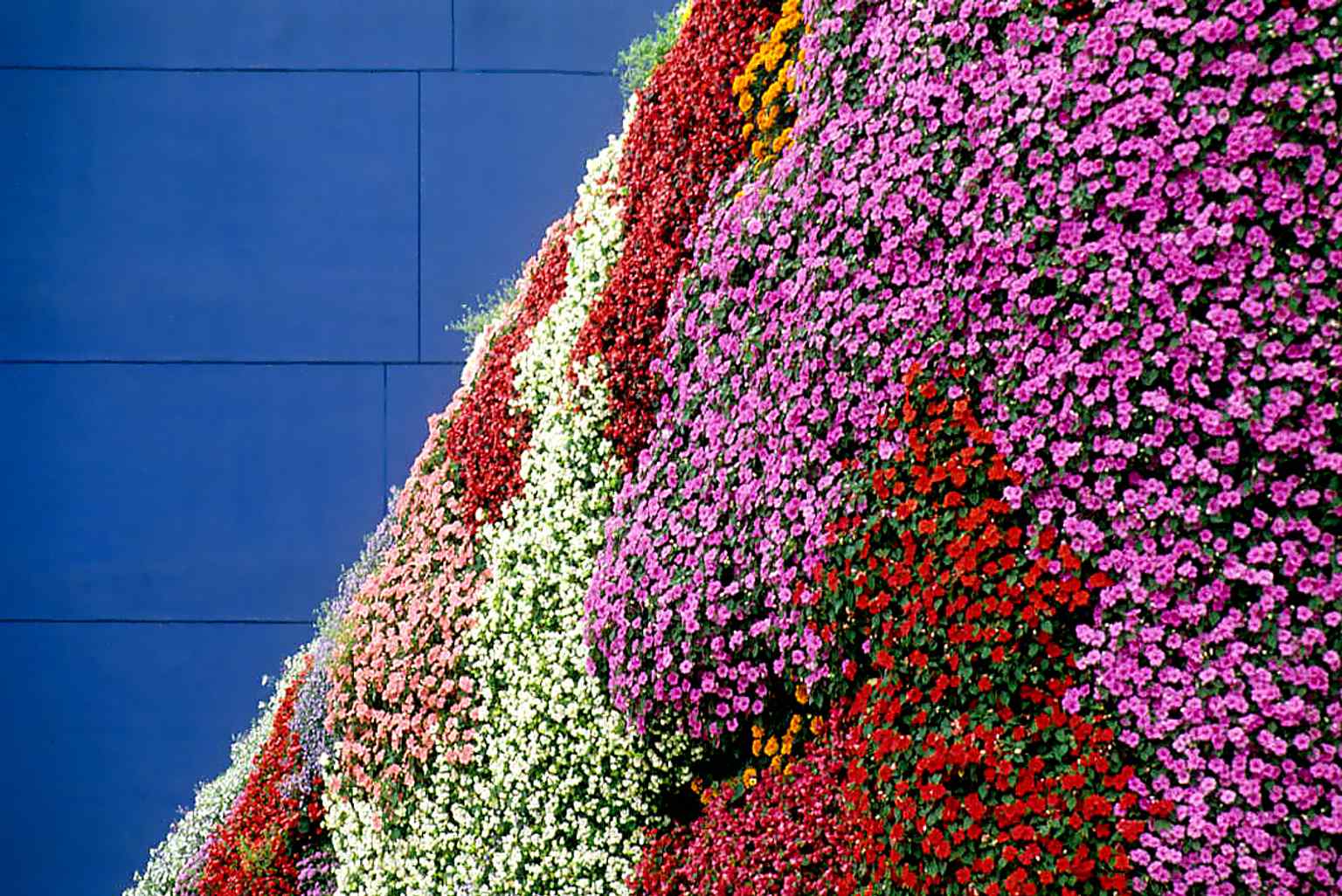
Another detail view of the living flower skin, useful for showing the sculpture’s hand-built, seasonal texture up close.Photo: LBM1948, Wikimedia Commons, CC BY-SA 4.0. Cropped & resized. 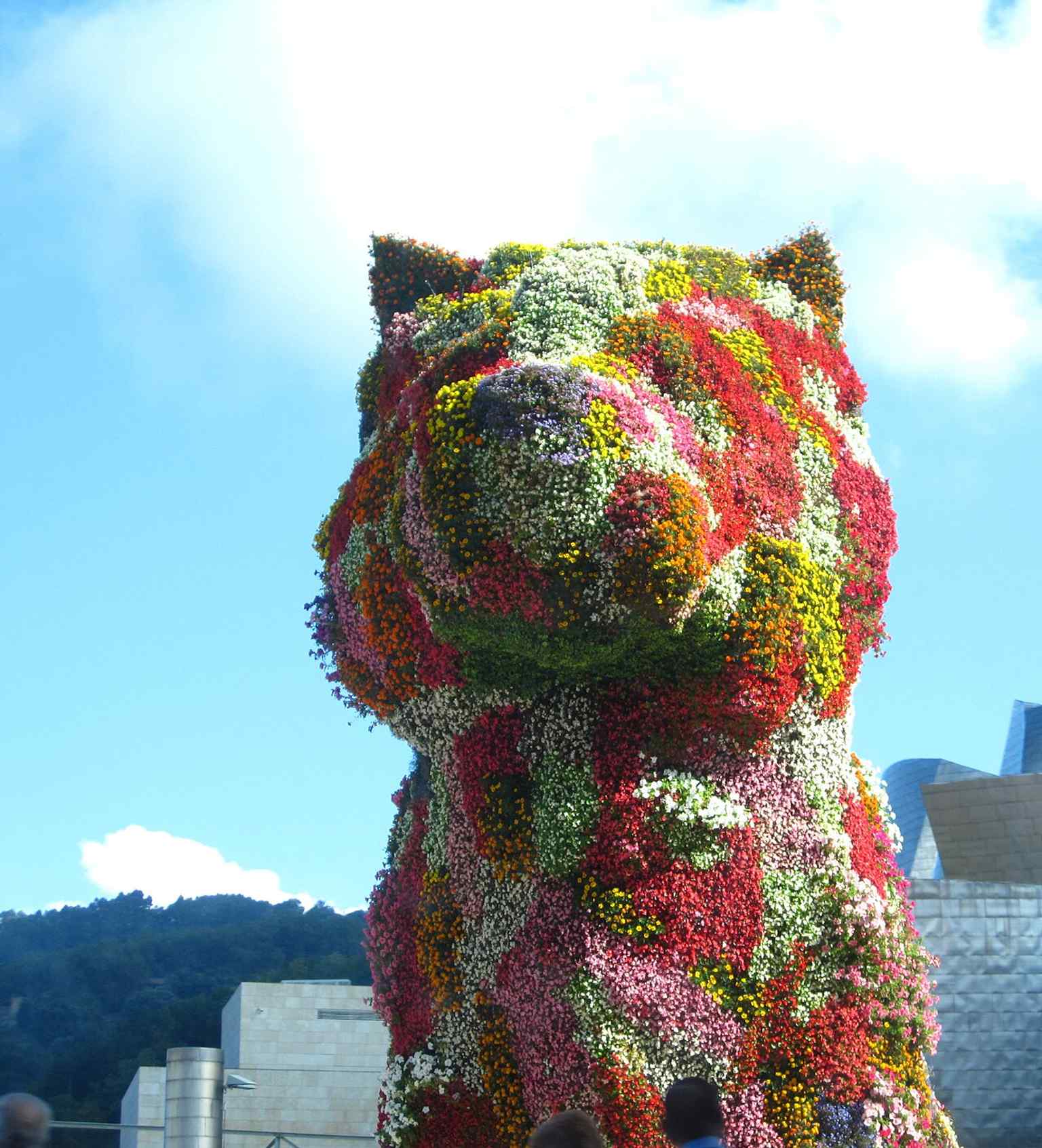
A dramatic, artful view of Puppy that captures its cheerful, almost theatrical presence — exactly the optimistic image Koons wanted.Photo: Jeff Koons, Wikimedia Commons, CC BY-SA 3.0 es. Cropped & resized. 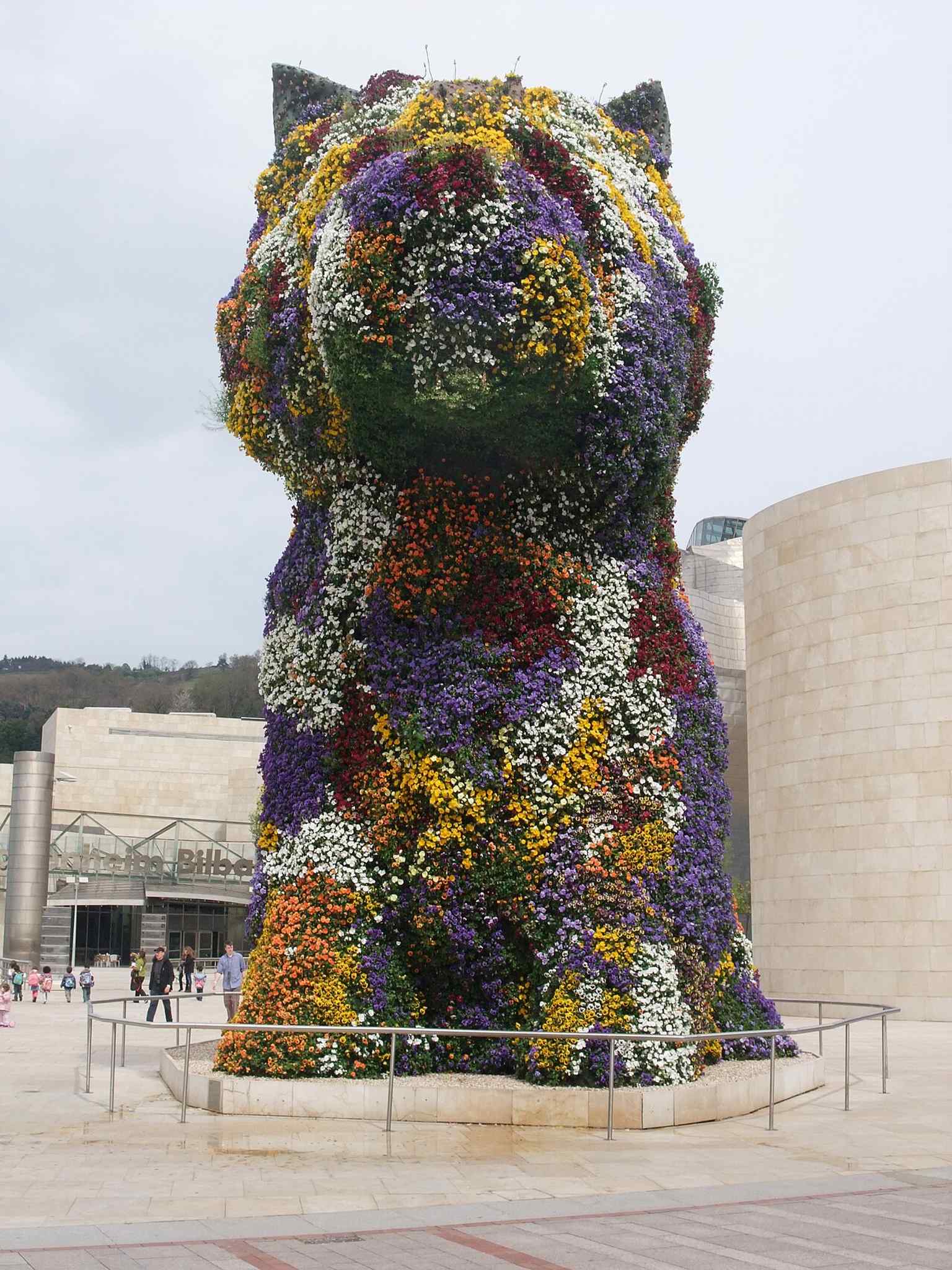
Puppy standing beside the Guggenheim in Bilbao, reinforcing the sculpture’s role as a beloved city landmark.Photo: Javi Guerra Hernando, Wikimedia Commons, CC BY-SA 4.0. Cropped & resized. 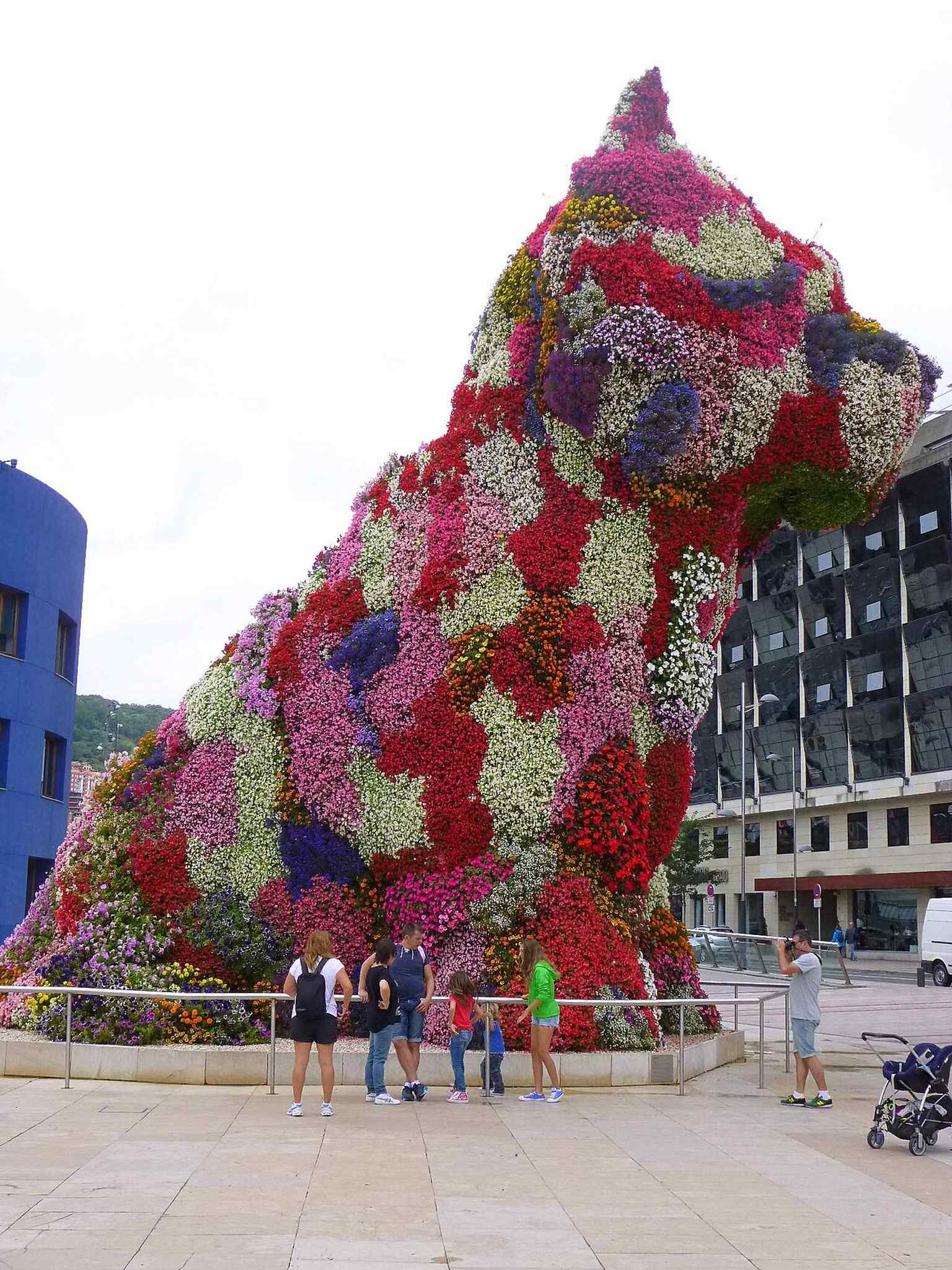
A clean mid-distance view of Puppy on the museum terrace, good for showing the sculpture’s proportion and placement.Photo: Zarateman, Wikimedia Commons, CC0. Cropped & resized. 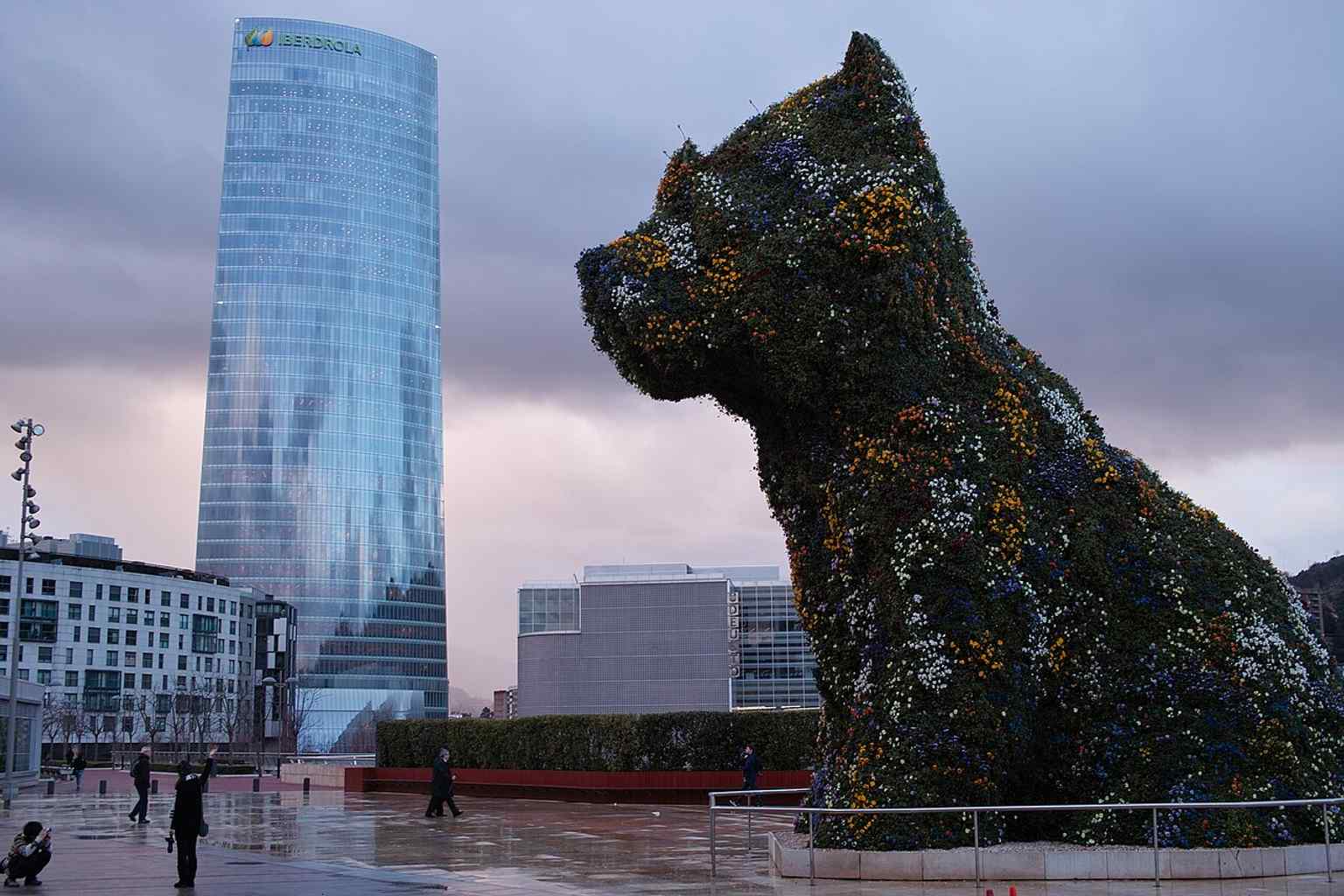
A wider cityscape view of Bilbao with Puppy and the skyline, helping place the sculpture within the modern riverfront setting.Photo: Nicolas Vigier from Paris, France, Wikimedia Commons, CC0. Cropped & resized. 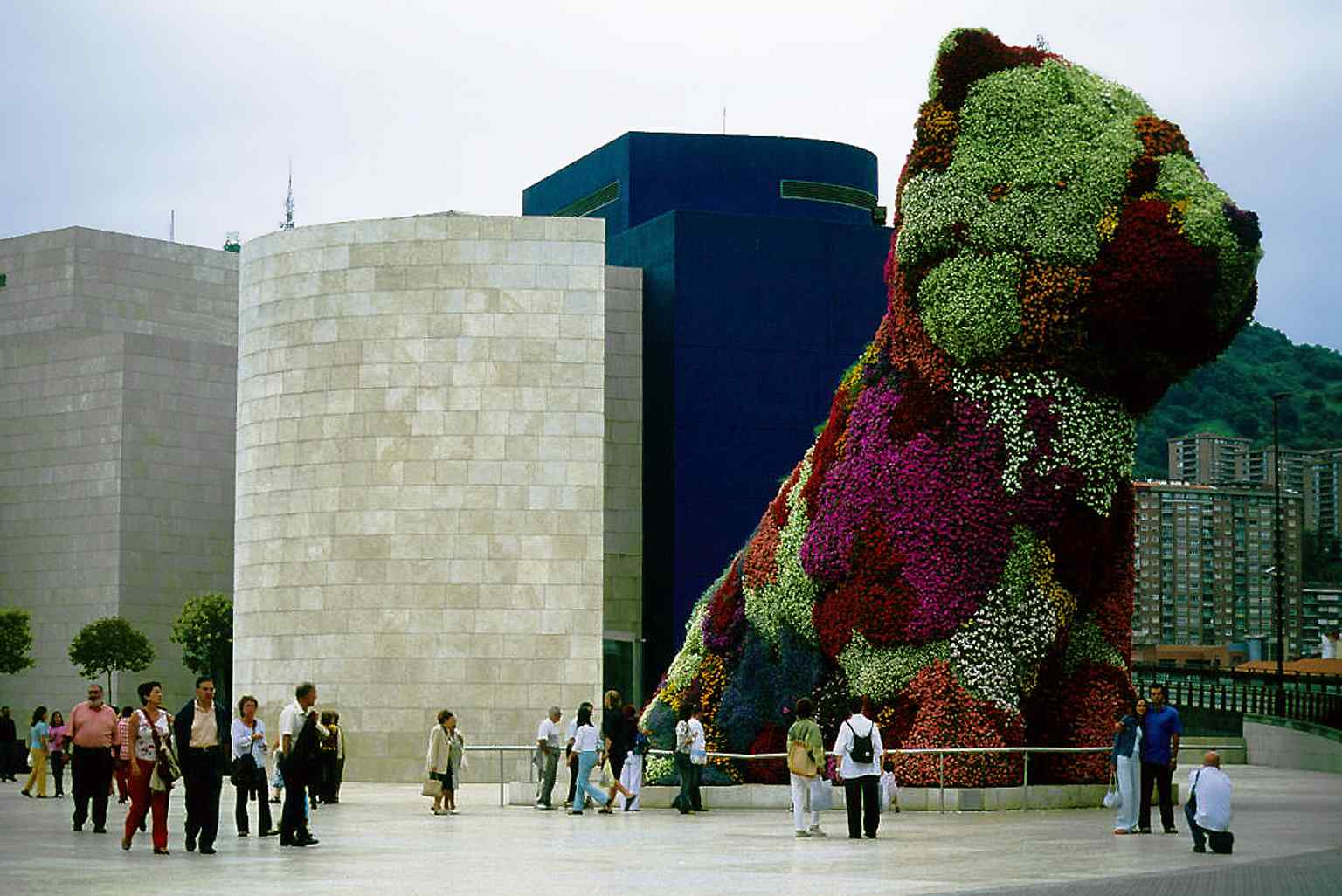
An early 2002 view of the flower dog outside the museum, before later maintenance campaigns and replanting projects.Photo: LBM1948, Wikimedia Commons, CC BY-SA 4.0. Cropped & resized. In front of you is a bright white pedestrian bridge with a tilted steel arch, a curved suspended deck, and fine cable lines that make it look almost like a drawn bow across the…Read moreShow less
Open dedicated page →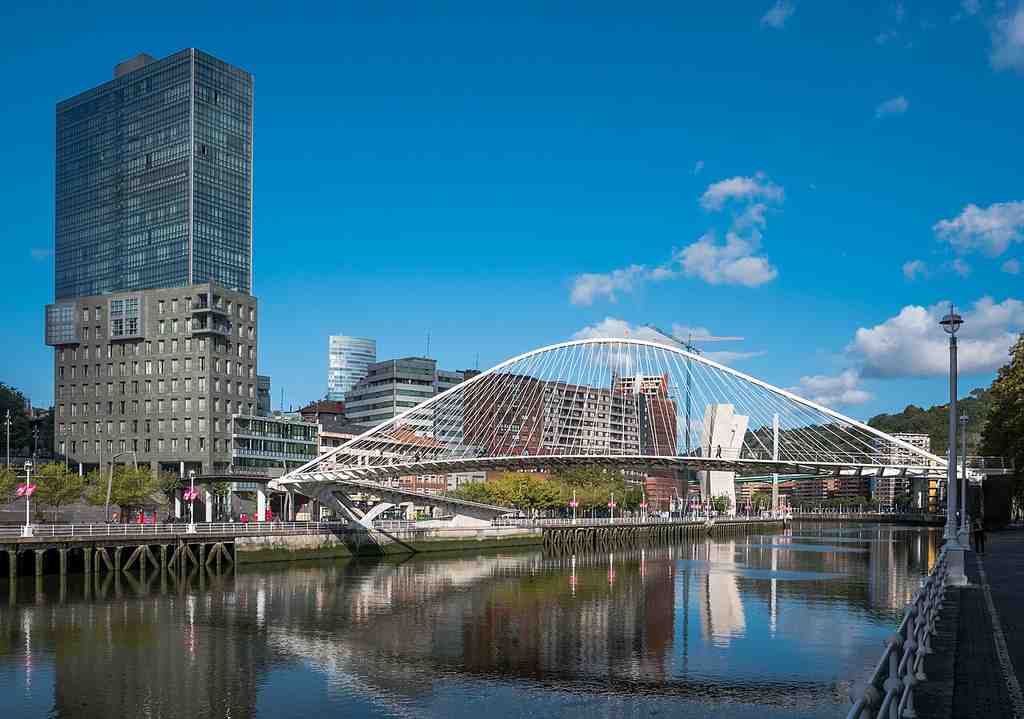
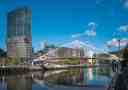
ZubizuriPhoto: Basotxerri, Wikimedia Commons, CC BY-SA 4.0. Cropped & resized. In front of you is a bright white pedestrian bridge with a tilted steel arch, a curved suspended deck, and fine cable lines that make it look almost like a drawn bow across the river.
This is Zubizuri, which in Basque means White Bridge... and for once, the city kept the naming nice and simple. Architect Santiago Calatrava designed it in the nineteen nineties, construction began in nineteen ninety, and Bilbao opened it on the thirtieth of May, nineteen ninety-seven. It links the Campo de Volantín side to Uribitarte, and from the start it announced a new version of the city: cleaner lines, big gestures, and a riverfront made for walking instead of heavy industry.
If you glance at the image on your screen, the upward view really shows Calatrava’s trick here: that inclined arch carries the walkway with iron cables, so the whole bridge seems to float rather than simply sit on supports. It is elegant, photogenic, and very much part of the same Bilbao makeover that gave the world the Guggenheim.

An upward-looking view that emphasizes the inclined arch and cable-supported deck — the bridge’s most distinctive structural feature.Photo: Basotxerri, Wikimedia Commons, CC BY-SA 4.0. Cropped & resized. Now for the twist. Beautiful design does not always mean friendly shoes.
The original walkway used glass tiles. They looked sleek, modern, almost jewel-like. But in daily use, people slipped. A lot. The city first tried anti-slip strips over the glass. Then it tested special transparent tiles meant to prevent falls. In the end, Bilbao covered the walkway with a plastic anti-slip carpet, which is about as close as architecture gets to admitting, “Well... that did not go exactly as planned.” Most visitors admire the white arch and never realize that one of the bridge’s most famous stories is about the floor, not the skyline.
And there was more. Some of those glass panels cracked and needed frequent replacement, first blamed on vandalism, later tied mainly to temperature changes. Maintenance costs kept piling up. So this bridge became a symbol of renewal, yes, but also a very local lesson: a city has to live with its icons, not just photograph them.
That tension became personal through Iñaki Azkuna, Bilbao’s mayor. He openly said he himself had fallen here before becoming mayor, which turned a design problem into something more human than a municipal report. When officials later wanted easier access up toward the city center, they approved a connecting walkway by Japanese architect Arata Isozaki in two thousand and six. If you look at the app image with the Isozaki connection, you can see the addition that sparked the argument.
Calatrava sued in two thousand and seven, saying the city had damaged the integrity of his creation - in plain English, the legal right of an artist or architect to object when others alter the work. A court first said the bridge had indeed been altered, but public use mattered more. On appeal, another court awarded Calatrava thirty thousand euros in two thousand and nine, far less than the three million euros he sought. He donated the money to Bilbao’s Casa de la Misericordia.
So Zubizuri is not just a pretty bridge. It is Bilbao in miniature: ambition, reinvention, argument, compromise... all crossing the same river.
From here, we turn toward Arenal, about a five-minute walk away, where public life in Bilbao played out long before white steel and designer lawsuits entered the picture. And like any good bridge, Zubizuri stays open all day, every day.
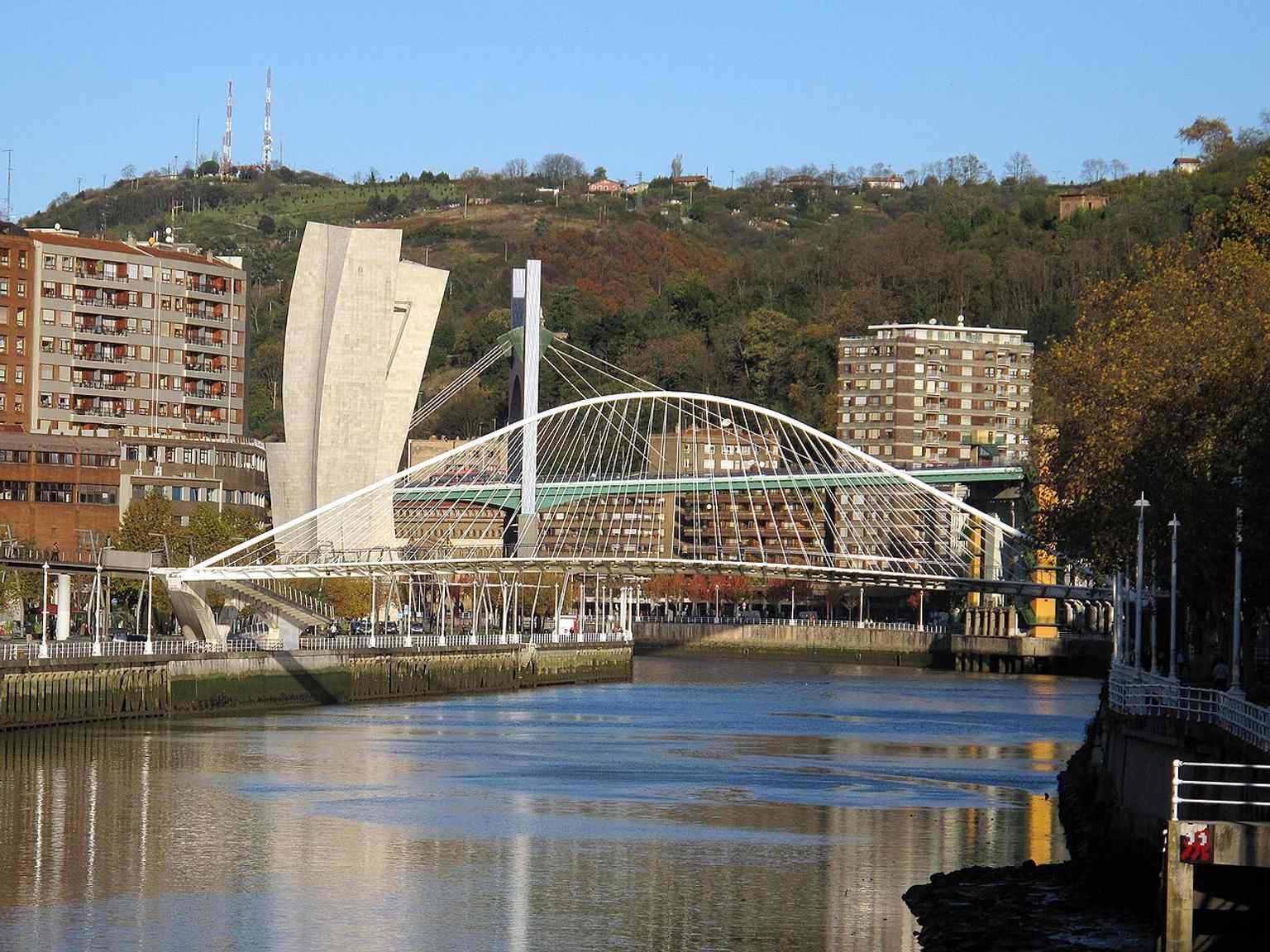
A classic side view of the White Bridge, showing Santiago Calatrava’s elegant 1990s design over the Nervión River.Photo: Kamahele, Wikimedia Commons, CC BY-SA 3.0 de. Cropped & resized. 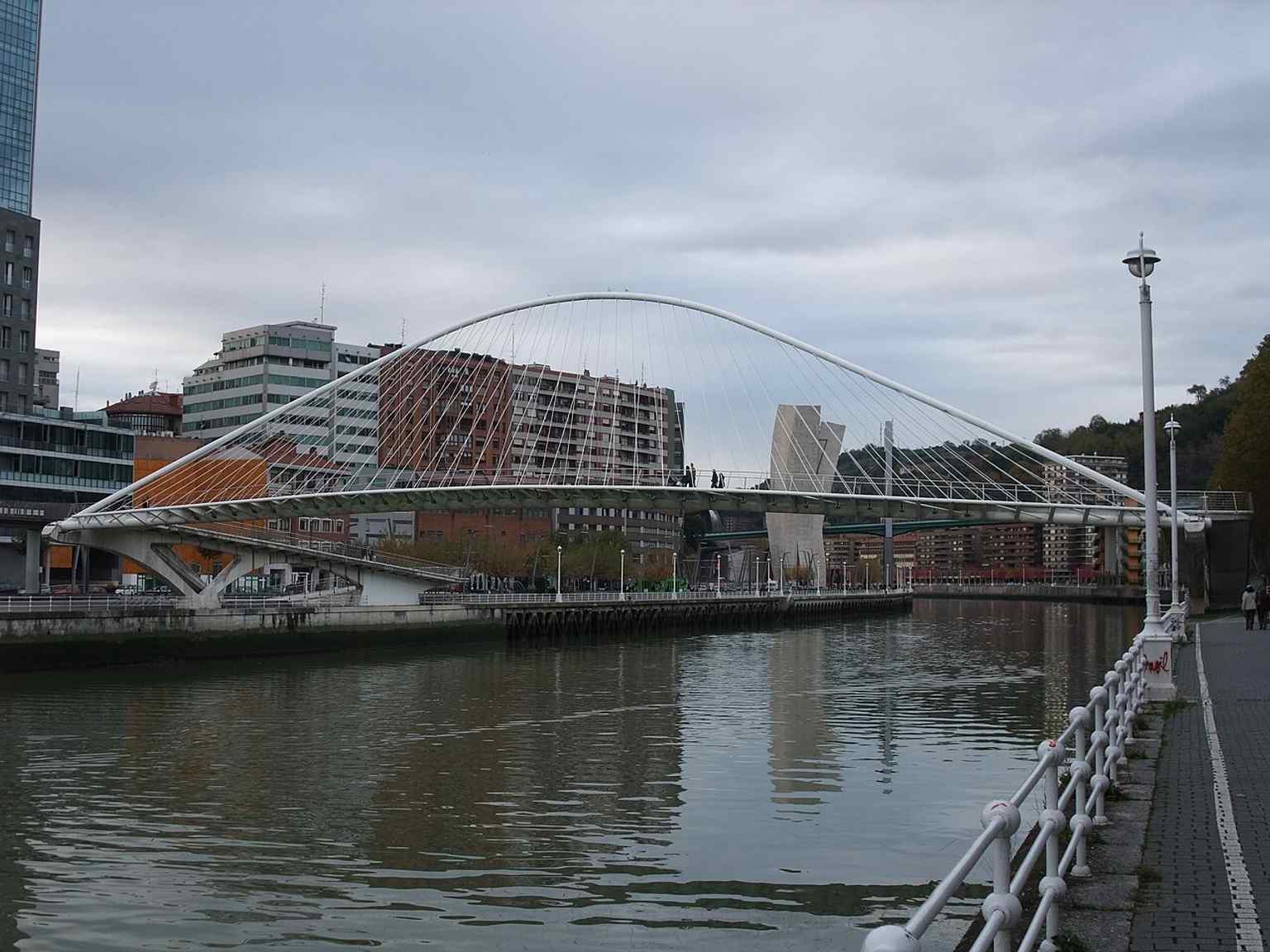
The bridge in full daylight, with its sweeping white arch making Zubizuri a symbol of Bilbao’s modern riverfront.Photo: Javi Guerra Hernando, Wikimedia Commons, CC BY-SA 4.0. Cropped & resized. 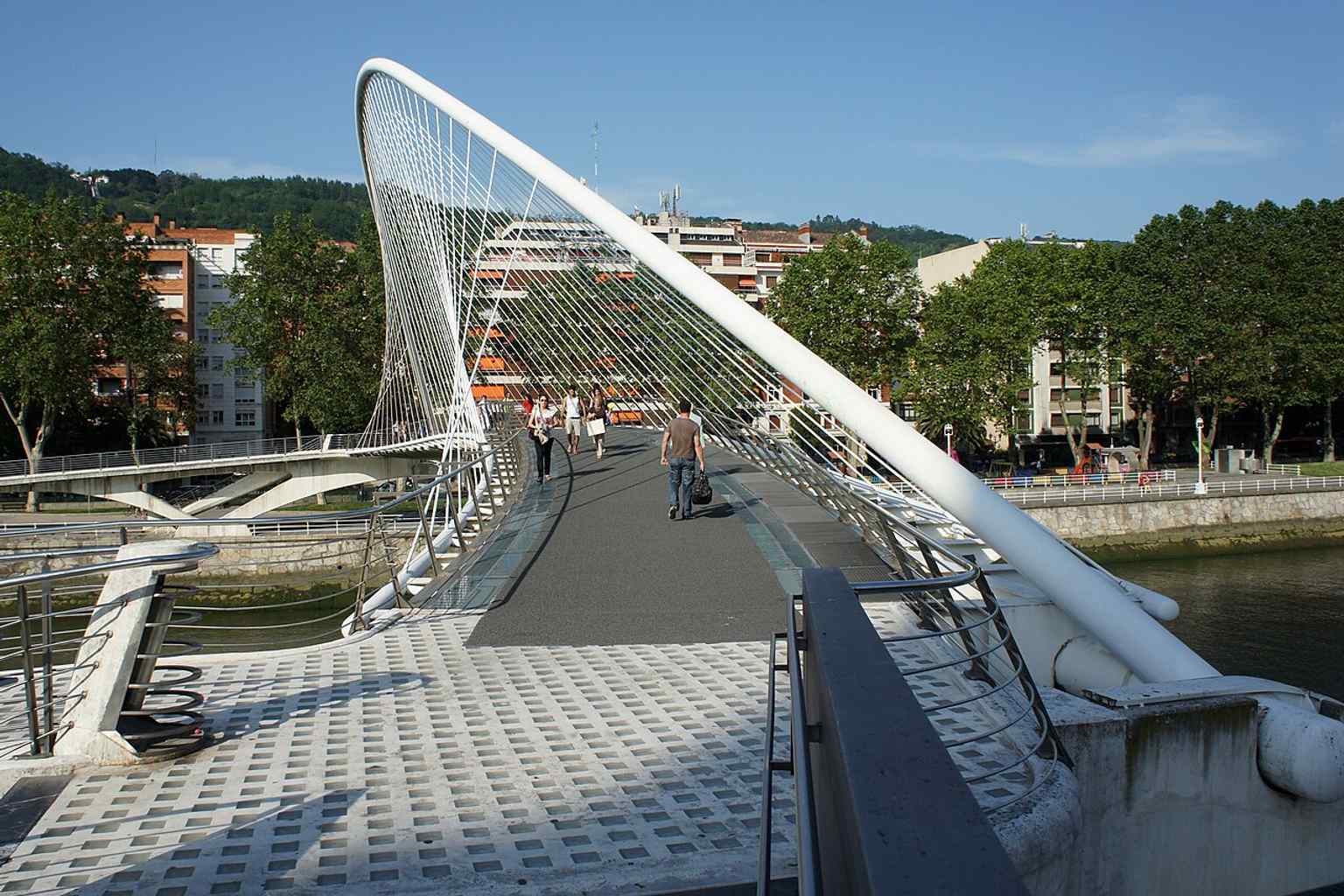
The white bridge seen across the water, reflecting the clean, minimalist look associated with Calatrava’s Bilbao projects.Photo: Mariordo (Mario Roberto Durán Ortiz), Wikimedia Commons, CC BY-SA 4.0. Cropped & resized. 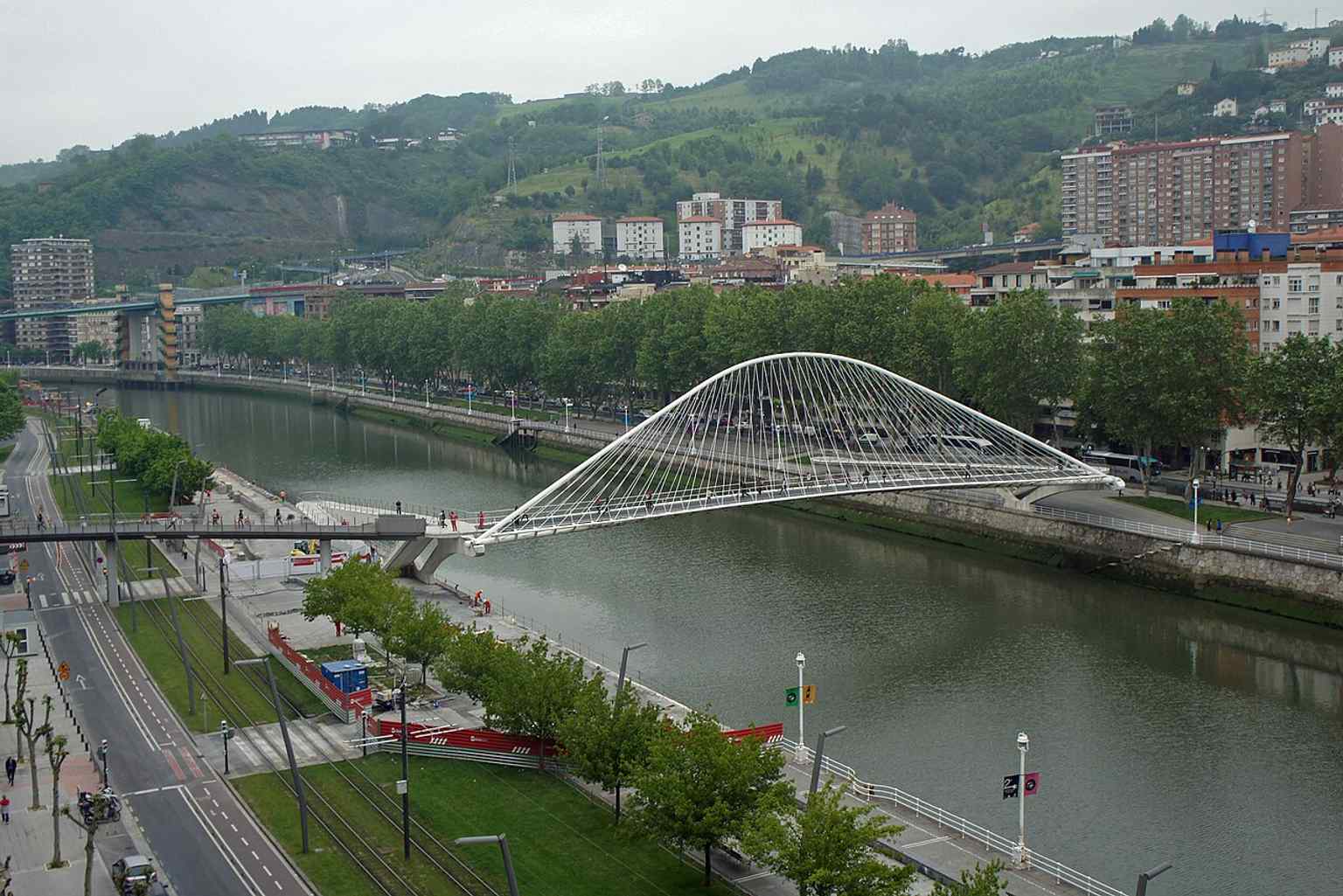
Another aerial angle that shows the bridge’s footprint on the river and its relationship to the surrounding waterfront.Photo: Mariordo (Mario Roberto Durán Ortiz), Wikimedia Commons, CC BY-SA 4.0. Cropped & resized. 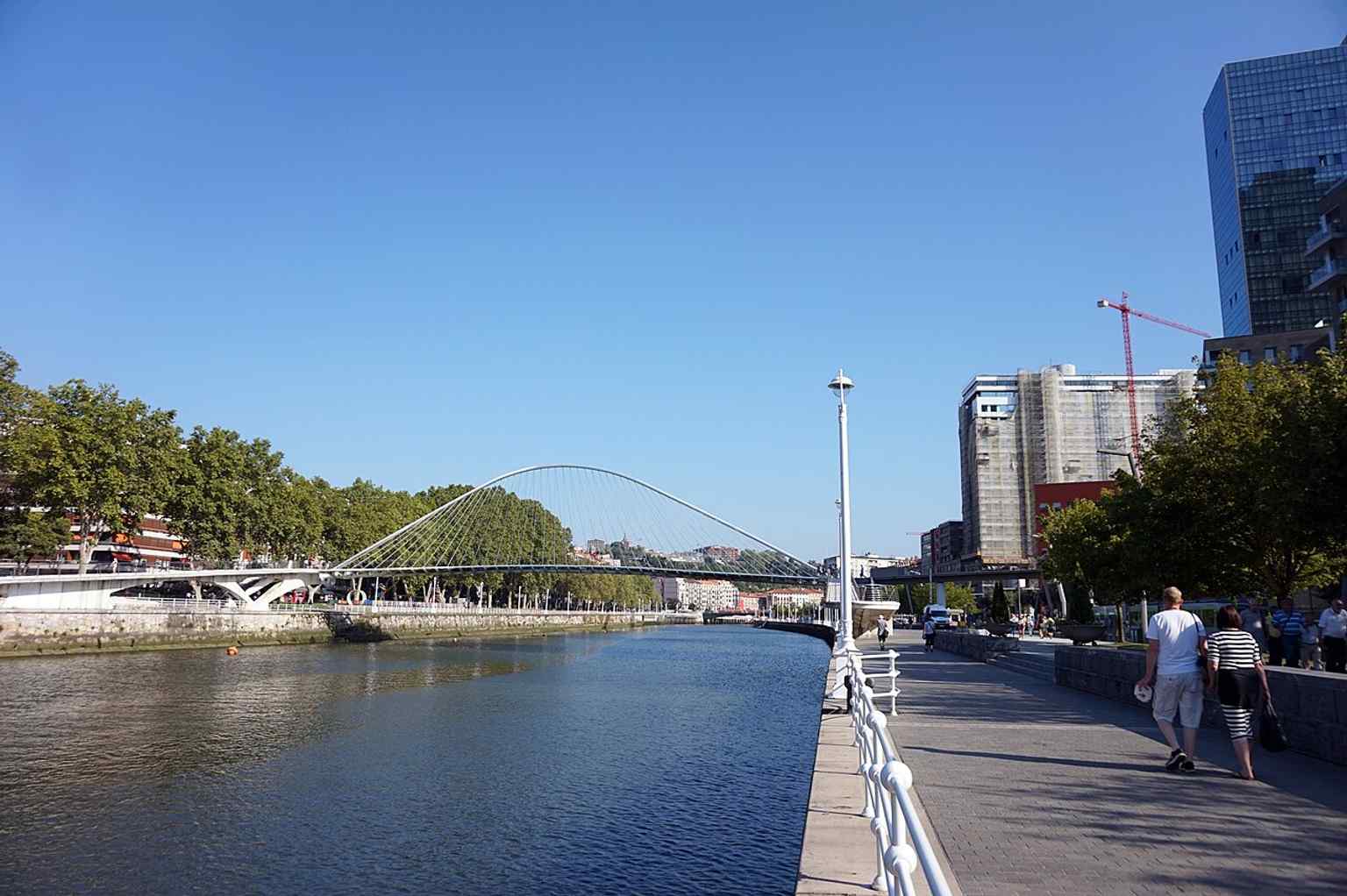
The bridge approached along the river walkway, matching the popular paseo route from Campo Volantín toward the Guggenheim area.Photo: Tiia Monto, Wikimedia Commons, CC BY-SA 3.0. Cropped & resized. 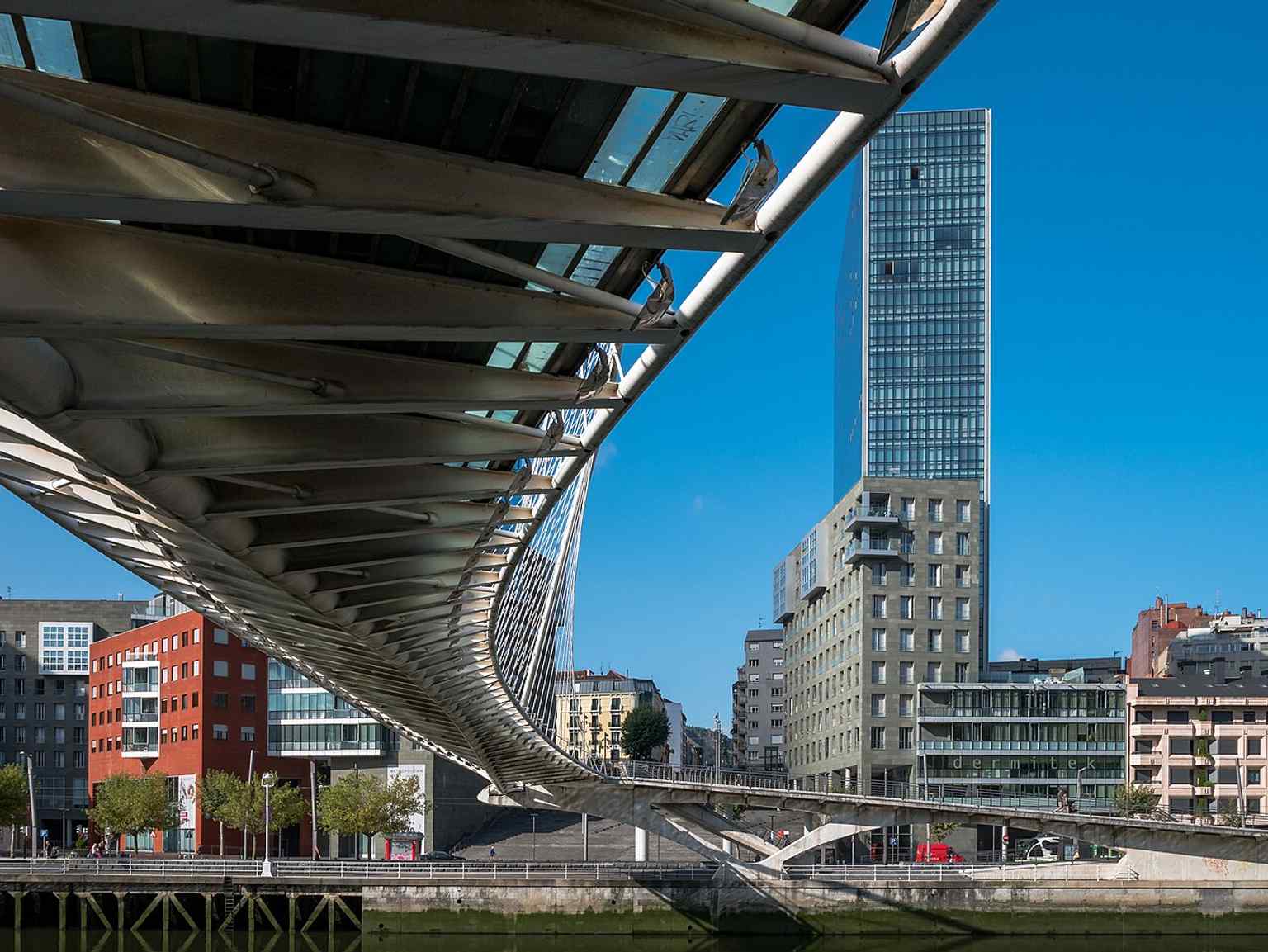
Zubizuri with the Isozaki Atea towers behind it, recalling the later controversy over the added connection to those buildings.Photo: Basotxerri, Wikimedia Commons, CC BY-SA 4.0. Cropped & resized. Look for a long stone-and-paved riverside promenade laid out in broad straight walks, framed by formal gardens and fountains, with the unmistakable pair of the Arriaga Theatre and…Read moreShow less
Open dedicated page →Look for a long stone-and-paved riverside promenade laid out in broad straight walks, framed by formal gardens and fountains, with the unmistakable pair of the Arriaga Theatre and San Nicolás marking its edges.
This is the Arenal, or Areatza in Basque, and for Bilbao it is much more than a pleasant public walk. It is the front porch of the Old Town, the emotional threshold to the Seven Streets, the city’s earliest core. Stand here and you are not quite inside the Casco Viejo yet... but you are at the point where Bilbao begins introducing itself.
The river beside you, the Nervión estuary, has seen the whole performance. It watched this place when it was not a promenade at all, but an inner sandy shore, almost a little beach, where boats landed and shipyards worked. It watched the town push outward in the late fifteenth century, opening new streets toward this edge. And it kept watching as a rough working margin turned into a civic living room.
If you glance at the image on your screen, you can see that long riverside face clearly. That view explains why the Arenal matters. It is Bilbao showing itself to the water.
By the eighteenth century, local leaders raised the ground with sand, built a low wall, and added benches. In eighteen fifty-seven, they organized the interior with gardens, fountains, and ornamental pools. Even now, the layout still carries a bit of that orderly civic pride. From the City Hall end, three walks once began together, each with a social nickname: the priests’ path on the left, the young gentlemen’s in the center, and the espadrille path on the right... which is a pretty sharp little class joke, if you think about it. Bilbao has always known how to sort a crowd with a smile.
And yet beneath that calm, this ground holds a harder memory. In eighteen oh four, during the Zamacolada revolt, people gathered here to protest military conscription and a proposed new port in Abando. The army crushed the uprising and executed several of its leaders. During the First Carlist War, this open promenade became a fortified zone under siege. General Baldomero Espartero, one of the liberal commanders defending Bilbao, used the Arenal as a base of operations. Imagine that for a second: if a city learned to know its main public square through cannon fire instead of strolling, how differently would it understand itself?
That is the twist of the Arenal. The city’s real stage was never only inside the theater nearby. It was here, in the open, where people protested, fought, celebrated Basque festivals, rallied during the Civil War, and returned again after the terrible floods of nineteen eighty-three left the whole space underwater. Bilbao did not erase those shocks. It paved over them, planted through them, and kept meeting here anyway.
If you check the street-level photo in the app, you’ll catch that gateway feeling again. This is still where daily life gathers, not a frozen monument.
Look for the details if you can: the symmetrical pools, the bronze little mermaids holding fish, the green iron frogs spitting water, and farther along, the music kiosk and the sculpture of the bertsolari, the improvised verse singer, Balendin Enbeita. Leisure here sits right on top of argument, memory, and reinvention.
Next, we leave this broad civic stage and step toward a more intimate kind of refuge: the Church of San Nicolás, born from a neighborhood tied to sailors and fishermen, about a seven-minute walk from here.
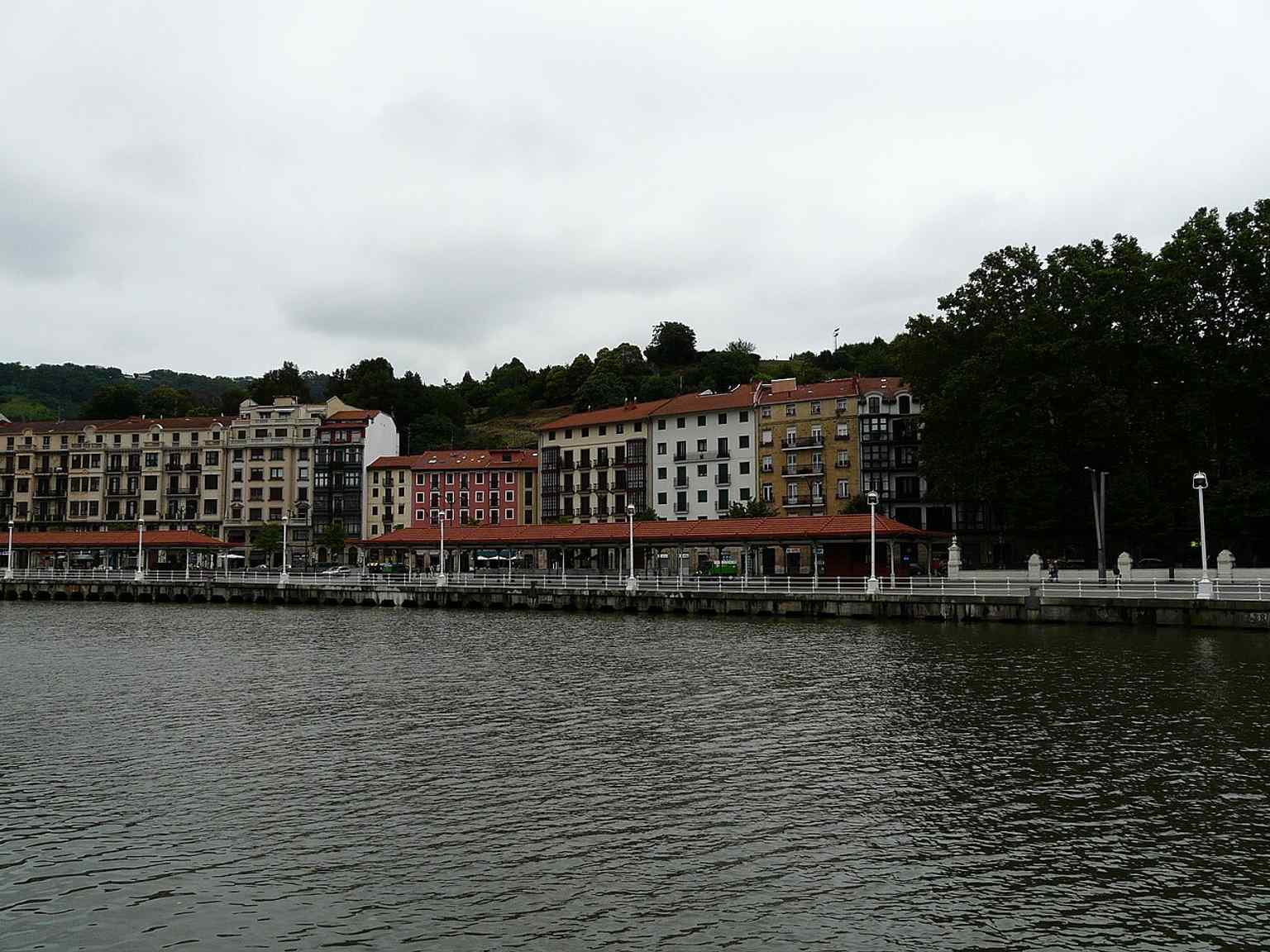
A wide view of El Arenal from across the river, showing its long promenade as the main front of Bilbao’s Old Town beside the estuary.Photo: pere prlpz, Wikimedia Commons, CC BY-SA 3.0. Cropped & resized. 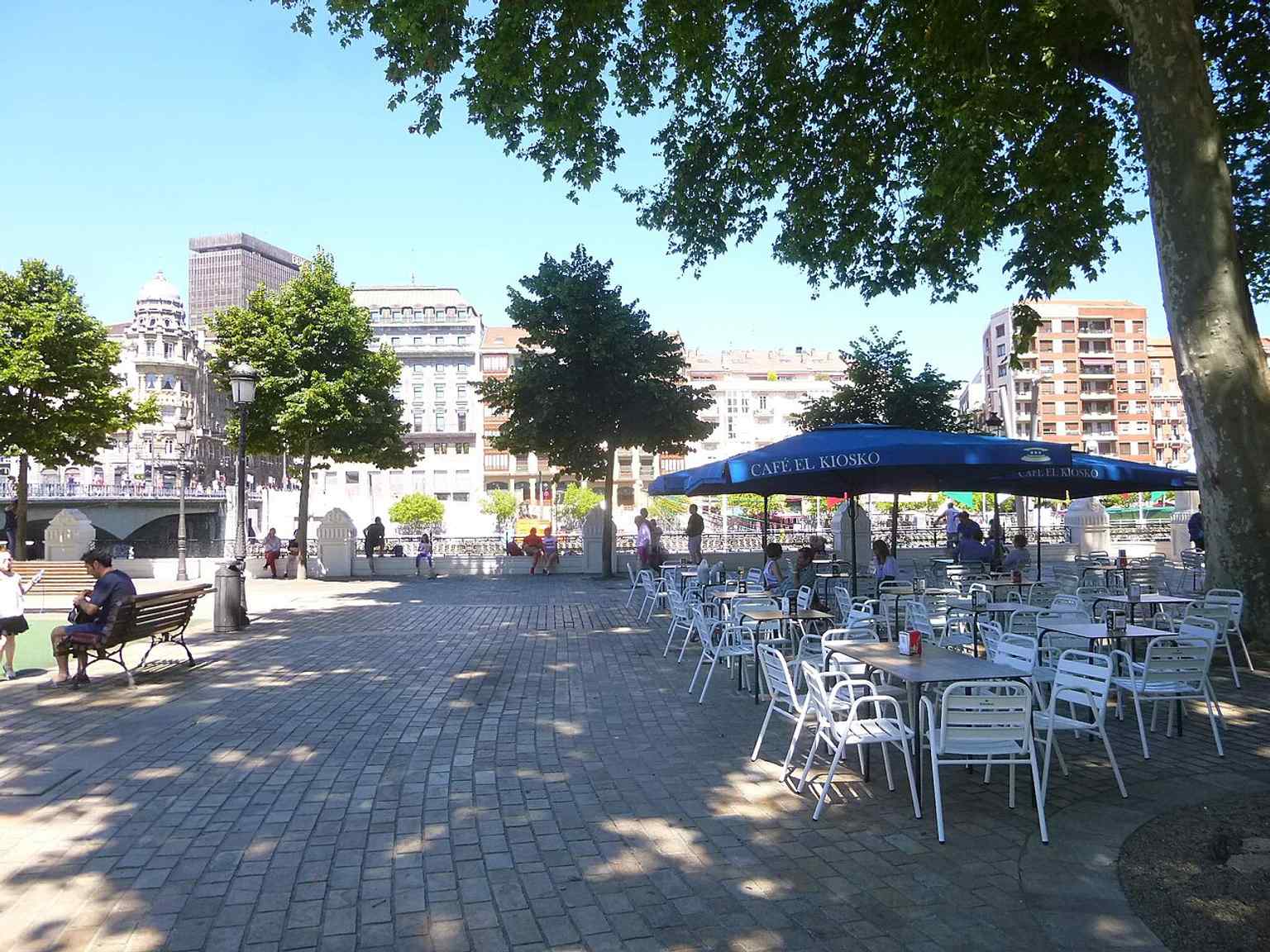
A clear street-level view of El Arenal, the historic riverside promenade that serves as a gathering place and gateway to the Casco Viejo.Photo: Zarateman, Wikimedia Commons, CC0. Cropped & resized. 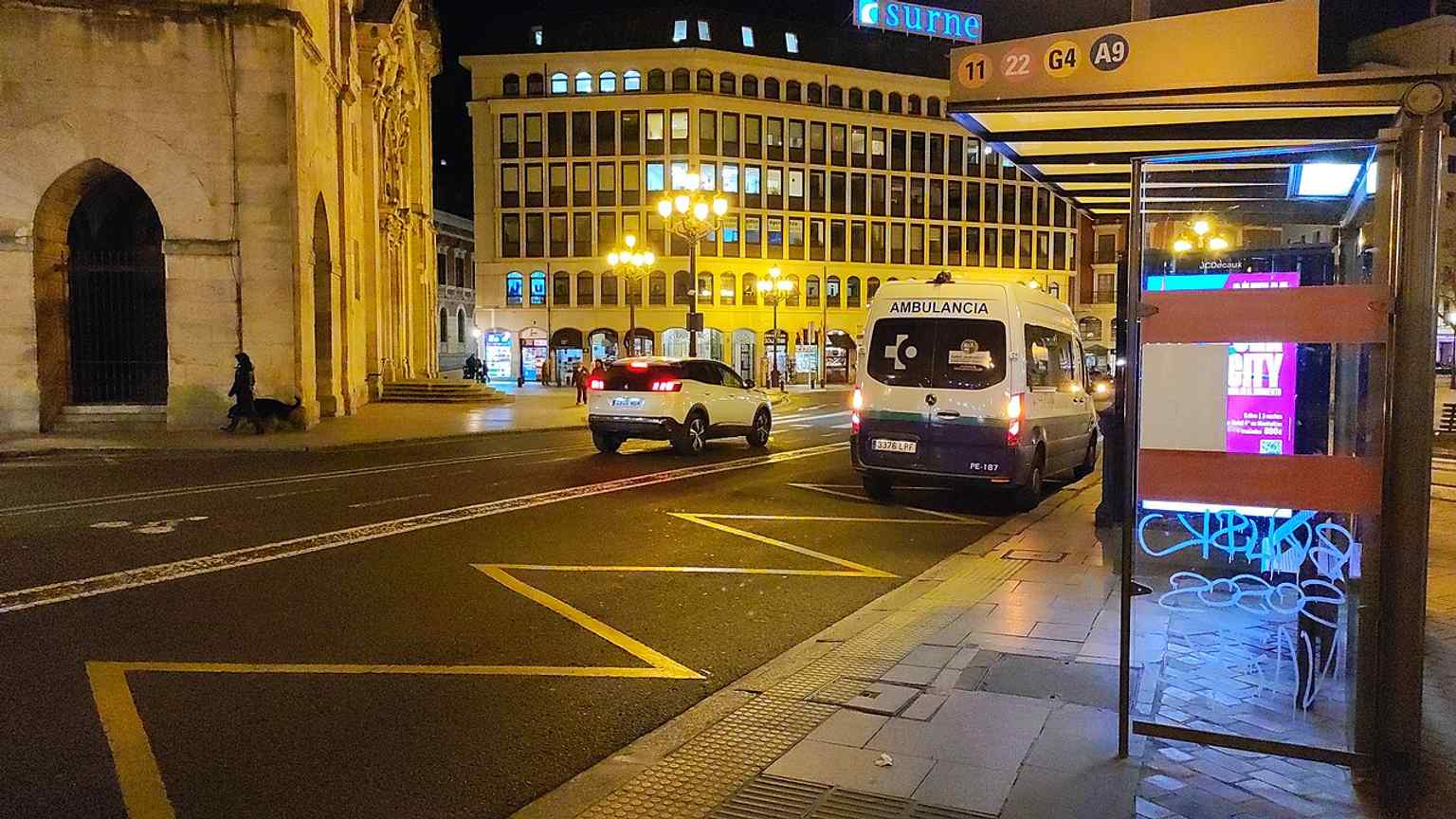
A bus stop at Areatza/Arenal near San Nicolás, reflecting how this central promenade is still a major everyday transport hub in Bilbao.Photo: Josi, Wikimedia Commons, CC BY 4.0. Cropped & resized. On your left, look for a pale stone Baroque church with a broad central doorway, two attached side towers, and a compact bell wall rising in front of the hidden dome. San Nicolás…Read moreShow less
Open dedicated page →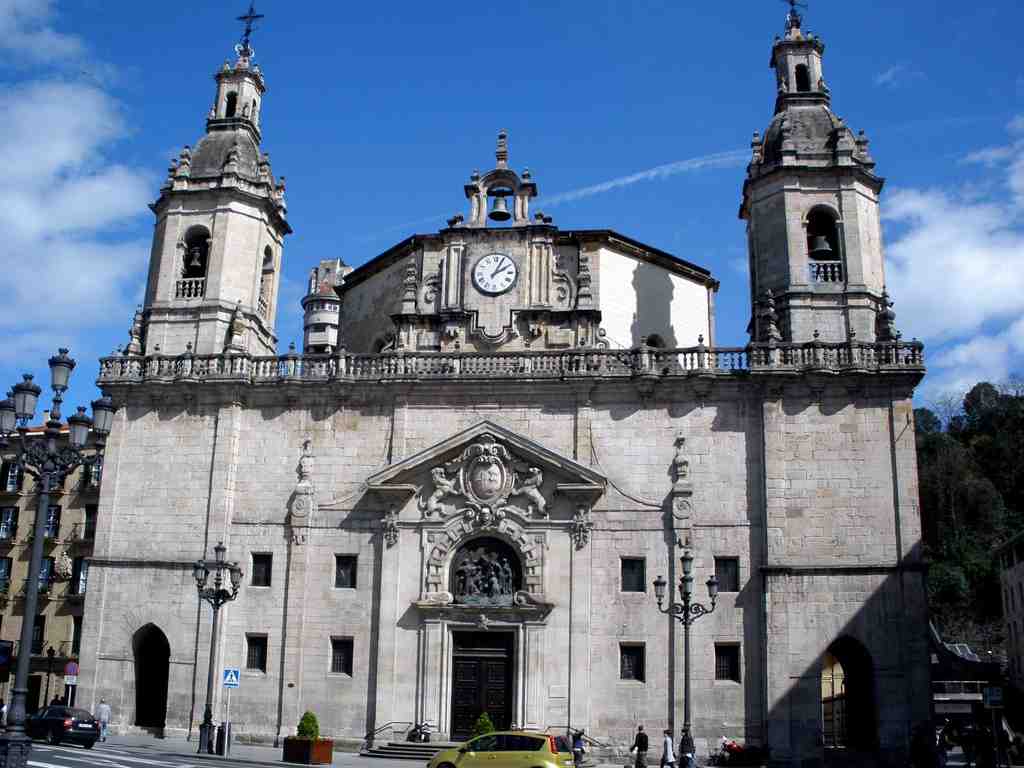
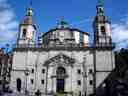
Church of San Nicolás (Bilbao)Photo: Zarateman, Wikimedia Commons, CC0. Cropped & resized. On your left, look for a pale stone Baroque church with a broad central doorway, two attached side towers, and a compact bell wall rising in front of the hidden dome.
San Nicolás looks self-assured now... but this spot began in much shakier fashion. Long before this façade faced the Arriaga, fishermen built a small chapel here for Saint Nicholas of Bari, the protector of sailors. Back then, this stood outside the old town, in a working waterside district where men headed to the river and the sea for their living. They came here to pray before storms, asking for safe return. Bilbao owed its bread to the water, and sometimes the water came back asking for interest.
That first church, founded in fourteen ninety, lost the fight. Floods weakened it, its foundations failed, and the city finally admitted defeat. Most visitors never catch that part of the story, because the present building wears such calm Baroque confidence. But behind that confidence is an engineering surrender. On the twenty-seventh of June, seventeen forty-three, the city council chose demolition. Later that same year, on the sixth of December, workers laid the first stone of the replacement you see now.
The man in charge was Ignacio Ibero, an architect from Azpeitia. He did not give Bilbao a routine parish church. He drew a Greek cross plan - that means all four arms inside are equal in length - fitted neatly into a square, then crowned it with a dome. From outside, that dome reads as an eight-sided prism, though the front bell wall cleverly hides much of it. If you glance at the image on your screen, you can see how the façade stages that little trick, almost like a proud face keeping its thoughts to itself.
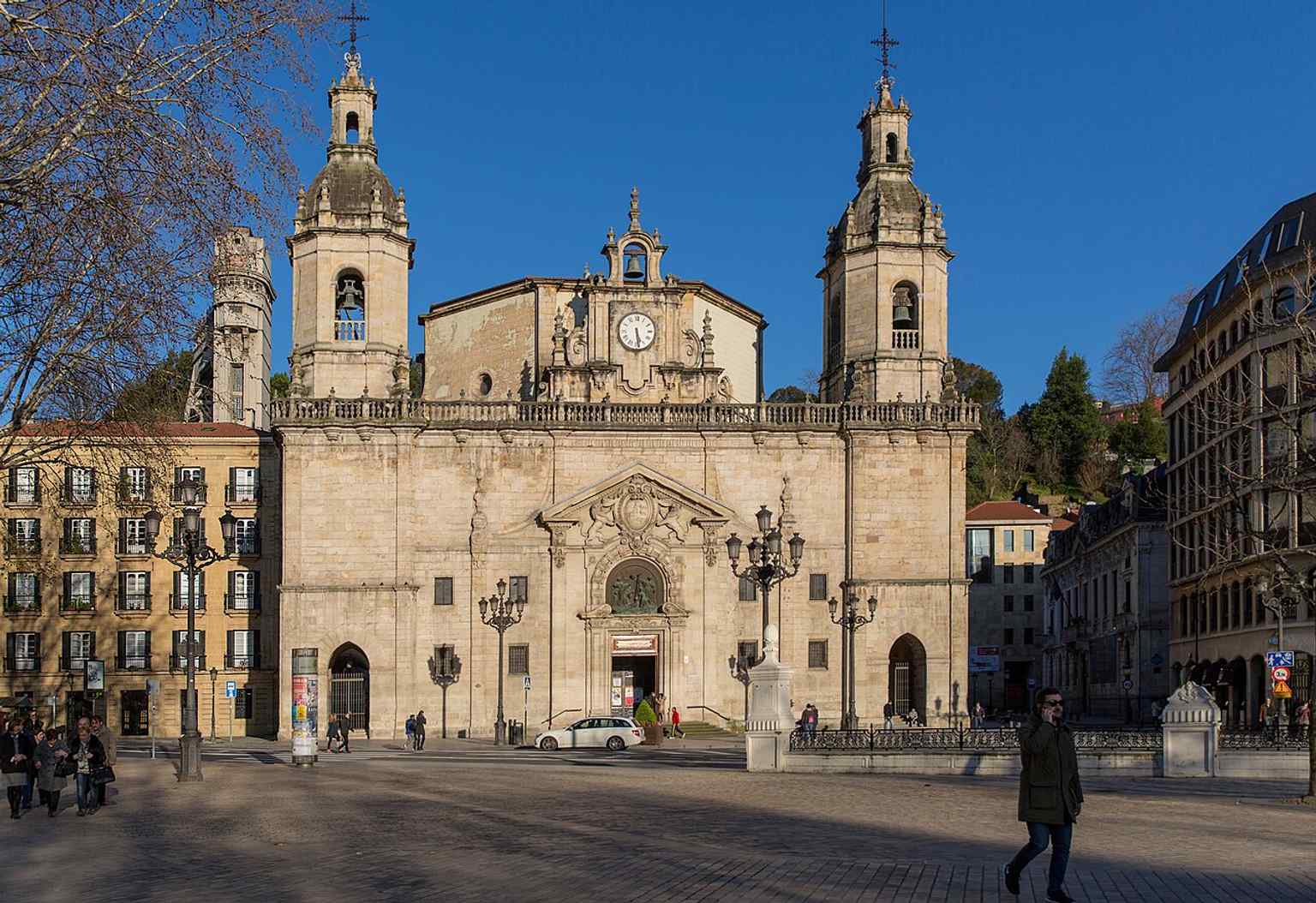
The Baroque façade of San Nicolás in Bilbao’s Old Town — the church that replaced an earlier fishermen’s chapel dedicated to Saint Nicholas of Bari.Photo: PA, Wikimedia Commons, CC BY-SA 4.0. Cropped & resized. The front itself changed over time. In the late nineteenth century, builders reworked the entrance and added the bronze panel in the upper triangle, under the pediment with Bilbao’s coat of arms and two lions. Another local detail to notice: of the two side porches, only the one on the left keeps the original solution. The church has been adjusted, patched, and rethought, just like the city around it.
And the trials did not stop once the new church opened in seventeen fifty-six. The War of Independence closed it from eighteen oh eight to eighteen fourteen. Lightning struck it in eighteen sixteen. During the Carlist Wars, soldiers turned it into a military storehouse, even a powder magazine and workshop. Strange fate, isn’t it? A sanctuary built for fishermen seeking protection ended up storing the tools of war.
There is one more human thread worth holding onto. Juan Pascual de Mena, the court sculptor from Madrid, came here in seventeen fifty-four with his workshop and family to create the church’s grand altarpieces. So this was never only a neighborhood church. Bilbao’s own city council paid for much of that interior program, placing the city’s coat of arms among the sacred images. Faith and civic pride stood shoulder to shoulder here.
Even in nineteen eighty-three, floods damaged several side altarpieces, and later restoration stripped away extra layers to reveal the Ganguren stone more clearly. So yes... the river kept shaping the building, as provider, threat, and witness.
When you’re ready, head into the square pattern of the old town’s next big correction: Plaza Nueva, where Bilbao tried to bring tidy geometry to a city that had grown the old-fashioned way... one crowded corner at a time.
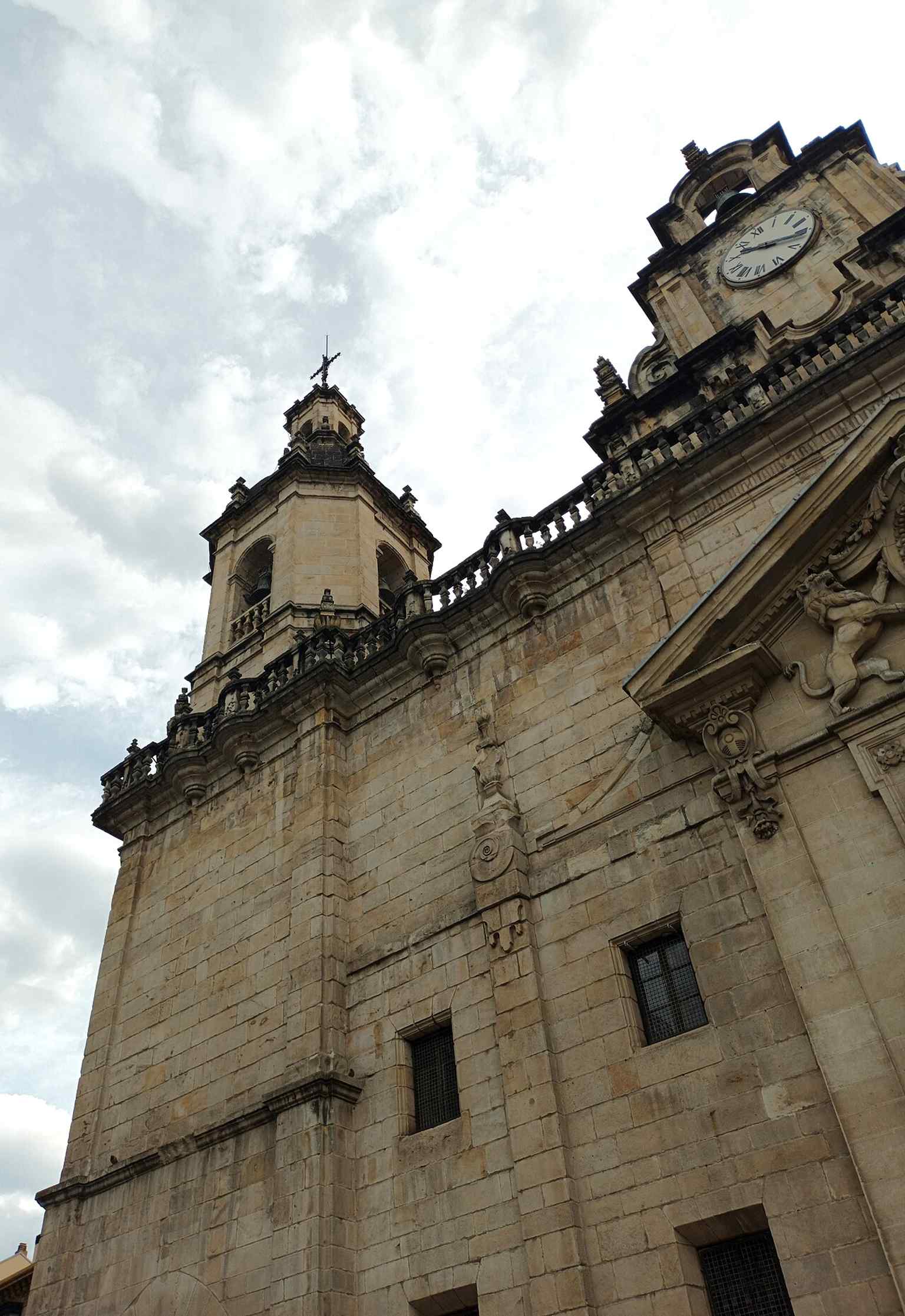
A recent view of the church’s front elevation, facing the Arriaga Theatre, showing the landmark as it stands today after later restorations.Photo: Acediscovery, Wikimedia Commons, CC BY 4.0. Cropped & resized. On your left, Plaza Nueva appears as a large neoclassical stone square wrapped in even arcades, with repeated round arches and a dignified central façade marked by…Read moreShow less
Open dedicated page →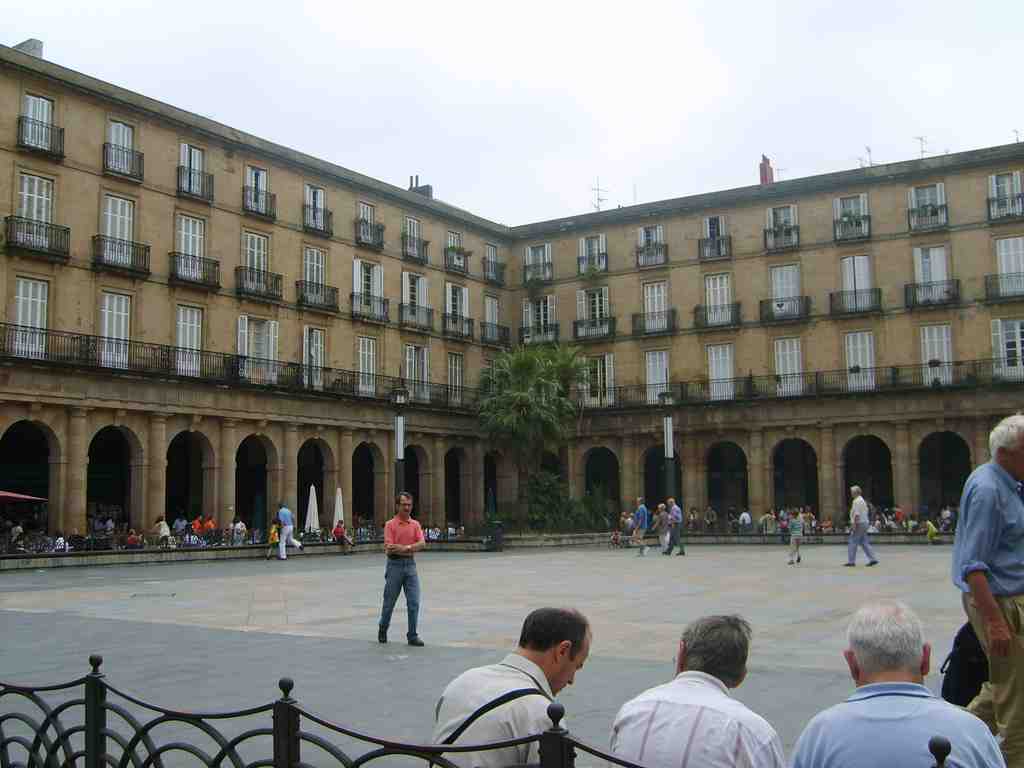
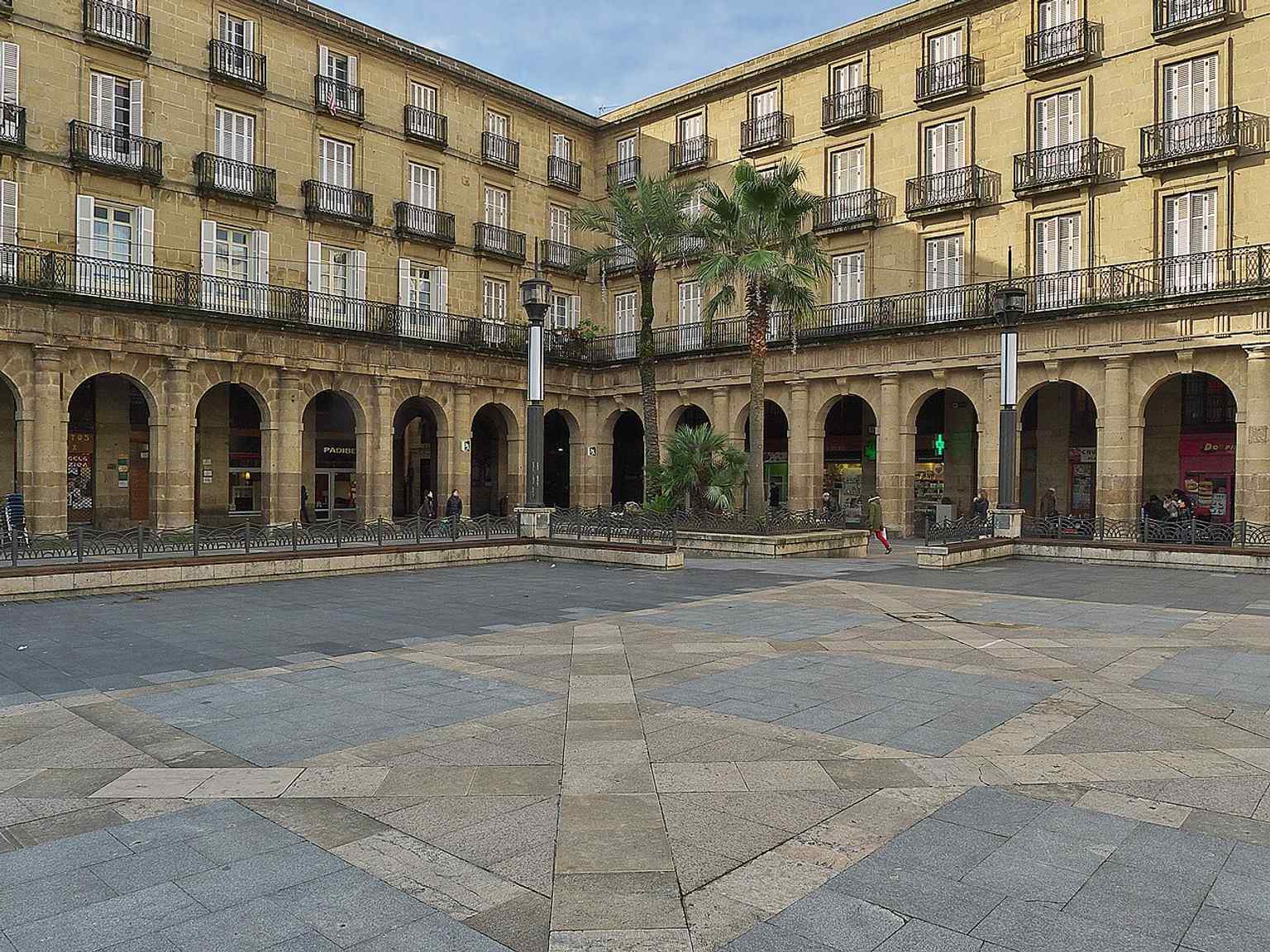
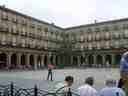
Plaza Nueva, BilbaoPhoto: Martin253~commonswiki, Wikimedia Commons, Public domain. Cropped & resized. On your left, Plaza Nueva appears as a large neoclassical stone square wrapped in even arcades, with repeated round arches and a dignified central façade marked by balconies.
This place looks calm now... almost stern. That was the point. In the early eighteen hundreds, Bilbao’s old medieval core, the Seven Streets, had begun to strain at the seams, so city planners picked this site to pull the center of gravity toward the Arenal and give the growing town a cleaner, more orderly civic heart. If you glance at the image on your screen, you can see that disciplined geometry in full. No crooked improvisation here... every side lines up like a well-rehearsed choir.
A broad view of Plaza Nueva shows the arcaded square completed in 1851, the landmark that replaced Bilbao’s old Plaza Vieja.Photo: Jl FilpoC, Wikimedia Commons, CC BY-SA 4.0. Cropped & resized. The design took shape in eighteen twenty-one, but the square did not hurry. Silvestre Pérez began the project, and Antonio Echevarría and Avelino Goikoetxea carried the work forward. Bilbao finally inaugurated it on the thirty-first of December, eighteen fifty-one. Cities, like good stews, sometimes take longer than planned.
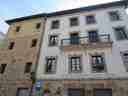
Those arches around the edge are called cuevas, or “caves,” and they turned a formal government square into everyday Bilbao. Under them, taverns and shops settled in, while the main building served first as the Biscay government, later as Banco de Bilbao, and now as Euskaltzaindia, the Royal Academy of the Basque Language. If you look at the façade image, you are seeing that long civic handoff in one view.
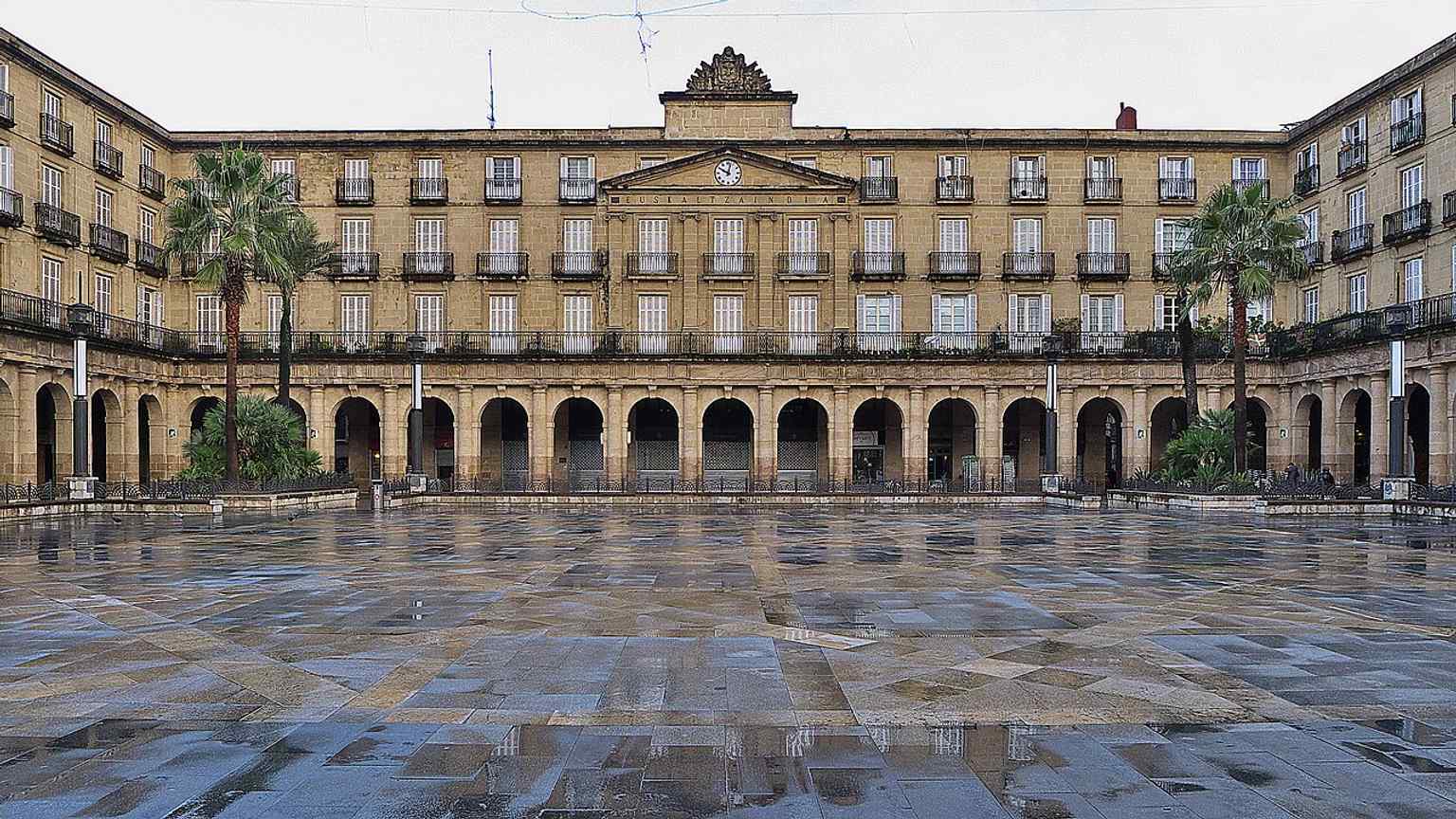
The neoclassical façade of Plaza Nueva, now home to Euskaltzaindia, reflects the square’s long civic history from government seat to language stewardship.Photo: Jose Luis Filpo Cabana, Wikimedia Commons, CC BY 3.0. Cropped & resized. And there was theater here too, just the official kind. On the thirty-first of July, nineteen hundred, the provincial government left this square in a formal procession for its new palace on Gran Vía. Imagine the ceremony: authority literally walking out under those arches. Even the square’s center kept changing, from Mariano Benlliure’s statue of founder Diego López de Haro to a music kiosk, then a fountain.
That is Bilbao in miniature: government, business, language, memory... all taking turns in the same frame. In a moment, we’ll head to the Basque Museum, where that question sharpens: not just who ruled here, but how a people chose to remember themselves.
Look for the sturdy stone facade with rows of arched openings and the newer, cleaner entrance cut into the historic masonry, where old college architecture meets a very deliberate…Read moreShow less
Open dedicated page →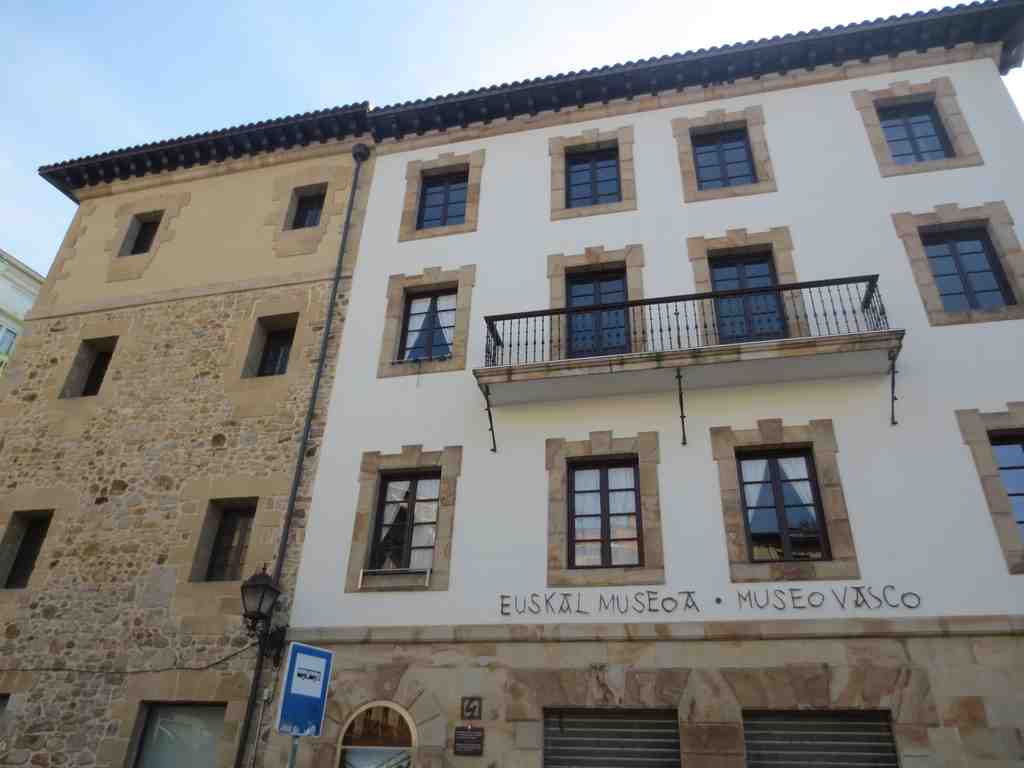
Basque Museum (Bilbao)Photo: MaiGor JoaEto, Wikimedia Commons, CC BY-SA 4.0. Cropped & resized. Look for the sturdy stone facade with rows of arched openings and the newer, cleaner entrance cut into the historic masonry, where old college architecture meets a very deliberate modern update.
What stands here is not just a museum... it is Bilbao making its case. In this building, Basque cultural identity is treated as something living: language, memory, tools, beliefs, trade, and daily habits all tied together into a shared sense of who belongs to this place and how they know it. That matters in a city that has rebuilt itself so many times. Right here in the Old Town, among the Seven Streets, Bilbao does not leave that memory to chance.
The museum opened on the third of July, nineteen twenty-one, under the long and slightly formal name Archaeological Museum of Vizcaya and Basque Ethnographic Museum. But the story started earlier, in nineteen seventeen, when the provincial council approved a Basque ethnographic museum and put Ramón de la Sota in charge of its governing board. Soon the council and Bilbao City Hall became equal patrons. That shared backing tells you a lot: this was never meant to be somebody’s dusty hobby. It was a public project, a civic promise.
The setting matters too. This complex grew from the old College of San Andrés, once run by the Jesuits until Spain expelled them in seventeen sixty-seven. The neighboring Church of Santos Juanes originally belonged to that same college. So even before the first display case arrived, this place already carried layers of teaching, faith, and public life.
Inside, the museum spreads Basque history across four floors. The ground floor holds grave slabs and coats of arms, and near the entrance stands an oak sculpture by Néstor Basterretxea, shaped to suggest a tree. That image became the museum’s symbol in nineteen eighty-four... a pretty good choice, honestly. A tree says roots, branching, survival, and a stubborn refusal to blow away.
At the center of the cloister stands the idol of Mikeldi, a mysterious stone figure from Durango. Scholars still argue over what it meant and how old it is, and the old fellow seems in no hurry to settle the debate. During the museum’s closure in October of twenty twenty-one, workers moved the collection for a full renovation, but Mikeldi stayed exactly where it was, like a silent foreman keeping an eye on the job. If you glance at your screen, the cloister image gives you a feel for the older fabric of the place and its funerary stones.
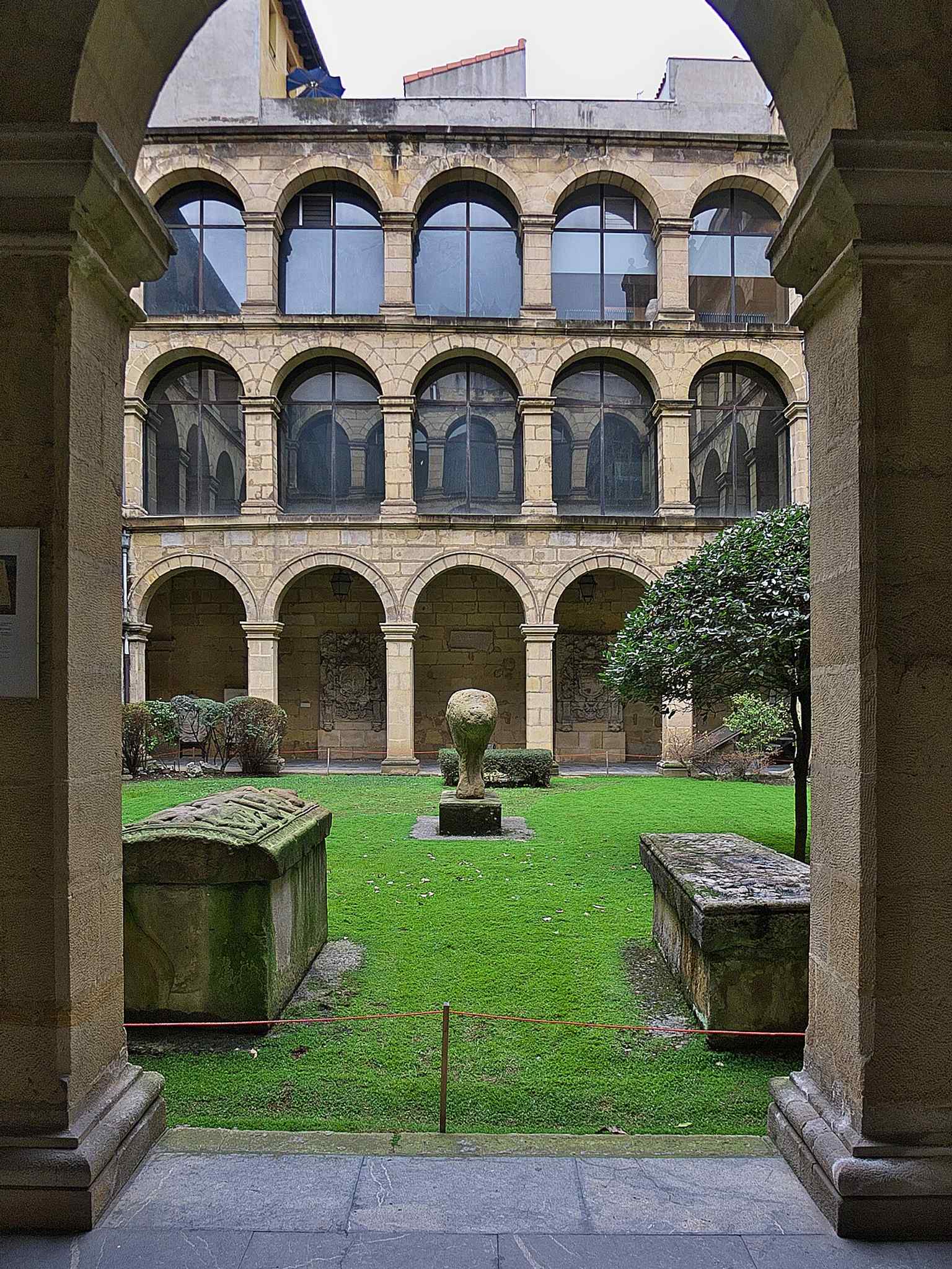
Medieval sarcophagi on the cloister floor — a reminder that the museum grew out of the old San Andrés college complex in Bilbao.Photo: Jl FilpoC, Wikimedia Commons, CC BY-SA 4.0. Cropped & resized. The renovation itself had been brewing for decades. Plans surfaced in the late nineteen eighties, a new winning design came in twenty twenty, and a major mid-twenties overhaul gave the museum a broader, clearer route and a new main entrance on Calle de la Cruz. Inside, you’ll also find a four-meter reproduction of the Kurutziaga Cross, galleries on seafaring, shepherding, ceramics, linen and wool, rooms on prehistory and Biscayan archaeology, the old Bilbao Consulate furniture with red velvet benches linked to the exiled artist Luis Paret, and even the preserved Urra Shop, an entire workshop saved like a time capsule.
So this stop gathers the threads we’ve been following: industry, art, trade, belief, and local pride do not sit in separate boxes here. Bilbao arranges them side by side and says, plainly, this is us.
Next, that story turns inward and older still. Santiago Cathedral is about a four-minute walk away, where civic memory gives way to sacred continuity and deep time. If you plan to go inside later, the museum usually opens from ten to seven, stays closed on Tuesdays, and closes at two on Sundays.
On your right, Santiago Cathedral stands in pale sandstone with a pointed Gothic portal, a round rose window, and a slender spired tower rising above the close-packed…Read moreShow less
Open dedicated page →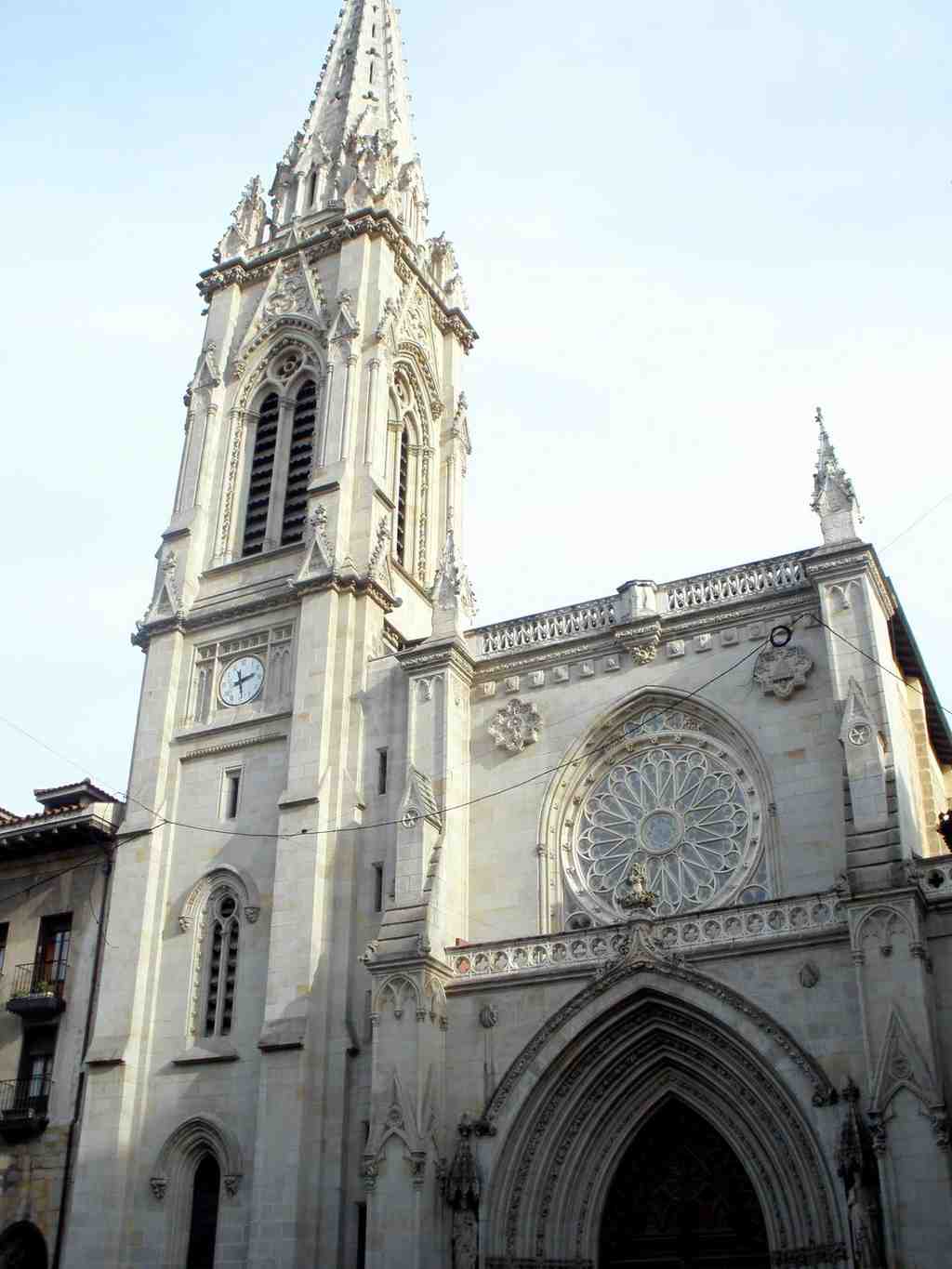
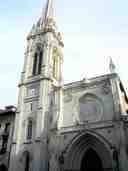
Santiago Cathedral (Bilbao)Photo: Zarateman, Wikimedia Commons, CC0. Cropped & resized. On your right, Santiago Cathedral stands in pale sandstone with a pointed Gothic portal, a round rose window, and a slender spired tower rising above the close-packed streets.
For a cathedral, Santiago feels almost modest... not small, exactly, just compact, like Bilbao packed its memory into one sturdy stone box. That fits the place. This is the Old Town at its deepest historical register, and this site held sacred use even before Bilbao received its town charter in thirteen hundred from Diego López the Fifth de Haro.
The church takes its name from Saint James, Santiago in Spanish, Bilbao’s patron saint. That dedication mattered here because a coastal branch of the Camino de Santiago, the pilgrimage route to Compostela, passed through the town. On the north side, the Puerta del Ángel, also called the Pilgrims’ Gate, still carries the shell symbol of Saint James. If you check the image in the app, you can see that shell and the delicate late Gothic carving around the doorway.
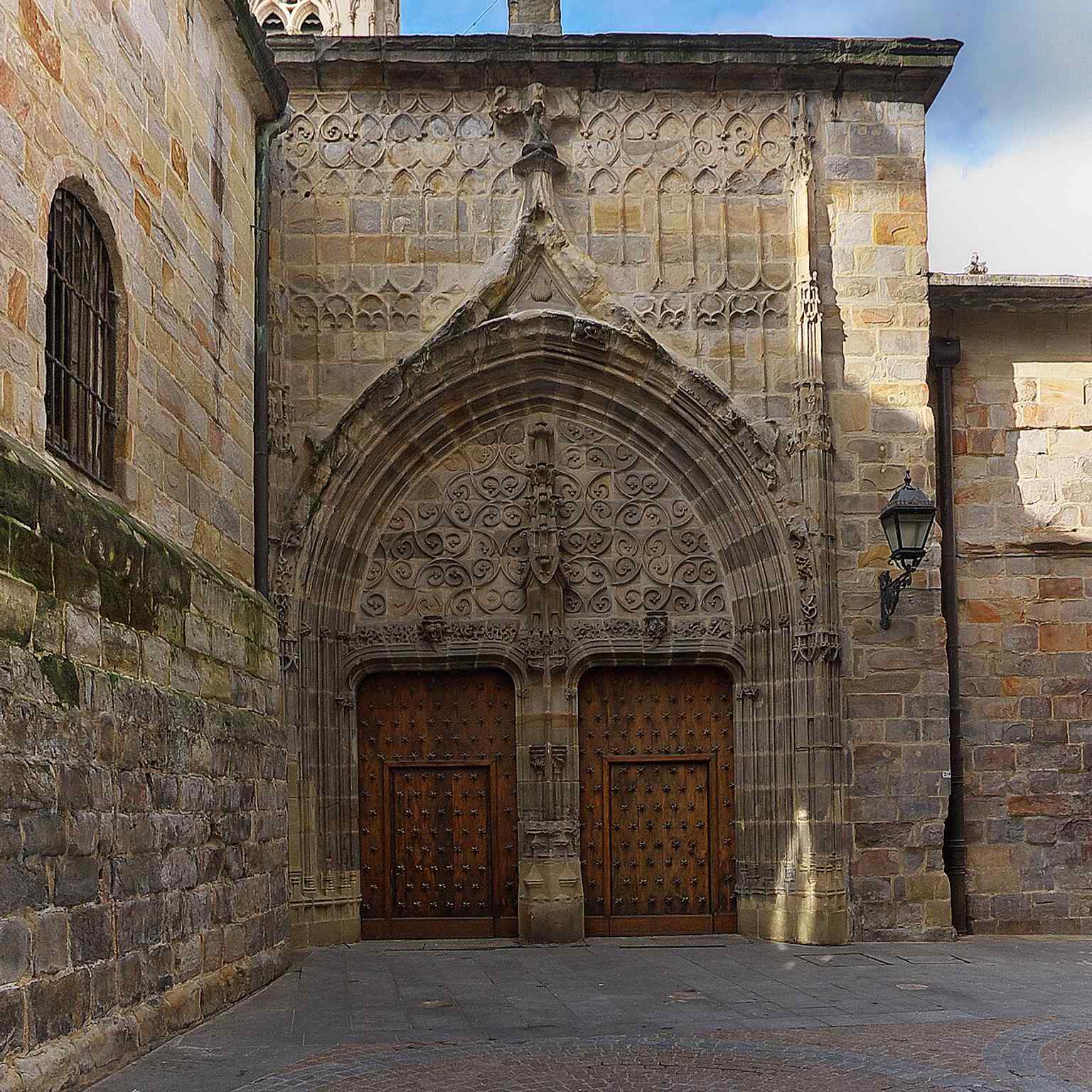
The Puerta del Ángel, the cloister entrance on the north side, known as the Pilgrims’ Gate for its shell motif and Jacobean symbolism.Photo: Jose Luis Filpo Cabana, Wikimedia Commons, CC BY 3.0. Cropped & resized. Two earlier churches stood here before the present one. The first rose before the formal founding of Bilbao. The second expanded as the settlement grew, then fire destroyed it in thirteen seventy-four. Pope Gregory the Eleventh answered in a very medieval fashion: he offered indulgences, spiritual favors from the Church, to anyone who gave alms for rebuilding. Out of disaster came ambition. Builders began the present Gothic church around thirteen ninety-seven and kept adding to it for more than a century... chapels, cloister, porch, sacristy, each generation laying down another sentence in stone.
What you see from outside, though, belongs to a later chapter. In the eighteen eighties, architect Severino de Achúcarro tore down the older classical front and gave Santiago the neo-Gothic façade you see now, completing it in eighteen ninety-one. Take a quick look at the west front on your screen and you’ll spot how that later skin frames the older heart behind it. The tower rises about sixty-four meters, built partly with white stone from Mount Oiz and topped with stone brought from Angoulême in France. Even the bells arrived in stages, cast between eighteen ninety and nineteen sixteen. Bilbao has a habit of rebuilding without erasing, and this cathedral may be the clearest example yet.
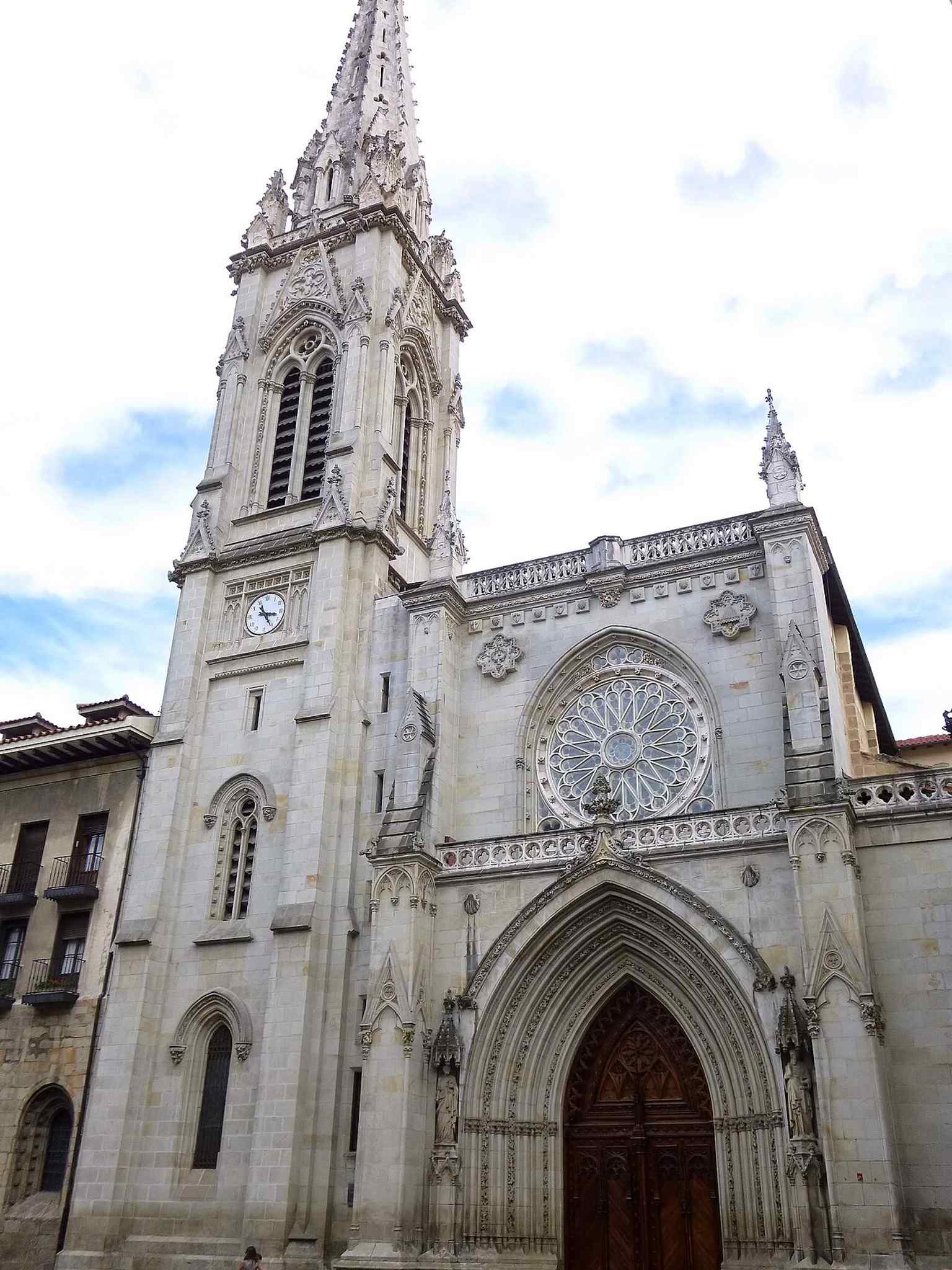
West façade of Santiago Cathedral, rebuilt in the 1880s in Neo-Gothic style with the tower and spire that define its modern silhouette.Photo: Zarateman, Wikimedia Commons, CC BY-SA 4.0. Cropped & resized. Rome granted the church the rank of minor basilica in eighteen nineteen, a special mark of honor, making it the first in the Basque Country to receive that title. Then, in nineteen forty-nine, it became Bilbao’s cathedral when the new diocese was created. Bishop Casimiro Morcillo González took possession the next year and consecrated the cathedral in nineteen fifty-five, sealing its place as the spiritual center of the city.
Most visitors study the tower and miss the real secret below the altar. In the crypt, locals sometimes speak of an old city wall, but what survives there is even better: very early masonry from the first church on this site, proof that this ground belonged to Bilbao’s story before Bilbao had fully become Bilbao.
Then came the flood of nineteen eighty-three. River water filled the Old Town and reached inside here too. Restorers worked for years, cleaning, repairing, and even lowering the floor to recover an older level. So the calm face of this cathedral is not fragile serenity... it is survival.
From here, the story moves outward toward San Antón, where riverbank, church, bridge, and city emblem lock together. When you’re ready, continue to the Church of Saint Anthony the Great. It’s about a four-minute walk.
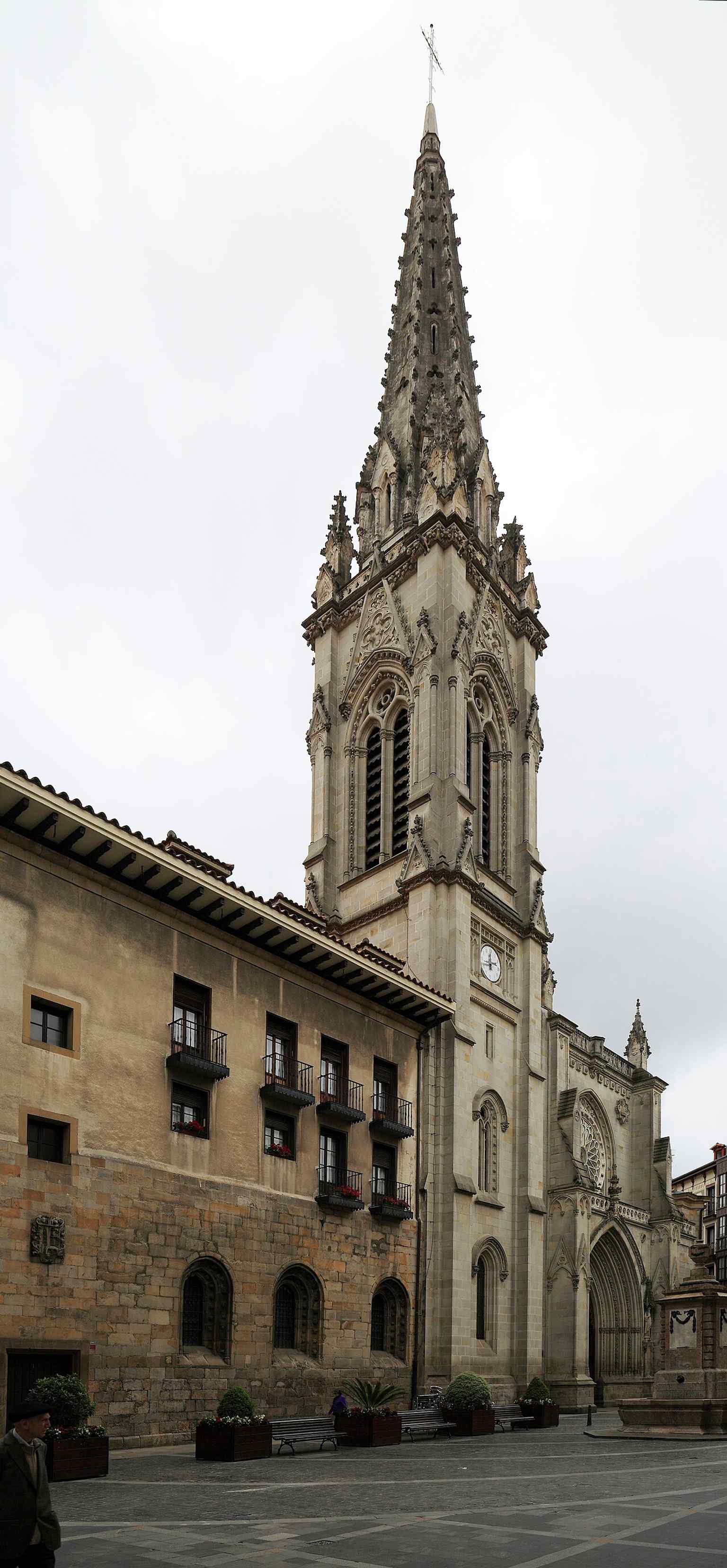
A wider view of the cathedral’s west side, showing how the church is tightly embedded in the old town around the Basilica of Santiago.Photo: Falk2, Wikimedia Commons, CC BY-SA 4.0. Cropped & resized. 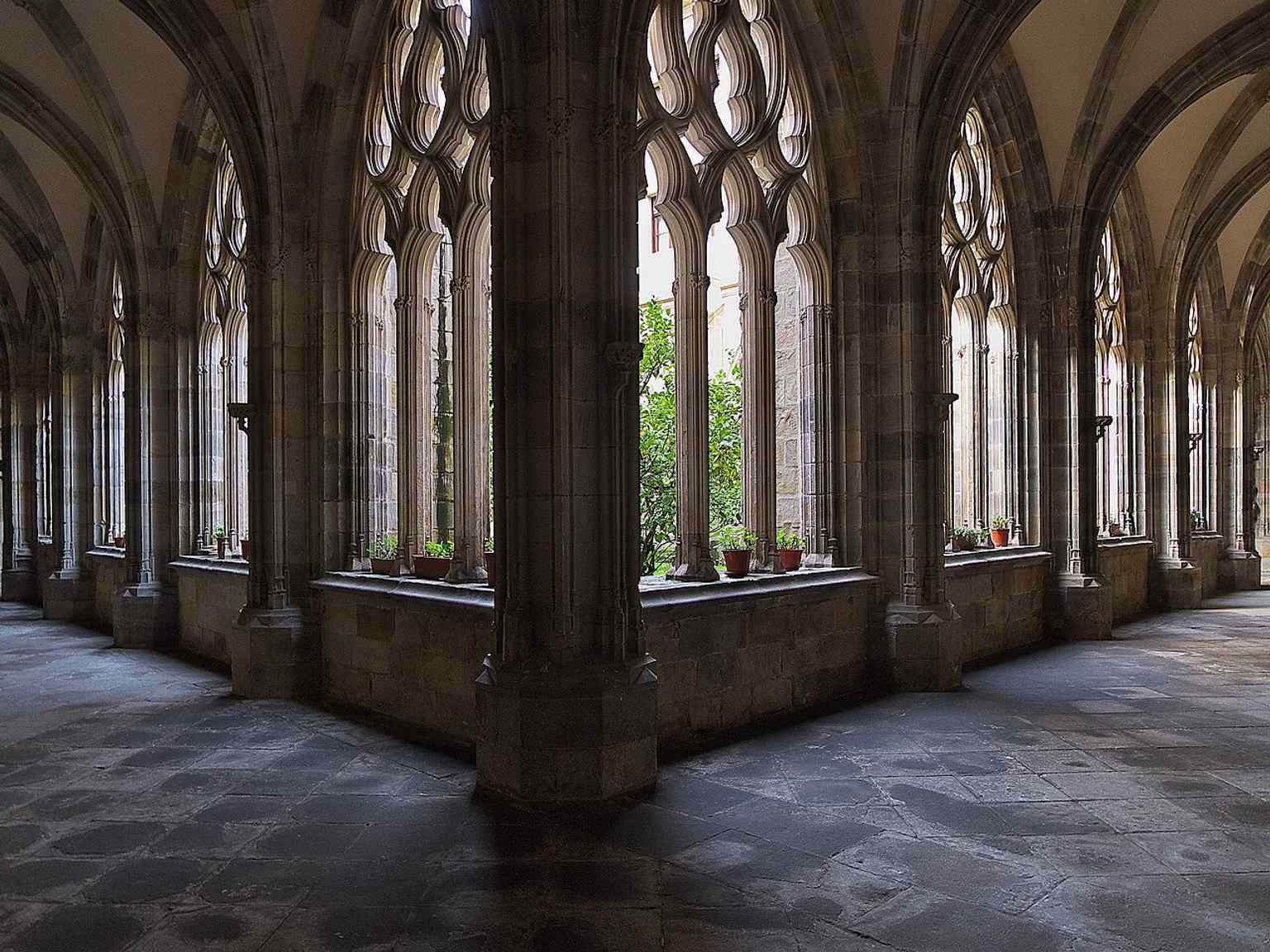
The cloister of Santiago Cathedral, a rare Gothic cloister in Biscay, later enriched with Neo-Gothic pinnacles, tracery, and gargoyles.Photo: José Luis Filpo Cabana, Wikimedia Commons, CC BY 3.0. Cropped & resized. 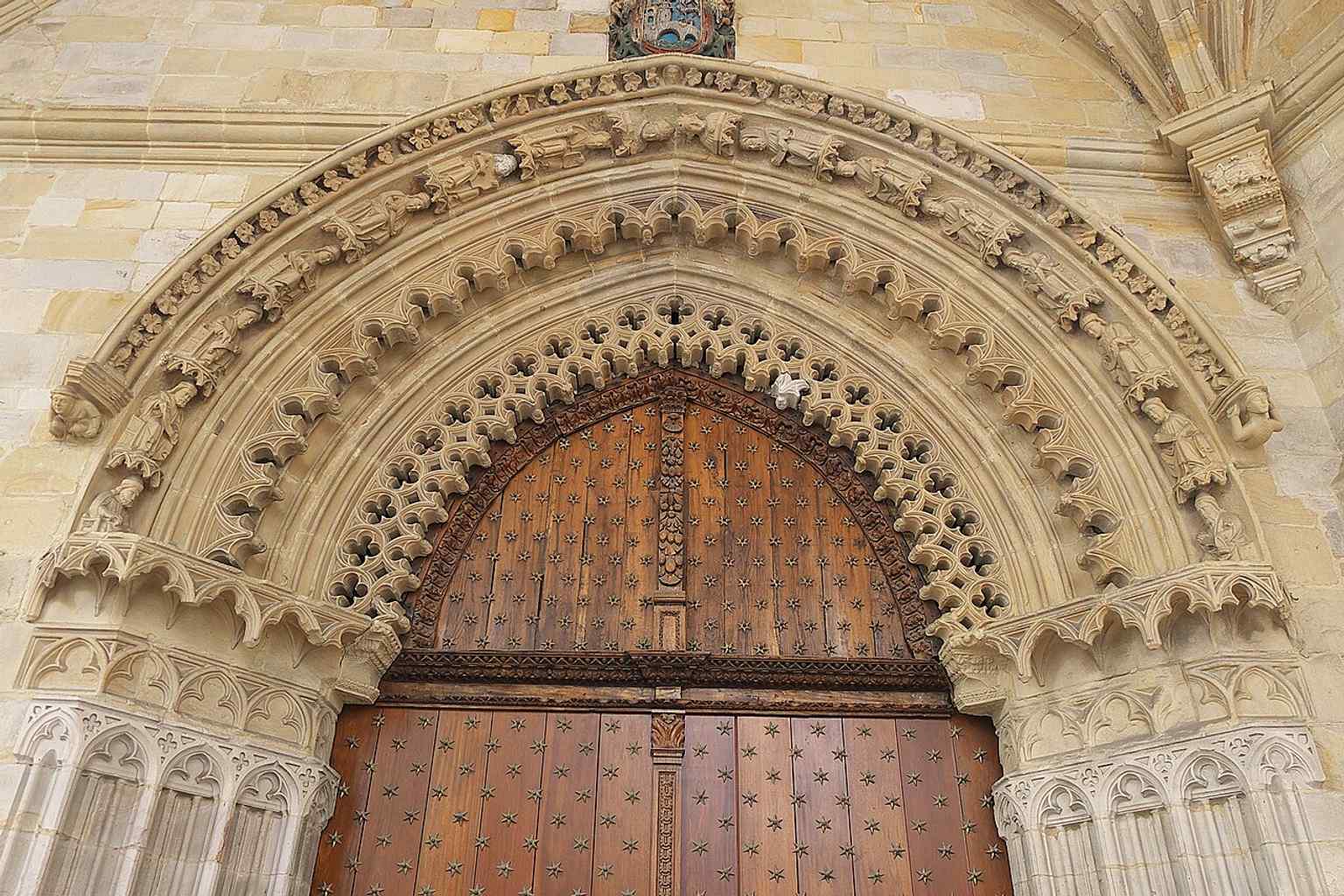
South portal archivolts and carvings from the 14th-century Gothic entrance, one of the cathedral’s key medieval access points.Photo: Jose Luis Filpo Cabana, Wikimedia Commons, CC BY 3.0. Cropped & resized. 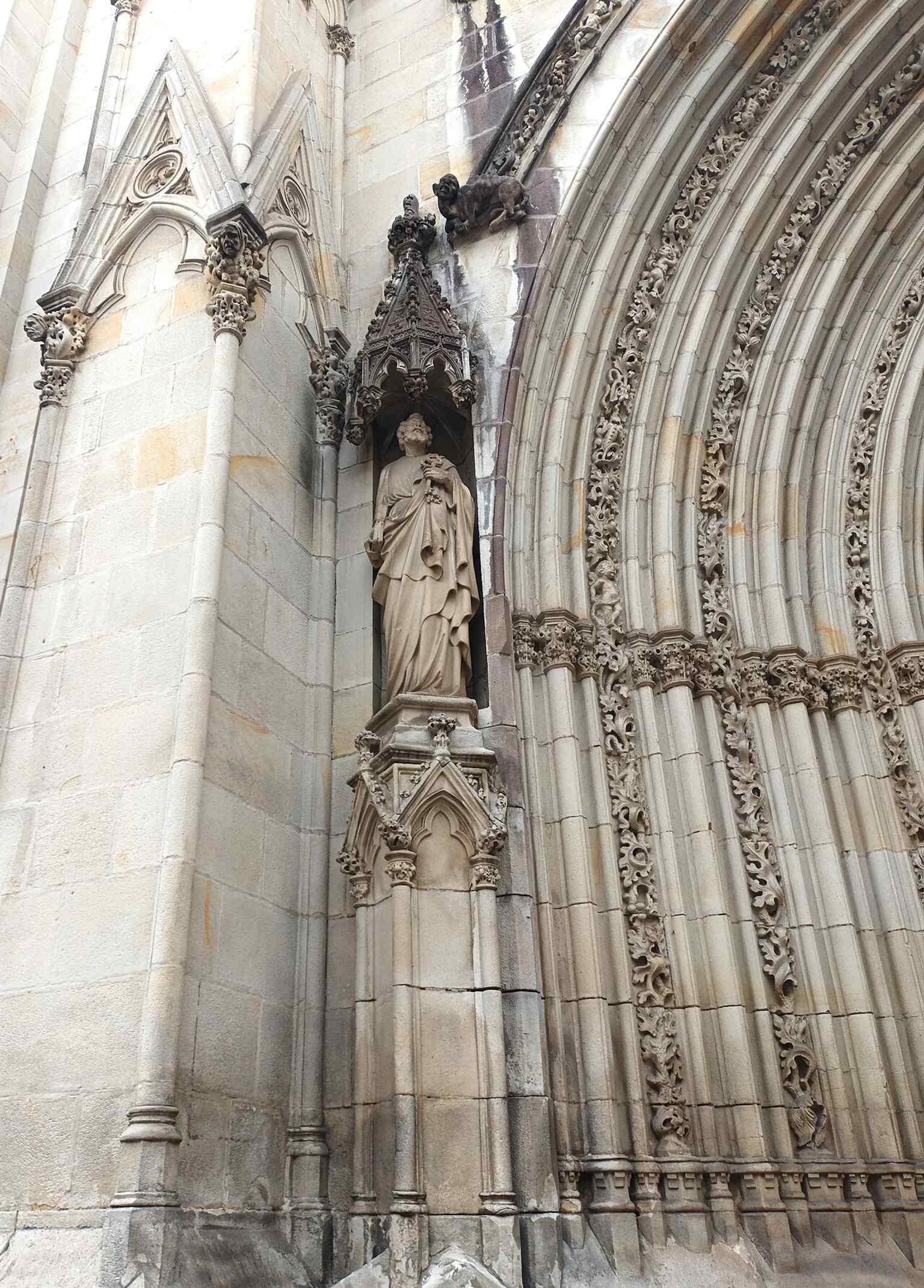
A sculpted figure in the cathedral’s western doorway, reflecting the ornate portal imagery that greets visitors at the main entrance.Photo: Acediscovery, Wikimedia Commons, CC BY 4.0. Cropped & resized. On your right is a pale stone church with a compact Gothic shape, a richly carved doorway, and a bell tower topped by a dome and lantern. This is San Antón, and in Bilbao it…Read moreShow less
Open dedicated page →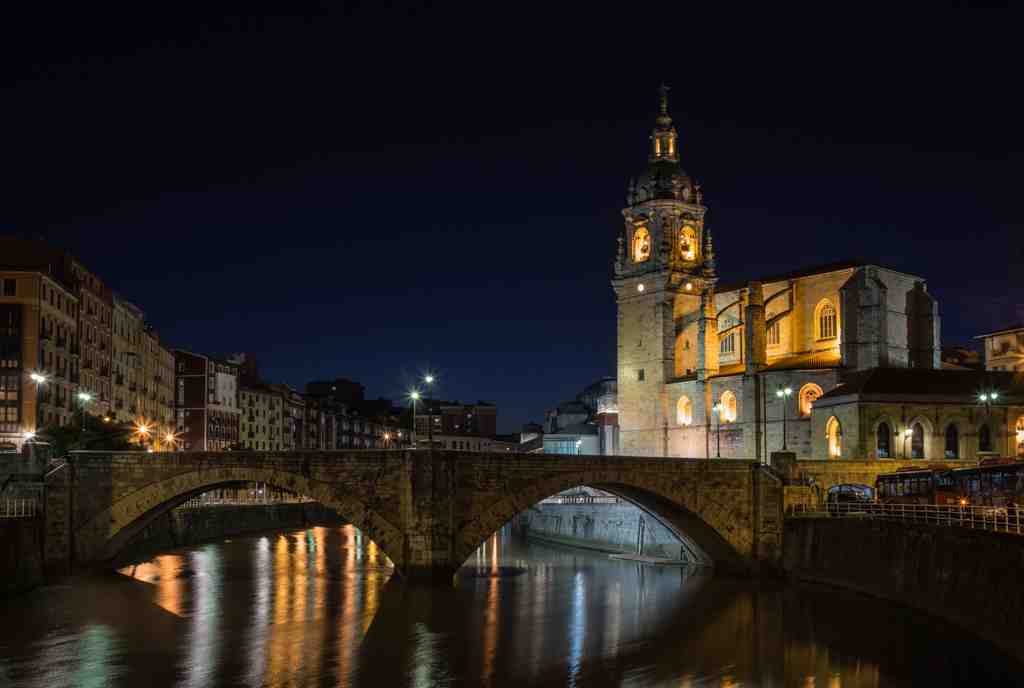
Church of Saint Anthony the GreatPhoto: Igerrak, Wikimedia Commons, CC BY-SA 4.0. Cropped & resized. On your right is a pale stone church with a compact Gothic shape, a richly carved doorway, and a bell tower topped by a dome and lantern.
This is San Antón, and in Bilbao it means more than just “church.” Put this building together with the bridge beside it, and you have the city’s coat of arms. Its outline also made its way onto the Athletic Club emblem, which is about as Bilbao as strong coffee and a serious opinion about football. So this place sits right where faith, trade, and civic pride all shake hands.
The setting matters. San Antón stands at the edge of the old commercial quarter, right beside the estuary. The river helped Bilbao grow rich, and it also gave the church plenty of trouble. Flood after flood hit this site, including the devastating one in nineteen eighty-three, which wrecked furniture, doors, and railings inside. The same water that carried goods and ambition also came back now and then like an unpaid bill.
Its story goes deeper than the walls you see. In two thousand and two, archaeologists found remains from the twelfth and thirteenth centuries here, older than Bilbao’s official founding in thirteen hundred. They also uncovered a fourteenth-century wall, two burial grounds, and the foundations of an earlier church consecrated in fourteen thirty-three. So San Antón is less one building than a stack of chapters: warehouse, fortification, cemetery, shrine, and city symbol.
If you glance at your screen, the interior image shows the rib vaults - the stone ribs crossing the ceiling - that still carry the Gothic character through all the later repairs. This is Biscay Gothic: not the giant, glass-heavy style you find in northern France, but a smaller, sturdier local version that fits the region’s history.
The church grew with Bilbao. Builders enlarged it in fourteen seventy-eight as the congregation expanded. Then in fifteen forty-eight they gave it a Renaissance front, with carved heads around the entrance and neat Corinthian columns. Later, in seventeen seventy-four, Gabriel de Capelastegui began the present bell tower, following a design by Juan de Iturburu. That tower did not just hold bells. It crowned the church like a public signature, and the figure at the top represented Faith. Even that finishing touch came from a nearby workshop on Ascao Street, tying the skyline to local metalworkers.
San Antón also survived some rough handling from people, not just rivers. During the Carlist war, forces used the church for military logistics. Fire and bombing damaged it. By eighteen eighty-one, the building had become dangerously worn down, and Sabino Goikoetxea led a restoration that saved it but also changed many original features. Helpful, yes... uncomplicated, not exactly.
Take a look at the old historical view on your phone, and you can see how long this silhouette has served as a marker for the city. That may be the real heart of San Antón. Bilbao keeps rebuilding itself, but it likes to leave a recognizable outline in the frame.
From here, the story turns practical again. In about one minute, Riverside Market picks up exactly where this church leaves off: river trade, daily commerce, and the very tasty business of keeping a city fed.
On your right, look for a long concrete-and-glass building with broad horizontal lines and decorative art deco panels set into its riverside façade. This is the Riverside Market,…Read moreShow less
Open dedicated page →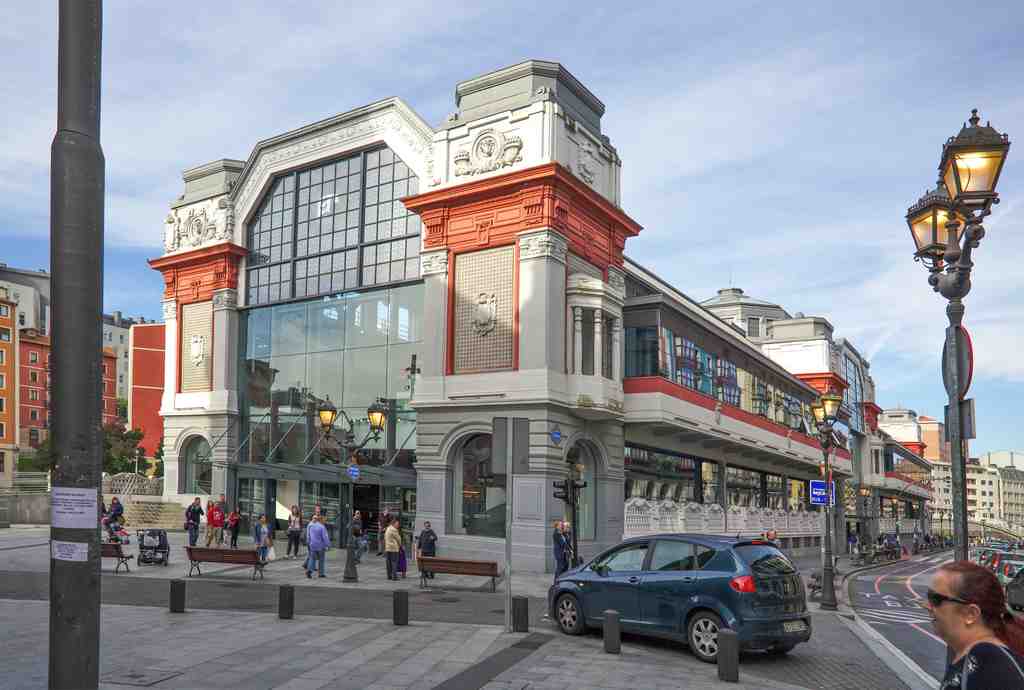
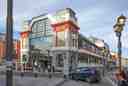
Riverside MarketPhoto: PA, Wikimedia Commons, CC BY-SA 4.0. Cropped & resized. On your right, look for a long concrete-and-glass building with broad horizontal lines and decorative art deco panels set into its riverside façade.
This is the Riverside Market, Mercado de la Ribera, stretched along the right bank of the Nervión beside the Old Town, and it is exactly the kind of place where Bilbao tells the truth about itself. Not in speeches, not in monuments... in dinner.
For centuries, this edge of the river served as the city’s working heart. From the fourteenth century onward, the old main square stood here beside San Antón church, the first town hall, and the houses of the Ribera. People came to buy, argue, compare fish, and probably exaggerate the quality of their onions. In the nineteenth century, the city began taming that open-air trade. By around eighteen forty, stall roofs started appearing, and by eighteen seventy the whole market had shelter. In eighteen fifty, Bilbao even set up quality controls for fish, milk, and meat, which tells you something important: this city tied civic pride to what landed on your plate.
One older market hall, built in iron, wrought metal, and glass, had a problem so practical it feels beautifully Bilbao. It trapped heat so badly that workers installed a watering system on the roof to cool the interior. A very grand building, with the survival instincts of a sprinkler.
The market you see now took shape in nineteen twenty-nine. Architect Pedro de Ispizua designed it in reinforced concrete with wide open floors, no interior columns, strong ventilation, and carefully managed natural light. He was a Bilbao kid with a gift for drawing, entered the School of Arts and Crafts at twelve, later worked on the Sagrada Familia under Gaudí in Barcelona, and then came home to shape his own city. Here, he gave Bilbao something wonderfully sensible: a market planned for use first, but dressed with stained glass, latticework, floral details, and an art deco sparkle on the façade. If you glance at the image in the app, you can see how the market, river, and old quarter lock together like pieces of one machine. And the interior photo shows Ispizua’s real trick, daylight flowing through lofty open space instead of getting trapped behind a forest of columns.
Inside, the building still organizes daily life by floor. The ground level belongs to fish, shellfish, salt cod, and pickles. Upstairs come meats, charcuterie, poultry, pastries, and preserves. Above that, fruit, vegetables, eggs, flowers, mushrooms, and seeds. And here is the detail locals quietly treasure: the market still keeps an area for direct sales from caseríos, the small Basque farmsteads. That link matters. Even after Bilbao reinvented its riverfront, its museums, and its image, the city still leaves space for someone from the countryside to bring in what they grew.
This place took its share of blows. Mercabilbao opened in nineteen seventy-one and pushed Ribera away from wholesale trade toward neighborhood shopping. Then the floods of nineteen eighty-three hit hard and forced major repairs. In two thousand eight, engineers discovered a serious structural problem: beach sand in the concrete had carried chlorides that corroded the steel reinforcement inside. So Bilbao rebuilt the market in phases from two thousand nine onward, correcting the damage without closing it for a single day. That tells you everything, really. A museum can shut for renovation. A city’s pantry has to keep feeding people.
Before you head on, look toward those entrances and ask yourself: if you had to explain Bilbao with one stall inside, would you choose cod, peppers, cured meat, eggs, or flowers from a caserío? After all the grand gestures a city can make, it feels right to end here, by the river, where history still changes hands in paper bags.
If you want to come back inside, the market usually opens from seven thirty in the morning until eight at night, with later closing, until nine, from Thursday through Saturday.
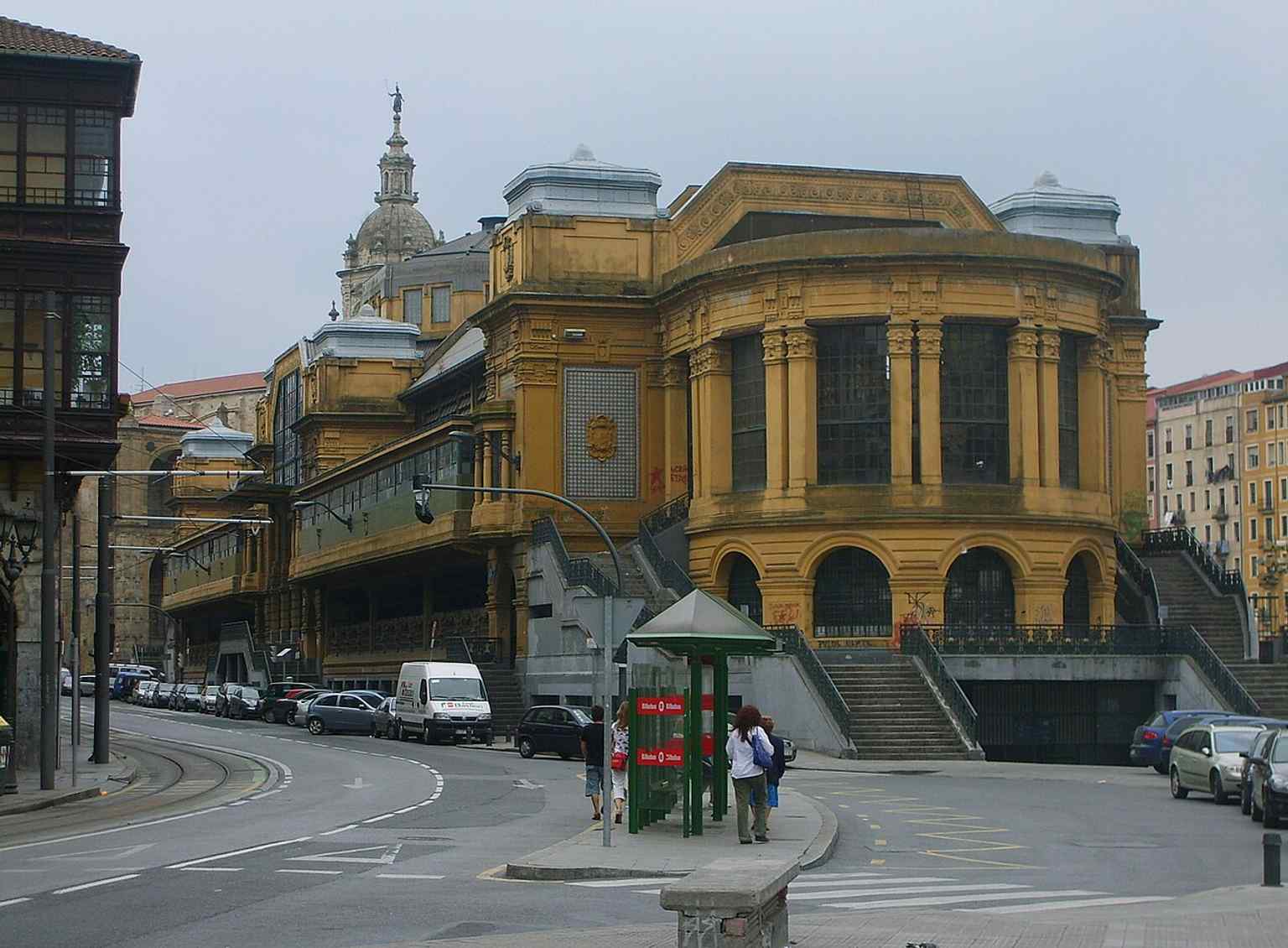
A classic full view of the market building, showing the long riverside façade beside Bilbao’s old quarter.Photo: No machine-readable author provided. Martin253~commonswiki assumed (based on copyright claims)., Wikimedia Commons, Public domain. Cropped & resized. 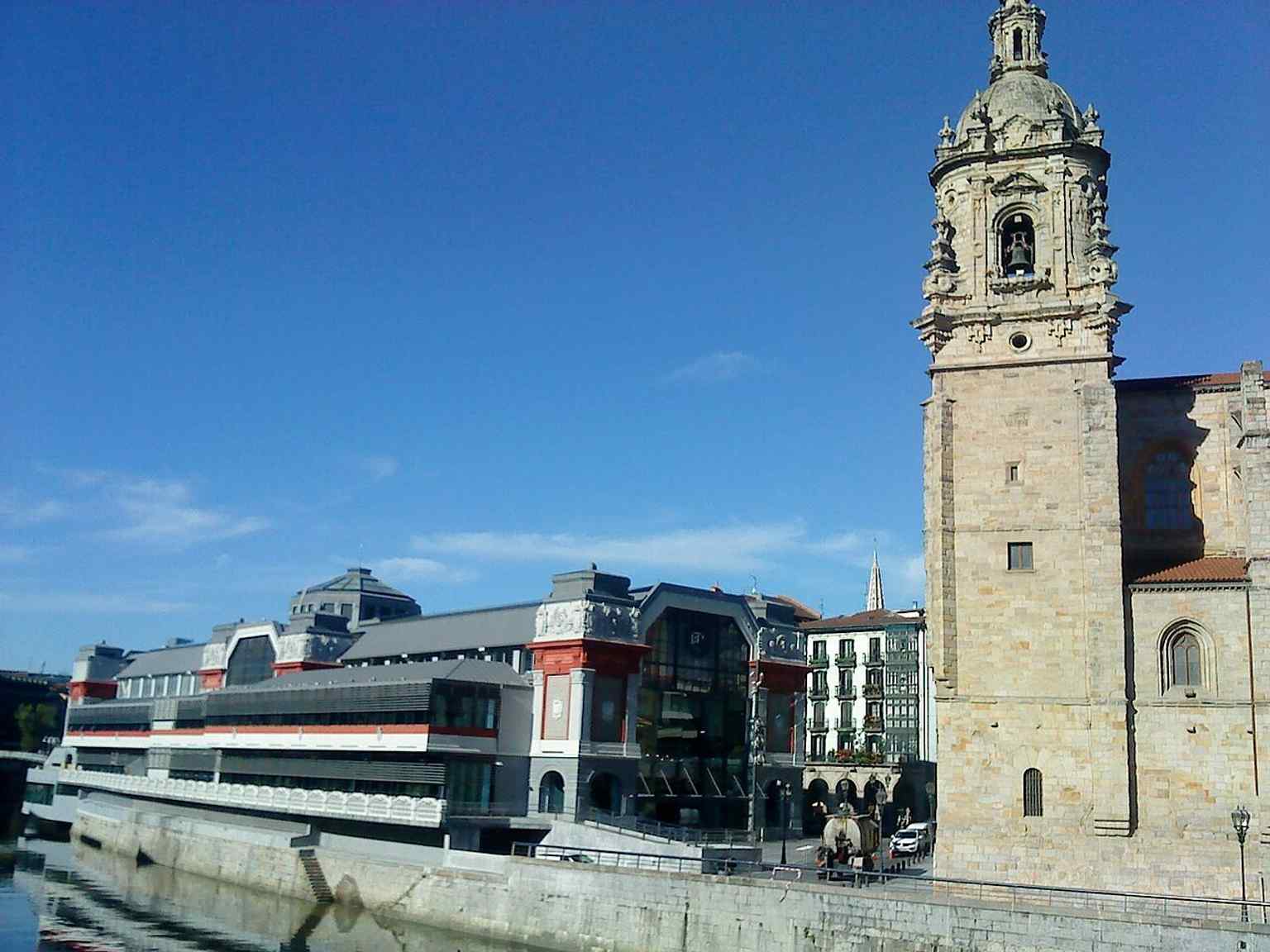
The market with San Antón Church next door, exactly the landmark pairing that shaped this site for centuries.Photo: Txo, Wikimedia Commons, CC BY-SA 3.0. Cropped & resized. 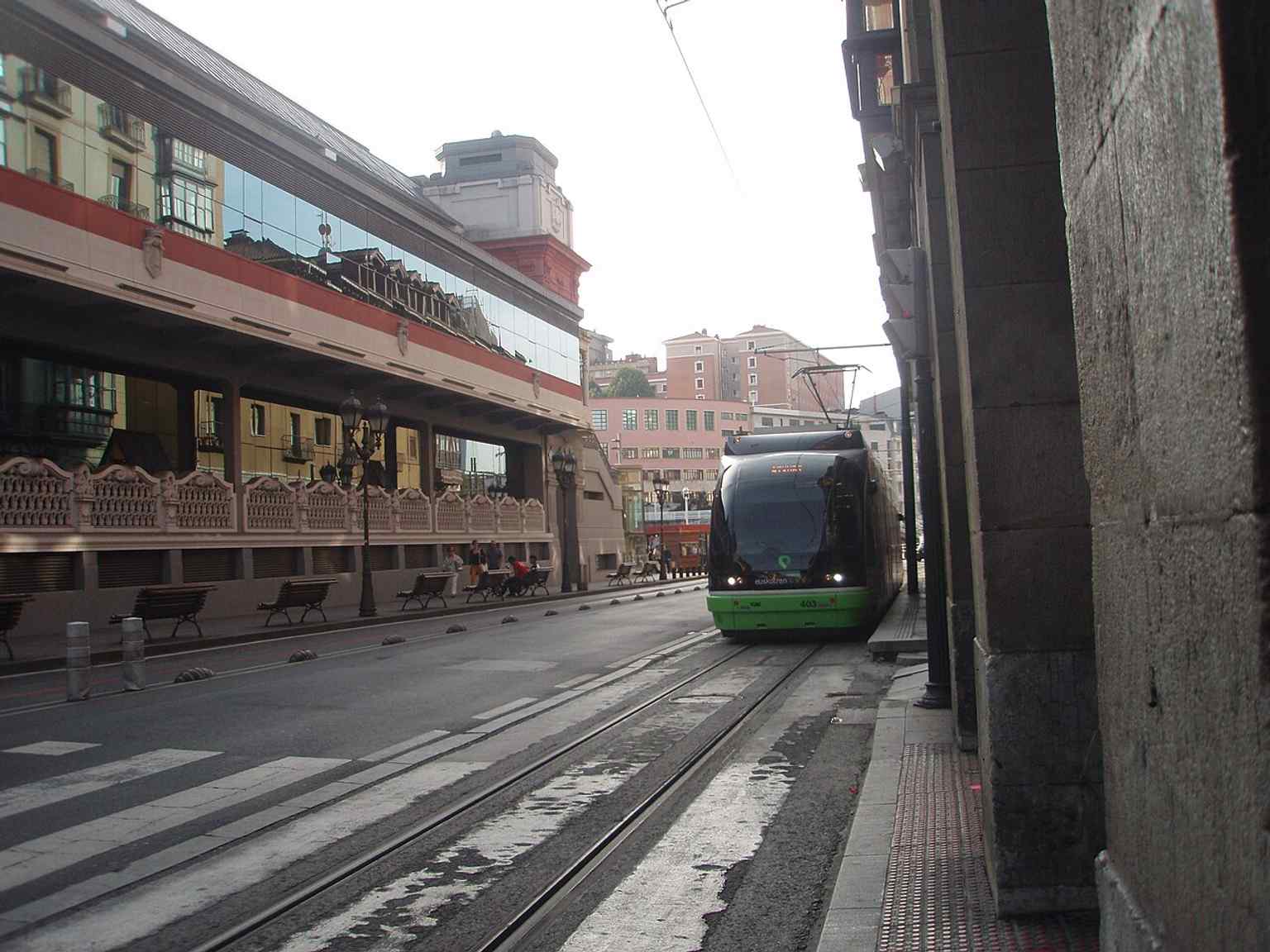
The market seen with the tram in front, reflecting the easy public-transport access mentioned in the source.Photo: MaiGor JoaEto, Wikimedia Commons, CC BY-SA 4.0. Cropped & resized. 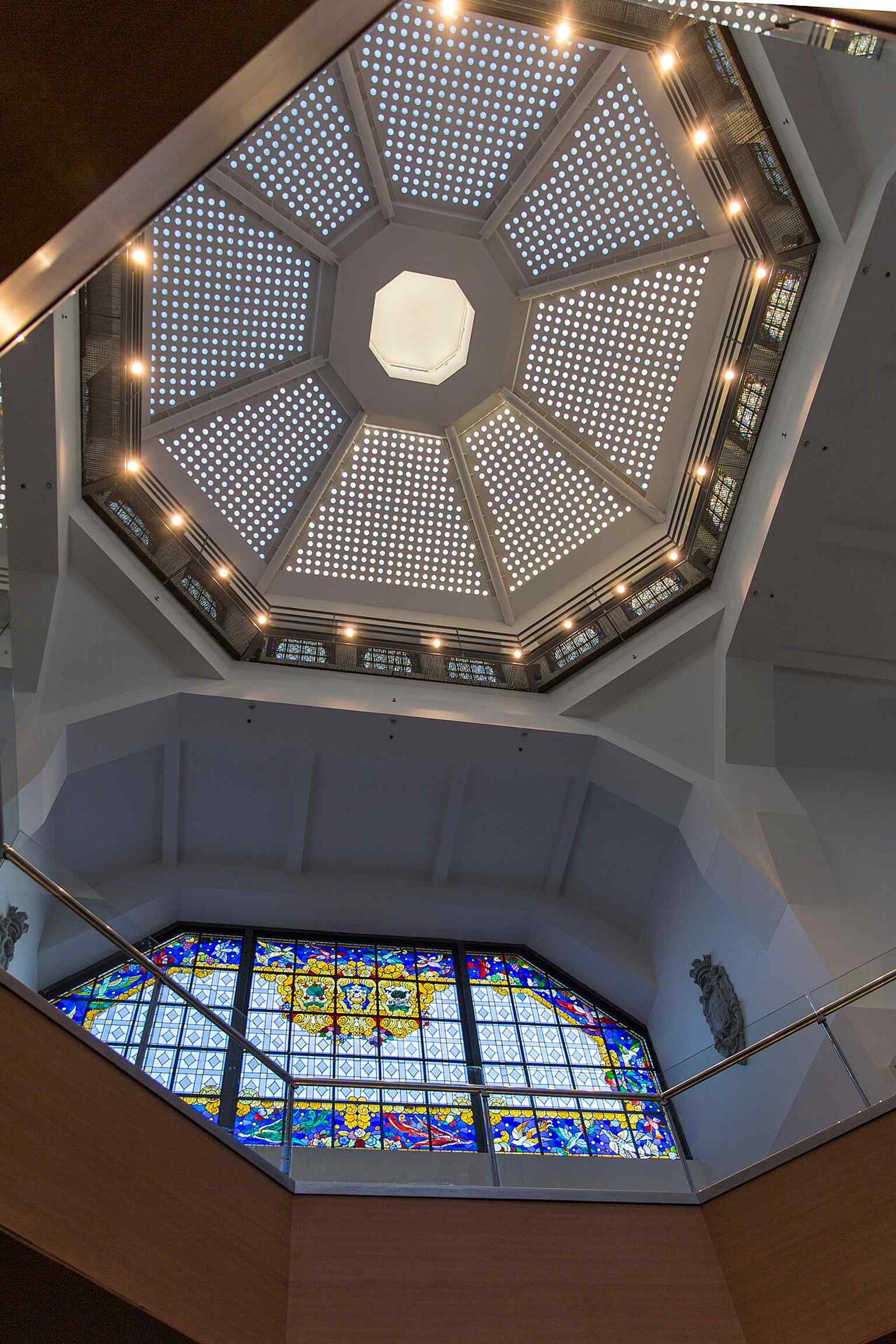
Inside the market under its lofty ceiling, where natural light and open space were central to the 1929 design.Photo: PA, Wikimedia Commons, CC BY-SA 4.0. Cropped & resized. 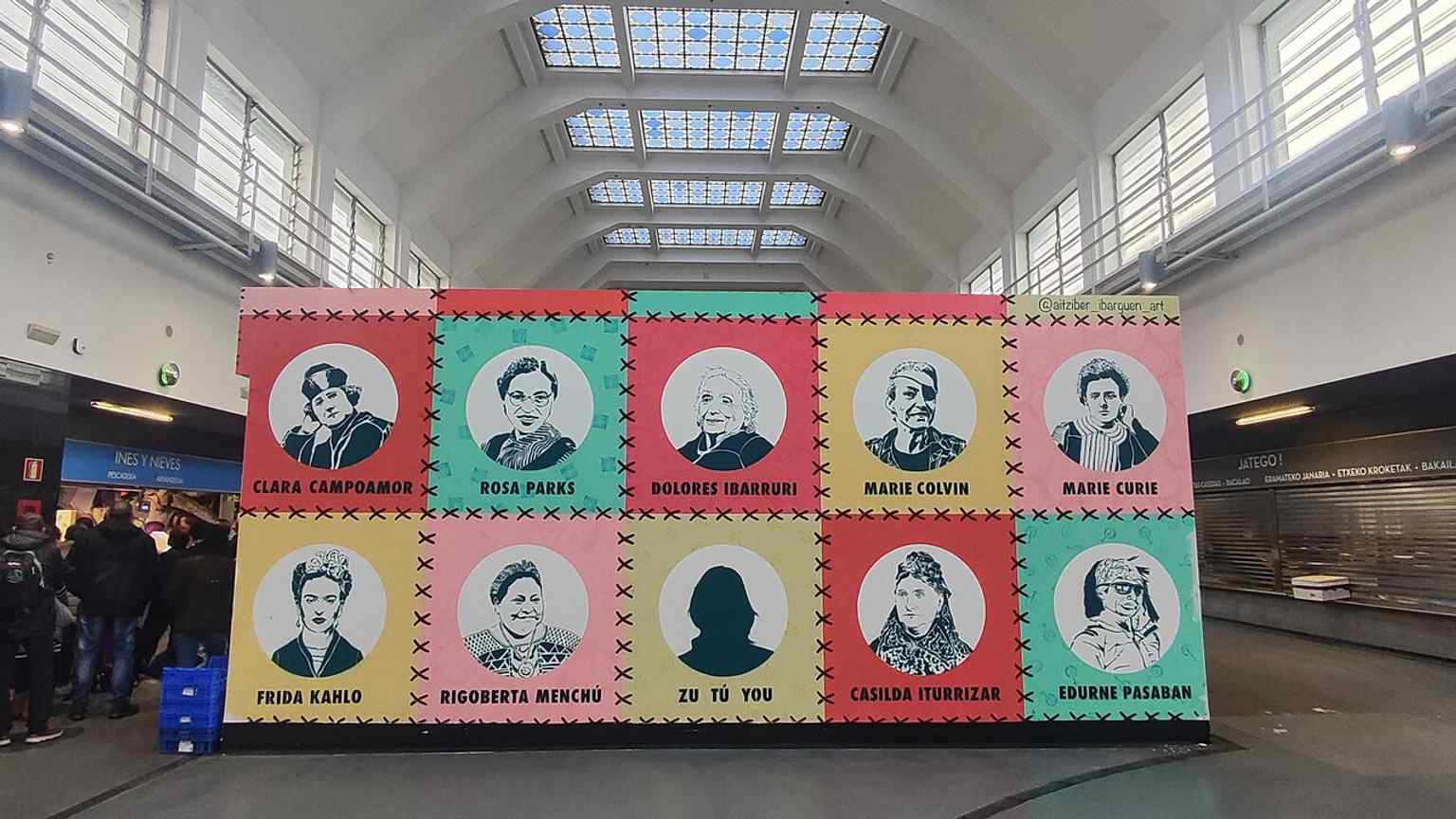
A modern interior view showing the busy covered market that still serves Bilbao’s neighborhood shoppers.Photo: Mentxuwiki, Wikimedia Commons, CC BY-SA 4.0. Cropped & resized. 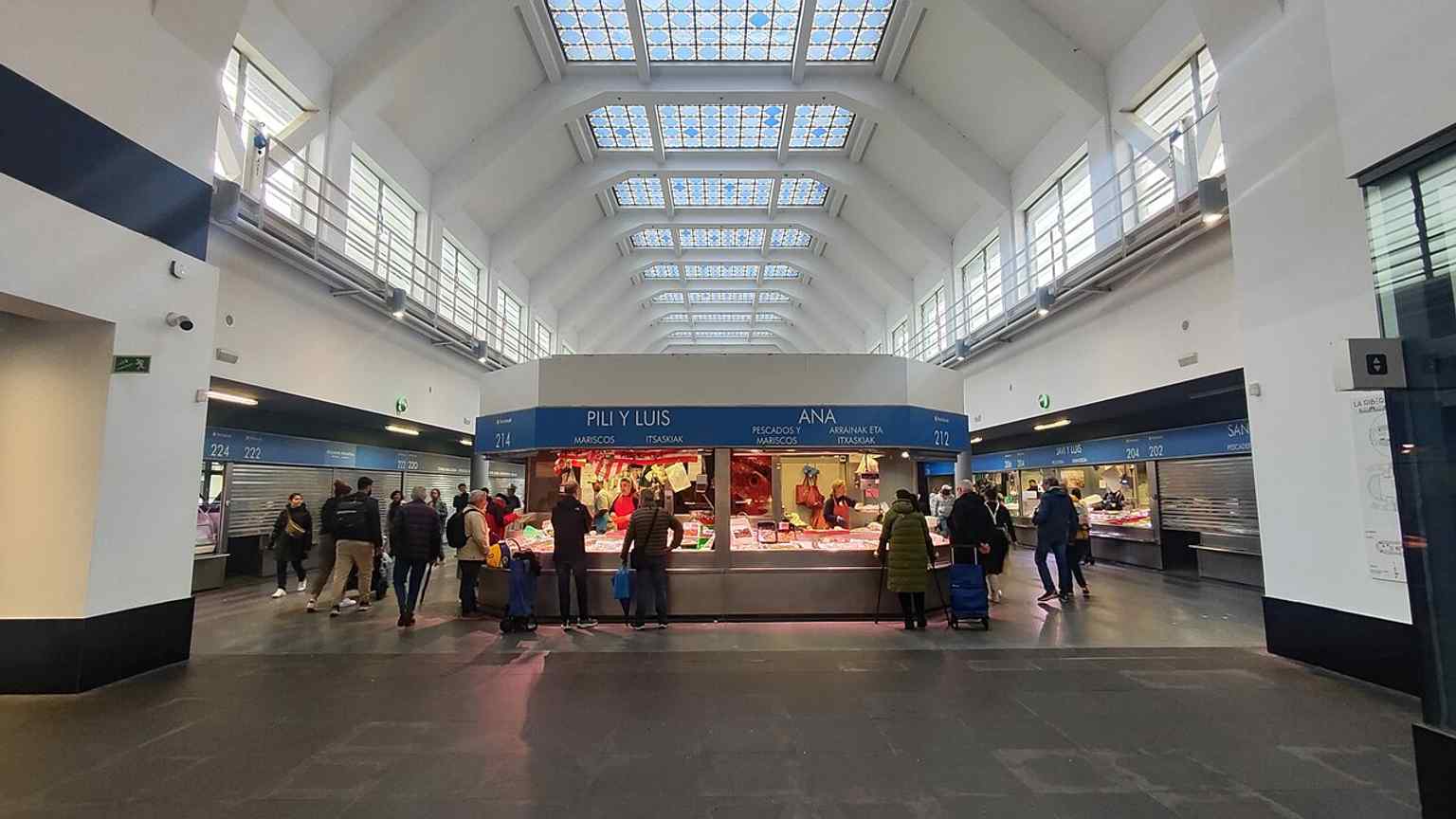
Another interior angle that helps show the market’s updated stalls and circulation after the 1983 flood repairs.Photo: Mentxuwiki, Wikimedia Commons, CC BY-SA 4.0. Cropped & resized. 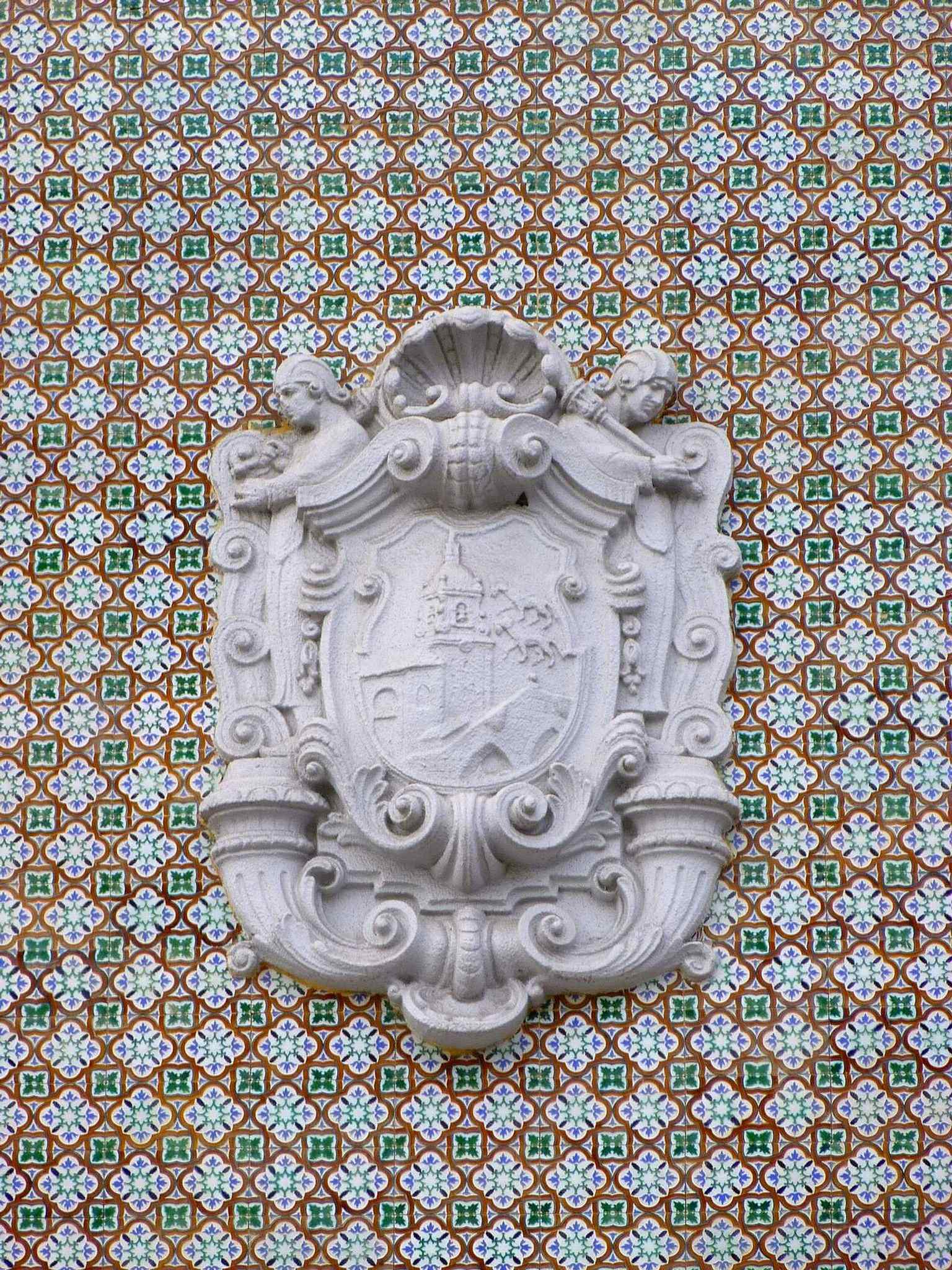
A close-up of the Bilbao coat of arms on the building, a reminder of the market’s civic importance.Photo: Zarateman, Wikimedia Commons, CC BY-SA 4.0. Cropped & resized. 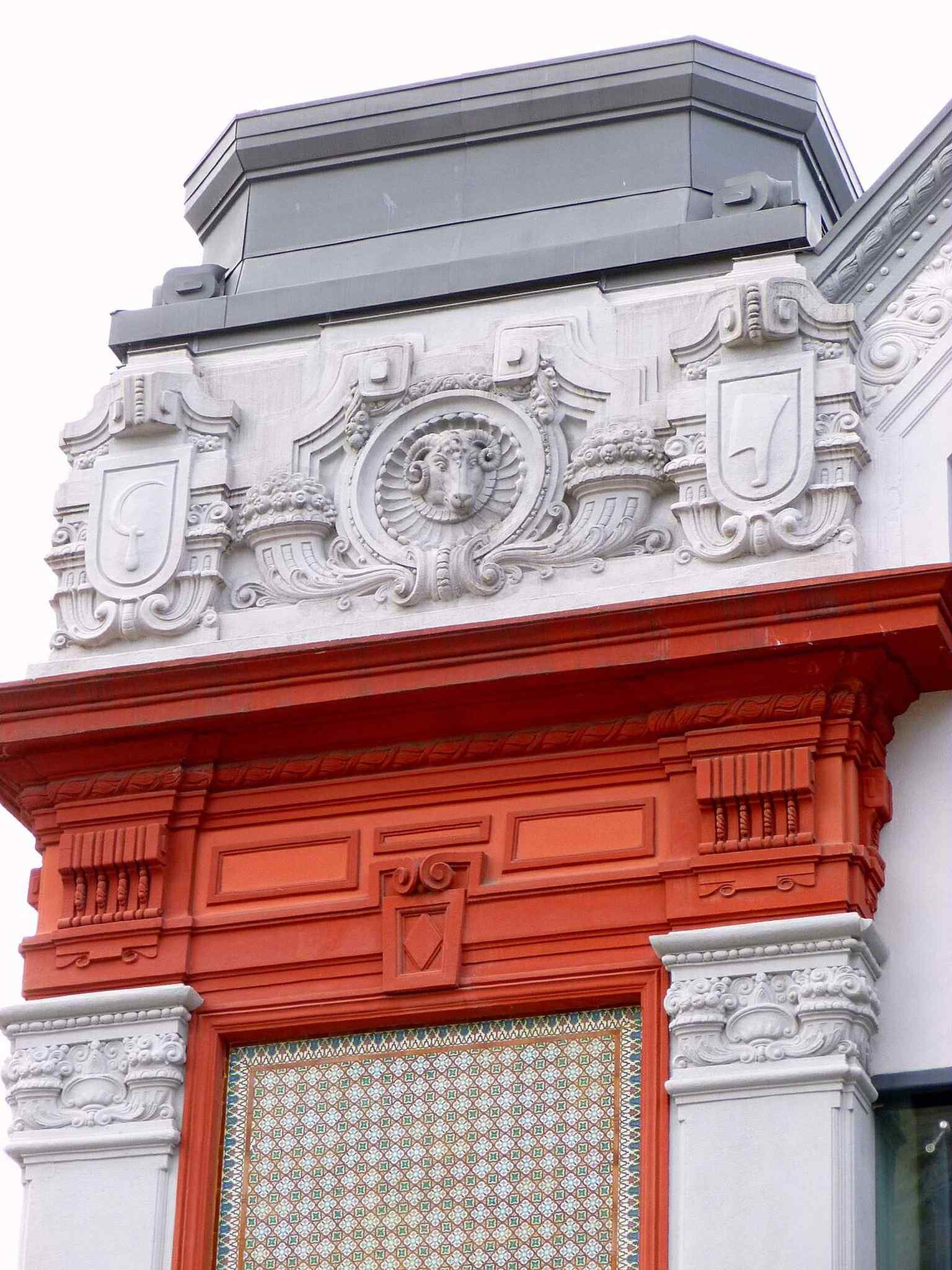
Architectural ornament on the façade — the art-deco and eclectic detailing added to the rationalist structure.Photo: Zarateman, Wikimedia Commons, CC BY-SA 4.0. Cropped & resized. 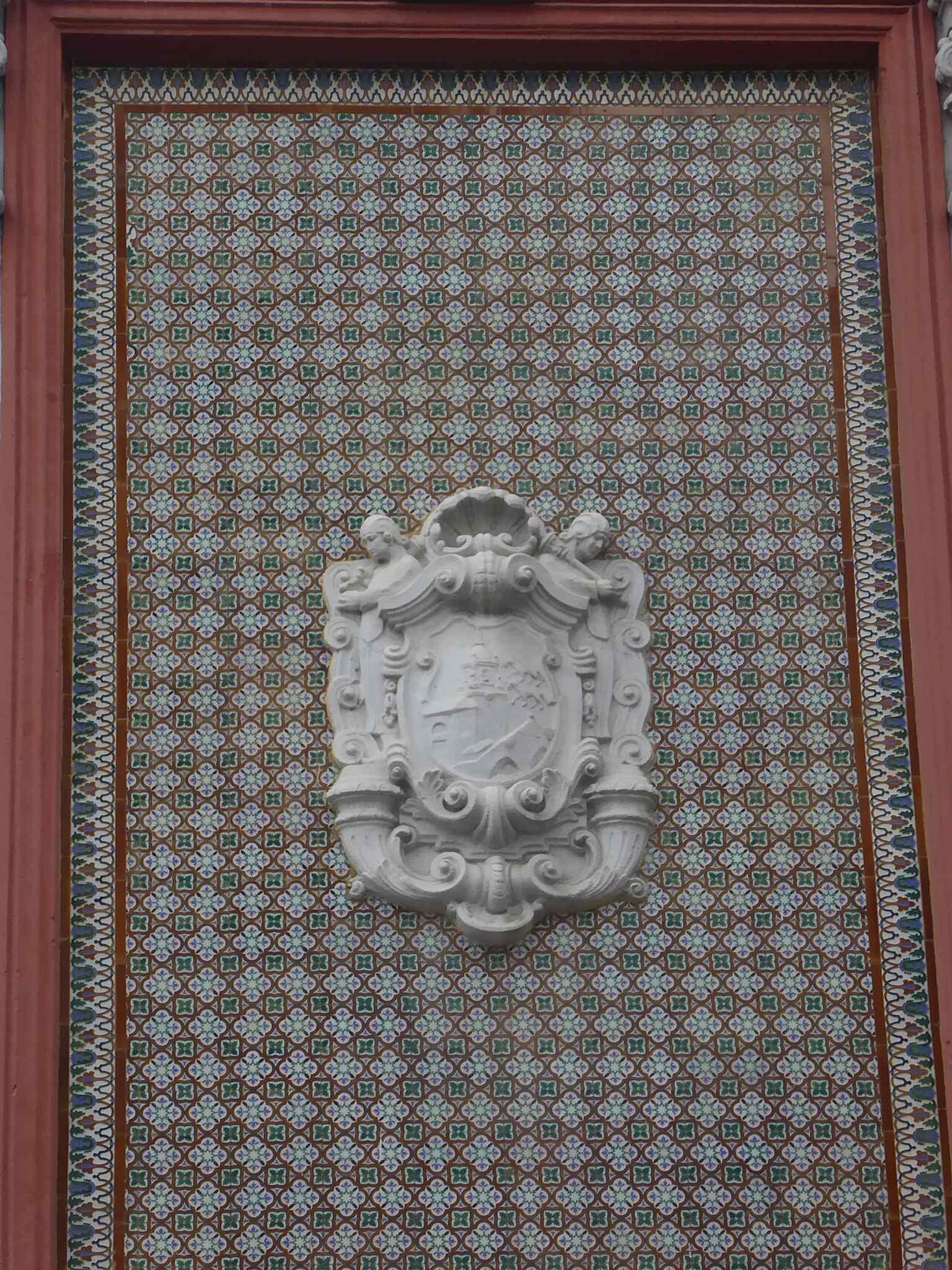
Decorative tilework on the market exterior, part of the rich façade treatment that distinguishes the building.Photo: Ardfern, Wikimedia Commons, CC BY-SA 4.0. Cropped & resized. 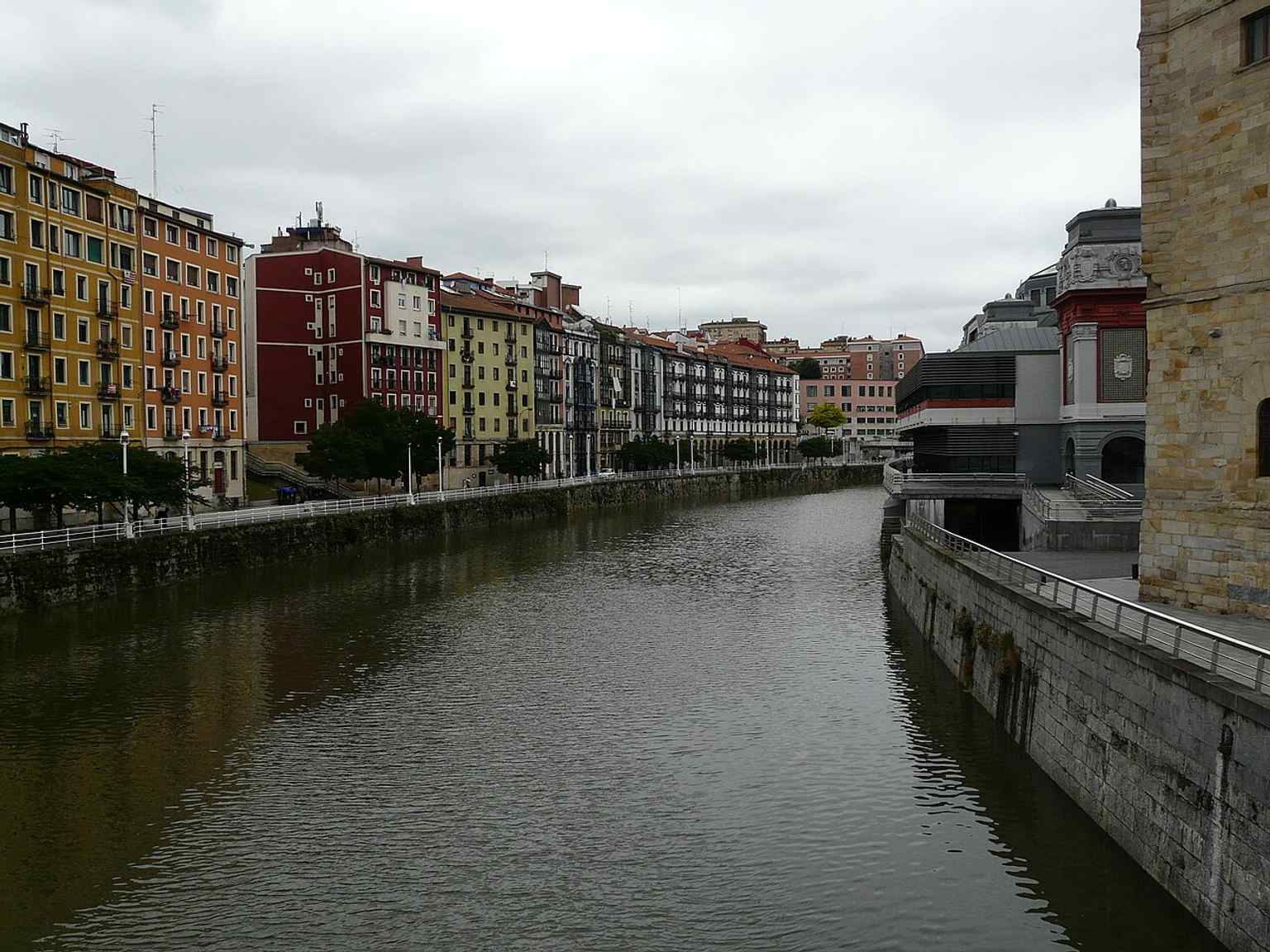
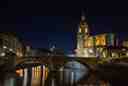
A view from San Antón Bridge looking toward the riverfront, placing the market in the wider Bilbao landscape.Photo: pere prlpz, Wikimedia Commons, CC BY-SA 3.0. Cropped & resized.
Frequently asked questions
How do I start the tour?
After purchase, download the AudaTours app and enter your redemption code. The tour will be ready to start immediately - just tap play and follow the GPS-guided route.
Do I need internet during the tour?
No! Download the tour before you start and enjoy it fully offline. Only the chat feature requires internet. We recommend downloading on WiFi to save mobile data.
Is this a guided group tour?
No - this is a self-guided audio tour. You explore independently at your own pace, with audio narration playing through your phone. No tour guide, no group, no schedule.
How long does the tour take?
Most tours take 60–90 minutes to complete, but you control the pace entirely. Pause, skip stops, or take breaks whenever you want.
What if I can't finish the tour today?
No problem! Tours have lifetime access. Pause and resume whenever you like - tomorrow, next week, or next year. Your progress is saved.
What languages are available?
All tours are available in 50+ languages. Select your preferred language when redeeming your code. Note: language cannot be changed after tour generation.
Where do I access the tour after purchase?
Download the free AudaTours app from the App Store or Google Play. Enter your redemption code (sent via email) and the tour will appear in your library, ready to download and start.
If you don't enjoy the tour, we'll refund your purchase. Contact us at help@audatours.com
Checkout securely with 












%20julesvernex2.jpg)
%2014.jpg)

%2015.jpg)

-Puppy%20(Jef%20Koons%2C%201992)-1-Situado%20junto%20al%20Museo%20Guggenheim.jpg)
%203.jpg)
.jpg)
%2013.jpg)


-Puente%20Zubizuri%20(Santiago%20Calatrava)-2.jpg)


%20(2576).jpg)


.jpg)


.jpg)
.jpg)


.jpg)
