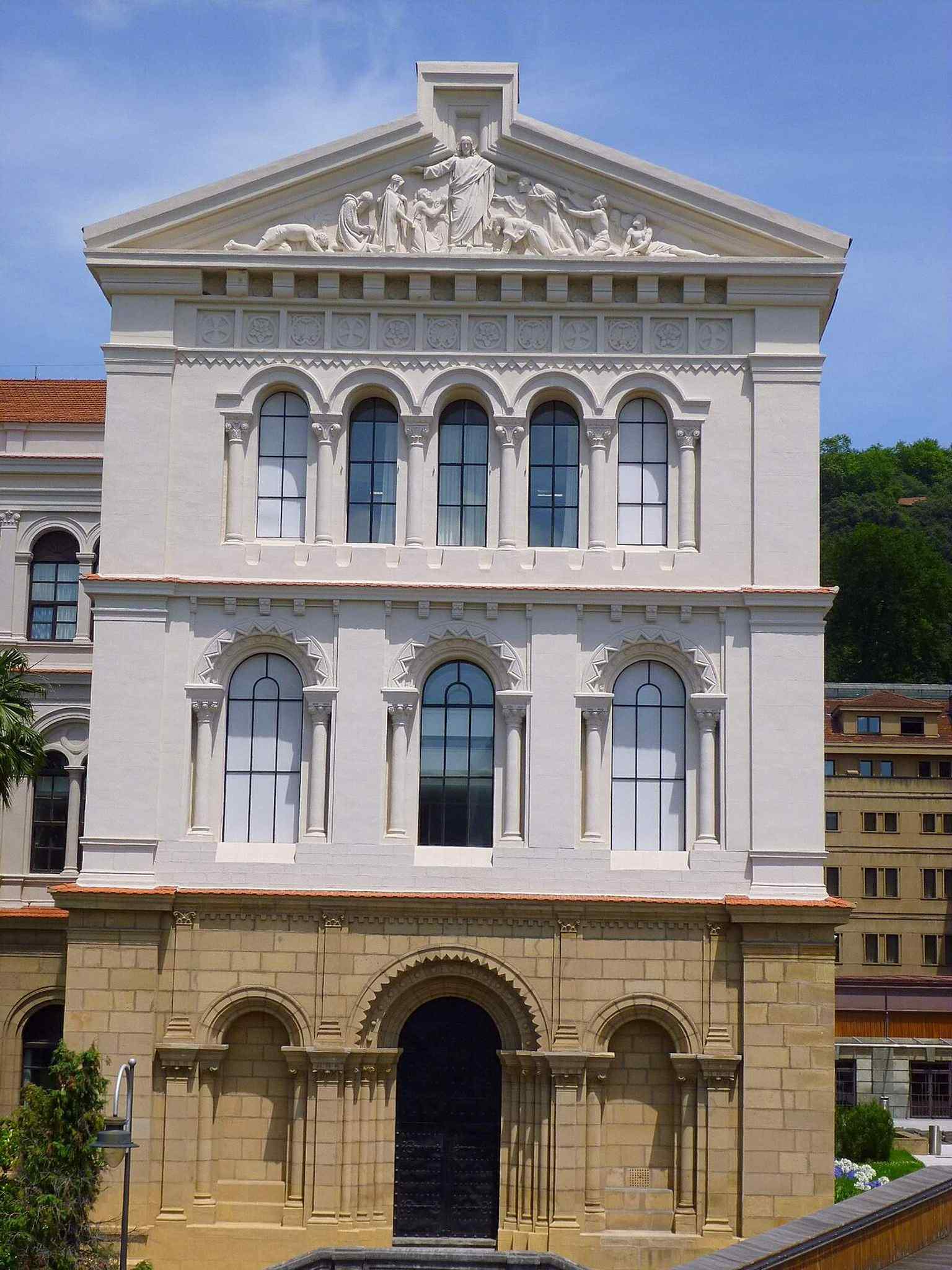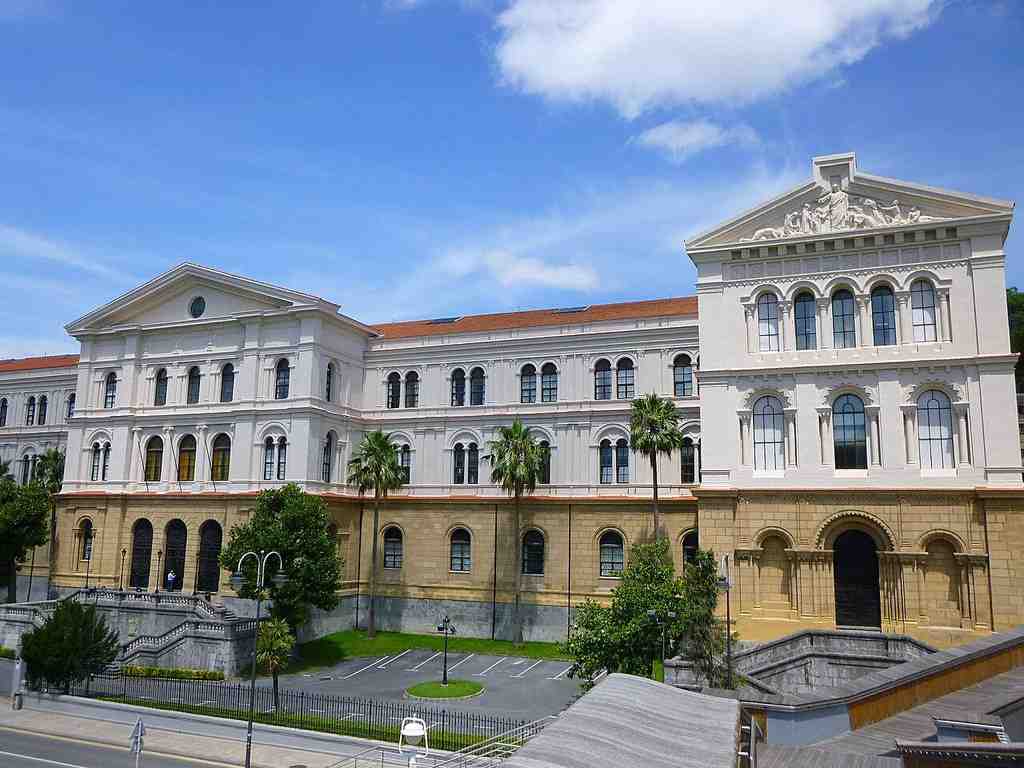
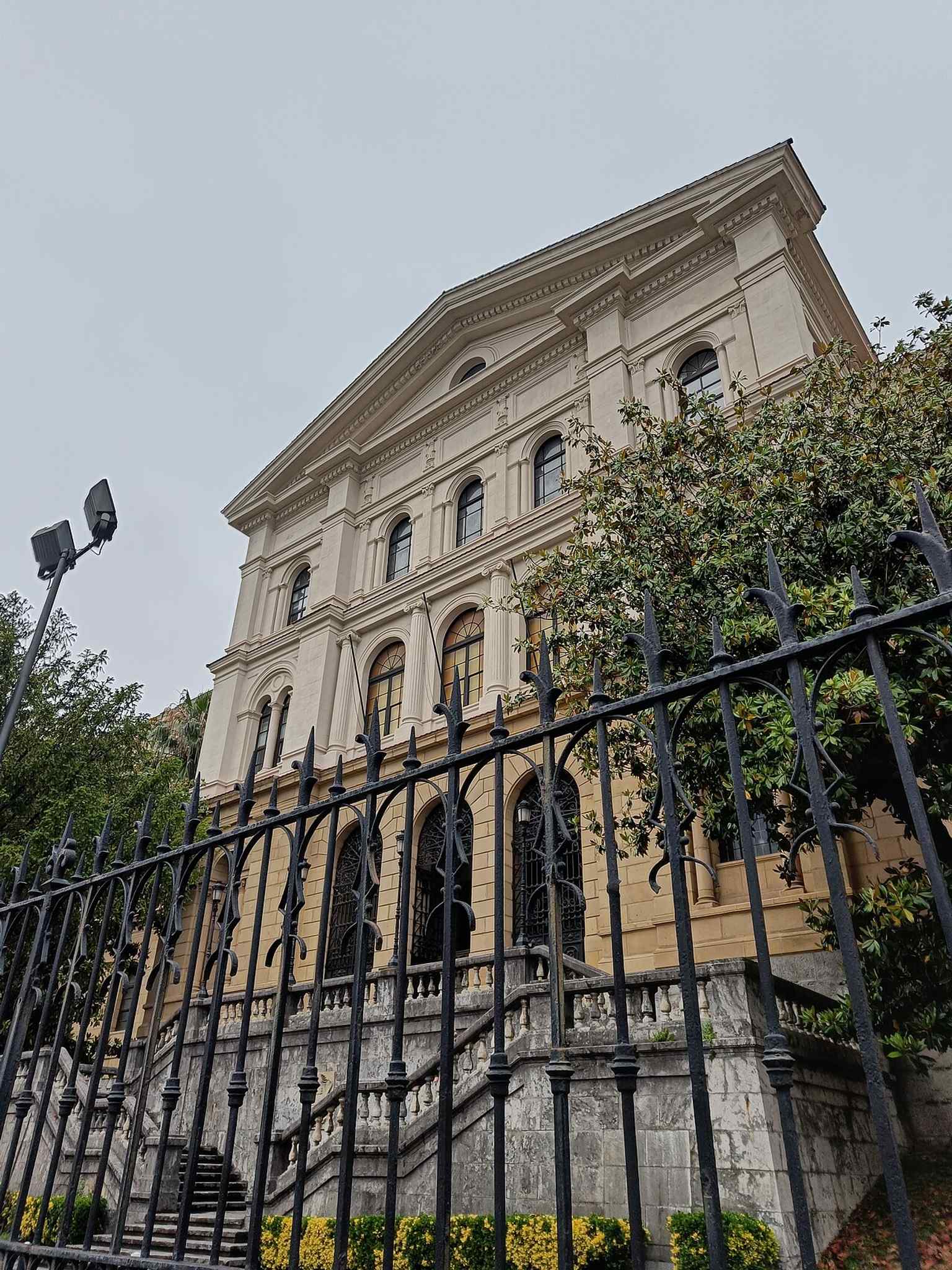
On your right, the University of Deusto shows itself as a long pale-stone facade with orderly rows of arched windows and a central pediment that gives the whole building the calm authority of a scholarly palace.
From where you stand across the street, you are looking at the historic heart of Deusto, often called La Literaria. If you glance at your screen, the image helps pick out that formal, balanced front more clearly. It is handsome, yes, but its real importance is less about style than about intention. Bilbao did not reinvent itself with docks, banks, and grand avenues alone. It also needed trained minds... lawyers, teachers, business leaders, engineers, people who could turn industrial muscle into a durable society.
The Jesuits, the Catholic order that runs this university, are specialists in organized learning. They build systems that outlast political swings: classrooms, libraries, habits of study, a kind of intellectual scaffolding for a city.
They founded Deusto in eighteen eighty-six, when Bilbao and its port were growing fast and the Basque Country wanted a university of its own. That choice mattered. The Ensanche was pushing the city outward, and here, across the river, education was expanding its reach in parallel. One side laid out streets; the other trained the people who would fill the offices on them.
Deusto became Spain’s oldest private university, and one of its most respected. One of its boldest moves came in nineteen sixteen, when the university launched what became the Commercial University of Deusto. Its first students graduated with Deusto’s own business qualification a full twenty-five years before Spain officially recognized degrees in economics. That is a pretty good example of Bilbao behavior: if the rulebook is late, start working anyway.
But this facade has seen far more than lectures. In nineteen thirty-two, during the Second Republic, the government dissolved the Jesuit order in Spain and confiscated its property, so the university closed. Then, after Bilbao fell in June of nineteen thirty-seven, this main building became the central and permanent core of a Francoist concentration camp. It also served as a prison, a hospital, and a base for organizing prisoner battalions until December of nineteen thirty-nine. That is a hard layer of memory to carry beneath such a composed exterior.
One person tied to this place stands out: Jesús María Leizaola. Later rector José María Guibert said Leizaola had the vision and the determination to save these buildings during the occupation. Without that intervention, this campus might not have survived at all. So when you look at the stone and symmetry, you are also looking at something rescued.
Deusto kept adapting. It opened in San Sebastián in nineteen fifty-six. In nineteen sixty-seven, its theology faculty arrived from Oña, and the Vatican authorized it to admit all kinds of students, not only future clergy. Much later, architect Rafael Moneo designed the university’s new library, opened in two thousand and nine with ten floors, five of them underground, and a translucent glass skin carefully designed not to compete with the Guggenheim nearby. You can see the broader campus shape on your phone here.
That is the thread to keep in mind as we head on: before Bilbao unveiled its global icon, it spent generations building quieter engines like this one. The next stop is the city’s most famous leap onto the world stage.