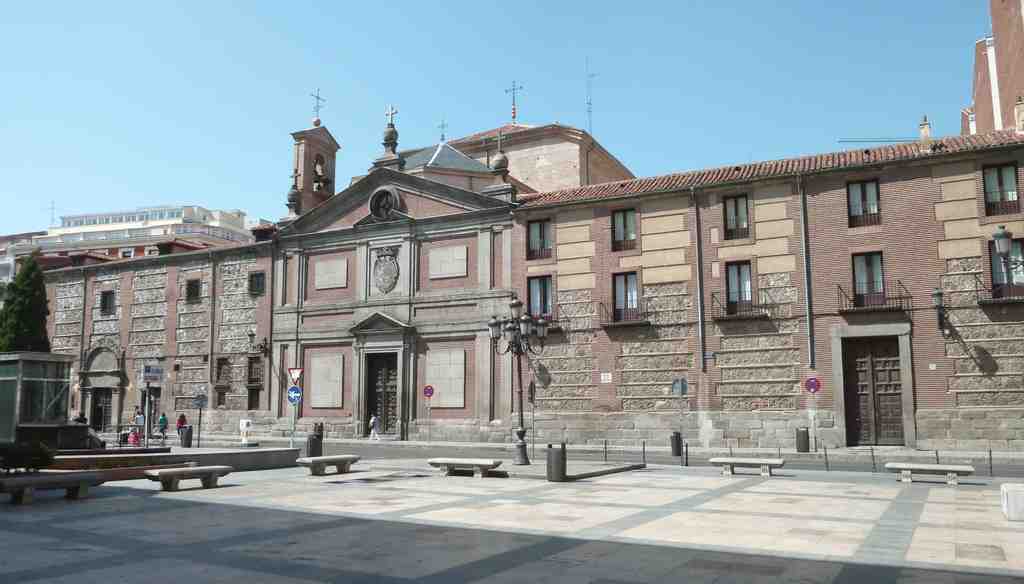
On your left, look for a long tawny stone facade, rectangular and restrained, with a severe classical doorway and the church front folded quietly into the monastery wall.
This place likes to play shy. The Royal Monastery of the Barefoot Nuns does not swagger the way a palace does, but that is exactly the trick. Behind this calm exterior sits one of Madrid’s most politically charged addresses.
The monastery began in fifteen fifty-nine, when Juana of Austria founded it here on the site of her family home. Juana was no minor princess tucked into the margins. She was the sister of King Philip the Second, the widow of the Portuguese prince Juan Manuel, the mother of the future King Sebastian of Portugal, and for a time governor of the Spanish kingdom itself. After Portugal, power, widowhood, and court duty, she turned her own birthplace into a convent... and not just a convent. She created a retreat, a dynastic memorial, a charitable center, and a carefully controlled world where royal women could shape the city without standing in the public square making speeches.
That is the turn here. Madrid’s story is not only kings on balconies and armies in plazas. Sometimes influence wore simple sandals. The “barefoot” name comes from the Franciscan nuns who lived here in plain footwear year-round, a deliberate sign of humility. In Madrid, humility occasionally came with excellent art and very strong family connections.
Most tourists see a peaceful religious building. Locals know this square was once the heart of the old arrabal de San Martín, an older suburb outside medieval Madrid’s first walls. So this quiet facade stands over layers of older city life: houses, processions, royal proclamations, and before all that, even a noble palace where the first Cortes, the governing assembly, met in Madrid in thirteen thirty-nine.
If you glance at the image on your screen, you can see how different the square once looked, with the monastery surrounded by other severe buildings that later vanished or changed shape. This convent survived while much around it did not.
Inside, the real surprise deepens. Royal women turned the monastery into a kind of hidden Habsburg court. Maria of Austria, widow of Emperor Maximilian the Second, lived here from fifteen eighty, and her daughter Margarita became a nun here. Their presence made these enclosed rooms a place of counsel, ceremony, and memory. Princesses stayed in the Cuarto Real, the royal quarters. Gifts poured in. Art accumulated. Rubens tapestries hung for great feast days. The composer Tomás Luis de Victoria served here for years, first as Maria’s chaplain and later as organist, so imagine sacred music rising through spaces shaped as much by devotion as by dynasty.
The building kept changing too. Fire in eighteen sixty-two destroyed the original high altar. Bomb damage during the Civil War scarred the great staircase, yet later restoration uncovered layers of painted decoration and even revealed several different artists’ hands at work. Madrid never quite stops rewriting itself, even in silence.
Royal women as hidden patrons leave one of their clearest signatures here: they founded, collected, commissioned, sheltered, and preserved. Not all power in Madrid announced itself with trumpets or vast facades. Some of it lived behind convent walls and still managed to steer the story.
When you are ready, continue about nine minutes to the Royal Academy of Fine Arts of San Fernando. If you want to return later, check the current visiting hours in the app.