
Madrid Audio Tour: Historic Center Gems
Beneath Madrid’s bright stone, Centro still pulses like a drumbeat from empire days. Stand at Puerta del Sol where news and unrest detonated, then slip into alleys that hide royal secrets in plain sight. This self guided audio tour threads through Puerta del Sol, Plaza Mayor, the Monastery of the Descalzas Reales and nearby corners, turning familiar squares into scenes of rebellions, political battles, scandals, and forgotten moments most visitors walk past. When did a crowd in Sol tip the city from patience to fury, and who paid the price? What silence clings to the Descalzas Reales corridors, and which vow was never meant to be heard? Why does Plaza Mayor still preserve one oddly specific detail tied to spectacle and shame? Follow the sound from sunlit plazas to shadowed cloisters, moving with tension, discovery, and sudden clarity. Start now, and hear Centro beat again under your feet.
Tour preview
About this tour
- scheduleDuration 110–130 minsGo at your own pace
- straighten5.0 km walking routeFollow the guided path
- location_on
- wifi_offWorks offlineDownload once, use anywhere
- all_inclusiveLifetime accessReplay anytime, forever
- location_onStarts at Puerta del Sol
Stops on this tour
lock_open 3 free previews · 11 unlock with purchase
Ahead of you, Puerta del Sol opens as a broad semicircular stone plaza framed by uniform cream façades, with the red-brick Real Casa de Correos and its clock tower as the…Read moreShow less
Open dedicated page →Ahead of you, Puerta del Sol opens as a broad semicircular stone plaza framed by uniform cream façades, with the red-brick Real Casa de Correos and its clock tower as the unmistakable marker.
Picture José Rodríguez de Losada for a moment: a watchmaker from León, living in London, deciding that Madrid deserved a better clock. That sounds a little niche, I know... but in this square, public time became public pride.
Sol began as something much plainer than the stage you see now. In the late medieval city wall, this was one of Madrid’s gates, named for a sun emblem set above the entrance because the gate faced the sunrise. As the city spread, the gate lost its original job. Then, in the eighteen hundreds, Madrid cleared away houses and former convents, kept the line of the Real Casa de Correos, and shaped this open semicircle you’re standing in now. A gate became a plaza; a threshold became the city’s front room.
The Real Casa de Correos, straight ahead, is the oldest major building here. French architect Jaime Marquet gave it form between seventeen sixty-six and seventeen sixty-eight. Later it served as the Ministry of the Interior, and under Franco its cells became a feared place for political prisoners. Today it holds the Presidency of the Community of Madrid. That’s Madrid for you: one façade, several lives.
If you want, glance at the before-and-after image in the app; it shows just how much this place widened from a tighter nineteenth-century square into today’s civic stage.
Now, somewhere near the Casa de Correos is one of Spain’s smallest big-deal landmarks: Kilómetro Cero. Installed here in nineteen fifty, it marks the starting point of the country’s radial roads. Officially, distances fan out from here. Emotionally, plenty of people still treat Sol the same way... as the place where plans begin. If you check the plaque image on your screen, you’ll see how modest the marker is for such a grand national claim.
Take a second and notice what people do in this square. Some pause to get their bearings. Some wait for a friend. Some photograph a symbol and move on. Even now, Sol still works like Madrid’s shared starting line.
And then there’s that clock. Before Losada donated the current one, the earlier clock had a rotten reputation for running late. Not charmingly late, either. So late it embarrassed the city and even delayed departures from the square. Losada’s replacement opened in eighteen sixty-six, inaugurated by Queen Isabella the Second, and Madrid grabbed onto it with both hands. Since nineteen sixty-two, its New Year’s chimes have carried the ritual of the twelve grapes into homes across Spain. In nineteen thirty-eight, during the Civil War, a shell even struck the clock and failed to explode, as if the thing had decided it would keep going no matter what.
That’s the trick of Sol: it turns ordinary routines - checking the hour, meeting a friend, starting a trip - into ceremony. When you’re ready, head on to Plaza Mayor, about seven minutes away, and we’ll see how Madrid gave public life an even grander set of walls.
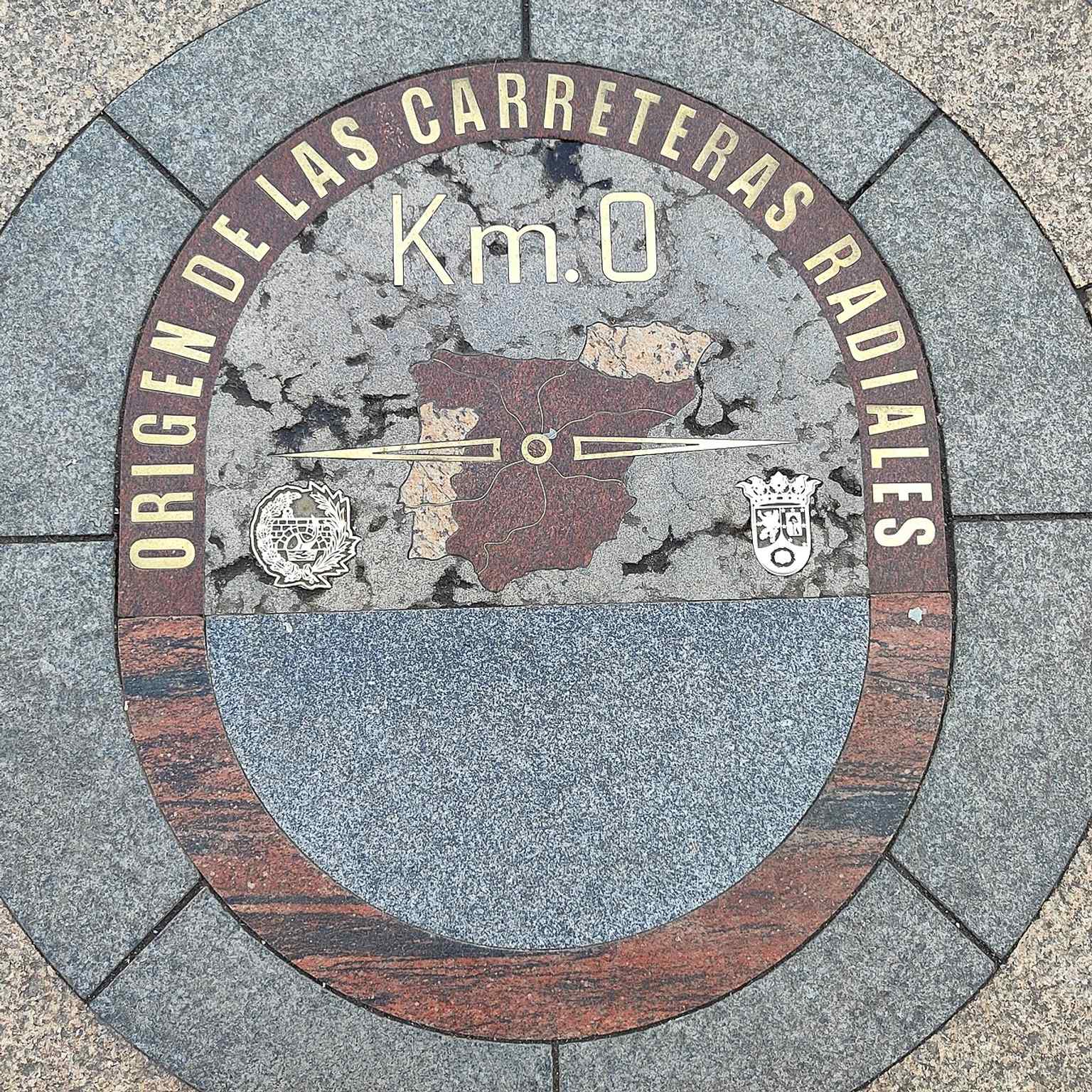
A contemporary close-up of the Km 0 monument, showing how this tiny marker sits at the center of a constantly busy square.Photo: Mentxuwiki, Wikimedia Commons, CC BY-SA 4.0. Cropped & resized. 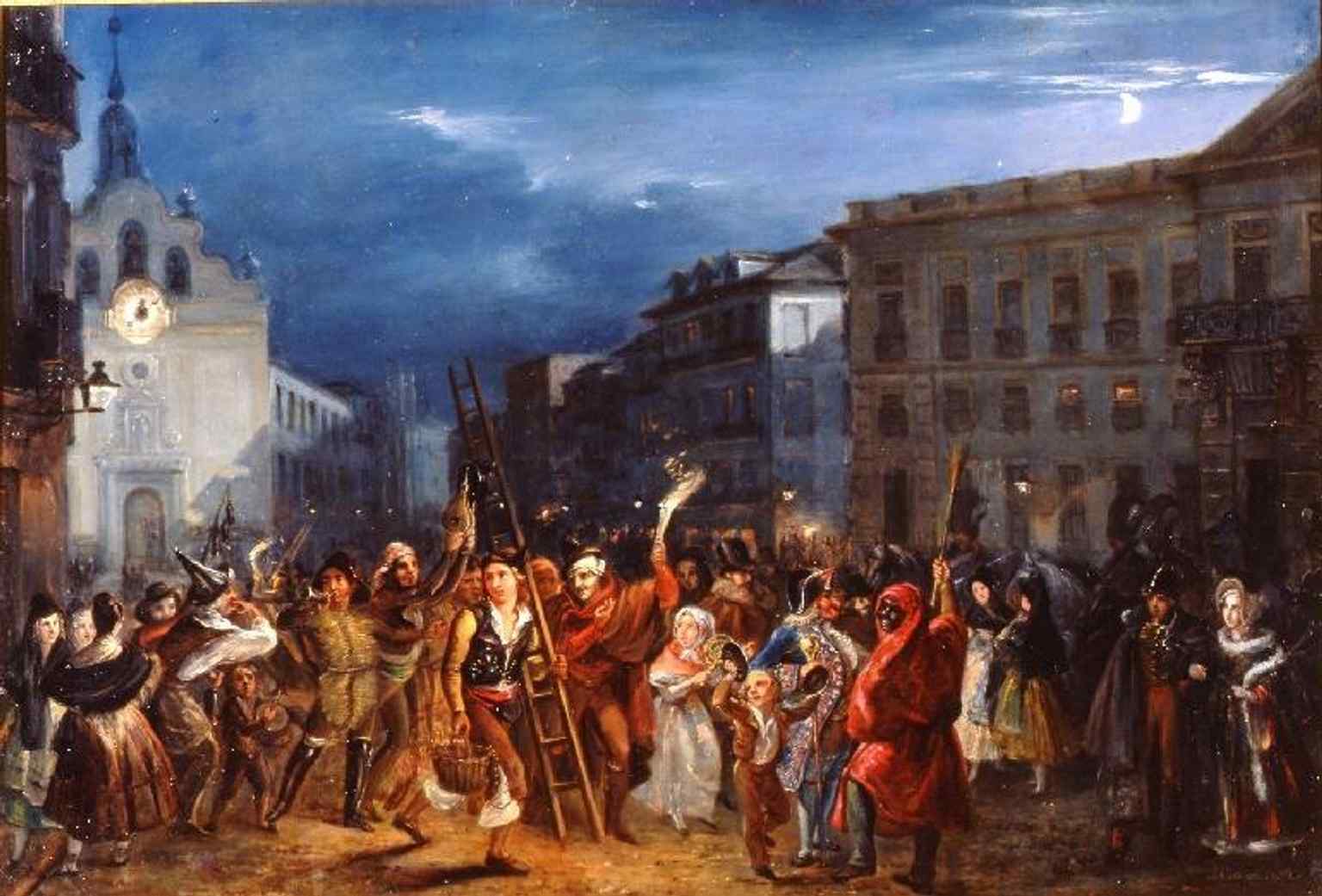
Luis Paret’s 18th-century view of Puerta del Sol recalls the plaza’s early origins as a city gate before it became today’s broad square.Photo: José Castelaro y Perea, Wikimedia Commons, Public domain. Cropped & resized. 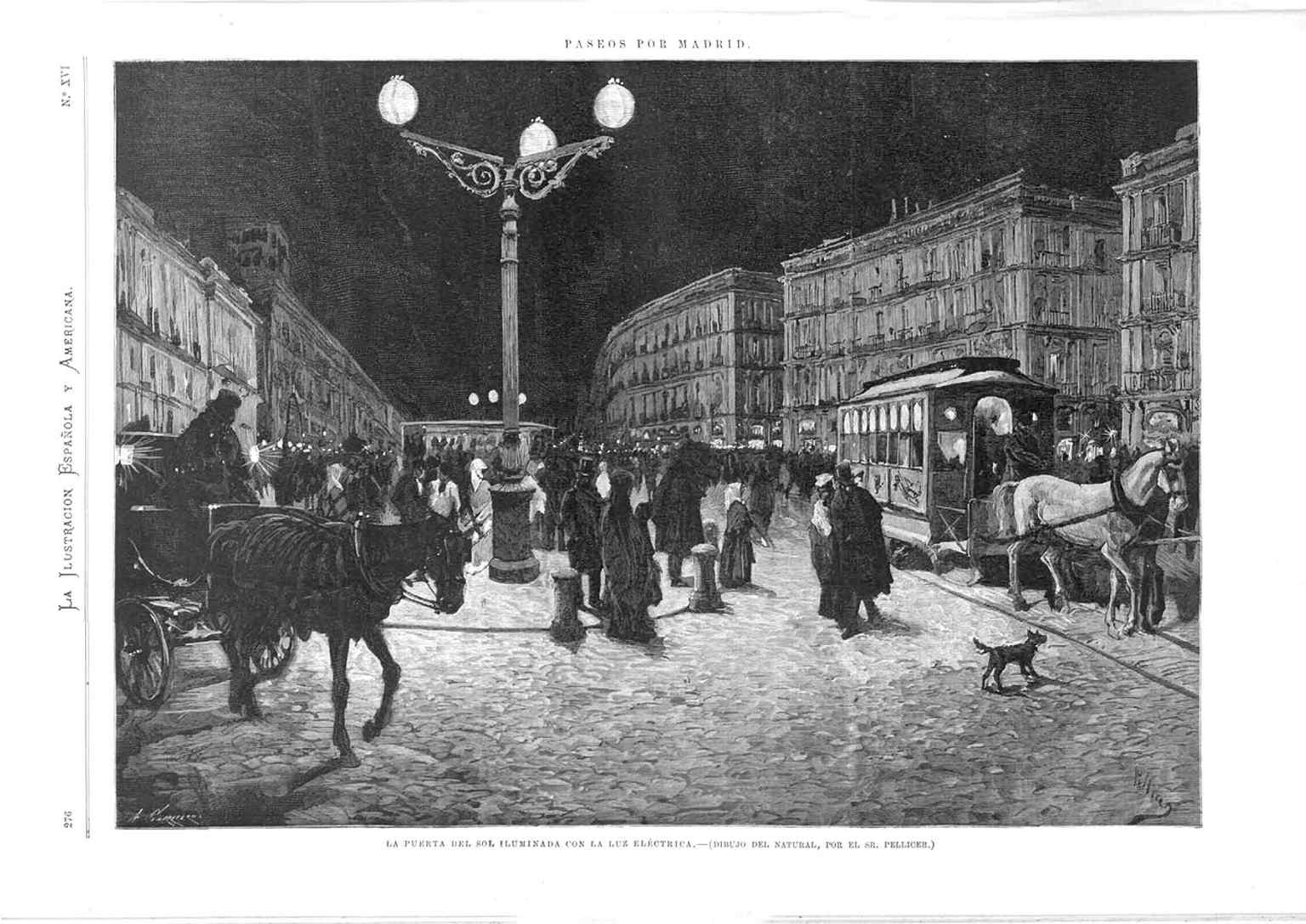
A 1878 illustration of Puerta del Sol lit by electric light, capturing the moment when modern technology was transforming the square.Photo: Josep Lluis Pellicer / Arturo Carretero, Wikimedia Commons, Public domain. Cropped & resized. 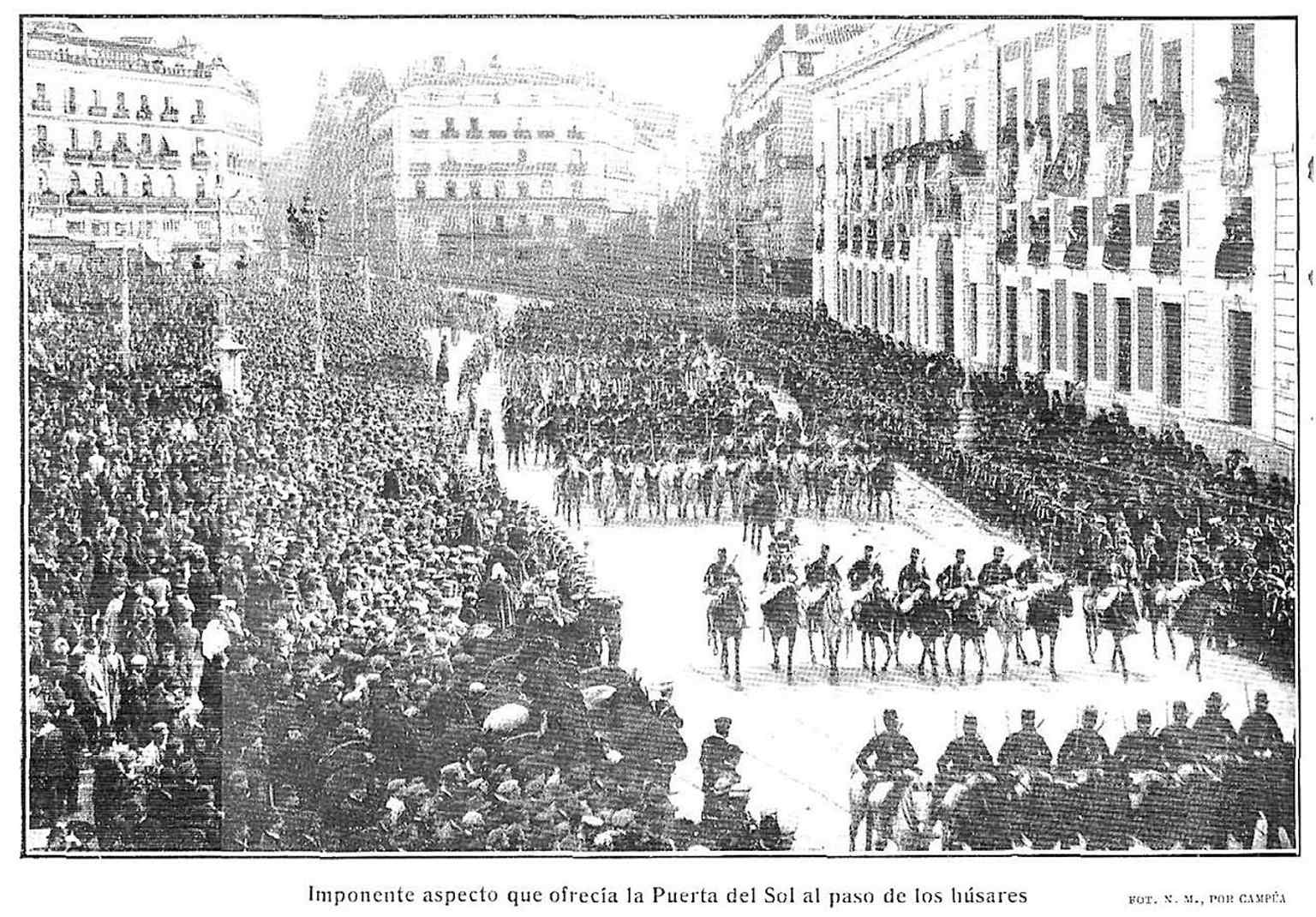
This 1910 print shows Puerta del Sol crowded with mounted hussars, evoking the plaza’s long role as a stage for public life.Photo: José Demaría López, Wikimedia Commons, Public domain. Cropped & resized. 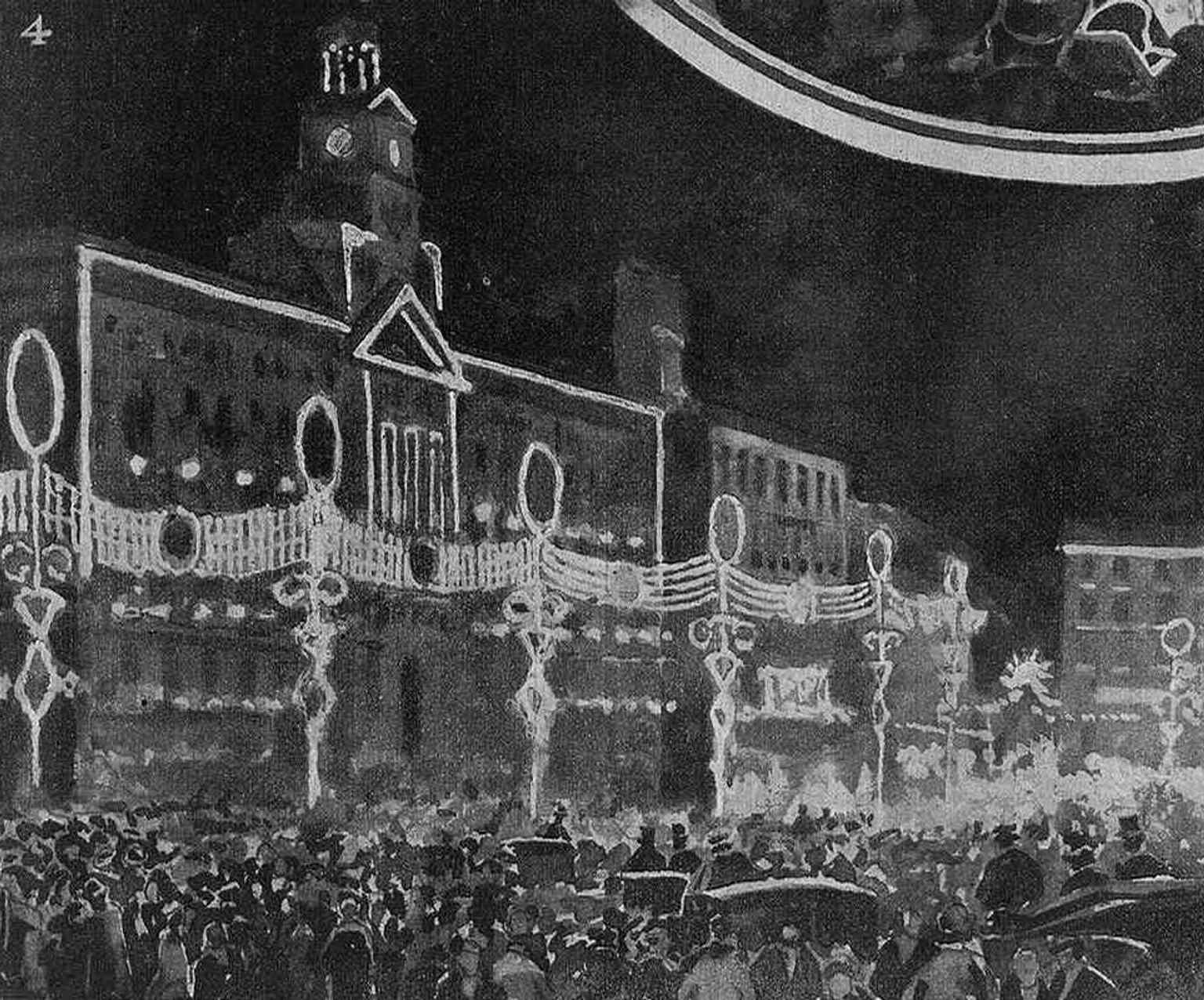
A 1905 illustration of Sol illuminated at night, a vivid reminder that the plaza has long been a dramatic center of Madrid life.Photo: Salvador Azpiazu, Wikimedia Commons, Public domain. Cropped & resized. 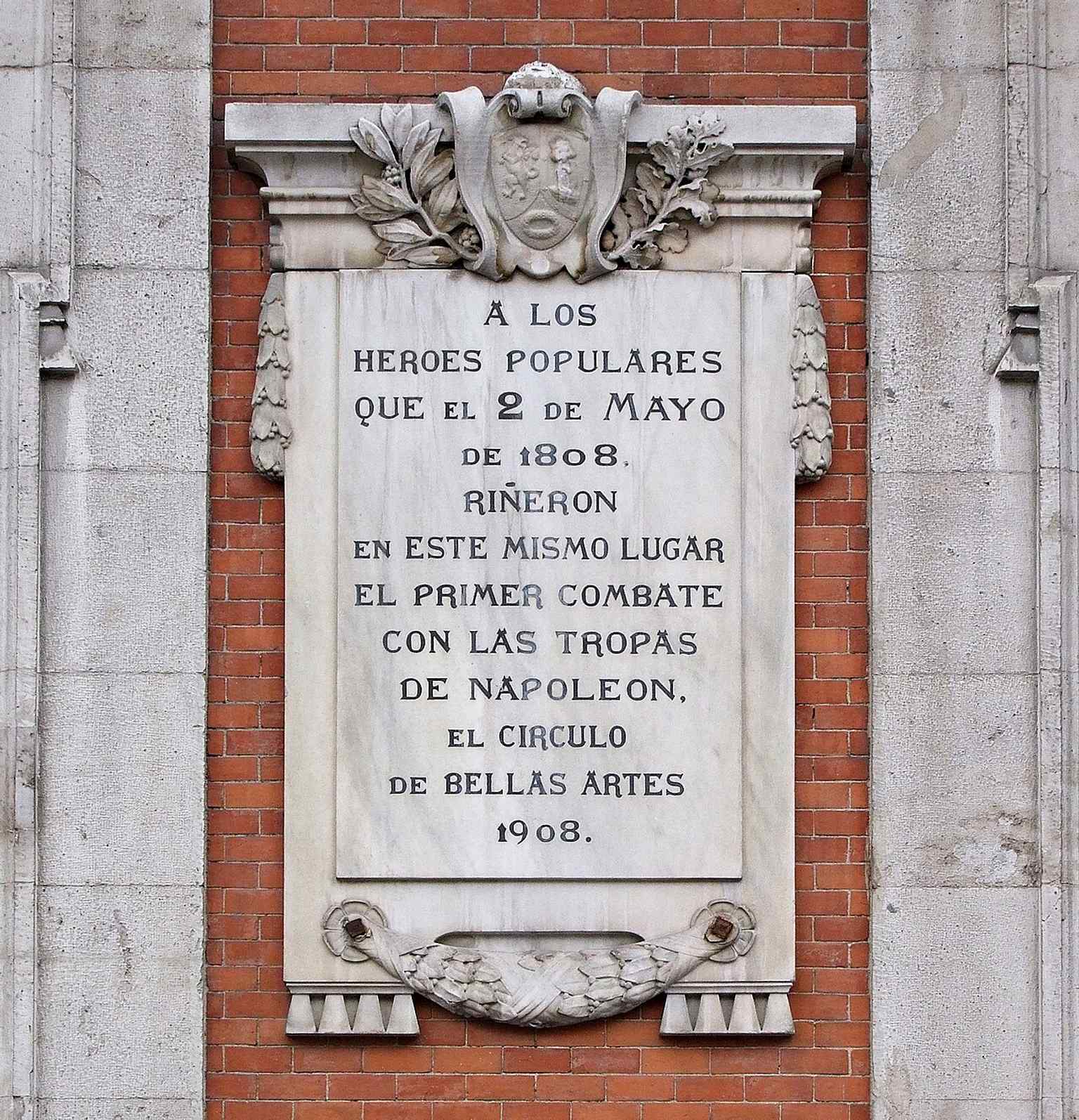
The commemorative plaque for the Dos de Mayo heroes reflects the square’s political memory and its ties to the 1808 uprising.Photo: Alta Falisa, Wikimedia Commons, CC BY-SA 4.0. Cropped & resized. 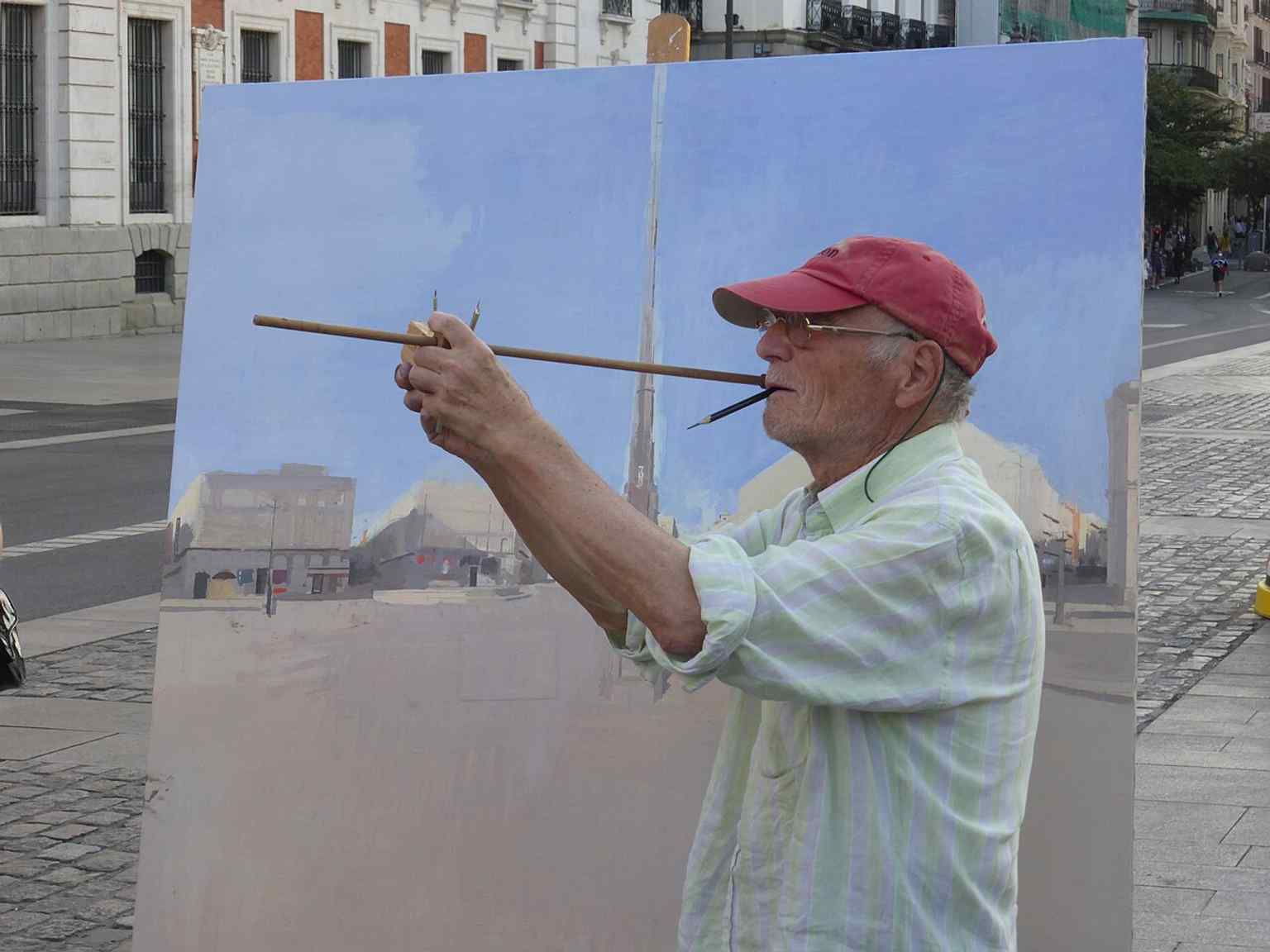
Painter Antonio López working in the open air shows Puerta del Sol not just as a monument, but as a living subject for Madrid artists.Photo: CARLOS TEIXIDOR CADENAS, Wikimedia Commons, CC BY-SA 4.0. Cropped & resized. 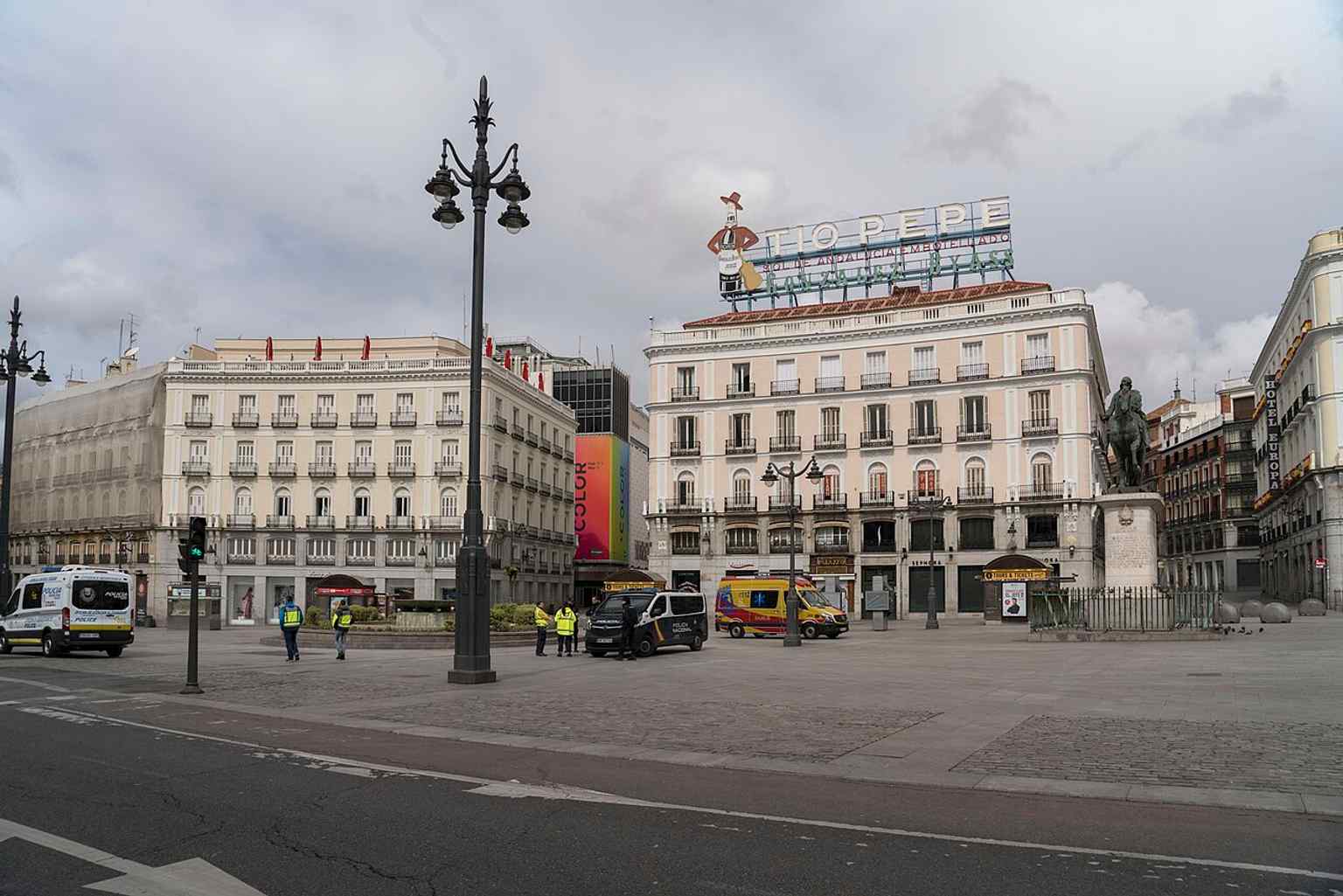
An unusually empty Puerta del Sol during the COVID-19 lockdown, highlighting how exceptional silence can feel in this normally crowded crossroads.Photo: Nemo, Wikimedia Commons, CC BY-SA 4.0. Cropped & resized. 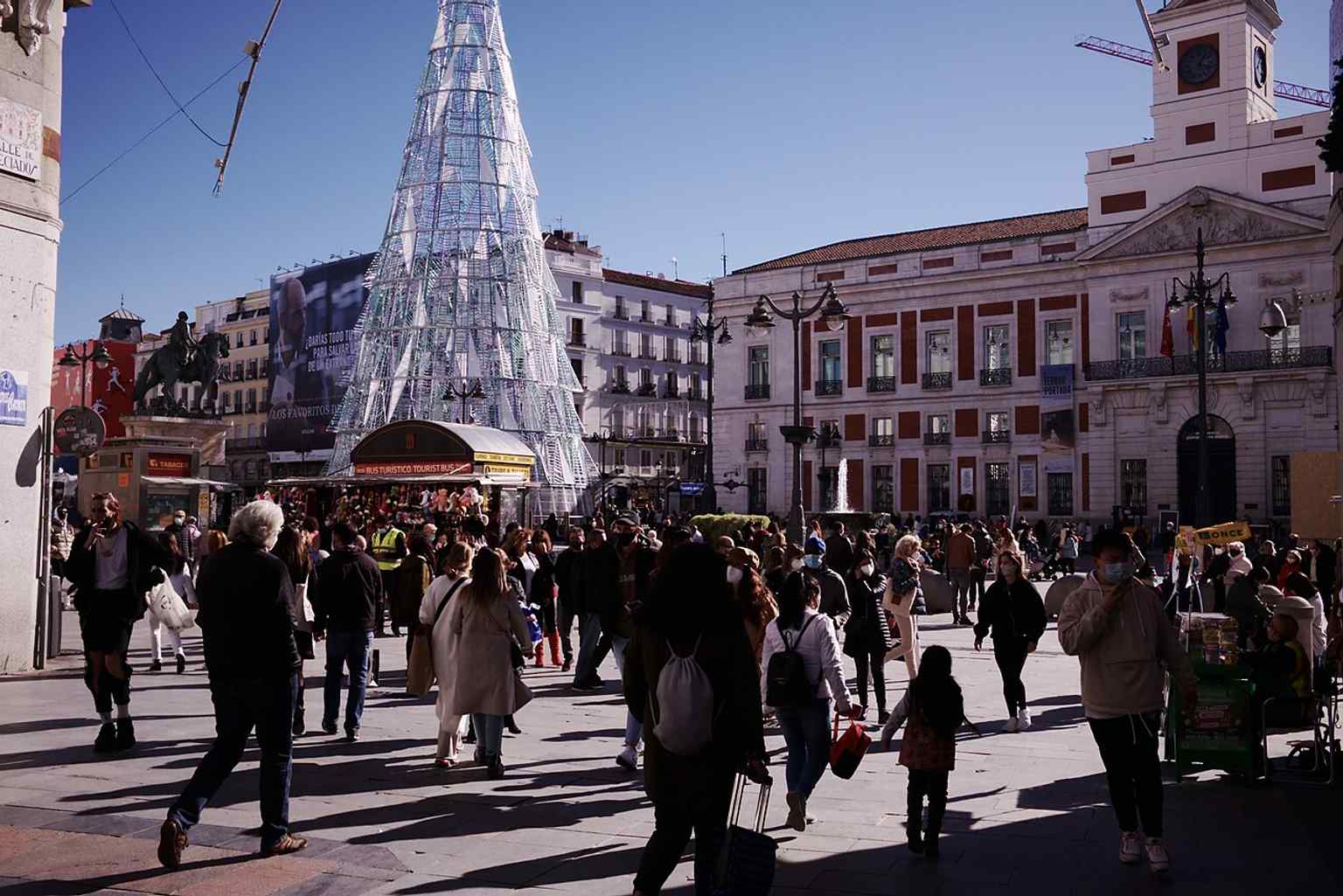
Puerta del Sol during a quiet winter moment, emphasizing its role as a major pedestrian meeting place even in everyday city life.Photo: Nicolas Vigier, Wikimedia Commons, CC0. Cropped & resized. On your left, Plaza Mayor opens as a grand red-brick rectangle framed by granite arcades and rows of iron balconies, with the painted Casa de la Panadería standing out as its…Read moreShow less
Open dedicated page →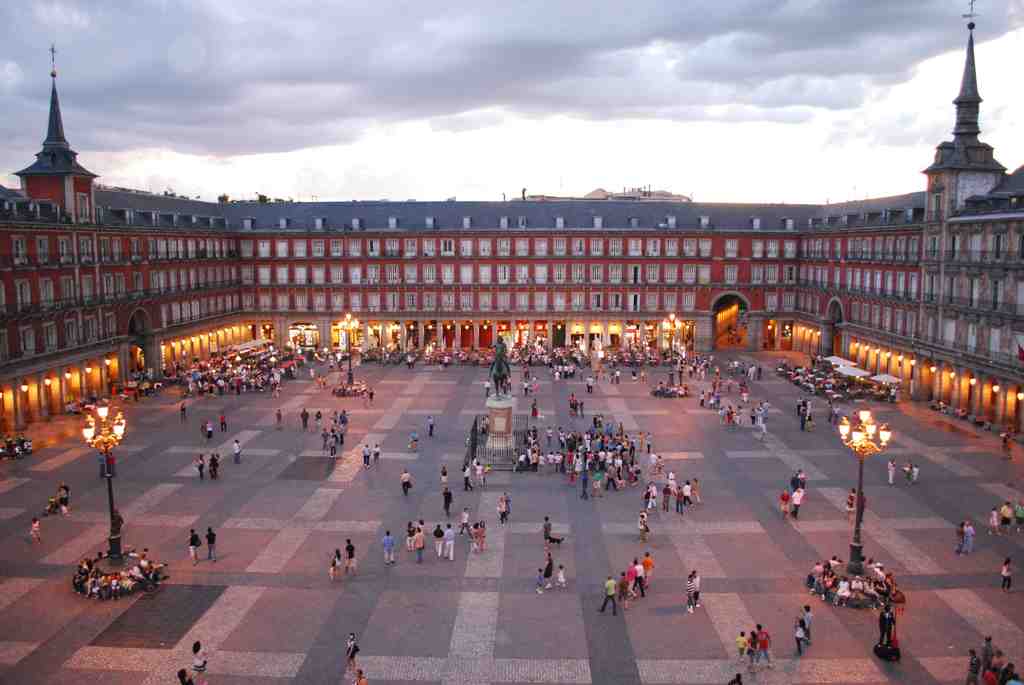
Plaza Mayor of MadridPhoto: Sebastian Dubiel, Wikimedia Commons, CC BY-SA 3.0 DE. Cropped & resized. On your left, Plaza Mayor opens as a grand red-brick rectangle framed by granite arcades and rows of iron balconies, with the painted Casa de la Panadería standing out as its signature marker.
From here, you’re looking at one of Madrid’s great public stages. A stage, in this case, means more than a place where things happened. It was designed so people could watch from the square, from the arcades, and from those balconies above... and just as important, be watched themselves. In a city like Madrid, the crowd was never only the audience. The crowd became part of the performance.
This space began humbler than it looks. In the Middle Ages, it stood outside the old walled town as the plaza del Arrabal, the main market where the roads from Toledo and Atocha met. Traders gathered here so regularly that the town built a lonja, a covered market hall, to keep commerce under control. Then Felipe the Second decided Madrid needed a square fit for a capital. He ordered Juan de Herrera to redesign it, Diego Sillero began the Casa de la Panadería in fifteen ninety, and in sixteen seventeen Felipe the Third told Juan Gómez de Mora to finish the whole ensemble. Gómez de Mora completed it in sixteen nineteen, and the official opening followed with the beatification of San Isidro in sixteen twenty, complete with celebrations and literary contests. Madrid liked to make an entrance, even then.
Architecturally, it is a neat piece of control: a rectangular square enclosed by housing, arcades below, three stories above, and two hundred thirty-seven balconies aimed inward like theater boxes. An arcade, by the way, is that sheltered passage of repeated arches along the ground floor. Handy for trade... and perfect for spectators.
And this place needed spectators. It hosted markets, royal proclamations, processions, bullfights, and executions. It also hosted the darker kind of ceremony. In sixteen eighty, Carlos the Second presided here over an auto de fe, a public ritual staged by the Inquisition to judge and punish people accused of heresy. Francisco Rizi painted the scene, and the canvas still shows the square turned into a theater of fear, religion, and royal authority.
Plaza Mayor kept burning and returning. Fires hit in sixteen thirty-one, sixteen seventy-two, and most devastatingly in seventeen ninety, when flames destroyed a third of the square and spread into nearby streets. Juan de Villanueva then reshaped the place you see: he lowered the surrounding buildings from five stories to three and closed the corners with large access arches. If you like, have a look at the before-and-after image in the app; it neatly shows the square shifting from the spare formality of nineteen forty-eight to the busier landmark centered on the restored Casa de la Panadería.
Later, Queen Isabella the Second moved the equestrian statue of Felipe the Third into the center in eighteen forty-eight, and the square slowly turned from arena into symbol. The Casa de la Panadería, once tied to market power, now serves visitors instead.
So here’s the question to carry with you: if you had stood in this square in sixteen eighty, packed among thousands, would you have felt devotion, curiosity, fear... or simply the pressure to show the “right” emotion? That was the trick of Plaza Mayor. In one age it entertained, in another it disciplined, and in another it terrified, all depending on who held the script. When you’re ready, the Collegiate Church of San Isidro is about a four-minute walk from here.
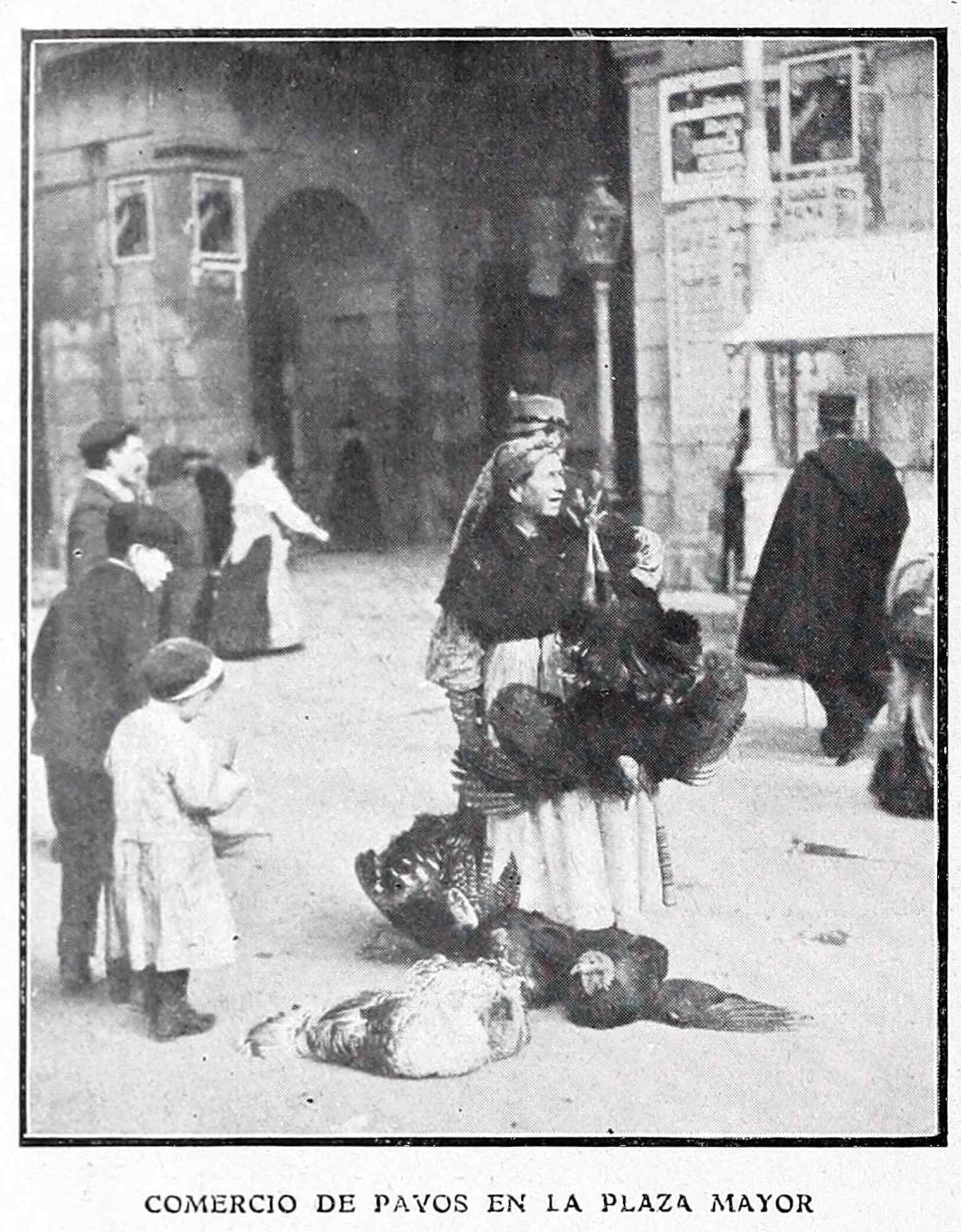
A Christmas-market scene in Plaza Mayor, echoing the long tradition of festive stalls that still fill the square every December.Photo: Francisco Goñi, Wikimedia Commons, Public domain. Cropped & resized. 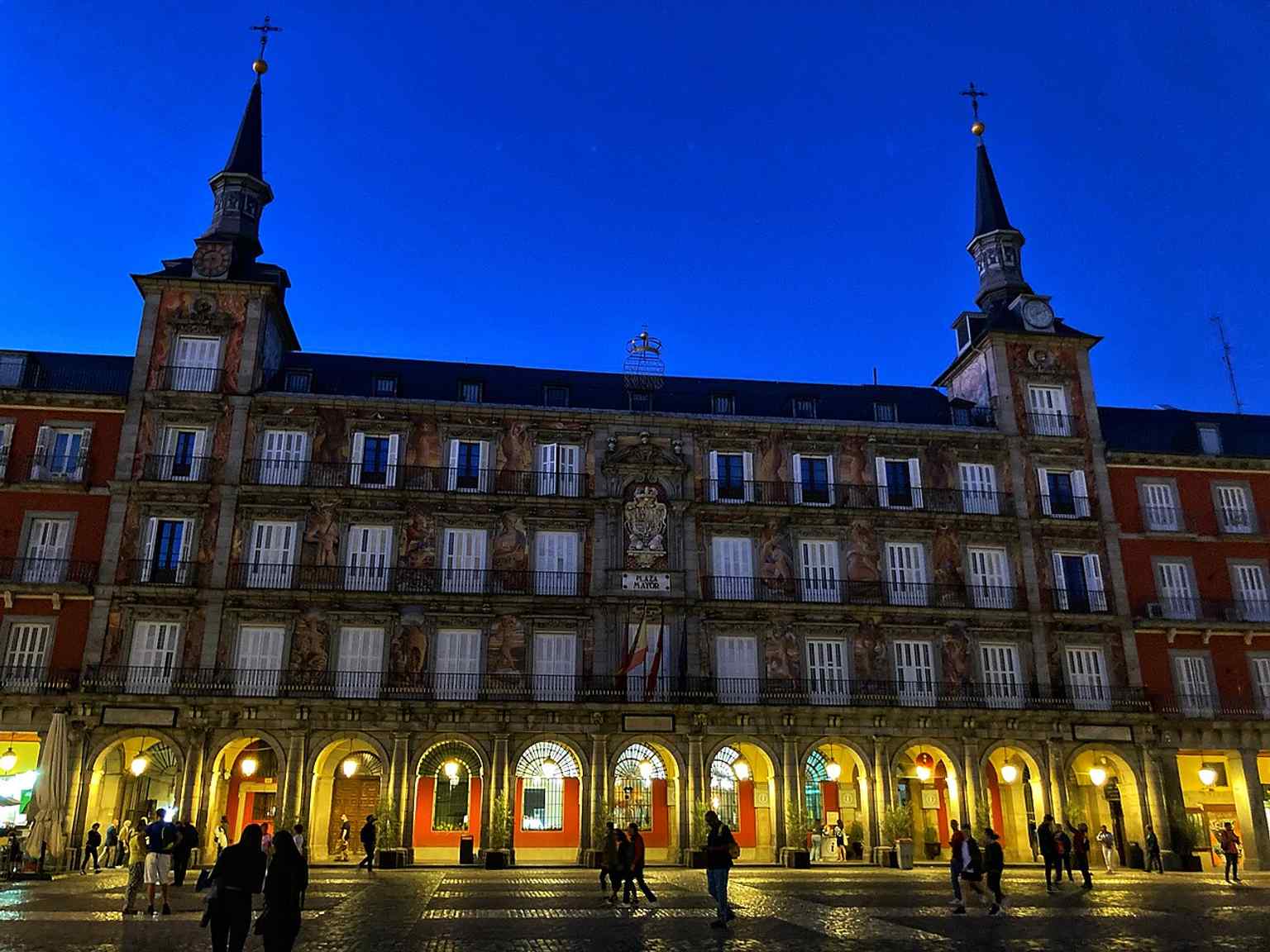
A clear contemporary view of the Casa de la Panadería, the square’s signature building on the north side.Photo: Artem Vynohradov, Wikimedia Commons, CC BY-SA 4.0. Cropped & resized. 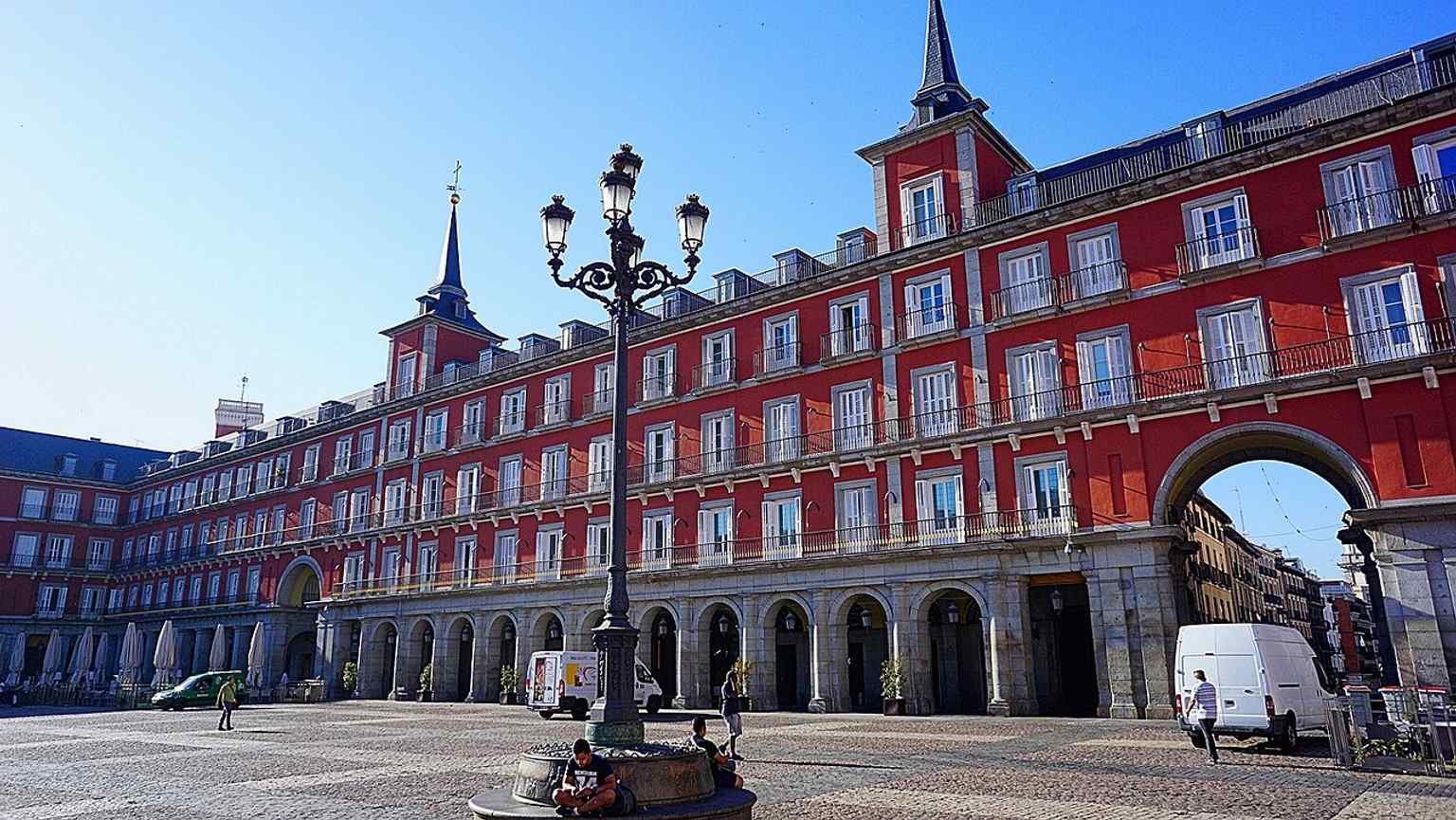
The Casa de la Carnicería on the opposite side of the square, one of the key buildings that completes Plaza Mayor’s enclosed rectangle.Photo: Coralma*, Wikimedia Commons, CC BY-SA 4.0. Cropped & resized. 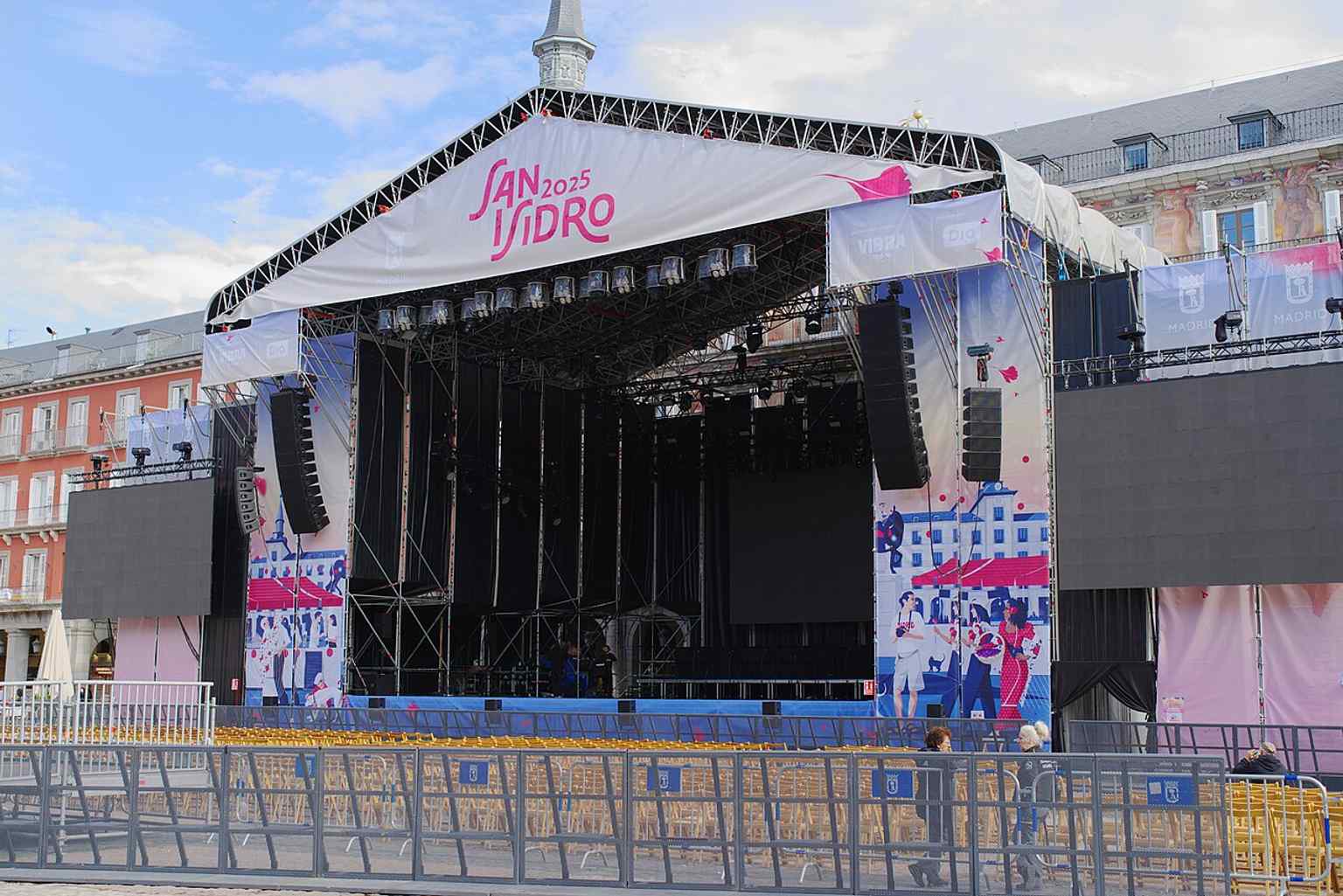
Plaza Mayor during the San Isidro festivities, continuing its centuries-old role as Madrid’s ceremonial and celebratory heart.Photo: Javier Perez Montes, Wikimedia Commons, CC BY-SA 4.0. Cropped & resized. On your left, look for the dark granite facade with four tall Corinthian columns, two square towers capped by octagonal spires, and the stone figures of San Isidro and Santa María…Read moreShow less
Open dedicated page →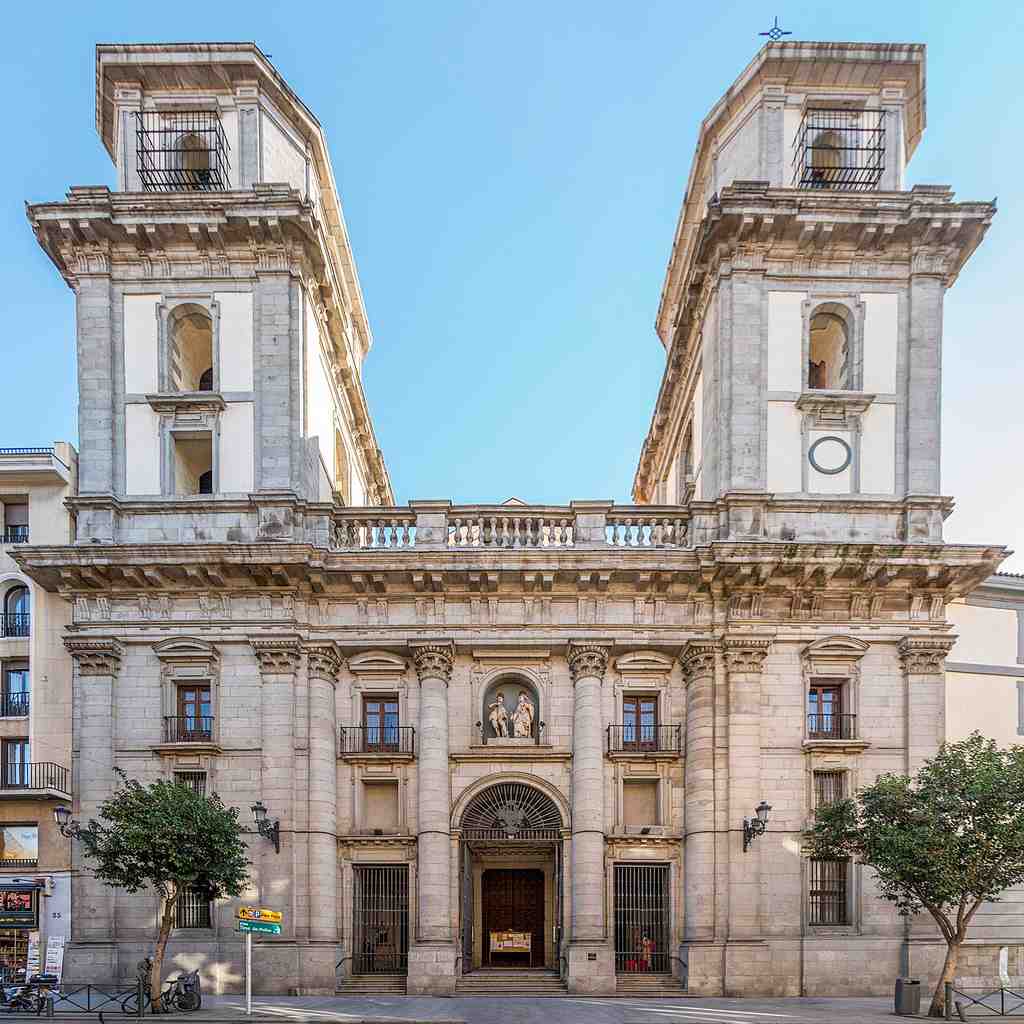
Collegiate Church of San IsidroPhoto: Fernando, Wikimedia Commons, CC BY-SA 4.0. Cropped & resized. On your left, look for the dark granite facade with four tall Corinthian columns, two square towers capped by octagonal spires, and the stone figures of San Isidro and Santa María de la Cabeza set above the entrance.
From where you stand, this is more than a church front... it is authority dressed for public view. The facade has the confidence of a palace, not the shyness of a neighborhood chapel. In Madrid, belief often came with architecture that could organize a crowd, impress a ruler, and remind everyone who spoke for heaven in the city.
That ambition began next door with the old Colegio Imperial, the Imperial College of the Jesuits. They did not separate education from devotion; they wanted to form minds and souls together, which is a very efficient arrangement if you hope to guide a capital. Before this grand church rose here, the site held a smaller Jesuit chapel dedicated to Saints Peter and Paul, opened in the sixteenth century and later expanded with the college. Then María of Austria, daughter of Emperor Charles the Fifth, left her fortune to the Society of Jesus and ordered something much more commanding.
Pedro Sánchez drew the design around sixteen twenty. Work started two years later, and after Sánchez died, Francisco Bautista and Melchor de Bueras carried it on until sixteen sixty-four. The Jesuits dedicated it first to Saint Francis Xavier. If you ever go inside, the plan follows the Gesù in Rome: one great nave, meaning the main central hall, side chapels, a crossing, and a dome. And that dome mattered. Bautista created an early lightweight timber-and-plaster dome, a clever cost-saving shell that other Madrid builders quickly copied. Practicality, dressed up as grandeur... Madrid likes that trick.
Then power shifted again. In seventeen sixty-seven, King Carlos the Third expelled the Jesuits from Spain. The church changed roles and changed identity with them. It became the Collegiate Church of San Isidro, and the body of Madrid’s patron saint moved here from San Andrés, along with the relics of his wife, Santa María de la Cabeza. Ventura Rodríguez later redesigned the sanctuary as a kind of sacred stage set, with San Isidro’s silver chest above and her urn below, framed by saints and painting. Devotion here was arranged like ceremony, meant to be seen from a distance and remembered.
And then... one of the darkest episodes landed right on these steps. In eighteen eighty-six, the first bishop of Madrid, Narciso Martínez Izquierdo, came here to celebrate Palm Sunday Mass. He had already faced a cholera epidemic and the death of King Alfonso the Twelfth, and his reforms had made enemies. As he climbed the stairs, the priest Cayetano Galeote shot him three times. He died the next day. If you want a glimpse of how shocking that felt, take a look at the image in the app.
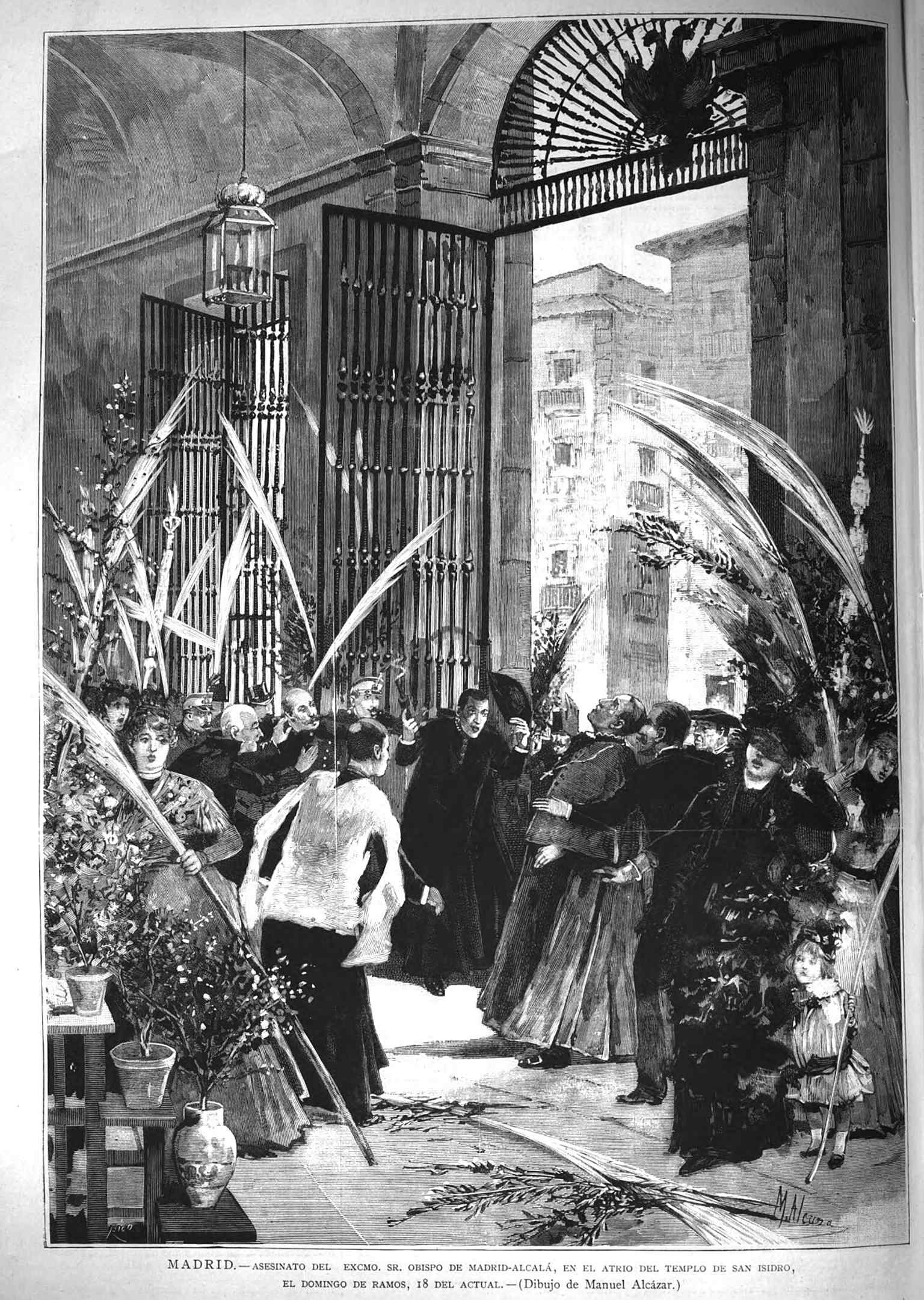
The atrium of San Isidro where Bishop Narciso Martínez Izquierdo was shot on Palm Sunday in 1886 — one of the church’s most dramatic episodes.Photo: Manuel Alcázar y Ruiz / Bernardo Rico, Wikimedia Commons, Public domain. Cropped & resized. The church suffered again in nineteen thirty-six, when fire destroyed major paintings, the high altarpiece, and the lantern of the dome. Later reports said the whole roof vanished, but that turned out to be wrong; investigators found that much of the roofing survived. Javier Barroso led the long restoration and finally completed the upper sections of the towers, which had stood unfinished since the seventeenth century. So even the skyline you see now is partly a twentieth-century act of repair.
For a long stretch, from eighteen eighty-five until nineteen ninety-three, this served as Madrid’s temporary cathedral... a role it surrendered only when Almudena finally took over, which we’ll meet later. And if Plaza Mayor gave public ritual its stage, places like this gave it doctrine, discipline, and blessing.
That is the pattern to notice in Madrid: faith was rarely private here; it was built to be seen, heard, and obeyed, and when you’re ready, continue about seven minutes to Plaza de la Villa, and if you want to return inside later, public visiting hours are limited, usually Tuesday and Friday evenings and Sunday late morning.
Show 11 more stopsShow fewer stopsexpand_moreexpand_less
This square looks like a compact stone room open to the sky, framed by a red-brick medieval tower, pale carved palace facades, and a raised enclosed passage linking two civic…Read moreShow less
Open dedicated page →This square looks like a compact stone room open to the sky, framed by a red-brick medieval tower, pale carved palace facades, and a raised enclosed passage linking two civic buildings.
This is Plaza de la Villa, and if you want to understand Medieval Madrid, this is one of the best places to stand still and let the city explain itself. Back then, government, religion, and neighborhood life lived shoulder to shoulder. Nothing here was oversized. Power worked at close range.
For a long time, people called this place Plaza de San Salvador, after the church that once stood nearby on Calle Mayor. Here is the local detail most visitors miss: Madrid’s town council did not begin in some grand marble chamber. It first met in the church portico... basically under a porch. Not exactly imperial swagger, but very Madrid.
From this square, three little streets still slip away along the old medieval layout: Codo to the east, Cordón to the south, and Madrid to the west. If you glance at the image on your screen, you can see how snugly the plaza fits into that earlier city, tucked beside Calle Mayor like a surviving pocket of the old map.
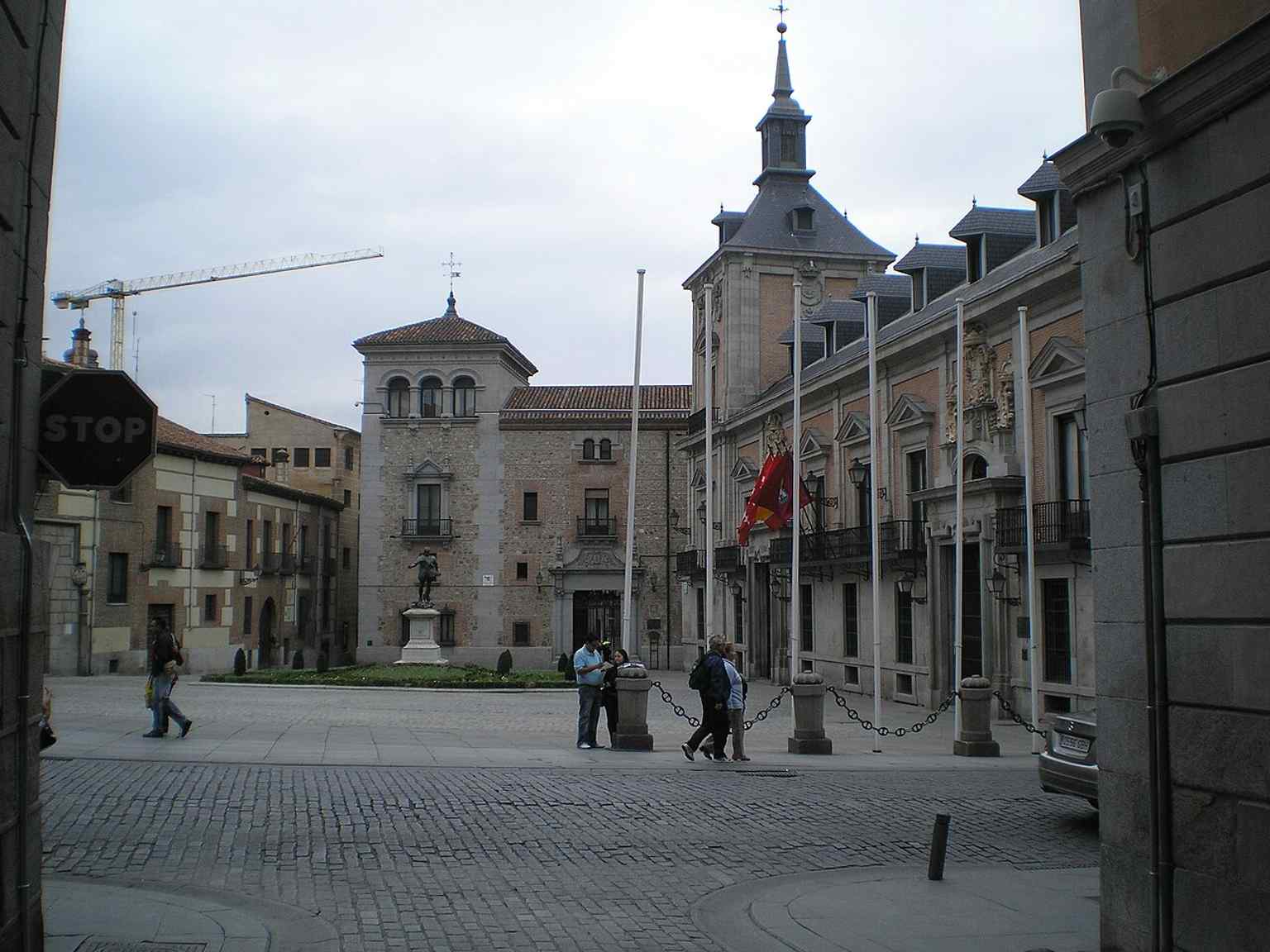
A wide view of Plaza de la Villa, showing the historic square as a compact medieval space tucked beside Calle Mayor.Photo: Carlos Delgado, Wikimedia Commons, CC BY-SA 3.0. Cropped & resized. Now look at the buildings around you. They form a tidy timeline. On the eastern side stands the Casa y Torre de los Lujanes, the oldest surviving civil complex in Madrid, built in Gothic-Mudéjar style, which mixes Christian Gothic forms with brickwork and details shaped by Islamic craft traditions. Notice the tower and the old family shields on the pointed doorway. The Lujanes were an important local family. Madrid, being Madrid, tells two stories about one famous guest here: after the Battle of Pavia in fifteen twenty-five, King Francis the First of France was either imprisoned in that tower... or simply lodged there under guard. Same tower, very different mood. In the nineteenth century, because it was one of the tallest points around, workers even used its roof for an optical telegraph line to Aranjuez. Before wires, messages traveled by visible signals from rooftop to rooftop.
On the southern edge, the Casa de Cisneros arrived in fifteen thirty-seven. Benito Jiménez de Cisneros, nephew of Cardinal Cisneros, commissioned it as a palace in Plateresque style, meaning stone carved with the delicacy of a silversmith’s work. Tradition says Antonio Pérez, secretary to King Philip the Second, spent time here as a prisoner. A palace and a prison... that pairing turns up in Madrid more often than you might expect.
Then on the western side, the Casa de la Villa gave the city a proper municipal home. Juan Gómez de Mora designed it in the seventeenth century, and builders finished it in sixteen ninety-three after a long, patient campaign. City officials did not plan it only for ceremony; they also meant to house the jail. Authority liked everyone close at hand.
And in the middle, the square gained its bronze admiral in eighteen ninety-one. Álvaro de Bazán stands with half armor, a general’s baton, and one boot on a Turkish flag. If you check the monument image, you can catch the theatrical confidence Mariano Benlliure gave him. His unveiling drew Queen Regent María Cristina, Infanta Isabel, Antonio Cánovas del Castillo, ministers, generals, the whole civic parade. Even this intimate square knew how to become a public stage.
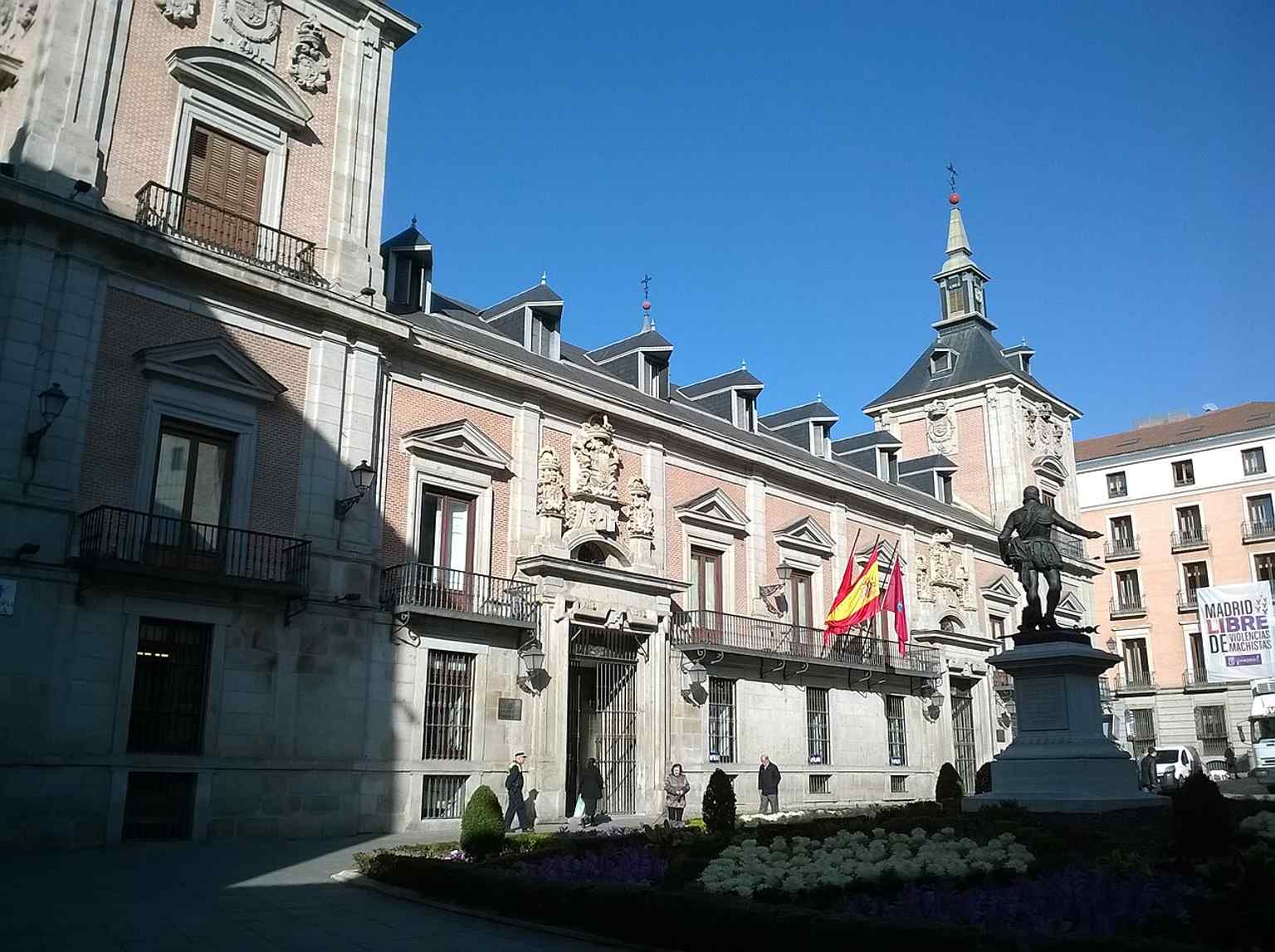
The Álvaro de Bazán monument in the center of the square, honoring the admiral celebrated with this 19th-century bronze statue.Photo: rene boulay, Wikimedia Commons, CC BY-SA 3.0. Cropped & resized. Hold this place in mind as we continue. What comes next will seem larger, grander, and more official, but not newer in spirit. Those later monuments grow out of spaces like this one. When you’re ready, head toward Almudena Cathedral, about a six-minute walk from here.
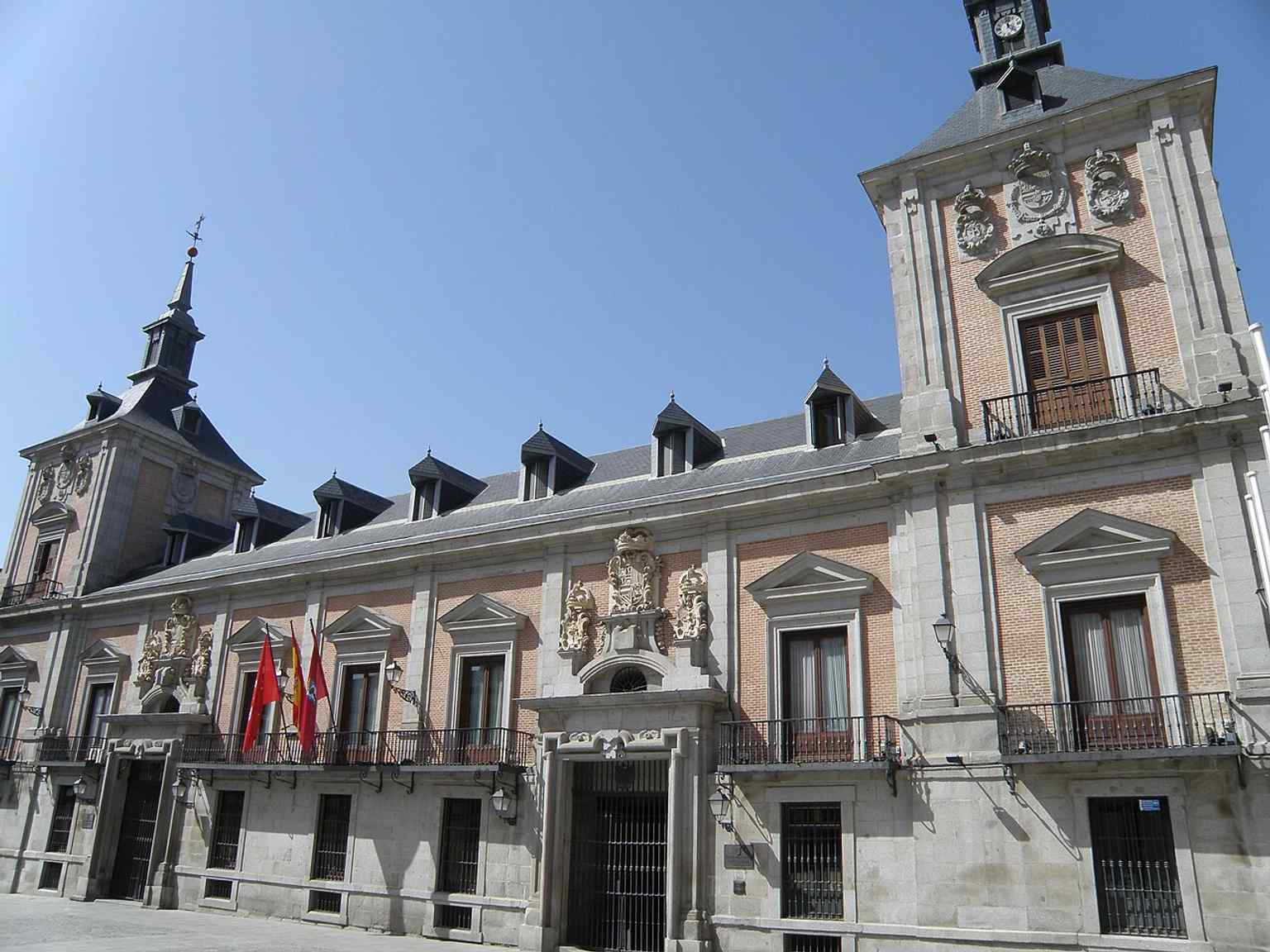
Casa de la Villa, the former City Hall on the west side of the square, one of the landmark’s most important civic buildings.Photo: Viennevi, Wikimedia Commons, CC BY-SA 3.0. Cropped & resized. 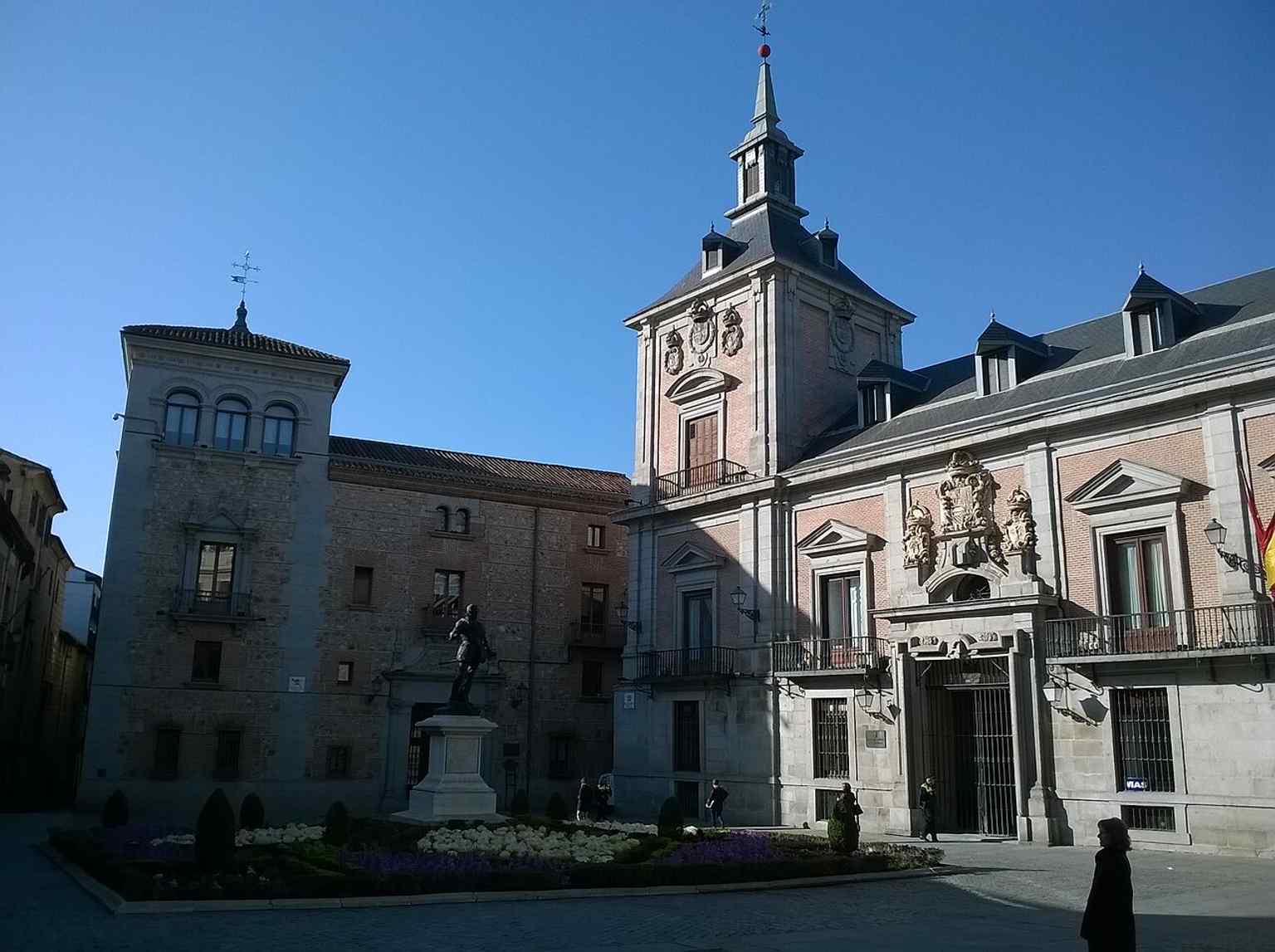
Casa de Cisneros and Casa de la Villa together, highlighting how the southern and western edges of the plaza are defined by these palaces.Photo: rene boulay, Wikimedia Commons, CC BY-SA 3.0. Cropped & resized. 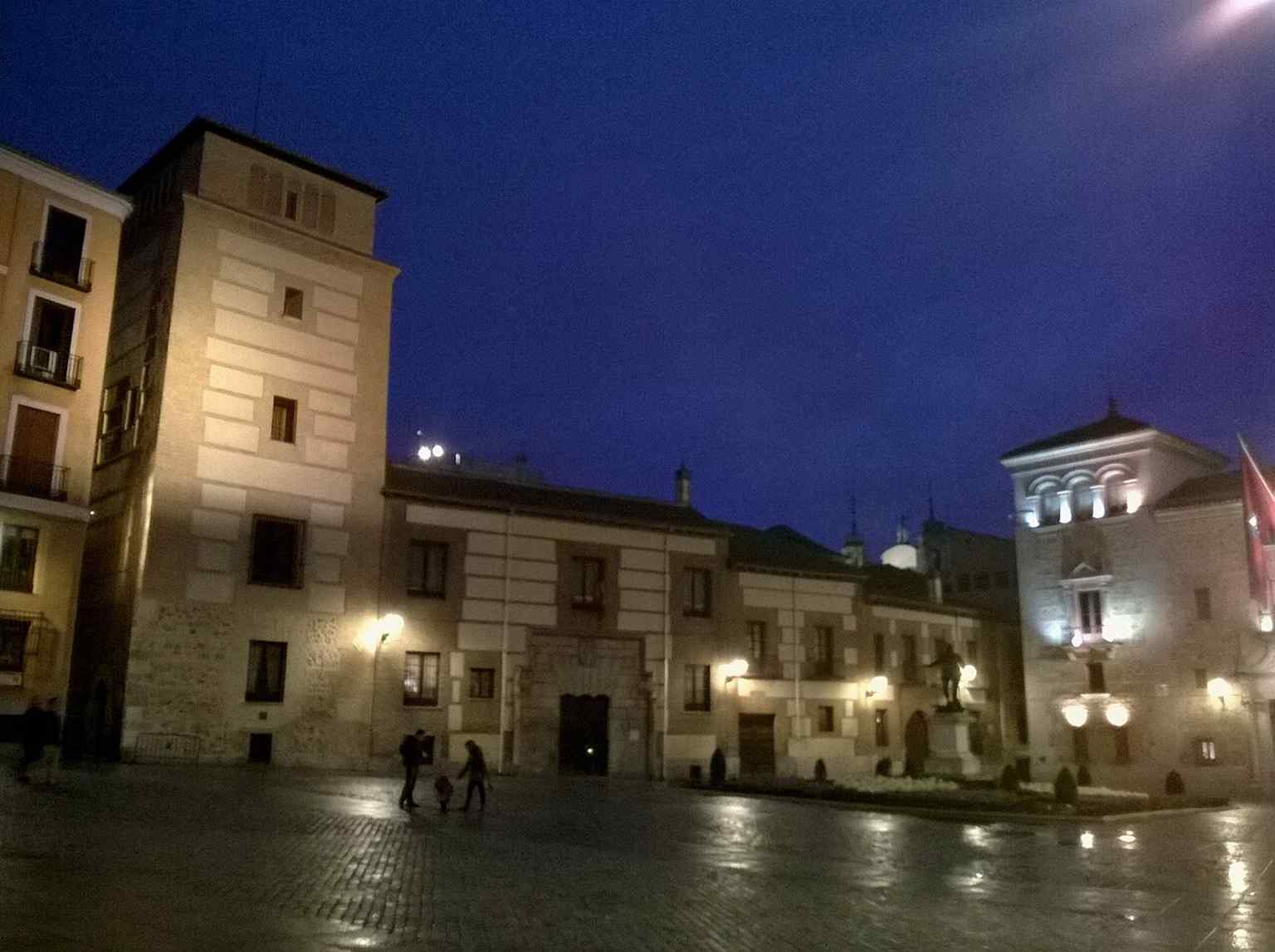
The Lujanes Tower and Casa de Cisneros side by side, reflecting the square’s mix of Gothic-Mudéjar and Plateresque architecture.Photo: rene boulay, Wikimedia Commons, CC BY-SA 3.0. Cropped & resized. On your left, look for the pale stone cathedral with a broad, columned front, a dark slate dome rising above the roofline, and twin towers that give it the posture of a royal…Read moreShow less
Open dedicated page →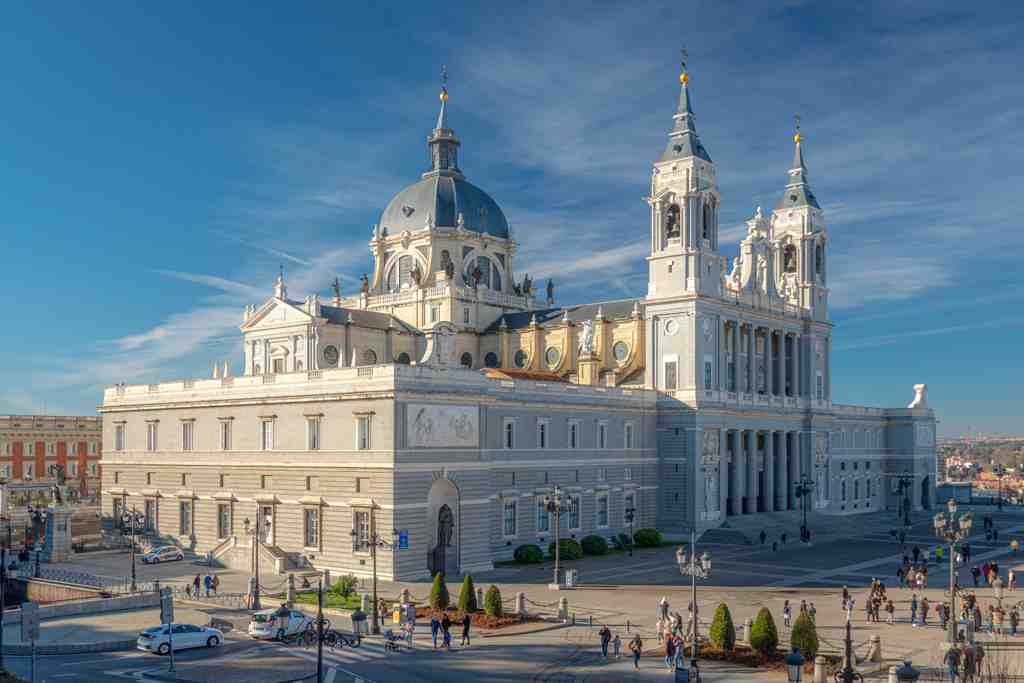
Almudena CathedralPhoto: Fernando, Wikimedia Commons, CC BY-SA 4.0. Cropped & resized. On your left, look for the pale stone cathedral with a broad, columned front, a dark slate dome rising above the roofline, and twin towers that give it the posture of a royal neighbor.
This is Almudena Cathedral, Madrid’s long-awaited great church... and like so much in this city, it stands on top of older lives. Near this spot stood an earlier church of Santa María de la Almudena, and before that, a mosque. Even the name Almudena comes from the Arabic al-mudayna, meaning “citadel,” a little reminder that Madrid keeps changing costumes without entirely leaving the stage.
The Virgin of the Almudena sits at the heart of that memory. According to legend, after King Alfonso the Sixth retook Madrid in the late eleventh century, he prayed for a lost image of the Virgin that Christians had hidden inside the city wall during Muslim rule. A section of the wall collapsed and revealed the statue, still with candles beside it... a story Madrid has cherished ever since, because it suggests that faith, memory, and identity can survive a very long burial.
Take a moment and look at how closely this cathedral stands to the palace across from it. That pairing is unusual. Most cathedrals claim their own space and face east to west; this one runs north to south so it can join the royal complex. In other words, devotion here does not stand off to the side... it looks power straight in the eye.
And yet this building took its sweet time getting here. For centuries, Madrid wanted a proper cathedral, but the archbishops of Toledo resisted giving up church authority. Plans came and went. At last, in eighteen eighty-three, King Alfonso the Twelfth laid the first stone on land the Crown provided, with strong support from the royal court. That gives the building a human pulse under all this stone.
Meanwhile, Madrid improvised. The church of San Isidro, which we visited earlier, served as the city’s working cathedral for decades while this one crawled forward. One cathedral under construction, another on temporary duty... that is a very Madrid arrangement.
What you see outside is mostly neoclassical, chosen in the twentieth century so the cathedral would harmonize with the palace. Inside, though, the main space turns neo-Gothic, while the crypt below goes neo-Romanesque. If you want a peek underground, have a look at the crypt image in the app: more than four hundred columns, each with a different carved capital, like a stone forest with no repeated leaves.
The cathedral finally reached its great public moment in nineteen ninety-three, when Pope John Paul the Second consecrated it in person. If you check the historic photo on your screen, you can see that long-delayed finish line. Since then, Almudena has hosted royal rites, state funerals, and the wedding of the future King Felipe the Sixth and Letizia in two thousand and four.
Now let your eyes drift toward the palace opposite. Sacred continuity has taken its place beside royal magnificence, and in about four minutes we’ll cross into that story at the Royal Palace of Madrid. If you want to return later, check the current opening hours in the app.
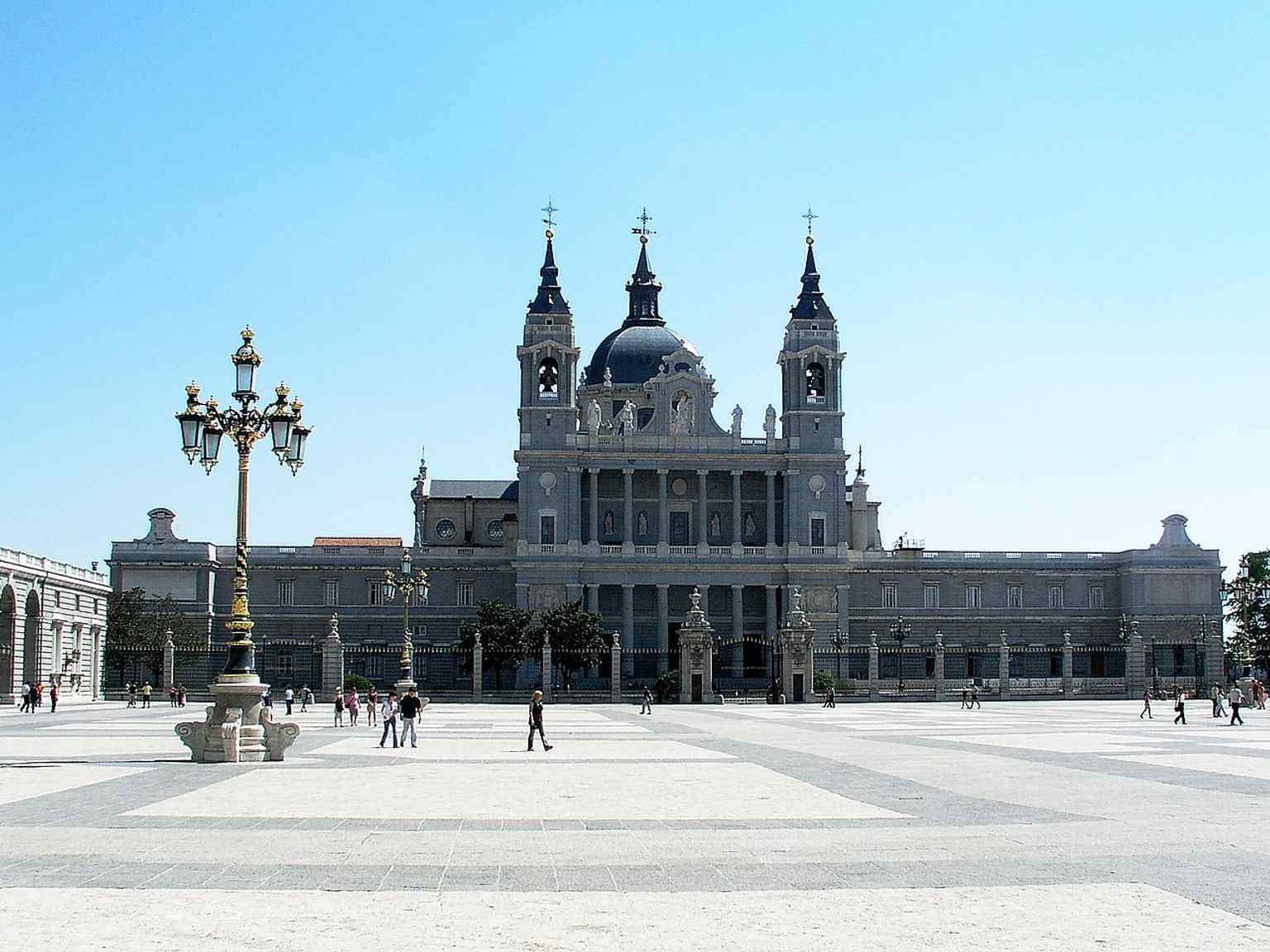
North view from the Royal Palace side, showing how the cathedral was designed to fit the palace complex and the historic center of Madrid.Photo: No machine-readable author provided. Xauxa assumed (based on copyright claims)., Wikimedia Commons, CC BY-SA 3.0. Cropped & resized. 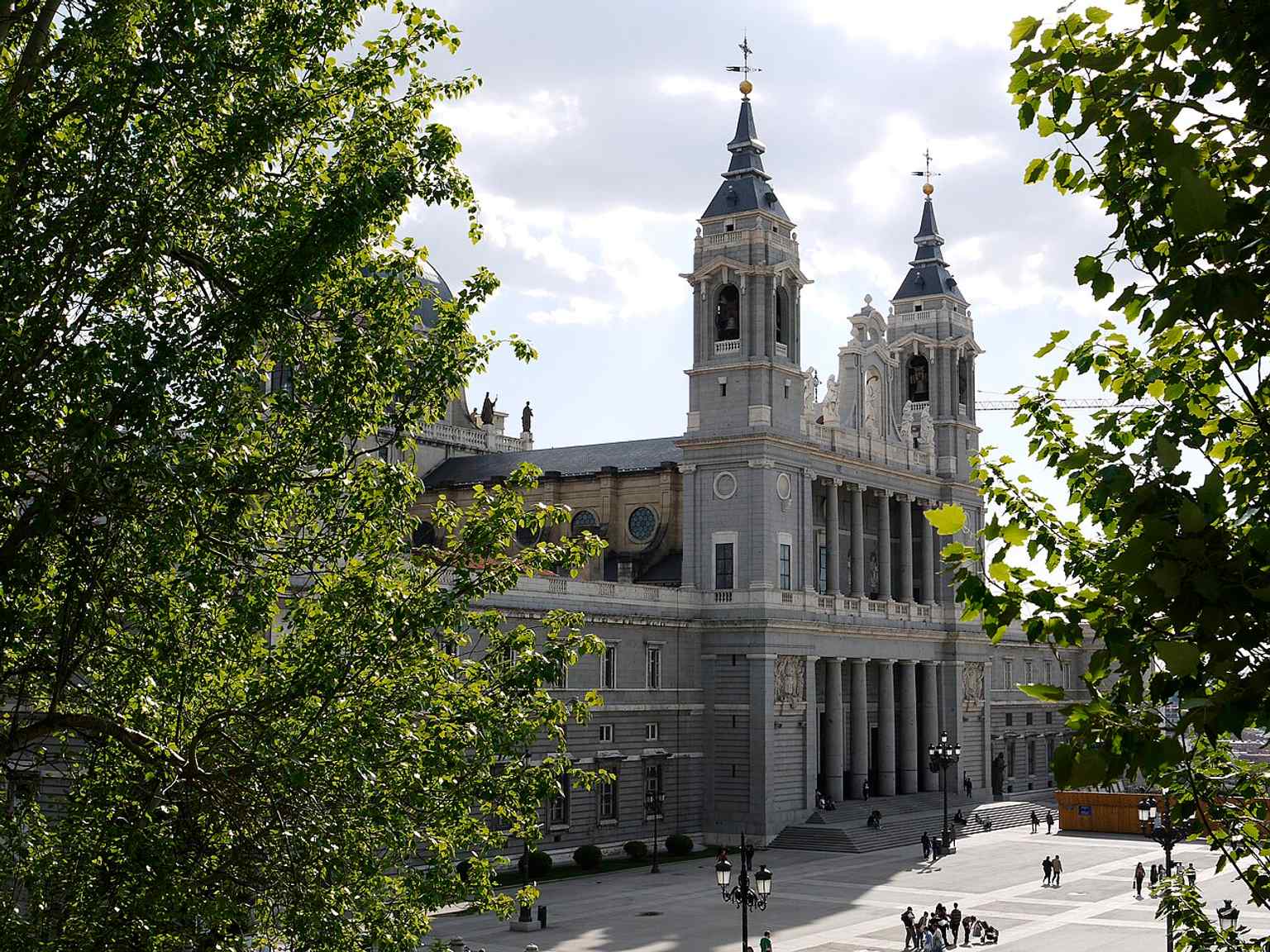
A clear daytime view of the main body and dome from the northeast, highlighting the cathedral’s mix of neoclassical exterior and monumental scale.Photo: Xauxa Håkan Svensson, Wikimedia Commons, CC BY-SA 3.0. Cropped & resized. 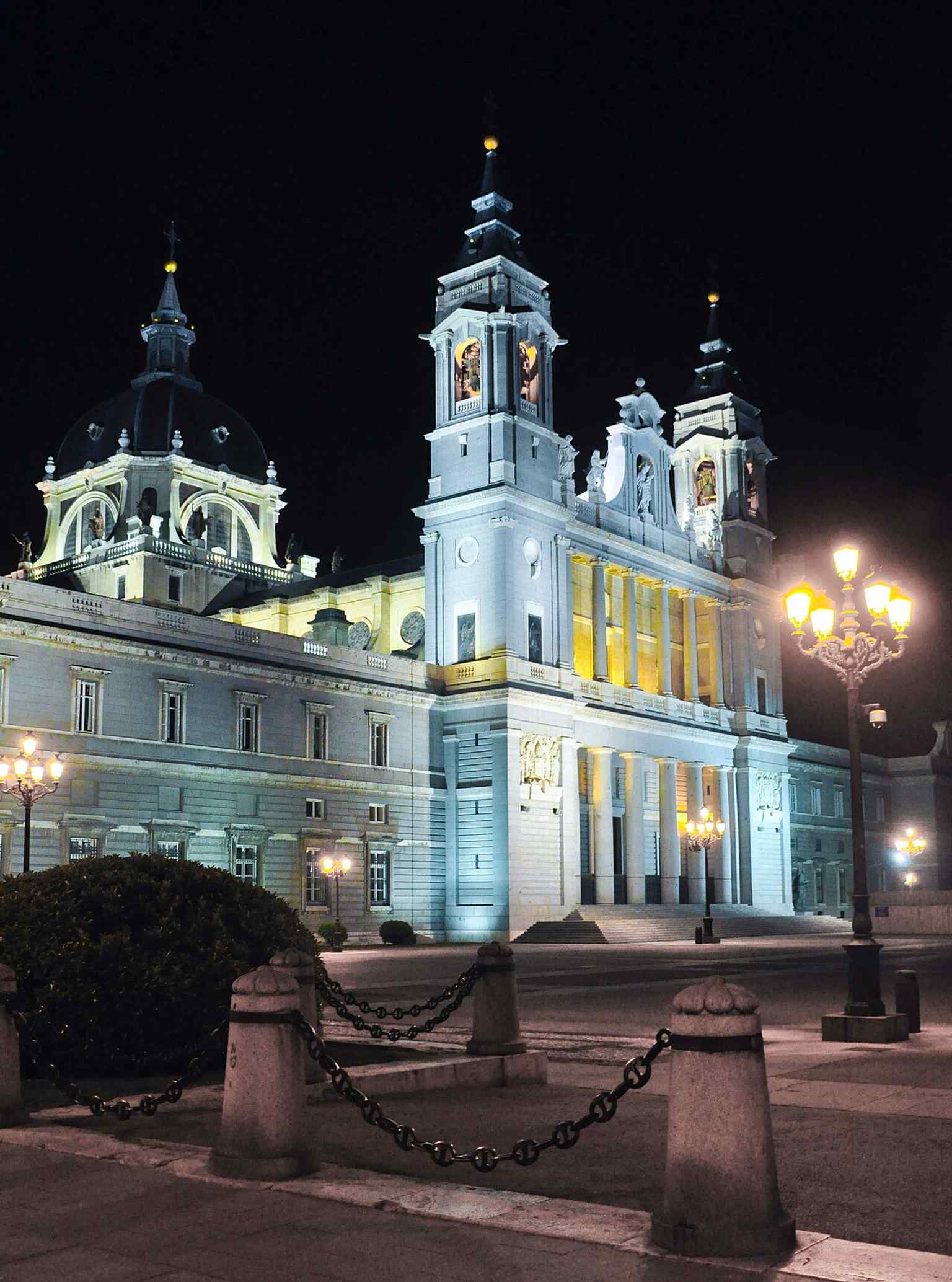
The cathedral illuminated at night, a dramatic look at one of Madrid’s most recognizable religious landmarks.Photo: רנדום, Wikimedia Commons, CC BY-SA 3.0. Cropped & resized. 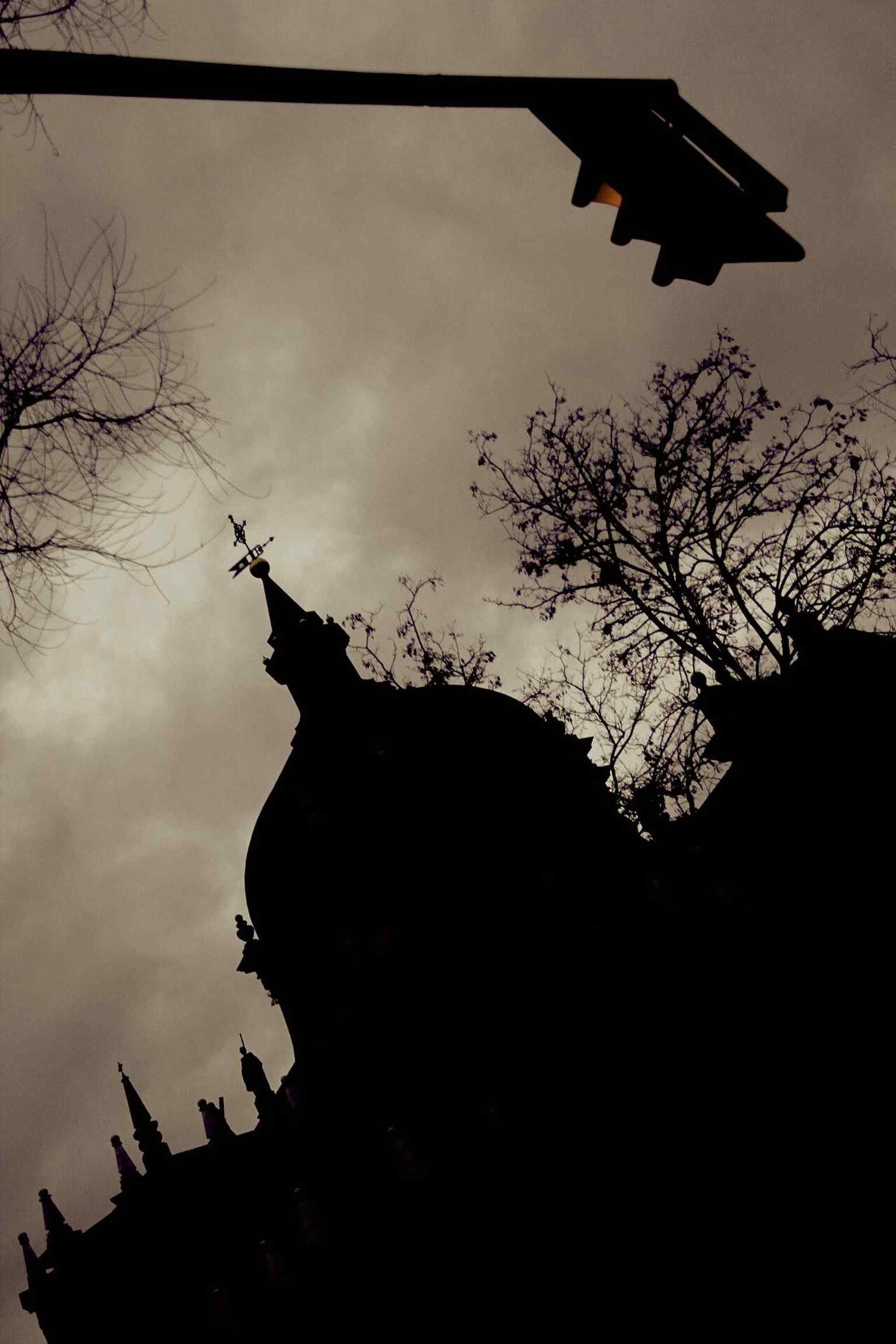
The dome at night, emphasizing one of the cathedral’s most distinctive features: a double dome with a dark slate exterior.Photo: Miguel Novelo, Wikimedia Commons, CC BY 3.0. Cropped & resized. 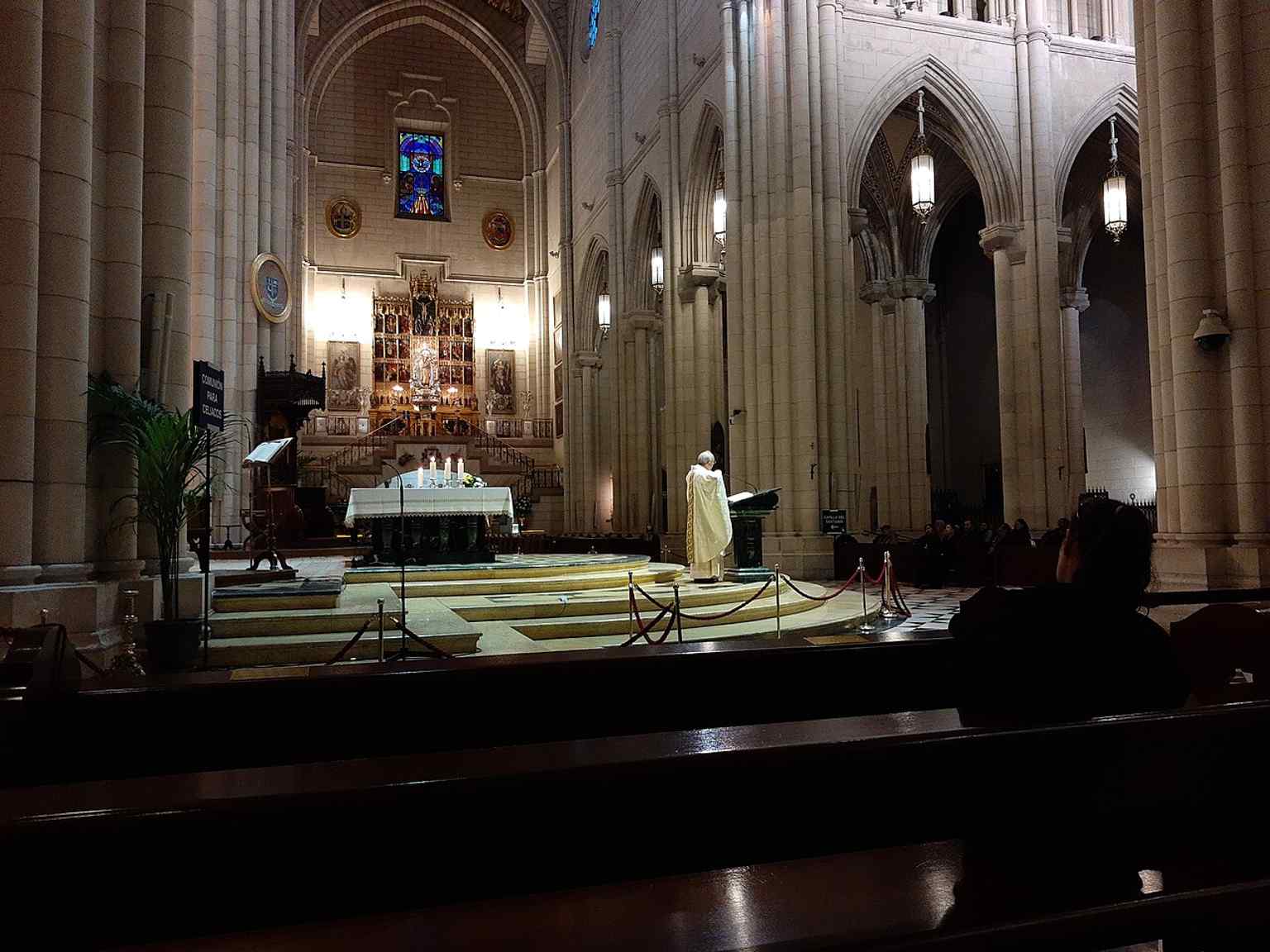
The nave during a sermon, a good glimpse of the cathedral in active use as the seat of the Archdiocese of Madrid.Photo: Gerda Arendt, Wikimedia Commons, CC0. Cropped & resized. 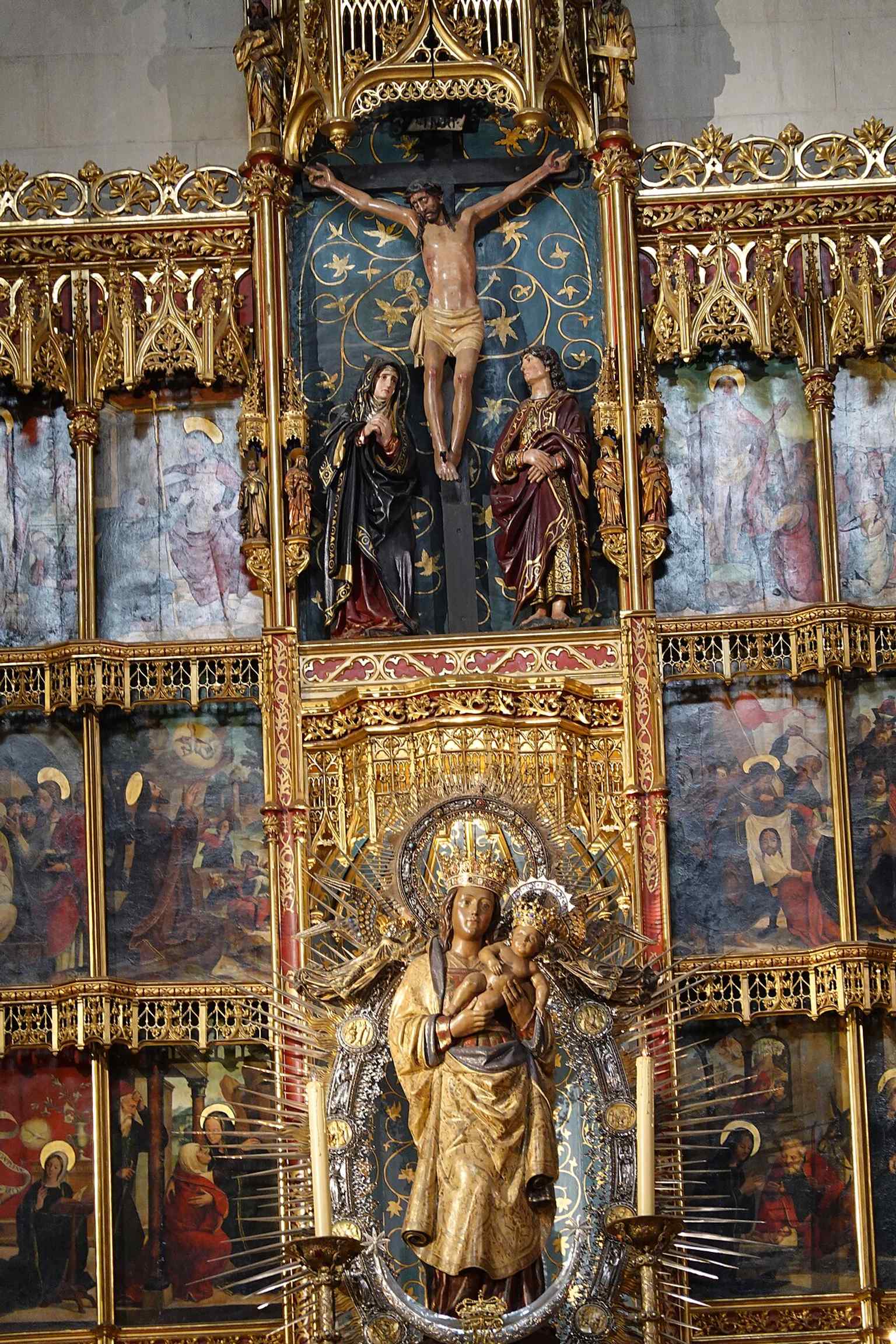
The altarpiece of the Chapel of Our Lady of Almudena, centered on the cathedral’s patron and tied to the city’s founding devotion.Photo: Joseolgon, Wikimedia Commons, CC BY 4.0. Cropped & resized. Look to your left for a vast pale-stone rectangle set on a rusticated base, lined with long rows of balconies, and crowned at the center by a raised attic with a clock above the…Read moreShow less
Open dedicated page →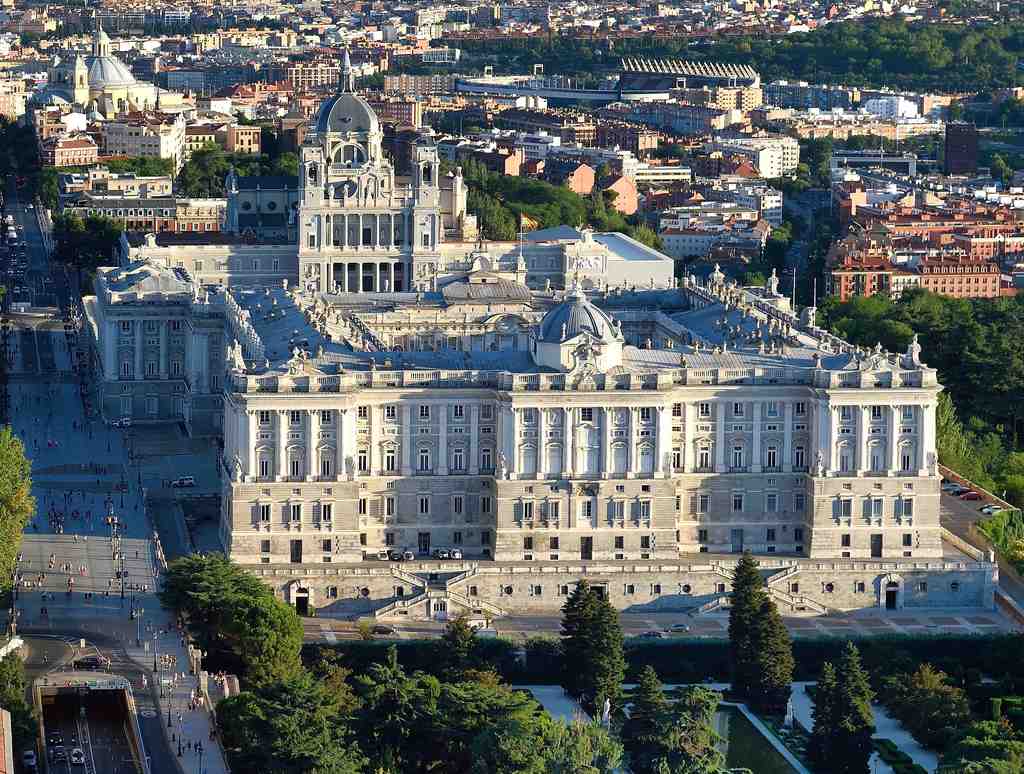
Royal Palace of MadridPhoto: Tim Adams, Wikimedia Commons, CC BY-SA 4.0. Cropped & resized. Look to your left for a vast pale-stone rectangle set on a rusticated base, lined with long rows of balconies, and crowned at the center by a raised attic with a clock above the cornice.
This is the Royal Palace of Madrid... the Bourbon dynasty’s grand reply to disaster, doubt, and the need to look unmistakably in charge. It is still the official residence of the king of Spain, though the royal family lives elsewhere, at the Zarzuela Palace, so this giant now works mainly as a stage for state ceremonies. And giant is the right word: with more than three thousand rooms, it is one of the largest royal palaces in Western Europe. In palace terms, this place does not believe in modesty.
The story begins with the fire of the Real Alcázar. On Christmas Eve in seventeen thirty-four, flames tore through the older royal fortress that stood on this very site, forcing the court to flee. Catastrophe, yes... but also opportunity. Felipe the Fifth had already found the old Habsburg stronghold too severe and old-fashioned, and after the fire he seized the moment to give Madrid a new royal image in stone.
Here is the part most people miss: this palace does not simply replace the Alcázar... it sits on top of it. Beneath this Bourbon monument survive parts of the old foundations, and even some earlier structures, folded into the new building like buried memory under a silk coat.
If you glance at the image in the app, you can see that older Alcázar for yourself; it looks much more like a fortress than the palace in front of you.
Felipe the Fifth called in the Italian architect Filippo Juvara, who imagined something even bigger on another site. Juvara died before he could carry it through, so his student Juan Bautista Sachetti adapted the plan to this awkward, historic plot. Later, Ventura Rodríguez shaped the Royal Chapel, and Francesco Sabatini helped finish and refine the whole enterprise. Architecture here is not one man’s signature; it is a relay race run by ambition.
Look closely at the façade. The heavy lower level, the giant Doric pilasters - those tall flat columns attached to the wall - and the long disciplined rhythm of windows all work like royal body language. Above the center, the statues honor Felipe the Fifth and Fernando the Sixth, the rulers who began and completed the palace. Much of the original rooftop sculpture came down under Carlos the Third, who wanted a cleaner, more classical silhouette. Even kings redecorate.
During the Alcázar fire, the marqués de Villena ordered a frantic rescue of paintings. Masterpieces like Las Meninas escaped, though the flames left damage so real that later restorers had to repaint part of the infanta Margarita’s face. That is Madrid in a nutshell: save what you can, rebuild the rest, and keep the ceremony going.
Inside, when no official act interrupts, visitors can enter rooms loaded with Tiepolo, Velázquez, Goya, tapestries, clocks, silver, and the famed Stradivarius instruments of the palace collection. If you feel like it, check the before-and-after view of Calle de Bailén; the palace hardly budges, but the city around it shifts from bus-heavy road life to a more open modern boulevard.
Now we leave the enclosed language of monarchy and step toward the public space designed to frame it. In about one minute, Plaza de Oriente opens out in front of the palace like a theater apron, with the Royal Theatre facing it across the way. If you plan to go inside later, check the current opening hours in the app.
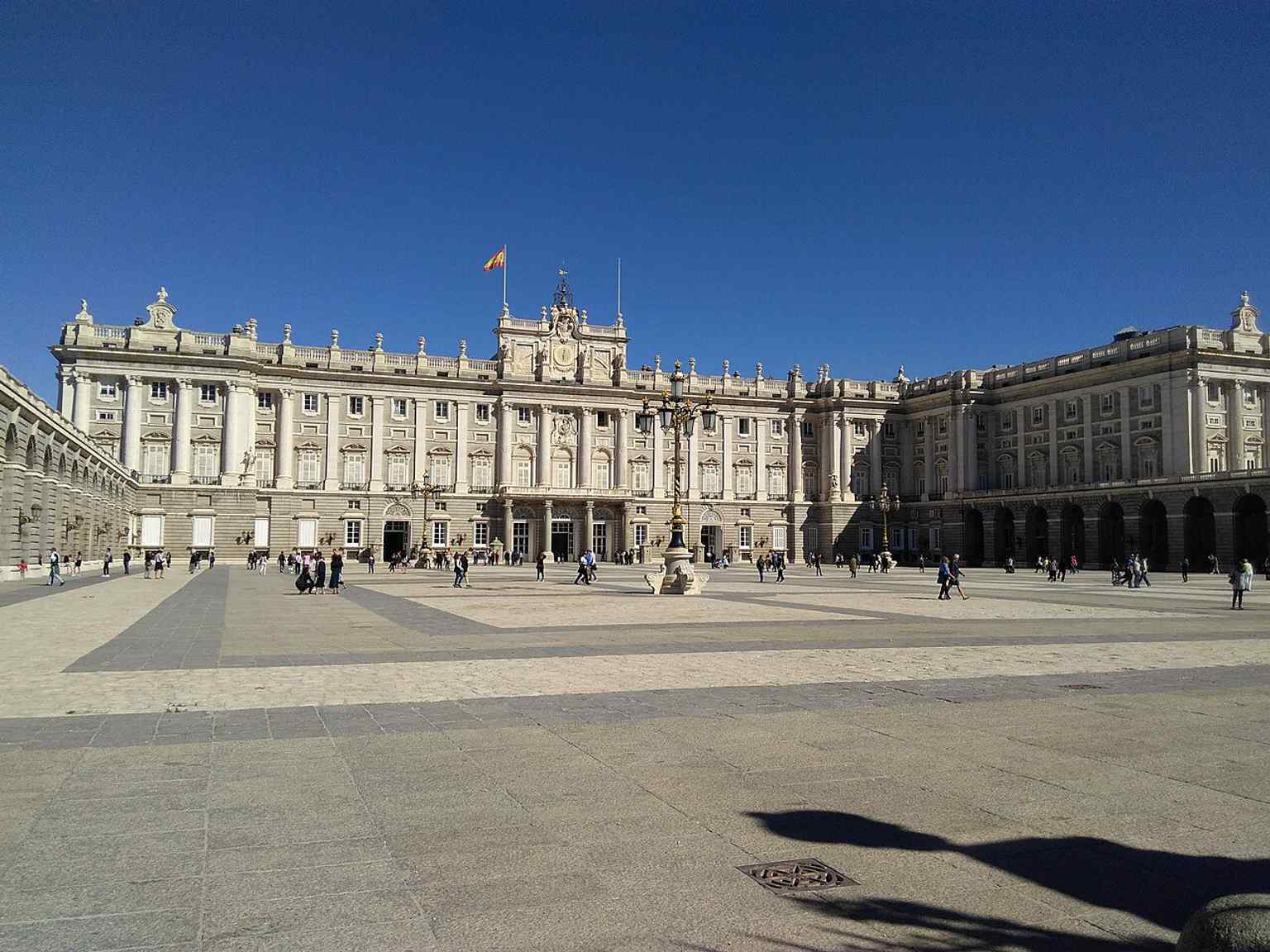
The palace courtyard and south-facing side, where state ceremonies take place in the grand forecourt.Photo: G41rn8, Wikimedia Commons, CC BY-SA 4.0. Cropped & resized. 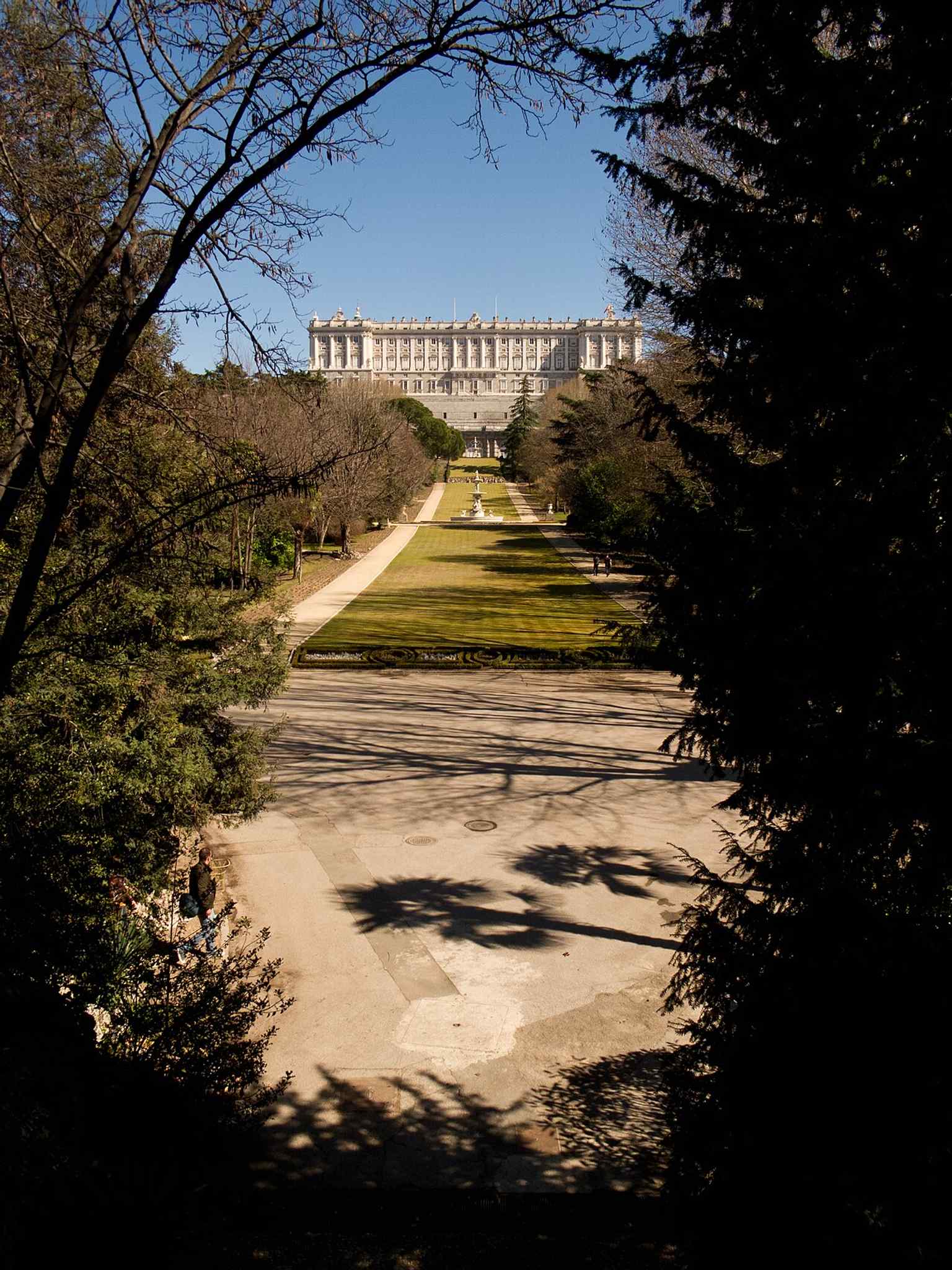
The west side seen from Campo del Moro, showing the palace’s garden setting on the opposite flank.Photo: Carlos Delgado, Wikimedia Commons, CC BY-SA 3.0. Cropped & resized. 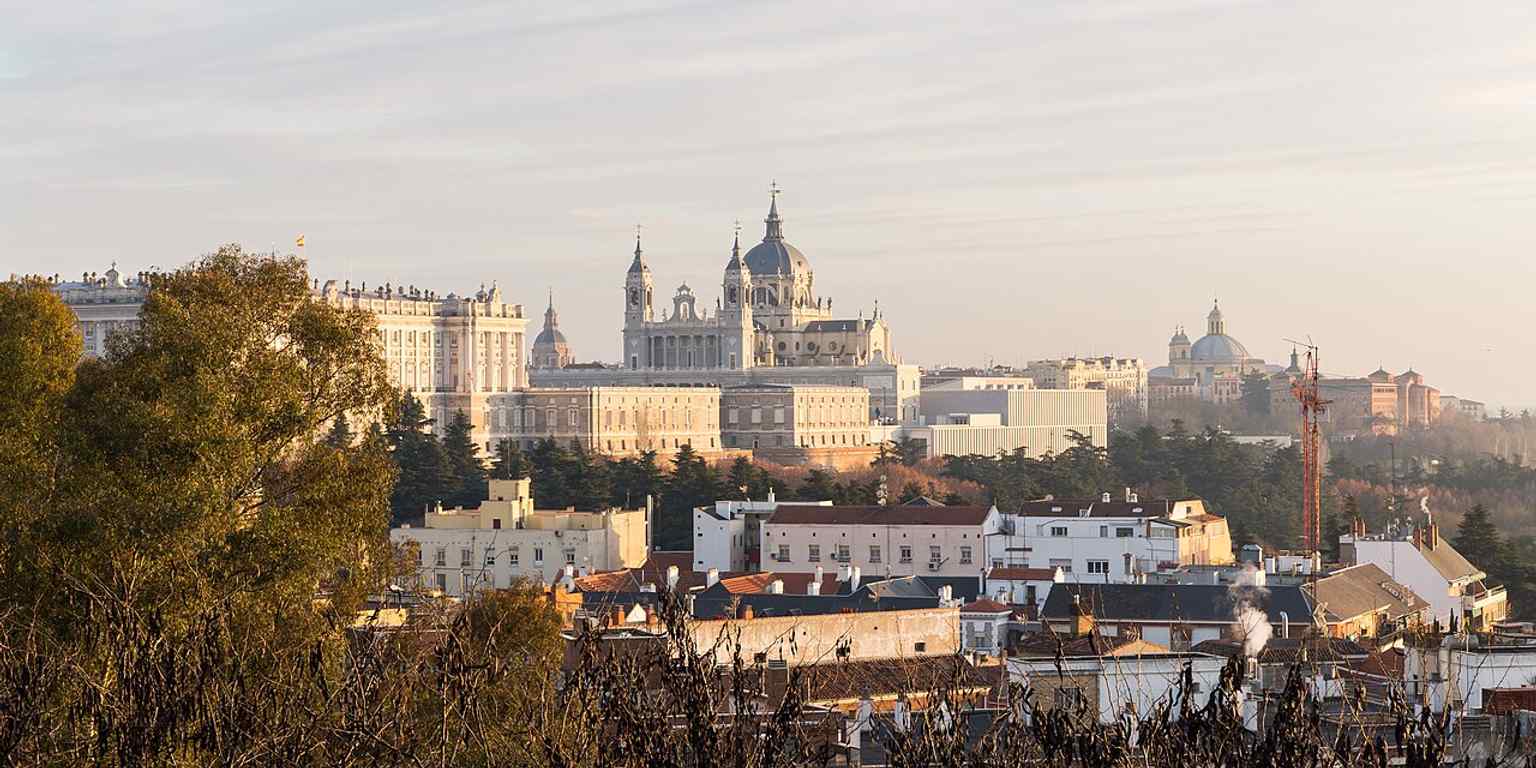
The palace beside the Almudena Cathedral, highlighting the southern edge of the monumental complex.Photo: Diego Delso, Wikimedia Commons, CC BY-SA 4.0. Cropped & resized. 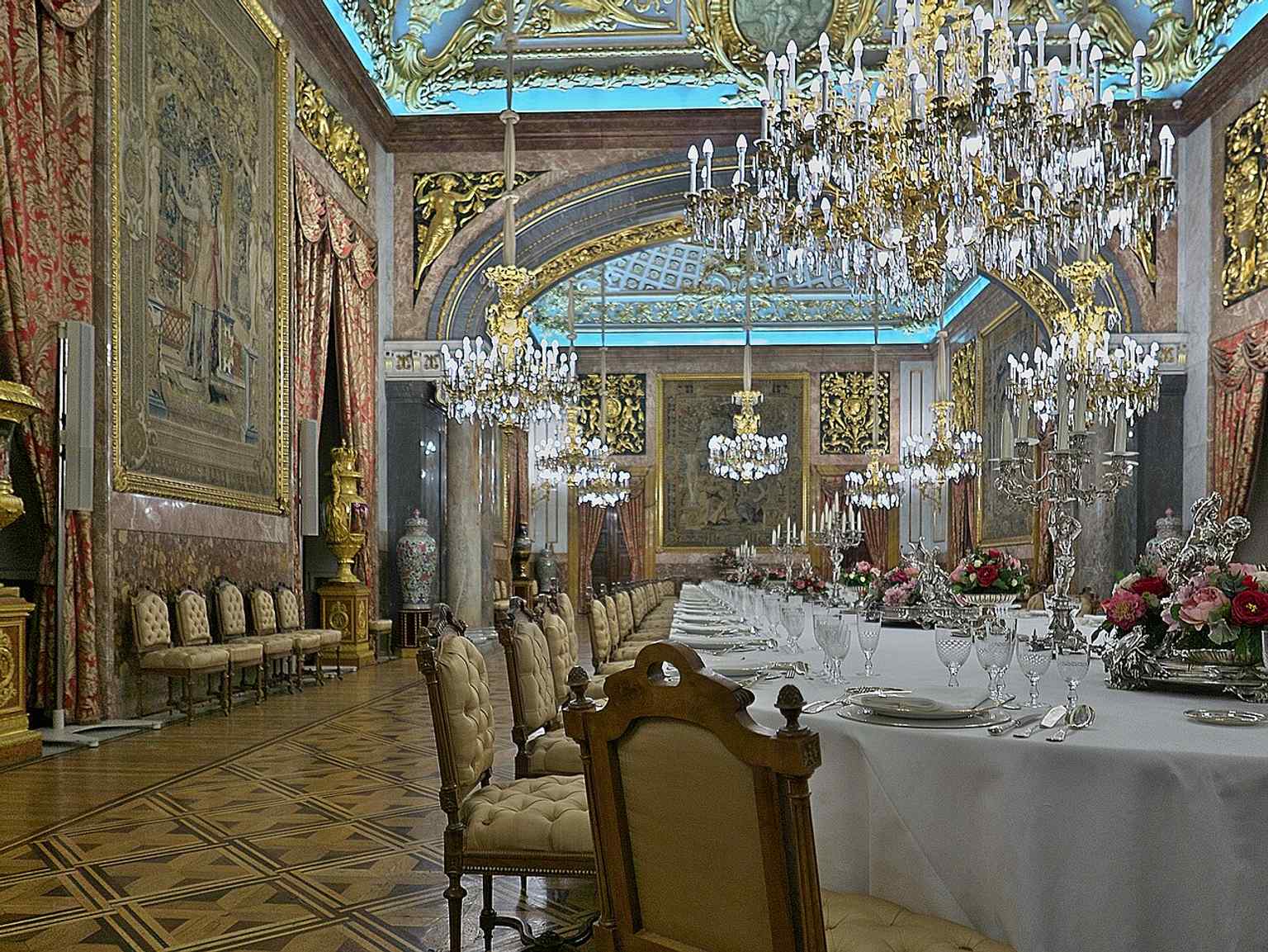
The Gala Dining Room, one of the palace’s grand ceremonial interiors and a reminder of official state banquets.Photo: José Luis Filpo Cabana, Wikimedia Commons, CC BY 4.0. Cropped & resized. Look for a broad rectangular stone plaza with a curved far end, formal hedge-cut gardens, and, right in the middle, a bronze king on a horse rearing up on its back legs…Read moreShow less
Open dedicated page →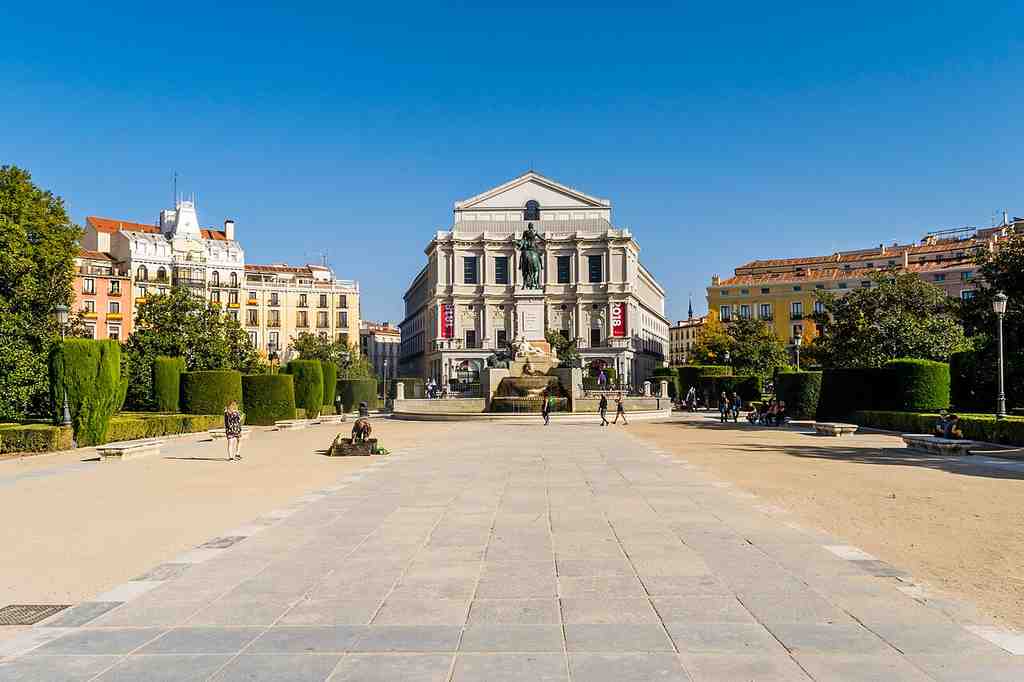
Plaza de OrientePhoto: Oliver Gargan, Wikimedia Commons, CC BY-SA 4.0. Cropped & resized. Look for a broad rectangular stone plaza with a curved far end, formal hedge-cut gardens, and, right in the middle, a bronze king on a horse rearing up on its back legs alone.
This is Plaza de Oriente... and it’s one of Madrid’s clearest lessons in how power likes its elbow room. What seems like an elegant civic salon began, in part, as a clearing. José the First - Napoleon’s brother, the king Madrileños mocked as Pepe Botella, and sometimes Pepe Plazuelas - ordered old medieval houses around the palace torn down in the early eighteen hundreds so the royal seat could breathe. Breathe for the palace, that is... not so much for the people who lost the neighborhood.
The final shape you see came later, in eighteen forty-four, when architect Narciso Pascual Colomer fixed the plan: a monumental rectangle, closed with that curved eastern end toward the theater. It’s a carefully staged space. The Royal Palace forms the western backdrop, the Royal Theatre closes the east, and the Monastery of the Encarnación watches from the north. Palace, monastery, theater, gardens... it’s practically a set design for monarchy.
At the center stands the plaza’s star turn: Philip the Fourth on horseback. The sculptor Pietro Tacca cast it in bronze in the seventeenth century using portraits by Velázquez as models. What made it famous is the engineering trick. The story goes that Galileo Galilei advised how to balance the horse on only its hind legs: make the rear solid and the front hollow. Art and physics... a fine partnership when you don’t want your king tipping over. If you want a closer look at that balancing act, there’s a detail image on your screen.
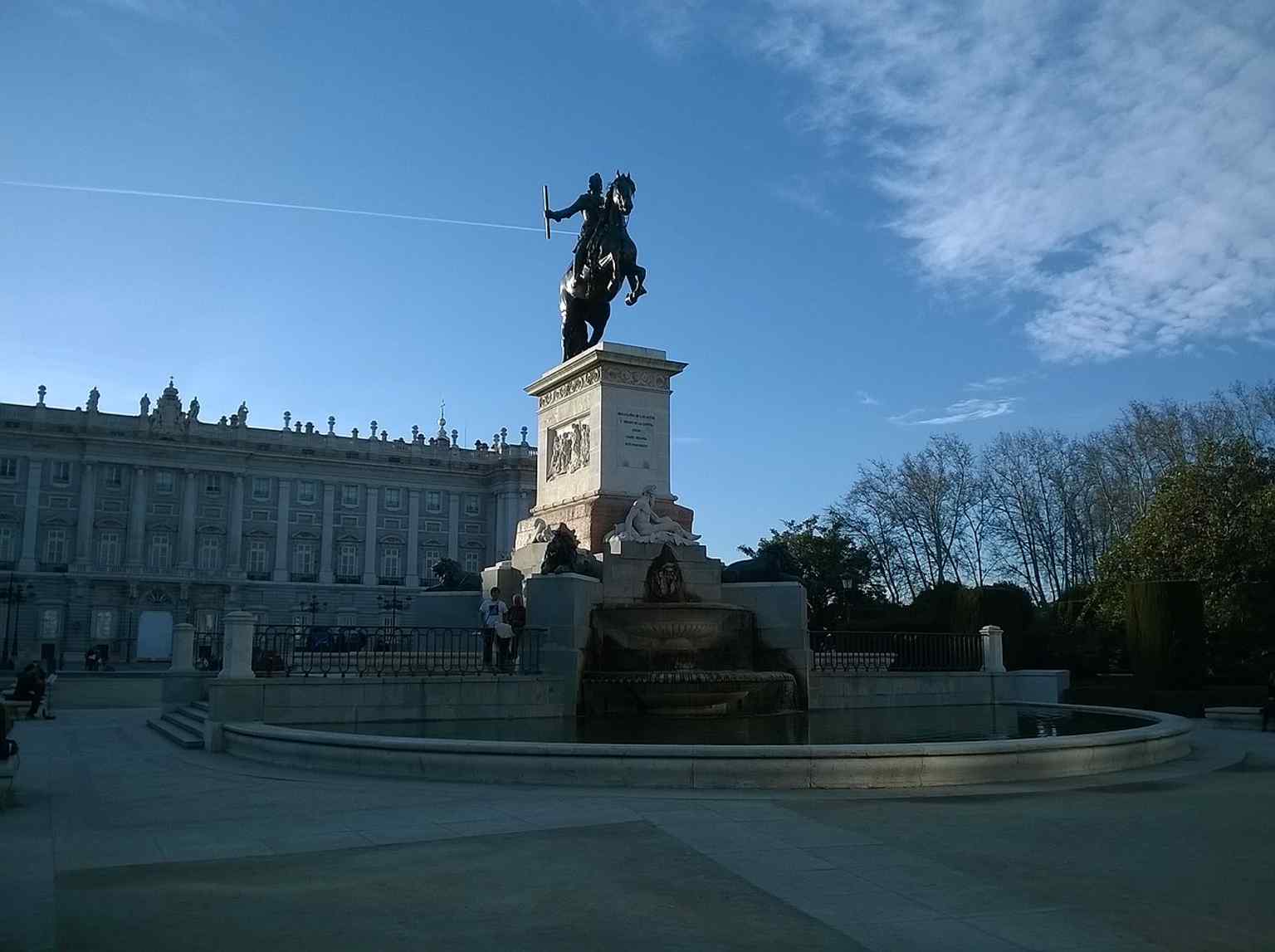
A closer look at the Philip IV monument, famous for the horse balanced on its hind legs alone — a breakthrough in equestrian sculpture.Photo: rene boulay, Wikimedia Commons, CC BY-SA 3.0. Cropped & resized. Around the central gardens, notice the long rows of stone monarchs, popularly called the “Gothic kings.” They were carved for the top cornice of the Royal Palace in the seventeen fifties, then removed when people worried the structure might not enjoy carrying a whole stone dynasty on its shoulders. Legend improved the story, of course: Queen Isabel Farnese supposedly dreamed the statues crashed down and killed the royal family. Madrid does love a practical concern dressed in a dramatic coat.
The plaza kept changing. In the nineteenth century the gardens circled the Philip statue; in nineteen forty-one they were rearranged into the formal grid you see now. And in the nineteen nineties the city buried the traffic of Calle de Bailén, turning this into a fully pedestrian space and stitching the plaza directly to the palace frontage. There was a price to that makeover too: archaeologists found older remains here, including traces tied to Madrid’s Islamic and Christian fortifications. Some vanished during the works, though an eleventh-century watchtower base survived inside the underground parking area. If you’re curious, the before-and-after image in the app shows just how much the theater side and the plaza’s framing changed over time.
Before we move on, let your gaze travel along the edges of the square. See how the open space steers your eyes from palace to theater, then back again, as neatly as a stage manager hitting his marks. And that building opposite, the one closing the curve... that’s where royal display turned into performance proper. Head toward the Royal Theatre, about a minute away.
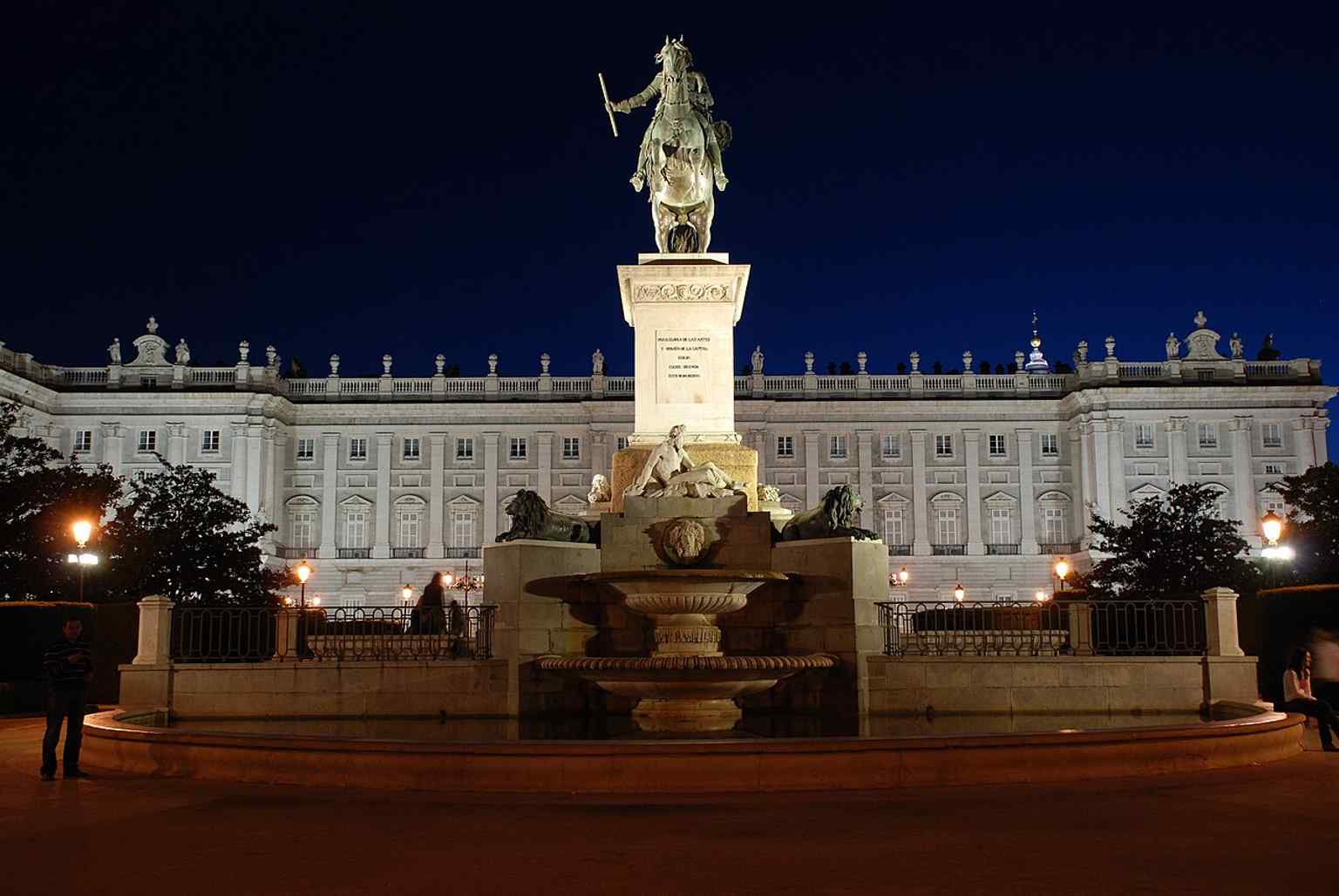
A night view of the Royal Palace shows how Plaza de Oriente opens directly onto Madrid’s royal residence after the Bailén underpass was added.Photo: MarcusObal, Wikimedia Commons, CC BY-SA 3.0. Cropped & resized. 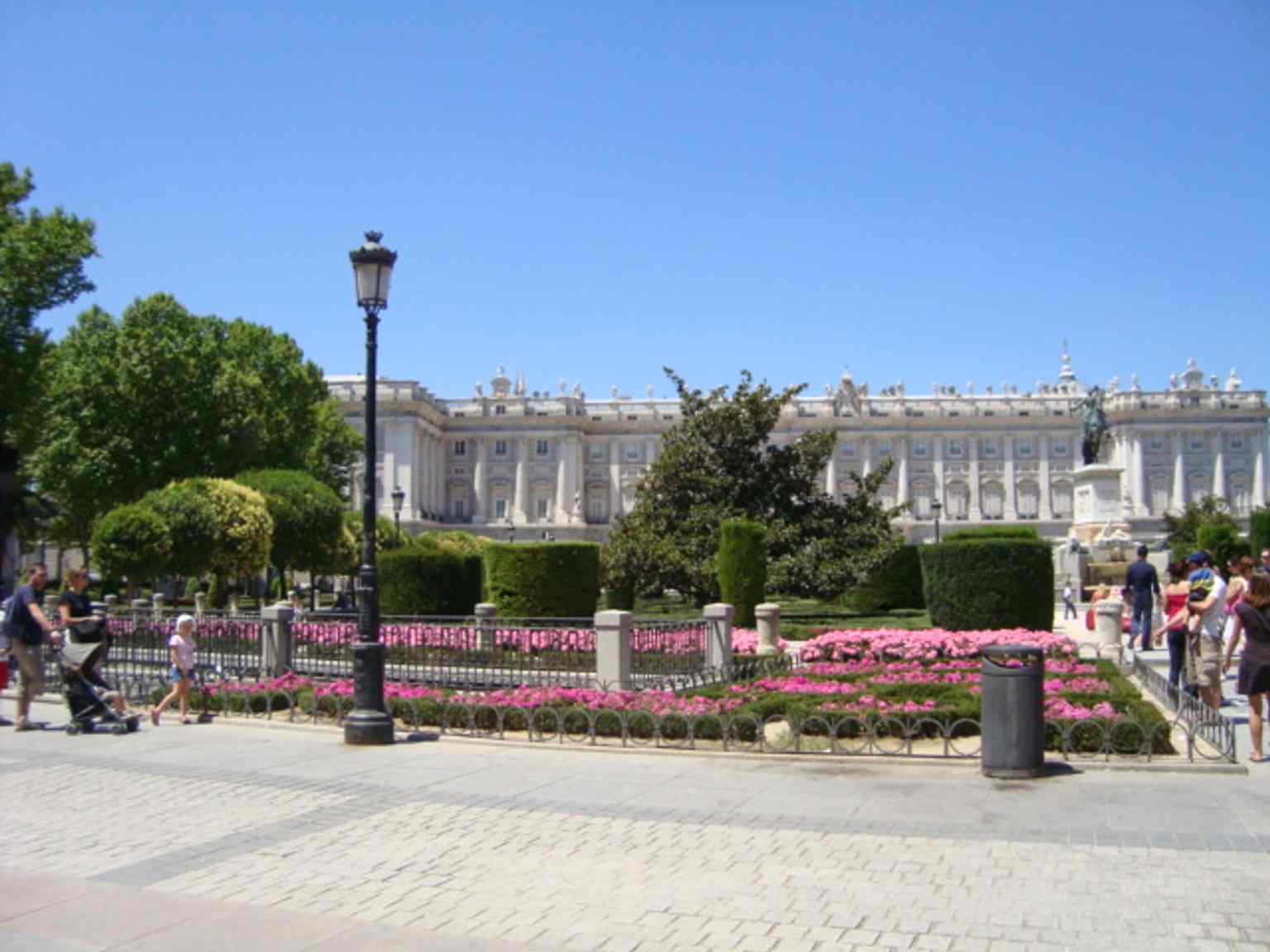
The monument to Philip IV in front of the Royal Palace — the central landmark that structures the square’s gardens and sculpture layout.Photo: Tiberio Claudio Augusto, Wikimedia Commons, Public domain. Cropped & resized. 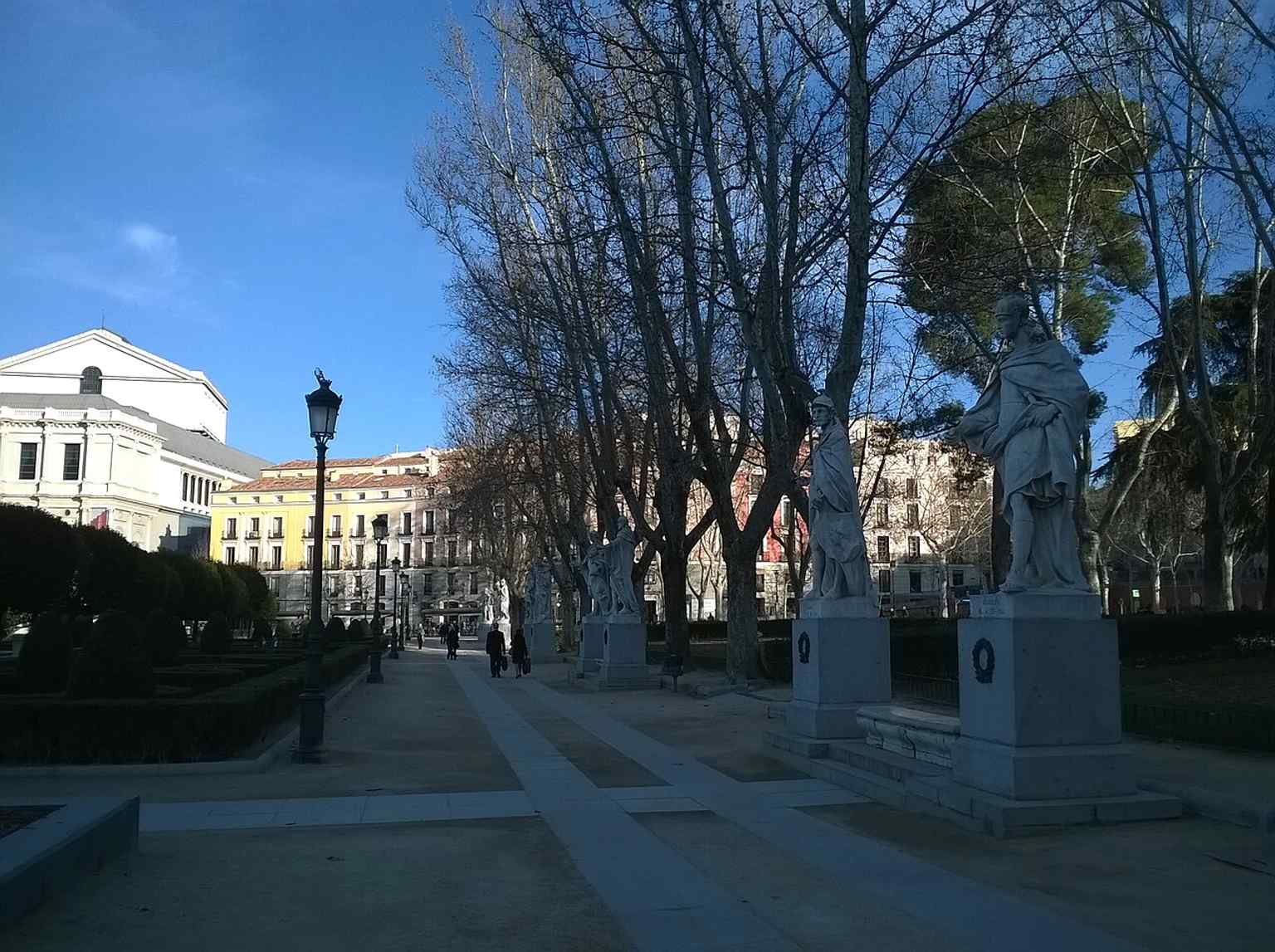
One of the plaza’s “Gothic kings” statues, part of the long sculptural sequence that divides the central gardens from the side lawns.Photo: rene boulay, Wikimedia Commons, CC BY-SA 3.0. Cropped & resized. 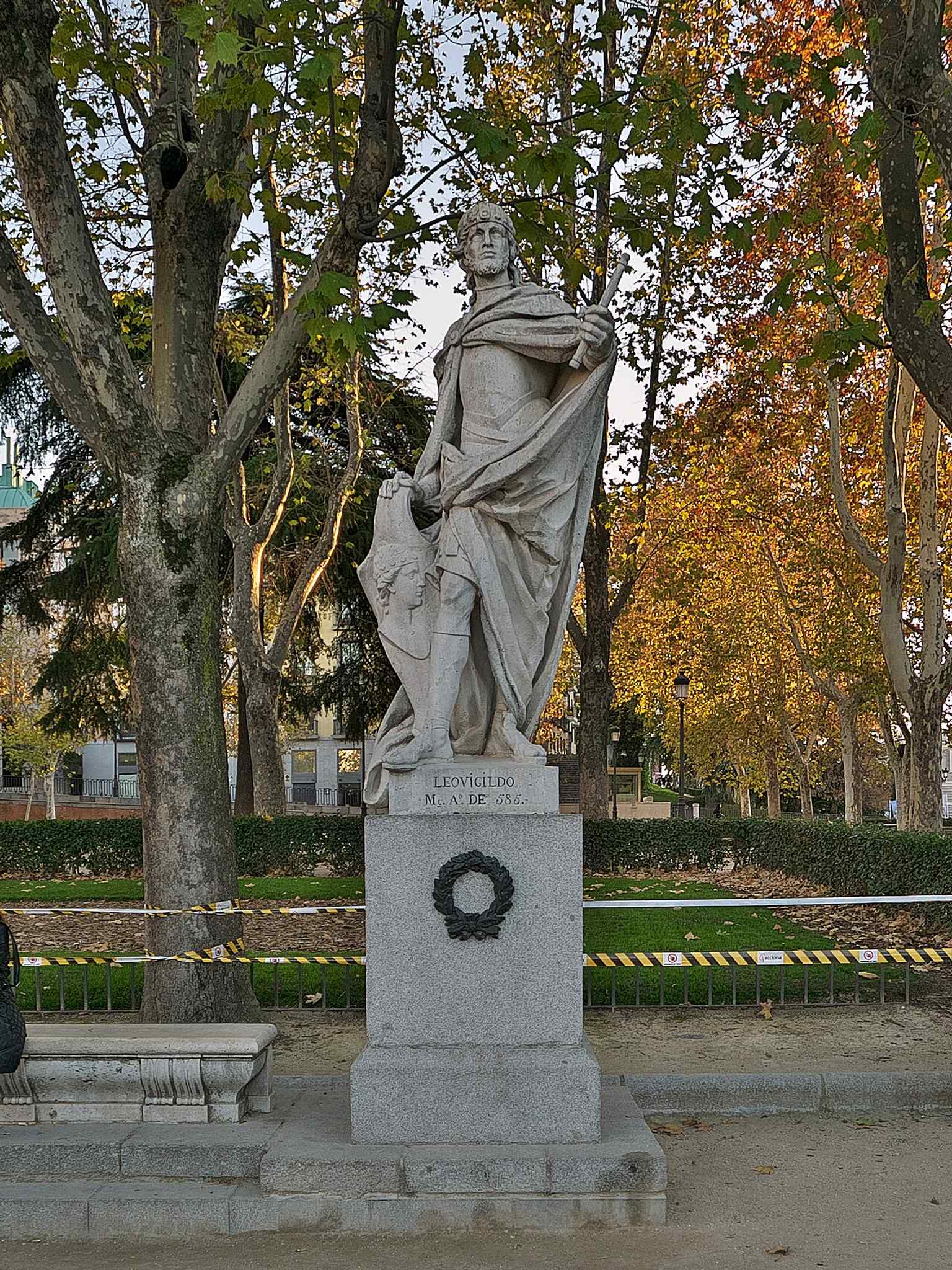
The statue of Leovigild, one of the twentieth-century placements of the kings series that once decorated the Royal Palace cornice.Photo: Jl FilpoC, Wikimedia Commons, CC BY-SA 4.0. Cropped & resized. 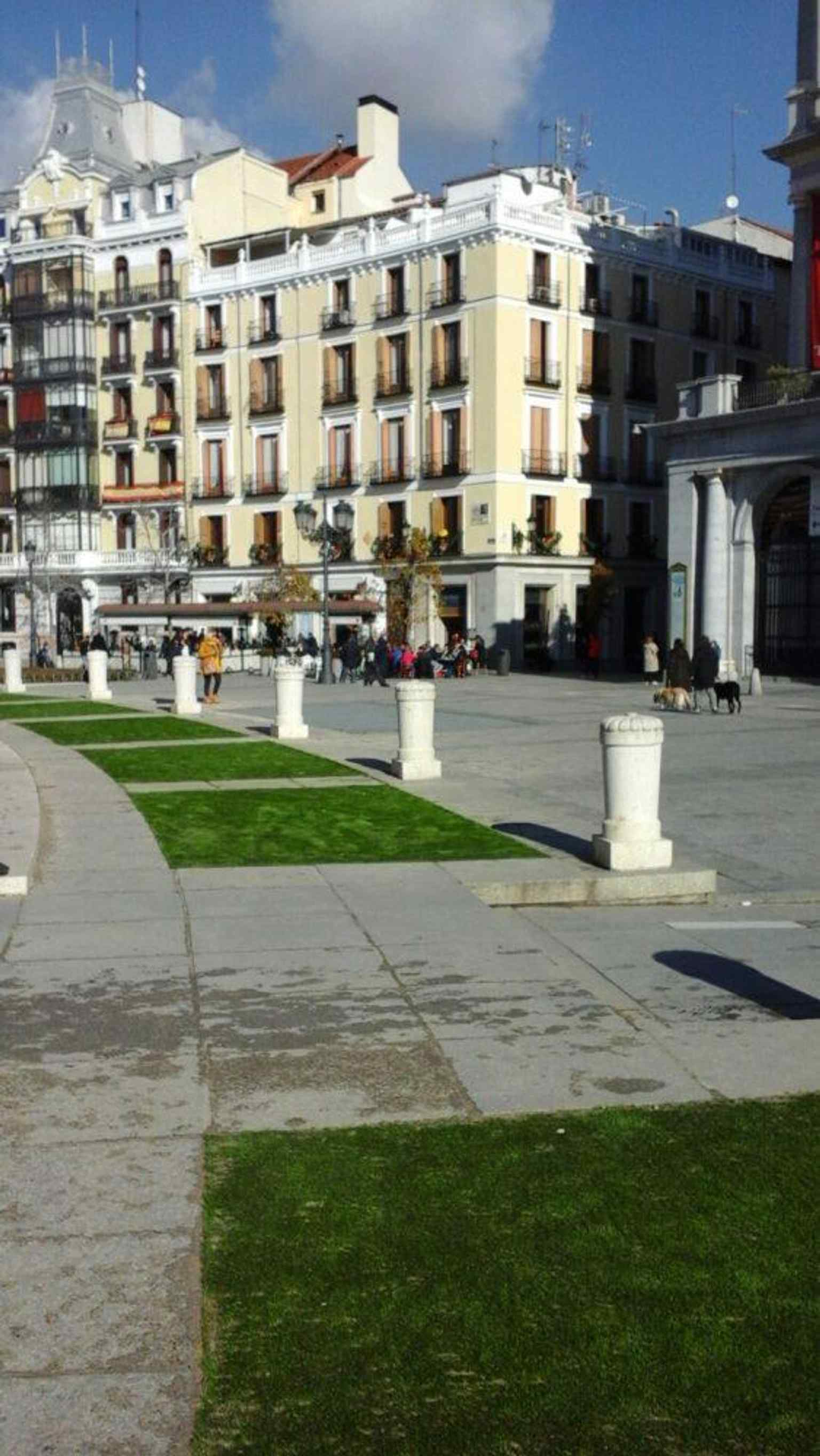
Modern artificial turf in the parterres shows how the plaza’s gardens have been adapted to stay green in low light.Photo: Diario de Madrid, Wikimedia Commons, CC BY 4.0. Cropped & resized. 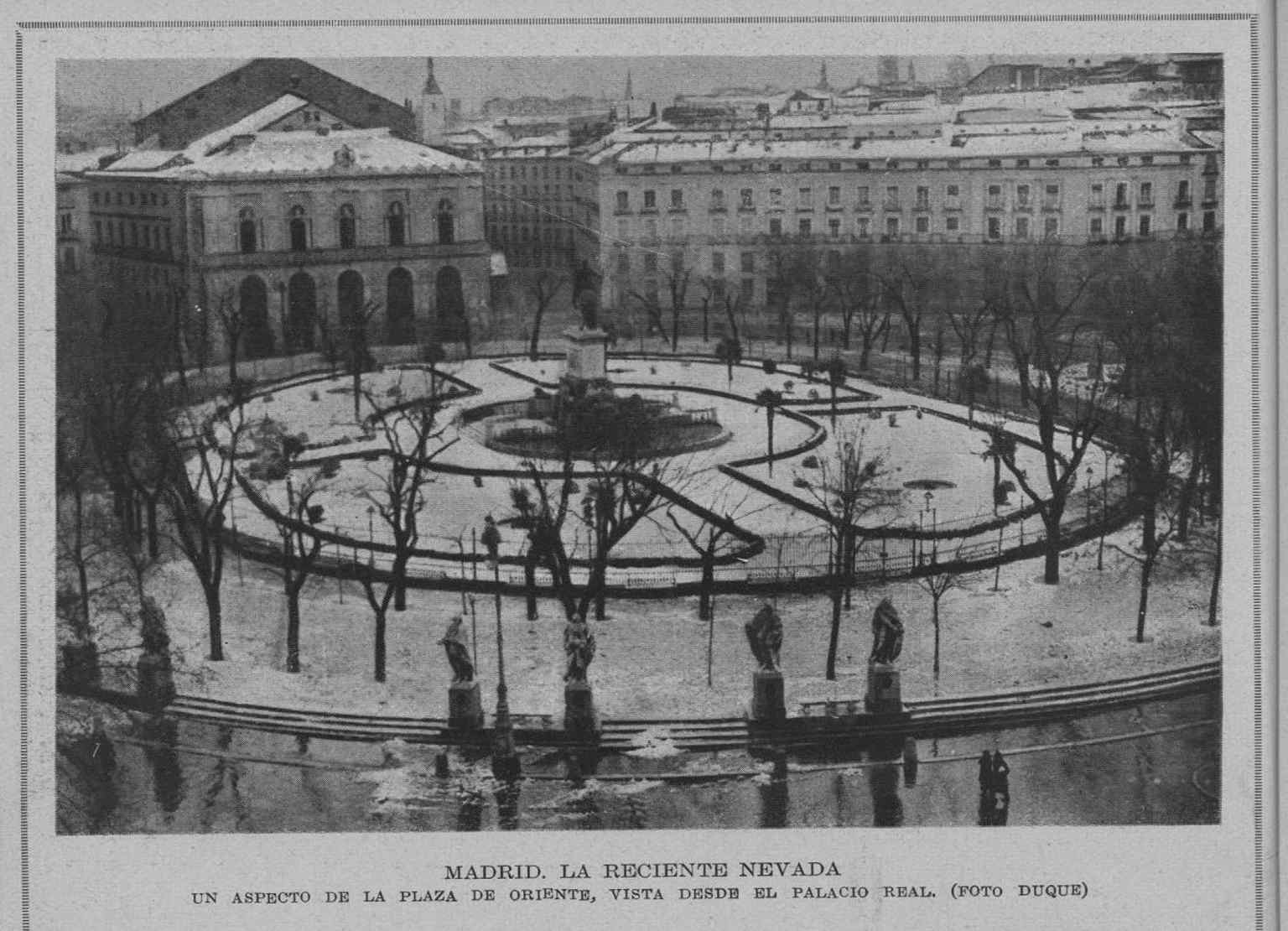
A 1913 snowy view of Plaza de Oriente from the Royal Palace side, capturing the square before its later 1990s peatonalization.Photo: Julio Duque, Wikimedia Commons, Public domain. Cropped & resized. 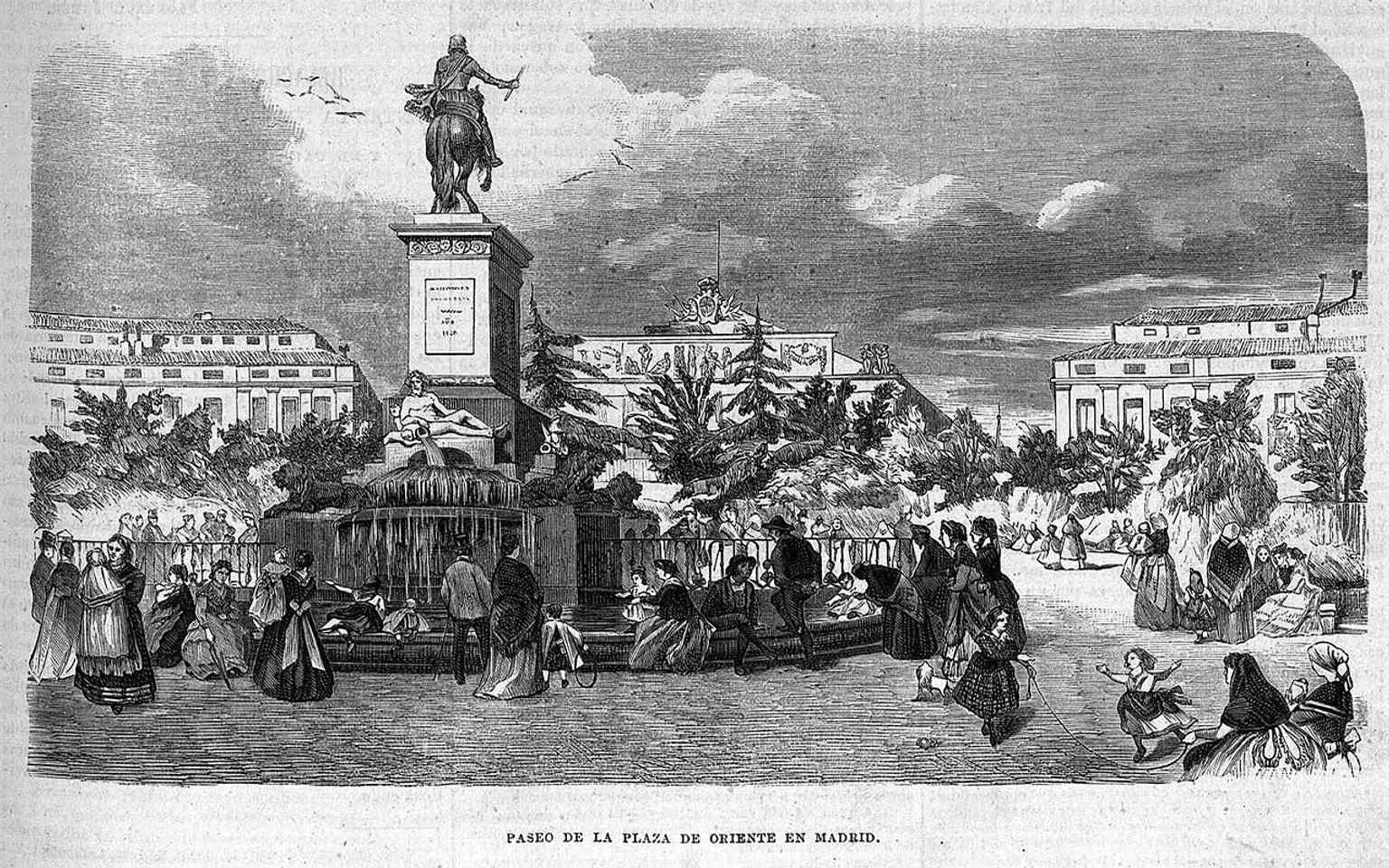
An 1870 engraving of the Paseo de la Plaza de Oriente, useful for showing how the area looked in the 19th century.Photo: Francisco Pradilla y Ortiz, Wikimedia Commons, Public domain. Cropped & resized. 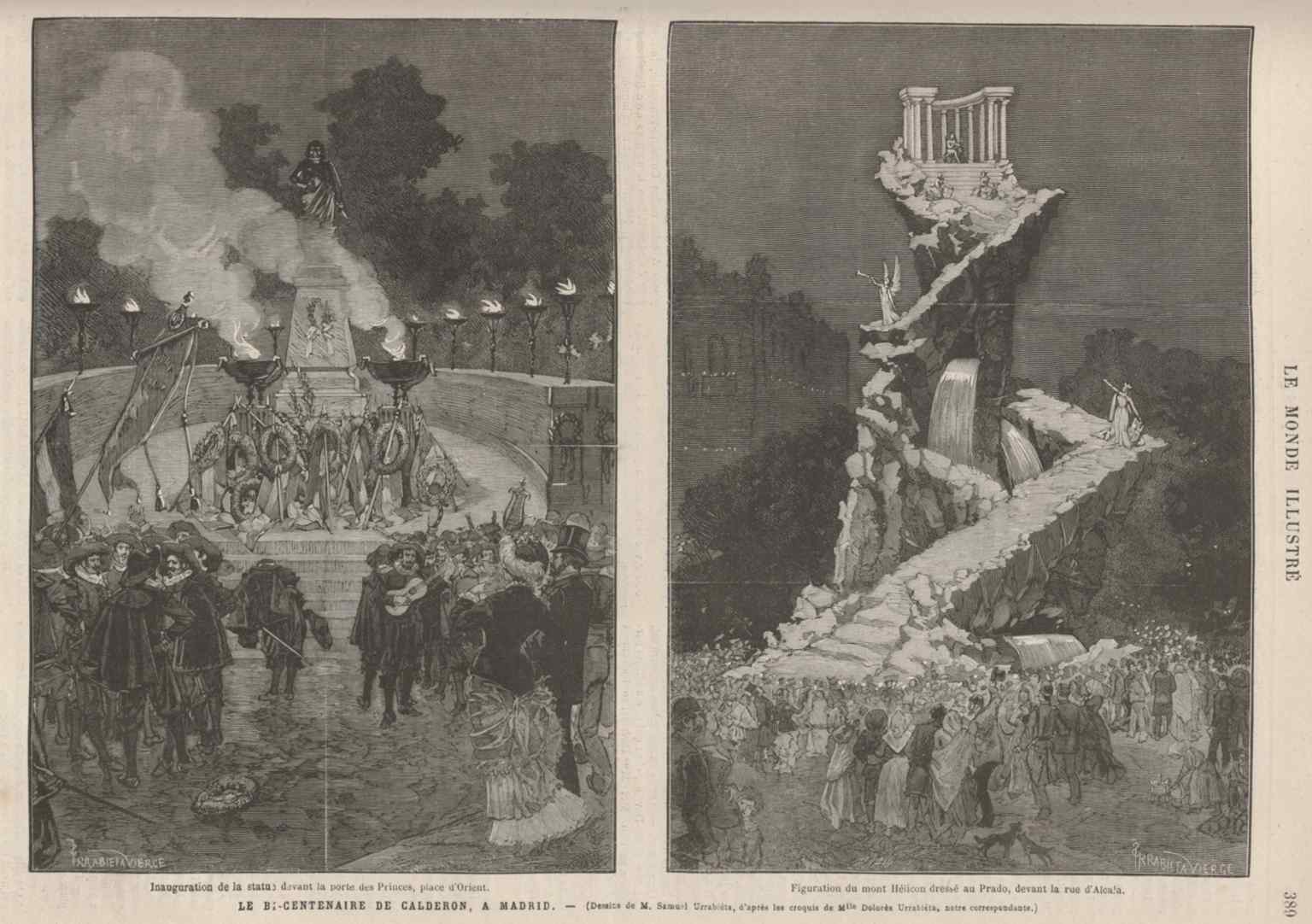
A period illustration of the statue inauguration, reflecting the square’s long tradition of royal sculpture and public ceremony.Photo: Dolorès Urrabieta / Samuel Urrabieta, Wikimedia Commons, CC BY-SA 4.0. Cropped & resized. 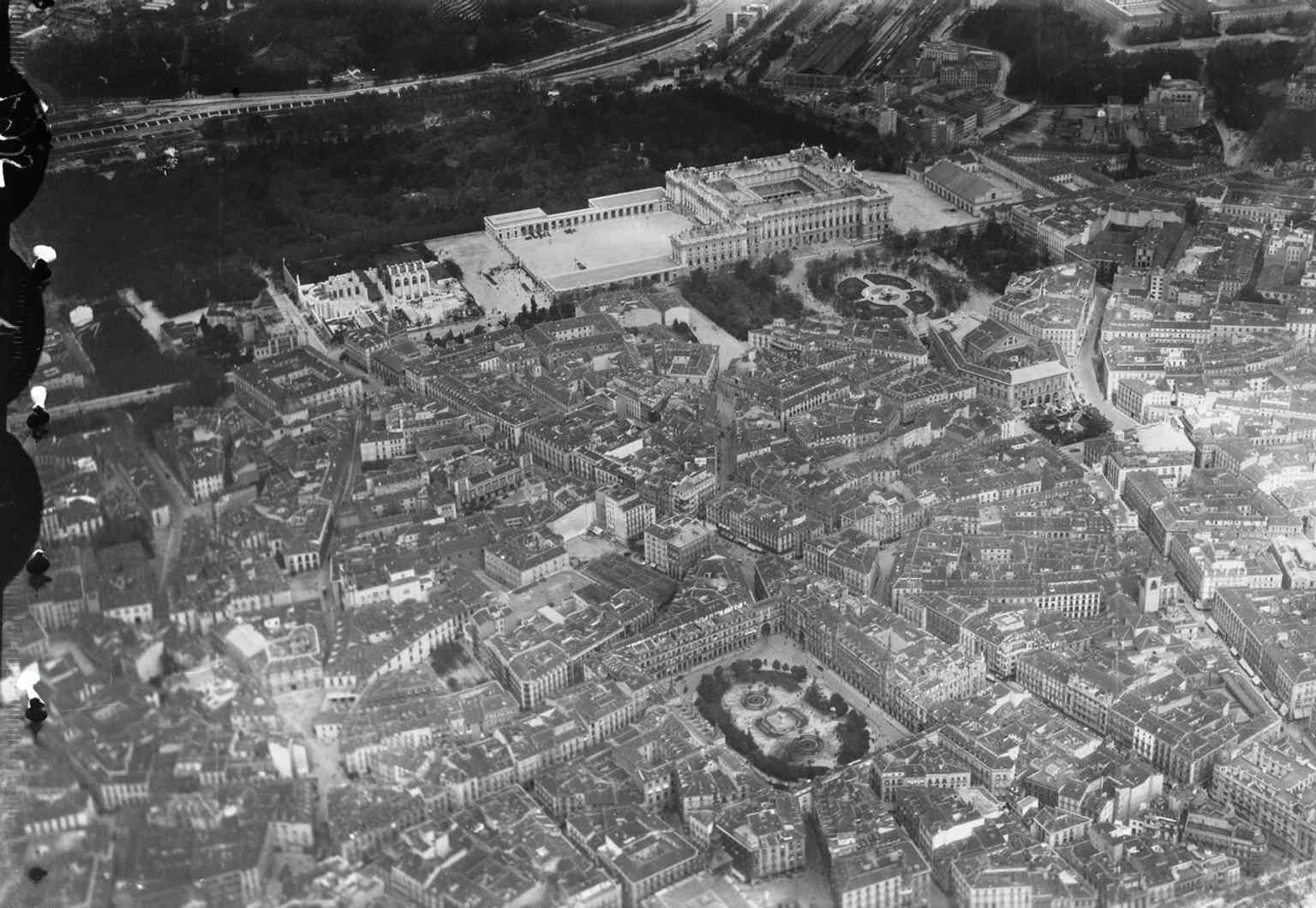
An early aerial view over the Royal Palace and its surroundings helps place Plaza de Oriente within Madrid’s historic center.Photo: Walter Mittelholzer, Wikimedia Commons, Public domain. Cropped & resized. On your right, the Royal Theatre is the broad pale-stone opera house with a gently curved facade, tall arched windows in neat rows, and a bulky upper block rising behind the…Read moreShow less
Open dedicated page →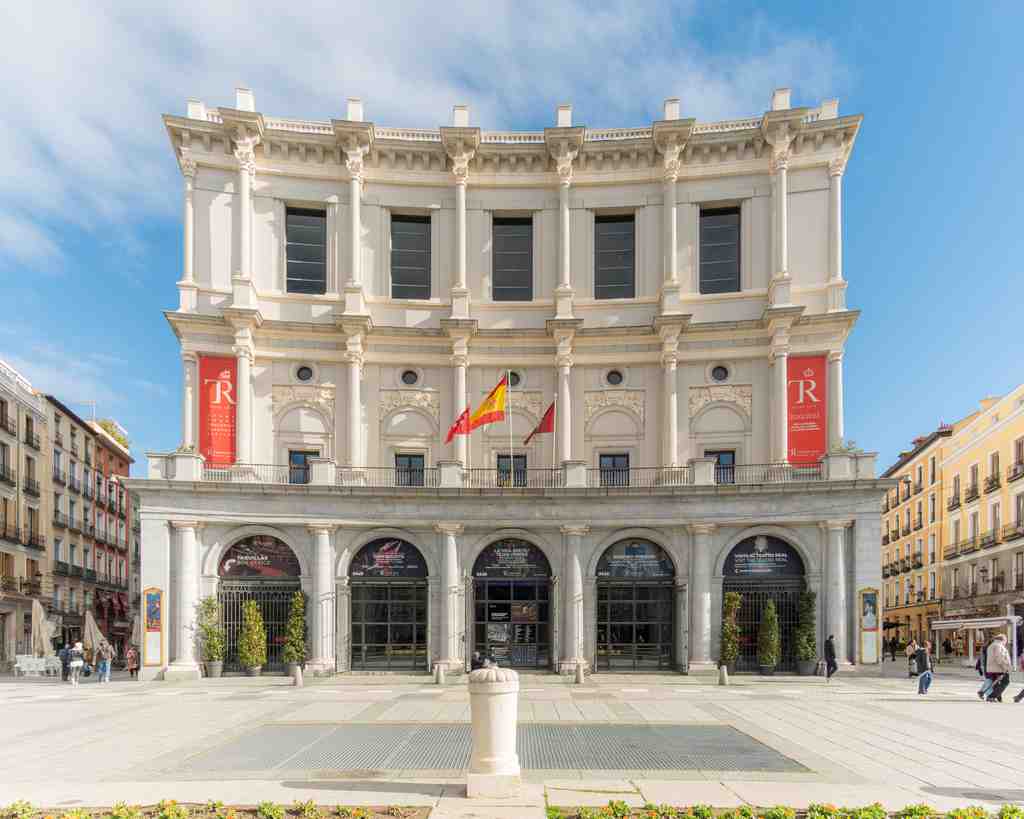
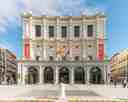
Royal Theatre (Madrid)Photo: Fernando, Wikimedia Commons, CC BY-SA 4.0. Cropped & resized. On your right, the Royal Theatre is the broad pale-stone opera house with a gently curved facade, tall arched windows in neat rows, and a bulky upper block rising behind the elegant front.
This is the Teatro Real, or simply El Real... and here Madrid turns performance into government by other means. Set directly opposite the Royal Palace, this building did not land here by accident. King Fernando the Seventh pushed for an opera house in eighteen eighteen as part of remaking this whole royal quarter, and architect Antonio López Aguado gave it an irregular hexagonal plan so the grand face would look straight onto Plaza de Oriente, while the less glamorous side turned toward what is now Plaza de Isabel the Second.
That detail matters, because this theater was always meant to be seen as much as heard. In Isabel the Second’s Madrid, the city wanted to look polished, cultured, and fully European. So when the young queen formally inaugurated the theater in eighteen fifty, with Donizetti’s La favorita, the message was clear: Madrid could do opera with the same confidence as Milan or Naples.
Now for the twist... the elegant facade hides a saga of chaos. Work dragged on for decades. Officials ignored funding orders, managers were accused of fraud, and the project survived on improvised taxes on beer, exported lead, hazelnuts, and raisins. Not the most romantic patronage in opera history. Then, suddenly, a royal order demanded the building be finished in just six months. At the peak, more than one thousand workers swarmed over the site, and newspapers marveled that Spain had never seen a public project move so fast.
If you check the image on your screen, that original season ticket from eighteen fifty feels almost like a passport into this carefully staged new capital.
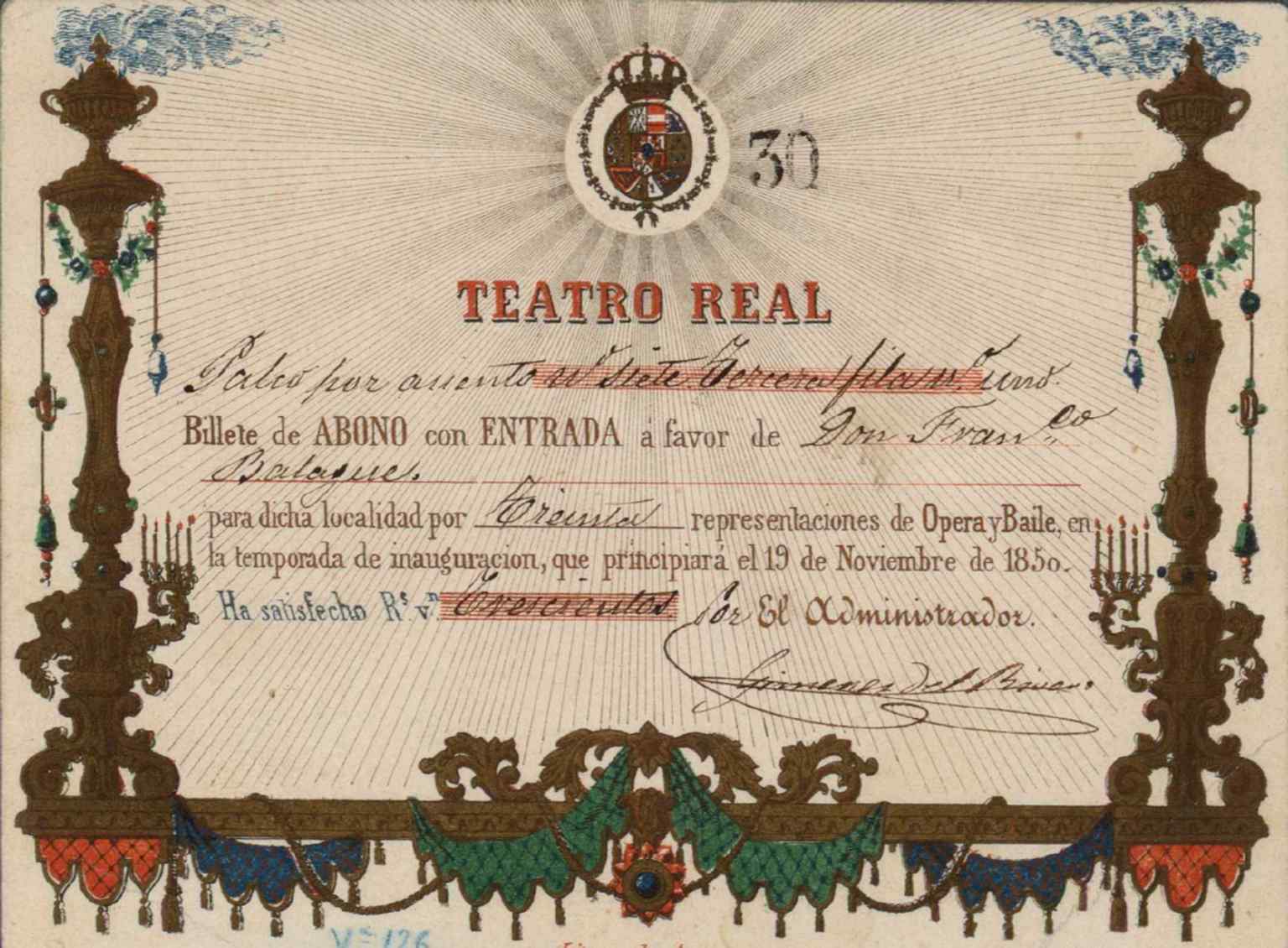
An original 1850 season ticket, tied to the theatre’s inaugural era and its first performances under Isabel II.Photo: Teatro Real, Wikimedia Commons, Public domain. Cropped & resized. Inside, the first audiences did not just watch opera. They watched one another. Boxes, salons, the royal box, the ritual of arriving dressed for display... this was society singing along without opening its mouth. Even the scandals became part of the show. In eighteen sixty-three, the superstar soprano Adelina Patti arrived charging a staggering fee per performance. Ticket prices shot up, resellers got greedy, and at her final appearance some in the crowd brought whistles and used them... with the queen present. Madrid, bless it, has never believed culture should be entirely well behaved.
The building itself kept changing as the city changed around it. In nineteen twenty-five, engineers closed it because unstable foundations, worsened by nearby Metro works using explosives, put the whole structure at risk. Later rebuilds made it larger and more solid, which explains the hefty mass behind the refined front. You can see that block-like form especially clearly in the rear view on the app.
Then came another human story. Architect José Manuel González Valcárcel led the late twentieth-century transformation, trying to bring opera back here for good. In nineteen ninety-two, he died inside the theater during a press visit to the works. It is a sobering reminder that grand cultural symbols are never effortless; people pour real lives into them.
El Real reopened as an opera house in nineteen ninety-seven, ending a seventy-two-year absence, and it still serves as one of Europe’s major opera stages. It has also hosted Eurovision, the Goya Awards, and the Christmas Lottery draw. That tells you everything: in Madrid, prestige is never only political. It is rehearsed, performed, and made audible.
Our next stop is the Royal Monastery of the Barefoot Nuns, about a seven-minute walk away, where public splendor gives way to enclosed devotion. If you want to come back inside later, check the current visiting hours in the app.
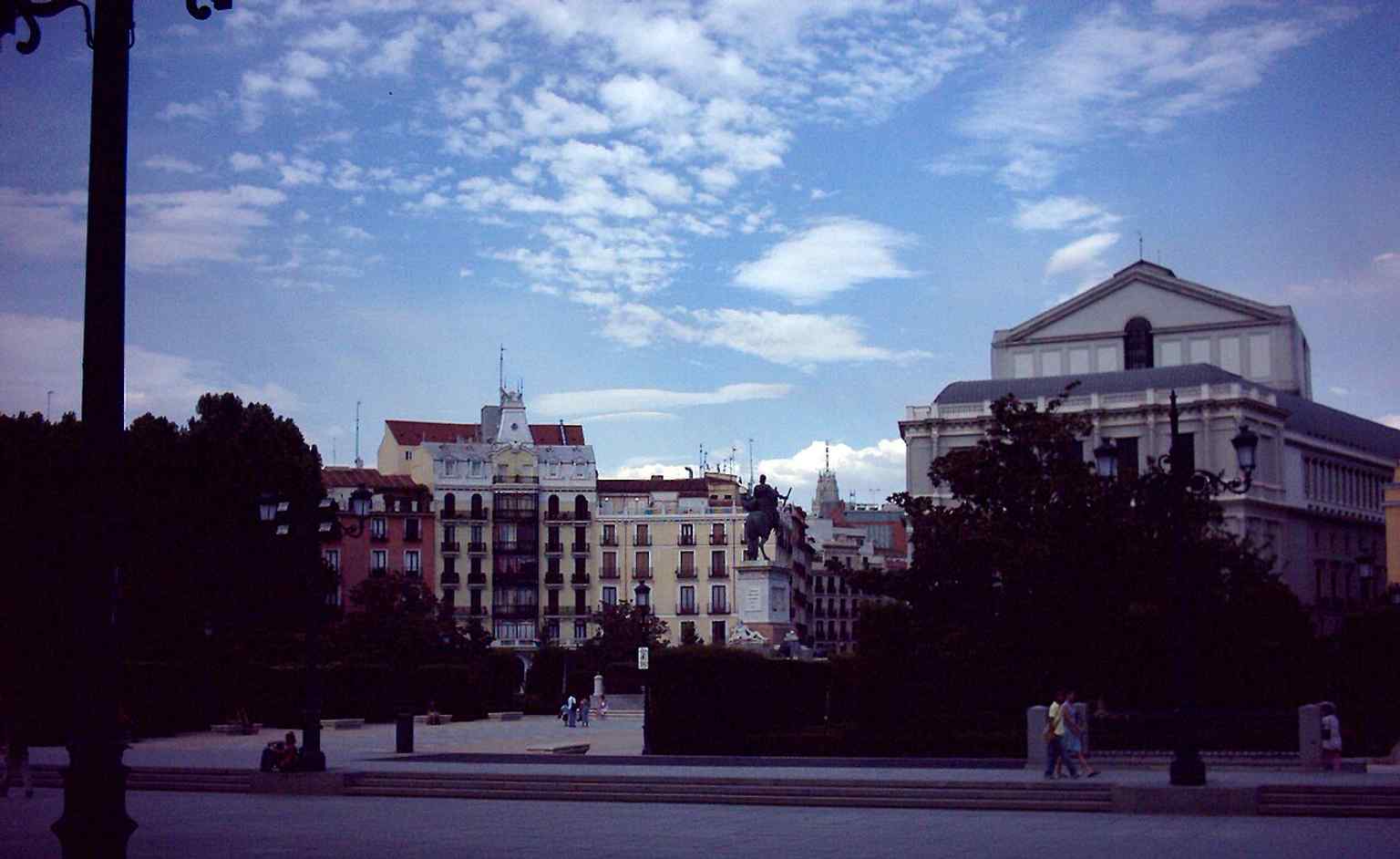
A wider Plaza de Oriente view with the opera house in the background, showing the theatre’s royal setting.Photo: No machine-readable author provided. Balbo assumed (based on copyright claims)., Wikimedia Commons, CC BY-SA 3.0. Cropped & resized. 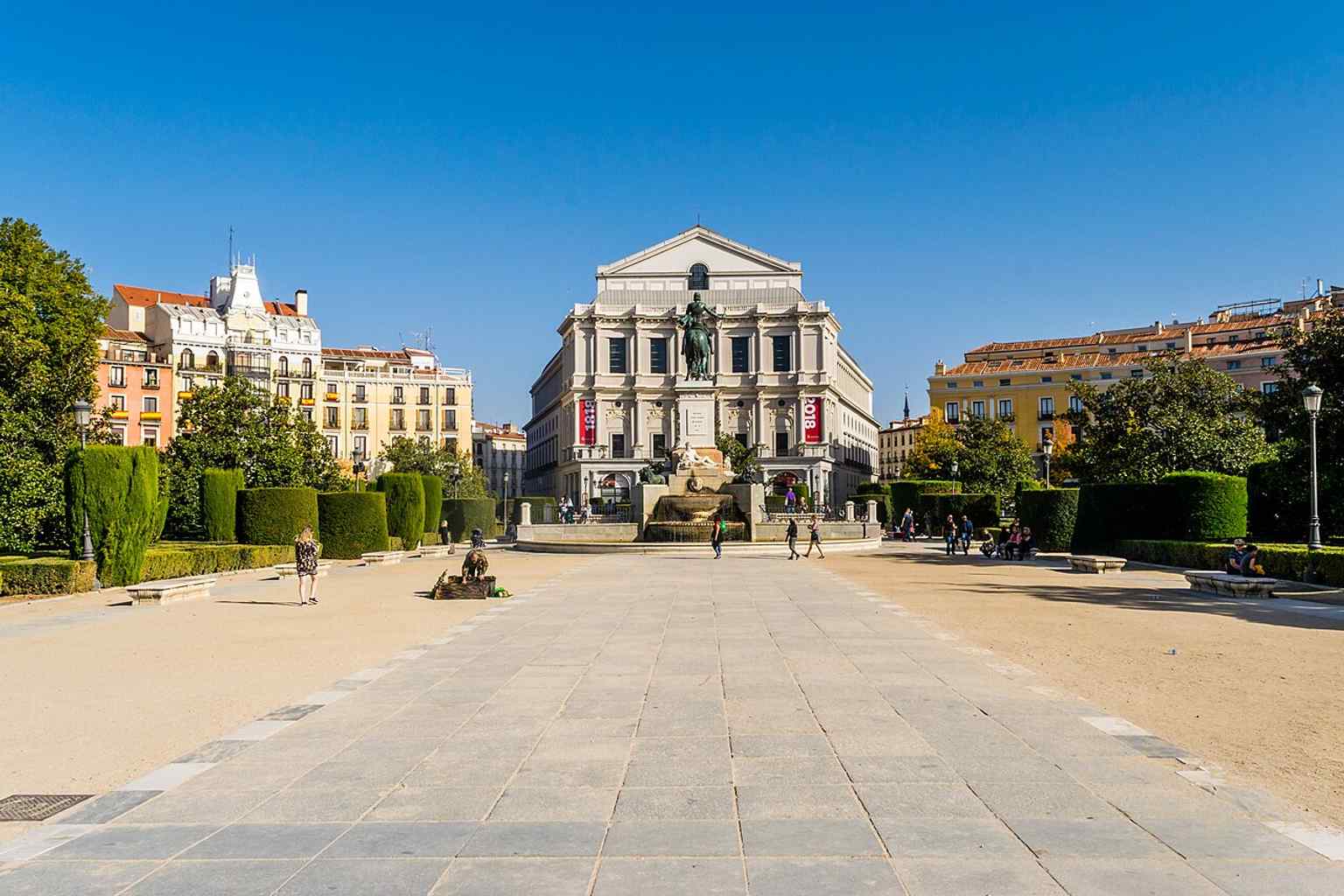
A dramatic telephoto view of the Royal Theatre beside the Royal Palace, echoing its landmark position in central Madrid.Photo: Oliver Gargan, Wikimedia Commons, CC BY-SA 4.0. Cropped & resized. 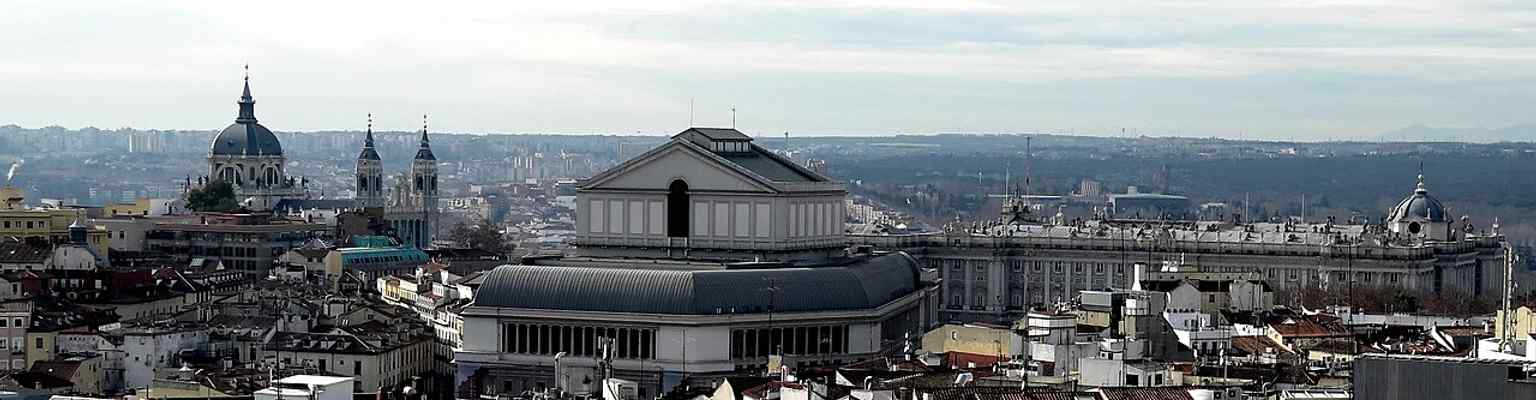
A skyline panorama placing the Royal Palace, the Teatro Real, and the Almudena Cathedral together in one grand Madrid vista.Photo: FDV, Wikimedia Commons, CC BY-SA 4.0. Cropped & resized. 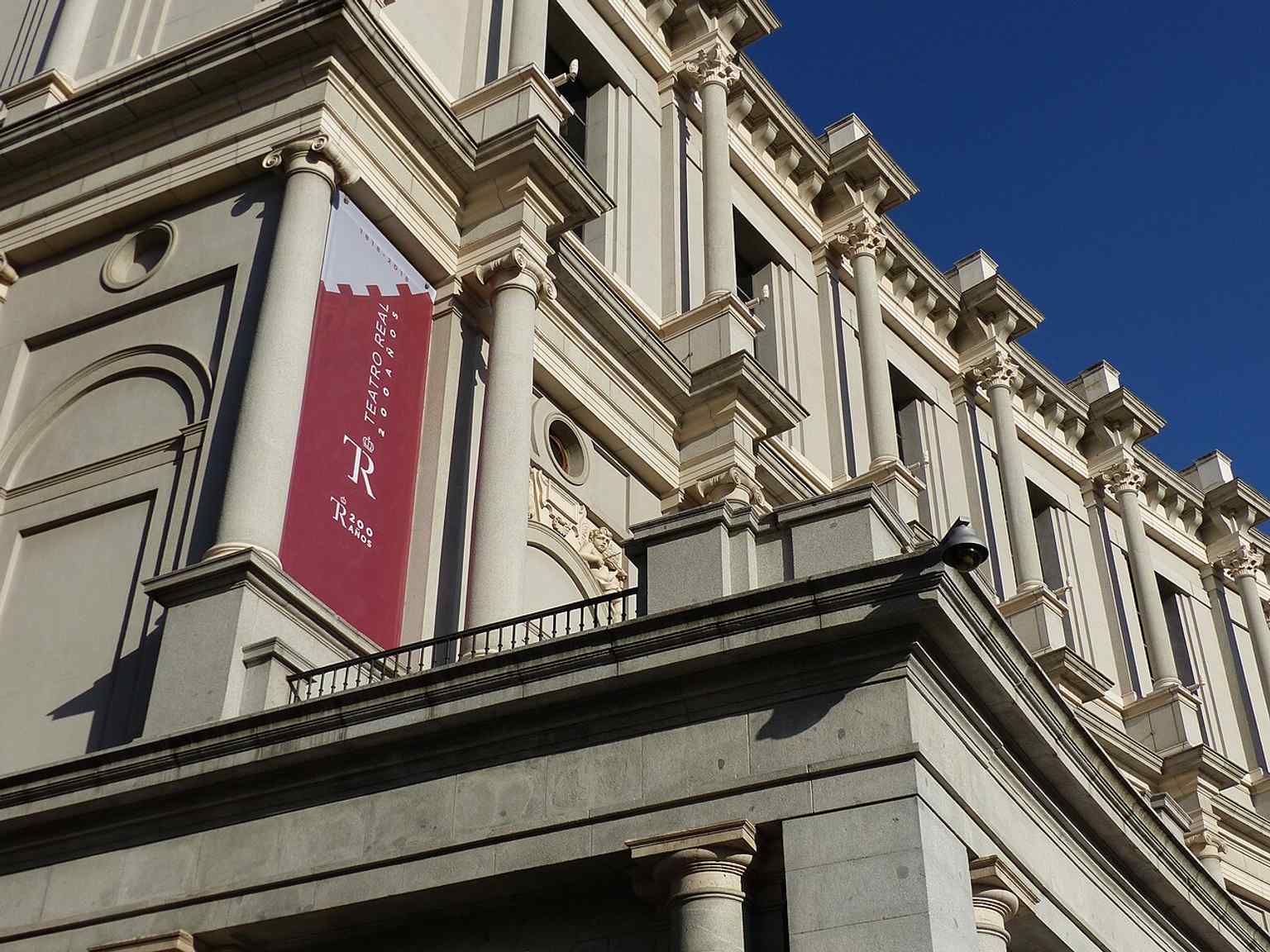
A high-resolution frontal façade view, ideal for the theatre’s restored 19th-century look after the 1990s rebuild.Photo: Benjamín Núñez González, Wikimedia Commons, CC BY-SA 4.0. Cropped & resized. On your left, look for a long tawny stone facade, rectangular and restrained, with a severe classical doorway and the church front folded quietly into the monastery wall. This…Read moreShow less
Open dedicated page →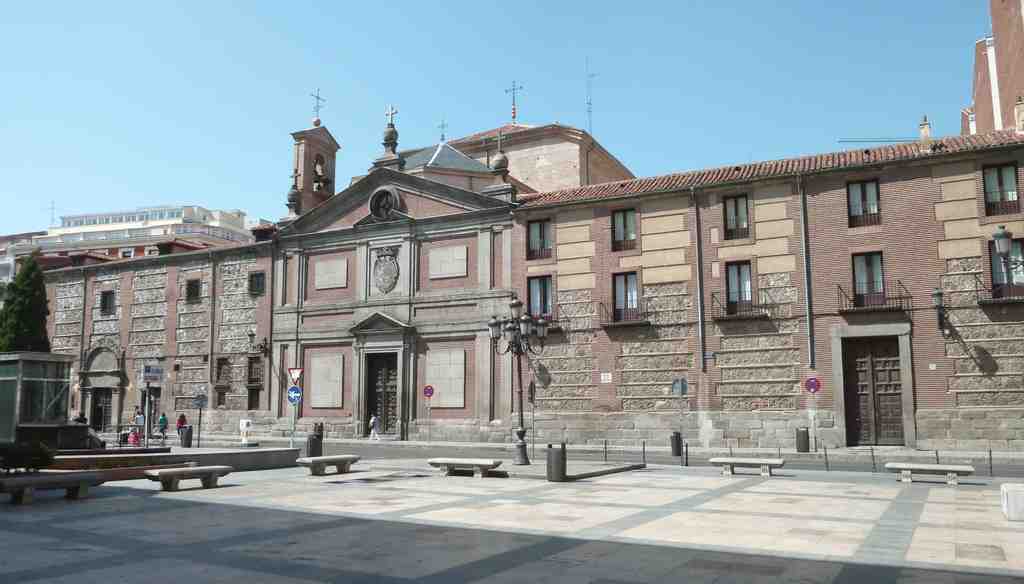
Royal Monastery of the Barefoot Nuns (Madrid)Photo: Zaqarbal, Wikimedia Commons, CC BY-SA 3.0. Cropped & resized. On your left, look for a long tawny stone facade, rectangular and restrained, with a severe classical doorway and the church front folded quietly into the monastery wall.
This place likes to play shy. The Royal Monastery of the Barefoot Nuns does not swagger the way a palace does, but that is exactly the trick. Behind this calm exterior sits one of Madrid’s most politically charged addresses.
The monastery began in fifteen fifty-nine, when Juana of Austria founded it here on the site of her family home. Juana was no minor princess tucked into the margins. She was the sister of King Philip the Second, the widow of the Portuguese prince Juan Manuel, the mother of the future King Sebastian of Portugal, and for a time governor of the Spanish kingdom itself. After Portugal, power, widowhood, and court duty, she turned her own birthplace into a convent... and not just a convent. She created a retreat, a dynastic memorial, a charitable center, and a carefully controlled world where royal women could shape the city without standing in the public square making speeches.
That is the turn here. Madrid’s story is not only kings on balconies and armies in plazas. Sometimes influence wore simple sandals. The “barefoot” name comes from the Franciscan nuns who lived here in plain footwear year-round, a deliberate sign of humility. In Madrid, humility occasionally came with excellent art and very strong family connections.
Most tourists see a peaceful religious building. Locals know this square was once the heart of the old arrabal de San Martín, an older suburb outside medieval Madrid’s first walls. So this quiet facade stands over layers of older city life: houses, processions, royal proclamations, and before all that, even a noble palace where the first Cortes, the governing assembly, met in Madrid in thirteen thirty-nine.
If you glance at the image on your screen, you can see how different the square once looked, with the monastery surrounded by other severe buildings that later vanished or changed shape. This convent survived while much around it did not.
Inside, the real surprise deepens. Royal women turned the monastery into a kind of hidden Habsburg court. Maria of Austria, widow of Emperor Maximilian the Second, lived here from fifteen eighty, and her daughter Margarita became a nun here. Their presence made these enclosed rooms a place of counsel, ceremony, and memory. Princesses stayed in the Cuarto Real, the royal quarters. Gifts poured in. Art accumulated. Rubens tapestries hung for great feast days. The composer Tomás Luis de Victoria served here for years, first as Maria’s chaplain and later as organist, so imagine sacred music rising through spaces shaped as much by devotion as by dynasty.
The building kept changing too. Fire in eighteen sixty-two destroyed the original high altar. Bomb damage during the Civil War scarred the great staircase, yet later restoration uncovered layers of painted decoration and even revealed several different artists’ hands at work. Madrid never quite stops rewriting itself, even in silence.
Royal women as hidden patrons leave one of their clearest signatures here: they founded, collected, commissioned, sheltered, and preserved. Not all power in Madrid announced itself with trumpets or vast facades. Some of it lived behind convent walls and still managed to steer the story.
When you are ready, continue about nine minutes to the Royal Academy of Fine Arts of San Fernando. If you want to return later, check the current visiting hours in the app.
On your left stands a school, a museum, and a kind of command center for taste all at once. This is the Royal Academy of Fine Arts of San Fernando, created by royal decree in…Read moreShow less
Open dedicated page →On your left stands a school, a museum, and a kind of command center for taste all at once. This is the Royal Academy of Fine Arts of San Fernando, created by royal decree in seventeen fifty-two... but its real story starts earlier, with a fire.
When the old Real Alcázar burned in seventeen thirty-four, the court suddenly needed a new palace and, just as important, art worthy of it. So power did what power often does in Madrid: it organized. The sculptor Juan Domingo Olivieri began holding classes in his rooms inside the new royal palace from seventeen forty-one, and by seventeen forty-four a preparatory board was already meeting around him. Picture it: courtiers, artists, ambition, and a lot of opinion in one room. Never a low-drama combination.
What emerged here was something new for Spain. Art stopped being only workshop knowledge, passed from master to apprentice, and became a regulated subject with professors, plaster casts, live hired models, prizes, and study grants to Rome. Painting, sculpture, architecture, engraving... all trained, judged, and put to use. This was how a monarchy taught people to make authority look natural.
One of the key figures was Felipe de Castro. In the early rules, noblemen held the advantage. Castro pushed back. When the final statutes arrived in seventeen fifty-seven, he shifted control toward artists themselves. That may sound bureaucratic, but it mattered. It meant the image of the state would not be shaped only by titles, but by people who actually knew how to draw a hand, carve a saint, or design a facade that could make a king look inevitable.
And speaking of facades, the building in front of you tells the same story in stone. This is the Goyeneche Palace, designed by José de Churriguera, then remodeled when the Academy moved here in seventeen seventy-three. Diego de Villanueva stripped away much of the older Baroque style - that curly, theatrical look - and gave it a neoclassical face, calmer and more disciplined, more Roman in spirit. If you check the image on your screen, you can see that polished exterior logic clearly here.
Francisco de Goya gives this place its human edge. He was not a student here, but an academician and professor of painting, and his relationship with the Academy could be prickly. Goya valued freedom; institutions like rules. Still, the Academy holds one of Madrid’s finest groups of his work after the Prado, including La Tirana and two self-portraits. Take a peek at that theatrical, quicksilver presence on your phone. Even inside the system, Goya kept wriggling like a man refusing to sit still for his own portrait.
Places like this also prepared the ground for what comes later on our route. Long before the Prado opened as a public museum, the Crown’s collections and institutions like this one trained artists, stored masterpieces, and defined what counted as national culture. In other words, the Royal Collection did not simply become the Prado by magic; places like this built the machinery first.
That is a handy thing to remember as Madrid turns more modern ahead of us: this city often dresses innovation in respectable old clothes. Next, we head toward the Metropolis Building, about a five-minute walk away, where that trick becomes wonderfully obvious. If you want to come back inside, check the current visiting hours in the app.
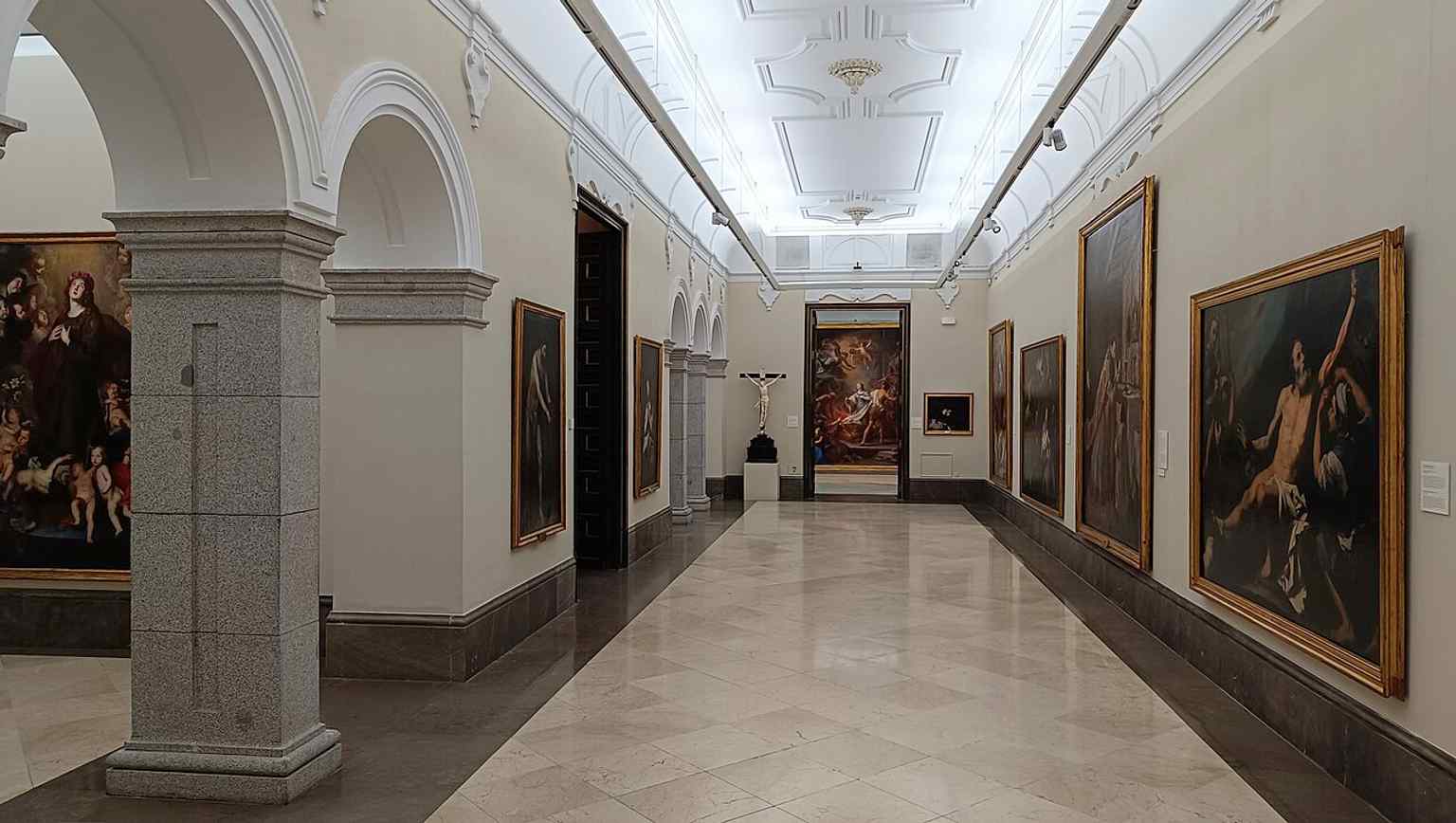
A modern view of the Royal Academy of Fine Arts of San Fernando, the institution founded by royal decree in 1752.Photo: MaGrc, Wikimedia Commons, CC BY-SA 4.0. Cropped & resized. 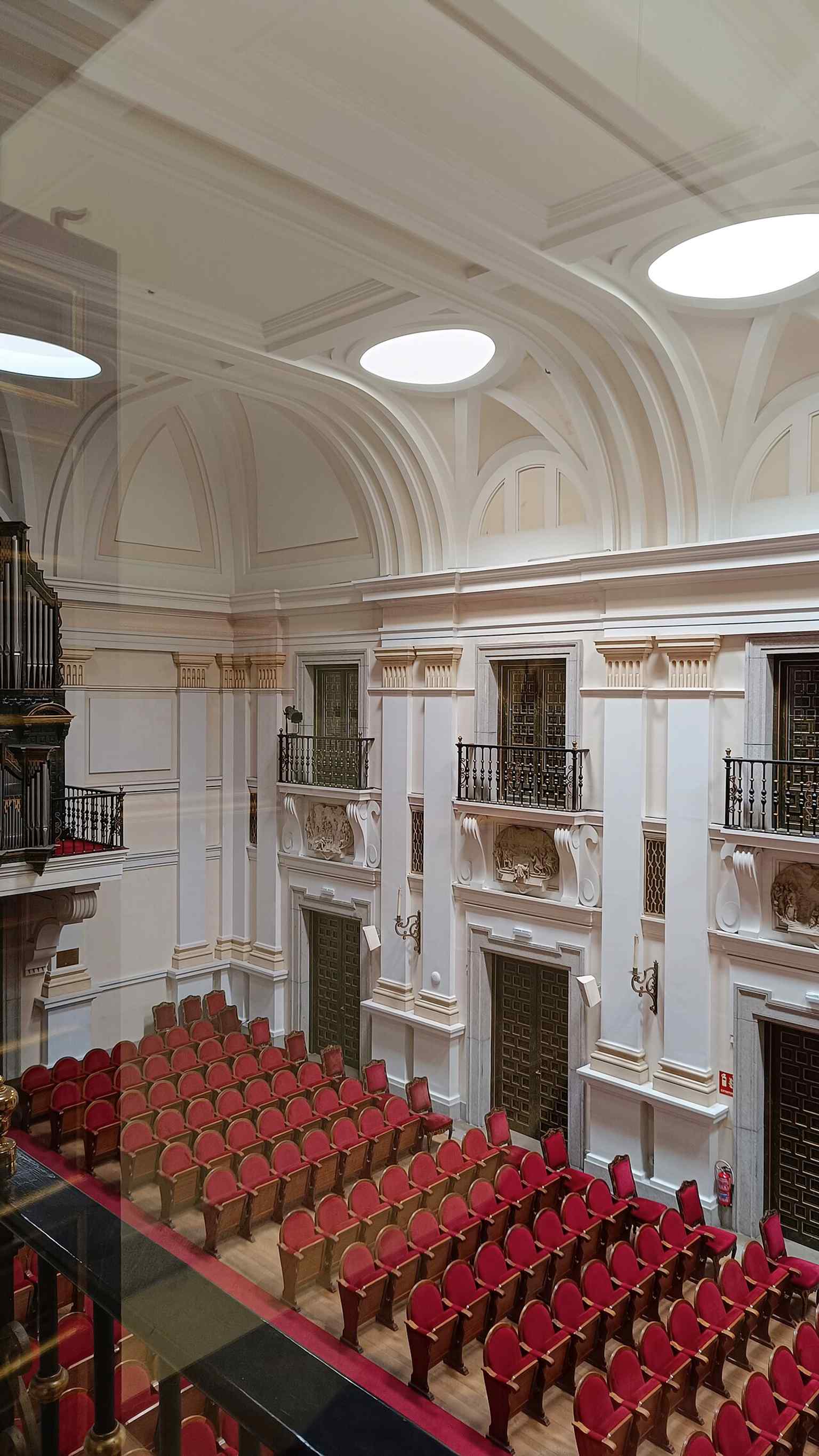
One of the Academy’s museum rooms, showing how the old school building now houses a major art collection.Photo: MaGrc, Wikimedia Commons, CC BY-SA 4.0. Cropped & resized. 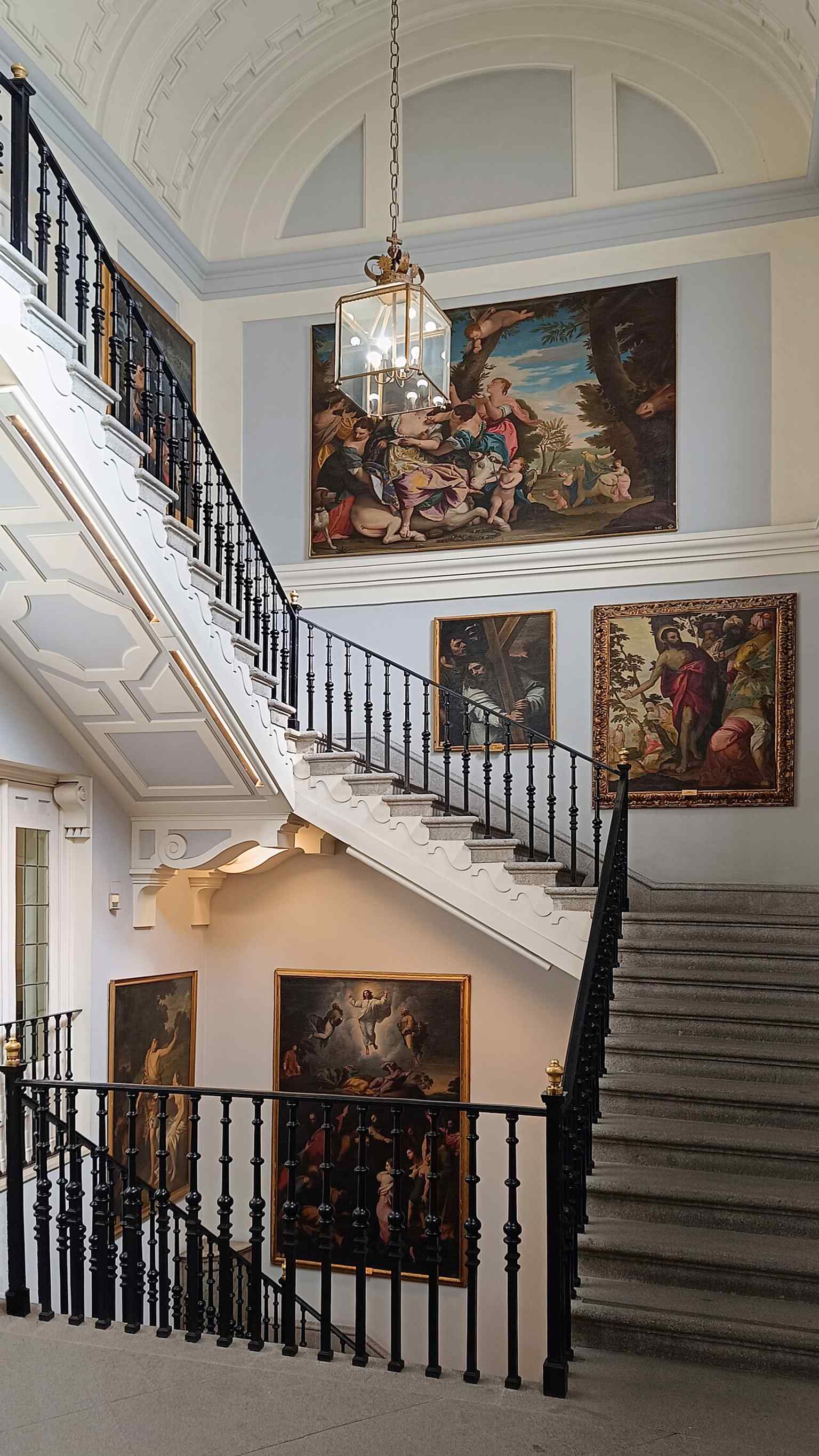
Another gallery in the Academy museum, reflecting the conversion of the historic site into exhibition space.Photo: MaGrc, Wikimedia Commons, CC BY-SA 4.0. Cropped & resized. 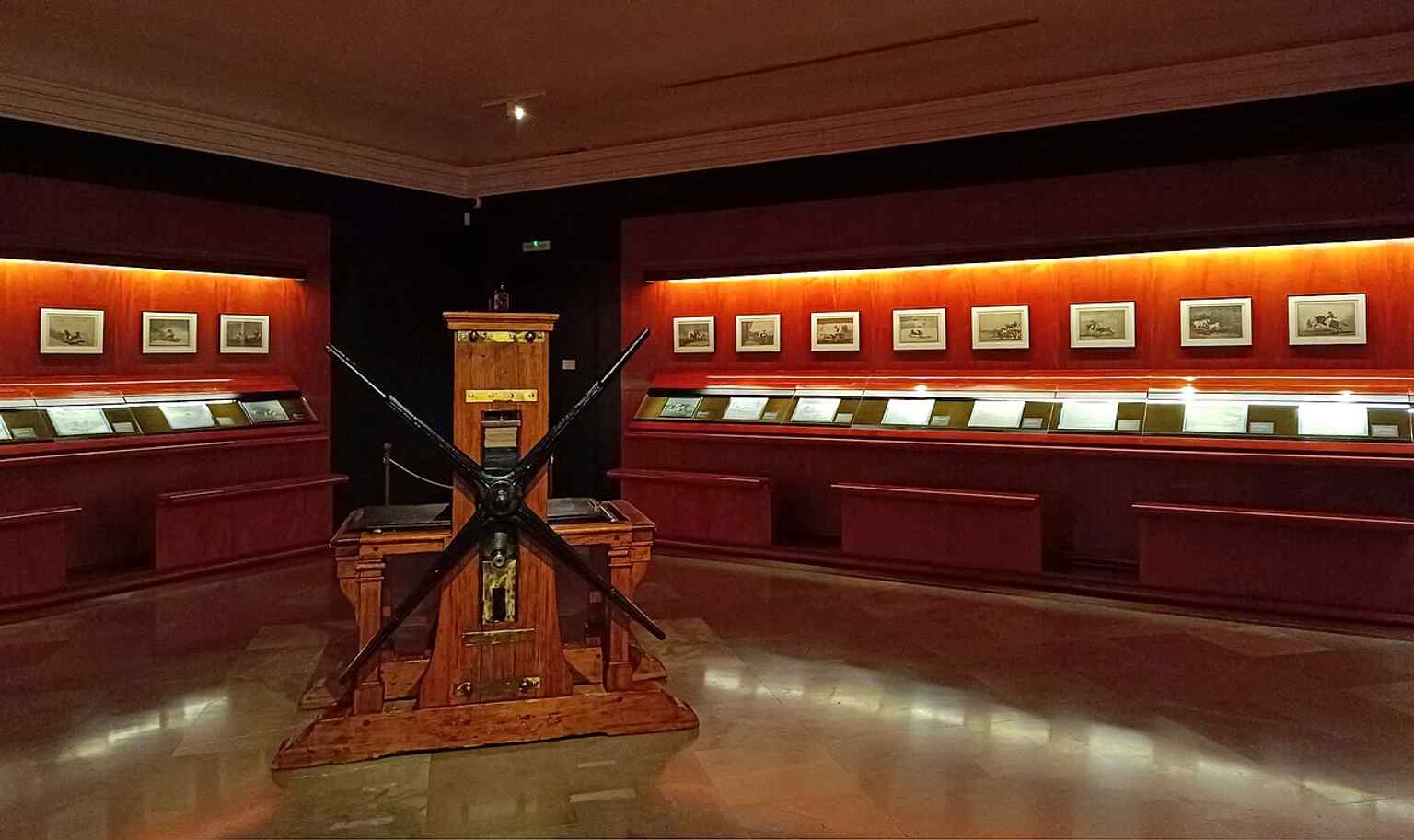
A different interior view of the Academy’s galleries, where centuries of Spanish art are displayed under one roof.Photo: MaGrc, Wikimedia Commons, CC BY-SA 4.0. Cropped & resized. 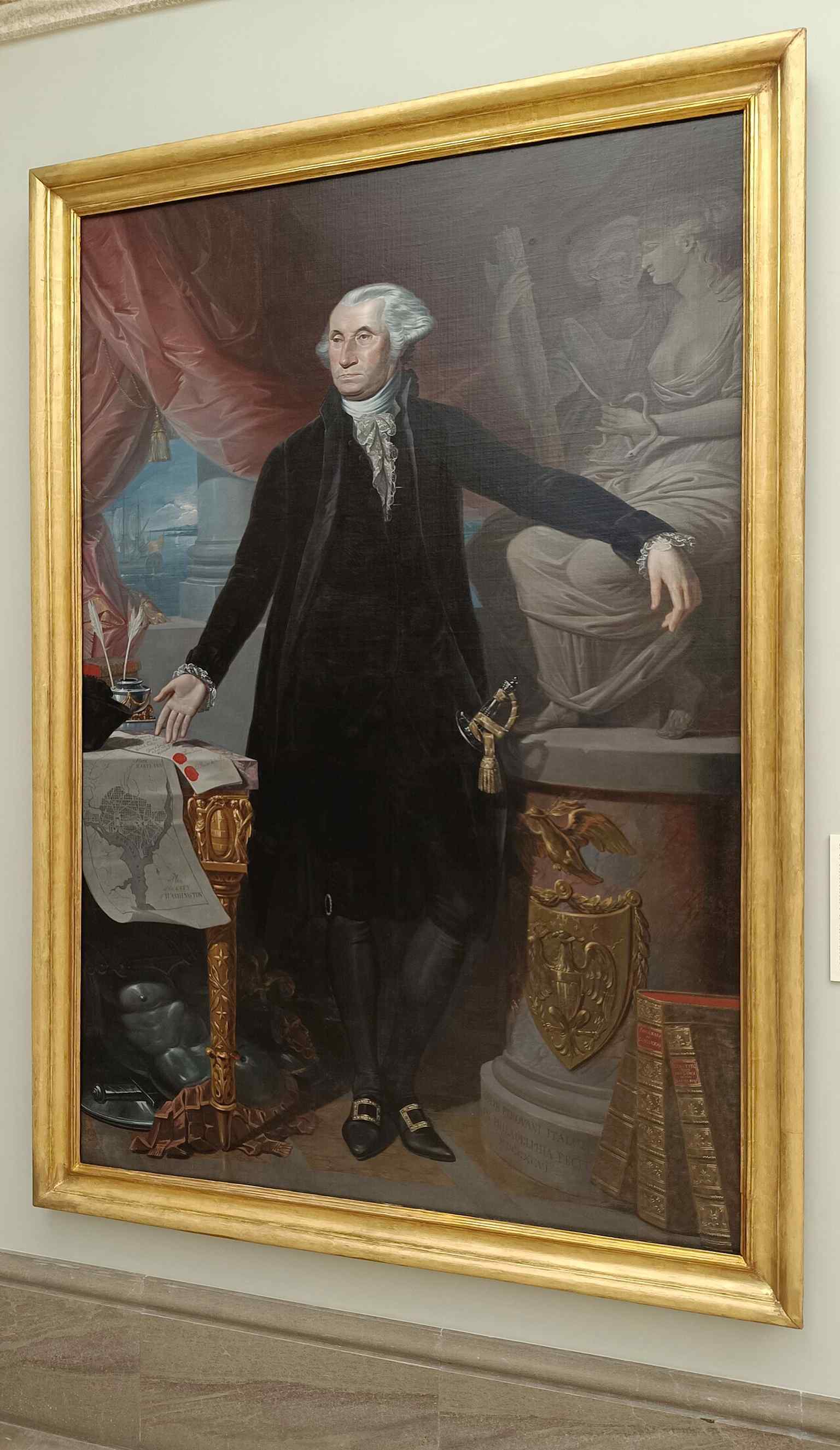
Josef Perovani’s 1796 portrait of George Washington is one of the Academy’s most striking international works.Photo: MaGrc, Wikimedia Commons, CC BY-SA 4.0. Cropped & resized. 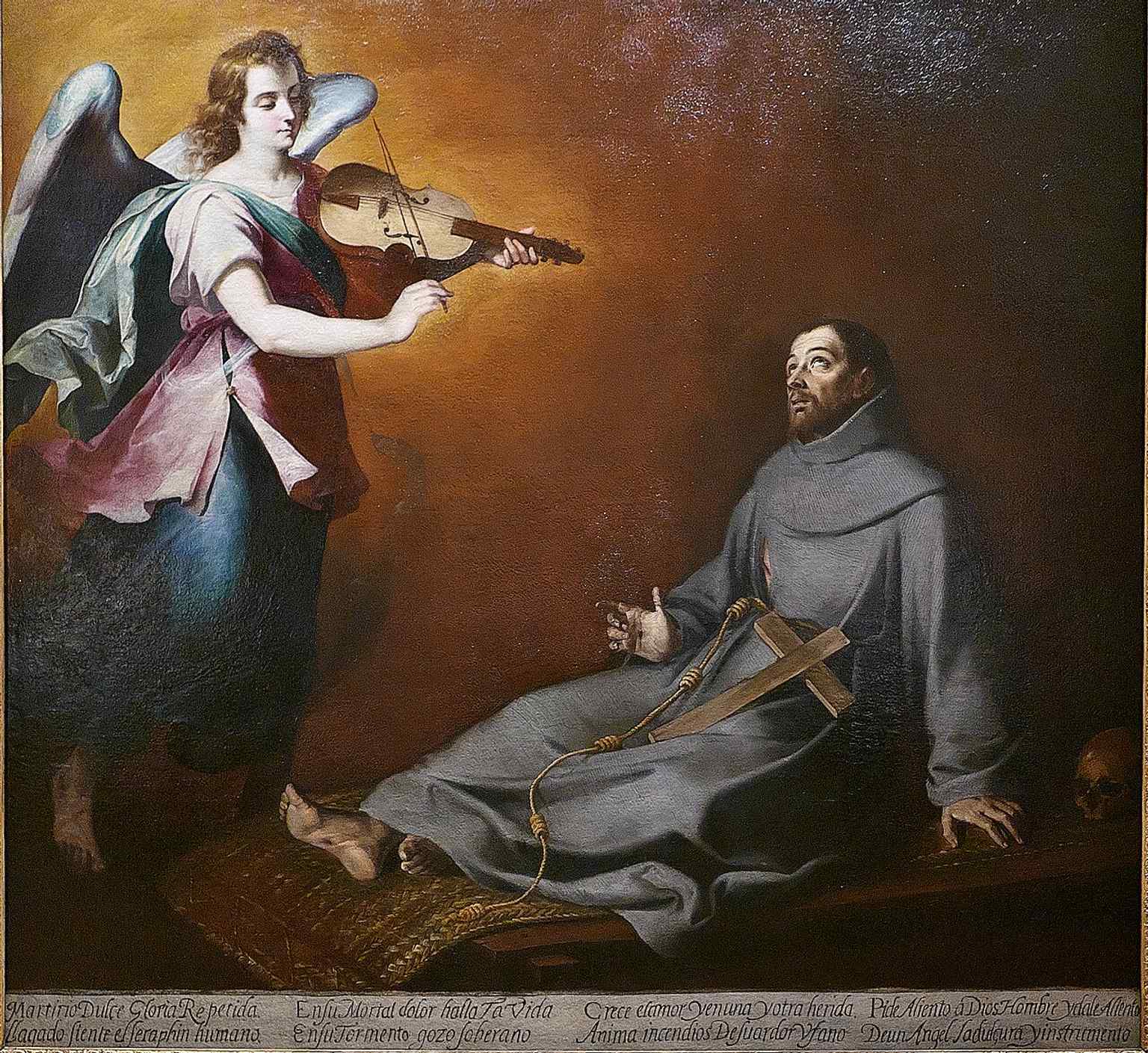
Murillo’s Ecstasy of Saint Francis of Assisi represents the Academy’s rich collection of Spanish religious painting.Photo: José Luis Filpo Cabana, Wikimedia Commons, CC BY-SA 4.0. Cropped & resized. 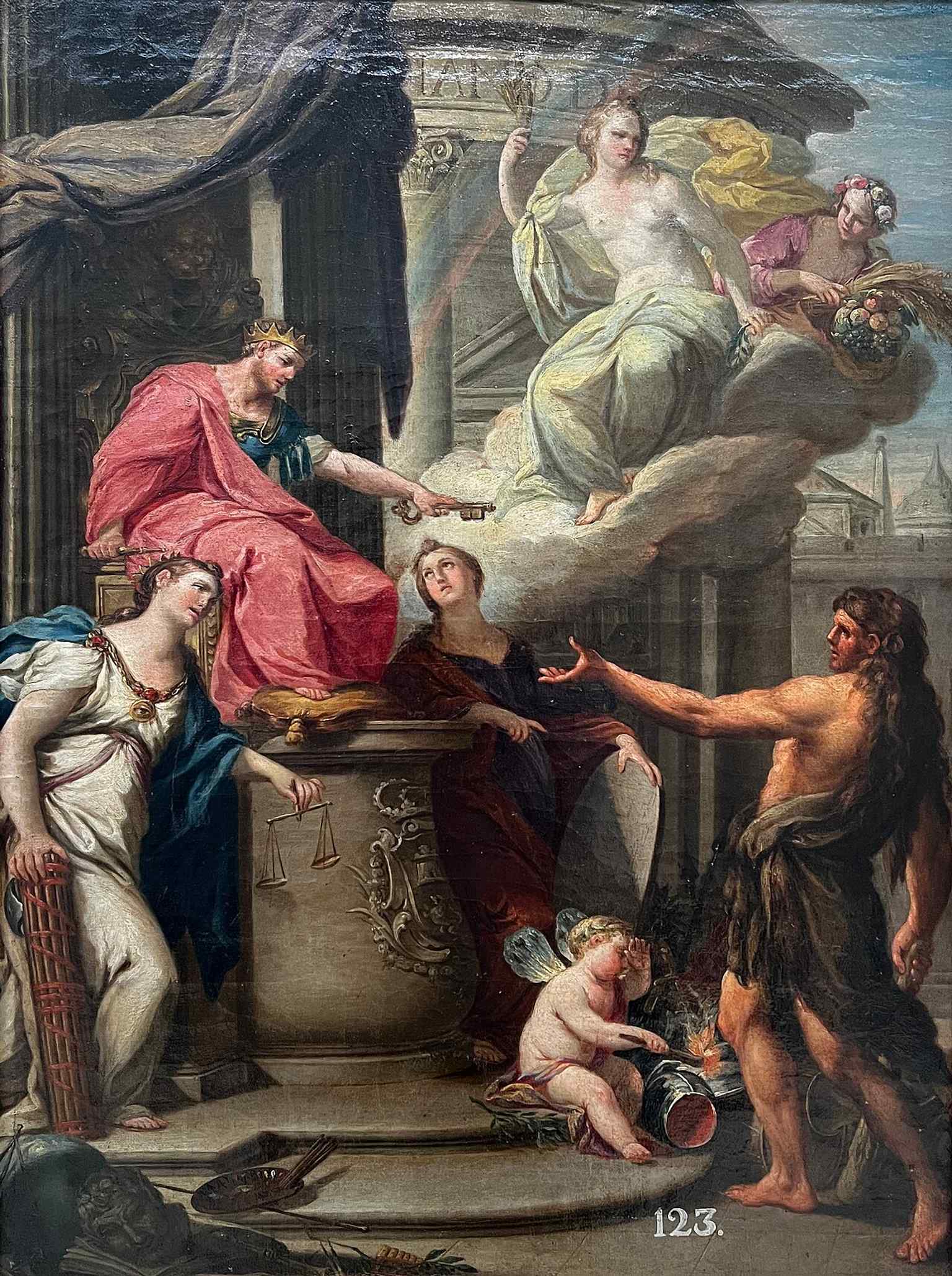
Preciado de la Vega’s Allegory of Peace evokes the Enlightenment ideals that shaped the Academy’s early years.Photo: Francisco Preciado de la Vega (1713-1789), Wikimedia Commons, Public domain. Cropped & resized. On your left rises a white stone corner palace with a rounded tower, a black slate dome, and a gold-winged statue poised high above the traffic. This is the Metropolis Building,…Read moreShow less
Open dedicated page →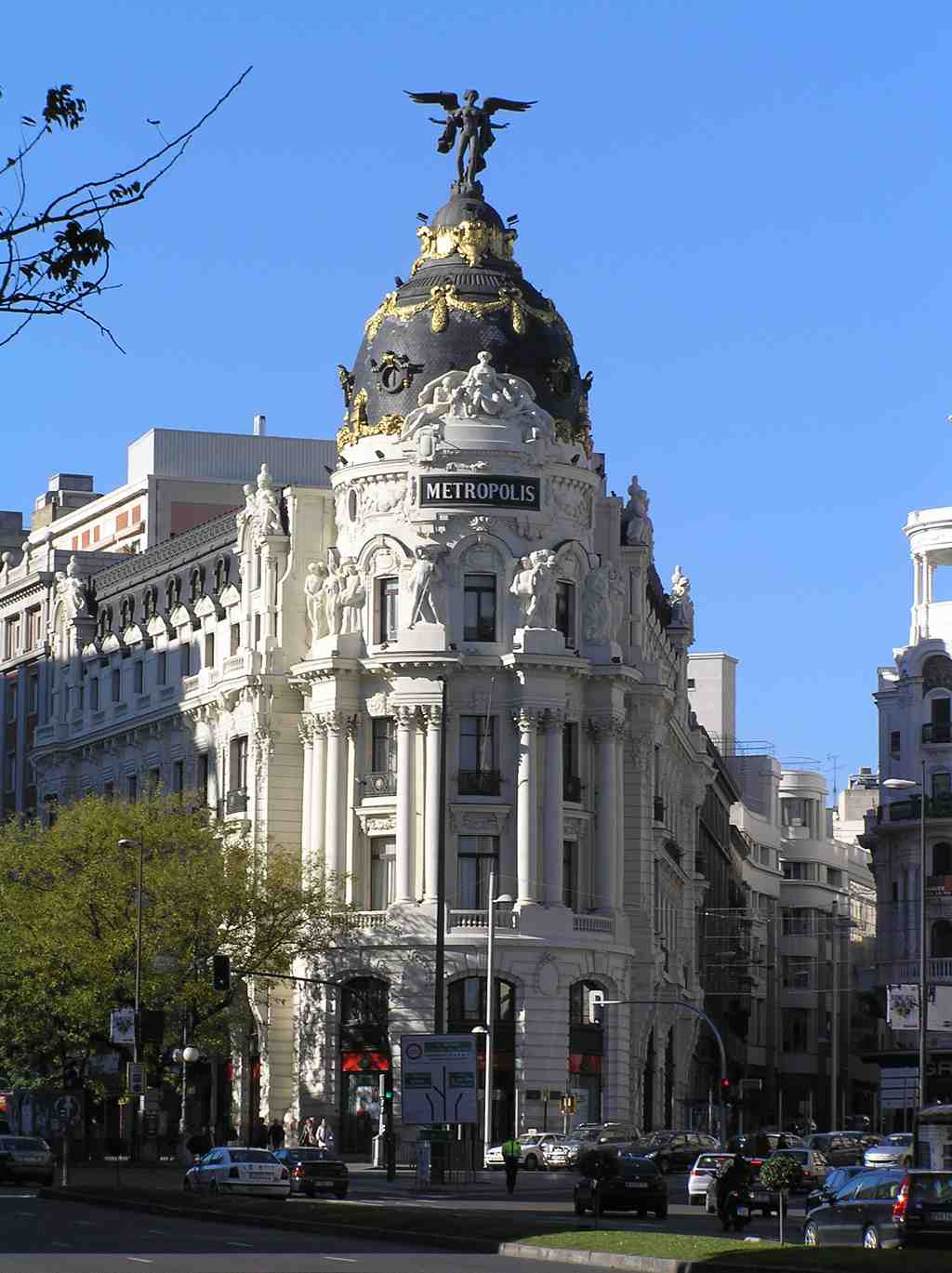
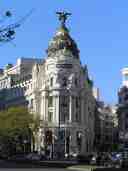
Metropolis BuildingPhoto: Discasto, Wikimedia Commons, CC BY-SA 4.0. Cropped & resized. On your left rises a white stone corner palace with a rounded tower, a black slate dome, and a gold-winged statue poised high above the traffic.
This is the Metropolis Building, and it tells you exactly where Madrid is headed now in our walk: into money, engineering, speed, and a little bit of showmanship. It looks as if Paris sent Madrid a very elegant hatbox... and Madrid said, “Perfect, put it on the busiest corner you’ve got.” The style is French-inspired eclecticism, with neobaroque flourishes, Corinthian columns, and those upper roof levels tucked into mansards - the sloped attic floors you see in old French city palaces.
But here’s the part locals love to point out. For all that ornament, this was one of Madrid’s early reinforced-concrete buildings. The owners wanted modern strength: concrete in the outer supports, floors, and dome meant wider rooms, bigger openings, fewer interior columns, and better fire resistance. Rather fitting for an insurance company that sold fire insurance. After everything this city had already learned from loss and rebuilding, that was not a small concern. The clever bit is that they hid that modern skeleton behind a costume of classical stone and sculpture, so the building could feel respectable, established, almost old-fashioned at first glance.
The story starts with demolition. To create this new urban corner during the making of Gran Vía, Madrid cleared away an earlier building nicknamed the Casa del Ataúd - the Coffin House - because the plot was so narrow. Even then, change did not arrive politely. Neighbors and businesses fought the demolitions in court, and construction could not begin until June of nineteen oh seven. The French architects Jules and Raymond Février won the design competition, but the Spanish architect Luis Esteve Fernández-Caballero carried the project through on site and finished it in nineteen ten. The building opened on the twenty-first of January, nineteen eleven.
Look up at the figures along the facade. Commerce, Agriculture, Industry, and Mining stand there like a stone balance sheet of the age. If you want a closer look at the sculptural program and that handsome contrast between pale stone, dark slate, and bronze railings, glance at the image on your screen.
Now lift your eyes to the dome. That black slate cap with gold details is often called Pompier style - “firefighter” in French - because it resembles an old French fireman’s helmet. Originally, the top carried La Unión y el Fénix, the first owner’s emblem: a phoenix with a human figure by René de Saint-Marceaux. When the Metrópolis insurance company took over in nineteen seventy-five, they replaced it with the winged Victory you see now, by Federico Coullaut-Valera. The old phoenix did not vanish; it moved to Paseo de la Castellana. Madrid rarely throws away its symbols... it just reassigns them.
One more layer: restorers cleaned the soot and pigeon stains, re-gilded the dome, and even tracked down the original stained-glass makers, Maumejean. If you check the restoration photo in the app, you can see how much care that glittering crown demands. Recently, the inside has entered yet another chapter, mixing private and hospitality uses.
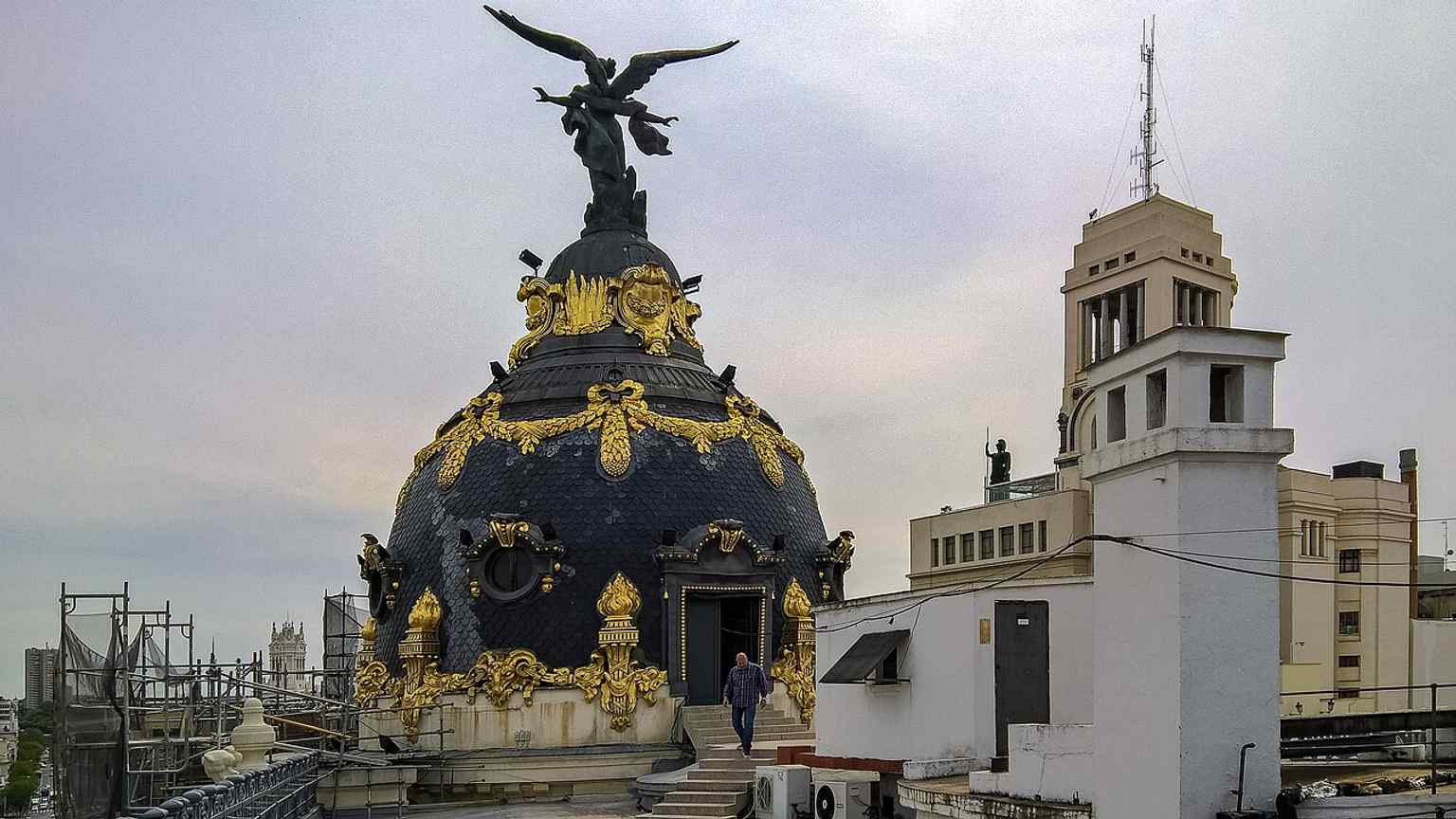
The dome during restoration in 2016, when scaffolding revealed the care needed to re-gild and clean the building’s most iconic feature.Photo: Pedro Seoane Prado, Wikimedia Commons, CC BY-SA 4.0. Cropped & resized. Most people say Gran Vía begins here, but technically this address is Alcalá thirty-nine; Gran Vía number one is the Grassy building. That’s Madrid for you: even its starting lines have a flourish.
When you’re ready, head on toward Cibeles Square, about seven minutes away, where beauty, traffic, and civic pride all shake hands in the middle of the street. You can admire this exterior at any hour, since the site is always accessible from outside.
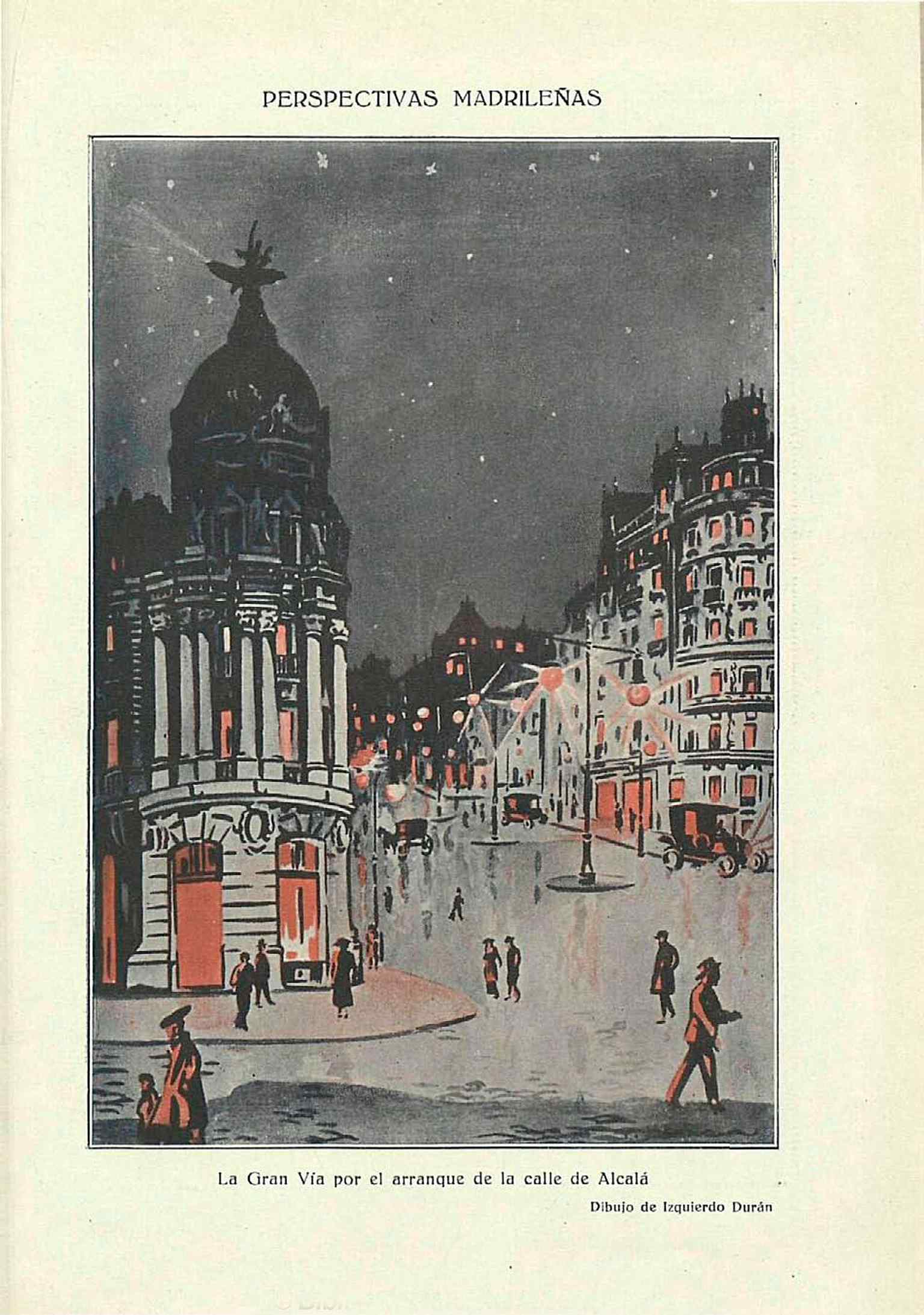
An early 1917 illustration of the Gran Vía starting at Alcalá, valuable for understanding the building’s role in the new avenue’s urban composition.Photo: José Izquierdo Durán, Wikimedia Commons, Public domain. Cropped & resized. On your left, Cibeles Square opens as a broad circular junction of pale stone, centered on a white marble fountain where a seated goddess rides a chariot pulled by two lions, with…Read moreShow less
Open dedicated page →On your left, Cibeles Square opens as a broad circular junction of pale stone, centered on a white marble fountain where a seated goddess rides a chariot pulled by two lions, with the ornate white Palace of Cibeles rising behind.
This is the place where Madrid presents itself to the world. Sol may measure the nation from Kilometer Zero, but Cibeles is the city’s grand portrait... myth in the middle, power on every corner, and a whole lot of symbolism arranged with almost theatrical confidence. And yes, the traffic helps with the drama.
At the center sits the fountain of Cibeles, created in seventeen eighty-two for the great urban project called the Salón del Prado, when King Carlos the Third tried to turn this edge of Madrid into a refined public promenade of gardens, fountains, science, and culture. Architect Ventura Rodríguez designed it. Sculptor Francisco Gutiérrez Arribas carved the goddess and her chariot, while Roberto de Michel shaped the lions. The goddess is Cybele, an ancient mother figure linked by the Greeks to Rhea. Madrid gave itself not a warrior, not a king, but a goddess in motion. That tells you something.
She did not start here, though. For more than a century, the fountain stood nearer the Buenavista Palace and faced Neptune down the Prado axis, like two mythological neighbors nodding across the city. Back then, Cibeles also served a practical job: people drew water here. In eighteen ninety-five, city planners moved the whole ensemble into the center of this crossroads, set it on steps, added two little cherubs at the back, and turned a useful fountain into an emblem. If you peek at the historical image on your screen, you can see her before the modern square fully closed around her.
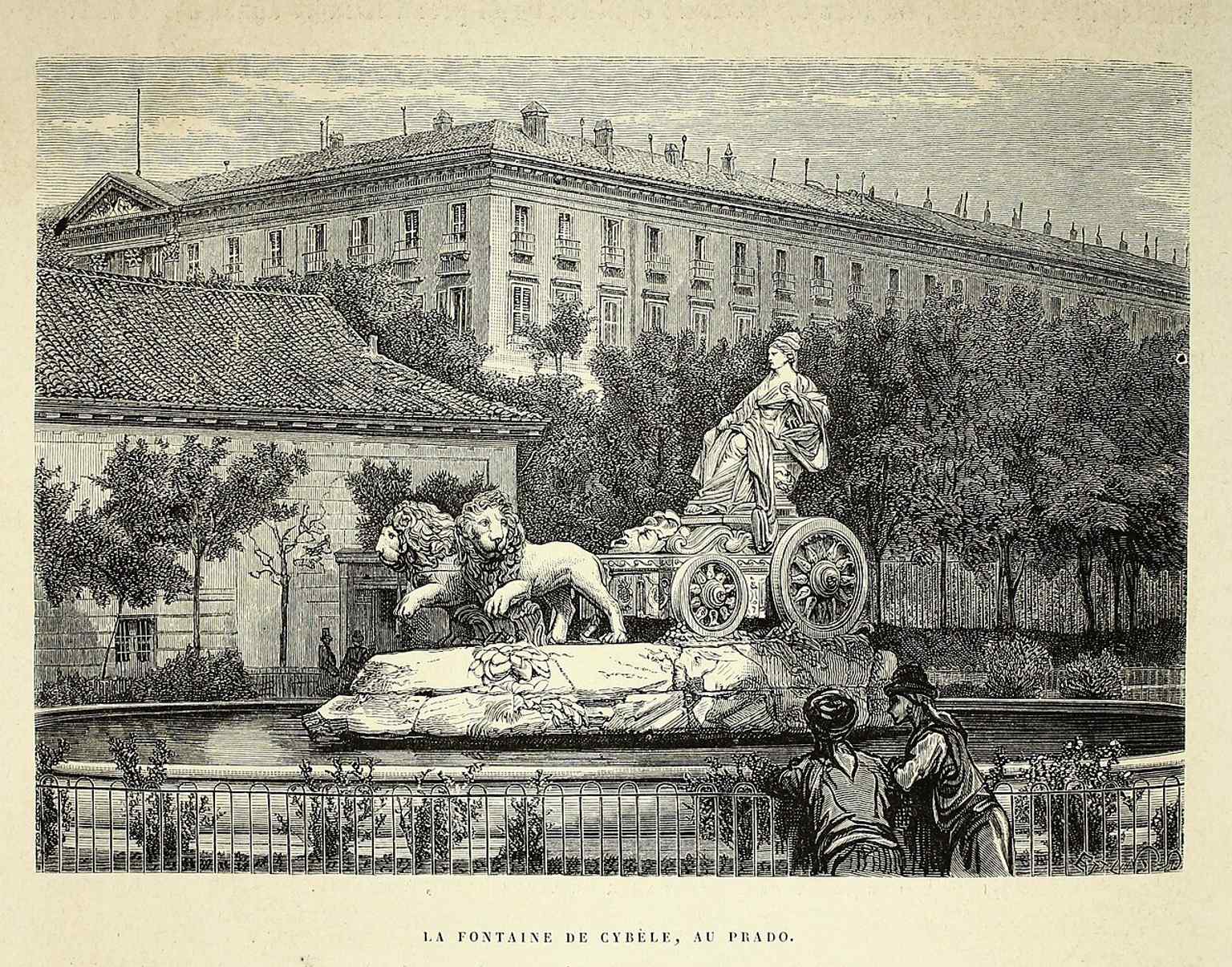
Gustave Doré’s 1874 illustration shows the fountain in its earlier urban setting, when Cibeles was still part of the Prado promenade.Photo: Gustave Doré, Wikimedia Commons, Public domain. Cropped & resized. Now notice the ring of institutions. To the northwest sits Buenavista Palace, the oldest corner, from seventeen seventy-seven, now the Army headquarters. To the southwest, the Banco de España, opened in eighteen ninety-one, gives the square financial muscle. Across from it, the Palacio de Linares became Casa de América, layering diplomacy onto old aristocratic splendor... with a side order of ghost stories in the nineteen nineties. Madrid does enjoy good upholstery and a better rumor.
And then there is the giant stage-set behind the fountain: the former Palace of Communications, opened in nineteen seventeen after Antonio Palacios and Julián Otamendi pushed its design into being. That soaring white mass, with its tower climbing more than sixty meters, first served mail, telegraph, and telephone. Since two thousand and seven, it has housed City Hall, so the building now speaks for Madrid in the most literal way possible.
That is why so much public life ends up here. In nineteen thirty-one, crowds celebrated the proclamation of the Second Republic when its flag rose on that facade. Atlético supporters gathered here after the nineteen sixty-one to sixty-two Cup Winners’ Cup. Real Madrid later made Cibeles their near-obligatory victory stop in the late nineteen eighties. Protest marches converge here. The Three Kings parade ends here. Even sheep cross the square during the Fiesta de la Trashumancia, reviving the old livestock routes through Madrid. Take a glance at the aerial view in the app and you’ll see the trick: this is less a square than a civic amphitheater built inside a roundabout.
Now let’s glide south toward Neptune, where another Enlightenment fountain reminds us that urban beauty here was never just decoration... it was policy in stone.
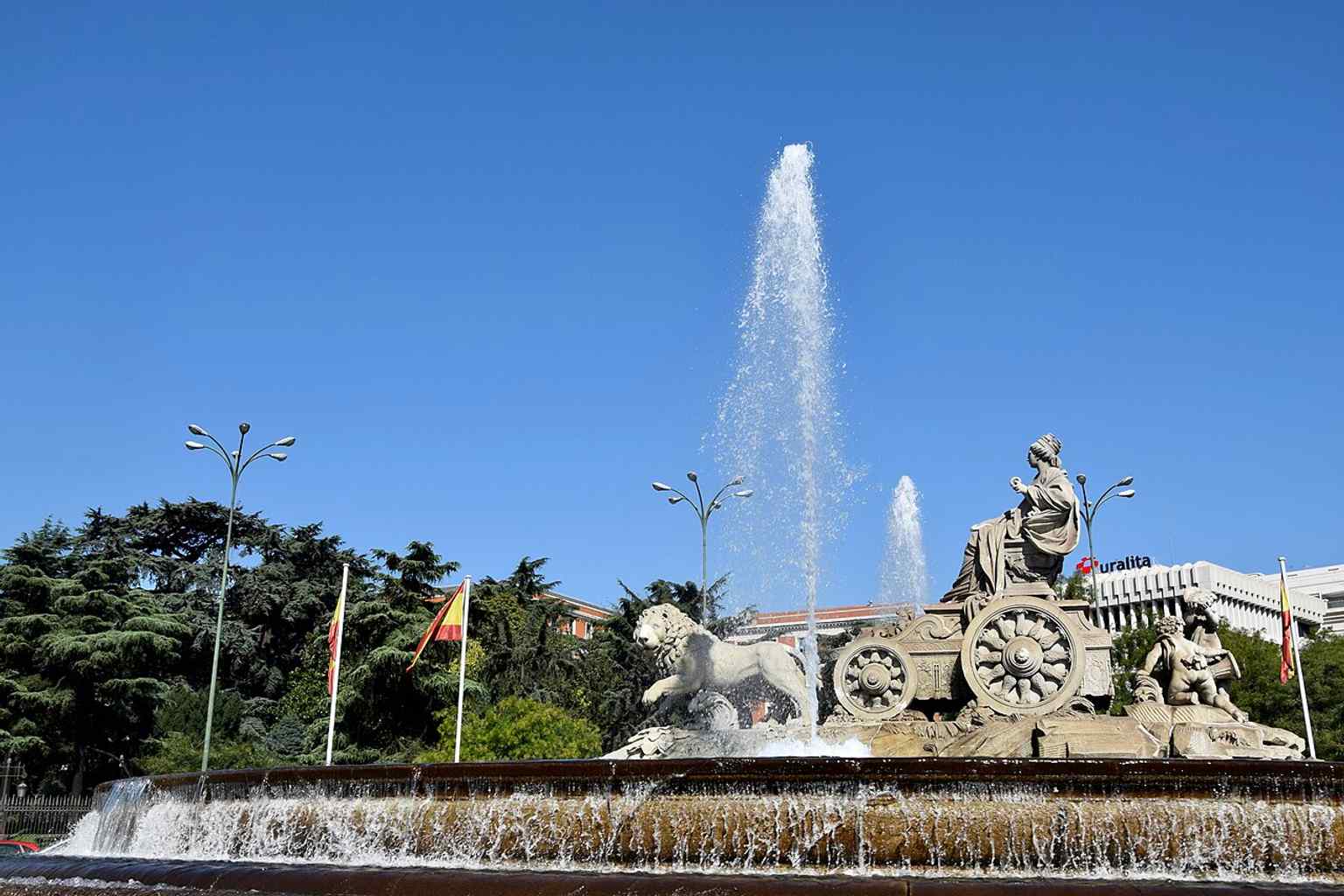
A close view of the Cybele statue itself, sculpted by Francisco Gutiérrez in 1782 as part of Ventura Rodríguez’s design.Photo: Ank Kumar, Wikimedia Commons, CC BY-SA 4.0. Cropped & resized. 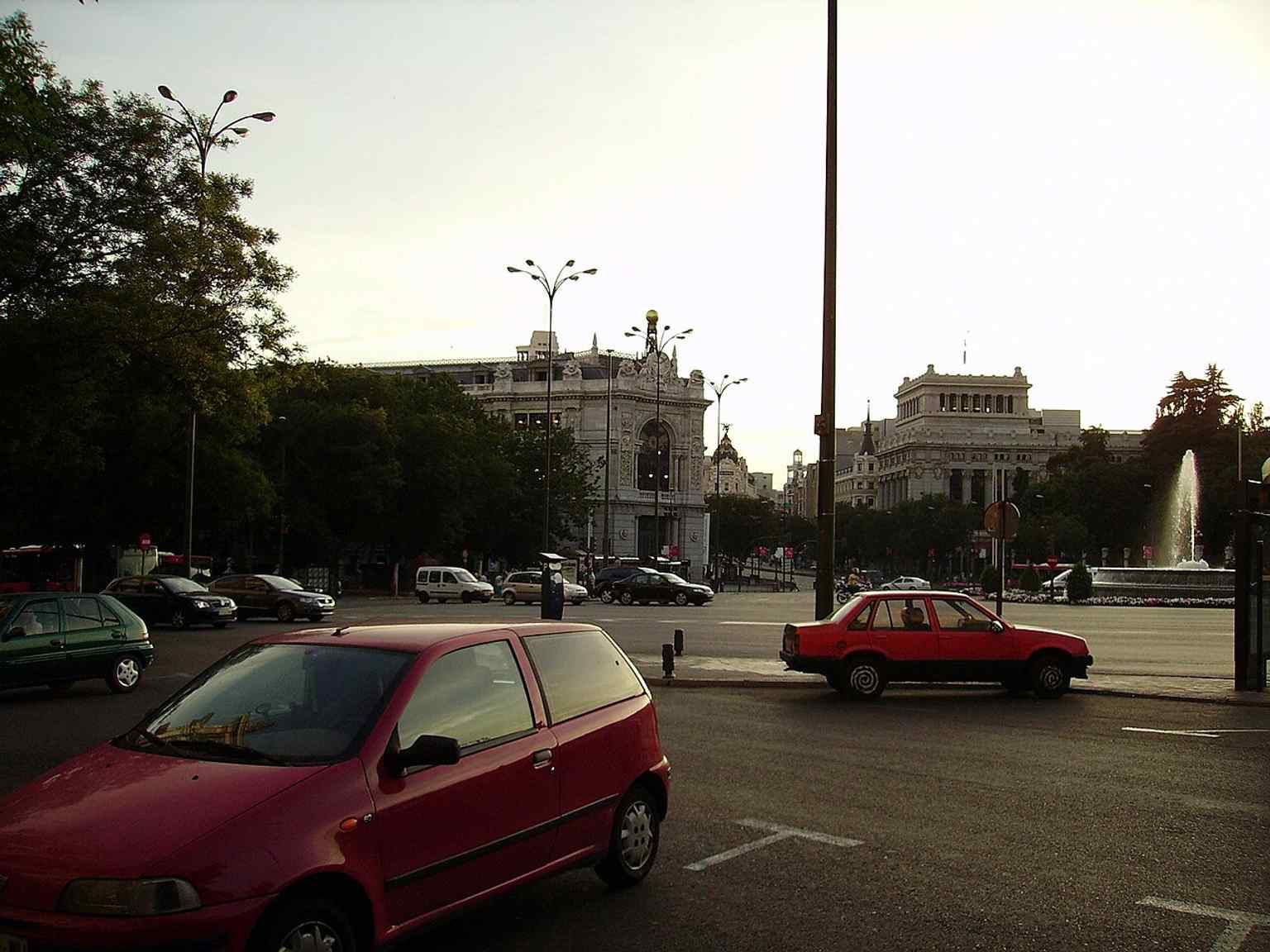
The Banco de España, which closes the southwest corner of Cibeles Square and helped define the modern plaza after the fountain’s relocation.Photo: Ricardo Ricote Rodrí…, Wikimedia Commons, CC BY 3.0. Cropped & resized. 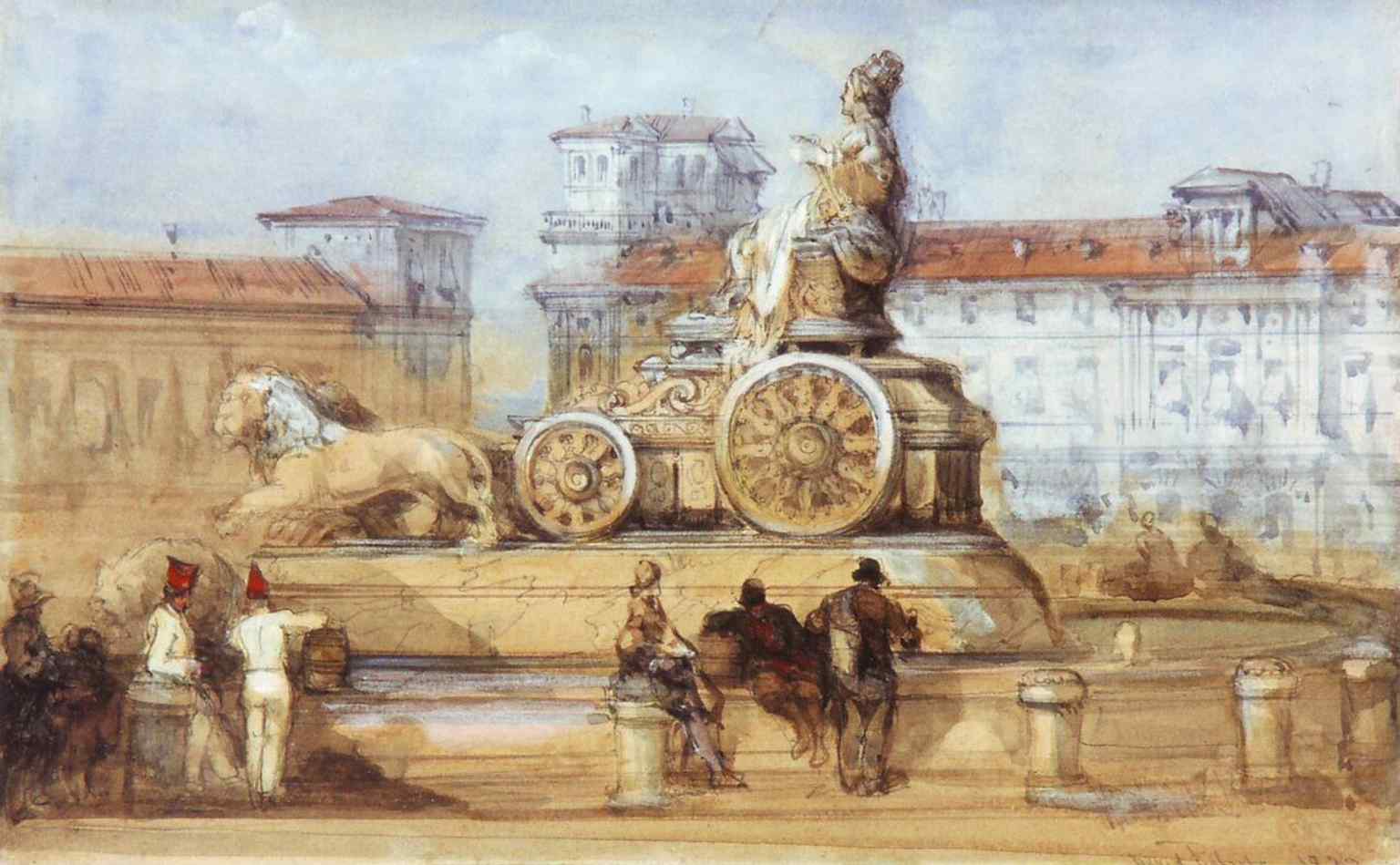
David Roberts’s romantic view of Cibeles captures the square before its later monumental surroundings were fully built.Photo: David Roberts, Wikimedia Commons, Public domain. Cropped & resized. 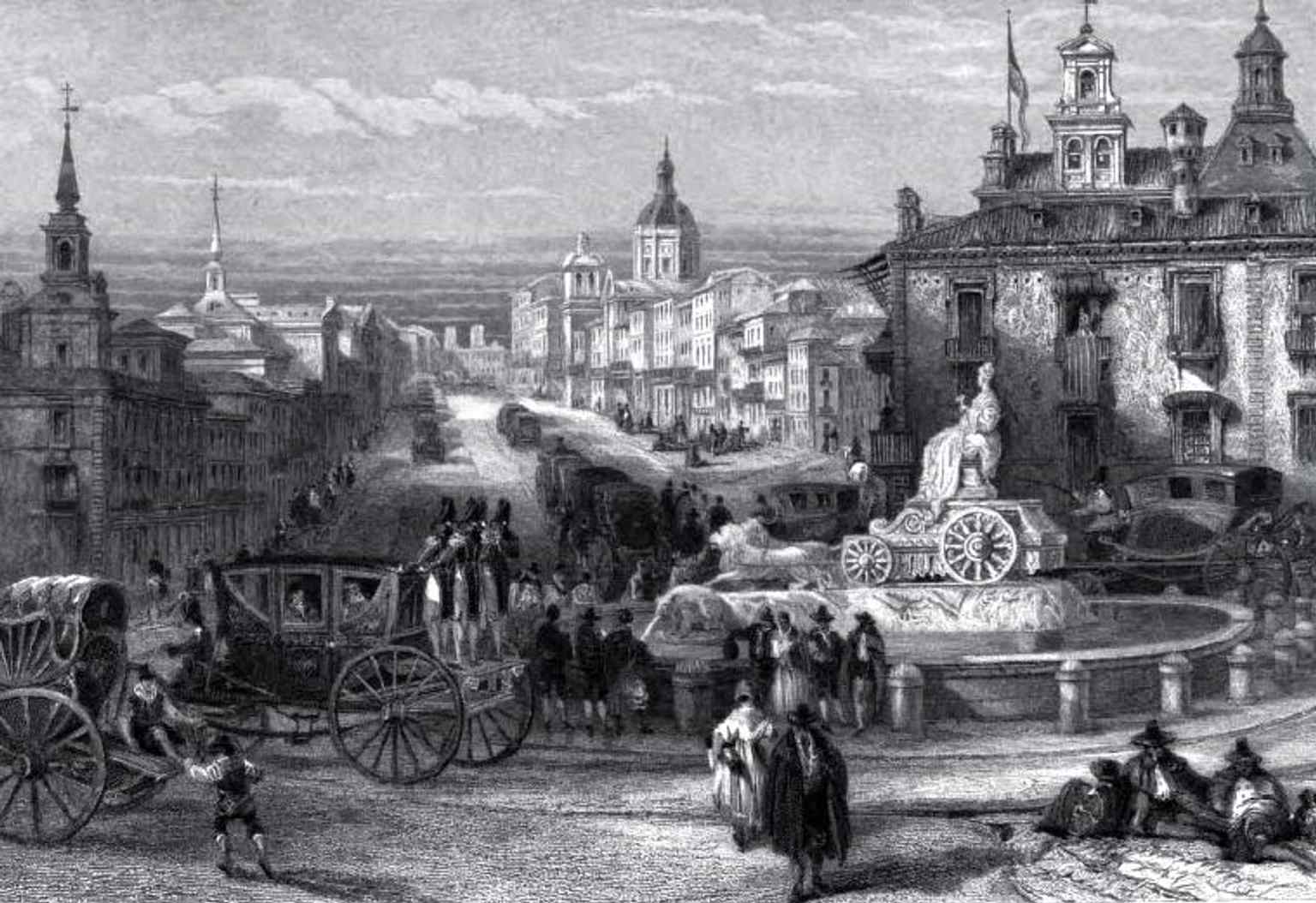
An 1832 engraving of Cibeles and Alcalá Street, showing the area before the square became the formal roundabout we know today.Photo: David Roberts, Wikimedia Commons, Public domain. Cropped & resized. 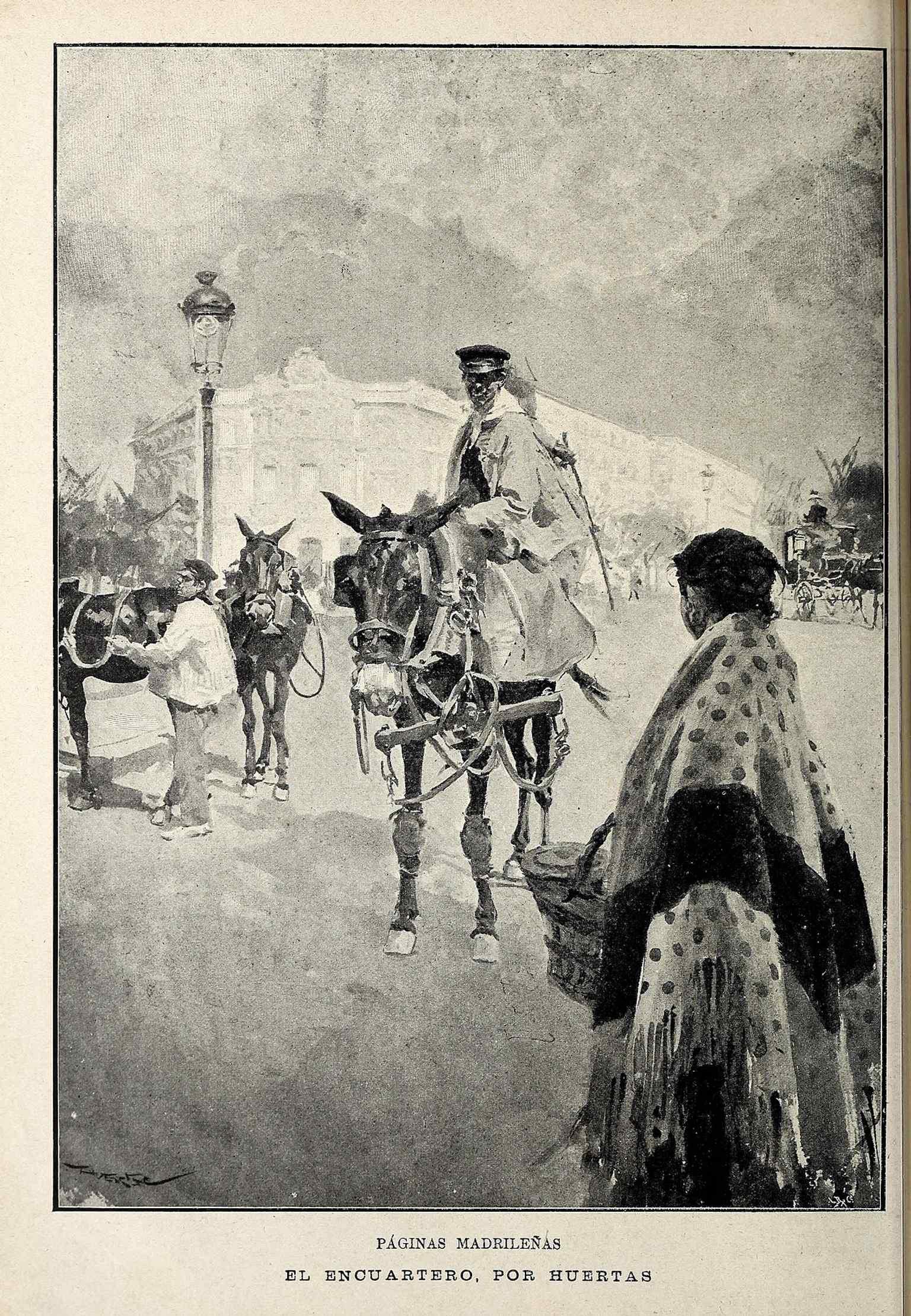
A 1898 print linked to the Palacio de Linares, one of the four corner palaces that frame the square.Photo: Ángel Díaz Huertas, Wikimedia Commons, Public domain. Cropped & resized. 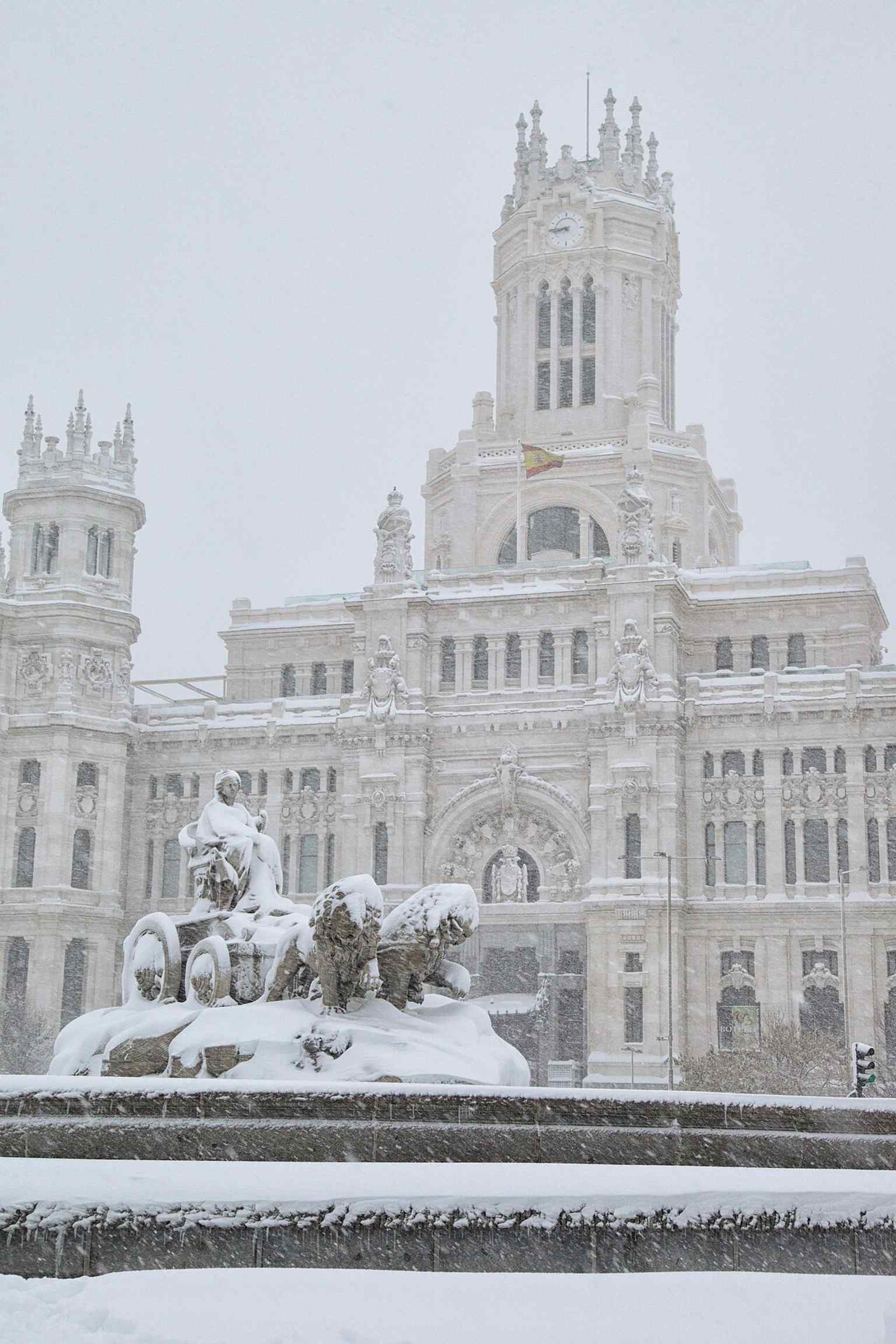
The square under Filomena snow in 2021 — an unusual winter scene around the fountain and the Palace of Cibeles.Photo: Javier Pérez Montes, Wikimedia Commons, CC BY-SA 4.0. Cropped & resized. 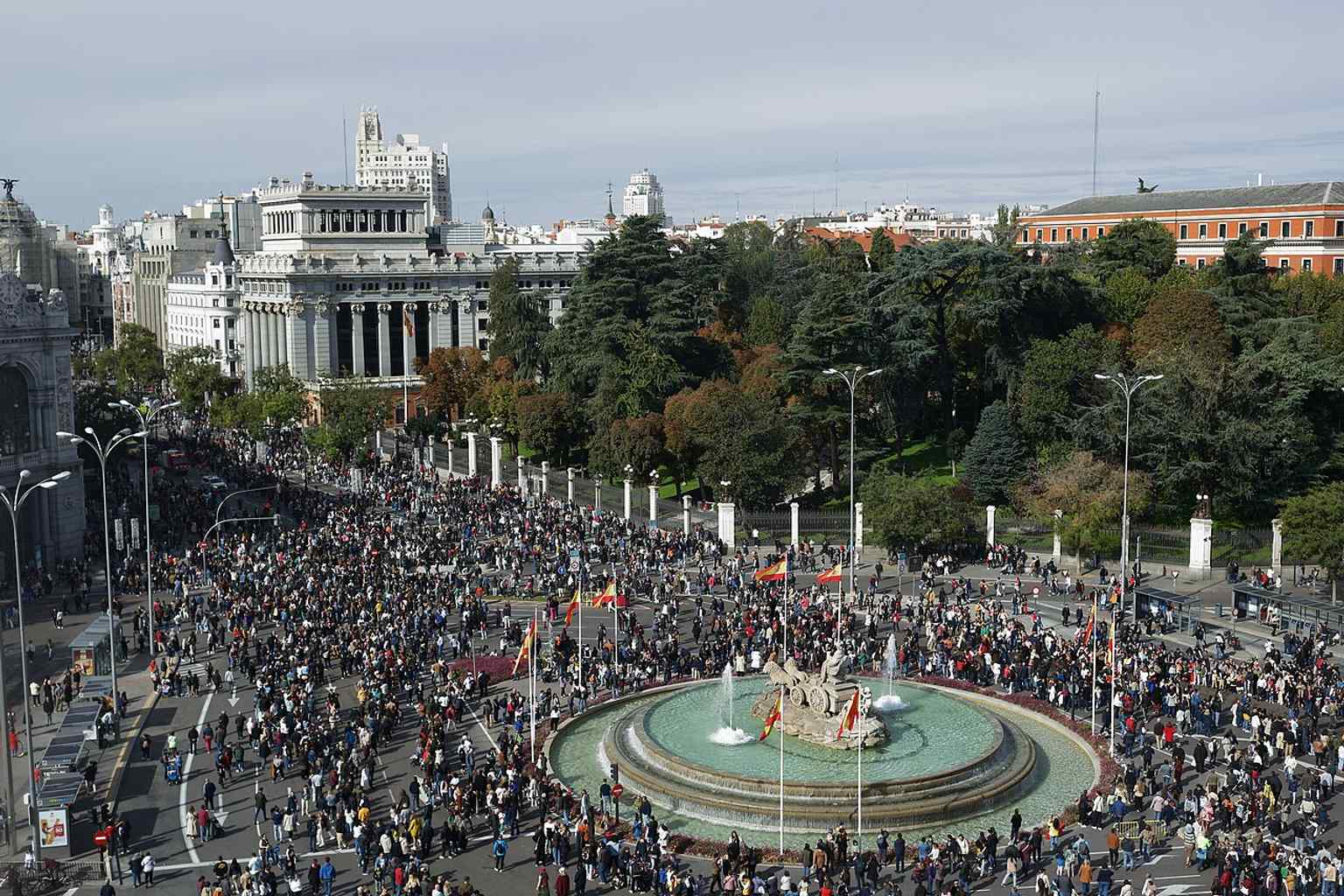
Trashumance day in Cibeles, when a herd passes through the plaza and revives Madrid’s old livestock routes.Photo: Javier Perez Montes, Wikimedia Commons, CC BY-SA 4.0. Cropped & resized. 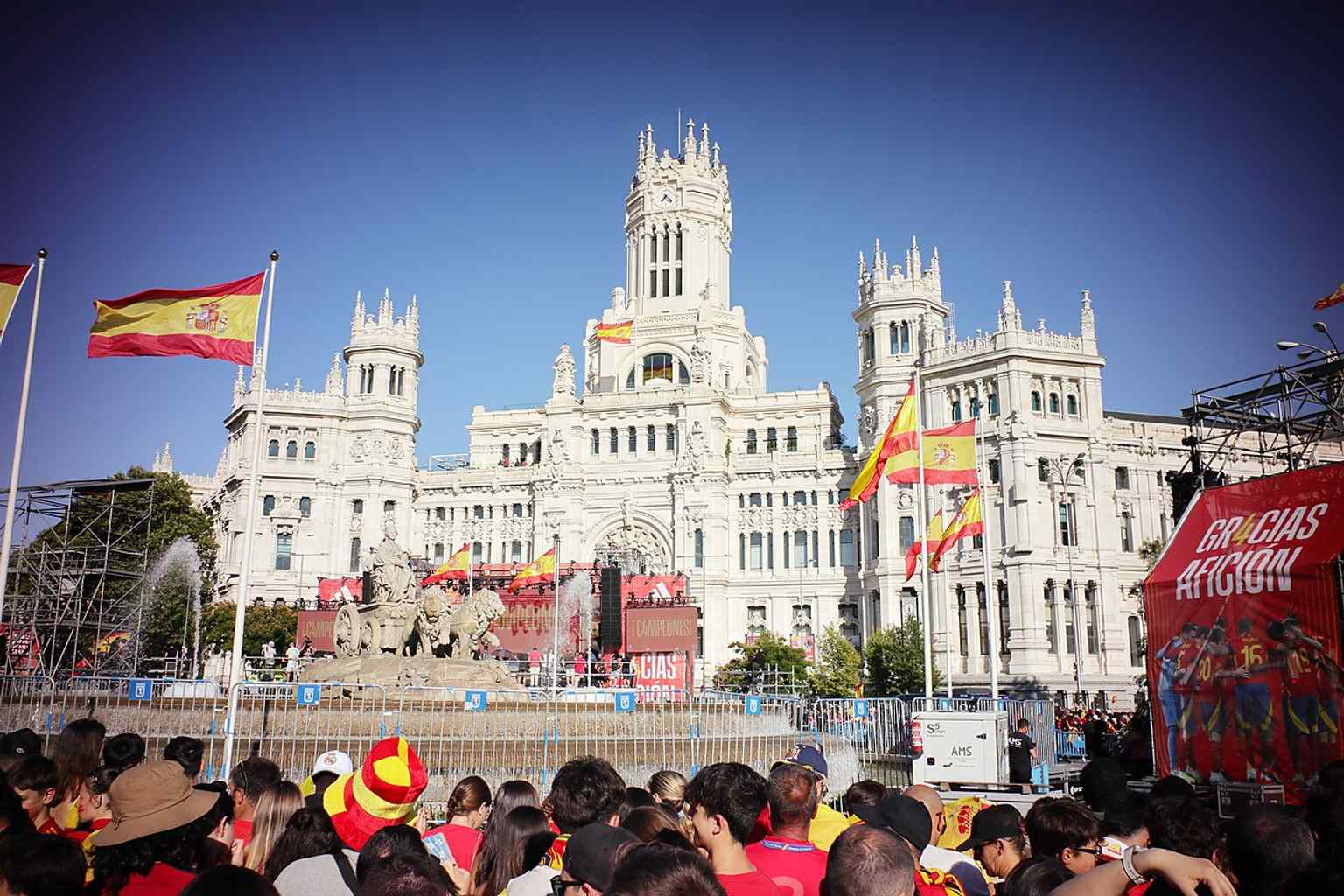
A celebration crowd filling Cibeles in 2024, echoing the square’s long role as Madrid’s favorite place for sporting victories.Photo: Javier Perez Montes, Wikimedia Commons, CC BY-SA 4.0. Cropped & resized. In front of you is a white marble fountain set in a broad circular basin, crowned by a muscular sea god standing on a shell-shaped chariot, with two fish-tailed sea horses as his…Read moreShow less
Open dedicated page →In front of you is a white marble fountain set in a broad circular basin, crowned by a muscular sea god standing on a shell-shaped chariot, with two fish-tailed sea horses as his unmistakable marker.
This is Neptune... calm, balanced, and very deliberate, like Madrid dressing up for company. In the late seventeen hundreds, King Charles the Third wanted his capital to look like it belonged in the same conversation as Paris and Saint Petersburg. So he pushed a grand makeover of the city, and this fountain became part of that plan: not just decoration, but a statement that Madrid could think big, build beautifully, and put its power on display in public.
The architect Ventura Rodríguez drew the whole ensemble in seventeen seventy-seven as part of the planned Salón del Prado, a formal urban promenade lined with major monuments. He did not work alone. Miguel Ximénez shaped wooden models for the design, and Juan Pascual de Mena took on the main sculpture in white marble from Montesclaros, near Toledo. Here’s the human wrinkle in the stone: Mena began carving in seventeen eighty-two, but he died in seventeen eighty-four after finishing only Neptune himself. His pupil José Arias, along with José Rodríguez, Pablo de la Cerda, and José Guerra, carried the rest forward. So what looks perfectly unified from here is actually a team effort... several hands chasing one enlightened idea.
Look at the figure in the center. Neptune stands upright in his sea chariot, a shell pulled by two hippocamps, which are mythical sea horses with fish tails instead of hind legs. Around them, seals and dolphins send water upward. The original program gave him a snake in one hand and a trident in the other, though by eighteen fourteen the trident had already disappeared. Madrid, even in marble, has never been entirely safe from wear, mishap, or a little mischief.
If you want a closer look at the carving, glance at the detail image on your screen; it makes the stone texture and Neptune’s pose much easier to read.
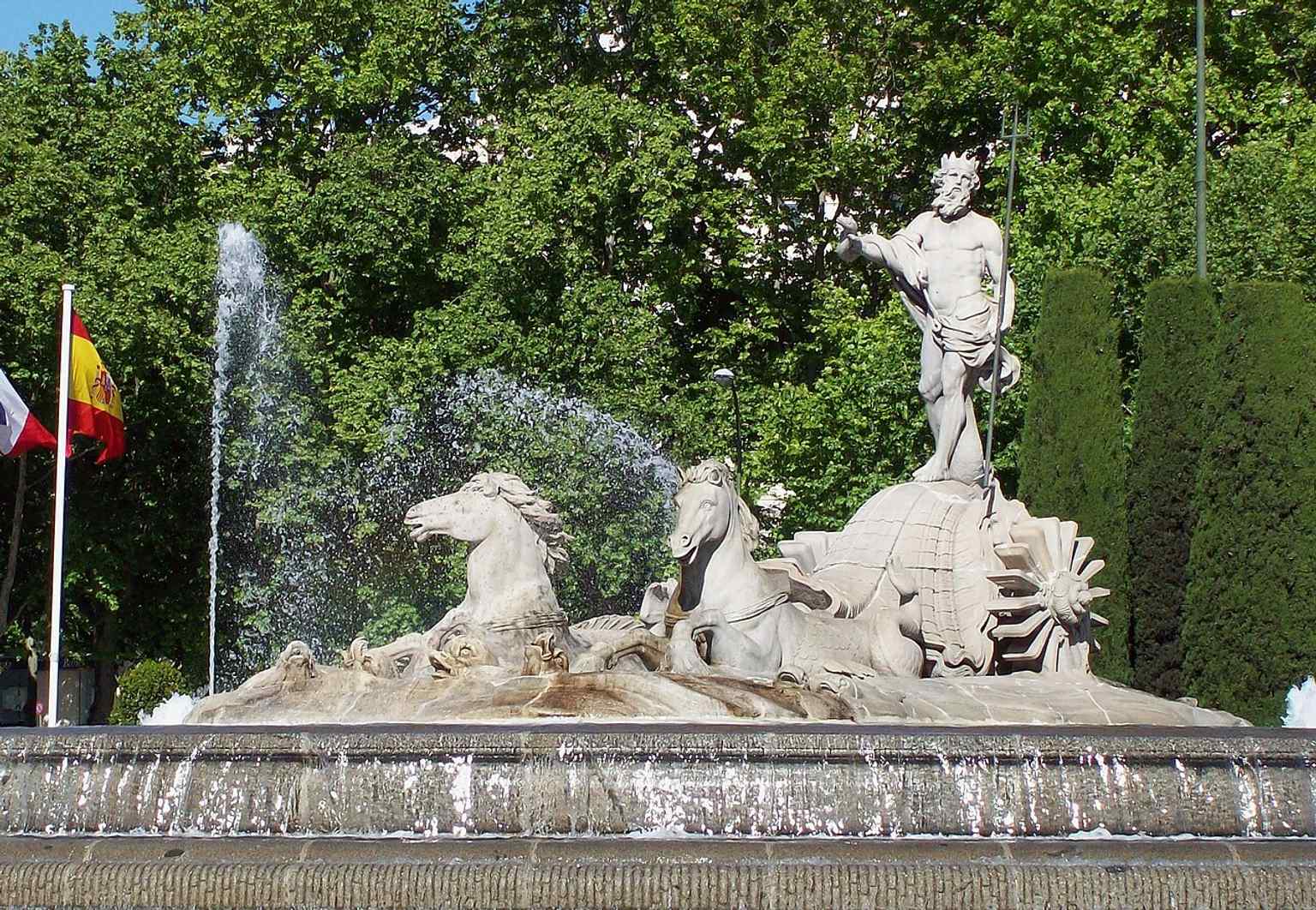
A close, clear view of the marble sculpture, letting you read the god’s pose and the carriage group carved around him.Photo: Photograph: Luis García (Zaqarbal), Wikimedia Commons, CC BY-SA 3.0. Cropped & resized. This fountain did not always stand here. It first stood farther up, on the slope of the Carrera de San Jerónimo, where Neptune visually faced Cibeles and joined Apollo in a kind of mythological conversation across the Prado. Then, in eighteen ninety-eight, the city moved him to the center of this roundabout. Practical city planning won that round, but the original choreography changed. If you like, check the before-and-after image in the app; it shows how a quieter early twentieth-century view turned into today’s busy traffic circle while Neptune stayed put at the center.
And he has kept gathering meanings. In the eighteen forties, registered water carriers filled their jars here. During the Civil War, workers shielded Neptune with bricks against bombardment. In hard times, Madrileños even hung a sign on him that joked, “Feed me or take away my fork.” Dry humor... very local. Since nineteen ninety-one, Atlético de Madrid fans have claimed this spot for victory celebrations, turning enlightened marble into living ritual.
That may be Neptune’s real gift to Madrid: he started as a royal vision of order, and he ended up belonging to everybody.
Ahead, the story narrows from public monument to painted memory. Walk about five minutes to the Prado Museum, where the city gathers its image of itself indoors at last. And one practical note: this fountain sits out here all day, every day, so you can always circle back for another look.
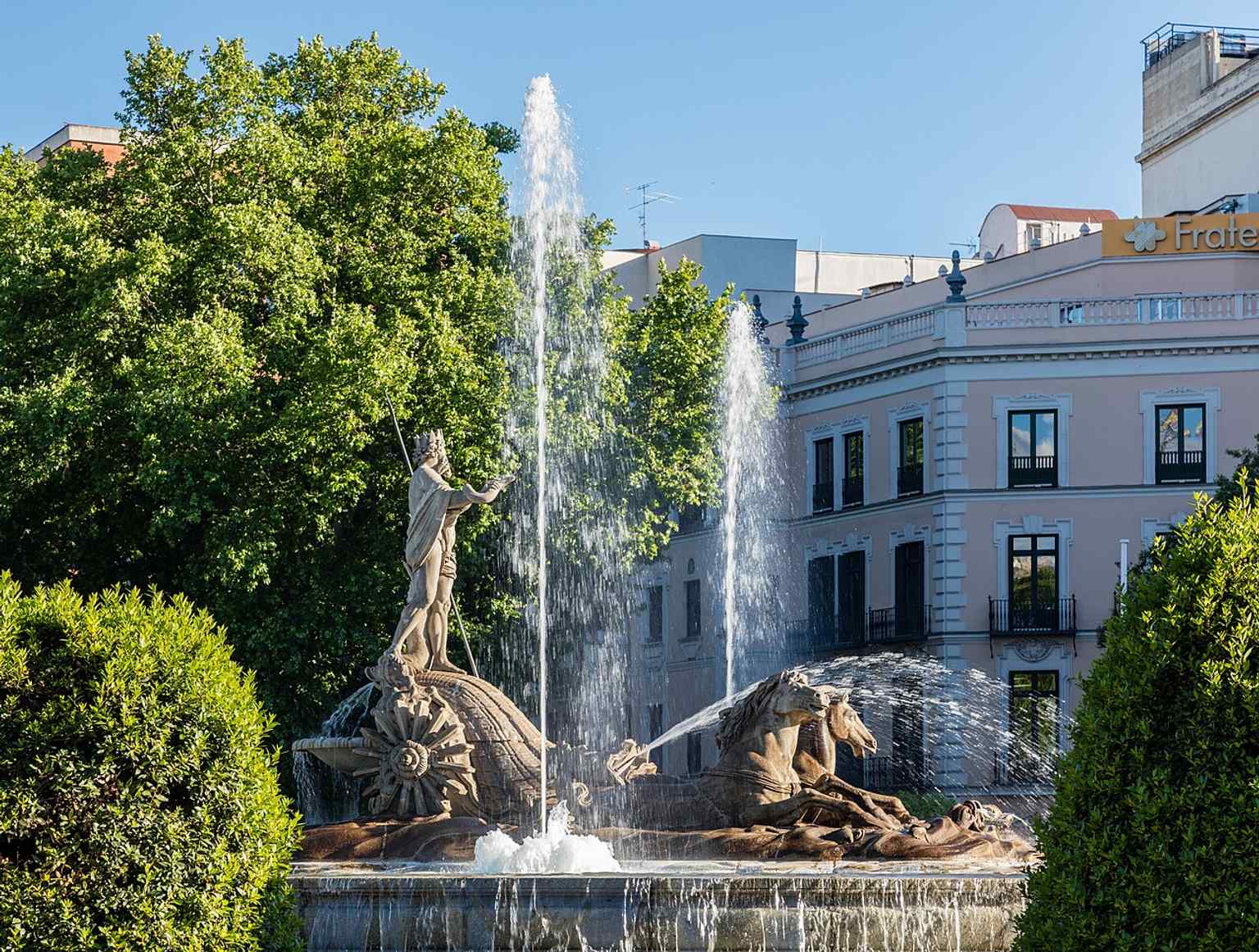
A crisp daylight view of the fountain in Plaza de Cánovas del Castillo, where Neptuno was relocated in 1898.Photo: Diego Delso, Wikimedia Commons, CC BY-SA 4.0. Cropped & resized. 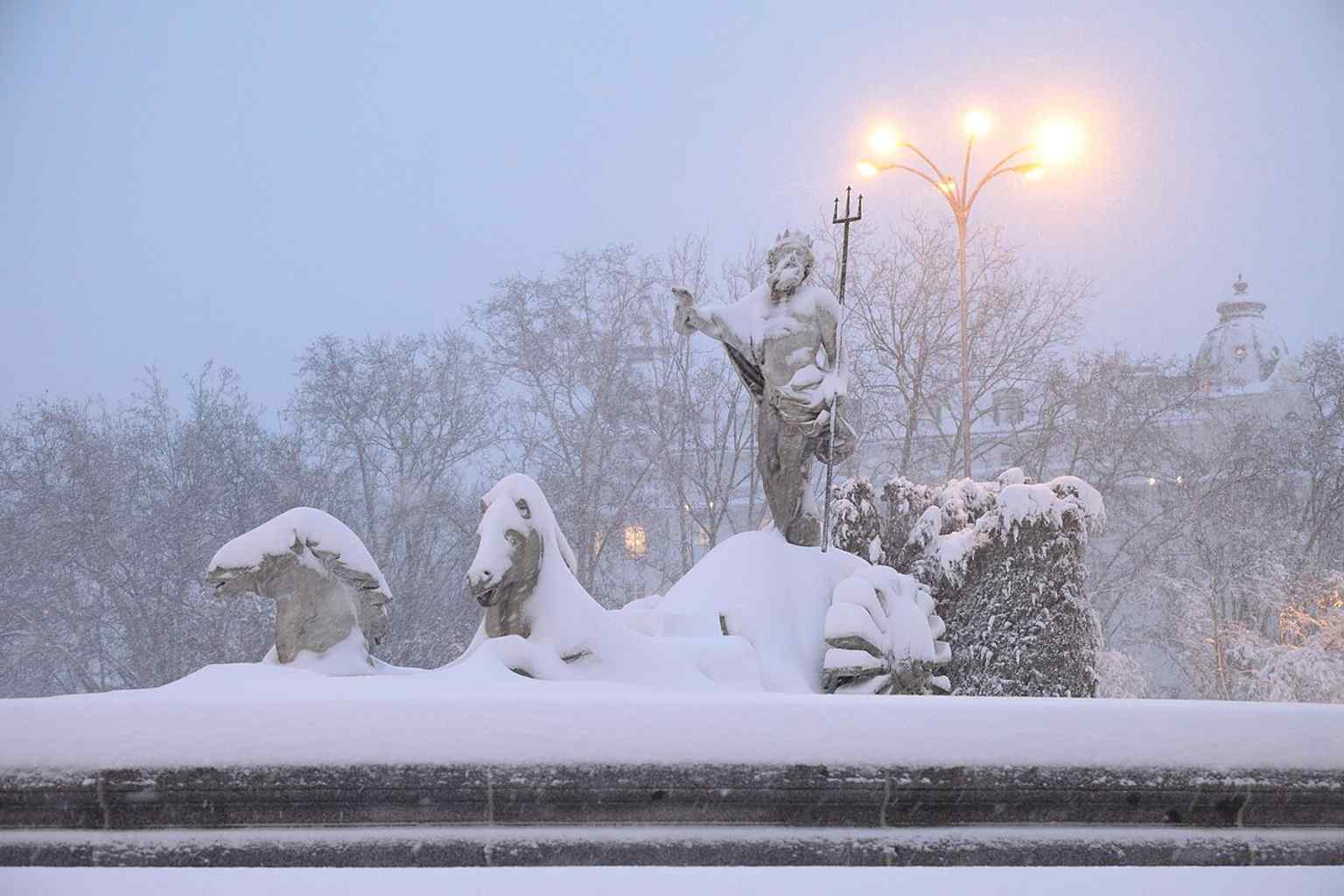
Neptuno under snow during Storm Filomena in 2021 — a dramatic modern scene that transforms the fountain into a city landmark in winter.Photo: Javier Pérez Montes, Wikimedia Commons, CC BY-SA 4.0. Cropped & resized. 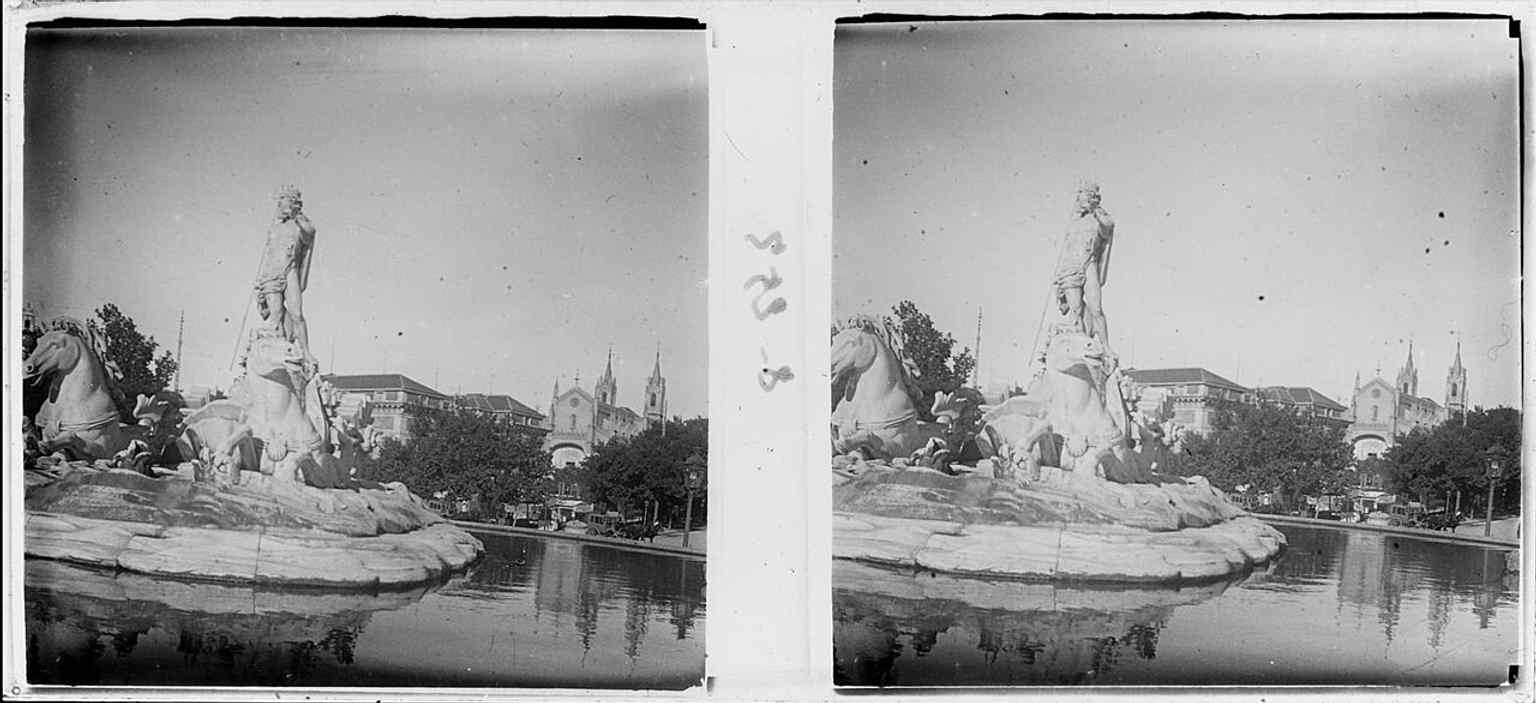
An early 20th-century photograph of the sculptural ensemble, offering a rare historical look at Neptuno before modern traffic and signage.Photo: Josep Salvany i Blanch, Wikimedia Commons, Public domain. Cropped & resized. 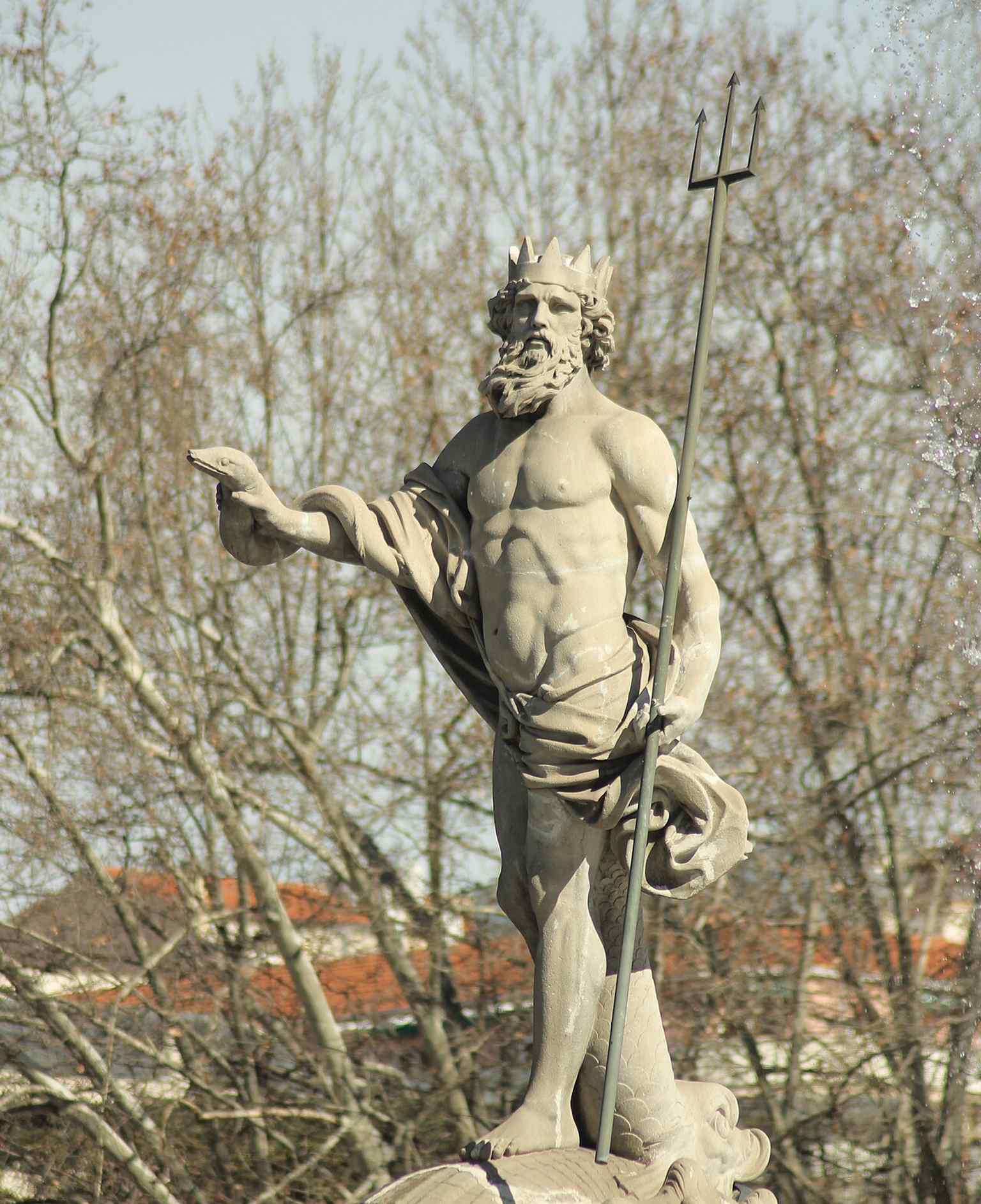
This old image of Neptuno highlights the classic form of the god before later alterations and restorations.Photo: Juan Pascual de Mena, Wikimedia Commons, CC BY-SA 3.0 es. Cropped & resized. 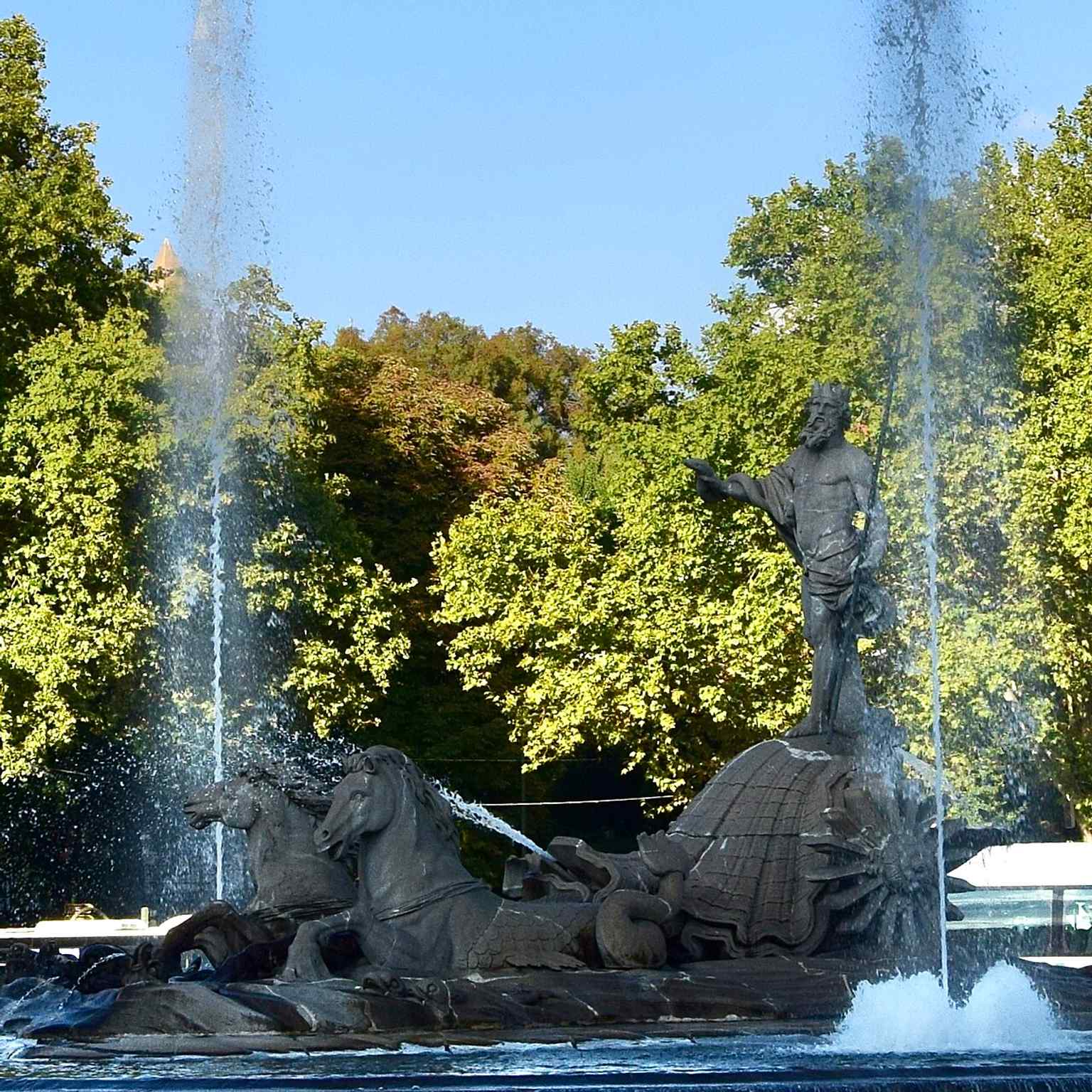
A posed modern photo that clearly shows Neptune riding the sea-chariot, matching the mythological imagery described in the source text.Photo: Ank Kumar, Wikimedia Commons, CC BY-SA 4.0. Cropped & resized. 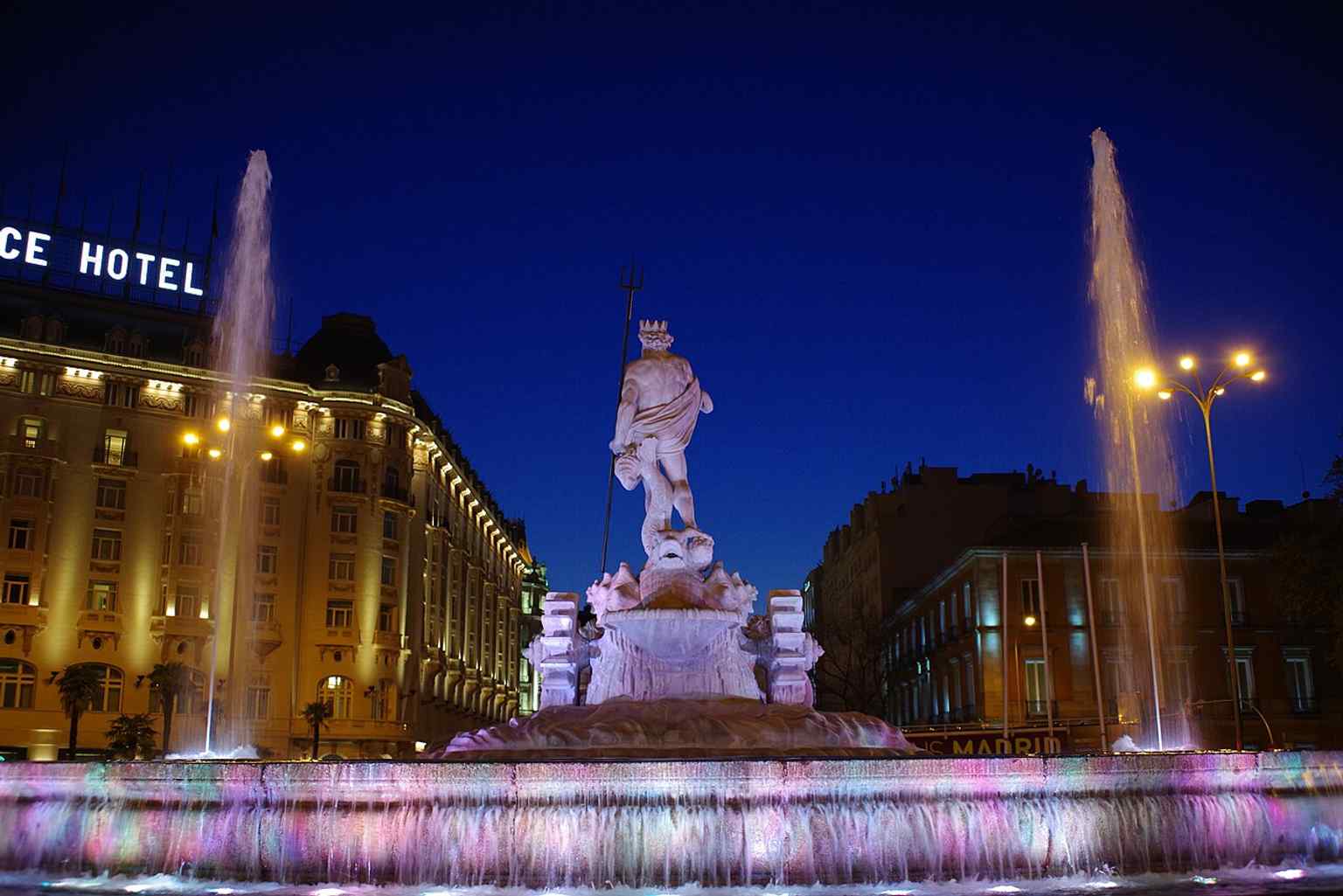
Night photography from 2025 brings out the fountain’s dramatic silhouette and its role as a living city gathering place.Photo: Javier Perez Montes, Wikimedia Commons, CC BY-SA 4.0. Cropped & resized. 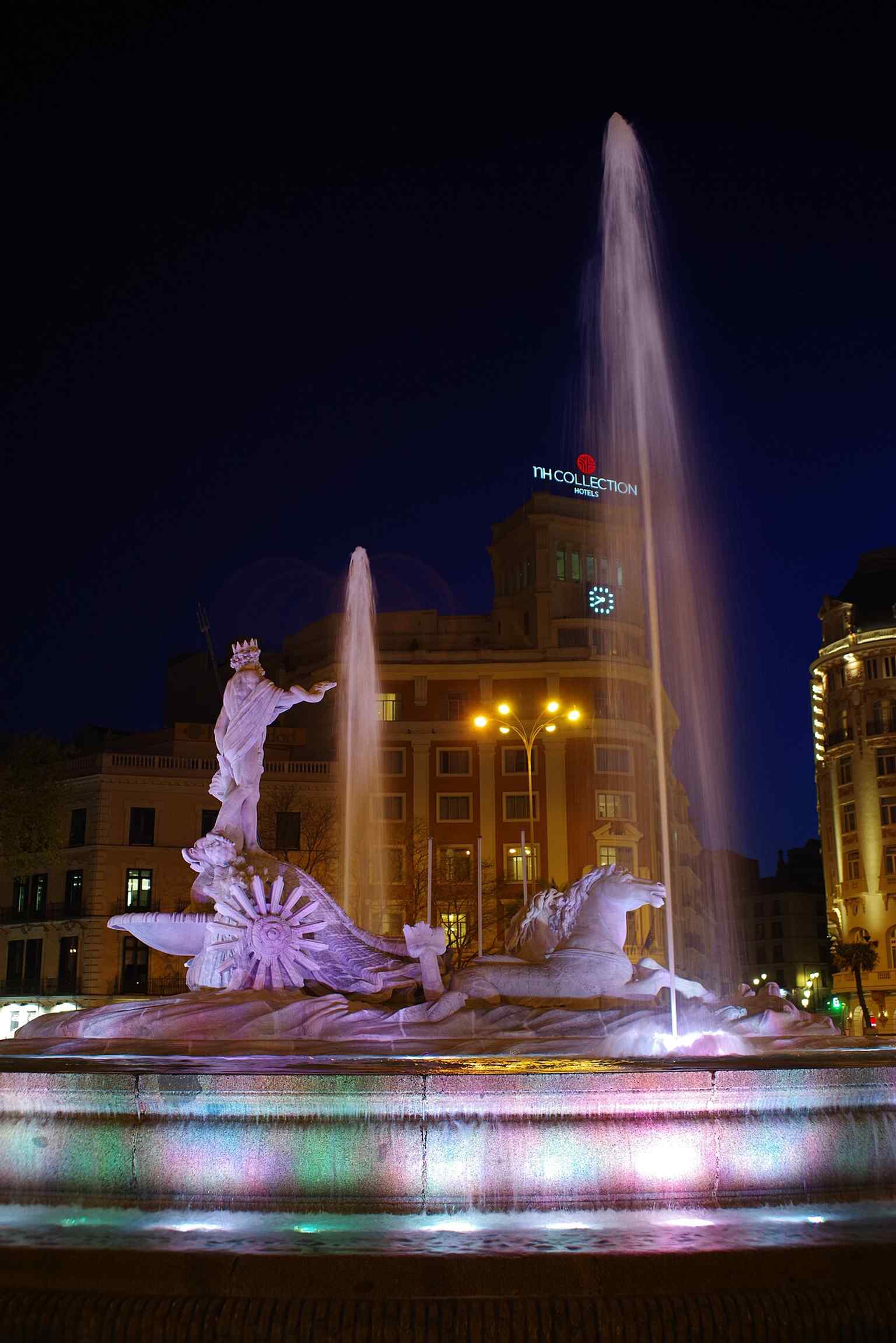
Another nocturnal view, adding variety while keeping focus on the monument’s illuminated presence in Madrid.Photo: Javier Perez Montes, Wikimedia Commons, CC BY-SA 4.0. Cropped & resized. 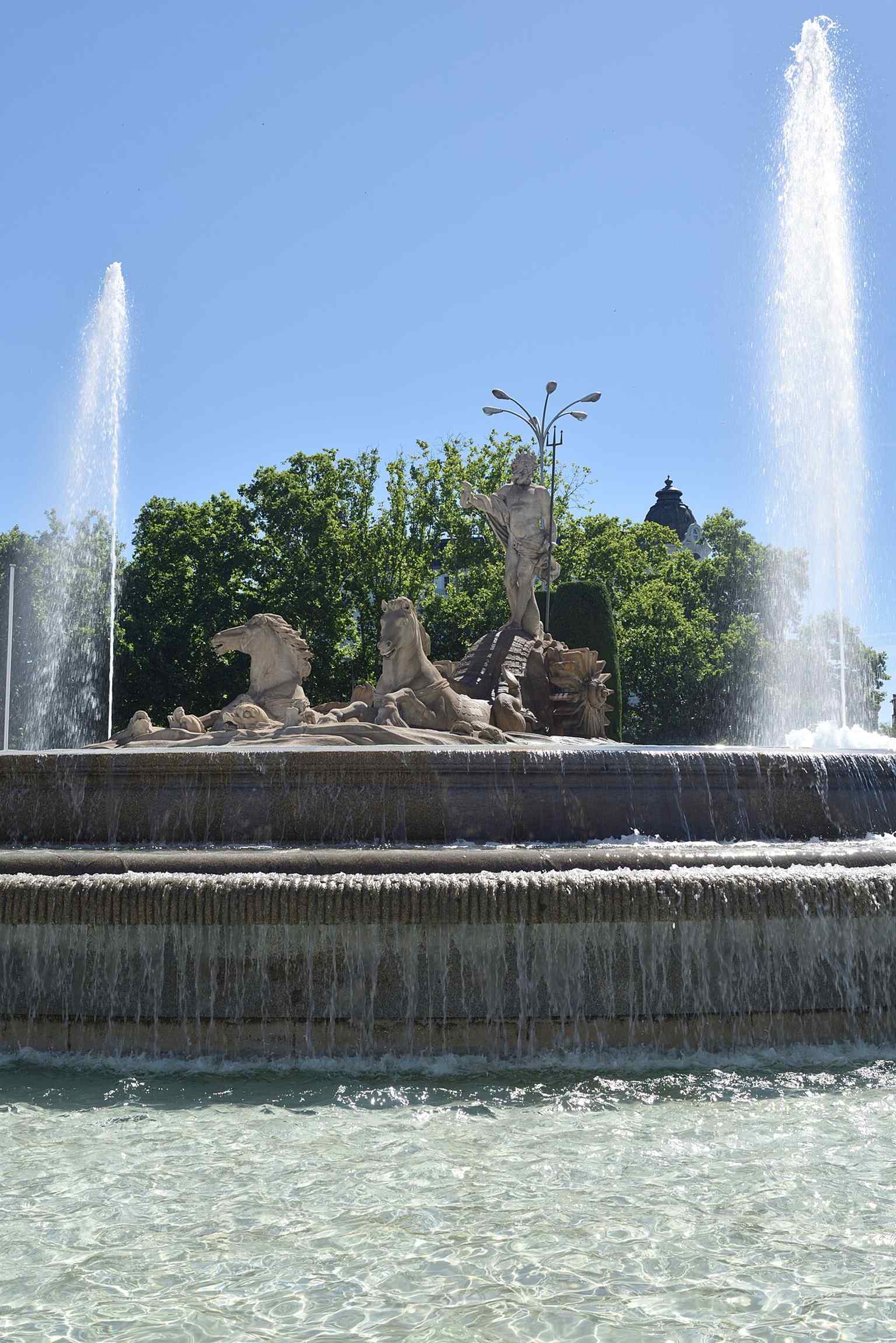
A recent high-resolution close-up that captures the stone texture and sculptural detail of the fountain’s central figure.Photo: Javier Perez Montes, Wikimedia Commons, CC BY-SA 4.0. Cropped & resized. 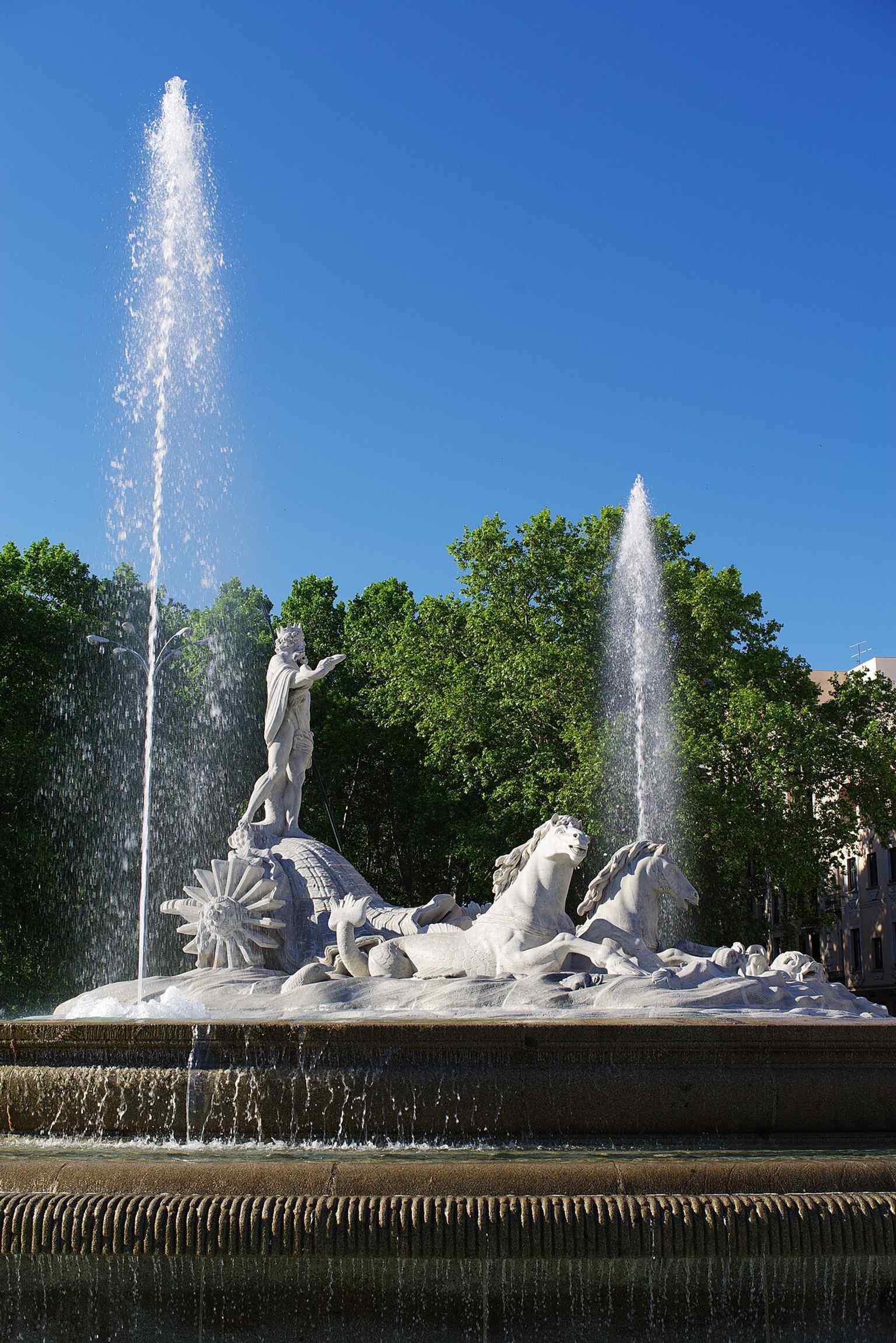
A 2025 daylight image showing the fountain in a contemporary urban context, ideal for the story of Neptuno as a modern meeting point.Photo: Javier Perez Montes, Wikimedia Commons, CC BY-SA 4.0. Cropped & resized. On your left, look for a long pale-stone building with a deep columned portico and the seated statue of Velázquez marking the entrance. This is the Prado, and it feels like a…Read moreShow less
Open dedicated page →On your left, look for a long pale-stone building with a deep columned portico and the seated statue of Velázquez marking the entrance.
This is the Prado, and it feels like a finish line because, in a way, the city has been quietly steering us here all along. Crowns, convents, plazas, ceremony, ambition... they all end up under this roof.
Juan de Villanueva drew this building in seventeen eighty-six for King Carlos the Third, but not as an art museum. He planned a home for the Royal Cabinet of Natural History, a place for science, classification, and orderly thought. Madrid, being Madrid, changed the script. Instead of minerals and specimens, these galleries became the container for a royal picture collection that slowly turned into something public. When the museum opened in November of eighteen nineteen, the first catalog listed only three hundred eleven paintings, though about one thousand five hundred works from the royal sites were already in its care. The museum began, basically, as a grand reshuffling of the crown’s possessions before it became the Prado people know today.
And what possessions they were. Charles the Fifth favored Titian. Philip the Second chased the strange, unforgettable visions of Bosch. Philip the Fourth enriched the holdings with Velázquez, Rubens, and Italian masters. Philip the Fifth and Isabel Farnese added major sculpture and more painting. So the Prado is not just a museum; it is a former royal appetite, turned inside out for the public.
Then the collection kept growing by absorbing other histories. The old Museo de la Trinidad sent in religious paintings rescued from suppressed monasteries and convents. Later, the Museum of Modern Art fed in nineteenth-century Spanish painting. That is why the Prado can hold medieval altarpieces, court portraits, war images, Black Paintings, and Sorolla under one institutional heartbeat. It is less a single collection than a whole republic of collections.
If you glance at your screen, that monument to Velázquez at the entrance, installed in eighteen ninety-nine, gives away who truly reigns here now. Not a king on horseback... a painter in a chair. I like that. Feels like progress with better posture.
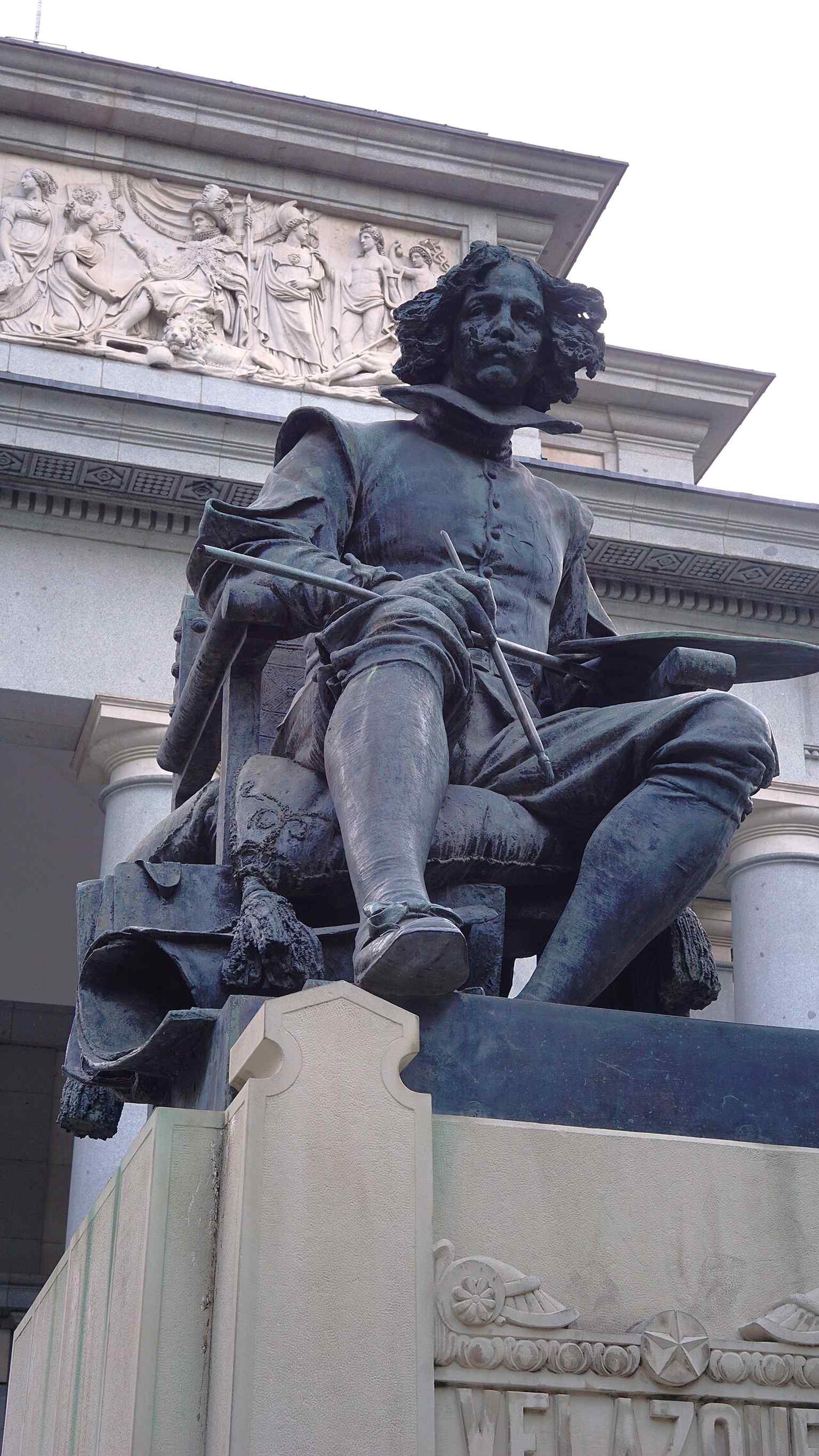
Velázquez stands at the main entrance, a 1899 monument that honors the painter most closely associated with the Prado's collection.Photo: Coralma*, Wikimedia Commons, CC0. Cropped & resized. This place also survived the twentieth century by the grit of very real people. In November of nineteen thirty-six, bombs fell on the Prado and its surroundings during the civil war. Emergency protections saved the building from catastrophic loss; inside, damage was limited to a sixteenth-century relief. Then Timoteo Pérez Rubio helped direct the evacuation of the treasures. By February of nineteen thirty-nine, seventy-one trucks carried the most important works across the border for safety. Not glamorous, maybe, but civilization often depends on someone who knows how to label a crate and keep moving.
And the Prado has always been a school as much as a shrine. Generations of copyists worked here; Fortuny, Sorolla, Sargent, even Picasso learned by looking long and hard. You can see that tradition in the app image of a modern copyist facing Las Hilanderas.
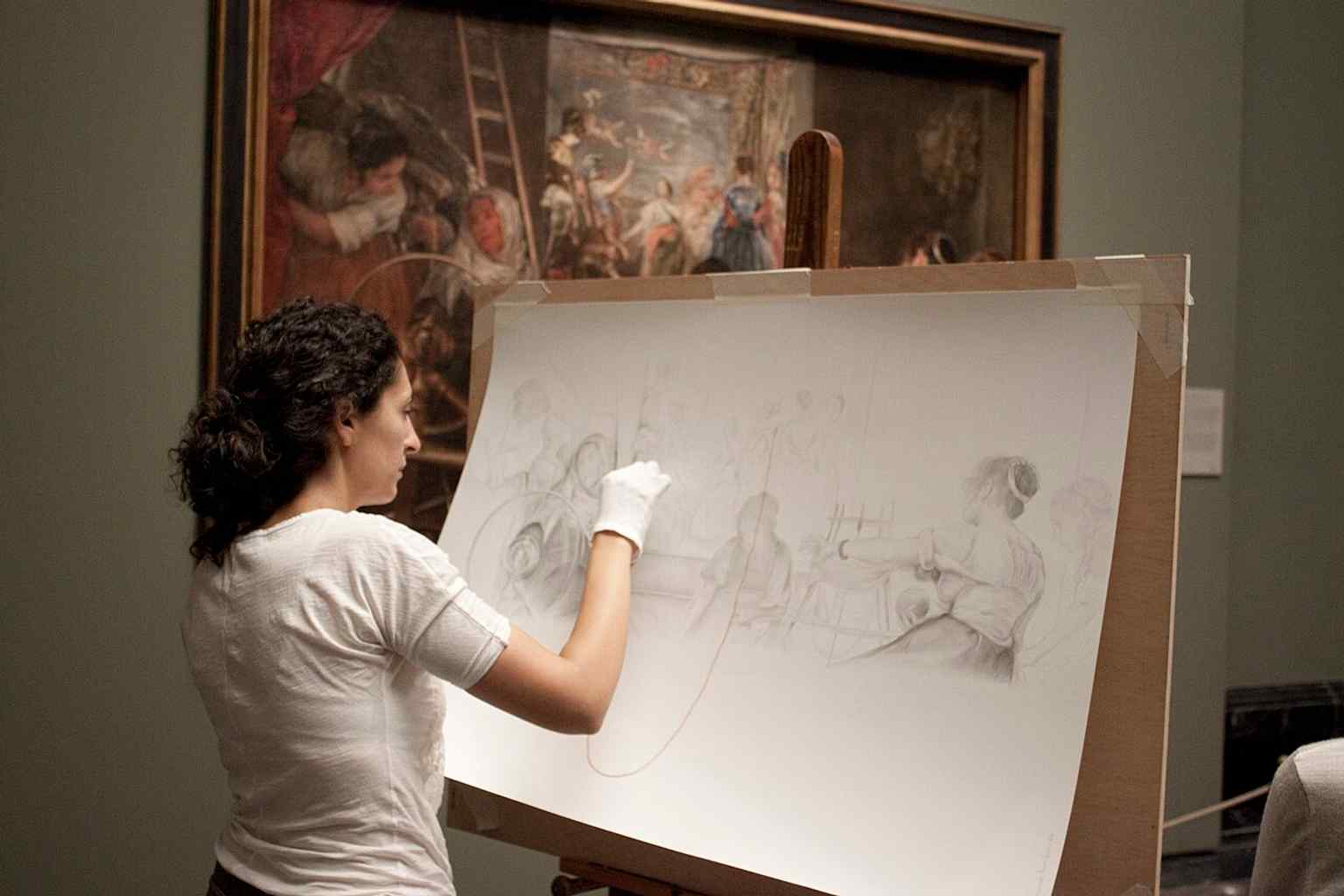
A contemporary artist copying Las Hilanderas in the galleries, a reminder that the Prado has long functioned as a school for painters.Photo: Creadoraonline, Wikimedia Commons, CC BY-SA 4.0. Cropped & resized. So here is the question I’ll leave with you: when art gathered to glorify rulers becomes something any stranger can enter and study, does power lose its force... or does it become more complicated, more honest?
If Sol measures the roads of Spain, the Prado measures another distance entirely: the journey from possession to memory. After everything this city has layered over itself, it is fitting that we end at the place where so many of those layers learned to speak in public.
If you’re going inside, check the current opening hours in the app.
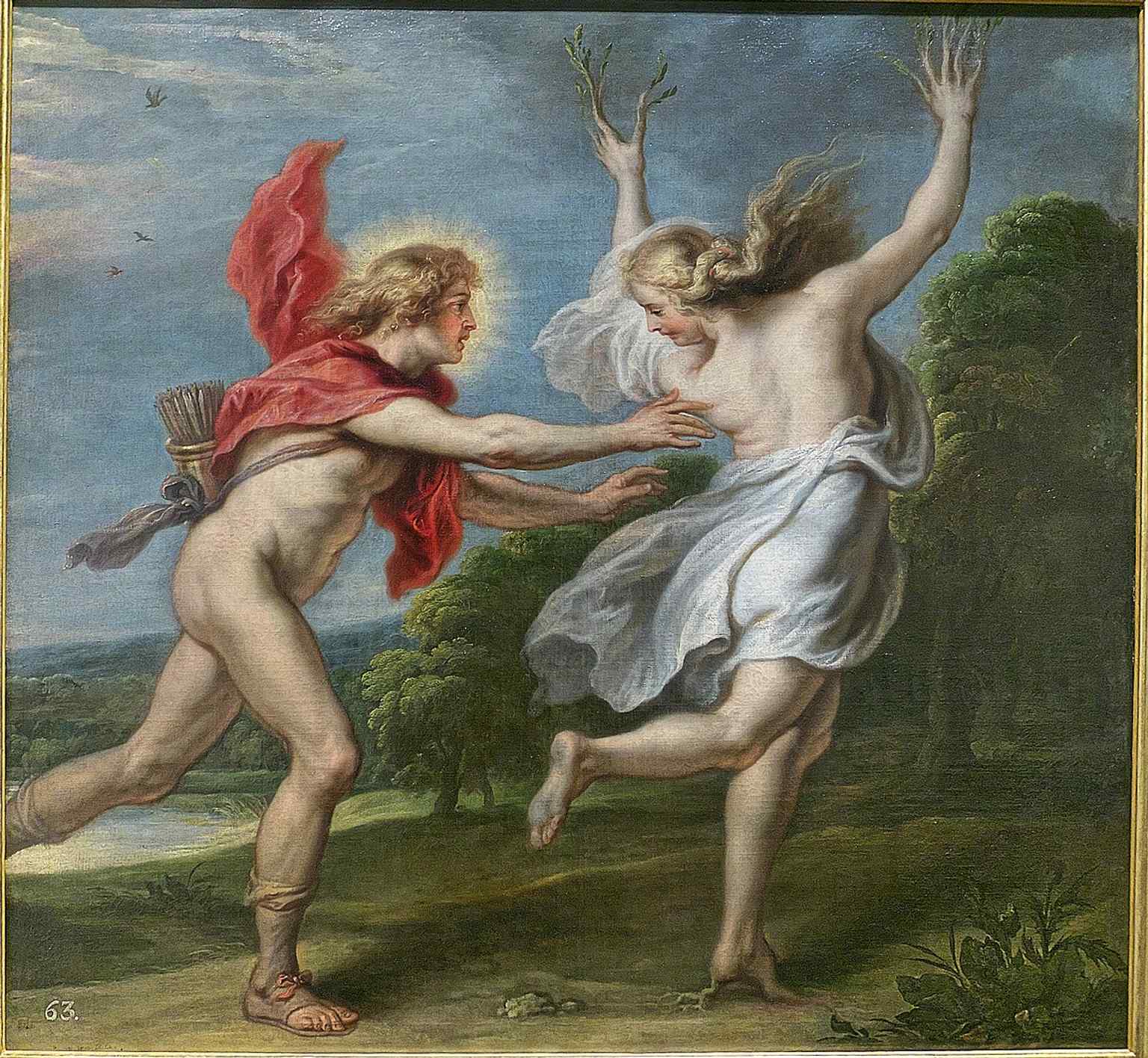
A mythological painting made for the Torre de la Parada, one of the Prado's famous royal palace commissions.Photo: Theodoor van Thulden / After Peter Paul Rubens / Peter Paul Rubens, Wikimedia Commons, CC BY-SA 4.0. Cropped & resized. 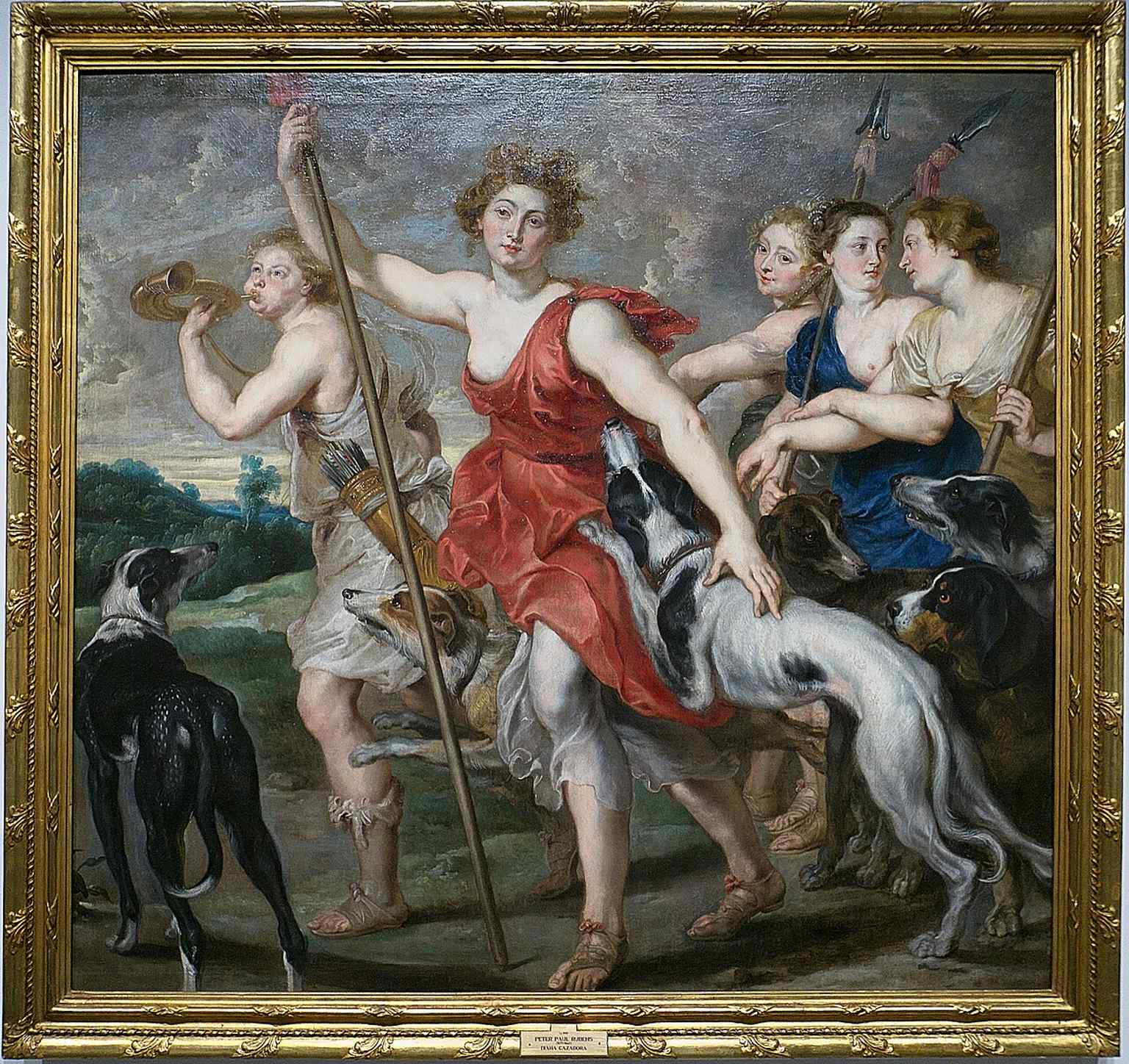
Rubens' hunting goddess scene reflects the courtly Baroque taste that helped shape the Spanish royal collections.Photo: Peter Paul Rubens, Wikimedia Commons, CC BY-SA 4.0. Cropped & resized. 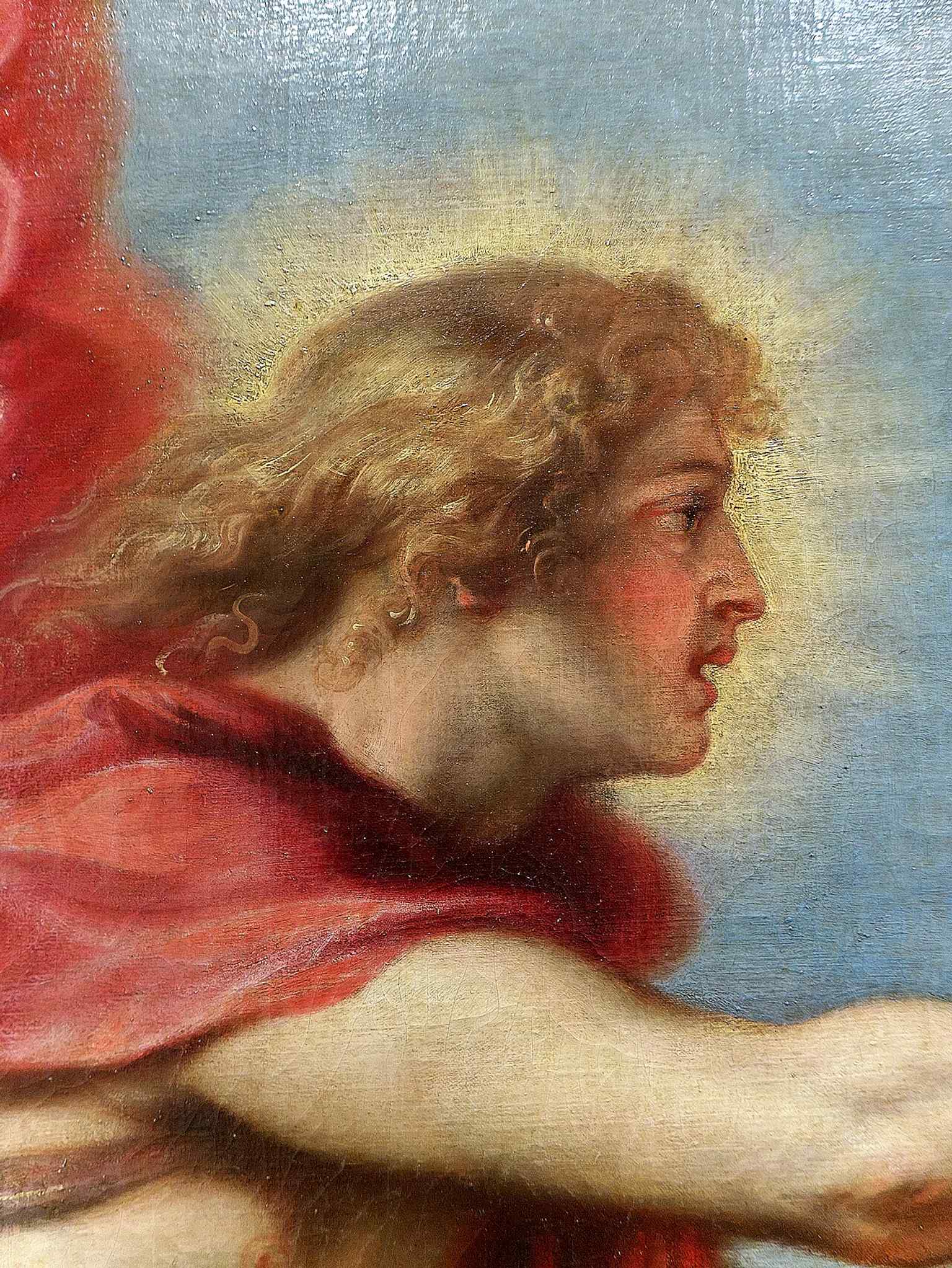
A surviving fragment of the Prado's Torre de la Parada cycle, showing how the museum preserves pieces from royal decorative programs.Photo: Jl FilpoC, Wikimedia Commons, CC BY-SA 4.0. Cropped & resized. 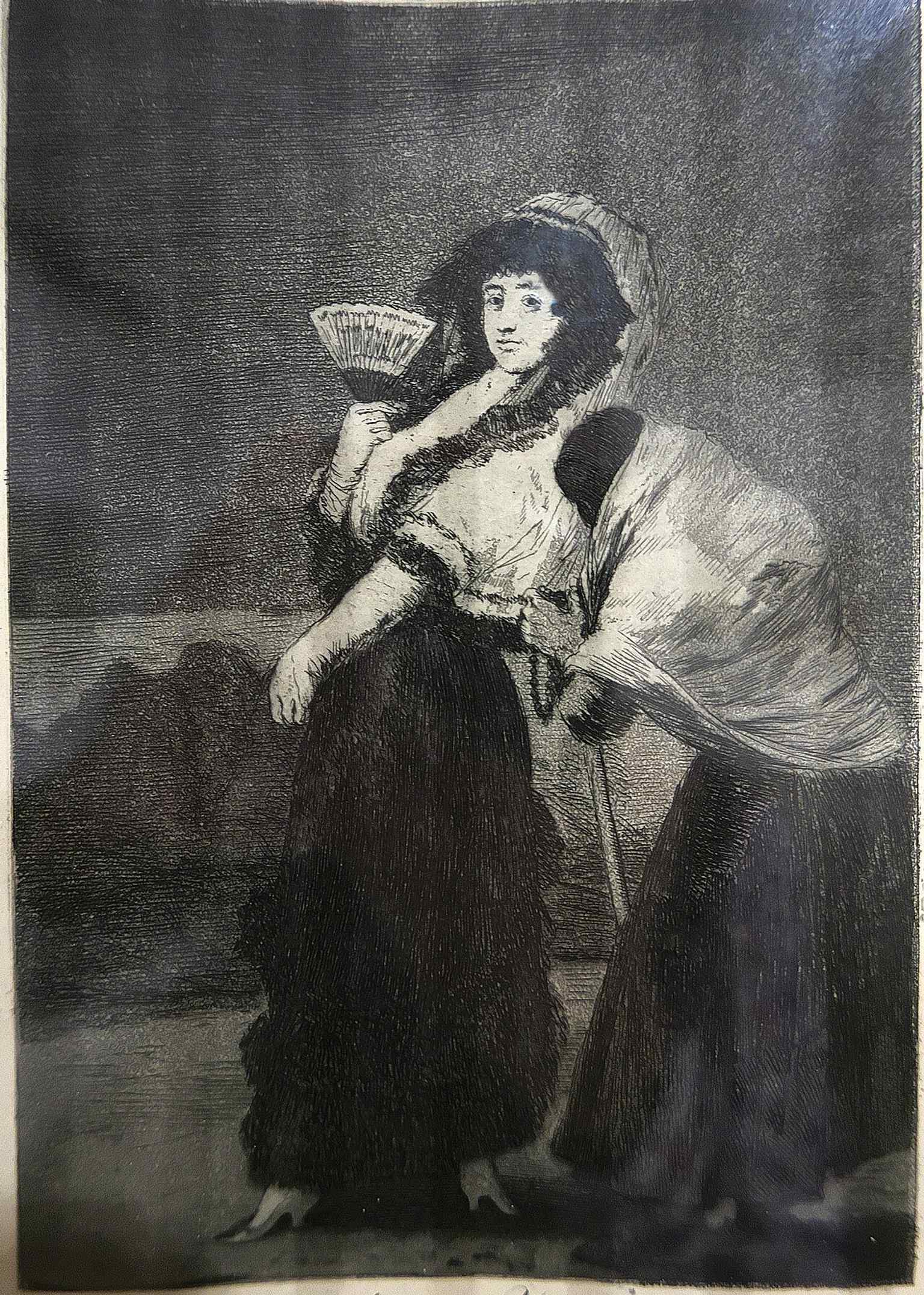
One of Goya's sharpest Caprichos prints, part of the museum's unrivaled collection of his drawings and engravings.Photo: Jl FilpoC, Wikimedia Commons, CC BY-SA 4.0. Cropped & resized. 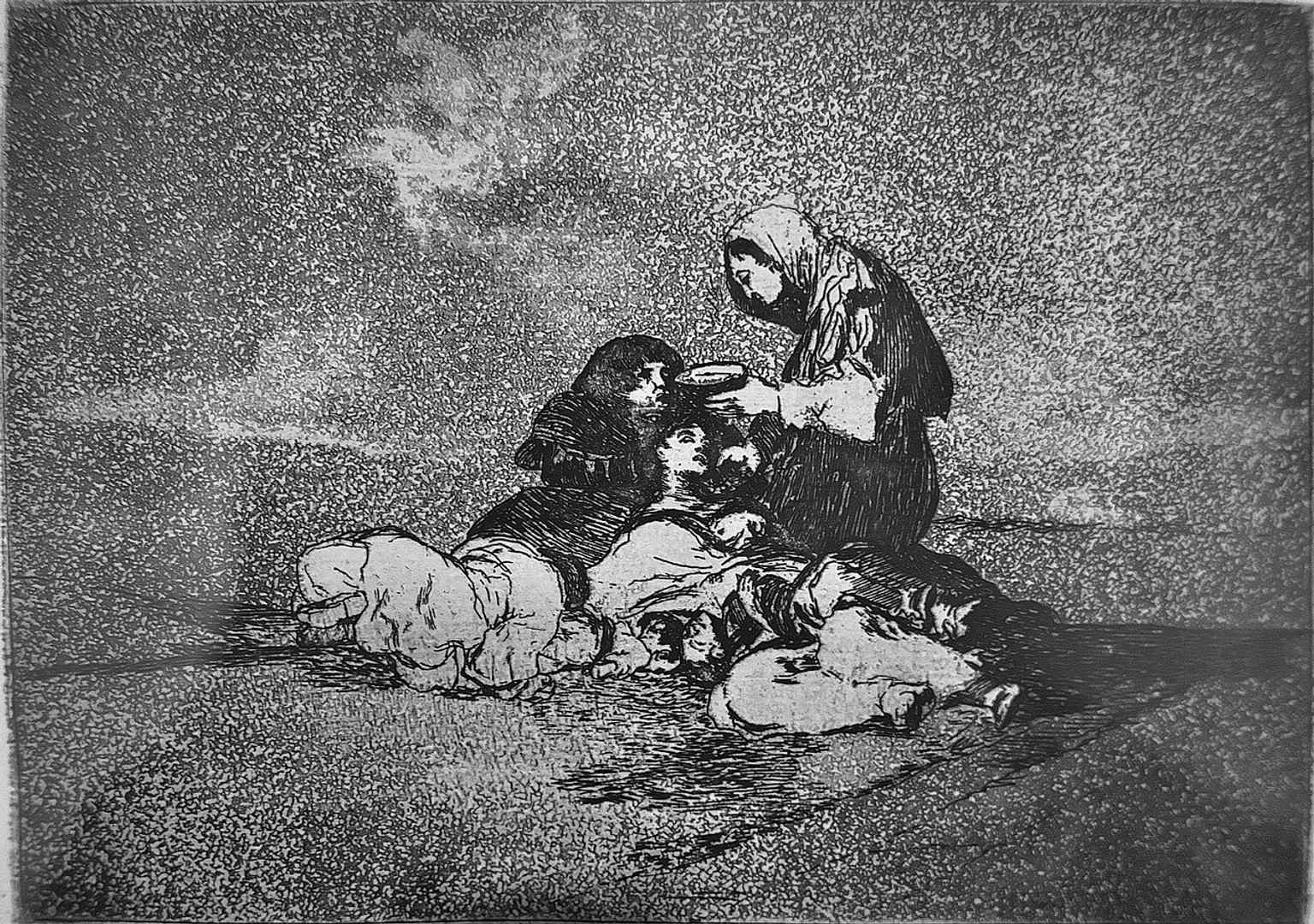
A bleak plate from The Disasters of War, showing the human suffering that made Goya central to Prado's modern identity.Photo: Jl FilpoC, Wikimedia Commons, CC BY-SA 4.0. Cropped & resized. 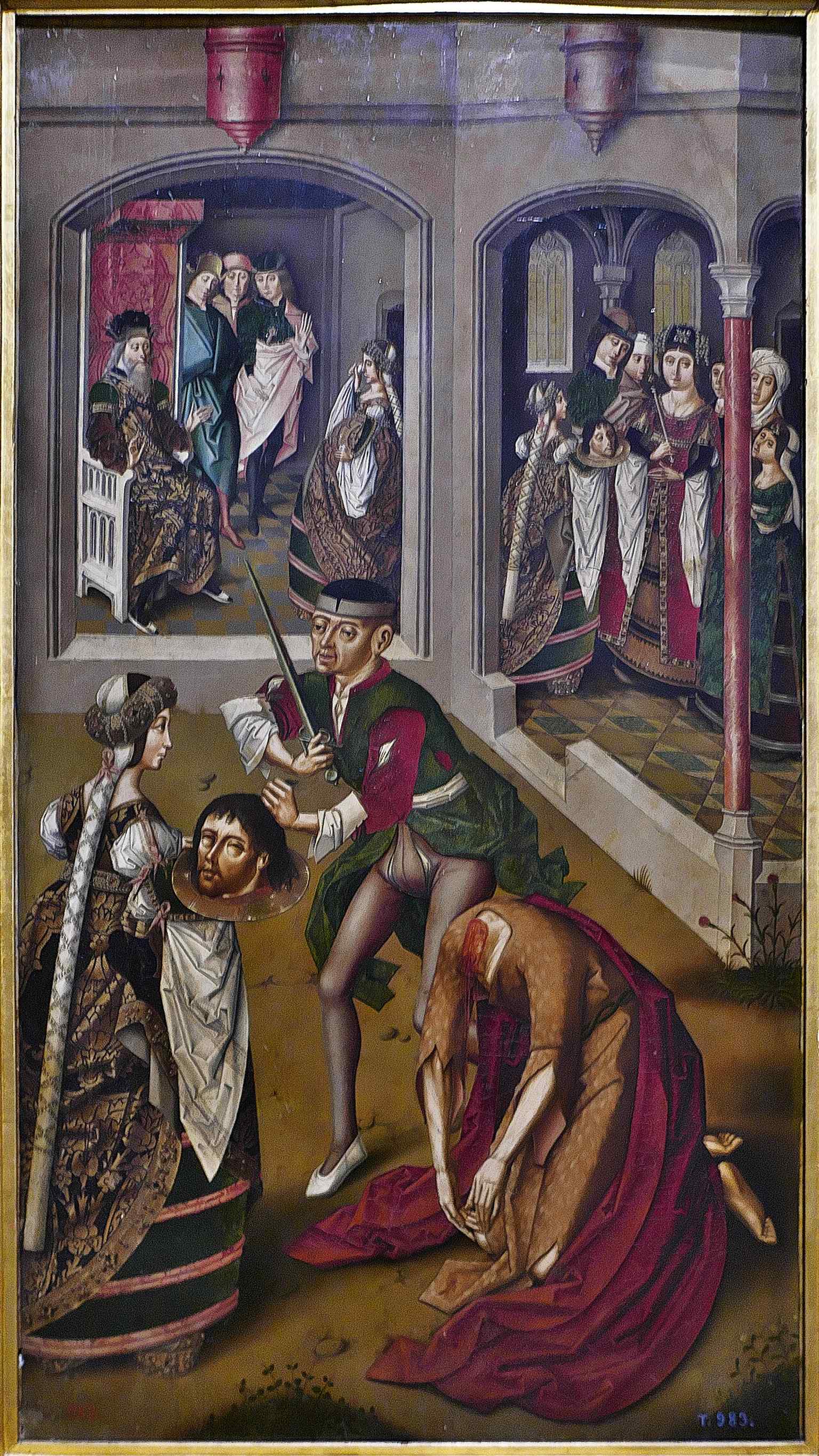
A late-medieval panel from the Miraflores altarpiece, illustrating the religious painting tradition strengthened by the Museum of the Trinity.Photo: Jl FilpoC, Wikimedia Commons, CC BY-SA 4.0. Cropped & resized. 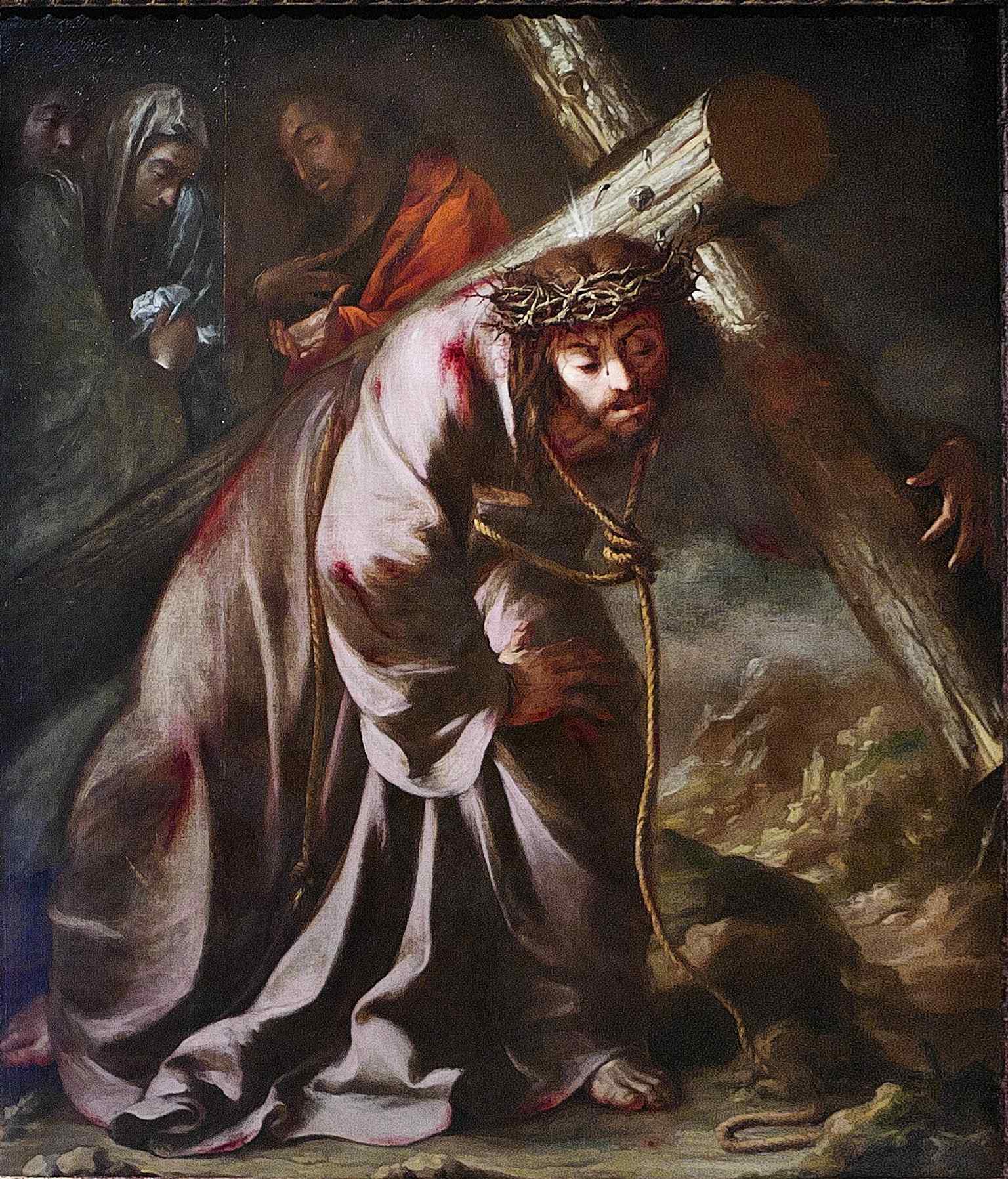
Juan de Valdés Leal's dramatic Christ on the Way to Calvary is a powerful example of Spain's Baroque religious painting.Photo: Jl FilpoC, Wikimedia Commons, CC BY-SA 4.0. Cropped & resized. 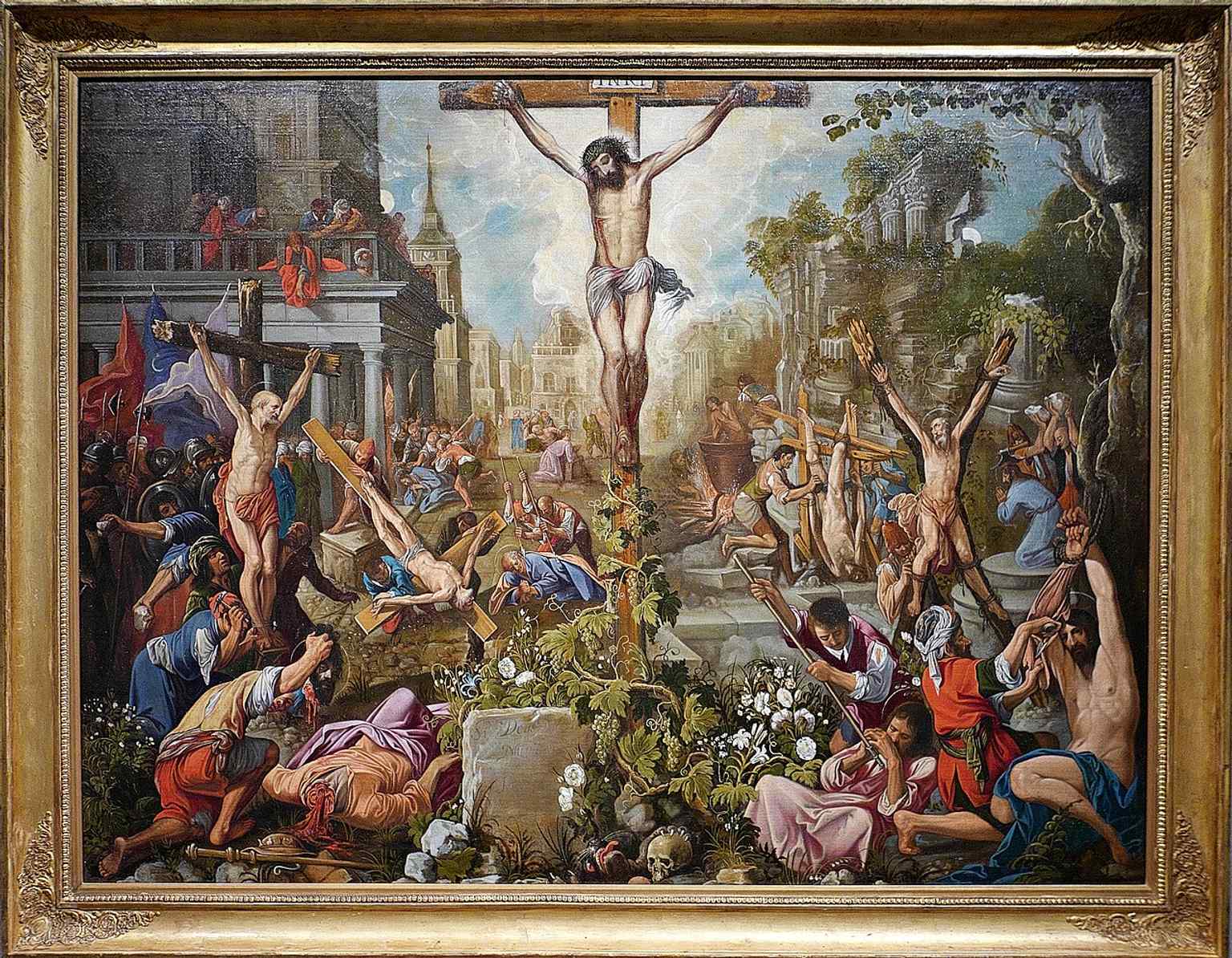
This martyrdom scene recalls the devout large-scale paintings that entered the Prado through the dissolved Museo de la Trinidad.Photo: Jl FilpoC, Wikimedia Commons, CC BY-SA 4.0. Cropped & resized. 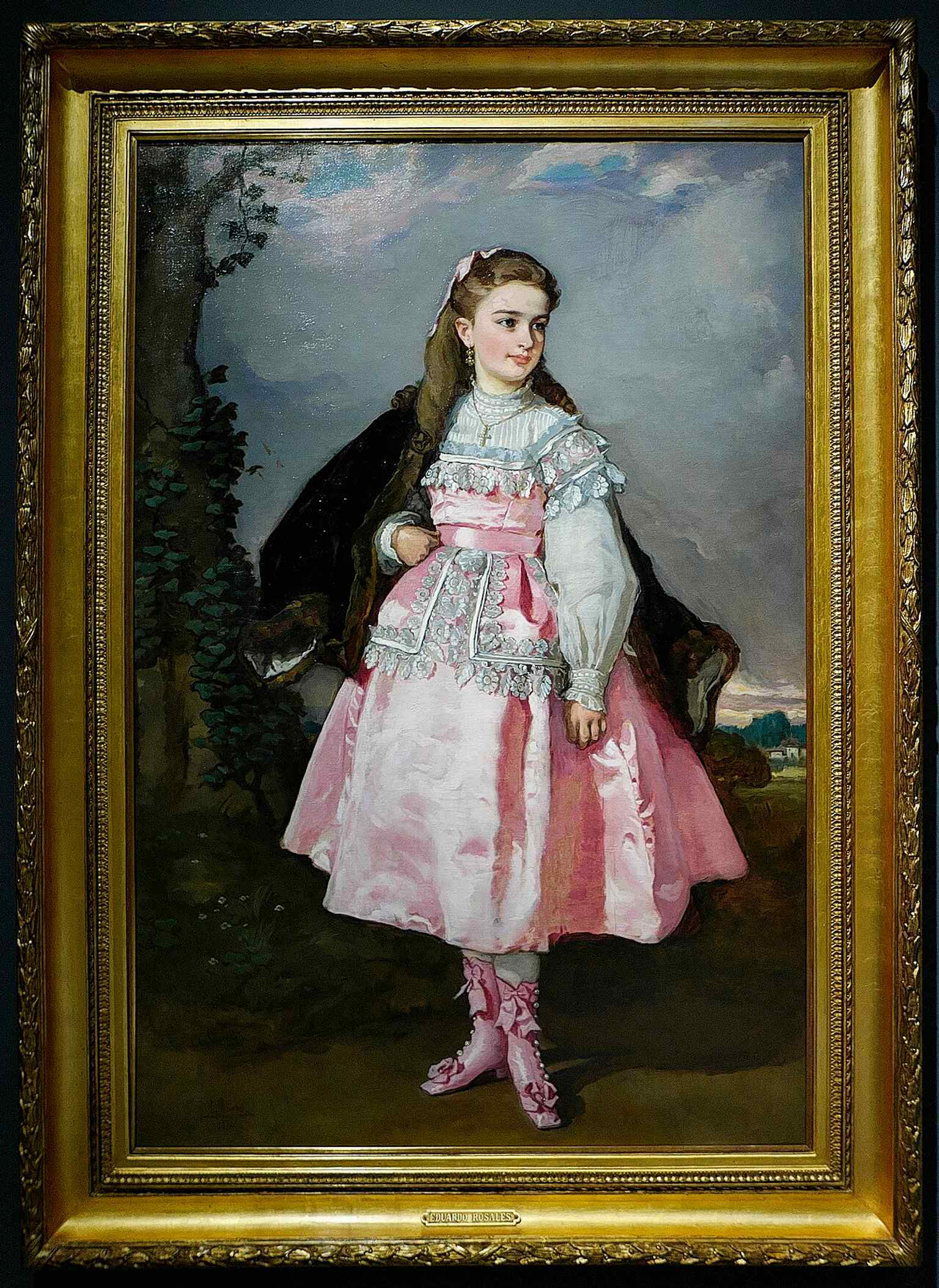
Sorolla's portrait of Concepción Serrano shows how the Prado later expanded into 19th-century Spanish painting.Photo: Eduardo Rosales, Wikimedia Commons, Public domain. Cropped & resized. 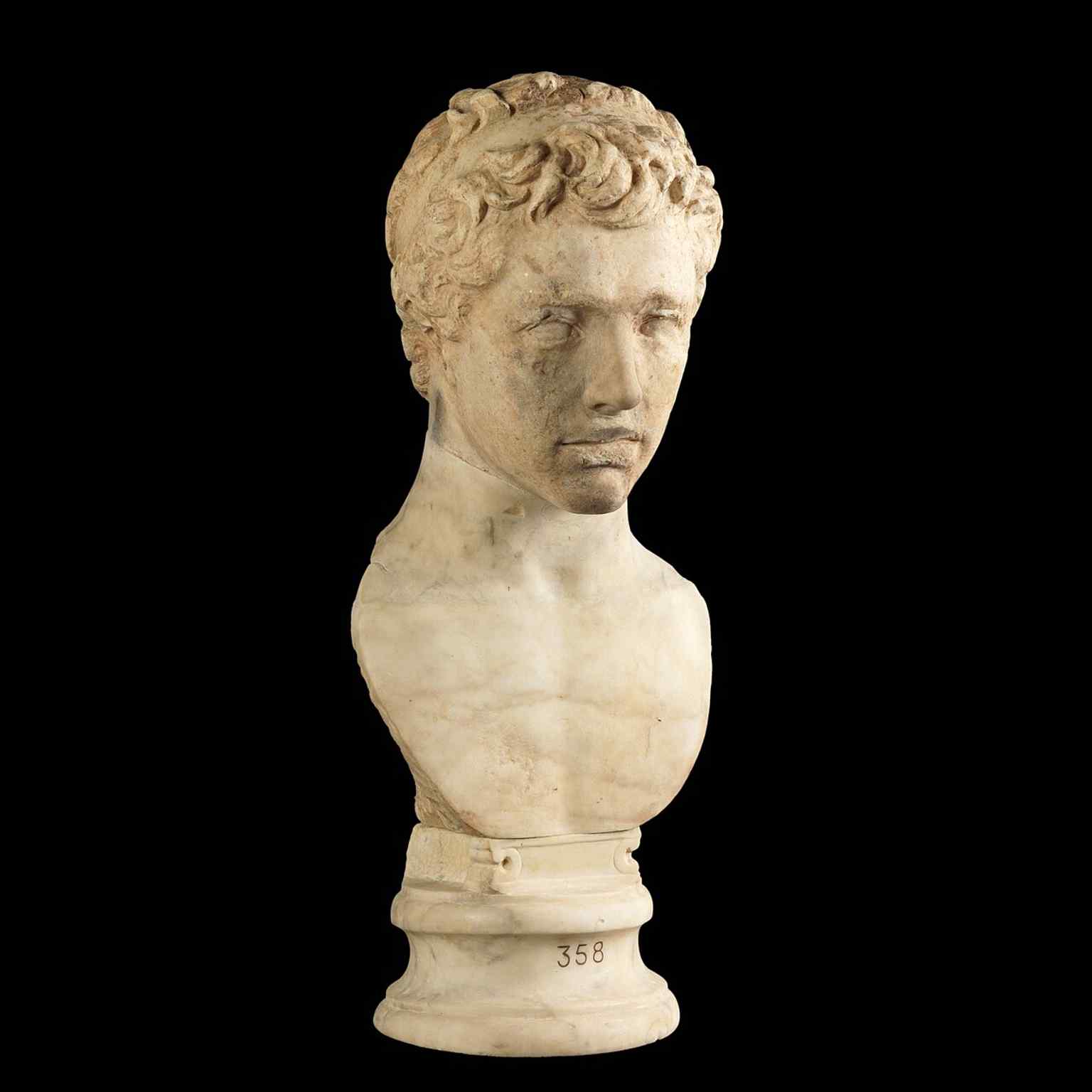
A Roman imperial bust from the sculpture collection, echoing the Prado's roots in royal antiquities and classical art.Photo: Taller romano, Wikimedia Commons, CC0. Cropped & resized. 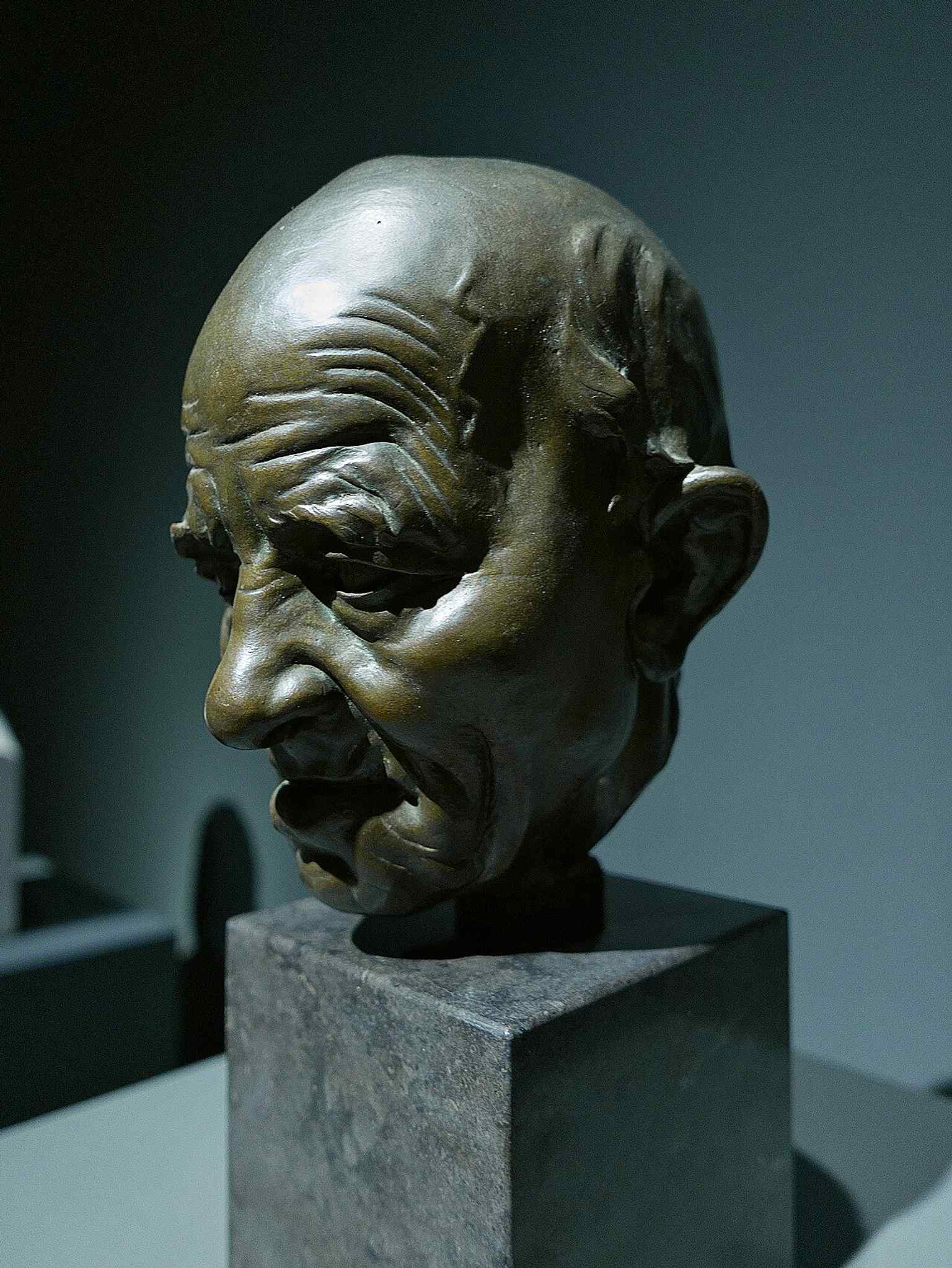
A close-up bronze head from the sculpture holdings, highlighting the Prado's often overlooked three-dimensional collections.Photo: Manuel Iglesias Recio, Wikimedia Commons, Public domain. Cropped & resized. 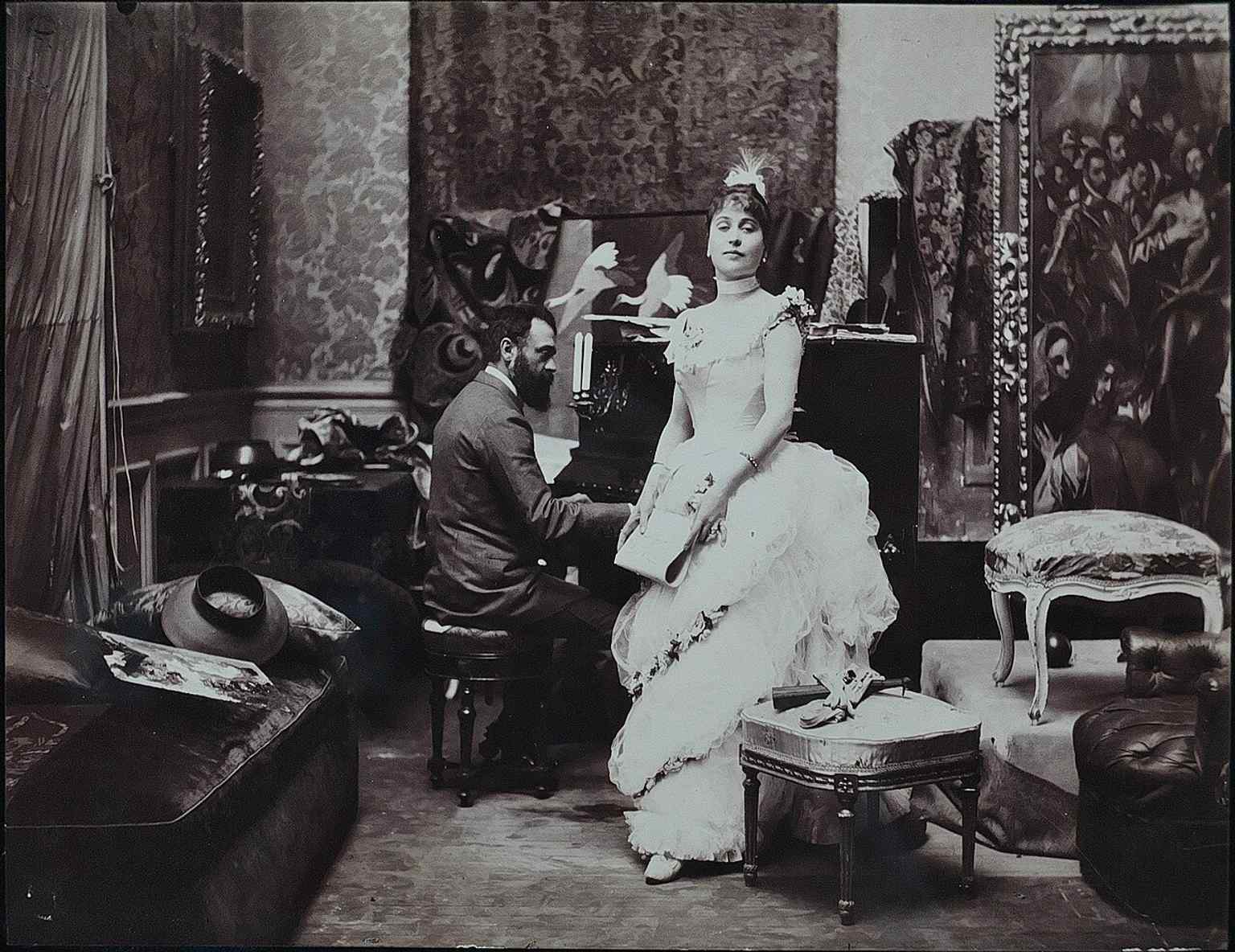
A historic studio photograph from the museum archive, evoking the Prado as a working place for artists and copists.Photo: Conde de Chaumont-Quitry, Wikimedia Commons, Public domain. Cropped & resized. 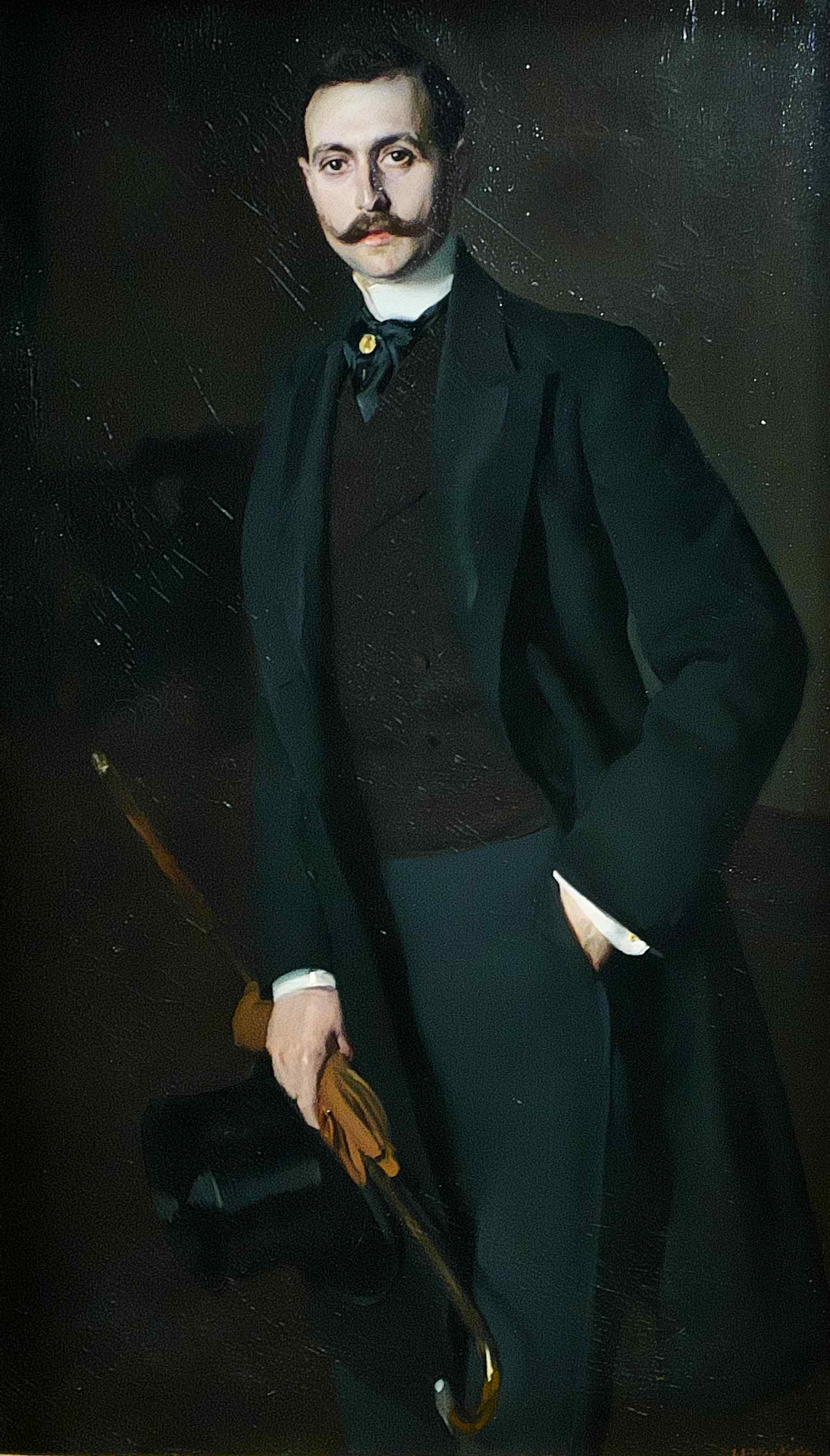
Sorolla's portrait of Aureliano de Beruete links the museum to one of its key modern directors and advocates.Photo: Joaquín Sorolla, Wikimedia Commons, Public domain. Cropped & resized.
Frequently asked questions
How do I start the tour?
After purchase, download the AudaTours app and enter your redemption code. The tour will be ready to start immediately - just tap play and follow the GPS-guided route.
Do I need internet during the tour?
No! Download the tour before you start and enjoy it fully offline. Only the chat feature requires internet. We recommend downloading on WiFi to save mobile data.
Is this a guided group tour?
No - this is a self-guided audio tour. You explore independently at your own pace, with audio narration playing through your phone. No tour guide, no group, no schedule.
How long does the tour take?
Most tours take 60–90 minutes to complete, but you control the pace entirely. Pause, skip stops, or take breaks whenever you want.
What if I can't finish the tour today?
No problem! Tours have lifetime access. Pause and resume whenever you like - tomorrow, next week, or next year. Your progress is saved.
What languages are available?
All tours are available in 50+ languages. Select your preferred language when redeeming your code. Note: language cannot be changed after tour generation.
Where do I access the tour after purchase?
Download the free AudaTours app from the App Store or Google Play. Enter your redemption code (sent via email) and the tour will appear in your library, ready to download and start.
If you don't enjoy the tour, we'll refund your purchase. Contact us at help@audatours.com
Checkout securely with 












%20Puerta%20del%20Sol.jpg)


%20Comercio%20de%20pavos%20en%20la%20Plaza%20Mayor.jpg)


.jpeg)


.jpg)


.png)
.png)


.jpg)
.jpg)

.jpg)
%2001.jpg)


%2009.jpg)


%2011.jpg)
%2C%20Madrid%2C%20Spain%20(%20Ank%20Kumar%20)%2002.jpg)


.jpg)
.jpg)
.jpg)


.jpg)

%2C%20Manuel%20Iglesias%20Recio.jpg)

.jpg)