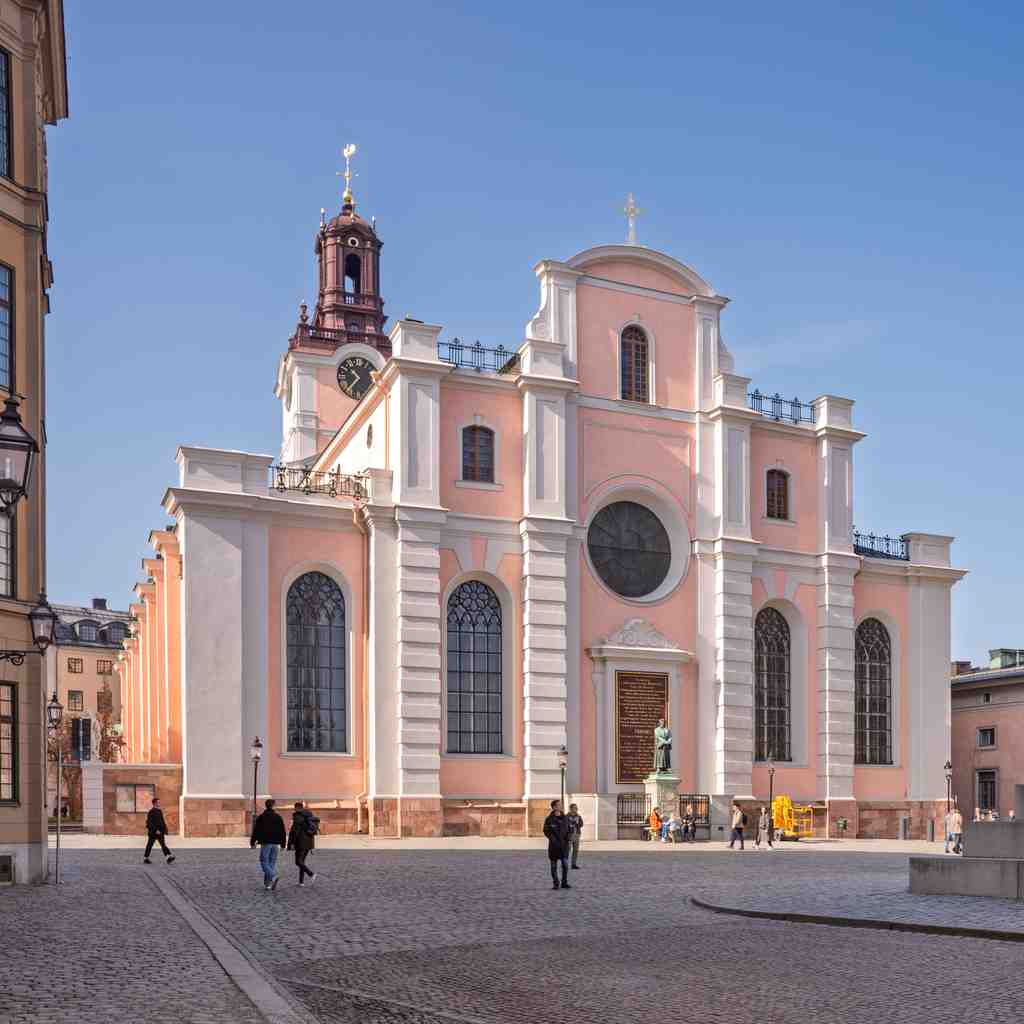
Look for the great brick church with a steep copper roof and a tall square tower marked by a clock and a dark spire.
This stop is not only the church beside you, but the parish that grew around it and tried, for centuries, to hold Stockholm together. Here, the Reformation became personal. It was not just a change in doctrine, meaning religious teaching; it was a local fight over who could interpret God’s word, who controlled the city’s holiest room, and which voice Stockholmers were supposed to trust.
When Gustav Vasa took Stockholm in fifteen twenty-three, later sources say a thanksgiving mass took place here. That mattered. The new ruler used this church almost at once as a public stage, turning prayer into a declaration of political victory. And beside him, or sometimes against him, stood Olaus Petri. He was more than a preacher. He helped teach Stockholm how to understand a new age.
Most visitors never notice that the argument is still under their feet. The medieval high choir, the eastern sacred space once reserved for the altar and clergy, is marked in the paving outside. A later tradition says Gustav Vasa actually wanted to tear down the whole church. Resistance, closely tied to figures like Olaus Petri, helped preserve it. His statue stands where that lost choir once reached, like a witness refusing to step aside.
In fifteen thirty-five, a strange sky over Stockholm produced the famous sun dogs, bright halos around the sun. Inside this church hangs the painting known as the Vädersolstavlan, long linked to Olaus Petri and often said to have been commissioned by him. It was not just a city view. People read those burning circles in the sky as a sign of God’s anger at Gustav Vasa’s Reformation. So even an image became a rebuke.
The parish itself tells the same story in another form. It began around twelve sixty as Saint Nicholas parish after breaking away from Solna. Then the city kept dividing outward. The German congregation split off in fifteen fifty-eight. The Finnish congregation followed in fifteen seventy-seven. Klara left in fifteen eighty-seven, Maria Magdalena in fifteen ninety-one, and Riddarholmen later broke away and then returned in eighteen oh seven. On paper, that looks administrative. In real life, it meant language, migration, and loyalty all pressing against one sacred center.
The reshaping never quite stopped. The parish took the name Storkyrkoförsamlingen in nineteen oh seven and finally merged into Stockholm Cathedral parish in nineteen eighty-nine. Even in nineteen ninety-eight, conservators revisited the question, reinforcing the view that the Vädersolstavlan hanging inside is a sixteen thirty-six copy of a lost original from fifteen thirty-five.
That is the pattern here: authority claims permanence, but every generation edits it. And in Stockholm, disputes over legitimacy did not stay theological for long. In about a one-minute walk, we reach the next stop, where those struggles turn sharper still.
If you want to step inside later, the cathedral is generally open daily from nine thirty A-M to five P-M.