
Stockholm Audio Tour: Royal Heritage
Beneath the gilded spires of Stockholm, shadows of ancient treachery and iron-willed ambition still cling to the cobblestones. You are standing on ground where crowns were forged and heads were lost. Uncover these echoes with an immersive self-guided audio tour that bypasses the tourist crowds to reveal the raw, unfiltered pulse of the Swedish capital. Traverse the path between the imposing Riksdag and the storied halls of the Royal Palace at your own pace. Did a desperate king really hide a secret stash of gold within these thick stone walls? What shadowy deal occurred inside the parliament that changed the fate of a nation forever? Why does a specific window in the palace remain locked for centuries against the midnight air? Experience the thrill of walking through living history. Ignite your curiosity and transform your walk into a cinematic journey. Start your exploration now and claim the hidden secrets of the city.
Tour preview
About this tour
- scheduleDuration 120–140 minsGo at your own pace
- straighten4.4 km walking routeFollow the guided path
- location_on
- wifi_offWorks offlineDownload once, use anywhere
- all_inclusiveLifetime accessReplay anytime, forever
- location_onStarts at Riksdag
Stops on this tour
lock_open 3 free previews · 17 unlock with purchase
Stand here for a moment and take in the idea before the building... Sweden’s highest elected authority feels calm, almost restrained. No fortress walls, no royal fanfare, just a…Read moreShow less
Open dedicated page →Stand here for a moment and take in the idea before the building... Sweden’s highest elected authority feels calm, almost restrained. No fortress walls, no royal fanfare, just a parliament doing the work of decisions. And yet that calm sits on top of older struggles over who counted, who spoke, and who obeyed.
This part of Stockholm is small enough to cross on foot, but it holds stacked kinds of rule: king, church, nobility, merchants, crowds, and finally elected representatives. That is what makes these streets so revealing. Power here rarely disappears... it settles into new rooms, new rituals, and new stone.
The Swedish parliament, the Riksdag, is now a single chamber with three hundred and forty-nine members, elected by proportional vote for fixed four-year terms. It enacts laws, approves constitutional change, and, under Sweden’s modern constitutional order, its speaker nominates the prime minister. That sounds clean and contemporary, but the institution grew slowly out of something much older: assemblies of estates, where society spoke not as equal citizens, but as ranked groups.
Its roots reach back to a meeting at Arboga, traditionally dated to fourteen thirty-five. Then, in fifteen twenty-seven, Gustav the First Vasa pulled representatives of all four estates into the system: nobility, clergy, burghers, and freeholding farmers. It lasted for centuries. Only in eighteen sixty-six did Louis De Geer force through the reform that swept away estate representation and replaced it with a bicameral parliament, an upper and lower chamber. He faced fierce resistance, especially from nobles who understood exactly what they were losing.
If you glance at the image on your screen, you can see one of those older chambers preserved inside the parliament complex, the former First Chamber hall. It is a reminder that even modern democracy often arrives by passing through imperfect rooms first.
And then there is the ground itself. Locals sometimes speak about Stockholm as if it has a second body under the visible one. During construction of the new parliament house on Helgeandsholmen, workers cut into the earth and uncovered a thirteenth-century city wall and a medieval cemetery. That discovery stopped work and started another argument: should the state press on, or should the older city be protected? In the end, part of those remains survived beneath the parliament, and you can still trace that buried Stockholm in the museum below. Most visitors look at the institution above and never realize a graveyard and defensive wall helped interrupt its making.
The move here also sparked debate about how public authority should look, and who it was meant to impress. Critics attacked the design as too lavish. In a way, they were arguing over the same old question De Geer faced: what should public authority look like, and who is it meant to impress?
Even the modern Riksdag has shown its fragility. In the nineteen seventy-three election, the chamber split evenly, one hundred and seventy-five to one hundred and seventy-five, and some decisions had to be settled by lot. Sweden cut the number of seats to three hundred and forty-nine soon after, so chance would not sit in the speaker’s chair again.
So let me leave you with this... when you picture political authority, do you picture ideas, institutions, or the earth they rise from? In Stockholm, you are rarely allowed to choose only one. From here, we move from law on paper to law in stone, and walk to the parliament house itself.
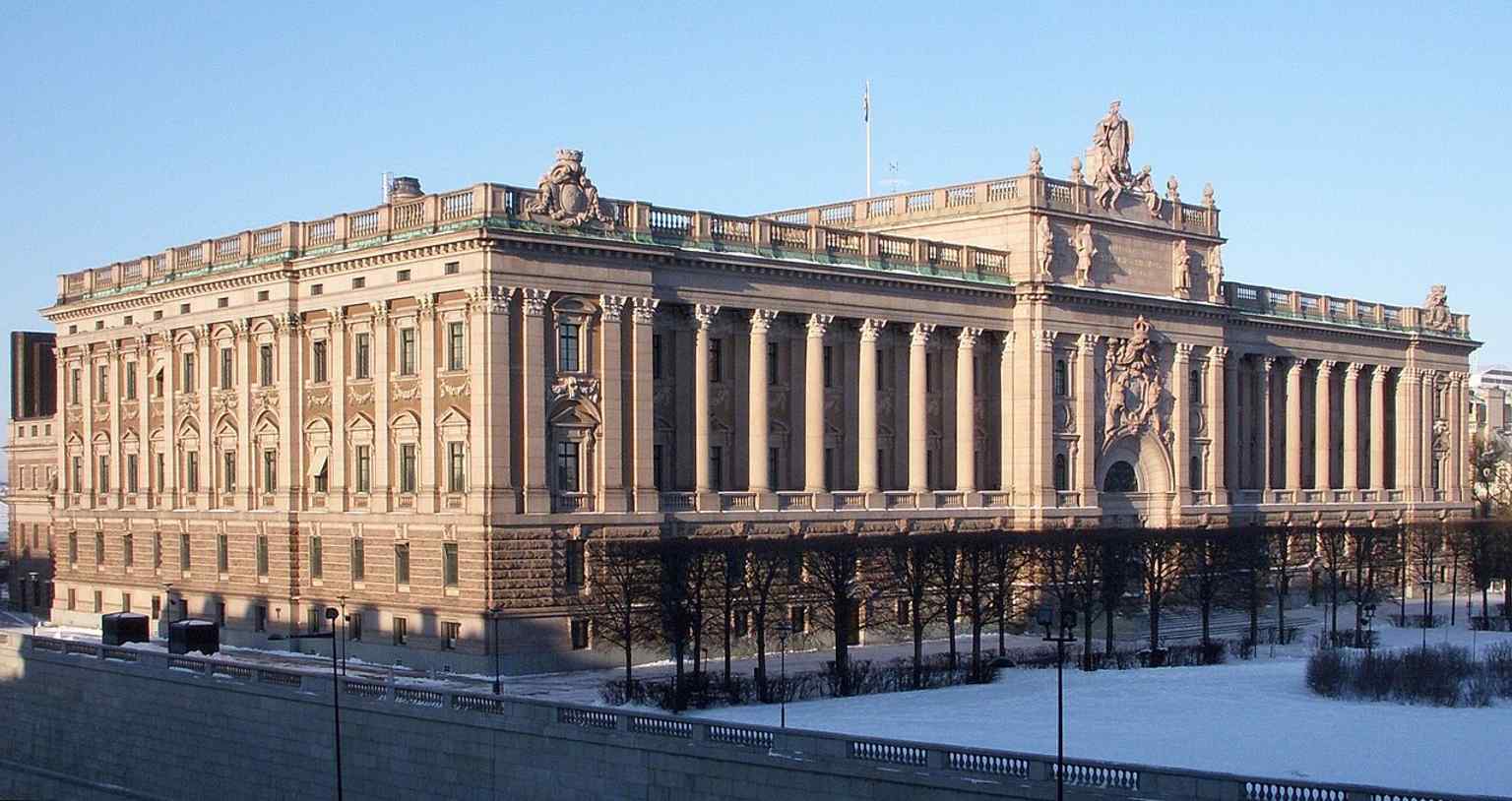
A clear front view of Riksdagshuset in central Stockholm, the seat of Sweden’s parliament since the building opened in 1905.Photo: Holger.Ellgaard, Wikimedia Commons, CC BY-SA 3.0. Cropped & resized. 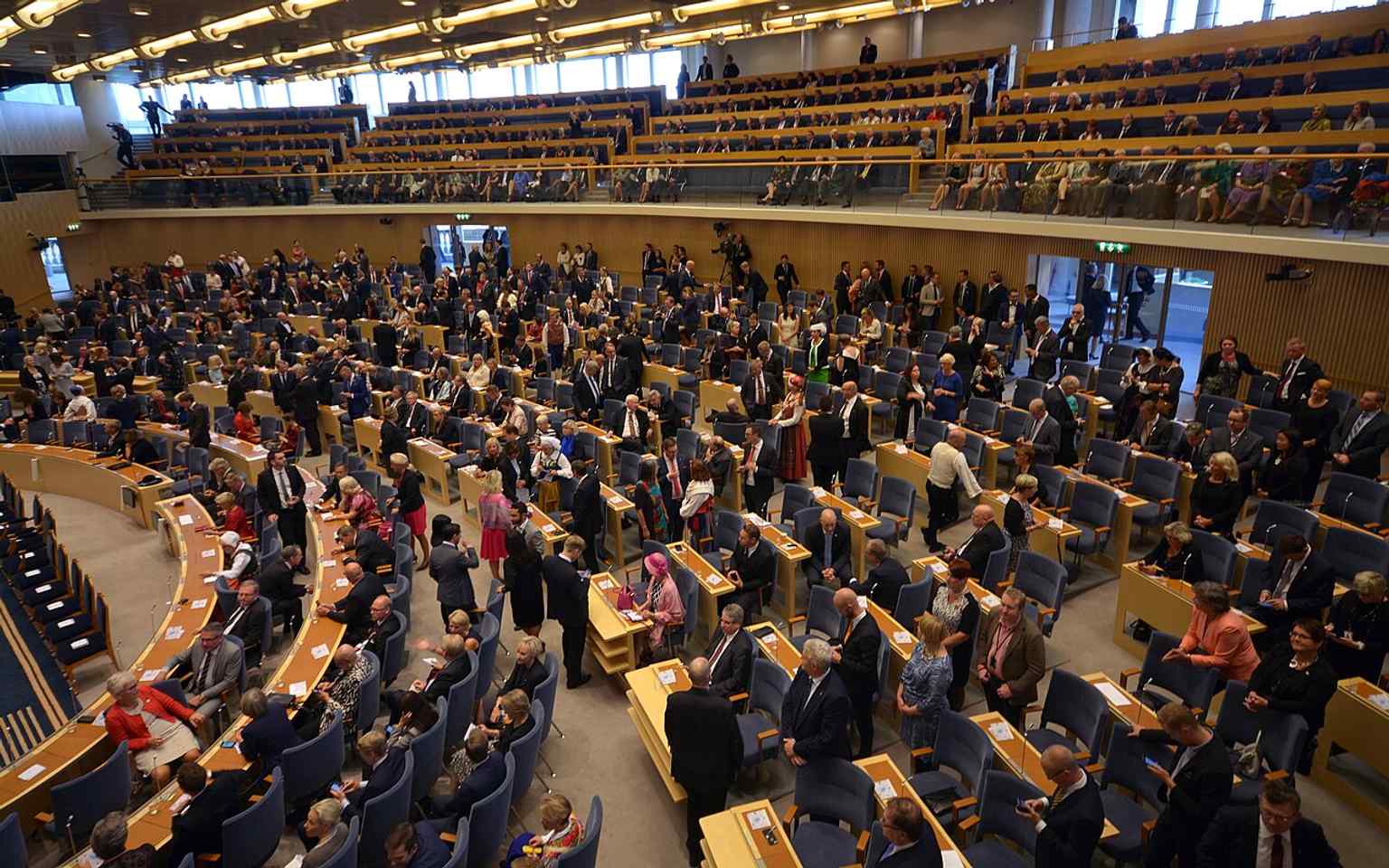
The ceremonial opening of the Riksdag, reflecting the parliament’s modern constitutional role and public state traditions.Photo: Esquilo, Wikimedia Commons, CC BY-SA 3.0. Cropped & resized. 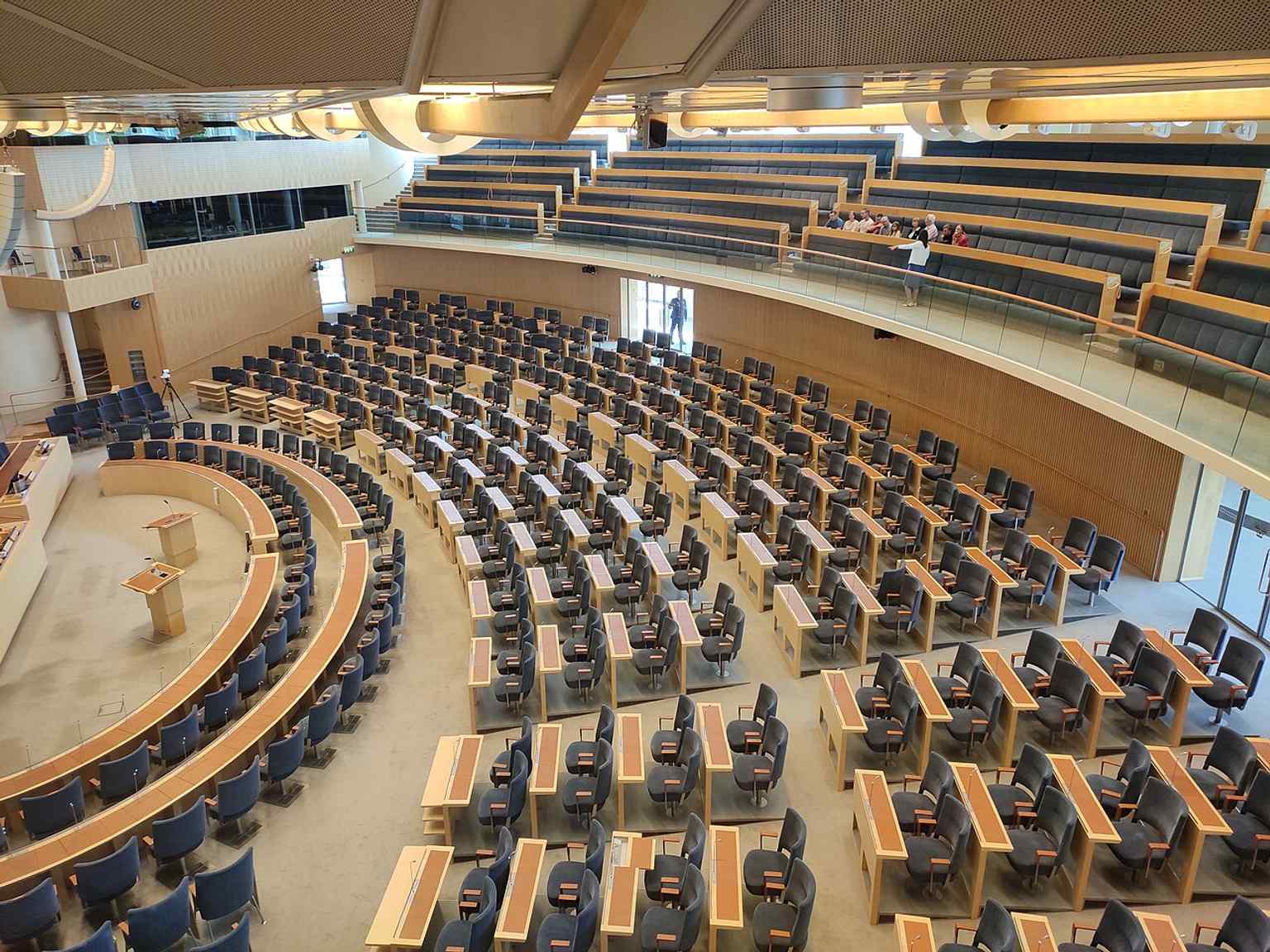
The meeting room inside the Riksdag, a good visual for committee work and day-to-day parliamentary decision-making.Photo: ANKAN, Wikimedia Commons, CC BY-SA 4.0. Cropped & resized. 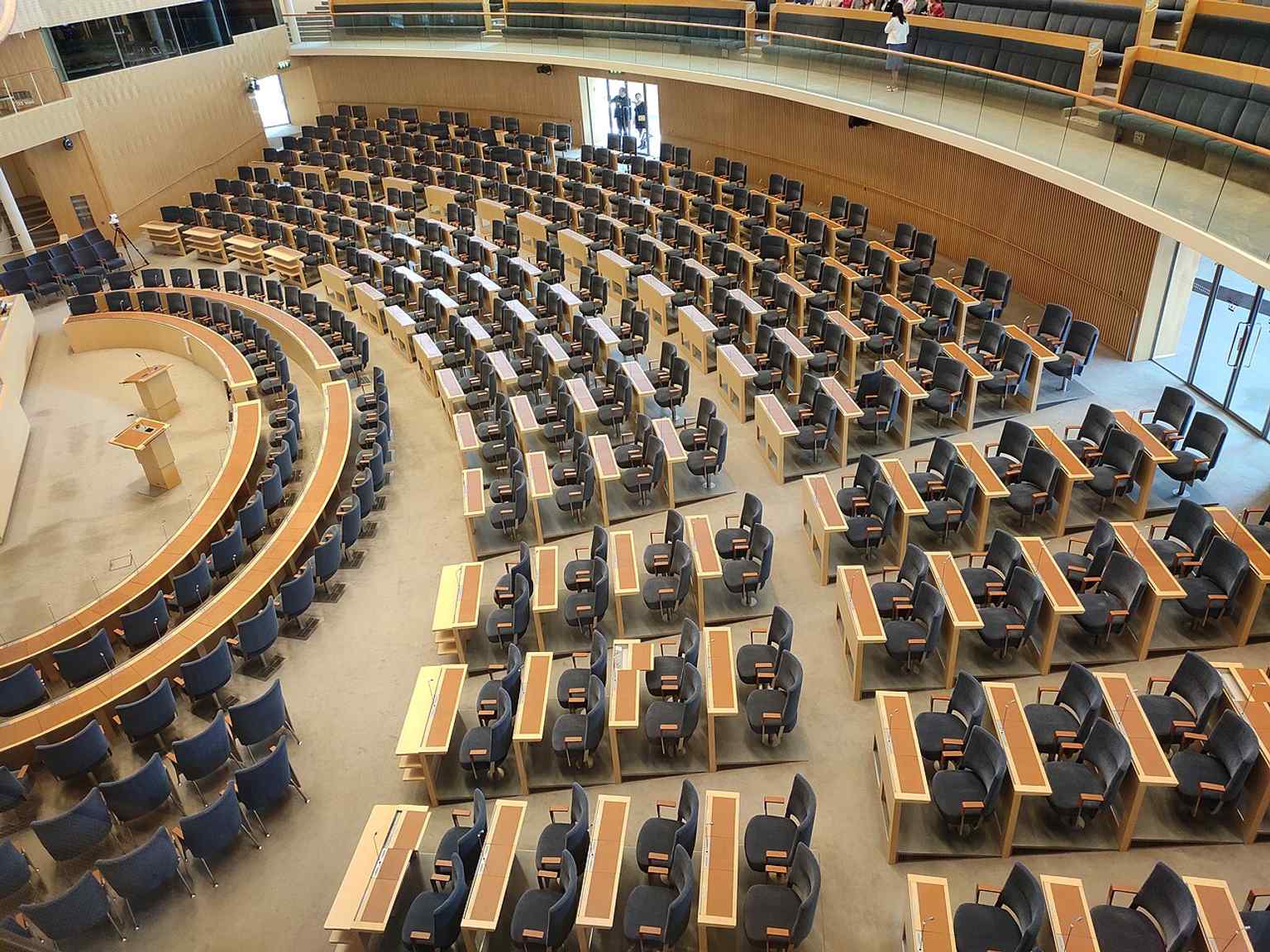
Another interior of the parliament’s meeting spaces, showing the formal setting where laws and government votes are handled.Photo: ANKAN, Wikimedia Commons, CC BY-SA 4.0. Cropped & resized. 
An official portrait of the Speaker and deputy speakers, illustrating the presidium that leads parliamentary proceedings.Photo: Los Perros pueden Cocinar, Wikimedia Commons, CC BY-SA 4.0. Cropped & resized. On your left, look for a long pale stone façade with a projecting central arch, rows of tall Corinthian columns, and the Swedish coat of arms carved above the main entrance. This…Read moreShow less
Open dedicated page →
The Riksdag building in StockholmPhoto: CEphoto, Uwe Aranas, Wikimedia Commons, CC BY-SA 3.0. Cropped & resized. On your left, look for a long pale stone façade with a projecting central arch, rows of tall Corinthian columns, and the Swedish coat of arms carved above the main entrance.
This is Riksdagshuset on Helgeandsholmen: not the Riksdag itself, which is Sweden’s parliament as an institution, but the building that gives that institution its public face. It rose between eighteen ninety-five and nineteen oh four, designed in a late nineteenth-century language of power, then changed again in the early nineteen eighties when parliament took over the old central bank wing and made the whole complex its home.
You can read that intention in the architecture. The row of columns in front is a colonnade, a formal screen of columns used to create ceremony before you even cross a threshold. The central section pushes forward like a Roman triumphal arch. Higher up, the roofline hides behind a balustrade, a stone railing, so the building ends with control rather than flourish. This was no accident. Parliament wanted dignity, but Stockholm argued over how much dignity was too much.
For years, people fought over whether anything this monumental should stand on Helgeandsholmen at all. Critics feared it would crowd the island and challenge the palace across the water. Supporters wanted a building that looked unmistakably national. That tension fell, in the end, onto one young architect: Aron Johansson. He did not even win the original competition. Others were dismissed, his senior collaborator Helgo Zettervall resigned in anger when the façade was pushed six meters closer to Norrbro, and Johansson had to carry one of Stockholm’s most disputed projects forward alone. His earlier design included a dome... but the dome never rose. What remained is more disciplined, almost stern.
If you glance at the image in the app, the overhead view makes the argument clear: the building sits in negotiation with bridges, water, and the royal city around it, not above them.
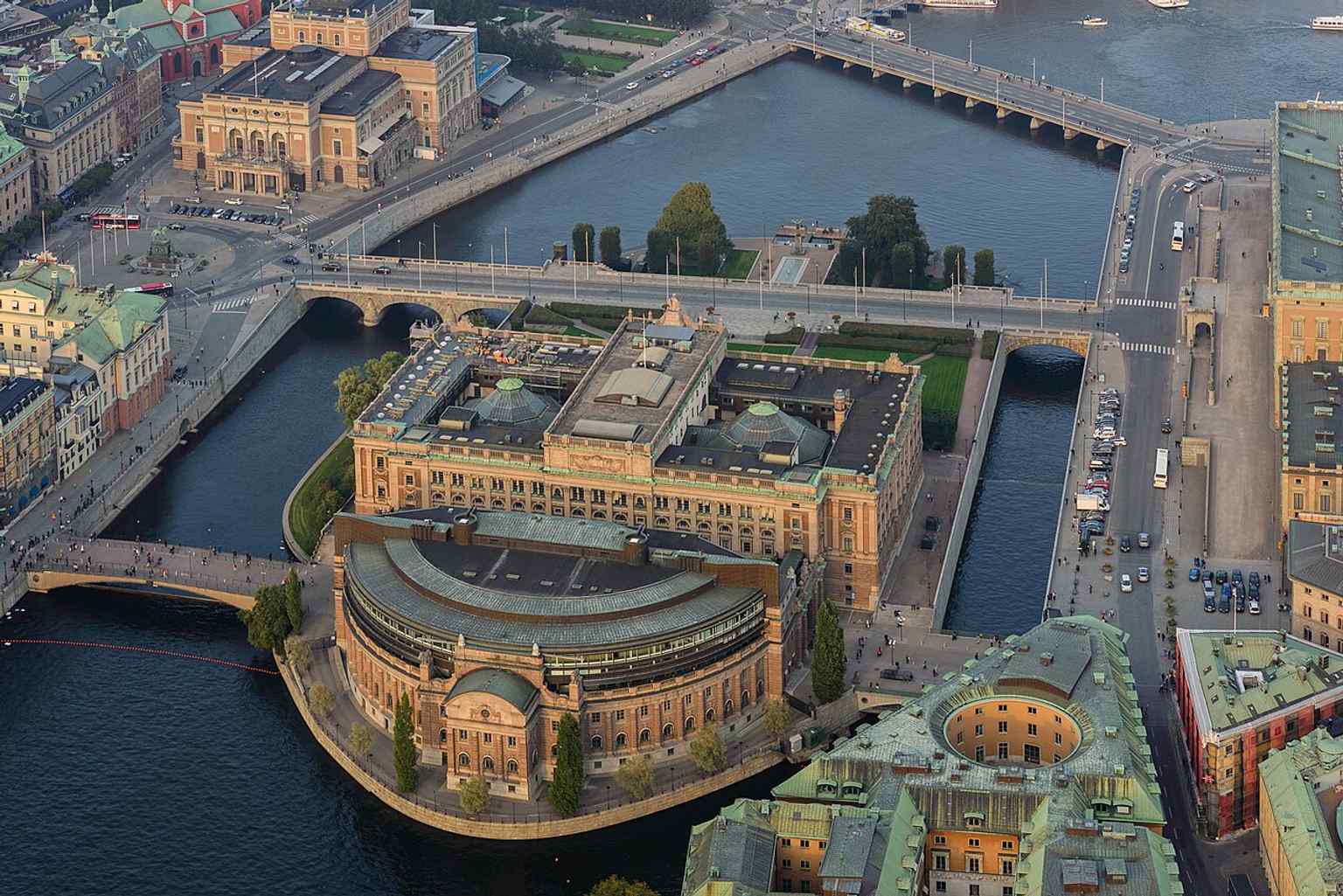
An overhead view from 2014 captures the parliament complex and surrounding streets, useful for explaining how the Riksdag sits between Norrbro and Riksplan.Photo: Arild Vågen, Wikimedia Commons, CC BY-SA 4.0. Cropped & resized. Its authority also rests on literal foundations. Builders removed thirty-seven thousand cubic meters of earth and drove more than nine thousand oak piles into the ground. On the thirteenth of May, eighteen ninety-seven, King Oscar the Second laid the foundation stone and placed inside it a sealed lead box holding constitutional texts, banknotes, coins, drawings, and newspapers, as if the state wanted to leave a message for the future about what mattered.
Look up to the sculpture if you can, or check the detail on your screen. Above the entrance sits the great coat of arms with lions. Higher still are figures representing the four old estates, and above them Mother Svea with two companions: Vigilance and Reflection. That is a remarkably direct lesson in how a parliament wished to be seen... watchful, thoughtful, and rooted in older forms of representation.
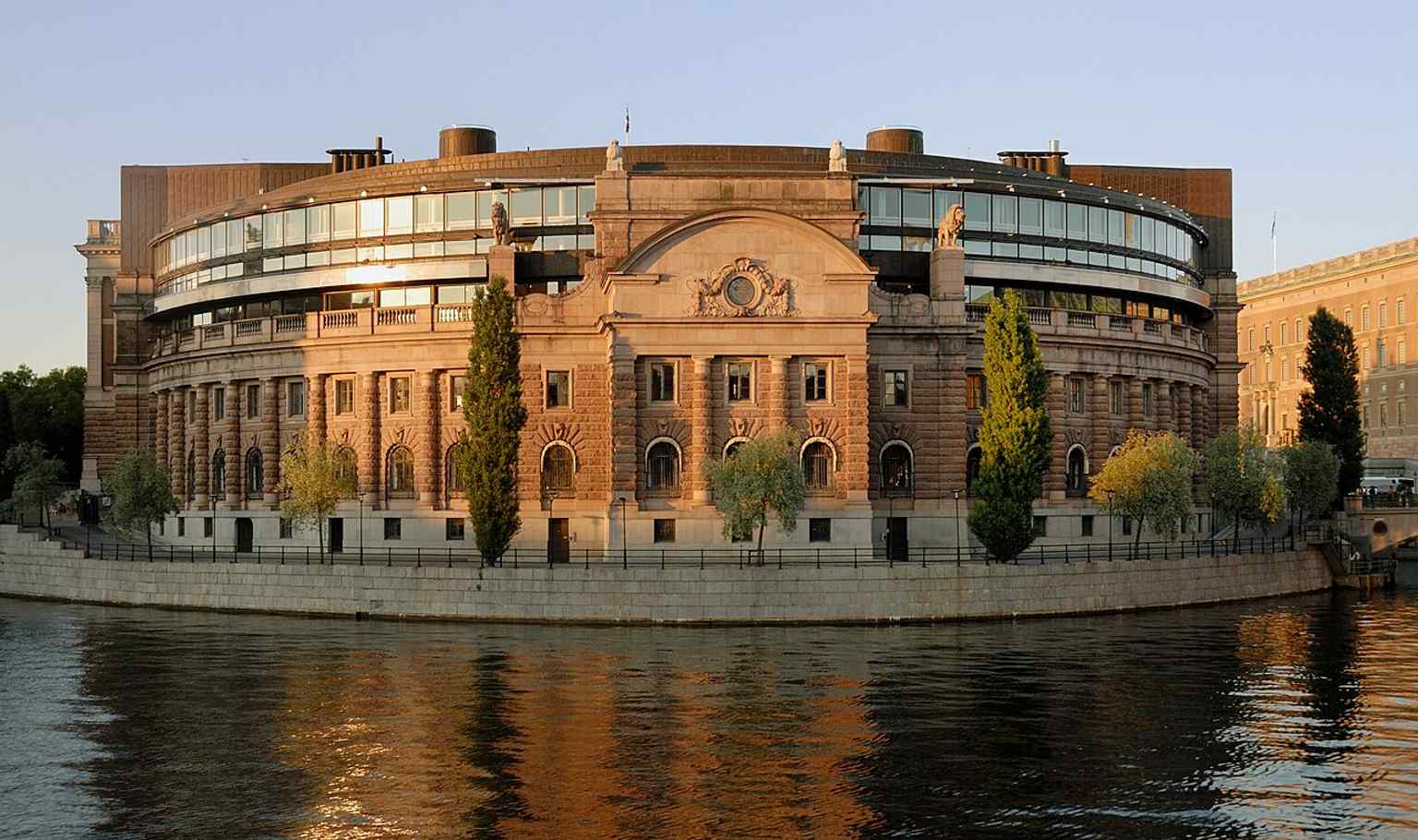
A closer exterior view of the Riksdag building, useful for discussing the façade details and the decorative sculpture program.Photo: Peter Haas, Wikimedia Commons, CC BY-SA 3.0. Cropped & resized. Yet the building did not freeze in nineteen oh five. After Sweden moved to a single-chamber parliament in nineteen seventy-one, architects Ahlgren-Olsson-Silow reshaped the former bank wing and added the new plenary hall, copper-clad above. During excavation, workers expected a garage under Riksplan and uncovered parts of Stockholm’s early sixteenth-century city wall instead. The garage shrank. The Medieval Museum took shape. Even modern democracy, here, had to negotiate with buried history.
That may be the most important thing to notice: this house of government only makes sense because of the crossings around it, the bridge ahead, the palace opposite, the older city pressing close. Next, head toward Norrbro, where those connections become impossible to miss.
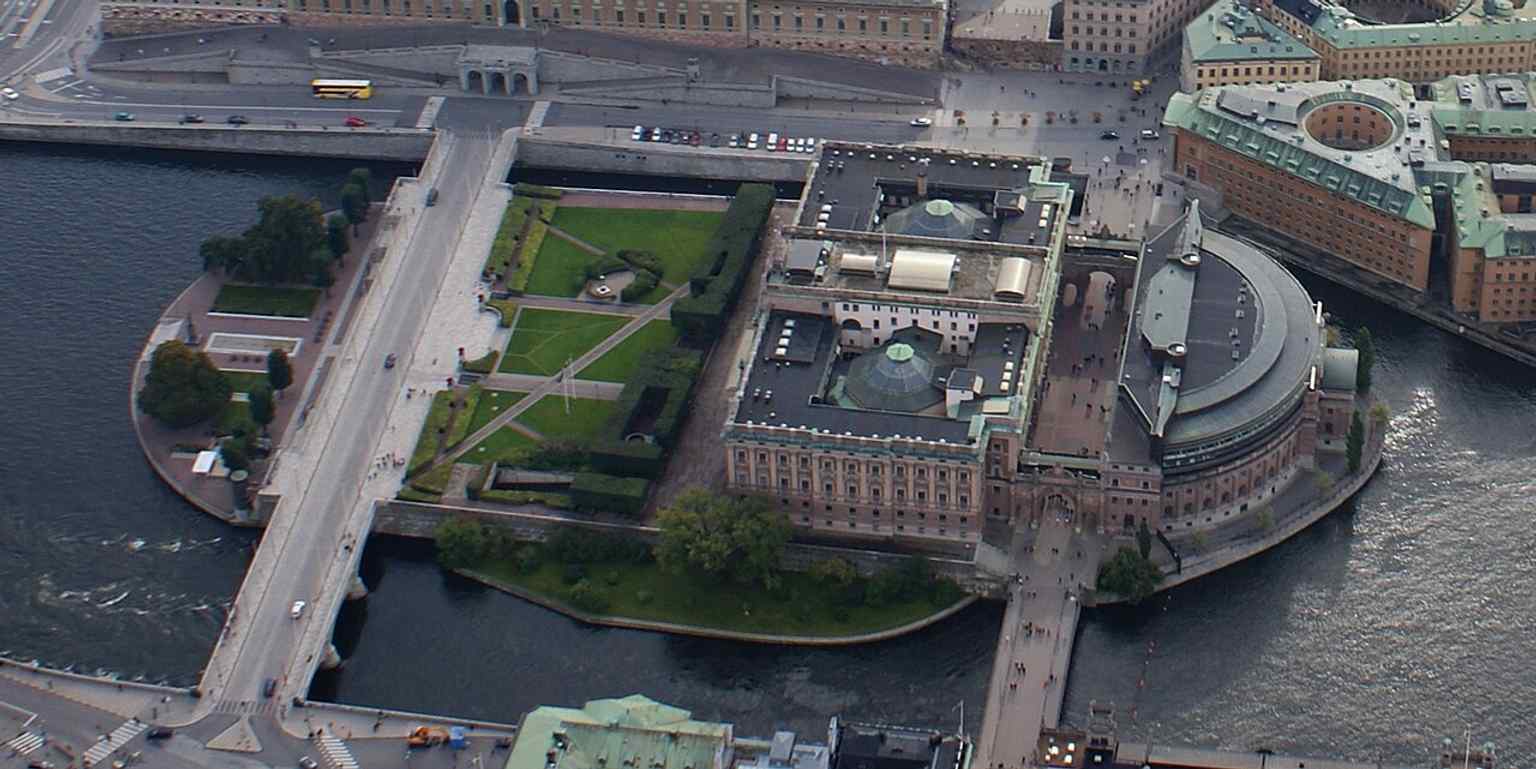
A helicopter view of Helgeandsholmen shows the Riksdag building in its whole setting beside the waterways and the historic center of Stockholm.Photo: Jan Ainali, Wikimedia Commons, CC BY-SA 3.0. Cropped & resized. 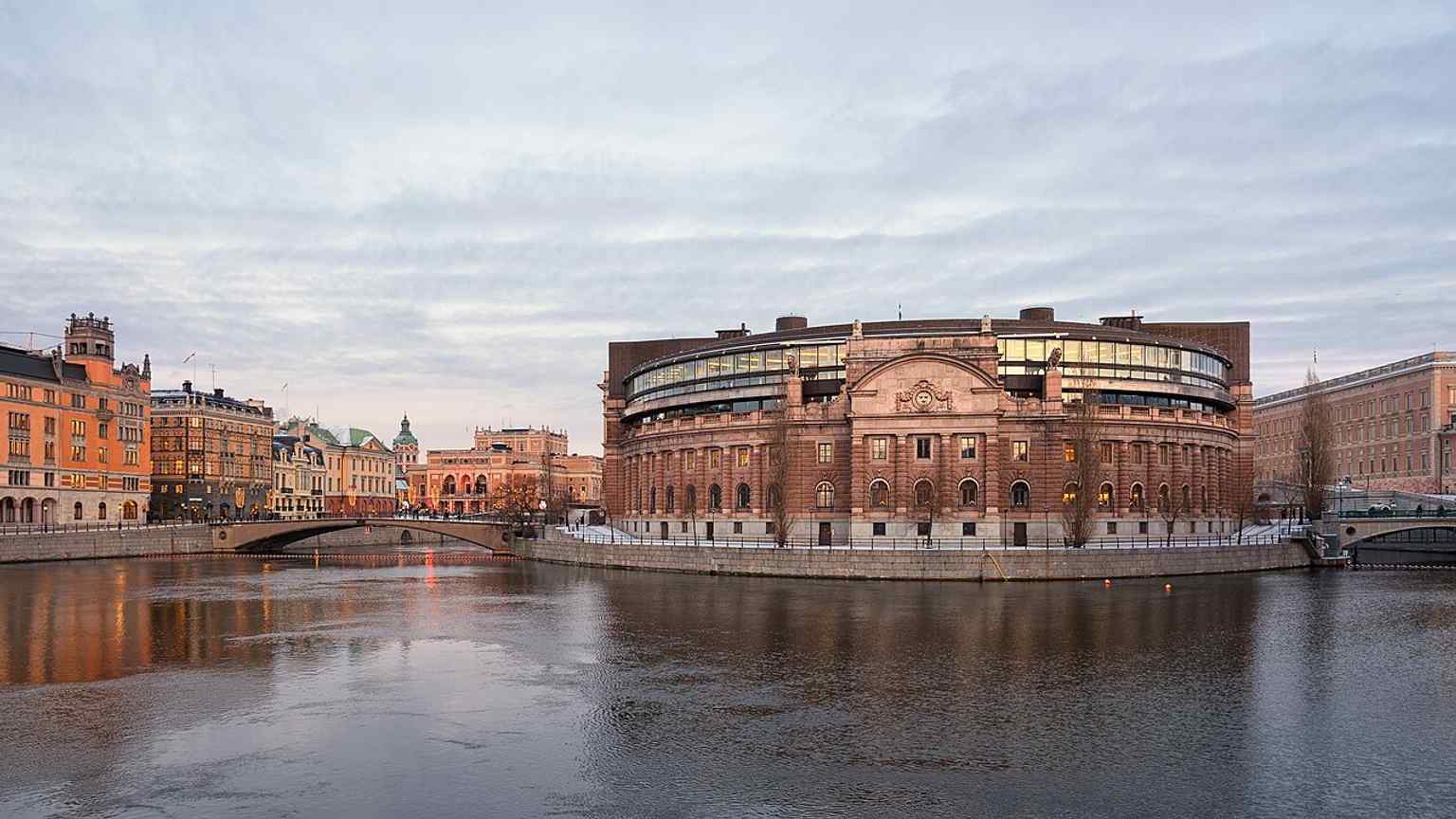
The parliament house with the Royal Swedish Opera in the background gives a broader Stockholm context and shows the building’s urban setting.Photo: Julian Herzog (Website), Wikimedia Commons, CC BY 4.0. Cropped & resized. 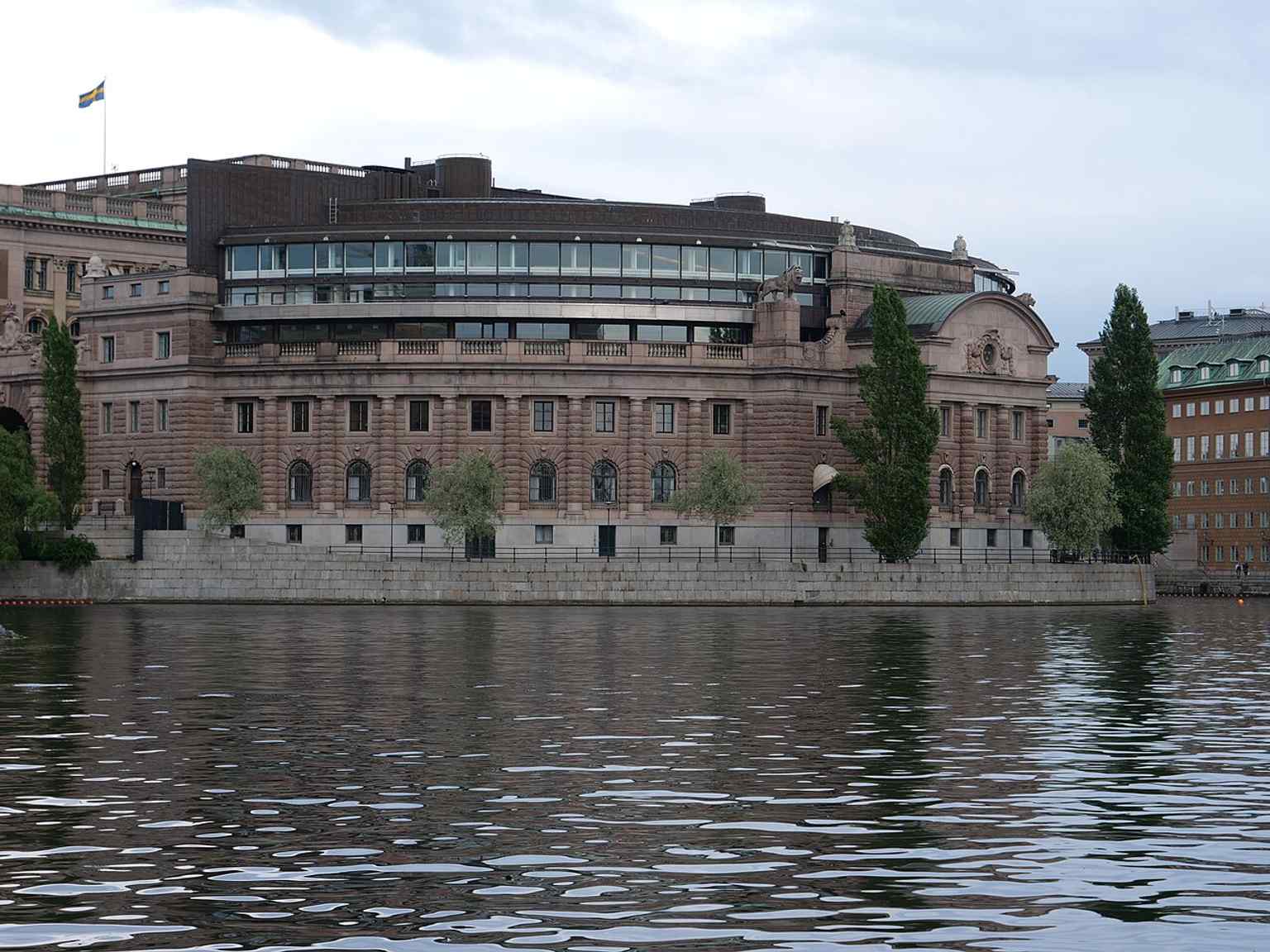
The north side of the Riksdag building, a less common angle that helps diversify the exterior coverage beyond the main front.Photo: Leonhard Lenz, Wikimedia Commons, CC BY-SA 4.0. Cropped & resized. 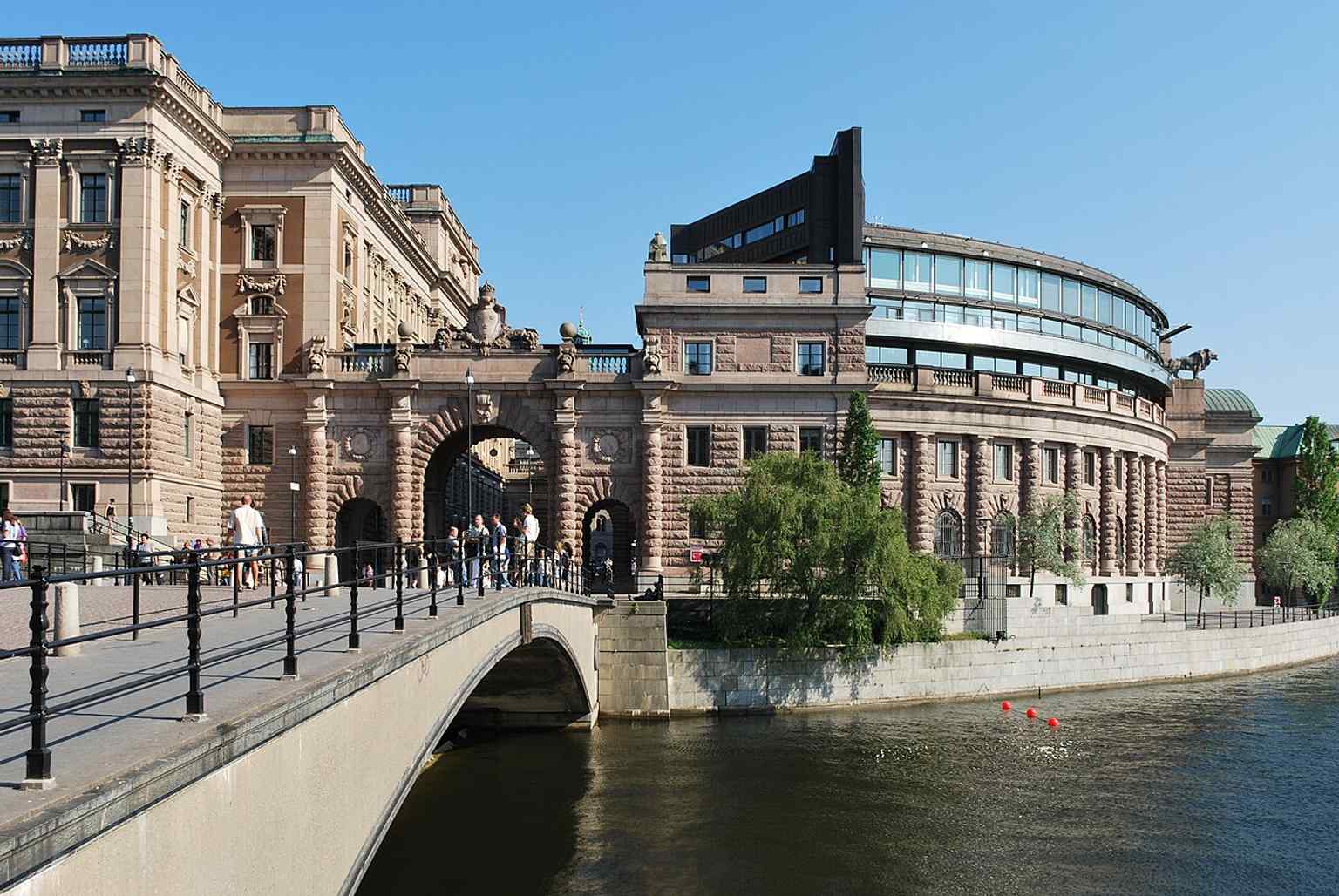
Walking toward the building along Riksbron emphasizes the approach to the parliament house across the water, just as visitors experience it on foot.Photo: Gordon Leggett, Wikimedia Commons, CC BY-SA 4.0. Cropped & resized. 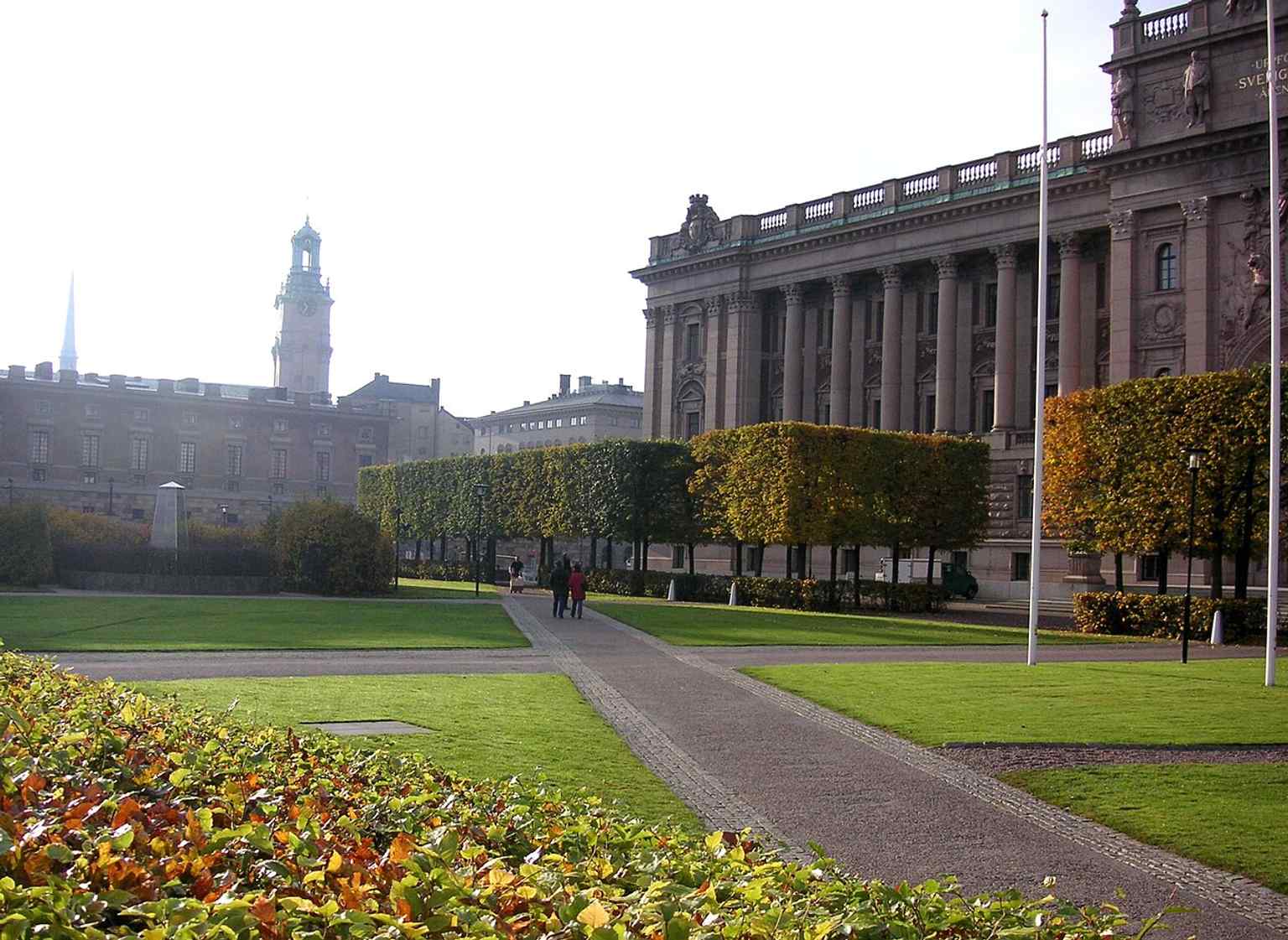
Riksplan in front of the parliament building highlights the open forecourt that frames the eastern side of the Riksdag.Photo: Holger Ellgaard, Wikimedia Commons, CC BY-SA 3.0. Cropped & resized. 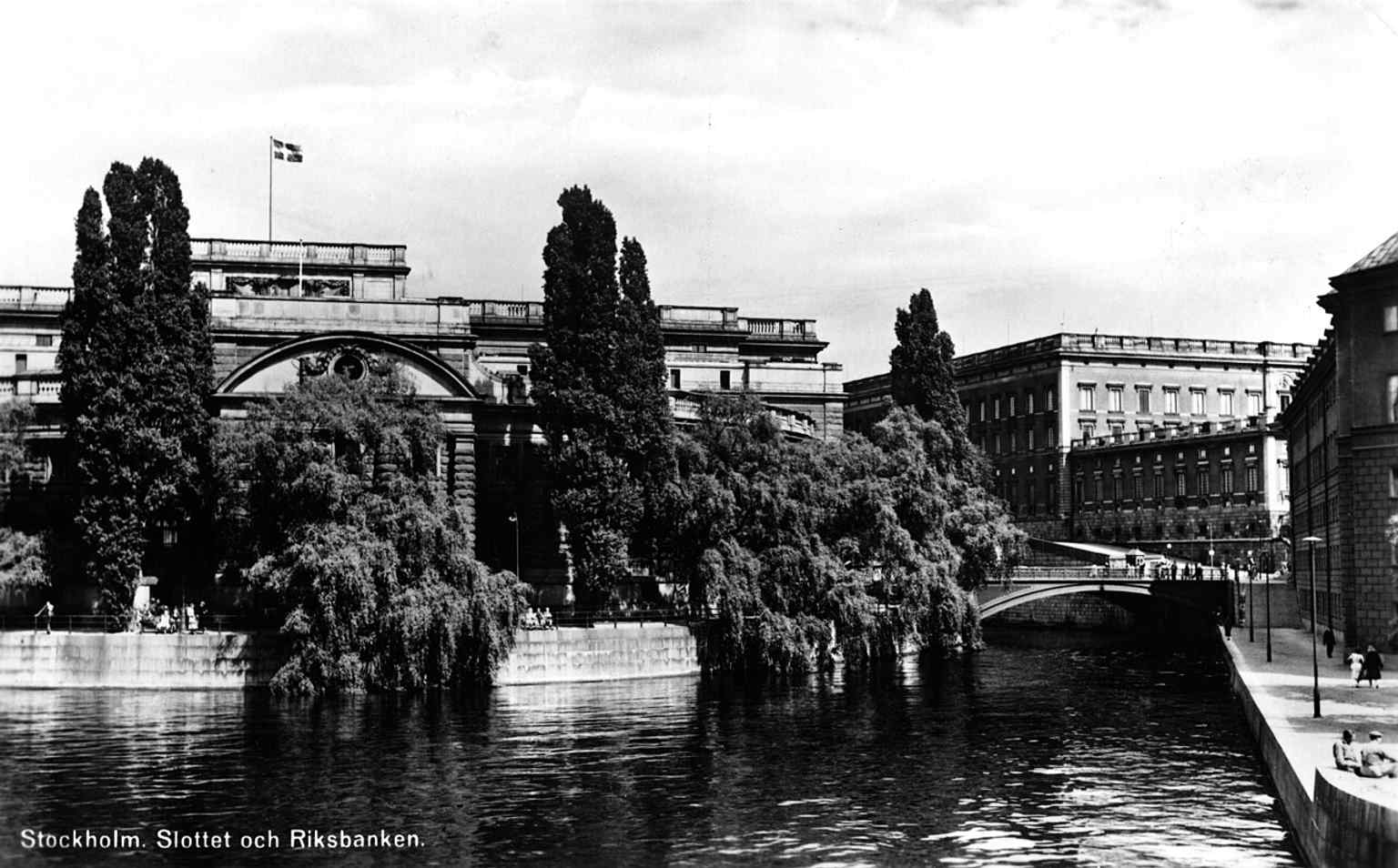
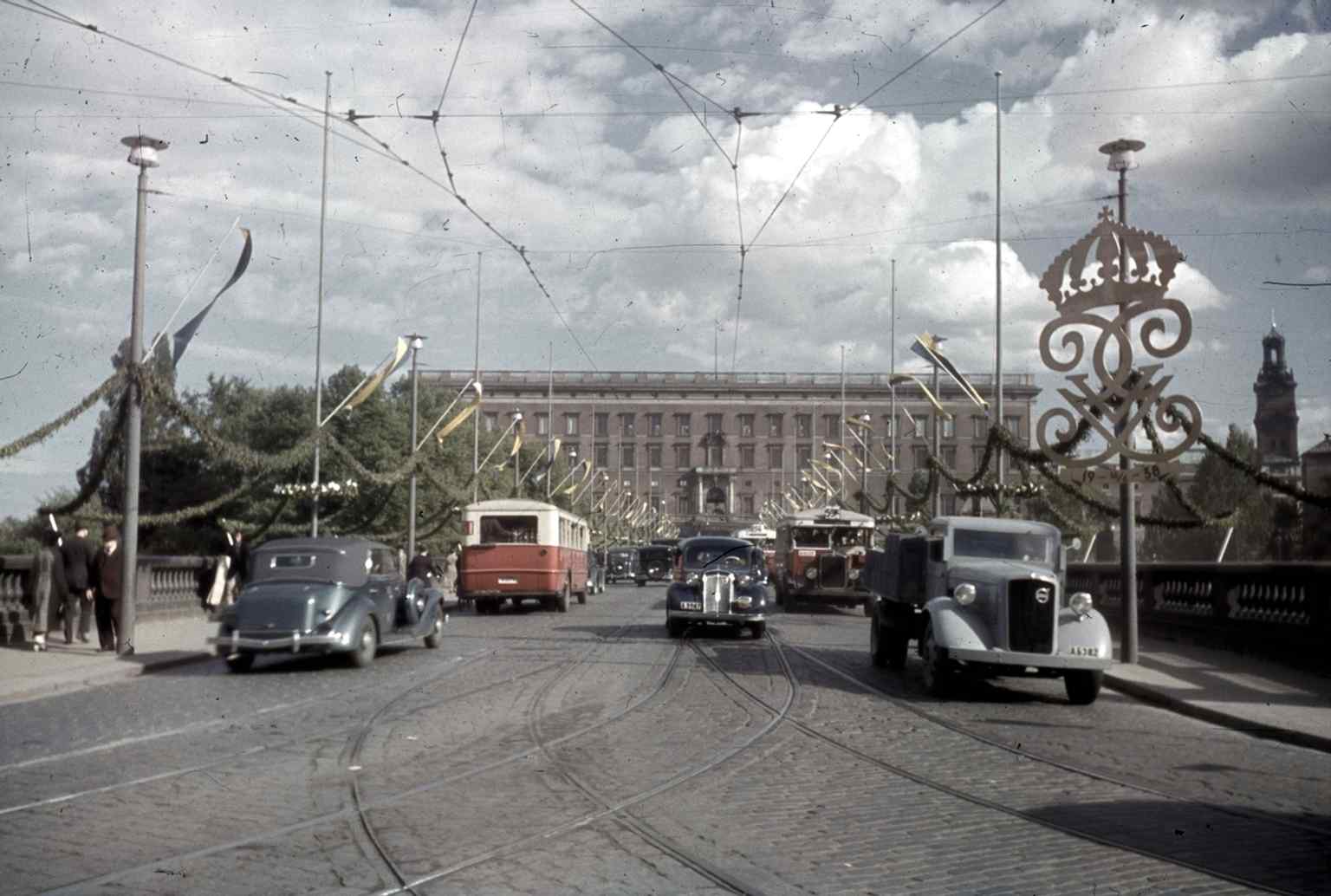
A 1950s postcard of Stockholm showing the palace and the old Riksbanken context, helping place the Riksdag area in its historic city setting.Photo: Sago-Konst AB, Wikimedia Commons, Public domain. Cropped & resized. Norrbro means, quite simply, the north bridge... and that plain name tells you something essential about Stockholm. Before this city became a capital of chambers, crowns, and…Read moreShow less
Open dedicated page →Norrbro means, quite simply, the north bridge... and that plain name tells you something essential about Stockholm. Before this city became a capital of chambers, crowns, and ceremony, it had to solve a more basic question: how do people, goods, soldiers, messages, and orders get across the water?
You are standing on the answer. Norrbro links Gamla stan to Norrmalm in a line that runs from Lejonbacken below the palace to Gustav Adolfs torg. The bridge you see now opened in eighteen oh seven, and it still matters because it is the oldest surviving stone bridge in Stockholm. Carl Fredrik Adelcrantz drew the plan, Erik Palmstedt reshaped it, and the builder Jonas Lidströmer helped turn ambition into masonry.
Gustav the Third laid the foundation stone in seventeen eighty-seven. More than two centuries later, Crown Princess Victoria helped mark the bridge’s reopening in twenty ten, almost as if the city wanted to complete the same gesture across generations.
But the need for a northward crossing is much older than this stonework. Written records mention Stockholm’s northern bridge as early as twelve eighty-eight, in a donation letter from King Magnus Ladulås. A few years later, the law code called Upplandslagen mentioned Stockholm’s bridge again. That is a clue to the city’s earliest logic: this was not a place that simply grew on land. It grew by managing passage between islands.
The route itself kept shifting. Earlier bridges stood farther west, more in line with Västerlånggatan, and by the late seventeen hundreds three wooden bridges crossed here, including Slaktarhusbron and Vedgårdsbron. Today’s Norrbro gathered those messy crossings into a single, deliberate royal axis. That matters. A bridge can do more than connect shores; it can organize a city around authority.
Look at its scale. Nineteen meters wide, built in three sections, with stone arches over Stallkanalen and Norrström and a flat middle span across Helgeandsholmen, it was generous for its time. Stockholm laid its first sidewalks here. The city lit its first gas lamps here in eighteen fifty-three, and later tested its first electric lighting here too. For a while, Norrbro did not just carry traffic. It staged urban life.
In the nineteenth century, elegant walkers used it as a promenade, a place to see and be seen. Shops lined the bridge in the Norrbrobasaren, turning a crossing into a marketplace. If you look at the before-and-after image, you can watch Norrbro shift from a decorated traffic bridge in nineteen thirty-eight to the modern crossing beside you now. When the parliament complex rose on Helgeandsholmen around nineteen hundred, the bazaar disappeared, and the bridge became less commercial, more ceremonial... a route for parades, protests, funeral processions, and state arrivals.
There is another Stockholm here too, the one under the present surface. Late twentieth-century excavations on Helgeandsholmen made this one of the city’s most important archaeological sites, a reminder that each new route rests on older attempts.
After two hundred years with little major care, the bridge began to fail. Its foundations shifted, the eastern facade bulged outward, and water leaked into the Medieval Museum beneath the middle span. Between two thousand seven and two thousand ten, workers dismantled large sections stone by stone, replaced rusted iron fastenings, renewed utility lines, and anchored the structure with more than three hundred jet columns. The cost reached one hundred seventy-five million kronor.
Walk on toward the palace, and you will see what this bridge ultimately served: passage narrowing into command. And, conveniently, Norrbro is open at all hours.
Norrbro in 1938, shown decorated for King Gustaf V’s 80th birthday — a rare pre-war view of the bridge as a ceremonial city stage.Photo: Gunnar Herbert Lundh, Wikimedia Commons, Public domain. Cropped & resized. 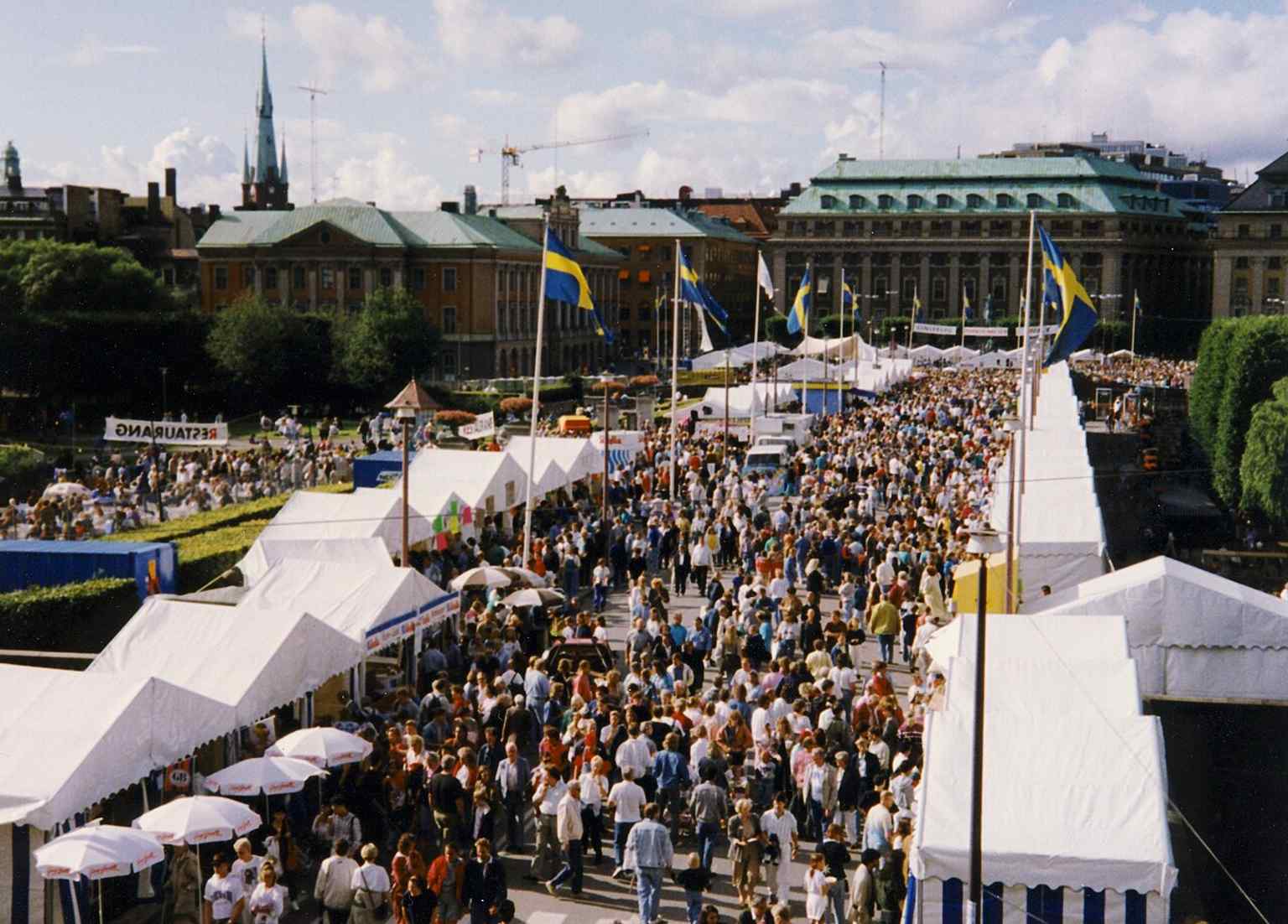
Norrbro turned into a festival venue during Stockholm Water Festival 1991, showing how the bridge has long served as a public gathering place.Photo: Holger.Ellgaard, Wikimedia Commons, CC BY-SA 3.0. Cropped & resized. 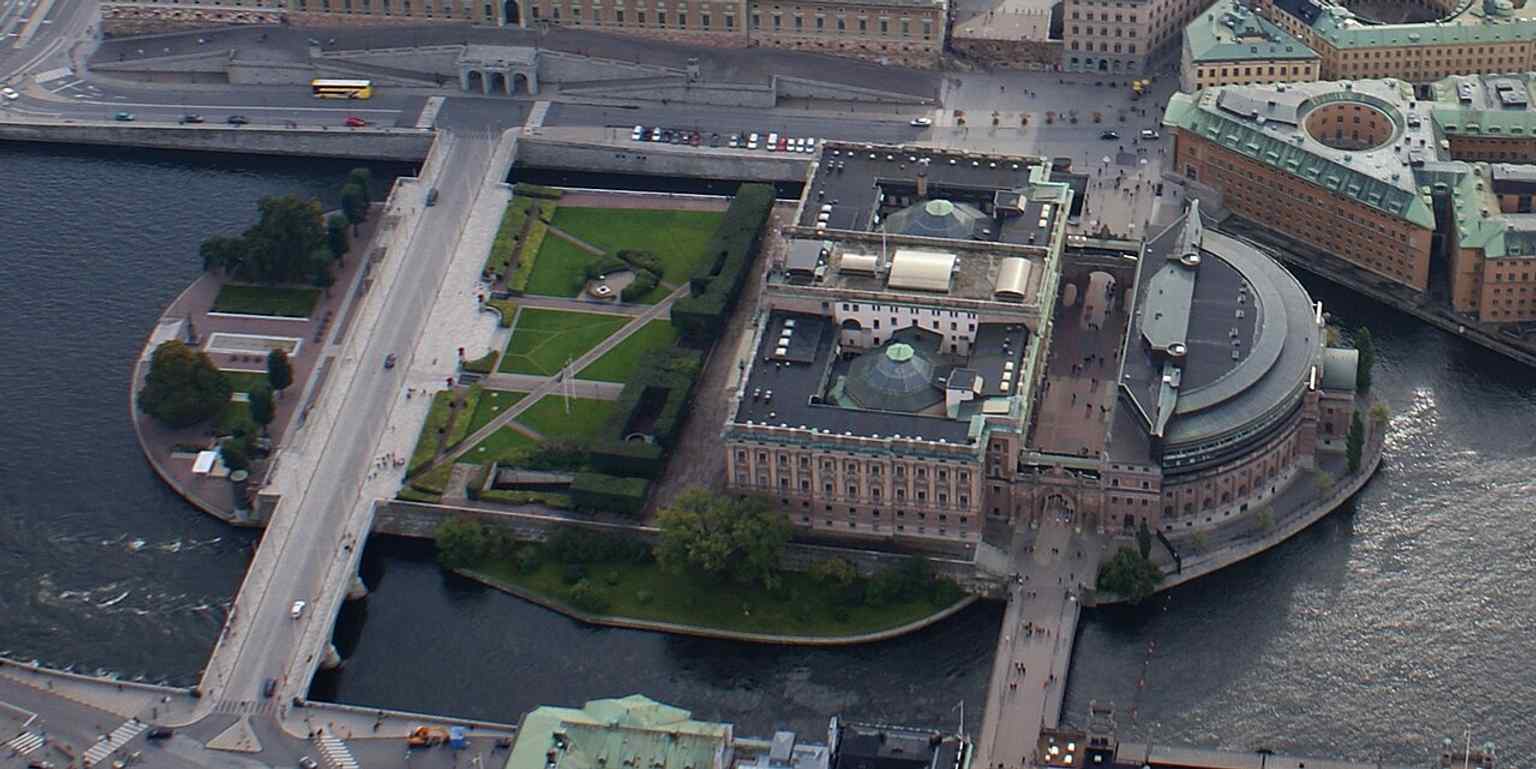
A helicopter view of Helgeandsholmen, the middle section of Norrbro’s three-part crossing between Gamla stan and Norrmalm.Photo: Jan Ainali, Wikimedia Commons, CC BY-SA 3.0. Cropped & resized. 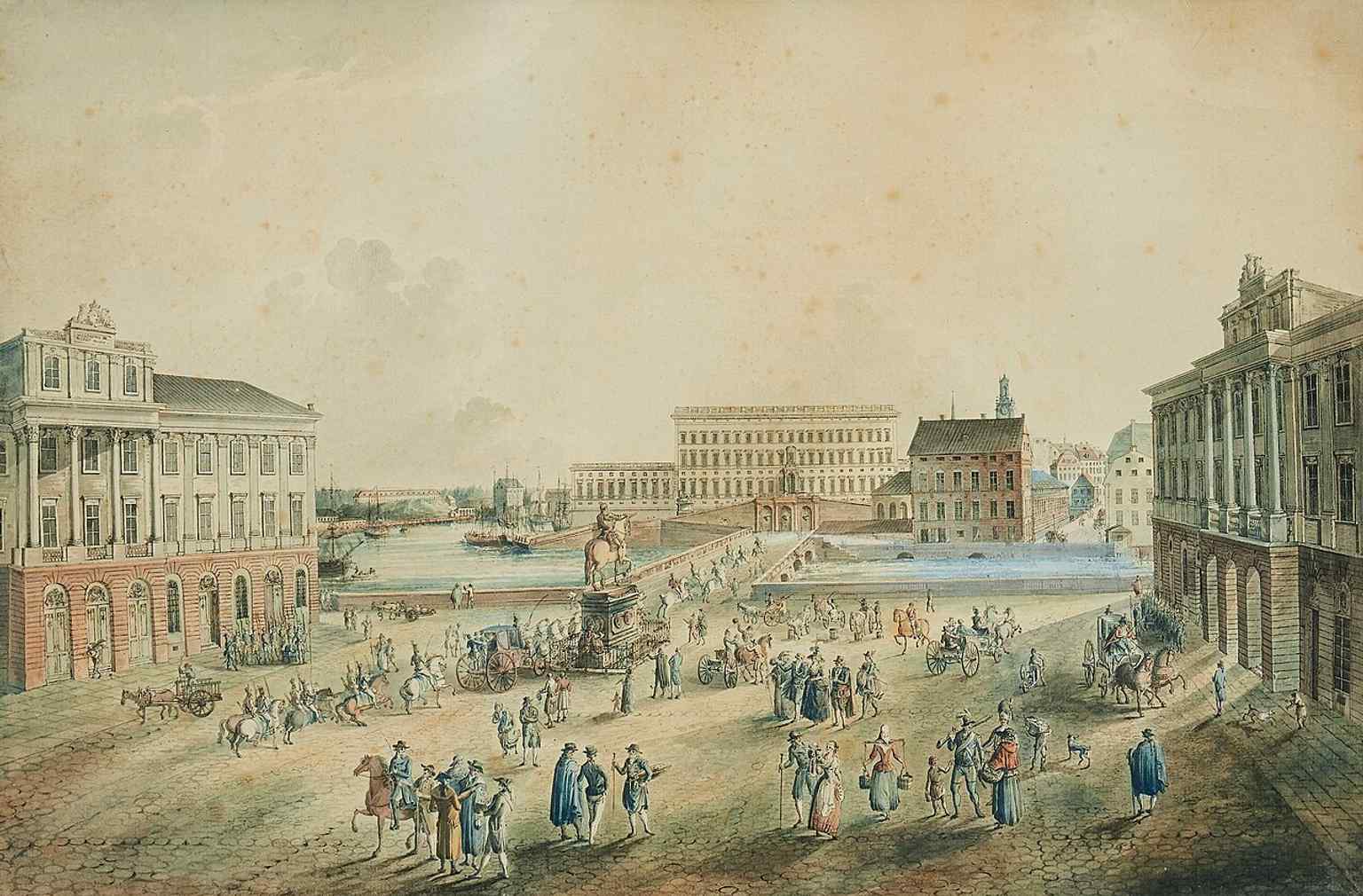
An 1790 watercolor of the Norrbro area with the Royal Palace and Gustav Adolph’s Square, capturing the bridge’s original role in the royal city axis.Photo: Johan Fredric Martin, Wikimedia Commons, Public domain. Cropped & resized. 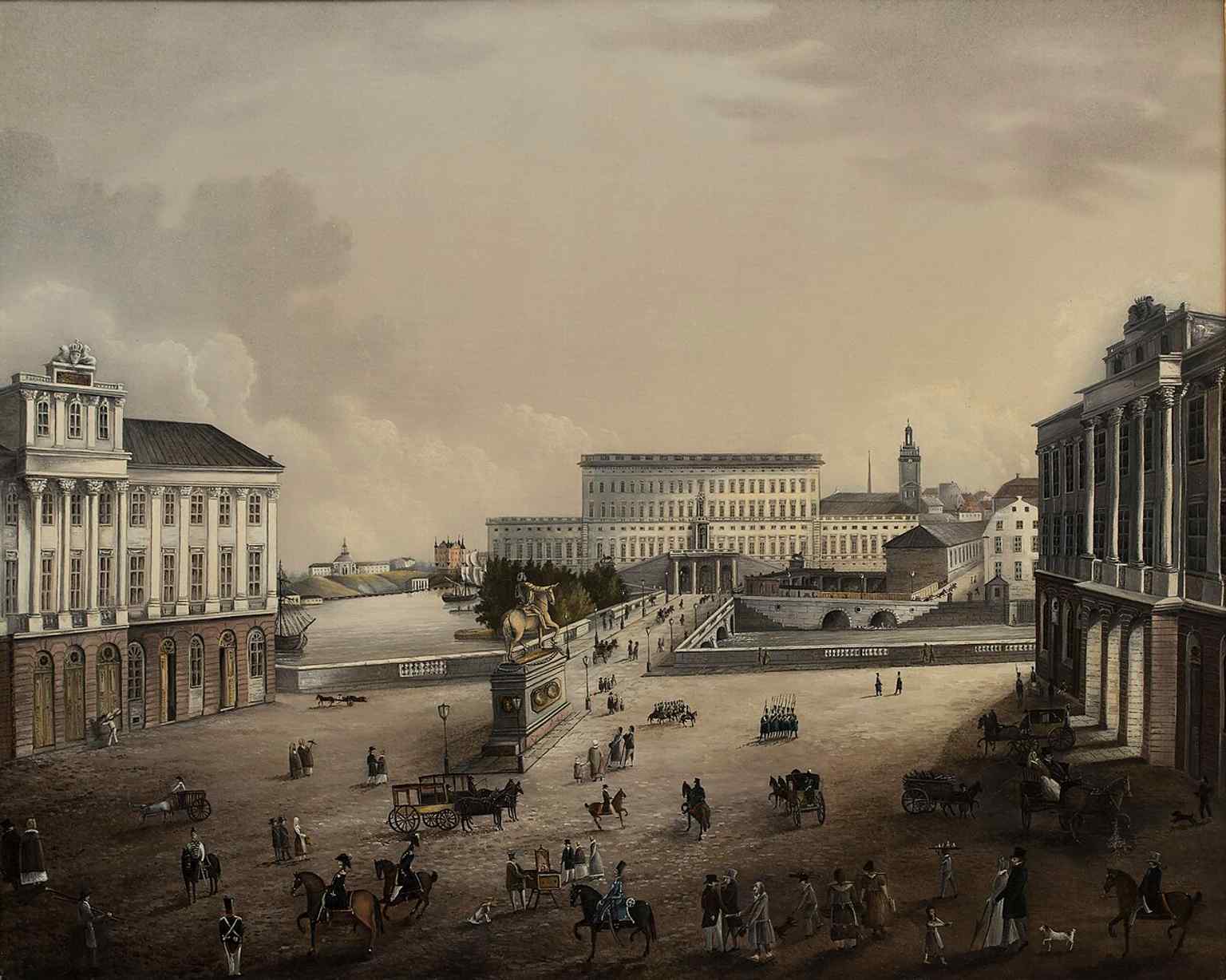
A 1862 view of Gustav Adolfs torg with Norrbro and the Norrbrobasaren, reflecting the bridge’s 19th-century life as both promenade and marketplace.Photo: Carl Gustaf Ulfsparre, Wikimedia Commons, Public domain. Cropped & resized.

Show 17 more stopsShow fewer stopsexpand_moreexpand_less
On your left rises a vast brick-red rectangle of brick and sandstone, lined with strict rows of windows and marked by a broad central balcony on the main western facade. This is…Read moreShow less
Open dedicated page →On your left rises a vast brick-red rectangle of brick and sandstone, lined with strict rows of windows and marked by a broad central balcony on the main western facade.
This is Stockholm Palace, the royal palace... but it is not simply a home. King Carl the Sixteenth Gustaf and Queen Silvia usually live at Drottningholm, while this building serves as the monarch’s official address, workplace, and stage for state ritual. Royal power here works through appearance: audiences, banquets, medals, cabinet meetings, guards, entrances, exits. Across the water, the Riksdag speaks for the nation in one architectural language; this palace answers in another, older one... command made ceremonial.
And yet this grand facade stands on a defensive site. In the thirteenth century, Birger Jarl placed a fortress here to control the narrow passage into Lake Mälaren. That mattered more than beauty. Whoever held this point could watch trade, movement, and threat. Over time the stronghold grew into the kingdom’s main residence and administrative center, so monarchy in Stockholm did something very practical: it turned military control into political presence.
The man who gave that change its form was Nicodemus Tessin the Younger. He studied Roman Baroque, especially the strict balance of palaces in Rome, and he wanted Sweden to speak that same language of durability. Then disaster struck. On the seventh of May, sixteen ninety-seven, fire tore through the old castle here.
Most of it died in smoke and heat, but parts of the newer northern walls survived. Only six weeks later, Tessin laid new drawings before the government. That speed tells you a lot. The palace was not just royal property; it was part of how the state functioned.
Take a moment and let your eyes travel across the facade. Count the windows if you like, imagine the courtyards hidden inside, and ask yourself how much stone a monarchy needs in order to look permanent.
The answer is: quite a lot. The palace holds more than one thousand four hundred rooms, about six hundred and sixty windows inside, and nearly a thousand windows in its outer walls. But for all that grandeur, it is surprisingly public in another sense. The Swedish state owns it. The National Property Board maintains it. The Royal Court works here with around two hundred employees. So this immense royal symbol survives not by staying untouched, but by being administered, repaired, modernized, and made useful.
If you want a clearer sense of the palace as a machine of ceremony, glance at the aerial image in the app; the courtyards and wings make the whole complex read almost like a diagram of power.
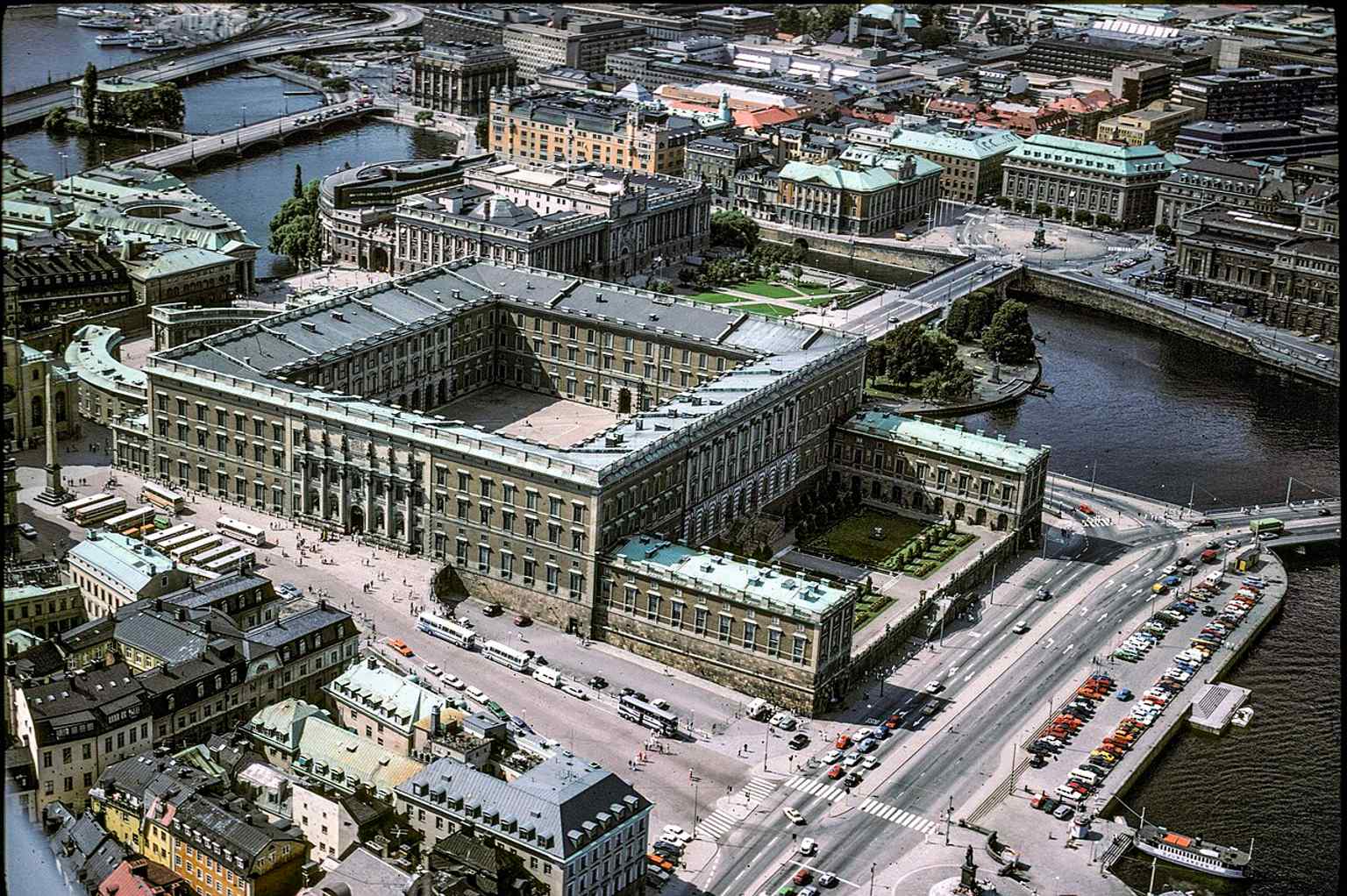
A clear aerial view of Stockholm Palace and its courtyard layout, showing how the royal complex sits between Gamla stan and the waterfront.Photo: L.G.foto, Wikimedia Commons, CC BY-SA 4.0. Cropped & resized. Construction itself dragged on for decades. War halted work in seventeen oh nine. In seventeen twenty-seven, the Riksdag stepped in with funding because the administration needed a proper seat. Tessin died before he saw it finished, and Carl Hårleman completed much of the interior, adding Rococo elegance behind this severe exterior. The royal family finally moved in in seventeen fifty-four.
If you check the before-and-after image, you’ll see how little the palace changed even as the approach around it became cleaner and more ceremonial.
So what looks fixed is really adapted power: fortress to castle, castle to palace, residence to official theater. And behind this ordered face, older walls still linger in cellars and foundations... the outline of a tougher, half-vanished stronghold we’ll meet soon. For now, we continue toward the palace banquet rooms, about two minutes away. The palace is generally open daily from ten to five.
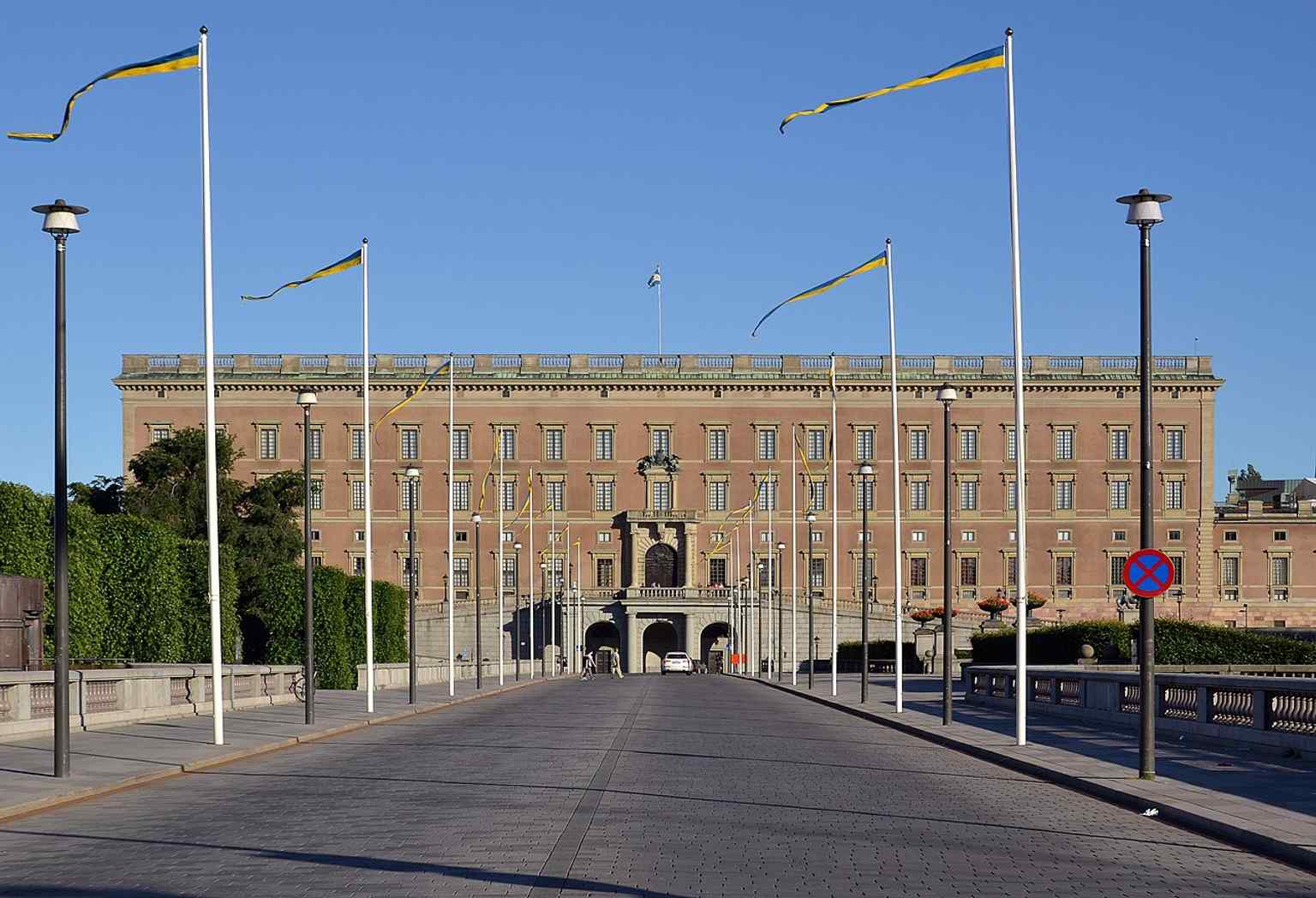
A strong overall exterior view of the Royal Palace, useful for introducing Sweden’s official royal residence in central Stockholm.Photo: Pudelek, Wikimedia Commons, CC BY-SA 4.0. Cropped & resized. 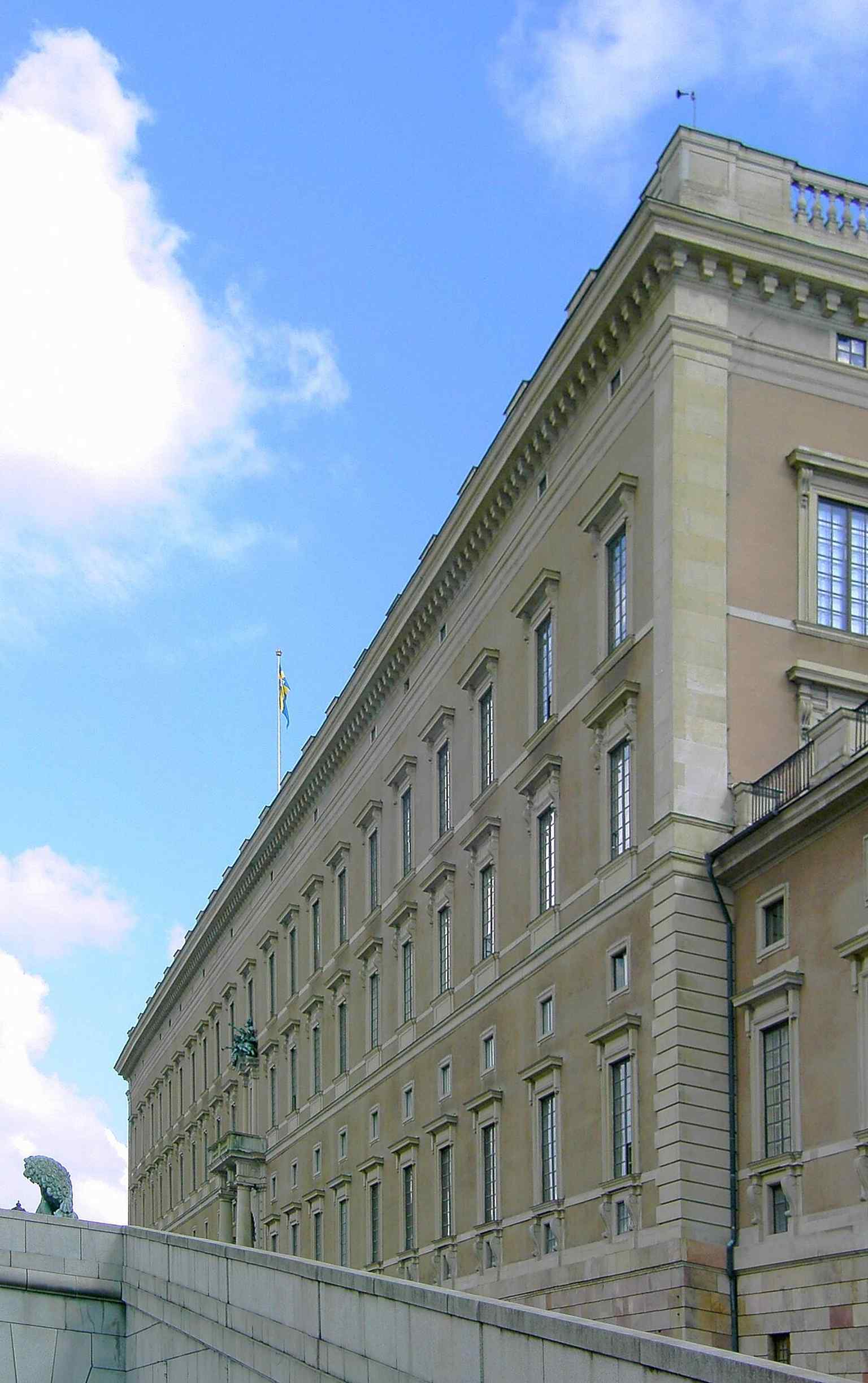
A dramatic full-height view along Lejonbacken, the northern approach where the palace’s power-symbol lions stand guard.Photo: Mastad, Wikimedia Commons, CC BY-SA 3.0. Cropped & resized. 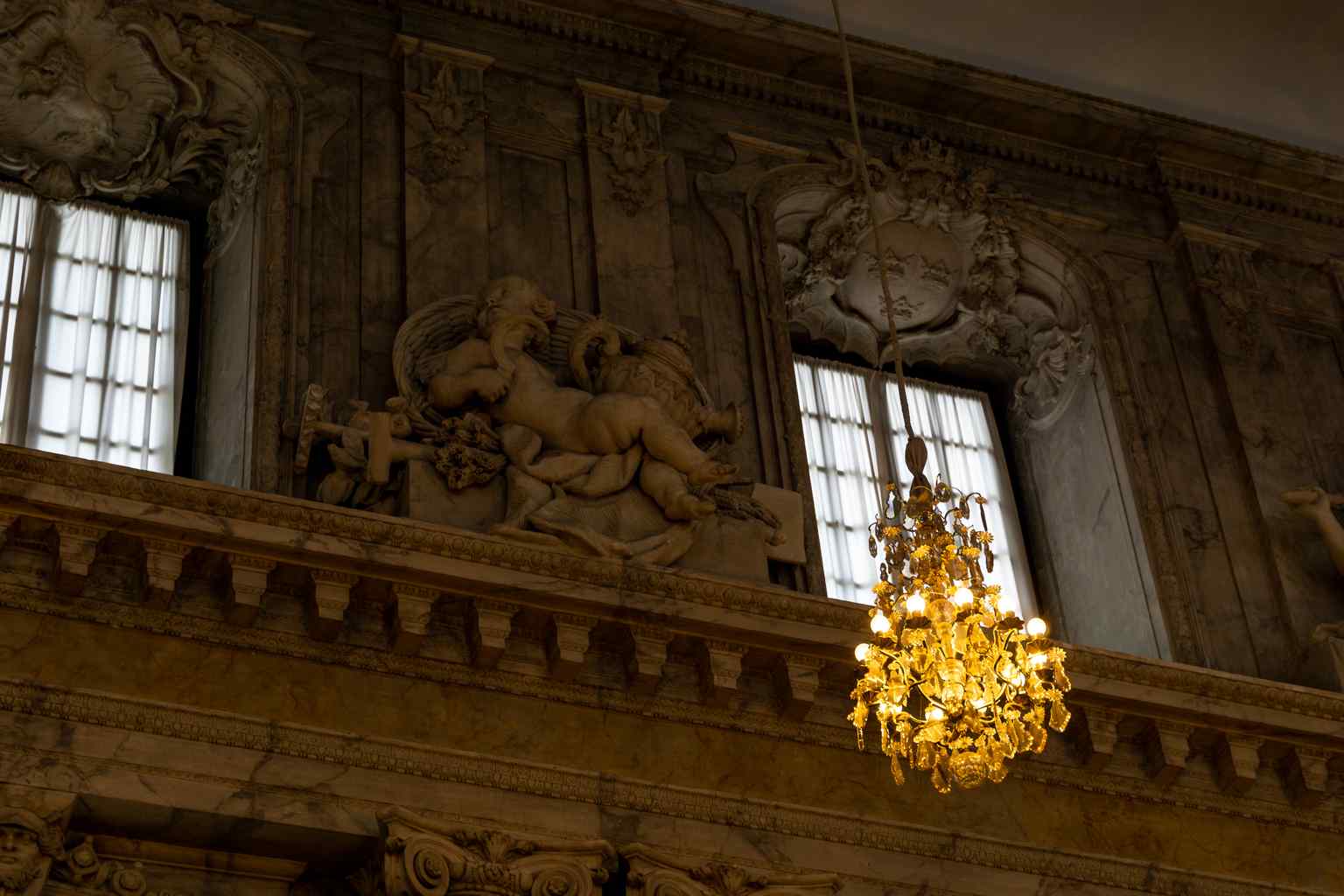
The palace from Lejonbacken, highlighting the northern façade and the grand stairway approach to the royal entrance.Photo: Piero Mazzinghi, Wikimedia Commons, CC BY-SA 4.0. Cropped & resized. 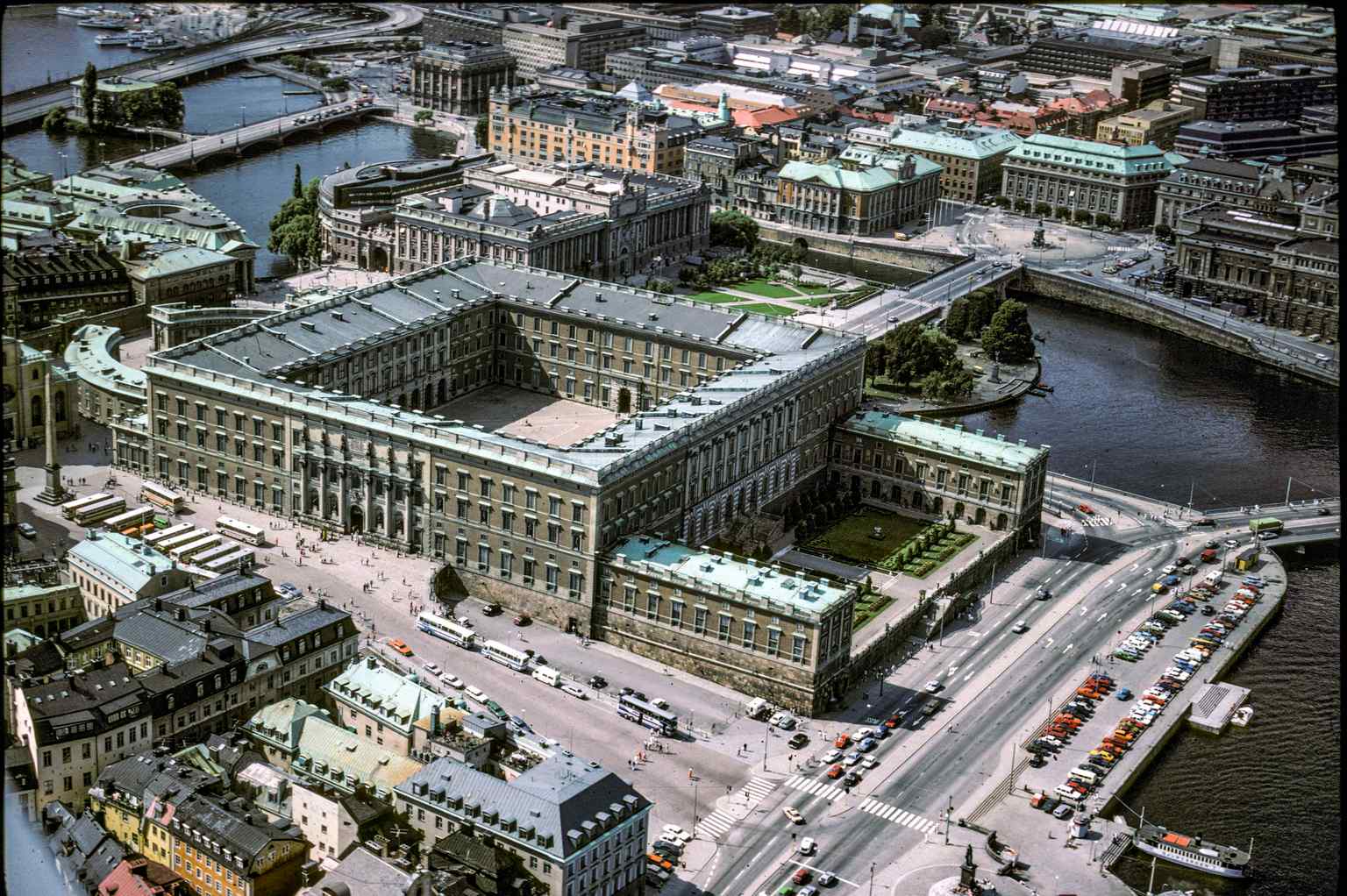
A modern exterior from the western side, near the Outer Courtyard where the changing of the guard takes place.Photo: Z thomas, Wikimedia Commons, CC BY-SA 4.0. Cropped & resized. 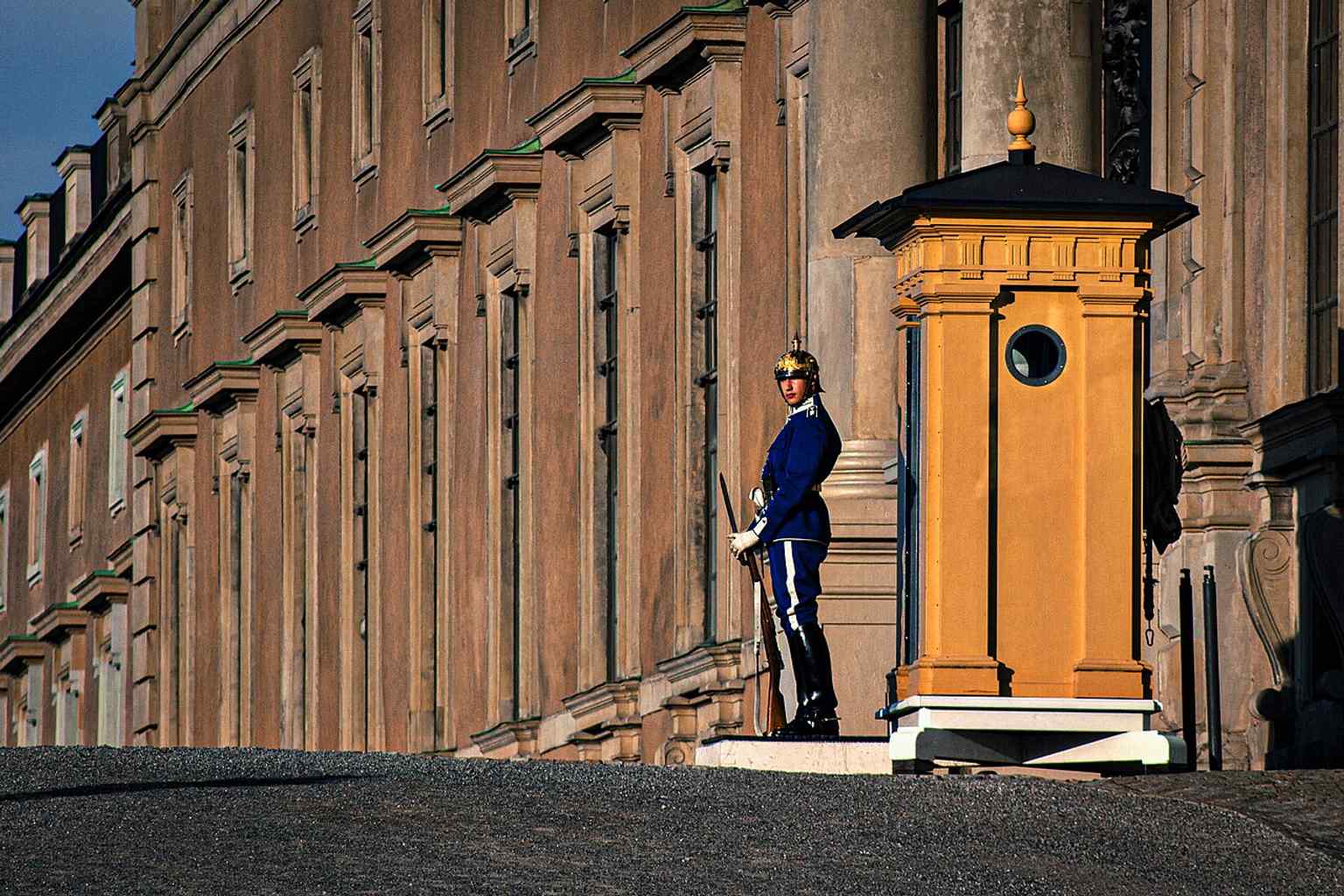
A guard scene at the palace exterior, matching the daily military presence that has protected the royal family since 1523.Photo: Bene Riobó, Wikimedia Commons, CC BY-SA 4.0. Cropped & resized. 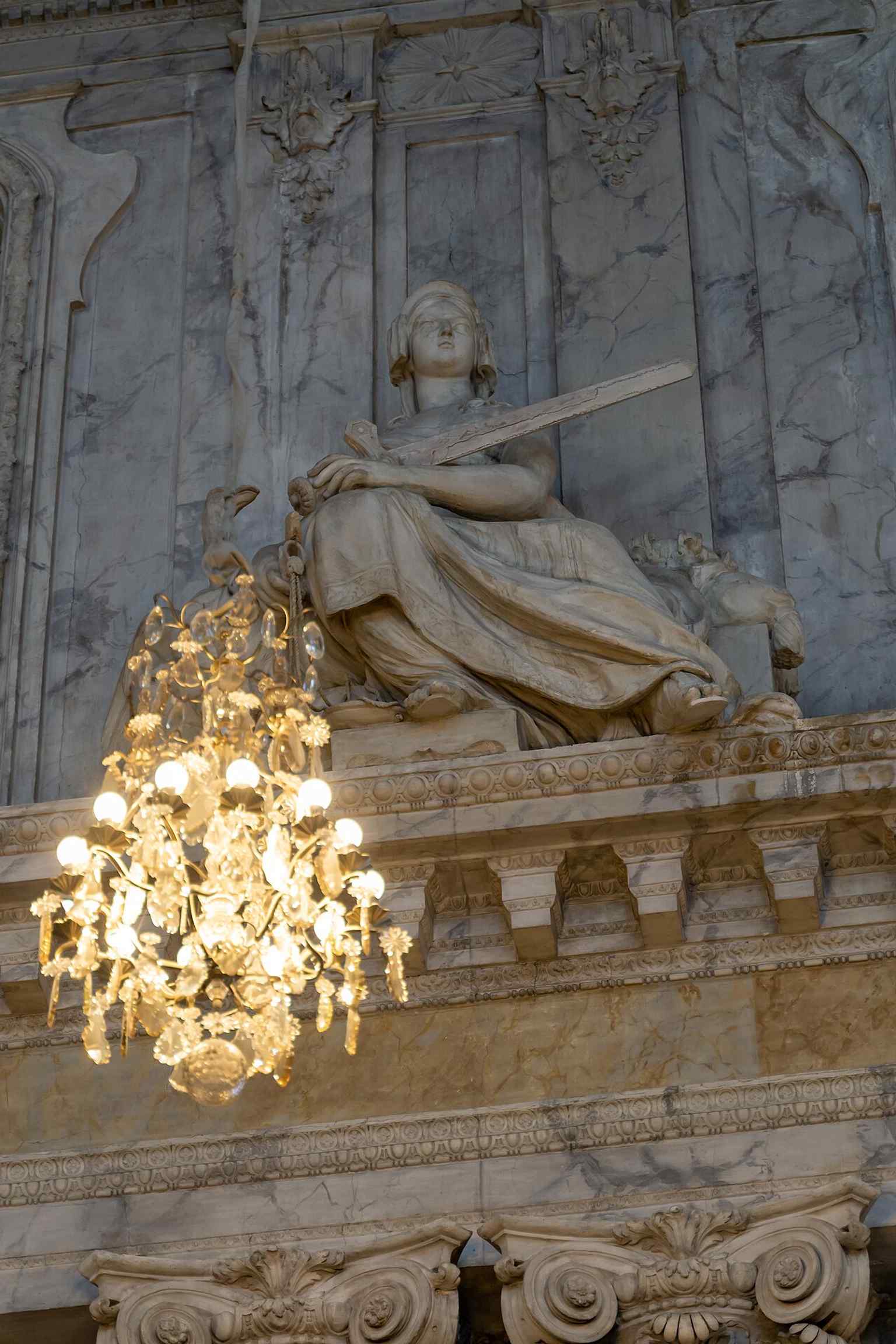
The Hall of State, where Sweden’s great ceremonies and official dinners are held in the northern row of the palace.Photo: Rainer Halama, Wikimedia Commons, CC BY-SA 4.0. Cropped & resized. 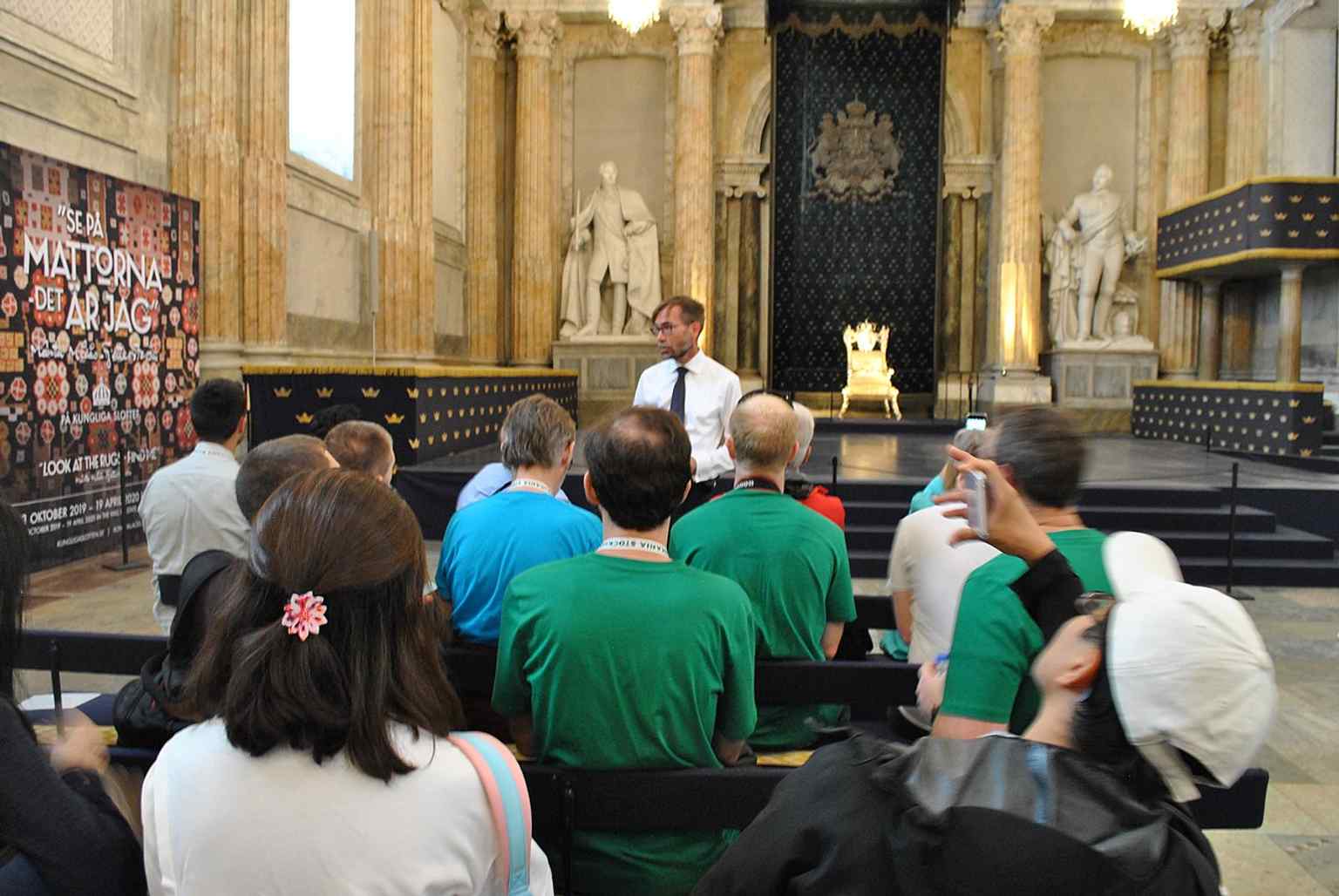
Inside the Hall of State during a public tour, connecting directly to the palace’s role for festivities, receptions, and state occasions.Photo: Audrey Lebioda, Nationalmuseum, Wikimedia Commons, CC BY-SA 4.0. Cropped & resized. 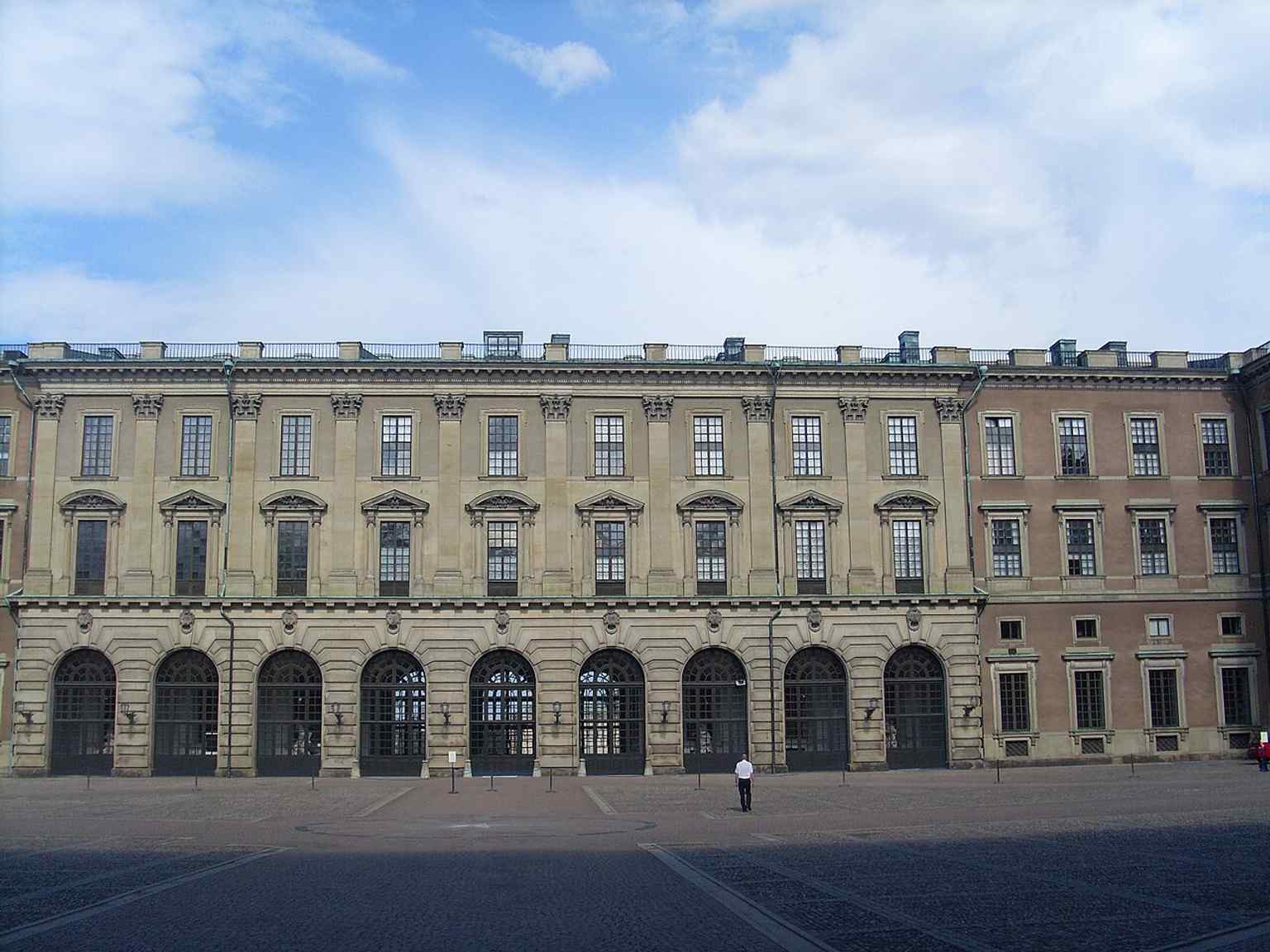
The lion masks in the Inner Courtyard, a subtle surviving decorative motif linked to Caspar Schröder’s sculptural work.Photo: Leogs, Wikimedia Commons, CC BY-SA 3.0. Cropped & resized. 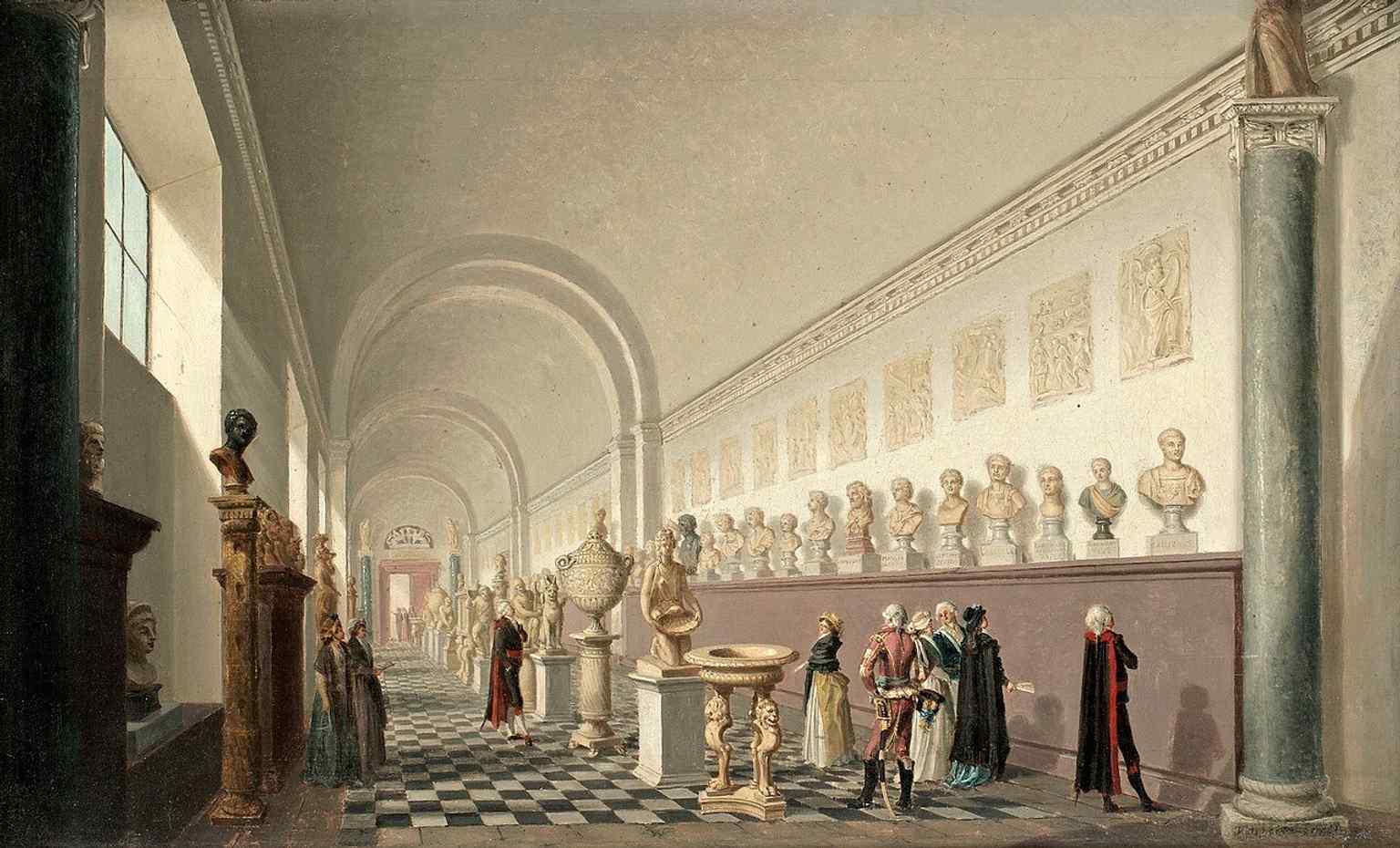
An 18th-century painting of the museum at the Royal Palace, a reminder that the palace has long housed royal collections and exhibitions.Photo: Pehr Hilleström, Wikimedia Commons, Public domain. Cropped & resized. On your left, look for the pale stone palace wall with its long rectangular facade, evenly spaced windows, and heavy rusticated base: that grand exterior stands over the vanished…Read moreShow less
Open dedicated page →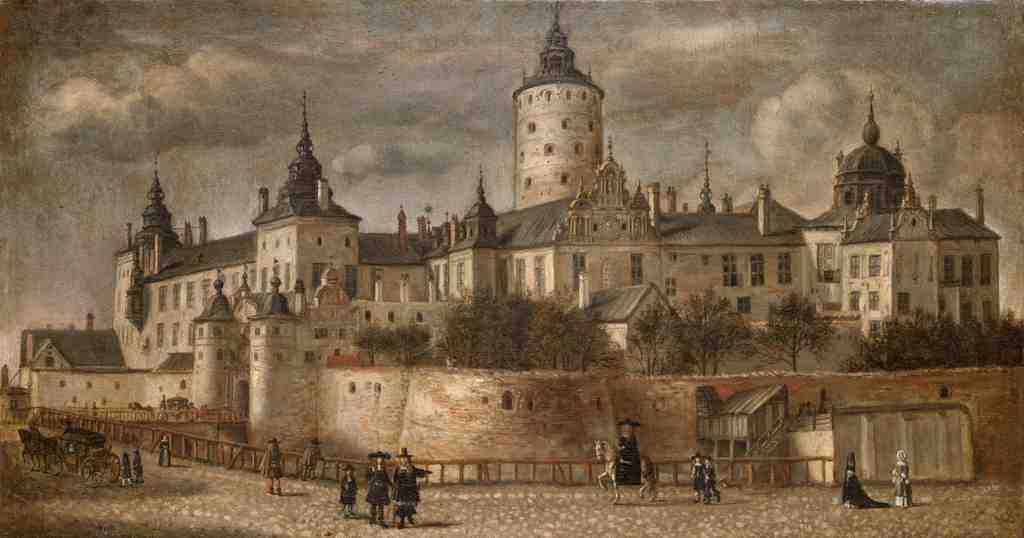
Tre KronorPhoto: Govert Dircksz Camphuysen, Wikimedia Commons, Public domain. Cropped & resized. On your left, look for the pale stone palace wall with its long rectangular facade, evenly spaced windows, and heavy rusticated base: that grand exterior stands over the vanished stronghold of Tre Kronor.
Tre Kronor began as a fortress before it ever became a palace. Here, at the narrow passage between Lake Mälaren and the Baltic, control of water meant control of the kingdom. Long before royal banquets and ceremony filled these rooms, this height on Stadsholmen held a stone defense tower - a kastal, meaning a compact medieval keep - whose oldest parts date to the mid-thirteenth century.
That first tower was brutally practical. It measured about fifteen meters across, with walls four meters thick. The entrance sat on the second floor so enemies could not easily force their way in, and below lay a dungeon reached only through a hatch in the floor. Royal power in Stockholm started like this... not as elegance, but as vigilance.
Over time, the fortress spread into a ring wall, courtyards, towers, apartments, archives, chapel, and great hall. By the late sixteen hundreds it worked almost like a small city within walls, with about sixteen hundred people living or laboring here: guards, servants, clerks, craftsmen, and courtiers pressed together around the crown.
If you glance at the image on your screen, you can see how Tre Kronor once dominated Stockholm’s ceremonial life, even before the present palace took its place. But that splendor rested on older struggles. In fifteen twenty, when King Christian the Second attacked Stockholm, Christina Gyllenstierna held this fortress in defiance for so long that she became a symbol of Swedish resistance. Tre Kronor was not only where rulers slept. It was where rule had to be defended.
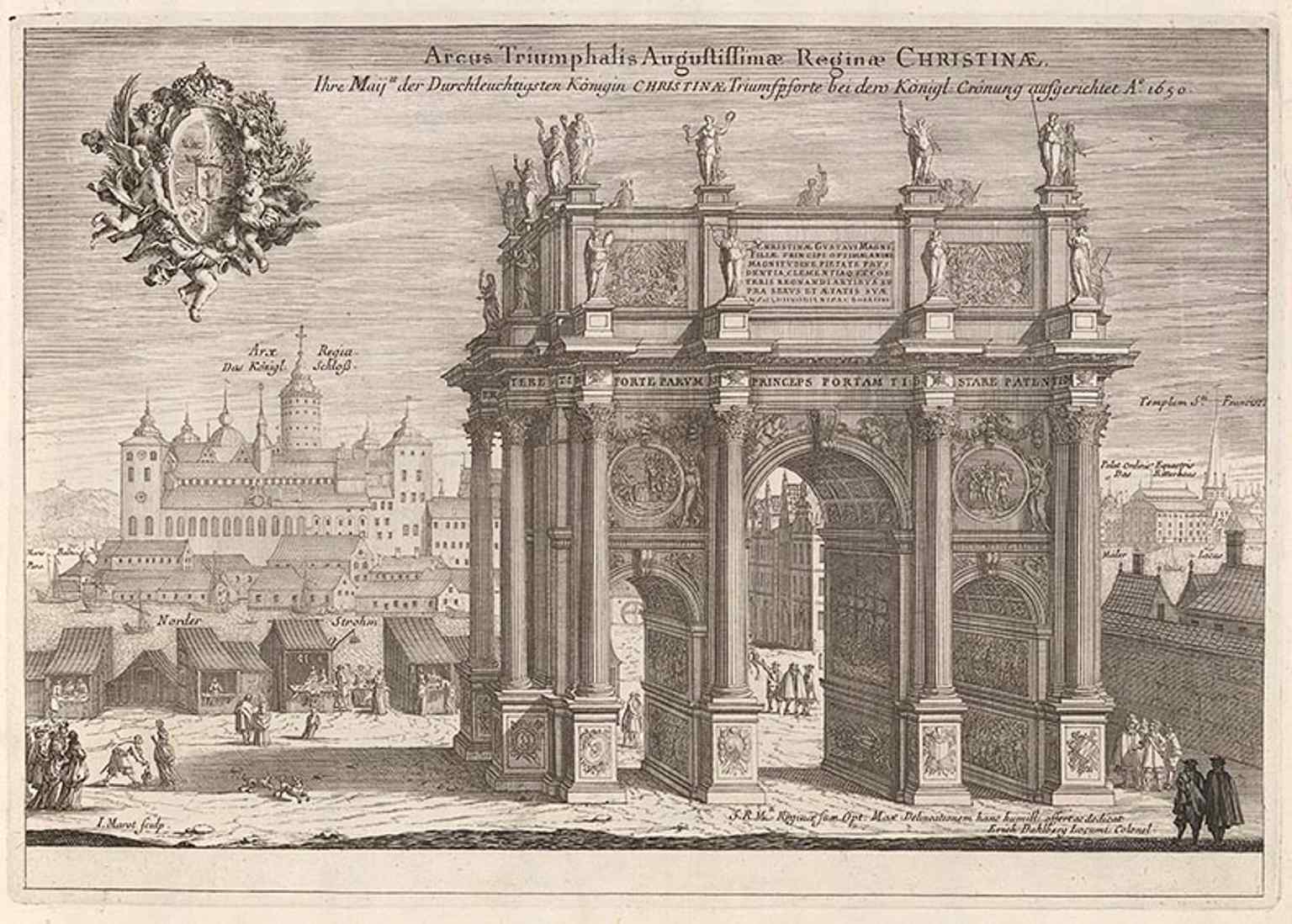
An engraved view made for Queen Christina’s coronation, showing the ceremonial Stockholm setting that once centered on Tre Kronor.Photo: Jean Marot / Erik Dahlbergh, Wikimedia Commons, Public domain. Cropped & resized. Gustav Vasa remembered that lesson. He strengthened the defenses, dug a moat, added outer walls and gun positions, and even tore down part of the nearby church’s eastern choir so the castle’s cannons could fire more freely. That small fact tells you a great deal: here, military need could even reshape sacred space.
Then came the fire of sixteen ninety-seven. A woman named Margareta Karlsdotter smelled smoke near the stairs to the great hall and sent a fire guard up to investigate. By then flames had already caught under the roof.
The disaster exposed something painfully human: a caretaker had secretly run an illegal tavern in the attic and used a stove without permission, while the fire watch failed at the worst possible moment. Servants hurled books and papers from windows to save them, but most of the royal library and archives died here anyway. A large part of Sweden’s memory turned to ash with the building.
So when you look at today’s palace, you are also looking at an absence. What lies below still shapes the story above ground.
Now we move to the church that gave sacred weight to royal authority... Stockholm Cathedral waits just ahead.
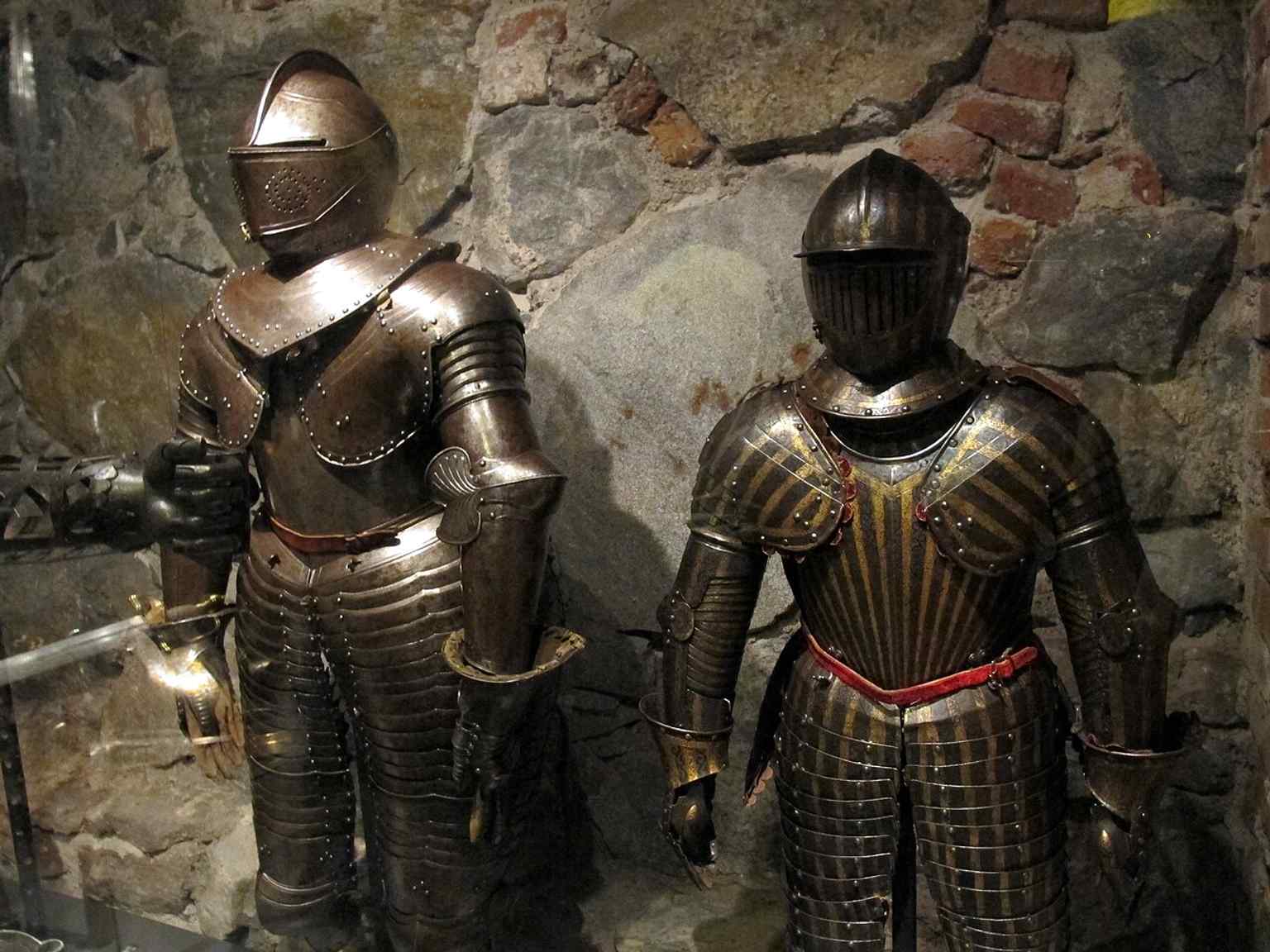
A display of 17th-century armor in the Royal Armoury, tying into Tre Kronor’s role as a heavily fortified royal residence before the 1697 fire.Photo: Murat Özsoy 1958, Wikimedia Commons, CC BY-SA 4.0. Cropped & resized. On your right, look for a pale plastered church with a tall square tower, a dark lantern rising from its top, and broad baroque wall strips laid over an older brick body. This is…Read moreShow less
Open dedicated page →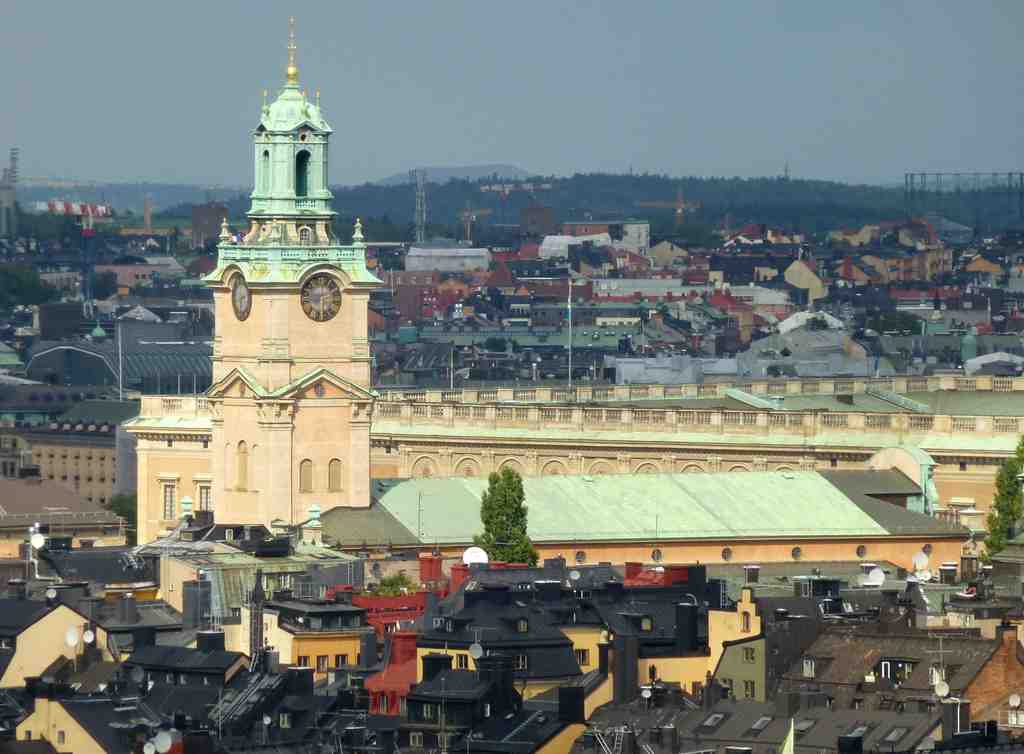
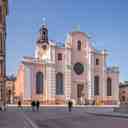
Stockholm CathedralPhoto: Bene Riobó, Wikimedia Commons, CC BY-SA 4.0. Cropped & resized. On your right, look for a pale plastered church with a tall square tower, a dark lantern rising from its top, and broad baroque wall strips laid over an older brick body.
This is Storkyrkan, Stockholm’s Great Church... and for centuries it has stood exactly where the city’s deepest authorities pressed against one another. Palace, government, market, and altar all met here. That made this church more than a place of prayer. It became a civic sanctuary, a coronation setting, a cathedral, and a ritual partner to power.
Tradition says the first church here rose in the twelve sixties through gifts from Birger Jarl. For about four hundred years, this was Stockholm’s only parish church, known simply as the town church, or Bykyrkan, and also as Saint Nicolai after Saint Nicholas, protector of sailors. That dedication mattered in a trading city shaped by merchants and ships. What you see now carries many centuries at once: a medieval church enlarged through the thirteen hundreds and fourteen hundreds into a five-aisled hall church - meaning a broad interior where the side aisles rise almost as high as the central space - then wrapped in a baroque exterior in the seventeen thirties so it could speak more fluently with the royal palace beside it.
If you glance at your screen, the aerial view makes that placement unmistakable: Storkyrkan sits between the palace and the old commercial heart, almost like a stone hinge in the city plan.
And inside, power did not merely visit... it performed itself. Kings and queens were crowned here from the Middle Ages onward. Magnus Eriksson and Blanka of Namur were crowned here in the thirteen thirties. Gustav the Third held his coronation here in the seventeen seventies. The last coronation in this church came in eighteen seventy-three, for Oscar the Second and Queen Sofia. Royal weddings followed the same pattern, including those of Carl the Sixteenth Gustaf and Silvia, and later Crown Princess Victoria and Daniel. Even the modern opening of parliament still begins with a service here, binding state ritual to sacred space with remarkable persistence.
This church also served the clergy as their meeting chamber during the old estate parliament. So when laws, monarchy, and faith gathered in Stockholm’s core, Storkyrkan was not background scenery. It was one of the rooms where the kingdom explained itself.
In nineteen forty-two, when Stockholm became its own diocese, this church took on cathedral status as the bishop’s seat. Yet its older identity never disappeared. It remained the Great Church of the city before it became the cathedral of the diocese.
One man brings that turning point into focus: Olaus Petri. He preached here in the fifteen twenties as Sweden’s Reformation began to take hold. In the church cellar, he had reforming texts printed, including the first Swedish translation of the New Testament in fifteen twenty-six. Here, the Mass was heard in Swedish for the first time. That is a profound shift to imagine: not just a change in doctrine, but a new language of authority, spoken aloud where crowns had been blessed.
If you look at the image of the royal seats, you can see how the church still stages that old relationship between throne and altar.
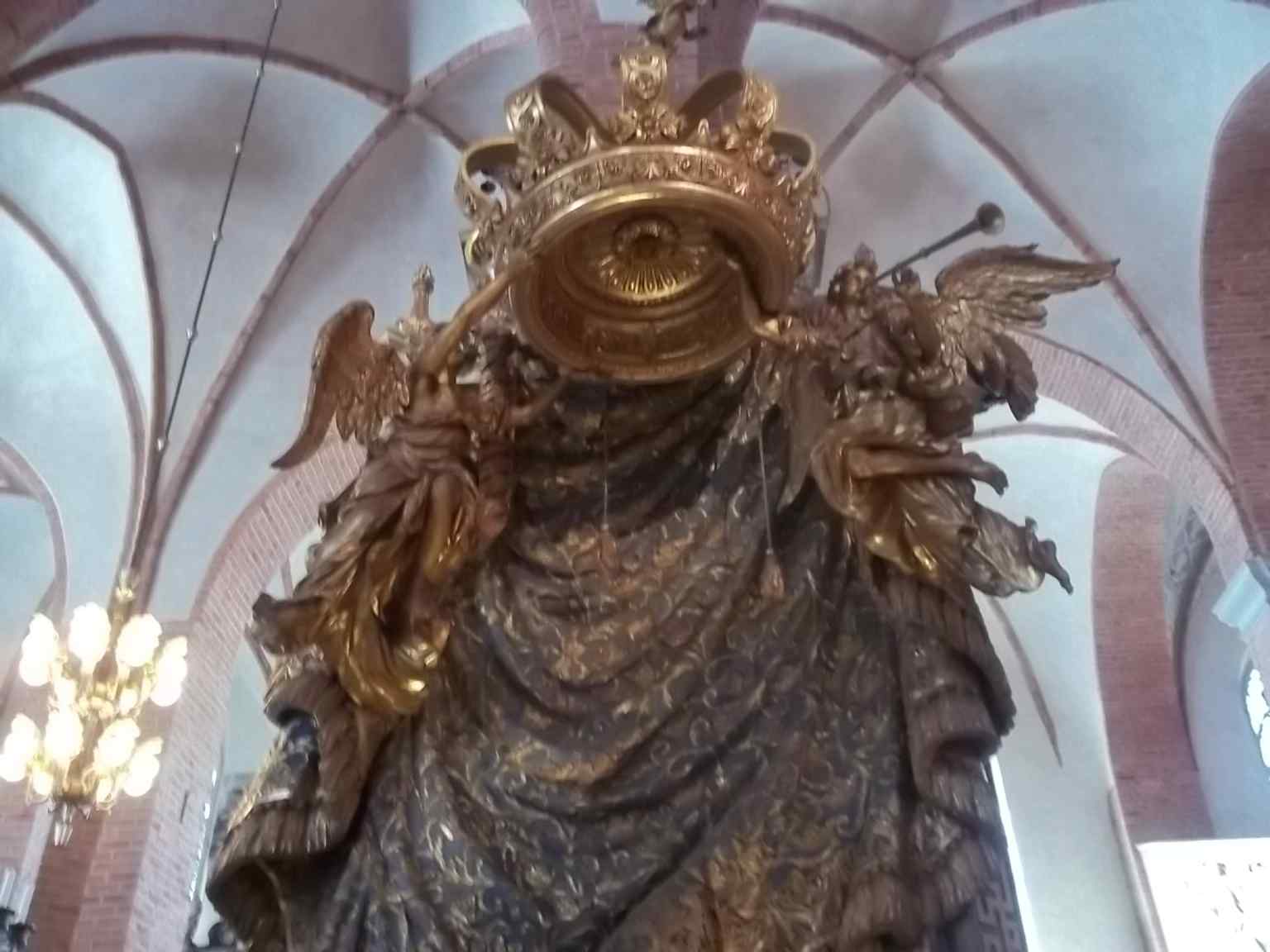
The royal seats inside Storkyrkan, used for state ceremonies when the king or queen attends services as head of state.Photo: HappyShare, Wikimedia Commons, CC BY-SA 3.0. Cropped & resized. At the next stop, we narrow from this great institution to the community and church authority around it... and to the arguments that made belief a public struggle. If you want to go inside later, Storkyrkan is generally open every day from nine thirty in the morning until five in the afternoon.
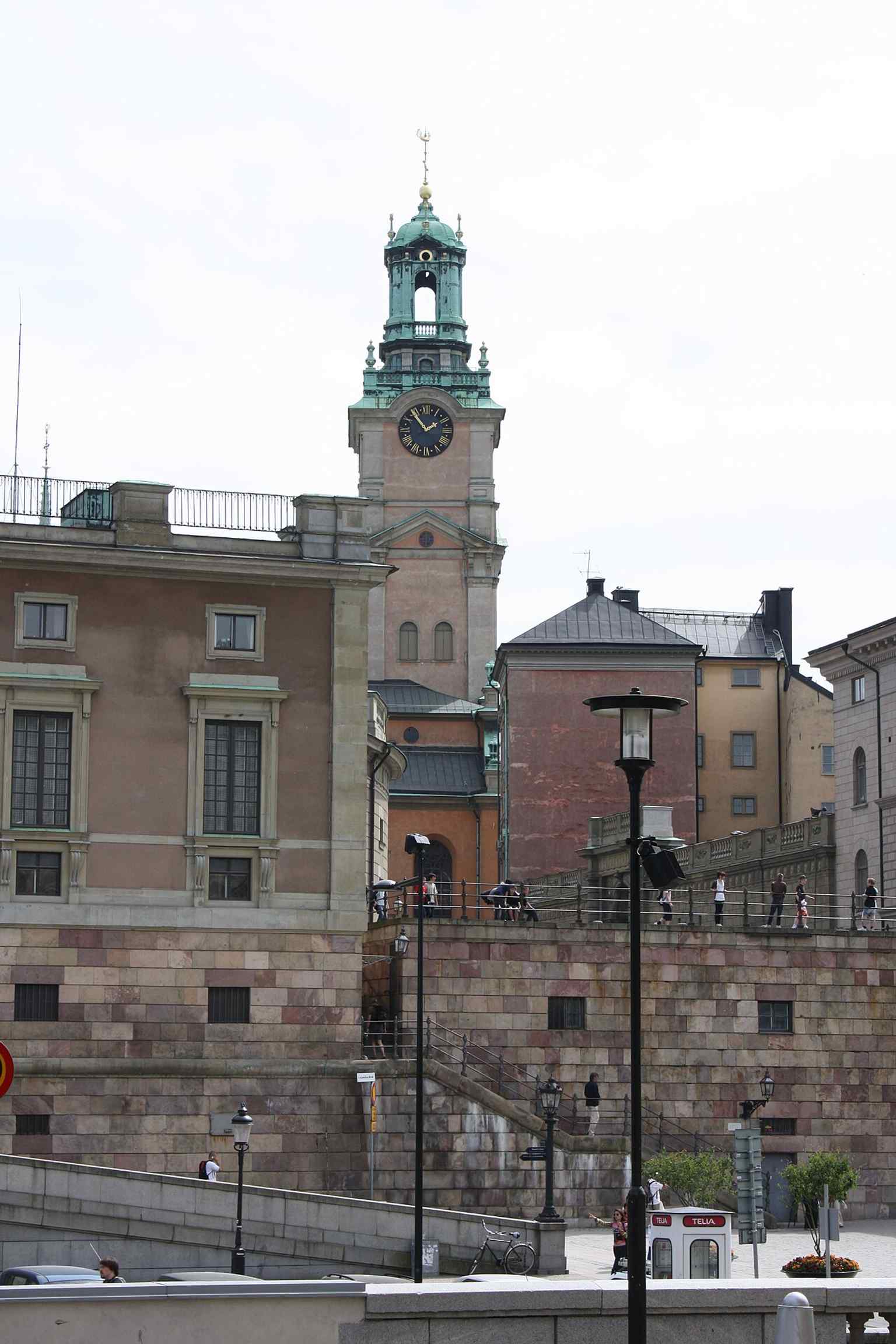
The tower and upper façade, a good match for the church’s baroque makeover from the 1730s with its prominent lantern and strong vertical silhouette.Photo: Carlo Pelagalli, Wikimedia Commons, CC BY-SA 3.0. Cropped & resized. 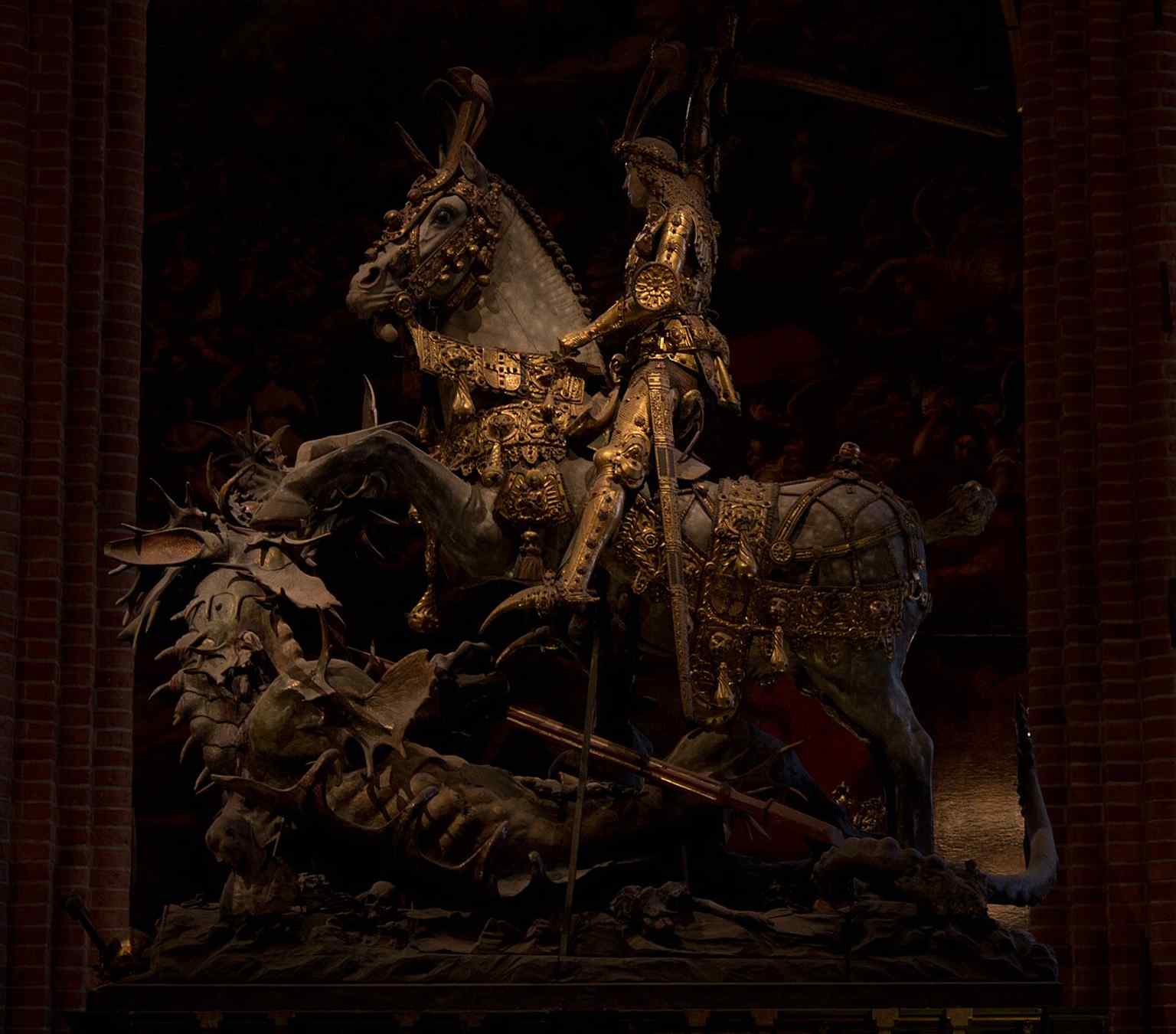
Bernt Notke’s Saint George and the Dragon, the medieval masterpiece inside Storkyrkan that has become one of Stockholm’s most famous church artworks.Photo: Johan Bakker, Wikimedia Commons, CC BY-SA 4.0. Cropped & resized. 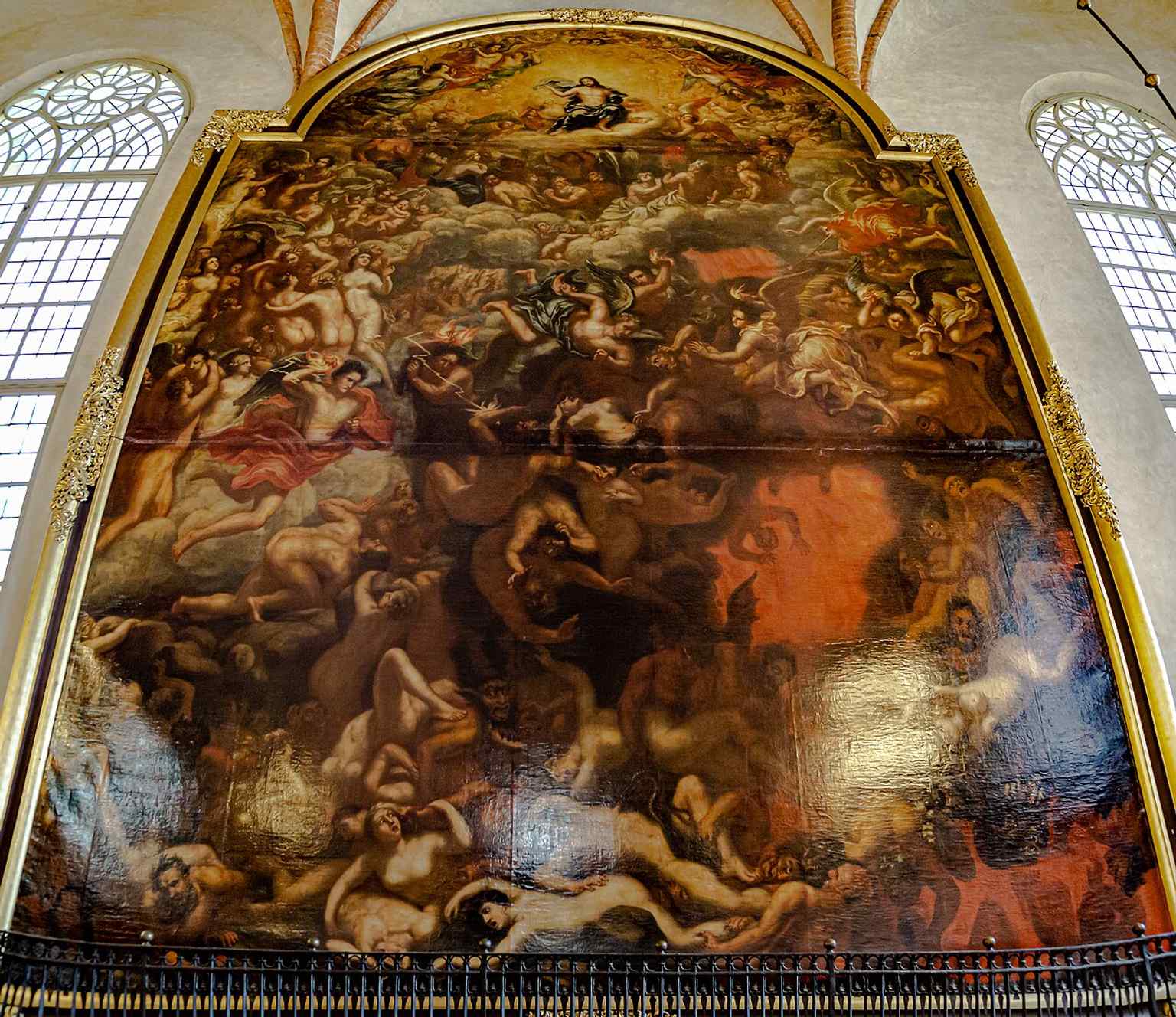
The Last Judgment painting from Storkyrkan’s collection — a reminder that the church’s interior preserves major religious art alongside royal history.Photo: David Klöcker Ehrenstrahl, Wikimedia Commons, Public domain. Cropped & resized. 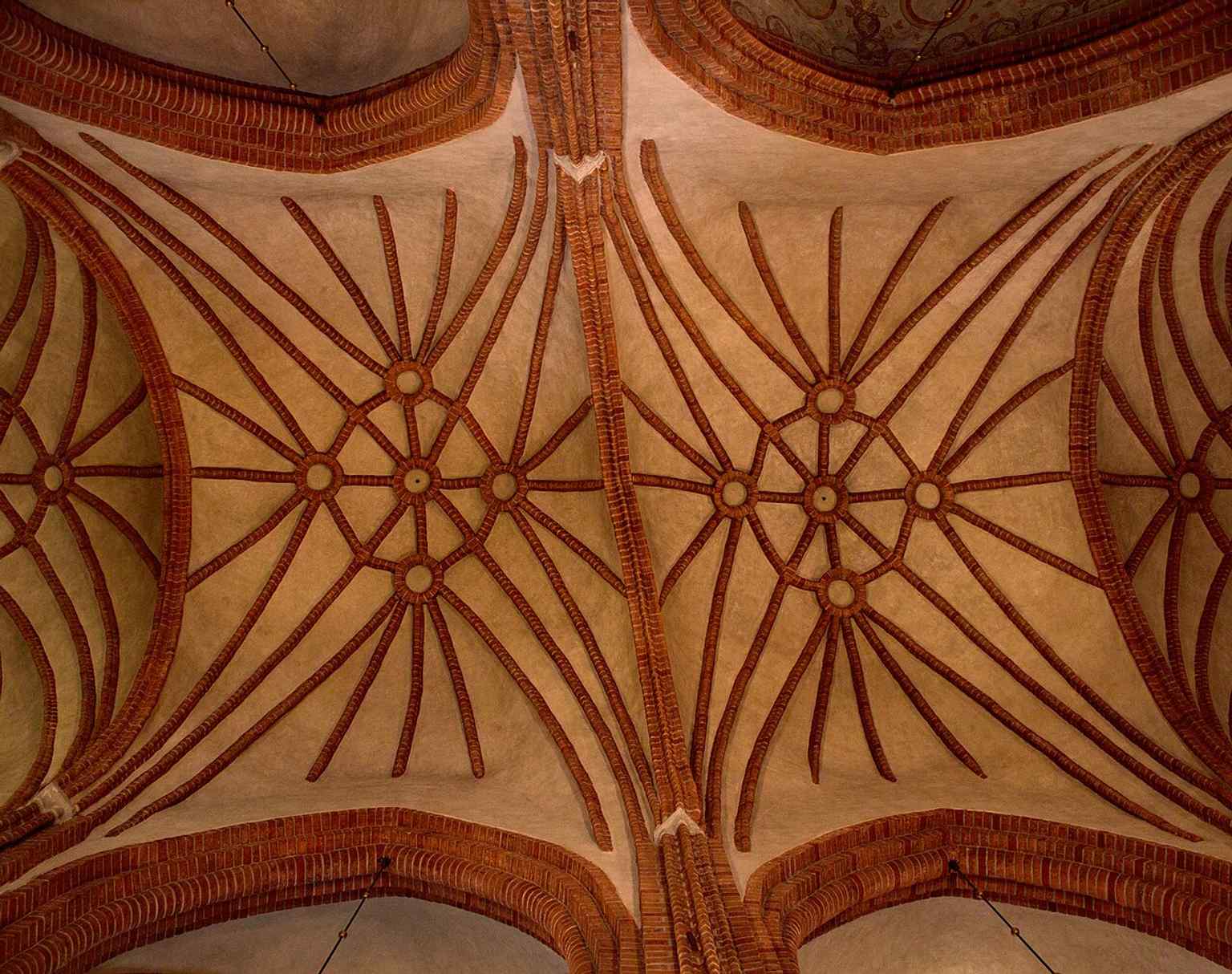
The soaring Gothic vaults of Storkyrkan, showing the medieval hall-church character that survived later rebuilding.Photo: Johan Bakker, Wikimedia Commons, CC BY-SA 4.0. Cropped & resized. 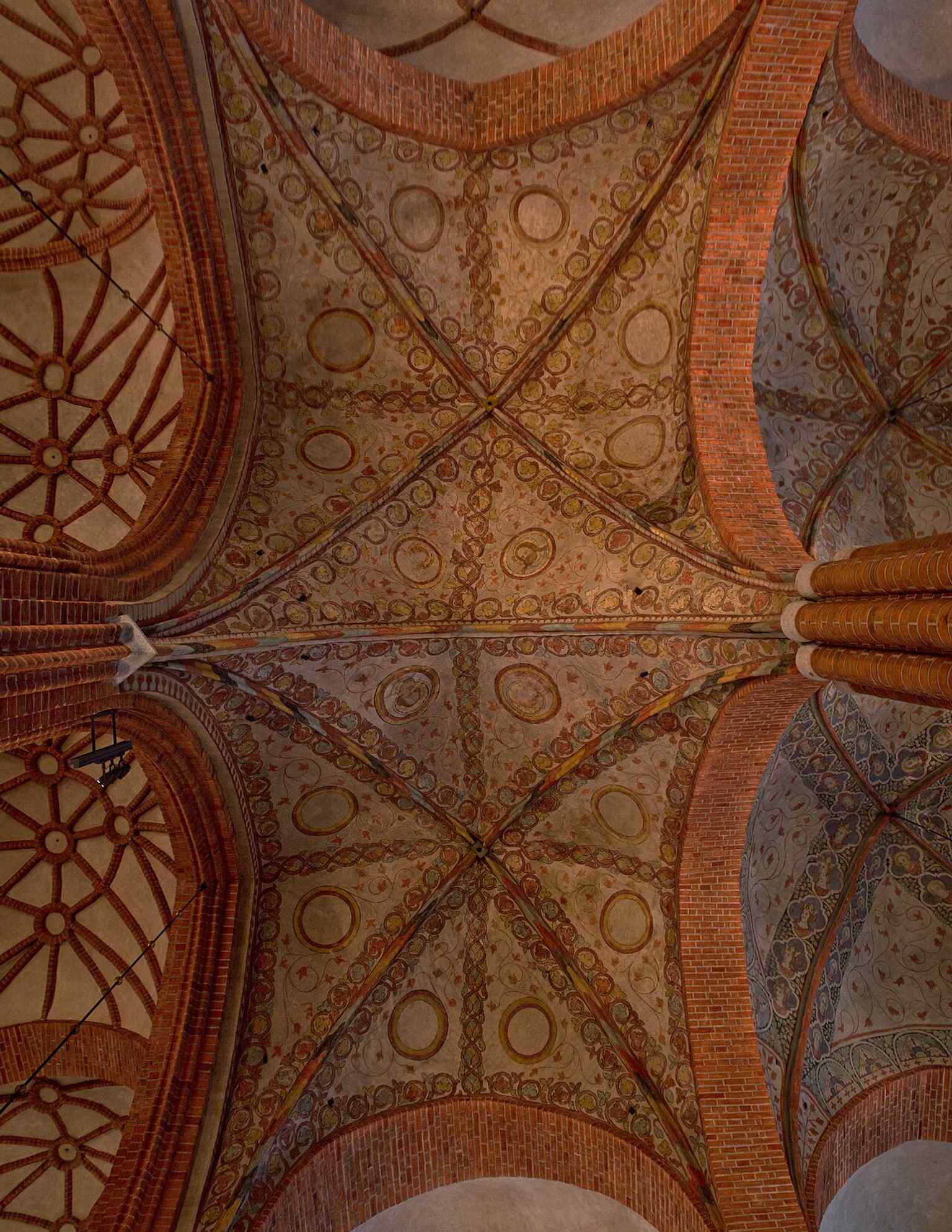
Another view of the church’s vaults and brickwork, reflecting the restorations that exposed the medieval masonry in the early 1900s.Photo: Johan Bakker, Wikimedia Commons, CC BY-SA 4.0. Cropped & resized. 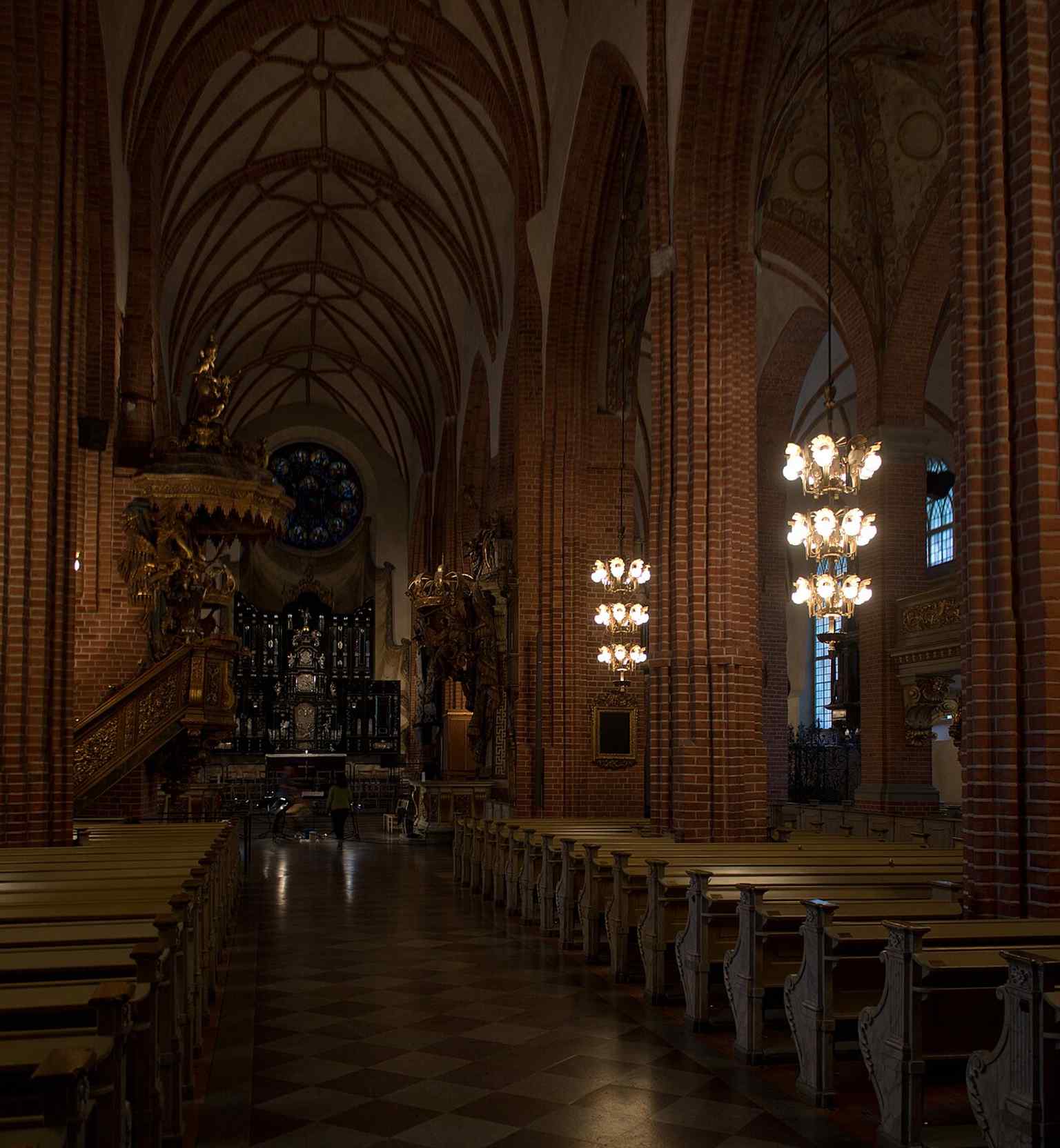
A chandelier suspended in Storkyrkan’s nave — one of the decorative interior elements that gives the church its ceremonial atmosphere.Photo: Johan Bakker, Wikimedia Commons, CC BY-SA 4.0. Cropped & resized. 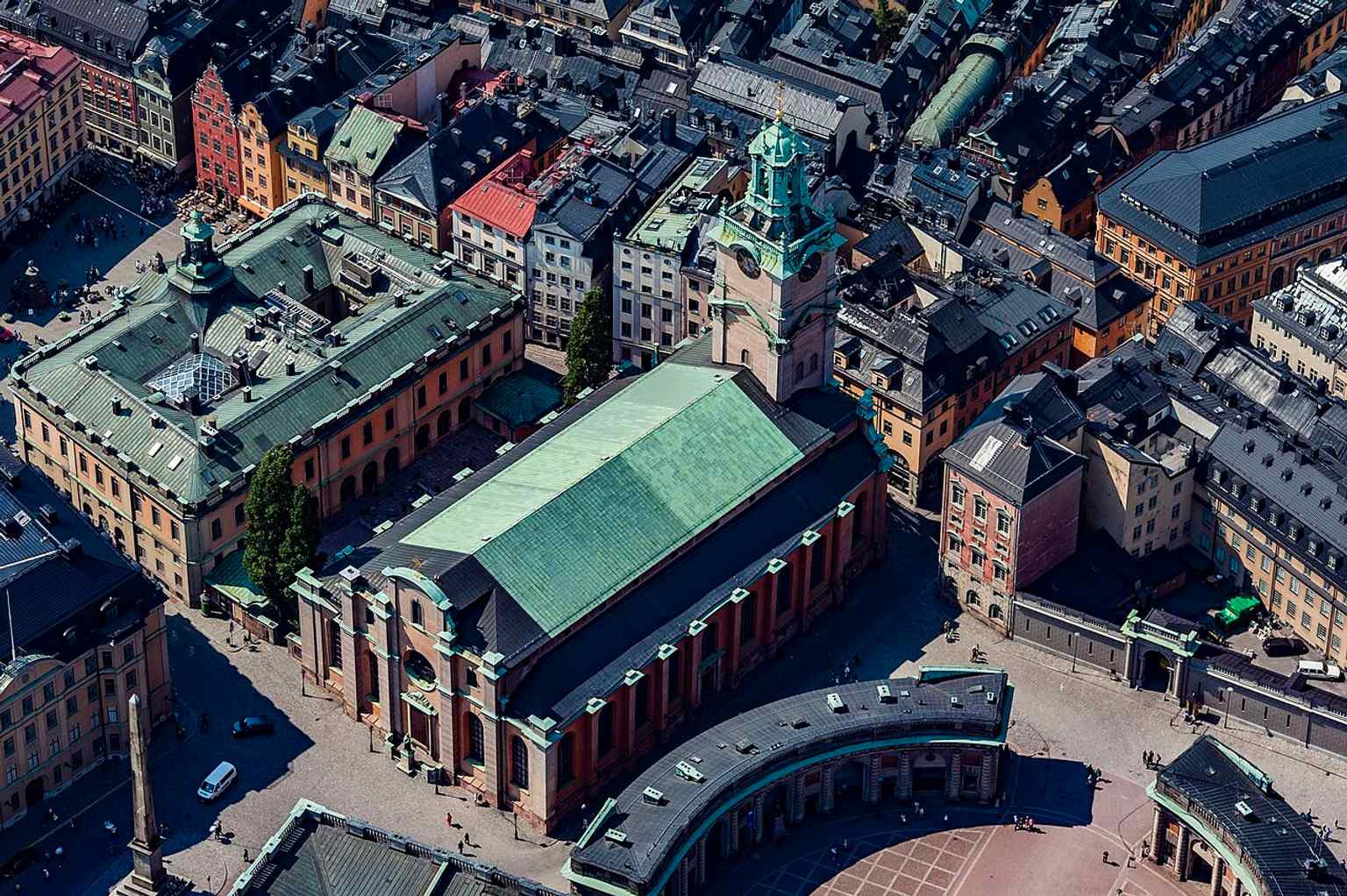
Historic Storkyrkan building documentation from the early 1900s, useful for showing how the church’s appearance was recorded before modern renovations.Photo: L.G.foto, Wikimedia Commons, CC BY-SA 4.0. Cropped & resized. 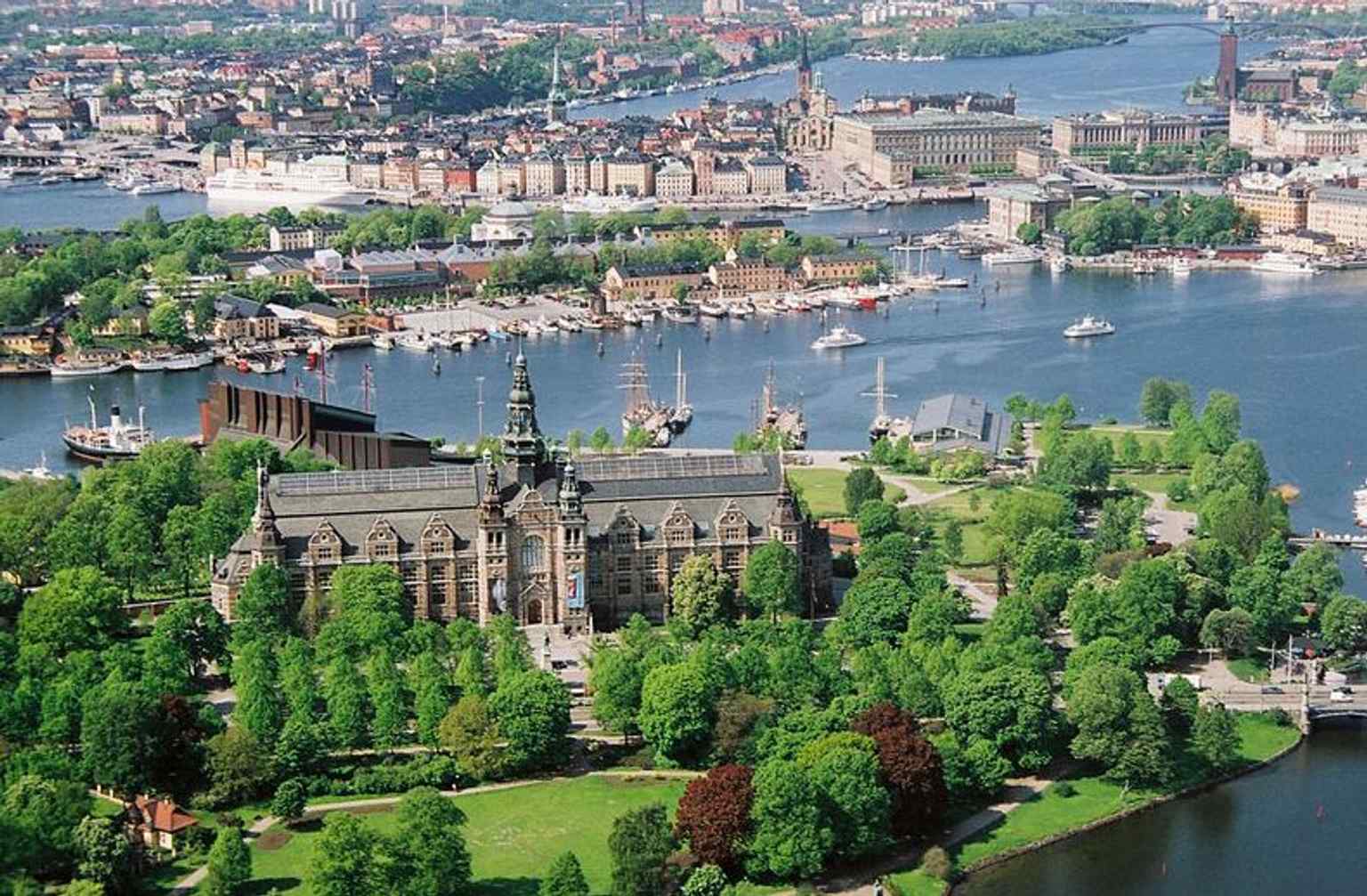
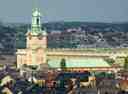
An elevated Stockholm panorama with Storkyrkan in the city fabric, emphasizing its position between the palace and the Old Town core.Photo: Unknown, Wikimedia Commons, CC BY-SA 3.0. Cropped & resized. Look for the great brick church with a steep copper roof and a tall square tower marked by a clock and a dark spire. This stop is not only the church beside you, but the parish…Read moreShow less
Open dedicated page →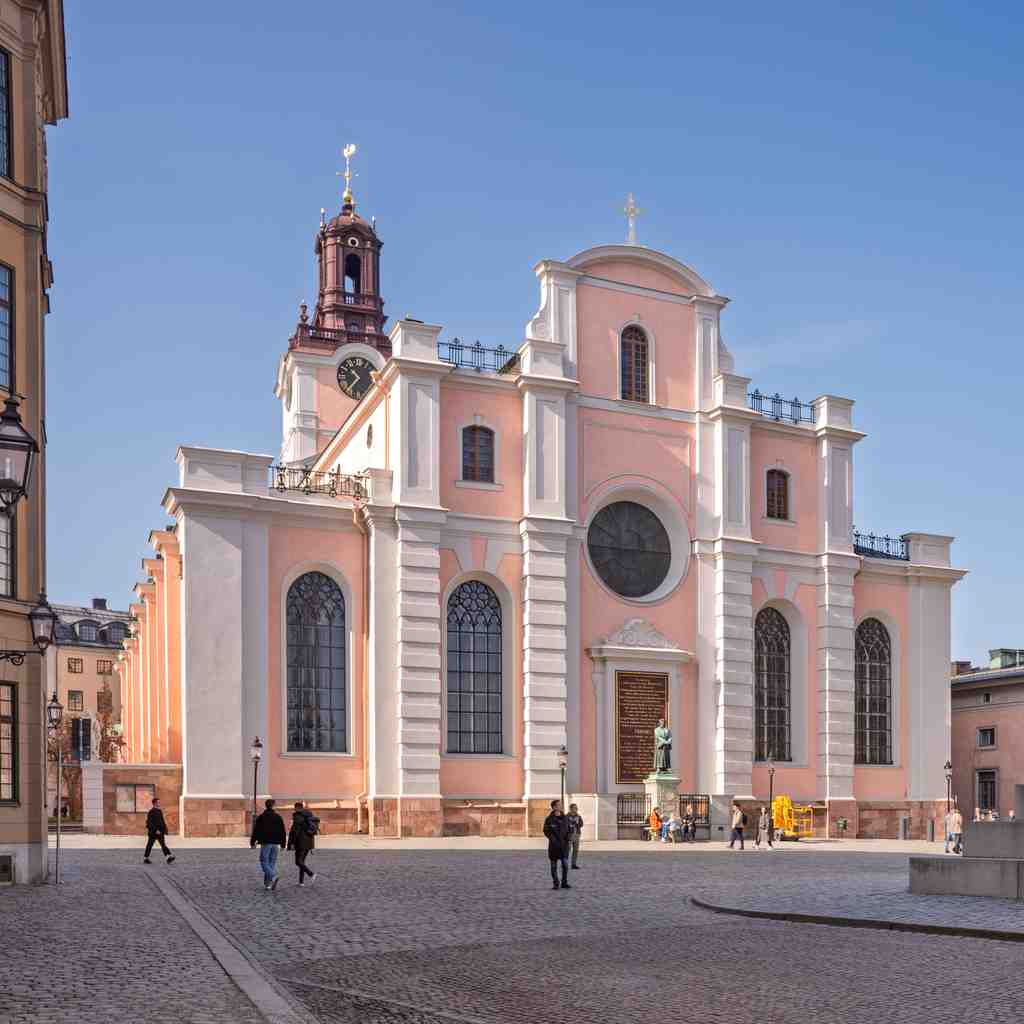
StorkyrkoförsamlingenPhoto: ArildV, Wikimedia Commons, CC BY-SA 4.0. Cropped & resized. Look for the great brick church with a steep copper roof and a tall square tower marked by a clock and a dark spire.
This stop is not only the church beside you, but the parish that grew around it and tried, for centuries, to hold Stockholm together. Here, the Reformation became personal. It was not just a change in doctrine, meaning religious teaching; it was a local fight over who could interpret God’s word, who controlled the city’s holiest room, and which voice Stockholmers were supposed to trust.
When Gustav Vasa took Stockholm in fifteen twenty-three, later sources say a thanksgiving mass took place here. That mattered. The new ruler used this church almost at once as a public stage, turning prayer into a declaration of political victory. And beside him, or sometimes against him, stood Olaus Petri. He was more than a preacher. He helped teach Stockholm how to understand a new age.
Most visitors never notice that the argument is still under their feet. The medieval high choir, the eastern sacred space once reserved for the altar and clergy, is marked in the paving outside. A later tradition says Gustav Vasa actually wanted to tear down the whole church. Resistance, closely tied to figures like Olaus Petri, helped preserve it. His statue stands where that lost choir once reached, like a witness refusing to step aside.
In fifteen thirty-five, a strange sky over Stockholm produced the famous sun dogs, bright halos around the sun. Inside this church hangs the painting known as the Vädersolstavlan, long linked to Olaus Petri and often said to have been commissioned by him. It was not just a city view. People read those burning circles in the sky as a sign of God’s anger at Gustav Vasa’s Reformation. So even an image became a rebuke.
The parish itself tells the same story in another form. It began around twelve sixty as Saint Nicholas parish after breaking away from Solna. Then the city kept dividing outward. The German congregation split off in fifteen fifty-eight. The Finnish congregation followed in fifteen seventy-seven. Klara left in fifteen eighty-seven, Maria Magdalena in fifteen ninety-one, and Riddarholmen later broke away and then returned in eighteen oh seven. On paper, that looks administrative. In real life, it meant language, migration, and loyalty all pressing against one sacred center.
The reshaping never quite stopped. The parish took the name Storkyrkoförsamlingen in nineteen oh seven and finally merged into Stockholm Cathedral parish in nineteen eighty-nine. Even in nineteen ninety-eight, conservators revisited the question, reinforcing the view that the Vädersolstavlan hanging inside is a sixteen thirty-six copy of a lost original from fifteen thirty-five.
That is the pattern here: authority claims permanence, but every generation edits it. And in Stockholm, disputes over legitimacy did not stay theological for long. In about a one-minute walk, we reach the next stop, where those struggles turn sharper still.
If you want to step inside later, the cathedral is generally open daily from nine thirty A-M to five P-M.
On your right, look for the tall red-brick facade with stepped gables and rows of pale round stones set into the wall beneath the windows. This is the place tied to the Stockholm…Read moreShow less
Open dedicated page →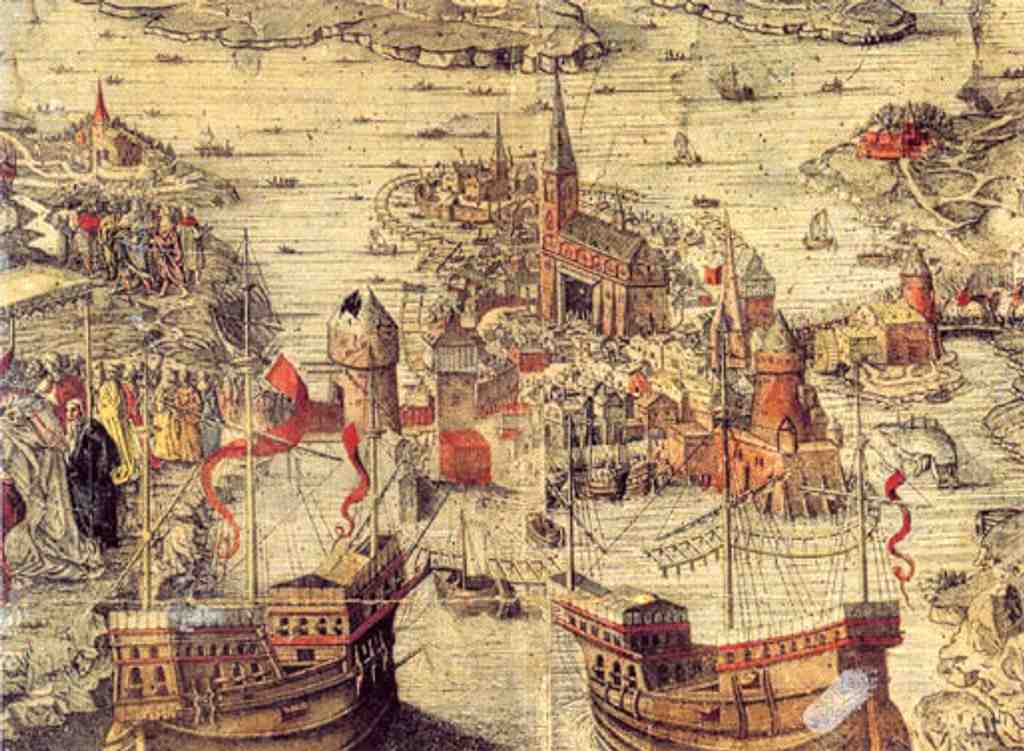
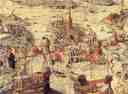
Stockholm BloodbathPhoto: Unknown author, Wikimedia Commons, Public domain. Cropped & resized. On your right, look for the tall red-brick facade with stepped gables and rows of pale round stones set into the wall beneath the windows.
This is the place tied to the Stockholm Bloodbath, the defining trauma of fifteen twenty. It began in ceremony and ended in slaughter, which is exactly why it stayed lodged so deeply in Swedish memory: here, royal ritual did not restrain violence... it gave violence a stage.
Christian the Second had just taken the crown. In Storkyrkan, he swore the usual oath to rule through native-born Swedes. At Tre Kronor, the court feasted for three days. Wine and beer flowed, and after months of siege and negotiation, many believed the danger had passed. Christian had already promised amnesty, a formal pardon for past resistance, when Stockholm surrendered.
But Archbishop Gustav Trolle had another plan. He wanted revenge and compensation after his fortress at Almarestäket had been demolished, and he used canon law, meaning church law, to argue that the men who opposed him had committed heresy. Heresy sounds theological, but here it became a political weapon. First came the coronation, then the banquet, then the legal language.
On the evening of the seventh of November, Christian summoned leading Swedes to a private meeting at the palace. On the next night, Danish soldiers entered with lanterns and torches and seized noble guests one by one. They had already been marked on Trolle's proscription list, a written list of enemies.
What makes a public promise feel solid... and what happens to a city when mercy is performed in front of everyone, then taken back behind closed doors?
At noon on the ninth of November, the executions began here. The bishops of Skara and Strängnäs were led out first and beheaded. Then fourteen noblemen, three burgomasters (that is, town mayors), fourteen town councillors, and around twenty townsmen were hanged or beheaded. The killings continued the next day. The chief executioner, Jörgen Homuth, later said eighty-two people died, though other accounts argued over the number. Even the death toll became part of the struggle over memory.
If you glance at your screen, you can see a later engraving imagining the scene: bishops and nobles brought out after the king's promise had already been broken.
One of the dead was Erik Johansson, father of Gustav Vasa. That matters because the bloodbath did more than kill opponents; it nearly erased a family that would soon reshape Sweden. When Gustav Vasa heard what had happened here, he went north to gather support. The revolt that followed broke Christian's power and helped sever Sweden from Denmark for good. Christian gained the Swedish name Kristian Tyrann, Christian the Tyrant, and he has never really escaped it.
If you look at the Bloodbath painting on your phone, notice how memory turns murder into instruction: later generations wanted this wound preserved, not softened.
And yet the city did not stop. Trade resumed, ships still came in, and ordinary life continued along the waterfront ahead of you. That uneasy survival is part of the story too. From here, continue toward Skeppsbron, where commerce kept moving beside the stain of state violence. If you plan to visit the related venue, it generally opens from ten to seven and stays closed on Sundays.
On your right, Skeppsbron looks like a broad stone quay edged by a long wall of tall, narrow plaster-and-masonry merchant houses, with richly framed portals repeating along the…Read moreShow less
Open dedicated page →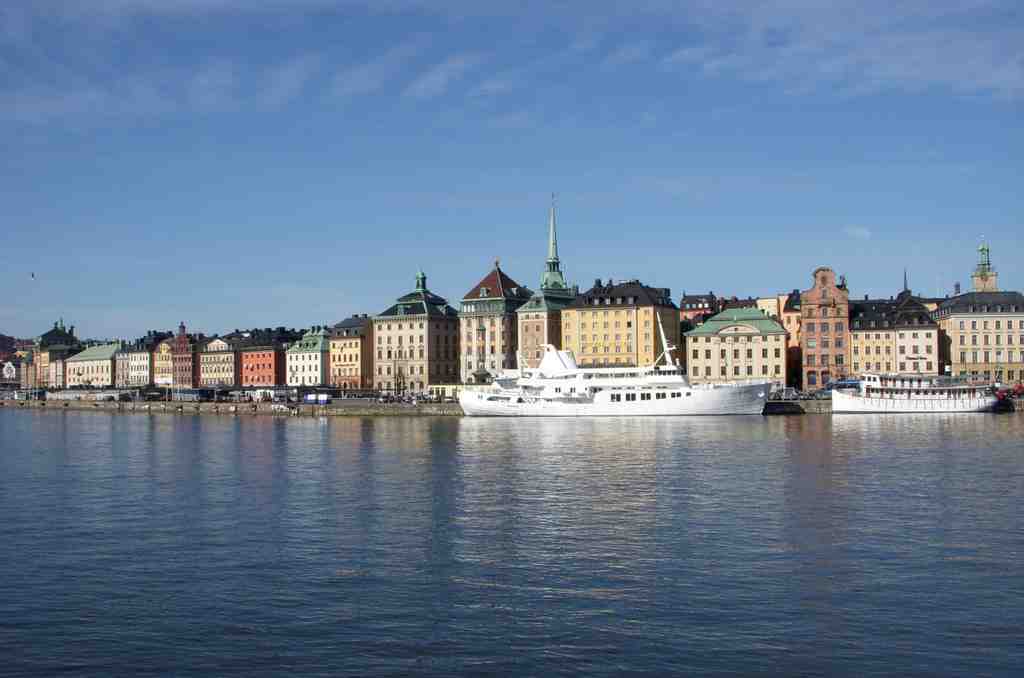
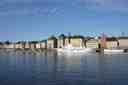
Skeppsbron, StockholmPhoto: Holger.Ellgaard, Wikimedia Commons, CC BY-SA 3.0. Cropped & resized. On your right, Skeppsbron looks like a broad stone quay edged by a long wall of tall, narrow plaster-and-masonry merchant houses, with richly framed portals repeating along the waterfront.
This is where Stockholm stopped merely announcing power and started handling it by the crate, the barrel, and the rope. Skeppsbron and the maritime economy belong together: long before it felt ceremonial, this edge of Gamla stan worked as a hard, noisy waterfront of cranes, fish, deep-draft ships, and royal ambition.
In the fifteen hundreds, a quay crane already stood here for heavy cargo, and just to the north lay a fishing harbor. Then the seventeenth century changed the scale of everything. Sweden’s wars brought wealth for a time, Stockholm became the official capital in sixteen thirty-four, and more than two thirds of the kingdom’s foreign trade passed through this city. The old eastern wall no longer defined the city’s future. Gustav the Second Adolf gave permission to tear that wall down in sixteen twenty-five and imagine something bolder: a harbor that still worked like a harbor, but also looked like a capital.
That decision remade the shoreline itself. Land rose from the sea, and people pushed the edge farther out with fill. In sixteen twenty-nine, the city began selling plots here. A merchant named Robert Rind received the first title deed on the sixth of November, sixteen thirty, and he built the house now known as Skeppsbron twenty-four. It still stands. I like that detail... one man placing his bet on a raw new waterfront where the city had only just decided to face the water instead of hiding behind stone.
Look at the row as a whole and you can read the plan. These were not simple homes. Lower floors held packhouses and offices; above them came living quarters and reception rooms. Wealth literally sat on top of labor. The facades advertised the trade: ship prows, globes, and Mercurius, the wing-hatted Roman protector of merchants. For travelers arriving by sea, this was Sweden’s shop window.
But the grand face depended on muscle. Men hauled sacks, rolled casks, guided horses, and later shifted goods straight from ship to railway when the tracks reached Skeppsbron in the eighteen seventies. If you open the harbor view in the app, you can catch something of that older crush of masts and cargo.
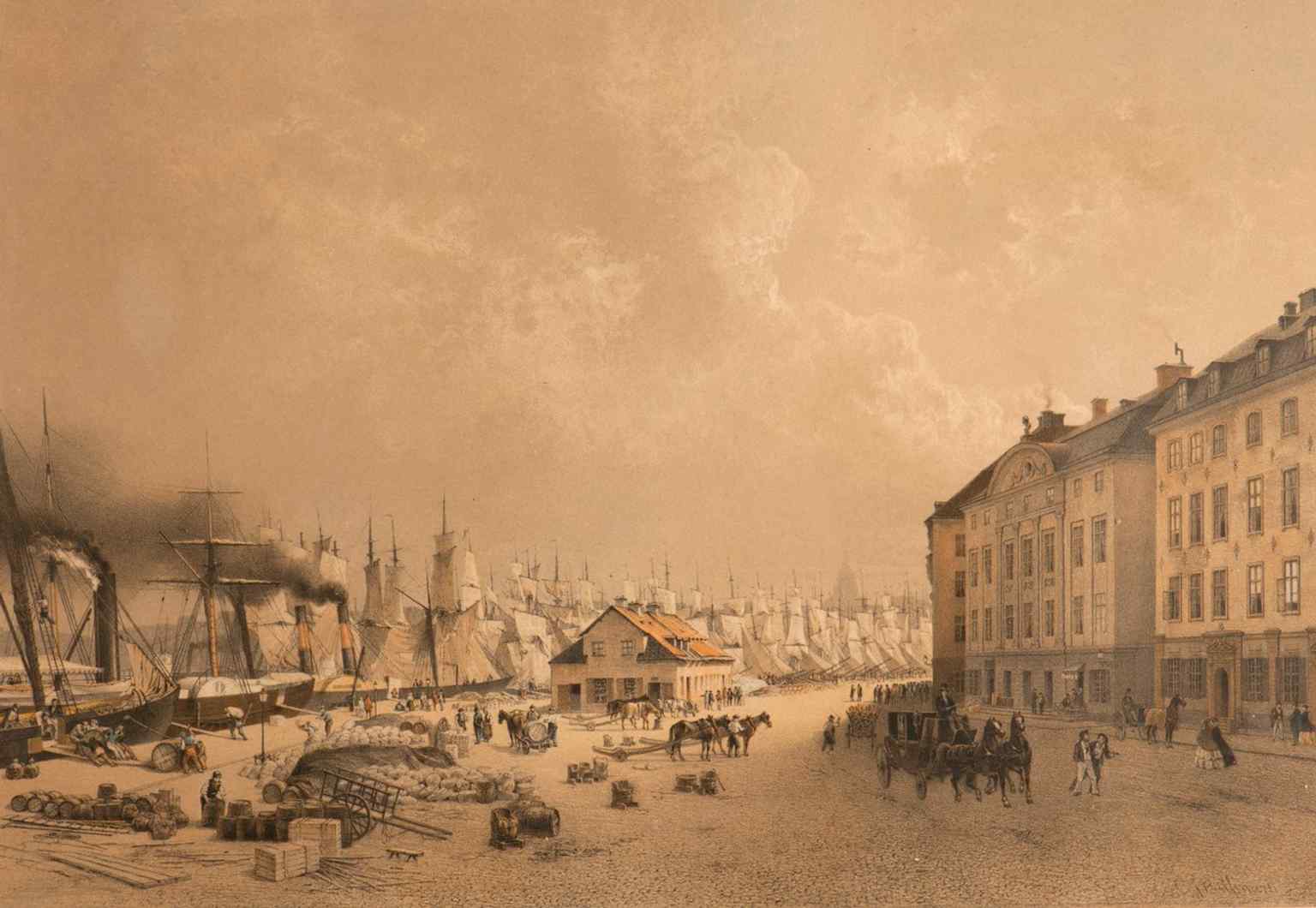
A 19th-century view of mid-Skeppsbron with ships at the quay, capturing the busy harbor scene that once made Stockholm’s east waterfront so important.Photo: Carl Johan Billmark, Wikimedia Commons, Public domain. Cropped & resized. Even after the Bloodbath and all the shocks of power we’ve been tracing, daily exchange returned and kept returning. That is one of this city’s deepest patterns: rulers stage authority, but workers keep the place alive.
By the late nineteenth century, shipping changed again. Bigger motor vessels and the rising land made this quay too shallow for the largest freight ships. Passenger traffic lasted much longer, and the waterfront slowly shifted from working harbor to traffic corridor and public edge. If you glance at the before-and-after image, you can see that change in a single sweep of shoreline.
From here, goods and people streamed inland through the narrow lanes behind these facades. Follow that movement, and it leads us next to Österlånggatan, where the waterfront’s raw labor turned into bargaining, bookkeeping, and trade.
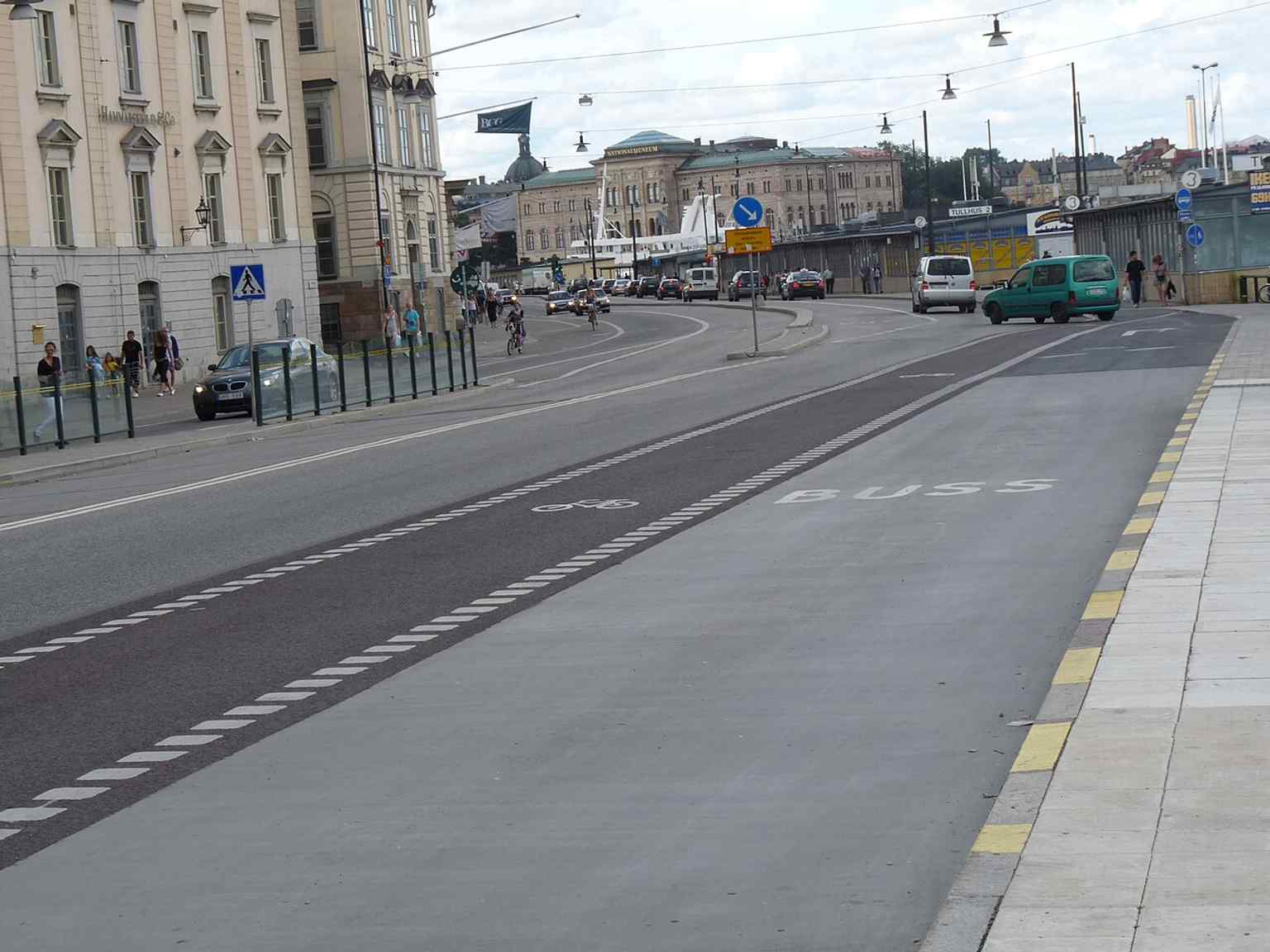
A clean street-level view of Skeppsbron, showing the broad waterfront boulevard that runs along the east side of Gamla stan.Photo: Dmitry G, Wikimedia Commons, Public domain. Cropped & resized. 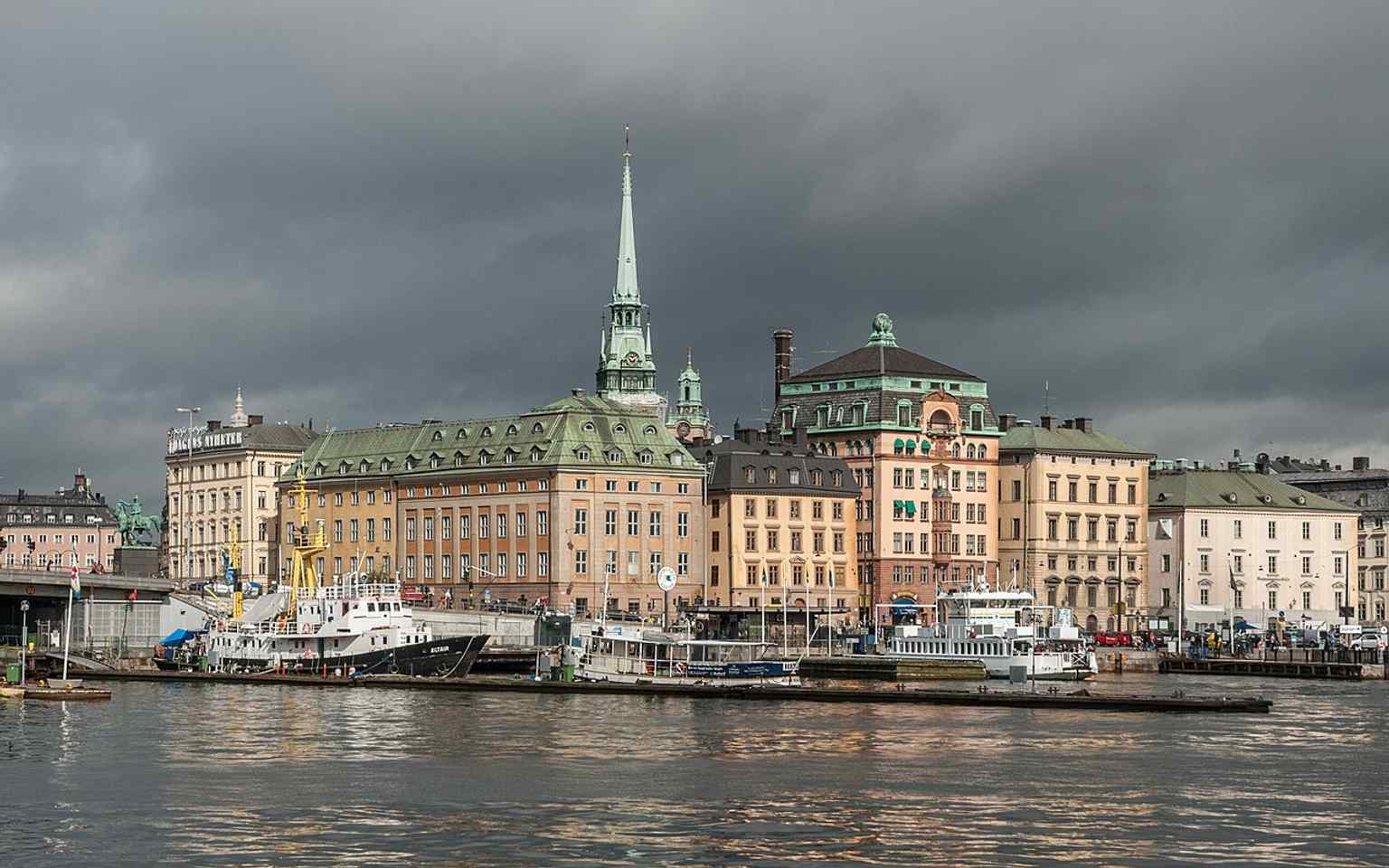
The south tip of Stadsholmen with the Skeppsbron waterfront buildings, including the grand merchant houses that formed the famous Skeppsbroraden.Photo: DXR, Wikimedia Commons, CC BY-SA 4.0. Cropped & resized. 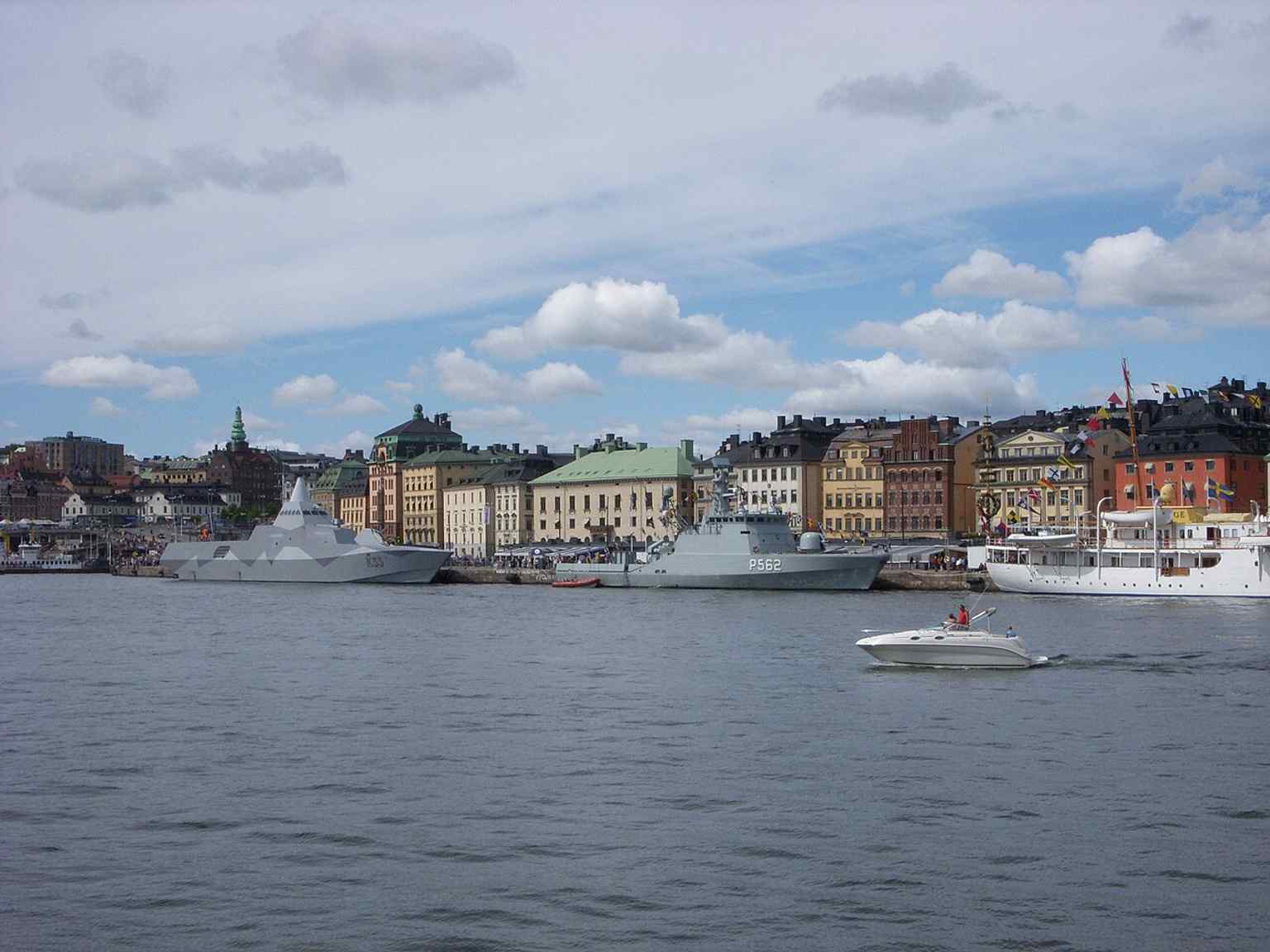
Skeppsbron crowded during the 2010 royal wedding, a vivid reminder that this old quay still serves as a ceremonial waterfront.Photo: Holger.Ellgaard, Wikimedia Commons, CC BY-SA 3.0. Cropped & resized. 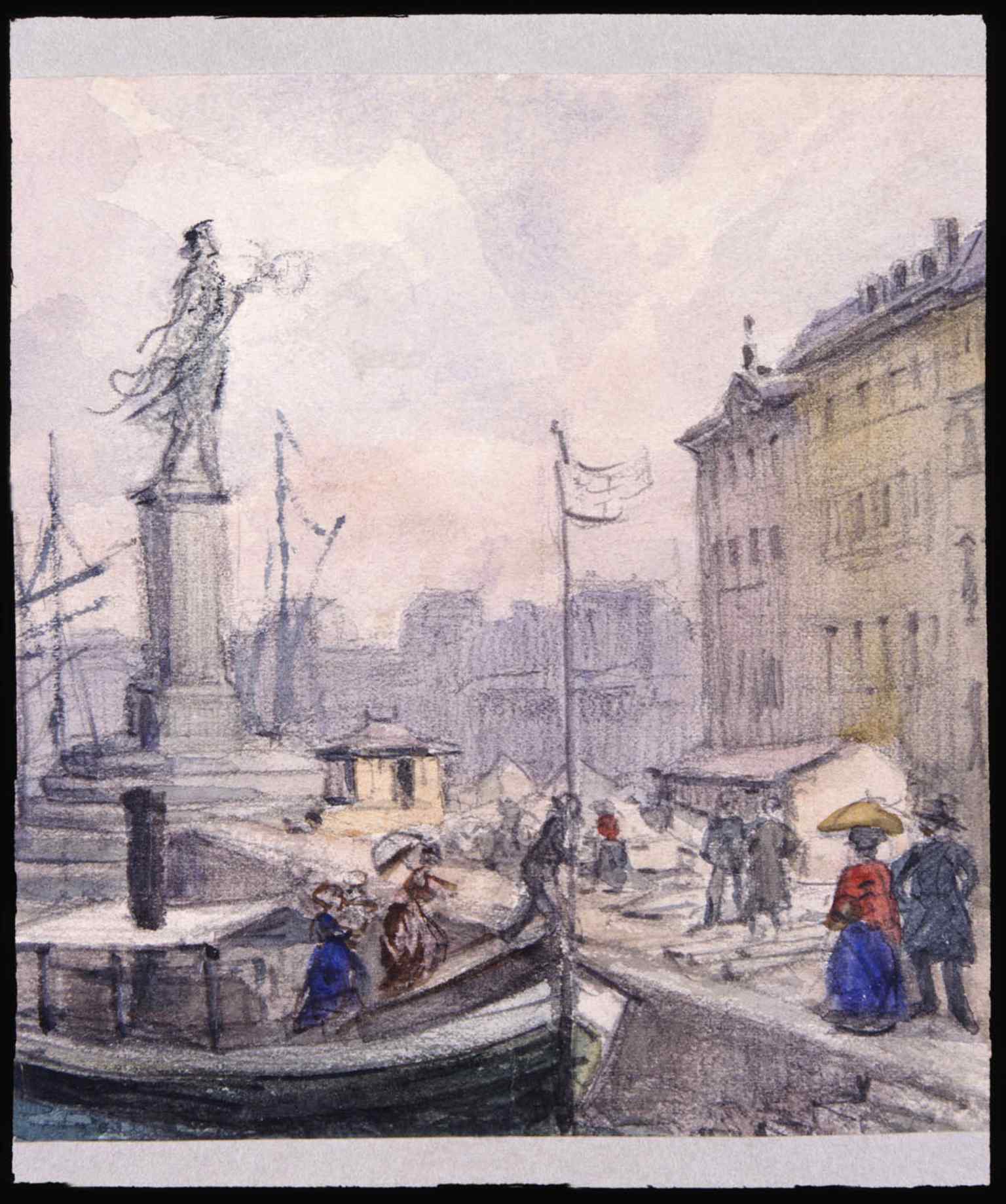
Fritz von Dardel’s watercolor shows fashionable pedestrians on Skeppsbron in the 1840s, when the quay was already both promenade and working harbor.Photo: Fritz von Dardel, Wikimedia Commons, Public domain. Cropped & resized. 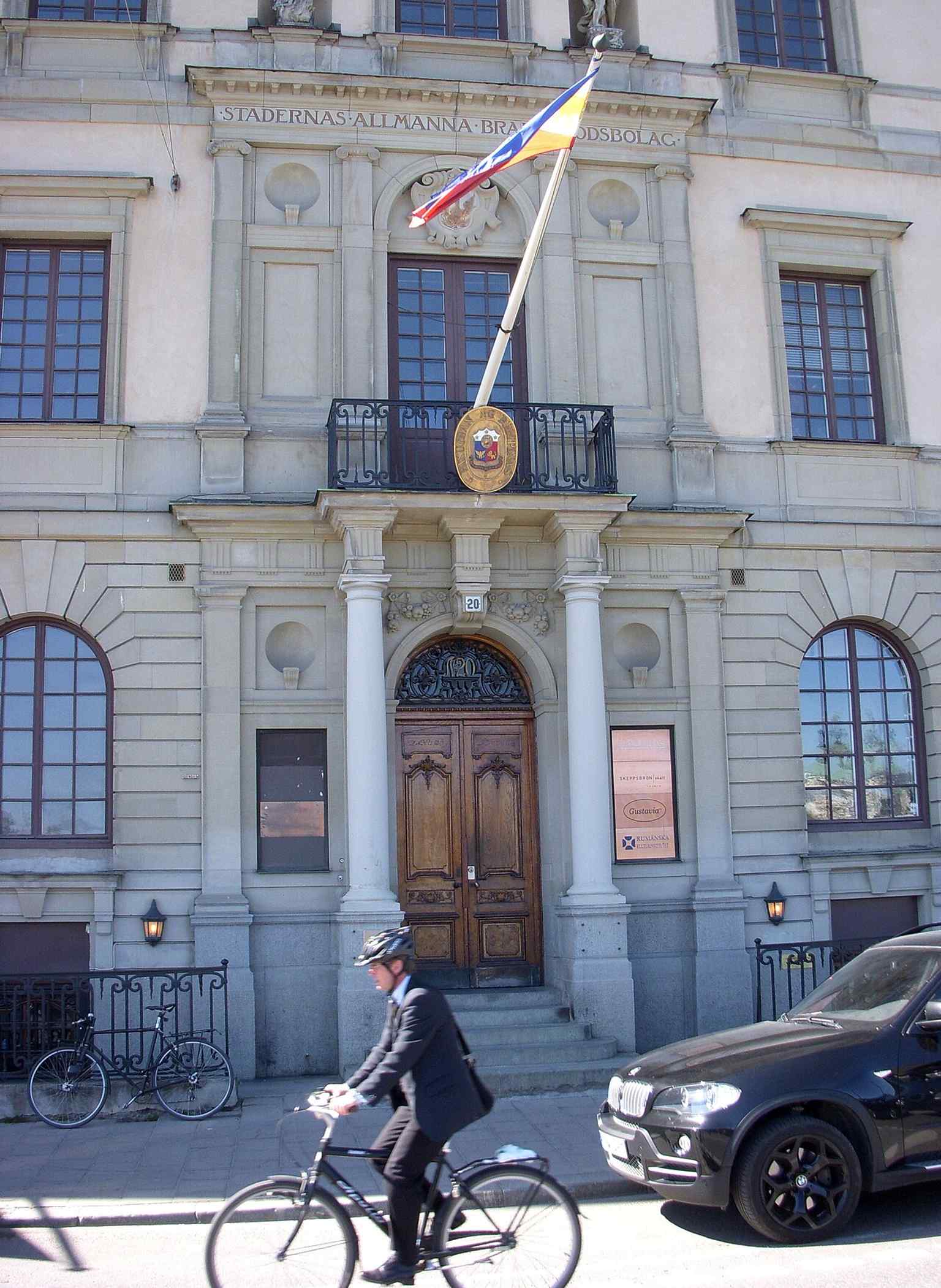
Skeppsbron 20, the Philippine Embassy in the former Brandstodsbolaget building, showing the ornate merchant architecture along the quay.Photo: Holger.Ellgaard, Wikimedia Commons, CC BY-SA 3.0. Cropped & resized. 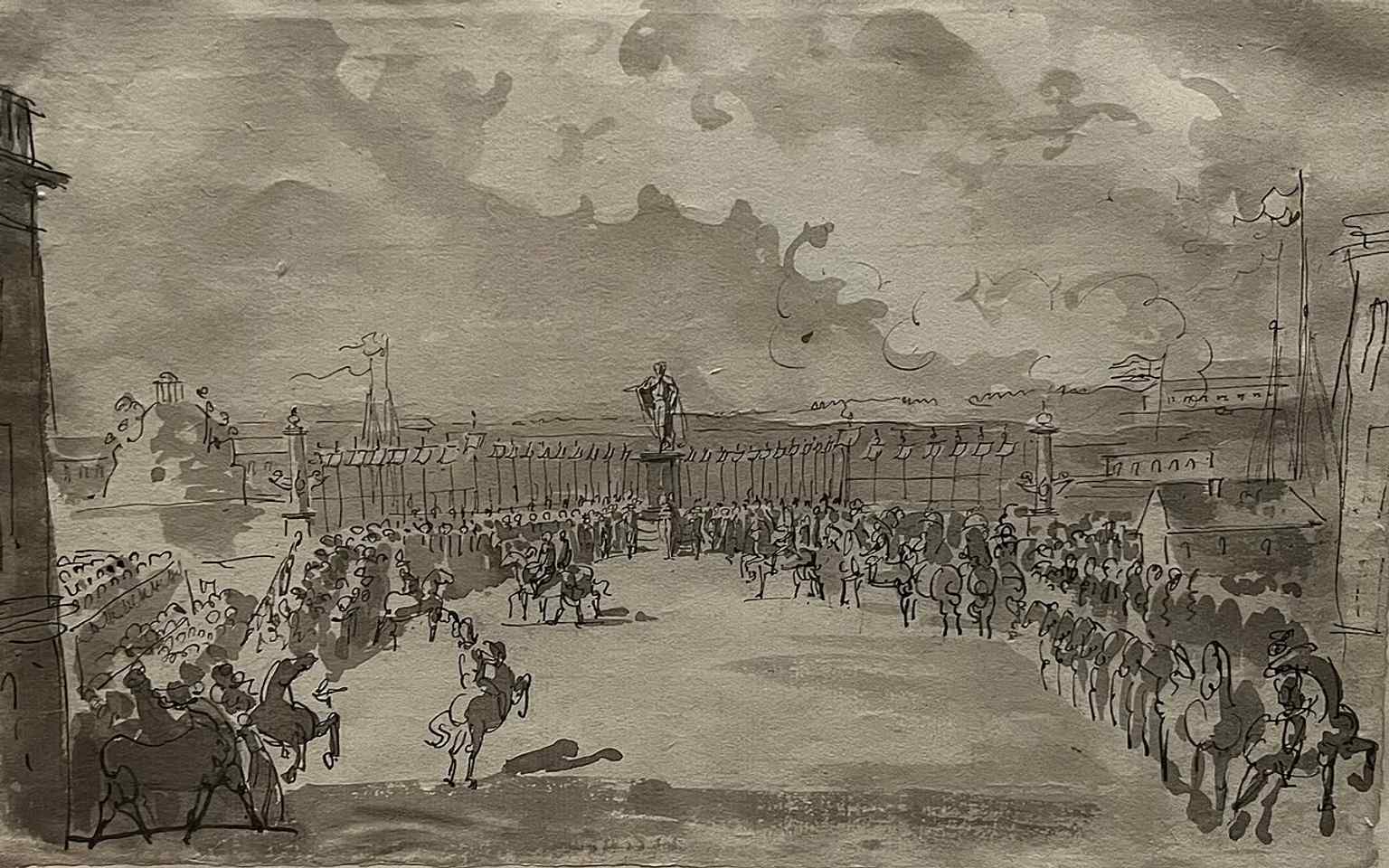
This 1808 drawing documents the unveiling of Sergel’s statue of Gustav III, the monument at Skeppsbrons northern end.Photo: Emanuel Limnell, Wikimedia Commons, Public domain. Cropped & resized. 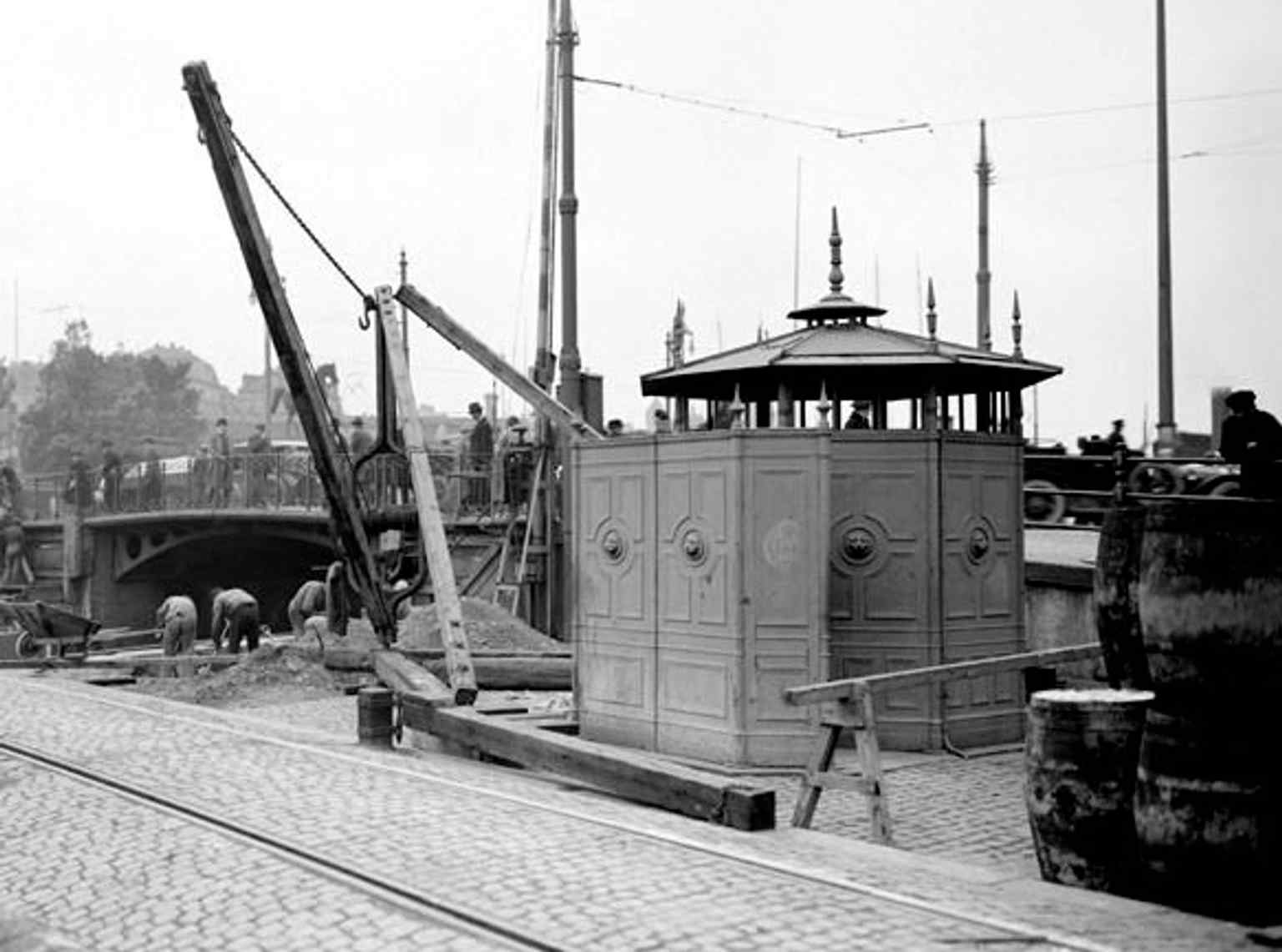
A rare detail from around 1900: one of Skeppsbrons public convenience buildings, part of the quay’s everyday working infrastructure.Photo: ingen uppgift, Wikimedia Commons, Public domain. Cropped & resized. 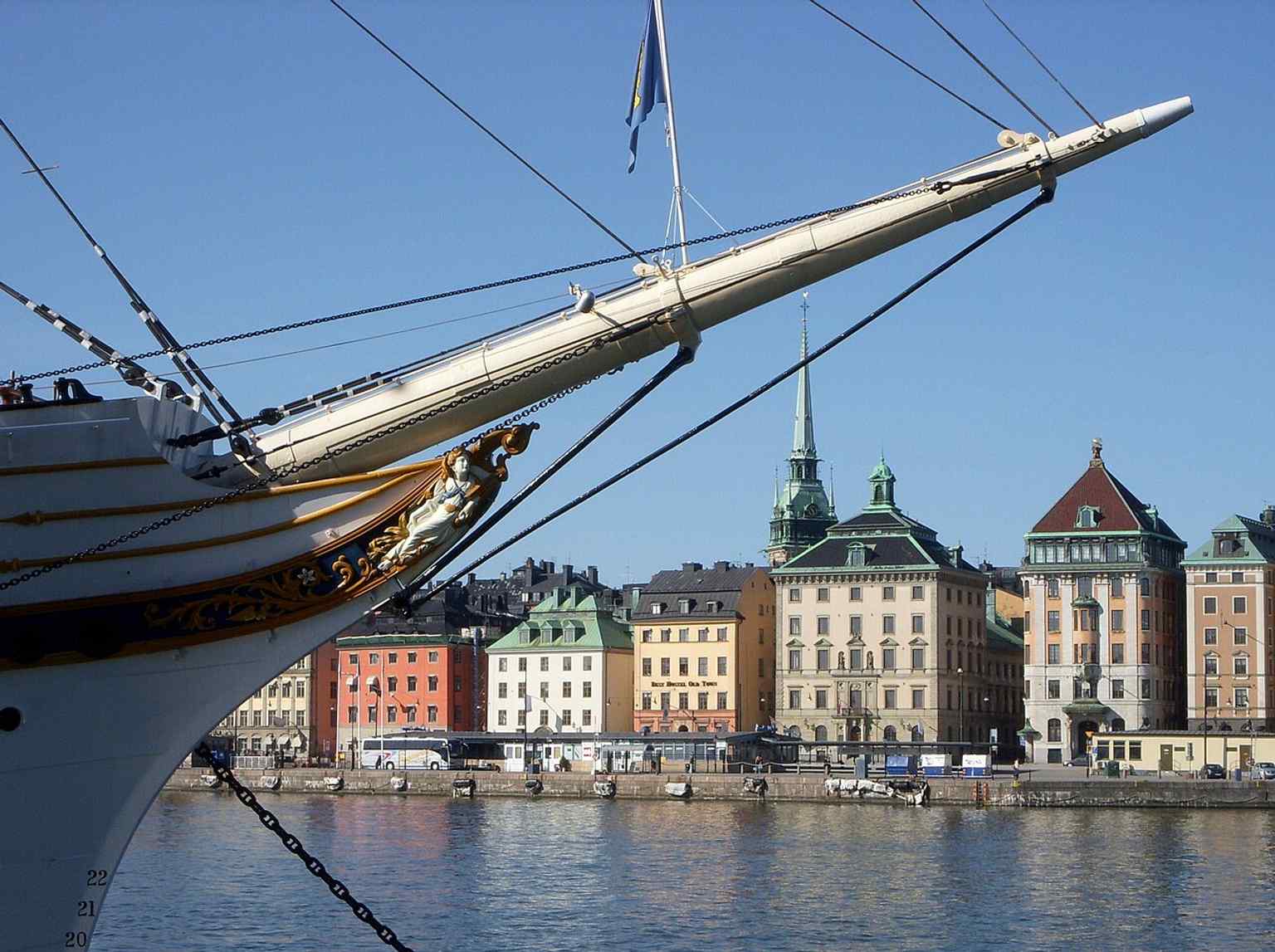
Af Chapman with Skeppsbron and Gamla stan in the background, a broad harbor view that places the quay in Stockholm’s central waterfront setting.Photo: Holger.Ellgaard, Wikimedia Commons, CC BY-SA 3.0. Cropped & resized. Look for a narrow stone-paved street lined with tall plaster-and-stone façades, with a long straight corridor and tight side alleys cut into the blocks. This is one of the twin…Read moreShow less
Open dedicated page →Look for a narrow stone-paved street lined with tall plaster-and-stone façades, with a long straight corridor and tight side alleys cut into the blocks.
This is one of the twin merchant streets of Gamla stan. Västerlånggatan held the western edge, and Österlånggatan held the eastern one. Both began as long roads outside the town wall, shaped first by shoreline and defense, then by trade, until the city slowly pulled them inward and made them essential.
What feels like an ordinary old street is, in fact, reclaimed ground layered over centuries. In the thirteenth century, this was little more than the eastern shoreline. Most visitors never realize that the original beaten track of Österlånggatan lies about three meters below the pavement under your feet, and that archaeologists found a late thirteenth- or early fourteenth-century landing stage nearby as well. In other words, ships once came right up to where people now window-shop.
The city changed this place by dumping gravel and rubbish into the water, pushing the shoreline farther east. By the fourteenth century, the path had become a proper street, paved and lined with workshops, shops, and dwellings. Swedish merchants from Bergslagen, the mining district to the north, settled along this street. German merchants clustered closer to Järntorget. Trade did not just enrich Stockholm; it physically remade the ground it stood on.
And yet this was never a polished commercial boulevard. It carried the rougher life that official power depended on but rarely acknowledged. Sailors, traders, travelers, taverns, arguments, smells from cargo and kitchens... this was the back side of the dock district. On your screen, the street can look calm and orderly now, but names from the seventeenth century tell a harsher story: Riga, Dutch Slough, Gilded Dragon, Three Kings, Swedish Arms, The Star. Romantic names, yes, though they concealed filth, stench, drinking, and misery behind the doors.
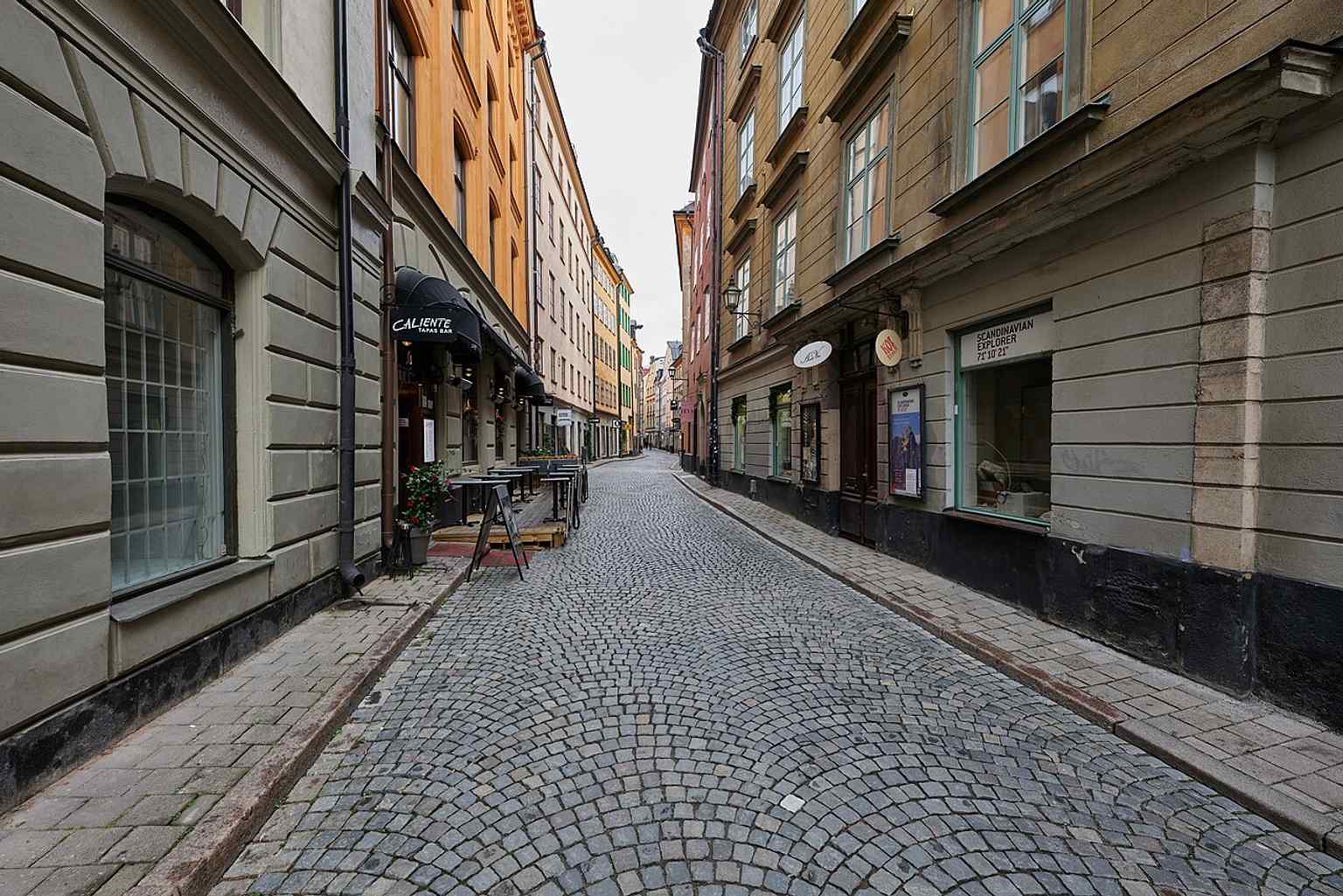
A broad modern streetscape of Österlånggatan, useful for showing the long, historic street as it appears in the 21st century.Photo: Leonhard Lenz, Wikimedia Commons, CC0. Cropped & resized. One person still lingers here in a more intimate way: Gunilla Johansdotter Bese, a noblewoman born in the late fifteenth century. She lived in the little passage still remembered as Fru Gunillas Gränd, between numbers forty-three and forty-five. Her name matters because it unsettles the easy picture of this as only a street of merchants and labor. Even here, in a place shaped by cargo and commerce, rank tried to secure its place.
Then the balance shifted again. When the broad quay at Skeppsbron took form in the seventeenth century, traffic and status moved outward, and Österlånggatan lost much of its old importance. The main artery became quieter. Power had found a newer frontage.
If you look at number thirty-seven on your phone, notice how tightly the alleys knot around it. That house stands on a medieval wall, carries a seventeenth-century portal, and still holds the compressed scale of the old merchant city. In a moment, we’ll turn toward Baggensgatan twenty-seven, where that older, more inward Stockholm becomes even easier to feel.
Look for the narrow plaster-fronted house with a steep gabled profile and a carved stone coat of arms set above the doorway. At first glance, this does not look like one of…Read moreShow less
Open dedicated page →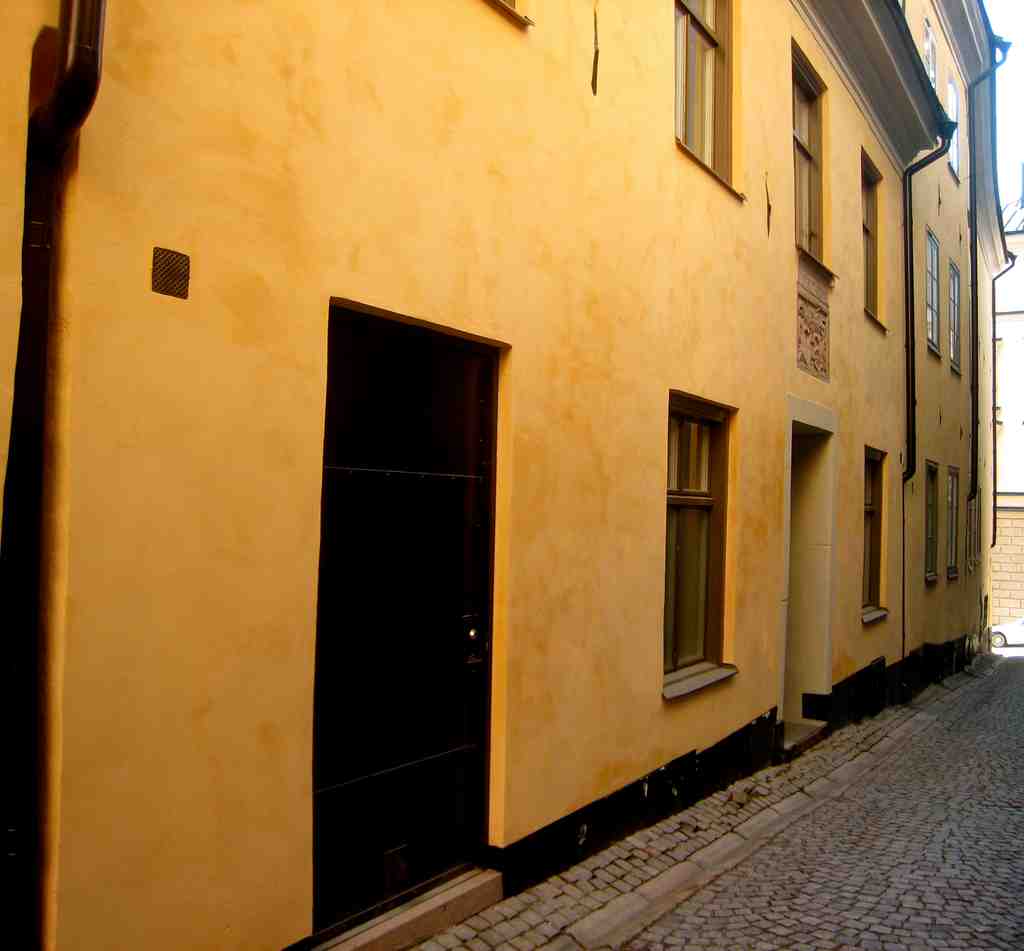
Baggensgatan 27Photo: Ankara, Wikimedia Commons, CC BY-SA 3.0. Cropped & resized. Look for the narrow plaster-fronted house with a steep gabled profile and a carved stone coat of arms set above the doorway.
At first glance, this does not look like one of Stockholm’s great survivors. But it is. Baggensgatan twenty-seven is likely one of the oldest surviving residential houses in the city... a place that quietly remembers medieval Stockholm not as a stage for kings, but as a place where people slept, prayed, traded, and kept going.
Most visitors pass the doorway and miss the age hiding in the wall. Look closely at the iron anchor plates fixed into the facade. They belong to a very early type, cast in one piece, older than the styles that became common after the mid fifteen hundreds. Locals notice those details. They tell you this house carries its centuries in its bones.
The story may begin in the thirteen thirties. King Magnus Eriksson likely ordered this house built in thirteen thirty-six for the Johanniters, a religious order also known as the Knights Hospitaller. He told them to keep a shelter here, something between a hostel and an inn, for pilgrims and traveling monks. That matters. It means medieval Stockholm was not only fortress, court, and punishment ground. It was also a city of arrivals... people with muddy boots, foreign accents, and religious purpose, looking for a bed behind these walls.
In the fourteen hundreds, Gertrud Hansdotter left the house to Vadstena Abbey. Then, in the late fifteen hundreds, another life began here. The Scottish nobleman Anders Keith, an officer in Swedish service and a favorite of King Johan the Third, held this address. His house stood between the twin merchant streets of the old town, with access from both Baggensgatan and Österlånggatan. Above the door, you can still see the stone shield with the arms of Keith and his wife, Elisabeth Birgersdotter Grip. The Latin inscription reads, “Auxilium nostrum a Domino” - our help comes from God. That shield originally faced Österlånggatan; workers moved it here in the eighteen sixties, which is why the house still wears its most personal memory toward this street.
Then the name changed everything. People began calling this place Papistekyrkan, “the Papist Church” - a Protestant nickname for a Catholic worship space. King Sigismund bought the house in the fifteen nineties and allowed Catholic services here. A priest named Andreas Olai led worship inside. In fifteen ninety-five, the conflict turned so sharp that the parish priest Erik Schepperus asked the city to lock the house because, as he put it, the papal priest was holding services here.
So this building is a witness twice over: first to medieval hospitality, then to the struggle over who had the right to worship in Stockholm at all. After that, it passed from nobles to masons, wine merchants, and traders. A fire in seventeen seventy damaged it, and the facade you see from Baggensgatan likely took its present character during the repairs.
That is the quiet power of this house. It proves that Gamla stan grew not only through crowns and decrees, but through migrants, merchants, clergy, and families layering their lives into the same walls. In a moment, we’ll carry that story into the community that helped shape this part of the city most visibly... at the German Church.
On your left rises a dark red brick church with tall pointed windows and a slender copper spire crowned by a gilded rooster. This is Tyska kyrkan, the German Church, also called…Read moreShow less
Open dedicated page →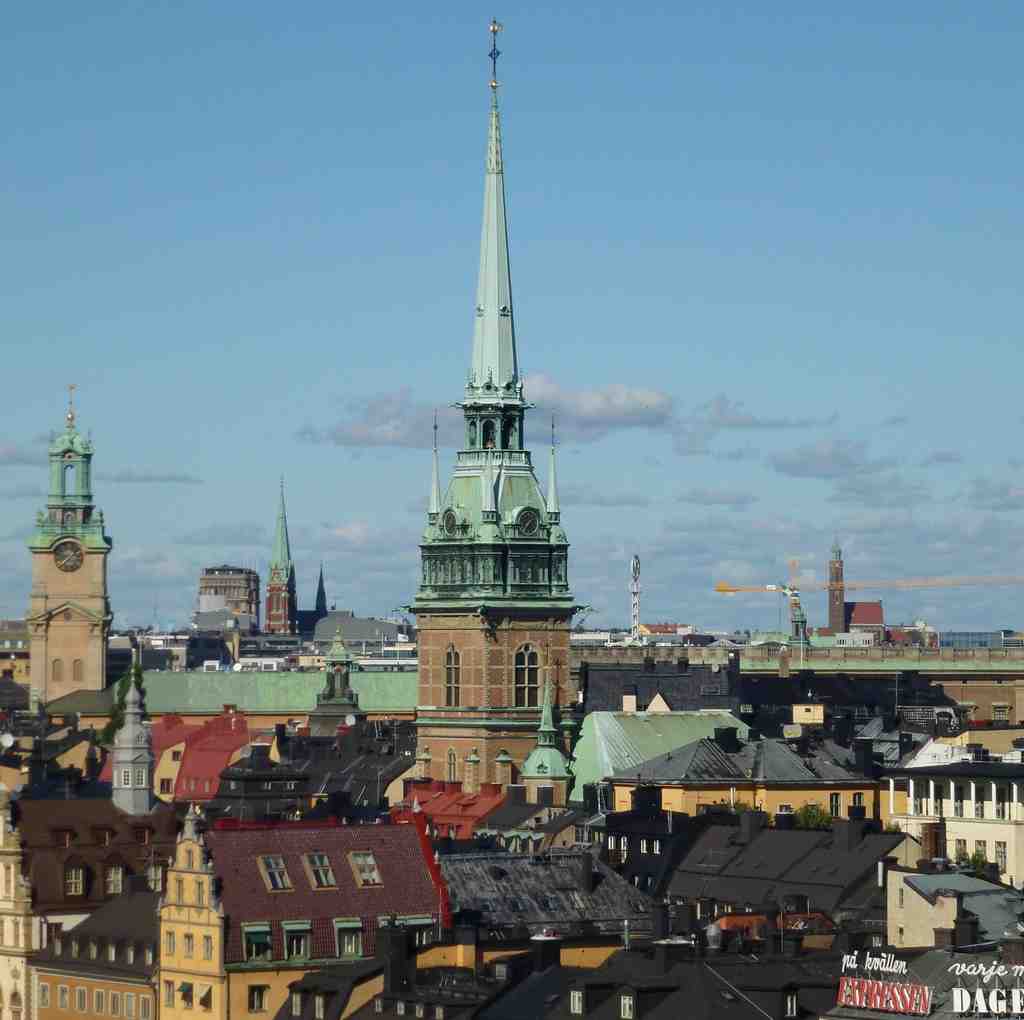
German Church, StockholmPhoto: Holger.Ellgaard, Wikimedia Commons, CC BY-SA 3.0. Cropped & resized. On your left rises a dark red brick church with tall pointed windows and a slender copper spire crowned by a gilded rooster.
This is Tyska kyrkan, the German Church, also called Saint Gertrud’s. It tells you something essential about old Stockholm: the city never grew as a sealed Swedish world. From the Middle Ages onward, German-speaking merchants built a community here that carried trade, credit, language, worship, and influence through these narrow streets. Saint Gertrud, their patron, protected travelers and seafarers, which made her a fitting guardian in a port city where fortunes arrived by ship.
Before this became a church, it was the guild house of Saint Gertrud. A guild was more than a religious club. It was a network for business, status, mutual aid, and political leverage. In other words, while kings ruled from palaces and bishops held the grand stage at Storkyrkan, these merchants built a parallel center of power here, tucked into the street grid yet deeply connected to the Baltic world.
One moment captures that perfectly. In fourteen forty-eight, Karl Knutsson Bonde was chosen king in Saint Gertrud’s guild hall. Not in a royal palace... here, in a merchants’ house. That tells you who mattered in Stockholm.
Pause for a second and study how the church pushes upward from such tight surroundings. When ground is scarce and prestige is contested, a community announces itself vertically... with height, bells, and a tower that claims the skyline.
If you glance at the image in the app, you can see how completely the tower dominates the roofs of Gamla stan. The present spire came later, after disaster. Fire destroyed the older tower in eighteen seventy-eight. When the burning spire collapsed, heavy bells crashed down through the roof. Everyone expected the interior to be lost. But the old brick vaults held. That gave Stockholm’s new fire brigade enough time to stop the flames before they consumed the church room.
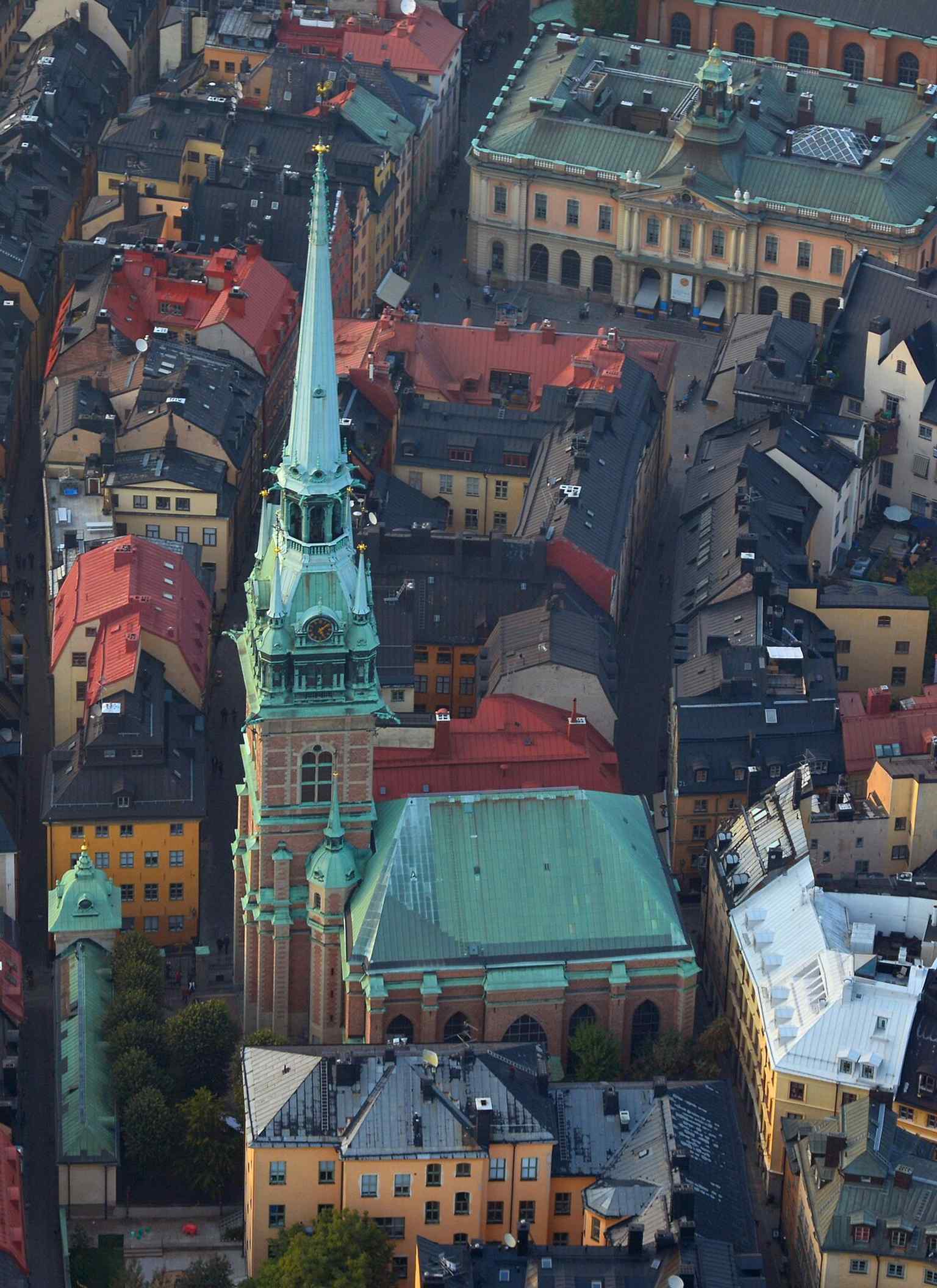
Aerial view of the church within the roofscape of Gamla stan — useful for showing how the tower dominates Stockholm’s skyline.Photo: Esquilo, Wikimedia Commons, CC BY-SA 3.0. Cropped & resized. Most visitors notice the tower. Locals tend to mention what survives below. Under this church complex, the vaulted remains of the old guild cellar still exist, including traces of a hypocaust, an underfloor hot-air heating system borrowed from Roman engineering. Think about what that means: wealthy German merchants once warmed their feast rooms above with hidden heat below. Commerce here did not merely support devotion. It financed comfort, ceremony, and political theater.
The church you see now took shape in stages. In the 1640s, the builder Hans Jacob Kristler from Strasbourg transformed the earlier chapel into a larger late Gothic hall church, then gave it a face of red brick, buttresses, and gray sandstone details. If you check the portal image, you can catch that layered identity in stone: part merchant house, part church, part international statement.
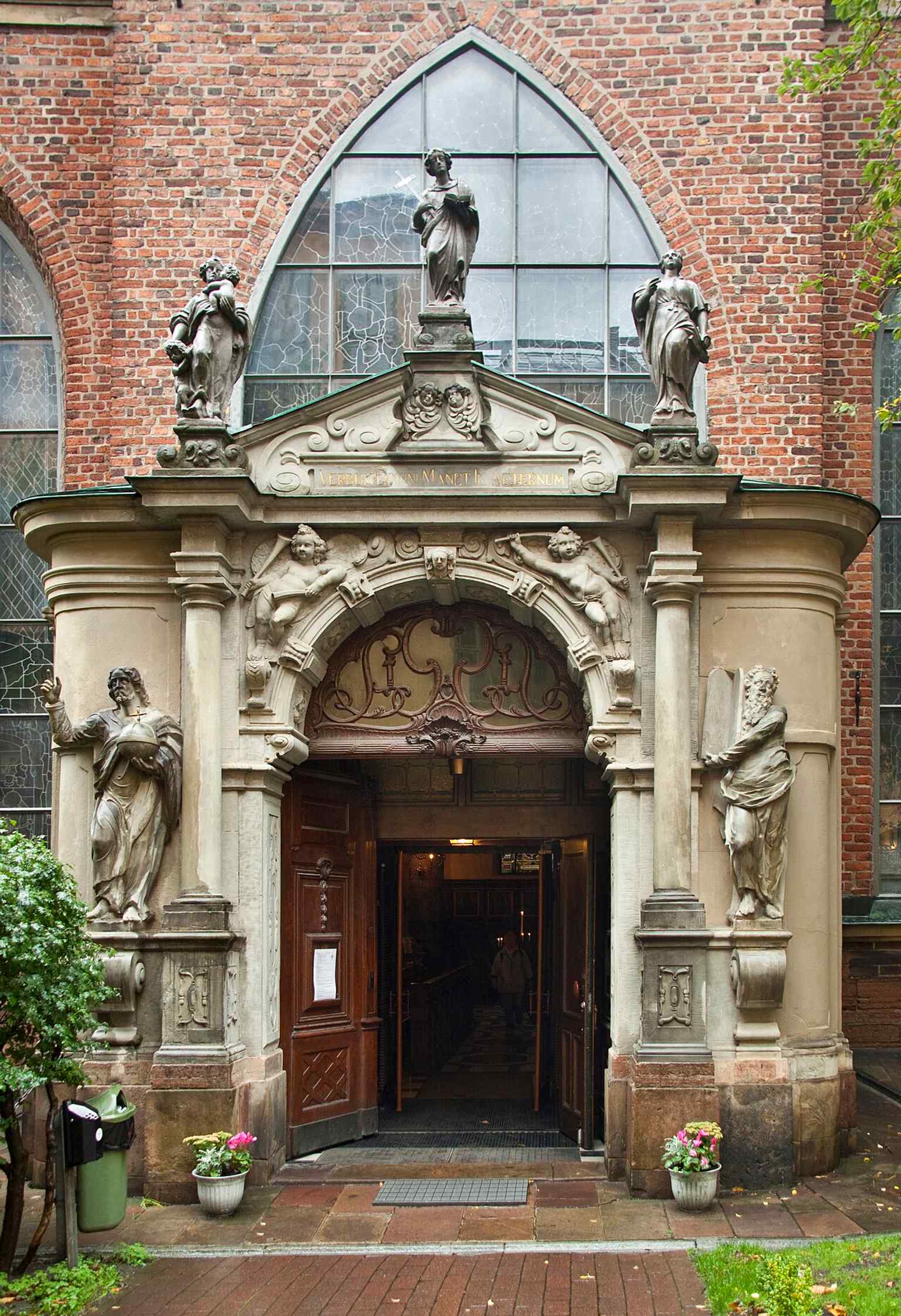
The southern portal from 1643, with the sculptural doorway that reflects the church’s Renaissance and Baroque rebuilding phases.Photo: Albabos, Wikimedia Commons, CC BY-SA 3.0. Cropped & resized. Inside, the story continues in another register: German services, a royal gallery designed by Nicodemus Tessin the Elder, and a near ten-meter Baroque altarpiece by Markus Hebel. So this was never a minor ethnic chapel. It stood at the meeting point of crown, congregation, and capital.
Around it, the streets once pressed close with stalls and clothing booths leaning against the church walls. Trade, prayer, gossip, and many languages mixed in the same few lanes. Hold that image as you continue toward Västerlånggatan, where the city’s daily traffic becomes the story again. If you want to return and go inside, the church generally opens Friday through Sunday from eleven to three.
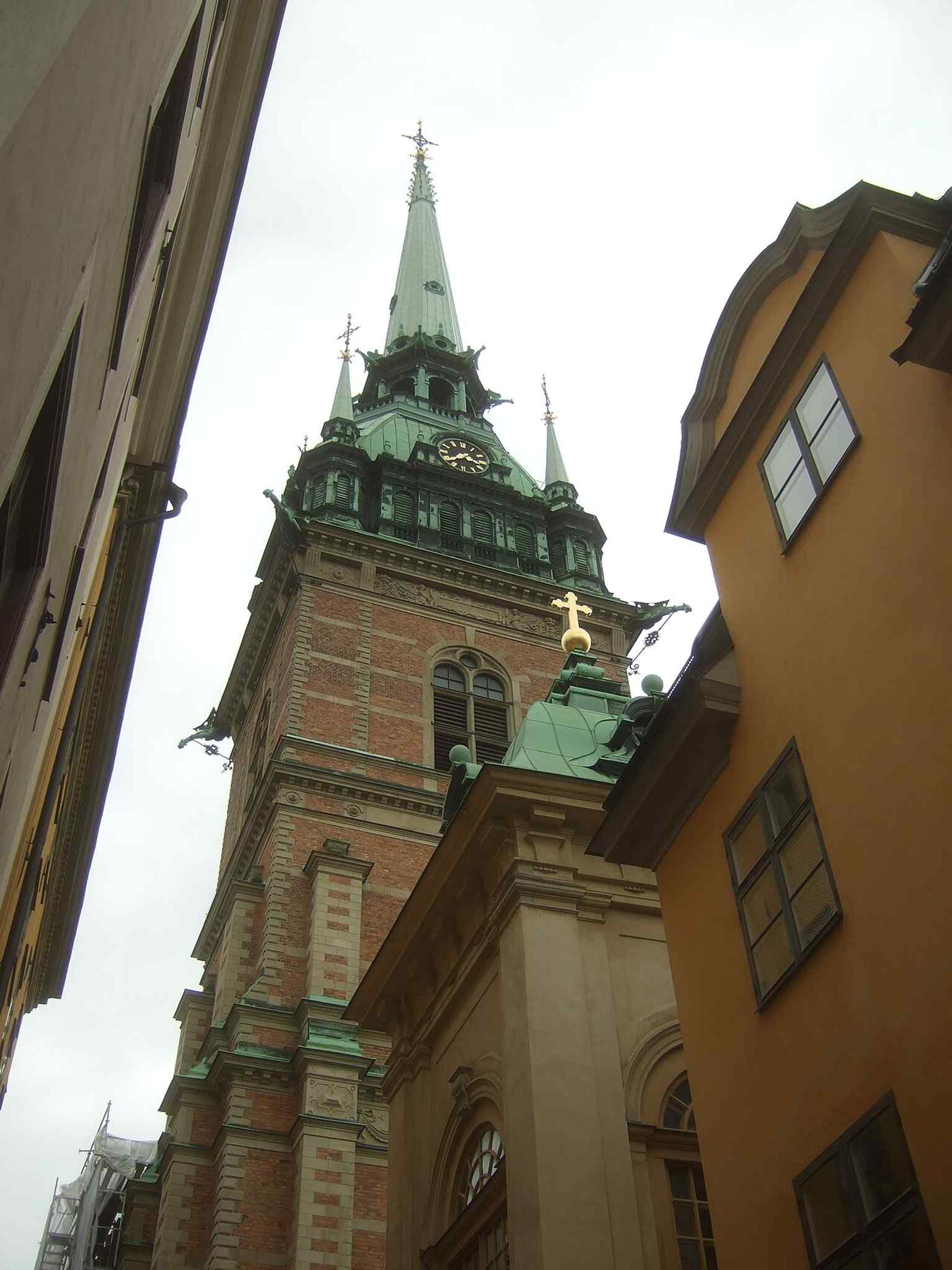
Seen from the busy corner of Tyska Brinken and Västerlånggatan, matching the church’s historic place in the narrow Old Town streets.Photo: Hans Lindqvist, Wikimedia Commons, CC BY-SA 4.0. Cropped & resized. 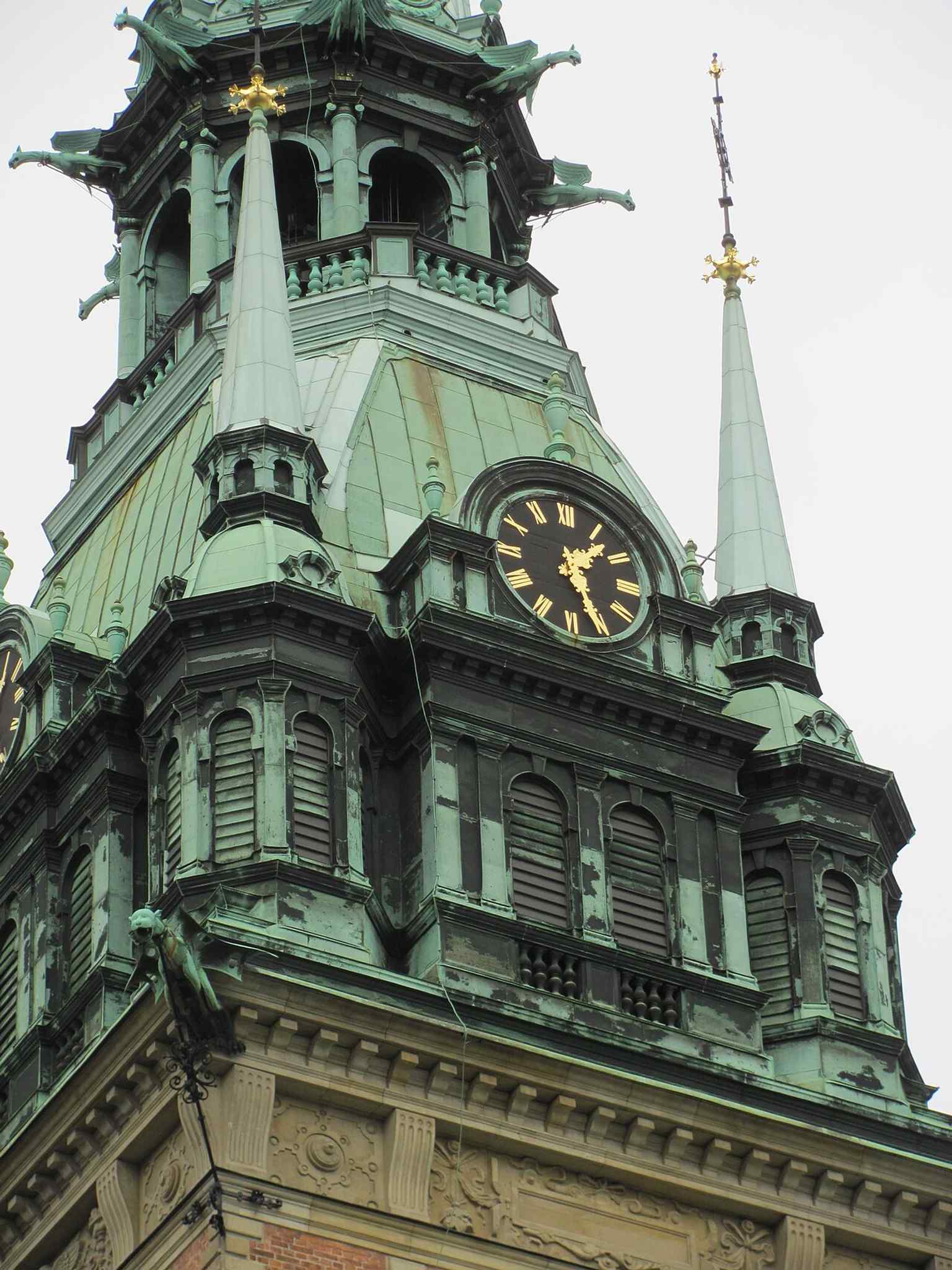
A close view of the clock face on the tower, tied to the church’s famous bells and the daily chimes heard across Gamla stan.Photo: Anders Biörk, Wikimedia Commons, CC BY-SA 3.0. Cropped & resized. 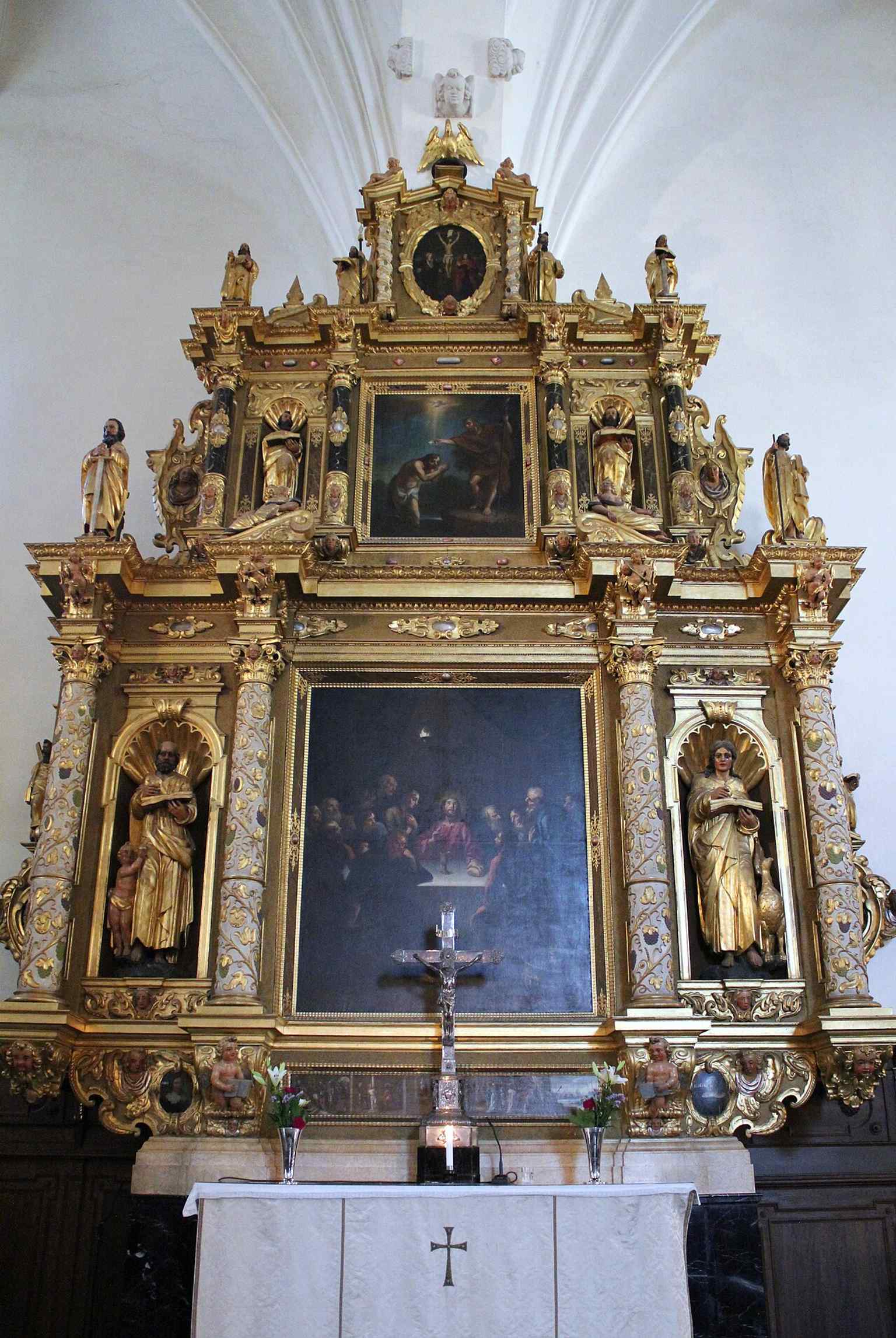
The monumental altarpiece by Markus Hebel, almost 10 meters high and one of the church’s most important Baroque artworks.Photo: Jssfrk, Wikimedia Commons, CC BY-SA 3.0. Cropped & resized. 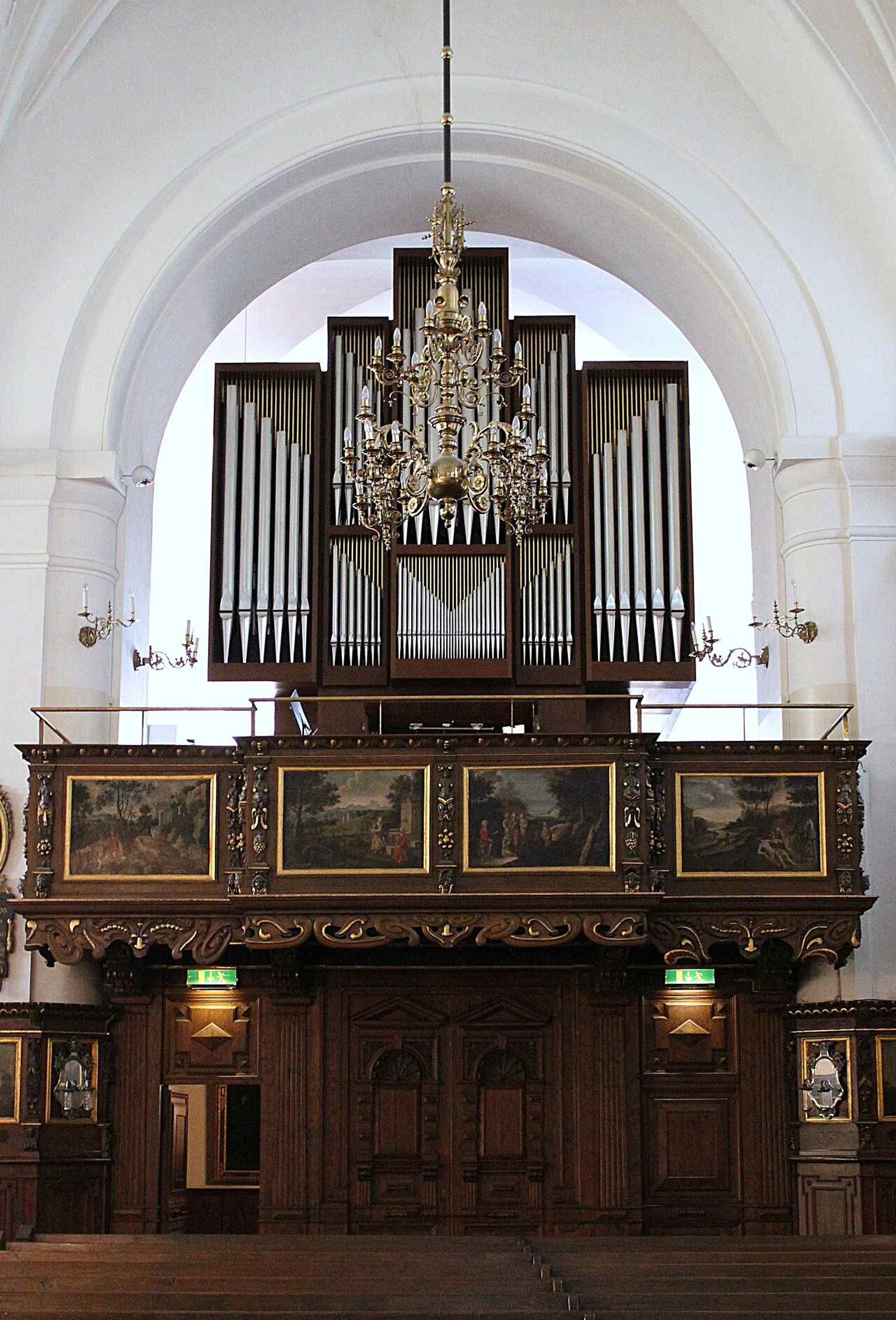
The small organ in the church, connecting to the long musical tradition and the historic organ story in the text.Photo: Jssfrk, Wikimedia Commons, CC BY-SA 3.0. Cropped & resized. 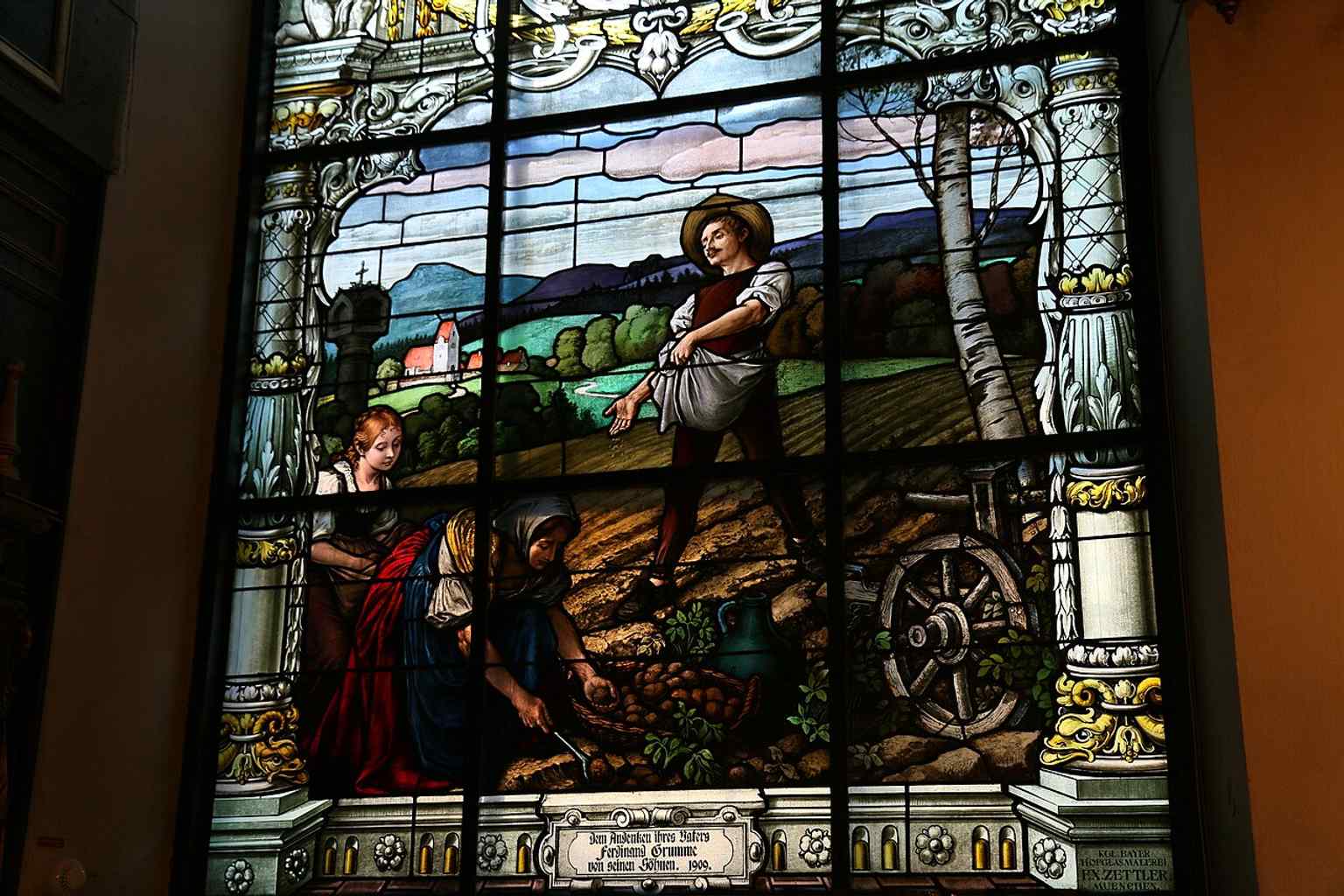
Stained glass from inside the church, a later addition that adds to the layered historic interior.Photo: Øyvind Holmstad, Wikimedia Commons, CC BY-SA 4.0. Cropped & resized. Västerlånggatan looks like a gently curving stone-paved street lined with tall plaster façades, narrow gables, and old forged-iron signs projecting above the shopfronts. At first…Read moreShow less
Open dedicated page →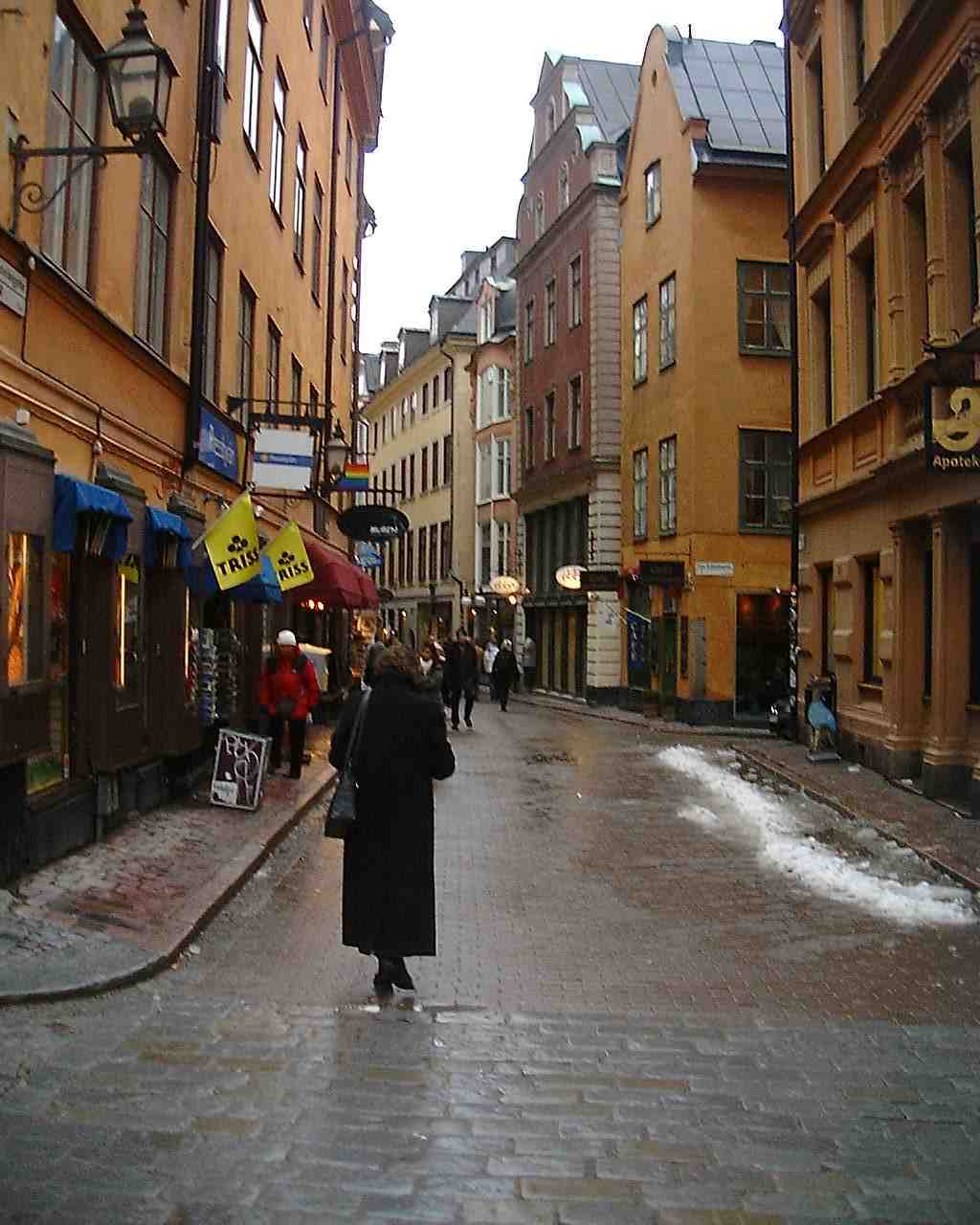
VästerlånggatanPhoto: Mats Halldin, Wikimedia Commons, CC BY-SA 3.0. Cropped & resized. Västerlånggatan looks like a gently curving stone-paved street lined with tall plaster façades, narrow gables, and old forged-iron signs projecting above the shopfronts.
At first glance, this feels like the Stockholm of postcards... charming, crowded, easy to love. But Västerlånggatan did not begin as a pretty shopping street. It began as a path outside the city’s western wall, following the shoreline. The curve you see is the clue. This was once the edge of Stockholm, not its polished center.
In the Middle Ages, this street and Österlånggatan formed a pair, the twin long streets running outside the walls on either side of town. Then this western route took on a larger job. It linked the northern gate at Norrbro to the southern gate at Söderbro, so traffic between Uppland and Södermanland pressed through here. That means this was not just picturesque. It was functional, strategic, and busy with purpose.
By the fifteenth century, the path had become a paved commercial spine. Merchants sold, craftsmen hammered, and the city sorted bodies and trades along its length. At the northern end, blacksmiths worked here because the authorities feared fire inside the walls. Later, goldsmiths moved in and the street climbed in status. If you glance at the image in the app, you can catch that layered look: medieval proportions underneath later shop façades, a street that keeps rewriting its own face.
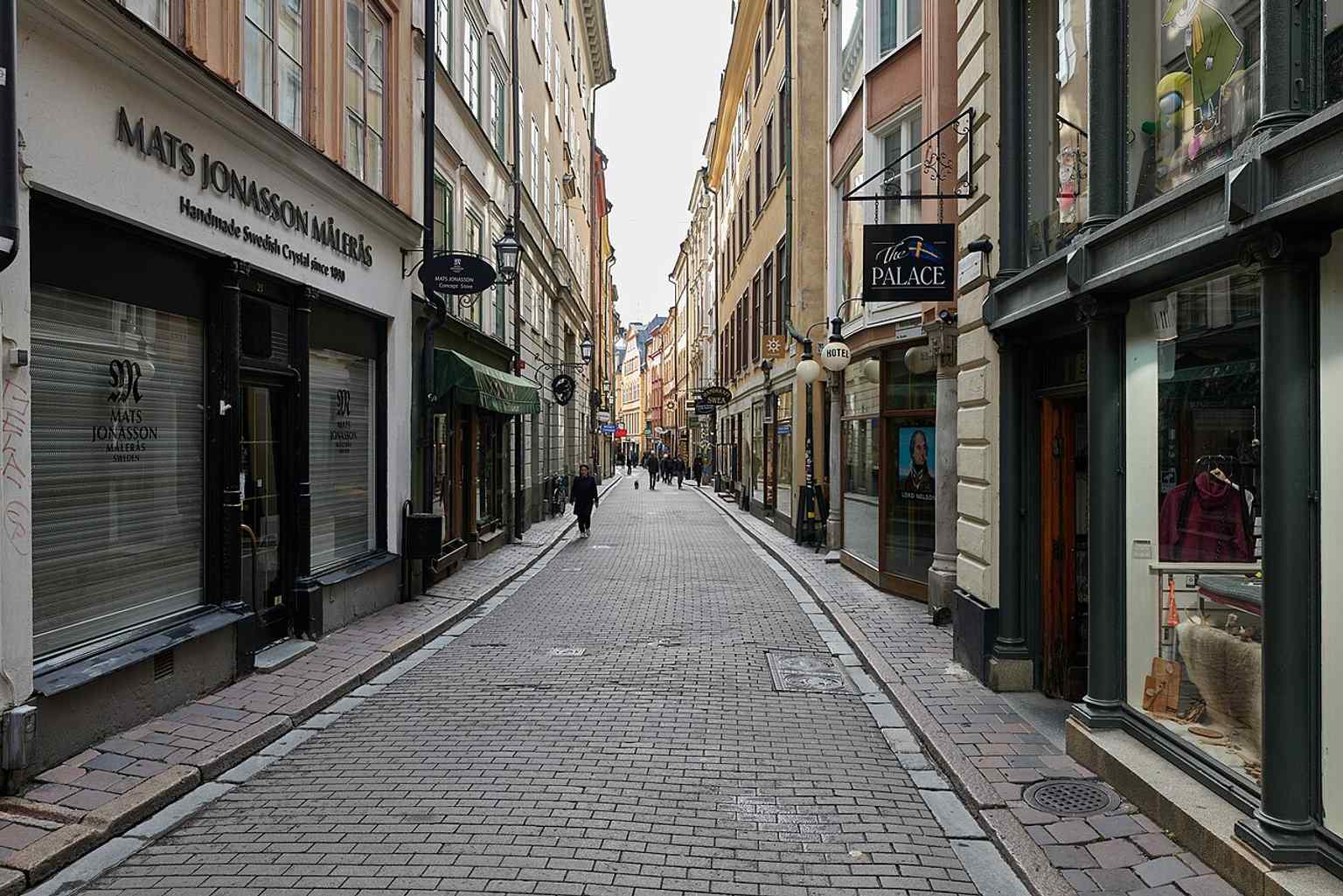
A street-level perspective of Västerlånggatan’s crowded façades, useful for the story of its shops, signs, and layered historic buildings.Photo: Leonhard Lenz, Wikimedia Commons, CC0. Cropped & resized. And that rewriting matters. In the nineteenth century, when Stockholm’s commercial center shifted north and parts of Gamla Stan declined, Västerlånggatan escaped. The bridge called Riksbron connected it more directly to newer shopping districts in nineteen oh seven. Shop owners modernized. They added large display windows, plaster ornament, and slim cast-iron colonettes ordered from Germany. Those handsome fronts often conceal much older cores behind them... cellars, beams, arches, whole medieval rooms still living inside the buildings.
One person captures the street’s hard commercial nerve better than any façade. Carolina Lindström ran a milliner’s shop here from the eighteen forties. A milliner, by the way, made and sold women’s hats and fashionable accessories. She worked so late people nicknamed her the Evening Star. Then, in eighteen forty-four, she learned that King Charles the Fourteenth had died before her competitors did. She rushed out and bought the city’s crape and mourning cloth before anyone else. Grief became inventory. Inventory became profit. That is the truth under the charm: this street taught people to turn news, rank, and ritual into business.
Even medicine carried that mix of necessity and theater. On your screen, notice the gilded raven of Apoteket Korpen, the Raven Pharmacy, founded in the sixteen seventies. In a city battered by plague and epidemics, people came here seeking cures that could include frogs, snakes, human fat, even powdered mummy. Elegant signs, desperate customers.
So stand here and read the street properly. Not as a costume backdrop, but as an artery where goods, fear, ambition, and reputation all changed hands. And just ahead, that same closeness between money and power will sharpen into something more dangerous... at the site of the Fersen murder, rank itself will fail to offer protection.
Look for the pale stone palace with its long rectangular facade, tall evenly spaced windows, and a broad central staircase leading up to a formal entrance. This is where…Read moreShow less
Open dedicated page →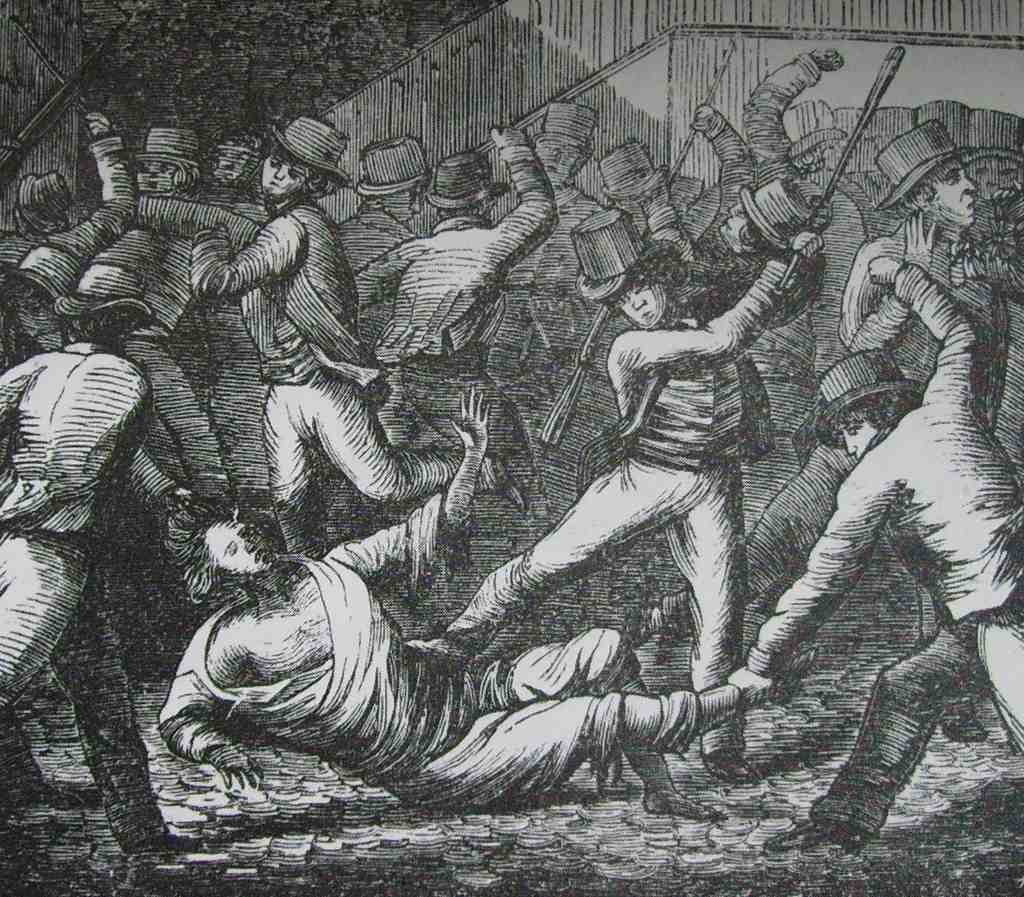
Fersen murderPhoto: Unknown author, Wikimedia Commons, Public domain. Cropped & resized. Look for the pale stone palace with its long rectangular facade, tall evenly spaced windows, and a broad central staircase leading up to a formal entrance.
This is where nobility, status, and political violence met in the open street. Axel von Fersen stood near the very top of Swedish society... and that made him visible, ceremonial, and terribly exposed.
By the summer of eighteen ten, Sweden had already been shaken hard. Gustav the Fourth Adolf had fallen in the coup of eighteen oh nine. Karl the Thirteenth took the throne, but he was old and had no direct heir, so the Danish prince Karl August became crown prince. Then, during a military exercise at Kvidinge, Karl August collapsed and died of a stroke. But rumor moved faster than medicine. Many in Stockholm decided he had been poisoned.
Fersen and his sister Sophie von Fersen became the perfect targets. They were Gustavians, supporters of the old royal line, and Axel was already famous across Europe for his closeness to Marie Antoinette and his role in the French court’s failed escape. So suspicion clung to him easily. It did not matter that he was innocent.
On the twentieth of June, eighteen ten, the crown prince’s funeral procession entered Stockholm. Protocol required Fersen, as riksmarskalk, the highest court officer for ceremonial state occasions, to appear in full dignity. He sat alone in a glittering gala carriage with seven glass windows and a golden count’s crown on the roof. Six white horses pulled it. He wore the white dress and black cloak of the Order of the Seraphim, Sweden’s highest chivalric order. The image on your screen catches how this later looked in memory: not a mourning city, but a city turning on one man.
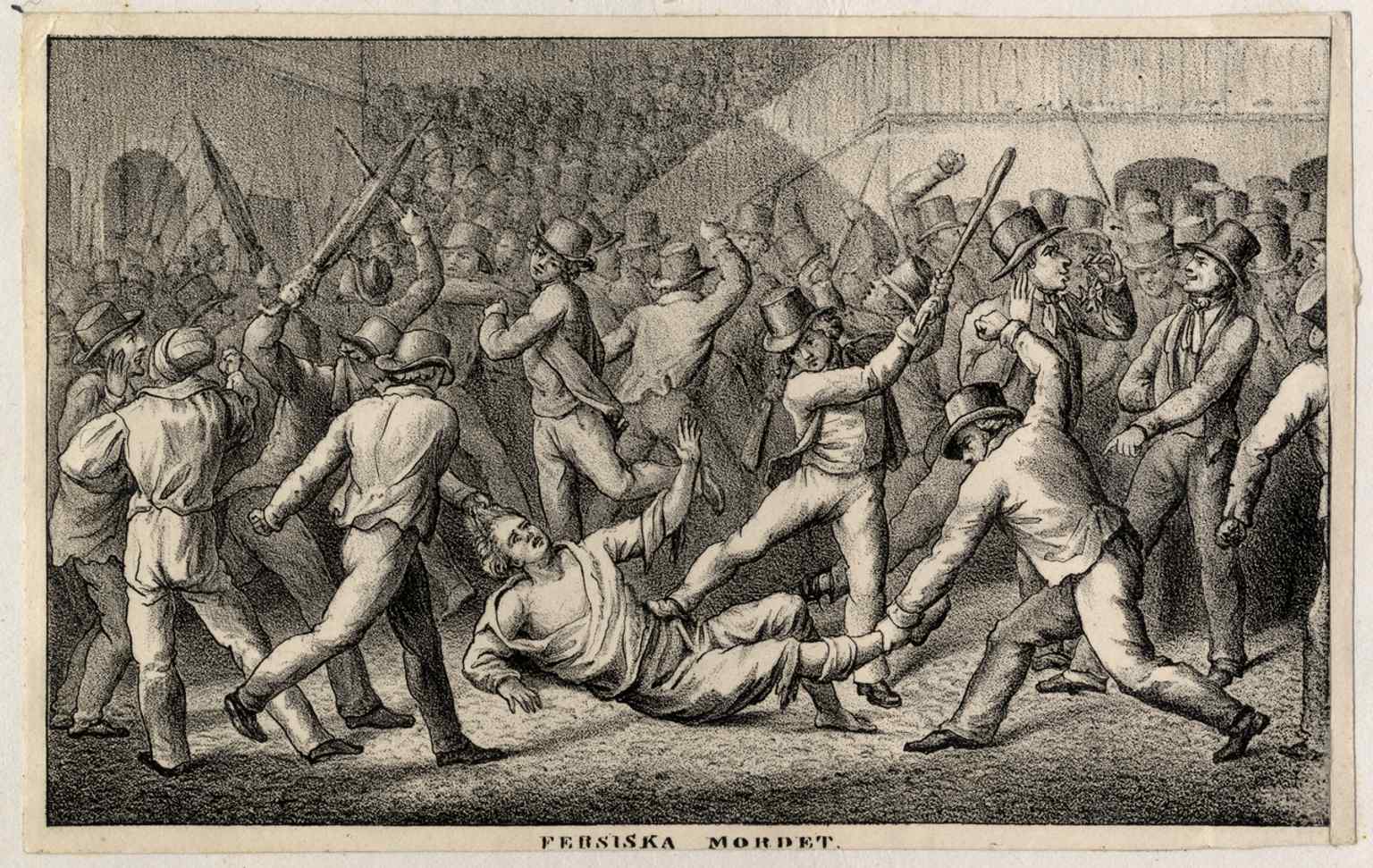
An early 19th-century print of Fersen’s murder, capturing the infamous lynching that later became known as “the bottom of Swedish disgrace.”Photo: Unknown authorUnknown author, Wikimedia Commons, Public domain. Cropped & resized. The crowd began with stones and insults on Södermalm. By Hornsgatan and Kornhamnstorg, the shouting had grown: “murderer.” By Stora Nygatan, every window of his carriage had shattered. Men with clubs rushed in. At the Hultgrenska house, the porter Bartholin managed to pull Fersen inside. In one account, Fersen wiped sweat and blood from his face, drank a glass of water, and tried to gather himself while the noise outside swelled. If you want to picture that desperate pause, glance at the app image of him fleeing into the house.
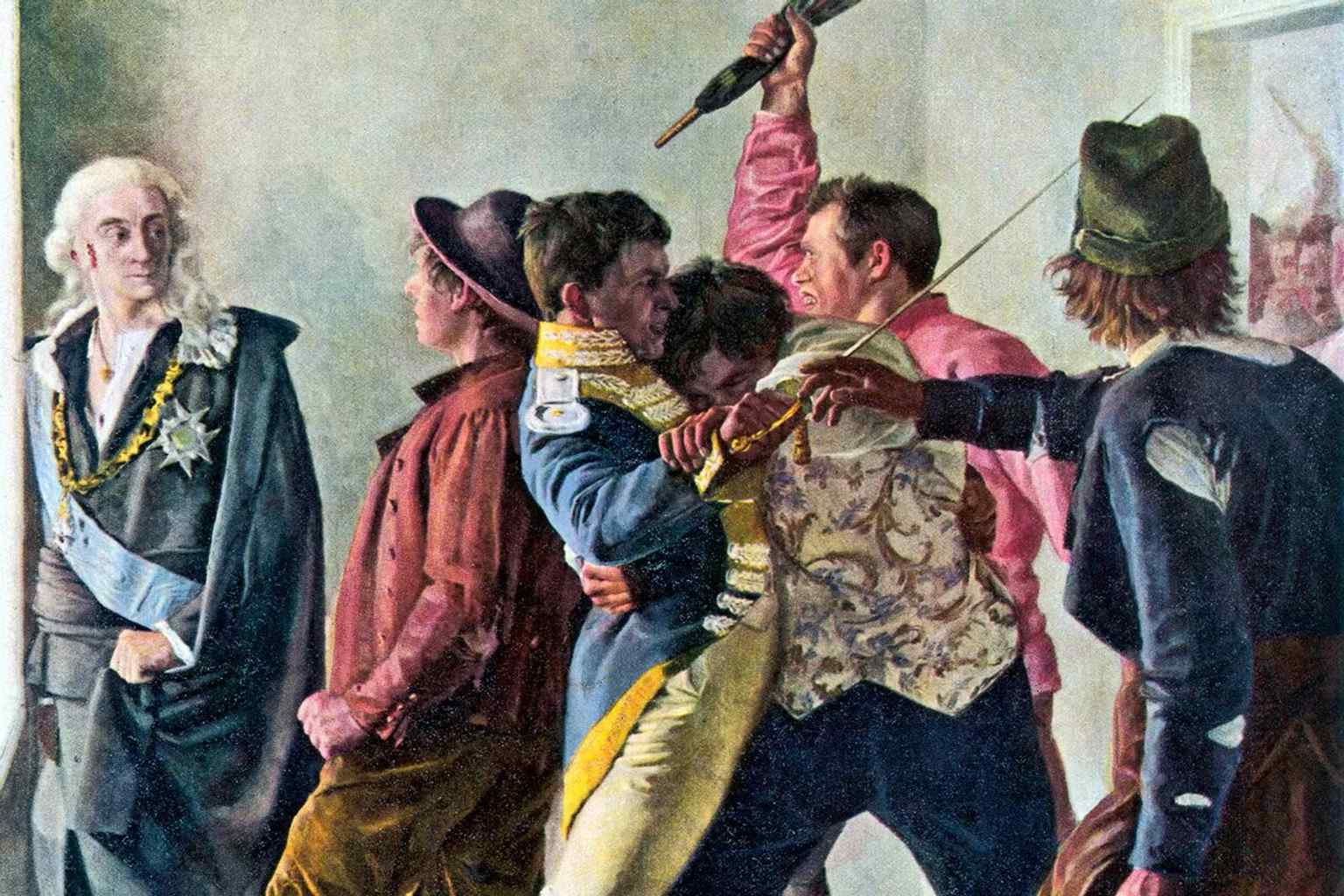
Axel von Fersen flees into the Hultgrenska house during the attack on 20 June 1810, one of the key moments in the murder story.Photo: Emil Österman, Wikimedia Commons, Public domain. Cropped & resized. Then Isaac Lars Silfversparre tried to lead him here, toward safety at Bondeska palatset. Instead, the mob closed again. Fersen reached the soldiers drawn up on this square and cried, “Boys, save me.” For a moment, some lowered bayonets toward the crowd. Then Major Nils Djurklou ordered them back into line. The king had forbidden live fire during the funeral. No one acted in time. The mob beat Axel von Fersen to death here.
Earlier on this tour, the Stockholm Bloodbath showed power killing in public with official theater. This was different, but no less revealing. Here the state did not strike cleanly from above. Here rumor, succession panic, and class hatred turned the street itself into an execution ground.
More than nine hundred people were questioned afterward. Only a handful were punished. Later, the court confirmed what doctors had said: Karl August died of a stroke. Fersen had not poisoned him. His innocence came too late.
So remember this square when you look at the grand facades around it. Elite architecture in Stockholm never meant safety. It carried honor, rivalry, and danger in equal measure. Next, we walk to the House of Nobility, where that world gave itself a palace.
On your right, look for the long red-brick and pale sandstone palace with a tall central gable and a curved double roof marked by slender obelisk-like chimneys. This is…Read moreShow less
Open dedicated page →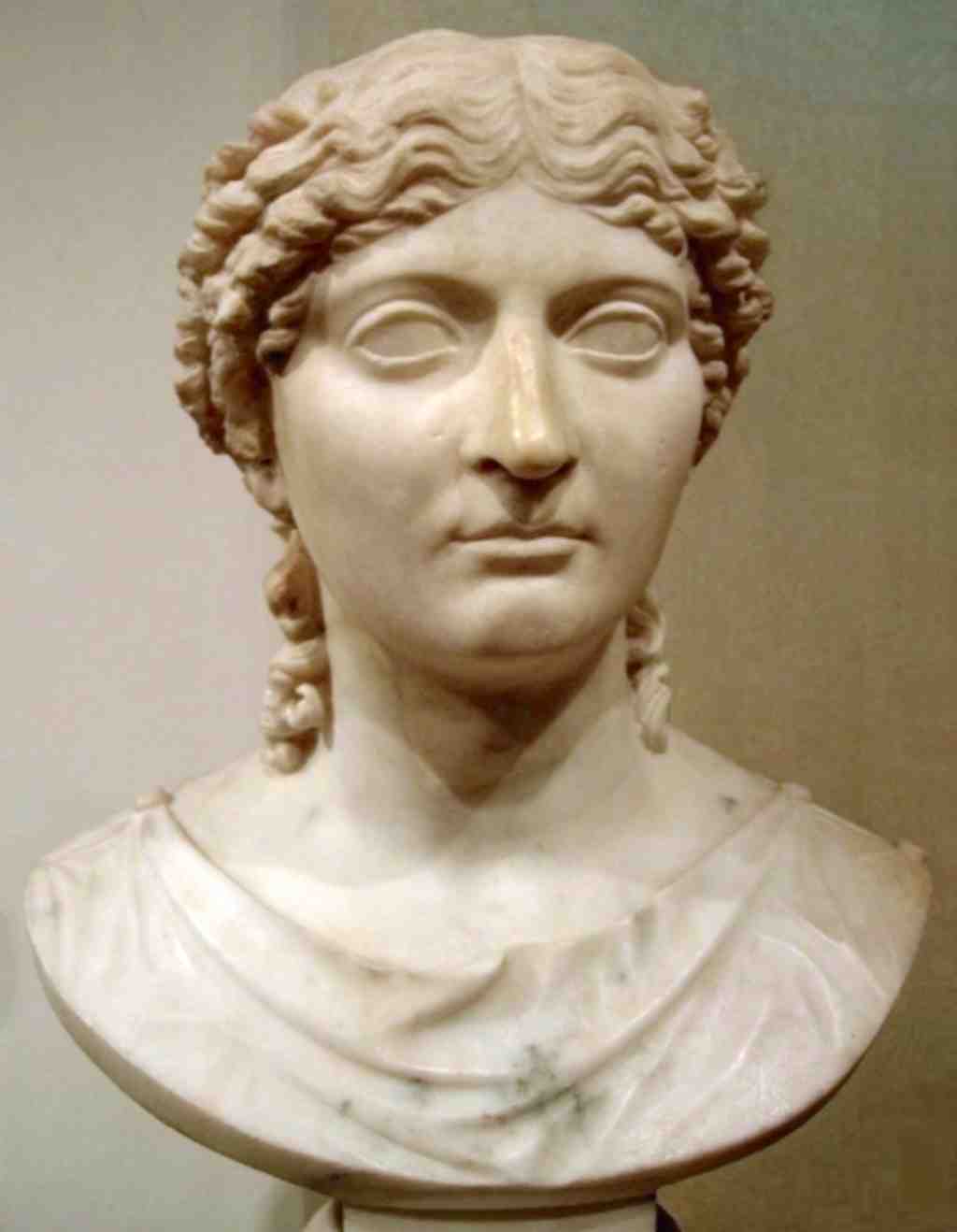
The Palace of the House of NobilityPhoto: Frankie Fouganthin, Wikimedia Commons, CC BY 4.0. Cropped & resized. On your right, look for the long red-brick and pale sandstone palace with a tall central gable and a curved double roof marked by slender obelisk-like chimneys.
This is Riddarhuset, the House of Nobility... not a royal residence, but something in its own way just as powerful: the headquarters of Sweden’s organized nobility. From the sixteen seventies until the reform of eighteen sixty-six, the noble estate met here as a political body. The crown had its palace, the church had its cathedral, parliament had its chambers, and the aristocracy gave itself this.
That ambition began with Axel Oxenstierna. He first bought this plot for his own palace, then changed course and sold it in sixteen forty-one for three thousand riksdaler, a substantial sum at the time, when he saw how perfectly the site suited a house for the whole noble order. Most visitors never realize how unstable that choice was. The ground lay so close to the water that workers digging the foundations carted the earth straight out into the lake to build up the shoreline. Even the land under privilege had to be manufactured.
The first architect, Simon de la Vallée, came from France and brought a new language of grandeur with him. He started work here in July of sixteen forty-one. Then, in November of sixteen forty-two, on Stortorget, Colonel Erik Oxenstierna stabbed him during a quarrel. De la Vallée lingered for eight days, then died. At that point, only the foundations stood. The project nearly froze for five years, slowed further by war with Denmark. So this elegant facade carries a memory of mud, argument, and blood from its very beginning.
Others took over: the German master stonemason Heinrich Wilhelm, then the Dutch architect Justus Vingboons, who gave the building much of its final shape before he quarreled so badly with the directors that they dismissed him and sent him home. At last, Simon’s son, Jean de la Vallée, completed the palace and designed that distinctive two-part roof, the curved lower section that later helped define the Swedish manor-house roofline.
If you glance at the image on your screen, you can peek inside the grand hall where the nobility still gathers beneath a forest of heraldry. Inside hang two thousand three hundred thirty-four coats of arms, though only six hundred fifty-six noble families are still considered living lines. That tells you what this place really is: not just a beautiful building, but an institution that keeps records, rituals, property, memory... almost like a private state within the state.
A 1918 assembly inside Riddarhuset, illustrating that the palace still serves as a venue for important public gatherings today.Photo: Unknown authorUnknown author, Wikimedia Commons, Public domain. Cropped & resized. Take a look at the before-and-after image in the app; a century changes the street outside, but the facade barely yields an inch.
And this frontage has seen violence in public too. Before the forecourt garden softened the approach in the nineteen tens, the palace stood directly against Riddarhustorget. That is where the mob killed Axel von Fersen in eighteen ten, right in front of noble power made stone.
Ahead on Riddarholmen, power changes its costume again. There, kings do not meet... they are buried. Walk on to Riddarholmskyrkan, about two minutes away.
If you want to come back inside later, Riddarhuset is generally open on weekdays from eleven in the morning to noon, and closed on weekends.
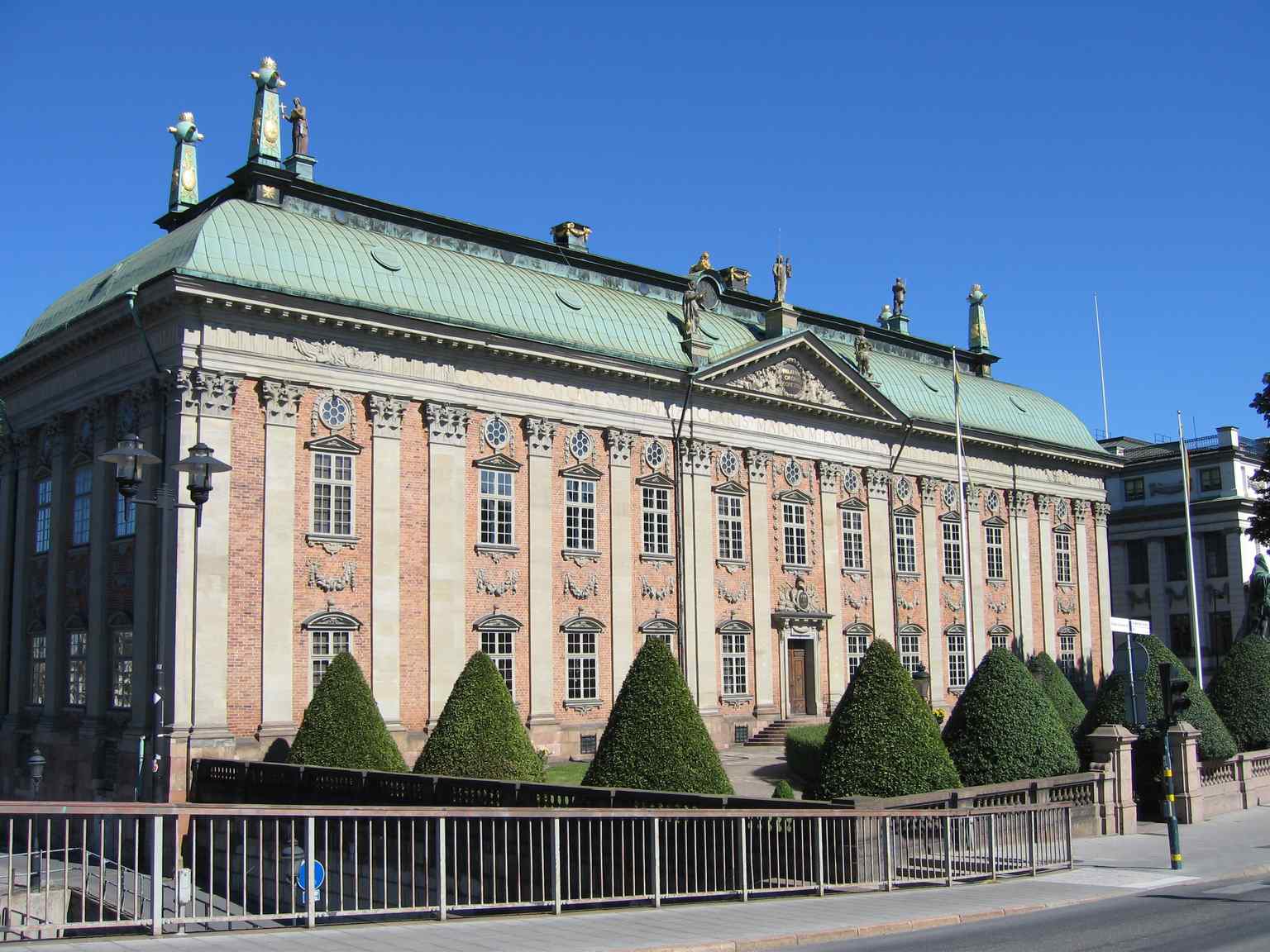
The palace’s main façade in Stockholm, where the nobility met for centuries after the house was completed in the 1600s.Photo: Unknown, Wikimedia Commons, CC BY-SA 3.0. Cropped & resized. 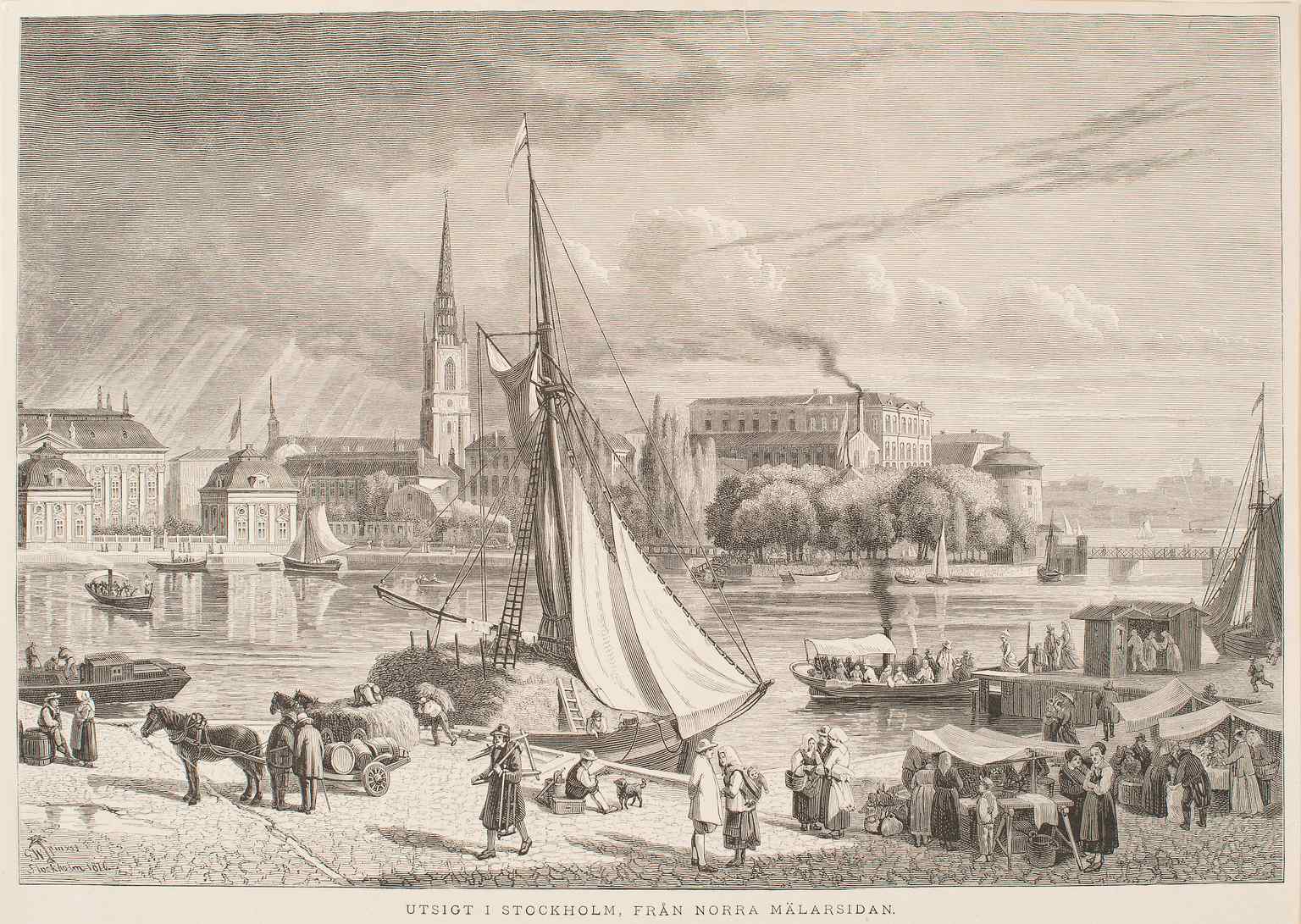
A clear early-20th-century view of Riddarhuset’s exterior, showing the stately palace that once housed the Swedish nobility.Photo: Unknown authorUnknown author, Wikimedia Commons, Public domain. Cropped & resized. 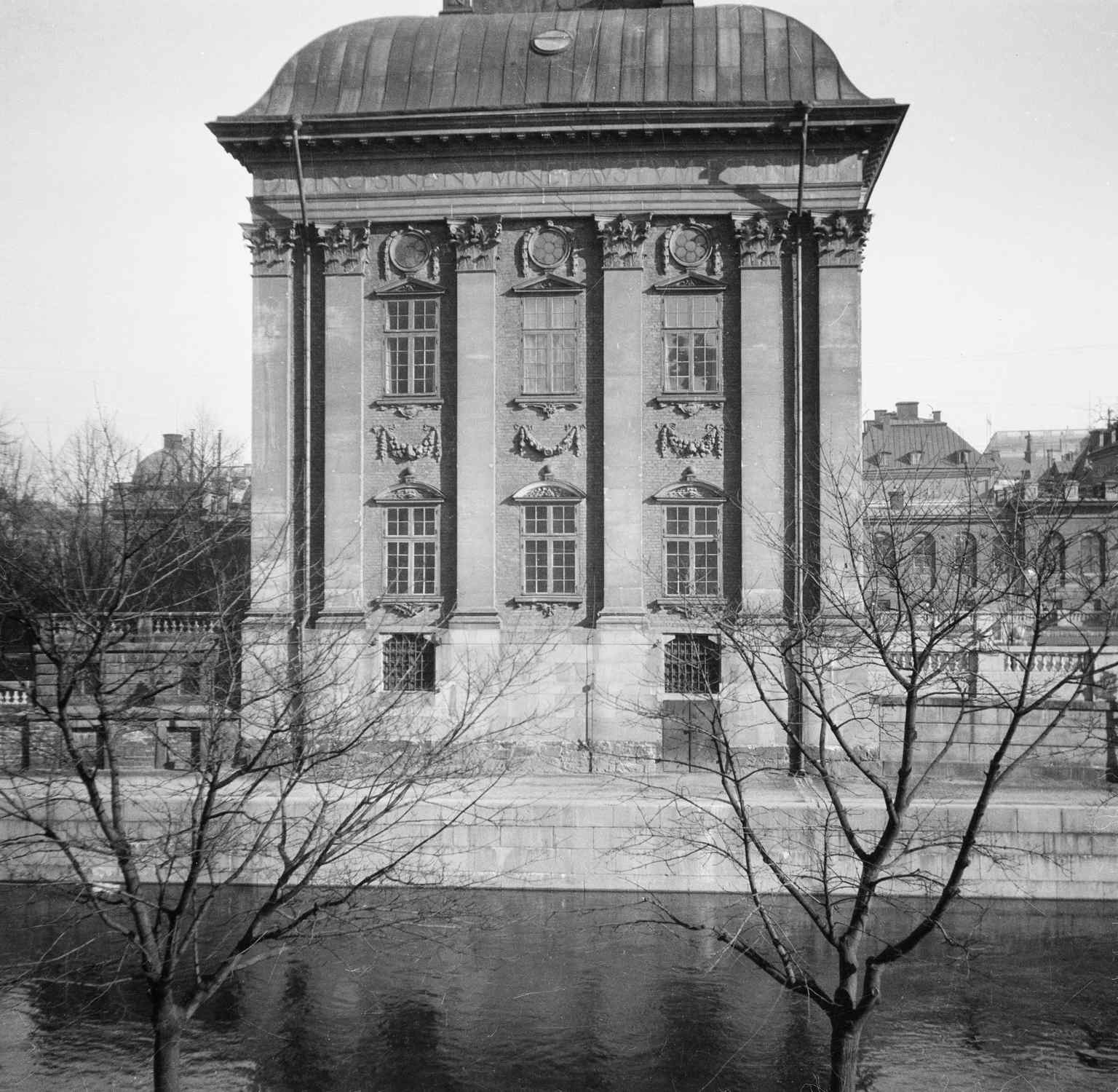
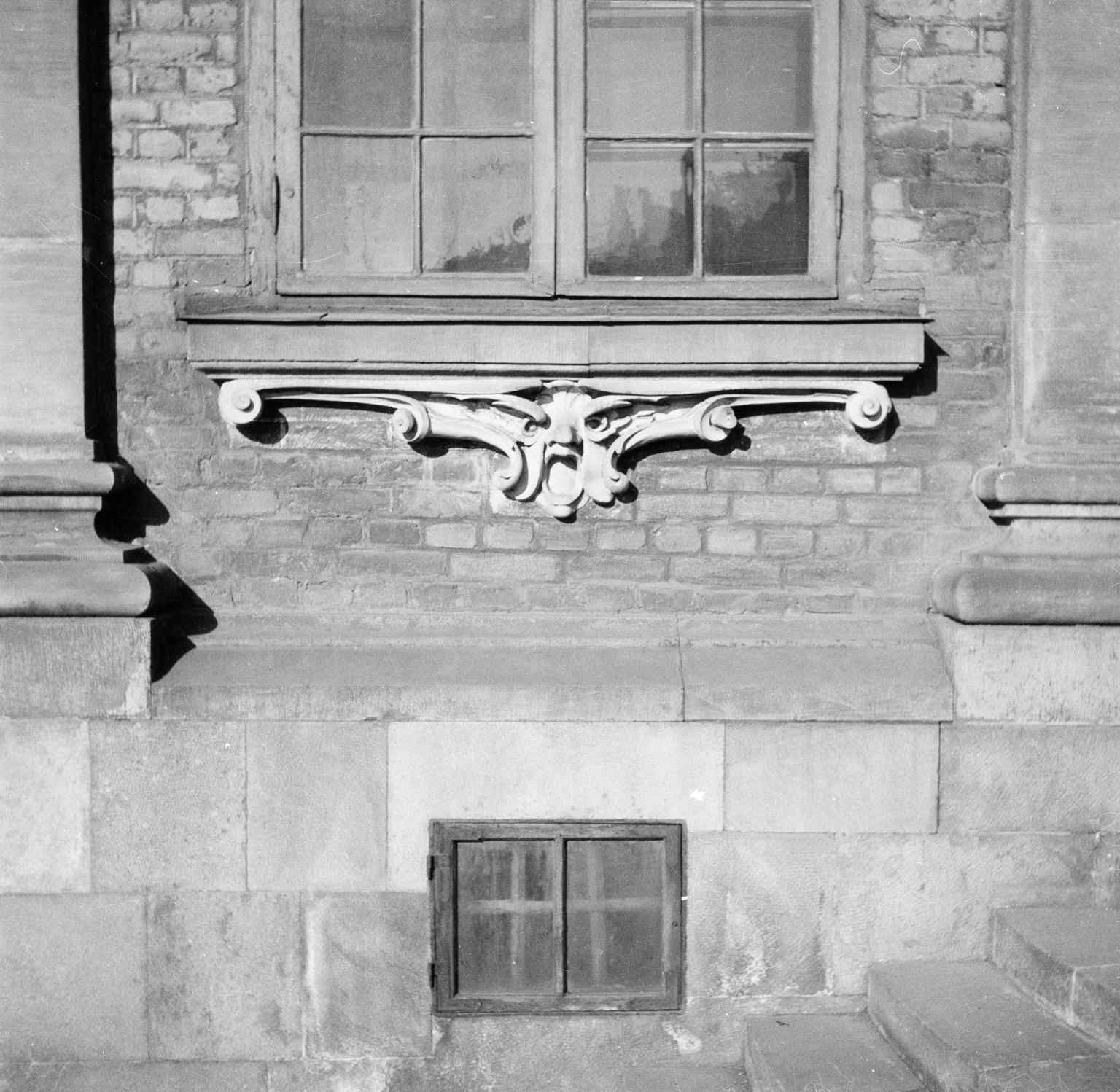
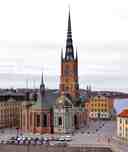
An exterior detail of the palace façade, highlighting the refined stonework and classical decoration described in the source text.Photo: Unknown authorUnknown author, Wikimedia Commons, Public domain. Cropped & resized. On your right, look for the red-brick basilica with its long polygonal choir and the lace-like black cast-iron spire rising from the west tower. From across the square, the…Read moreShow less
Open dedicated page →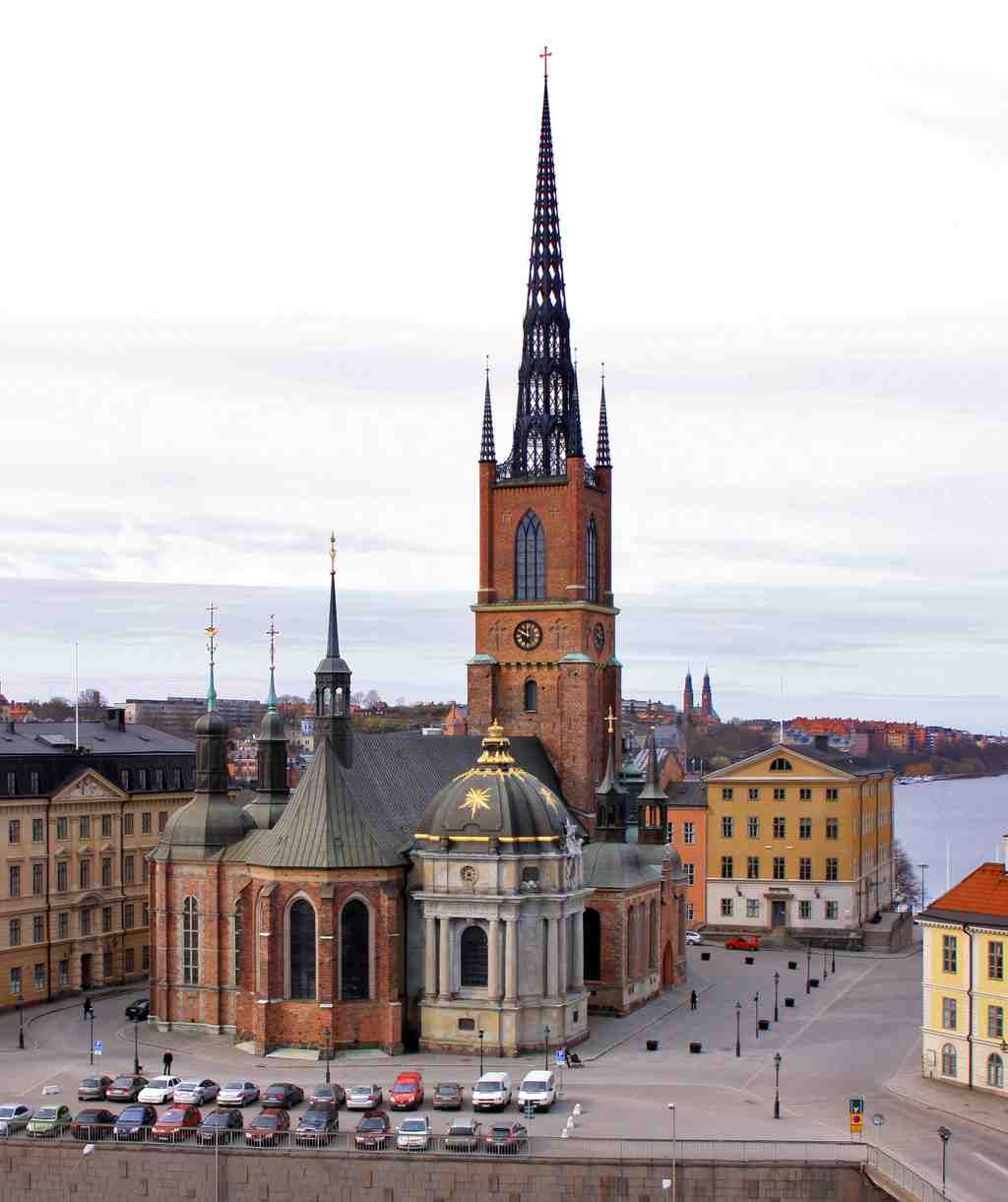
Riddarholm ChurchPhoto: Albabos, Wikimedia Commons, CC BY 3.0. Cropped & resized. On your right, look for the red-brick basilica with its long polygonal choir and the lace-like black cast-iron spire rising from the west tower.
From across the square, the church reads almost like a timeline in brick. Those walls are the oldest brick above ground in Stockholm, and this is the city’s only surviving medieval monastery church. It began as the church of the Greyfriars, the Franciscan order, after King Magnus Ladulås gave the friars land here in the twelve seventies. He asked to be buried in this church, and when they laid him in the choir in twelve ninety-two, the building was still young. In a sense, this place became royal before it was even fully finished.
But that was not yet the church you see in Stockholm’s memory. After Gustav Vasa broke the old Catholic order and pulled monastic wealth into the Crown, the friars disappeared and the building changed with the kingdom. It became Protestant, then parish, and eventually something even more ceremonial: a church where monarchy could turn into permanence.
If Storkyrkan was the place where a ruler met the realm in public ritual, this was the place where that same ruler entered history. Gustav the Second Adolf understood that. Before he left for war in Germany, he chose his burial place here. He died at Lützen in sixteen thirty-two, and by the time his funeral took place in sixteen thirty-four, the tradition had been restored. From him to Gustaf the Fifth, nearly every Swedish ruler came here in the end, with Queen Kristina the great exception. Count the medieval kings linked to the high altar, and the total reaches seventeen rulers.
Look at the church’s sides. Those chapels pressed against the brick are not just additions. They are dynasties in stone: the Gustavians, the Carolines, the Bernadottes, and noble families who built their own burial chapels beside the royal dead. And if you look at the interior image on your screen, you can see how the whole space fills with tombs, shields, and memorials, less a parish church than a chamber of state memory.
Even here, memory is not the same as certainty. In the late sixteenth and seventeenth centuries, kings wanted glorious ancestry displayed as clearly as power. Johan the Third ordered grand monuments for Magnus Ladulås and Karl Knutsson before the high altar. For centuries, people believed one grave truly held Magnus. Then, in two thousand eleven, modern tests showed the bones inside were more than a century too young.
The monument stayed powerful anyway. That tells you something important: kingdoms preserve not only bodies, but stories about themselves.
The spire above it all carries another layer. Lightning struck the tower in eighteen thirty-five, fire raged for three days, and the old spire collapsed. When the church rose again, craftsmen and architects gave it this cast-iron crown, industrial and Gothic at once, a newer age fastening itself onto medieval brick. If you want, glance at the before-and-after image in the app; it shows how the church kept its authority while the waterfront around it became unmistakably modern.
And that is the quiet force of this place. Here, rule becomes remembrance, ceremony becomes archive, and stone teaches a nation how to picture its own past. At the next stop, the Forum for Living History, that question changes: not how a state honors dynasties, but how it accepts responsibility for history. If you want to come back inside later, the church is generally open daily from ten in the morning to five in the afternoon.
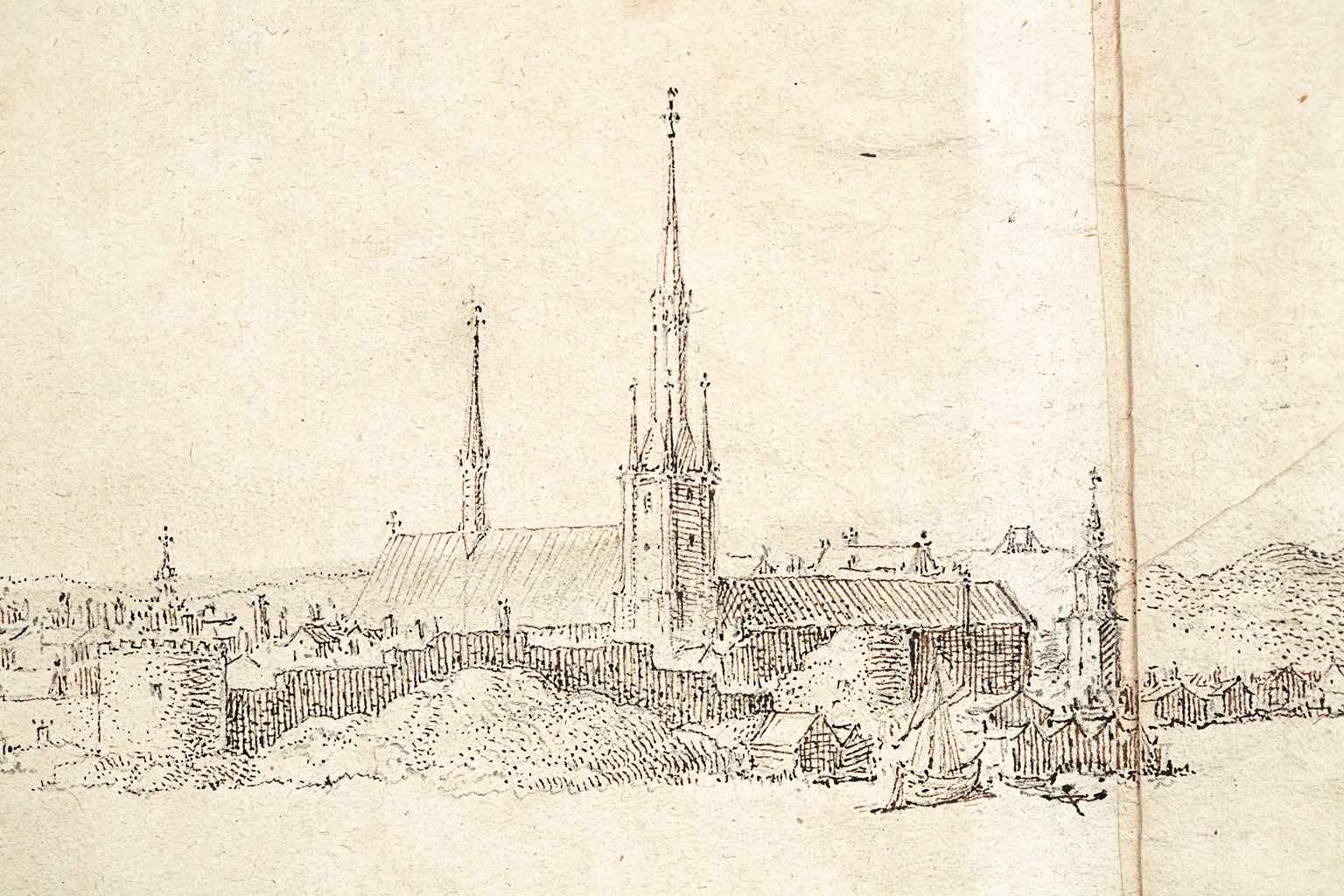
An early photograph of Riddarholmskyrkan, useful for showing how the church looked in the 19th century before modern restoration work.Photo: Eugène Trutat, Bibliothèque de Toulouse from Toulouse, France, Wikimedia Commons, No restrictions. Cropped & resized. 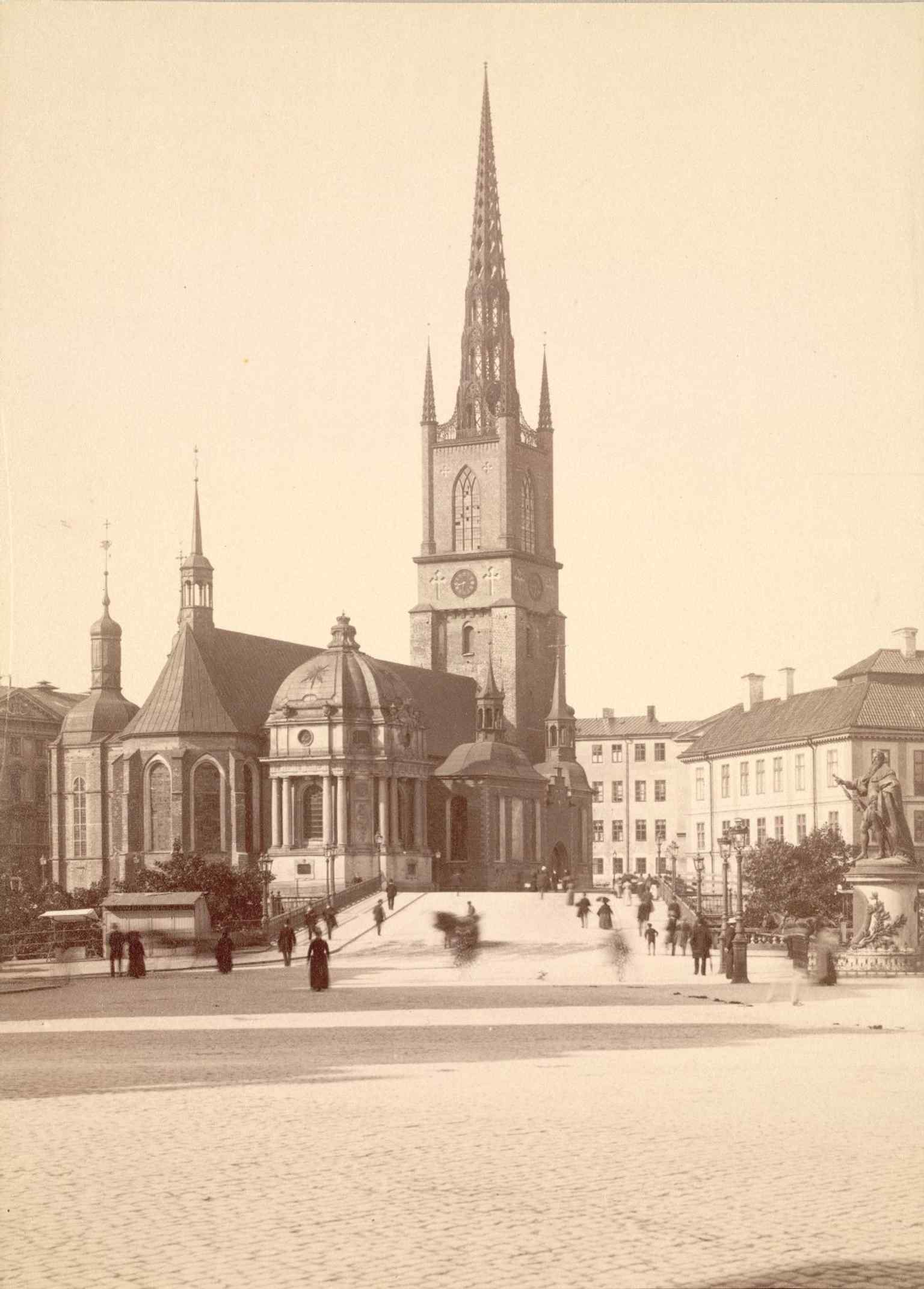
A late-19th-century albumen print of the church, showing the building before today’s surroundings were fully modernized.Photo: Cornell University Library, Wikimedia Commons, No restrictions. Cropped & resized. 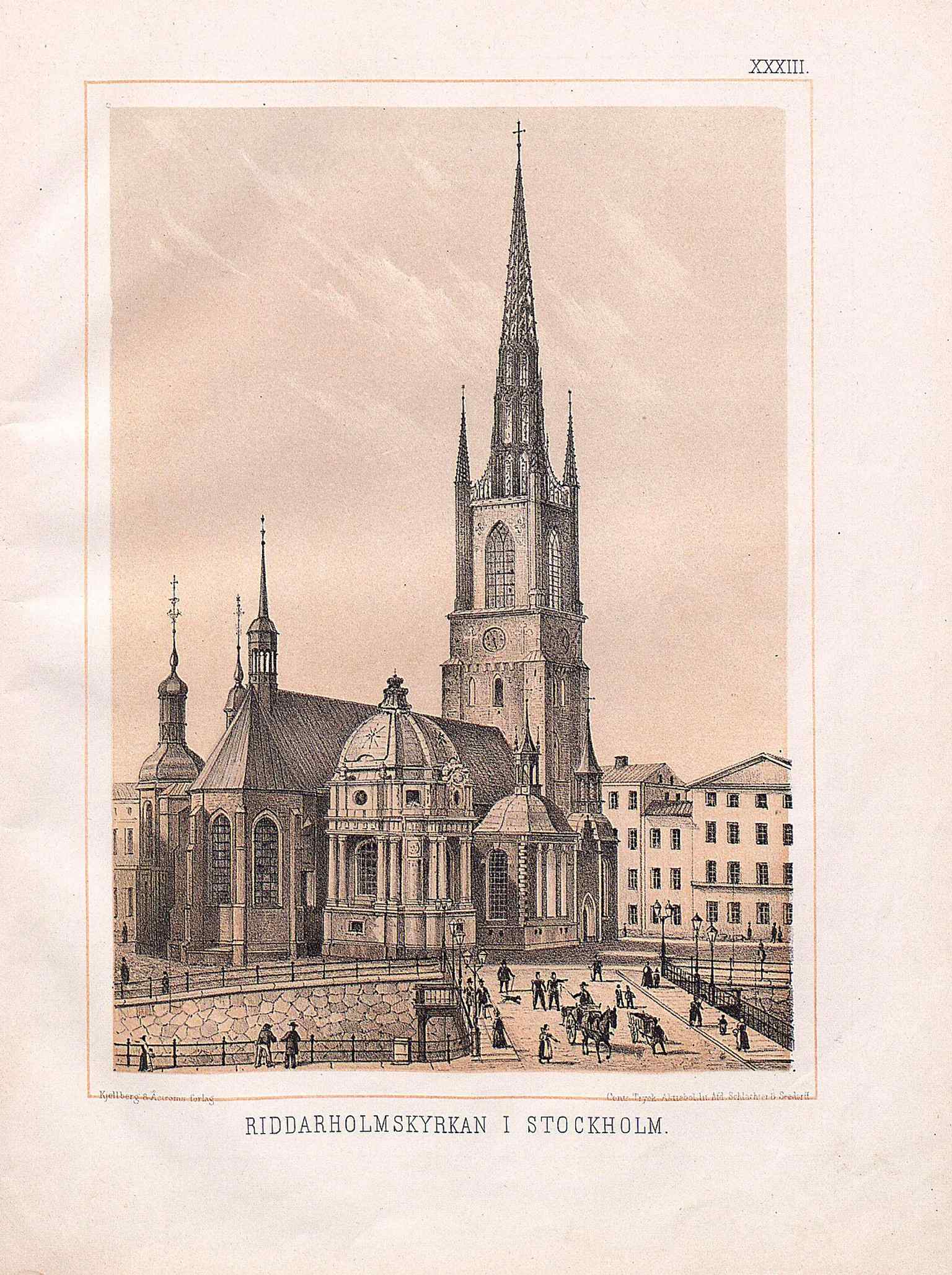
A 1874 printed view of Riddarholmskyrkan, highlighting the church as a famous Stockholm landmark in older illustrated publications.Photo: Publisher: Kjellberg & Åström, Stockholm 1874., Wikimedia Commons, CC0. Cropped & resized. 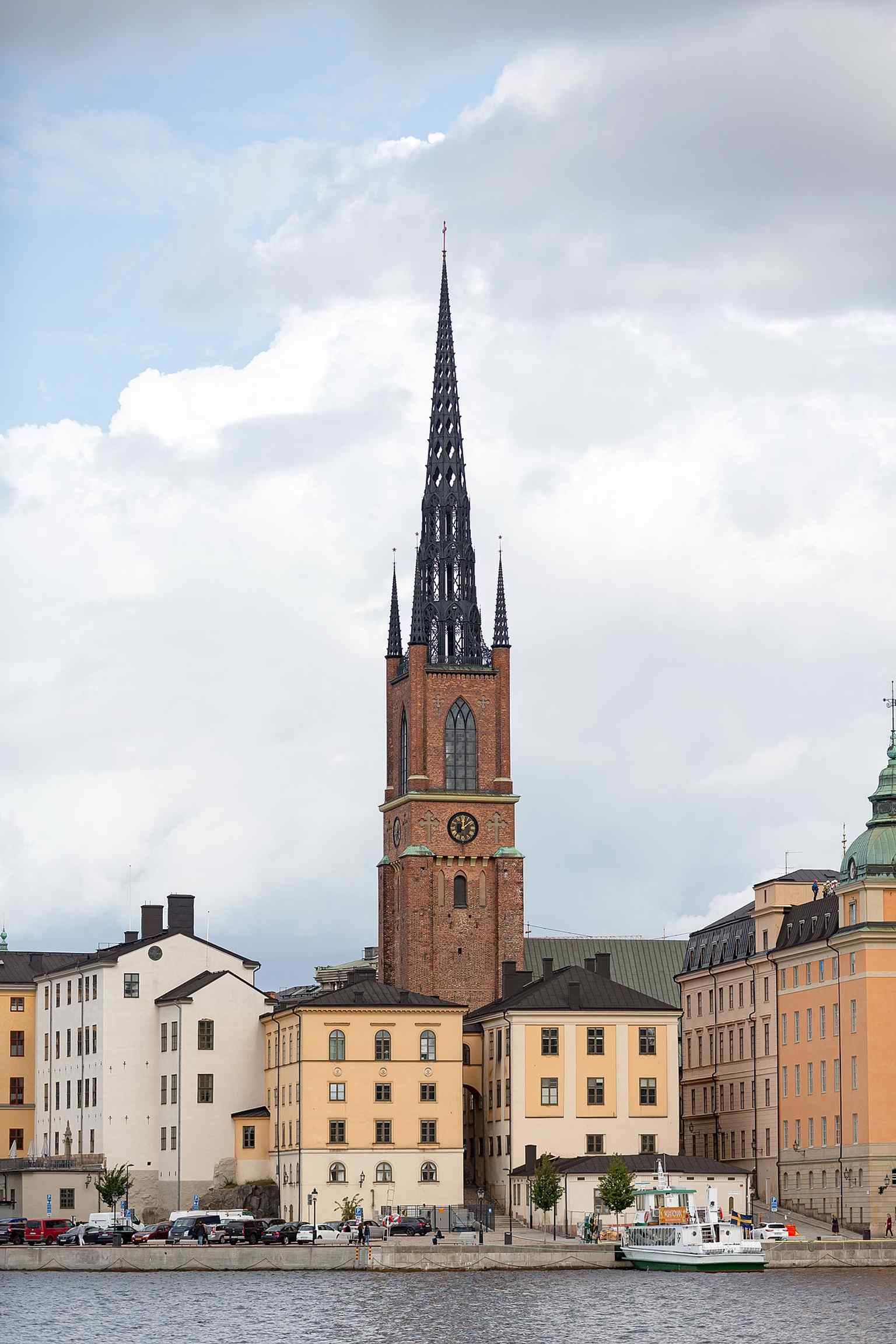
A wide view across the water toward Riddarholmskyrkan, emphasizing its dramatic island setting in central Stockholm.Photo: Manfred Werner (Tsui), Wikimedia Commons, CC BY-SA 4.0. Cropped & resized. 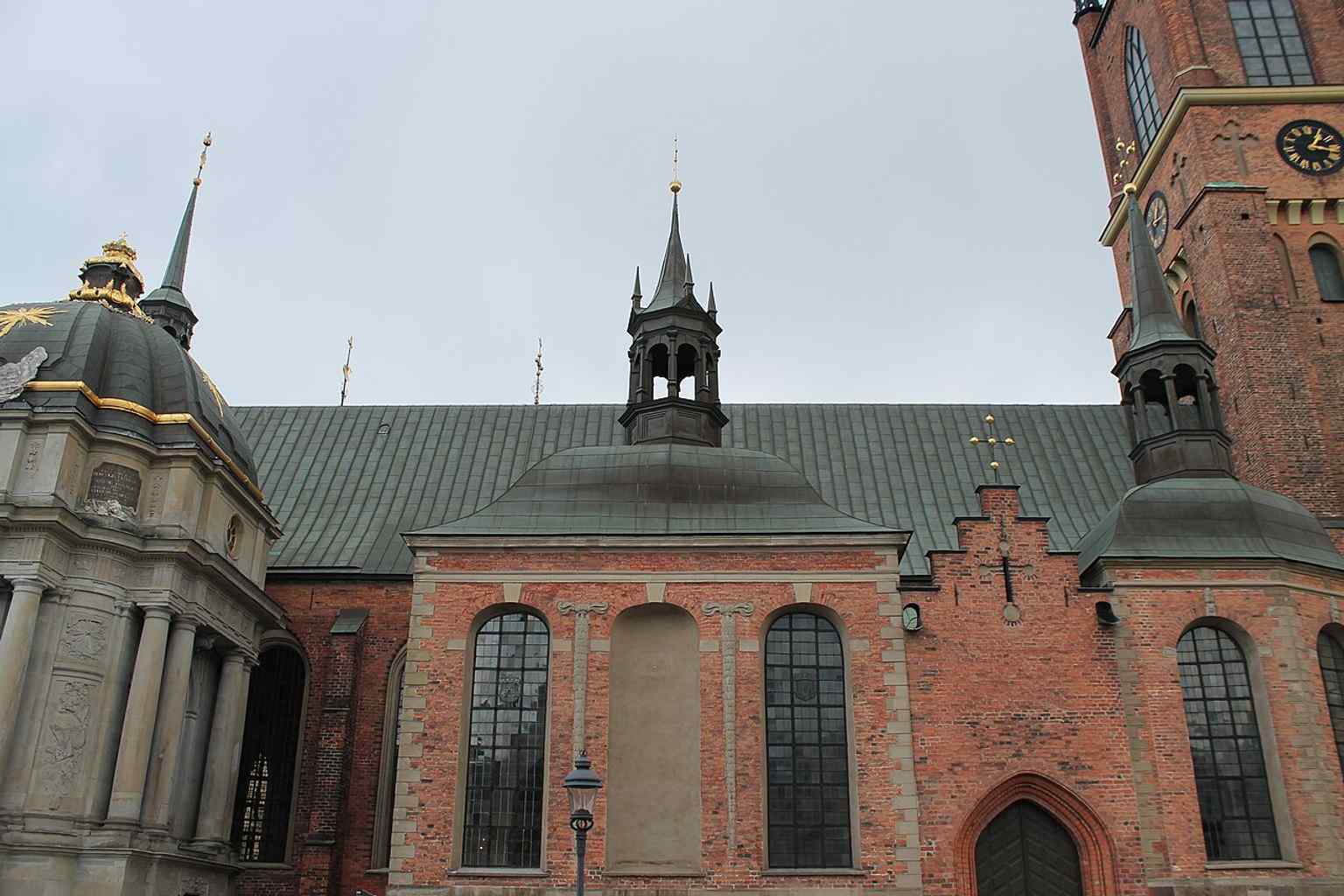
A closer architectural view of the church façade, ideal for the brick detailing and vertical Gothic character described in the script.Photo: John Samuel, Wikimedia Commons, CC BY-SA 4.0. Cropped & resized. 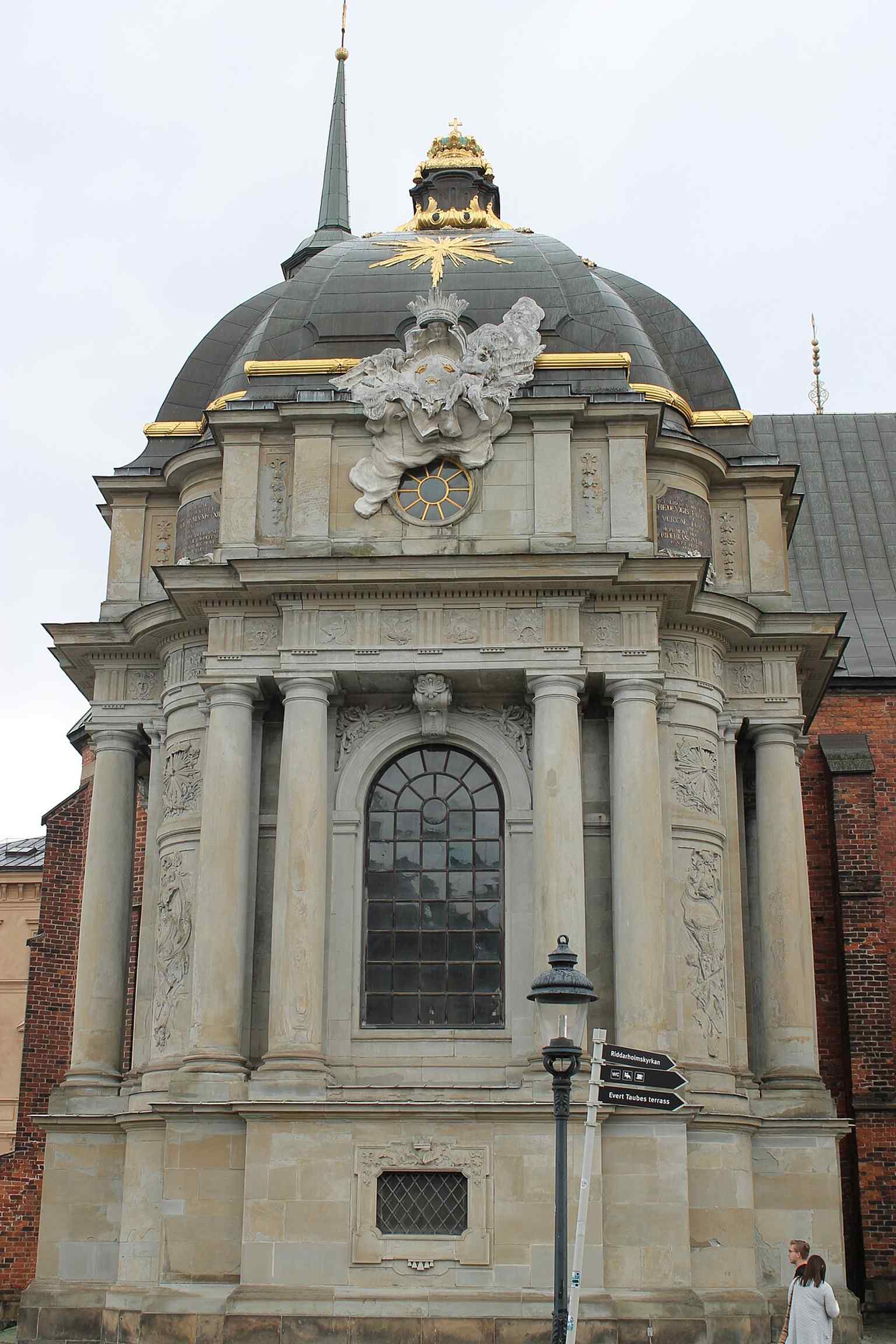
A detail of the church’s columns and window, echoing the medieval masonry and later additions seen throughout the building.Photo: John Samuel, Wikimedia Commons, CC BY-SA 4.0. Cropped & resized. Look for a compact stone-paved square framed by tall ocher and cream façades, with a cast-iron well at its center and the stern Renaissance bank building holding the eastern…Read moreShow less
Open dedicated page →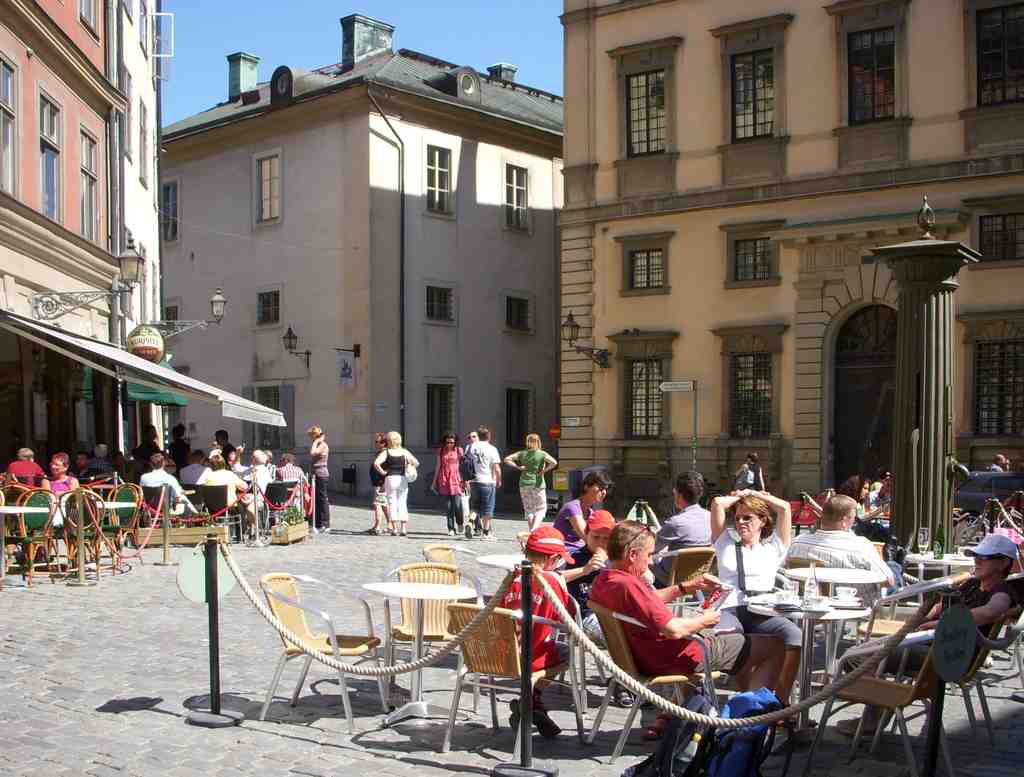
JärntorgetPhoto: Holger.Ellgaard, Wikimedia Commons, CC BY-SA 3.0. Cropped & resized. Look for a compact stone-paved square framed by tall ocher and cream façades, with a cast-iron well at its center and the stern Renaissance bank building holding the eastern side.
Järntorget is a small square... but Stockholm has hidden an astonishing amount of itself here. Beneath your feet lies part of an old post-glacial ridge, the spine of land that helped form this island. Long before these façades rose, water cut much farther into Gamla stan. The shoreline once crossed what is now the eastern side of the square, so this was not simply a plaza in a town. It began as an edge... a working margin between land and water.
That is why trade took hold here so early. By around the year thirteen hundred, this had become Stockholm’s second oldest square, and for centuries it served as one of the city’s busiest transfer points. Goods came in from Lake Mälaren and the Baltic, passed over this ground, and moved out again through the streets that still meet here: Västerlånggatan, Österlånggatan, and the lanes running toward the waterfront. Grain, iron, copper, hides, butter, wine, salt, spices, ceramics... the whole city’s appetite and ambition crossed this patch of stone.
Most visitors never notice that the square’s name preserves a turning point in Stockholm’s economy. It began as Korntorget, Grain Square. Then iron overtook barley, and by the late fifteenth century people increasingly called it Järntorget, Iron Square. It sounds like a simple renaming. It is really a record of power shifting through trade.
If you glance at the image in the app, you can see how compact the square feels today. In the Middle Ages it was larger, rougher, louder, pressed against the harbor’s life. The city’s official scales stood here by the southern square, because weighing goods meant taxing them, and taxing them meant revenue for both city and crown. Market, monarchy, and administration were never separate worlds. They leaned on one another here every day.
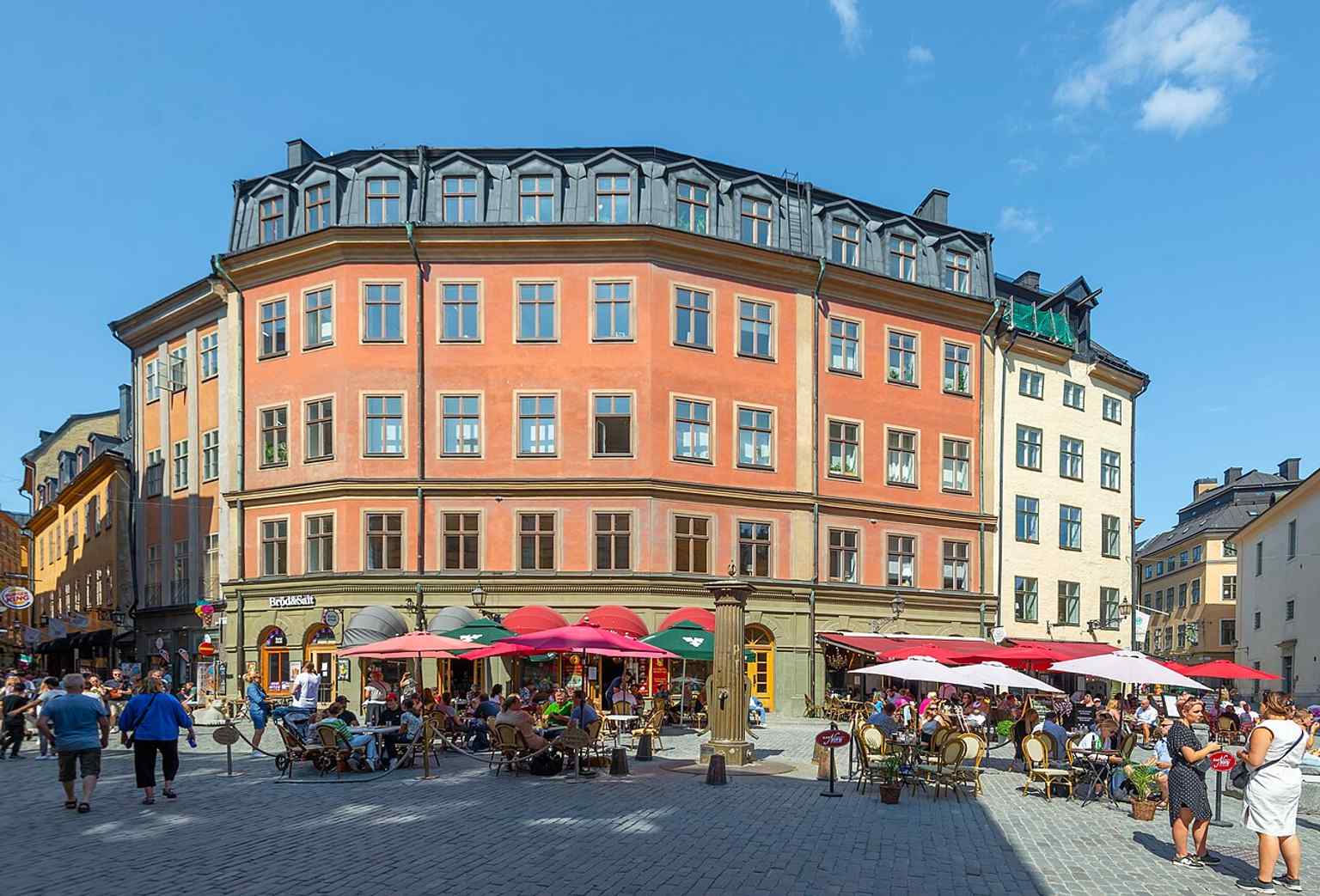
A current view of Järntorget in Gamla stan, the small square that was Stockholm’s main trade hub for centuries.Photo: Frankie Fouganthin, Wikimedia Commons, CC BY-SA 4.0. Cropped & resized. Look toward number eighty-four, Södra Bankohuset. Nicodemus Tessin the Elder gave that façade its controlled, Italian Renaissance gravity in the late seventeenth century. It announced what banks always want to announce: trust, order, permanence. Yet right beside that official face, the square kept its ordinary pulse. Johan Edvard Sundberg opened a shop and ladies’ café here in eighteen sixty-nine, offering women something rare for the time: a respectable public room of their own. But even that small freedom came with risk, because female servers still worked under the liberties men often assumed they could take. Progress, here as elsewhere in the city, arrived mixed with pressure.
And then there are the details locals still look for: the old crane perched atop number eighty-five, still hinting at hoisted cargo... the well donated in eighteen twenty-nine by the National Bank... the memory of packers once sealing iron and fish into casks nearby... and the fact that one of Stockholm’s oldest confectioners, Sundbergs, kept serving this square long after carts and manual labor still rattled through it.
If you have followed this walk from parliament to palace, from church to noble house, from execution ground to archive, this is a fitting place to end. Järntorget belongs to ordinary exchange, yet almost every larger force in Stockholm touched it: stone, water, money, labor, faith, rank, memory. In that sense, this square is not merely a final stop. It is Stockholm in miniature.

Frequently asked questions
How do I start the tour?
After purchase, download the AudaTours app and enter your redemption code. The tour will be ready to start immediately - just tap play and follow the GPS-guided route.
Do I need internet during the tour?
No! Download the tour before you start and enjoy it fully offline. Only the chat feature requires internet. We recommend downloading on WiFi to save mobile data.
Is this a guided group tour?
No - this is a self-guided audio tour. You explore independently at your own pace, with audio narration playing through your phone. No tour guide, no group, no schedule.
How long does the tour take?
Most tours take 60–90 minutes to complete, but you control the pace entirely. Pause, skip stops, or take breaks whenever you want.
What if I can't finish the tour today?
No problem! Tours have lifetime access. Pause and resume whenever you like - tomorrow, next week, or next year. Your progress is saved.
What languages are available?
All tours are available in 50+ languages. Select your preferred language when redeeming your code. Note: language cannot be changed after tour generation.
Where do I access the tour after purchase?
Download the free AudaTours app from the App Store or Google Play. Enter your redemption code (sent via email) and the tour will appear in your library, ready to download and start.
If you don't enjoy the tour, we'll refund your purchase. Contact us at help@audatours.com
Checkout securely with 












.jpg)


%20in%20Gamla%20Stan%2C%20Stockholm.jpg)


.jpg)


.JPG)


.jpg)


