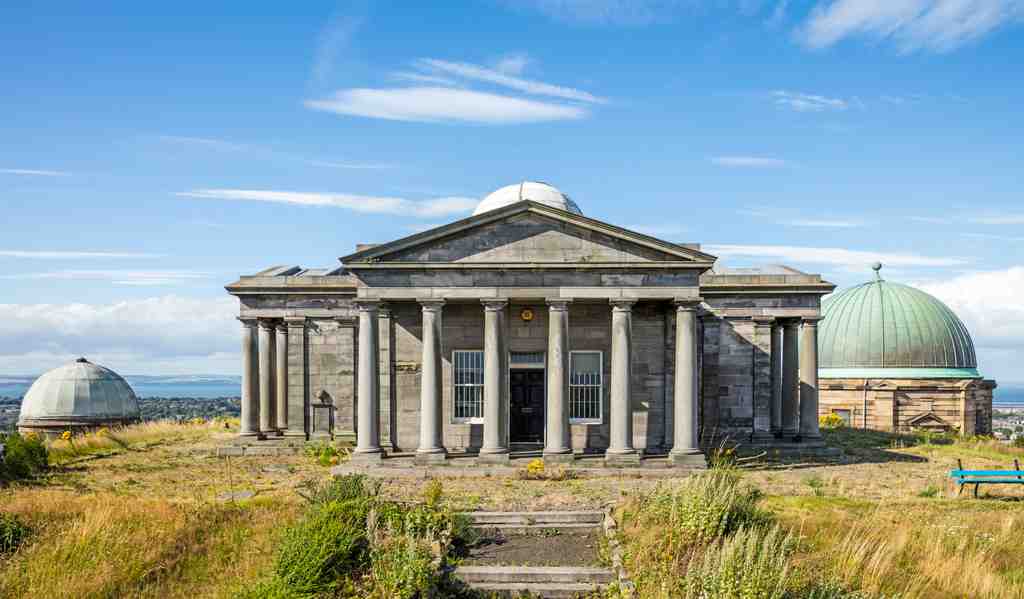
Ahead of you stands a pale stone, temple-like building with a triangular pediment, a rounded dome tucked behind it, and long boundary walls enclosing the hilltop site.
This place tells you a great deal about Edinburgh. The city did not want science hidden away in a workshop; it wanted astronomy raised onto the skyline, dressed in architecture, and made part of its public identity. Again and again here, Edinburgh dreamed on a heroic scale, then discovered that money, politics, and practical life were less obedient than stone. This observatory became one of the clearest examples: grand in intention, slightly improvised in reality.
The story begins with Thomas Short, who arrived in seventeen seventy-six carrying a twelve-foot reflecting telescope made by his brother James. Decades earlier, Professor Colin Maclaurin had raised money for a university observatory, but the Porteous Riots and the Jacobite rising left the fund unused. The city redirected that money to Short and gave him this plot on Calton Hill. James Craig designed an ambitious enclosure like a little fortress, with Gothic corner towers under the influence of Robert Adam. And then, with impeccable Edinburgh timing, the budget ran out after only one tower. Short moved into that surviving tower and worked from here until his death in seventeen eighty-eight.
Most people see the solemn architecture and assume this hill belonged only to serious men with telescopes. It did not. Thomas Short’s daughter, Maria Theresa Short, returned in eighteen twenty-seven and claimed the observatory as her inheritance. The Edinburgh Astronomical Institution shut her out, so she set up a rival observatory elsewhere on Calton Hill, more commercial than scientific, with a camera obscura drawing crowds. In other words, this supposedly lofty scientific landscape also had a showbusiness side. Her enterprise later moved to Castle Hill and grew into today’s Camera Obscura.
The temple-front building before you came later. In eighteen twelve the Astronomical Institution took over, and in eighteen eighteen William Henry Playfair designed this central structure. Though the building bears the Playfair name because of its architect, William Henry Playfair, John Playfair-the mathematician and president of the institution-gave the whole project its confident intellectual swagger. He stood for the city’s belief that learning itself could be made monumental.
Inside, observers used a transit telescope, a fixed instrument that watched stars cross the meridian - the north-to-south line in the sky - to set the observatory clock with great precision. If you want a look at that restored instrument, open the image on your screen. This was not abstract science. Mariners brought ships’ chronometers up from Leith to check them here, and in eighteen fifty-four electrical signals from this site dropped the time ball on Nelson’s Monument beside you; later they also triggered the One O’Clock Gun at the Castle.
By the late nineteenth century, the city had grown too close and the equipment too outdated, so the Royal Observatory moved to Blackford Hill. A new City Observatory opened here in eighteen ninety-eight under William Peck, an ingenious telescope-maker who turned the place into a public institution. After long decline, vandalism and theft finally emptied it in two thousand nine. Then came restoration, repair, and reinvention; the site reopened in two thousand eighteen as Collective, an arts centre. Have a glance at the before-and-after image in the app; the change is remarkable.
So this hill tried to measure the heavens, advertise civic intelligence, and entertain paying visitors all at once. Just ahead stands another Calton Hill dream, even more theatrical: a monument that tried to give Scotland the grandeur of ancient Greece.