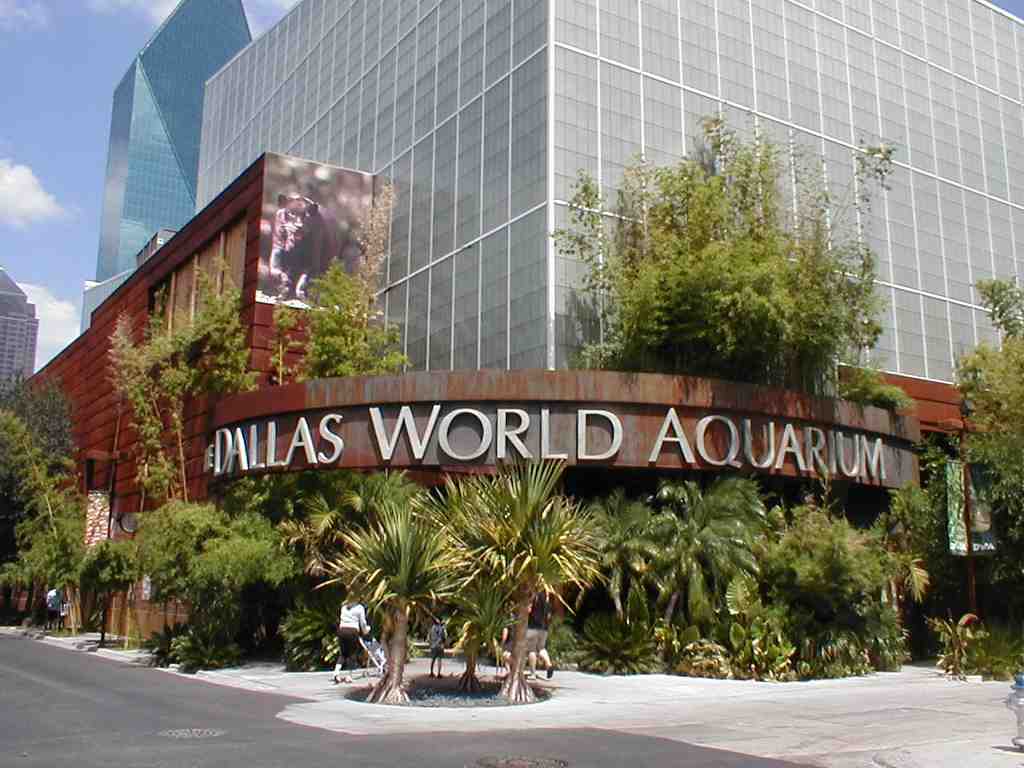
On your left, look for a sturdy red-brick warehouse facade, broad and boxy, with tall industrial window bands and a dark entrance canopy marked for the Dallas World Aquarium.
From out here, it still looks like downtown doing warehouse things. Which is part of the trick. This started as a nineteen twenty-four warehouse, and in October of nineteen ninety-two the interior was gutted and rebuilt as an aquarium. In nineteen ninety-seven, the building next door got the same treatment for Orinoco, Secrets of the River, and the alley between them became the line between freshwater and saltwater exhibits. That is adaptive reuse in Dallas form: keep the shell, reinvent the soul.
If you glance at the image in the app, you can see how plainspoken the exterior still is, even with everything swirling inside.
Inside, the place aims for spectacle. The upper levels recreate a rainforest canopy with aviaries and primates; below that come understory animals, then Amazonian fish and manatees. In two thousand four, Mundo Maya added tropical species from Mexico and Central America, plus a four-hundred-thousand-gallon shark tunnel. And the newer Cloud Forest Trek leans hard into theater, using a giant L-E-D wall to shift the rainforest from day to night while showing three-toed sloths.
The aquarium also presents itself as a conservation player, and it has held accreditation from the Association of Zoos and Aquariums, or A-Z-A, since nineteen ninety-seven. But this is where the story gets less tidy.
In two thousand thirteen, owner Daryl Richardson and conservation biologist Luis Sigler tried to collect eight pygmy three-toed sloths from Isla Escudo in Panama. Protesters and police met them at the airport, and coverage described the scene as a near-riot over pygmy sloths. Richardson said the project supported conservation and pointed to ranger and boat patrol funding. Critics saw something else: a private attraction reaching very far for very rare animals. Later reporting said two of those sloths died shortly after release back on the island.
That episode changed how people looked at this place. Wonder was still here... but now it came with questions. A later exposé by Ben Crair painted a tightly controlled workplace, and even the aquarium’s better stories, like its Amazon Rescue Center work with manatees, started to feel like part rescue mission, part reputation repair. Dallas can be very good at holding both versions at once.
If you want one small reminder of the genuine awe inside, check the stingray photo in the app. Those bright yellow spots look almost hand-painted.
Even a place built for amazement can carry ethical knots, and this city rarely chooses between the grand display and the uncomfortable debate. From here, the Dallas Museum of Art is about a twelve-minute walk away. If you plan to go inside first, the aquarium is open daily from eight-thirty A-M to four-thirty P-M.