
Warsaw Audio Tour: Royal Heritage Walk
Warsaw keeps its secrets in plain sight like cannon scars and polished cobblestones. In Saxon Garden, calm paths hide the echo of vanished palaces and the citys toughest comebacks. This self guided audio tour leads through Old Town and beyond, from the Archcathedral Basilica of St. John the Baptist to the Royal Castle, revealing political battles, rebellions, scandals, and forgotten moments most visitors walk past. Who decided the fate of Warsaw behind the Royal Castles doors when power shifted overnight. What shadow story clings to the Archcathedral after war, executions, and whispered prayers. Why does one corner of Saxon Garden carry a strangely specific memory of music, uniforms, and a single missing statue. Move from quiet alleys to grand halls and back again, feeling the city tighten and release with every turn, until Warsaw looks newly alive. Press play and follow the scars back to the light.
Tour preview
About this tour
- scheduleDuration 130–150 minsGo at your own pace
- straighten6.6 km walking routeFollow the guided path
- location_on
- wifi_offWorks offlineDownload once, use anywhere
- all_inclusiveLifetime accessReplay anytime, forever
- location_onStarts at Tomb of the Unknown Soldier in Warsaw
Stops on this tour
lock_open 3 free previews · 12 unlock with purchase
Look for three pale stone arches with thick square columns and a vaulted top, with the tomb and eternal flame set beneath the center arch. Before this became a monument, it…Read moreShow less
Open dedicated page →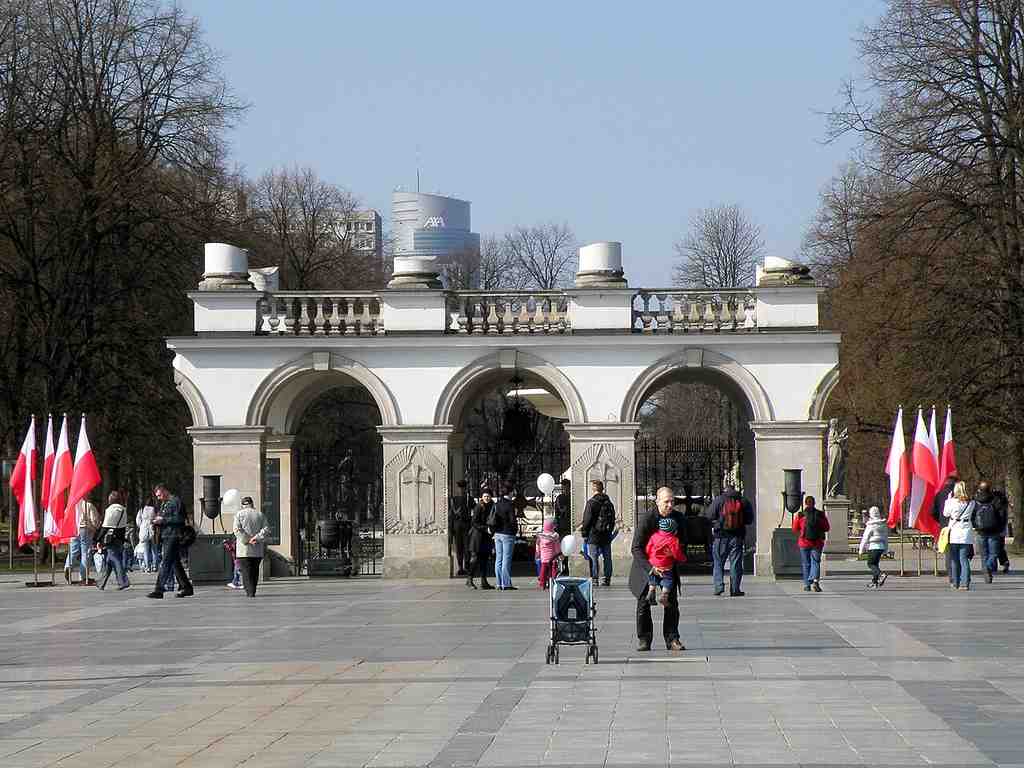
Tomb of the Unknown Soldier in WarsawPhoto: Ala z, Wikimedia Commons, Public domain. Cropped & resized. Look for three pale stone arches with thick square columns and a vaulted top, with the tomb and eternal flame set beneath the center arch.
Before this became a monument, it began with a mother. In October of nineteen twenty-five, Jadwiga Zarugiewiczowa, a Polish Armenian whose own son had died and never been found, stood in Lwów and chose one coffin from several exhumed graves. Inside lay an unnamed young fighter, likely a volunteer, identified by a simple cap with the Polish eagle and no military rank. One body came here to stand for thousands whose names never came home.
That idea reached Poland after the First World War, when France and Britain created tombs for unknown soldiers. Warsaw opened its own on the second of November, nineteen twenty-five, and placed it here in the middle arches of the Saxon Palace colonnade. That matters. This square was once part of the Saxon seat of power, a grand state setting of palace, square, and garden. Poland put mourning right into the bones of authority.
You can feel that double meaning even now. The eternal flame burns, the honor guard from the Polish Army’s representative unit stands watch, and state ceremonies still gather here. But this is not just a polished national altar. It is also a wound that the city chose not to hide.
Take a moment and study the arches... then the rougher brick that shows through on the side. Which carries more force for you: the rebuilt stone, or the missing palace it hints at? If you want a closer look at that scar, the side-detail image in the app makes the brickwork easy to spot.
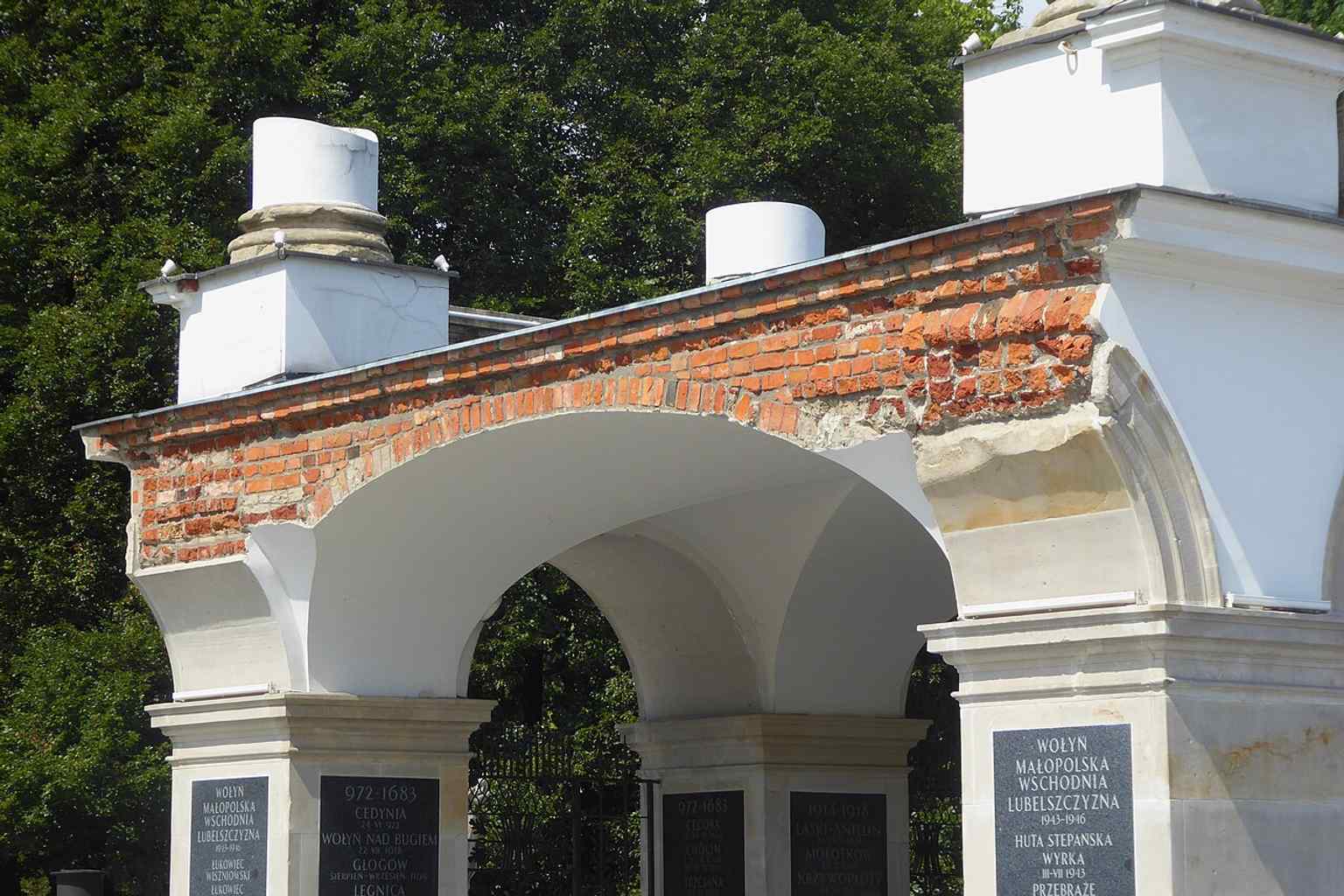
The southern side detail where the original brickwork is visible — a reminder that the tomb is the preserved remnant of a much larger palace structure.Photo: Ethan Doyle White, Wikimedia Commons, CC BY-SA 4.0. Cropped & resized. Most visitors sense something unusual here without quite naming it, so here’s the local tip: this tomb is not a freestanding monument at all. It is only the surviving fragment of a much larger palace colonnade, blown apart by the Germans in December of nineteen forty-four. That is why it feels complete and incomplete at the same time, like a sentence with the middle intact and the rest torn away. If you check the before-and-after image, you can see that transformation in one glance.
After the war, architect Zygmunt Stępiński rebuilt only these three arches, on purpose, preserving the place as a ruin-symbol rather than smoothing it into a neat replacement. Warsaw does this a lot. It lets damage stay readable. The missing parts become part of the meaning.
So this first stop sets the tone for the city around you. Public memory here does not live in one clean story; it lives in ritual, fragments, and the stubborn decision to keep showing where the break happened. From here, we’ll walk about four minutes to the Grand Theatre, where power and performance take the stage in a very different way.
And one practical note: the tomb is open to the public around the clock.
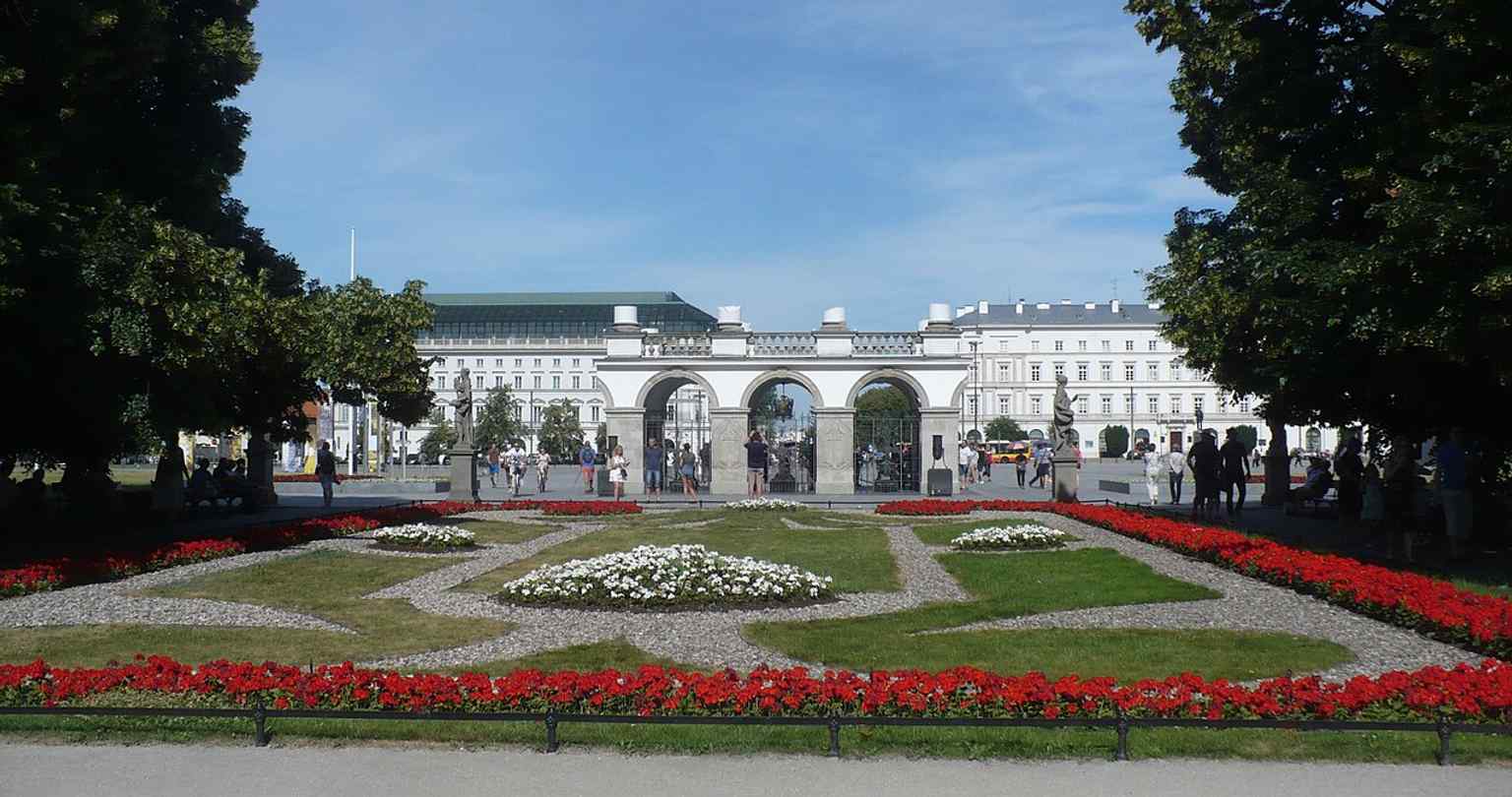
A wider exterior view of the monument on Piłsudski Square, useful for showing the surviving arcade fragment of the former Saxon Palace colonnade.Photo: Оксана Проценко, Wikimedia Commons, CC BY-SA 4.0. Cropped & resized. 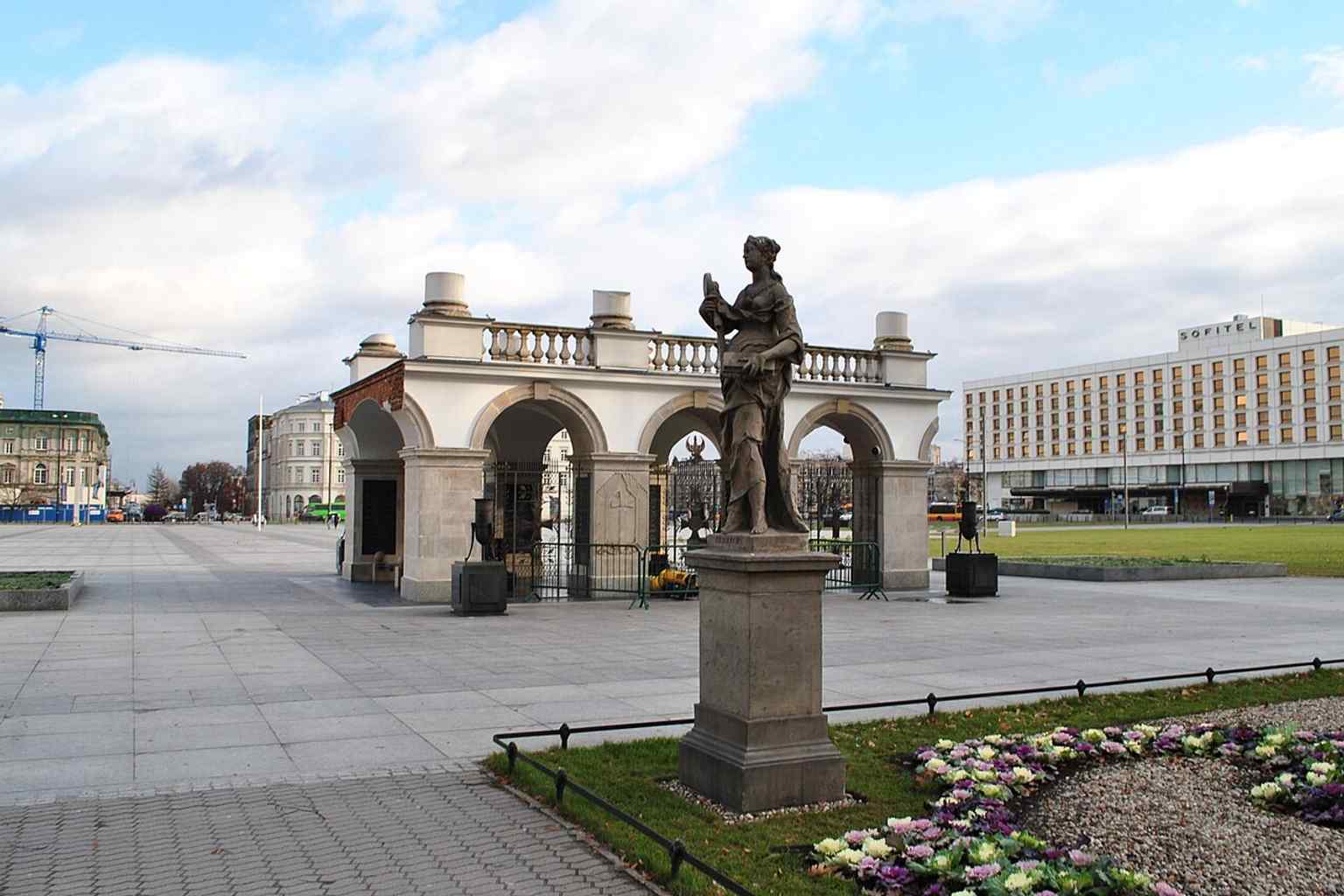
The tomb seen in its urban setting beside Piłsudski Square and the Saxon Garden, matching the landmark’s role as the ceremonial center of Warsaw.Photo: Marek Mróz, Wikimedia Commons, CC BY 4.0. Cropped & resized. 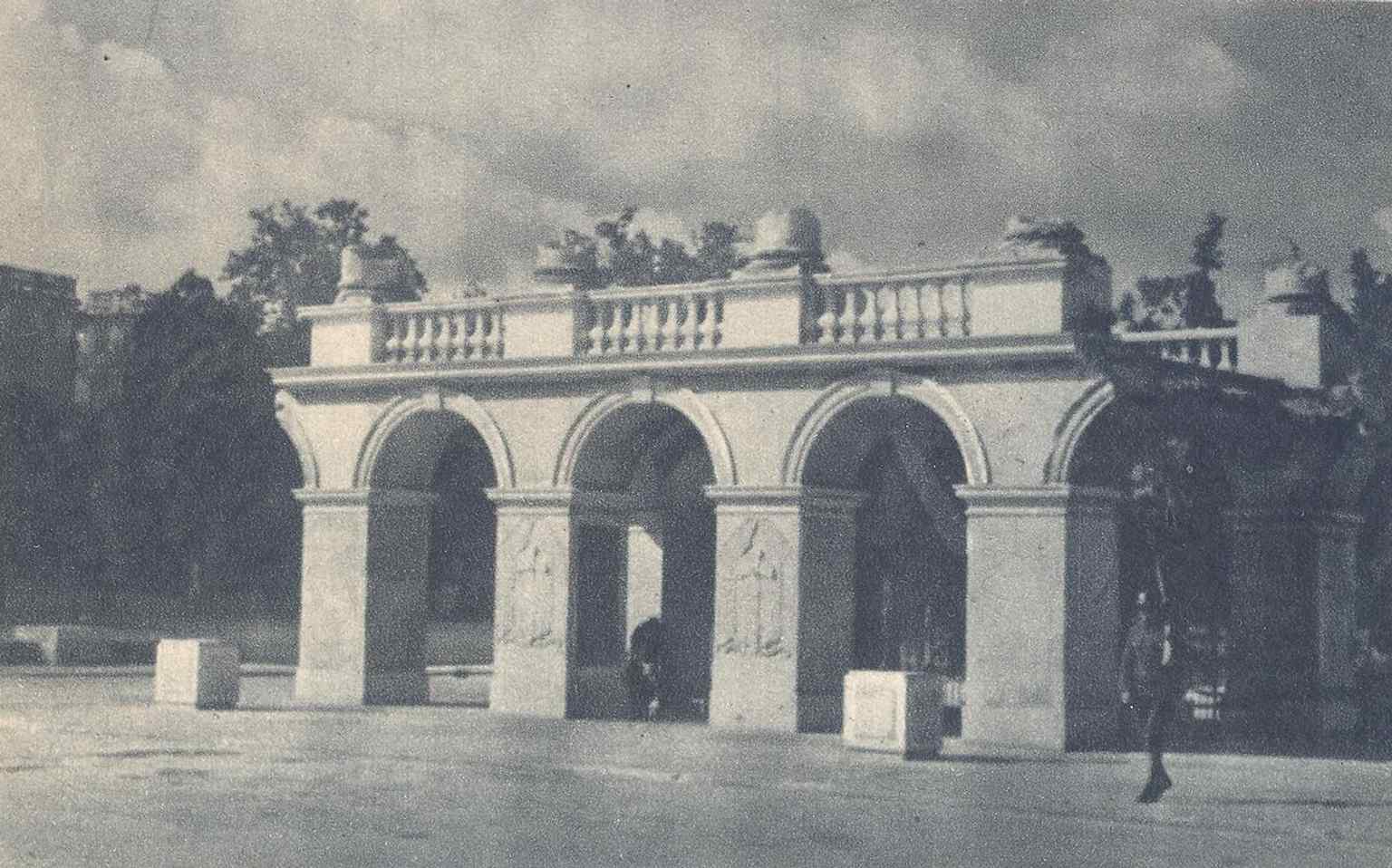
A wartime 1944 image of the Tomb of the Unknown Soldier, valuable for contrasting the monument’s later ruin and postwar restoration.Photo: Unknown authorUnknown author, Wikimedia Commons, Public domain. Cropped & resized. 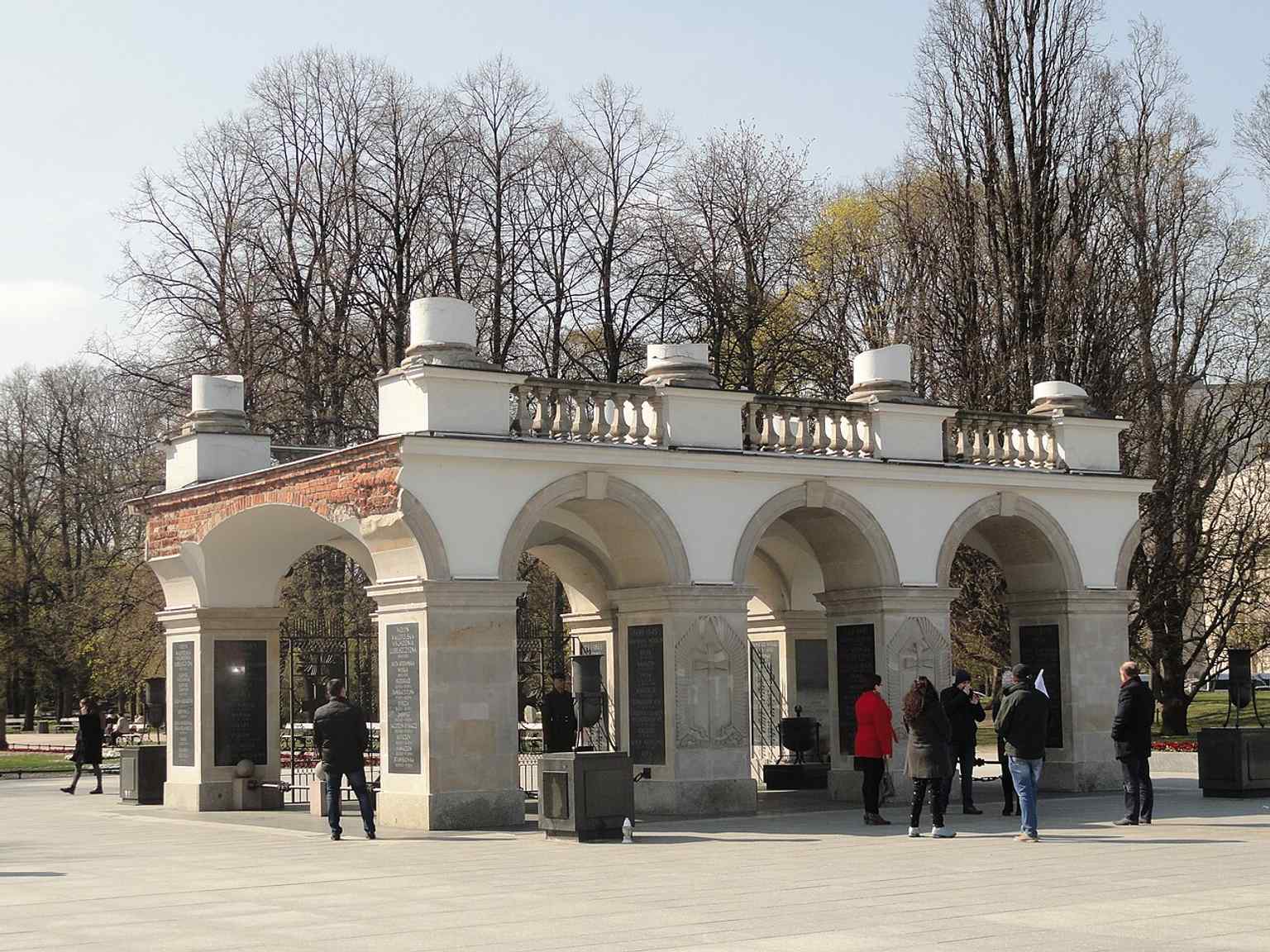
A high-resolution modern view that captures the monument’s restored stonework and the three-arched colonnade fragment in detail.Photo: Cybularny, Wikimedia Commons, CC BY-SA 4.0. Cropped & resized. 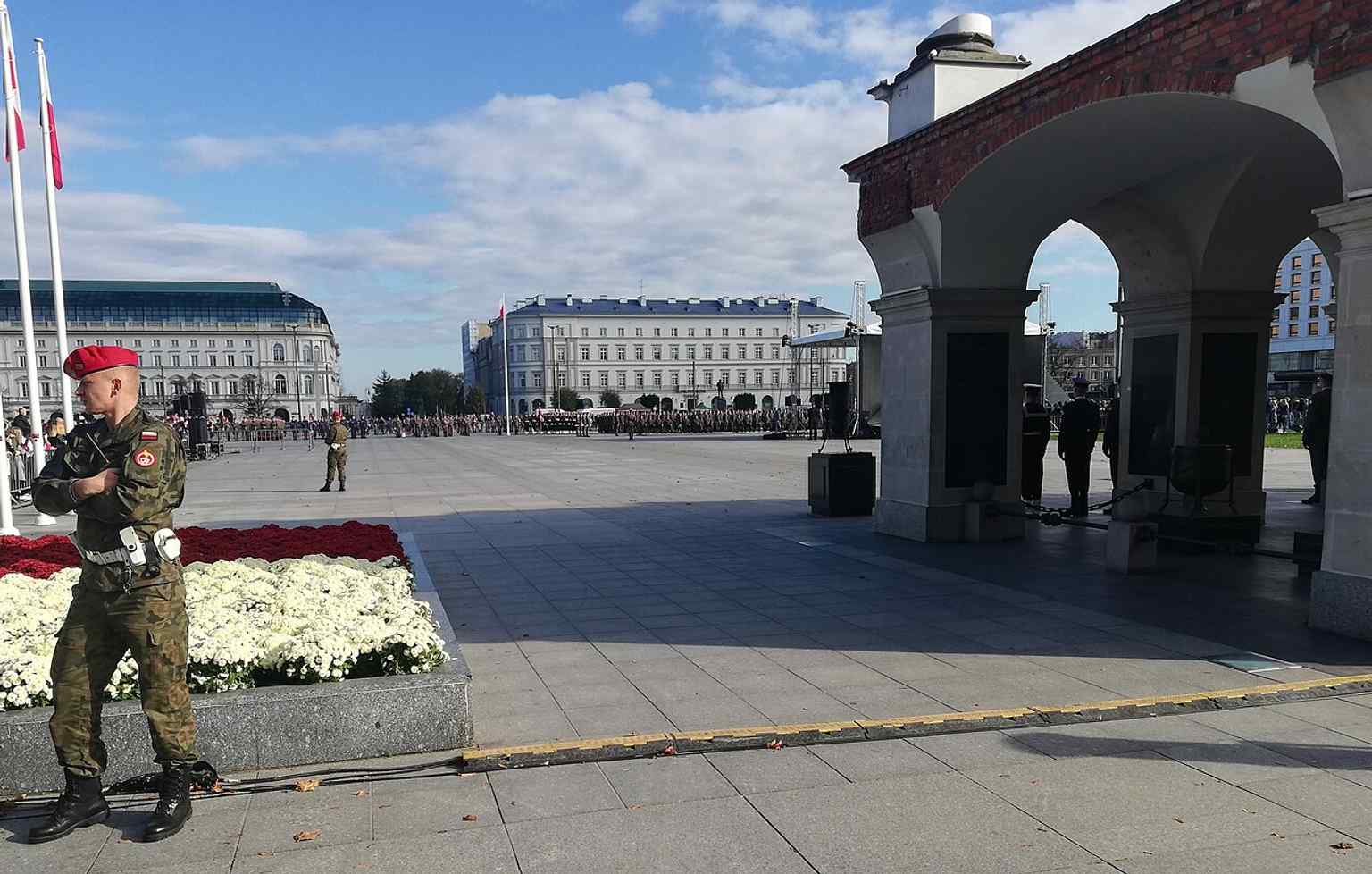
A clear view of a military ceremony directly in front of the tomb, illustrating the honor guard tradition described in the source text.Photo: Heshq, Wikimedia Commons, CC BY-SA 4.0. Cropped & resized. On your left, look for the long pale-stone front with its row of tall columns and the bronze quadriga of Apollo, a four-horse chariot sculpture perched above the roofline. Here…Read moreShow less
Open dedicated page →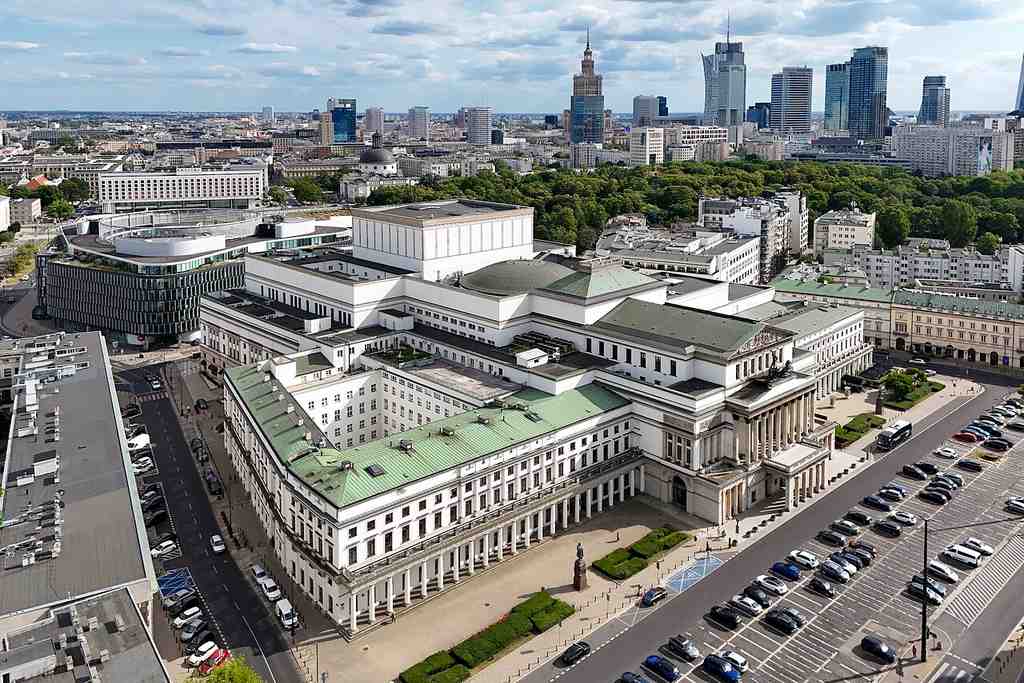
The Grand Theatre in WarsawPhoto: Toniklemm, Wikimedia Commons, CC BY-SA 4.0. Cropped & resized. On your left, look for the long pale-stone front with its row of tall columns and the bronze quadriga of Apollo, a four-horse chariot sculpture perched above the roofline.
Here Warsaw turns itself into a public stage. In this square, culture did not stay politely indoors; it spilled into civic life, into speeches, ceremonies, grief, and pride. Opera and ballet mattered here not just as entertainment, but as proof that a pressured city could still speak in its own voice.
Italian architect Antonio Corazzi designed this theater between eighteen twenty-five and eighteen thirty-three, on the site of the old Marywil commercial complex. He chose a neoclassical style, meaning the balanced, columned look borrowed from ancient Greece and Rome. His model stood in Naples, at the San Carlo theater, because Warsaw’s leaders wanted something grand enough to announce ambition... though politics soon started cutting the cloth a little shorter.
After the November Uprising, officials reduced Corazzi’s plan from two thousand seats to one thousand two hundred forty-eight, and they removed the great royal box facing the stage. Still, the opening night arrived in style on the twenty-fourth of February, eighteen thirty-three: Rossini’s Barber of Seville and a ballet by Karol Kurpiński. You can almost hear the city straightening its gloves.
This building taught Warsaw how to perform itself in public. Funeral processions for famous actors stopped outside while the opera orchestra played from the terrace. In eighteen sixty-two, Ludwik Jaroszyński tried to assassinate Grand Duke Konstanty here and failed, which tells you this square was never just decoration with good manners.
And it was never only about grand opera. Inside a set of assembly rooms later known as the Redutowe halls, Juliusz Osterwa and Mieczysław Limanowski opened Reduta in nineteen nineteen, Poland’s first experimental studio theater, a smaller stage built for artistic risk rather than spectacle. Even the side rooms, in other words, were aiming high.
Then war smashed the scene apart. Bombing hit the theater in nineteen thirty-nine. During the Warsaw Uprising, fighting damaged what remained, and German forces later blew up the surviving sections. Between the sixth and eighth of August, nineteen forty-four, the ruins became a murder site for about three hundred fifty Polish civilians. If you glance at the before-and-after image in the app, you can see this grand front as a broken shell in nineteen forty-nine, then standing whole again.
What rose afterward was not a simple copy. Rebuilders preserved the original front and the Wierzbowa Street side, then between nineteen forty-seven and nineteen sixty-five they enlarged and reinvented the rest. The result included one of the world’s largest opera stages, with a revolving platform, trapdoors, lighting bridges, and deep technical spaces hidden behind all this calm stone. By the final push, veteran theater organizer Arnold Szyfman carried much of the burden almost alone after political reshuffling left him isolated, yet the house reopened on the nineteenth of November, nineteen sixty-five, with Moniuszko’s The Haunted Manor. Today the rebuilt giant houses the National Opera, the Polish National Ballet, and the Theatre Museum.
And that bronze quadriga above you? It finally arrived in two thousand and two. Corazzi had wanted it from the start, but imperial authorities blocked the idea after the uprising. Warsaw took its time... then finished the sentence.
Just beyond this square, power speaks in a different language: clipped paths, open lawns, and designed calm. Saxon Garden is about a seven-minute walk away, and it shows how this city staged authority not only in music, but in landscape too.
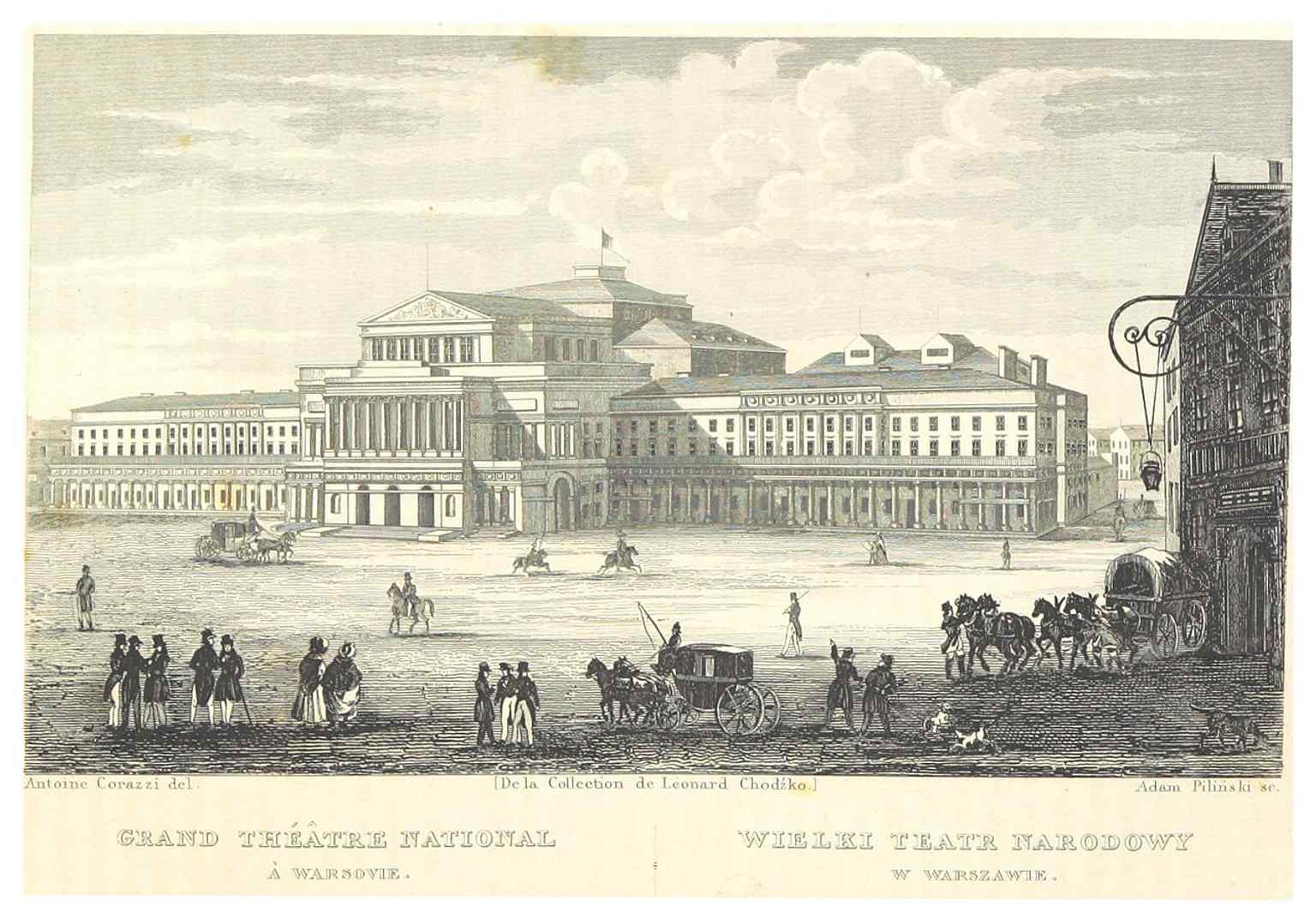
An 1839 print showing the Grand Theatre soon after its opening, when Corazzi’s neoclassical design was still the city’s new landmark.Photo: Unknown, Wikimedia Commons, Public domain. Cropped & resized. 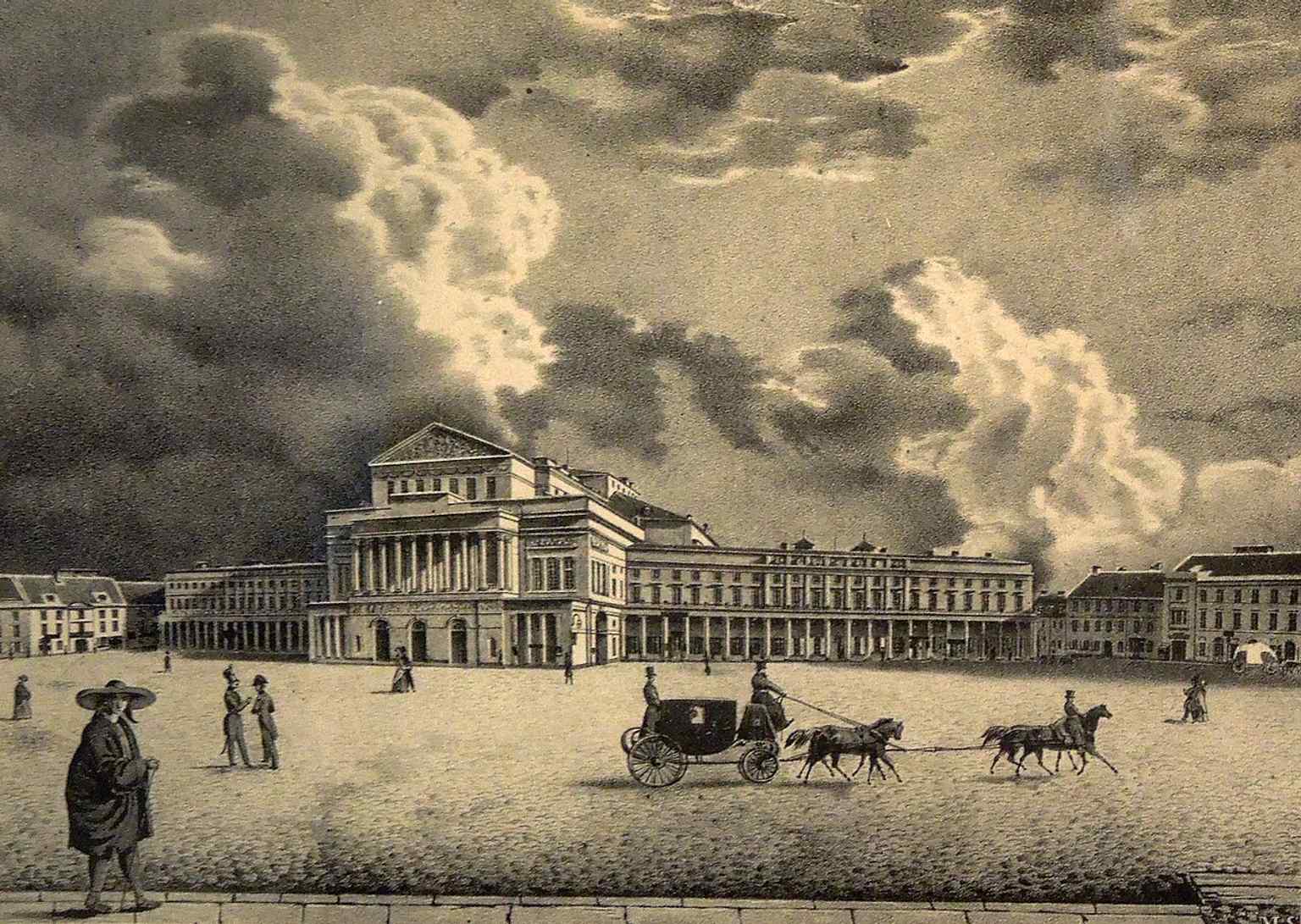
A 1840 lithograph of the theatre that helps show how the building looked in the first decades of the 19th century.Photo: Maurycy Scholtz, Wikimedia Commons, CC BY-SA 4.0. Cropped & resized. 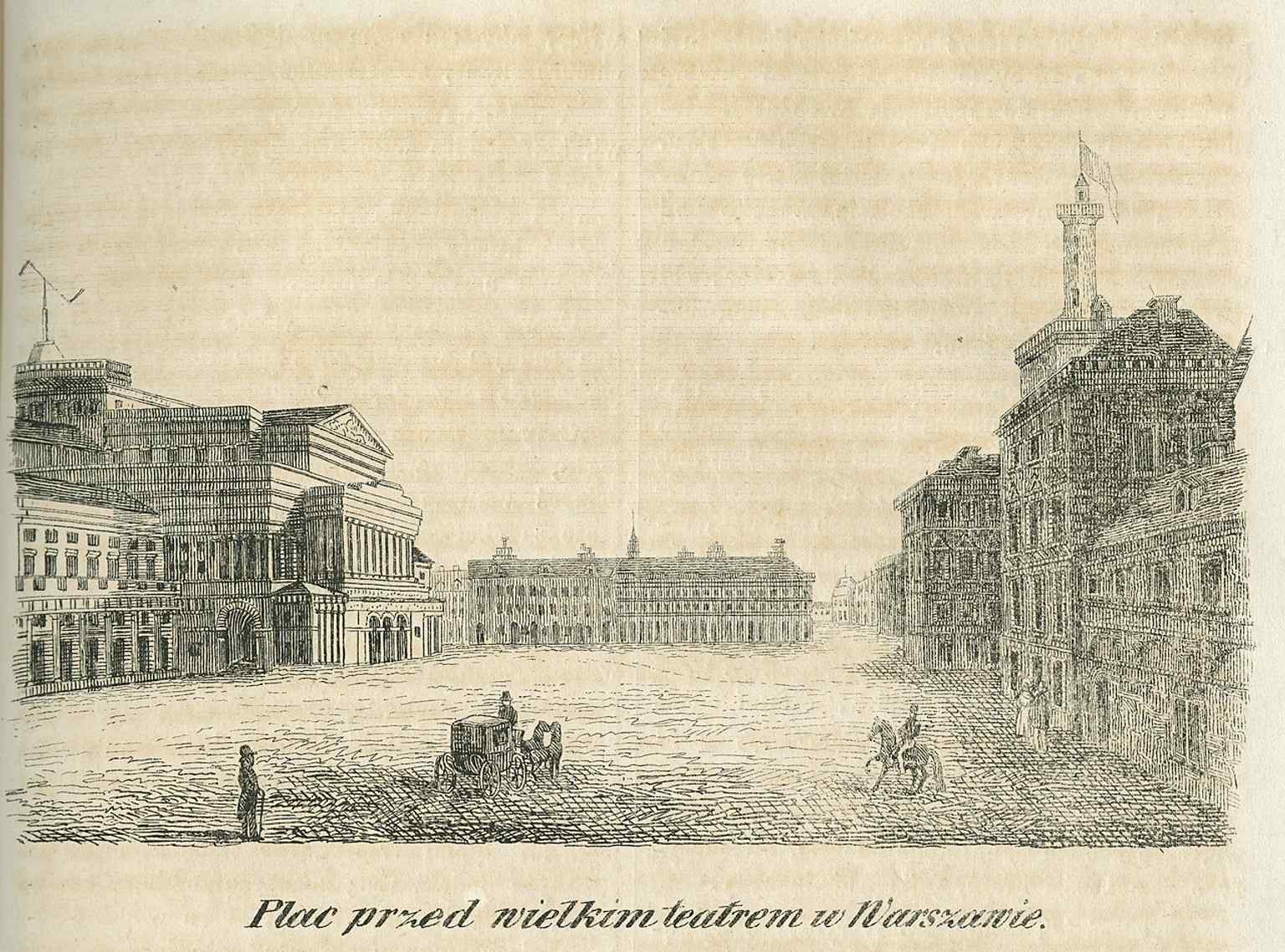
The theatre square in 1846, capturing the building in its early urban setting before later changes to the frontage and gardens.Photo: Unknown, Wikimedia Commons, Public domain. Cropped & resized. 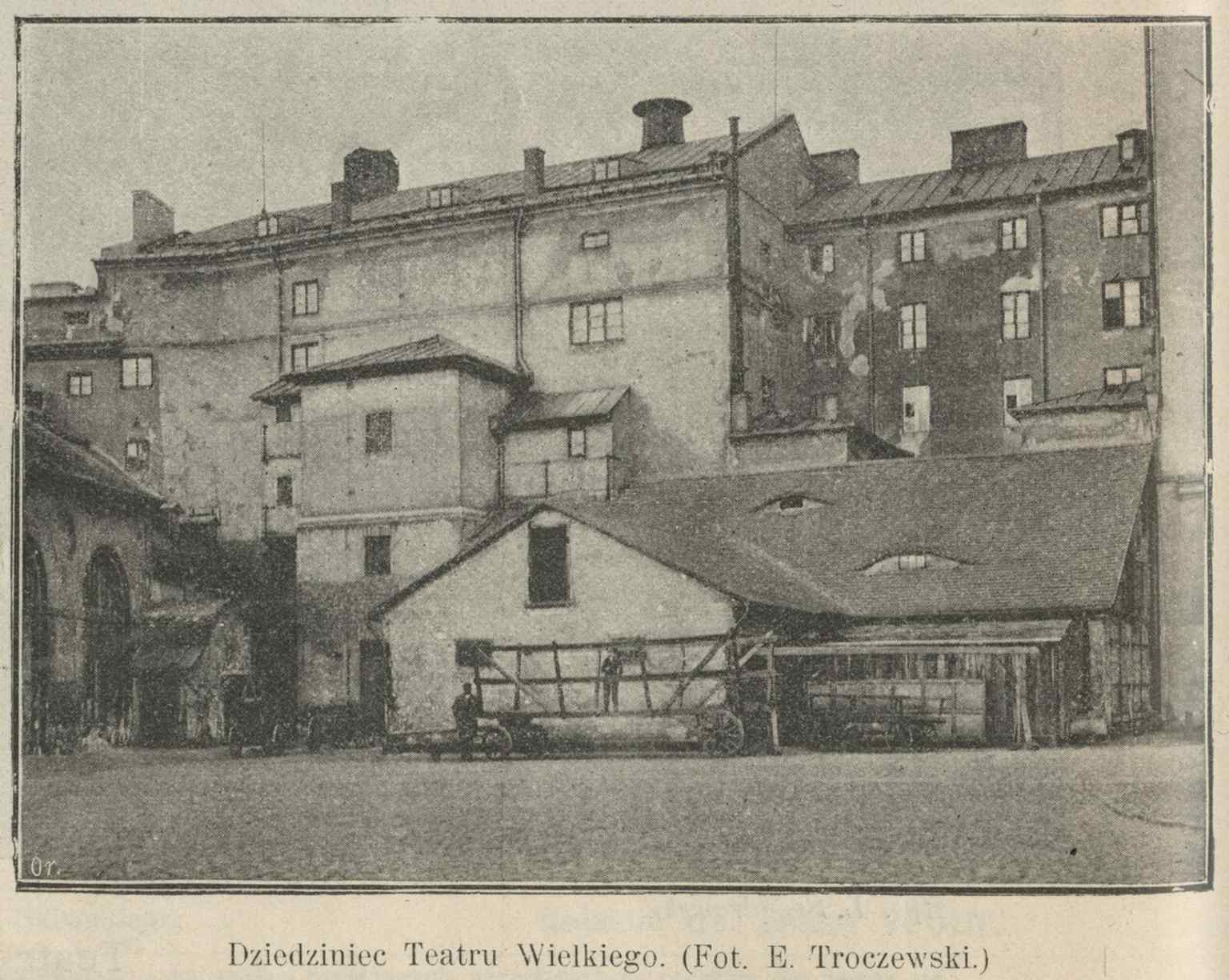
The theatre courtyard in 1896, a rare look behind the façade at the complex that also housed Redutowe spaces and service wings.Photo: Troczewski, E[dward] (fl. 1880-1893). Fot., Wikimedia Commons, Public domain. Cropped & resized. 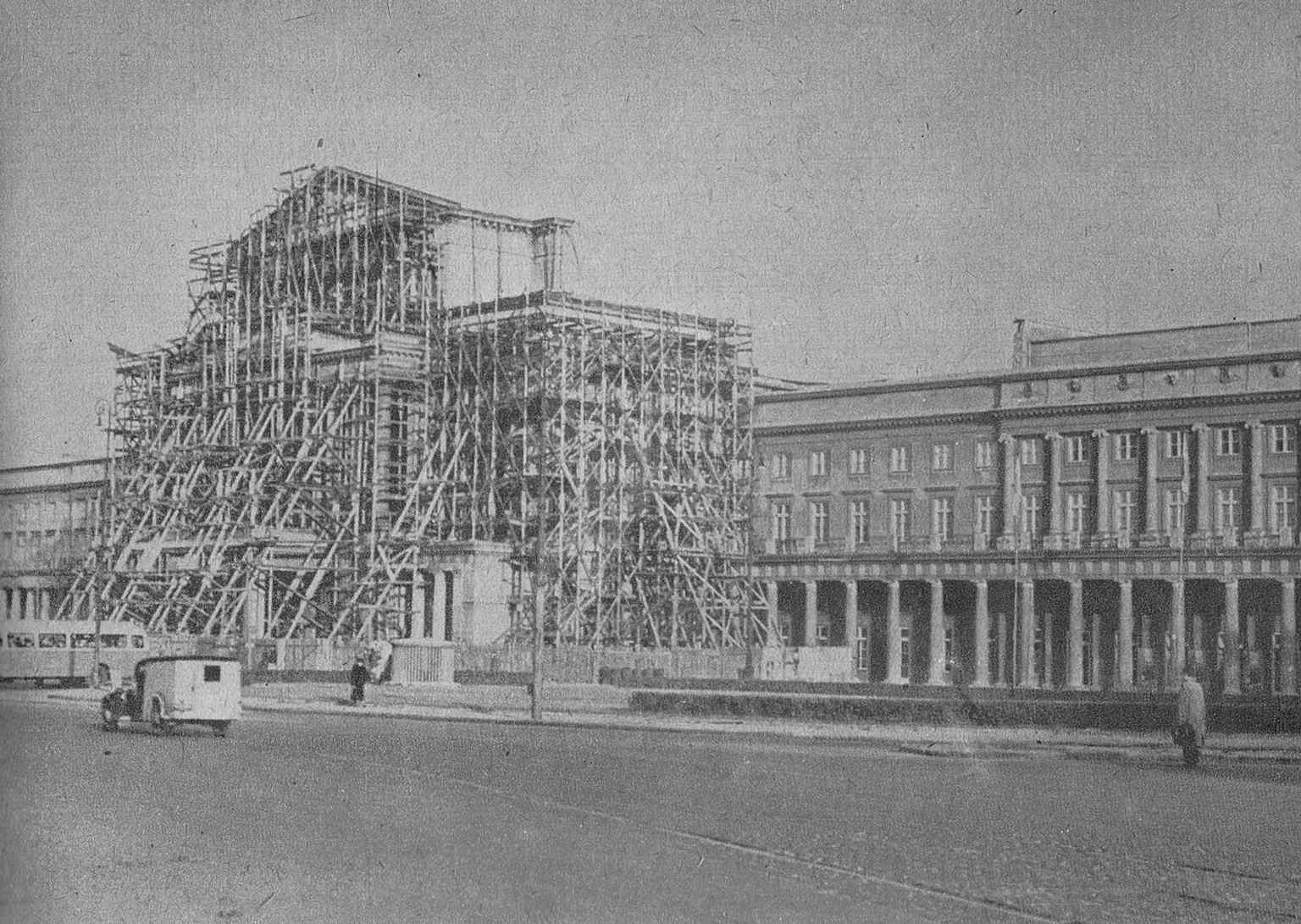
Reconstruction in 1949, showing the postwar rebuilding that began after the wartime destruction of the theatre.Photo: nieznany/unknown, Wikimedia Commons, Public domain. Cropped & resized. 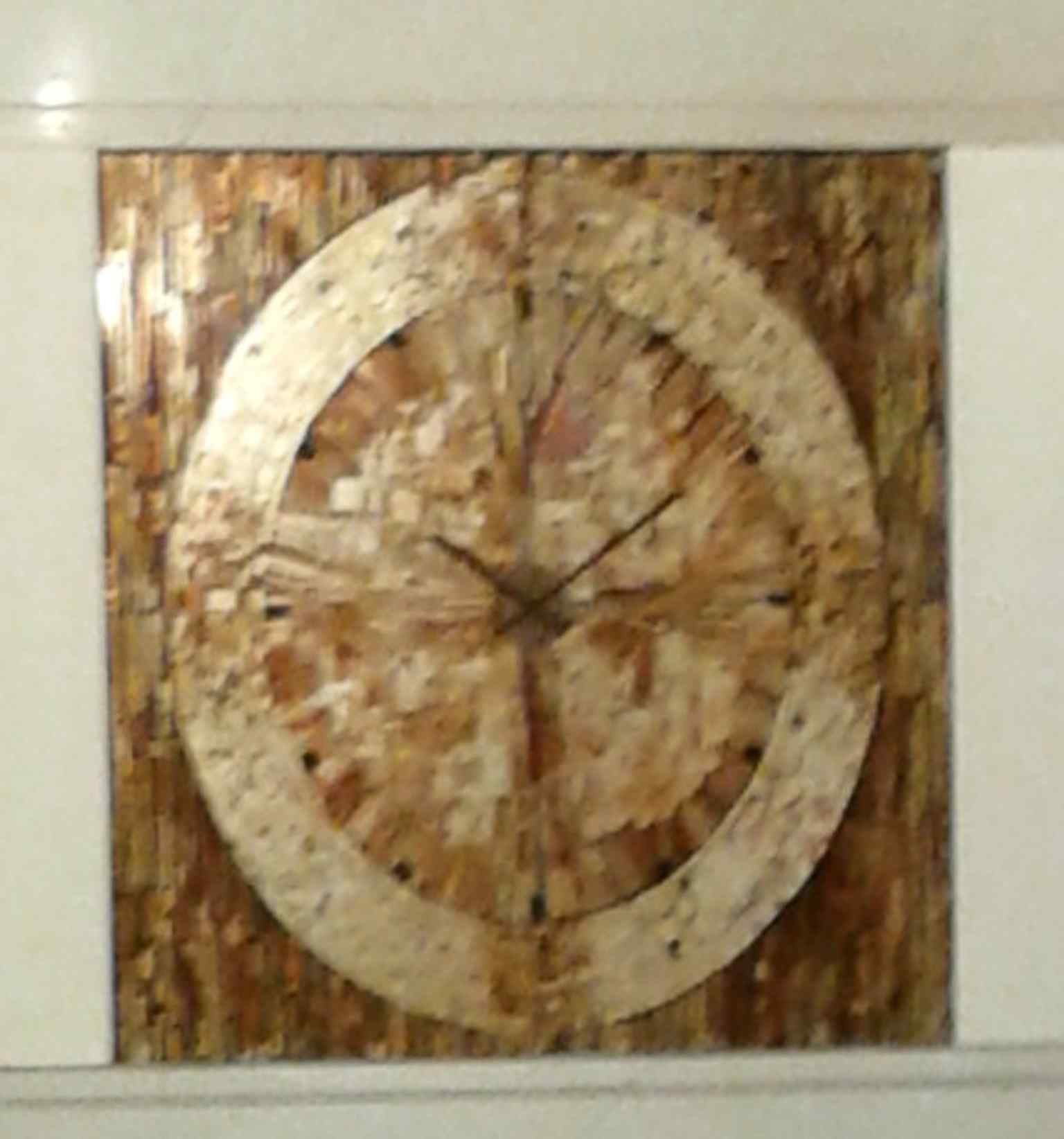
A mosaic clock inside the theatre, one of the small design details that reflects the building’s rich interior life.Photo: Panek, Wikimedia Commons, CC BY-SA 4.0. Cropped & resized. 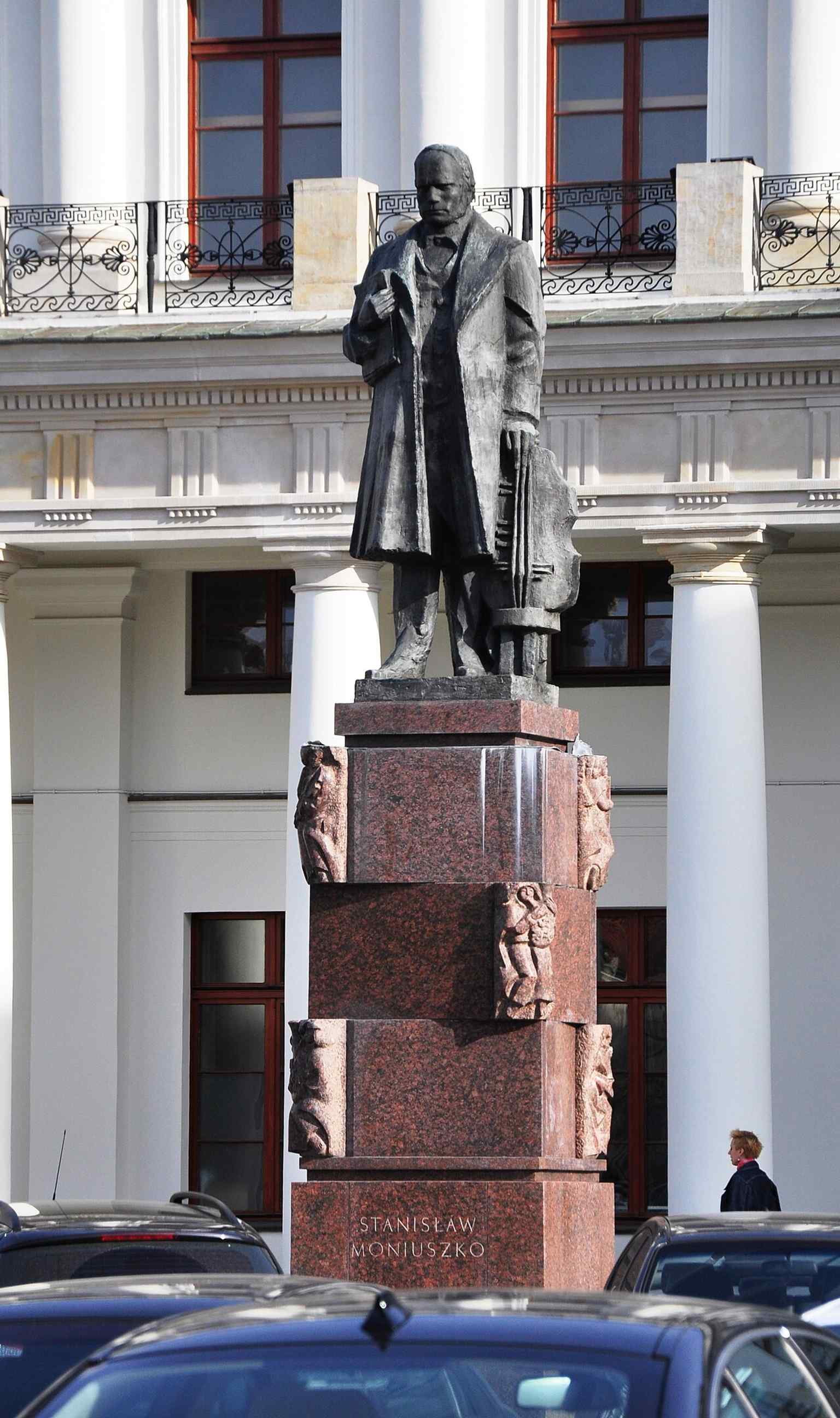
The Bogusławski monument on Theatre Square, honoring the founder linked to the theatre’s national stage tradition.Photo: Wistula, Wikimedia Commons, CC BY 3.0. Cropped & resized. 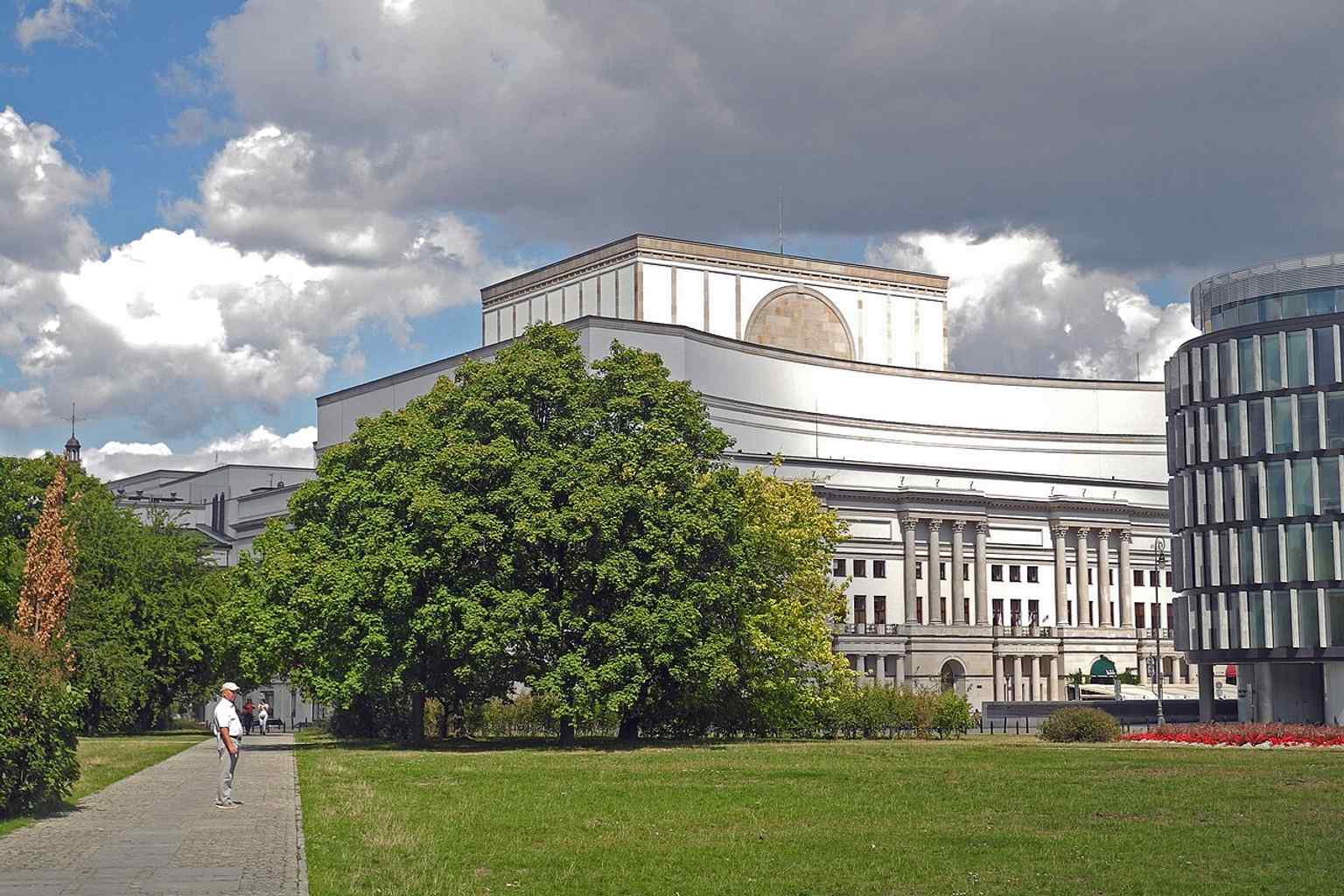
A recent view of the opera house at night, showing the theatre as a living performance venue rather than only a historic monument.Photo: SchiDD, Wikimedia Commons, CC BY-SA 4.0. Cropped & resized. Look for a broad formal park opening behind straight gravel paths and dense rows of trees, with the pale stone arcade of the old Saxon Palace marking one edge. Saxon Garden is…Read moreShow less
Open dedicated page →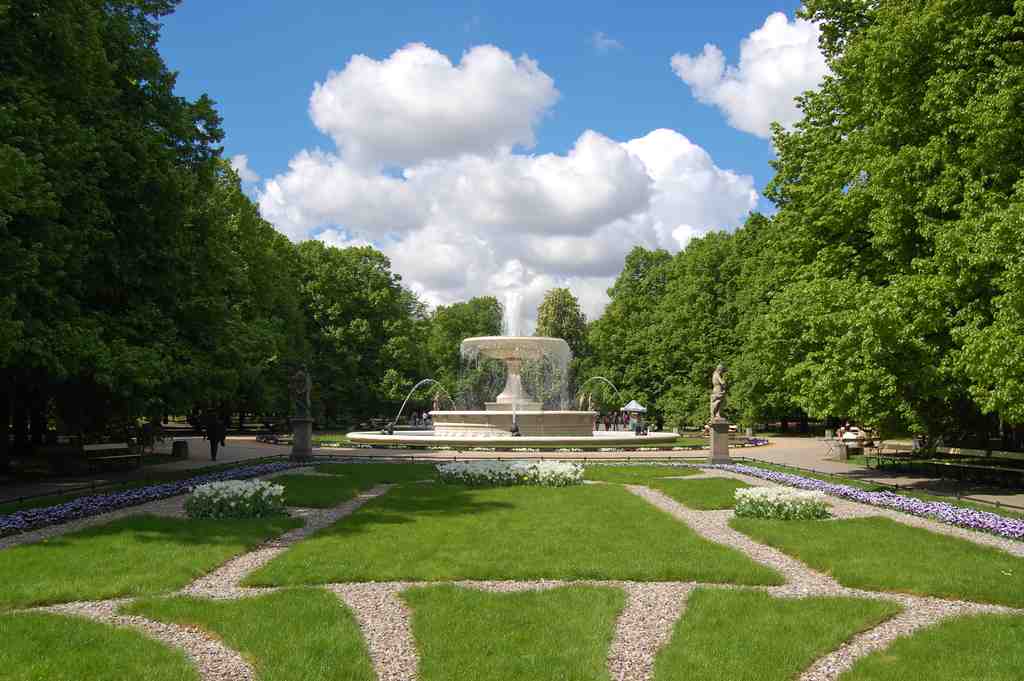
Saxon GardenPhoto: Marcin Białek, Wikimedia Commons, CC BY-SA 3.0. Cropped & resized. Look for a broad formal park opening behind straight gravel paths and dense rows of trees, with the pale stone arcade of the old Saxon Palace marking one edge.
Saxon Garden is where Warsaw turns urban planning into stagecraft. This is the city’s oldest public park, spread across fifteen and a half hectares, but it began much less peacefully: on the old line of Warsaw’s fortifications and beside a palace that Jan Andrzej Morsztyn built in the sixteen sixties. Then Augustus the Second stepped in and thought much bigger.
Augustus did not just want a pleasant royal garden. He wanted a dynastic billboard in hedges and avenues... a grand axis stretching from western Warsaw toward the Vistula, linking palaces, gardens, and power into one carefully arranged view. If you peek at the plan on your screen, you can see how deliberate it was: straight lines, symmetry, and the garden serving the palace like a giant green carpet. Very French, very orderly, very “please admire the king from the correct angle.”
Here is the local brag most visitors miss: Warsaw opened this park to the public in seventeen twenty-seven. That was unusually early for a royal garden to be open to ordinary walkers. So this place welcomed ordinary walkers while many more famous royal gardens still kept the rope up.
Even that openness had politics baked into it. A public park can look generous, and it is generous, but it also teaches you how a ruler wants the city to see itself. In the eighteenth century, these paths led the eye back toward the Saxon Palace, flanked by sculptures of subjects like Astronomy, Justice, Painting, and Science, as if the whole country had lined up for inspection. The garden even held the Great Salon, a pavilion planted on the central axis simply to complete the view.
Augustus the Second’s grand urban vision never fully landed. He planned an even larger Saxon composition, but after he died in seventeen thirty-three, key pieces stalled. The demolition of Lubomirski Palace farther west was called off, and the whole axis remained half dream, half city. Plans here rarely get the last word.
The garden kept changing costumes. In the nineteenth century, Warsaw softened the severe Baroque layout into a Romantic English-style landscape park, looser and more natural-looking. Henryk Marconi later added the fountain that became a classic meeting spot, with a marble sundial nearby and, farther in, a water tower modeled on the Temple of Vesta in Tivoli, an ancient round Roman temple. If you bring up the aerial view, you can see how the garden once sat inside a larger courtly composition that later generations had to reinterpret rather than simply inherit.
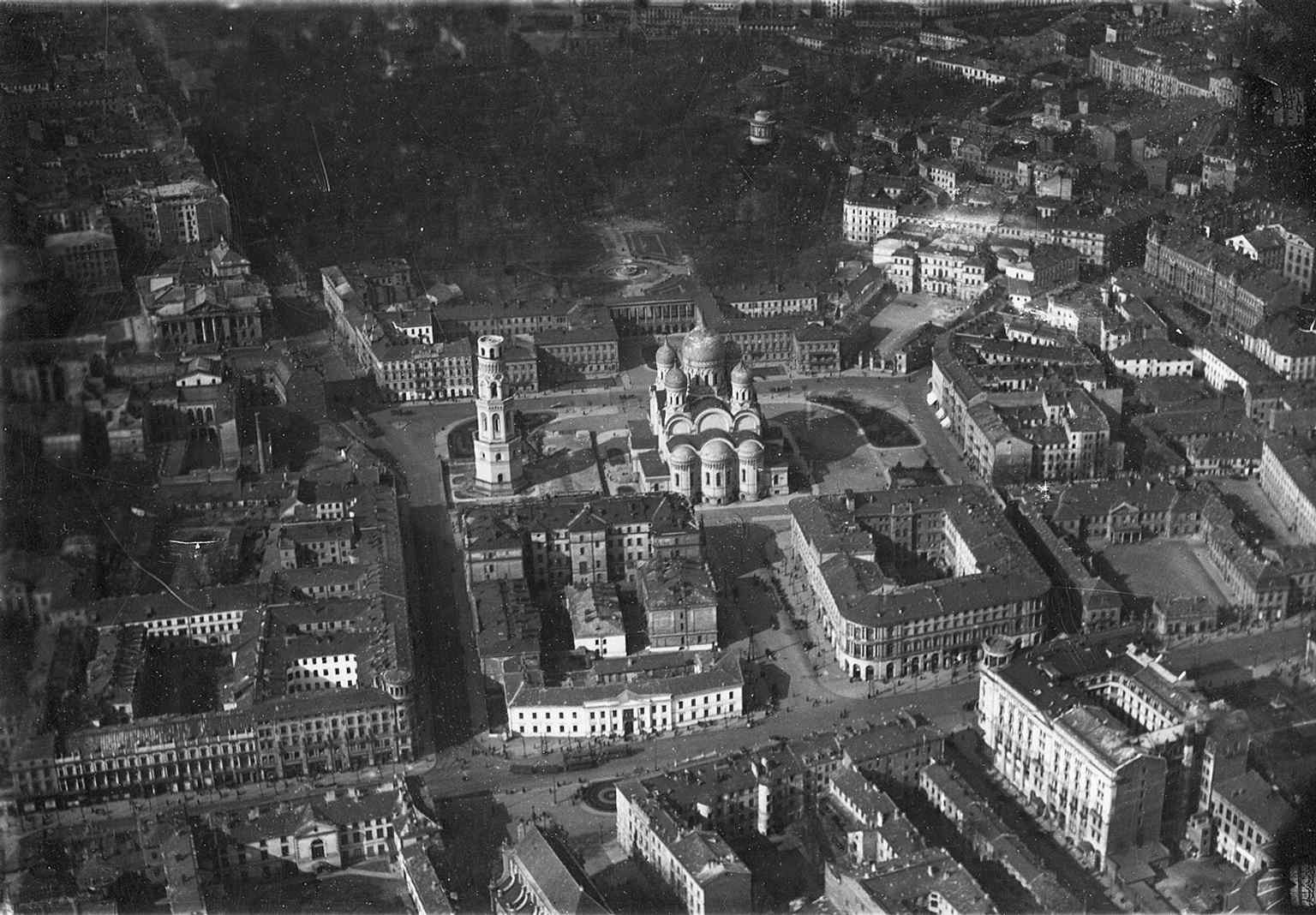
A 1920 aerial view shows the Saxon Garden in context, with the Saxon Palace, Brühl Palace, and the Water Tower still part of Warsaw’s historic central axis.Photo: AnonymousUnknown author, Wikimedia Commons, Public domain. Cropped & resized. There is a more intimate story tucked in here too. Augustus treated the nearby Blue Palace as a gift for his daughter, turning family affection into another display of royal scale. So behind the grand geometry, there was family politics... and a father trying to impress his daughter with real estate on a royal scale.
Then history turned hard again. The surviving arcade at the edge, now part of the Tomb of the Unknown Soldier, is all that remains of the Saxon Palace after deliberate wartime destruction, while the garden around it had to be pieced back together after the Warsaw Uprising and the wrecking that followed.
From here, we head toward a skyline marker born of a very different regime and a much blunter idea of power: the Palace of Culture and Science, about a nineteen-minute walk from here. And handily enough, Saxon Garden stays open all day and all night.
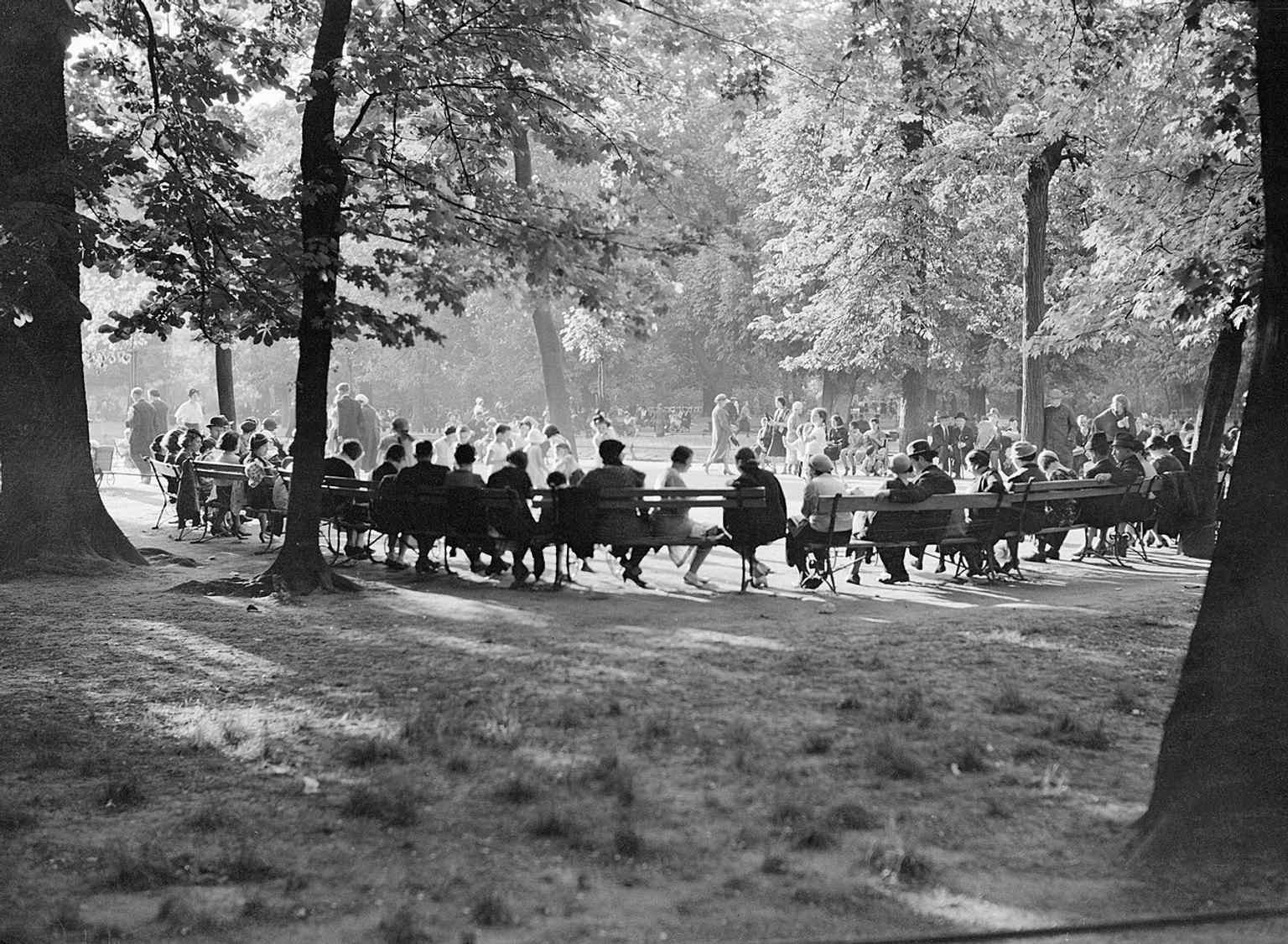
A 1934 glass negative of the Saxon Garden, when it was still a fashionable promenade in interwar Warsaw near the old Jewish quarter.Photo: Willem van de Poll, Wikimedia Commons, CC0. Cropped & resized. 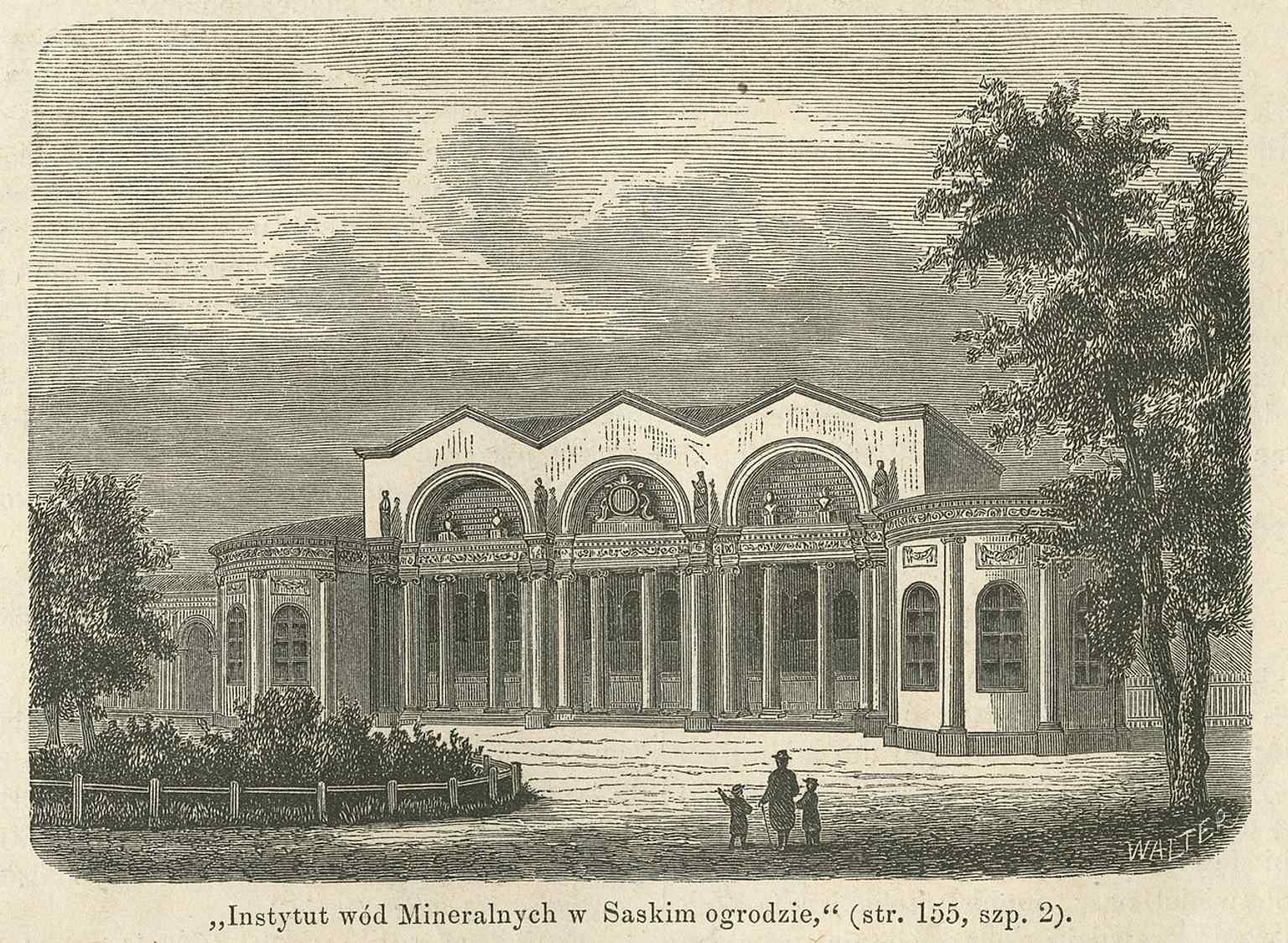
A 1863 view of the mineral-water institute in the Saxon Garden, showing how the park also hosted 19th-century leisure and wellness culture.Photo: Walter. Ryt., Wikimedia Commons, Public domain. Cropped & resized. 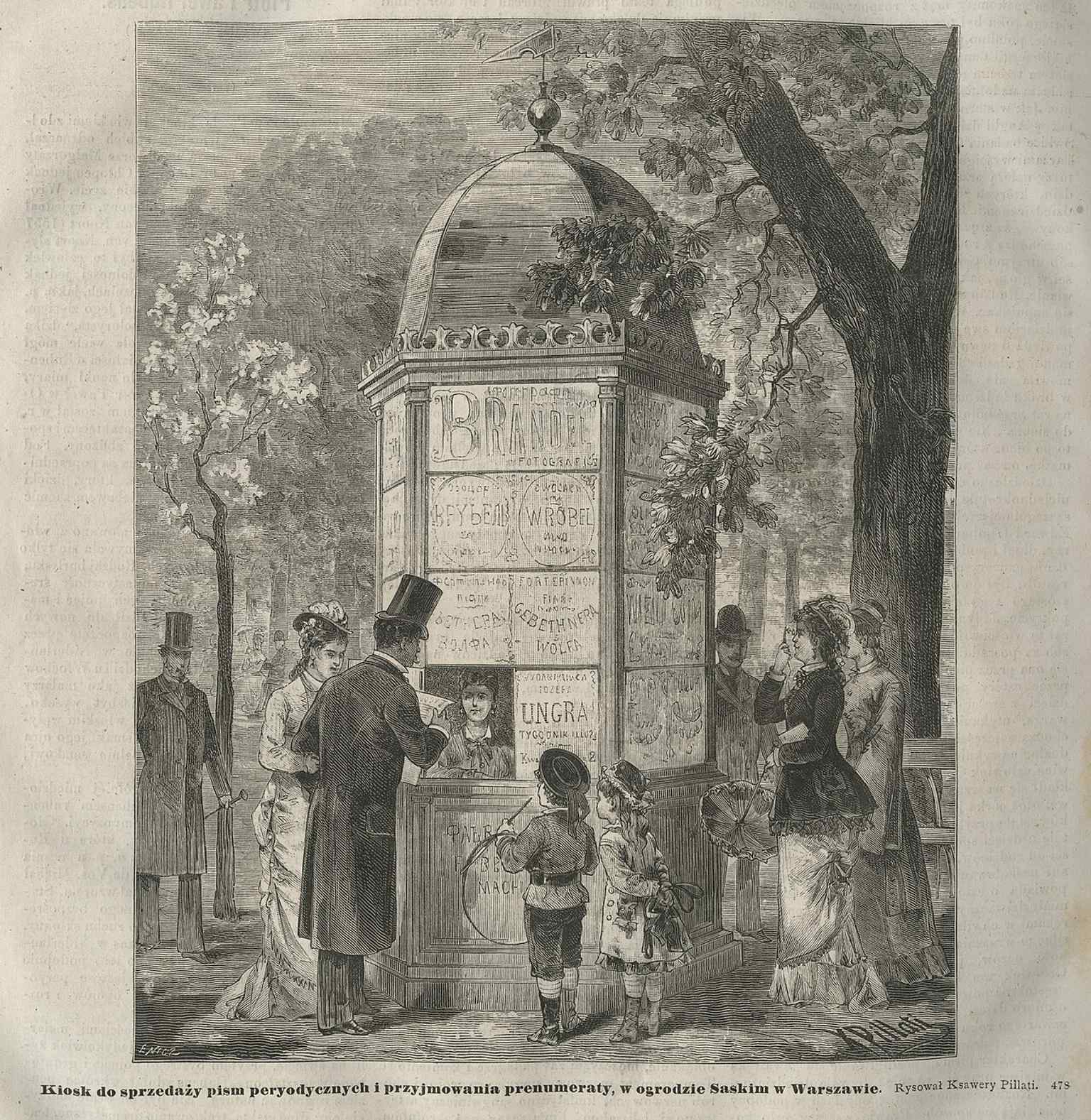
A 1877 kiosk for newspapers and subscriptions in the Saxon Garden, a reminder that the park was once a lively urban promenade.Photo: Nicz, E[dward] (1851-1916). Ryt, Wikimedia Commons, Public domain. Cropped & resized. 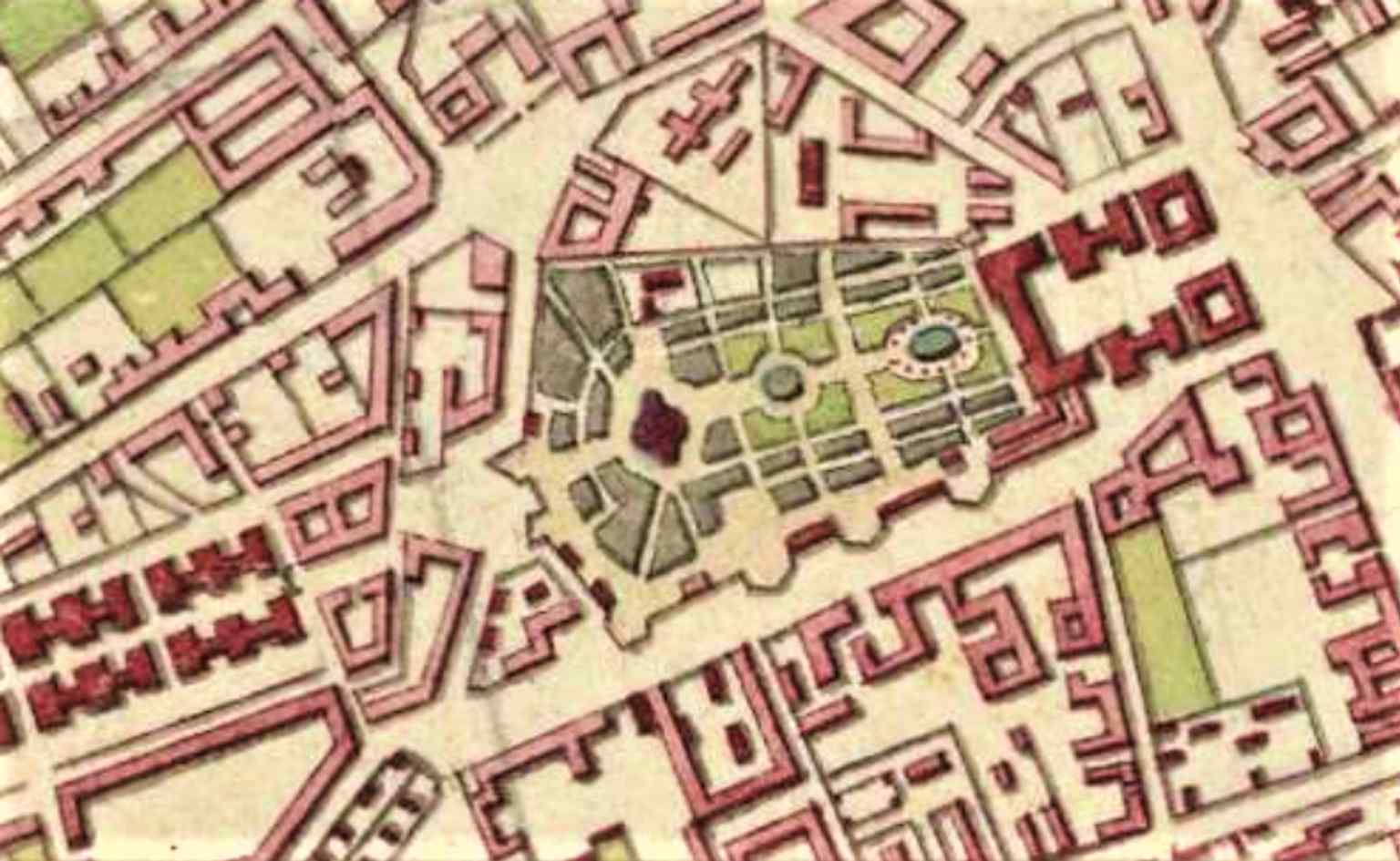
A 1804 map labels the Saxon Garden and Saxon Palace, useful for showing the park’s place in the early city layout.Photo: Josephinische Landesaufnahme, Wikimedia Commons, Public domain. Cropped & resized.
Show 12 more stopsShow fewer stopsexpand_moreexpand_less
On your left rises a pale ceramic-clad tower with a broad stepped base, a crown of stone pinnacles, and a needle-like spire that pulls the whole building up to an unmistakable…Read moreShow less
Open dedicated page →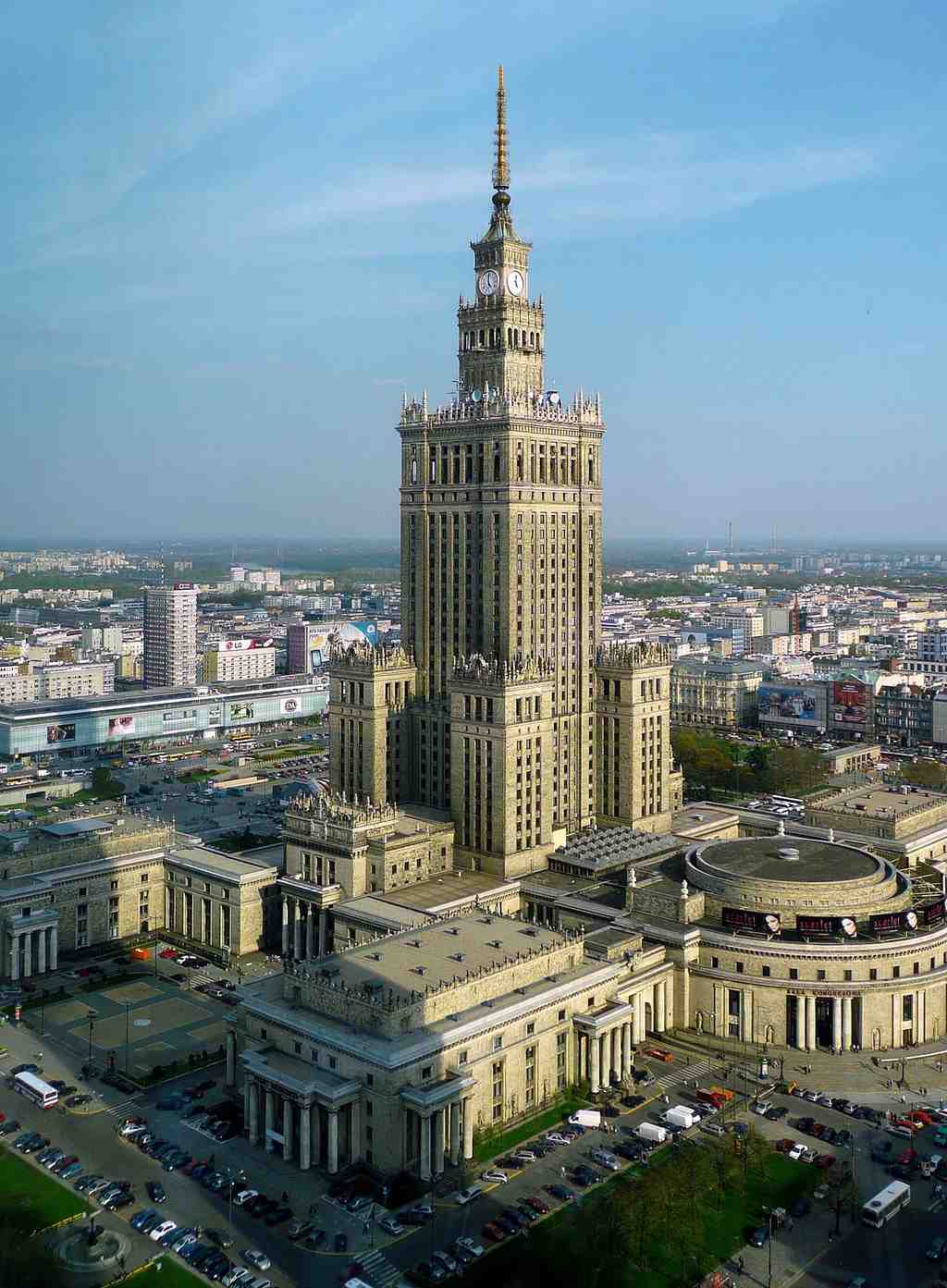
Palace of Culture and SciencePhoto: Nnb, Wikimedia Commons, CC BY-SA 4.0. Cropped & resized. On your left rises a pale ceramic-clad tower with a broad stepped base, a crown of stone pinnacles, and a needle-like spire that pulls the whole building up to an unmistakable point.
This is Warsaw’s Palace of Culture and Science, and from close to its base it feels less like a building than an argument built vertically. If you want one structure that captures Warsaw’s contested modernity, this is it. Some people see a useful civic giant that has earned its place; others see a monument dropped here by force. Both sides have evidence, and that is exactly why the palace still matters.
Joseph Stalin proposed it as a “gift” from the Soviet people to Poland. Gifts, as you know, are more complicated when nobody gets to say no. Builders raised it between nineteen fifty-two and nineteen fifty-five, during the hardest Stalinist years, and they cleared a painful amount of surviving prewar Warsaw to make room for it: several streets disappeared, along with dozens upon dozens of old apartment houses.
The chief architect, Lev Rudnev, did something interesting. He did not simply copy Moscow. He traveled through Polish cities like Kraków, Chełmno, and Zamość, studying local architecture because he wanted the tower to look, in some fashion, Polish. What you see, then, is a strange hybrid: socialist realism, meaning an official style meant to project state power, mixed with historic Polish details and a dash of American art deco skyscraper swagger. It came to two hundred thirty-seven meters with the antenna, making it one of Europe’s giants when it opened.
There is a great story about the height. Architect Józef Sigalin and the design team stood across the river while a small plane dragged a balloon upward over the future site. At one hundred meters... then one hundred ten... then one hundred twenty, Rudnev thought that was enough. The Polish side kept shouting, “Higher!” Warsaw, apparently, has never suffered from modesty. The final answer was this tower, visible from just about everywhere.
And yet the human cost sits in the shadows. Between three thousand five hundred and five thousand Soviet workers and around four thousand Polish workers labored here. Sixteen people died during construction. Soviet crews lived in specially built housing estates on the edge of town, with their own canteen, cinema, and even a pool... a whole temporary world assembled to create this permanent one.
If you check the before-and-after image, you can see how the bare parade ground of the nineteen fifties has turned into today’s Plac Centralny around the same commanding tower. And if you glance at the aerial image in the app, it shows how this palace still shoulders its way through Warsaw’s skyline, even among newer high-rises.
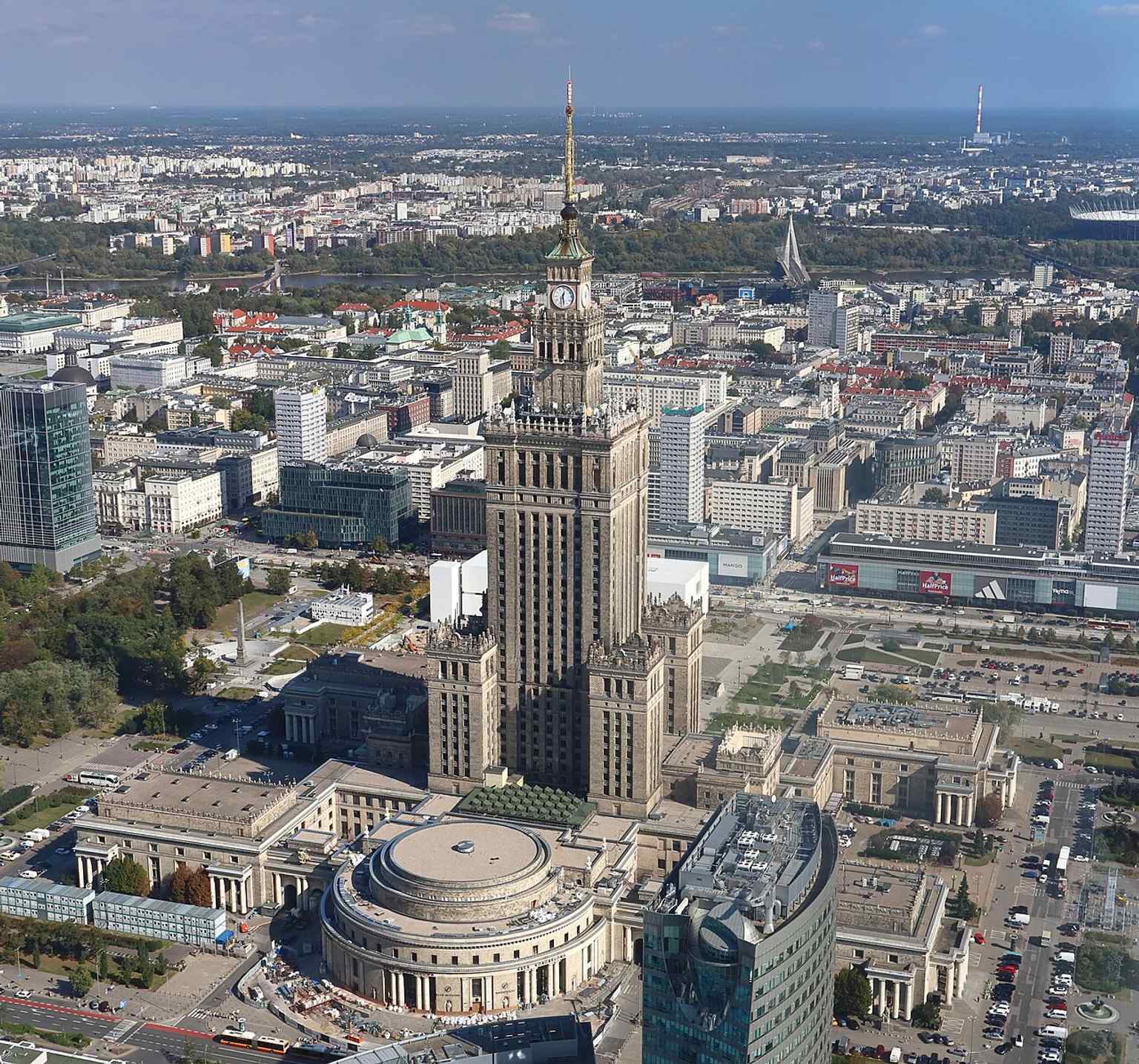
A modern elevated view from Varso Tower, placing PKiN in today’s skyline and showing how it still dominates central Warsaw.Photo: Cybularny, Wikimedia Commons, CC BY 4.0. Cropped & resized. Inside, the city long ago stuffed the building with everyday life: four theaters, museums, a cinema, university spaces, the city council chamber, a youth center, and the famous viewing terrace. So the palace kept doing what cities do best: it got repurposed, argued over, and absorbed. In two thousand seven, Warsaw even protected it as a historic monument, which made some residents furious and others relieved.
That is the tension worth carrying forward. Some buildings become symbols by force... then stay because the city learns to live around them, use them, and never quite forgive them. From here, the National Museum is about a nineteen-minute walk away. If you want to step inside later, the palace is generally open every day from ten in the morning until eight in the evening.
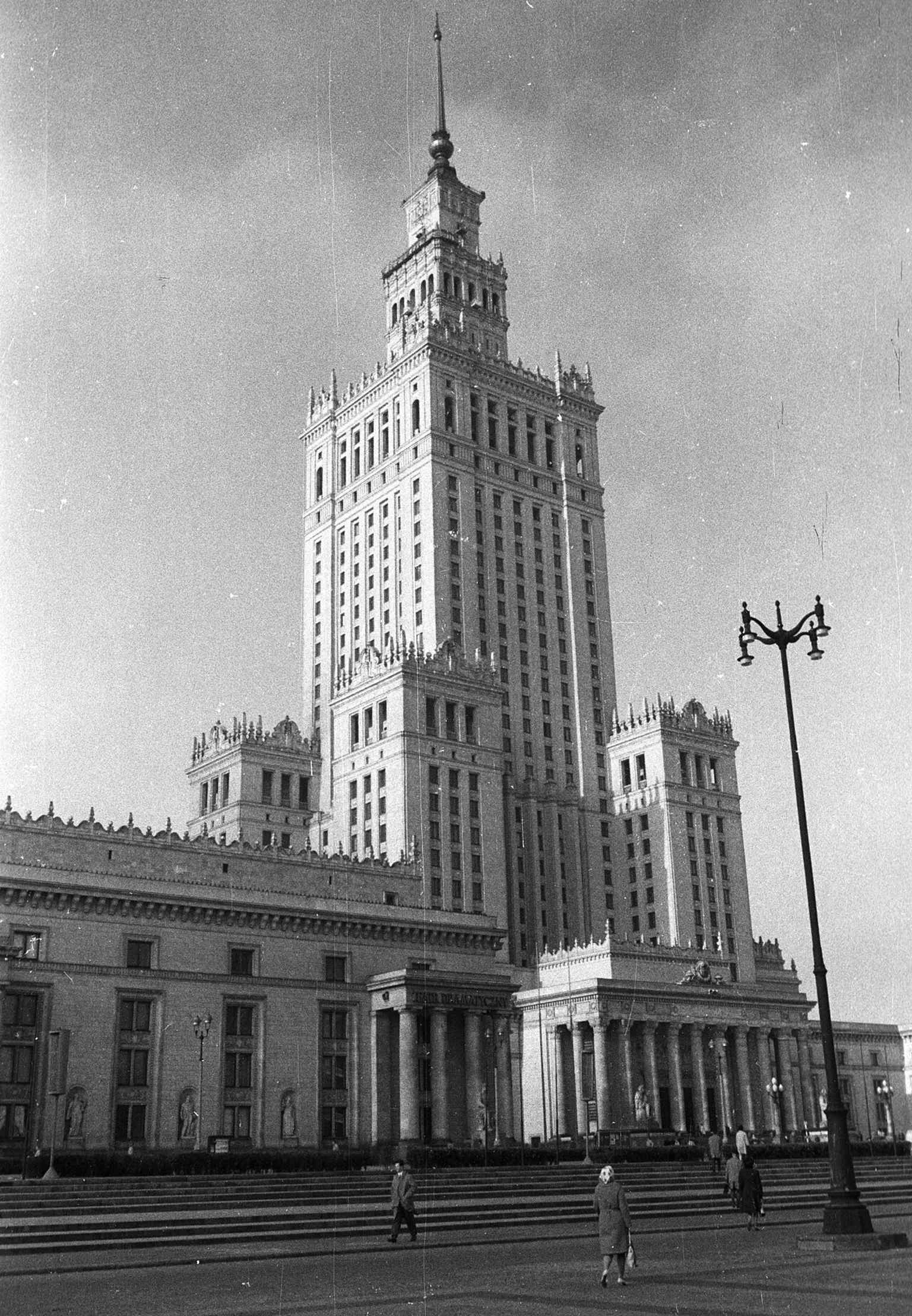
A 1962 Warsaw view with PKiN towering over the city, reflecting its status as one of Europe’s tallest buildings at the time.Photo: FOTO:Fortepan — ID 50528: Adományozó/Donor: Nagy Gyula., Wikimedia Commons, CC BY-SA 3.0. Cropped & resized. 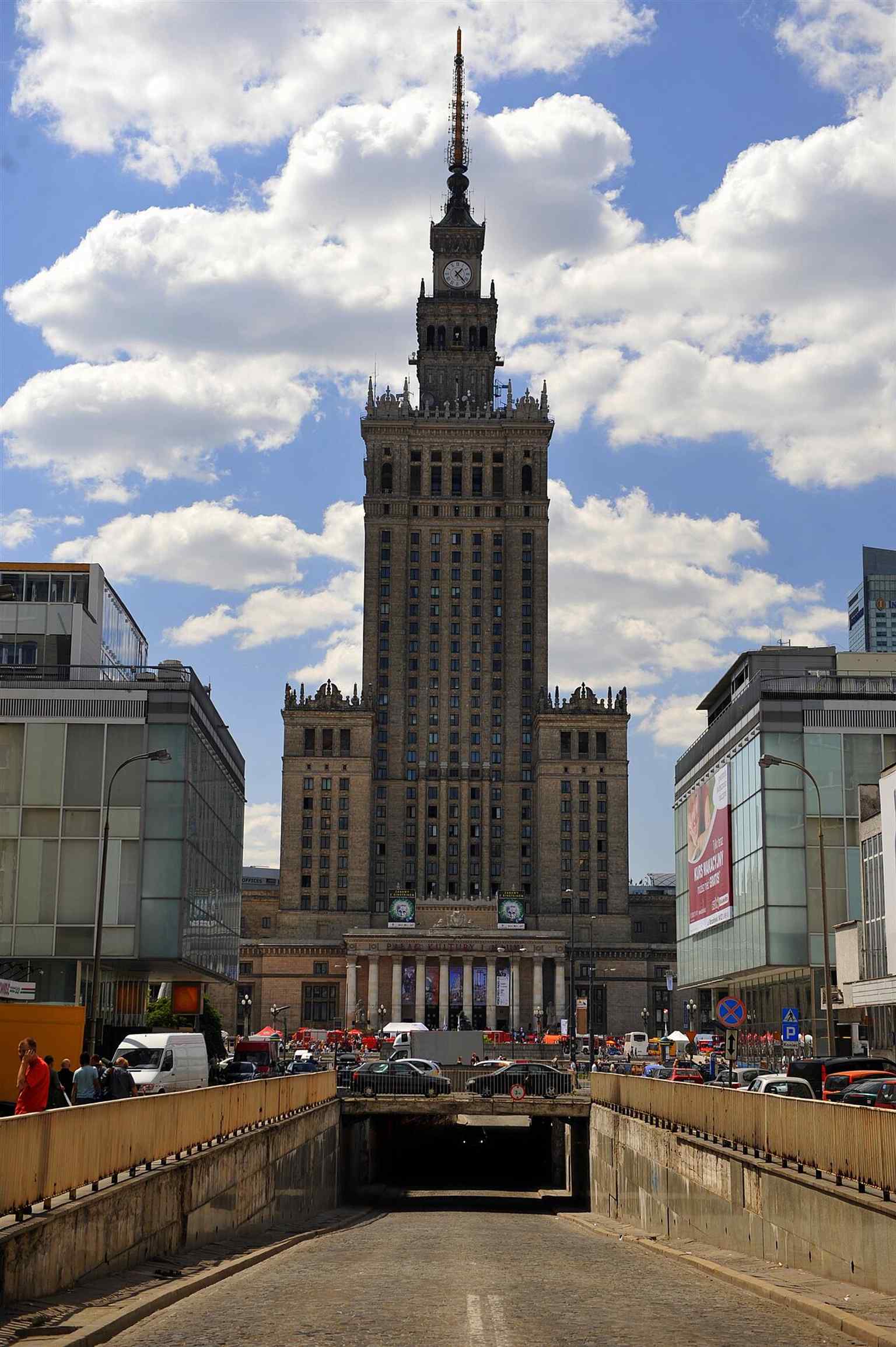
Seen from Złota Street, this angle emphasizes the palace’s massive scale in the city center near Plac Defilad.Photo: Cezary p, Wikimedia Commons, CC BY-SA 4.0. Cropped & resized. 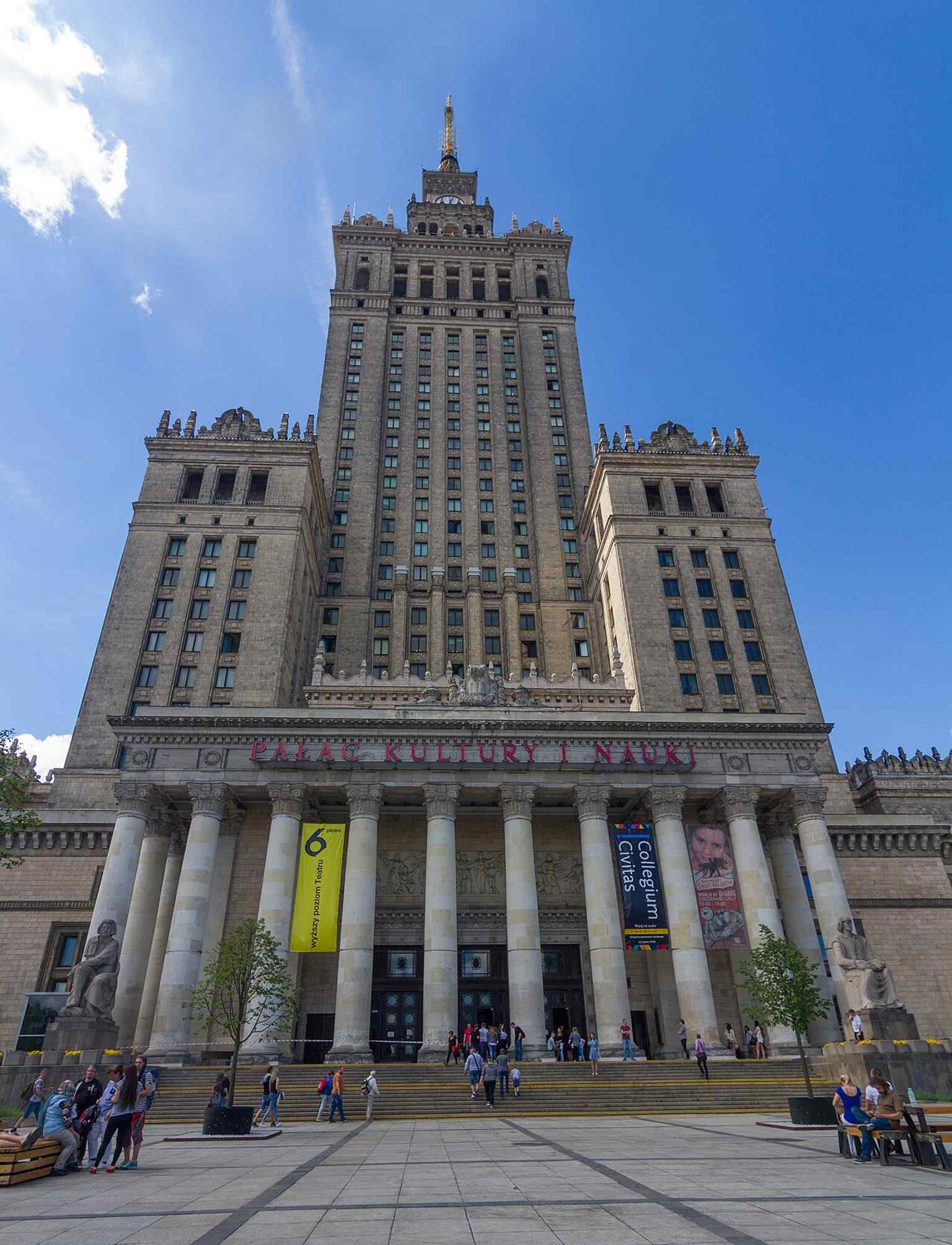
A dramatic low-angle shot from 2017 that makes the tower feel monumental, matching its 237-meter height with the antenna.Photo: Maksym Kozlenko, Wikimedia Commons, CC BY-SA 4.0. Cropped & resized. 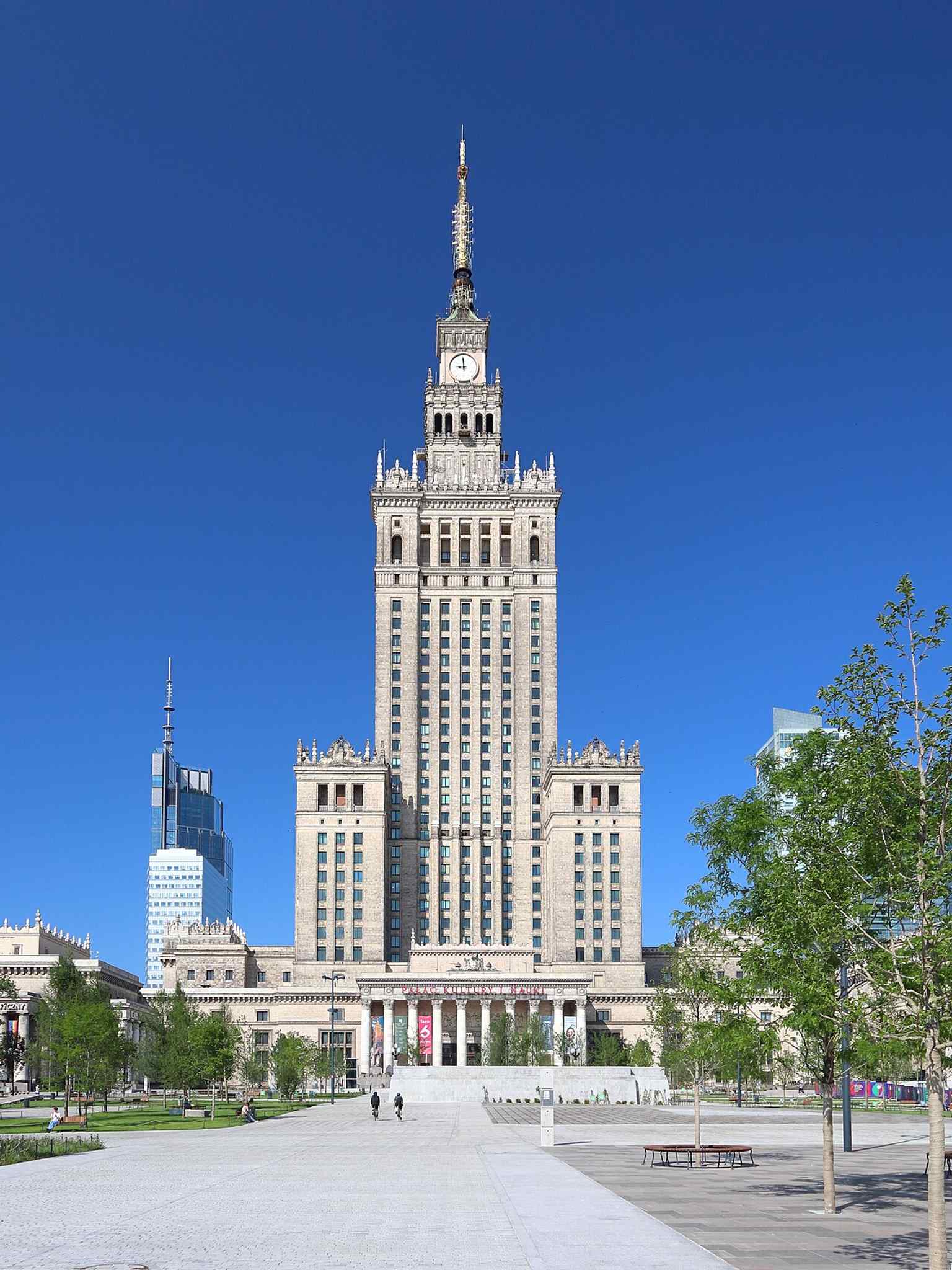
The 2025 view with Plac Centralny shows how the palace now anchors a newly reshaped public space around it.Photo: Cybularny, Wikimedia Commons, CC BY 4.0. Cropped & resized. 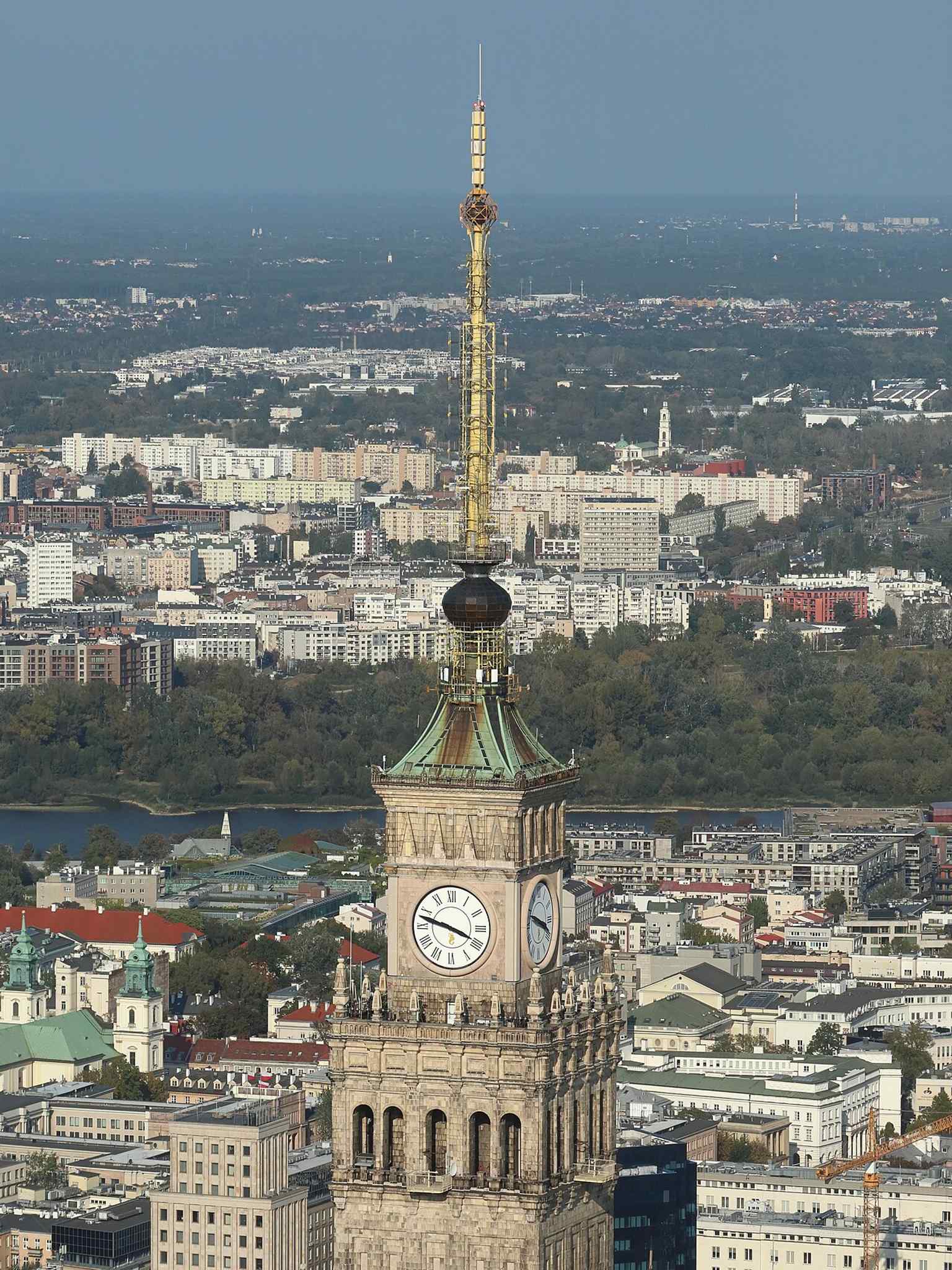
A closer rooftop view that spotlights the spire and antenna section, the part that brings the building to its full 237-meter height.Photo: Cybularny, Wikimedia Commons, CC BY 4.0. Cropped & resized. In front of you stands a long, pale stone modernist block with a flat roof, strong horizontal lines, and a deep central entrance cut into the facade like a calm, formal pause.…Read moreShow less
Open dedicated page →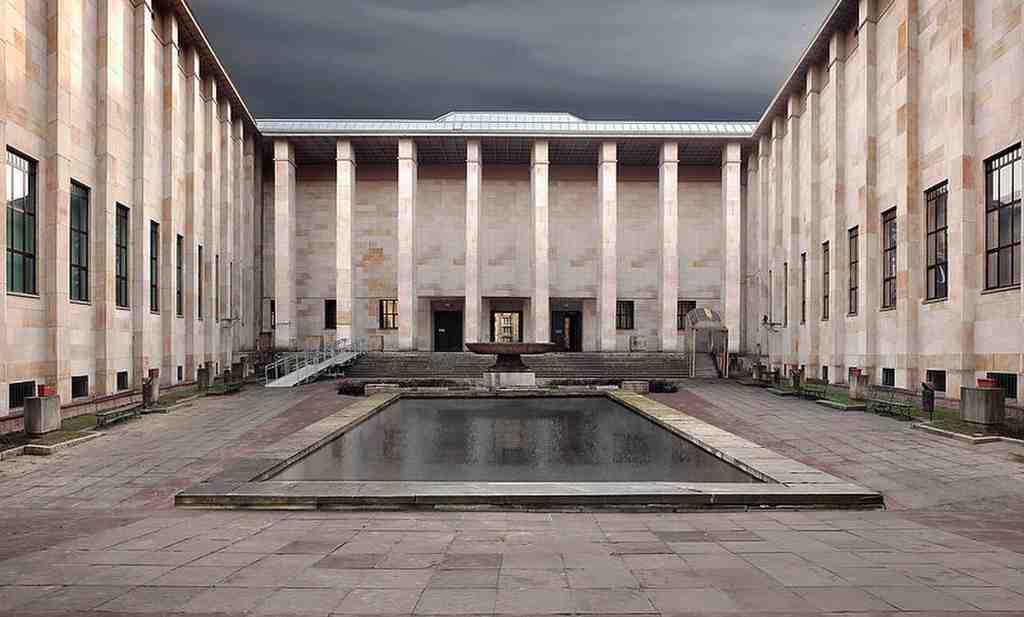
National Museum in WarsawPhoto: Muzeum Narodowe w Warszawie, Wikimedia Commons, CC BY-SA 4.0. Cropped & resized. In front of you stands a long, pale stone modernist block with a flat roof, strong horizontal lines, and a deep central entrance cut into the facade like a calm, formal pause.
This is the National Museum in Warsaw, and from where you’re standing on the front-left, you can see how deliberately unflashy it is. No royal theatrics, no spires trying to out-sing the skyline. Tadeusz Tołwiński and Antoni Dygat gave Warsaw this building between the late nineteen twenties and nineteen thirty-eight, and they gave it a very modern kind of dignity... the sort that says, “We’re serious about culture,” without needing gold leaf to prove it.
The institution itself goes back much farther, to eighteen sixty-two, when it began as the Museum of Fine Arts. In nineteen sixteen, the city took it over and gave it a bigger mission and a bigger name: National Museum. That shift mattered. It stopped being just a place to hang paintings and became a place to gather a country’s memory, Polish and foreign alike.
And then war came for memory as hard as it came for masonry.
During the Second World War, German looting stripped this museum on a staggering scale: ninety-nine percent of its coins and medals disappeared, all of its clocks, about eighty percent of its goldsmith work and jewelry, more than half its furniture, textiles, and rare bindings. Missing objects matter as much as shattered buildings, because when a painting, coin, or manuscript vanishes, a piece of a people’s record vanishes with it. A city can rebuild a wall; it cannot easily rebuild an original.
If you glance at the image in the app showing crates and wartime damage, you’re seeing proof that the museum did not simply suffer passively; its staff documented thefts so the losses would have names and paper trails.
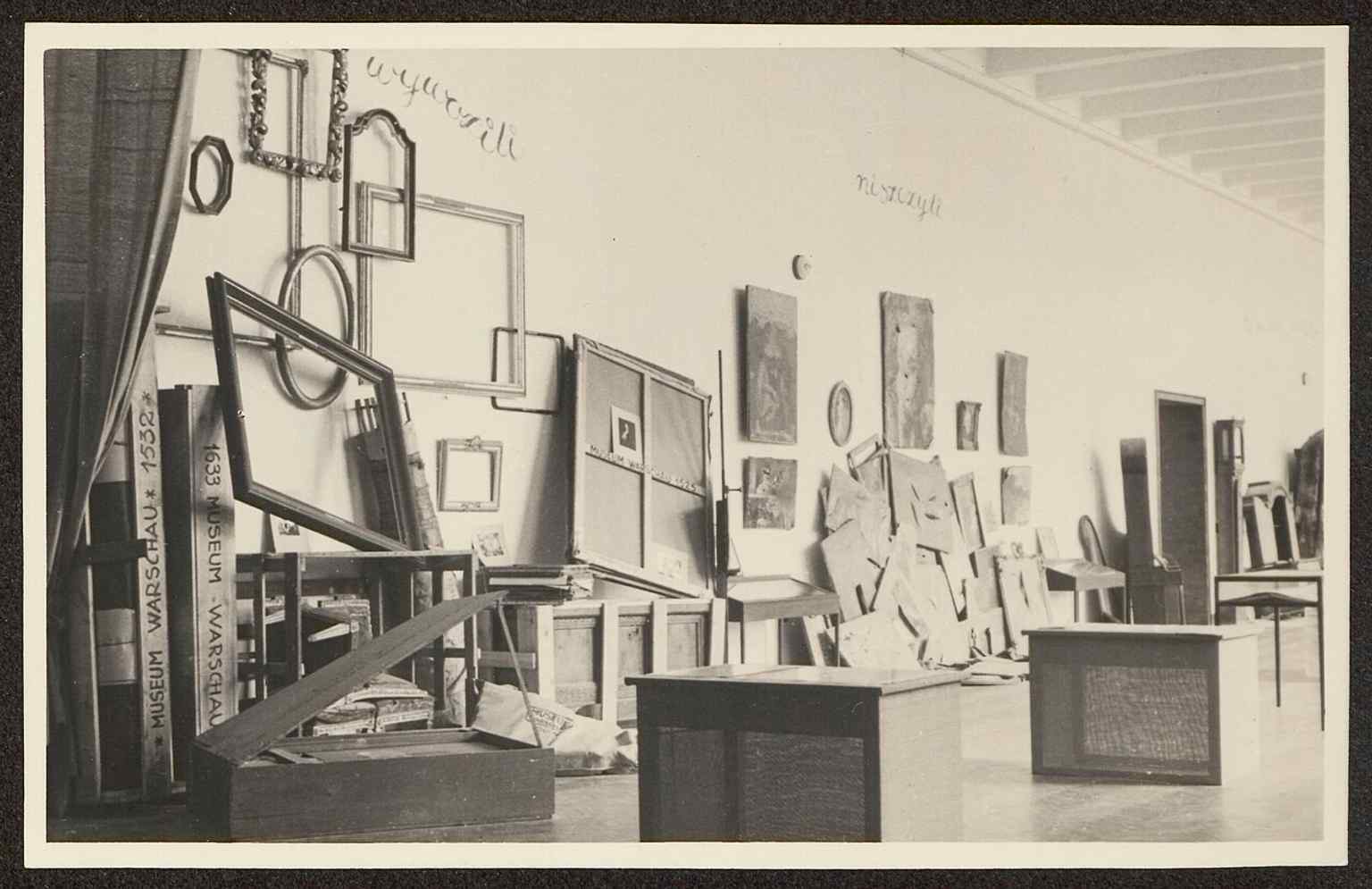
A wartime exhibition about the museum’s destruction and looted crates—evidence of how MNW documented Nazi thefts in 1945.Photo: Unknown authorUnknown author, Wikimedia Commons, Public domain. Cropped & resized. One man sits right at the heart of that story: Stanisław Lorentz, director here from the mid-nineteen thirties for decades after the war. During the occupation, he kept a daily chronicle in two versions, then hid the pages in wine bottles near the main entrance. That detail gets me every time... a museum man stuffing history into bottles like emergency messages from a sinking ship. He also persuaded the occupiers not to destroy the Jan Kiliński monument, but to store it here in the basement. And when Warsaw collapsed, he helped lead the “Pruszków action,” evacuating what remained of museum, library, and archive collections.
Some treasures inside tell the other half of the story: survival and rebuilding. This museum holds ancient Egyptian works, Old Masters like Botticelli and Cranach, and great Polish paintings by Matejko, Malczewski, Chełmoński, and Gierymski. In the Faras Gallery, born from Professor Kazimierz Michałowski’s excavations in Sudan, the museum even turned an archaeological rescue into one of Europe’s great Nubian collections. If you open the interior view on your screen, that gallery shows how Warsaw learned to rebuild not only walls, but meaning.
And there’s one more thread to keep in your pocket: workers here protected parts of the Royal Castle’s interiors too, long before that castle reappeared in full. So yes, museums carry scars you cannot see. Sometimes absence is the wound.
From here, the story moves back out to the street, where elegance and everyday hustle have always rubbed shoulders. We’re heading next to Nowy Świat, about a five-minute walk away. If you plan to come back inside, the museum is closed on Monday and usually open from ten in the morning, with a later closing on Friday.
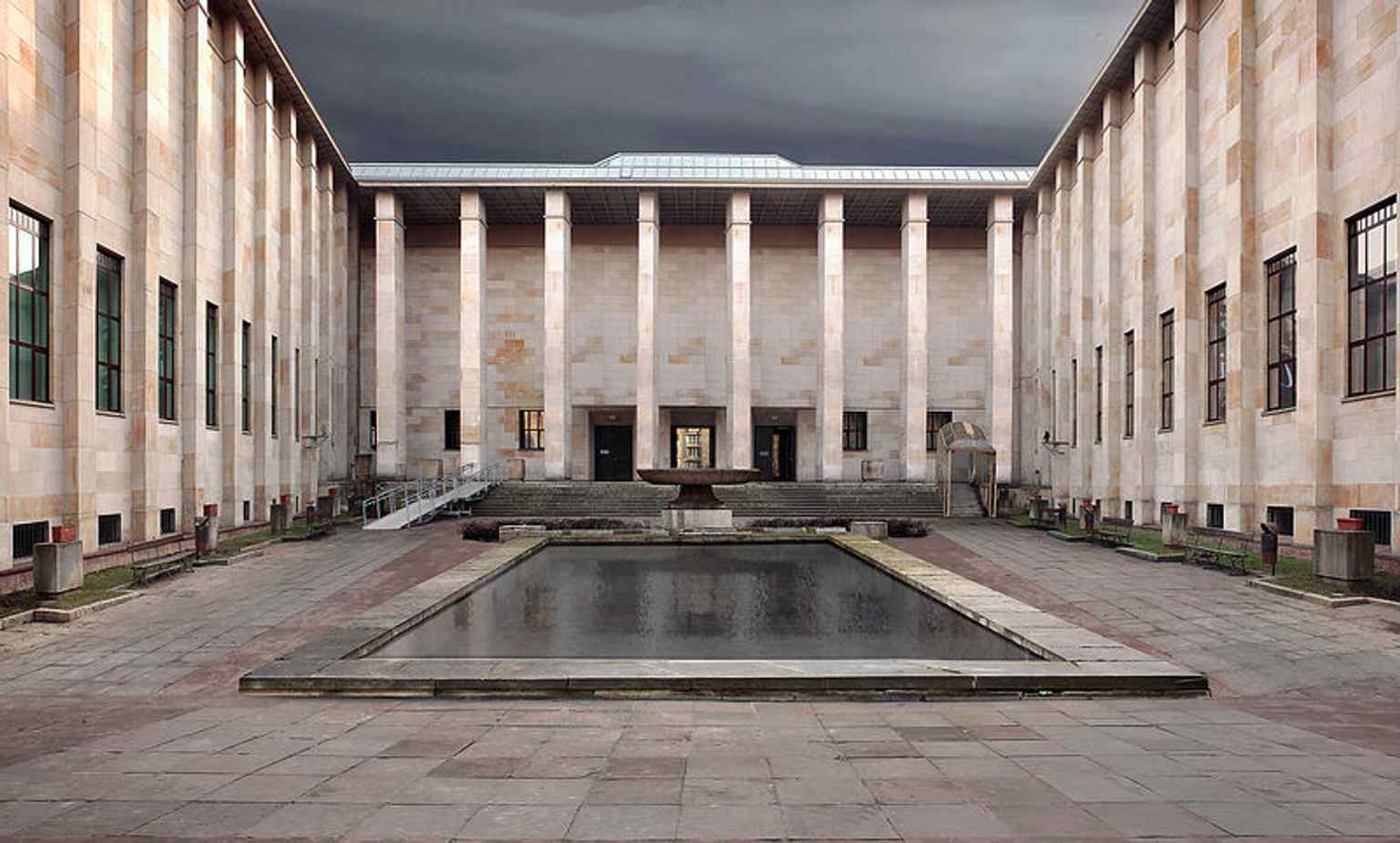
The museum’s modernist main building on Aleje Jerozolimskie, completed in 1938—the home base that anchors the whole story of MNW.Photo: Muzeum Narodowe w Warszawie, Wikimedia Commons, CC BY-SA 4.0. Cropped & resized. 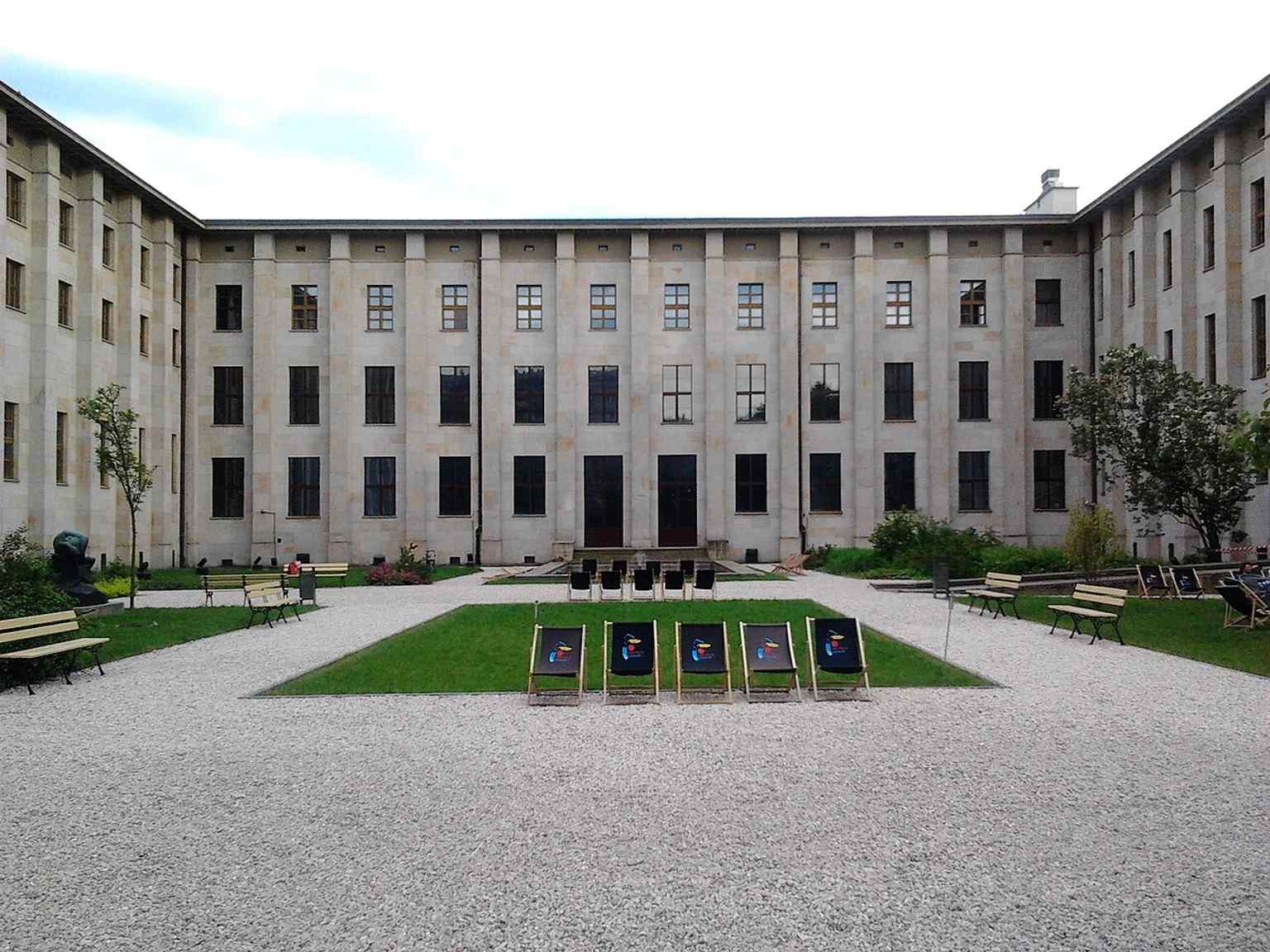
Stanisław Lorentz Courtyard, a clear view of the museum’s 1930s architecture and the later east-wing side of the complex.Photo: BurgererSF, Wikimedia Commons, CC0. Cropped & resized. 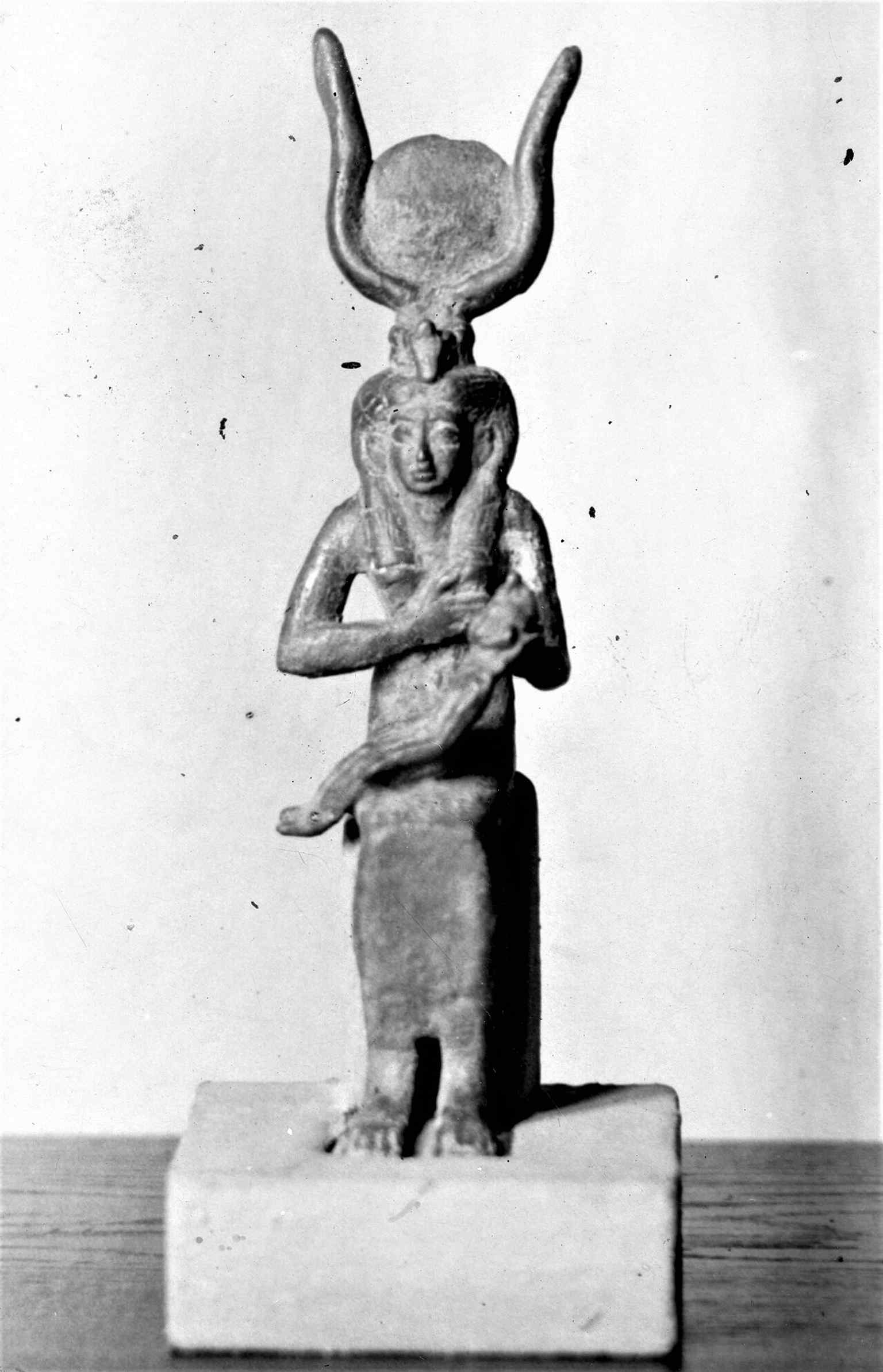
An Egyptian statue in the ancient art collection, reflecting MNW’s major holdings from ancient Egypt, Greece and Rome.Photo: Unknown authorUnknown author, Wikimedia Commons, Public domain. Cropped & resized. Look for a long, straight avenue lined with pale plaster façades, evenly spaced windows, and a notably low, two-story classical street wall that gives Nowy Świat its calm, almost…Read moreShow less
Open dedicated page →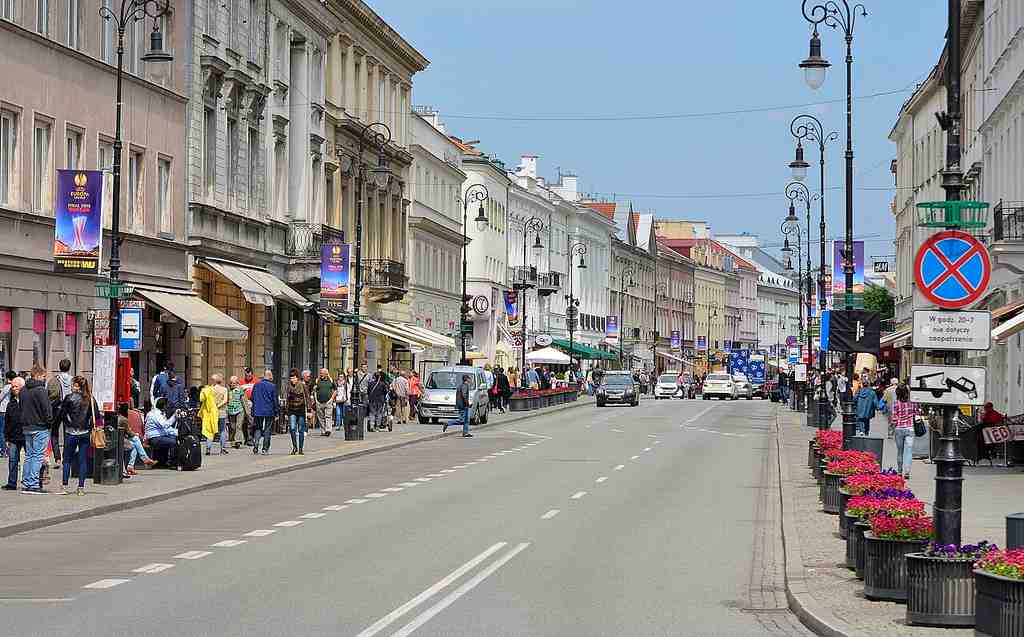
Nowy Świat Street in WarsawPhoto: Adrian Grycuk, Wikimedia Commons, CC BY-SA 3.0 PL. Cropped & resized. Look for a long, straight avenue lined with pale plaster façades, evenly spaced windows, and a notably low, two-story classical street wall that gives Nowy Świat its calm, almost stage-set rhythm.
Nowy Świat means “New World,” and that name began quite literally... this was the newer settlement that grew beyond Warsaw’s old earthworks in the seventeenth century, along the road from Old Warsaw toward Ujazdów. Today it feels polished, but this street has always carried what locals understood as the two worlds of Nowy Świat: the representative face of the capital on one hand, and the everyday scramble of the city on the other. Fine coats and empty pockets shared the same pavement. Elegant customers passed by people described in old city records as beggars with no clear way to make a living. Same street, same hour, different planets.
That tension gave the avenue its energy. This was never just a pretty corridor. It was a public stage, with new actors entering every decade: merchants, students, poets, cabaret crowds, office clerks, and social climbers trying to look like they belonged. In nineteen oh eight, electric trams began rolling through here. By the interwar years, Nowy Świat buzzed with shops and a good dozen restaurants. At the corner with Aleje Jerozolimskie, a famous place called Udziałowa had started as a dairy back in eighteen eighty-four, then reinvented itself as a stylish café. That little change tells you a lot about Warsaw. Even milk could put on a tuxedo here.
If you glance at the image in the app, you can see how the rebuilt frontage creates that elegant, disciplined line along the street. But don’t let the neatness fool you. One address here, Nowy Świat fifty-seven, helped launch modern Polish poetry. On the twenty-ninth of November, nineteen eighteen, Antoni Słonimski and his friends opened the literary cabaret Pod Picadorem there. Admission cost five marks, roughly the price of keeping the door open to ordinary people rather than only elites. In just three months they moved on, but that short run mattered. Słonimski and the future Skamander poets found a wider audience right here, on a street noisy enough to test whether poems could survive contact with real life.
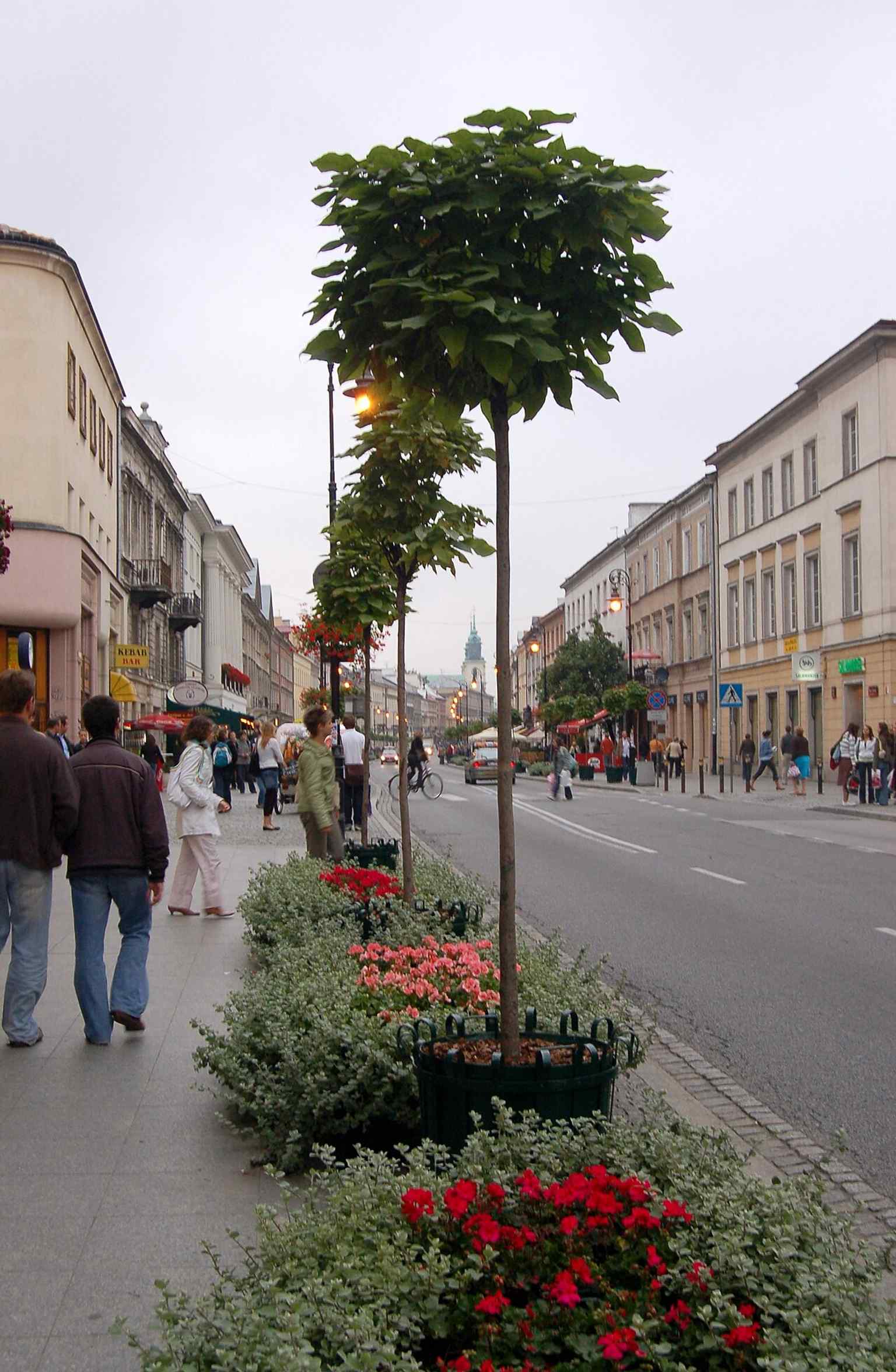
A 2006 view of Nowy Świat’s rebuilt frontage, showing the elegant postwar street wall that restored the avenue’s 19th-century character.Photo: Bahnfrend, Wikimedia Commons, CC BY-SA 4.0. Cropped & resized. Then history broke the set. Much of the street was destroyed in September nineteen thirty-nine. During the Warsaw Uprising in August nineteen forty-four, insurgents built barricades near Chmielna and at the line of Ordynacka and Warecka. After Powiśle fell on the sixth of September, the odd-numbered side of Nowy Świat marked the Polish defense line until capitulation. One wartime photograph by Sylwester Braun even caught the burning German labor office at number sixty-eight.
And still, Warsaw got back to work. In March nineteen forty-seven, crews began rebuilding. They lowered many houses to two stories and reshaped façades to recover a nineteenth-century look. The street reopened in July nineteen forty-nine, and in January the year before, the junction with Aleje Jerozolimskie received the city’s first postwar traffic light. Later, in nineteen ninety-six, planners narrowed the roadway, widened the sidewalks, and pushed out private cars. That is why the street feels more like a salon than a speedway today. Another image on your screen shows that long perspective beautifully.
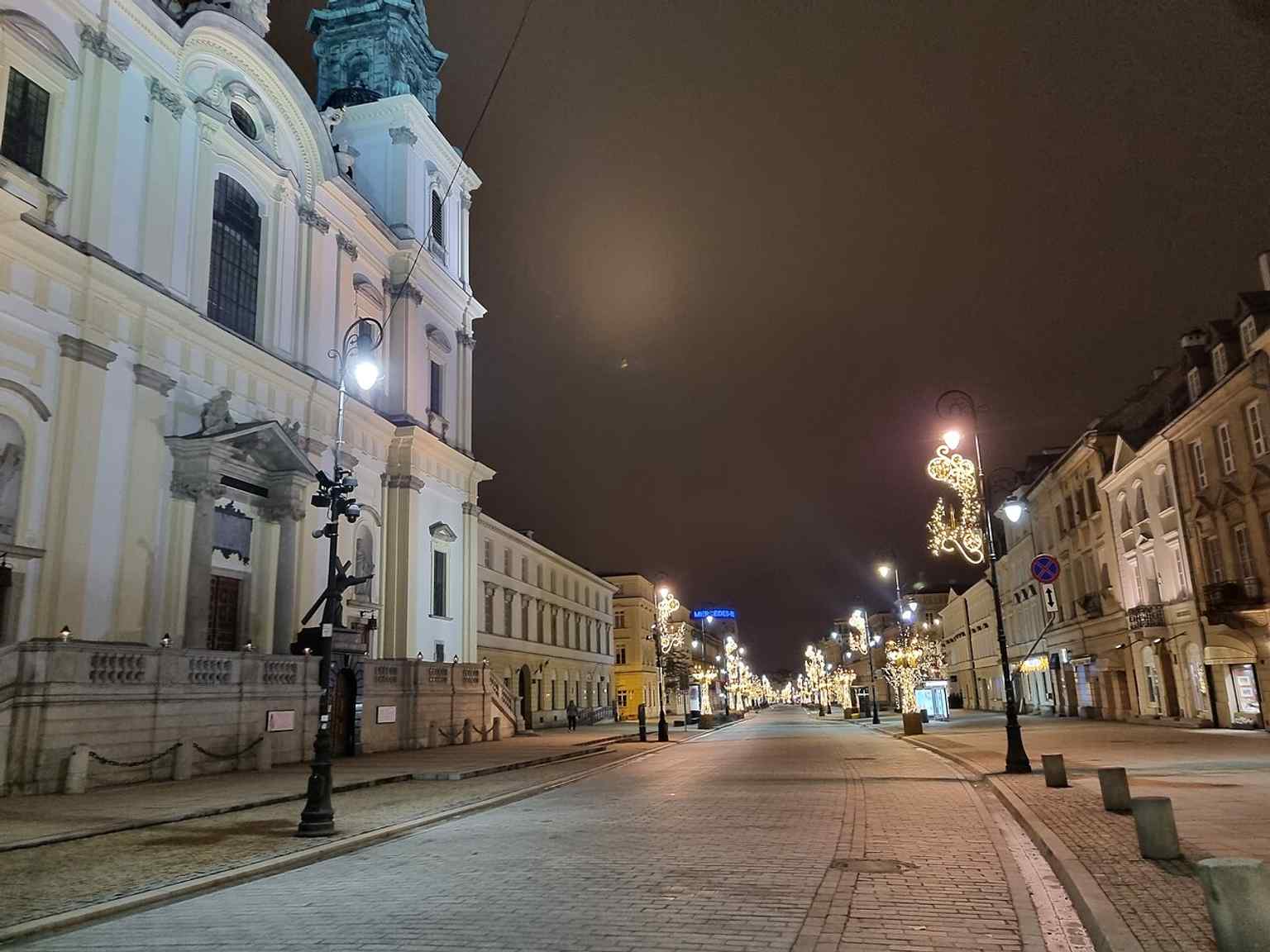
A recent open-street view of Nowy Świat, showing its pedestrian-friendly character after the 1996 narrowing of the roadway.Photo: Maksym Kozlenko, Wikimedia Commons, CC BY-SA 4.0. Cropped & resized. Soon, this social boulevard leads us to a church where Warsaw’s public story turns personal... intimate enough to be held inside a body. We’ll head next to the Basilica of the Holy Cross, about a nine-minute walk ahead.
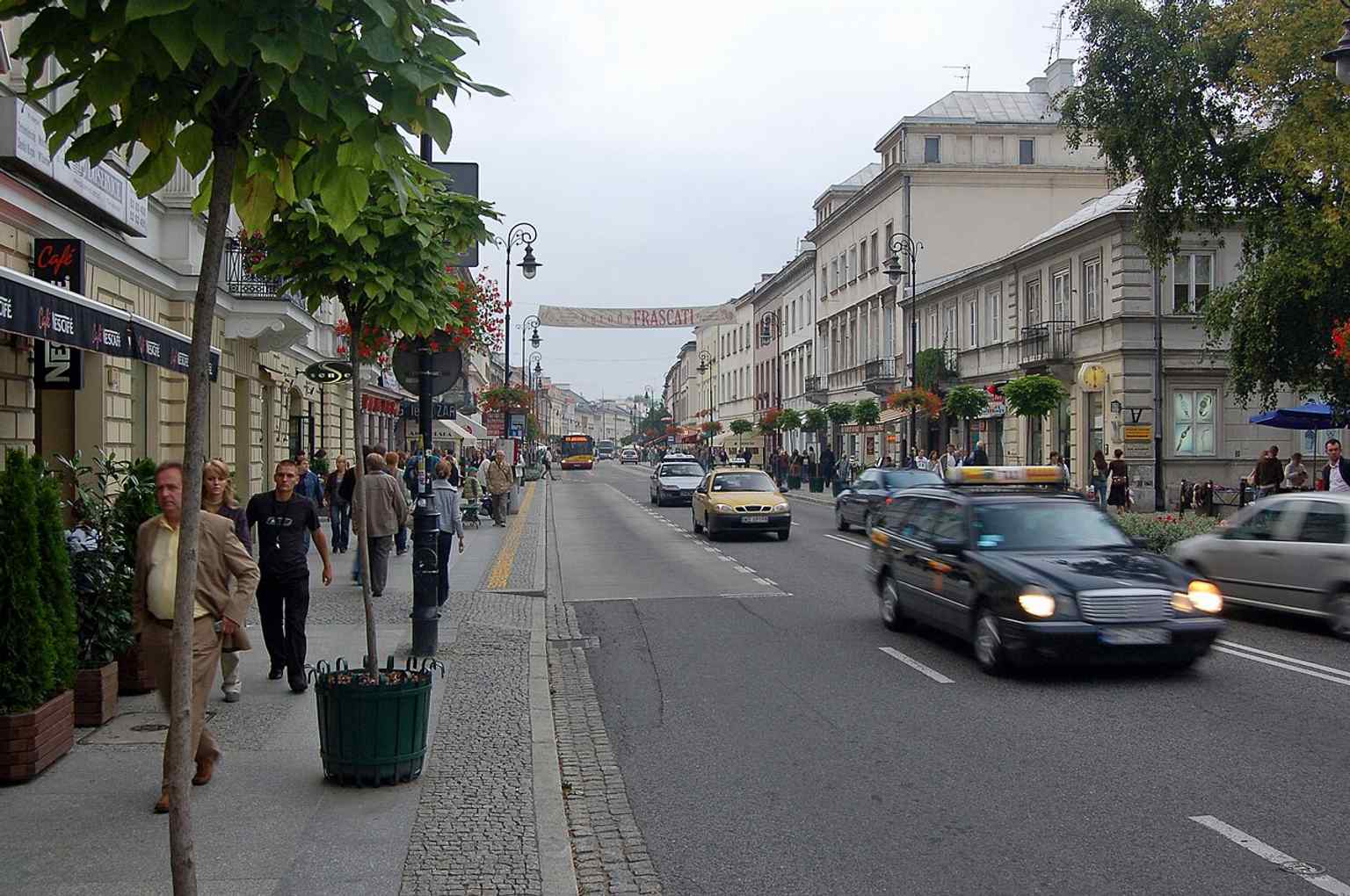
Another 2006 street view that helps show the long, classic-looking perspective of Nowy Świat, the historic continuation of Krakowskie Przedmieście.Photo: Bahnfrend, Wikimedia Commons, CC BY-SA 4.0. Cropped & resized. 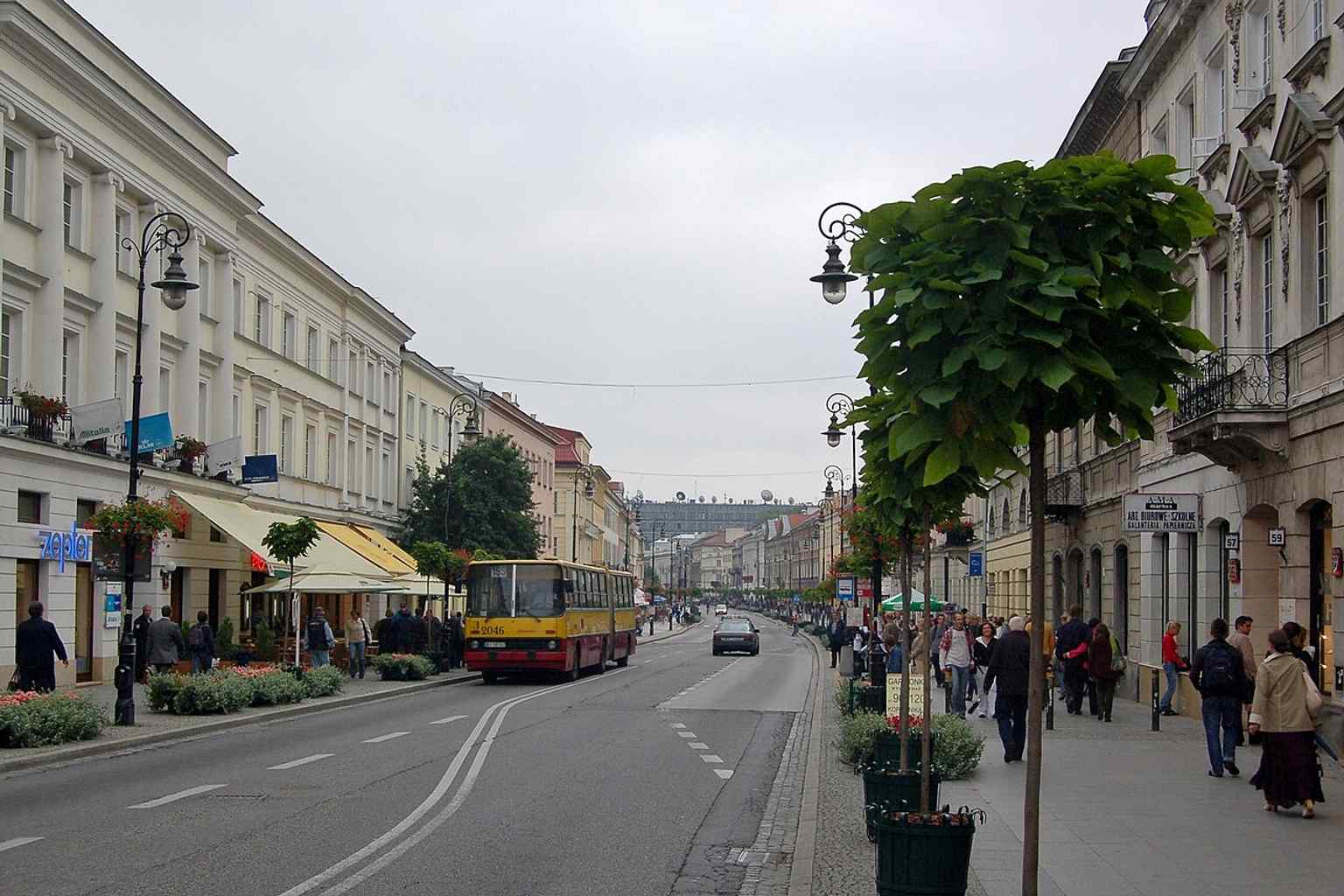
A 2006 scene with buses on Nowy Świat, echoing the street’s role as a busy urban artery rather than just a tourist promenade.Photo: Bahnfrend, Wikimedia Commons, CC BY-SA 4.0. Cropped & resized. 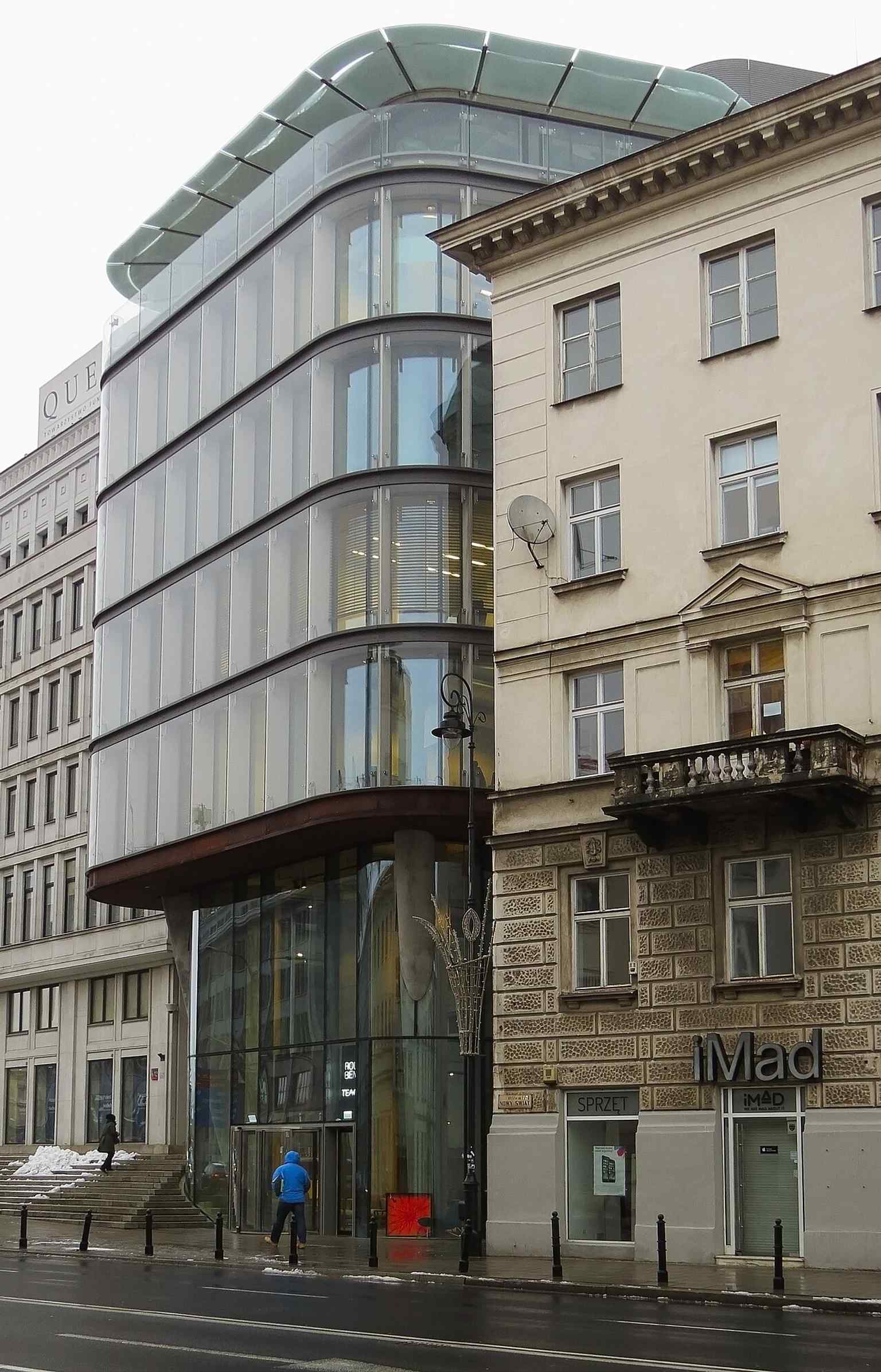
The Nowy Świat 2.0 building, part of the modern commercial layer that now sits beside the street’s historic façades.Photo: Аимаина хикари, Wikimedia Commons, CC0. Cropped & resized. 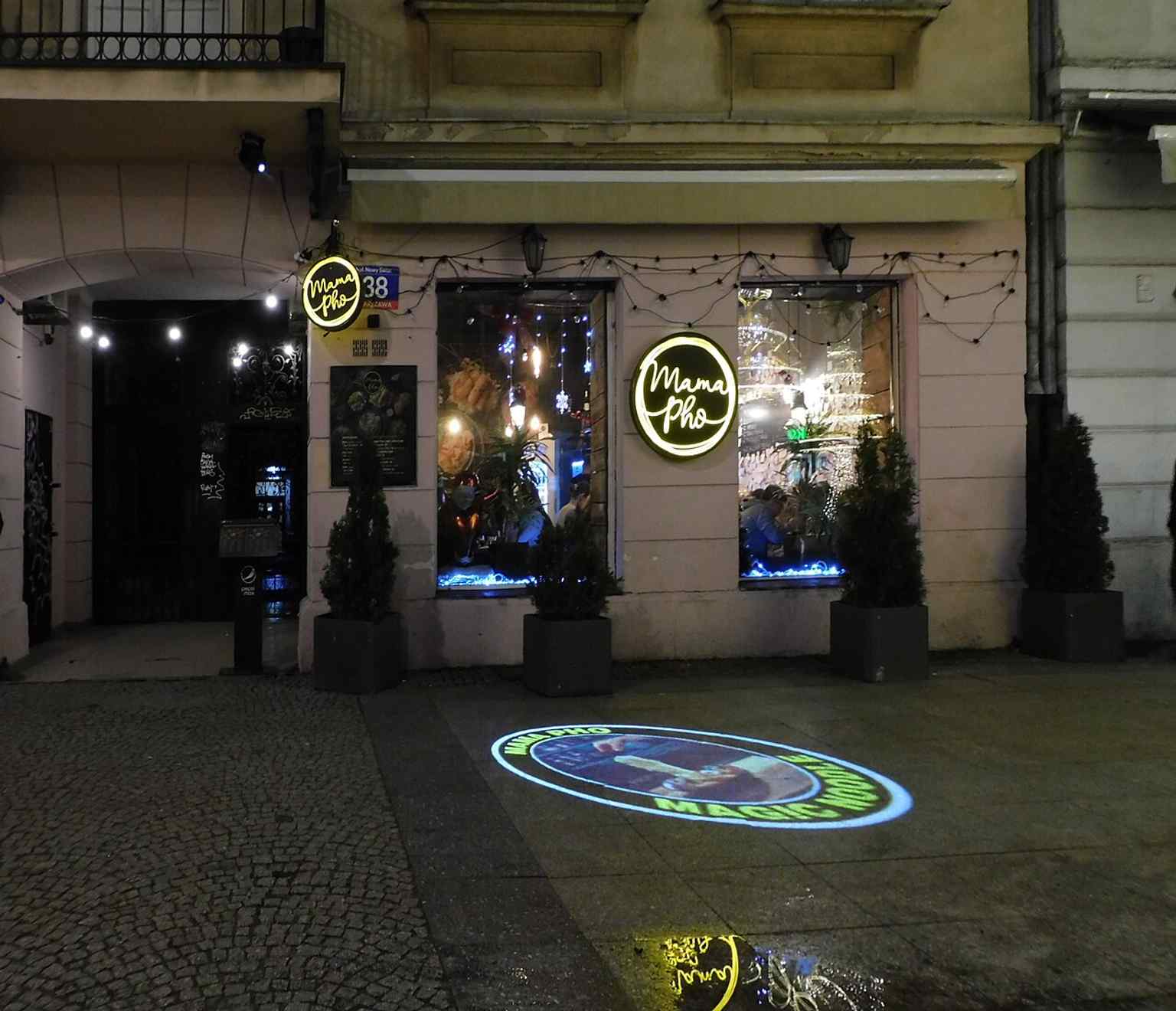
Nowy Świat 38, one of the street’s address-specific façades, representing the dense sequence of historic tenements along the avenue.Photo: Panek, Wikimedia Commons, CC BY-SA 4.0. Cropped & resized. 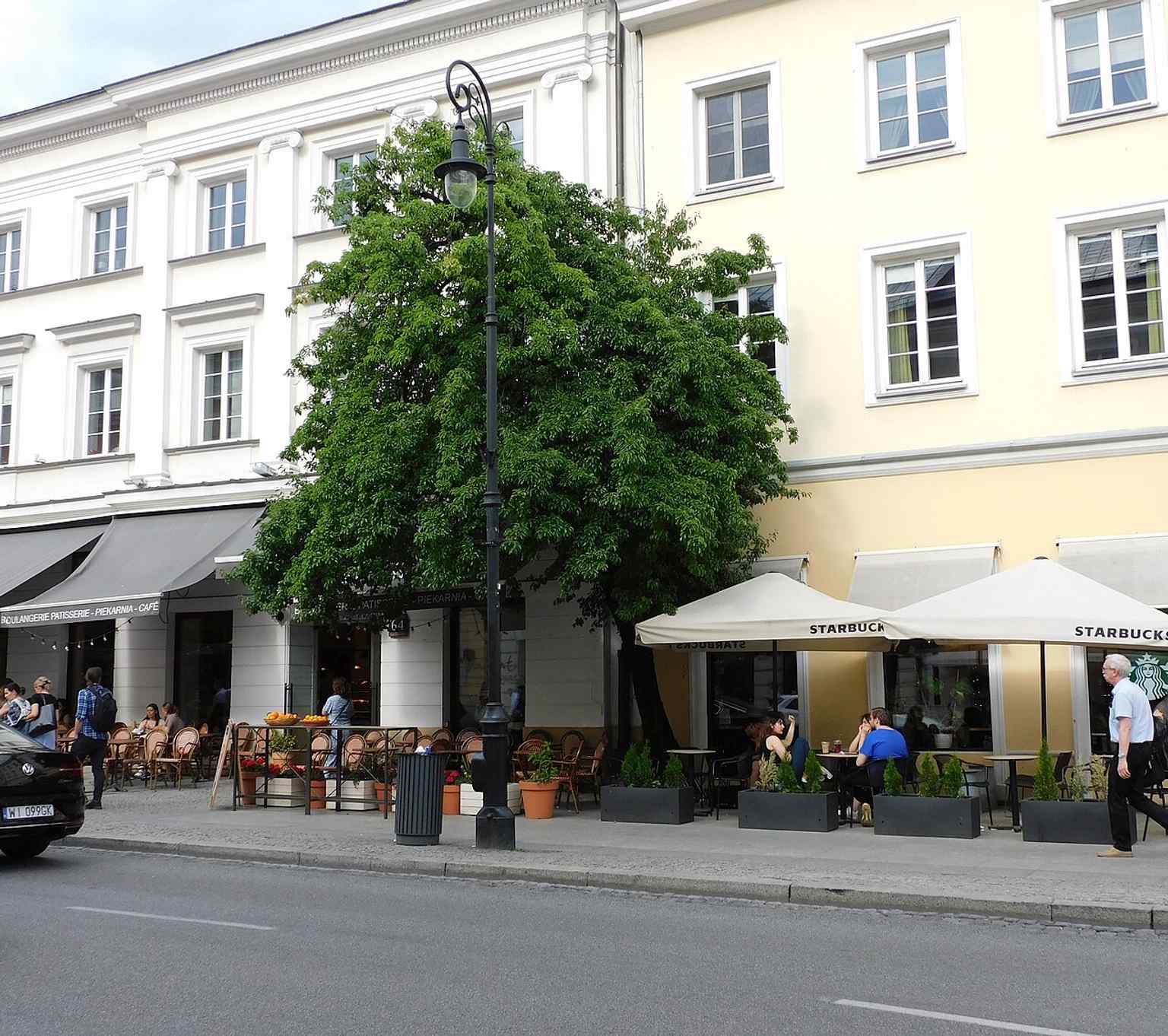
The famous self-seeded pear tree at Nowy Świat 62, one of the street’s quirky living landmarks and a recent Warsaw Tree of the Year finalist.Photo: Panek, Wikimedia Commons, CC BY-SA 4.0. Cropped & resized. 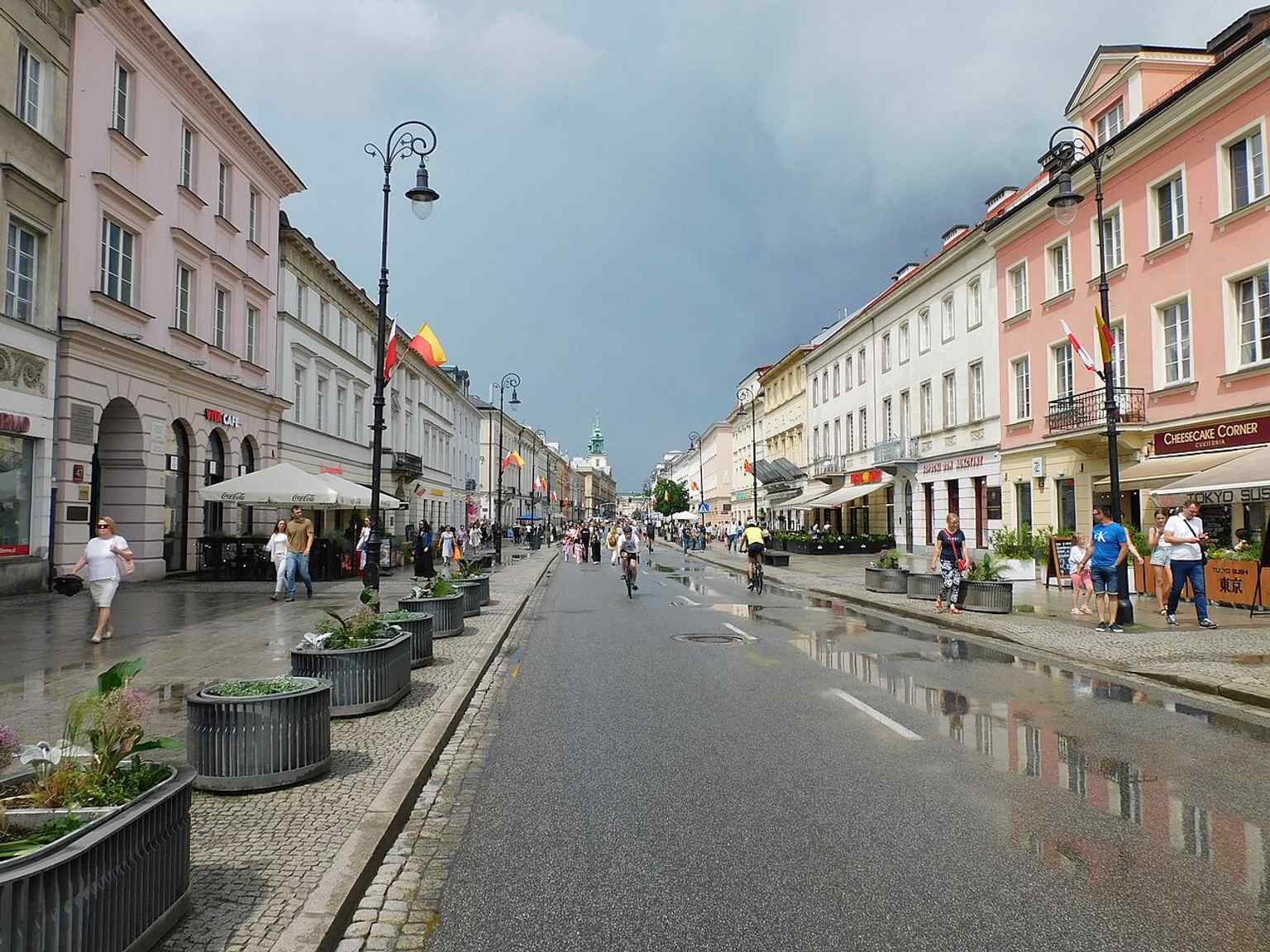
Springtime Nowy Świat in 2024, a lively modern promenade that fits the street’s current role as a place for walking and gathering.Photo: Panek, Wikimedia Commons, CC BY-SA 4.0. Cropped & resized. 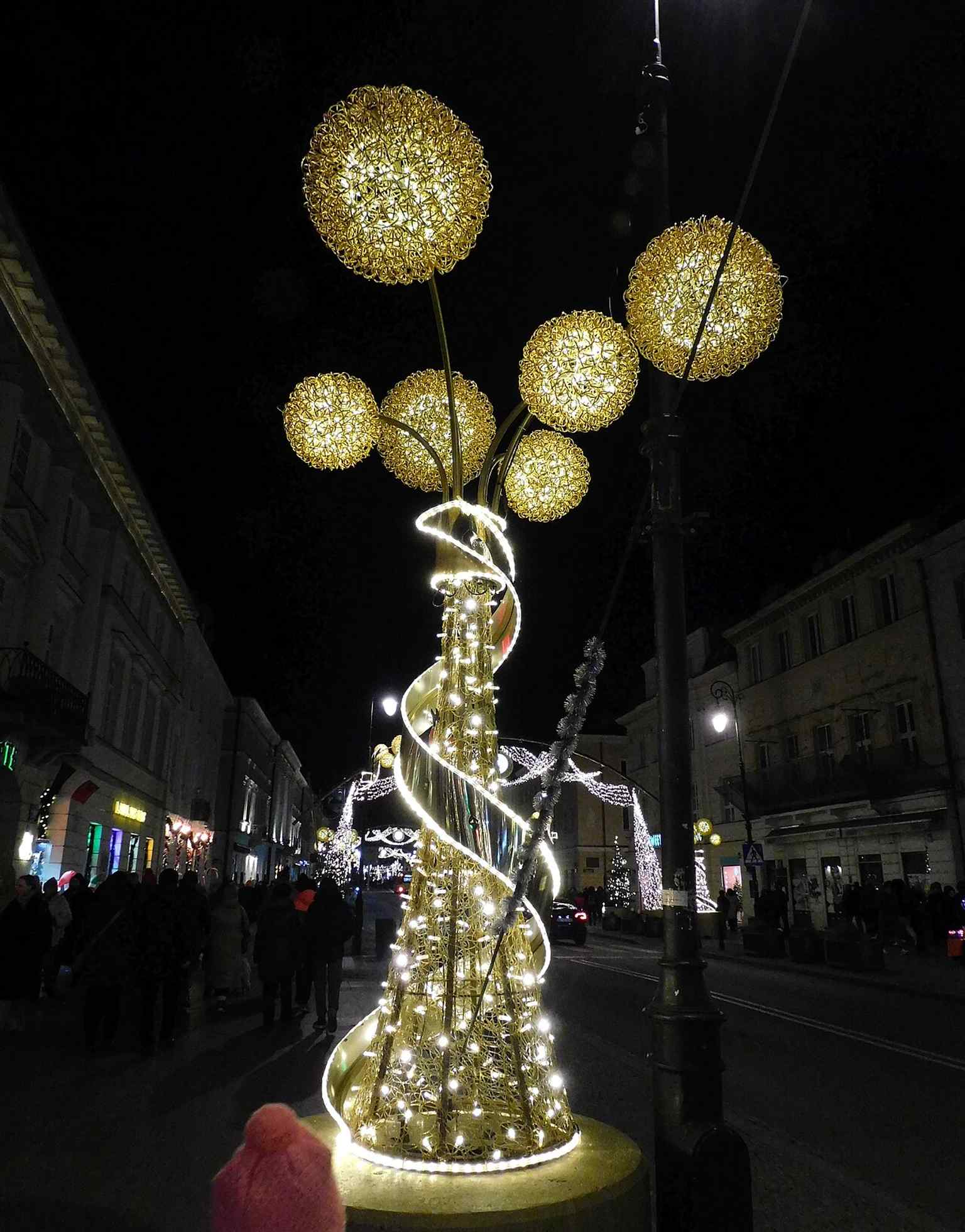
Christmas decorations on Nowy Świat, showing how the avenue now functions as a seasonal pedestrian space filled with light and activity.Photo: Panek, Wikimedia Commons, CC BY-SA 4.0. Cropped & resized. 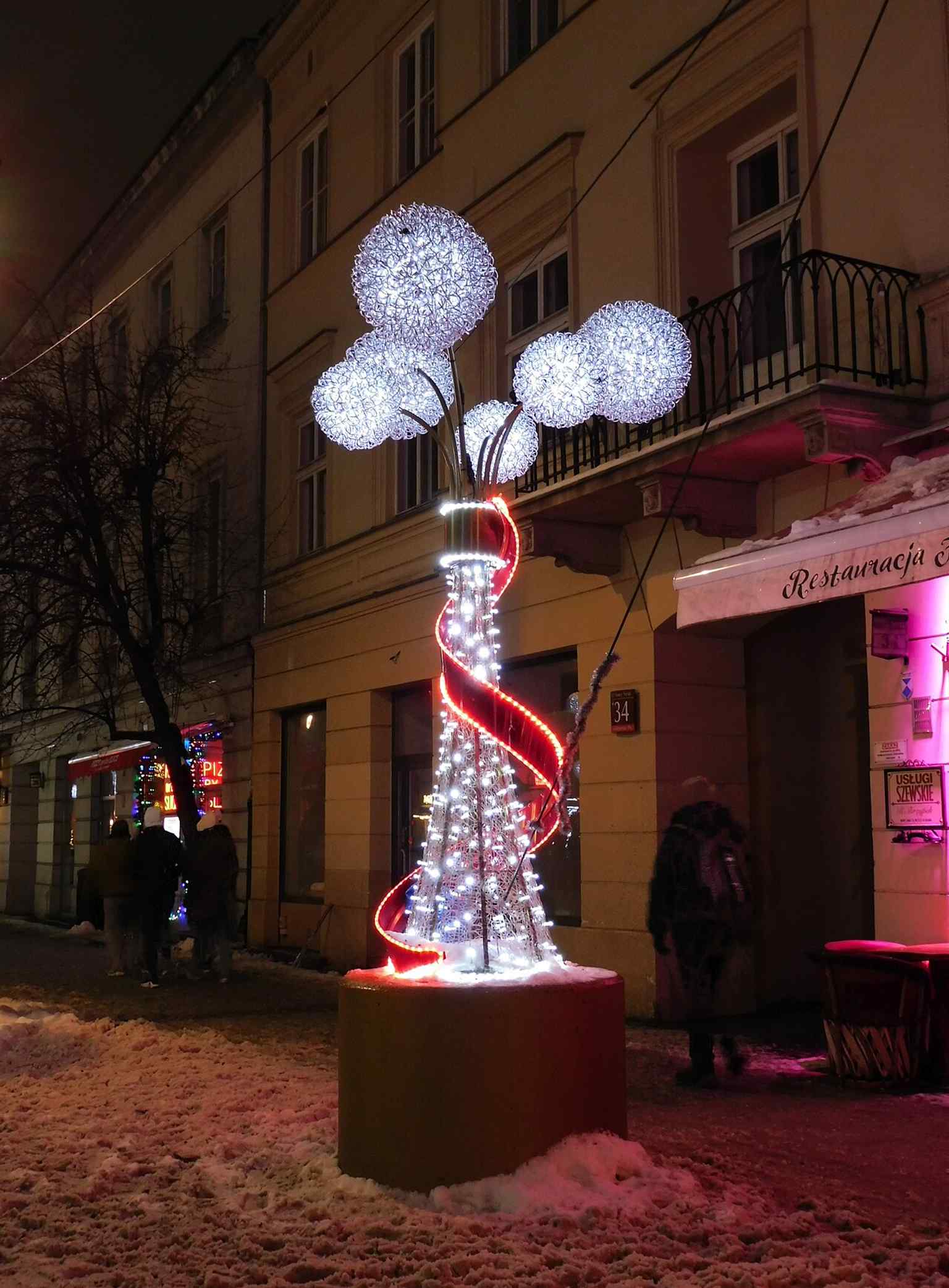
A winter 2026 view of the decorated street, capturing Nowy Świat as a contemporary promenade rather than a traffic corridor.Photo: Panek, Wikimedia Commons, CC BY-SA 4.0. Cropped & resized. Look for the pale stone Baroque façade with its twin towers and the dark bronze figure of Christ carrying a cross on a black pedestal before the entrance. This is the Basilica…Read moreShow less
Open dedicated page →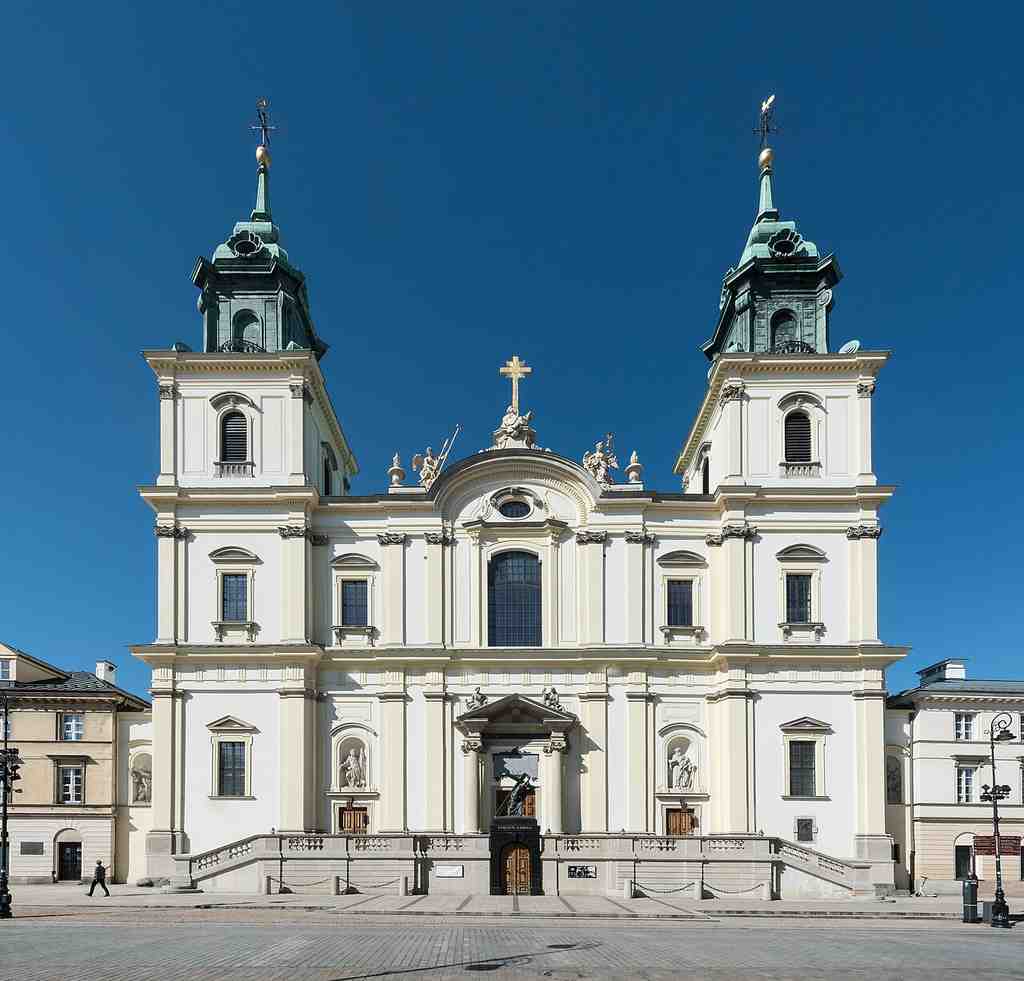
Basilica of the Holy Cross in WarsawPhoto: Adrian Grycuk, Wikimedia Commons, CC BY-SA 3.0 PL. Cropped & resized. Look for the pale stone Baroque façade with its twin towers and the dark bronze figure of Christ carrying a cross on a black pedestal before the entrance.
This is the Basilica of the Holy Cross, and for Warsaw it is more than a church. It is a kind of chest of memory. Inside one of its pillars rests perhaps the city’s most intimate national relic: Chopin’s heart in Warsaw. Not his statue, not just his music drifting through concert halls... his actual heart, brought back to Poland according to his wish, first kept in the crypts, then placed here with an epitaph of white Carrara marble. Suddenly history stops being abstract and gets very personal.
Stand with that a moment. A nation can honor a composer with street names and monuments, sure... but here Warsaw kept the part of him that beat.
The church itself goes way back. A chapel stood here by the early sixteenth century, then Marta Möller funded a small church in fifteen twenty-five. After wars battered the site, Queen Ludwika Maria Gonzaga helped bring in the Vincentian missionaries in the seventeenth century, and their order still serves the church. The grand building in front of you took shape between sixteen seventy-nine and sixteen ninety-six, designed by the Italian royal architect Józef Szymon Bellotti. Later, Jakub Fontana gave the façade its elegant theatrical front, while his father designed the tower helmets. Warsaw does love family businesses.
But this place gathered more than worship. King Jan the Third Sobieski prayed here before heading to Vienna in sixteen eighty-three. Kazimierz Pułaski was baptized here. King Stanisław August awarded the Order of Saint Stanislaus here. In seventeen ninety-two, deputies marked the first anniversary of the Constitution of the Third of May here before processing onward through the city. So yes, this church prayed... and it also witnessed the nation talking to itself.
If you peek at the before-and-after image in the app, you can see how this stretch of Krakowskie Przedmieście changed from an eighteenth-century churchscape into a rebuilt postwar capital.
The scars run deep. In the Christmas panic of eighteen eighty-one, about twenty-nine or thirty people died in a stampede here, and a false rumor blaming Jews helped trigger a pogrom. Then the Second World War tore into the building again. During the Warsaw Uprising, German forces used the church as a fortified point. On the sixth of September, nineteen forty-four, they drove in two small explosive vehicles called Goliaths and detonated them. The blast shattered the façade, wrecked the great altar, and brought down the famous Christ statue outside. It fell onto the street still pointing upward above the words Sursum Corda, “Lift up your hearts.” That is pure Warsaw: even toppled, it kept making its point.
If you want a glimpse of the restored interior, bring up the long central hall, the nave, on your screen.
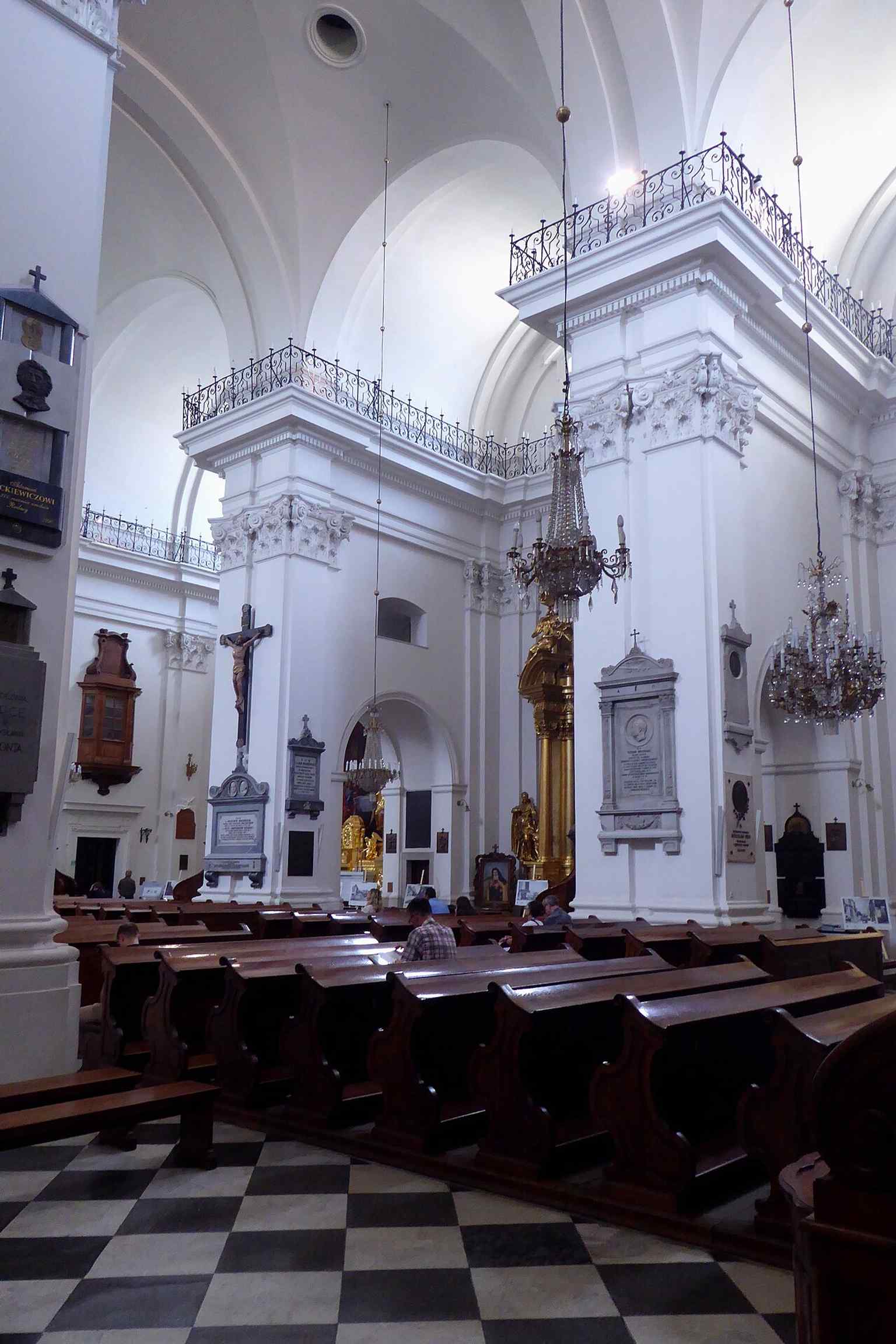
An interior nave archway, showing the church’s Baroque scale and the long, ceremonial space where national rites took place.Photo: Ethan Doyle White, Wikimedia Commons, CC BY-SA 4.0. Cropped & resized. After the war, workers rebuilt the church and finished by nineteen fifty. Cardinal Stefan Wyszyński consecrated the reconstructed main altar in nineteen fifty-three, giving the whole effort the feel of a moral repair, not just an architectural one.
And here is the question I’d leave with you: why would a people choose to preserve a composer’s heart in a church, instead of only raising statues or naming concert halls? In Warsaw, even the body can become a monument... and next we’ll meet a man whose mind the city cast in bronze, at the Copernicus Monument, about a two-minute walk ahead.
If you plan to step inside later, the basilica is generally open from early morning until evening, with slightly shorter hours on Saturday.
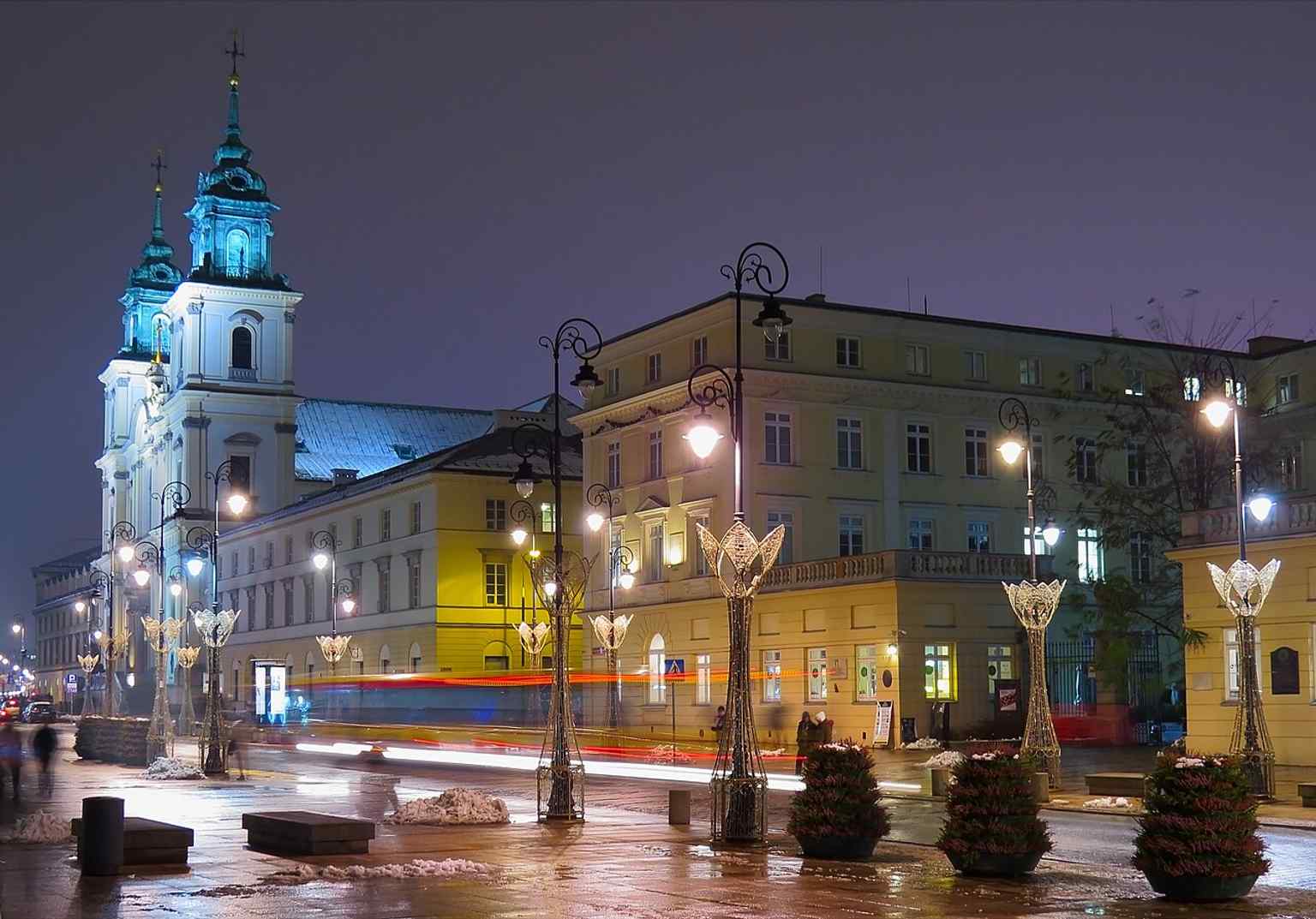
Holy Cross Church lit at night, showing the monumental silhouette that still anchors central Warsaw after centuries of upheaval.Photo: Аимаина хикари, Wikimedia Commons, CC0. Cropped & resized. 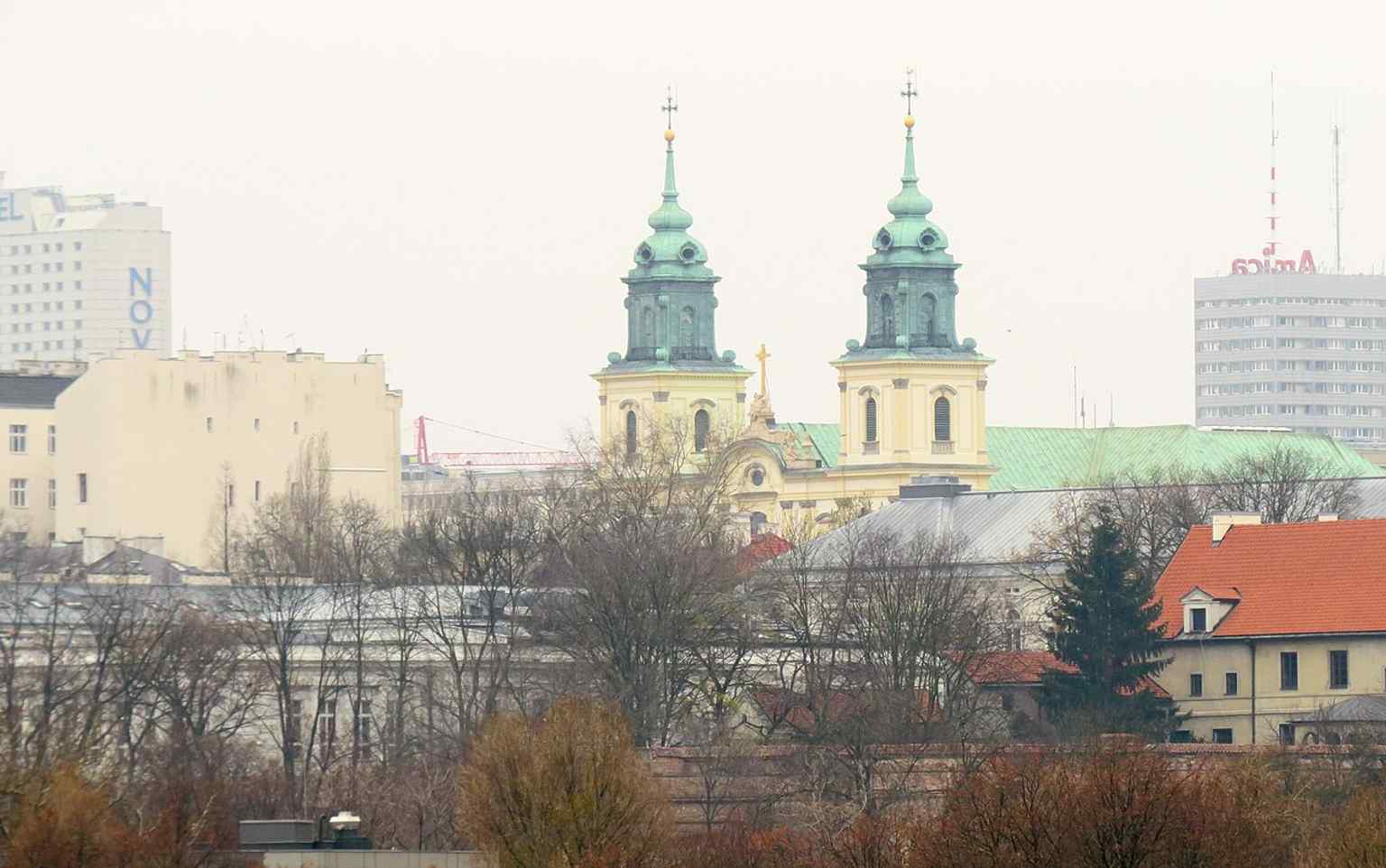
A wider city view from across the Vistula, placing the basilica in Warsaw’s skyline near the historic royal route.Photo: Аимаина хикари, Wikimedia Commons, CC0. Cropped & resized. 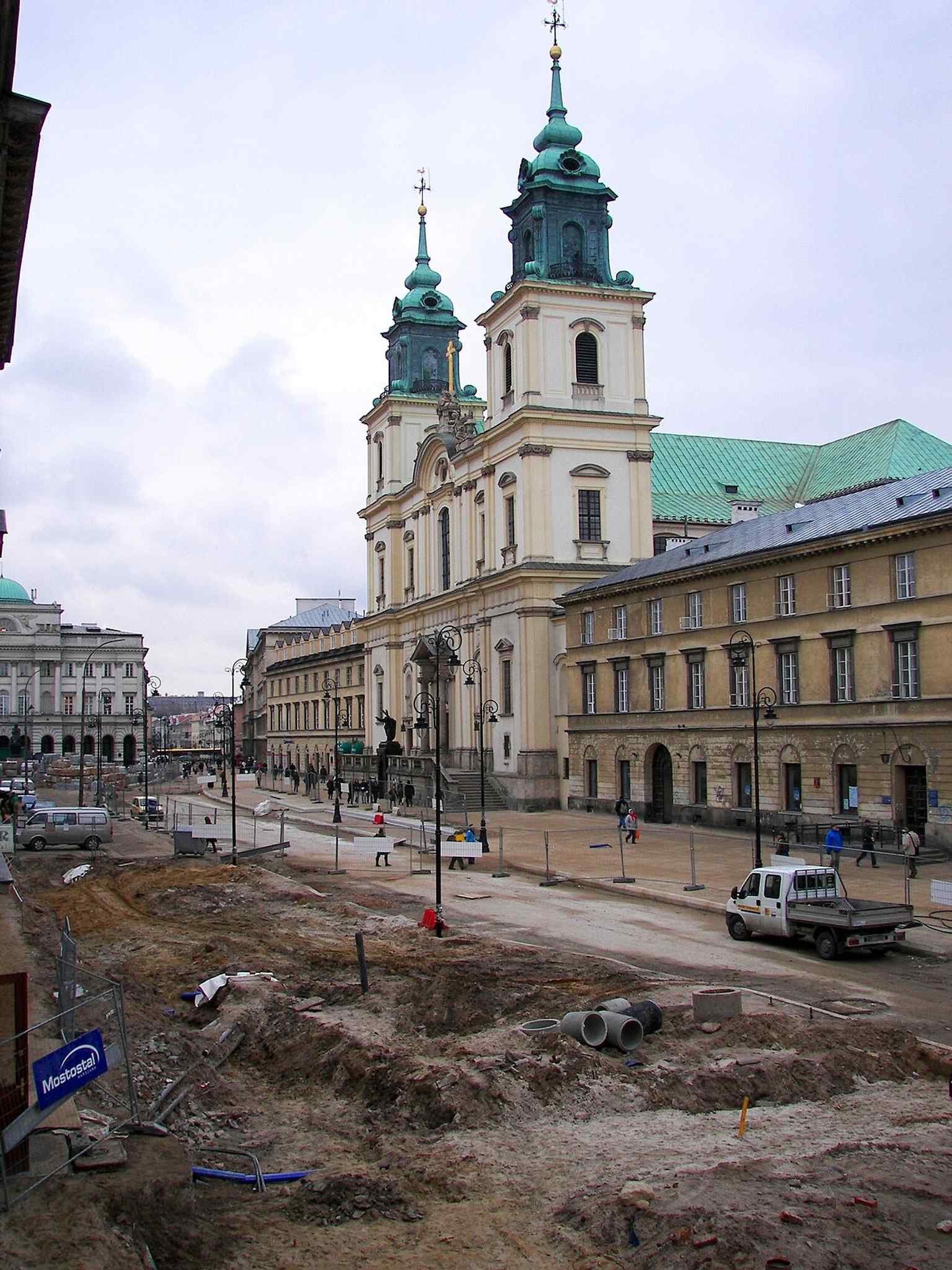
A prewar/postwar streetscape view of the church area, useful for telling the story of Holy Cross during Warsaw’s rebuilding.Photo: Piotr VaGla Waglowski, http://www.vagla.pl, Wikimedia Commons, Public domain. Cropped & resized. 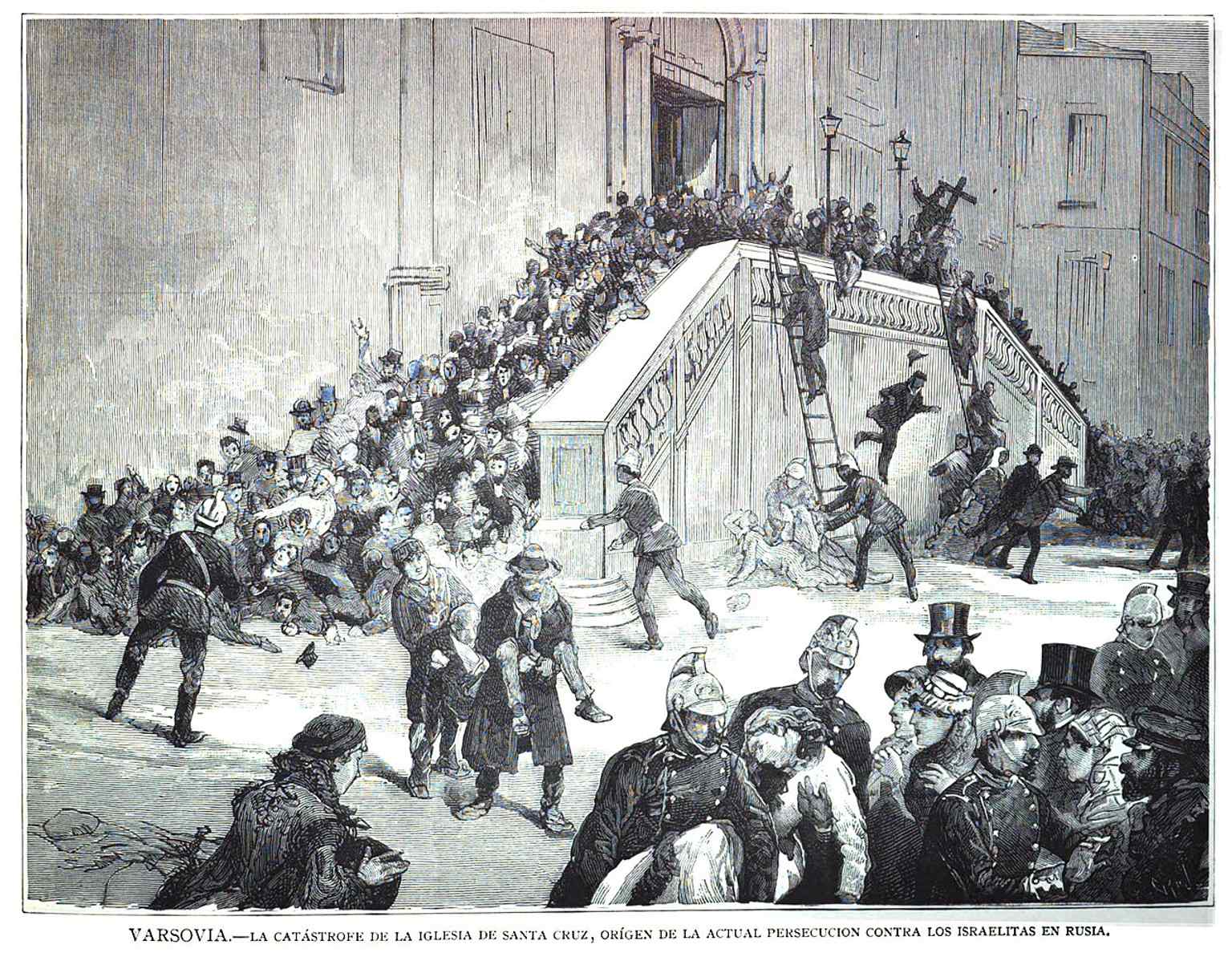
A dramatic 1882 newspaper illustration of the 1881 Christmas stampede, when a tragic panic at Holy Cross sparked a pogrom.Photo: Tomás Carlos Capuz, Wikimedia Commons, Public domain. Cropped & resized. 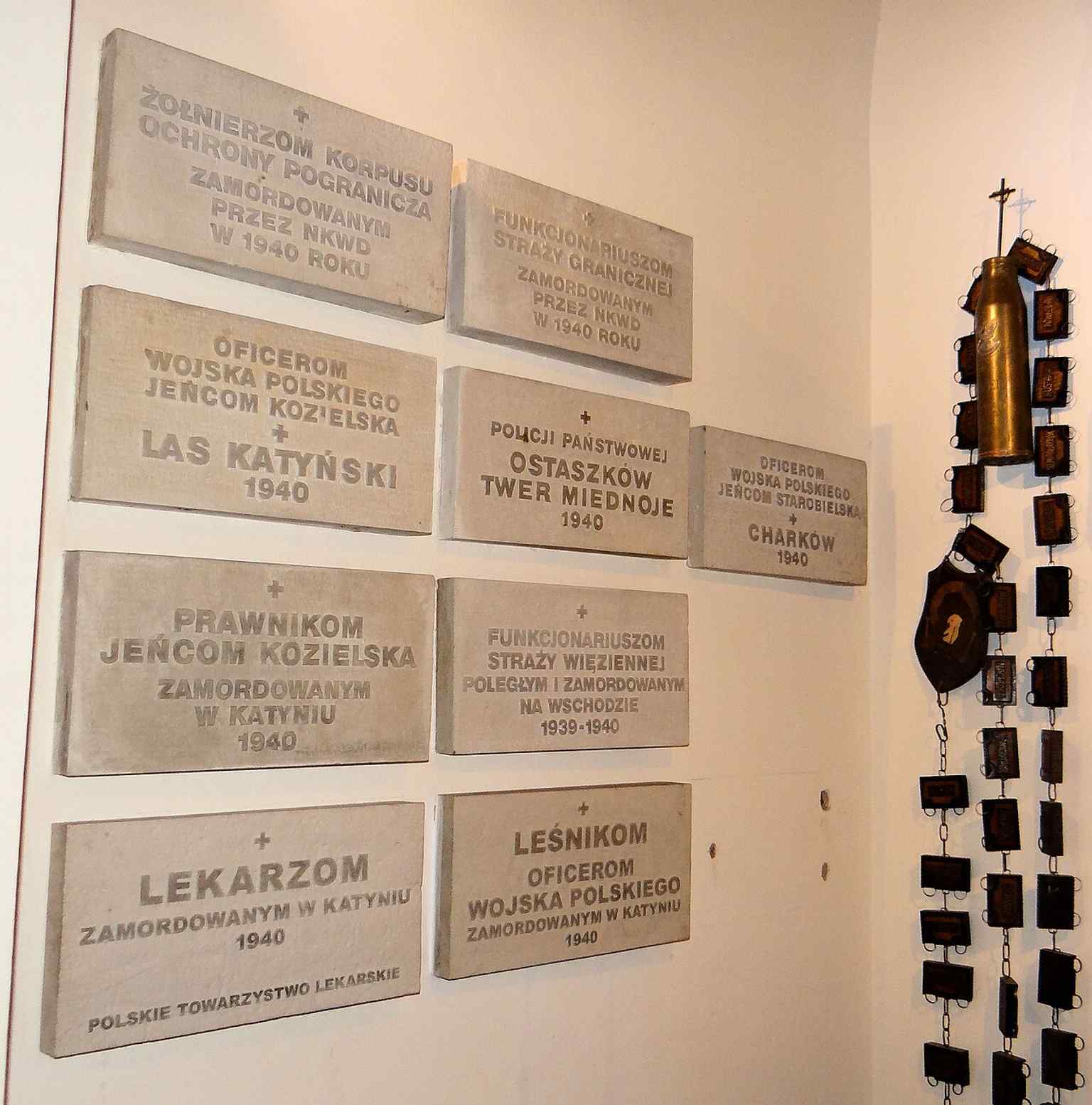
The Chapel of the Katyn Massacre, one of the basilica’s later memorial spaces linking the church to Poland’s modern history.Photo: Jolanta Dyr, Wikimedia Commons, CC BY-SA 3.0. Cropped & resized. 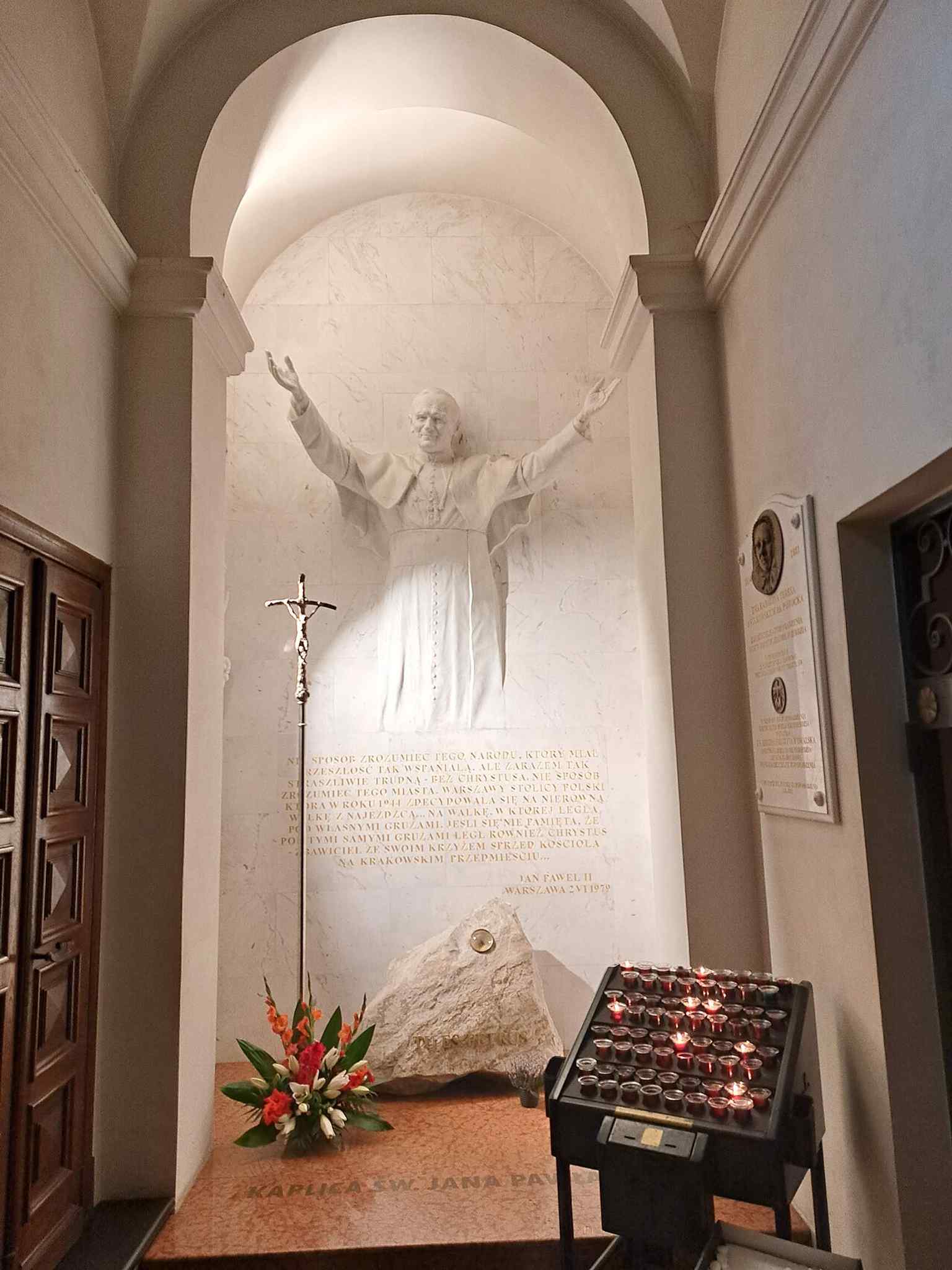
The Chapel of John Paul II, reflecting the basilica’s continuing role as a living place of devotion and remembrance.Photo: Olowirnik, Wikimedia Commons, CC BY 4.0. Cropped & resized. 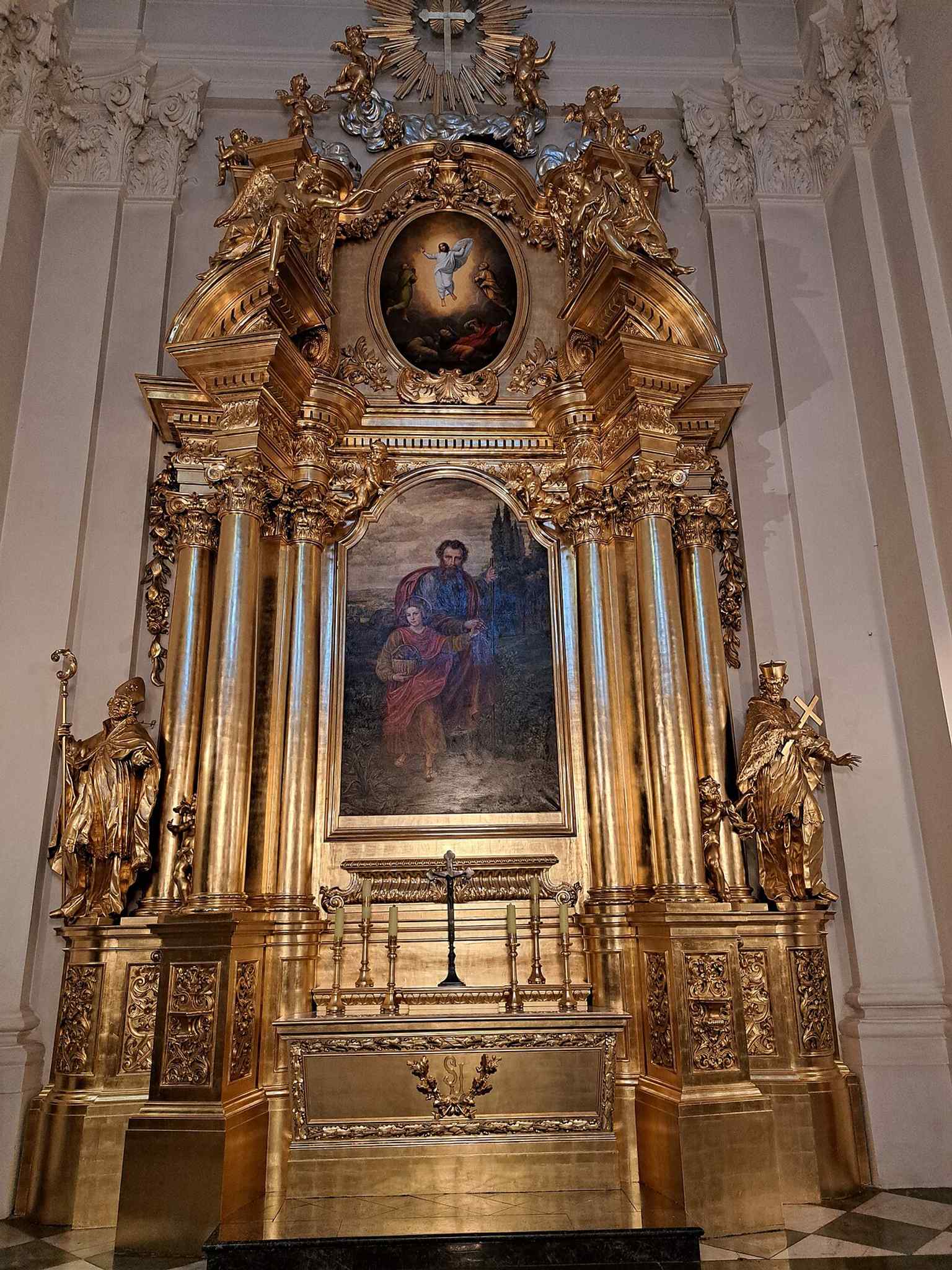
St. Joseph’s altar, one of the basilica’s restored side altars and a good example of its richly layered interior program.Photo: Olowirnik, Wikimedia Commons, CC BY 4.0. Cropped & resized. 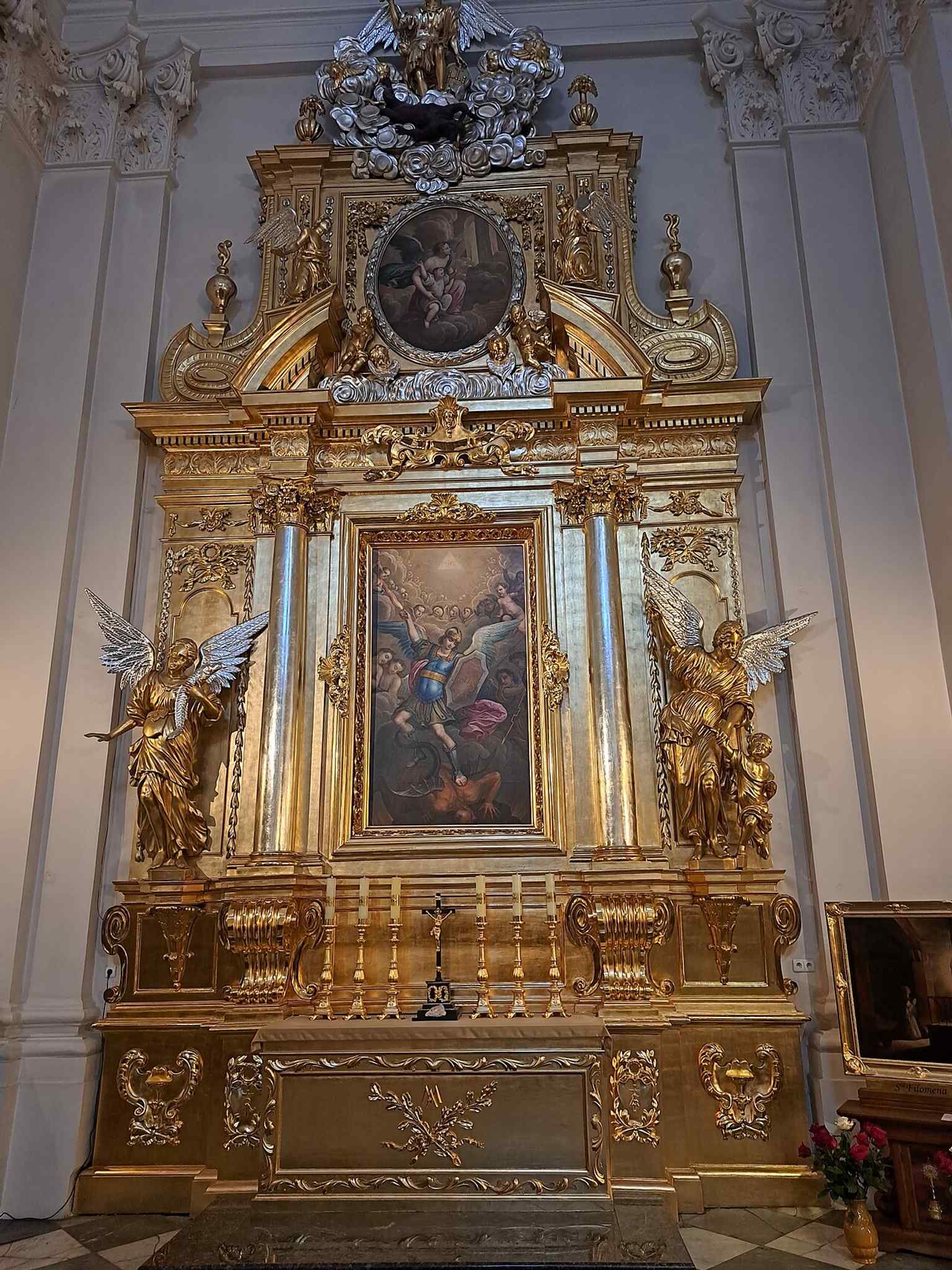
St. Michael the Archangel’s altar, showing the church’s Baroque side chapels and sculptural ornament.Photo: Olowirnik, Wikimedia Commons, CC BY 4.0. Cropped & resized. 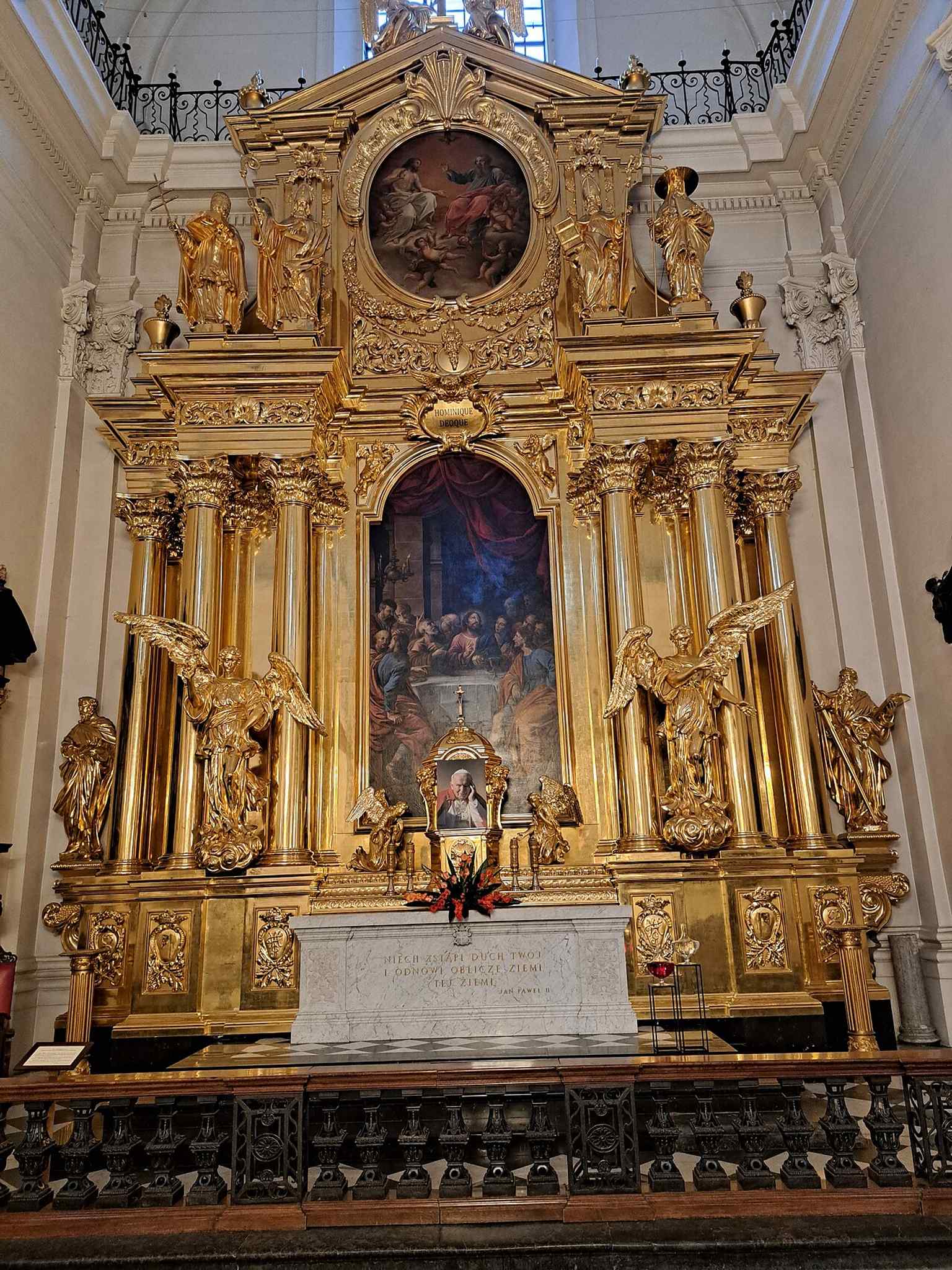
The Blessed Sacrament altar, tied to the basilica’s identity as an ‘Altar of the Homeland’ in modern Polish memory.Photo: Olowirnik, Wikimedia Commons, CC BY 4.0. Cropped & resized. 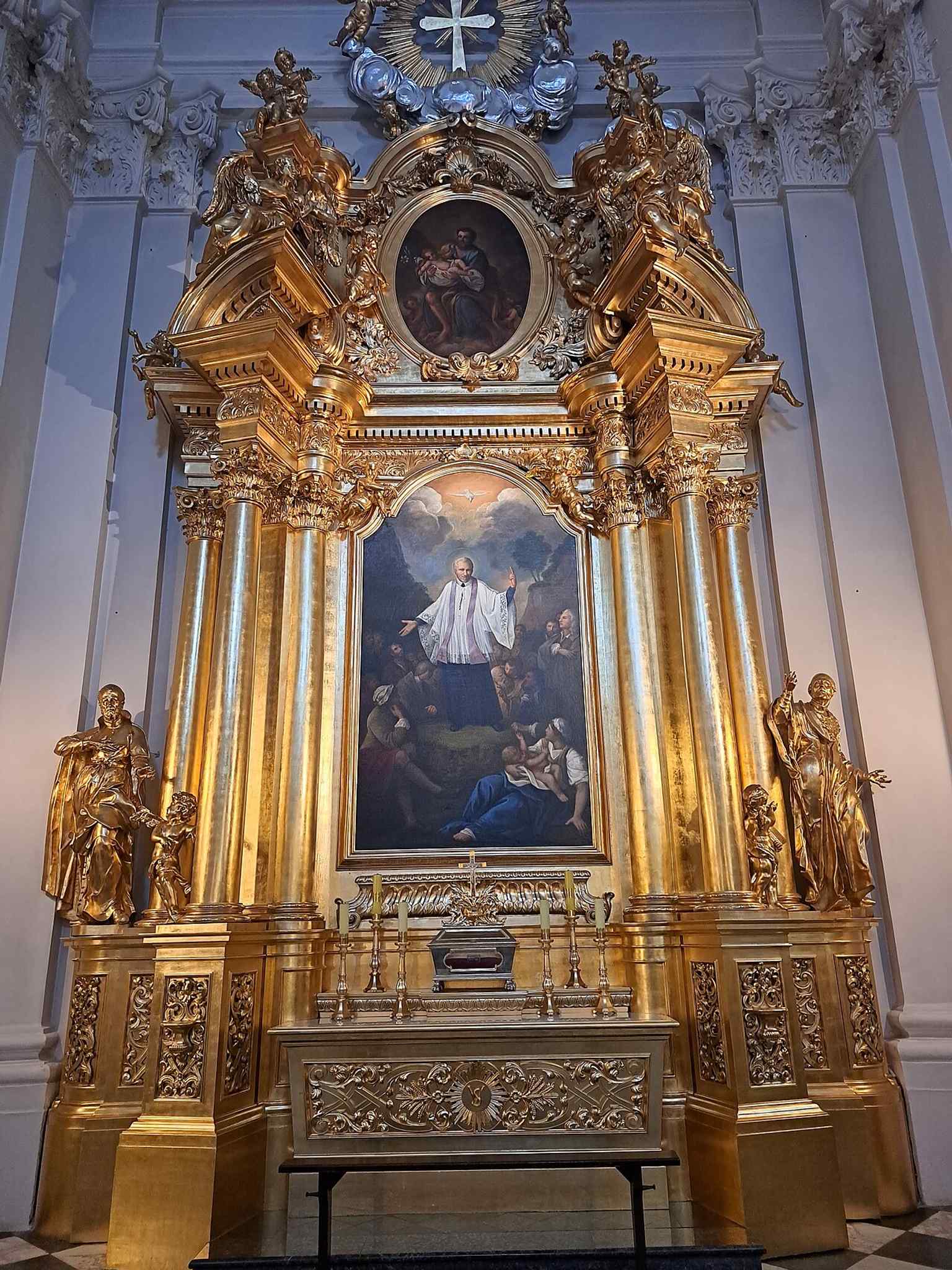
The St. Vincent de Paul altar, dedicated to the congregation that has served Holy Cross since the 17th century.Photo: Olowirnik, Wikimedia Commons, CC BY 4.0. Cropped & resized. On your left stands a bronze seated scholar on a dark pedestal, with a compass in one hand and a ringed celestial globe in the other. This is Nicolaus Copernicus... not just the…Read moreShow less
Open dedicated page →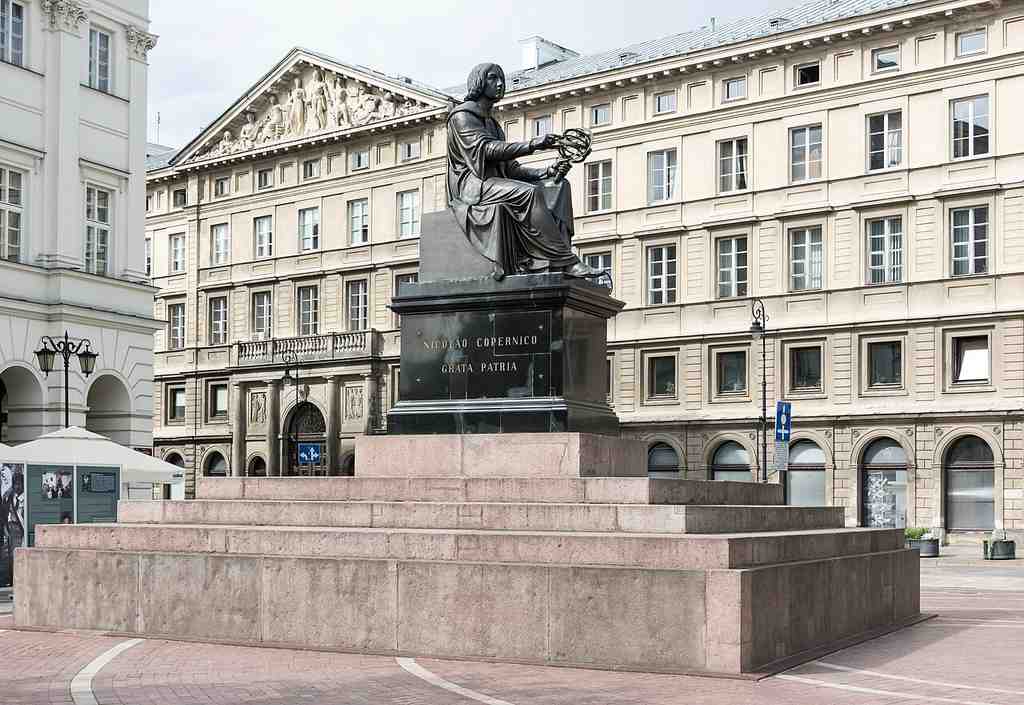
Monument to Nicolaus Copernicus in WarsawPhoto: Adrian Grycuk, Wikimedia Commons, CC BY 3.0 PL. Cropped & resized. On your left stands a bronze seated scholar on a dark pedestal, with a compass in one hand and a ringed celestial globe in the other.
This is Nicolaus Copernicus... not just the astronomer who rearranged the universe, but in Warsaw, a public badge of intellect turned into patriotism. That shift matters. A scientist in a book is one thing; a scientist in bronze, planted on a main ceremonial street, becomes a statement about who a nation believes it is.
The sculptor, Bertel Thorvaldsen from Denmark, gave Copernicus a calm, seated pose, almost like an ancient sage. In his right hand he holds a compass for measurement; in his left, an armillary sphere, a model of the heavens made of metal rings. And underneath him, the pedestal speaks in two voices. One side says in Latin, Nicolao Copernico Grata Patria, “To Nicolaus Copernicus, a grateful fatherland.” The other says in Polish, “To Nicolaus Copernicus, from his compatriots.” If you want a closer look at that Latin side, there’s a pedestal detail in the app.
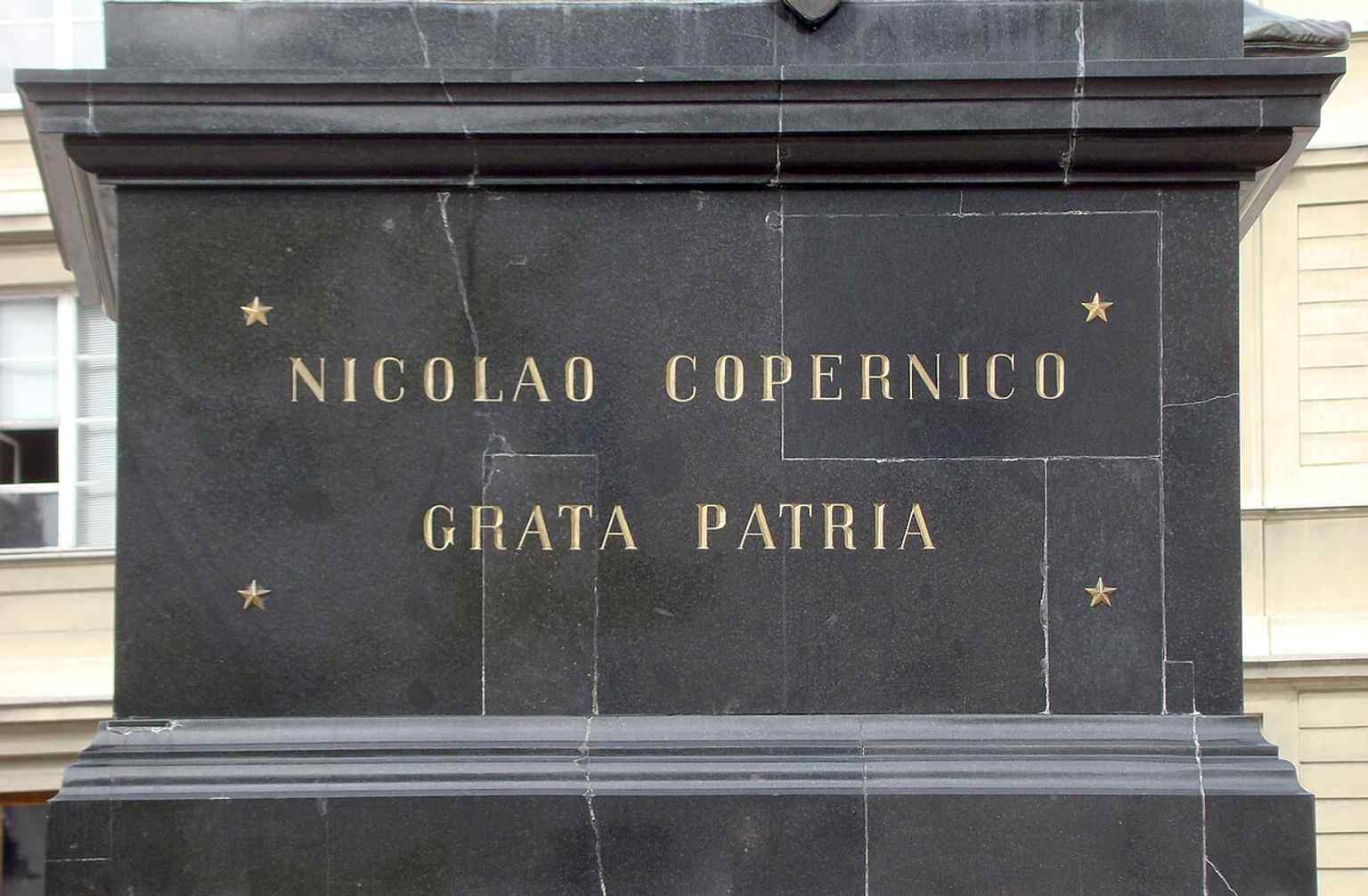
The Latin side of the pedestal reads 'Nicolao Copernico Grata Patria' — a direct reference to the monument’s bilingual inscriptions.Photo: Szczebrzeszynski, Wikimedia Commons, Public domain. Cropped & resized. Stanisław Staszic pushed this monument into existence. He paid for half of it from his own fortune and helped raise the rest by public subscription, then had it cast here in Warsaw in Jan Gregoire’s workshop. The statue stood ready by eighteen twenty-two, but officials interfered even with the pedestal height, and the unveiling dragged on until the eleventh of May, eighteen thirty. Julian Ursyn Niemcewicz finally unveiled it in front of Staszic Palace, then home to the Warsaw Society of Friends of Science. Even learning, here, gets a grand stage.
But the real surprise is what happened later. During the German occupation in nineteen forty, the occupiers covered the original inscriptions with their own plaques. One city employee, the sculptor Maksymilian Potrawiak, quietly smeared the screws with grease so they could be undone more easily. Then, on the eleventh of February, nineteen forty-two, Maciej Aleksy Dawidowski, known as Alek, came here and removed the German plaque himself. He hid it in a nearby snowbank. That is a very Warsaw kind of gesture: a monument to astronomy becoming a battlefield over language, ownership, and nerve.
The statue kept gathering history. In nineteen forty-three, three young underground poets honored Copernicus here with a wreath from “Underground Poland” on the four hundredth anniversary of his death. German patrols opened fire. Wacław Bojarski died of his wounds, Zdzisław Stroiński was arrested, and Tadeusz Gajcy escaped. So this quiet seated figure marks something larger than scholarship. People risked their lives here simply to say that knowledge, in Polish hands, belonged to the nation.
After the war, the monument itself had to return from the brink. German forces damaged it after the Warsaw Uprising and sent it away, likely for scrap. Workers found it later in Hajduki Nyskie and brought it back, then restored it again in nineteen forty-nine. Even in recent years, the story kept going: in two thousand and eight, thieves tore off the armillary sphere, and conservators recovered and reattached it. If you compare the old photo with the current view in the app, you can spot that strange moment when Copernicus was left with an empty hand.
Locals sometimes point out that this statue has distant cousins in Montreal and Chicago. So the symbol standing here does not end in Warsaw; it travels, carrying Polish memory and scientific pride across oceans like a well-packed family story.
Keep following this route and the mood shifts from the authority of ideas to the authority of office... the Presidential Palace waits farther along the same grand urban spine. And since this monument stands in open public space, you can pay your respects here at any hour.
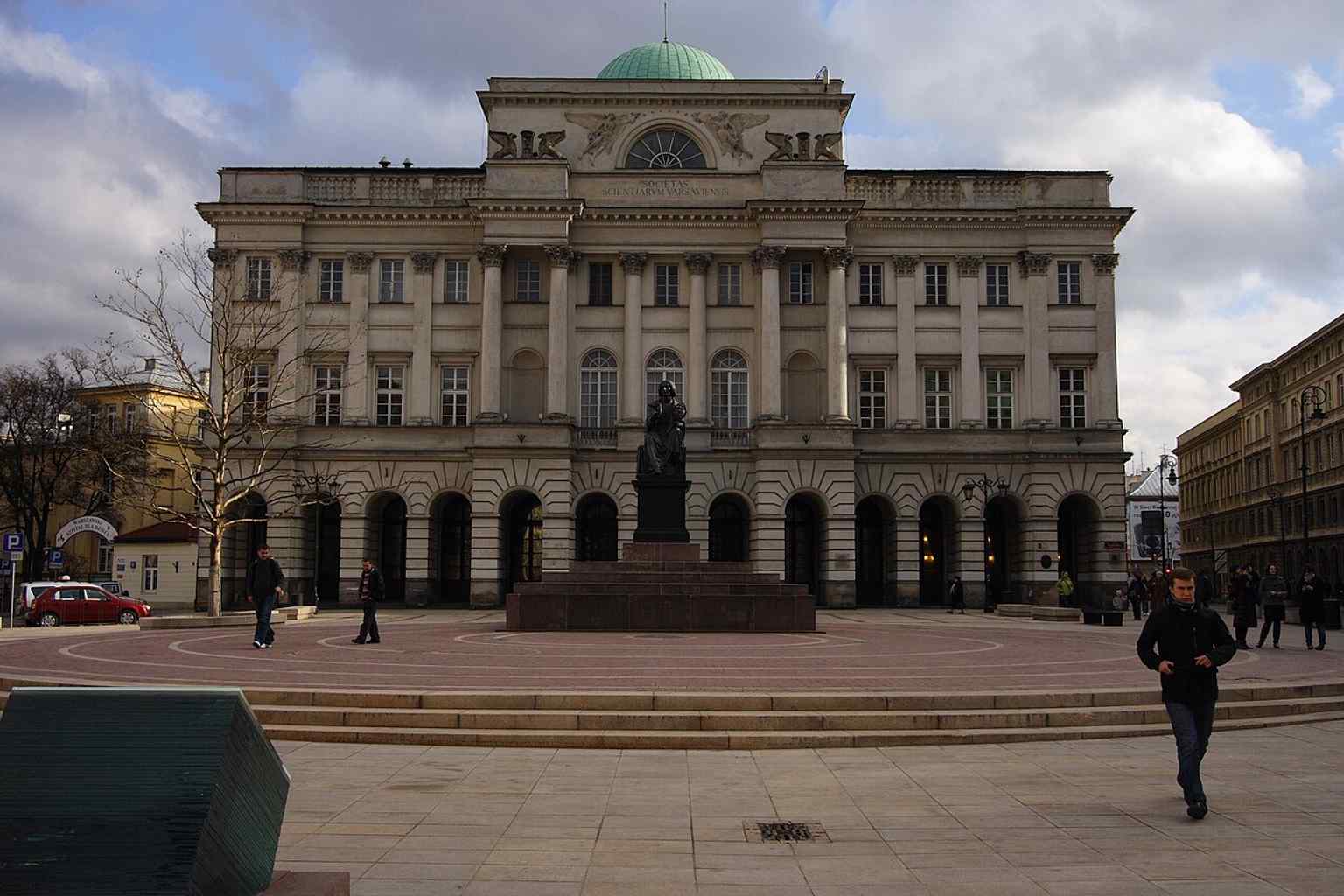
The Copernicus Monument framed with the Staszic Palace behind it, just as it stands on Krakowskie Przedmieście in front of the Polish Academy of Sciences.Photo: Anastasiya Lvova, Wikimedia Commons, CC BY 3.0. Cropped & resized. 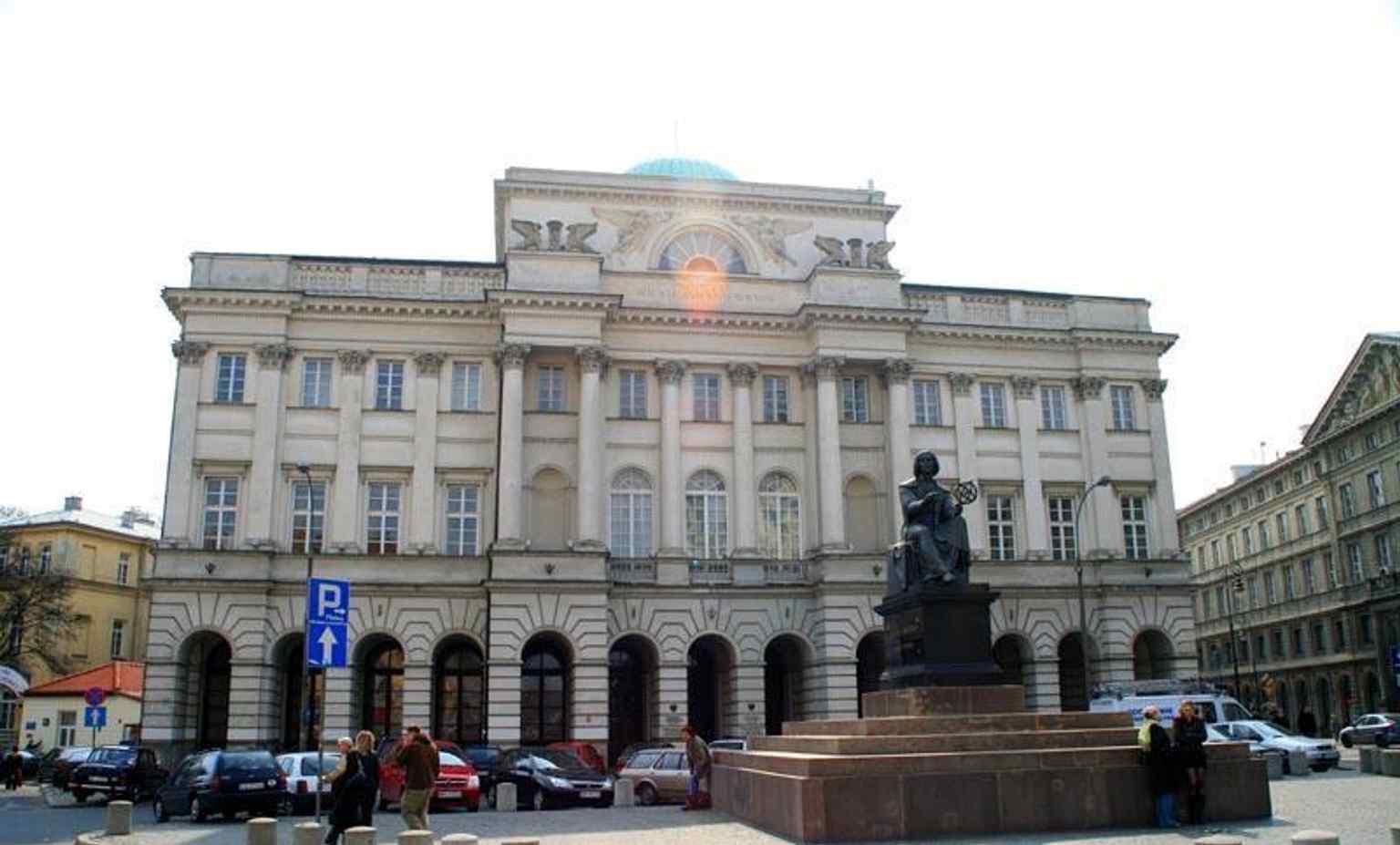
Wide composition with the Staszic Palace and the Copernicus statue together, matching the landmark’s historic placement before the palace.Photo: Marek and Ewa Wojciechowscy, Wikimedia Commons, CC BY-SA 3.0. Cropped & resized. 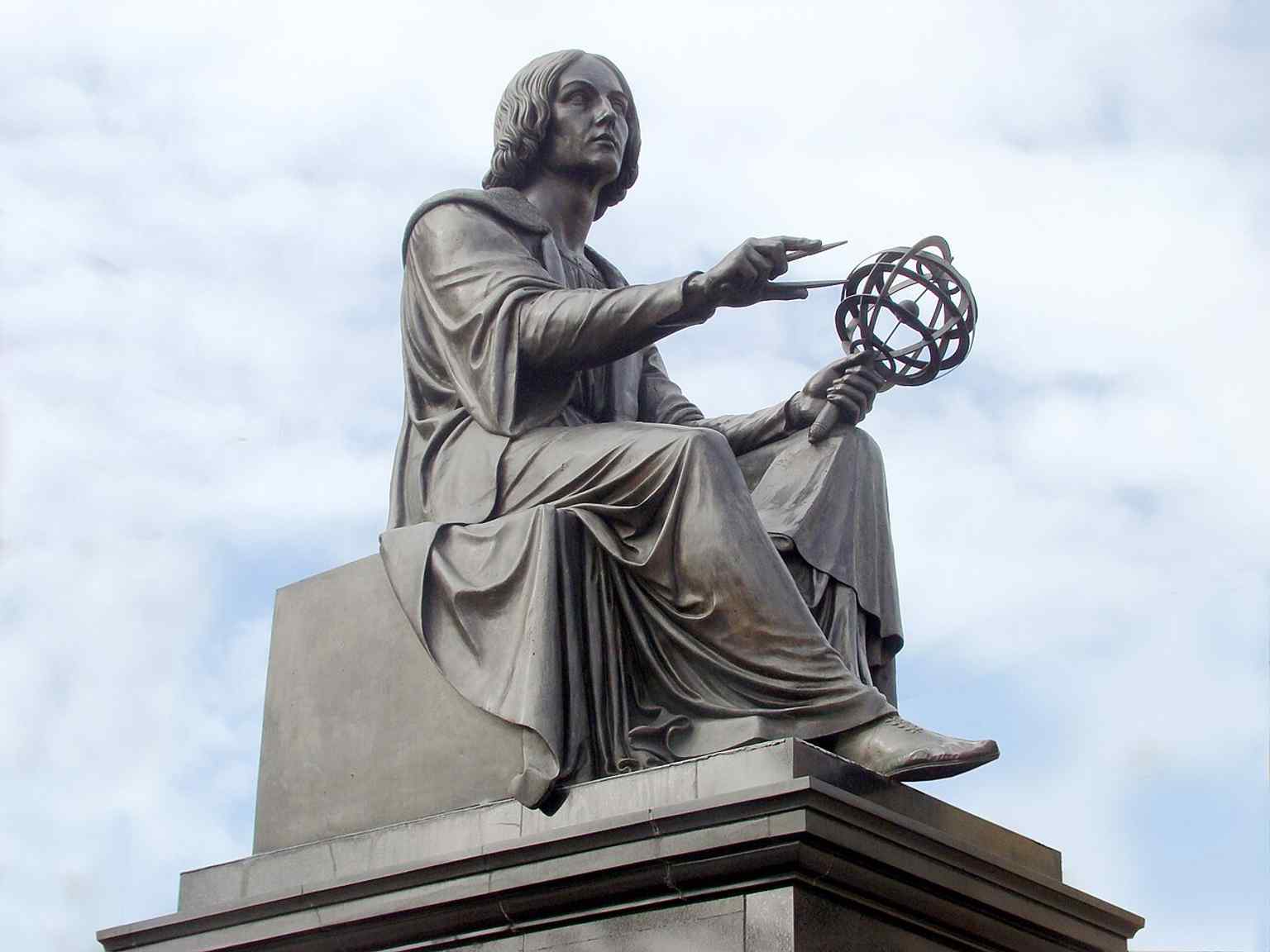
A closer look at Thorvaldsen’s seated Copernicus, emphasizing the compass in his right hand and the armillary sphere in his left.Photo: Szczebrzeszynski, Wikimedia Commons, Public domain. Cropped & resized. 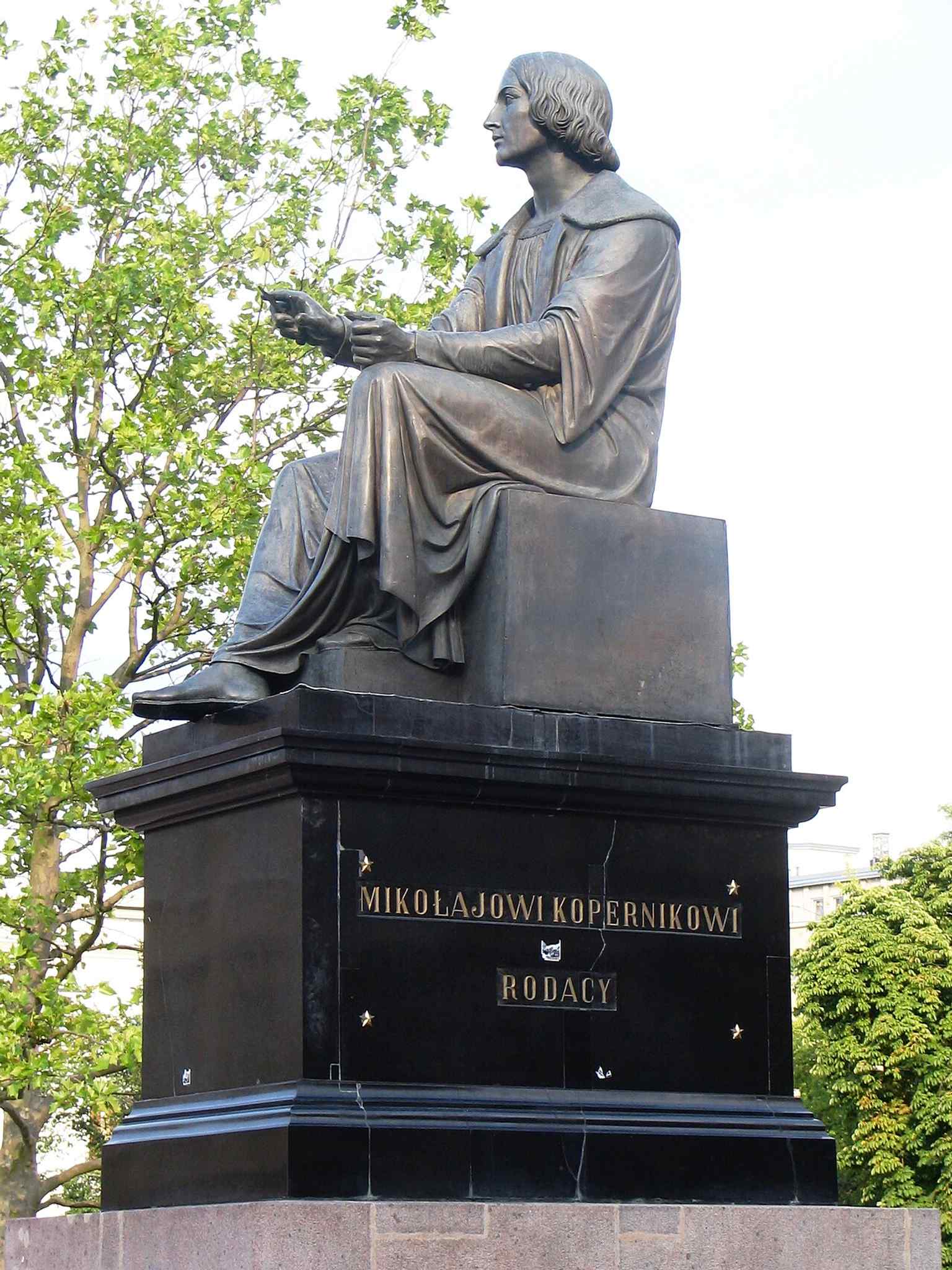
The monument shown without the armillary sphere, echoing the 2008 vandalism when the globe was torn from Copernicus’s hand.Photo: GrzegorzPetka, Wikimedia Commons, Public domain. Cropped & resized. 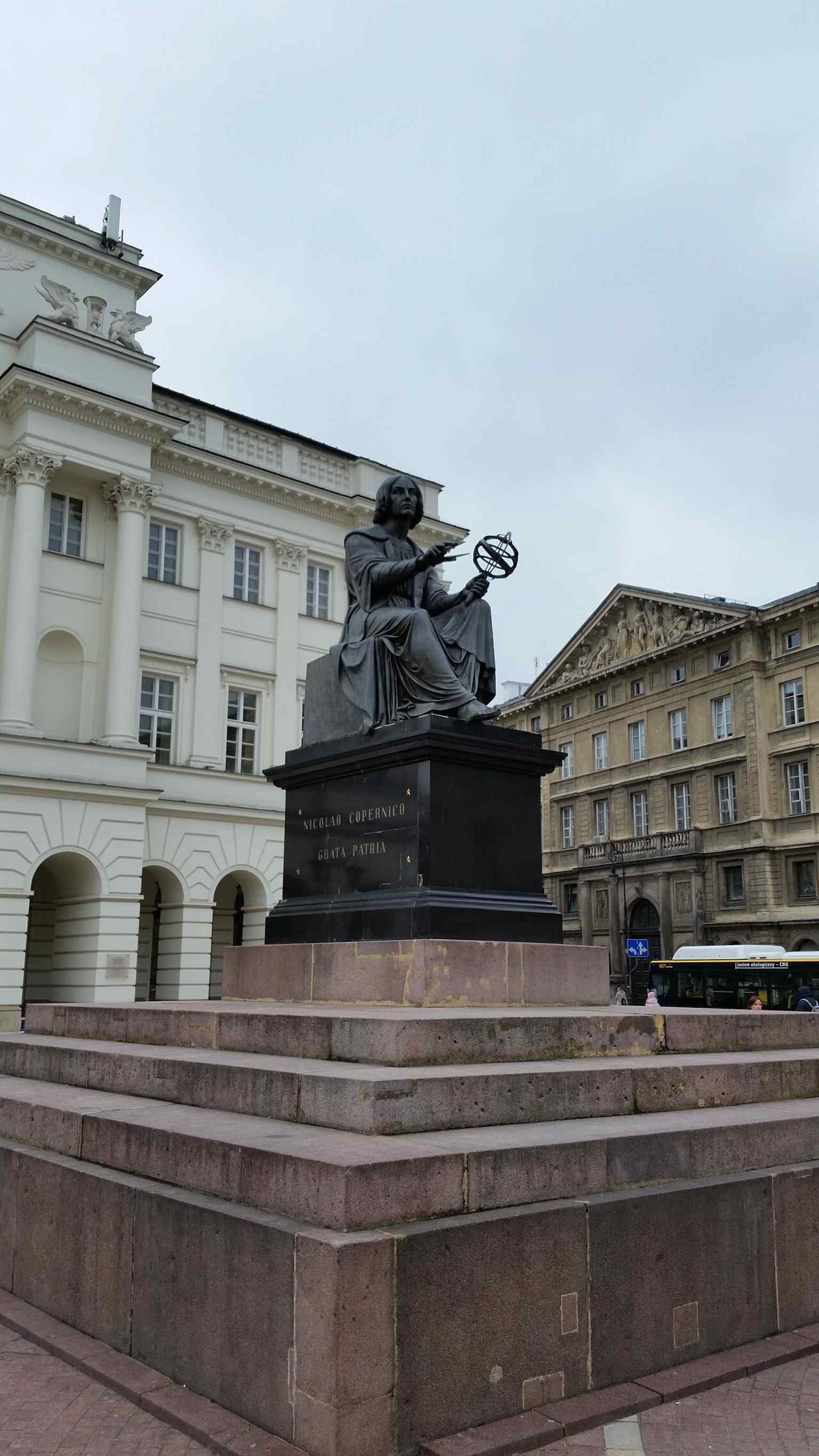
A tight vertical view of the statue that highlights the bronze figure and pedestal details more than the surrounding square.Photo: Toitoinebzh, Wikimedia Commons, CC BY-SA 3.0. Cropped & resized. 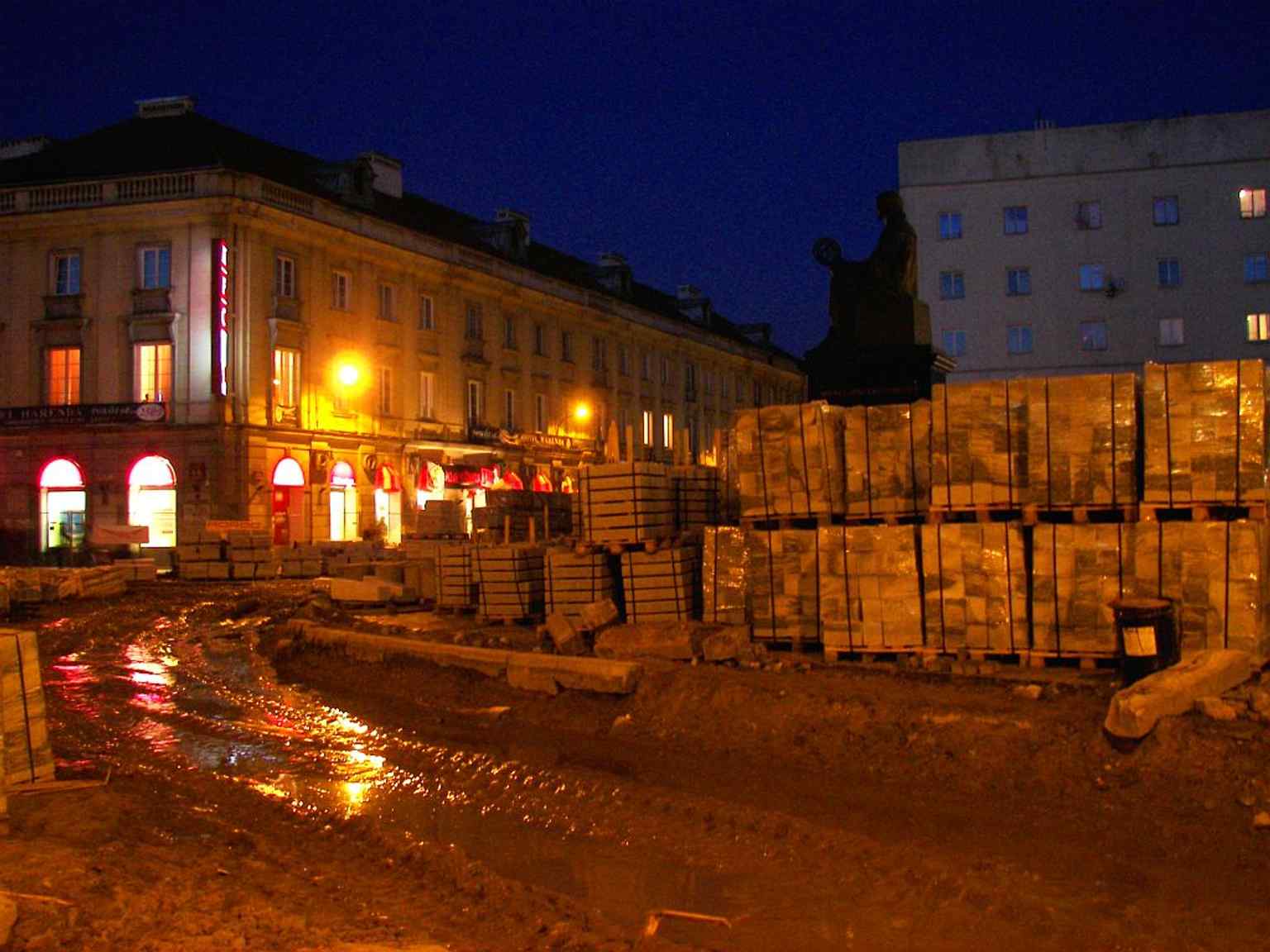
The monument during Krakowskie Przedmieście rebuilding works in 2007, showing how the square around it has changed over time.Photo: Piotr VaGla Waglowski, http://www.vagla.pl, Wikimedia Commons, Public domain. Cropped & resized. 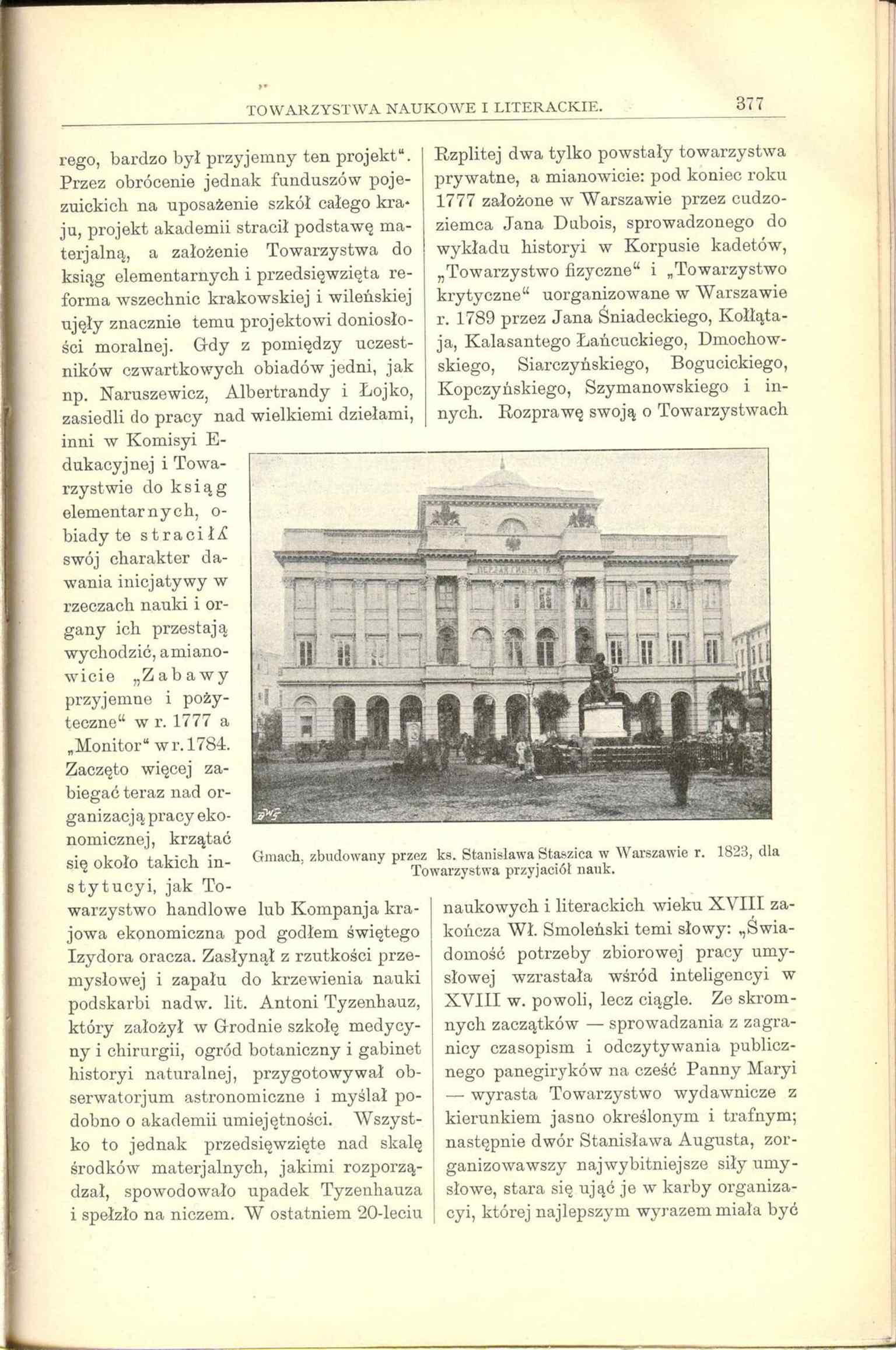
An old printed view from Encyklopedja staropolska ilustrowana, useful as a historical illustration of the monument’s long fame.Photo: Zygmunt Gloger, Wikimedia Commons, Public domain. Cropped & resized. 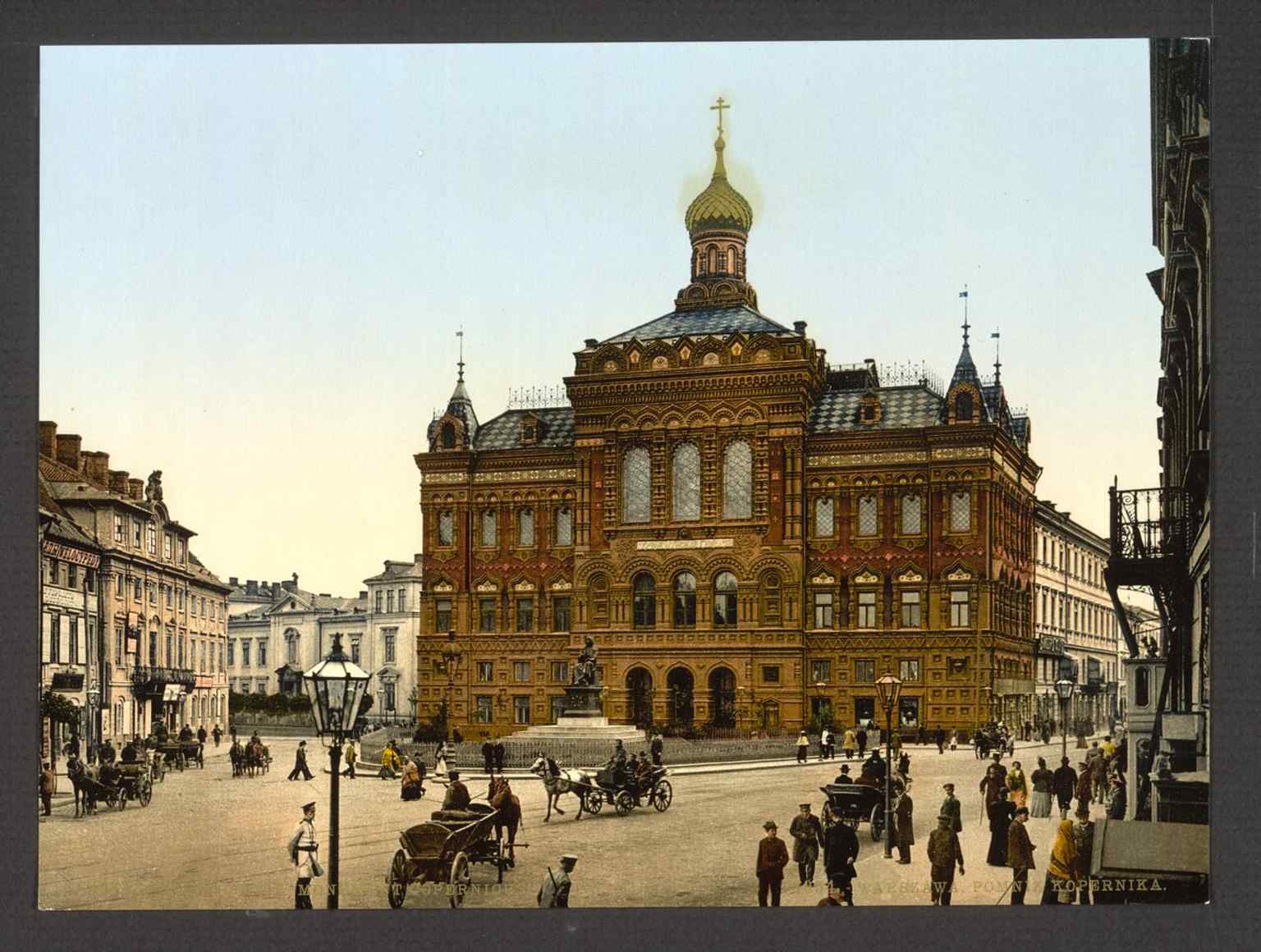
A 19th-century library image of the Copernicus Monument, offering an early documentary view of the Warsaw sculpture.Photo: Photochrom Print Collection, Wikimedia Commons, Public domain. Cropped & resized. 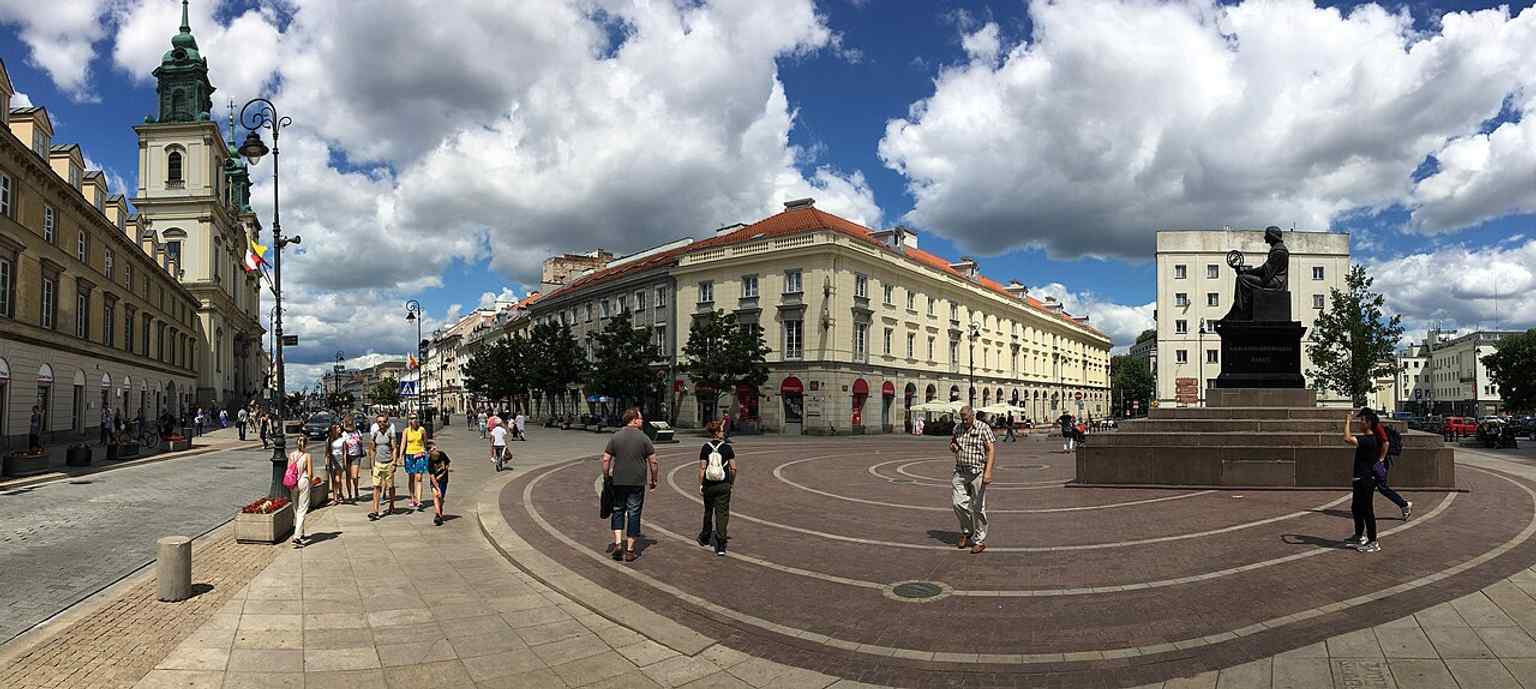
A broad streetscape of southern Krakowskie Przedmieście that situates the monument within Warsaw’s central historic axis.Photo: Romazur, Wikimedia Commons, CC BY-SA 4.0. Cropped & resized. On your right stands a long pale stone palace with a broad classical façade, a central row of Corinthian half-columns, and four reclining stone lions guarding the forecourt.…Read moreShow less
Open dedicated page →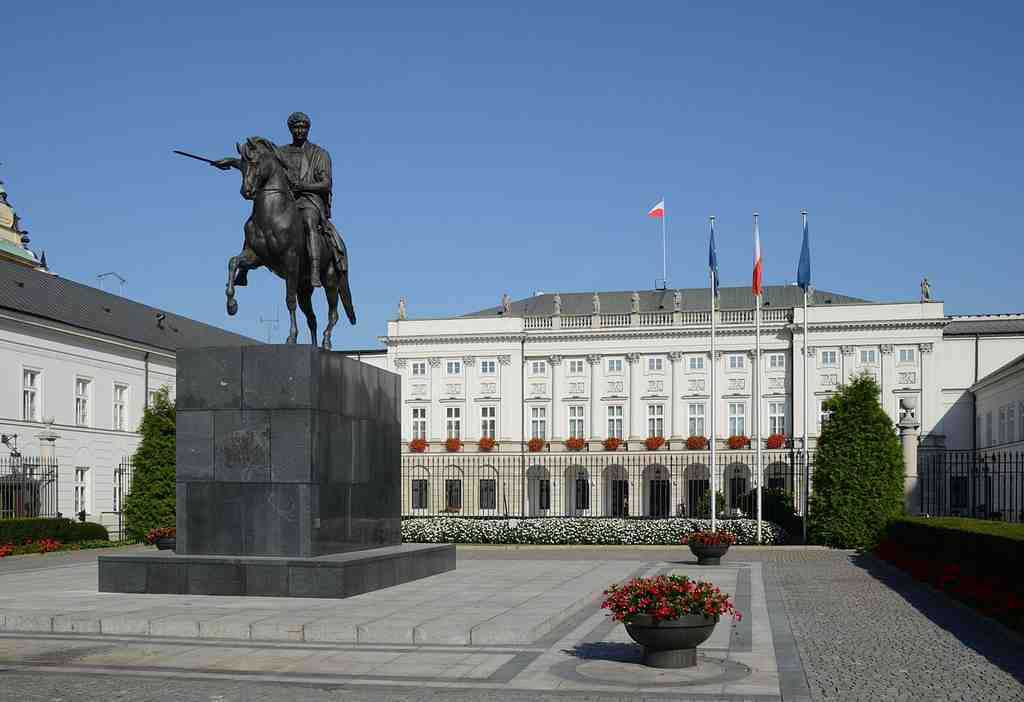
The Presidential Palace in WarsawPhoto: Marcin Białek, Wikimedia Commons, CC BY-SA 3.0. Cropped & resized. On your right stands a long pale stone palace with a broad classical façade, a central row of Corinthian half-columns, and four reclining stone lions guarding the forecourt.
This is the seat of the state on Krakowskie Przedmieście, one of the streets where Warsaw packs government, ceremony, and memory shoulder to shoulder. For centuries, power kept changing uniforms here, but it kept returning to this same address.
The palace began in the seventeenth century, when Stanisław Koniecpolski started a baroque residence here for his Warsaw base. Most people read this building from the street and never guess its first great luxury lay behind it: one of Warsaw’s earliest Italian-style gardens dropped in terraces all the way toward the Vistula, back when the river ran much closer to the escarpment. So this neat official front once belonged to a much more theatrical private world.
Then came the Radziwiłł family, who turned the place into a stage for public life: balls, assemblies, and even theater. In seventeen seventy-eight, one of the first Polish operas premiered here. In eighteen eighteen, eight-year-old Fryderyk Chopin gave his first public performance in the palace. Not bad for a building that later became a government office... talk about a career change.
The real visual shift came when the government of the Kingdom of Poland bought the palace in eighteen eighteen and hired Chrystian Piotr Aigner to remake it in a classical style. He lowered the roofline, stretched the side wings to the street, and gave the center that formal Corinthian order you see now. The lions out front date from that transformation too, carved by Camillo Landini, and they still lounge there like they own the mortgage.
But here is the turn in the story. On the twenty-ninth of November, eighteen thirty, General Maurycy Hauke was shot in front of this palace after he refused to join the uprising. He was no distant bureaucrat. He had served the old Polish Commonwealth and lived through the Napoleonic age. His death fixed this place in Warsaw’s memory not just as a seat of authority, but as a place where loyalty, rebellion, and tragedy collided in public.
After an eighteen fifty-two fire gutted the main block, the palace rose again with the same exterior form. Then, in eighteen seventy, Russian rule planted a statue of Ivan Paskevich in the forecourt, where an imperial message could stare straight down the route. If you like, check the before-and-after image; it shows how that monument once crowded the front and how much more open the palace feels now.
In the twentieth century, the building kept changing roles without leaving the stage. It housed Poland’s prime minister and cabinet between the wars. During the German occupation, the invaders turned it into the Deutsches Haus, a luxury hotel and casino for the occupier’s elite. They even set a bronze head of Adolf Hitler inside.
After the war, the palace survived when so much of Warsaw did not. Later, leaders signed the Warsaw Pact here, and in nineteen eighty-nine the Round Table talks helped negotiate the end of communist rule. Since nineteen ninety-four, it has served as the official seat of the President of Poland, where major state ceremonies and treaty signings have passed through its doors.
So this palace is not one story. It is a relay race of authority: magnates, governors, occupiers, cabinets, presidents. Ahead, in about seven minutes, St. Anne’s Church will remind you that on this street in Warsaw, political power never stands far from the sacred.
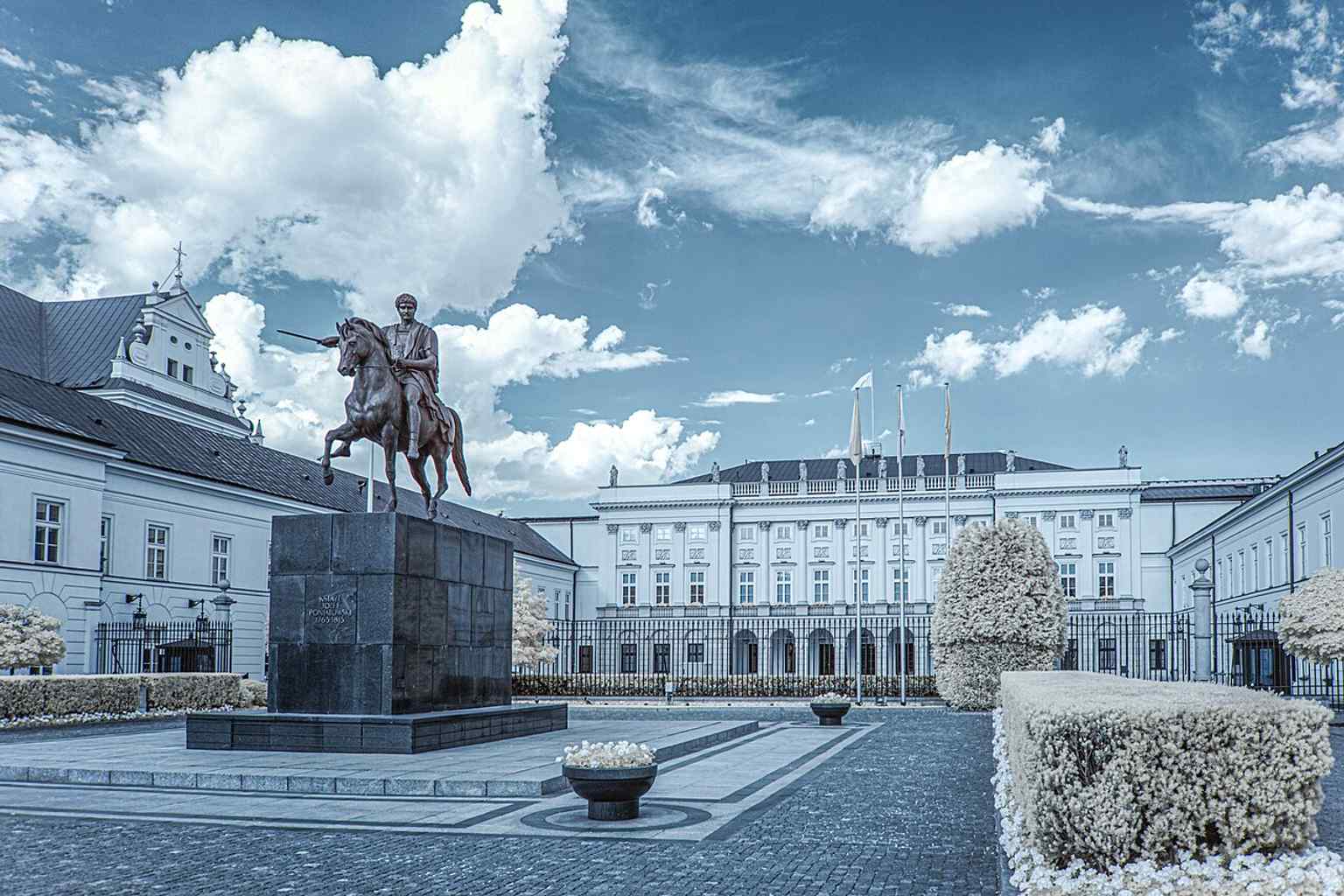
The palace front with the equestrian monument of Józef Poniatowski — a symbol tied to the site’s postwar history and state ceremonies.Photo: Omenaga, Wikimedia Commons, CC BY-SA 4.0. Cropped & resized. 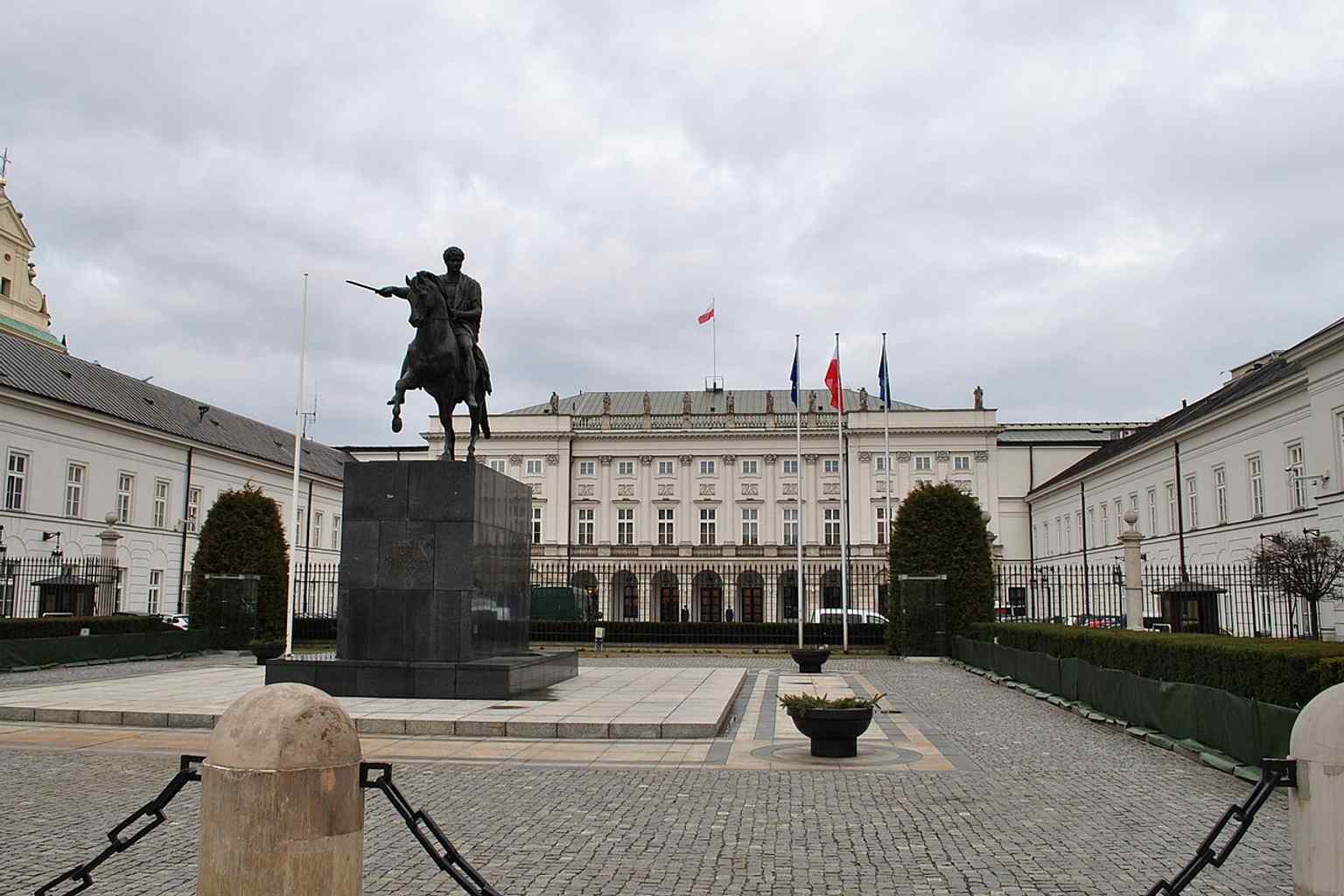
The palace on Krakowskie Przedmieście 46/48, showing its prominent position beside Warsaw’s historic royal route.Photo: Marek Mróz, Wikimedia Commons, CC BY 4.0. Cropped & resized. 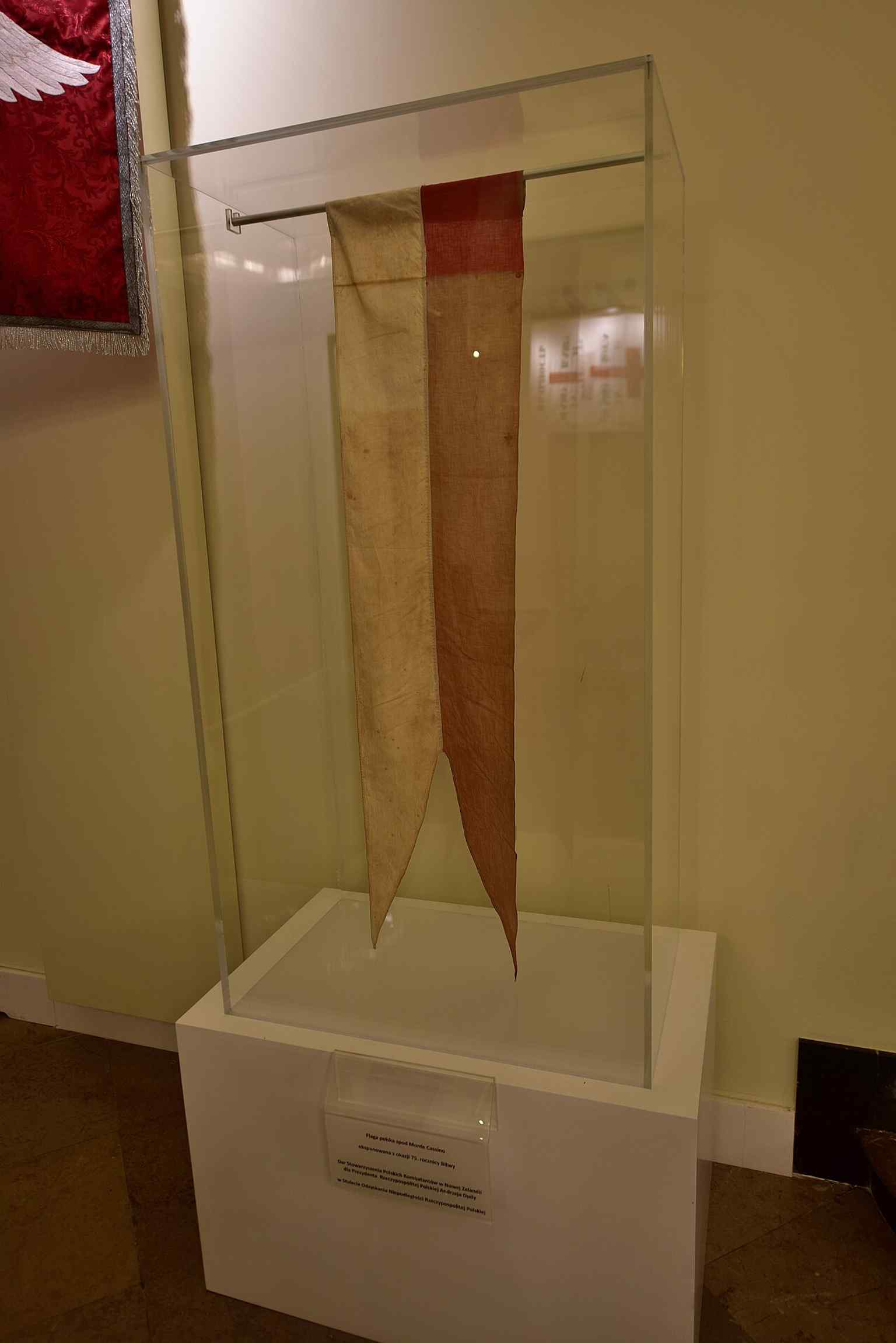
A Polish flag from Monte Cassino displayed inside the palace — one of the many wartime and patriotic commemorations linked to the building.Photo: Adrian Grycuk, Wikimedia Commons, CC BY-SA 3.0 pl. Cropped & resized. 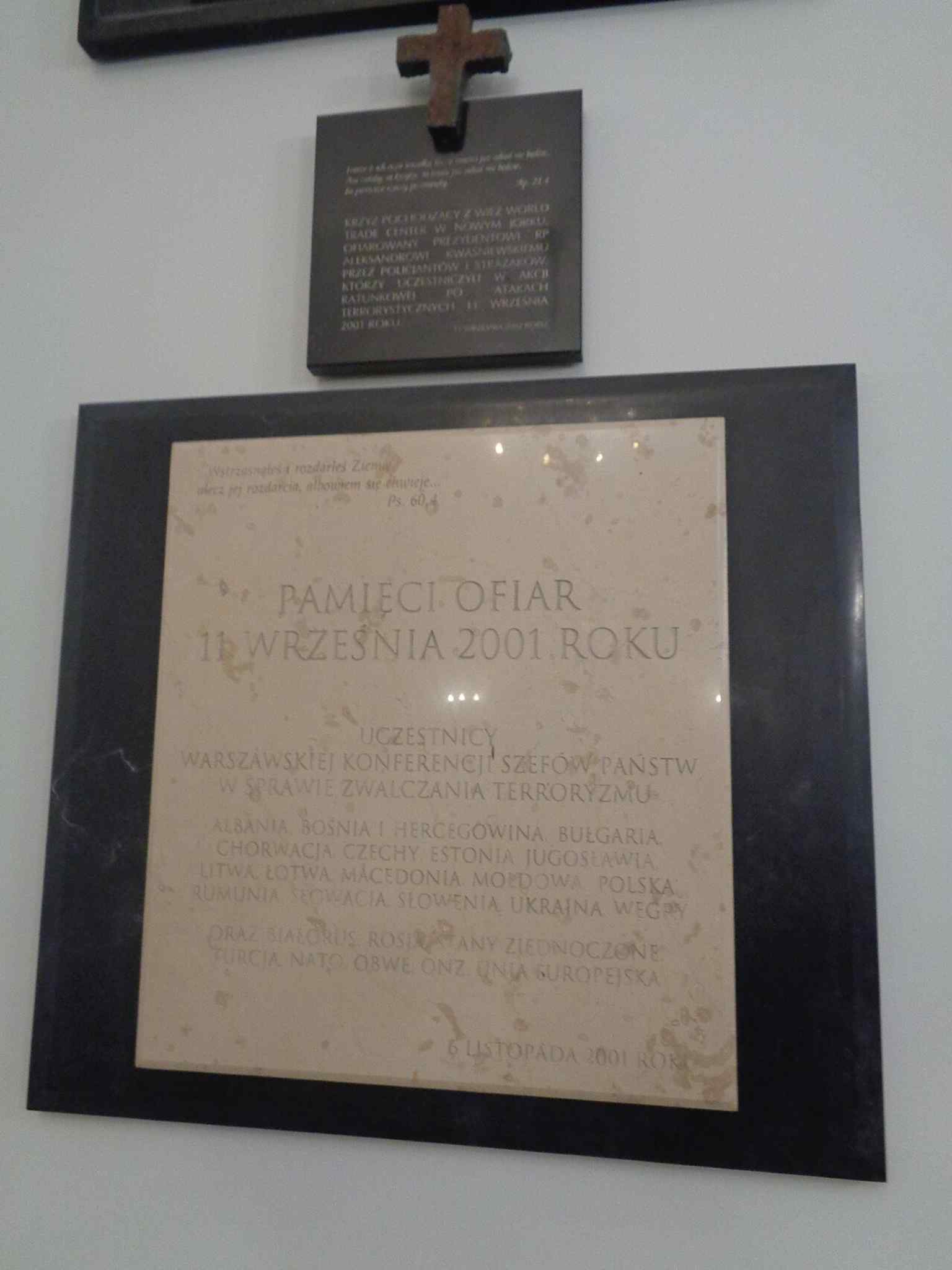
A memorial plaque in the chapel for the victims of the September 11 attacks, reflecting the palace’s role as a place of remembrance.Photo: Lukasz2, Wikimedia Commons, CC0. Cropped & resized. On your right, look for a pale stone façade shaped like a classical temple front, with tall columns, a triangular pediment, and a slender Italian-style bell tower rising beside…Read moreShow less
Open dedicated page →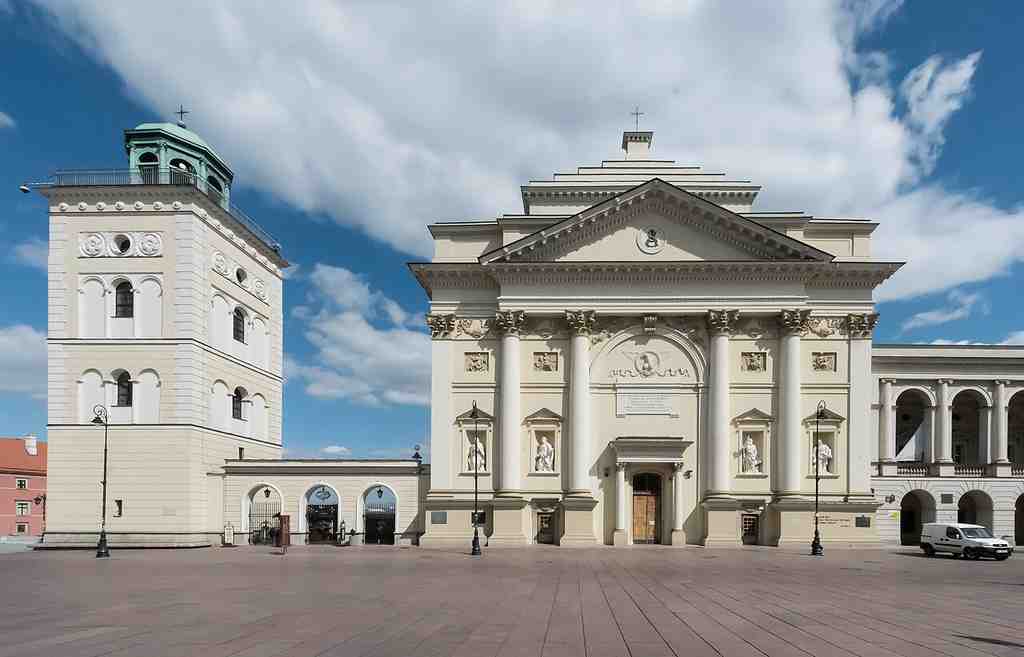
St. Anne's Church in Warsaw (City Center)Photo: Adrian Grycuk, Wikimedia Commons, CC BY-SA 3.0 PL. Cropped & resized. On your right, look for a pale stone façade shaped like a classical temple front, with tall columns, a triangular pediment, and a slender Italian-style bell tower rising beside it.
St. Anne’s looks calm and orderly from here... and that is only half the truth. This church began in fourteen fifty-four, when Duchess Anna Fiodorovna helped bring the first Bernardine friars to Warsaw, inspired by Jan Capistrano. Back then, this stood outside the city walls at the edge of the road south, a true threshold church: part monastery, part roadside marker, part spiritual gate into Warsaw.
In this city, churches often do more than serve worship. They also keep public memory safe - grief, loyalty, rebellion, thanksgiving - like national archives with incense instead of filing cabinets.
That role fits St. Anne’s perfectly. Kings used the open space before it for political theater: in fifteen seventy-eight, Margrave George Frederick of Ansbach paid homage here to King Stephen Báthory, and in sixteen eleven, Elector John Sigismund of Brandenburg did the same before Sigismund the Third Vasa. So this church did not simply watch history pass by; it stood on the route where state ritual announced itself to the city.
Its most beloved human story belongs to Blessed Władysław of Gielniów, a Bernardine preacher buried here in fifteen oh five. Warsaw people believed his intercession helped end the plague in fifteen twenty-two, and a local legend says that during a Good Friday sermon he rose in mystical ecstasy above the pulpit. Now, whether you take that literally or not... it tells you how deeply this place lived in the city’s imagination.
The surprise is this: the neat classical front you see is not the church’s original face at all. Fires wrecked the complex in fifteen oh seven and again in fifteen fifteen. Later rebuildings layered Gothic, Baroque, and finally classicism on top of one another. In the late eighteenth century, architect Piotr Aigner gave the façade its present look, borrowing from Palladio and the churches of Venice. So what seems pure and unified is really a carefully composed mask over a much older, messier survivor. If you compare the historic photo with the current view in the app, you can watch Krakowskie Przedmieście change around the church while St. Anne’s keeps anchoring the route.
And then came another twist. In nineteen forty-four, fire destroyed the roof, though the walls and bell tower survived. After the war, workers even used the damaged building to store objects recovered from Old Town rubble. But the most dramatic rescue came in nineteen forty-nine, when construction of the W-Z route triggered a landslide in the Vistula escarpment. The apse and part of the presbytery - the eastern end around the altar - began to move. Engineer Wacław Żenczykowski organized about four hundred people to work day and night, pumping cement deep into the ground and bracing the structure until they saved it in just twenty days. That is Warsaw in one story: even rebuilding the city nearly pulled the church apart.
Since nineteen twenty-eight, St. Anne’s has served as Warsaw’s academic church for students from the nearby university, art, music, and theater schools. In nineteen seventy-nine, John Paul the Second met young people here and blessed their crosses. If you glance at the app image of the chancel doors, you’ll catch another layer of the craftsmanship tucked behind this formal exterior.
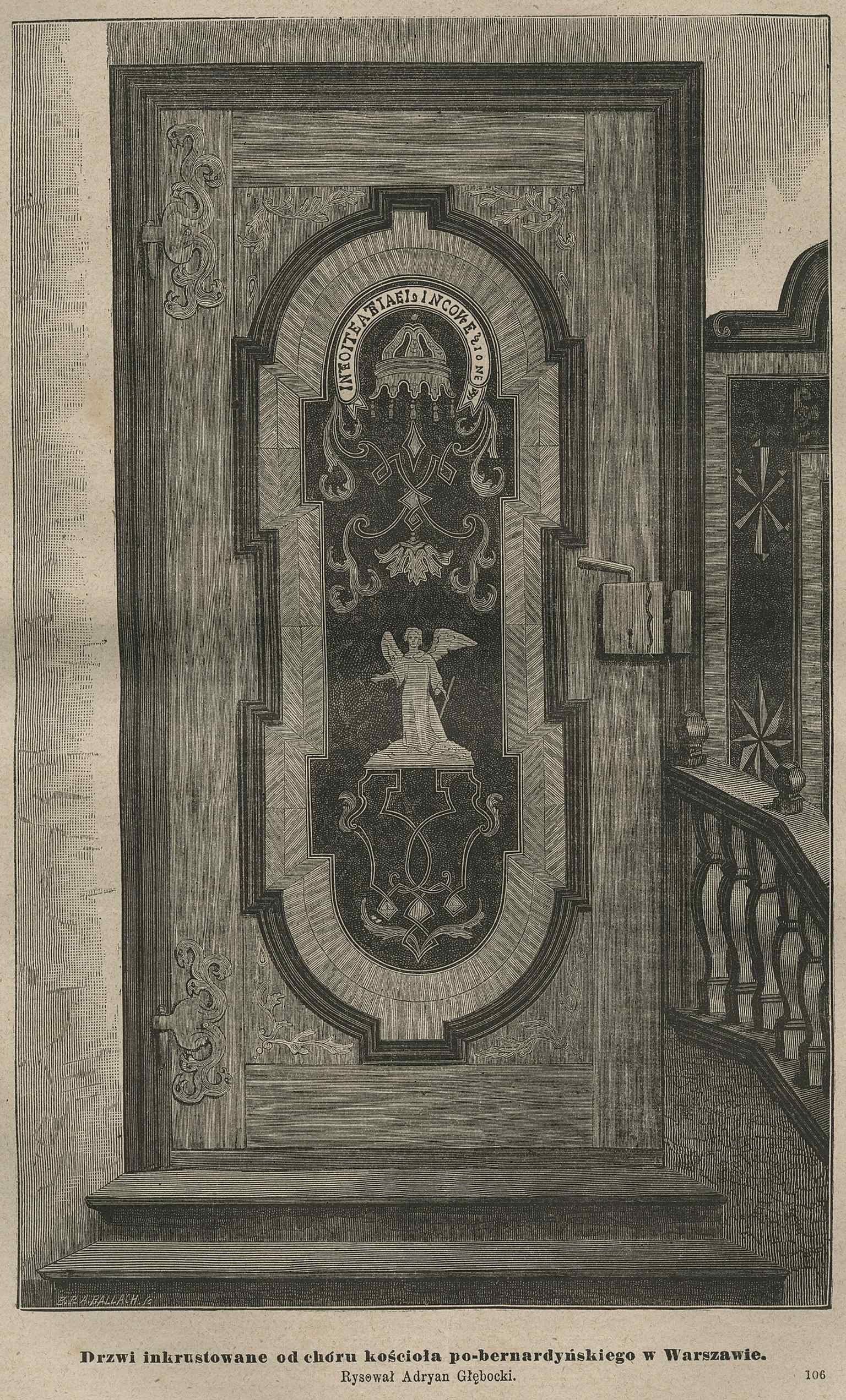
An 1879 drawing of the chancel doors captures one of the historic interior details of this former Bernardine church.Photo: Adrian Głębocki, Wikimedia Commons, Public domain. Cropped & resized. In a moment, we’ll head to a monument where dynastic image-making stops being subtle and rises straight into the square: the Column of Sigismund the Third Vasa. If you want to go inside later, St. Anne’s is generally open every day, with especially long evening hours on Sunday.
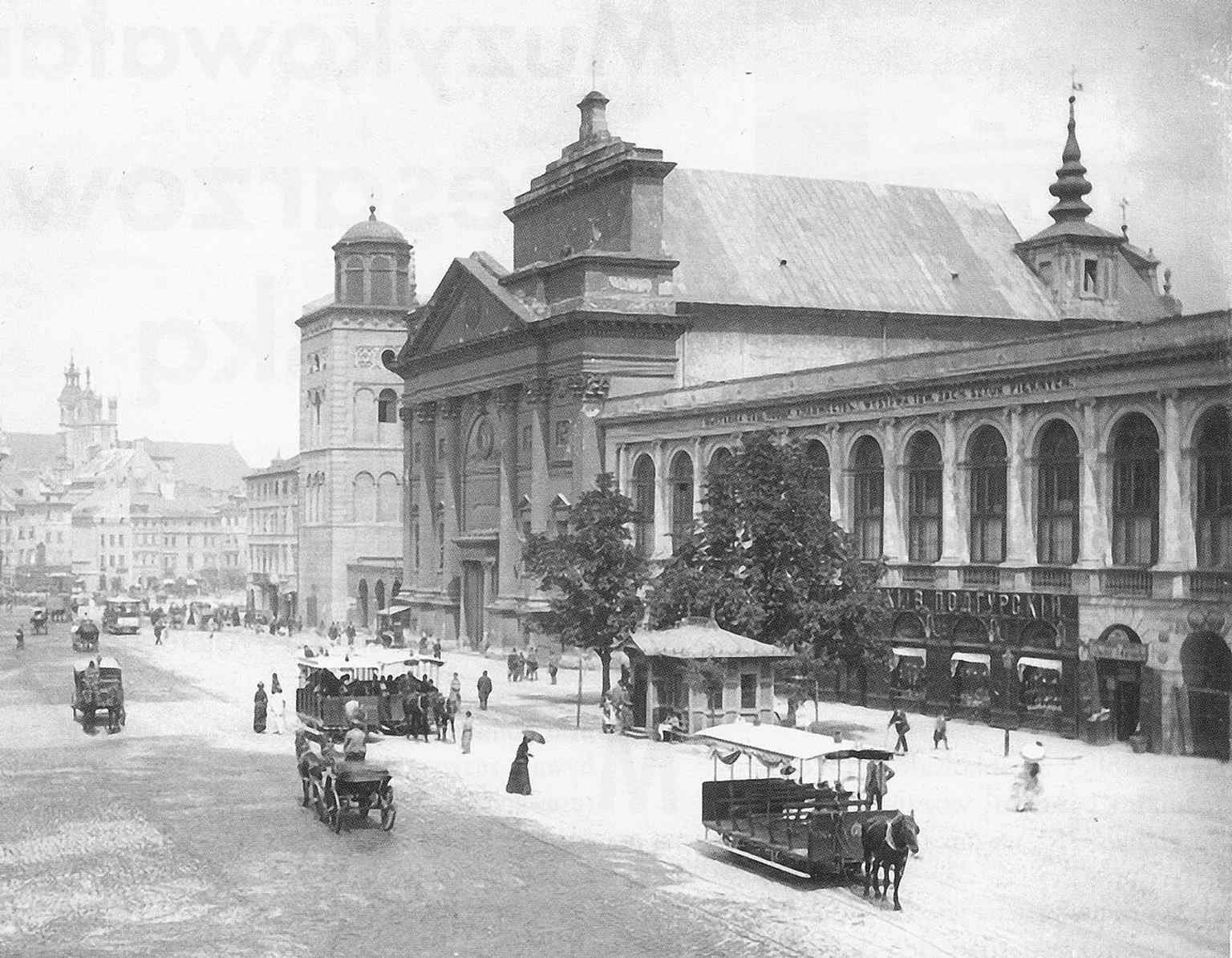
A 1890 view of Krakowskie Przedmieście with St. Anne’s Church in the distance, showing how the church anchored one of Warsaw’s main royal routes.Photo: Konrad Brandel, Wikimedia Commons, Public domain. Cropped & resized. 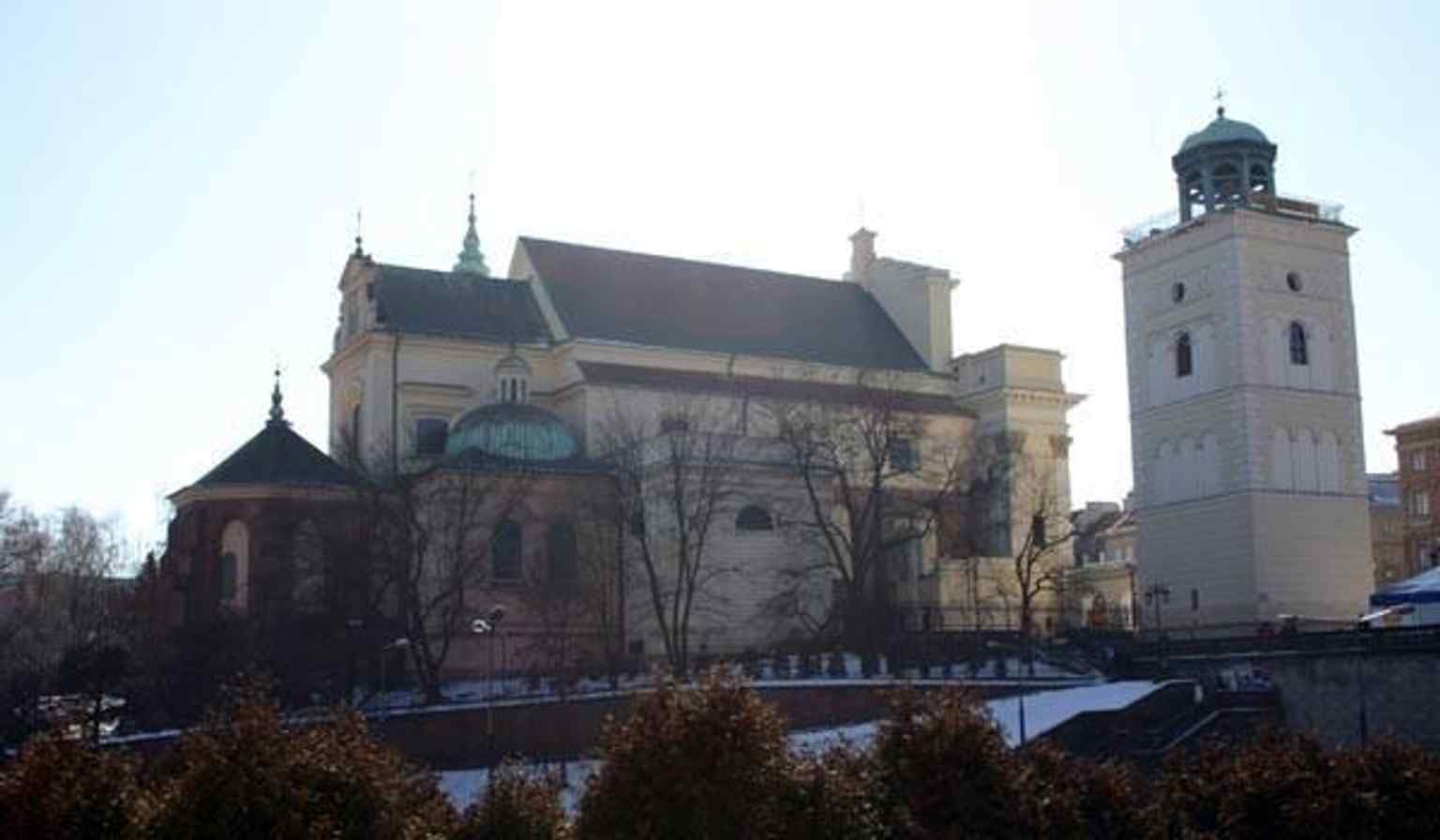
A clear modern view of the church exterior, highlighting the classicist façade added in the late 18th century by Piotr Aigner.Photo: Marek i Ewa Wojciechowscy, Wikimedia Commons, CC BY-SA 3.0. Cropped & resized. 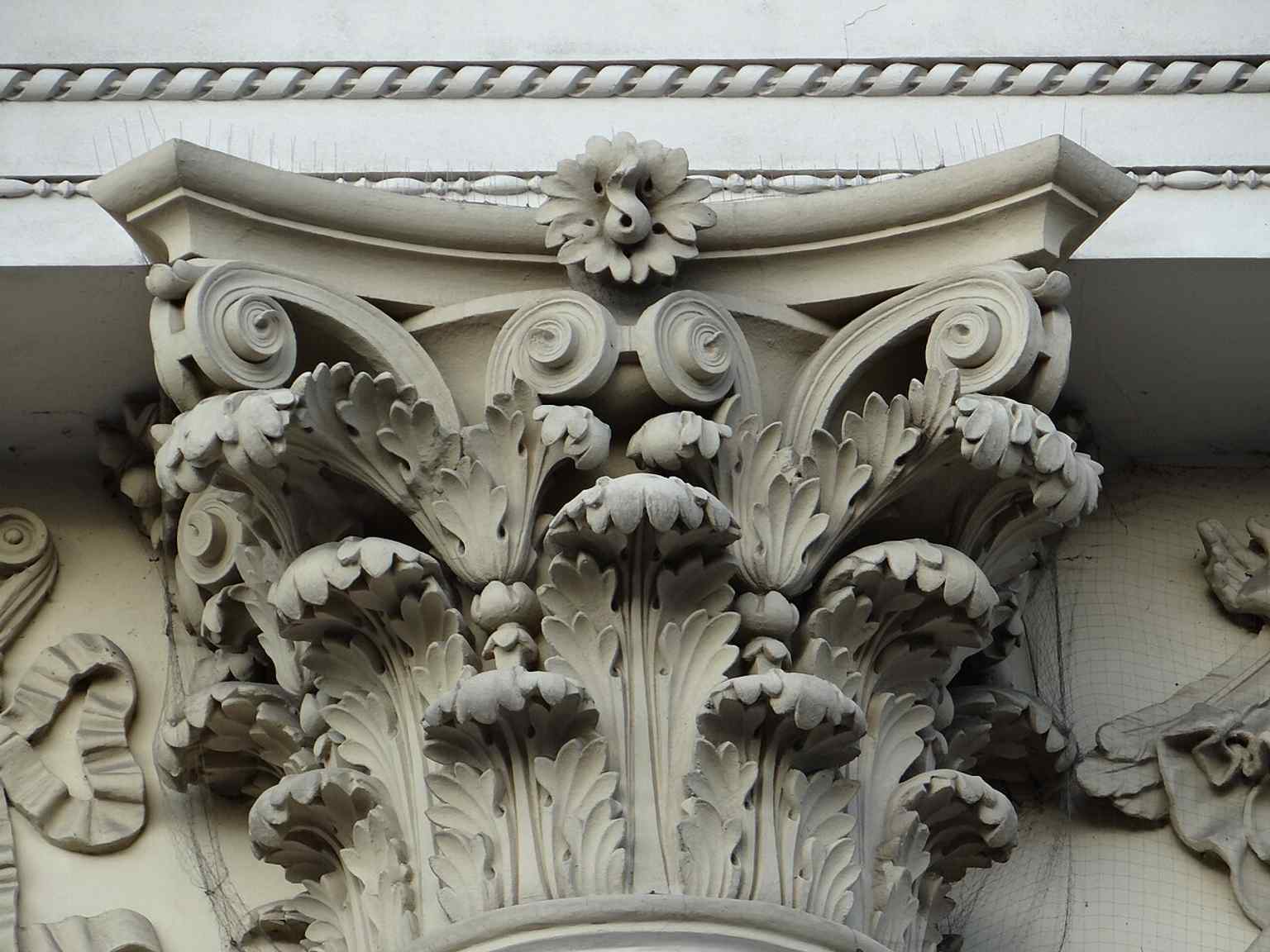
Corinthian capitals on the façade reveal the classical language of Aigner’s redesign, inspired by Palladian architecture.Photo: Jolanta Dyr, Wikimedia Commons, CC BY-SA 3.0 pl. Cropped & resized. 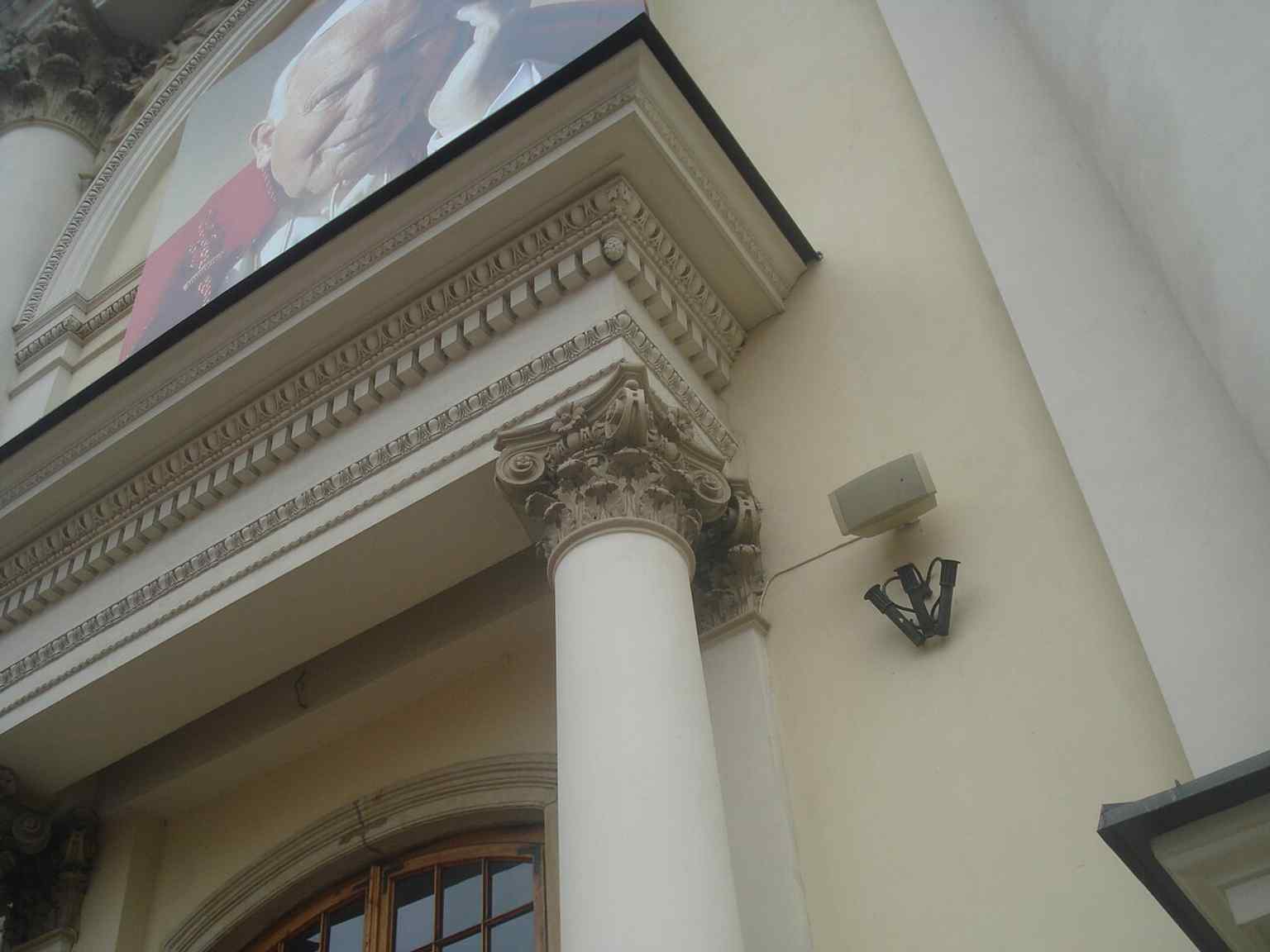
The decorated main entrance offers a close look at the sculptural details that give the façade its refined 18th-century character.Photo: Alma Pater, Wikimedia Commons, CC BY-SA 3.0. Cropped & resized. 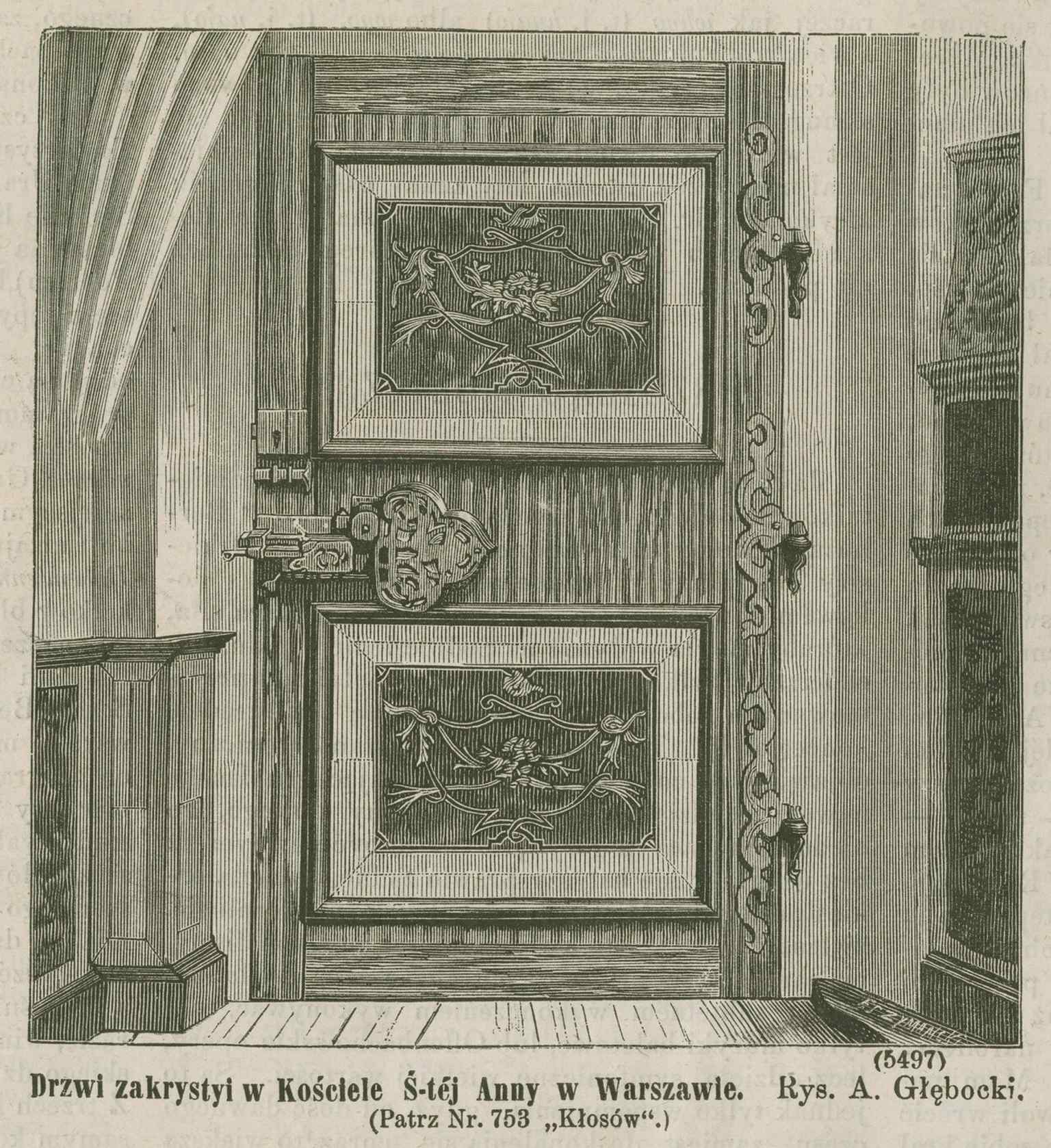
A drawing of the sacristy door shows the church’s preserved interior craftsmanship, beyond the better-known façade.Photo: Szymański, F. Ryt., Wikimedia Commons, Public domain. Cropped & resized. 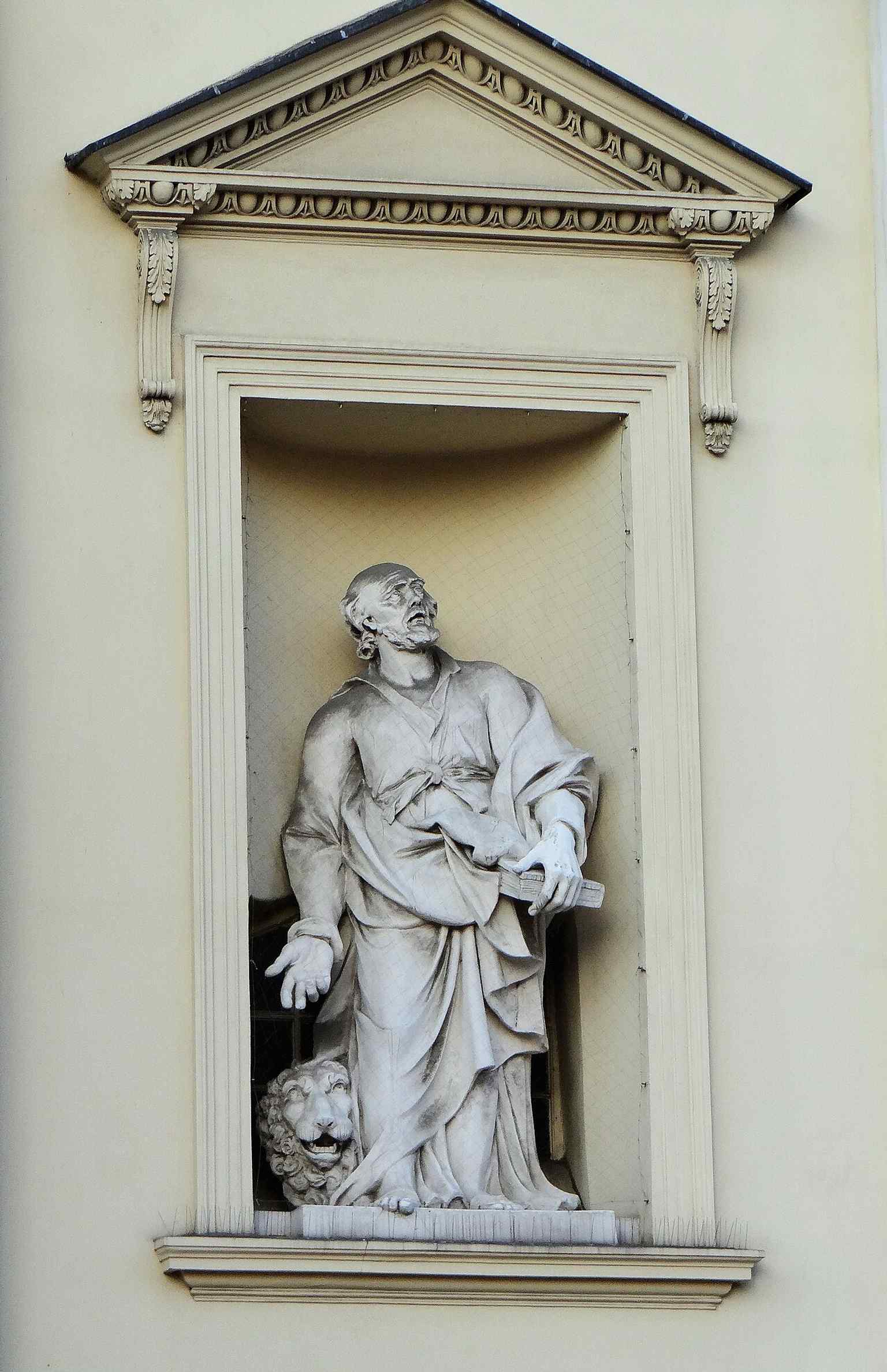
A high-resolution detail of the church’s exterior ornament, ideal for showing the rich stone carving added during later renovations.Photo: Jolanta Dyr, Wikimedia Commons, CC BY-SA 3.0 pl. Cropped & resized. 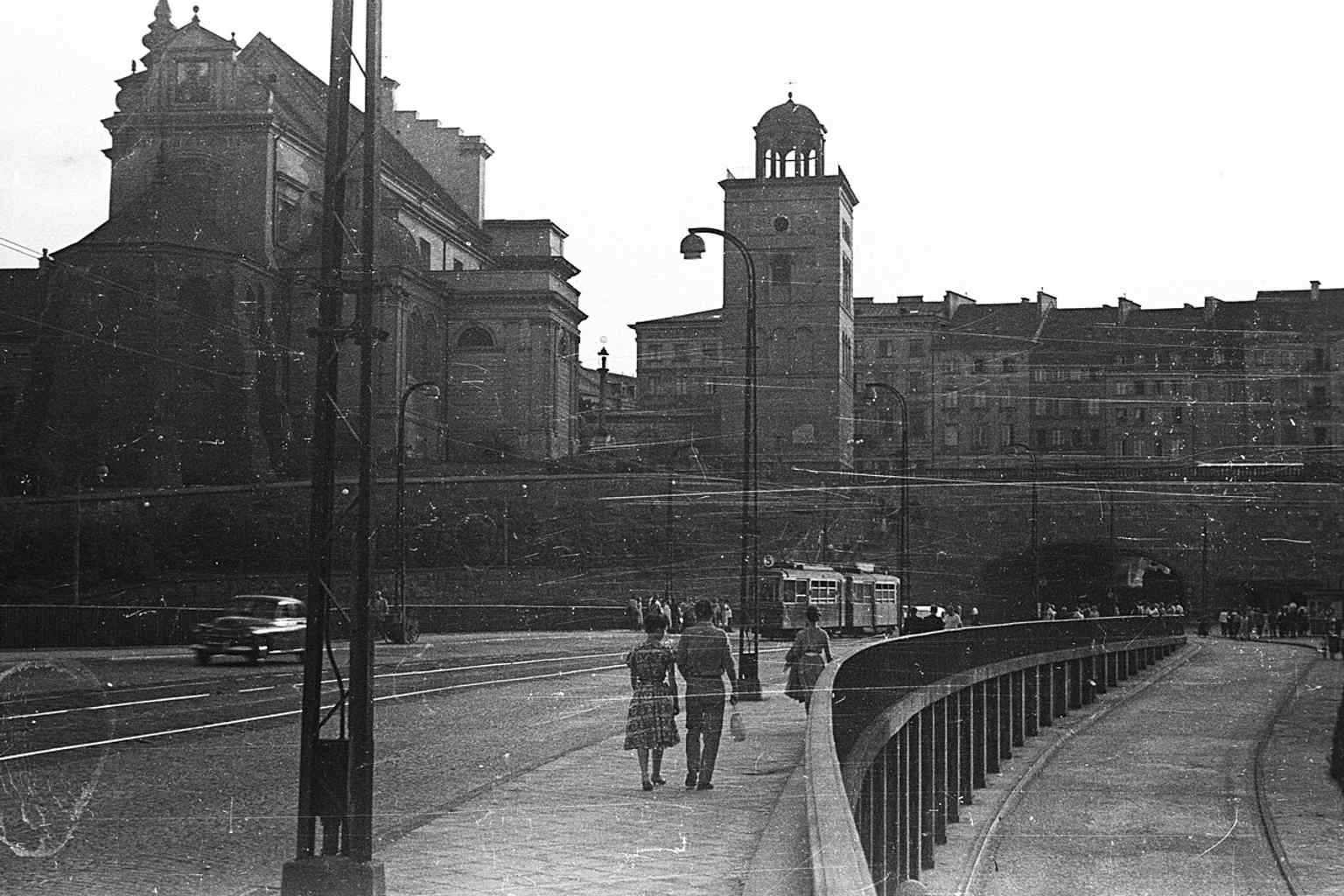
A broad city view from the bridge area places St. Anne’s Church in Warsaw’s skyline, close to the Royal Castle and Old Town.Photo: FOTO:Fortepan — ID 54652: Adományozó/Donor: Lencse Zoltán., Wikimedia Commons, CC BY-SA 3.0. Cropped & resized. 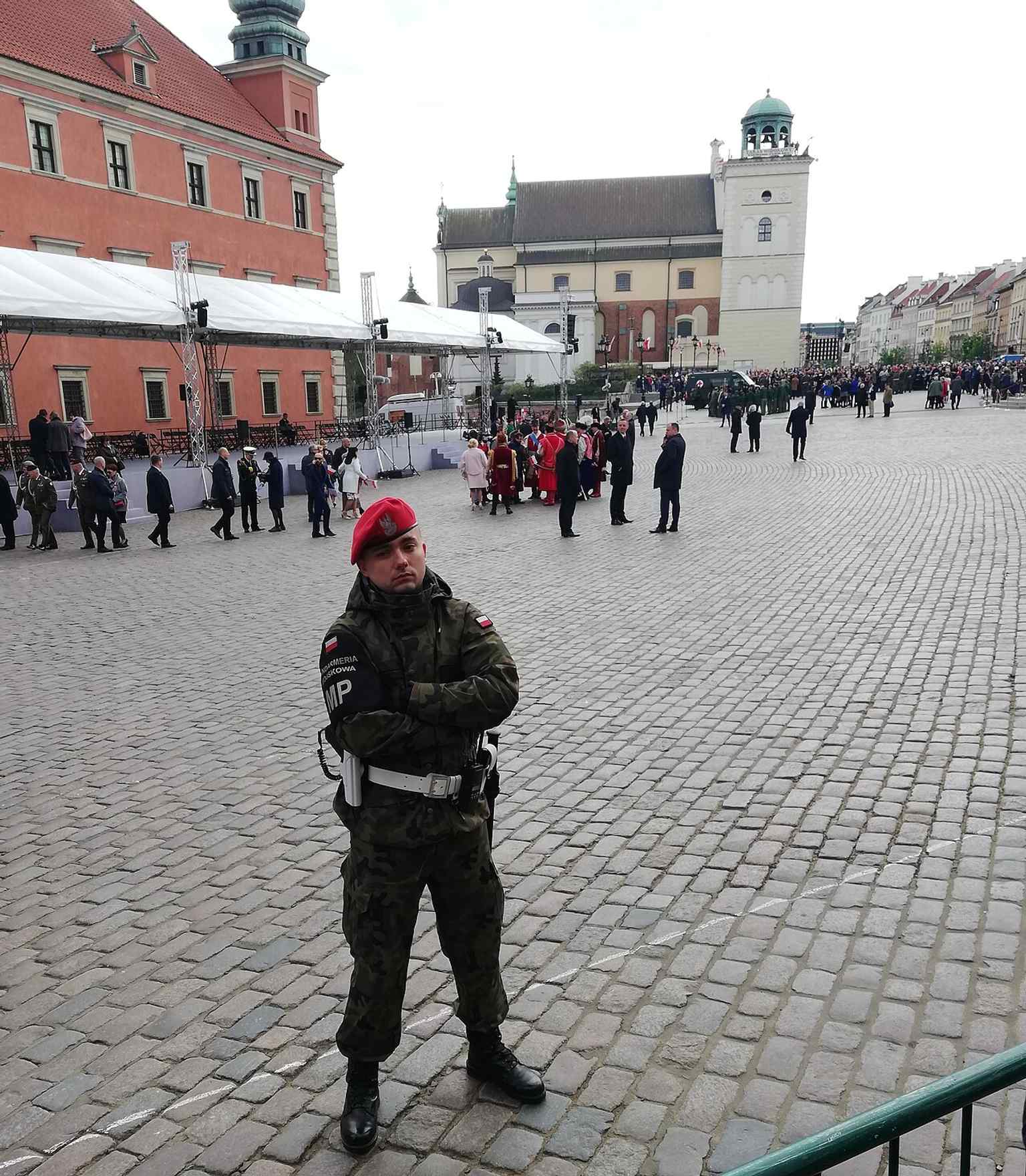
St. Anne’s Church rises behind Castle Square, a reminder of its prominent position at the edge of Warsaw’s historic center.Photo: Heshq, Wikimedia Commons, CC BY-SA 4.0. Cropped & resized. 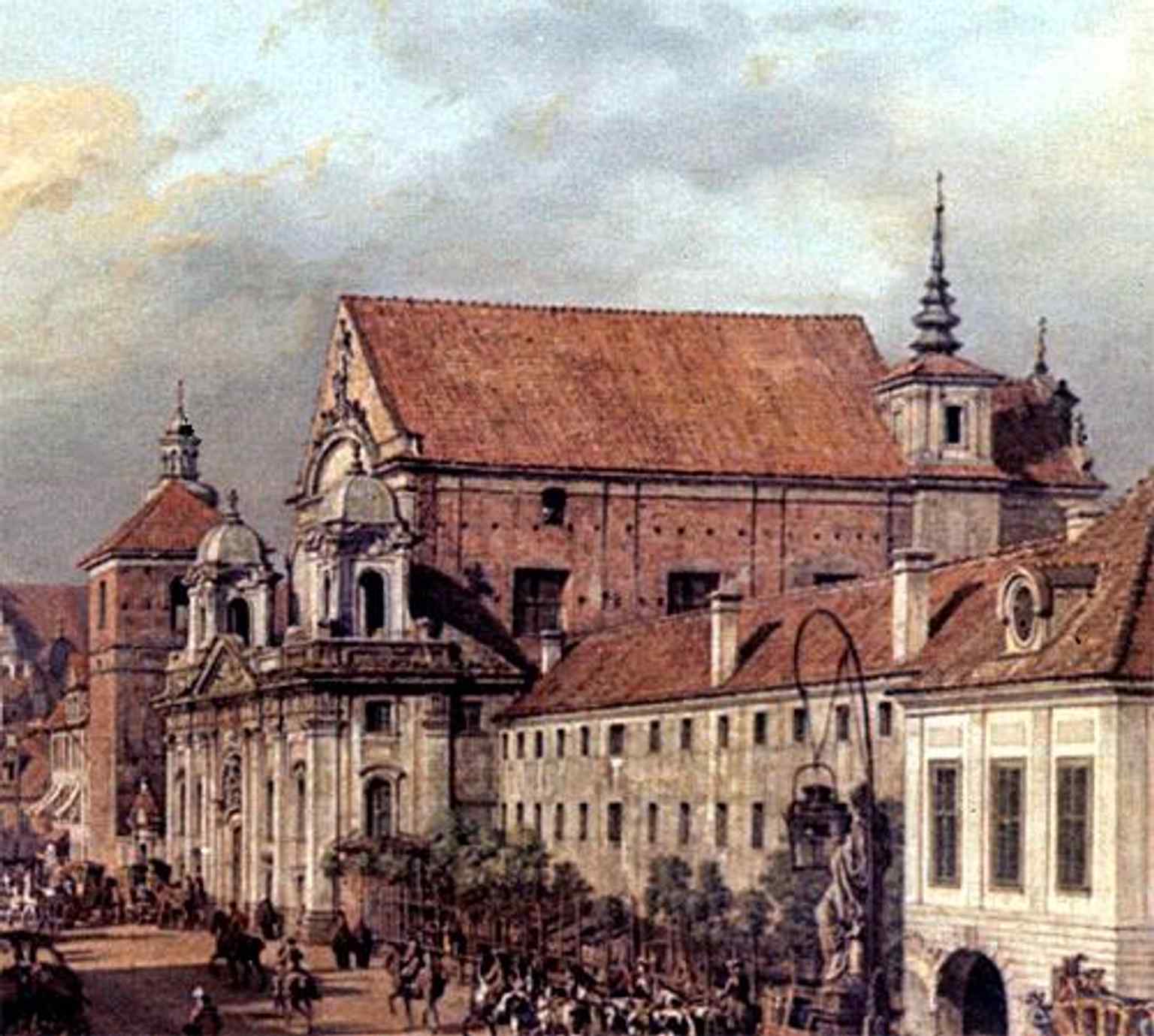
This 1774 print shows St. Anne’s Church in an older Warsaw streetscape, long before the neoclassical façade was completed.Photo: Bernardo Bellotto, Wikimedia Commons, Public domain. Cropped & resized. On your left, a tall stone column rises from a square pedestal, topped by a bronze crowned king in armor, with a sword in one hand and a cross braced beside him. This is…Read moreShow less
Open dedicated page →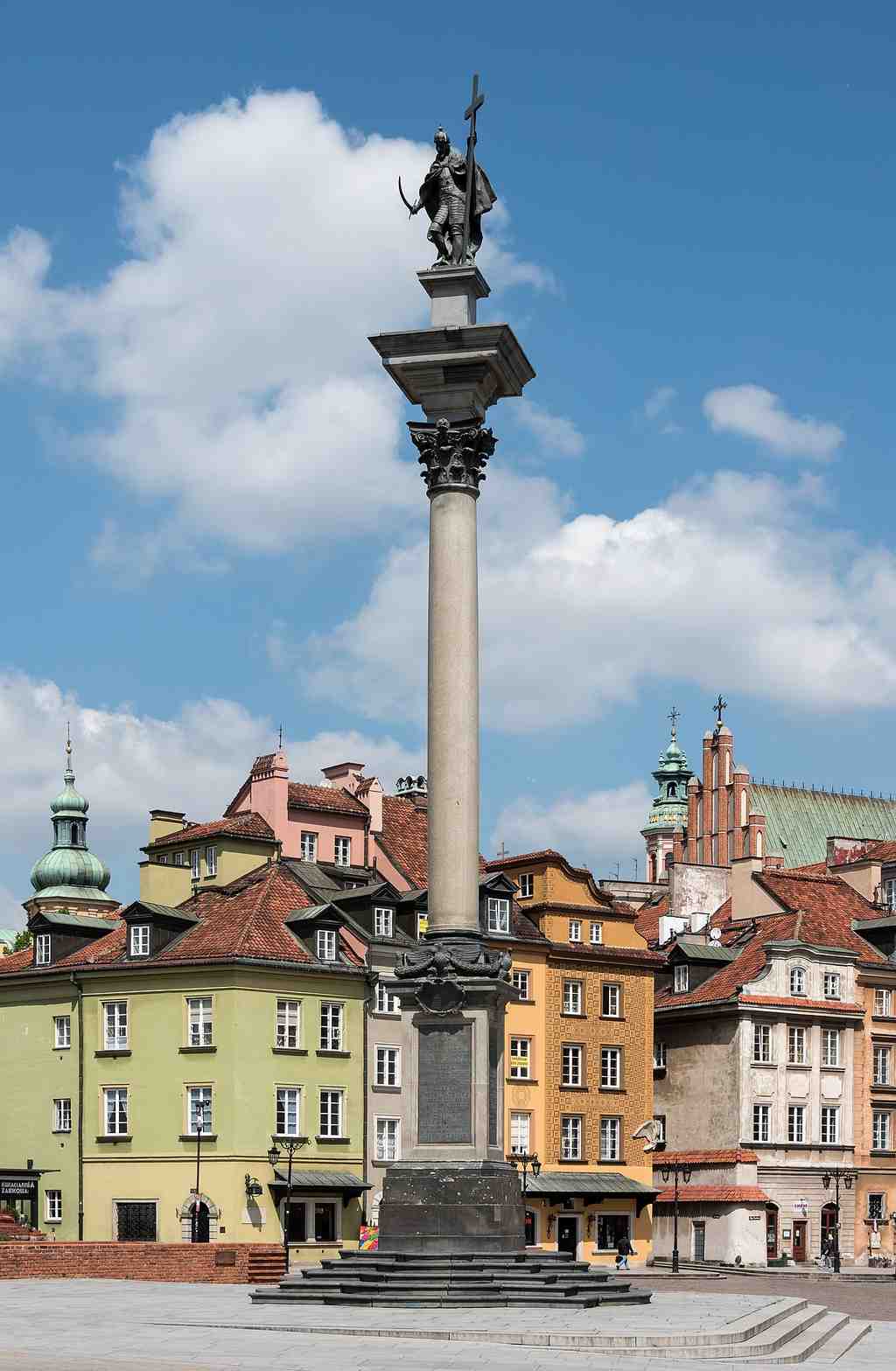
Column of Sigismund III VasaPhoto: Adrian Grycuk, Wikimedia Commons, CC BY-SA 3.0 PL. Cropped & resized. On your left, a tall stone column rises from a square pedestal, topped by a bronze crowned king in armor, with a sword in one hand and a cross braced beside him.
This is Sigismund’s Column, and it is doing much more than honoring a dead king. When Władysław the Fourth raised it here in the sixteen forties for his father, Sigismund the Third Vasa, he was making a public argument. The Vasa dynasty - that is, the royal family line ruling from this castle - used display, ceremony, and symbols to say, plainly, “we belong at the center of power.” And here, right in front of the royal residence and at the city’s key crossroads, they said it in stone and bronze.
That choice was bold enough to rattle church nerves. In Europe at the time, columns crowned with figures usually belonged to saints, sacred figures, or ancient emperors from memory. A living political dynasty putting a secular ruler up on a column like this? That was new, and more than a little cheeky. The papal nuncio, Mario Filonardi, objected most strongly to exactly that point: a worldly king lifted into a form people associated with holy elevation. So from the beginning, this monument carried a little static in the air.
Take a second and look at how it dominates the square. Height, visibility, and that tight link to the castle were not decoration... they were the message. Warsaw was becoming a stage, and this column gave the leading actor a very tall mark to stand on.
The statue itself tells the story. Sigismund wears old-style armor and a richly decorated coronation cloak, with a crown on his head. In his right hand he lifts a saber; with his left he steadies a Latin cross. Sword and faith, rule and devotion - no subtlety here, folks. If you want a closer look at that pose, open the statue detail on your screen.
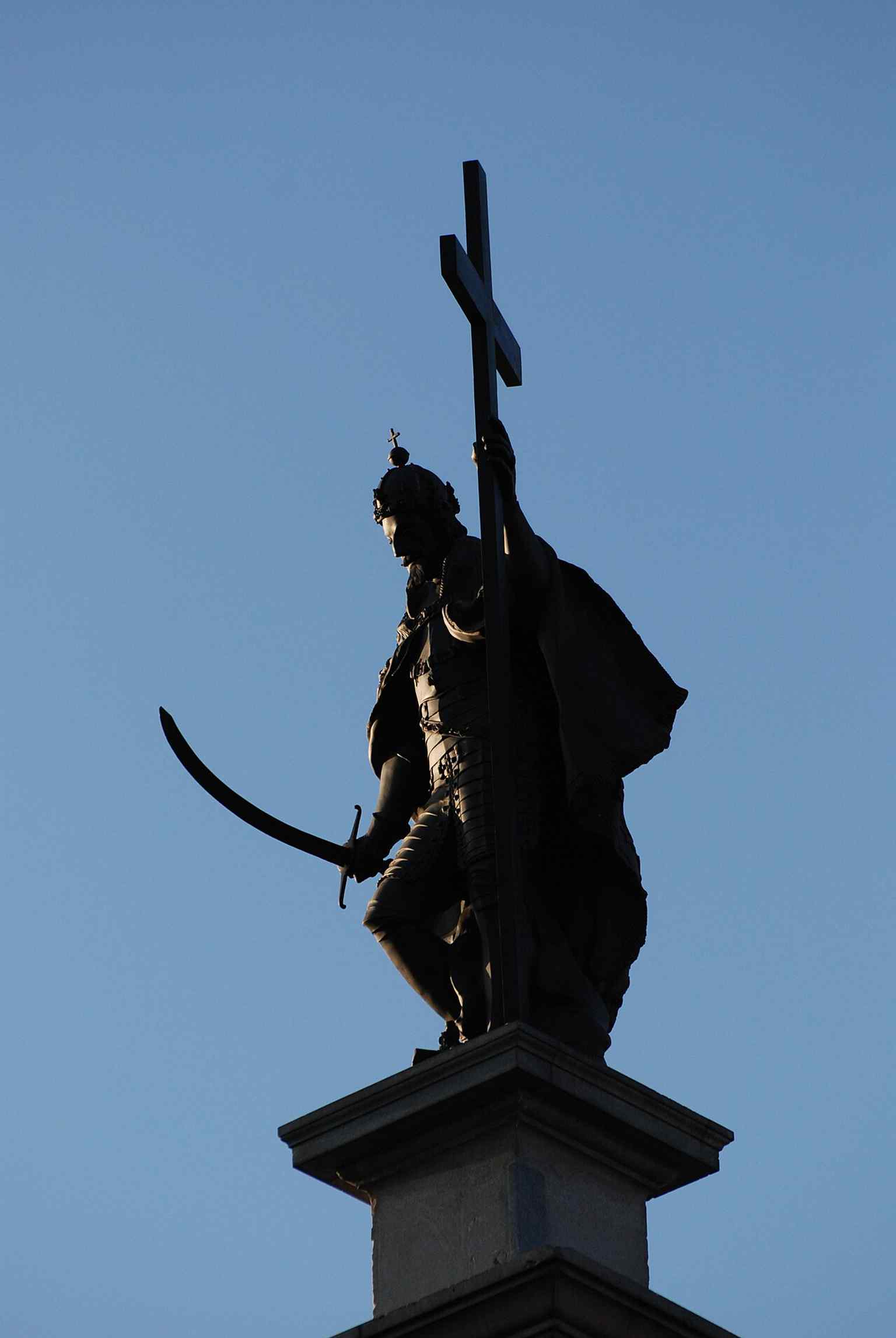
The crowned king with sword and cross — the exact bronze figure that made this the first secular column monument in modern Europe.Photo: TenKobuz, Wikimedia Commons, CC BY-SA 3.0 pl. Cropped & resized. The bronze king came from sculptor Clemente Molli, brought from Bologna, and the casting likely happened here in Warsaw under Daniel Tym, the royal founder who also made the inscription plaques. The original shaft was even more dramatic: one huge block of local conglomerate stone from Czerwona Góra, nicknamed “Zygmuntówka” for its speckled, almost marbled pattern. Workers floated it up the Vistula, then about three hundred men, backed by two hundred royal guards, rolled it into place in a single day.
And like so much in Warsaw, the monument did not remain untouched. It suffered damage in wars, got rebuilt in the nineteenth century, and in September of nineteen forty-four German forces brought it down. The king survived the fall with surprisingly limited damage, and after the war metalworkers and other labor unions pushed to restore him. When the column returned in nineteen forty-nine, they shifted it slightly and turned Sigismund to face Krakowskie Przedmieście. If you want the square’s transformation in one glance, the image in the app shows how the column’s setting changed after the war.
So this column is not just a statue. It is an announcement: dynasty, ambition, faith, victory, and survival, all planted in public view. Now let your eyes travel straight toward the Royal Castle it was meant to glorify... that’s our next stop, about one minute away. And like the square itself, this monument is always accessible - open all day, every day.
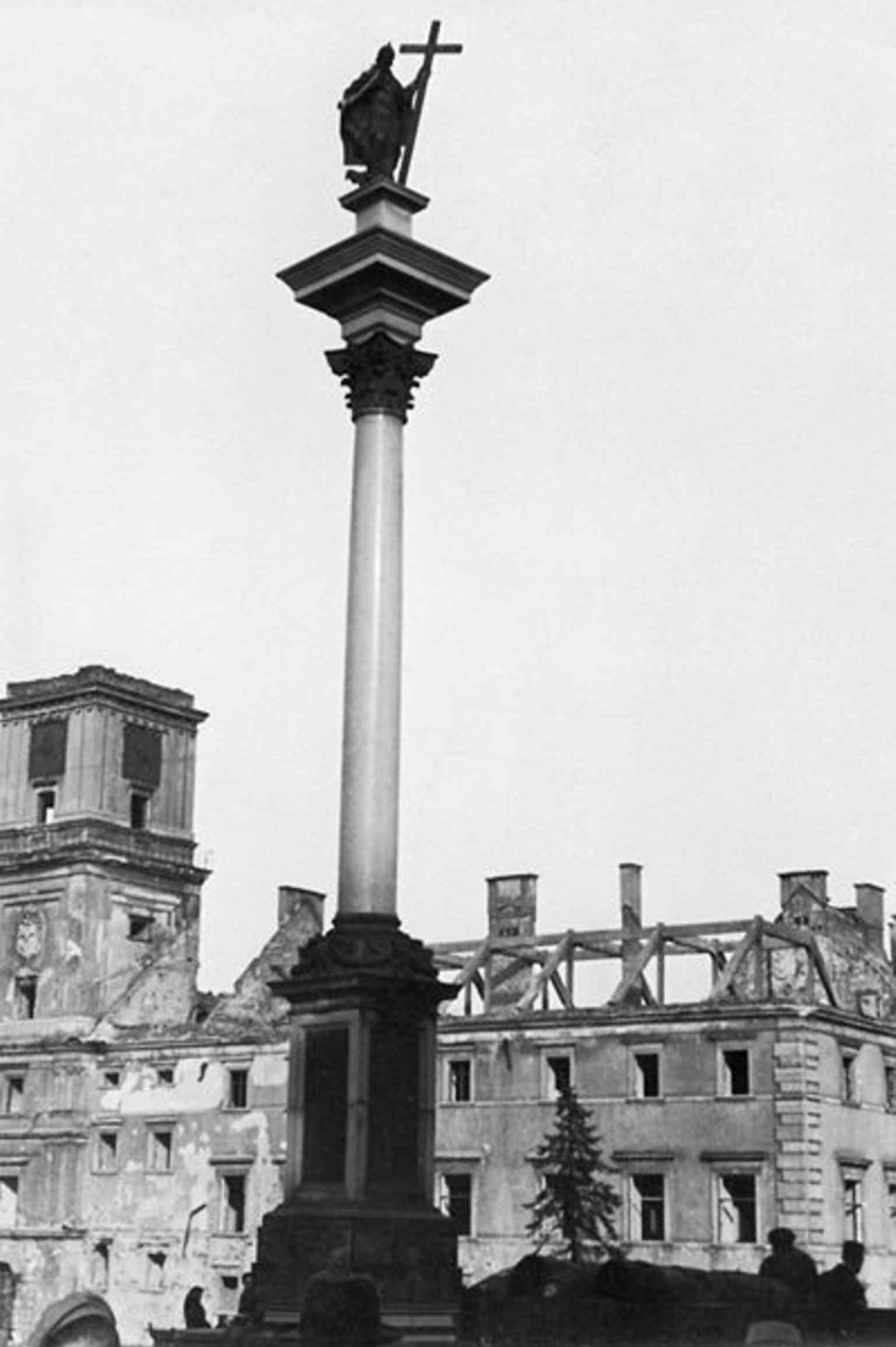
The column standing before the ruined Royal Castle in 1941 — a stark wartime view of Warsaw’s royal heart.Photo: Documentation cell of Armia Krajowa, Wikimedia Commons, Public domain. Cropped & resized. 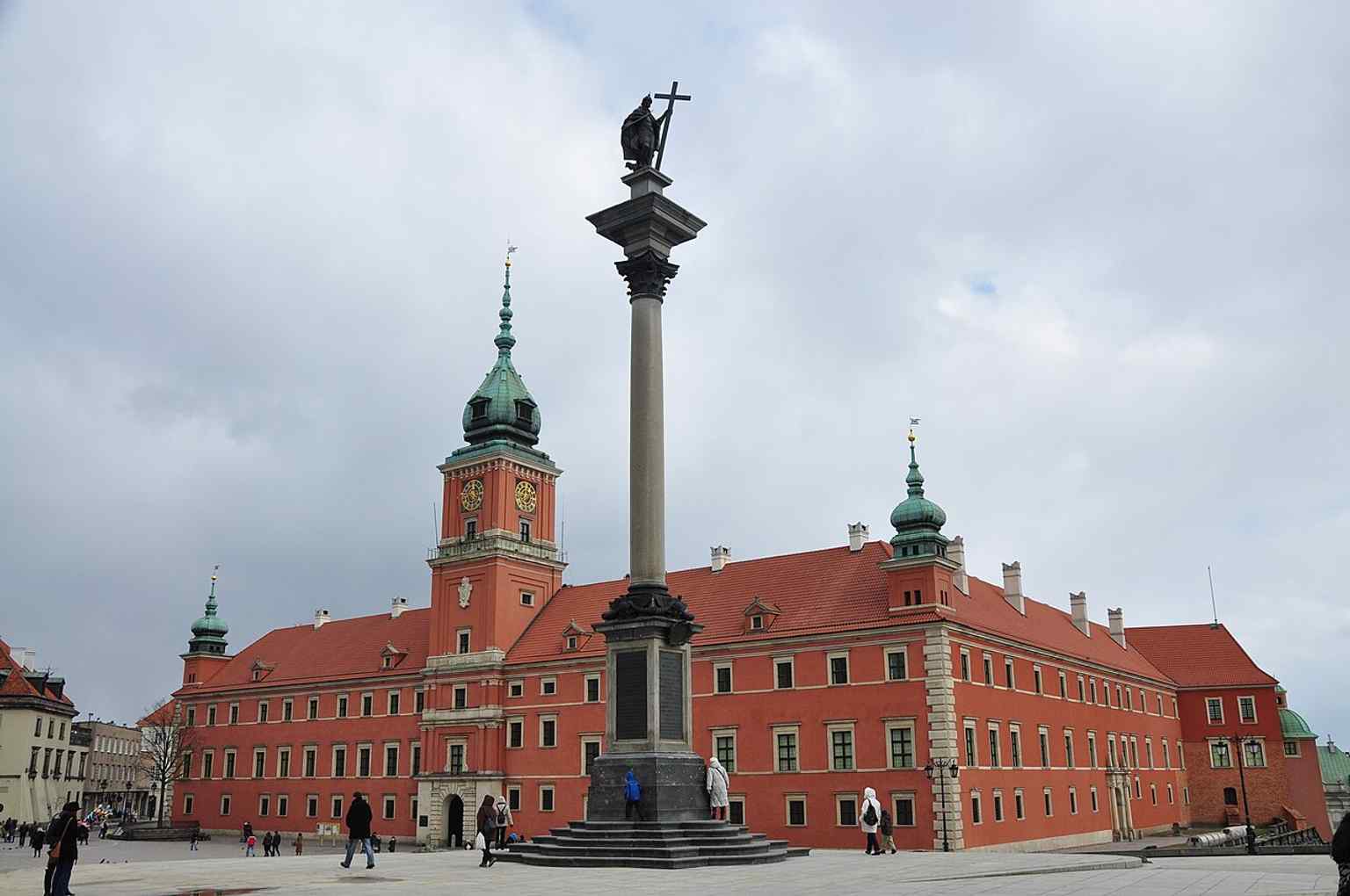
A clear wide view of Sigismund’s Column beside the Royal Castle, showing how it anchors Castle Square today.Photo: Spitfire303, Wikimedia Commons, CC BY-SA 3.0 pl. Cropped & resized. 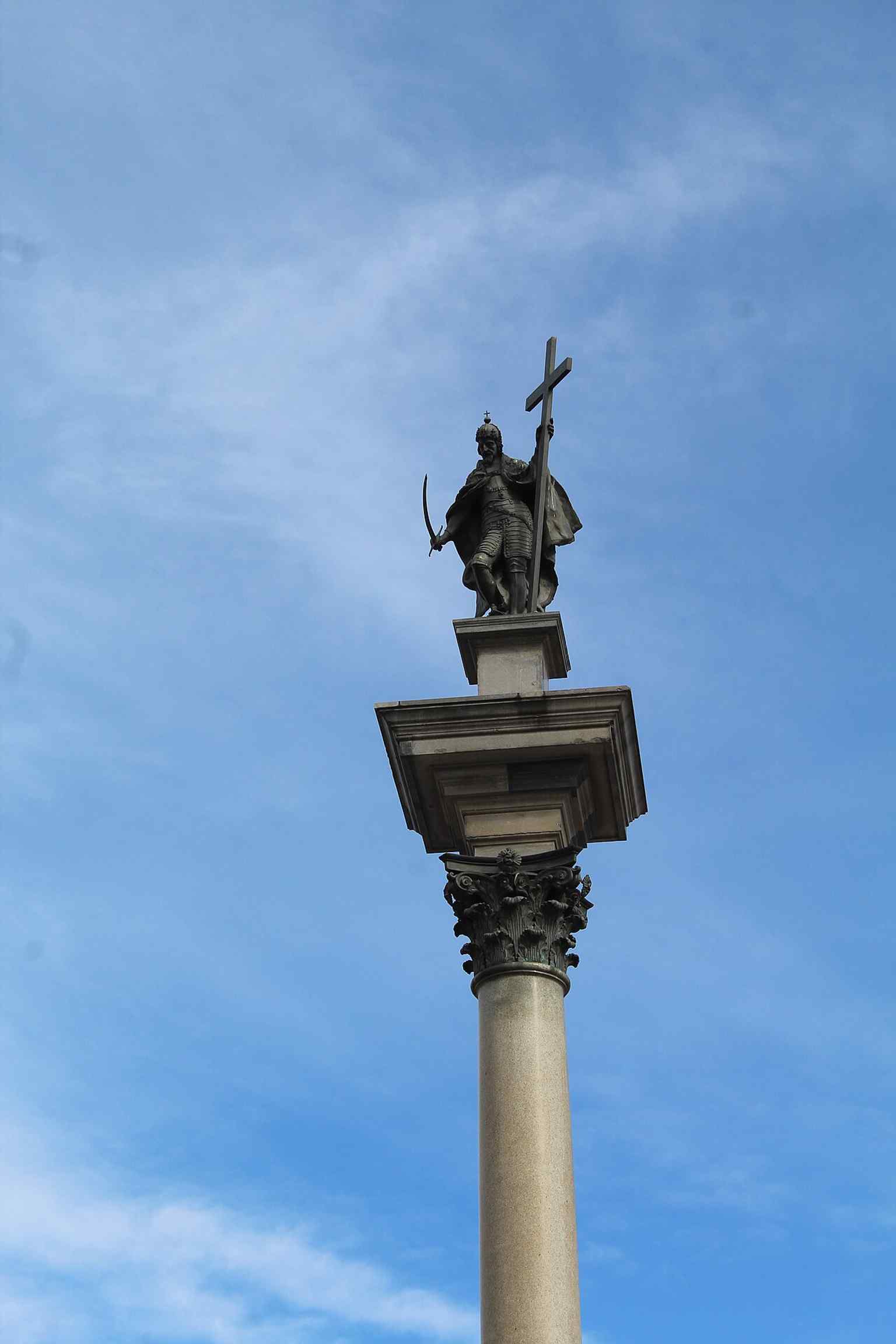
A close look at the statue’s upper section, useful for telling the story of the king’s iconic pose and bronze craftsmanship.Photo: 1312anna97, Wikimedia Commons, CC BY-SA 4.0. Cropped & resized. 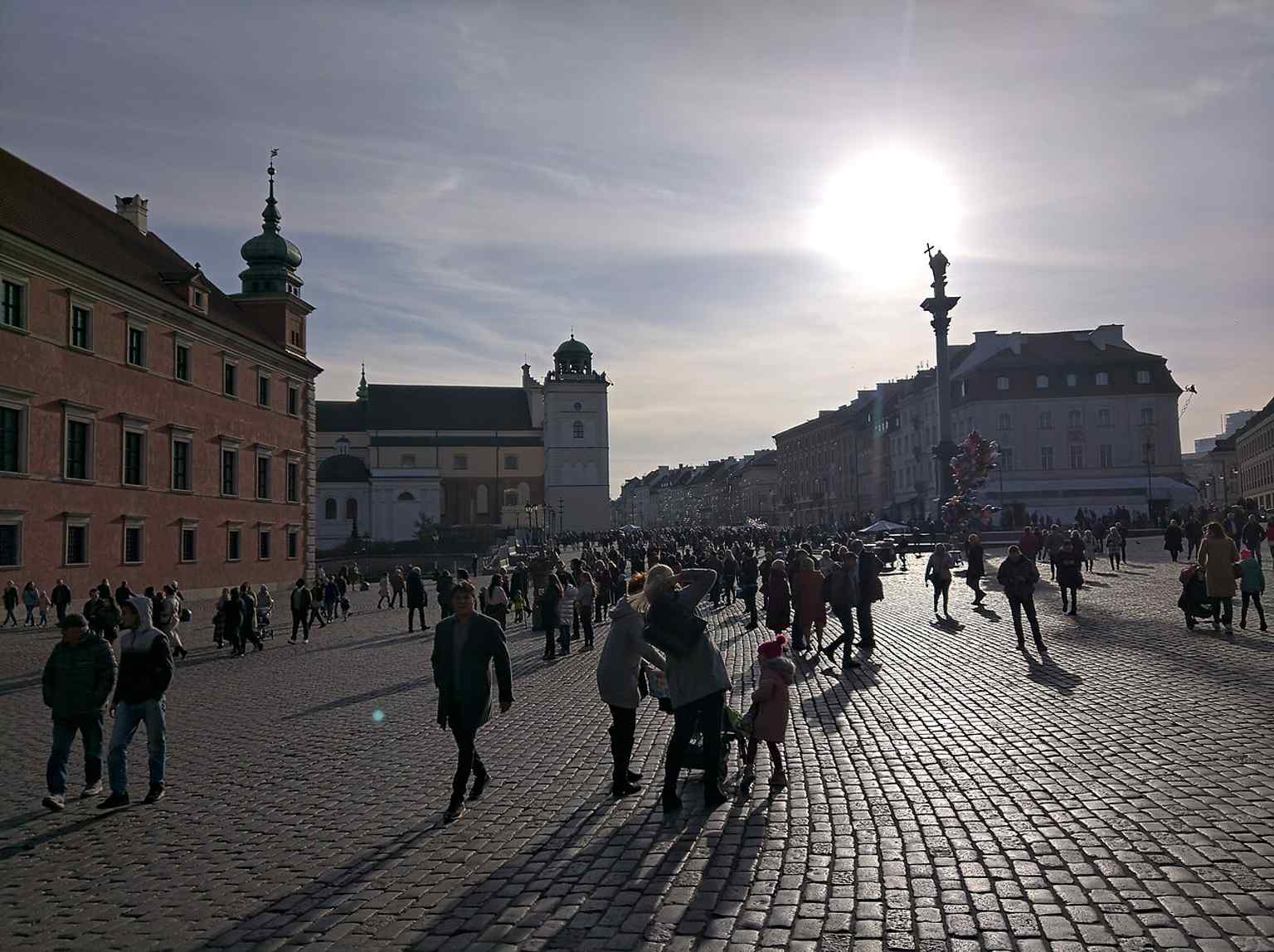
A view toward Krakowskie Przedmieście, matching the historical orientation of the monument before the wartime destruction and rebuilding.Photo: Wulfstan, Wikimedia Commons, CC BY-SA 4.0. Cropped & resized. 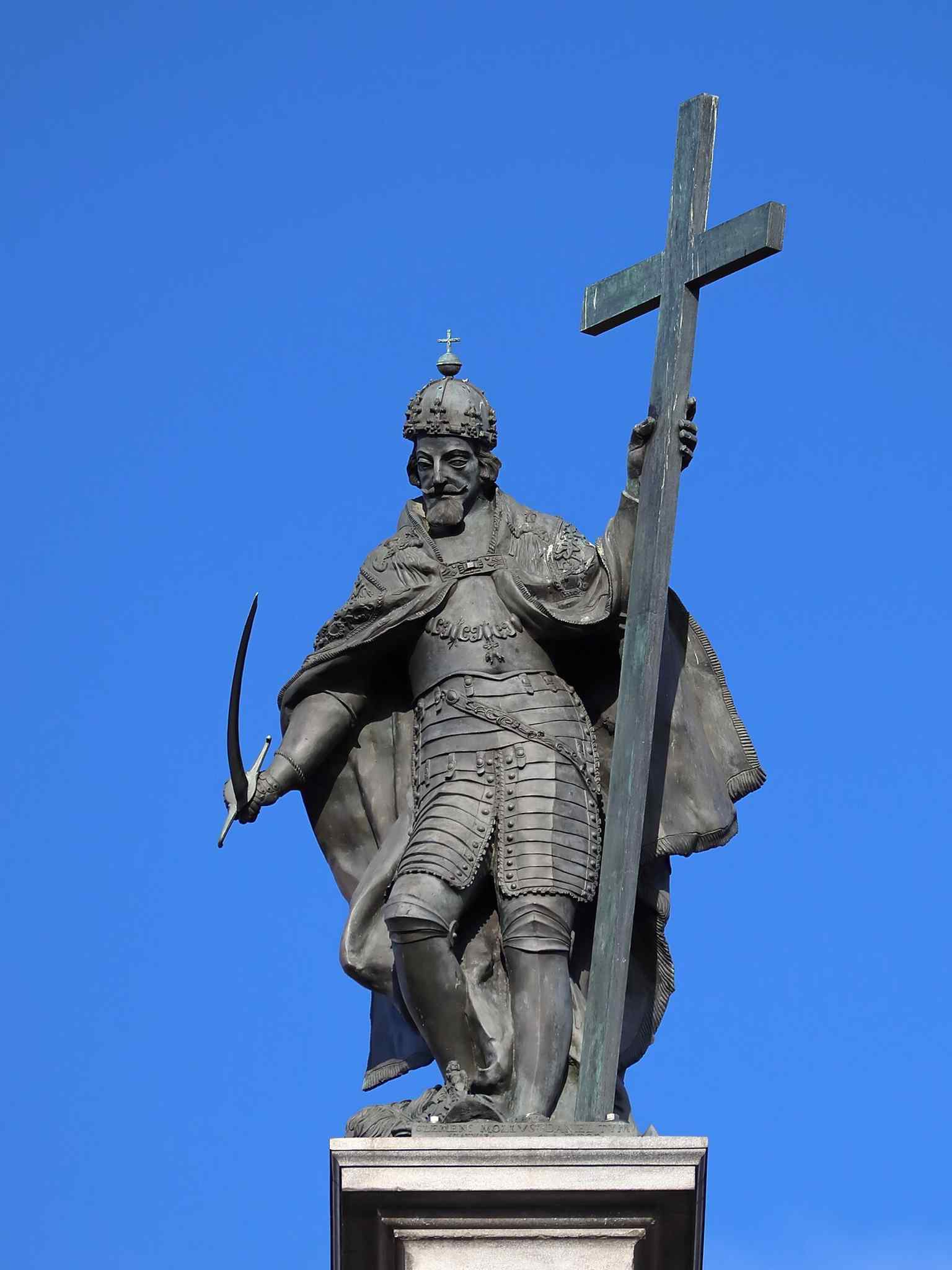
The restored king figure in sharp detail — a good image for the postwar reconstruction completed in 1949.Photo: Cybularny, Wikimedia Commons, CC BY-SA 4.0. Cropped & resized. 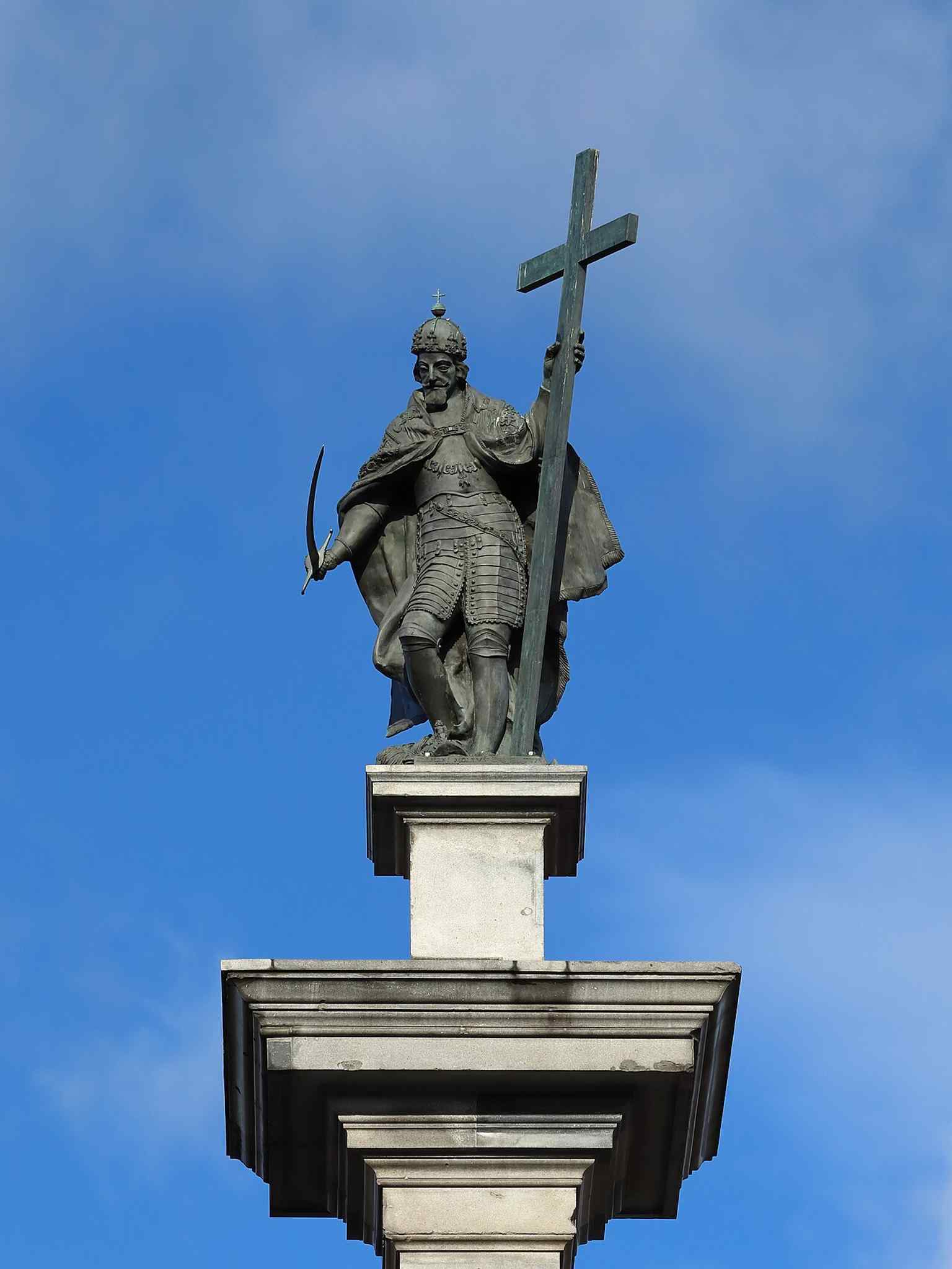
Another close detail of the monument’s bronze ruler, emphasizing the sword, cross, and royal regalia described in the source.Photo: Cybularny, Wikimedia Commons, CC BY-SA 4.0. Cropped & resized. 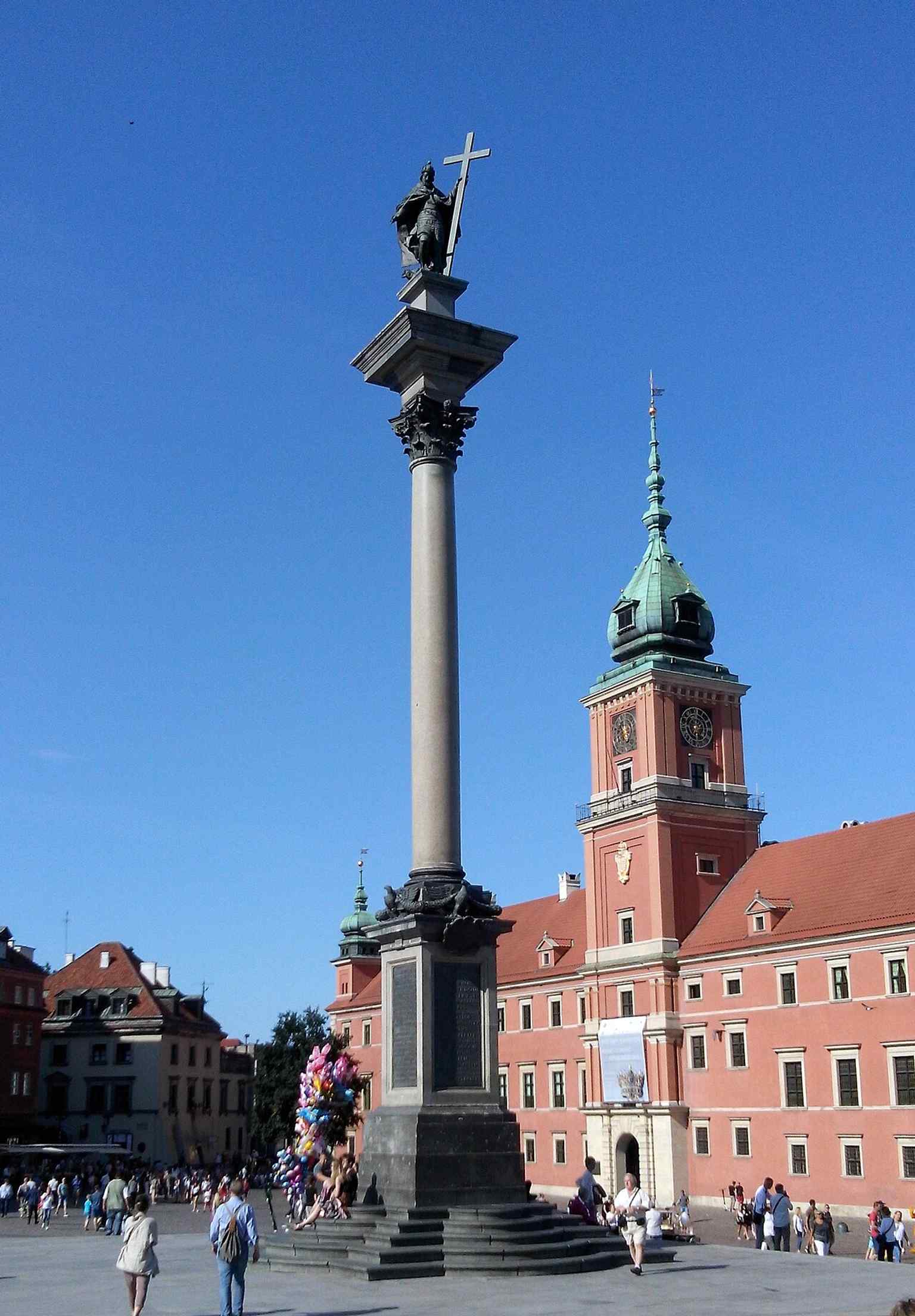
A compact contemporary view of the column on Castle Square, showing the monument as a freestanding city landmark.Photo: Shev.vl.vas, Wikimedia Commons, CC BY-SA 4.0. Cropped & resized. 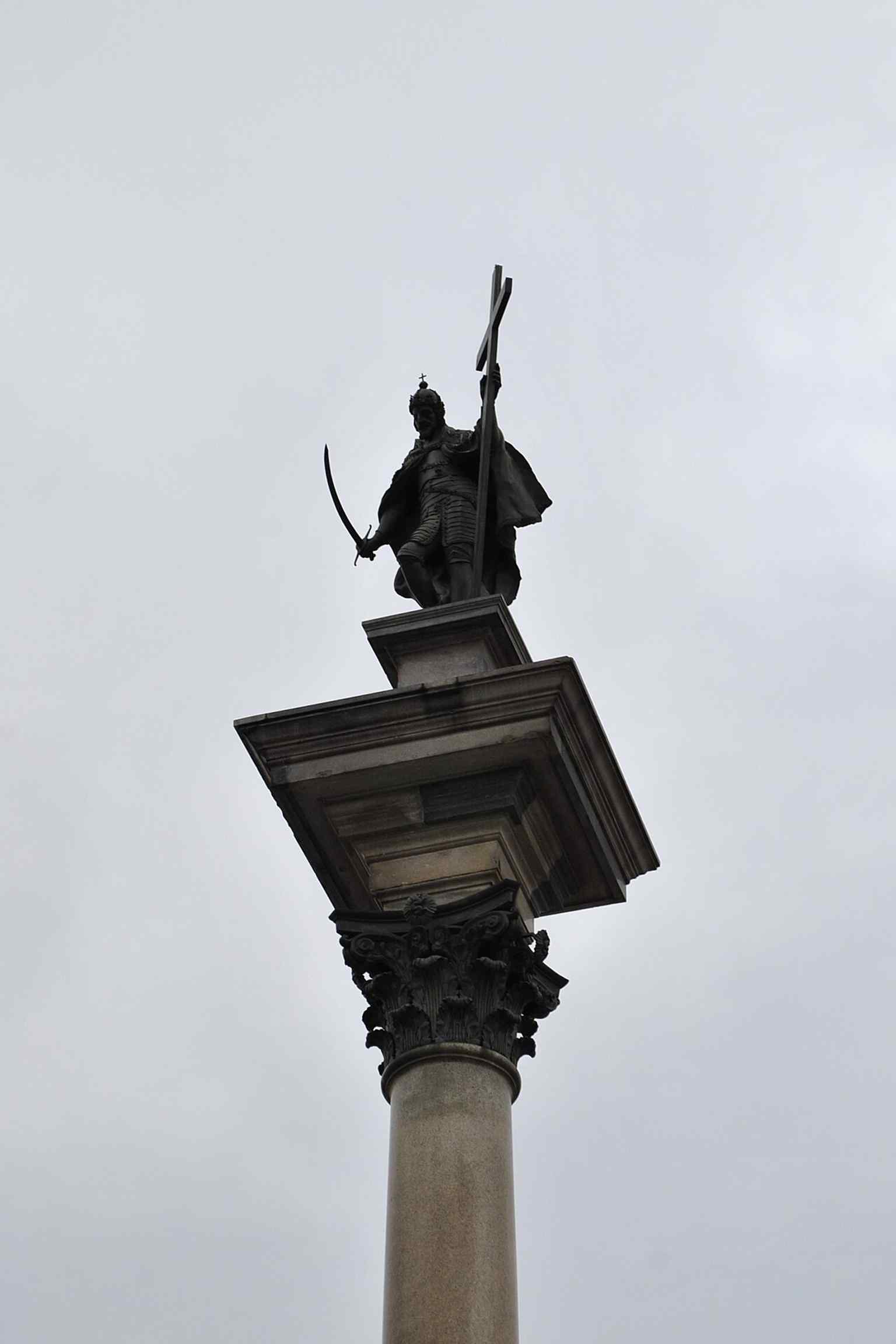
The column seen from across Castle Square — useful for explaining its prominent public location in Warsaw’s historic center.Photo: Marek Mróz, Wikimedia Commons, CC BY 4.0. Cropped & resized. Look for the long brick-red palace front, stretched in a broad rectangle and crowned by a square clock tower with a dark spire and gold clock faces. This is the hinge of…Read moreShow less
Open dedicated page →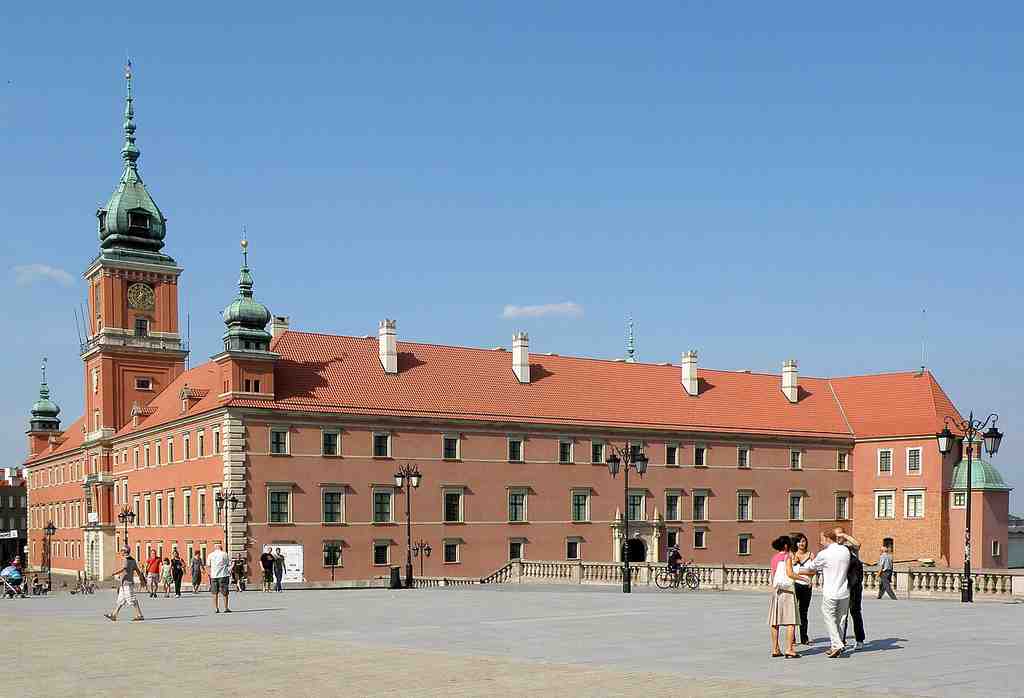
Royal Castle in WarsawPhoto: Ala z, Wikimedia Commons, CC BY-SA 3.0. Cropped & resized. Look for the long brick-red palace front, stretched in a broad rectangle and crowned by a square clock tower with a dark spire and gold clock faces.
This is the hinge of Warsaw’s story. Before it became a museum, this was the working seat of power: first the residence of the Mazovian dukes, then, from the sixteenth century on, the home of the king and the Sejm, the parliament of the Polish-Lithuanian Commonwealth. Not just a palace, then... more like the nation’s front office.
The king you met on the column, Sigismund the Third Vasa, helped make this place the real center of rule. He moved the court permanently to Warsaw and expanded the castle into a grand five-sided residence with an inner courtyard. That was Vasa self-display at full strength: if you shift the center of a kingdom, you give it a proper stage set.
Inside these walls, ceremony and argument lived side by side. In the Senate Chamber, on the third of May, seventeen ninety-one, deputies adopted the Constitution of the Third of May, one of Europe’s great reform documents. A little later, those same lawmakers walked straight to Saint John’s to swear it again in public worship. We’ll follow that path soon.
And here, really, the rebirth of the Old Town comes into focus. After almost total destruction, people in Poland did not treat this castle as a ruin to admire from a distance, or as a blank lot for something modern and shiny. They chose continuity. They rebuilt the symbol on purpose, knowing full well that rebuilding is also a declaration of identity.
The cost of losing it was painfully human. During the bombardment in September nineteen thirty-nine, German fire set the castle ablaze. On the seventeenth of September, Kazimierz Brokl, the castle’s curator, died here. That matters. The catastrophe did not only smash roofs and halls; it killed people who were trying to protect memory itself.
Then came planned stripping and destruction. German teams removed floors, marble, fireplaces, and carved stone. Adolf Hitler ordered the castle blown up in October nineteen thirty-nine, and in September nineteen forty-four the remains were deliberately demolished. If you want, take a quick look at the historic comparison in the app; the burned shell beside the restored façade says more than a speech ever could.
What stands here now rose through one of Poland’s most meaningful reconstructions. Stanisław Lorentz and others secretly documented the losses during the occupation, and later the Citizens’ Committee for rebuilding led the work from nineteen seventy-one to nineteen eighty-four. People across the country funded it through public donations. Even the clock became a statement: when it restarted in July nineteen seventy-four, it began at eleven fifteen, the exact moment its hands had stopped in nineteen thirty-nine.
If you glance at the image of the Former Deputies’ Chamber on your screen, you’ll see the political heart of the place restored, not just the shell.
So this castle is both ancient and modern: a royal residence, a parliamentary landmark, a wartime wound, and a carefully chosen answer to erasure. In a moment, we’ll head to the Archcathedral Basilica of Saint John the Baptist, where the castle’s political drama continued in sacred space. If you want to come back inside later, the museum is generally open Tuesday through Sunday from ten to six, and closed on Monday.
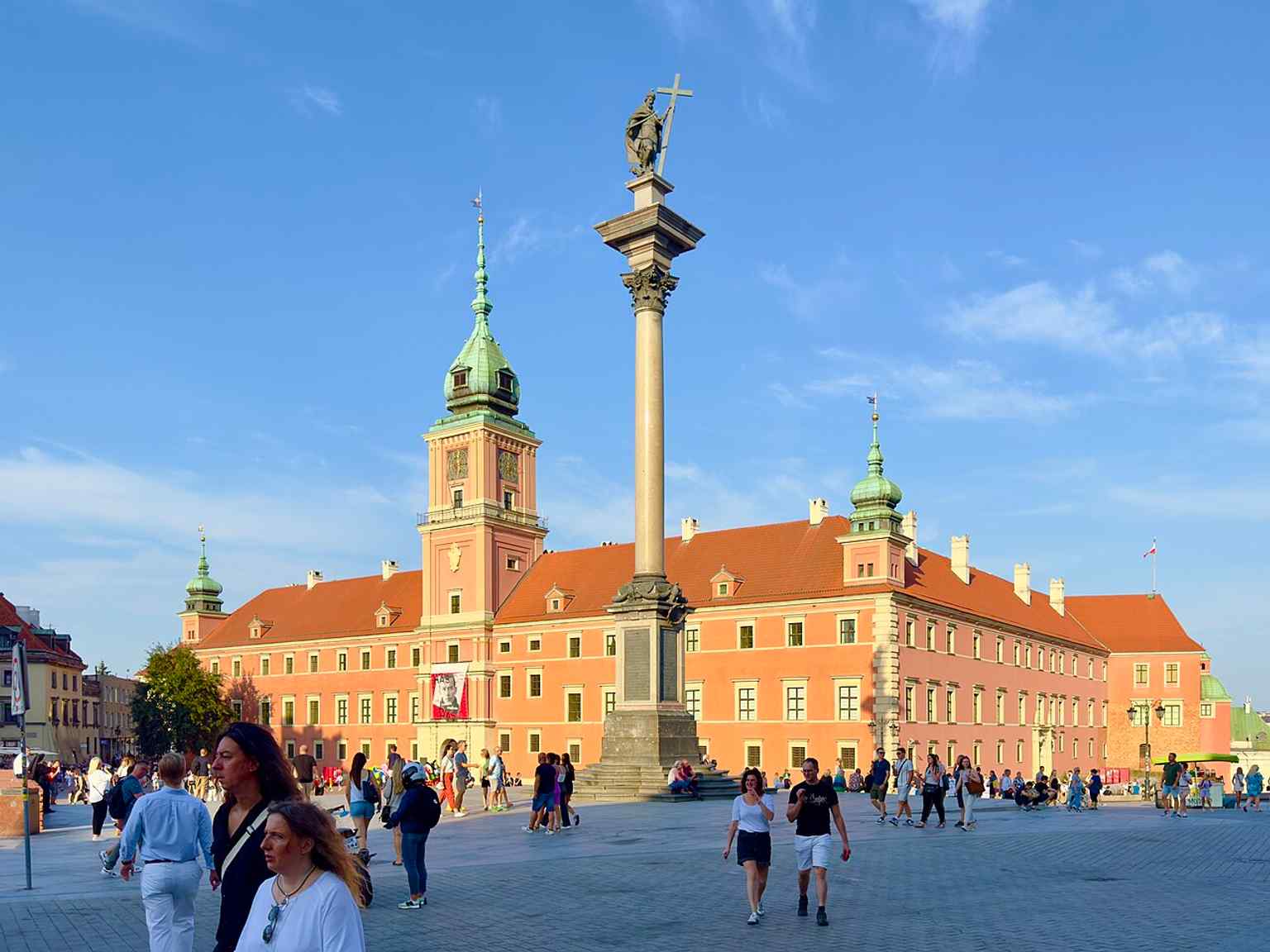
The western façade in 2024, emphasizing the castle’s monumental city-front presence near the historic Old Town.Photo: Chris Olszewski, Wikimedia Commons, CC BY-SA 4.0. Cropped & resized. 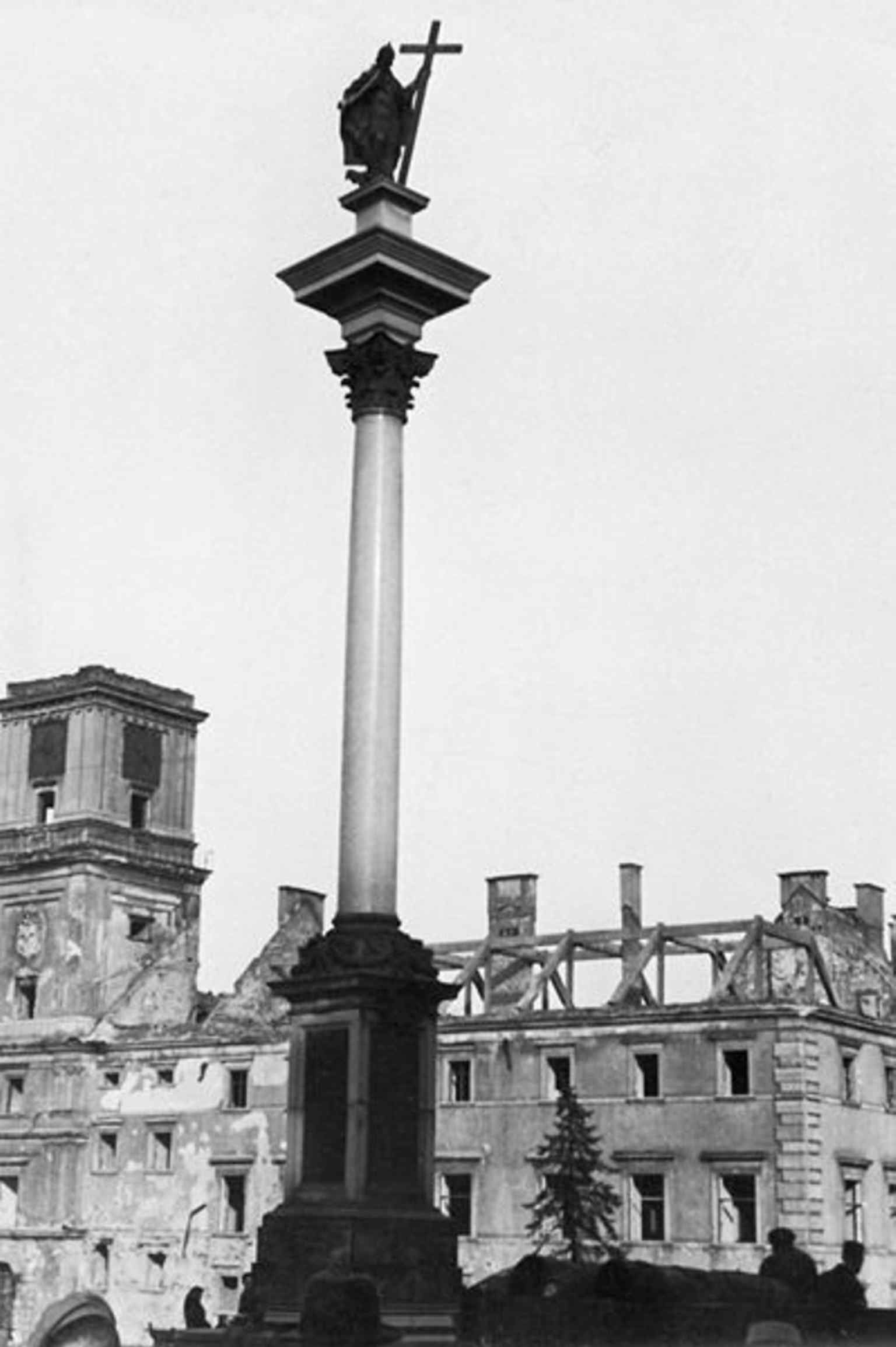
A wartime image of the burned-out castle beside Sigismund’s Column — a stark reminder of the 1939 destruction and loss.Photo: Documentation cell of Armia Krajowa, Wikimedia Commons, Public domain. Cropped & resized. 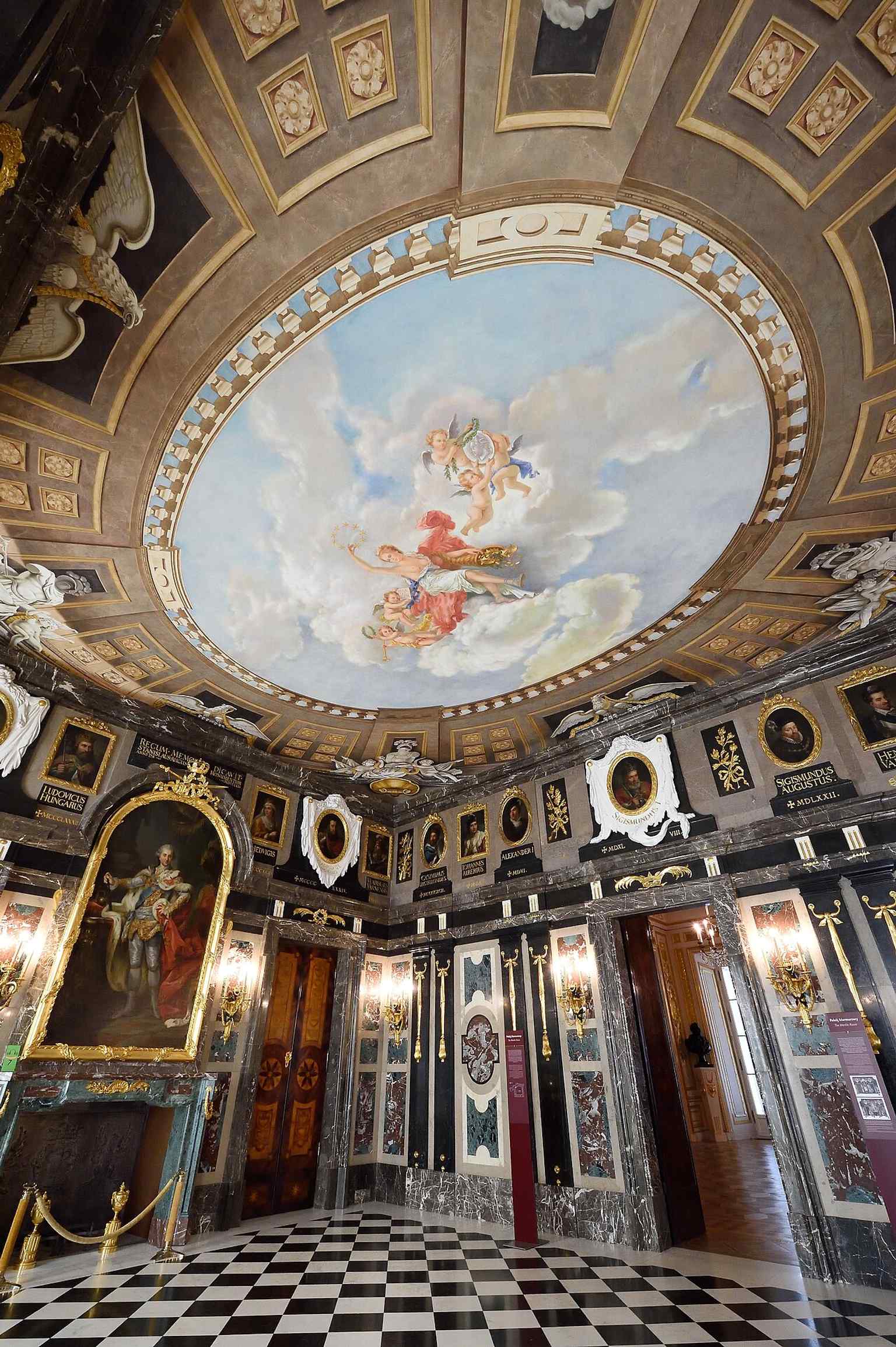
The Marble Room, one of the castle’s most representative interiors, associated with the refined royal and republican décor of the Stanisław August era.Photo: Tim Adams, Wikimedia Commons, CC BY 3.0. Cropped & resized. 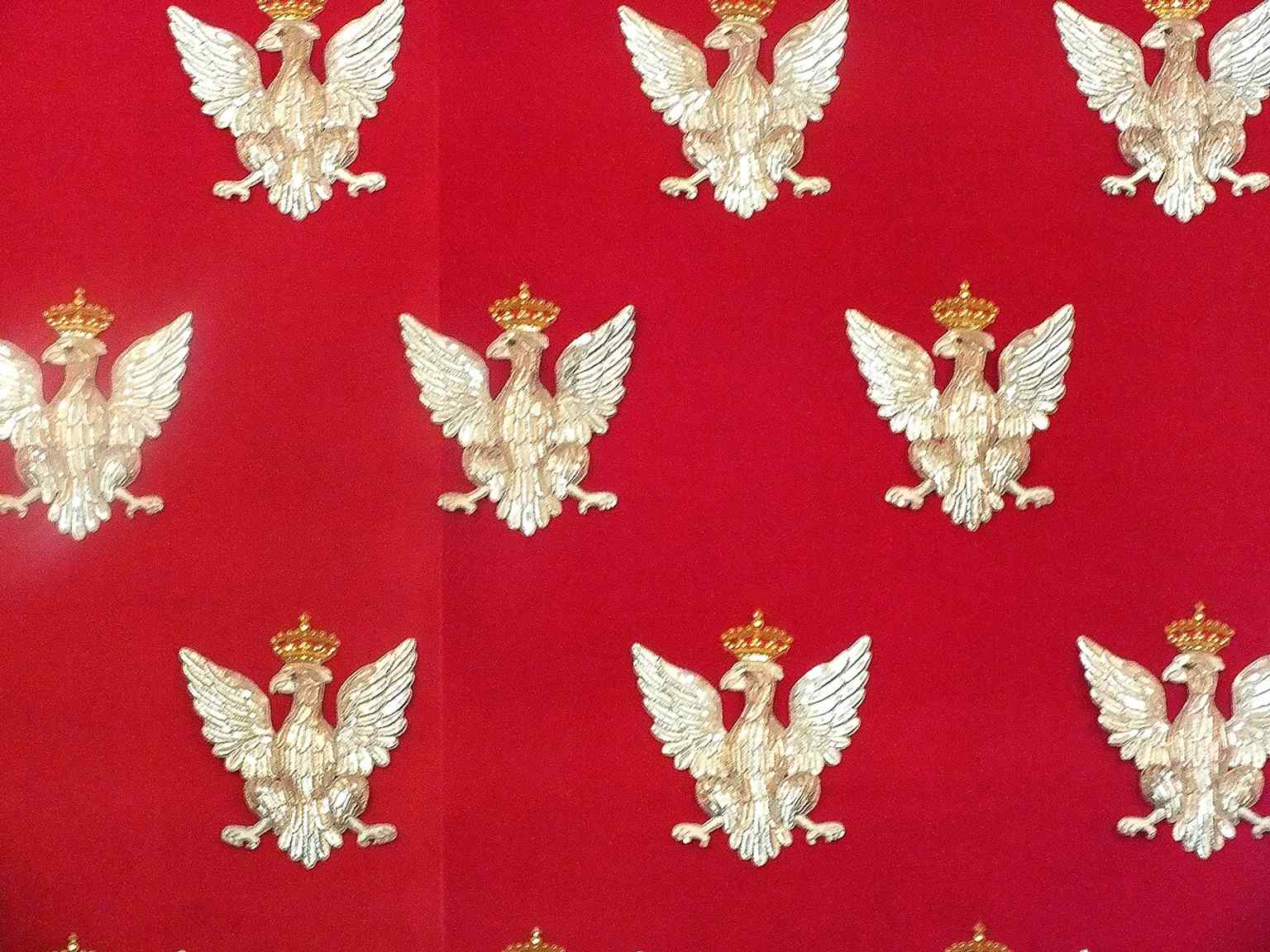
The Throne Room interior, where ceremonies and state authority were staged in the royal residence.Photo: Aw58, Wikimedia Commons, CC BY-SA 4.0. Cropped & resized. 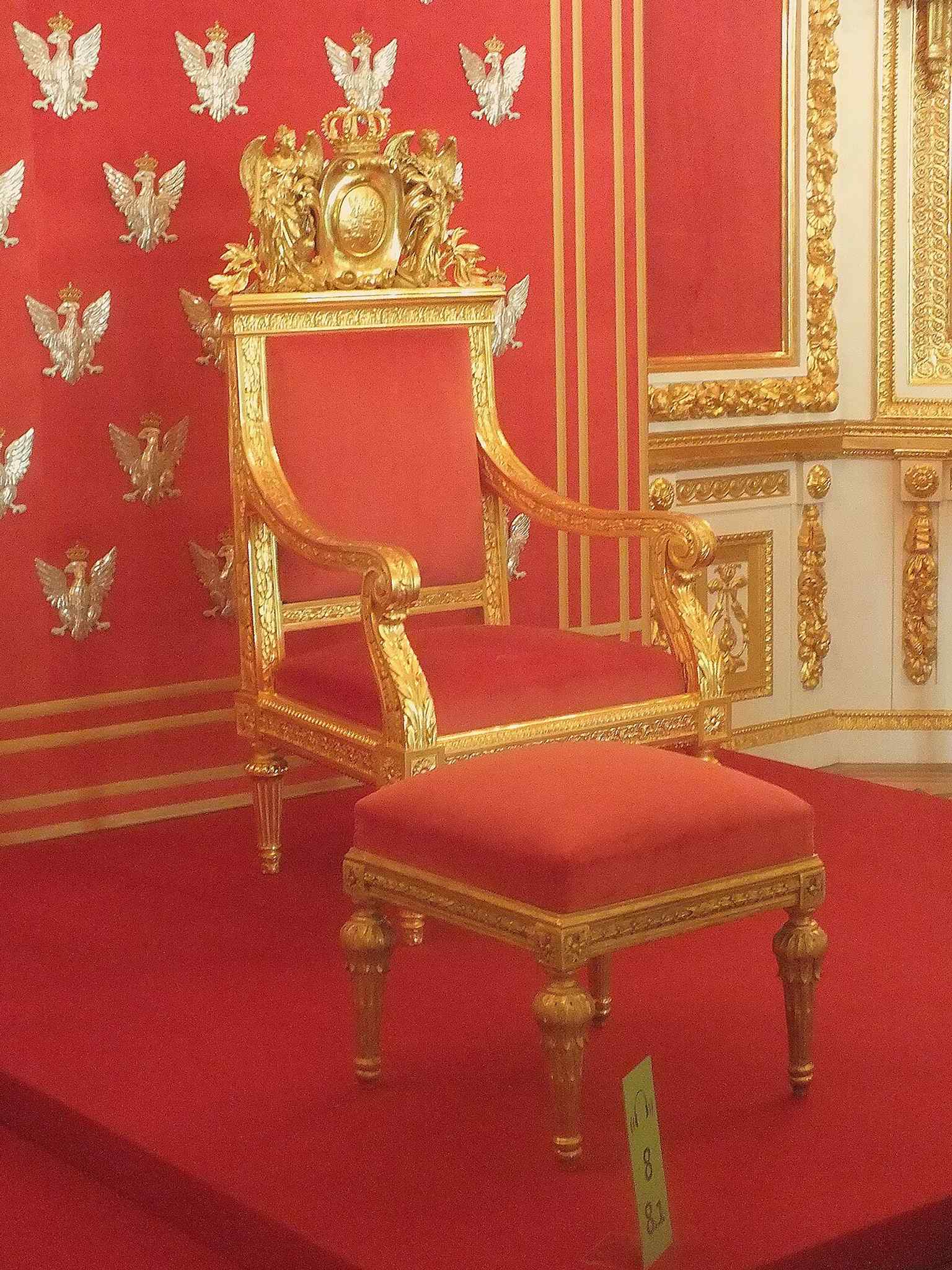
A close look at the throne itself — the kind of symbolic centerpiece that anchored the castle’s ceremonial role.Photo: Aw58, Wikimedia Commons, CC BY-SA 4.0. Cropped & resized. 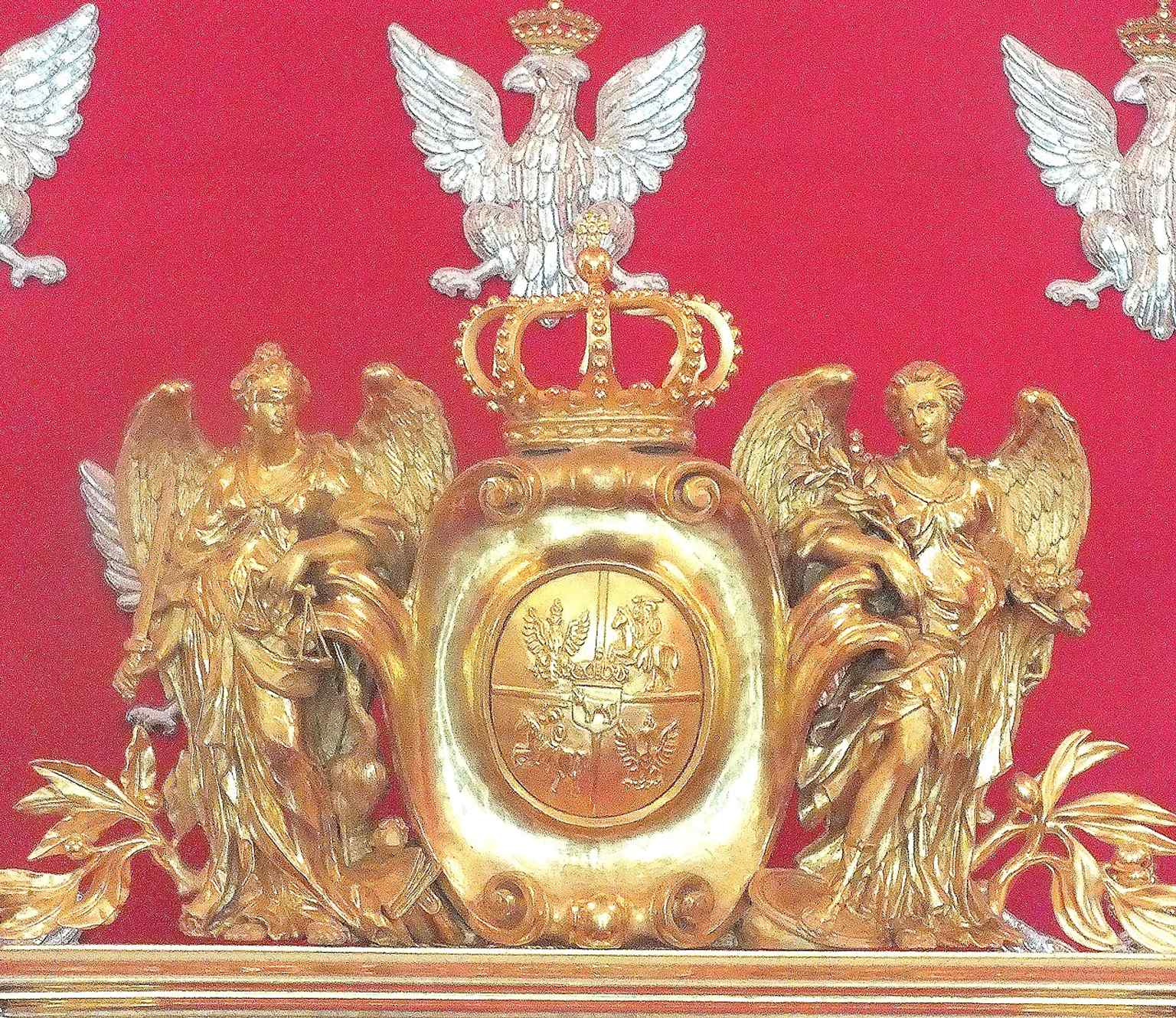
A decorative detail from the Throne Room, showing the richly restored interior finish of the late-18th-century royal apartments.Photo: Aw58, Wikimedia Commons, CC BY-SA 4.0. Cropped & resized. 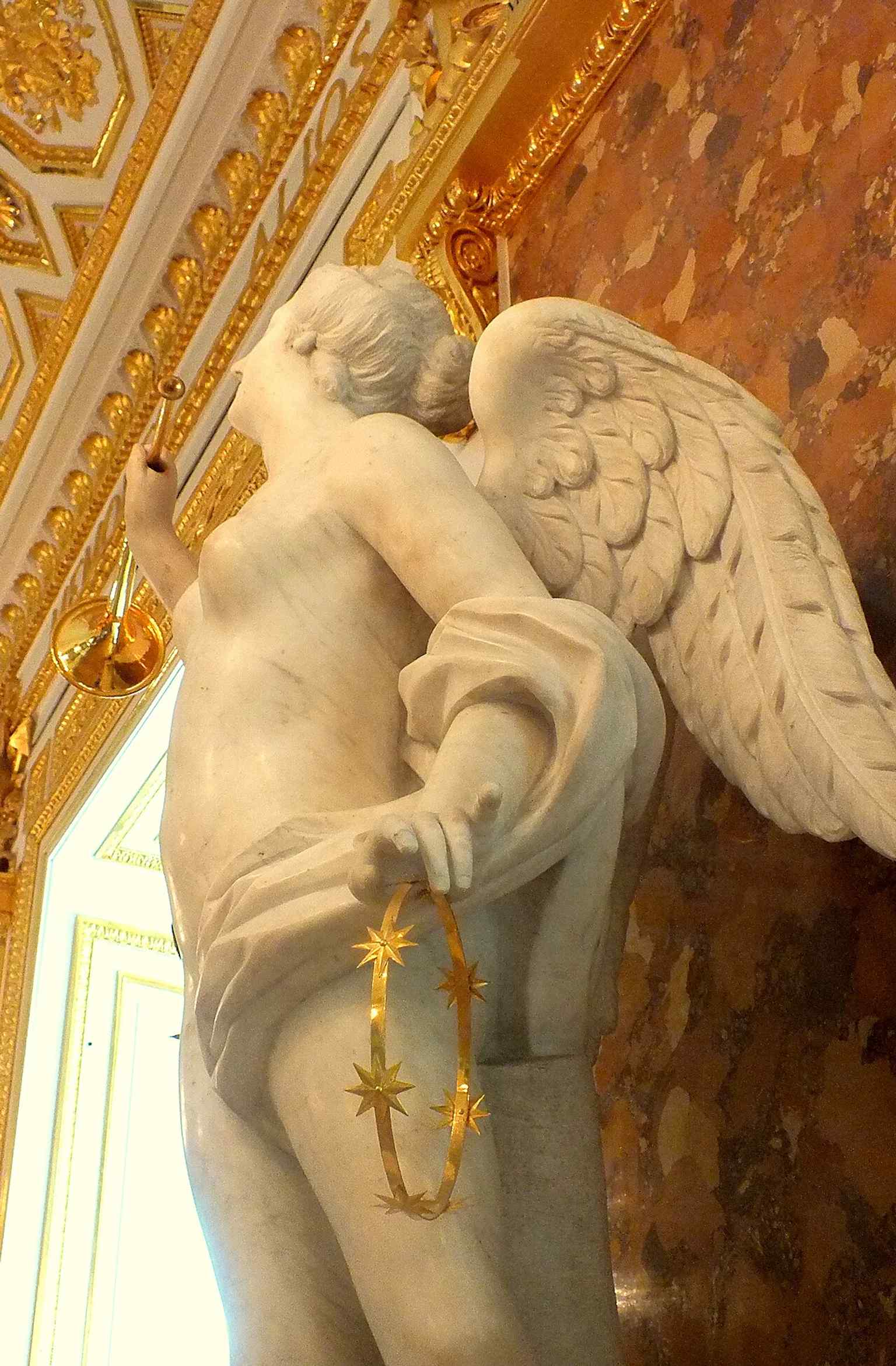
A sculpture from the Knights’ Room by André Le Brun, echoing the castle’s Enlightenment-era interior program and artistic patronage.Photo: Aw58, Wikimedia Commons, CC BY-SA 4.0. Cropped & resized. 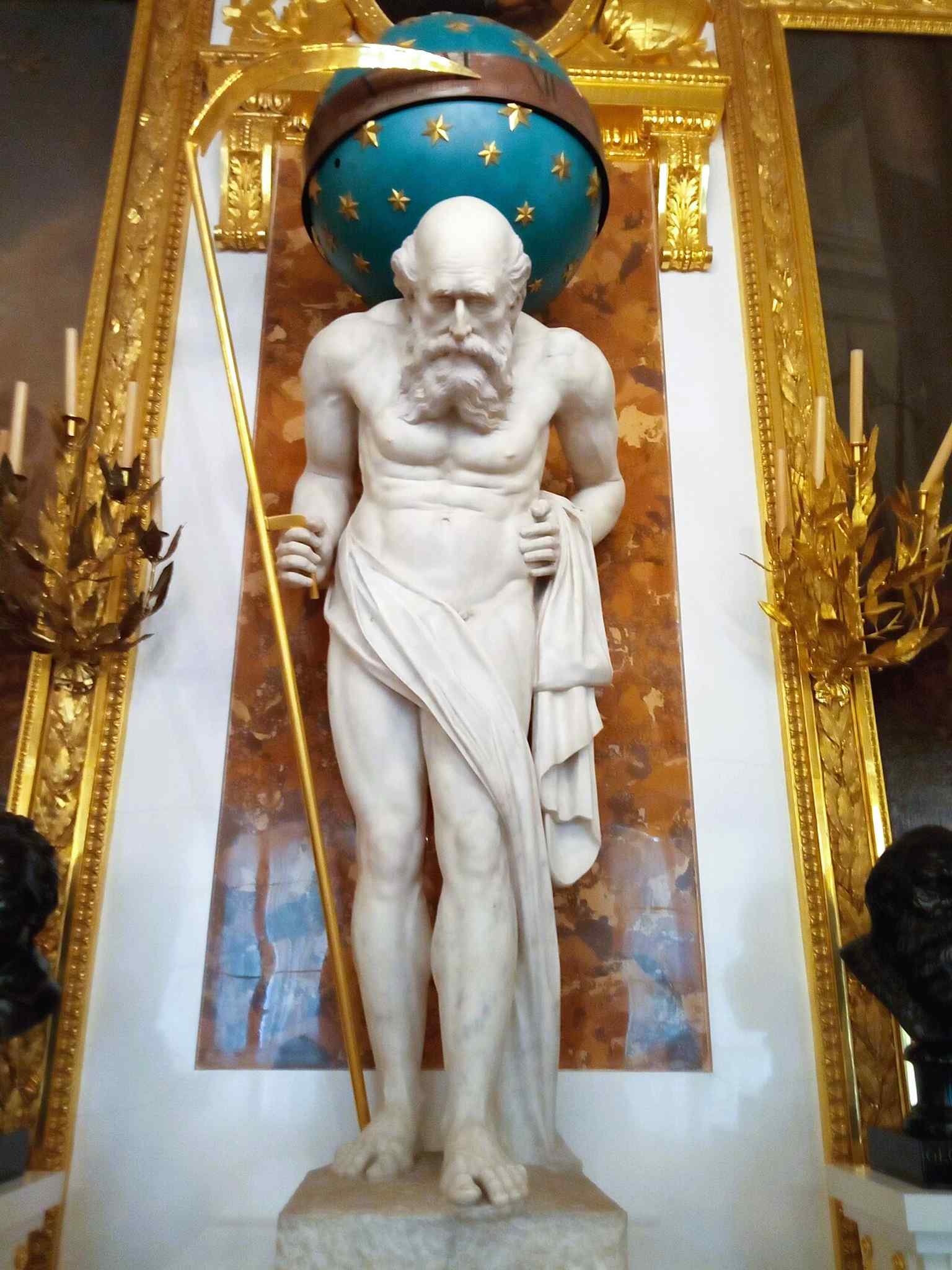
The sculpture of Chronos in the interior highlights the castle’s museum character and the dramatic symbolism embedded in its décor.Photo: Vi Ko, Wikimedia Commons, CC BY 4.0. Cropped & resized. On your right, look for the tall red-brick façade with its broad stepped gable, narrow pointed windows, and deep central archway. This is St. John’s Archcathedral, and from…Read moreShow less
Open dedicated page →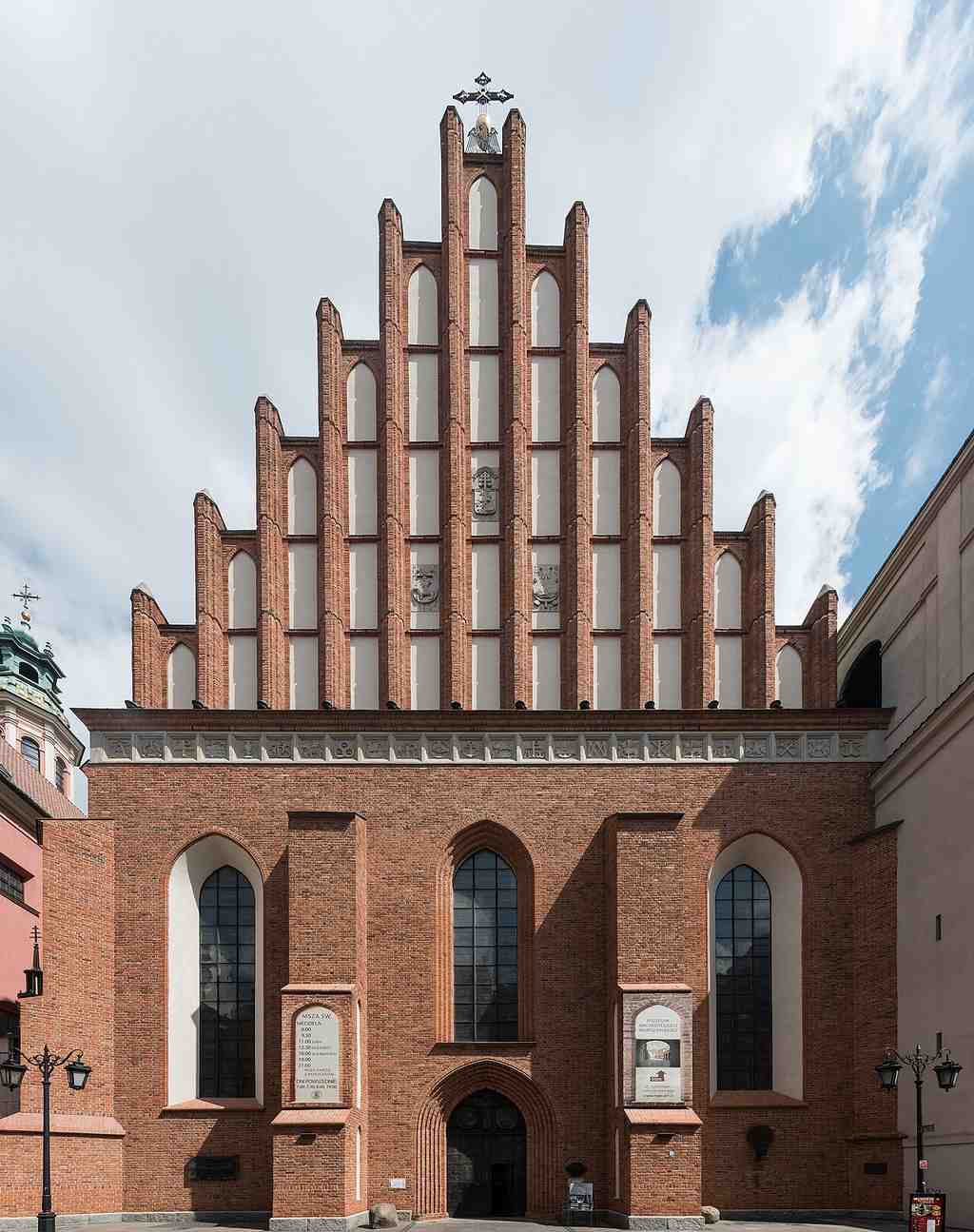
Archcathedral Basilica of St. John the Baptist in WarsawPhoto: Adrian Grycuk, Wikimedia Commons, CC BY-SA 3.0 PL. Cropped & resized. On your right, look for the tall red-brick façade with its broad stepped gable, narrow pointed windows, and deep central archway.
This is St. John’s Archcathedral, and from where you stand you can read its whole argument in brick: plain, upright, and serious, like a witness sworn in before speaking. Even its address matters. Most medieval town churches in Poland faced a market corner. This one lines the street because it served two masters at once: the town parish and the castle next door.
A wooden chapel stood here around the turn of the thirteenth and fourteenth centuries. Then Duke Janusz the First the Elder pushed the church into brick around thirteen ninety, and Warsaw began storing more than prayer here. In thirteen thirty-eight, the city posted a summons against the Teutonic Order on the church door. That tells you the tone of the place early on: altar on one side, public business on the other.
Later, Father Piotr Skarga preached here. Władysław the Fourth swore his royal pacta conventa here - a binding promise to the Commonwealth. Royal weddings filled the nave, the soaring central hall of the church. Queens received crowns here, and the Constitution of the Third of May was sworn here too. At the Royal Castle, power wore velvet. Here, it knelt.
Then came the familiar Warsaw blow. Bombing damaged the cathedral in nineteen thirty-nine, and German destruction in nineteen forty-four left almost nothing but fragments, with the presbytery and the Baryczków Chapel surviving best. If you like, compare the historic photo with the current view in the app; it shows how completely this church had to be brought back from ruin.
The man who gave it back its face was Jan Zachwatowicz, working with Maria and Kazimierz Piechotka. He did not simply copy the last prewar version. Sources were thin, so he reached further back and rebuilt a more medieval cathedral, using traces, comparisons, and an old watercolor by Zygmunt Vogel. In other words, this façade is both ancient memory and postwar decision. That is a very Warsaw kind of truth.
Inside, the church keeps gathering voices. If you glance at the interior image on your screen, you’ll see the severe brick nave and star-shaped vaulting rebuilt after the war. There are baroque choir stalls offered by Jan the Third Sobieski after Vienna, the Baryczków crucifix, a revered Gothic cross saved from destruction, and tombs that read like a compressed national archive: Mazovian dukes, King Stanisław August, President Gabriel Narutowicz, Ignacy Jan Paderewski, Henryk Sienkiewicz, and Cardinal Stefan Wyszyński.
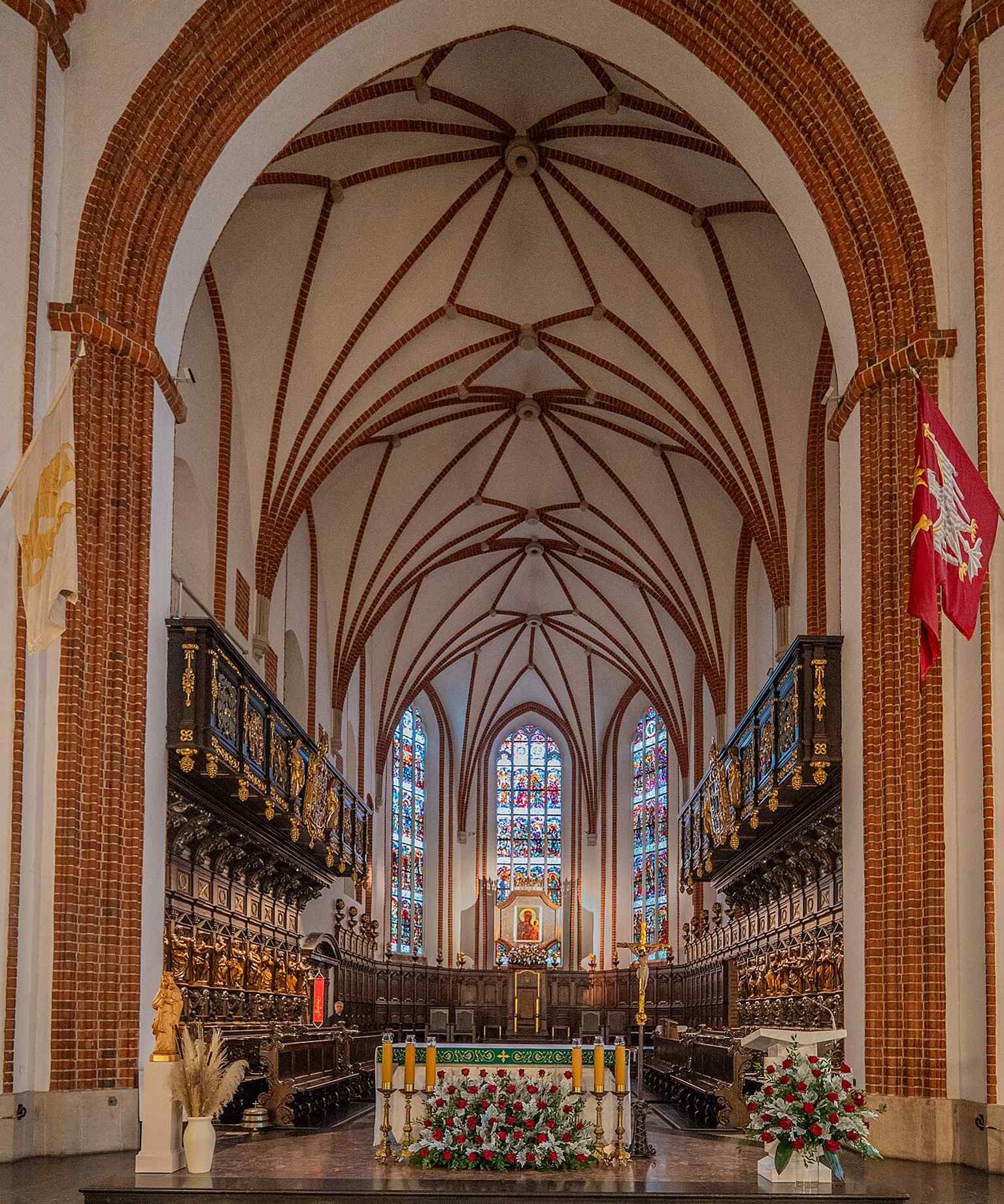
The nave interior in 2025, showing the cathedral’s austere Gothic space and the star vault rebuilt after wartime destruction.Photo: Kapitel, Wikimedia Commons, CC BY-SA 4.0. Cropped & resized. Wyszyński gives this place a particularly human pulse. When he died in nineteen eighty-one, the bells of the Old Town announced it, and his funeral turned into a national act of grief. Later, Pope John Paul the Second came here to pray at his tomb. So this church is not frozen memory. It keeps receiving new voices, new wounds, and new acts of care. When U-N-E-S-C-O, the United Nations Educational, Scientific and Cultural Organization, recognized Warsaw’s rebuilt Old Town, this cathedral stood as proof that careful reconstruction can itself become part of world heritage.
In a moment, we’ll leave this chamber of vows, sermons, burials, and oaths for Old Town Square, where history gets noisier and more public, only about a minute ahead. If you want to step inside later, the cathedral is generally open every day from early morning into the evening, with longer hours on Sundays.
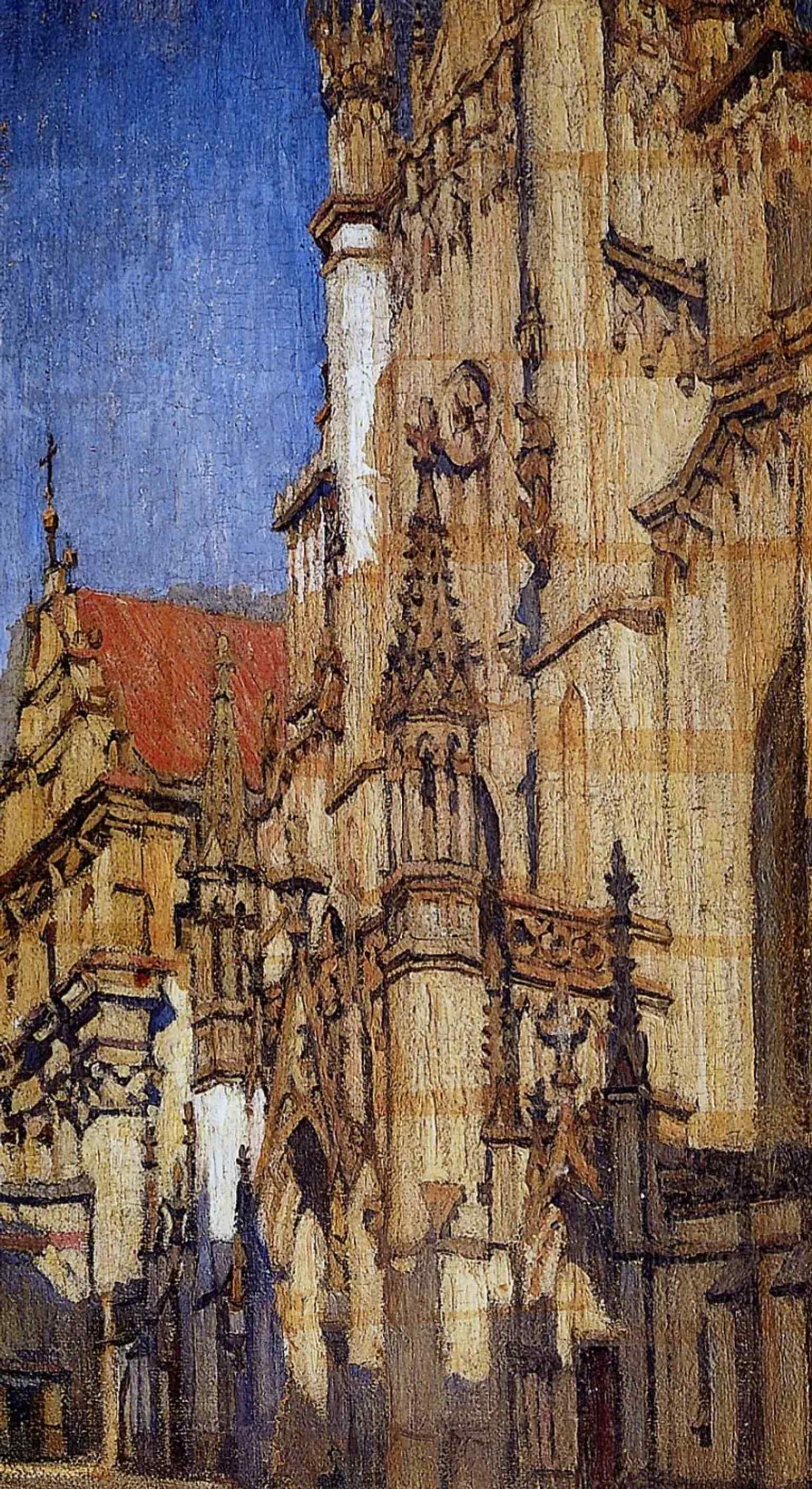
A 1907 painted view of St. John’s Cathedral, valuable as an early artistic record of the Warsaw landmark before modern damage and reconstruction.Photo: Aleksandr Shturman, Wikimedia Commons, Public domain. Cropped & resized. 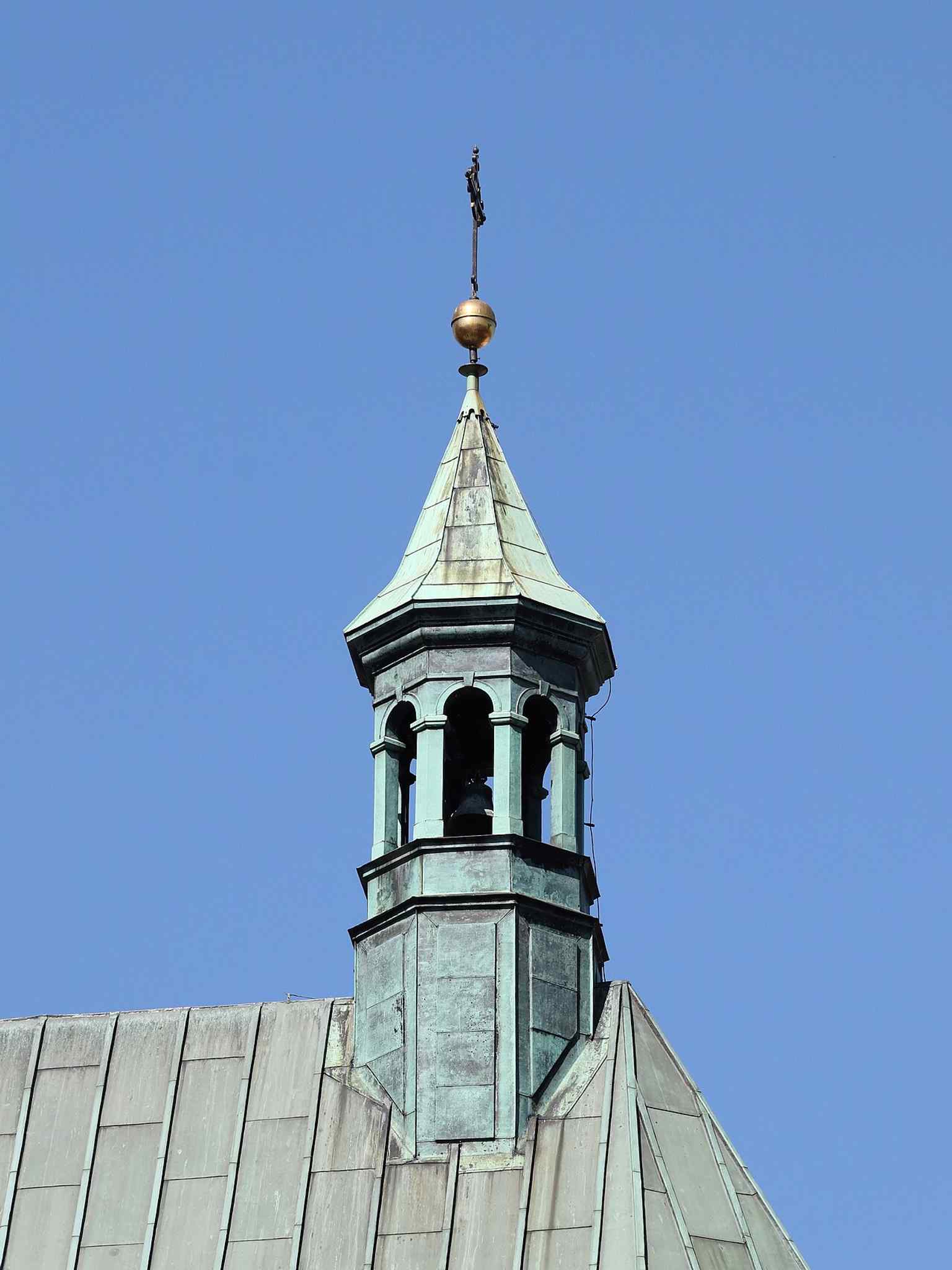
The tower above the presbytery, showing the church’s Gothic revival silhouette and the rebuilt postwar form seen today.Photo: Cybularny, Wikimedia Commons, CC BY 4.0. Cropped & resized. 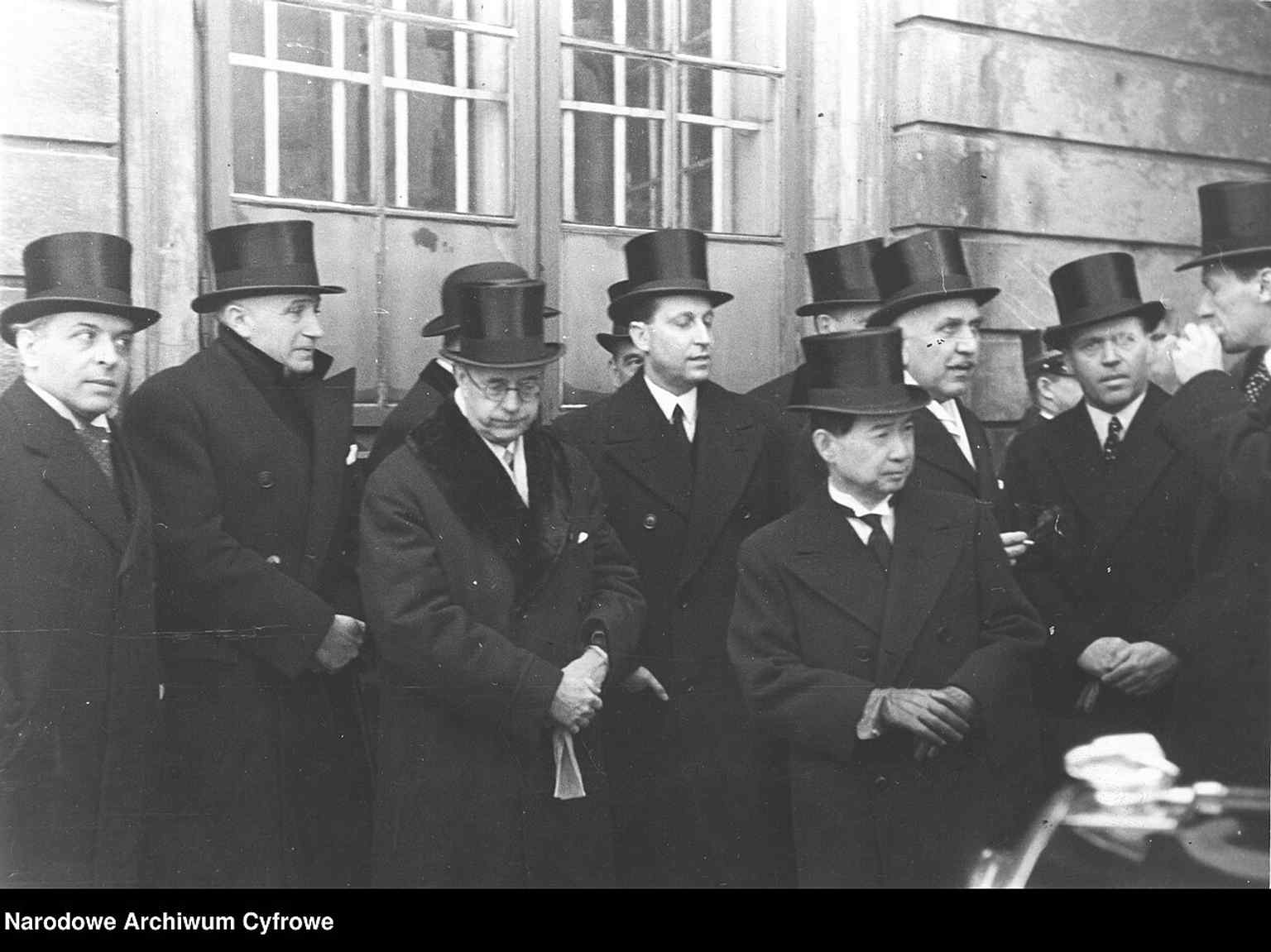
A 1935 view of May 3rd celebrations at the cathedral, recalling the site where the Constitution of 3 May was sworn in.Photo: Koncern Ilustrowany Kurier Codzienny - Archiwum Ilustracji, Wikimedia Commons, Public domain. Cropped & resized. 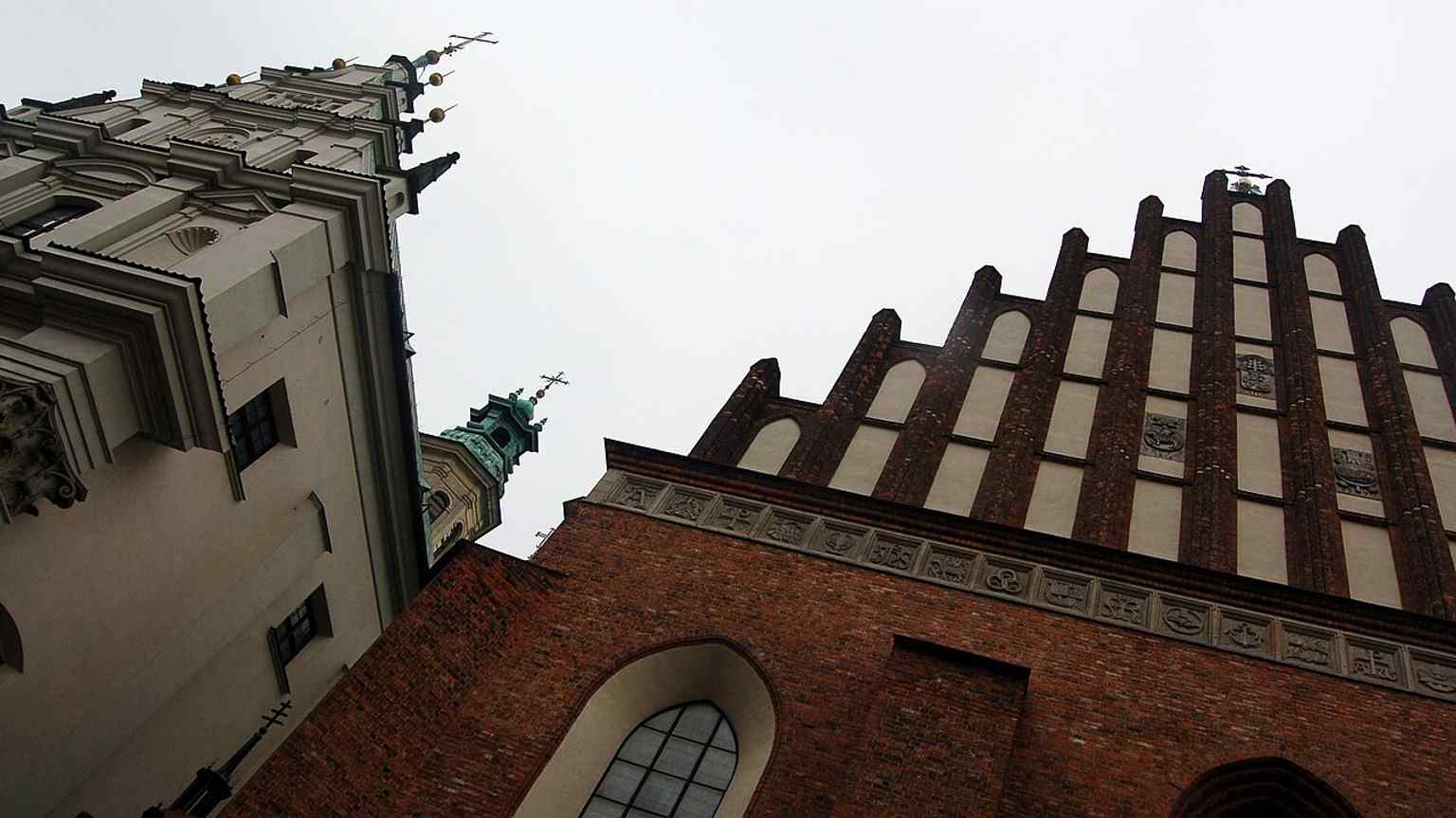
A wider 2006 view with the Jesuit Church beside St. John’s Cathedral, helpful for placing the landmark in Warsaw’s Old Town streetscape.Photo: Bahnfrend, Wikimedia Commons, CC BY-SA 4.0. Cropped & resized. 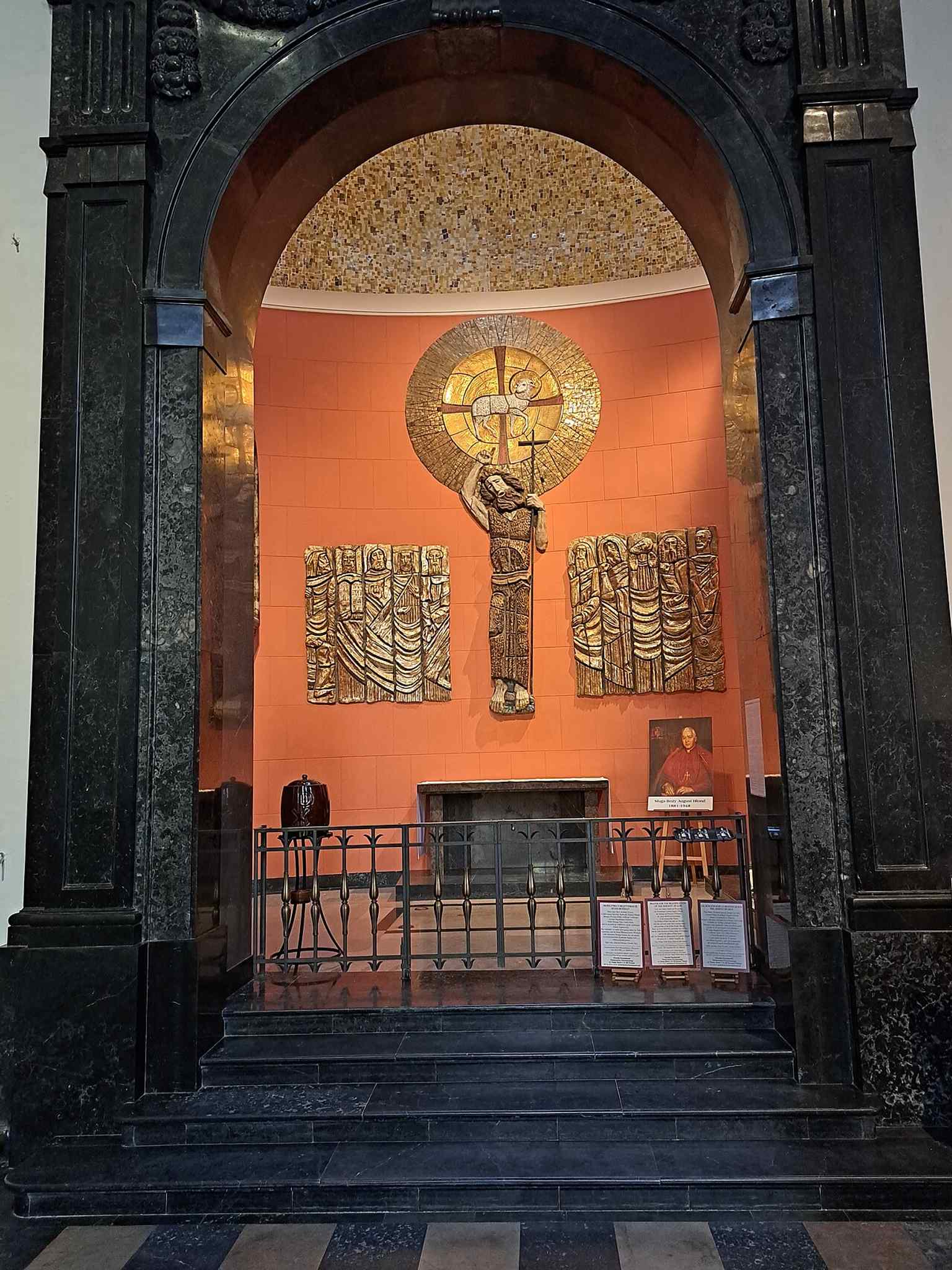
St. John the Baptist Chapel, one of the most important interior spaces, linked to the cathedral’s patron and later memorial burials.Photo: Olowirnik, Wikimedia Commons, CC BY-SA 4.0. Cropped & resized. 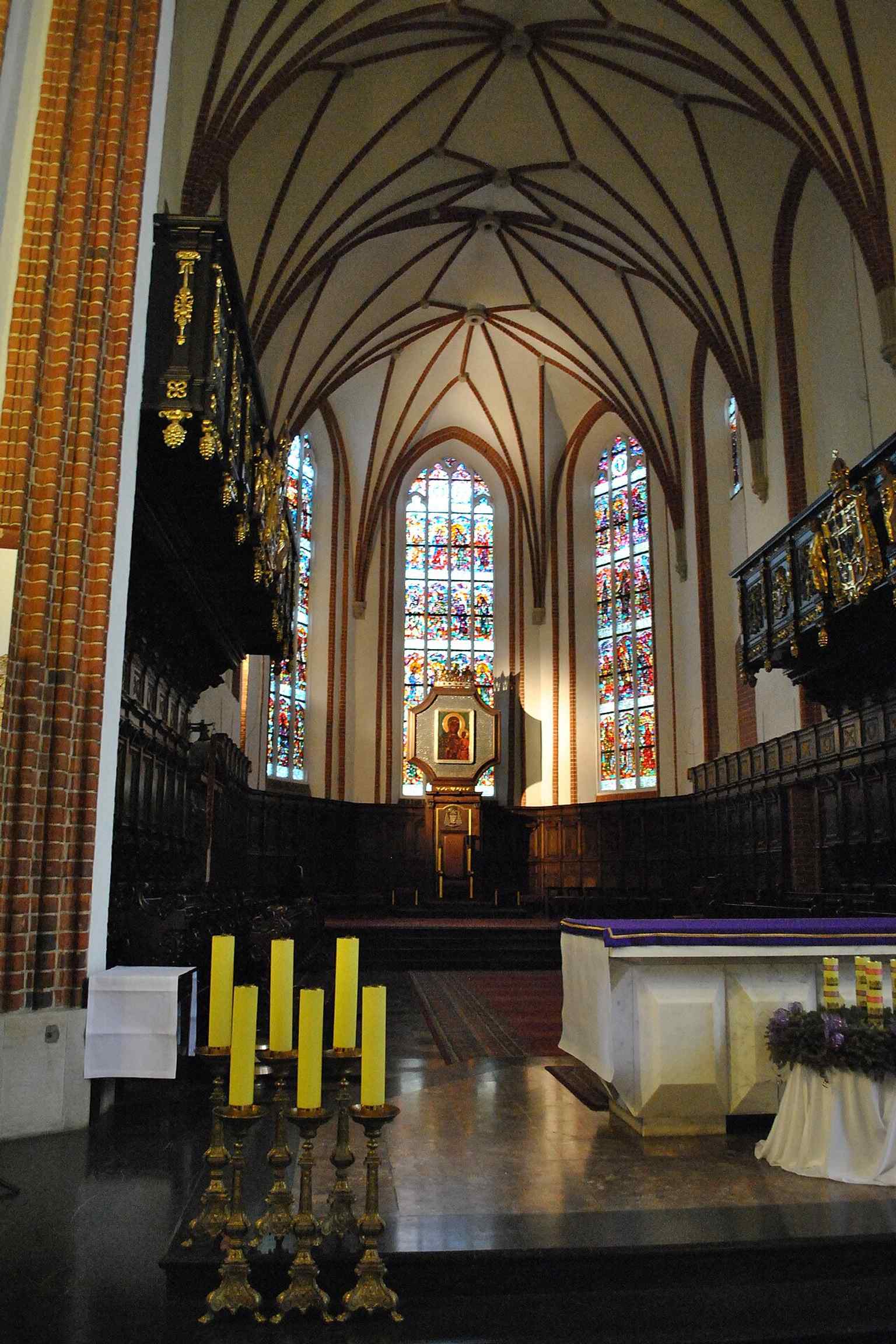
The presbytery, where the main altar and choir stalls anchor the cathedral’s liturgical heart and its postwar reconstruction.Photo: Marek Mróz, Wikimedia Commons, CC BY 4.0. Cropped & resized. Look for a broad rectangular cobbled square framed by tall stucco townhouses with steep ceramic roofs, with the Warsaw Mermaid standing at the center as its unmistakable marker.…Read moreShow less
Open dedicated page →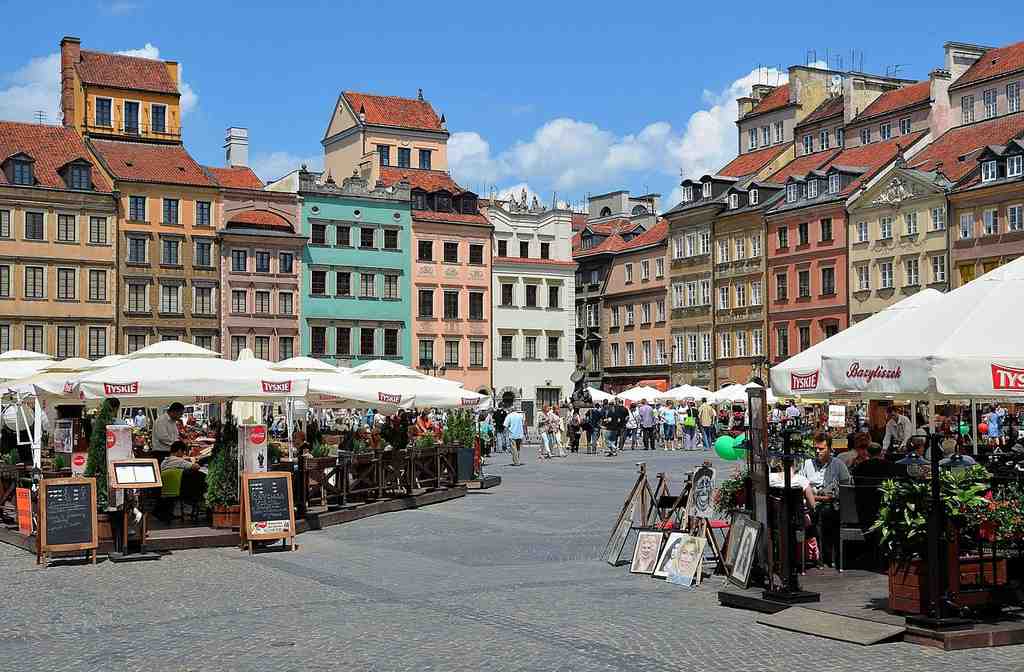
Old Town Square in WarsawPhoto: Adrian Grycuk, Wikimedia Commons, CC BY-SA 3.0 PL. Cropped & resized. Look for a broad rectangular cobbled square framed by tall stucco townhouses with steep ceramic roofs, with the Warsaw Mermaid standing at the center as its unmistakable marker.
This is the old living room of Warsaw... and like any good living room, it has seen trade, arguments, celebrations, punishment, gossip, and the occasional political thunderstorm.
The square took shape at the turn of the thirteenth and fourteenth centuries. Builders laid it out parallel to the Vistula, about ninety by seventy-three meters, and eight streets run out from its corners like spokes from a wheel. For centuries this was the administrative and trading heart of Old Warsaw. Right in the middle stood the town hall, first recorded in the early fifteenth century, with a clock tower and market stalls crowded around it. So this was not just where people bought fish and cloth. This was where the city made decisions... and made them in public.
That public stage could turn harsh. In sixteen sixty-five, officials beheaded Konstanty Kotowski and three other men here for the murder of Hetman Wincenty Gosiewski. On the ninth of May, seventeen ninety-four, crowds gathered again as leaders of the Targowica Confederation were hanged in front of the town hall. Same square, same stones underfoot... very different errands.
But it could also carry hope. Jan Dekert, the Warsaw mayor whose name now marks the north side, became one of the boldest voices for the rights of townspeople. In December of seventeen eighty-nine, he led the famous Black Procession from this very square to the Royal Castle, pressing for the restoration of urban rights. If you compare the historic photo in the app, the Dekert side still holds that civic memory in its frontage today.
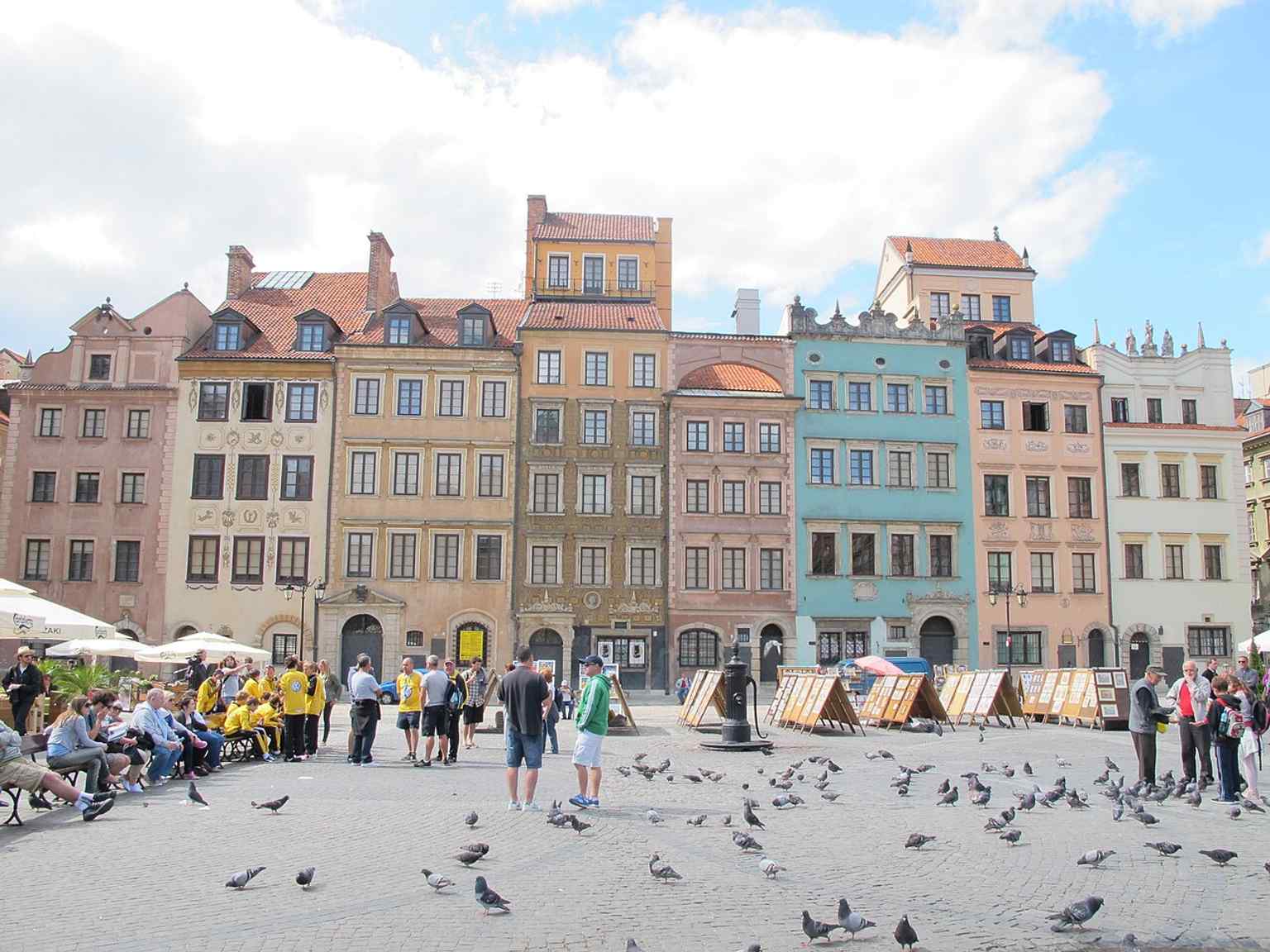
The Dekert side of the square, home to the Museum of Warsaw today and one of the most historically significant façades after the postwar reconstruction.Photo: Андрей Романенко, Wikimedia Commons, CC BY-SA 4.0. Cropped & resized. Later, the square changed jobs. The old town hall came down in eighteen seventeen. The market itself moved away in the early twentieth century, and workers laid geometric cobbles across the open space. Then in eighteen fifty-five, engineers added a fountain tied to Henryk Marconi’s modern water system, topped by the Mermaid sculpted by Konstanty Hegel. The figure you see now has had quite a journey. Conservators counted more than fifty bullet and shrapnel marks on her surface. Warsaw, as ever, keeps the scars and the symbol in the same frame. If you want a wider sense of the square as a whole, take a quick peek at the broad view on your screen.
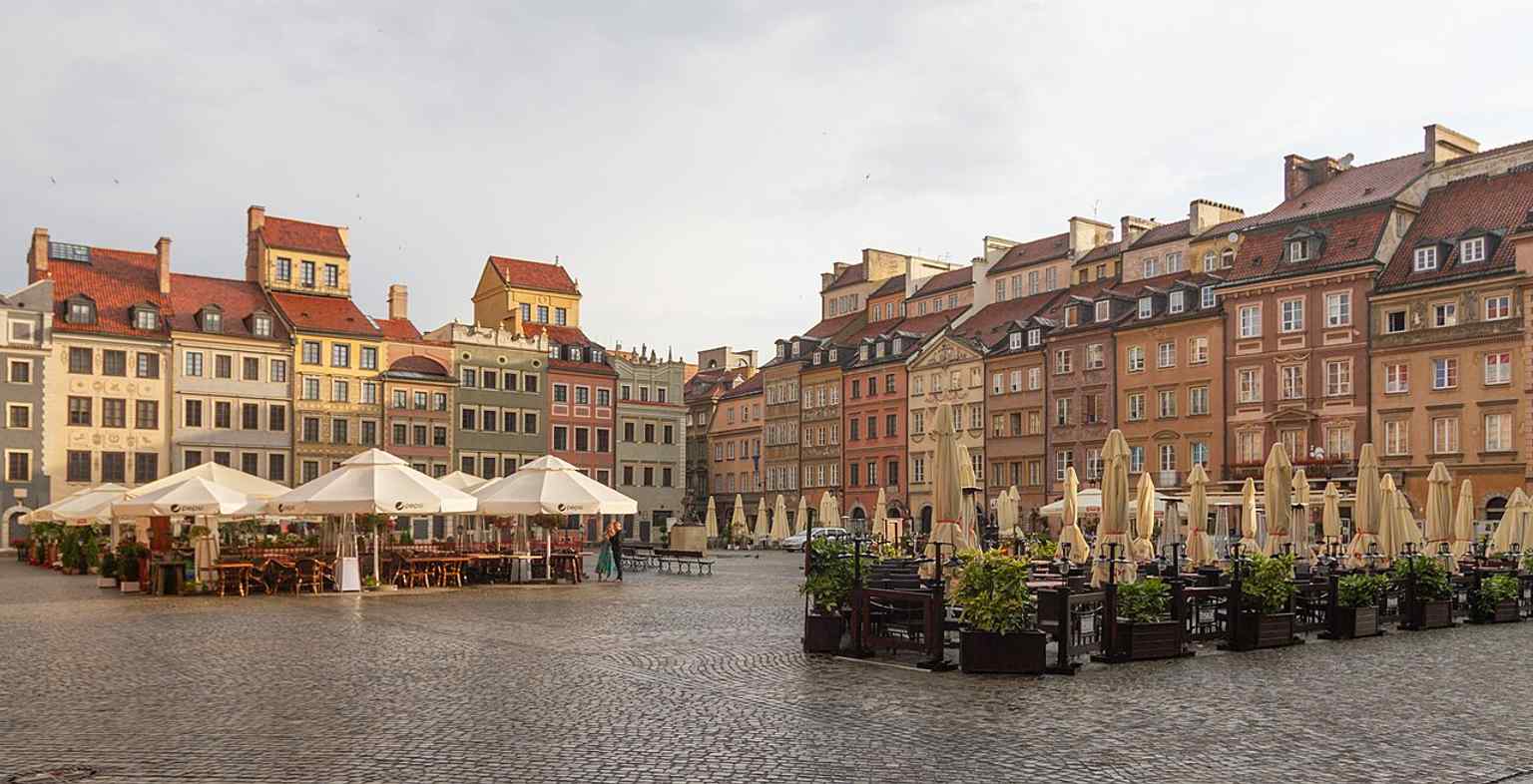
A broad 2018 view of the Old Town Market Square, showing the rebuilt historic frontage and the open central space that has hosted markets, celebrations, and political events for centuries.Photo: Maksym Kozlenko, Wikimedia Commons, CC BY-SA 4.0. Cropped & resized. During the Warsaw Uprising, most of these houses were destroyed. After the war, the damage was so complete that reconstruction here became something almost unheard of: not patching ruins, but rebuilding a historic city with salvaged portals, painted walls, and memory as a set of working plans. Between nineteen forty-nine and nineteen fifty-three, teams carefully brought the square back, and the Dekert side became the home of today’s Museum of Warsaw.
So here is the question I’ll leave you with... if a square is rebuilt after near-total ruin, does it become less real, or more real, once generations return and fill it again with footsteps, voices, and ordinary life?
That may be the secret of this place. A city’s heart does not survive by standing still. It survives when people come back and use it again. From here, the Barbican is about a two-minute walk ahead. And if you plan to linger later, the square is generally accessible every day from eight in the morning until ten at night.
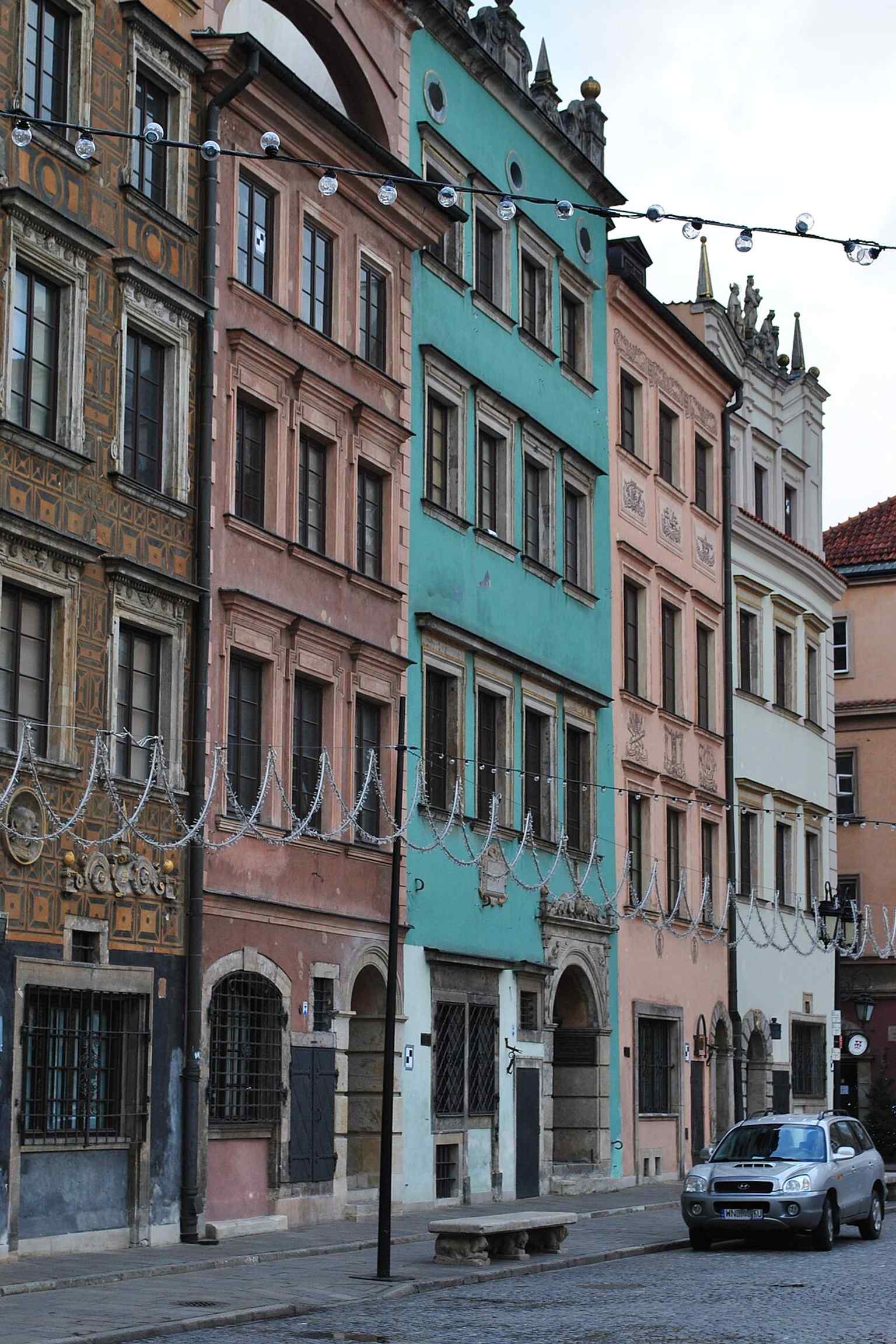
The Dekert side in 2014, where the restored façades later served as the Museum of Warsaw and reflect the careful postwar reconstruction of the square.Photo: Marek Mróz, Wikimedia Commons, CC BY 4.0. Cropped & resized. 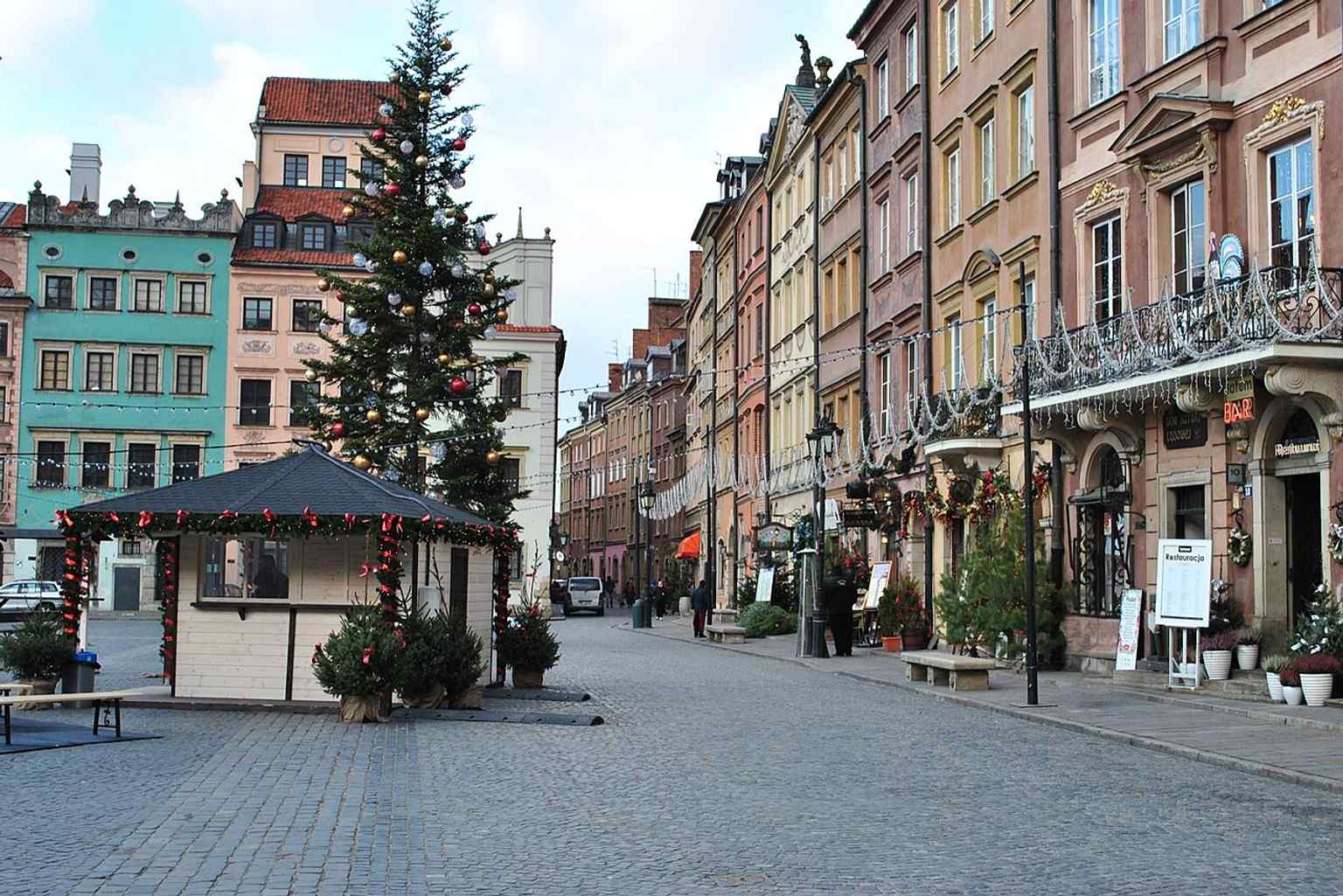
The Kołłątaj side beside Świętojańska Street, helping show how the square connects to the eight streets that radiate from its corners.Photo: Marek Mróz, Wikimedia Commons, CC BY 4.0. Cropped & resized. 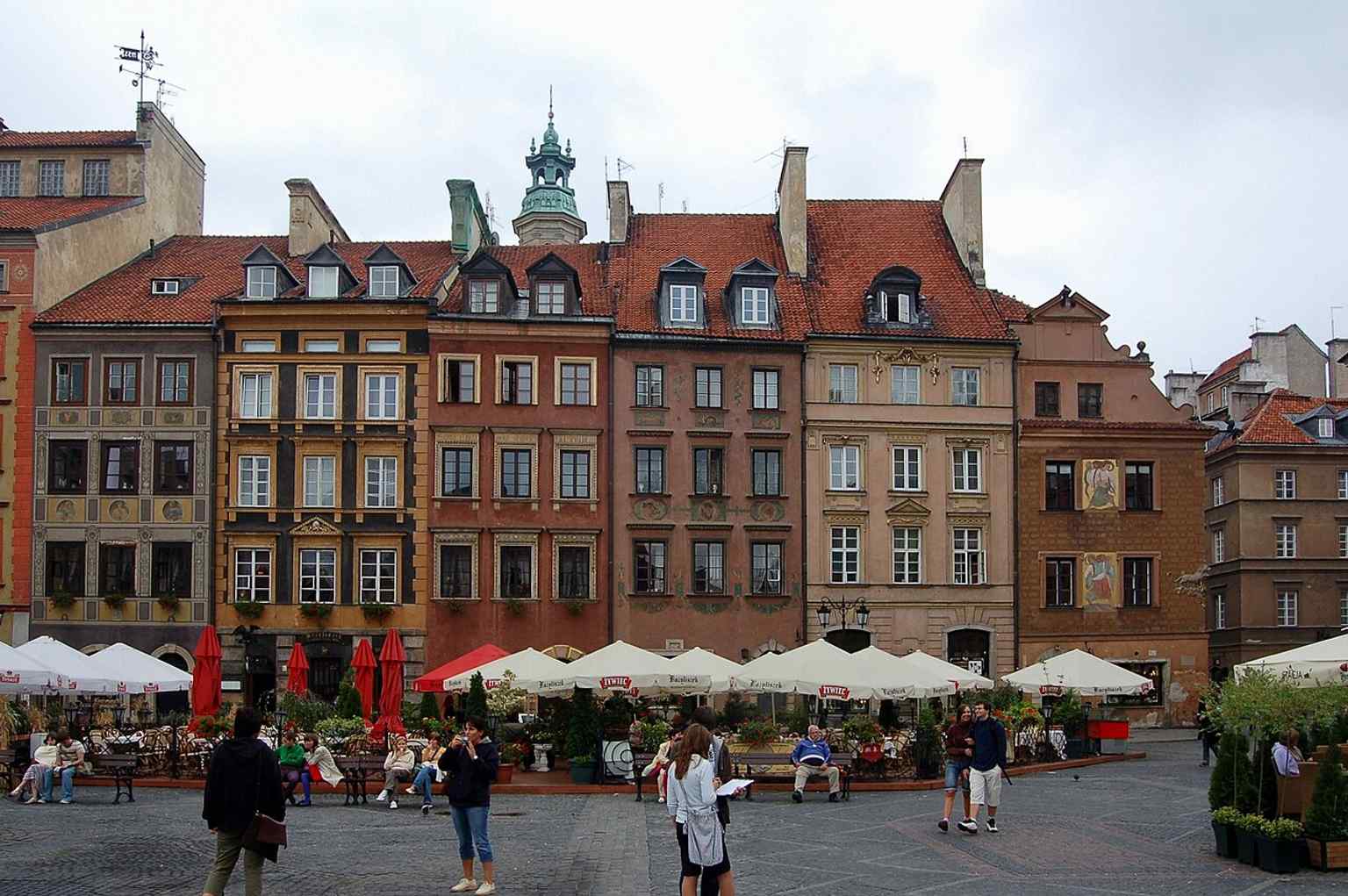
A 2006 view of the Zakrzewski side, facing toward the Royal Castle and Cathedral — the southern edge of the square tied to the old city’s ceremonial axis.Photo: Bahnfrend, Wikimedia Commons, CC BY-SA 4.0. Cropped & resized. 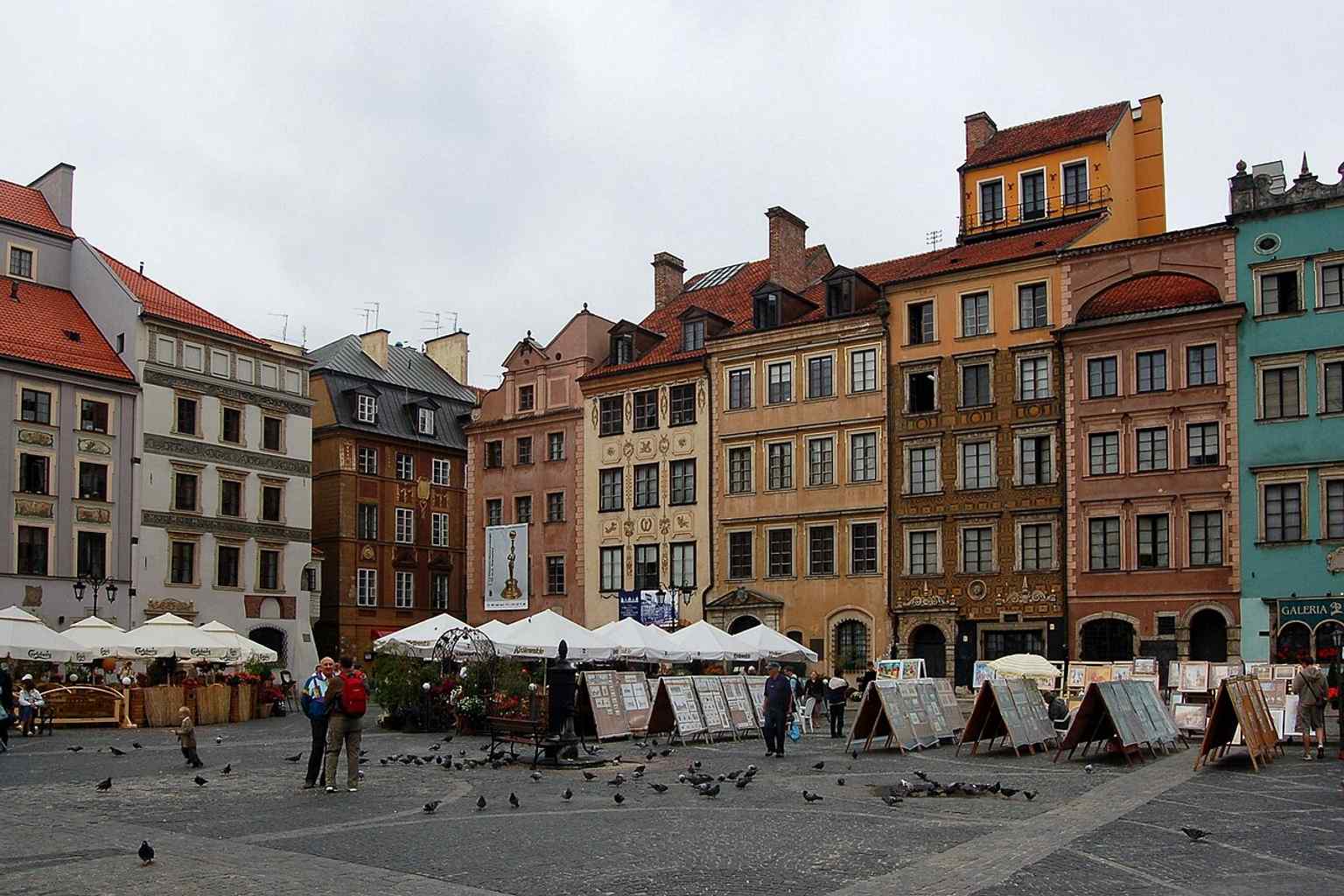
The Dekert side in 2006, a useful comparison point for the changing conservation colors and rebuilt historic character of the museum façades.Photo: Bahnfrend, Wikimedia Commons, CC BY-SA 4.0. Cropped & resized. 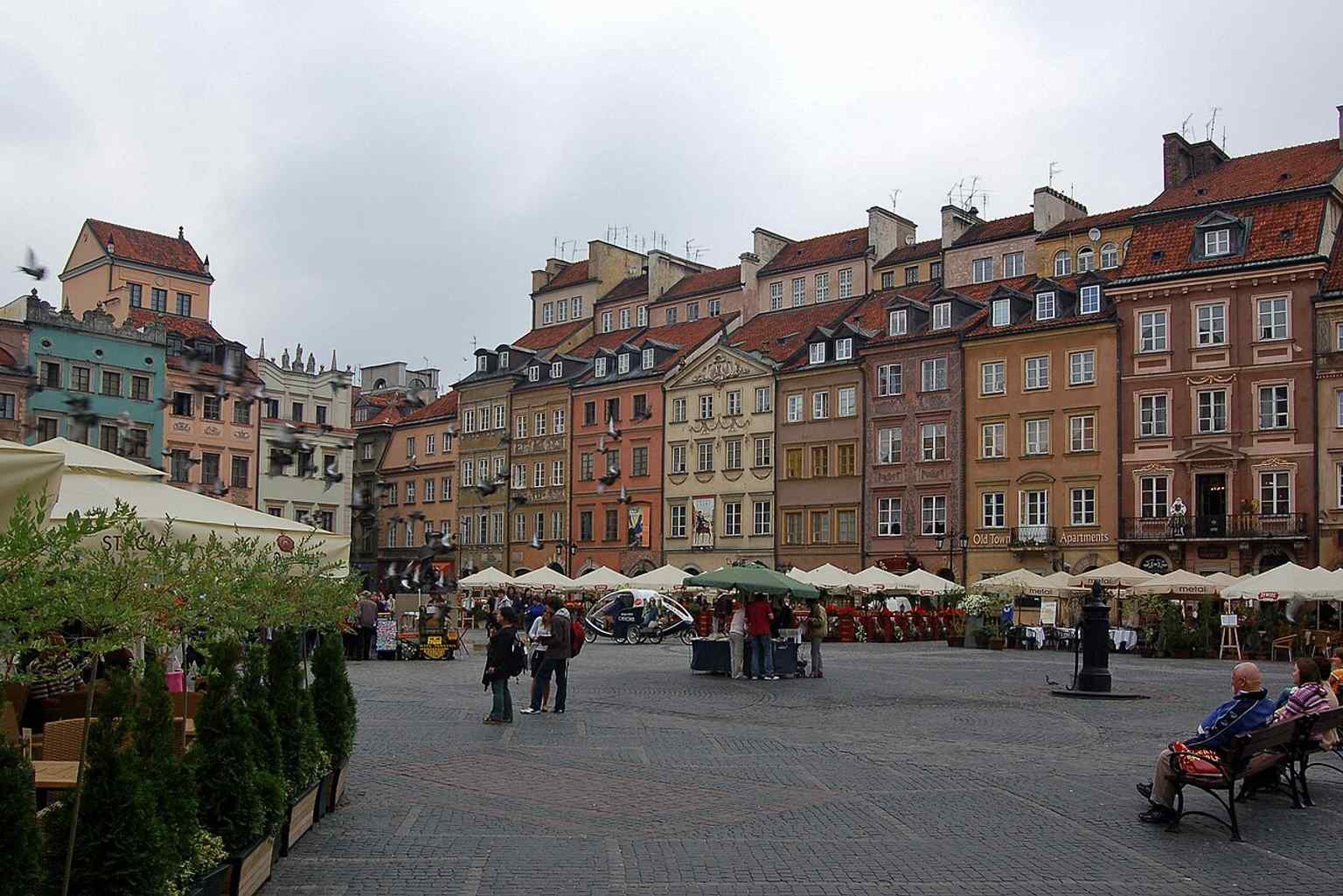
The Barss side in 2006, one of the square’s four named façades that survived as part of the postwar historical reconstruction.Photo: Bahnfrend, Wikimedia Commons, CC BY-SA 4.0. Cropped & resized. 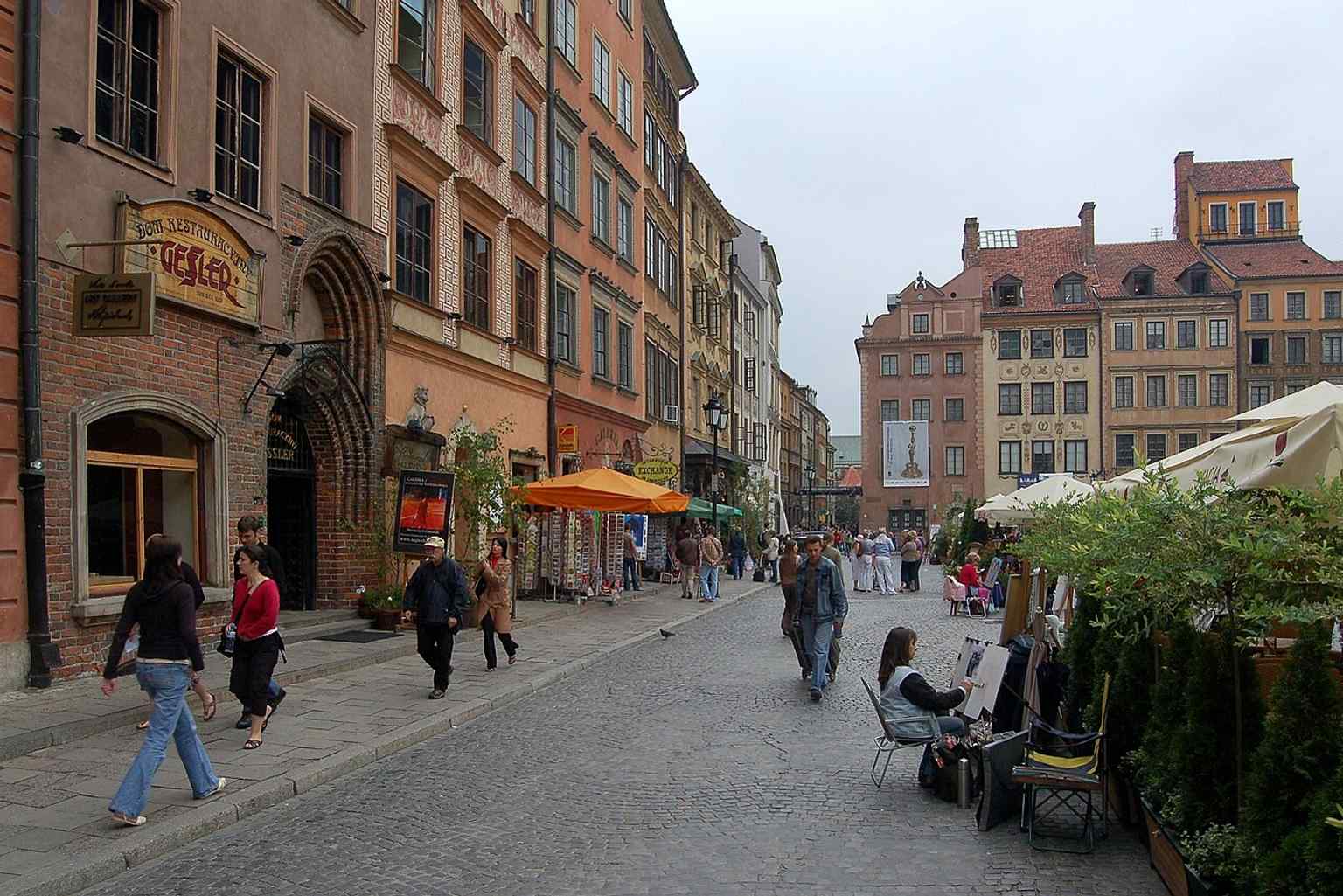
A view of the Kołłątaj side, illustrating the western frontage that once bordered the market and trade activity of the old square.Photo: Bahnfrend, Wikimedia Commons, CC BY-SA 4.0. Cropped & resized. 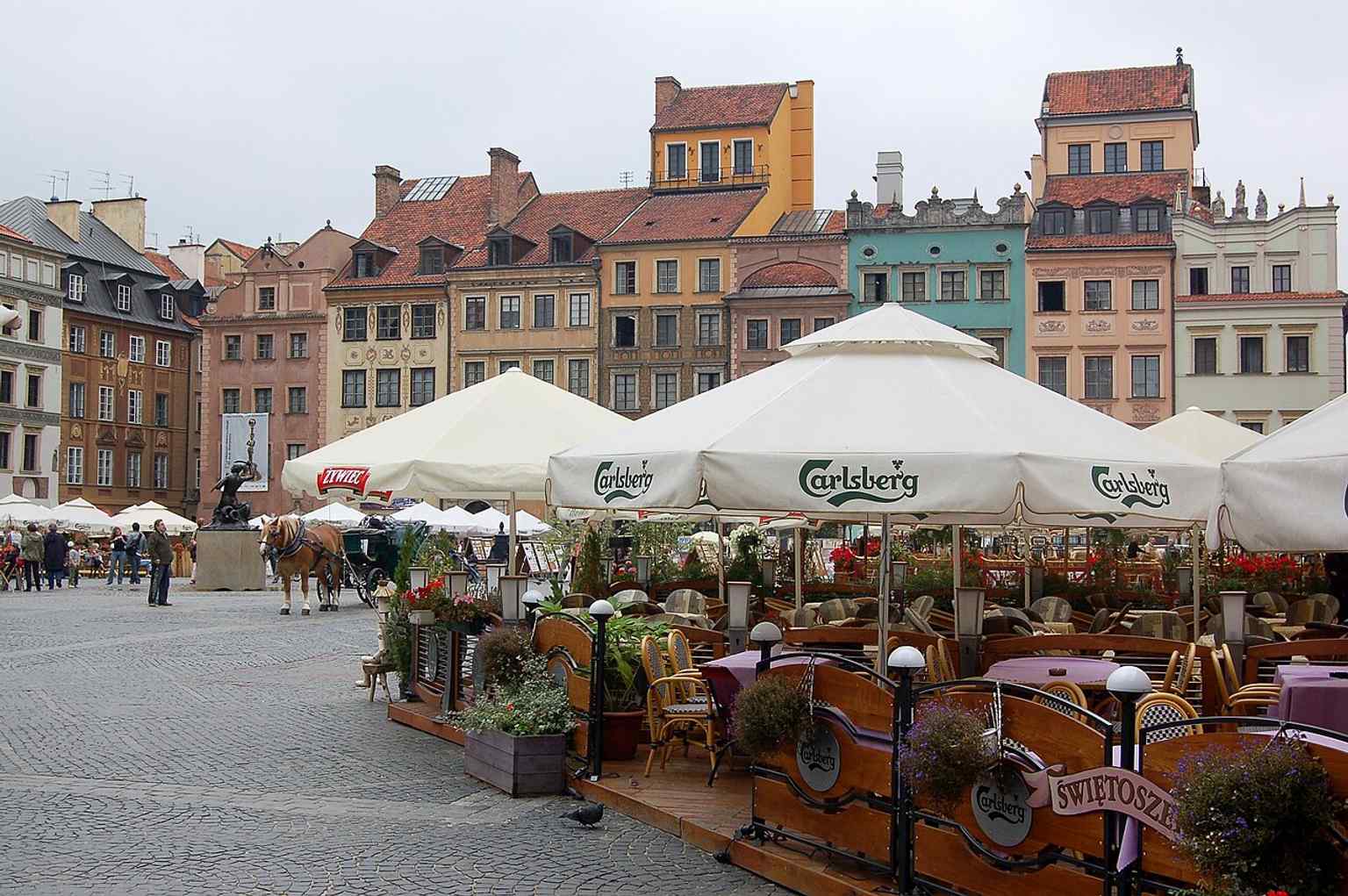
Another angle on the Dekert side, the northern frontage associated with Jan Dekert and the civic history of Warsaw’s burgher rights.Photo: Bahnfrend, Wikimedia Commons, CC BY-SA 4.0. Cropped & resized. 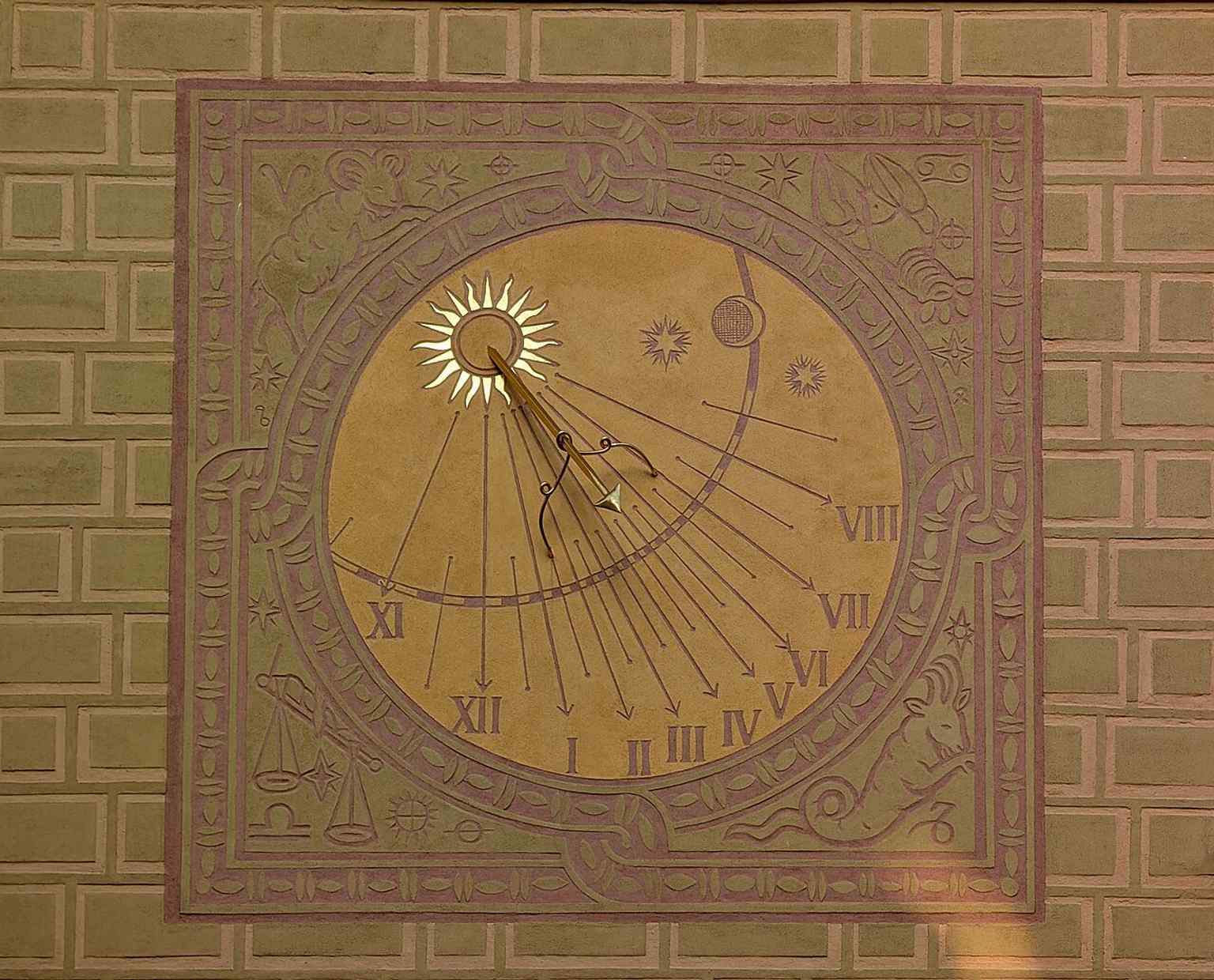
The ornate vertical sundial on the House under the Lion, a decorative detail on the square that fits the postwar revival of historic façades.Photo: Siarhei Besarab, Wikimedia Commons, CC BY-SA 4.0. Cropped & resized. 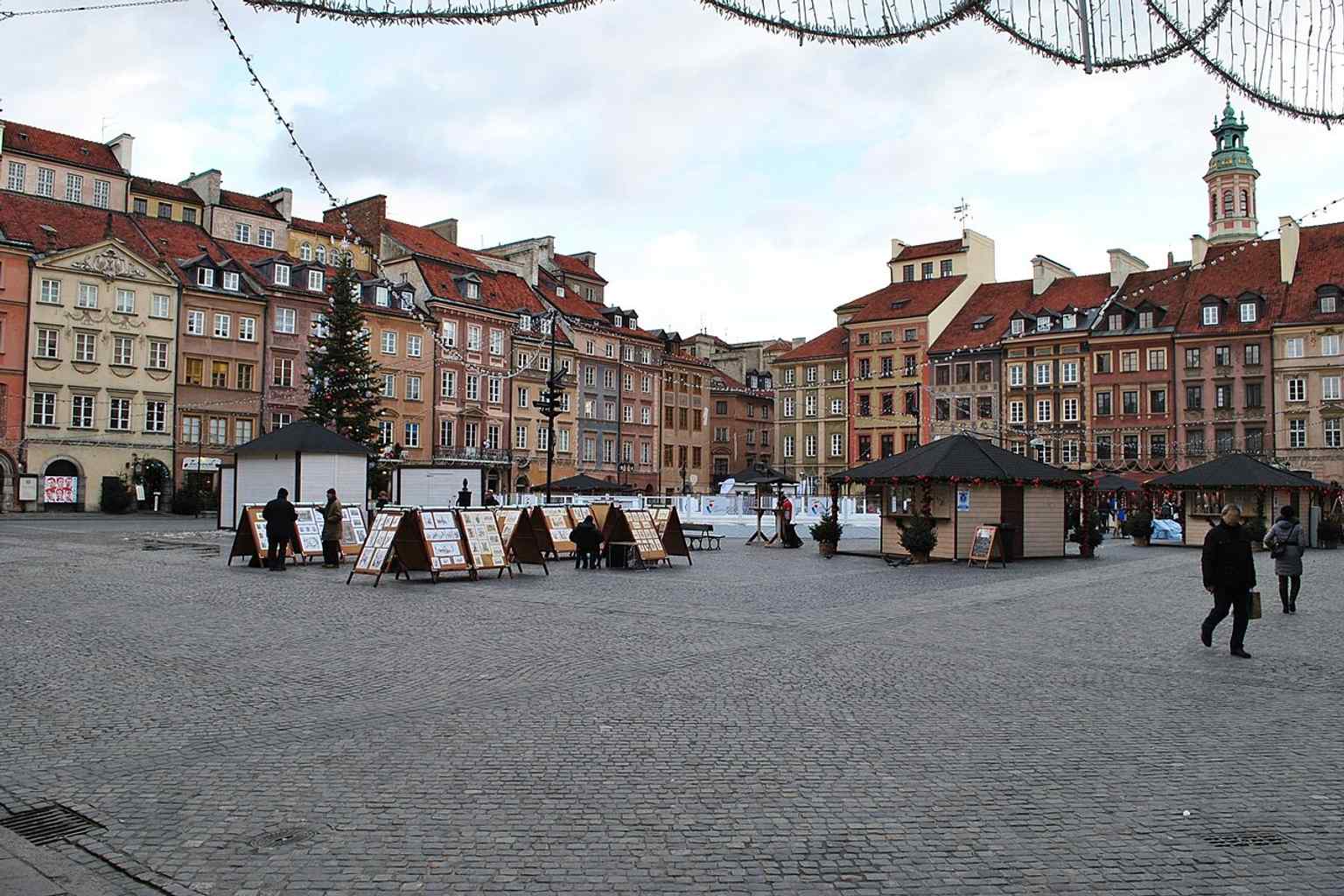
A 2014 view of the Barss side, showing the eastern frontage that forms one of the square’s four named sides.Photo: Marek Mróz, Wikimedia Commons, CC BY 4.0. Cropped & resized. Look for the red-brick, half-round fortification with a broad arched passage through the middle and a row of small circular loophole windows along its upper level. This is the…Read moreShow less
Open dedicated page →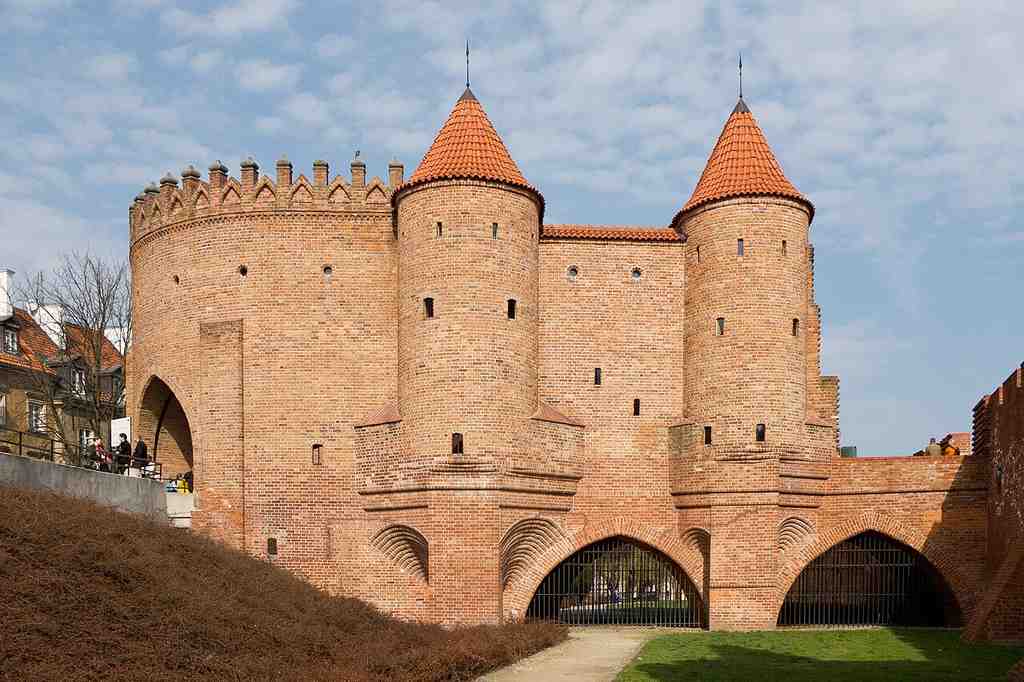
Barbican in WarsawPhoto: Carlos Delgado, Wikimedia Commons, CC BY-SA 3.0 PL. Cropped & resized. Look for the red-brick, half-round fortification with a broad arched passage through the middle and a row of small circular loophole windows along its upper level.
This is the Barbican of Warsaw... a fortified outwork, meaning an extra defensive barrier placed in front of a city gate. It rose around fifteen forty-eight to protect the New Town Gate and strengthen the walls on either side. In plain English: before anyone entered Old Warsaw from this direction, the city wanted one more handshake... with a weapon in it.
Most visitors read this as medieval Poland, but there is a little Italy tucked into the brickwork. Jan Baptysta from Venice designed it - not just a builder, but a Renaissance architect, sculptor, and stonemason. So this was more than a wall. It was Warsaw importing the latest military know-how from Venice, trying on a modern sixteenth-century face at its northern edge.
Its shape tells the story. The building projects out beyond the old moat in a rounded bastion, two levels high. Down below, gunners fired through artillery loopholes. Up above, defenders used a covered gallery - a roofed passage - with round firing openings on both sides. It likely connected to drawbridges in front and inside the approach. If you want the full layout, the aerial view makes the whole defensive puzzle click into place.
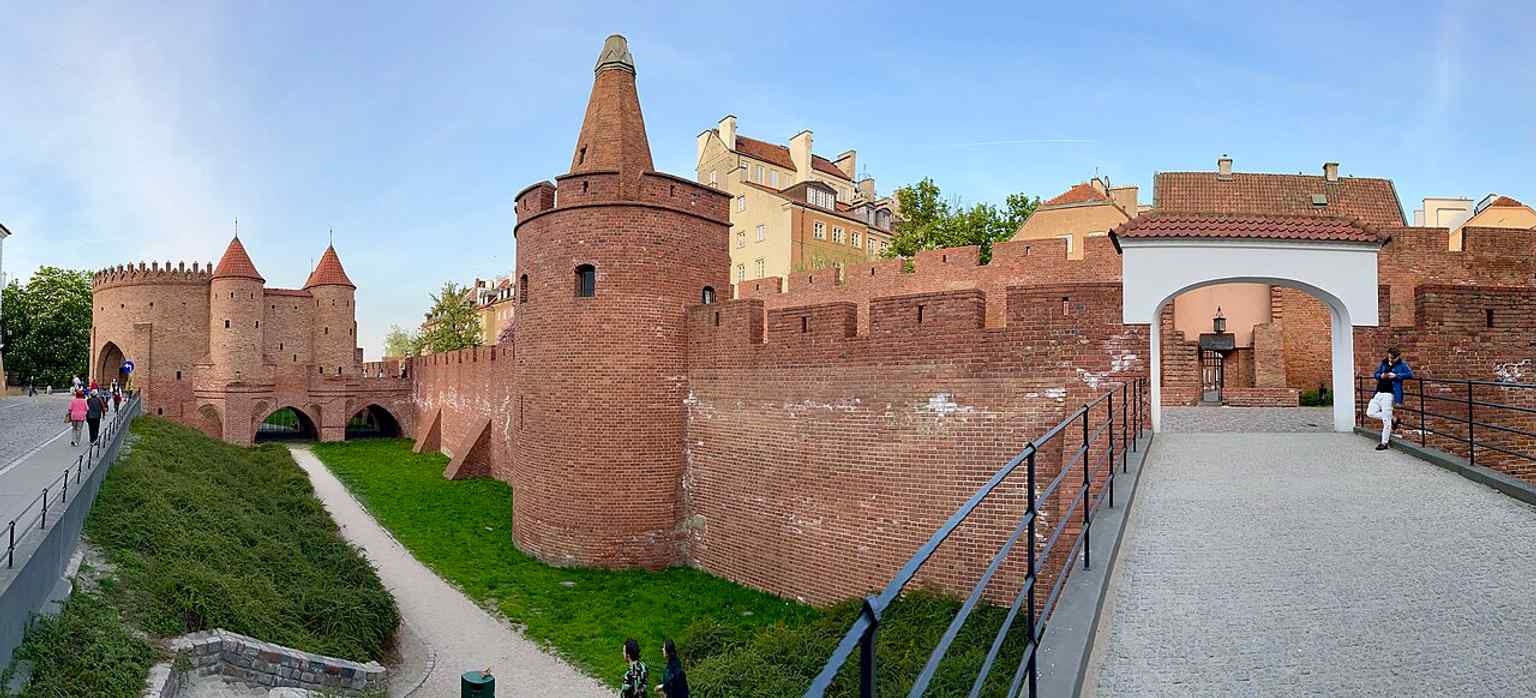
A wide overhead-style look at the Barbican and the surrounding defensive walls, ideal for explaining how it fit into Warsaw’s old fortifications.Photo: Kgbo, Wikimedia Commons, CC BY-SA 4.0. Cropped & resized. And yet here is the twist: even when workers finished it, the Barbican was already a little old-fashioned. Artillery had advanced so quickly that this handsome new defense had missed the train by a station or two. It fought seriously only once, during the Swedish Deluge, when fighting in Warsaw briefly centered on this gate. Local memory blurs the exact day, which feels honest somehow; war rarely leaves tidy labels.
Then came a quieter kind of danger: forgetting. In the eighteenth century people partly dismantled the Barbican. In the nineteenth, they folded it into ordinary townhouses. One building, the Piwnica Gdańska, used the old defensive wall as its back wall. So the monument survived partly because it disappeared into daily life. Not glamorous, but effective - like hiding the family silver in a flour tin.
After the destruction of nineteen thirty-nine and nineteen forty-four, conservator Jan Zachwatowicz helped shape the decision not to leave these remains as noble ruins. Then Wacław Podlewski led the reconstruction from nineteen fifty-two to nineteen fifty-four, using seventeenth-century engravings and even bricks taken from demolished Gothic buildings in Nysa and Wrocław. If you study the wall, locals sometimes notice the older bricks sitting lower and newer ones higher, as if the rebuilding left its own layers of memory in plain sight. If you glance at the before-and-after image on your screen, you can watch this gateway shift from an earlier postcard calm into the busier Old Town around it.
The rebuild was not perfect: part of the inner approach never returned, and the outer portal does not exactly match the old form. But that feels fitting here. This place stands between defense, legend, and restoration. Even the flaws tell the truth.
On the inner wall, there is a sandstone plaque from nineteen fifty-six honoring the soldiers and residents who fought during the Swedish invasion. A wall that once tried to stop enemies now also holds remembrance.
If you want more, the small Museum of Warsaw display inside usually opens only on Wednesdays and Saturdays from one in the afternoon to five. From tomb to theater, palace to market, Warsaw has shown how cities defend themselves not only with walls, but with memory.
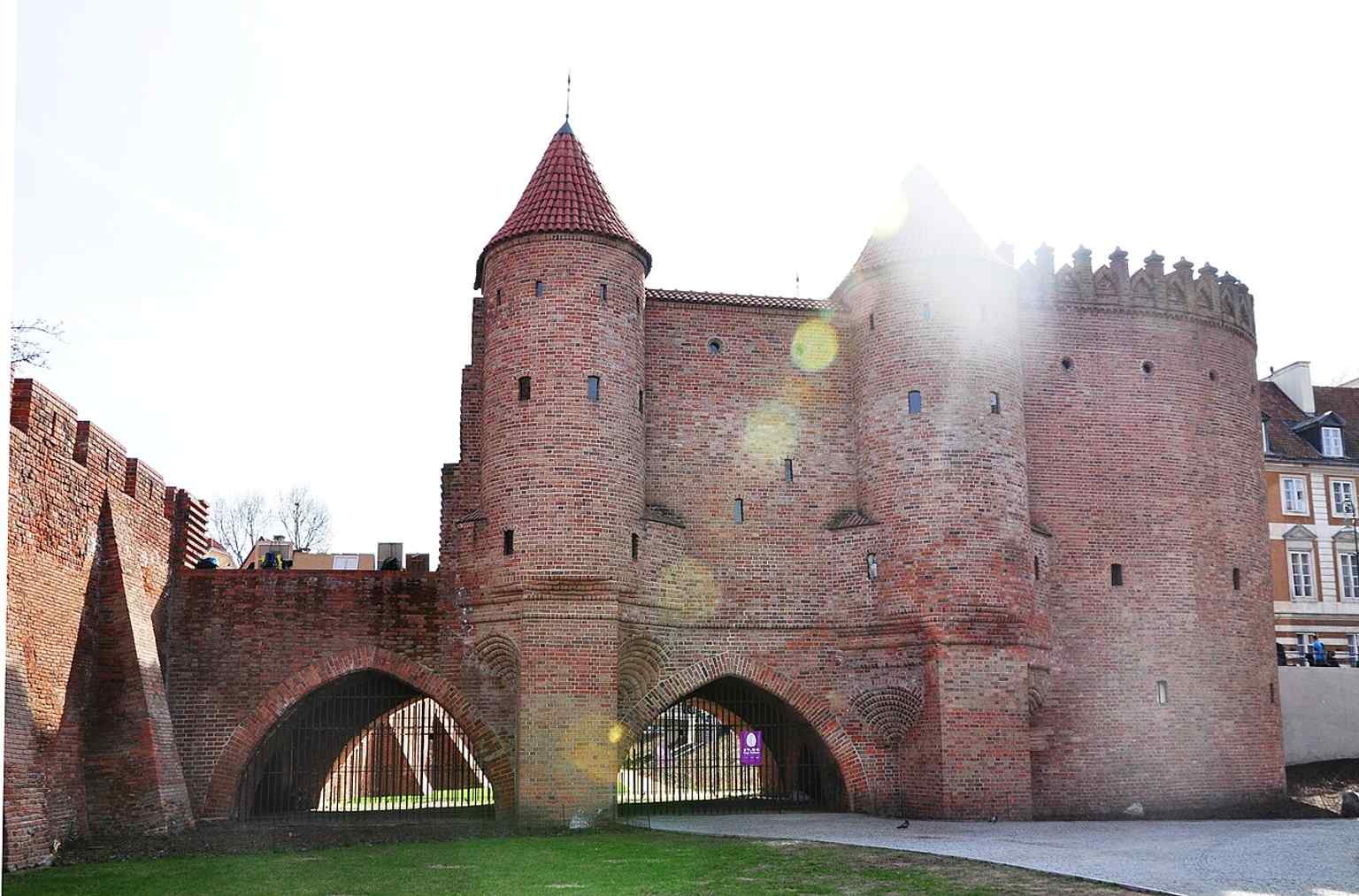
A strong east-side view of the Warsaw Barbican, showing the brick fortification that once guarded the New Town Gate.Photo: Wistula, Wikimedia Commons, CC BY 3.0. Cropped & resized. 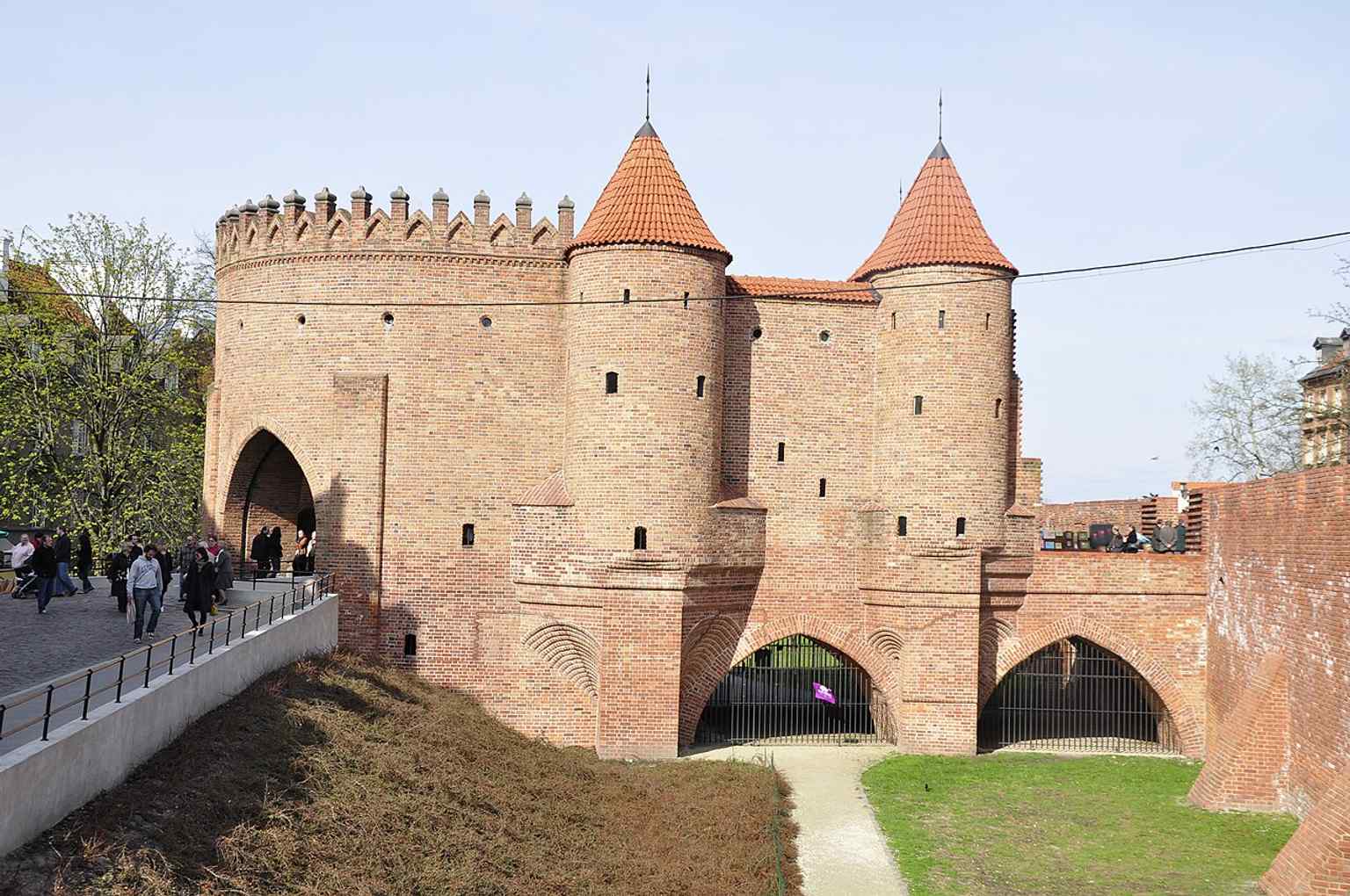
West-side view of the Barbican, useful for showing its rounded bastion shape and the reconstructed outer approach.Photo: Wistula, Wikimedia Commons, CC BY 3.0. Cropped & resized. 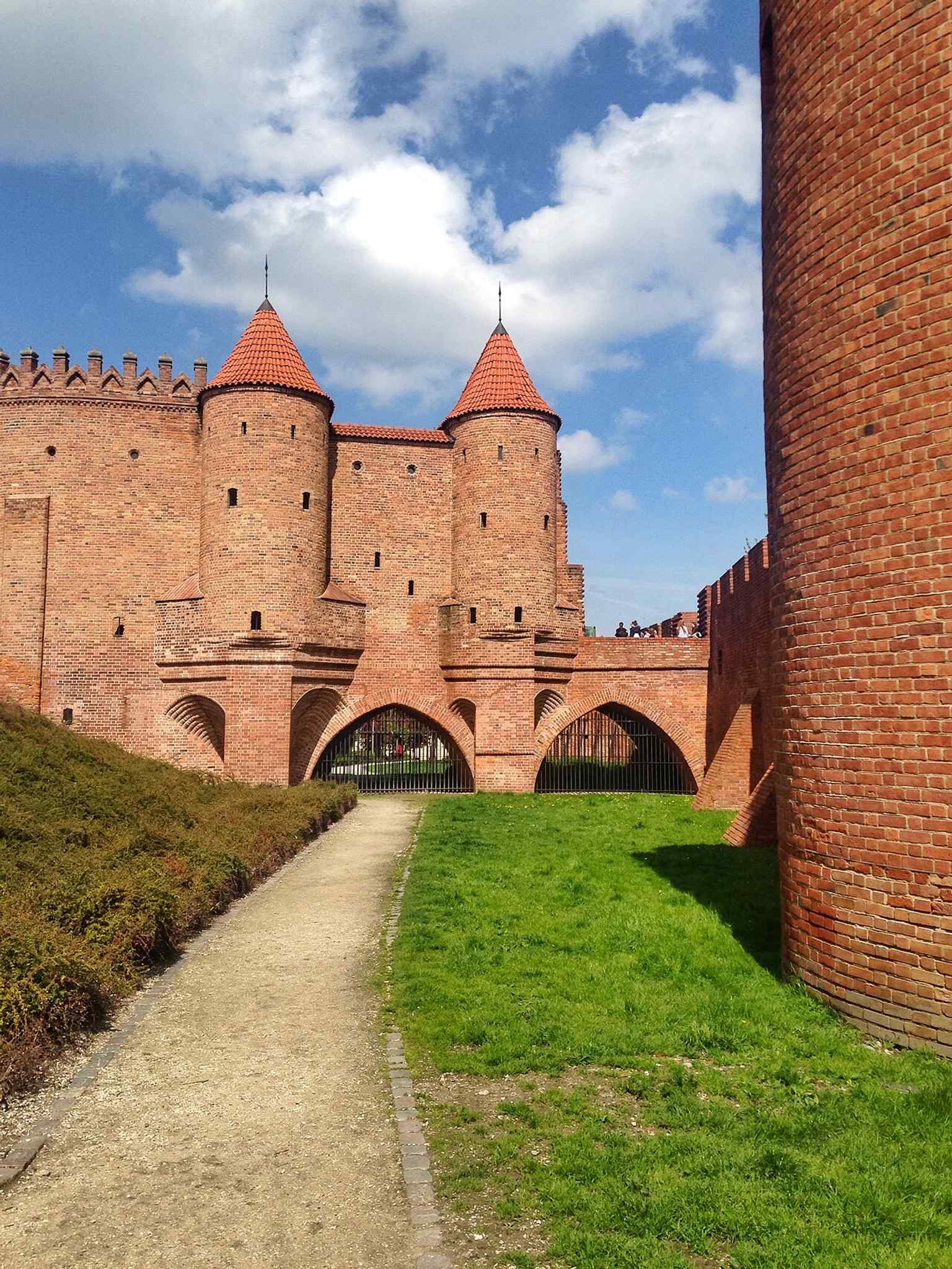
The Barbican seen as a rebuilt historic monument between the Old and New Towns, with the wartime destruction and 1952–1954 reconstruction in mind.Photo: Brian Dooley, Wikimedia Commons, CC0. Cropped & resized. 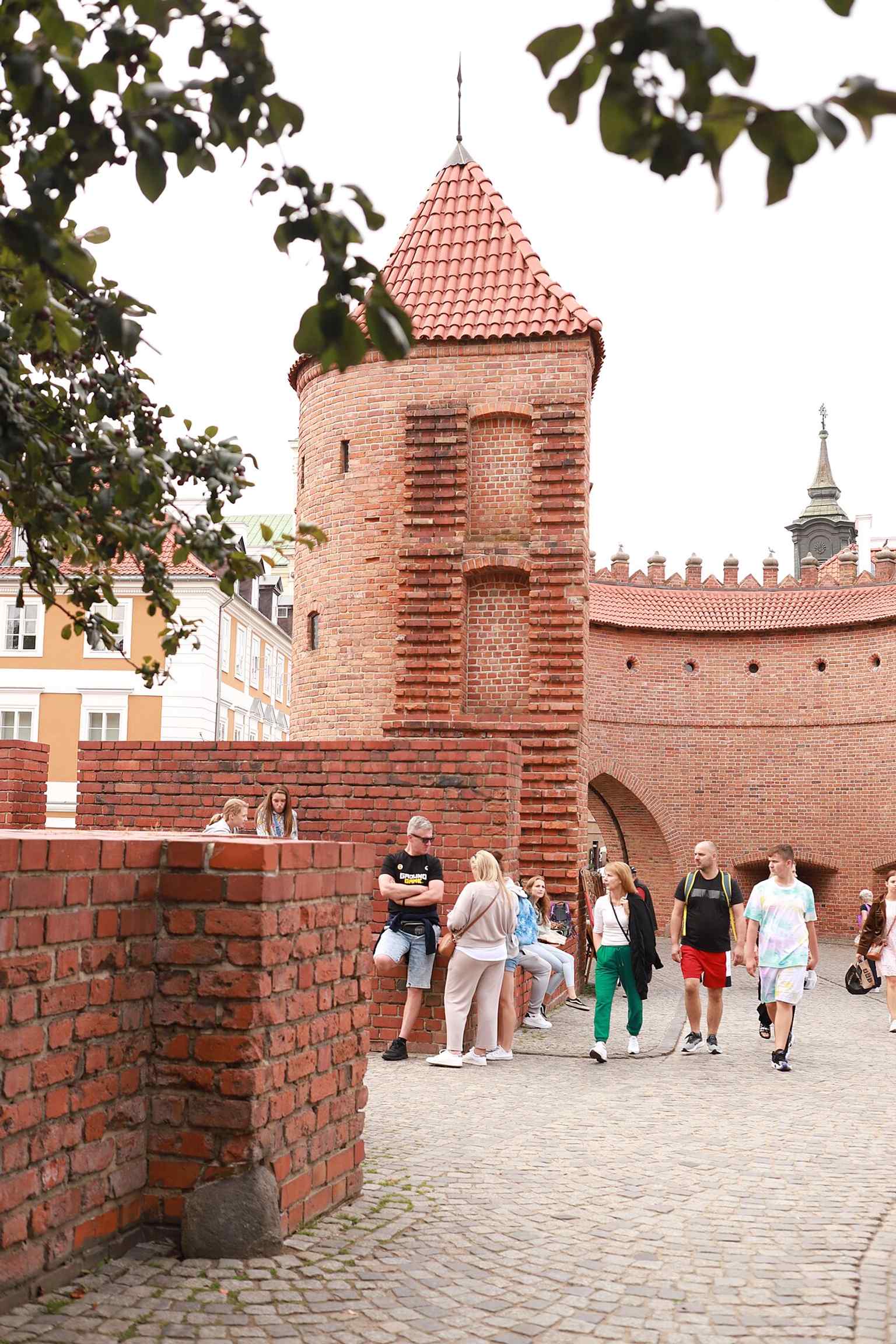
The Barbican beside Międzymurze Jana Zachwatowicza, linking the monument to the postwar conservation story of Warsaw’s walls.Photo: Rakoon, Wikimedia Commons, CC0. Cropped & resized. 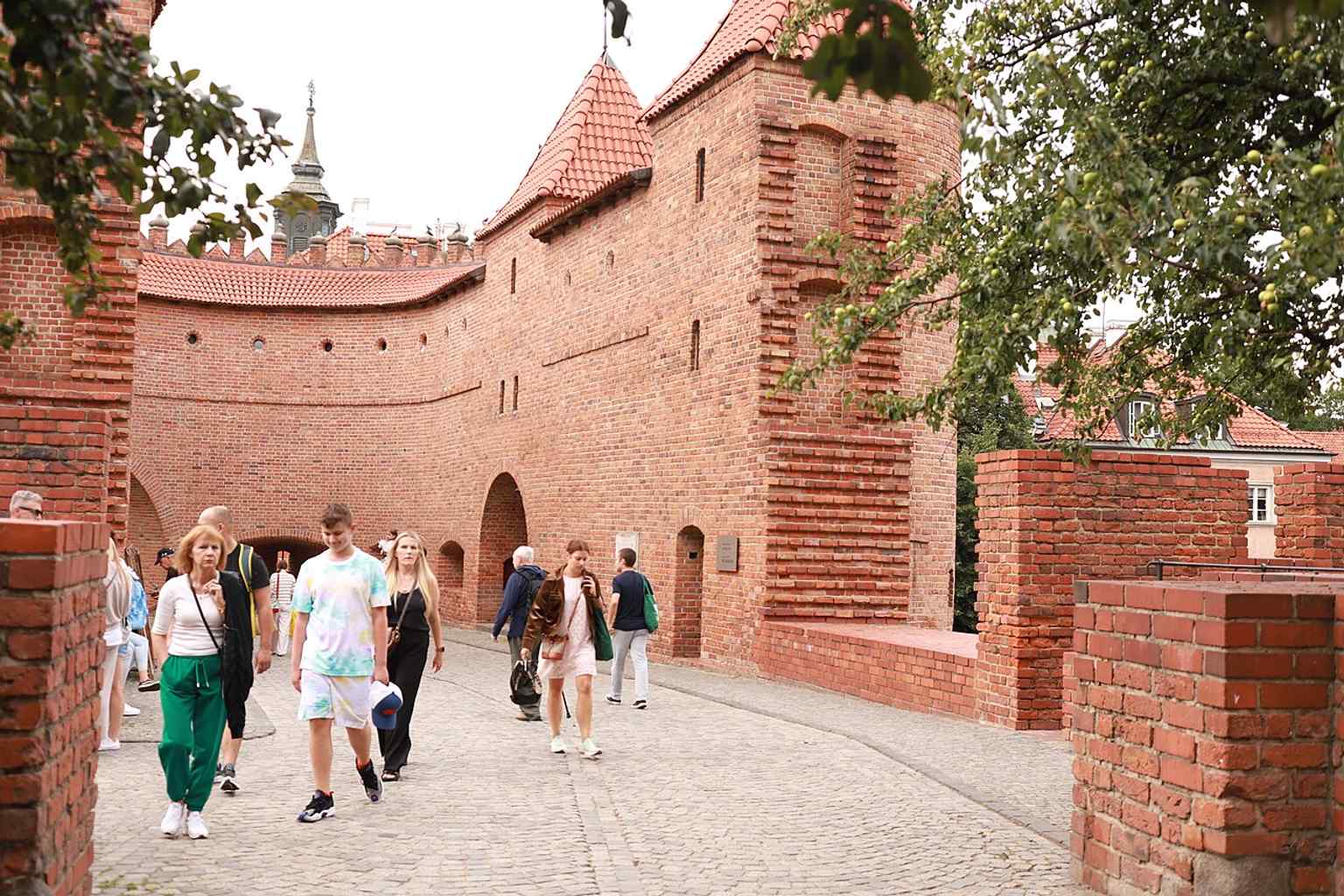
A broad modern view of the Barbican and adjacent walls, showing the rebuilt fortification as part of the Old Town fabric.Photo: Rakoon, Wikimedia Commons, CC0. Cropped & resized. 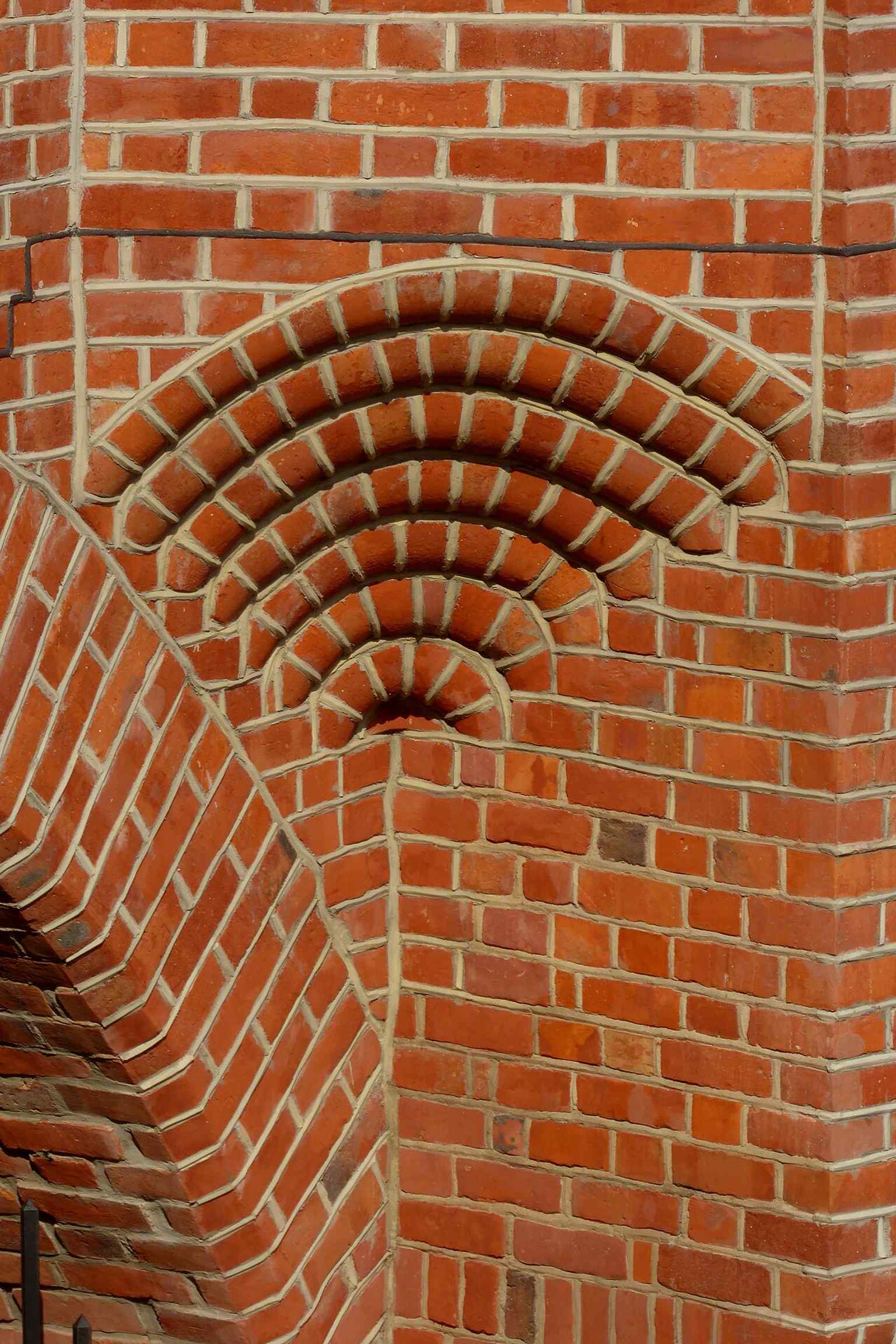
A close architectural detail from the Barbican’s western side, useful for highlighting the brickwork and reconstructed medieval character.Photo: Ethan Doyle White, Wikimedia Commons, CC BY-SA 4.0. Cropped & resized. 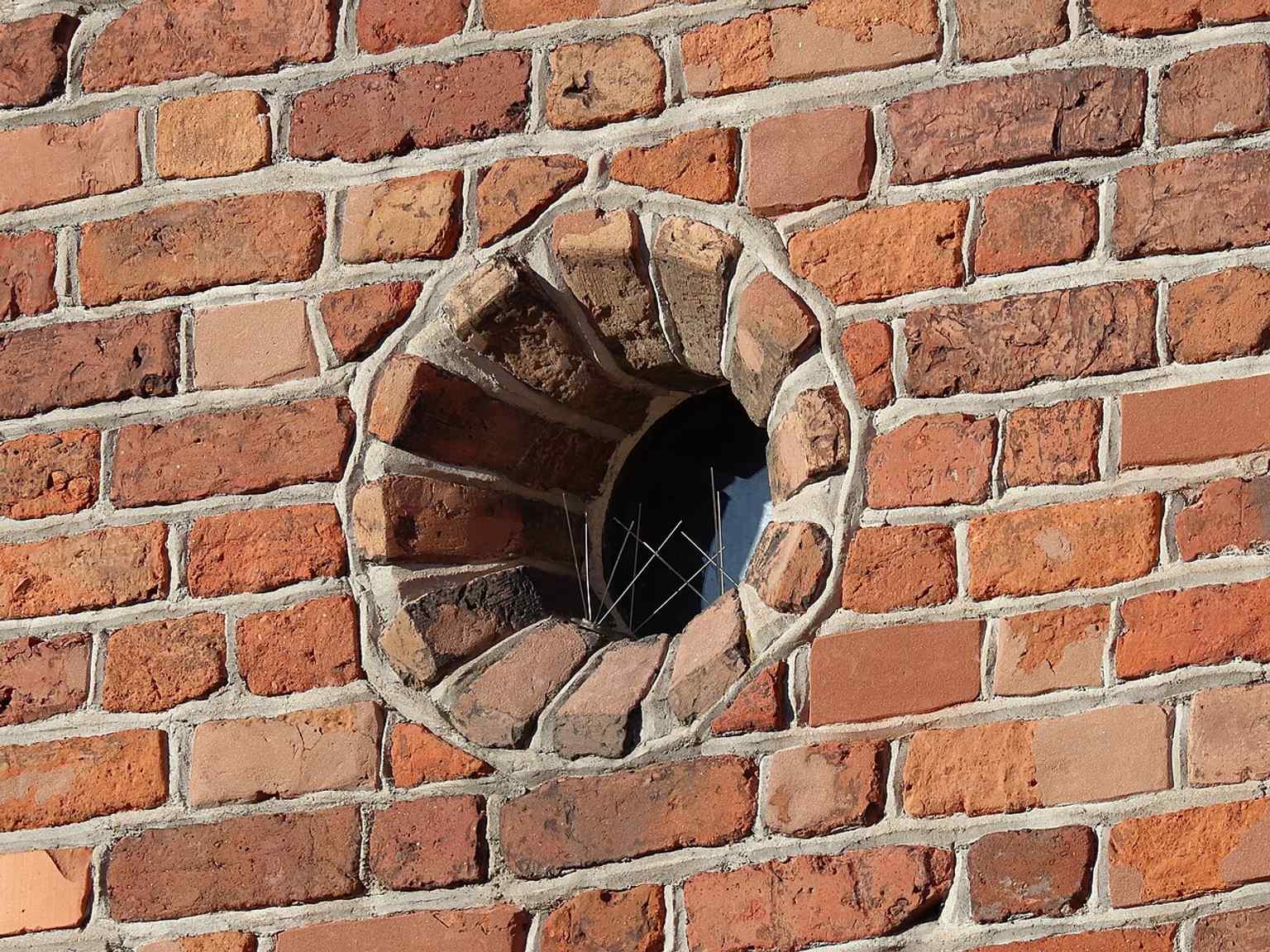
The Barbican’s round loophole window, echoing the defensive openings described in the original fortified structure.Photo: Cybularny, Wikimedia Commons, CC BY 4.0. Cropped & resized. 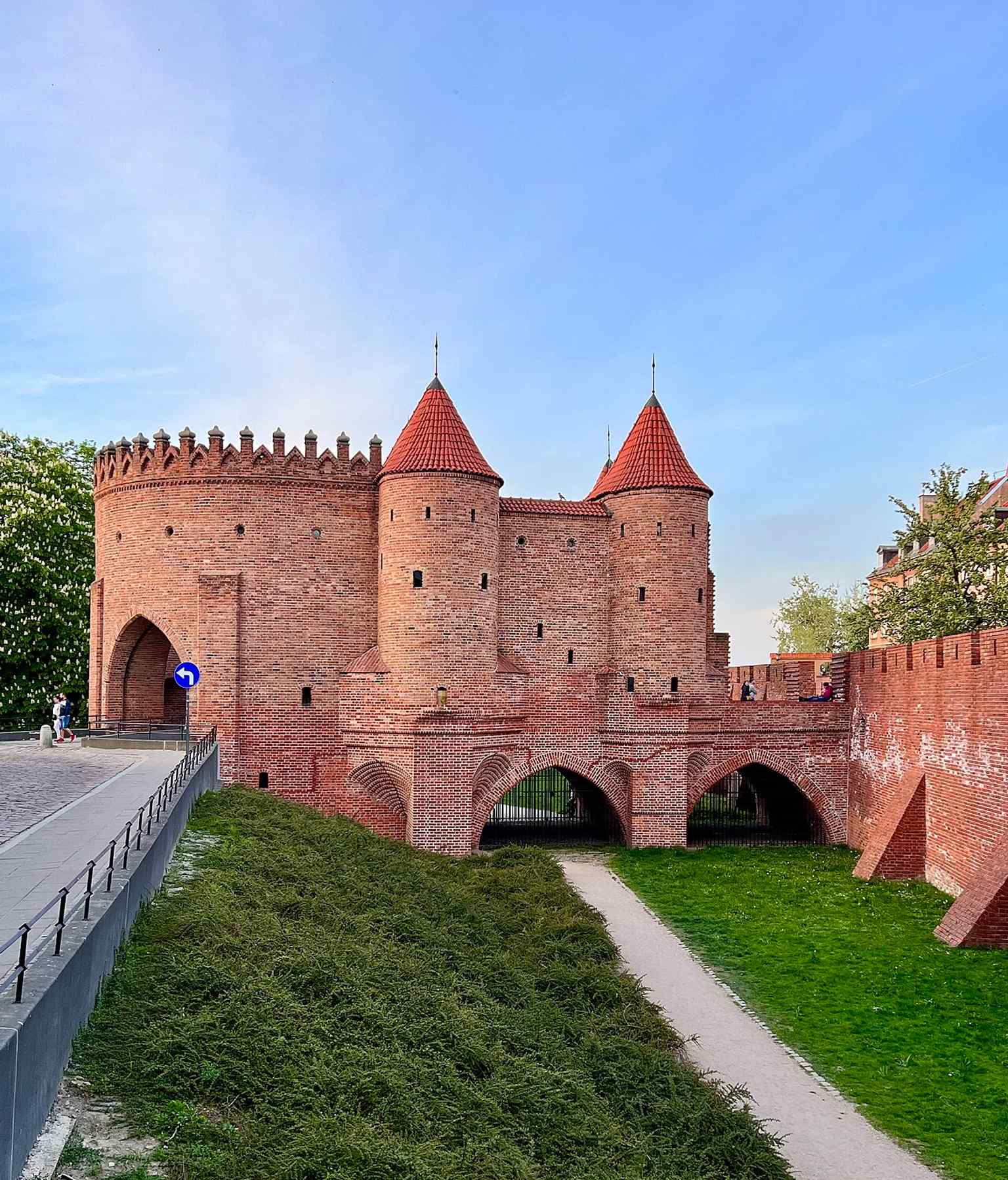
The Barbican and Warsaw Old Town walls together, showing the broader defensive system it was built to protect.Photo: Kgbo, Wikimedia Commons, CC BY-SA 4.0. Cropped & resized. 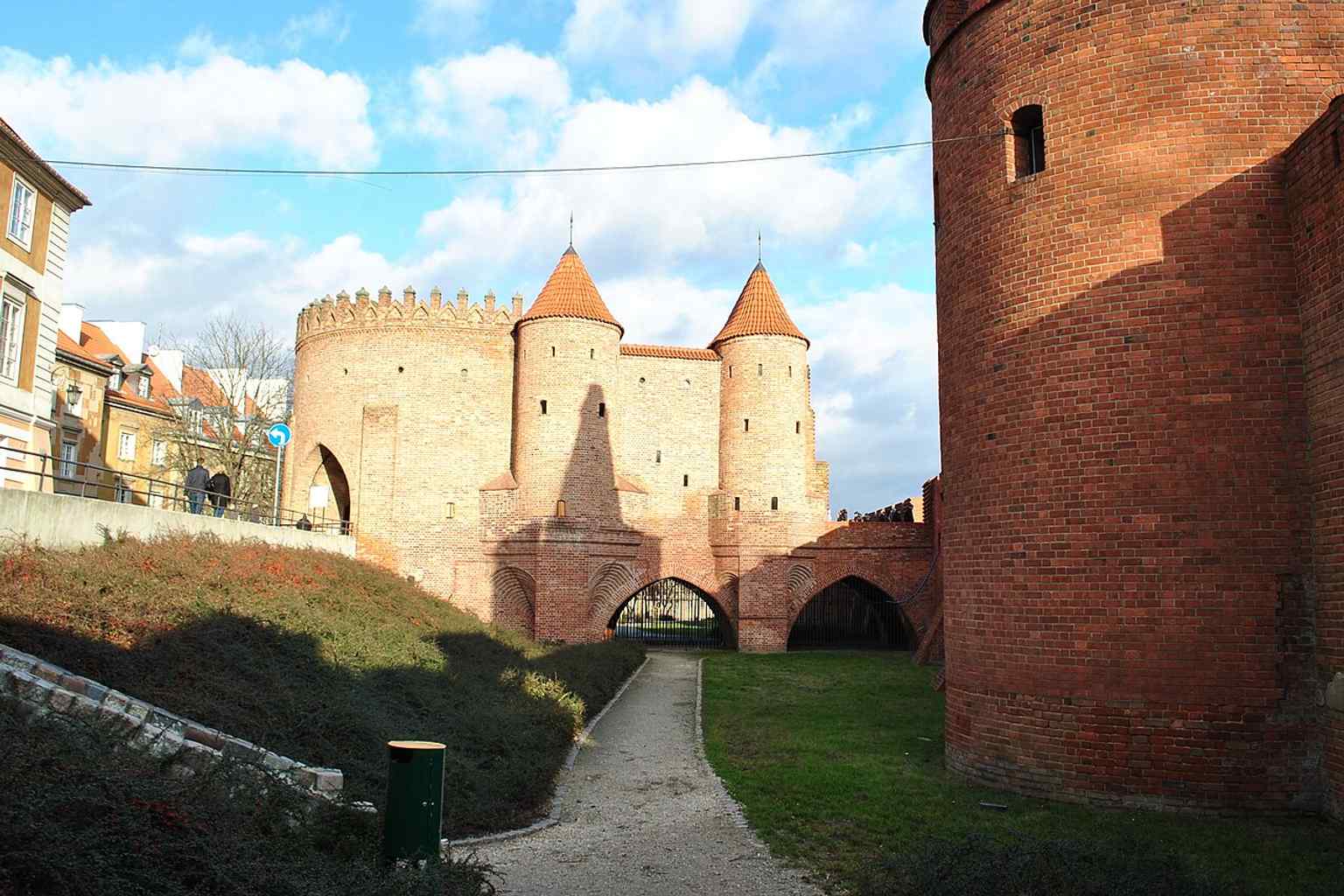
A street-level view from Podwale and Nowomiejska, where the Barbican once linked directly to the city’s gate approach.Photo: Marek Mróz, Wikimedia Commons, CC BY 4.0. Cropped & resized. 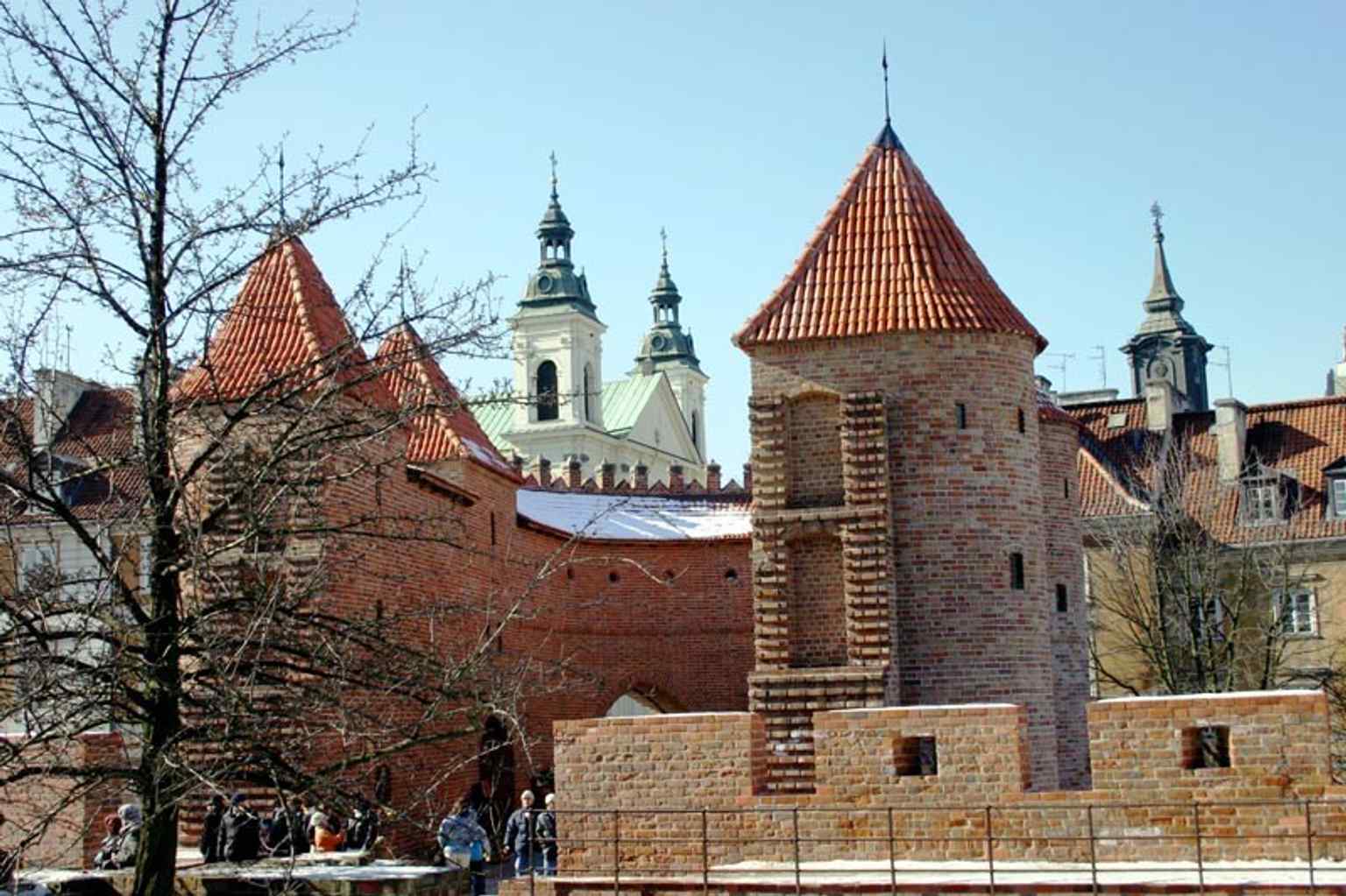
A classic postcard-style view of the Barbican with the Holy Spirit Church nearby, placing the fortification in its historic urban setting.Photo: Marek and Ewa Wojciechowscy, Wikimedia Commons, CC BY-SA 3.0. Cropped & resized.
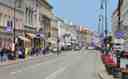
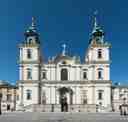
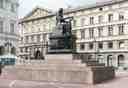
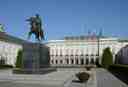
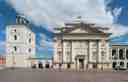
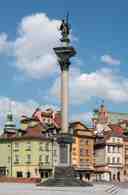
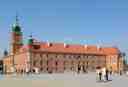
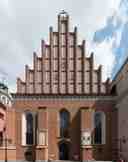
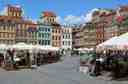
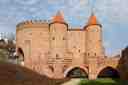
Frequently asked questions
How do I start the tour?
After purchase, download the AudaTours app and enter your redemption code. The tour will be ready to start immediately - just tap play and follow the GPS-guided route.
Do I need internet during the tour?
No! Download the tour before you start and enjoy it fully offline. Only the chat feature requires internet. We recommend downloading on WiFi to save mobile data.
Is this a guided group tour?
No - this is a self-guided audio tour. You explore independently at your own pace, with audio narration playing through your phone. No tour guide, no group, no schedule.
How long does the tour take?
Most tours take 60–90 minutes to complete, but you control the pace entirely. Pause, skip stops, or take breaks whenever you want.
What if I can't finish the tour today?
No problem! Tours have lifetime access. Pause and resume whenever you like - tomorrow, next week, or next year. Your progress is saved.
What languages are available?
All tours are available in 50+ languages. Select your preferred language when redeeming your code. Note: language cannot be changed after tour generation.
Where do I access the tour after purchase?
Download the free AudaTours app from the App Store or Google Play. Enter your redemption code (sent via email) and the tour will appear in your library, ready to download and start.
If you don't enjoy the tour, we'll refund your purchase. Contact us at help@audatours.com
Checkout securely with 












.jpg)


%20p349%20GRAND%20THEATRE%20NATIONAL%2C%20A%20WARSOVIE.jpg)

.jpg)
.jpg)


.jpg)
%2C%20in%20de%20buurt%20van%20de%20oude%20Joodse%20volkswijk%2C%20Bestanddeelnr%20190-0032.jpg)
.jpg)
.jpg)
%20%2C%20Josephinische%20Landesaufnahme.png)


.jpg)

.jpg)
.jpg)


.jpg)


.jpg)


.jpg)


.jpg)


.jpg)


.jpg)

.jpg)


.jpg)

.jpg)


.jpg)
.jpg)
.jpg)
.jpg)
.jpg)
.jpg)
.jpg)

.jpg)


.jpg)


.jpg)
